Why? The Philosopher Philip Goff’s New Cosmic Religion

Paul Austin Murphy

Paul Austin Murphy

Sep 25, 2023 (Medium.com)

The philosopher Philip Goff has just had a book published called Why? The Purpose of the Universe. According to the writer Philip Pullman, this book is “going to explain the purpose of the universe”. More relevantly, some reviewers have made a point of telling us that Goff’s philosophical speculations have nothing to do with religion. This essay argues that they have almost everything to do with religion. What’s more, Goff’s new cosmic religion is designed to express his prior political views and values.

[This essay isn’t going to tackle the technical details of the new speculations about “cosmic purpose” and suchlike. See the linked essays at the end of this piece for more detailed discussions on these subjects.]

(i) Introduction
(ii) The Politics of Philip Goff’s Cosmic Religion
(iii) Philip Goff’s Non-Traditional Religion
(iv) Philip Goff and the Physicist Paul Davies
(v) Davies and Goff and Their Non-Traditional Religion

In a review of Why? The Purpose of the Universe, the writer Philip Pullman claims that Philip Goff believes that his book is “going to explain the purpose of the universe”. It can be presumed that Goff himself would deny that his new book is so highfalutin. Perhaps, instead, Goff would say that it simply describes and analyses the various options on offer when it comes to explaining the purpose of the universe

But who knows?

In any case, Pullman finds Goff’s “cosmic chutzpah” appealing. Indeed, it “predisposed [him] in its favour before [he] even began to read the text”!

In a similar vein, rather than the Universe itself having a purpose, the professor of philosophy Josh Rasmussen actually states that Goff’s own book

“contributes to the purpose of the universe in a profound and beautiful way”.

Let’s return to Philip Pullman.

It’s worth noting here that Pullman also buys into the political and ethical underpinnings of Goff’s new speculative philosophies. Or, at the least, Pullman tells us that Goff’s new book will help us

“regain that sense of connectedness that’s so important not just to our well-being, but to our very survival”.

To add more academic backing to Goff’s speculations. The British philosopher Michael Tye believes that Goff’s book will (or simply may?) offer an answer to those of us who’ve “ever wondered what the point is in living”.

Philip Goff

… So it is these religious, political and ethical underpinnings of Goff’s philosophies (explicitly referred to by Michael Tye, Philip Pullman and Josh Rasmussen) which will be discussed in this essay. [See note 1 on Goff’s many academic fans.]

Finally, what also needs to be noted in this introduction is that Goff extensively refers to both science and philosophy in his new book.

Yet he’s doing nothing new here.

In fact, many of the followers of traditional religions did exactly the same thing, and they did so for many centuries before Goff was even born.

This means that Goff is simply making his own contribution to this long religious tradition.

The Politics of Philip Goff’s Cosmic Religion

Philip Goff and Rudy Rucker. Rucker, just like Goff, ties panpsychism very strongly to both politics and ethics. Indeed, both Rucker and Goff tie panpsychism to roughly the same political beliefs, values and causes. However, Rucker’s philosophy lacks the philosophical sophistication found in some of Goff’s work. That said, Rucker isn’t a philosopher. He’s a novelist and self-described “cyber punk”.

At least in one introduction, Goff seems to simply assume that there is such a thing as a “cosmic purpose without God”, and only then does he “explore a variety of hypothesis” to explain it.

Which “variety of hypothesis” is that? This variety:

“[A] non-standard designer (e.g., a bad designer, a limited designer, or maybe just an ordinary person in the next universe up), teleological laws (laws of nature with purposes built into them), or cosmopsychism (the view that the universe itself is conscious).”

When it comes to Goff’s belief (or his entire belief system) in a “cosmic purpose”, he believes that it must “involv[e] political engagement”.

Indeed, Goff often admits that there are political and ethical motivations and beliefs hiding (or sometimes not actually hiding) underneath the philosophical positions which he does take.

For example, Goff states that

“living in hope of cosmic purpose is a deeply meaningful way of engaging with the world”.

In other words, Goff is stating (if perhaps implicitly) that believing in a cosmic purpose helps us (both politically and ethically) engage with the world. More specifically, Goff argues that a belief in a cosmic purpose helps us (as individuals and as societies) develop a superior political and moral attitude to the world.

Interestingly, the Belgium philosopher Helen De Cruz also believes that seemingly non-ethical philosophical theories should “provide an ethical guide”. Cruz then says that Goff’s book

“outlines an attractive picture of spiritual belonging and practice in a godless world []”.

So is Goff doing what so many poststructuralists, postmodern philosophers and Marxists have done when they placed Politics in the role of First Philosophy? (Such philosophers haven’t — as far as I know — put their own position in this simple way.)

Alternatively, is Goff doing what the French philosopher Emmanuel Levinas did when he placed Ethics in the role of First Philosophy? (Levinas actually put it this way himself. See here.)

Perhaps, instead, both Politics and Ethics together take on the role of First Philosophy in Goff’s philosophy.

Now it’s worth saying here that the very idea of keeping science and philosophy free of politics has been deemed to be naïve and unsophisticated by various Marxists, postmodern philosophers and poststructuralists. (A small number of Marxists don’t take the position that “all science and philosophy is inherently political”.) Consequently, in this Hobbesian world, all scientists — just like all academics — are always involved in a political (to use Antonio Gramsci‘s terms) “war of position”, as well as a battle for “hegemony”. [See note 2.]

Perhaps Philip Goff believes at least some of this too.

In any case, Goff himself has a fairly long history of admitting (if sometimes in roundabout ways) that politics and ethics are in the driving seat when it comes to at least some — perhaps many — of his philosophies.

Like the scientists and activists of Science for the People who believed that science should serve “radical politics”, or the countless academics who believe that their work should serve very particular political causes and goals, Goff believes that the philosophies he advances should also serve very particular political causes and goals.

This way of looking at science and philosophy has been taken to extreme levels.

For example, the Nazis in the 1930s and the Soviets from the 1920s to the 1950s explicitly and directly tied both science and philosophy to advancing, respectively, Nazi and communist goals and ideas. (Lysenkoism and racial science are just two obvious examples of this.) [See note 3.)

In terms of actual examples of the political and ethical underpinnings of Goff’s philosophies.

We have Goff’s “spiritual” and political takes on panpsychism itself, on the nature of plants, and now we have his political, ethical and religious take on cosmic purpose.

As an example of this, take Goff’s words in his book Galileo’s Error:

“For a child raised in a panpsychist worldview, hugging a conscious tree could be a natural and normal as stroking a cat.”

In the same book, Goff also wrote:

“My hope is that panpsychism can help humans once again to feel that they have a place in the universe. At home in the cosmos, we might begin to dream about — and perhaps make real — a better world.”

And one more passage:

“[I]t’s reasonable to suppose that children raised in a panpsychist culture would have a much closer relationship with nature and invest a great deal more value in its continued existence.”

As for plants, Goff wrote:

“[W]e now know that plants communicate, learn and remember. I can see no reason other than anthropic prejudice not to ascribe to them a conscious life of their own.”

And now for egalitarian plants:

“The mycorrhiza structures [between tree roots and fungi] allow for a complex system of egalitarian redistribution.”

So does all this mean that Goff’s politics and ethics are wagging the philosophical dog here?

Philip Goff’s Non-Traditional Religion

It can be strongly doubted that what Philip Goff offers us is a “religion without belief”. However, it certainly is a religion.

Some reviewers of Philip Goff’s new book make a point of saying that his philosophical speculations have nothing to do with religion. Or, at the very least, they make the point that Goff’s speculations have nothing to do with traditional religion.

For example, Geraint Lewis (Professor of Astrophysics at the University of Sydney) writes:

“In this new book, Goff explores purpose in the cosmos, not a purpose rooted in religion, but in a conscious fabric of the universe itself.”

This claim (i.e., Goff’s philosophical positions are not “rooted in religion”) will be rejected in this essay. Indeed, it seems obviously false.

It can easily be argued that Goff’s new philosophy is rooted in religion. What’s more, it can be argued that it’s even rooted in (as well as being a reaction to) traditional religion. However, to some readers it may seem otherwise (or it’s made to seem otherwise) simply because Goff is attempting to create a non-traditional religion — a new religion which he also believes is backed up by both science and philosophy.

None of that means that Goff has actually broken free of religion.

Far from it.

After all, a non-traditional religion (even one that refers to science and philosophy) is still a religion.

This is also a non-traditional religion which is perfectly in tune with Goff’s prior politics and ethics. That is, Goff’s new philosophical explorations reach political and ethical conclusions which just happen to perfectly square with what Goff believed well before such explorations. (Goff has provided enough biographical information — over the years — to substantiate this claim.)

Yet the notion of a cosmic purpose may seem like a strange thing to tie directly to politics. However, that’s exactly what Goff does.

Philip Goff and the Physicist Paul Davies

When I read Philip Goff’s own account of his new book, it, at times, seemed as if he was directly quoting the physicist and popular-science writer Paul Davies.

However, it’s not clear how extensively Goff has relied on the books of Davies, or even if he has done so at all. That said, it’s still the case that, at least at times, their mutual philosophical positions are almost identical. (One difference being that Davies’s positions — at least the relevant ones — date back to the 1980s. [See Davies’s God and the New Physics, published in 1983.])

Other commentators have noted these strong similarities too.

For example, Dr. Brandon Rickabaugh wrote the following:

“Goff is not the first to entertain this view. Paul Davies, for example, entertains the hypothesis that ‘the universe has engineered its own self-awareness through quantum backward causation or some other physical mechanism yet to be discovered.’ ‘In this way,’ says Davies, ‘the universe could both create itself and steer itself toward its destiny.’ Goff is, however, the first to develop a detailed defense of such a view.”

Well, Davies is a physicist. This means that he uses a different set of technical terms and modes of expression than those which Goff uses. This may also mean that Goff’s work on these issues isn’t really more (as Rickabaugh puts it) “detailed” than Davies’s own. Indeed, there isn’t really that much — technical — detail in Goff’s books. (There is technical detail in Goff’s academic papers.)

So to get back on track.

If Philip Goff isn’t clear (or perhaps honest) about his religious (as well as political) motivations, then Paul Davies certainly is. Or, at the very least, Davies has, at times, been upfront about all this.

For example, Davies once expressed his own position by using the American theoretical physicist John Archibald Wheeler as a proxy.

Firstly, Davies claims that Wheeler was

“not conventionally religious, but inspired by a reverence for nature and a deep sense that human beings are part of a grand scheme which we glimpse only incompletely”.

So surely it’s not unfair to say that Davies is also talking about himself here.

In any case, Davies finishes off with these words:

“So maybe that is a religious conviction of sorts.”

Elsewhere, Davies also talked in terms of his own “cosmic religious feeling”.

Davies and Goff and Their Non-Traditional Religion

Many people class themselves as “spiritual but not religious”. That’s partly because, like Philip Goff, they have political and ethical problems with traditional religions. There are, of course, other reasons for embracing new (as it were) spiritual religions. Another important reason is that such religions don’t make any demands on the believer. There’s also a strong whiff of narcissism when it comes to many spiritual-but-not-religious people.

Philip Goff is at pains to say that his philosophies aren’t religious. Similarly, Paul Davies is at pains to say that his religion isn’t “conventional”.

Goff states his non-traditional views in the following:

“I don’t believe in the Omni-God (the all-knowing, all-powerful, and perfectly good, creator that Christians, Muslims and Jews believe in) because I don’t think a perfectly good being who could do anything would create a universe with so much suffering.”

Like many people since since the 1960s (and a small amount of people before that), Goff and others may believe that it’s just not acceptable anymore to believe in (as Paul Davies puts it) “conventional religion”. After all, in many people’s eyes — including in Goff’s eyes — traditional religion has a bad history. Indeed, to some people, traditional religion has an evil history.

More relevantly, Goff is completely in tune with Davies when it comes to believing in “a universe with a purpose”. Of course, that purpose isn’t (to use Goff’s words) “driven by an Omni-God”. It’s driven by… well, other things.

Paul Davies put his own teleological position in the following way:

“[T]he bio-friendliness of the universe arises from an overarching law or principle that constrains the universe/multiverse to evolve towards life and mind. It has the advantage of ‘taking life seriously’, treating it neither as a completely unexplained bonus [] nor as a mere passive selector [].”

He then continued:

“In short, it builds purpose into the workings of the cosmos at a fundamental (rather than an incidental) level, without positing an unexplained pre-existing purposive agent to inject purpose miraculously.”

[The technical details of this cosmic teleology aren’t going to be discussed in this essay. See links at the end of this essay.]

Goff sees traditional religion as being politically and ethically incorrect. In parallel, Goff’s new cosmic religion is deemed (by Goff himself) to be politically and ethically correct.

Goff expresses his position in the following way:

“Ultimately, I outline a way of living in hope that cosmic purpose is unfolding, involving political engagement and a non-literalist interpretation of traditional religion.”

The upshot here is that if one interprets traditional religion literally, then that will result in politically and ethically incorrect conclusions and beliefs. However, if one interprets traditional religion non-literally, then such interpretations — and traditional religion itself — can be shaped and fashioned into something that’s both politically and ethically correct.

Another way of putting this is to say that Goff’s new cosmic religion perfectly reflects what he takes to be the progressive (see here) values, causes, and beliefs of 2023.

Thus, this is the purest form of religious presentism one can imagine (i.e., in terms of Goff’s judgments about traditional religion).

Goff then gives more details about his non-traditional religion. (Except, of course, he’d argue that it isn’t any kind of religion at all.) He writes:

“Western thought has been dominated by the dichotomy of traditional religion and secular atheism. In Why? The Purpose of the Universe (Oxford University Press), I argue that it’s time to move on from both God and atheism.”

So is it time to “move on” to a non-traditional religion?

Is it time to move on to a religion which also abides by Goff’s own politics and ethics?

It certainly seems that way.

Again elsewhere, Goff distinguishes himself from traditional “religious thinkers” and their “traditional God”. He writes:

“In contrast to religious thinkers, I argue that the traditional God is a bad explanation of cosmic purpose. Instead, I explore a range of alternative possibilities for accounting for cosmic purpose, from the speculation that we live in a computer simulation to the hypothesis that the universe is itself a conscious mind.”

Goff is actually a religious thinker.

Sure, he also sees himself as a critic of traditional religion, and also as a critic of traditional religious thinkers.

So it can be said that Goff’s cosmic religion is very up-to-date. Yes, it’s fashionable and very 2023.

However, Goff believes that his non-traditional cosmic religion still needs the back up of both science and philosophy.

Thus, in the following passage Goff sells his own scientific credentials to his readers:

“Through an exploration of contemporary cosmology and cutting-edge philosophical research on the nature of consciousness, I argue for cosmic purpose: the idea that the universe is directed towards certain goals, such as the emergence of intelligent life.”

Well, at the least, Goff is informing people that he reads scientific literature.

Yet it must immediately be said here that traditional religion also needed the backup (or help) of both science and philosophy!

Or, at the very least, many theologians, philosophers and scientists in the past — and over many centuries — also believed that their own religions needed both scientific and philosophical backup (or help).

Thus, Philip Goff is doing nothing new when he extensively refers to both science and philosophy — while also advocating his new cosmic religion.

Finally, since politics, ethics and religion are in the driving seat here, we can expect no limit to Philip Goff’s future philosophical speculations.

Notes

(1) The abundance of positive reviews of Philip Goff’s new book (as featured in this essay) is partly — or even largely — down to a system of career networking that many academics — especially Goff himself — indulge in on Twitter/X, social media generally, and within the book-selling and seminar circuits. Indeed, I’ve personally seen it occur — many times — in practice. Another way to put that is to say that Goff — just like many other academics — has gone out of his way make many academic and career-related friends on social media, etc.

(2) Antonio Gramsci’s vision is a variation on Thomas Hobbes’s “the war of all against all” (i.e., Gramsci’s “war of position”). However, instead of individuals warring against individuals, we have social groups, political groups or identities warring against other social groups, political groups or identities.

(3) There’s a vast literature on this subject. See Science and technology in Nazi Germany’, and ‘The Soviet Academy of Sciences and the Communist Party’.

Links: ‘Panpsychist Philip Goff’s Combination Problem: Little Conscious Subjects and Emergence’‘Intrinsic Nature: Philosopher Philip Goff on What Physics Leaves Out’, and ‘Professor Philip Goff’s (Panpsychist) Philosophy of Trees’.

On Paul Davies: ‘Physicist Paul Davies’s Deep — or Specious! — Questions About Life, the Universe and Everything’‘Isaac Newton’s Religious Physics?’, and ‘Physicist Paul Davies’s Contributions to the Advancement of Religion, As Seen By Father Mariano Artigas’.
Paul Austin Murphy

Written by Paul Austin Murphy

MY PHILOSOPHY: https://paulaustinmurphypam.blogspot.com/ My Flickr Account: https://www.flickr.com/photos/193304911@N06/

Disclosure: Where We Really Come From! NEW Evidence From ETs, Atlantis & Pyramids with Gregg Braden

“Beauty is the fifth power.”

Navajo saying

Michael Sandler’s Inspire Nation Premiered Jul 27, 2023 Inspire Nation Show with Michael SandlerIt’s rare an interview comes along that completely shatters our perception of reality, why we’re here, and where we came from. But with Gregg Braden, you’ll learn the real truth about pyramids, Atlantis and Antarctica, ET interventions, the true story behind our DNA, the climate and what’s REALLY happening to the Earth, the hidden cycles of civilization and whether we’ll make it through…And even what the powers that be, want to do to remove our humanity as they insert artificial parts and chips in our bodies and through AI. Gregg Braden is a five-time New York Times best-selling author, scientist, international educator and renowned as a pioneer in the emerging paradigm based in science, social policy and human potential. The Wisdom Codes: https://greggbraden.com/product/wisdo… Find more from Gregg Braden: https://greggbraden.com/

Illumination

Illumination


When Buddha was on his death bed he noticed his young disciple Anan was weeping.  

“Why are you weeping, Anan?” he asked.

“Because the light of the world is about to be extinguished and we will be in darkness,” Anan replied.

The Buddha summoned up all his remaining energy and spoke what were to be his final words on earth:  

“Anan, Anan, be a light unto yourself.”

Buddhist Story 

AN OPPORTUNITY FOR DAILY REFLECTION BROUGHT TO YOU BY THE SCHOOL OF PRACTICAL PHILOSOPHY

This country runs on 98 percent renewable energy

Ramón Méndez Galain |

TED Countdown Summit

• July 2023

Fifteen years ago, Uruguay was experiencing an energy crisis brought on by its reliance on fossil fuels; today, the nation produces 98 percent of its electricity from renewable sources (and even exports extra energy to neighboring countries). How did they turn things around so quickly? Uruguay’s former secretary of energy, Ramón Méndez Galain, explains how they pulled off this unprecedented shift — and shares how any other country can do the same.

About the speaker

Ramón Méndez Galain

Just energy transition leaderSee speaker profile

Green energy visionary Ramón Méndez Galain is showing that powering an entire nation on clean energy is more than just a pipe dream.

The Influence of Greek Culture in Our Lives with Elaine Dundon

New Thinking Aug 27, 2015 Elaine Dundon, MBA, is co-author, with her husband Alex Pattakos, PhD, of The OPA! Way: Finding Joy & Meaning in Everyday Life & Work. She is also author of the international, best-selling book, The Seeds of Innovation. With her husband, she is also co-founder of The Global Meaning Institute. She is a former faculty member at the University of Toronto. Here she points out that a third of the words we use in English have Greek roots. Ancient Greece gave birth to philosophy and to the important notion that our fate is determined by how we develop our character. The very word, philosophy, means “the love of wisdom.” She describes how, in her travels through the villages of Greece, she and her husband discovered many wisdom teachings alive in the lives of the people. She also points out how the Greek people have survived through many invasions and other crises throughout the millennia. As a result of this history they have learned how to find meaning in life under a wide range of circumstances. New Thinking Allowed host, Jeffrey Mishlove, PhD, is author of The Roots of Consciousness, Psi Development Systems, and The PK Man. Between 1986 and 2002 he hosted and co-produced the original Thinking Allowed public television series. He is the recipient of the only doctoral diploma in “parapsychology” ever awarded by an accredited university (University of California, Berkeley, 1980). His master’s degree is in criminology. He serves as dean of transformational psychology at the University of Philosophical Research. He teaches parapsychology for ministers in training with the Centers for Spiritual Living through the Holmes Institute. He has served as vice-president of the Association for Humanistic Psychology, and is the recipient of its Pathfinder Award for outstanding contributions to the field of human consciousness. He is also past-president of the non-profit Intuition Network, an organization dedicated to creating a world in which all people are encouraged to cultivate and apply their inner, intuitive abilities. His American Indian name, chosen at age eight, is Soaring Eagle. (Recorded on July 8, 2015)

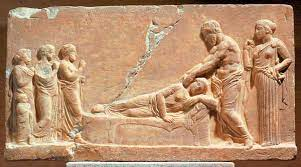
Sleep temples

From Wikipedia, the free encyclopedia

Sleep temples (also known as dream temples or Egyptian sleep temples) are regarded by some as an early instance of hypnosis over 4000 years ago, under the influence of Imhotep. Imhotep served as Chancellor and as High Priest of the sun god Ra at Heliopolis. He was said to be a son of the ancient Egyptian demiurge Ptah, his mother being a mortal named Khredu-ankh.

Sleep temples were hospitals of sorts, healing a variety of ailments, perhaps many of them psychological in nature. Patients were taken to an unlit chamber to sleep and be treated for their specific ailment.The treatment involved chanting, placing the patient into a trance-like or hypnotic state, and analysing their dreams in order to determine treatment. Meditationfastingbaths, and sacrifices to the patron deity or other spirits were often involved as well.

Sleep temples also existed in the Middle East and Ancient Greece. In Greece, they were built in honor of Asclepios, the Greek god of medicine and were called Asclepieions. The Greek treatment was referred to as incubation and focused on prayers to Asclepios for healing. These sleep chambers were filled with snakes, a symbol to Asclepios. A similar Hebrew treatment was referred to as Kavanah and involved focusing on letters of the Hebrew alphabet spelling the name of their God. In 1928, Mortimer Wheeler unearthed a Roman sleep temple at Lydney ParkGloucestershire, with the assistance of a young J.R.R. Tolkien.[1]

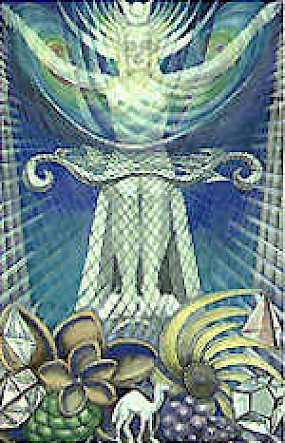
Tarot Card for October 3: The Priestess

The Priestess

The Priestess (or High Priestess, Papess, Pope Joan, Isis) is numbered two. This is the representation of the Goddess. She is the complementary partner of the Magician, possessing all his skill and ability, but with far more insight and psychism. She is more subtle yet somehow far more noticeable.

She is almost always shown with the Lunar Crescent, conveying her natural affinity with the forces of Nature and natural cycles. The Magician generates his own power, whereas the Priestess draws upon the forces of life itself.

She sits between two pillars with veils suspended between them – it is the Priestess who allows us to penetrate the innermost secrets of life. She is also the bridge between our conscious and Higher selves, by teaching us through our dreams and our subconscious. It is in our subconscious that we hold the keys to the Universe.

The Priestess

(via angelpaths.com and Alan Blackman)

Revisiting the Counterculture with Matthew Ingram

New Thinking Allowed with Jeffrey Mishlove Nov 3, 2020 Matthew Ingram is known for throwing raves in West Africa in 1993, writing for Teletubbies, his cult music blog Woebot, writing for the Wire and FACT magazines, setting up the Dissensus forum and putting out a series of LPs. His “Vitamin C” animated documentary was shown at the Chicago International Children’s Film Festival. He is author of Retreat: How the Counterculture Invented Wellness. His website is http://www.woebot.com/ Here the discussion focuses on the many personalities who contributed to the cultural wave that swept the western world, particularly the United States, during the 1960s (many of whom have been interviewed by Jeffrey Mishlove). Matthew’s book specifically focuses on the period from 1955 to 1975. Topics include the role of the Vietnam war, LSD, new psychotherapies, eastern religions and the idea of enlightenment, the anti-establishment protests, the sexual revolution, and feminism. There were, of course, important historical antecedents as well as consequences. (Recorded on October 19, 2020.)

The Human Potential Movement & the Esalen Institute with Matthew Ingram

New Thinkin Nov 17, 2020 Matthew Ingram is known for throwing raves in West Africa in 1993, writing for Teletubbies, his cult music blog Woebot, writing for the Wire and FACT magazines, setting up the Dissensus forum and putting out a series of LPs. His “Vitamin C” animated documentary was shown at the Chicago International Children’s Film Festival. He is author of Retreat: How the Counterculture Invented Wellness. His website is http://www.woebot.com/. Here the discussion focuses on the Esalen Institute, in Big Sur, California, as an important hub of the human potential movement that began in the 1960s and continues to the present day. Topics include gestalt therapy, holotropic breathing, kundalini and the Spiritual Emergence Network, sensory isolation, rebirthing, encounter groups, Rolfing and body work, as well as explorations of physics and consciousness. (Recorded on November 2, 2020.)

At 68, I’m Having the Best Sex of My Life

Why do human beings take so long to get a clue and grow up?

Tris Harkness

Tris Harkness

Published in Crow’s Feet

May 4, 2023 (Medium.com)

Photo by Marivi Pazos on Unsplash

Somany things prevented me from having good sex when I was a young woman. First, there was the crushing shame I felt about my sexual fantasies. Then there were the ridiculous beauty standards I absorbed from the media and failed to live up to (as did all my friends). Third was the sexual shield I put up to protect myself from random catcalls and harassment in public. And in private, there was the long haul of pure exhaustion from raising sometimes difficult children, making a living and running a household, coupled with the growing resentment I felt for my husband, who rarely asked what I needed and often put his sexual needs first.

All of that — all of life as a woman — got in the way of me becoming the eager, responsive, joyful sexual being that I’m becoming today, at age 68. And the irony is, I got here by accident. I wasn’t seeking a sexual awakening when I opened our marriage a year and a half ago. I was seeking relief from my husband’s sexual needs.

Here’s what happened instead — or in addition — to assuaging his feelings of lack. About six months into our experiment with polyamory, while my husband was dating others and finding his groove, a man across the country, a reader of my open marriage stories on Medium, started texting me some sexy stuff that turned me on.

That was pretty much the perfect scenario for an old repressed woman like me. Since there was no way we could meet in person, due to the physical distance between us, there was no real threat to my marriage or my sexual status quo. It was easy to participate and cost me nothing. There was zero risk. So I sat back and marveled as this charming man wooed me. He complimented me. We exchanged racy pictures. I was nervous about that! But he kept up the pursuit.

He sent me super sexy voice memos in which he told me how much he desired me — in French! We followed up with video chats where clothing was removed and the compliments kept flowing. My libido exploded. It felt like I had an atomic bomb lodged in my nether regions. And since there was no way to consummate, I brought all that newfound sexual energy back to my husband, who was well pleased.

Meanwhile, I found that all of my negative ideas about sex in general, and my lack of attractiveness in particular, were completely wrong.

Here’s a sampling of the scales that fell from my eyes in the past year:

  1. I thought I was too old, too wrinkled, or too flabby to be alluring. Nope. My suitor was 12 years younger and not the least bit dissuaded by my flaws.
  2. I thought because I have only one breast (my mastectomy scar is covered by a beautiful tattoo) that my body was repellent. Wrong again! Not a problem. Bring it on, he kept saying, even after the exchange of revealing pictures. So I did.
  3. I thought my sparse pubic hair made me look sickly. I grew up in an era when women didn’t shave their pubic hair, but both menopause and chemo wrecked havoc on my curlies. Yet once again, it didn’t bother my romantic interest. My concerns were moot.
  4. I thought my “perverted” sexual fantasies (focused on spanking) (Shhhh. Don’t tell!) would drive away a “normal” man. Surprise! They did not. Although he hadn’t thought of spanking as any kind of sexy before, he responded with considerable lust when I wrote a spanking scenario involving the two of us.

Private lives and fortunate accidents

All these surprising discoveries were happening, and continue to happen, in private — meaning we haven’t come out to our children or extended family as polyamorous (or bisexual, or anything else; is it really their business?), though I’ve told three close girlfriends about what’s going on.

One reads my stories on Medium, which is a wee bit embarrassing. We don’t often talk about sex, and I don’t know the particulars of her own sex life in her long-term heterosexual marriage. One is a lesbian and currently celibate, and though she has no objections to my sexual adventures, she doesn’t have any similar desires of her own. The third is divorced and also celibate. She’s so turned off by sex that she sent me a puking emoji when I brought up my liaisons in texts.

That means two out of three of the women I’m closest to — all women my age — are currently turned off to sex. I’m not surprised, given the twisted sexual messages and experiences that being a woman in America bring all of us. That’s where I was headed myself until this fortunate accident occurred.

Why do I call it fortunate? At the risk of sounding like a huckster, I want to say that my revived sex life feels like some kind of magic elixir — like the fountain of youth. I probably should mention here that my original suitor and I never met. Plans were in the works when his wife pulled the plug, deciding that she didn’t want to try polyamory after all. Still, his attentions put me on this path, and for that I am grateful. We remain email friends to this day.

After that frustration, I took my newly stirred sexual energy to the apps, and had a surprising amount of positive response on OKCupid. Turns out that lots of men are attracted to older women, despite what you have read, seen, and heard ad infinitum all around you. But ultimately, my interactions on the apps resulted in just one lonely and less-than-fulfilling sexual encounter.

After that, I thought perhaps I would give up. I wasn’t really that interested anyway! The French-talking charmer had just sucked me in… But then I connected with the bisexual man my husband was seeing, and that’s where I remain today. Now the three of us have formed a kind of “throuple.” We’ve been sleeping together for almost a year.

Here are some benefits I’ve noticed from reviving my long-lost sexual self: I have more energy. I feel more alive. My hair has stopped falling out. My happiness has increased. My body feels more fit and agile and, miracle of miracles, I’ve started having regular orgasms for the first time in my life.

Orgasms are not a slam dunk for me. Not by a long shot. But now that sex has become more important to me, I’ve been actively pursuing the goal of having orgasms more often. I’ve read books on the subject, and I’ve practiced with my two men.

One thing that led me astray back in the day was the response of a boyfriend when I masturbated to orgasm in his arms after we had penetrative sex. He said it made him feel bad that I had to bring myself off. He wanted to be able to do that for me. Uh-oh, I thought. I’m emasculating him! So I stopped touching myself before, during, or after sex (for the next 40 years!), which resulted in me having far fewer orgasms. What a dope.

Now my attitude about that has changed. Now I recognize that the cultural pressure on women to orgasm via penetration is silly, because most women need clitoral stimulation to come.

My Takeaway

Which brings me back to my original question: Why do human beings take so long to get a clue and grow up? If only I’d known when I was younger that the things I believed about sex were backwards and stupid, I would have had a lot more years of vital sexual life.

To recap: here’s what I learned in the last year — at the ripe old age of 67–68.

  1. Kinky sexual fantasies are not uncommon and nothing to be ashamed of. If you share yours with your lover, chances are he or she will learn to love what you love, or at least be glad to help you find your bliss, whatever unique route that takes. Don’t let your kinks stop you from getting sexual satisfaction.
  2. Beauty standards are BS. Men find all kinds of women sexy. Those imperfections you’re so worried about? He doesn’t even notice them! And if he does, he quickly forgets them in the heat of passion. I’m guessing it’s the same for every gender. Lust is all around you — it’s yours for the asking. You were never meant to be perfect. Don’t let your physical imperfections stop you from getting sexual satisfaction.
  3. Now that I’m older, fewer men harass me on the street. (Getting older is a lot better than advertised!) But to the men who still imagine it’s cool to shout (or whisper) sexual “compliments” to female passersby, please stop. It’s not flattering. It’s threatening. And it shuts us down. And to the women carrying around those invisible sexual shields for protection: don’t let boorish men stop you from getting sexual satisfaction. There are plenty of good men out there. They just aren’t as loud.
  4. Finally, to the exhausted women working and raising families, I get it. You don’t have to put out for your lover if you don’t want to. But if your lack of desire is born of resentment, the sooner you take care of that, the better. If your partner isn’t giving you want in the bedroom or out, ask for it. Not meanly. Not angrily. Just plainly and simply. Because you deserve fun sex as much as he does. Don’t let inconsiderate partners stop you from getting sexual satisfaction.

I’m not saying the sex I’m having is always fantastic. I’m not saying I never have sexual problems anymore. What I’m saying is society and circumstances set me up to have mostly crappy sex for most of my long life, and now, at long last, it’s finally getting better.

So I’m still wondering, why did it take so long for me to get a clue and grow up? Whatever the answer, I’m glad I finally did.

That was the 40th installment of my Chronicle of an Open Marriage. Read the 41st here. Or start at the beginning with #1:

I Want My Husband to Have Sex With Men

A wife ponders the possibilities of opening her marriage

medium.com

Find all my stories about opening our marriage on this Listor about sex in general on this one. Get an email whenever I publish. And have a lovely day.

Tris Harkness

Written by Tris Harkness

The full moon has different names for each month. Here’s the meaning and origin for the whole lunar calendar.

Morgan McFall-Johnsen and Jenny McGrath 

Sep 26, 2023, 12:35 PM PDT (businessinsider.com)

An orange-looking full moon rises behind the eiffel tower
The full moon, known as the “Super Pink Moon” rises behind the Eiffel Tower in Paris, France. 
  • This year’s harvest moon rises Friday, September 29. It’s also the last supermoon of 2023.
  • Harvest moons occur in either September or October, depending on the date of the fall equinox.
  • Every full moon has a special name. This naming system helped people track time for millennia.
Insider Today

NEW LOOK

Sign up to get the inside scoop on today’s biggest stories in markets, tech, and business — delivered daily. Read previewEmail addressSign up

By clicking “Sign Up”, you accept our Terms of Service and Privacy Policy. You can opt-out at any time.

Bull

There are typically 12 full moons each year, including three or four supermoons. But while common, full moons have a long history of significance for many people and cultures.  

“Astronomical events such as this mark the passage of time and provide a steady rhythm to our lives,” Patrick Hartigan, a professor of physics and astronomy at Rice University, told Insider via email.

“These cycles are independent of human activities and remind us that we are part of this world but that we do not control everything,” he said.

The next full moon will be a harvest moon, rising on September 29.

September: harvest moon, “corn moon,” “barley moon”

An Amish child and woman stand on horse-drawn wagon while harvesting corn in Maryland
Amish people harvest corn in Maryland. 

Over the millennia, September’s full moon has signified to farmers that it’s time to finish harvesting corn and other crops.

A harvest moon sometimes occurs in October (the moon doesn’t follow the Gregorian calendar), but it’s always the full moon closest to the autumnal equinox.

Every few years, the harvest moon falls in October instead of September.

The harvest moon rises with the setting sun. There’s an optical illusion that the moon — any moon — looks larger than usual when it’s near the horizon.

So folks who see the full moon rise from the horizon around sunset may think it looks larger than normal. These bright moonlit nights give farmers a little extra time to harvest their crops.

This year’s harvest moon will reach its peak at 5:58 a.m. ET on September 29, according to The Old Farmer’s Almanac

The next harvest moon: September 29, 2023

Here are some of the many names assigned to full moons throughout the year.

person takes phone photo of another person holding a child in front of yellow full moon
Tourists take pictures as a full moon rises in Moscow, Russia. 

Across North America and Europe, people have used full moons to track months and seasons for thousands of years, naming each one based on the seasonal changes it indicates.

Different languages and cultures characterized their moons differently, sometimes based on agricultural cycles, sometimes on natural phenomena.

The names assigned to full moons are often attributed to the native Algonquian peoples, who share a family of languages and originate from the area that today ranges from New England as far west as Lake Superior.

Colonial settlers across North America adopted their own version of the indigenous names, according to The Old Farmer’s Almanac.

October: “hunter’s moon,” “blood moon,” “dying grass moon,” “travel moon”

hunting shooting guns dogs pheasants
A man shoots at pheasants flying overhead during a pheasant hunt in Stokenchurch, England. 

These names refer to the time of year when leaves have fallen, the deer are fat, and animals are coming into harvested fields to eat what’s left. Historically, hunters took advantage of October to store meat for the winter.

Some associate this month’s blood moon or “sanguine moon” with hunting, and it’s different from a blood moon caused by a lunar eclipse. In the latter case, the moon appears to have a reddish hue.

The next hunter’s moon: October 28, 2023

November: “beaver moon,” “frosty moon”

A beaver floats in water holding a branch
November’s full moon is named for the industrious beaver. 

Beavers prepare for winter in November, as do trappers. This moon signaled the time to catch beavers and secure a supply of warm furs before the swamps froze.

The next beaver moon: November 27, 2023

December: “cold moon,” “long night’s moon”

full moon snow moon december
The moon sets behind a mountain at sunrise in Lake Louise, Alberta in December. 

December has the longest, darkest nights of the year, and the moon sits above the horizon longer than usual. Some Europeans and their descendants in North America also called the December full moon the “moon before Yule.”

The next cold moon: December 26, 2023

January: “wolf moon,” “old moon,” “ice moon”

wolves
Since they’re known for their nighttime howls, it’s not surprising there’s a full moon named for wolves. 

In mid-winter, as the story goes, hungry wolves would gather outside villages in North America and medieval Europe and howl into the night. This full moon was sometimes also called the “moon after Yule.”

The next one: January 25, 2024

February: “snow moon,” “hunger moon”

A full moon rises above the Hudson River in a darkened sky
The full February snow moon rises above the Hudson River and the town of Irvington, New York. 

In North America, February marks the depths of winter, when snow blankets the ground and fresh food was traditionally harder to come by. Because it’s a shorter month, some February’s don’t have a full moon at all.

The next snow moon: February 24, 2024

March: “worm moon,” “sap moon,” “crow moon”

Massachusetts Governor Charlie Baker holds a large silver bucket while tapping a maple tree in massachusetts
Former Massachusetts Governor Charlie Baker urges sap to come out of a maple tree during an event at Hollis Hill Farm in Fitchburg, Massachusetts. 

As spring approaches, earthworms emerge from the ground, maple trees are ripe for tapping, and migratory birds return as winter ends.

According to the Almanac, that’s led Ojibwe people to call this the “sugar moon,” Algonquin or Cree to call it the “eagle moon” or “goose moon,” and northern Ojibwe to call it the “crow comes back moon.”

European settlers with religious calendars called this the “Lenten moon.”

According to NASA, “other names are the ‘chaste moon’ or the ‘death moon,’ related to the fasting of Lent and traditions from when the start of spring was the end of the old year and start of the new.”

The next worm moon: March 25, 2024

April: “pink moon,” “sprouting grass moon,” “egg moon,” “fish moon”

wild flowers on a hill near a road along the California coastline in Big Sur at sunset
Wildflowers along the California coastline in Big Sur at sunset. 

The pink moon is named for the pink phlox flowers that bloom in spring. The other names refer to additional staples of the changing season: growing grass, birds filling nests with eggs, and fish that swim upstream to spawn.

The next pink moon: April 23, 2024

May: “flower moon,” “planting moon”

A field of pink, white, yellow, and red flowers with a person standing amongst them from a distance
As spring emerges, so does May’s flower moon. 

In May, flowers burst fully into bloom, and it becomes time to sow crops again. Flower moon is an Algonquin name, according to the Almanac

In the Middle Ages, an English name for the May full moon was the “milk moon,” according to NASA.

The next flower moon: May 23, 2024

June: “strawberry moon,” “rose moon,” “hot moon”

A woman and two children picking strawberries in vermont
A family picks strawberries at the Legare Farm Stand in Calais, Vermont. 

Strawberries ripen for picking in June. Europeans dubbed this the rose moon, and other cultures called it the hot moon because it harkens summer heat ahead.

“Mead” or “honey moon” are other European names for this full moon. The term “honeymoon” dates back at least to the 1500s and originally meant a sweet period of time lasting around a month.

The next strawberry moon: June 21, 2024

July: “buck moon,” “thunder moon,” “hay moon”

Two deer lock antlers with a great deal of mud caught between them
Young stag deer clash antlers during the annual rut in Richmond Park in west London, Britain. 

Deer grow new, velvety antlers in July, and thunderstorms rage aplenty in some parts of North America. For Anglo-Saxons, July was all about hay. 

Sockeye fish return to spawn in Alaska in June and July, so it makes sense the Tlingit people would call this month’s moon the “salmon moon.”

The buck moon: July 21, 2024

August: “sturgeon moon,” “red moon”

A man wearing a hat holds a large sturgeon fish near a body of water
Researcher Matt Balazik gets ready to toss a 70-pound Atlantic sturgeon into the James River near Charles City, Virginia. 

Tribes near the Great Lakes and Lake Champlain knew August was the best time to catch sturgeon, an enormous, hearty fish. Some people also think the moon appears more reddish in color this month because of the heat.

The next sturgeon moon: August 19, 2024

Some full moons are called supermoons or micromoons. The contemporary terms refer to how large and small the moon looks at various points in its elliptical orbit.

A supermoon above a cityscape
Supermoons can appear a bit larger and brighter than a typical full moon. 

Supermoons occur when the moon is at perigee — the closest point to Earth. They can cause stronger ocean tides and weather events.

Micromoons are the opposite, occurring at apogee — when the moon is furthest from Earth. They can reduce the variation in spring tides by 2 inches. Micromoons appear about 14% smaller than supermoons, and sometimes seem dimmer, since the area illuminated by the sun appears 30% smaller, according to TimeandDate.com.

Since the International Astronomical Union has not officially defined supermoons or micromoons, astronomers disagree on which full moons get the designation.

The next full supermoon: August 19, 2024

The next full micromoon: February 24, 2024

Blue moons are like special bonuses. They occur every two or three years, when a month or season has one extra full moon.

A full moon rises over the Wyoming wilderness at Yellowstone National Park, making the sky look purple
A full moon isn’t the best time to see stars, even at a place as dark as Yellowstone National Park. 

When an astronomical season (the time between solstice and equinox) has four full moons instead of the normal three, the third one is a seasonal blue moon.

When a calendar month has two full moons, the second one is a monthly blue moon. That happens because the lunar month is only 29 days long, while the Gregorian calendar month is usually 30 or 31 days long.

The moon doesn’t actually appear blue on these occasions. That would only happen if dust or smoke particles of a particular size cloud the atmosphere, say after a forest fire, volcanic eruption, or dust storm.

The next seasonal blue moon: August 19, 2024

The next monthly blue moon: August 19, 2024