Prime Minister Benjamin Netanyahu in July. Credit: Sraya Diamant Haaretz Editorial Get email notification for articles from Haaretz Editorial
Oct 8, 2023 (Haaretz.com)
The disaster that befell Israel on the holiday of Simchat Torah is the clear responsibility of one person: Benjamin Netanyahu. The prime minister, who has prided himself on his vast political experience and irreplaceable wisdom in security matters, completely failed to identify the dangers he was consciously leading Israel into when establishing a government of annexation and dispossession, when appointing Bezalel Smotrich and Itamar Ben-Gvir to key positions, while embracing a foreign policy that openly ignored the existence and rights of Palestinians.
Netanyahu will certainly try to evade his responsibility and cast the blame on the heads of the army, Military Intelligence and the Shin Bet security service who, like their predecessors on the eve of the Yom Kippur War, saw a low probability of war with their preparations for a Hamas attack proving flawed.
They scorned the enemy and its offensive military capabilities. Over the next days and weeks, when the depth of Israel Defense Forces and intelligence failures come to light, a justified demand to replace them and take stock will surely arise.
However, the military and intelligence failure does not absolve Netanyahu of his overall responsibility for the crisis, as he is the ultimate arbiter of Israeli foreign and security affairs. Netanyahu is no novice in this role, like Ehud Olmert was in the Second Lebanon War. Nor is he ignorant in military matters, as Golda Meir in 1973 and Menachem Begin in 1982 claimed to be.
Israel At War: Get a daily summary direct to your inbox
Email *
Please enter a valid email addressSign Up
Netanyahu also shaped the policy embraced by the short-lived “government of change” led by Naftali Bennett and Yair Lapid: a multidimensional effort to crush the Palestinian national movement in both its wings, in Gaza and the West Bank, at a price that would seem acceptable to the Israeli public.
In the past, Netanyahu marketed himself as a cautious leader who eschewed wars and multiple casualties on Israel’s side. After his victory in the last election, he replaced this caution with the policy of a “fully-right government,” with overt steps taken to annex the West Bank, to carry out ethnic cleansing in parts of the Oslo-defined Area C, including the Hebron Hills and the Jordan Valley.
This also included a massive expansion of settlements and bolstering of the Jewish presence on Temple Mount, near the Al-Aqsa Mosque, as well as boasts of an impending peace deal with the Saudis in which the Palestinians would get nothing, with open talk of a “second Nakba” in his governing coalition. As expected, signs of an outbreak of hostilities began in the West Bank, where Palestinians started feeling the heavier hand of the Israeli occupier. Hamas exploited the opportunity in order to launch its surprise attack on Saturday.
Above all, the danger looming over Israel in recent years has been fully realized. A prime minister indicted in three corruption cases cannot look after state affairs, as national interests will necessarily be subordinate to extricating him from a possible conviction and jail time.
This was the reason for establishing this horrific coalition and the judicial coup advanced by Netanyahu, and for the enfeeblement of top army and intelligence officers, who were perceived as political opponents. The price was paid by the victims of the invasion in the Western Negev.
The above article is Haaretz’s lead editorial, as published in the Hebrew and English newspapers in Israel.
The Israeli-Palestinian conflict was reignited once again on October 7 after a surprise offensive launched by Hamas against Israel. In retaliation, Israel ordered air strikes and a “complete siege” of the Gaza Strip, the Hamas-run Palestinian enclave. This is a new deadly episode in a conflict that has its roots deep in the mid-20th century. FRANCE 24 traces its history.
1947: Thousands of European Jewish emigrants, many of them Holocaust survivors, board a ship – which came to be called Exodus 1947 – bound for then British-controlled Palestine. Heading for the “promised land”, they are intercepted by British naval ships and sent back to Europe. Widely covered by the media, the incident sparks international outrage and plays a critical role in convincing the UK that a UN-brokered solution is necessary to solve the Palestine crisis.
A UN special committee proposes a partition plan giving 56.47 percent of Palestine for a Jewish state and 44.53 percent for an Arab state. Palestinian representatives reject the plan, but their Jewish counterparts accept it.
On November 29, the UN General Assembly approves the plan, with 33 countries voting for partition, 13 voting against it and 10 abstentions.
1948-49: On May 14, David Ben-Gurion, Israel’s first prime minister, publicly reads the Proclamation of Independence. The declaration, which would go into effect the next day, comes a day ahead of the expiration of the British Mandate on Palestine. The Jewish state takes control of 77 percent of the territory of Mandate Palestine, according to the UN.
For Palestinians, this date marks the “Nakba”, the catastrophe that heralds their subsequent displacement and dispossession.
As hundreds of thousands of Palestinians, hearing word of massacres in villages such as Dir Yassin, flee towards Egypt, Lebanon, and Jordanian territory, the armies of Egypt, Syria, Lebanon, Jordan and Iraq attack Israel, launching the 1948 Arab-Israeli War.
The Arab armies are repelled, a ceasefire is declared and new borders – more favourable to Israel – are drawn. Jordan takes control of the West Bank and East Jerusalem while Egypt controls the Gaza Strip.
1956: The Second Arab-Israeli War, or the Suez Crisis, takes place after Egypt nationalises the Suez Canal. In response Israel, the United Kingdom and France form an alliance and Israel occupies the Gaza Strip and the Sinai Peninsula. The Israeli army eventually withdraws its troops, under pressure from the US and the USSR.
1959: Yasser Arafat sets up the Palestinian organisation Fatah in Gaza and Kuwait. It later becomes the main component of the Palestine Liberation Organisation (PLO).
1964: The PLO is created.
1967: The Third Arab-Israeli War, or the Six-Day War, between Israel and its Arab neighbours, results in a dramatic redrawing of the Middle East map. Israel seizes the West Bank and East Jerusalem, the Gaza Strip, the Sinai Peninsula and the Golan Heights.
1973: On October 6, during the Jewish holiday of Yom Kippur, Egyptian and Syrian armies launch offensives against Israel, marking the start of a new regional war. The Yom Kippur War, which ends 19 days later with Israel repelling the Arab armies, results in heavy casualties on all sides – at least several thousand deaths.
1979: An Israeli-Egyptian peace agreement is sealed in Washington following the Camp David Accords signed in 1978 by Egyptian President Anwar Sadat and Israeli Prime Minister Menachem Begin. According to the terms of this agreement, Egypt regains the Sinai Peninsula, which it had lost after the Six-Day War. Sadat becomes the first Arab leader to recognise the State of Israel.
1982: Under Defence Minister Ariel Sharon, Israeli troops storm into neighbouring Lebanon in a controversial military mission called “Operation Peace of Galilee”. The aim of the operation is to wipe out Palestinian guerrilla bases in southern Lebanon. But Israeli troops push all the way to the Lebanese capital of Beirut.
The subsequent routing of the PLO under Arafat leaves the Palestinian refugee camps in Lebanon essentially defenceless. From September 16 to 18, Lebanese Christian Phalangist militiamen – with ties to Israel – enter the camps of Sabra and Shatilla in Beirut, unleashing a brutal massacre that shocks the international community. The massacres, the subject of an Israeli inquiry popularly called the Kahane Commission, would subsequently cost Sharon his job as defence minister.
1987: Uprisings in Palestinian refugee camps in Gaza spread to the West Bank marking the start of the First Palestinian Intifada (“uprising” in Arabic). Nicknamed the “war of stones”, the First Intifada lasts until 1993, costing more than 1,000 Palestinian lives. The image of the stone-throwing Palestinian demonstrators pitched against Israel’s military might comes to symbolise the Palestinian struggle.
It was also during this uprising that Hamas, influenced by the ideology of Egypt’s Muslim Brotherhood, was born. From the outset, the Islamist movement favours armed struggle and rejects outright any legitimacy of an Israeli state.
1993: After months of frenetic secret negotiations, Yasser Arafat and Israeli Prime Minister Yitzhak Rabin sign the Oslo Accords. The accords see the creation of the Palestinian Authority, which gets administrative control of the West Bank and Gaza. On September 13 on the White House lawn, Arafat and Rabin exchange a historic handshake in the presence of US President Bill Clinton. The event is watched by over 400 million TV viewers across the world.
1995: On November 4, Rabin is assassinated by a Jewish right-wing extremist at a peace rally in Tel Aviv.
1996: Benjamin Netanyahu is elected prime minister for the first time.
2000: On September 28, Sharon provokes Palestinians by making a tour of Jerusalem’s Al-Aqsa/Temple Mount site as leader of the right-wing Likud party, sparking the Second Intifada, also known as the Al-Aqsa Intifada. It lasted until 2005, with 3,000 Palestinians and 1,000 Israelis killed over five years.
2001: Sharon is elected prime minister of Israel and breaks off contact with Arafat, who is subsequently confined to his compound in Ramallah.
2002: The Israeli government begins Operation Defensive Shield – the construction of a wall to separate Israel from the West Bank. The UN Security Council speaks for the first time of a coexistence between the two states of Israel and Palestine. The Israeli army lifts the siege on Ramallah.
2004: On March 22, Sheikh Ahmed Yassin, the paraplegic co-founder and spiritual leader of Hamas, is killed in an Israeli helicopter strike. Eight months later, on November 11, PLO chairman Arafat dies at a Paris hospital following a prolonged illness. Arafat’s death has been the subject of controversy. Some experts believe he died of natural causes, while others are open to the possibility he was poisoned using polonium 210.
2005: Mahmoud Abbas is elected president of the Palestinian Authority. After a 38-year occupation, Israel pulls out of Gaza.
2006: On January 4, Prime Minister Sharon suffers a stroke and falls into a coma that he stays in until his death in 2014. Ehud Olmert takes over as prime minister and head of Sharon’s newly founded centrist party, Kadima.
Hamas sweeps the legislative elections in the Palestinian Territories, causing the US and EU to freeze direct aid to the Palestinian government.
Lebanese Islamic fundamentalist group Hezbollah launches rocket attacks on Israel and takes two Israeli soldiers captive. Israel retaliates with force and many civilians, mainly Lebanese, are killed. The war, widely viewed as a failure in Israel, led to mounting calls for Olmert to resign.
2007: Following months of internecine military fighting between Hamas and Fatah forces, Hamas seizes control of Gaza.
2008: On December 27, the Israel Defense Forces (IDF) launch a surprise offensive on Gaza, killing more than 200 people in one day. Shortly after, the IDF follows up with a two-week-long ground invasion of Gaza. A UN report concluded that both Israel and Hamas committed war crimes during the conflict.
2011: On March 27, Israel deploys an anti-rocket missile defence system called Iron Dome, which allows the country to intercept short-range rockets regularly fired from Gaza.
2014: In June, three Israeli teenagers are abducted and murdered near the West Bank city of Hebron. Israeli authorities blame Hamas for the incident and on July 8, launch multiple air strikes on Gaza, prompting an exchange of rocket fire with Hamas over a seven-week period. The Israeli missile strikes result in the deaths of more than 2,200 Palestinians in Gaza.
2018: On March 30, tens of thousands of Palestinians rally near the Israeli border in the Gaza Strip to protest Israel’s blockade of the enclave. Demonstrations continue for several months. At least 189 Palestinians were killed and more than 6,000 injured during these protests between the end of March and the end of December 2018, according to the Independent International Commission of Inquiry mandated by the UN Human Rights Council.
2021: Palestinian worshippers clash with Israeli police in May at Jerusalem’s Al-Aqsa Mosque compound following weeks of mounting tension. Hamas unleashes a barrage of rockets into Israel after demanding Israeli forces withdraw from the compound. Israel responds with air strikes on Gaza, setting off an 11-day conflict resulting in the deaths of more than 200 people.
2022: Israel pounds Gaza with air strikes on August 5, killing a senior militant of the Islamic Jihad group and triggering retaliatory rocket fire from the Palestinian enclave. At least 40 Palestinians are killed in the three days of fighting that follow.
On October 7, Hamas mounts an unprecedented, multipronged surprise attack on Israel with fighters infiltrating the heavily fortified Gaza border in several locations by air, land and sea. Israeli forces respond with air strikes on Gaza and military reinforcements to the border.
Journalist and podcast host Krista Tippett has spent a career interviewing some of the world’s most brilliant people. All these conversations have left her with wisdom on the art of living and what it means to be human right now. Listen along as she offers three practices to help you make sense of the world around you and bring your fullest, most joyful self to it.
With her groundbreaking “On Being” podcast, Krista Tippett takes up the ancient, animating questions for 21st-century life: What does it mean to be human? How do we want to live? And who will we be to each other?
A live action role-playing game (LARP) is a form of role-playing game where the participants physically portray their characters.[1] The players pursue goals within a fictional setting represented by real-world environments while interacting with each other in character. The outcome of player actions may be mediated by game rules or determined by consensus among players. Event arrangers called gamemasters decide the setting and rules to be used and facilitate play.
The first LARPs were run in the late 1970s, inspired by tabletop role-playing games and genre fiction. The activity spread internationally during the 1980s and has diversified into a wide variety of styles. Play may be very game-like or may be more concerned with dramatic or artistic expression. Events can also be designed to achieve educational or political goals. The fictional genres used vary greatly, from realistic modern or historical settings to fantastic or futuristic eras. Production values are sometimes minimal, but can involve elaborate venues and costumes. LARPs range in size from small private events lasting a few hours, to large public events with thousands of players lasting for days.
Terminology
LARP has also been referred to as live role-playing (LRP), interactive literature, and free form role-playing. Some of these terms are still in common use; however, LARP has become the most commonly accepted term.[2] It is sometimes written in lowercase, as larp.[3] The live action in LARP is analogous to the term live action used in film and video to differentiate works with human actors from animation. Playing a LARP is often called larping, and one who does it is a larper.
Play overview
The participants in a LARP physically portray characters in a fictional setting, improvising their characters’ speech and movements somewhat like actors in improvisational theatre.[4] This is distinct from tabletop role-playing games, where character actions are described verbally.[1] LARPs may be played in a public or private area and may last for hours or days.[5][6] There is usually no audience.[7] Players may dress as their character and carry appropriate equipment, and the environment is sometimes decorated to resemble the setting.[8] LARPs can be one-off events or a series of events in the same setting, and events can vary in size from a handful of players to several thousand.[9][10]
Events are put on for the benefit of the players, who take on roles called player characters (PCs) that the players may create themselves or be given by the gamemasters. Players sometimes play the same character repeatedly at separate events, progressively developing the character and its relations with other characters and the setting.
Arrangers called gamemasters (GMs) determine the rules and setting of a LARP, and may also influence an event and act as referees while it is taking place.[11][12][13] The GMs may also do the logistical work, or there may be other arrangers who handle details such as advertising the event, booking a venue, and financial management. Unlike the GM in a tabletop role-playing game, a LARP GM seldom has an overview of everything that is happening during play because numerous participants may be interacting at once. For this reason, a LARP GM’s role is often less concerned with tightly maintaining a narrative or directly entertaining the players, and more with arranging the structure of the LARP before play begins and facilitating the players and crew to maintain the fictional environment during play.[14]
Participants sometimes known as the crew may help the GMs to set up and maintain the environment of the LARP during play by acting as stagehands or playing non-player characters (NPCs) who fill out the setting.[15][16] Crew typically receive more information about the setting and more direction from the GMs than players do. In a tabletop role-playing game, a GM usually plays all the NPCs, whereas in a LARP, each NPC is typically played by a separate crew member.[17] Sometimes players are asked to play NPCs for periods of an event.
Much of play consists of interactions between characters. Some LARP scenarios primarily feature interaction between PCs. Other scenarios focus on interaction between PCs and aspects of the setting, including NPCs, that are under the direction of the GMs.[18][19]
The earliest recorded LARP group is Dagorhir, which was founded in 1977 in the United States and focuses on fantasy battles.[22] Soon after the release of the movie Logan’s Run in 1976, rudimentary live role-playing games based on the movie were run at US science fiction conventions.[23] In 1981, the International Fantasy Gaming Society (IFGS) started, with rules influenced by Dungeons & Dragons.[24] IFGS was named after a fictional group in the 1981 novel Dream Park, which described futuristic LARPs.[25] In 1982, the Society for Interactive Literature, a predecessor of the Live Action Roleplayers Association (LARPA), formed as the first recorded theatre-style LARP group in the US.[26]
Treasure Trap, formed in 1982 at Peckforton Castle, was the first recorded LARP game in the UK and influenced the fantasy LARPs that followed there.[27][28] The first recorded LARP in Australia was run in 1983, using the science fiction Traveller setting.[29] In 1993, White Wolf Publishing released Mind’s Eye Theatre, which is still played internationally and is probably the most commercially successful published LARP.[30] The first German events were in the early 1990s, with fantasy LARP in particular growing quickly there, so that since 2001, two major German events have been run annually that have between 3000 and 7000 players each and attract players from around Europe.[31][32][33]
Today, LARP is a widespread activity internationally. Games with thousands of participants are run by for-profit companies, and a small industry exists to sell costume, armour and foam weapons intended primarily for LARP.[34] In 2023, Dicebreaker reported that “China has developed its own LARP phenomenon in recent years. Jubensha is far more commercially successful and influential than anything we have seen before even in Nordic countries – and there is a good chance it might change our perception of what live-action roleplaying games are capable of in the future”.[35]
Purpose
Most LARPs are intended as games for entertainment. Enjoyable aspects can include the collaborative creation of a story, the attempt to overcome challenges in pursuit of a character’s objectives, and a sense of immersion in a fictional setting.[36] LARPs may also include other game-like aspects such as intellectual puzzles, and sport-like aspects such as fighting with simulated weapons.[37]
Some LARPs stress artistic considerations such as dramatic interaction or challenging subject matter. Avant-garde or arthaus events have especially experimental approaches and high culture aspirations and are occasionally held in fine art contexts such as festivals or art museums. The themes of avant-garde events often include politics, culture, religion, sexuality and the human condition. Such LARPs are common in the Nordic countries but also present elsewhere.[38][39]
In addition to entertainment and artistic merit, LARP events may be designed for educational or political purposes. For example, the Danish secondary school Østerskov Efterskole [dk] uses LARP to teach most of its classes.[40] Language classes can be taught by immersing students in a role-playing scenario in which they are forced to improvise speech or writing in the language they are learning.[41] Politically-themed LARP events may attempt to awaken or shape political thinking within a culture.[42][43]
Because LARP involves a controlled artificial environment within which people interact, it has sometimes been used as a research tool to test theories in social fields such as economics or law. For example, LARP has been used to study the application of game theory to the development of criminal law.[44]
During a LARP, player actions in the real world represent character actions in an imaginary setting.[1] Game rules, physical symbols and theatrical improvisation are used to bridge differences between the real world and the setting. For example, a rope could signify an imaginary wall. Realistic-looking weapon props and risky physical activity are sometimes discouraged or forbidden for safety reasons.[45] While the fictional timeline in a tabletop RPG often progresses in game-time, which may be much faster or slower than the time passing for players, LARPs are different in that they usually run in real-time, with game-time only being used in special circumstances.[46]
There is a distinction between when a player is in character, meaning they are actively representing their character, and when the player is out-of-character, meaning they are being themselves. Some LARPs encourage players to stay consistently in character except in emergencies, while others accept players being out-of-character at times.[47] In a LARP, it is usually assumed that players are speaking and acting in character unless otherwise noted, which is the opposite of normal practice in tabletop role-playing games.[48] Character knowledge is usually considered to be separate from player knowledge, and acting upon information a character would not know may be viewed as cheating.
While most LARPs maintain a clear distinction between the real world and the fictional setting, pervasive LARPs mingle fiction with modern reality in a fashion similar to alternate reality games. Bystanders who are unaware that a game is taking place may be treated as part of the fictional setting, and in-character materials may be incorporated into the real world.[49][50]
Many LARPs have game rules that determine how characters can affect each other and the setting.[51][52] The rules may be defined in a publication or created by the gamemasters.[53] These rules may define characters’ capabilities, what can be done with various objects that exist in the setting, and what characters can do during the downtime between LARP events. Because referees are often not available to mediate all character actions, players are relied upon to be honest in their application of the rules.
Some LARP rules call for the use of simulated weapons such as foam weapons or airsoft guns[54] to determine whether characters succeed in hitting one another in combat situations. In Russian LARP events, weapons made of hard plastic, metal or wood are used.[55] The alternative to using simulated weapons is to pause role-play and determine the outcome of an action symbolically, for example by rolling dice, playing rock paper scissors or comparing character attributes.[56]
There are also LARPs that do without rules, instead relying on players to use their common sense or feel for dramatic appropriateness to cooperatively decide what the outcome of their actions will be.[57]
Genres
LARPs can have any genre, although many use themes and settings derived from genre fiction.[58] Some LARPs borrow a setting from an established work in another medium (e.g., The Lord of the Rings or the World of Darkness), while others use settings based on the real world or designed specifically for the LARP.[59]Proprietarycampaign settings, together with rulesets, are often the principal creative asset of LARP groups and LARP publishers.
LARP with a Victorian setting
LARPs set in the modern day may explore everyday concerns, or special interests such as espionage or military activity. Such LARPs sometimes resemble an Alternate Reality Game, an Assassin game, or a military simulation using live combat with airsoft, laser tag, or paintball markers. LARPs can also be set in historical eras or have semi-historical settings with mythological or fantastical aspects incorporated.
Fantasy LARP
Fantasy is one of the most common LARP genres internationally and is the genre that the largest events use.[60] Fantasy LARPs are set in pseudo-historical worlds inspired by fantasy literature and fantasy role-playing games such as Dungeons & Dragons. These settings typically have magic, fantasy races, and limited technology. Many fantasy LARPs focus on adventure or on conflict between character factions. In contrast, science fiction LARPs take place in futuristic settings with high technology and sometimes with extraterrestrial life. This describes a broad array of LARPs, including politically themed LARPs depicting dystopian or utopian societies and settings inspired by cyberpunk, space opera and post-apocalyptic fiction.[61]
Horror LARPs are inspired by horror fiction. Popular subgenres include zombie apocalypse and Cthulhu Mythos, sometimes using the published Cthulhu Live rules.[62] The World of Darkness, published by White Wolf Publishing, is a widely used goth–punk horror setting in which players usually portray secretive supernatural creatures such as vampires and werewolves.[30] This setting can be played using Mind’s Eye Theatre, which is a set of LARP rules also published by White Wolf. World of Darkness LARPs are usually played in a chronicle, a series of short events held at regular intervals, and are also popular at conventions. An international chronicle is run by White Wolf’s official fan club, the Camarilla.
Styles
LARP events have a wide variety of styles that often overlap. Simple distinctions can be made regarding the genre used, the presence of simulated weapons or abstract rules, and whether players create their own characters or have them assigned by gamemasters. There is also a distinction between scenarios that are only run once and those that are designed to be repeatable.[63] While some LARPs are open to participants of all ages, others have a minimum age requirement. There are also youth LARPs, specifically intended for children and young people. Some are run through institutions such as schools, churches, or the Scouts. Denmark has an especially high number of youth LARPs.[64][65]
Theatre-style
A theatre-style LARP in a decorated room at COSI Columbus (2007)
Theatre-style, or freeform, LARP is characterised by a focus on interaction between characters that are written by the gamemasters, not using simulated weapons for combat, and an eclectic approach to genre and setting. Events in this style typically only last a few hours and require relatively little preparation by players and are sometimes played at gaming conventions. Some murder mystery games where players are assigned characters and encouraged to roleplay freely also resemble theatre-style LARP.[citation needed]
Fests
A battle with 2000 participants at Bicolline, Quebec (2005)
Some very large events known as fests (short for festival) have hundreds or thousands of participants who are usually split into competing character factions camped separately around a large venue. There are only a few fests in the world, all based in Europe and Canada; however, their size means that they have a significant influence on local LARP culture and design. At the other end of the size scale, some small events known as linear or line-course LARPs feature a small group of PCs facing a series of challenges from NPCs and are often more tightly planned and controlled by GMs than other styles of LARP.[66][needs update]
Nordic LARP
Nordic larp emphasises a collaborative “play to lose” strategy, keeping rules unobtrusive, and often explores emotionally complex issues.[67] The style emerged in Finland and Scandinavia during the 1990s with a focus on “collaborative storytelling around intense human experiences”.[68]Wired commented that this style adds “distinct challenges, including the possibility of real emotional harm. To work out issues of how to keep players safe and push the limits of the form, the community gathers at Knutepunkt, an annual meeting that is as much hardcore game jam as academic conference”.[68]
Script murder games
Script murder games, also known as jubensha (lit. ’scripted murder’), are murder mystery LARP games that emerged in China.[69][70][35] Typically, script murder games can be experienced in a tabletop game format or a format which combines larping and escape rooms. Players are given different script options and are assigned characters to play through the murder mystery; these games often occur at dedicated gaming stores where players pay to participate.[69][71][72] The style become popularized in 2015 “when reality shows with names like ‘Lying Man,’ ‘Dinner Party Seduction,’ and later ‘Who’s The Murderer,’ showed celebrities playing whodunits”[70] which led to the development of jubensha clubs that run games in this style.[35]
Cultural significance
Roleplaying may be seen as part of a movement in Western culture towards participatory arts, as opposed to traditional spectator arts.[73] Participants in a LARP cast off the role of passive observer and take on new roles that are often outside of their daily life and contrary to their culture.[74] The arrangers of a LARP and the other participants act as co-creators of the game.[75] This collaborative process of creating shared fictional worlds may be associated with a broader burgeoning “geek” culture in developed societies that is in turn associated with prolonged education, high uptake of information technology and increased leisure time.[76] In comparison to the mainstream video-game industry, which is highly commercialized and often marketed towards a male audience, LARP is less commoditized, and women actively contribute as authors and participants.[77]
LARP is not well known in most countries and is sometimes confused with other role-playing, reenactment, costuming, or dramatic activities. While fan and gamer culture in general has become increasingly mainstream in developed countries, LARP has often not achieved the same degree of cultural acceptability. This may be due to intolerance of the resemblance to childhood games of pretend, a perceived risk of over-identification with the characters, and the absence of mass marketing.[78][79] In US films such as the 2006 documentary Darkon, the 2007 documentary Monster Camp, and the 2008 comedy Role Models, fantasy LARP is depicted as somewhat ridiculous and escapist, but also treated affectionately as a “constructive social outlet”.[80][81][82] In the Nordic countries, LARP has achieved a high level of public recognition and popularity. It is often shown in a positive light in mainstream media, with an emphasis on the dramatic and creative aspects.[83] However, even in Norway, where LARP has greater recognition than in most other countries, it has still not achieved full recognition as a cultural activity by government bodies.[84]
Communities have formed around the creation, play and discussion of LARP. These communities have developed a subculture that crosses over with role-playing, fan, reenactment, and drama subcultures.[78][85] Early LARP subculture focused on Tolkien-like fantasy, but it later broadened to include appreciation of other genres, especially the horror genre with the rapid uptake of the World of Darkness setting in the 1990s.[85][86] Like many subcultures, LARP groups often have a common context of shared experience, language, humour, and clothing that can be regarded by some as a lifestyle.[78]
LARP has been a subject of academic research and theory. Much of this research originates from role-players, especially from the publications of the Nordic Knutepunkt role-playing conventions.[87] The broader academic community has recently begun to study LARP as well, both to compare it to other media and other varieties of interactive gaming, and also to evaluate it in its own right.[49][88] In 2010, William Bainbridge speculated that LARP may one day evolve into a major industry in the form of location-based games using ubiquitous computing.[89]
In Denmark, Østerskov Efterskole uses LARP as an educational method of teaching subjects to high school boarding students through interactivity and simulation.[90] LARP groups are also using simulations of current and historical events and topics like refugees and the AIDS crisis to roleplay and explore these subjects.[91]
In China, the script murder game industry has continued to grow since 2015. The New York Times reported that in 2021 “the number of scripted murder enterprises registered in China totaled about 6,500, a more than 60 percent increase from the prior year, according to state-run media”.[70] The Agence France-Presse reported that “the live action murder mystery market appears to have captured the imagination of China’s urban youth before the Covid-19 pandemic emerged”.[69] During the COVID-19 pandemic, “Murder Mystery Game” (MMG) apps allowed people to play jubensha digitally and were “available to millions of people across” China.[35]Dicebreaker reported that following the easing of pandemic restrictions in China, “more than 45,000 [jubensha] shops” opened with “nearly 10 million active players. It is estimated that soon the Jubensha market will reach 23.89 billion Chinese Yuan”.[35]Voice of America commented that, per the Chinese market research firm iResearch, script murder games are “the third most popular form of entertainment for Chinese people, after watching movies and participating in sports”.[92]
The popularization of script murder games and industry growth in China has led to both national and governmental attention with the Chinese government considering formal regulation of the industry.[71][72][93] In September 2020, the Agence France-Presse commented that “a report on China National Radio last month voiced fears that too many of the scripts relied on murders, violent plots and sexual content, but others see the games as a way to get young people off their smartphones and back interacting with each other in real life”.[69] In October 2021, the South China Morning Post reported that “advertisements for script-killing are prominent in China. […] The fact that it is a new industry is precisely the problem in the eyes of the authorities. Since the Covid-19 case that brought ‘script-killing’ to national attention, the game has been getting mainstream traction, inviting official concerns and possible future regulations”.[71] In October 2022, Polygon commented that Chinese “regulators are beginning to take notice of the genre’s mature content. A story published Wednesday indicates that municipal and provincial authorities have now begun regulating content and demanding that some retailers remove certain materials from sale. […] As a result, some store owners are now curating their selection to fall in line with government regulation”.[72]China Daily, a publication owned by the Chinese Communist Party, reported in April 2023 that China’s Ministry of Culture and Tourism was beginning to draft regulations for script murder games and “soliciting public opinions”.[93] The draft regulations state that “the contents of such games must not smear the traditional Chinese culture or contain inappropriate materials involving obscenity, gambling, drugs, and other elements that could go against moral standards”.[93] The regulations also include additional rules for minors such as not allowing “underage customers on school days” and that “children under the age of 14 must be accompanied by their parents or other guardians”.[93]
House Majority Leader Steve Scalise, R-La., talks to reporters as he leaves Republicans’ closed-door forum in which they heard from the candidates for House speaker on Tuesday.
Jose Luis Magana/AP
Republicans have chosen Majority Leader Steve Scalise, R-La., to be their nominee for House speaker in a closed-door, secret-ballot election.
Scalise defeated House Judiciary Committee Chairman Jim Jordan, R-Ohio, by a vote of 113-99. That gave Scalise a narrow majority of the Republicans’ 221 votesin the chamber, but he has yet to lock up the 217 votes necessary to win on the House floor. A source with direct knowledge of the matter said Jordan plans to vote for Scalise on the House floor and is encouraging his colleagues to do the same.
But it’s not clear when Republicans will take the nomination to the floor or whether the conference will unify around Scalise. After the vote Wednesday morning, Rep. Max Miller, R-Ohio, said the race was “not over.”
“I’m still throwing my support behind Jim Jordan for House speaker,” Miller told reporters. “I am not going to change my vote now or anytime soon on the House floor.”
New speaker, same math
With a razor-thin majority, a small number of defectors could hold up Scalise’s nomination, as they did with Rep. Kevin McCarthy’s nomination in January. Rep. Marjorie Taylor Greene, R-Ga., said she would not vote for Scalise, citing his current fight with multiple myeloma, a type of blood cancer.
“I like Steve Scalise, and I like him so much that I want to see him defeat cancer more than sacrifice his health in the most difficult position in Congress,” Greene wrote on X, the social media platform formerly known as Twitter.
Rep. Thomas Massie, R-Ky., also wrote on social media that Scalise has not secured his vote “because he has not articulated a viable plan for avoiding an omnibus” spending bill. Current government funding expires on Nov. 17, so averting a shutdown and passing long-term funding bills will be a pressing matter for whoever is elected House speaker.
Rep. Keith Self, R-Texas, said he voted for Jordan in the closed conference meeting but will support Scalise on the floor.
“We need to get back to work,” he told reporters. “We took the vote, and Steve Scalise is our nominee. … It was close, but that’s the way elections go.”
Republicans seem determined to avoid a protracted public fight, like the 15 rounds of voting it took McCarthy to secure the gavel in January. Scalise met with several holdouts Wednesday evening.
“The message was, let’s make sure we’re united before we go to the floor,” Rep. Juan Ciscomani, R-Ariz., said after the conference vote. “And now we have work to do to make sure that the people that didn’t vote for Steve Scalise do so on the floor.”
Who is Steve Scalise?
Scalise, 58, was elected in 2008 in a special election to replace Bobby Jindal, who had just been elected governor of Louisiana.
The former systems engineer got his start in politics at Louisiana State University, where he was twice elected speaker of LSU’s student government association. He served as a member of the Louisiana State Legislature for 12 years before being elected to the U.S. House.
The turning point in his career was a 2012 win that made him chairman of the influential Republican Study Group.
As House majority whip in 2017, Scalise was shot by a gunman in Alexandria, Va., as he was playing second base, his normal position on the congressional baseball team. The incident led to a long road to recovery: Scalise underwent multiple surgeries and blood transfusions after the bullet that struck his left hip traveled across his pelvis, fracturing bones, injuring internal organs and causing severe bleeding.
In August of this year, Scalise said he’d been diagnosed with multiple myeloma, a “very treatable blood cancer” for which he has begun treatment. “I have now begun treatment, which will continue for the next several months,” he said on X.
If the House majority leader’s position becomes vacant, Rep. Tom Emmer of Minnesota, the majority whip, and Rep. Kevin Hern of Oklahoma are in the running for that position.
The weather has seeded our earliest myths, inspired some of our greatest art, and even affects the way we think. In our divisive culture, where sharped-edged differences continue to fragment our unity, it is often the sole common ground for people bound by time and place — as we move through the seasons, we weather the whims of the weather together.
Of the four seasons, autumn is by far the most paradoxical. Wedged between an equinox and a solstice, it moors us to cosmic rhythms of deep time and at the same time envelops us in the palpable immediacy of its warm afternoon breeze, its evening chill, its unmistakable scentscape. It is a season considered temperate, but one often tempestuous in its sudden storms and ecstatic echoes of summer heat. We call it “fall” with the wistfulness of loss as we watch leaves and ripe fruit drop to the ground, but it is also the season of abundance, of labor coming to fruition in harvest.
Recounting an essay assignment from her schoolgirl days, Colette writes in the autumn of her life:
It has always remained in my memory, this note written with red ink in the margin of a French composition. I was eleven or twelve years old. In thirty lines I had stated that I could not agree with those who called the autumn a decline, and that I, for my part, referred to it as a beginning. Doubtless my opinion on the matter, which has not changed, had been badly expressed, and what I wanted to say what that this vast autumn, so imperceptibly hatched, issuing from the long days of June, was something I perceived by subtle signs, and especially with the aid of the most animal of my senses, which is my sense of smell. But a young girl of twelve rarely has at her disposal a vocabulary worthy of expressing what she thinks and feels. As the price of not having chosen the dappled spring and its nests, I was given a rather low mark.
She considers how autumn haunts the other seasons and signals its superior splendor:
The rage to grow, the passion to flower begin to fade in nature at the end of June. The universal green has by then grown darker, the brows of the woods take on the color of fields of eel grass in shallow seas. In the garden, the rose alone, governed more by man than by season, together with certain great poppies and some aconites, continues the spring and lends its character to the summer.
[…]
Depths of dark greenery, illusion of stability, incautious promise of duration! We gaze at these things and say: “Now this is really summer.” But at that moment, as in a windless dawn there sometimes floats an imperceptible humidity, a circle of vapor betraying by its presence in a field the subterranean stream beneath, just so, predicted by a bird, by a wormy apple with a hectically illuminated skin, by a smell of burning twigs, of mushrooms and of half-dried mud, the autumn at that moment steals unseen through the impassive summer…
[…]
Even a child cannot respond to everything. But its antennae quiver at the slightest signal.
After several pages of lyrically recounted late-summer memories from her childhood, Colette contemplates the singular impressionability of early memory — a sort of time-capsule of consciousness that stays with us for life:
The style of things, the kind of things that we shall love in later life are fixed in that moment when the child’s strong gaze selects and molds the figures of fantasy that for it are going to last.
Reflecting on how her mother entered the autumn of her own life — “with such serenity,” with “the gaiety of those who have nothing more to lose and so excel at giving” — Colette considers the sensorial and symbolic rewards of the season:
Even as I write, it is approaching once again, the season that a schoolgirl celebrated long ago because, precociously, she loved it. It comes back decked in gold, so as to inspire wisdom, or its opposite, so that the chestnut tree may flower a second time, so that the cat, which weaned its last litter in June, may feel the need for further adventures, so that the swallow may be misled and start another nest, so that a ripened woman may glow with sunlight and sigh: “I’m sure there’ll never be another winter…”
And, indeed, how beautiful Colette’s notion is — this notion of autumn as a beginning rather than a decline — as a metaphor for the life-cycle of human existence, in the context of the art of growing older.
English has changed a lot in the last several hundred years, and there are many words once used that we would no longer recognize today. For whatever reason, we started pronouncing them differently, or stopped using them entirely, and they became obsolete. There are some old words, however, that are nearly obsolete, but we still recognize them because they were lucky enough to get stuck in set phrases that have lasted across the centuries. Here are 12 words that survived by getting fossilized in idioms.
1. Wend
You rarely see a wend without a way. You can wend your way through a crowd or down a hill, but no one wends to bed or to school. However, there was a time when English speakers would wend to all kinds of places. Wend was just another word for go in Old English. The past tense of wend was went and the past tense of go was gaed. People used both until the 15th century, when go became the preferred verb, except in the past tense where went hung on, leaving us with an outrageously irregular verb.
2. Deserts
The desert from the phrase “just deserts” is not the dry and sandy kind, nor the sweet post-dinner kind. It comes from an Old French word for deserve, and it was used in English from the 13th century to mean “that which is deserved.” When you get your just deserts, you get your due. In some cases, that may mean you also get dessert, a word that comes from a later French borrowing.
3. Eke
If we see eke at all these days, it’s when we “eke out” a living, but it comes from an old verb meaning to add, supplement, or grow. It’s the same word that gave us eke-name for “additional name,” which later, through misanalysis of “an eke-name” became nickname.
4. Sleight
“Sleight of hand” is one tricky phrase. Sleight is often miswritten as slight and for good reason. Not only does the expression convey an image of light, nimble fingers, which fits well with the smallness implied by slight, but an alternate expression for the concept is legerdemain, from the French léger de main,” literally, “light of hand.” Sleight comes from a different source, a Middle English word meaning “cunning” or “trickery.” It’s a wily little word that lives up to its name.
5. Dint
Dint comes from the oldest of Old English, where it originally referred to a blow struck with a sword or other weapon. It came to stand for the whole idea of subduing by force, and is now fossilized in our expression “by dint of X” where X can stand for your charisma, hard work, smarts, or anything you can use to accomplish something else.
6. Roughshod
Nowadays we see this word in the expression “to run/ride roughshod” over somebody or something, meaning to tyrannize or treat harshly. It came about as a way to describe the 17th century version of snow tires. A “rough-shod” horse had its shoes attached with protruding nail heads in order to get a better grip on slippery roads. It was great for keeping the horse on its feet, but not so great for anyone the horse might step on.
7. Fro
The fro in “to and fro” is a fossilized remnant of a Northern English or Scottish way of pronouncing from. It was also part of other expressions that didn’t stick around, like “fro and till,” “to do fro” (to remove), and “of or fro” (for or against).
8. Hue
The hue of “hue and cry,” the expression for the noisy clamor of a crowd, is not the same hue as the term we use for color. The color one comes from the Old English word híew, for “appearance.” This hue comes from the Old French hu or heu, which was basically an onomatopoeia, like hoot.
9. Kith
The kith part of “kith and kin” came from an Old English word referring to knowledge or acquaintance. It also stood for native land or country, the place you were most familiar with. The expression “kith and kin” originally meant your country and your family, but later came to have the wider sense of friends and family.
10. Lurch
When you leave someone “in the lurch,” you leave them in a jam, in a difficult position. But while getting left in the lurch may leave you staggering around and feeling off-balance, the lurch in this expression has a different origin than the staggery one. The balance-related lurch comes from nautical vocabulary, while the lurch you get left in comes from an old French backgammon-style game called lourche. Lurch became a general term for the situation of beating your opponent by a huge score. By extension, it came to stand for the state of getting the better of someone or cheating them.
11. Umbrage
Umbrage comes from the Old French ombrage (shade, shadow), and it was once used to talk about actual shade from the sun. It took on various figurative meanings having to do with doubt and suspicion or the giving and taking of offense. To give umbrage was to offend someone, to “throw shade.” However, these days when we see the term umbrage at all, it is more likely to be because someone is taking, rather than giving it.
12. Shrift
We might not know what a shrift is anymore, but we know we don’t want to get a short one. Shrift was a word for a confession, something it seems we might want to keep short, or a penance imposed by a priest, something we would definitely want to keep short. But the phrase “short shrift” came from the practice of allowing a little time for the condemned to make a confession before being executed. So in that context, shorter was not better.
Arika Okrent is a Linguist and author of “In the Land of Invented Languages.” She is living in Chicago, doing her part to fight off the cot-caught merger and keep “gym shoes” alive.
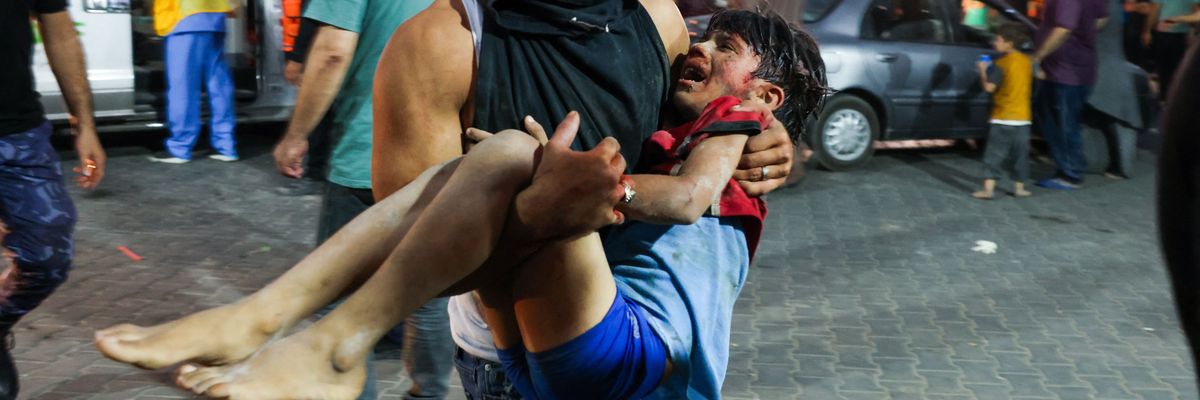
Israel’s retaliatory airstrikes across the Gaza Strip after Hamas’ weekend attack have killed at least 1,100 people in the besieged enclave, including 326 children, the Palestinian Ministry of Health said Wednesday.
Gaza-based Hamas launched a major surprise attack against Israel on Saturday, a Jewish holiday, and the Israeli death toll has now surpassed 1,200. The far-right Israeli government and Israel Defense Forces (IDF) responded with Operation Swords of Iron, bombing Gazan residential, medical, and educational buildings, and intensifying a 16-year blockade of the region.
Defense for Children International – Palestine (DCIP), which has documented cases of over 2,400 Palestinian kids killed by Israeli forces and settlers since 2000, has so far confirmed 105 of the 326 deaths.
“Intensive Israeli bombardment throughout the Gaza Strip, lack of electricity, Israeli airstrikes on telecommunications infrastructure, and the unprecedented rate of daily child fatalities has resulted in a lag between confirmed fatalities by DCIP and the overall total child fatalities published regularly by the Ministry of Health in Gaza,” the group said.
Responding to the new Ministry of Health figure, Yonah Lieberman, a co-founder of the American Jewish group IfNotNow, asked on social media, “Where is the outrage we saw when Israeli children were killed?”
DCIP’s Miranda Cleland said that from her time with the organization, she has learned that “all the dead Palestinian babies in Gaza won’t humanize Palestinians to the Israeli war machine, funded by the U.S. government, cheering on their killings.”
GAZA UPDATE: Israeli airstrikes have killed at least 326 Palestinian children in Gaza. @DCIPalestine has been able to confirm 105 Palestinian child fatalities in Gaza, including six-month-old Diaa' Ahmad Abdulati Salah from Jabalia refugee camp. https://t.co/tN3cZtIlE0pic.twitter.com/4hEEXYNFgD
The United States gives Israel $3.8 billion in annual military aid under a 10-year deal from 2016. U.S. President Joe Biden said Tuesday that his administration had begun sending additional assistance and he will seek further support from Congress.
The American group Jewish Voice for Peace argued Wednesday that “the U.S. must work to immediately de-escalate to prevent the further loss of life, and not fuel and exacerbate the violence by sending more weapons to Israel. There is only one way to end violence: to address its root cause, 75 years of Israeli military occupation and apartheid. We must end U.S. complicity in this systemic oppression.”
Some members of Congress have spoken out against Israel’s recent killing of Palestinian civilians. Sen. Bernie Sanders (I-Vt.) said Wednesday that while he welcomes the Biden administration’s offer of “solidarity and support to Israel” following Hamas’ deadly attack, “we must also insist on restraint from Israeli forces attacking Gaza and work to secure U.N. humanitarian access.”
“The targeting of civilians is a war crime, no matter who does it. Israel’s blanket denial of food, water, and other necessities to Gaza is a serious violation of international law and will do nothing but harm innocent civilians,” he stressed. “Let us not forget that half of the 2 million people in Gaza are children. Children and innocent people do not deserve to be punished for the acts of Hamas.”
The population of Gaza is about 2 million. Nearly half are children.
Millions of innocent people cannot be made to pay for Hamas’ horror.
Collective punishment is a war crime. So are blockades to food and water.
Ayed Abu Eqtaish, accountability program director at DCIP, noted Wednesday that the IDF is expected to continue ramping up its operation.
“Israeli forces are destroying entire neighborhoods in the Gaza Strip as an apparent full-scale ground assault is imminent,” he said. “Immediate humanitarian relief is necessary to protect civilians as Israeli forces prepare to intensify attacks and Israeli officials declare their intention to commit further war crimes and crimes against humanity.”
The United Nations Relief and Works Agency for Palestine Refugees in the Near East (UNRWA) is seeking $104 million to provide humanitarian aid across the Gaza Strip and beyond over the next couple of months.
“What is unfolding is already an unprecedented humanitarian tragedy. Whatever the circumstances are, rules apply in times of conflict and this one is no exception. Aid to civilians who have nowhere to flee must be immediate: water, food, medicine,” UNRWA Commissioner-General Philippe Lazzarini said Wednesday. “It is of utmost urgency that access to humanitarian assistance and protection be upheld for all civilians.”
Catherine Russell, executive director of the United Nations Children’s Fund (UNICEF), this week has also emphasized the necessity of ensuring access to humanitarian aid in the region, along with denouncing all recent attacks on civilians, especially kids.
“I am also deeply concerned about measures to block electricity and prevent food, fuel, and water from entering Gaza, which may put the lives of children at risk,” she said. “I remind all parties that in this war, as in all wars, it is children who suffer first and suffer most.”
Our work is licensed under Creative Commons (CC BY-NC-ND 3.0). Feel free to republish and share widely.
Jessica Corbett is a senior editor and staff writer for Common Dreams.
And from Haaretz.com:
“Anyone who wants to thwart the establishment of a Palestinian state has to support bolstering Hamas and transferring money to Hamas,” he told a meeting of his Likud party’s Knesset members in March 2019. “This is part of our strategy – to isolate the Palestinians in Gaza from the Palestinians in the West Bank.”
The terror attacks by Hamas against civilians who were in their homes and dancing at a concert are being called Israel’s Sept. 11, and that’s a fair comparison.
Let’s hope that Israel responds to this outrage more wisely than we in the United States did to the attack on our country.
There’s a lot of loose talk about eliminating Hamas, and Hamas deserves it. As a journalist who has traveled repeatedly to Gaza, I’m appalled by the sympathy that some Americans and Europeans have shown for a misogynist and repressive terror organization like Hamas. If you care about human rights, you want to see Hamas eliminated.
Yet dismantling terrorist organizations can be harder than it looks and can raise troubling moral questions about collateral damage. The Taliban also deserved elimination, yet in the end it was the United States that was eliminated from Afghanistan. I worry that Israel may charge into Gaza with a ground invasion as thoughtlessly as we plowed into Iraq.
Neal Keny-Guyer, a former chief executive of Mercy Corps, knows Gaza well and thinks it is possible for Israel to kill or capture most Hamas leaders. “But at what cost to civilian lives?” he asked me. He noted that street fighting might well spill over into an uprising in the West Bank and a war on the Lebanon border as well.
Gaza is half the size of New York City and home to some 2.2 million people, almost half of whom are children. Global sympathies are overwhelmingly with Israel in the aftermath of the terror attacks, as they should be, but will that be sustained if a ground invasion leads to thousands of Gazan children dying in house-to-house fighting?
Israelis grieving their dead may not care. The Israeli journalist Haviv Rettig Gur argues that the country has undergone a tectonic shift and is now determined to do what it takes, whatever the cost.
“A safe Israel can spend much time and resources worrying about the humanitarian fallout from a Gaza ground war; a more vulnerable Israel cannot,” he wrote in The Times of Israel on Sunday. Israeli officials have struck a similar tone.
“We are fighting human animals, and we are acting accordingly,” said the Israeli defense minister, Yoav Gallant. Another official was quoted as saying that Gaza would be turned into “a city of tents.”
Rabbi Jonathan Jaffe in Chappaqua, N.Y., issued an open letter noting that Jews have been traumatized by the terror attacks. “Now, Israel will act like any other country would if it was invaded by a bloodthirsty neighbor and its citizens murdered, tortured, kidnapped and mutilated,” he wrote. “And when the world inevitably protests the Jewish use of force, we won’t care.”
I empathize with that trauma and anger. Who can watch the video of Shani Louk, a 22-year-old woman kidnapped by Hamas and paraded half-naked and badly injured in Gaza, and not feel rage?
Yet this mood reminds me of the aftermath of Sept. 11 in the United States, when we sailed into trouble. I wrote column after column warning of the risks of invading Iraq, but Americans brimmed with pain, confidence and resolve. What we needed was a companion dose of humility.
The Middle East is an ongoing education in such humility. Israel originally helped nurture Hamas in Gaza because it thought religious leaders would hang out in the mosque and be less dangerous than nationalist ones. Likewise, Israel’s invasion of Lebanon in 1982 inadvertently laid the seeds for Hezbollah on the northern border.
There’s a reason that four successive Israeli prime ministers have chosen not to invade and occupy Gaza. Urban combat is a nightmare, whether for Americans in Falluja or Russians in Grozny, and civilian casualties are often enormous. That’s particularly true in a place like Gaza, where civilians cannot flee.
If we owe a moral responsibility to Israeli children, then we owe the same moral responsibility to Palestinian children. Their lives have equal weight. If you care about human life only in Israel or only in Gaza, then you don’t actually care about human life.
What that means in practice is difficult to navigate. Israel has a right to respond, and in war, civilians inevitably suffer.
“Today I woke up to see my neighborhood completely wiped off, including the building where I have my apartment,” Wafa Ulliyan, a Gazan aid worker who immigrated to Canada a few years ago, told me. “It became ashes.”
Ulliyan said she doesn’t want to see either Israelis or Palestinians targeted but just wants two states to live in peace. I’ve met plenty of people like her in Gaza — although of course there are also some who celebrate when rockets targeting Israel go off.
I flinch when I hear the defense minister refer to Palestinians as animals. Hamas dehumanized Israelis, and we must not dehumanize innocent people in Gaza.
There will be no optimal solution in Gaza, any more than there was in Afghanistan or Iraq. We are fated to inhabit a world with more problems than solutions, and it’s fair to feel conflicted about next steps. Israel will face hard choices in the coming weeks; its challenge will be to respond to war crimes without committing war crimes.
We don’t want to replicate in Gaza the approach reportedly expressed by an American Army major in Vietnam in 1968: “It became necessary to destroy the town to save it.”
The counsel we Americans should offer Israel is threefold and admittedly difficult to follow. First, Israel has right on its side when it goes after its assailants. Second, urban combat has a poor record in achieving its goals — and a considerable history of horrendous casualties. Third, if your moral compass is attuned to the suffering of only one side, your compass is broken, and so is your humanity.
The Times is committed to publishing a diversity of letters to the editor. We’d like to hear what you think about this or any of our articles. Here are some tips. And here’s our email: letters@nytimes.com.
Nicholas Kristof joined The New York Times in 1984 and has been a columnist since 2001. He has won two Pulitzer Prizes, for his coverage of China and of the genocide in Darfur. You can follow him on Instagram, Facebook and Threads. His forthcoming memoir is “Chasing Hope: A Reporter’s Life.” @NickKristof • Facebook
A version of this article appears in print on , Section A, Page 26 of the New York edition with the headline: Turning Our Moral Compass to Suffering on Both Sides. Order Reprints | Today’s Paper | Subscribe





 It has always remained in my memory, this note written with red ink in the margin of a French composition. I was eleven or twelve years old. In thirty lines I had stated that I could not agree with those who called the autumn a decline, and that I, for my part, referred to it as a beginning. Doubtless my opinion on the matter, which has not changed, had been badly expressed, and what I wanted to say what that this vast autumn, so imperceptibly hatched, issuing from the long days of June, was something I perceived by subtle signs, and especially with the aid of the most animal of my senses, which is my sense of smell. But a young girl of twelve rarely has at her disposal a vocabulary worthy of expressing what she thinks and feels. As the price of not having chosen the dappled spring and its nests, I was given a rather low mark.