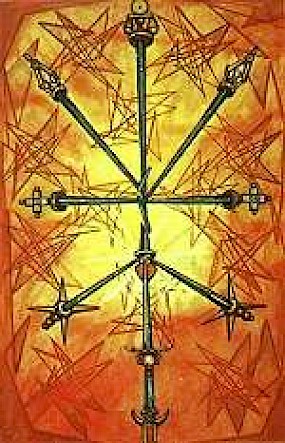
The Lord of Ruin is another of those dive-for-shelter cards that most people hate to see coming up in a reading. And certainly sometimes the card will presage a painful, even devastating event.
But this is not the underlying tenet of the Lord of Ruin. It’s the end result of failing to engage with the true message it brings.
You see, the Ten of Swords is about the power in our own minds. The end result of our thoughts, beliefs and aspirations. If we have believed in our worthiness to achieve and attain; if we have struggled to reach the highest limits of our own current spiritual potential; if we have lived in an ethical and fair manner, we will inevitably have attracted joy, happiness and success into our lives.
If, on the other hand, we have fallen short of our best; believed in our weakness and therefore empowered that belief; if we have given in to negative and harmful thoughts, we will inevitably attract to us sadness, distrust and a reason to fear.
And then the Lord of Ruin walks in. We make so many of the events that happen in our lives… and we pay too little attention to ensuring that we make only good things for ourselves. I have never believed that we can eliminate painful and testing times entirely – we learn so well, when we do things the hard way, to give up hurting to learn. But I know, beyond a shadow of doubt, that we can reduce their frequency.
Most often, the Ten of Swords should be interpreted as an unexpected, shocking and traumatic upheaval. But it’s worth looking for clues about how you might be able to lessen the impact. If you find cards like the Nine of Cups or the Eight of Swords, then it’s probably better to give the dust time to settle before making an assessment. Things often look a lot worse than they really are. With the Eight of Wands or the Five of Disks, you might feel that clear communication would resolve difficulties.
When the card comes up with Adjustment/Justice it often points to legal matters. With the Tower the problem is caused by an outside influence (but this could be one of those nasty spiritual jolts that life sometimes gives us when we’re stagnating or fearful) and you then need to look for other cards indicating who or where. With Death, the Ten of Swords takes on its saddest aspect, indicating sudden endings.
This card has the major function of reminding us that what we think today creates tomorrow. And yesterday created today. We could do worse for ourselves than to do the best we can at the time.
ARIES (March 21-April 19): The Indigenous Semai people of Malaysia have an unusual taboo. They try hard not to cause unhappiness in others. This makes them reluctant to impose their wishes on anyone. Even parents hesitate to force their children to do things. I recommend you experiment with this practice. Now is an excellent time to refine your effect on people to be as benevolent and welcoming as possible. Don’t worry—you won’t have to be this kind and sweet forever. But doing so temporarily could generate timely enhancements in your relationship life.
TAURUS (April 20-May 20): Taurus author Shakespeare reshaped the English language. He coined hundreds of words and revised the meanings of hundreds more. Idioms like “green-eyed monster” and “milk of human kindness” originated with him. But the Bard also created some innovations that didn’t last. “Recover the wind” appeared in “Hamlet” but never came into wide use. Other failures include, “Would you take eggs for money?” and “from smoke to smother.” Still, Shakespeare’s final tally of enduring neologisms is impressive. With this vignette, I’m inviting you to celebrate how many more successes than flops you have had. The time is right for realistic self-praise.
GEMINI (May 21-June 20): I hope beauty will be your priority in the coming weeks. I hope you will seek out beauty, celebrate it, and commune with it adoringly. To assist your efforts, I offer five gems: 1. Whatever you love is beautiful; love comes first, beauty follows. The greater your capacity for love, the more beauty you find in the world. —Jane Smiley. 2. The world is incomprehensibly beautiful—an endless prospect of magic and wonder. —Ansel Adams. 3. A beautiful thing is never perfect. —Egyptian proverb. 4. You can make the world beautiful just by refusing to lie about it. —Iain S. Thomas. 5. Beauty isn’t a special inserted sort of thing. It is just life, pure life, life nascent, running clear and strong. –H. G. Wells.
CANCER (June 21-July 22): I read a review that described a certain movie as having “a soft, tenuous incandescence—like fog lit by the glow of fireflies.” That sounds like who you are these days, Cancerian. You’re mysterious yet luminous; hard to decipher but overflowing with life energy; fuzzy around the edges but radiating warmth and well-being. I encourage you to remain faithful to this assignment for now. It’s not a state you will inhabit forever, but it’s what’s needed and true for the foreseeable future.
LEO (July 23-Aug. 22): The published work of Leo author Thomas de Quincey fills fourteen volumes. He inspired superstar writers like Edgar Allan Poe, Charles Baudelaire, Nikolai Gogol and Jorge Luis Borges. Yet he also ingested opium for fifty-four years and was often addicted. Cultural historian Mike Jay says de Quincey was not self-medicating or escaping reality, but rather keen on “exploring the hidden recesses of his mind.” He used it to dwell in states of awareness that were otherwise unattainable. I don’t encourage you to take drugs or follow de Quincey’s path, Leo. But I believe the time is right to explore the hidden recesses of your mind via other means. Like what? Working with your nightly dreams? Meditating your ass off? Having soul-altering sex with someone who wants to explore hidden recesses, too? Any others?
VIRGO (Aug. 23-Sept. 22): Virgo journalist H. L Mencken said, “The average person doesn’t want to be free. He wants to be safe.” There’s some truth in that, but I believe it will be irrelevant for you in the coming months. According to my analysis, you can be both safer and freer than you’ve been in a long time. I hope you take full advantage! Brainstorm about unexpected feats you might be able to accomplish during this state of grace.
LIBRA (Sept. 23-Oct. 22): Libran philosopher and writer Michel Foucault aspired to open up his readers’ minds with novel ideas. He said his task was to make windows where there had been walls. I’d like to borrow his approach for your use in the coming weeks. It might be the most fun to demolish the walls that are subdividing your world and keeping you from preventing free and easy interchange. But I suspect that’s unrealistic. What’s more likely is partial success: creating windows in the walls.
SCORPIO (Oct. 23-Nov. 21): More and more older people are transitioning to different genders. An article in The Guardian (tinyurl.com/GenderMeaning) describes how Bethan Henshaw, a warehouse worker, transitioned to female at age fifty-seven. Ramses Underhill-Smith became a man in his forties. With this as your starting point, I invite you to re-evaluate your personal meanings of gender. Please note I’m not implying you should change your designation. Astrological omens simply suggest that you will benefit from expanding your ideas. Here’s Scorpio singer Sophie B. Hawkins, a mother who says she is omnisexual: “My sexuality stems from an emotional connection to someone’s soul. You don’t have to make a gender choice and stick with it.”
SAGITTARIUS (Nov. 22-Dec. 21): Sagittarian author Mark Twain said that in urgent or trying circumstances, uttering profanities “furnishes a relief denied even to prayer.” I will add that these magic words can be downright catalytic and healing—especially for you right now. Here are situations in which swearing could be therapeutic in the coming weeks: 1. when people take themselves too seriously; 2.when you need to escape feelings of powerlessness; 3. when know-it-alls are trying to limit the range of what can be said; 4. when people seem frozen or stunned and don’t know what to do next. In all these cases, well-placed expletives could provide necessary jolts to shift the stuck energy. (PS: Have fun using other surprises, ploys, and twists to shake things up for a good cause.)
CAPRICORN (Dec. 22-Jan. 19): In Roman mythology, Venus was goddess of love, desire and beauty. Yet modern science tells us the planet Venus is blanketed with sulfuric acid clouds, has a surface temperature of 867 degrees Fahrenheit, and is covered with 85,000 volcanoes. Why are the two Venuses out of sync? Here’s a clue, courtesy of occultist Dion Fortune. She said the goddess Venus is often a disturbing influence in the world, diverting us from life’s serious business. I can personally attest to the ways that my affinity for love, desire and beauty have distracted me from becoming a hard-driving billionaire tech entrepreneur. But I wouldn’t have it any other way. How about you, Capricorn? I predict that the goddess version of Venus will be extra active in your life during the coming months.
AQUARIUS (Jan. 20-Feb. 18): Thousands of heirloom food species are privately owned and hoarded. They once belonged to Indigenous people but haven’t been grown for decades. Descendants of their original owners are trying to get them back and grow them again—a process they call rematriation—but they meet resistance from companies and governmental agencies that commandeered the seeds. There has been some progress, though. The Ho-Chunk Nation of Wisconsin has recovered some of its ancestral corn, beans and squash. Now would be a good time for you Aquarians to launch your own version of rematriation: reclaiming what was originally yours and that truly belongs to you.
PISCES (Feb. 19-March 20): I like Piscean poet Jane Hirshfield’s understanding of what “lies at the core of ritual.” She says it’s “the entrance into a mystery that can be touched but not possessed.” My wish for you right now, Pisces, is that you will experience mysteries that can be touched but not possessed. To do so will give you direct access to prime riddles at the heart of your destiny. You will commune with sublime conundrums that rouse deep feelings and rich insights, none of which are fully explicable by your logical mind. Please consider performing a homemade sacred ritual or two.
Matthew Stel Oct 10, 2023 This is the 2nd morning Venus Gate (which is associated with the third eye chakra), and the second Moon-Venus conjunction since Venus became a morning star. I really encourage you to wake up at least 45 minutes to an hour before sunrise tomorrow to be blessed to see them even closer together. Venus is currently near to her maximum elongation from the Sun (maximum is reached on October 23rd) and so she is visible in the morning for the longest period of time before sunrise. You can currently see her rise close to 3 am, so if you want to see the striking sight of Venus very close to the Moon, right on your local eastern horizon, then you might consider setting your alarm for tomorrow morning. Because Venus is visible so long before sunrise, this is a moment when there is maximum opportunity for developing intimacy with her, and it makes this Venus Gate more special. I feel that we are invited to really connect with her now, and to take more time to simply be with her, to pray to her, and to appreciate her beauty. These two days that she is joined by the Moon (who is another goddess of intimacy and connection) are particularly special for this, and there is an even greater opportunity for deep communion with the goddess energy that they both embody and channel together. When the Moon and Venus come together each month it is a time to remember the importance of self-love, self-care, and what it is to have a sweet and kind connection with yourself and others. To go out to try to see these conjunctions regularly, whether they are in the sunrise sky or the sunset sky, is to develop a sweet loving bond with both of them on a spiritual level, and that somehow translates to you being able to have that kind of relationship with yourself. An additional alignment that is also happening right now, is that Venus is currently opposite the planet Saturn, and when the exact Moon-Venus conjunction forms tomorrow, they both will be exactly opposite Saturn. There are many ways that we might feel into this, but if you add Saturn’s associations with strength, maturity, commitment and loyalty, to the Moon-Venus associations with love, kindness, tenderness, and sweetness, you are likely to receive guidance during these days on what mature, committed, loyal love might look like for both yourself and your closest relationships. May it be so.
Hey Everyone! I hope you have all been very well, and that you have been practicing love and kindness with both yourself and all beings. This is just a quick email to let you know that there is a special astronomical alignment happening today and tomorrow. Venus is now visible in the morning sky before sunrise, and for the second time since she became a morning star, she is joined by a beautiful crescent moon. They will both be visible between 3:30 am and sunrise tomorrow, so if you get out at least 45 minutes before sunrise and look to the east, you will be sure to see them. This will happen six more times in the coming months before Venus disappears behind the Sun next April.
I will be back later this week with information about an Eclipse Season Promotion that I will be offering. Until then, wishing you all happy sky gazing!
Matthew
This was the incoming Moon-Venus conjunction yesterday morning (with Venus also very near to the star Regulus). This is the 2nd morning Venus Gate (which is associated with the third eye chakra), and the second Moon-Venus conjunction since Venus became a morning star. I really encourage you to wake up at least 45 minutes to an hour before sunrise tomorrow to be blessed to see them even closer together.
Venus is currently near to her maximum elongation from the Sun (maximum is reached on October 23rd), and so she is visible in the morning for the longest period of time before sunrise. You can currently see her rise close to 3 am, so if you want to see the striking sight of Venus very close to the Moon, right on your local eastern horizon, then you might consider setting your alarm for tomorrow morning.
Because Venus is visible so long before sunrise, this is a moment when there is maximum opportunity for developing intimacy with her, and it makes this Venus Gate more special. I feel that we are invited to really connect with her now, and to take more time to simply be with her, to pray to her, and to appreciate her beauty. These two days that she is joined by the Moon (who is another goddess of intimacy and connection) are particularly special for this, and there is an even greater opportunity for deep communion with the goddess energy that they both embody and channel together.
When the Moon and Venus come together each month it is a time to remember the importance of self-love, self-care, and what it is to have a sweet and kind connection with yourself and others. To go out to try to see these conjunctions regularly, whether they are in the sunrise sky or the sunset sky, is to develop a sweet loving bond with both of them on a spiritual level, and that somehow translates to you being able to have that kind of relationship with yourself.
An additional alignment that is also happening right now, is that Venus is currently opposite the planet Saturn, and when the exact Moon-Venus conjunction formed today, they both were exactly opposite Saturn. There are many ways that we might feel into this, but if you add Saturn’s associations with strength, maturity, commitment and loyalty, to the Moon-Venus associations with love, kindness, tenderness, and sweetness, you are likely to receive guidance during these days on what mature, committed, loyal love might look like for both yourself and your closest relationships.
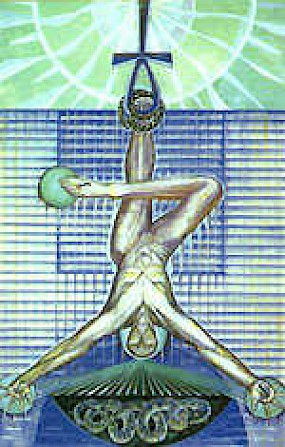
The Hanged Man is numbered twelve and is depicted as a figure, usually male, hanging upside down from a tree or branch. He often has his hands behind his back, as though tied (though as you can see the Thoth interpretation moves away from this aspect of apparent helpnessness). Usually one leg is tucked behind the other to form a triangle shape. Strangely though, he tends to look quite happy and content with his situation.
Not a very popular card, the Hanged Man deals with sacrifice, delays and waiting – and also being bogged down and helplessness. We sacrifice every time we make a choice – reading this web page means you have sacrificed reading the alternatives. Since sacrifice can mean giving up one thing of value for another thing of equal or greater value, this card can easily be seen as representing the natural and normal function of disposing of something that no longer suits its purpose as well as its replacement will.
The Hanged Man is totally vulnerable, his attitude is “whatever will be, will be”. He accepts everything that happens with equanimity and courage – he is, after all, simply giving in to his destiny. He can sometimes represent the person who has waited too long, who is perhaps scared to change. We should endure with strength and inner peace, but also be courageous enough to take action when destiny calls.
How Race, Medicine, and the Law Shape Reactions to Pregnancy Loss
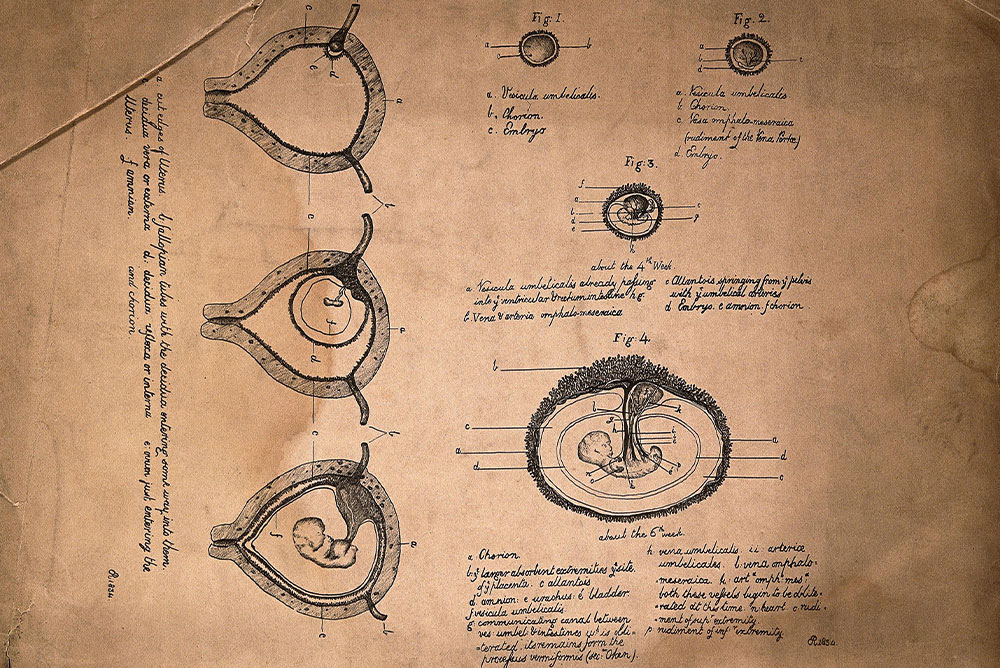
Lithograph of development of fetus in uterus, 1834. Courtesy of Wellcome Collection.
by SHANNON WITHYCOMBE | MAY 18, 2022 (zocalopublicsquare.org)
In the fall of 2012, I woke up early in the morning with cramps. I went to the bathroom and saw blood on my underwear. I was nine weeks pregnant, and it looked like I was having a miscarriage. I was surprised and sad, but also resigned. I had been researching and writing about the history of 19th century miscarriage for seven years, and I knew how often it is a routine part of a person’s reproductive journey.
I called my doctor’s office and was directed to the emergency room, where I sat for six hours, received two vaginal ultrasounds and three pelvic exams, and was repeatedly told I could not have any food, “just in case we need to do something.” I left with a $500 hospital bill, a headache, a noncommittal diagnosis of “threatened abortion,” and a new feeling of confusion and insecurity. Doctor after doctor told me, patronizingly, “We can’t find your pregnancy.” Despite what I thought I knew about pregnancy and miscarriage, that question made me wonder: Had I possibly read the pregnancy tests wrong?
Later, after things had run their course and I sat in bed with a heating pad over my abdomen, I could not help but think of all the women I had found in my research, women who miscarried at home, with family help, and who seemed free from recriminations, self-doubt, and self-blame. What had changed in the 150 years since then?
The answer is: reproductive expectations, limitations, and realities. Throughout history, people with uteruses have had miscarriages, and they have always understood the experiences within their personal family structures, within social and legal limitations on fertility control, and under the influence of all sorts of other factors, from trends in medical practice to racial politics. Today, those factors also include rapidly expanding legislation on the “rights” of the fetus taking priority over the health and life of the mother.
For women in the late 19th century, the factors and limitations influencing their understanding of miscarriage included a national ban on contraception and abortion. In January 1874, 26-year-old Annie Van Ness wrote in her diary: “I have been very cross and irritable and I think I have a very good reason to feel ill humored.” Two weeks later, she reported feeling much better: “Quite a change has come over the spirit of my dream since I last wrote, and I am happy again.” The reason for the change? Van Ness had a miscarriage.
When I first came across Van Ness’s words, I was surprised and fascinated. At a time when most white American women were besieged with messages that their duty and natural destiny was to have children, this woman was openly writing about how happy she was to fail in that duty. And she was far from alone. In 1879, Mary Cheney, a mother of nine who had spent 16 years in near constant reproduction—pregnant, birthing, or nursing—wrote her husband, after miscarrying: “O Bliss, O Rapture unforeseen! The imaginary number 10, whom I had already begun to love, is not a real entity as yet, and I hope will not be for a long time to come.”
At a time when most white American women were besieged with messages that their duty and natural destiny was to have children, this woman was openly writing about how happy she was to fail in that duty.
According to today’s social narratives, miscarriage is almost always a loss, an event to grieve, and usually a secret. But in a world where women had much less control over their fertility, things were different. When Annie Van Ness got married in 1873, her husband had just lost most of his wealth in the recent economic panic. She had no interest in starting her family amidst financial instability, but she also had no reliable means to prevent or terminate pregnancy (both were illegal in New York, where she lived). Within such restrictions it makes sense that she was cross when she suspected she was pregnant, and happy when she miscarried. My first miscarriage, and the disappointment I felt around it, took place under very different circumstances: I had the ability to prevent pregnancy until I felt I had the financial and social stability to start a family.
Van Ness, Cheney, and I—and American women everywhere, for the last 150 years—have also interpreted our miscarriages in ways that are contingent on race. Throughout the 1800s, white male physicians were trying to gain a foothold in the business of delivering babies. Previously, most American women had given birth at home, attended by female family members, friends, and midwives.
To argue that they were the better attendants for birthing women, male physicians perpetuated a narrative of racial and ethnic difference in childbirth. They claimed that groups that were “closer to nature” or “more animalistic” (namely, African Americans and Native Americans) did not need medical help in childbirth because they were naturally better at the job. But white, “civilized” women were removed from ancient natural knowledge and couldn’t possibly take care of matters on their own. (White physicians, angling to practice new skills or experiment with procedures, also sought to deliver the babies of enslaved Black women but in keeping with the narrative, rarely offered them pain relief or comfort.)
Doctors all over the country promoted and presented “proof” for the “civilized versus savage” narrative. St. Louis physician George Engelmann, writing in 1881 in the prestigious American Journal of Obstetrics, contended that most “primitive” women’s labor “may be characterized as short and easy, accompanied by few accidents and followed by little or no prostration.” He added, “the nearer the civilization is approached, the more trying does the ordeal of childbirth become.”
This thinking, too, impacted women’s experiences of pregnancy loss. In 1846, Susan Shelby Magoffin, newly married and 18 years old, set off from Missouri on a trip down the Santa Fe trail with her husband. Six weeks in, she had a miscarriage. She spent the following week in bed, supervised by a physician. Reflecting on her sadness over losing her chance to be “a happy mother,” in her diary, she also noted that while she was suffering through the miscarriage, “an Indian woman gave birth to a fine healthy baby, about the same time, and in half an hour after she went to the River and bathed herself and it.”
Magoffin’s diary reveals both an intertwining feeling of failure and the ideas of racial disparities—and an acute difference in postpartum care. The perceived weakness of white women like Magoffin has resulted in their receiving increased care, resources, and protection. Meanwhile, women of color faced the next century of being denied medical and economic support for birthing and rearing their children.
The legacy of “savage” and “civilized” women popularized in the 19th century remains with us today, visible in well-documented health disparities. Black women face a maternal mortality rate almost three times as high as white women, and Black infants die two to three times more often than white infants. New laws criminalizing abortion, intrauterine devices (IUDs), and Plan B will make the gaps in care and resources between these groups more dangerous, and will affect a new generation’s experience of pregnancy loss anew. These laws will undoubtedly increase the surveillance and policing—and deaths—of members of those groups constructed as “naturally” good at pregnancy and childbirth.
Already, my own experience with miscarriage stands in stark contrast to those of women of color like Lizelle Herrera in Texas and Brittney Poolaw in Oklahoma, whose arrivals at the hospital were met with suspicion and even jail time.
I have felt myriad emotions for each of my three pregnancies that did not result in a live child, but as states continue to pass laws codifying fetal personhood and categorizing failed pregnancies as murder, such emotions will come under new scrutiny and suspicion. For women of color, reacting to a miscarriage in a way deemed inappropriate by medical practitioners or even neighbors will carry a much bigger danger.
SHANNON WITHYCOMBEis an associate professor of history at the University of New Mexico. She is the author of Lost: Miscarriage in Nineteenth-Century America, and is currently researching the racial dynamics of infant mortality and prenatal care in the early 20th century. Follow her on Twitter @skwithycombe.
Author’s Note: This is a complete revision of the post originally titled “Maslow Got It Wrong.” My earlier version included inaccuracies, as some readers pointed out, like the assumption Maslow depicted his theory in a pyramid shape. I have documented and attempted to correct these errors in this companion post called What I Got Wrong: Revisions to My Post About Maslow and the Blackfoot. I’ve updated the post you’ll read below, so it is more focused on what we can learn from the Blackfoot and from other Native cultures. I have retitled this post to reflect this emphasis more clearly.
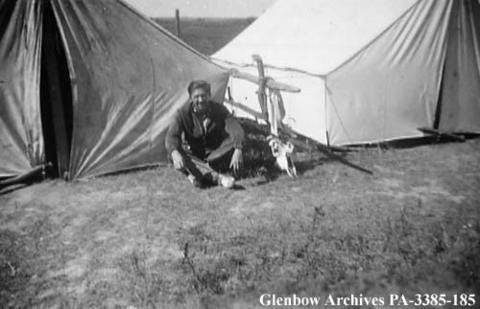
Some months ago, I was telling my friend and GatherFor Board Member Roberto Carlos Rivera that I had come across unpublished papers by Abraham Maslow suggesting changes to his famous Hierarchy of Needs. Roberto, Executive Director of Alliance for the 7th Generation, was familiar with the subject and turned me on to something else I didn’t know: Maslow’s Hierarchy of Needs may have been inspired by the Siksika (Blackfoot) way of life. In reading follow-up materials he sent me, I learned Maslow spent six weeks living at Siksika — which is the name of the people, their language, and the Blackfoot Reserve — in the summer of 1938. His time there upended some of his early hypotheses and possibly shaped his theories. While I initially came to believe Maslow appropriated and misrepresented the teachings of the Blackfoot, I have learned that this narrative, while held by some, may not be accurate even according to Blackfoot scholars. Yet what has been far more valuable for me in this inquiry was learning what Maslow witnessed at Siksika. Whereas mainstream American narratives focus on the individual, the Blackfoot way of life offers an alternative resulting in a community that leaves no one behind.
Ryan Heavy Head (also known as Ryan FirstDiver) and the late Narcisse Blood, members of the Blackfoot Nation, received a grant from the Canadian Government’s Social Sciences and Humanities Research Council to research Blackfoot influences on Maslow. Their lectures summarize their findings and are stored in the Blackfoot Digital Library. Dr. Cindy Blackstock — a member of the Gitxsan First Nation tribe, a professor at McGill, and Executive Director of the First Nations Child and Family Caring Society — has conducted similar research. My primary investigation into this topic involved watching Blood and Heavy Head’s lectures; reading the works of and corresponding with Cindy Blackstock; speaking to and reviewing the writings and podcasts of the world’s foremost Maslow expert, Dr. Scott Barry Kaufman; speaking to Ryan Heavy Head on the phone; and consulting the sources cited at the end of this article.
What Maslow Encountered at Siksika
According to Blood and Heavy Head’s lectures (2007), 30-year-old Maslow arrived at Siksika along with Lucien Hanks and Jane Richardson Hanks. He intended to test the universality of his theory that social hierarchies are maintained by dominance of some people over others. However, he did not see the quest for dominance in Blackfoot society. Instead, he discovered astounding levels of cooperation, minimal inequality, restorative justice, full bellies, and high levels of life satisfaction. He estimated that “80–90% of the Blackfoot tribe had a quality of self-esteem that was only found in 5–10% of his own population” (video 7 out of 15, minutes 13:45–14:15). As Ryan Heavy Head shared with me on the phone, “Maslow saw a place where what he would later call self-actualization was the norm.” This observation, Heavy Head continued, “totally changed his trajectory.” (For the reader wondering what self-actualization is, Maslow offered this definition, influenced by Kurt Goldstein, in his 1943 paper: “This tendency might be phrased as the desire to become more and more what one is, to become everything that one is capable of becoming.” The word itself does not exist in the Siksika language, but the closest word is niita’pitapi, which Ryan Heavy Head told me means “someone who is completely developed, or who has arrived.”)
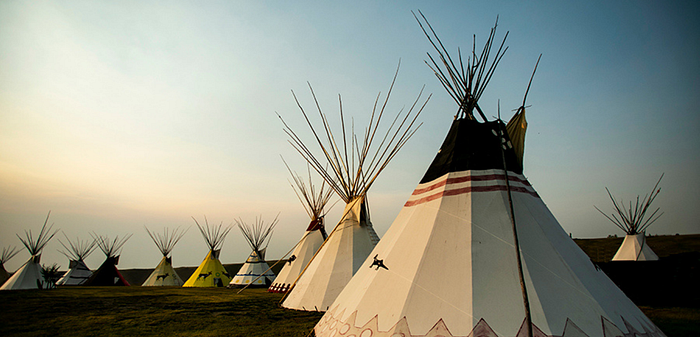
Deeply curious about the reason for the stark difference between Blackfoot culture and his own culture, Maslow sought out positive deviants, or unusually successful individuals. He started with the wealthiest members of the Blackfoot tribe. He discovered that “for the Blackfoot, wealth was not measured by money and property but by generosity. The wealthiest man in their eyes is one who has almost nothing because he has given it all away” (Coon, 2006). Maslow witnessed a Blackfoot “Giveaway” ceremony in his first week at Siksika. During the Giveaway, members of the tribe arranged their tipis in a circle and publicly piled up all they had collected over the last year. Those with the most possessions told stories of how they amassed them and then gave every last one away to those in greater need (Blood & Heavy Head, 2007, video 7 out of 15, minutes 13:00–14:00). By contrast, as shared by Maslow’s biographer Edward Hoffman, Maslow observed different qualities in members of his own culture:
To most Blackfoot members, wealth was not important in terms of accumulating property and possessions: giving it away was what brought one the true status of prestige and security in the tribe. At the same time, Maslow was shocked by the meanness and racism of the European-Americans who lived nearby. As he wrote, “The more I got to know the whites in the village, who were the worst bunch of creeps and bastards I’d ever run across in my life, the more it got paradoxical.”
Maslow continued his investigation by looking into negative deviants. He was curious how the Blackfoot might deal with lawbreakers without the strategy of dominance that he’d seen in his own culture. He found that “when someone was deviant, [the Siksika] didn’t peg them as deviant. A person who was deviant could redeem themselves in society’s eyes if they left that behavior behind” (Blood & Heavy Head, 2007, video 7 out of 15, minutes 15:44–16:08).
Maslow then wondered whether the answer to producing high self-actualization might lie in child-rearing. He found that children were raised with great permissiveness and treated as equal members of Siksika society, in contrast to a strict, disciplinary approach found in his own culture. Despite having great freedom, Siksika children listened to their elders and served the community from a young age (ibid, minutes 16:35–17:07).
According to Heavy Head, witnessing the qualities of self-actualization among the Blackfoot and diving into their practices led Maslow to deeper research into the journey to self-actualization, and the eventual publishing of his famous Hierarchy of Needs concept in his 1943 paper.
Differences Between Maslow’s Theories and Blackfoot Beliefs
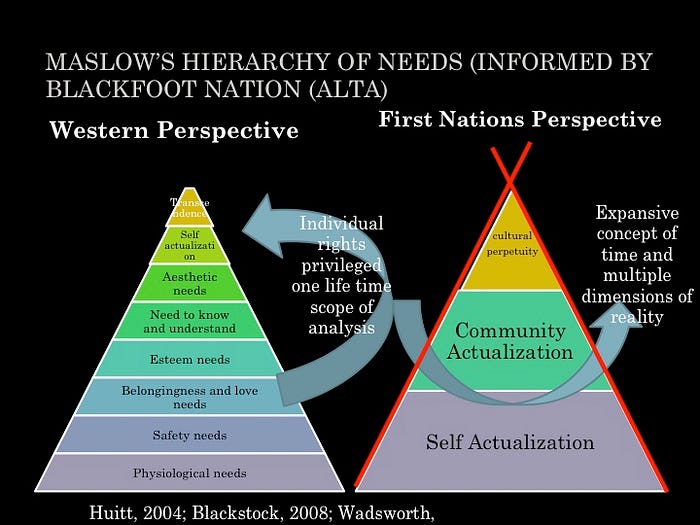
Ryan Heavy Head shared with me that, while there are strong belief systems and long standing traditions in place, the Blackfoot don’t have a “model” for their worldview, neatly codified in a paper like Maslow’s. But to help explain the different emphases of the Western worldview and the views of First Nations, Dr. Cindy Blackstock, herself a member of the Gitxsan tribe who interviewed members of the Blackfoot Nation, created the illustration below (Michel, 2014):
Because Maslow never himself depicted his hierarchy as a pyramid (Kaufman, 2019) and the Blackfoot did not draw their worldview on a tipi (Heavy Head, personal conversation, 2021), this diagram should not be read as an exact comparison or as capturing the nuances of both lenses. However, I have included it here to help those of us mired in Western thinking see the different emphasis of First Nations perspectives.
Blackstock makes clear that there is great diversity among First Nations, but the above diagram captures some of the similarities she’s found in her study of them, including the Blackfoot. I summarize my understanding of her diagram below.
Self-Actualization
Maslow appeared to ask, “how do we become self-actualized?”. Many First Nation communities, though they would not have used the same word, might be more likely to believe that we arrive on the planet self-actualized. Ryan Heavy Head explained the difference through the analogy of earning a college degree. In Western culture, you earn a degree after paying tuition, attending classes, and proving sufficient mastery of your area of study. In Blackfoot culture, “it’s like you’re credentialed at the start. You’re treated with dignity for that reason, but you spend your life living up to that.” While Maslow saw self-actualization as something to earn, the Blackfoot see it as innate. Relating to people as inherently wise involves trusting them and granting them space to express who they are (as perhaps manifested by the permissiveness with which the Siksika raise their children)rather than makingthem the best they can be. For many First Nations, therefore, self-actualization is not achieved; it is drawn out of an inherently sacred being who is imbued with a spark of divinity. Education, prayer, rituals, ceremonies, individual experiences, and vision quests can help invite the expression of this sacred self into the world. (As some readers have commented, this concept appears in other belief systems, such as Paulo Freire’s challenge to the “banking concept of education” and the Buddhist notion that all beings contain Buddha-nature.)
Community Actualization
As Maslow witnessed in the Blackfoot Giveaway, many First Nation cultures see the work of meeting basic needs, ensuring safety, and creating the conditions for the expression of purpose as a community responsibility, not an individual one. Blackstock refers to this as “Community Actualization.” Edgar Villanueva (2018) offers a beautiful example of how deeply ingrained this way of thinking is among First Nations in his book Decolonizing Wealth. He quotes Dana Arviso, Executive Director of the Potlatch Fund and member of the Navajo tribe, who recalls a time she asked Native communities in the Cheyenne River territory about poverty:
“They told me they don’t have a word for poverty,” she said. “The closest thing that they had as an explanation for poverty was ‘to be without family.’” Which is basically unheard of. “They were saying it was a foreign concept to them that someone could be just so isolated and so without any sort of a safety net or a family or a sense of kinship that they would be suffering from poverty.” (p. 151)
Ryan Heavy Head explains that such communal cooperation is especially important for the Blackfoot because of their relationship to place, something Maslow entirely omitted in his theories:
the one thing that [Maslow] really missed was the Indigenous relationship to place. Without that, what he’s looking at as self-actualization doesn’t actually happen. There’s a reason people aren’t critical of their tribe: you’ve got to live with them forever.
In other words, having your life bound up with those around you for its whole duration can support creating a culture of generosity, trust, and cooperation, rather than one of inequality and individualism. Being in conflict with permanent neighbors, while also living in such a communal culture, can prove costly and stressful. Learning to cooperate, forgiving wrongdoing, and pursuing the sharing of resources and wisdom make life much more tolerable in these conditions.
Cultural Perpetuity
The skillfulness to nourish a community-wide family, keep each person fed, live in harmony with the land, and minimize internal and external conflicts is handed down from generation to generation in First Nations. Because knowledge can vanish as people pass on, each generation sees it as their responsibility to perpetuate their culture by adding to the tribe’s communal wisdom and passing on ancestral teachings to children and grandchildren. As Cindy Blackstock (2019) explains:
First Nations often consider their actions in terms of the impacts of the “seven generations.” This means that one’s actions are informed by the experience of the past seven generations and by considering the consequences for the seven generations to follow.
Many First Nations have developed both formal rituals and informal apprenticeships for the transfers of wisdom from elders to youngsters to ensure the community is able to support self-actualization and community-actualization in perpetuity.
As Blackfoot scholar Billy Wadsworth (of the Blood, or Kanai Tribe) summarizes in dialogue with Cindy Blackstock (2011), Maslow did not “fully situate the individual within the context of community.” If he had done so, and also more deeply integrated the Blackfoot perspective, “the model would be centered on multi-generational community actualization versus on individual actualization and transcendence.”
Maslow himself may have agreed with this critique. Scott Barry Kaufman (2020) shares an excerpt from an unpublished Maslow essay from 1966, 23 years after he published his paper on the Hierarchy of Needs, called “Critique of Self-Actualization Theory”,
self-actualization is not enough. Personal salvation and what is good for the person alone cannot be really understood in isolation. The good of other people must be invoked as well as the good for oneself. It is quite clear that purely inter-psychic individualist psychology without reference to other people and social conditions is not adequate.
What else emerges when we see the individual as deeply situated in community?
Circles, Not Triangles
The triangular models above suggest that there’s a place to start meeting our needs and a place we end up. But is it true that our needs follow Maslow’s hierarchy of “prepotency”, where some needs consistently take priority over others? Maslow (1943) himself indicates there are many exceptions to his hierarchy and Blackstock (2011) agrees, citing Seneca First Nation member and psychologist Terry Cross:
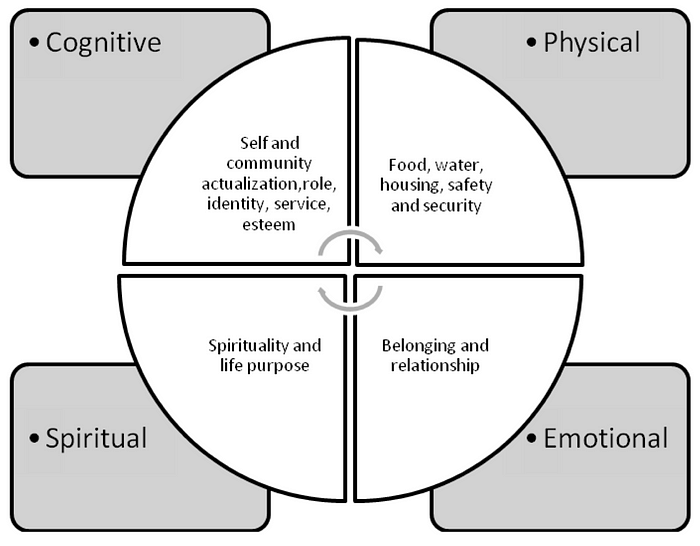
Cross (2007) argues that human needs are not uniformly hierarchical but rather highly interdependent […] [P]hysical needs are not always primary in nature as Maslow argues, given the many examples of people who forgo physical safety and well-being in order to achieve love, belonging, and relationships or to achieve spiritual or pedagogical objectives. The idea of dying for country is an example of this as men and women fight in times of war.
Blackstock represents Cross’ ideas in the circular model below:
This circular model reveals thinking in line with many First Nations: depending on the situation, the order in which our needs must be met is subject to change. A circular model captures the inter-relatedness of our needs and helps highlight that we can experience needs simultaneously and in changing order. This way of viewing needs makes more sense when seeing an individual as deeply rooted in a community, especially because a community is capable of meeting multiple needs in parallel. While one individual is cooking, another may be keeping children safe, while another may be negotiating peace with people from other tribes.
When we organize a society as though each individual is primarily responsible for meeting their own needs, we may see results like Maslow predicted in his 1943 paper:
In actual fact, most members of our society who are normal, are partially satisfied in all their basic needs and partially unsatisfied in all their basic needs at the same time. A more realistic description of the hierarchy would be in terms of decreasing percentages of satisfaction as we go up the hierarchy of prepotency, For instance, if I may assign arbitrary figures for the sake of illustration, it is as if the average citizen is satisfied perhaps 85 per cent in his physiological needs, 70 per cent in his safety needs, 50 per cent in his love needs, 40 per cent in his self-esteem needs, and 10 per cent in his self-actualization needs.
In this hierarchical view and the subsequent execution of it in society, it’s rare to see individuals who have met their needs. Here’s Maslow again:
We shall call people who are satisfied in these needs, basically satisfied people […] Since, in our society, basically satisfied people are the exception, we do not know much about self-actualization, either experimentally or clinically.
But Maslow seemed to discover that basically satisfied people were the norm at Siksika, where community was primarily responsible for meeting the needs of its members.
Why Haven’t We Heard About The Blackfoot Worldview Before?
Though Maslow saw full bellies, low-inequality, and rates of self-actualization at 80–90%, why didn’t he alert the world to all we could be learning from the Blackfoot? He clearly held them in high regard, as he indicated in journals and in his biography.
It’s possible that Maslow may have faced dismissal if he had publicized Blackfoot teachings. Dr. Richard Katz, author of Indigenous Healing Psychology: Honoring the Wisdom of First Peoples, Harvard professor, and personal friend of Maslow’s speaks to this point in a podcast conversation with Scott Barry Kaufman (minutes 28:50–32:20). He says he never spoke directly with Maslow about this, but postulates that Maslow may have been concerned that elevating Siksika teachings might diminish the validity of the ideas he was putting forth. Such barriers to Indigenous contributions have remained in academia until today (Blackstock, 2019).
Despite the fallibility of our mainstream institutions, publicly challenging prevailing worldviews is risky business. Galileo’s elevation and defense of the Copernican heliocentric solar system, for example, led to his being labeled a heretic by the Catholic Church and placed under permanent house arrest.
By offering compelling alternatives, Indigenous worldviews pose a threat to our status quo. Lakota Medicine Man John Fire Lame Deer offers one poignant contrast between the world he grew up in and the world of “the white man”:
Before our white brothers came to civilize us we had no jails. Therefore we had no criminals. You can’t have criminals without a jail. We had no locks or keys, and so we had no thieves. If a man was so poor that he had no horse, tipi or blanket, someone gave him these things. We were too uncivilized to set much value on personal belongings. We wanted to have things only in order to give them away. We had no money, and therefore a man’s worth couldn’t be measured by it. We had no written law, no attorneys or politicians, therefore we couldn’t cheat. We really were in a bad way before the white men came, and I don’t know how we managed to get along without these basic things which, we are told, are absolutely necessary to make a civilized society. (Lame Deer: Seeker of Visions, p. 70)
Precisely for whom is the United States the greatest country in the world?
The wealthiest Americans, unlike the Blackfoot during the Giveaway Ceremony — devote the smallest portion of their income to supporting those in need. As Ken Stern writes in The Atlantic:
In 2011, the wealthiest Americans — those with earnings in the top 20 percent — contributed on average 1.3 percent of their income to charity. By comparison, Americans at the base of the income pyramid — those in the bottom 20 percent — donated 3.2 percent of their income. […] Some experts have speculated that the wealthy may be less generous [than other classes] — that the personal drive to accumulate wealth may be inconsistent with the idea of communal support.
Since its inception, mainstream US culture has consistently failed to meet the basic needs of so many of its people. Who wins when, despite this shortcoming, we tell tales of American greatness? Who is left out?
Waking up from Our American Dream
As Seneca First Nation member and psychologist Terry Cross defines it in this keynote presentation, “culture is one group or people’s preferred way of meeting their basic human needs.” The American Dream tells us that we meet our basic needs by working hard to “pull ourselves up by our bootstraps.” That way, we become free from having to depend on anyone else.
Who benefits from this story being told? Is it even true? As Daniel Suelo says in The Man Who Quit Money, “There’s not a creature or even a particle in the universe that’s self-sufficient. We’re all dependent on everybody else” (p. 133). Who sewed the clothes you’re wearing right now? How many materials from how many different parts of the world are inside the device you’re reading this post on? How many hands touched the food you ate for lunch on its way to your table? How many living beings participated in the creation of your home, in your education, and in your emotional state? Even if you purchased these goods with money you earned, you are relying on a community to care for you. Our lives are inextricably tied up with one another. Indigenous communities offer us an example of what is possible when we embrace this reality.
Because it has affected us all and exposed fissures in our structural underpinnings, this pandemic may be our moment to interrupt our old story. It’s prompted us to embrace previously heretical ideas like reparations, universal basic income in the form of stimulus checks, and mutual aid. This is our moment to step out of our lonely struggle to fend for ourselves, a story maintained by those winning in the status quo. This is our moment not to create something new, but to return to an ancient way of being, known to the Blackfoot, the Lakota, the Natives of the Cheyenne River Territory, and other First Nations. It’s a story that leaves no one without family: a story in which we begin by offering each other belonging, and continue by teaching our descendants how we lived: together.
About the Author
For years, I’ve been wrestling with the American Dream — especially the part that tells us we should all be self-made. My parents immigrated to the US from India with $200 in their pockets. While they worked hard, they might not have been able to navigate life in a brand-new country if my Uncle Suresh hadn’t given them a place to stay or if a kind stranger named Dr. Bob Selker had made a call that landed my dad his first job at a hospital in Denver. My own family’s experience taught me that no one makes it on their own. My belief that no one makes it on their own led to creating GatherFor. We organize and resource teams of neighbors experiencing unemployment, housing and food insecurity, and other socioeconomic challenges to support each other like a family would. We provide them direct cash assistance and workshops as requested on the way to supporting them cultivate a “neighborhood safety net.” We’re currently piloting in Brownsville, Brooklyn, and you can learn more at gatherfor.org and support our direct cash assistance efforts here if you’d like.
Acknowledgements
Writing this post, especially after receiving a great deal of public feedback, involved multiple drafts, rewrites, and conceptual reorientations. You cansee another post detailing my earlier inaccuracies and corrections here. I am sincerely grateful to Colette Kessler and Vidya Ravilochan for serving as thought partners and diligent editors for multiple drafts of this post. I also want to thank Roberto Rivera for teaching me about many of the concepts presented here; Ryan Heavy Head for his phone call with me and reviews of this draft; Scott Barry Kaufman for compassionate corrections to nuances about Maslow’s work; and Abby Nimz, Kamasamudram Ravilochan,
Sheryl Winarick for feedback. This post would not be possible without the work of Ryan Heavy Head and Narcisse Blood for telling the story of Maslow’s time at Siksika and Cindy Blackstock for the development of her Breath of Life Theory. Lastly, I want to convey my deepest thanks to the Siksika and other Native peoples for sharing the teachings that I believe we have so much to learn from.
Blood, N., & Heavyhead, R. (2007). Blackfoot influence on Abraham Maslow(Lecture delivered at University of Montana). Blackfoot Digital Library. Accessed 25 April 2021.
Coon, D. (2006). Abraham H. Maslow: Reconnaissance for eupsycia. In D.A. Dewsbury, L.T. Benjamin Jr. & M. Wertheimer (Eds). Portraits of Pioneers in Psychology, Vol. 6 (pp. 255–273). Washington, D.C. & Mahwah, N.J.: American Psychological Association and Lawrence Erlbaum Associates
A king made an announcement to offer a prize to the artist who created the best painting depicting peace. Many painters sent the king several of their best paintings.
One of the paintings, among the various masterpieces, was of a calm lake perfecting mirroring peaceful towering snow-capped mountains. Overhead was a clear blue sky with fluffy clouds. The painting was perfect. Most people who viewed the paintings of peace from various artists, thought that it was the best among all.
But when the king announced the winner, everyone was shocked. The painting which won the prize had mountains too, but they were rugged and bare. The sky felt very angry, there was lightning, and this did not look peaceful at all. It looked like the artist had mistakenly submitted a painting depicting a storm, rather than peace.
But if one looked closely at the painting, they saw a tiny bush growing in a crack in the rock. In the bush, a mother bird had built her nest. In the midst of the fury of adverse weather, the bird sat on her nest in peace.
Author Unknown
AN OPPORTUNITY FOR DAILY REFLECTION BROUGHT TO YOU BY THE SCHOOL OF PRACTICAL PHILOSOPHY
Consciousness, spirituality, biography, sexuality, androgyny, futurism, space, the arts, science, astrology, democracy, humor, books, movies and more