Kenneth Branagh Is Finally Processing His Childhood Trauma

Talk Nov. 3, 2021 (NYTimes.com)

By David Marchese

When Kenneth Branagh strode boldly into the cinematic world with his 1989 adaptation of “Henry V” — a surprise hit that earned the first-time director two Academy Award nominations — it portended big things for the then-28-year-old. He has since achieved them, though not without some missteps and not, perhaps, in ways he would have predicted. Branagh, who is 60 and who made his cinematic name with a series of vibrant interpretations of Shakespeare, has over the last decade reinvented himself as a director of big-budget, big-earning Hollywood extravaganzas, among them “Thor” (2011), “Cinderella” (2015) and “Murder on the Orient Express” (2017). In the latter he also starred as Detective Hercule Poirot, a role he’ll reprise in next year’s “Death on the Nile.” But a much smaller and more personal work may yet yield his biggest career coup. The semiautobiographical “Belfast,” which premieres Nov. 12, takes as its inspiration the dislocation — literal and figurative — experienced by Branagh and his family during the Troubles in Northern Ireland in 1969. The film, which he wrote and directed, is being discussed as a leading contender for Oscar glory, the first time that has been true of one of his efforts since he was a much younger and much less professionally battle-scarred man. “For Christ’s sake,” the amiable Branagh says about his winding career path, “who says that one should have a life of ease?”

Did you and your family ever talk about what you went through in 1969? Feeling you had to leave Belfast for England would have been tough by itself, let alone being compelled to do so by sectarian violence. I’m curious if the emotional ramifications were ever discussed. Nobody’s asked me that before, and to be perfectly honest, I’ve never thought about that. No, nothing like that happened, and I think it would have been helpful. What did happen was the family unit and the individuals all sort of closed down and went in on themselves. Maybe there was a fear of talking about it. I think my family had to believe that the sacrifice was worth it, and how flawed as a solution it was or whether it was the right decision never came up. But it must have been under the surface in quite a significant way.

Which makes me wonder about what you were hoping to accomplish by making the movie. And I mean personally, not artistically. What were you trying to puzzle out? Perhaps to understand that situation. That rupture was the most significant event in my personal life. There was a sense that before that mob came up the street I knew who I was and that I was at peace. From that point onward, a whole series of identities and masks was constructed. What I wanted to do was peel some of those away. To do some self-remembering without indulgence, simply trying to open what had been covered up. Because there’s so much of who I am that was formed in that period up to 8 years old and before that riot occurred. But from that moment there was a guardedness, there was an inability to roll with things in the way that one had done before.

What you’re describing is the aftereffect of trauma. I hesitate to use the word in the sense that this little story exists in a place among groups of people who had many, many more traumatic experiences. This was never spoken about partly because a cardinal sin for my parents was to be suggesting that anything you’d been through was worthy of categorizing in such a way. There’s no question that being shaken by the events of that time from my very particular 8-year-old perspective was, yes, I suppose you’d have to call that traumatic. But another cardinal sin was to indulge in your suffering. And yet over the years I’ve thought one doesn’t have to be doing that to go back and try and understand that this was a difficult time, which plenty of other people might recognize as such. Not to elicit pity but to share with them recognition that might be insightful in some way.

Here’s something else that I’m hoping you can give me some insight on, even though it’s related in only a roundabout way to “Belfast” and the tribalism that features in the film: We’re increasingly obsessed with trying to figure out in which bucket to place people: us or them, good person or not. And I haven’t been able to avoid doing that with Van Morrison, whose music is all over your movie and who’s been so aggressively skeptical and aggrieved about public-health measures during the pandemic. He’s also released songs with titles like “They Own the Media” — this is stuff that’s at best ignorant and at worst, worse. My judgment of Van jolted me out of the film every time his voice came on the soundtrack. So I clearly haven’t been able to figure out a satisfying answer to the good art/bad artist question, but how do you think about the issue? This way of trying to understand the world, which I encountered back there in that particular area of tribalism in Belfast — you’re with us or you’re against us — it seems to me allows for little of the humanity that appears in the gaps between those harshly drawn lines. In those gaps all sorts of human behavior occurs. Sometimes irresponsible behavior and sometimes heroic behavior. I have not understood or followed particularly what Van has spoken about in this regard. He is entirely and utterly an artist, and he has his particular unique Celtic brand of it, including a sort of inbuilt defiance of convention, independence of mind. With such passion also comes, inevitably, strong opinions and a very particular and in his case ever-changing personality. But I found him, as an artistic ally, a real mensch. That was my direct experience and the one that I can best talk about, and it was excellent.

Obviously when you were 8 years old you had no clear sense of the politics figuring into any us versus them mentality. Of why, for example, beyond the fact of their being Catholic, your neighbors’ windows had been smashed. But how did your background affect your subsequent understanding of the politics in Northern Ireland? Although there was this fascination with what the Catholic religion did — this business of confessions seemed handy — my father was always clear with me that if people are honest, decent and true, then it didn’t matter where they came from or what they were and what they did. As rosy-tinted as that seems, that’s how I feel. What’s evolved is the necessity of understanding more than silly thoughts about confession, actually trying to understand the differences and what can be celebrated, understood, disagreed with respectfully. But the process is difficult. That desire to understand what appears to be, in crude language, “the other side” — it’s very easy to get lazy about. But I do believe that voices can and should be heard. More than heard, understood, and that’s the difficult thing, because you’ve got to work at understanding.

I’m sure that answer was sincere, but I also can’t quite tell if it was an elegant dodge. Growing up Protestant, you were a unionist, I assume? We were always nominally Protestant in the sense that that’s where we came from and that’s the church which we were sent to, but my father was essentially an independent. He encouraged independent thinking. I think anybody’s view of politics in the north of Ireland has to have changed over the years, particularly since the Good Friday Agreement. If nothing else, I meant what I said in the sense that you have to be ready for seismic shifts in a landscape of possibility. Creative pragmatism within politics has been more readily available than previously. The shift has been significant enough to make me feel as though the flexibility I’m talking about, which may feel like an elegant dodge, really is about keeping your eyes open to what have been quite miraculous movements.

Your emotional investment in “Belfast” is different, I would think, from your emotional investment in the big-budget Hollywood films that you’ve done lately. How does that difference manifest in the final product? I ended up at “Thor” because I’d made three films where I had a lot more freedom: “Sleuth,” “As You Like It” and “Magic Flute.” They did not find audiences or any particular critical approbation. I wanted the work that I made to be seen by people, and after you’ve struck out three times, people are not falling over themselves to hire that 47-year-old former wunderkind Kevin Brannigan or whatever his name was. But that “Thor” opportunity came up, which I had to basically audition for. I found that quite bracing. One of the things that got me the job was I’d written the first half dozen pages of a screenplay, and I read it to Kevin Feige to say, Here is my personal inflection on this. Although, as they say, we went in a different direction, it was still in the film: my personal take — the Dutch angles, which for me seemed natural but created a miniature furor. Marvel actually tried to see whether they could horizontalize them again. But I was thrilled they couldn’t; that kept a personal stamp on it. You try and do that in all the films. They are amazing opportunities, and you’re well paid, but it’s also an enormous amount of stress, so you really only want to do something that you think will reward you in terms of gold of another kind.

You referred to yourself a second ago as “former wunderkind Kevin Brannigan.” You did have that initial burst in your career from “Henry V” till “Frankenstein,” which was a real setback. Did you learn anything from that quick ascent and subsequent comedown that helped you later on? It’s an interesting question. Doing “Henry V,” I’d never envisaged that there would be a career as a movie director after that. We simply made that film, which every step of the way was a miracle. To then get this opportunity to go to Hollywood with “Dead Again” and shoot on a stage that Orson Welles shot “Citizen Kane” on — that was thrilling. It was all so intoxicating that you didn’t think much about it. I suppose by the time you got to “Frankenstein,” maybe you were starting to think too much. So it was a slow putting back together of trying to understand why things had gone [whistles and points down]. I remember when I did “Henry V,” what Sam Goldwyn Jr. said to me in his amazing house, where I remember walking past a painting and going, God, that looks like a Matisse; that is a Matisse. Christ the night! Then realizing, there’s a Picasso. I asked him about that and he said, “Take care of your career and you can have those things on your walls. But what you’ve got to do in your 30s, you have to be onscreen in contrasting roles twice a year if you’re a leading man. You’re not a conventional leading man, by any means, so think twice about going off and doing bloody plays.”

Advice you didn’t follow particularly well. Not so much.

You just said you’d tried to understand why things went south back then. Did you arrive at any answers? A friend of mine talked in these terms once: He said that the great boxers have only seven great fights in them. He was talking about actors maybe also only having seven great roles in them where everything comes together. In between those you’re going to do a lot of dancing, you’re going to do a lot of calculating, you’re going to try and play the system — as if you had any control over it. There was a time when I used to read the trades encyclopedically. I could tell you about a junior executive who got a development deal for a spec script who was moving over to Lorimar to do something else. In the end I had to stop. I was trying to solve the conundrum of a career in movies, and I was not the man to do that.

Have you solved anything now? No. But I may have discovered, for me at least, there’s nothing to solve. That Beckett phrase of fail, fail again, fail better is maybe one to bear in mind. But who pretends that life is one slowly ascending curve of human development? Most of the time you have to smash into something: the death, the broken relationship, the horrible career moment. Then you think, Well, what matters to me? What do I enjoy? Or even just, I’m still here.


This interview has been edited and condensed from two conversations.

David Marchese is a staff writer for the magazine and the columnist for Talk. Recently he interviewed Alice Waters about being uncompromising and Neil deGrasse Tyson about how science might once again reign supreme.

(Contributed by Michael Kelly, H.W.)

OK, but what should we actually do about Facebook?

Beyond concerns about the distortion of domestic politics, there are a number of other questions about Facebook, Instagram and WhatsApp — all of which Facebook founder Mark Zuckerberg, pictured here testifying before Congress, announced last week, are now under a new corporate umbrella called Meta. (Eric Thayer/The New York Times)

Beyond concerns about the distortion of domestic politics, there are a number of other questions about Facebook, Instagram and WhatsApp — all of which Facebook founder Mark Zuckerberg, pictured here testifying before Congress, announced last week, are now under a new corporate umbrella called Meta. (Eric Thayer/The New York Times)

By Farhad Manjoo

New York Times

One of the most unsettling revelations in the cache of internal documents leaked by former Facebook employee Frances Haugen has been just how little we know about Facebook and consequently how unprepared our political culture is to do anything about it, whatever it is.

That’s the first problem in fixing Facebook — there isn’t much agreement about what, exactly, the problem with Facebook is. The left says it’s Facebook’s amplification of hate, extremism and misinformation about, among other things, vaccines and the last presidential election. President Joe Biden put it bluntly this summer: “They’re killing people.”

Former President Donald Trump and others on the right say the opposite: Social media giants are run by liberals bent on silencing opposing views. In a statement last week, Trump called Mark Zuckerberg, Facebook’s founder, “a criminal” who altered “the course of a Presidential Election.”

Beyond concerns about the distortion of domestic politics, there are a number of other questions about Facebook, Instagram and WhatsApp — all of which, Zuckerberg announced last week, are now under a new corporate umbrella called Meta. Is Instagram contributing to anxiety and body-shaming among teenagers? Are Facebook’s outrage-juicing algorithms destabilizing developing countries, where the company employs fewer resources to monitor its platform than it does in its large markets? Is Facebook perpetuating racism through biased algorithms? Is it the cause of global polarization, splitting societies into uncooperative in-groups?

Inherent in these concerns is a broader worry — Facebook’s alarming power. The company is among the largest collectors of humanity’s most private information, one of the planet’s most-trafficked sources of news, and it seems to possess the ability, in some degree, to alter public discourse. Worse, essentially all of Facebook’s power is vested in Zuckerberg alone. This feels intolerable; as the philosopher Kanye West put it, “No one man should have all that power.”

So, what to do about all this? In the past few days I asked more than a dozen experts this question. Here are some of their top ideas and what I think about them.

Break it up

Under the tech-friendly Obama administration, the Justice Department and the Federal Trade Commission allowed Facebook to swallow up quick-growing potential rivals. Splitting Facebook into three or more independent companies would undo that regulatory misstep and instantly reduce Zuckerberg’s power over global discourse.

It could also improve the tenor of social media, as the newly independent networks “would compete with each other by differentiating themselves as better and safer products,” said Matt Stoller, director of research at the American Economic Liberties Project, an anti-monopoly advocacy group.

Still, as Stoller notes, a breakup might be a necessary measure, but it’s hardly sufficient; competition notwithstanding, after a split we’d be left with three networks that retain Facebook’s mountainous data and its many corporate pathologies.

The breakup plan also faces steep hurdles. Over the last few decades, American antitrust law has grown fecklessly friendly to corporations. It’s unclear how to undo that. In June, a federal judge threw out sprawling antitrust cases against Facebook brought by the FTC and 40 states, saying that they had failed to prove that Facebook is a social media monopoly.

Place limits on its content

Imposing rules for what Facebook can and cannot publish or amplify has been a hot topic among politicians. Democrats in Congress have introduced proposals to police misinformation on Facebook, while lawmakers in Texas and Florida have attempted to bar social media companies from kicking people off for speech offenses, among them Trump.

As I wrote last week, these policies give me the creeps, since they inevitably involve the government imposing rules on speech. Just about all of them seem to violate the First Amendment.

Yet bizarrely, content rules have become the leading proposals for fixing Facebook; repeal of Section 230 of the Communications Decency Act — which limits tech platforms’ liability for damages stemming from content posted by users — is often described as a panacea. Among the many ways to address Facebook’s ills, speech rules are the least palatable.

Regulate ‘surveillance capitalism’

Here is a seemingly obvious way to cut off Facebook at the knees: Prohibit it from collecting and saving the data it has on us, thereby severely hampering its primary business, targeted advertising.

The rationale for this is straightforward. Imagine we determine that the societal harms generated by “surveillance capitalism,” Harvard professor Shoshana Zuboff’s aptly creepy label for the ad-tech business, pose a collective danger to public safety. In other such industries — automobiles, pharmaceuticals, financial products — we mitigate harms through heavy regulation; the digital ad industry, meanwhile, faces few limits on its conduct.

So let’s change that. Congress could impose broad rules on how ad behemoths like Facebook and Google collect, save and use personal information. Perhaps more important, it could create a regulatory agency with resources to investigate and enforce the rules.

“At a minimum,” said Roger McNamee, an early Facebook investor who is now one of its most vocal critics, regulators should ban second- and third-party uses of the most intimate data, “such as health, location, browser history and app data.”

Privacy rules are one of the primary ways European regulators have attempted to curb social media’s effects. So why don’t we hear more about it in America?

I suspect it’s because this is a bigger-than-Facebook solution. All the tech giants — even Apple, which has criticized the digital ad business’s hunger for private data — make billions of dollars from ads, and there are lots of other companies that have grown dependent on ad targeting. When California attempted to improve consumer privacy, corporate lobbyists pushed to get the rules watered down. I worry that Congress wouldn’t fare much better.

Force it to release internal data

Nathaniel Persily, a professor at Stanford Law School, has a neat way of describing the most basic problem in policing Facebook: “At present,” Persily has written, “we do not know even what we do not know” about social media’s effect on the world.

Persily proposes piercing the black box before we do anything else. He has written draft legislation that would compel large tech platforms to provide to outside researchers a range of data about what users see on the service, how they engage with it, and what information the platform provides to advertisers and governments.

Rashad Robinson, president of civil rights advocacy group Color of Change, favored another proposed law, the Algorithmic Justice and Online Platform Transparency Act, which would also require that platforms release data about how they collect and use personal information about, among other demographic categories, users’ race, ethnicity, sex, religion, gender identity, sexual orientation and disability status, in order to show whether their systems are being applied in discriminatory ways.

Tech companies savor secrecy, but other than their opposition it’s difficult to think of many downsides to transparency mandates. Even if we do nothing to change how Facebook operates, we should at least find out what it’s doing.

Improve digital literacy

Renée DiResta, technical research manager at the Stanford Internet Observatory and a longtime scholar of the anti-vaccine movement’s digital presence, described one idea as “unsexy but important”: Educating the public to resist believing everything they see online.

This is not just a thing for schools; some of the most egregious amplifiers of online mendacity are older people.

What we need, then, is something like a society-wide effort to teach people how to process digital information. For instance, Mike Caulfield, an expert on digital literacy at the University of Washington, has developed a four-step process called SIFT to assess the veracity of information. After Caufield’s process becomes ingrained in his students, he has said, “we’re seeing students come to better judgments about sources and claims in 90 seconds than they used to in 20 minutes.”

Do nothing

In his new book, “Tech Panic: Why We Shouldn’t Fear Facebook and the Future,” Robby Soave, an editor at Reason magazine, argues that the media and lawmakers have become too worked up about the dangers posed by Facebook.

He doesn’t disagree that the company’s rise has had some terrible effects, but he worries that some proposals could exacerbate Facebook’s dominance — a point with which I agree.

The best remedy for Facebook, Soave told me in an email, is to “do nothing, and watch as Facebook gradually collapses on its own.”

Soave’s argument is not unreasonable. Once-indomitable tech companies have fallen before. Facebook still makes lots of money, but it has lost consumers’ trust, its employees are upset and leaking left and right, and because most of its popular products were acquired through acquisitions — which regulators are likely to bar in the future — it seems unlikely to innovate its way out of its troubles.

I don’t agree with Soave that we should do absolutely nothing about Facebook. I would favor strong privacy and transparency rules.

But Soave will probably get what he wants. As long as there’s wide disagreement among politicians about how to address Facebook’s ills, doing nothing might be the likeliest outcome.

This article originally appeared in The New York Times.

Pierre Grimes: “In the beginning was the Self”

New Thinking Allowed with Jeffrey Mishlove Pierre Grimes, PhD, is a specialist in classical Greek philosophy. He is the founder of the American Philosophical Practitioners Association. He is also founder of the Noetic Society in the Los Angeles area. He is author of Philosophical Midwifery: A New Paradigm for Understanding Human Problems, Socrates and Jesus: A Dialogue in Heaven, and Unblocking: Removing Blocks to Understanding. Born in 1925, he is also a decorated veteran of the second world war. Here he notes that neither Socrates nor Jesus wrote down their own thoughts. In order to understand them, we must rely upon their interpreters. Both men were put to death for their ideas. Both were concerned with divine illumination. He presents Jesus as a gnostic teacher, as depicted in the Nag Hammadi scriptures, whose live and work was close to that of Socrates. New Thinking Allowed host, Jeffrey Mishlove, PhD, is author of The Roots of Consciousness, Psi Development Systems, and The PK Man. Between 1986 and 2002 he hosted and co-produced the original Thinking Allowed public television series. He is also past-president of the non-profit Intuition Network, an organization dedicated to creating a world in which all people are encouraged to cultivate and apply their inner, intuitive abilities. (Recorded on October 4, 2021) For a complete, updated list with links to all of our videos, see https://newthinkingallowed.com/Listin…. For opportunities to engage with and support the New Thinking Allowed video channel — please visit the New Thinking Allowed Foundation at http://www.newthinkingallowed.org. To join the NTA Psi Experience Community on Facebook, see https://www.facebook.com/groups/19530…. To download and listen to audio versions of the New Thinking Allowed videos, please visit our new podcast at https://itunes.apple.com/us/podcast/n…. Our Facebook page: https://www.facebook.com/newthinkinga… Our Twitter page: https://twitter.com/newthinkallowed Our Instagram page: https://www.instagram.com/jeffreymish… Our LinkedIn discussion group: https://www.linkedin.com/groups/13860…

Bio: Red Hawk

Red Hawk (Robert Moore, Ph.D.) is the author of five collections of poetry: Journey of the Medicine Man (August House, 1983; finalist, Walt Whitman Award); The Sioux Dog Dance (Cleveland State University, 1991; runner-up, Patterson Poetry Prize); The Way of Power (Hohm Press, 1996); The Art of Dying (Hohm Press, 1999); Wreckage With A Beating Heart (Hohm Press, 2005) and Raven’s Paradise (Bright Hill Press, 2010; Bright Hill Press National Poetry Book 2009 winner).

His newest work, Self-Observation: The Awakening of Conscience (Hohm Press, 2009), is a prose contemplation of the practice of self-study and is also translated and published in Romanian by Good Company. This book is available for purchase on our website and also you can read the first chapter, for free, here.

He was the Hodder Fellow in the Humanities at Princeton University and is now professor of English at the University of Arkansas in Monticello.

Red Hawk earned a bachelor’s degree in English and history, and a master’s degree in English, both from Illinois State University. He earned a doctorate in Contemporary American Literature from the University of Cincinnati. He has received several awards and grants, and had poetry readings with such luminaries as Allen Ginsburg and former U.S. Poet Laureate Rita Dove, Miller Williams, Tess Gallagher, and Coleman Barks, and more than 70 solo-readings in the U.S. More than 80 of his poems have been published in magazines such as The Atlantic, Kenyon Review, Poetry, Atlanta Review, Shenandoah and many others.

Red Hawk has also earned praise from many poets, critics and editors. The late renowned editor of The New York Quarterly William Packard said, “Red Hawk is like Whitman because he can contain multitudes and yet he is always so authentically himself. . . These poems are desperately important to us all today because Red Hawk has that rarest of all virtues – Virgil had it, Dante had it, Shakespeare had it – a sense of civilization.” Pulitzer Prize winning poet Gary Snyder said, “Red Hawk’s is a powerful, wise, and down-home voice,” while National Book Award winner Hayden Carruth said, “He made (these poems) extraordinarily convincing. He writes in a plain style with great daring, economy, and power.”

Red Hawk has practiced self-observation for over 30 years, under the guidance of the Gurdjieff Society of Arkansas, meditation master Osho Rajneesh, and spiritual teacher, Lee Lozowick. He has 2 terrific daughters who live in California, and he lives in Monticello, AR with his sweetheart Chandrika.

(goodcompany.ro)

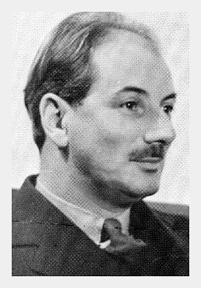
Bio: Lewis Mumford

From Wikipedia, the free encyclopedia

Lewis Mumford
BornOctober 19, 1895
Flushing, New York, U.S.[1]
DiedJanuary 26, 1990 (aged 94)
Amenia, New York, U.S.[1]
OccupationHistorianwriter
NationalityAmerican
GenreHistoryphilosophy
Notable worksThe City in History
Technics and Civilization
The Myth of the Machine
Notable awardsLeonardo da Vinci Medal, 1969

Lewis Mumford (October 19, 1895 – January 26, 1990) was an American historian, sociologist, philosopher of technology, and literary critic. Particularly noted for his study of cities and urban architecture, he had a broad career as a writer. Mumford made signal contributions to social philosophy, American literary and cultural history and the history of technology.[2] He was influenced by the work of Scottish theorist Sir Patrick Geddes and worked closely with his associate the British sociologist Victor Branford. Mumford was also a contemporary and friend of Frank Lloyd WrightClarence SteinFrederic OsbornEdmund N. Bacon, and Vannevar Bush.

Life

Mumford was born in FlushingQueens, New York, and graduated from Stuyvesant High School in 1912.[3] He studied at the City College of New York and The New School for Social Research, but became ill with tuberculosis and never finished his degree. In 1918 he joined the navy to serve in World War I and was assigned as a radio electrician.[1][4] He was discharged in 1919 and became associate editor of The Dial, an influential modernist literary journal. He later worked for The New Yorker where he wrote architectural criticism and commentary on urban issues.

Mumford’s earliest books in the field of literary criticism have had a lasting influence on contemporary American literary criticism. In The Golden Day (1926), he argued for a mid-19th-century American literary canon comprising Herman MelvilleRalph Waldo EmersonHenry David ThoreauNathaniel Hawthorne and Walt Whitman, all of whom he argued reflected the American culture of the period, which would soon be destroyed by the American Civil War and late-19th-century industrialization.[5] Herman Melville (1929), which combined an account of Melville’s life with an interpretive discussion of his work,[6] was an important part of the Melville revival.[5] Soon after, with the book The Brown Decades, he began to establish himself as an authority in American architecture and urban life, which he interpreted in a social context.

Mumford was a close friend of the psychologist Henry Murray, with whom he corresponded extensively from 1928 until the 1960s on topics including Herman Melville, psychology, American values and culture, and the nature of the self.[7]

In his early writings on urban life, Mumford was optimistic about human abilities and wrote that the human race would use electricity and mass communication to build a better world for all humankind. He would later take a more pessimistic stance. His early architectural criticism also helped to bring wider public recognition to the work of Henry Hobson RichardsonLouis Sullivan and Frank Lloyd Wright.

In 1963, Mumford received the Frank Jewett Mather Award for art criticism from the College Art Association.[8] Mumford received the Presidential Medal of Freedom in 1964.[1] In 1975 Mumford was made an honorary Knight Commander of the Order of the British Empire (KBE).[1] In 1976, he was awarded the Prix mondial Cino Del Duca.[1] In 1986, he was awarded the National Medal of Arts.[1]Mumford’s house in Amenia

He served as the architectural critic for The New Yorker magazine for over 30 years. His 1961 book, The City in History, received the National Book Award.[1][9]

Lewis Mumford died at the age of 94 at his home in Amenia, New York, on January 26, 1990.[1] Nine years later the house was listed on the National Register of Historic Places. His wife Sophia died in 1997, at age 97.[10]

Ideas

In his book The Condition of Man, published in 1944, Mumford characterized his orientation toward the study of humanity as “organic humanism”. The term is an important one because it sets limits on human possibilities, limits that are aligned with the nature of the human body. Mumford never forgot the importance of air quality, of food availability, of the quality of water, or the comfort of spaces, because all these things had to be respected if people were to thrive. Technology and progress could never become a runaway train in his reasoning, so long as organic humanism was there to act as a brake. Indeed, Mumford considered the human brain from this perspective, characterizing it as hyperactive, a good thing in that it allowed humanity to conquer many of nature’s threats, but potentially a bad thing if it were not occupied in ways that stimulated it meaningfully. Mumford’s respect for human “nature”, that is to say, the natural characteristics of being human, provided him with a platform from which to assess technologies, and technics in general. Thus his criticism and counsel with respect to the city and with respect to the implementation of technology was fundamentally organized around the organic humanism to which he ascribed. It was from the perspective of organic humanism that Mumford eventually launched a critical assessment of Marshall McLuhan, who argued that the technology, not the natural environment, would ultimately shape the nature of humankind, a possibility that Mumford recognized, but only as a nightmare scenario.

Mumford believed that what defined humanity, what set human beings apart from other animals, was not primarily our use of tools (technology) but our use of language (symbols). He was convinced that the sharing of information and ideas amongst participants of primitive societies was completely natural to early humanity, and had obviously been the foundation of society as it became more sophisticated and complex. He had hopes for a continuation of this process of information “pooling” in the world as humanity moved into the future.[11]

Mumford’s choice of the word “technics” throughout his work was deliberate. For Mumford, technology is one part of technics. Using the broader definition of the Greek tekhne, which means not only technology but also art, skill, and dexterity, technics refers to the interplay of social milieu and technological innovation—the “wishes, habits, ideas, goals” as well as “industrial processes” of a society. As Mumford writes at the beginning of Technics and Civilization, “other civilizations reached a high degree of technical proficiency without, apparently, being profoundly influenced by the methods and aims of technics.”

Megatechnics

In The Myth of the Machine Vol II: The Pentagon of Power (Chapter 12) (1970), Mumford criticizes the modern trend of technology, which emphasizes constant, unrestricted expansion, production, and replacement. He contends that these goals work against technical perfection, durability, social efficiency, and overall human satisfaction. Modern technology, which he called “megatechnics”, fails to produce lasting, quality products by using devices such as consumer creditinstallment buying, non-functioning and defective designs, planned obsolescence, and frequent superficial “fashion” changes. “Without constant enticement by advertising,” he writes, “production would slow down and level off to normal replacement demand. Otherwise many products could reach a plateau of efficient design which would call for only minimal changes from year to year.”

He uses his own refrigerator as an example, reporting that it “has been in service for nineteen years, with only a single minor repair: an admirable job. Both automatic refrigerators for daily use and deepfreeze preservation are inventions of permanent value. … [O]ne can hardly doubt that if biotechnic criteria were heeded, rather than those of market analysts and fashion experts, an equally good product might come forth from Detroit, with an equally long prospect of continued use.”

Biotechnics

Pentagon of Power picture and a quote from it.

Mumford was deeply concerned with the relationship between technics and bioviability. The latter term, not used by Mumford, characterizes an area’s capability to support life up through its levels of complexity. Before the advent of technology, most areas of the planet were bioviable at some level or other; however, where certain forms of technology advance rapidly, bioviability decreases dramatically. Slag heaps, poisoned waters, parking lots, and concrete cities, for example, are extremely limited in terms of their bioviability. Non-bioviable regions are common in cinema in the form of dystopias (e.g., Blade Runner). Mumford did not believe it was necessary for bioviability to collapse as technics advanced, however, because he held it was possible to create technologies that functioned in an ecologically responsible manner, and he called that sort of technology biotechnics.[12] Mumford believed that biotechnic consciousness (and possibly even community) was emerging as a later stage in the evolution of Darwinian thinking about the nature of human life. He believed this was the sort of technics needed to shake off the suicidal drive of “megatechnics.” While Mumford recognized an ecological consciousness that traces back to the earliest communities, he regarded emerging biotechnics as a product of neo-Darwinian consciousness, as a post-industrial form of thinking, one that refuses to look away from the mutually-influencing relationship between the state of the living organism and the state of its environment. In Mumford’s mind, the society organized around biotechnics would restrain its technology for the sake of that integral relationship.

In Mumford’s understanding, the various technologies that arose in the megatechnic context have brought unintended and harmful side effects along with the obvious benefits they have bequeathed to us. He points out, for example, that the development of money (as a technology) created, as a side effect, a context for irrational accumulation of excess because it eliminated the burdensome aspects of object-wealth by making wealth abstract. In those eras when wealth was not abstract, plenitude had functioned as the organizing principle around its acquisition (i.e., wealth, measured in grains, lands, animals, to the point that one is satisfied, but not saddled with it). Money, which allows wealth to be conceived as pure quantity instead of quality, is an example of megatechnics, one which can spiral out of control. If Mumford is right in this conceptualization, historians and economists should be able to trace a relationship between the still-increasing abstraction of wealth and radical transformations with respect to wealth’s distribution and role. And, indeed, it does appear that, alongside its many benefits, the movement toward electronic money has stimulated forms of economic stress and exploitation not yet fully understood and not yet come to their conclusion. A technology for distributing resources that was less given to abstract hoarding would be more suitable to a biotechnic conception of living.

Thus Mumford argued that the biotechnic society would not hold to the megatechnic delusion that technology must expand unceasingly, magnifying its own power and would shatter that delusion in order to create and preserve “livability.” Rather than the megatechnic pursuit of power, the biotechnic society would pursue what Mumford calls “plenitude”; that is, a homeostatic relationship between resources and needs. This notion of plenitude becomes clearer if we suggest that the biotechnic society would relate to its technology in the manner an animal relates to available food–under circumstances of natural satisfaction, the pursuit of technological advance would not simply continue “for its own sake.”

Alongside the limiting effect of satisfaction amidst plenitude, the pursuit of technological advance would also be limited by its potentially negative effects upon the organism. Thus, in a biotechnic society, the quality of air, the quality of food, the quality of water, these would all be significant concerns that could limit any technological ambitions threatening to them. The anticipated negative value of noise, radiation, smog, noxious chemicals, and other technical by-products would significantly constrain the introduction of new technical innovation. In Mumford’s words, a biotechnic society would direct itself toward “qualitative richness, amplitude, spaciousness, and freedom from quantitative pressures and crowding. Self-regulation, self-correction, and self-propulsion are as much an integral property of organisms as nutrition, reproduction, growth, and repair.” The biotechnic society would pursue balance, wholeness, and completeness; and this is what those individuals in pursuit of biotechnics would do as well.

Mumford’s critique of the city and his vision of cities that are organized around the nature of human bodies, so essential to all Mumford’s work on city life and urban design, is rooted in an incipient notion of biotechnics: “livability,” a notion which Mumford got from his mentor, Patrick Geddes.

Mumford used the term biotechnics in the later sections of The Pentagon of Power, written in 1970. The term sits well alongside his early characterization of “organic humanism,” in that biotechnics represent the concrete form of technique that appeals to an organic humanist. When Mumford described biotechnics, automotive and industrial pollution had become dominant technological concerns, along with the fear of nuclear annihilation. Mumford recognized, however, that technology had even earlier produced a plethora of hazards, and that it would do so into the future. For Mumford, human hazards are rooted in a power-oriented technology that does not adequately respect and accommodate the essential nature of humanity. Mumford is stating implicitly, as others would later state explicitly, that contemporary human life understood in its ecological sense is out of balance because the technical parts of its ecology (guns, bombs, cars, drugs) have spiraled out of control, driven by forces peculiar to them rather than constrained by the needs of the species that created them. He believed that biotechnics was the emerging answer and the only hope that could be set out against the problem of megatechnics. It was an answer, he believed, that was already beginning to assert itself in his time.

It is true that Mumford’s writing privileges the term “biotechnics” more than the “biotechnic society.” The reason is clear in the last sentence of The Pentagon of Power where he writes, “for those of us who have thrown off the myth of the machine, the next move is ours: for the gates of the technocratic prison will open automatically, despite their rusty ancient hinges, as soon as we choose to walk out.” Mumford believed that the biotechnic society was a desideratum—one that should guide his contemporaries as they walked out the doors of their megatechnic confines (he also calls them “coffins”). Thus he ends his narrative, as he well understood, at the beginning of another one: the possible revolution that gives rise to a biotechnic society, a quiet revolution, for Mumford, one that would arise from the biotechnic consciousness and actions of individuals. Mumford was an avid reader of Alfred North Whitehead‘s philosophy of the organism.[13]

Polytechnics versus monotechnics

A key idea, introduced in Technics and Civilization (1934) was that technology was twofold:

  • Polytechnic, which enlists many different modes of technology, providing a complex framework to solve human problems.
  • Monotechnic, which is technology only for its own sake, which oppresses humanity as it moves along its own trajectory.

Mumford commonly criticized modern America’s transportation networks as being “monotechnic” in their reliance on cars. Automobiles become obstacles for other modes of transportation, such as walking, bicycle and public transit, because the roads they use consume so much space and are such a danger to people. Mumford explains that the thousands of maimed and dead each year as a result of automobile accidents are a “ritual sacrifice” the American society makes because of its extreme reliance on highway transport.

Three epochs of civilization

Also discussed at length in Technics and Civilization is Mumford’s division of human civilization into three distinct epochs (following concepts originated by Patrick Geddes):

Megamachines

Mumford also refers to large hierarchical organizations as megamachines—a machine using humans as its components. These organizations characterize Mumford’s stage theory of civilization. The most recent megamachine manifests itself, according to Mumford, in modern technocratic nuclear powers—Mumford used the examples of the Soviet and United States power complexes represented by the Kremlin and the Pentagon, respectively. The builders of the pyramids, the Roman Empire and the armies of the World Wars are prior examples.

He explains that meticulous attention to accounting and standardization, and elevation of military leaders to divine status, are spontaneous features of megamachines throughout history. He cites such examples as the repetitive nature of Egyptian paintings which feature enlarged pharaohs and public display of enlarged portraits of Communist leaders such as Mao Zedong and Joseph Stalin. He also cites the overwhelming prevalence of quantitative accounting records among surviving historical fragments, from ancient Egypt to Nazi Germany.

Necessary to the construction of these megamachines is an enormous bureaucracy of humans which act as “servo-units”, working without ethical involvement. According to Mumford, technological improvements such as the assembly line, or instant, global, wireless, communication and remote control, can easily weaken the perennial psychological barriers to certain types of questionable actions. An example which he uses is that of Adolf Eichmann, the Nazi official who organized logistics in support of the Holocaust. Mumford collectively refers to people willing to carry out placidly the extreme goals of these megamachines as “Eichmanns”.

The clock as herald of the Industrial Revolution

One of the better-known studies of Mumford is of the way the mechanical clock was developed by monks in the Middle Ages and subsequently adopted by the rest of society. He viewed this device as the key invention of the whole Industrial Revolution, contrary to the common view of the steam engine holding the prime position, writing: “The clock, not the steam-engine, is the key-machine of the modern industrial age. … The clock … is a piece of power-machinery whose ‘product’ is seconds and minutes ….”[14]

Urban civilization

The City in History won the 1962 U.S. National Book Award for Nonfiction.[9] In this influential book Mumford explored the development of urban civilizations. Harshly critical of urban sprawl, Mumford argues that the structure of modern cities is partially responsible for many social problems seen in western society. While pessimistic in tone, Mumford argues that urban planning should emphasize an organic relationship between people and their living spaces.

Mumford uses the example of the medieval city as the basis for the “ideal city,” and claims that the modern city is too close to the Roman city (the sprawling megalopolis) which ended in collapse; if the modern city carries on in the same vein, Mumford argues, then it will meet the same fate as the Roman city.

Mumford wrote critically of urban culture believing the city is “a product of earth … a fact of nature … man’s method of expression.”[15] Further, Mumford recognized the crises facing urban culture, distrustful of the growing finance industry, political structures, fearful that a local community culture was not being fostered by these institutions. Mumford feared “metropolitan finance,” urbanisation, politics, and alienation. Mumford wrote: “The physical design of cities and their economic functions are secondary to their relationship to the natural environment and to the spiritual values of human community.”[16]

Suburbs

Suburbia did not escape Mumford’s criticism either:

In the suburb one might live and die without marring the image of an innocent world, except when some shadow of evil fell over a column in the newspaper. Thus the suburb served as an asylum for the preservation of illusion. Here domesticity could prosper, oblivious of the pervasive regimentation beyond. This was not merely a child-centered environment; it was based on a childish view of the world, in which reality was sacrificed to the pleasure principle.[17]

Religion and spirituality

Mumford is also among the first urban planning scholars who paid serious attention to religion in the planning field.[18][19] In one of his least well-known books, Faith for Living (1940, p. 216), Mumford argues that:

The segregation of the spiritual life from the practical life is a curse that falls impartially upon both sides of our existence.[20]

Influence

Mumford’s interest in the history of technology and his explanation of “polytechnics”, along with his general philosophical bent, has been an important influence on a number of more recent thinkers concerned that technology serve human beings as broadly and well as possible. Some of these authors—such as Jacques EllulWitold RybczynskiRichard Gregg,[21] Amory LovinsJ. BaldwinE. F. SchumacherHerbert MarcuseErich FrommMurray BookchinThomas MertonMarshall McLuhanColin Ward[22] and Kevin Carson—have been intellectuals and persons directly involved with technological development and decisions about the use of technology.

Mumford also had an influence on the American environmental movement, with thinkers like Barry Commoner and Bookchin being influenced by his ideas on cities, ecology and technology.[23] Ramachandra Guha noted his work contains “some of the earliest and finest thinking on bioregionalism, anti-nuclearism, biodiversity, alternate energy paths, ecological urban planning and appropriate technology.”[24]

Mumford’s influence is also evident in the work of some artists including Berenice Abbott‘s photographs of New York City in the late 1930s.[25]

Mumford was an inspiration for Ellsworth Toohey, the antagonist in Ayn Rand‘s novel The Fountainhead (1943).[26]

More at: https://en.wikipedia.org/wiki/Lewis_Mumford

Louis Armstrong: St. James Infirmary

phalenopsis1 Louis Armstrong St. James Infirmary from The Best of Jazz Classics

Music in this video

Learn more

Listen ad-free with YouTube Premium

Song

St. James Infirmary

Artist

Louis Armstrong & Friends

Album

Louis Armstrong & Friends

Writers

Irving Mills

Licensed to YouTube by

The Orchard Music (on behalf of Stardust); AMRA, LatinAutorPerf, Sony ATV Publishing, UNIAO BRASILEIRA DE EDITORAS DE MUSICA – UBEM, SOLAR Music Rights Management, LatinAutor – SonyATV, CMRRA, and 5 Music Rights Societies

“Louis Daniel Armstrong (August 4, 1901 – July 6, 1971), nicknamed “Satchmo”, “Satch”, and “Pops”, was born and raised in New Orleans. His parents were Mary Albert and William Armstrong. Mary Albert was from Boutte, Louisiana, and gave birth at home when she was about sixteen. Louis Armstrong was raised by his grandmother until the age of five when he was returned to his mother.  At six he attended the Fisk School for Boys, a school that accepted black children in the racially segregated system of New Orleans.”From the age of 7 he lived with the Karnoffskys, a family of Lithuanian Jews. Mrs Karnoffsky used to sing lullabies for him at night before bed in Yiddish and Russian. The Karnoffskys treated him like family and they fed and nurtured him. In his memoir Louis Armstrong + the Jewish Family in New Orleans, La., the Year of 1907, he described his discovery that this family was also subject to discrimination by “other white folks” who felt that they were better than Jews: “I was only seven years old but I could easily see the ungodly treatment that the white folks were handing the poor Jewish family whom I worked for.” To distinguish the Karnoffskys from other hawkers, he tried playing a tin horn to attract customers. Morris Karnoffsky gave Armstrong an advance toward the purchase of a cornet from a pawn shop. Fluent in Yiddish, Armstrong wore a Star of David until the end of his life in memory of this family who had raised him.”He was a foundational influence in jazz, shifting the focus of the music from collective improvisation to solo performance. Around 1922, he followed his mentor, Joe “King” Oliver, to play in the Creole Jazz Band in Chicago.  There he reconnected with his friend Bix Beiderbecke, and spent time with Hoagy Carmichael and Lil HardinFletcher Henderson persuaded Armstrong to come to New York City, where he became a featured and musically influential band soloist and recording artist. Hardin became Armstrong’s second wife and they returned to live in Chicago. After years of touring, he settled in Queens, and by the 1950s, he was a national musical icon, assisted by his appearances on radio and in film and television.”With his instantly recognizable rich, gravelly voice, Armstrong was an influential singer and skillful improviser, also skilled at scat singing. He was one of the first popular African-American entertainers to “cross over” to wide popularity with white (and international) audiences. He rarely publicly politicized his race, to the dismay of fellow African Americans, but took a well-publicized stand for desegregation in the Little Rock crisis. He was able to access the upper echelons of American society at a time when this was difficult for black men.”He appeared in films such as High Society (1956) alongside Bing CrosbyGrace Kelly, and Frank Sinatra, and Hello, Dolly! (1969) starring Barbra Streisand. He received many accolades including three Grammy Award nominations and a win for his vocal performance of Hello, Dolly! in 1964. In 2017, he was posthumously inducted into the Rhythm & Blues Hall of Fame.”Against his doctor’s advice, Armstrong played a two-week engagement in March 1971 at the Waldorf-Astoria‘s Empire Room, after which he was hospitalized for a heart attack. He was released from the hospital in May, and quickly resumed practicing his trumpet playing. Still hoping to get back on the road, he died of a heart attack in his sleep on July 6, 1971, a month before his 70th birthday. He was residing in Corona, Queens, New York City, at the time of his death. He was interred in Flushing CemeteryFlushing, in Queens, New York City. His honorary pallbearers included Bing Crosby, Ella FitzgeraldDizzy GillespiePearl BaileyCount BasieHarry JamesFrank SinatraEd SullivanEarl WilsonAlan KingJohnny Carson and David FrostPeggy Lee sang “The Lord’s Prayer” at the services while Al Hibbler sang “Nobody Knows the Trouble I’ve Seen” and Fred Robbins, a long-time friend, gave the eulogy.” (wikipedia (edited)

(Contributed by Alan Blackman)