Once regarded as a brilliant eccentric whose works skirted the outer fringes of English art and literature, William Blake (1757–1827) is today recognized as a major poet, a profound thinker, and one of the most original and exciting English artists. Nowhere is his glorious poetic and pictorial legacy more evident than in The Marriage of Heaven and Hell, which many consider his most inspired and original work. The Marriage of Heaven and Hell is both a humorous satire on religion and morality and a work that concisely expresses Blake’s essential wisdom and philosophy, much of it revealed in the 70 aphorisms of his “Proverbs of Hell.” This beautiful edition, reproduced from a rare facsimile, invites readers to enjoy the rich character of Blake’s own hand-printed text along with his deeply stirring illustrations, reproduced on 27 full-color plates. A typeset transcription of the text is included.
Containing over 300 accounts of near-death experiences from those who have glimpsed beyond the physical boundaries of our world. Through the authors’ experiences, this compelling investigation explores how far science can go to examine NDEs, as well as ponders what readers can learn from them when science goes no further.
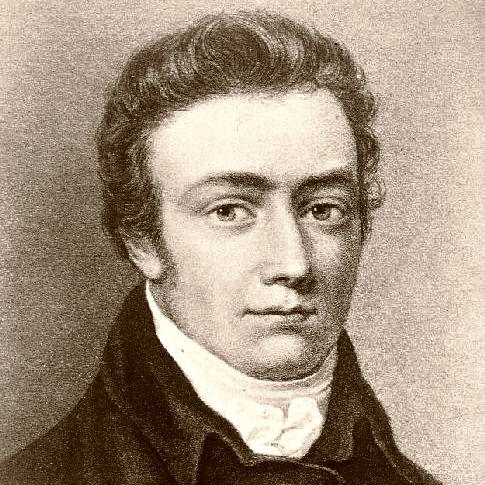
Samuel Taylor Coleridge (21 October 1772–25 July 1834) was an English poet, critic, and philosopher who consumed opium to address his health issues. His use of opium in his home country of England, as well as Sicily and Malta, is extensively documented. Coleridge’s opium use led to severe consequences. Coupled with his health conditions, it harmed his life and adversely impacted his career.[1]
History
Coleridge was widely known to have been a regular user of opium as a relaxant, analgesic, antidepressant, and treatment for numerous health concerns. He has written Kubla Khan under the drug’s influence, but the degree to which he used the drug as a creative enhancement is not precise. Although Coleridge mostly kept his addiction as hidden as possible from those close to him, it became public knowledge with the 1822 publication of Confessions of an English Opium Eater by his close friend Thomas de Quincey. The Confessions painted a rather negative picture of Coleridge, and his reputation suffered accordingly.
Where Coleridge first developed his opium habit is an issue of some scholarly dispute, but it dates from a relatively youthful period in his life. Coleridge’s explanation is clearly laid out in a letter to Joseph Cottle;
I was seduced into the ACCURSED Habit ignorantly – I had been almost bed ridden for many months with swelling in my knees – in a medical journal I happily met with an account of a cure performed in a similar case … by rubbing in of Laudanum, at the same time taking a given dose internally – it acted like a charm, like a miracle! … At length, the unusual stimulus subsided – the complaint returned – the supposed remedy was recurred to – but I cannot go thro’ the dreary history – Suffice to say, that effects were produced, which acted on me by Terror & Cowardice of PAIN and sudden death.[2]
However, most scholars agree that Coleridge had resorted to Laudanum (the tincture form of opium), particularly during times of nervousness and stress. Because Laudanum was widely available and widely used as an analgesic as well as a general sedative, many people were given the drug for all sorts of medical and nervous complaints. Coleridge was probably given the drug numerous times in his youth during several bouts of rheumatic illness. Small medicinal dosages seldom lead to full-blown addiction. Still, for Coleridge, who experienced the painful return of the symptoms many times in his life, it indeed introduced him to the use of the drug much earlier than his story to Cottle admits. Regardless of when and where Coleridge’s opium addiction began, it is clear that the more reliant on the drug he became, the more his work suffered, the less he was able to focus and concentrate, and the more strained his relations became. In fact, it is arguable that any analysis of Coleridge’s life must be done against the constant background of opium usage. But as necessary as the issue of opium is in Coleridge’s life, it is never a straightforward issue because he often hid it from public and familial view, and at other times he exaggerated its importance to his work. In the 1816 publication of his major ‘opium’ poems, Coleridge purposely drew a connection between his creative work and opium usage. Desperate for some financial success with his poetry, Coleridge intentionally attempted to portray himself as a dreamy opium-eater because he, perhaps rightly, believed that it would draw a morbid fascination to his work. Opium played an exciting role in the public image of Romantic literature. For a long time, there was a kind of cult glamorization of the drug and a morose allure to stories of its usage for respectable members of the bourgeoisie who were thrilled by such taboo subjects. With this in mind, Coleridge generated an image of himself as a dreamy poet who created drug-induced fantasies.
This dreamy image of himself began even before he was widely known to have been addicted to opium. In one of a series of biographical letters written to his friend Thomas Poole, Coleridge painted this picture of himself, which would always endure. Coleridge writes:
So I became a dreamer, and acquired an indisposition to all bodily activity; and I was fretful and inordinately passionate, and as I could not play at anything, and was slothful, I was despised and hated by the boys.
This slothful image was one that endured even with some of Coleridge’s close friends. Coleridge may have consciously created it in the earlier part of his career to draw attention away from his addiction. It was only later that Coleridge perceived advantage to drawing attention not to himself as merely a lazy scholar but a dreamy opium-eater. Coleridge told the most famous story that connects Coleridge’s work with his opium usage in his well-known preface to the poem Kubla Khan. Coleridge wrote:
The author continued for about 3 hours in a profound sleep, at least of the external senses, during which time he has the most vivid confidence, that he could not have composed less than from two or three hundred lines … On waking he appeared to himself to have a distinct recollection of the whole and taking up his pen, ink, and paper, instantly and eagerly wrote the lines that are here preserved. At this moment he was unfortunately called out by a person on business from Porlock, and detained by him above an hour, and on his return to his room found, to his no small surprise and mortification, that though he still retained some vague and dim recollection of the general purport of the vision, yet, with the exception of some eight or ten scattered lines and images, all the rest had passed away like the images on the surfaces of a stream into which a stone has been cast, but alas! without the after restoration of the latter![3]
The sleep of this story is said by Coleridge to be a sleep of opium, and Kubla Khan may be read as an early poetic description of this drug experience. The fact that the poem is generally regarded as one of Coleridge’s best is one reason for the continuing interest and debate about the opium’s role in his creative output and in Romanticism in general.
Coleridge, in his lucid moments, understood the problems with which he struggled better than most. In an 1814 letter to his friend John Morgan, Coleridge wrote about his difficulties.
In exact proportion, as I loved any person or persons more than others, & would have sacrificed my life to them, were they sure to be the most barbarously mistreated by silence, absence, or breach of promise. What Crime is there scarcely which has not been included in or followed from the one guilt of taking opium? Not to speak of ingratitude to my maker for the wasted Talents; of ingratitude to so many friends who have loved me I know not why; of barbarous neglect of my family … I have in this one dirty business of Laudanum an hundred times deceived, tricked, nay, actually & consciously LIED. – And yet all these vices are so opposite to my nature, that but for the free-agency-annihilating Poison, I verily believe that I should have suffered myself to be cut in pieces rather than have committed any one of them.
In some respects, Coleridge’s life bears a resemblance to that of a modern opiate addict. Unfortunately, as much as Coleridge had some grasp of his addictions and their results, as well as an unusually sharp sense of how this addiction might be treated, many of his closest friends and peers did not understand. The people who might have served him best, like Southey and Wordsworth, were far too willing to maintain his image as slothful and selfish, despite the professional help that he constantly bestowed upon them. Men like Robert Southey, naturally conservative in outlook, was not forward-looking enough to comprehend the possibility of Coleridge’s addiction being a mainly physical dependence, despite the fact that Coleridge himself, as well as a growing number of professionals like his friend Gillman, were aware of the physical aspect of drug reliance. On more than one occasion Coleridge pointed out that physical restraint might eventually lead to a cure, and on several occasions under the treatment of Dr. Gillman, he was led thus to the edge of freedom from the drug on which he had formed such a dependence. Southey wrote from the position of moral indignation and explicitly denied the physical aspect of the drug issue. Southey wrote to Cottle:
“…while acknowledging the guilt of the habit, he impute it still to morbid bodily causes, whereas … every person who has witnessed his habits, knows that for … infinitely the greater part – inclination and indulgence are the motives. It seems dreadful to say this … but it is so and I know it to be so, from my own observation and that of all with whom he has lived … This, Cottle, is an insanity of that species which none but the Soul’s physician can cure.”.
Coleridge in Highgate
In April 1816, Coleridge’s friend and physician, Joseph Adams, put him in touch with a Highgate doctor named James Gillman, intending to place Coleridge in his full-time care and effect a cure addiction problems. Although Gillman initially had no intention of taking this stranger into his household, he was so charmed by the poet on their first meeting that he agreed to take him in and attempt a cure. Coleridge spent most of the rest of his life in the Gillman house with only brief periods away. James Gillman was ahead of his time as a physician of addiction. Although he could never stop Coleridge’s intake of opium entirely, he managed to bring it under greater control for many years. It is undoubtedly to Gillman’s treatment, and friendship that we owe much of Coleridge’s later prose works, particularly his Biographia Literaria, Lay Sermons, and Opus Maximum.
Coleridge virtually became a member of the Gillman family and even accompanied them on annual vacations. On several occasions when Coleridge was away from the Gillman household, he fell back into excessive opium use. Each time Gillman managed to step in and return Coleridge to his home and controlled less harmful opium dosages. The pharmacy where the poet obtained his prescribed supply (and sometimes, an illicit addition to it) still exists in the High Street, though moved a few dozen yards from the original premises. Gillman later became one of Coleridge’s great champions’ reputation and commonly defended his friend in polite society and print with one of Coleridge’s earliest biographies. Coleridge’s reputation was somewhat restored during his years at Highgate. In his lucid periods, he became a kind of elder statesman of the literary establishment and was visited by many of the period’s most influential writers and thinkers. Despite Gillman’s care, however, Coleridge was overcome with respiratory problems and enlargement of the heart. Coleridge died at the age of 61.
As far as popular fascinations go, few have endured for as long, or created as robust a bibliography, as witches. While the word “witch” has its etymological roots (wicce) in Old English, the concept has antecedents much older and geographically widespread. Written accounts of women who practice magic are as old as recorded history and are still popular today. And while there is a broad spectrum of witch stories out there, there is a through-line to them all: witches are women whose embodiment of femininity in some way transgresses society’s accepted boundaries—they are too old, too powerful, too sexually aggressive, too vain, too undesirable. In the name of Halloween (and spooking the pants off the patriarchy), let us now look at some of literature’s most significant witches.
Hecate, 7th Century B.C.E.
The only daughter of Titans Perseus and Asteria, Hecate was a goddess of Greek mythology with a particularly large wheelhouse, associated variably with magic, witchcraft, the night, the moon, ghosts, and necromancy, as well as lighter fare like athletic games, courts of law, birth, and cattle-tending. In later periods she was often depicted in triple form, in connection with the phases of the moon. Hecate plays a crucial role in the myth of Persephone’s abduction by Hades; the only witness to the kidnapping besides Helios, she uses her iconographic torch to help Demeter scour the Earth for her lost daughter. Hecate also appears in Ovid’s Metamorphoses and is identified in Hesiod’s Theogony as the goddess Zeus valued above all others. The Orphic Hymns describe Hecate as she has come to be most known in the popular imagination: “Sepulchral, in a saffron veil array’d, leas’d with dark ghosts that wander thro’ the shade.”
Morgan le Fay, 1150
First referenced in Geoffrey of Monmouth’s Vita Merlini, Morgan le Fay was an enchantress-cum-antagonist of Arthurian Legend whose name has been rendered in so many different spellings that it practically constitutes an act of witchcraft in itself. Similarly to Hecate, Morgan le Fay’s narrative took on darkness over time. Portrayed as a healer in the early chivalric romances of Monmouth and Chrétien de Troyes, she appears in the later medieval stories as the half-sister and bitter adversary of King Arthur, plotter against Excalibur, apprentice of Merlin, and sexually menacing temptress whose obsessive love for Lancelot goes unrequited. Yet even at her most unequivocally villainous, it is Morgan le Fay who bears an injured Arthur to the island of Avalon after he is wounded in the Battle of Camlann.
Malleus Maleficarum, 1487
Often translated as Hammer of the Witches, the Malleus Maleficarum was a manifesto by German Catholic clergyman Heinrich Kramer written in defense of the prosecution of witches. Three years before its publication, Kramer had been expelled from Innsbruck for eccentric behaviors related to his attempts at prosecuting witchcraft—and for assuming the authority of an Inquisitor, which he was not. The Malleus Maleficarum set out to refute arguments against the existence of witchcraft and discredit its skeptics; it also asserted those who practiced it were more often women than men. While the Catholic Church officially condemned the Malleus Maleficarum in 1490, it became an important text during the brutal witch trials of the 16th and 17th centuries.
The Weird Sisters, 1611
Referred to as the “weyward sisters” in Macbeth’s first folio, this trio of witches delivers the dual prophecies that set the entire play’s course of events into motion: that the eponymous Scottish general will become king, while his companion, Banquo, will generate a line of kings. The Weird Sisters as described by Shakespeare are not only hag-like—with “chappy fingers” and “skinny lips”—but masculine as well, having beards. This latter characteristic connects them to Macbeth’s other villainous female figure: Lady Macbeth, who entreats the spirits to “unsex [her] here” while plotting the murder of King Duncan. In a disputed scene in the play’s third act, the Weird Sisters reappear with O.G. Hecate, who chastises them for meddling in Macbeth’s future without her. During their last appearance in act 4, the witches conjure a series of ominous visions for the now-king Macbeth that foreshadow his imminent fall.
Autumn is the season of ambivalence and reconciliation, soft-carpeted training ground for the dissolution that awaits us all, low-lit chamber for hearing more intimately the syncopation of grief and gladness that scores our improbable and finite lives — each yellow burst in the canopy a reminder that everything beautiful is perishable, each falling leaf at once a requiem for our own mortality and a rhapsody for the unbidden gift of having lived at all. That dual awareness, after all, betokens the luckiness of death.
Art by Arthur Rackham, 1906. (Available as a print.)
But autumn is also the season of revelation, for the seeming loss unveils a larger reality: Chlorophyll is a life-force but it is also a cloak, and when trees shed it from their leaves, nature’s true colors are revealed.
Photosynthesis is nature’s way of making life from light. Chlorophyll allows a tree to capture photons, extracting a portion of their energy to make the sugars that make it a tree — the raw material for leaves and bark and roots and branches — then releasing the photons at lower wavelengths back into the atmosphere. A tree is a light-catcher that grows life from air.
Although the human mind has puzzled over why leaves fall and change color at least as far back as Aristotle, chlorophyll — which shares chemical kinship with the hemoglobin in our blood — was only discovered and named in 1817, by the French pharmacist-chemist duo Joseph Bienaimé Caventou and Pierre Joseph Pelletier. In a lovely touch of humility that distinguishes, always, the scientist from the explorer — the explorer, so eager to name the lands and landmarks he has “discovered” after himself — they wrote in their landmark paper:
We have no right to name a substance long-known, and to the story of which we have added only a few facts; however, we will propose, without granting it any importance, the name chlorophyll, from chloros, color, and φυλλον, leaf: a name that would indicate the role it plays in nature.
Oak by the self-taught 19th-century naturalist, painter, and poet Rebecca Hey from The Spirit of the Woods — the world’s first illustrated encyclopedia of wild trees. (Available as a print.)
But chlorophyll, which is yet to be fully understood, is not the only pigment in trees. Throughout a leaf’s life, four primary pigments course through its cells: the green of chlorophyll, but also the yellow of xanthophyll, the orange of carotenoids, and the reds and purples of anthocyanins.
In spring and summer, when the day grow long and bright, chlorophyll saturates leaves as the tree busies itself converting photons into the sweetness of new growth.
As daylight begins fading in autumn and the air cools, deciduous trees prepare for wintering and stop making food — an energy expenditure too metabolically expensive in the dearth of sunlight. Enzymes begin breaking down the decommissioned chlorophyll, allowing the other pigments that had been there invisibly all along to come aflame. And because we humans so readily see in trees metaphors for our emotional lives, how can this not be a living reminder that every loss reveals what we are made of — an affirmation of the value of a breakdown?
Life and Loss Are One by Maria Popova. (Available as a print and as stationery cards, benefitting The Nature Conservancy.)
A similar process take place as fruit ripen from green to varying shades of red, purple, orange, or yellow.
Two centuries after the discovery of chlorophyll, a new generation of scientists armed with a new arsenal of tools unimaginable in 1817, in that abiding way science has of only revealing new layers of reality when it lets go of its assumptions, placed bananas in various stages of ripeness under UV light and discovered that as the world’s favorite yellow fruit ripens and its chlorophyll breaks down, it not only reveals the xanthophyll of yellow, but produces the chlorophyll catabolite hmFCC — a previously unknown blue fluorescent compound.
Artwork based on laboratory imaging from Agewandte Chemie: A Journal of the German Chemical Society, international edition, 2008.
Subsequent research has found signs of this blue pigment in devil’s ivy — the evergreen golden pothos thriving in the corner of my library in Brooklyn at this very moment — rendering the mystery of chlorophyll ongoing and filling the human heart with exhilaration. How thrilling to think that something we discovered two centuries ago, something nature created more than a billion years ago when the first green plants evolved from prokaryotes, can still shimmer with mystery — a molecular microcosm of the ultimate thrill: the knowledge that however much we might uncover, nature will never cease to be filled with surprise ripe for the reaping. And how humbling to think that we too are animals doing their best to make sense of the world with their creaturely limitations — animals whose vision evolved to peak in so narrow a band of the spectrum, in the tiny wavelength range between red and violet, blind to everything between radio and cosmic rays, blind to ultraviolet light. But if we were butterflies or reindeer, bees or sockeye salmon, bananas might be blue.
The poetic astronomer Maria Mitchell captured this best in her rueful and rapturous observation that “we have a hunger of the mind which asks for knowledge of all around us, and the more we gain, the more is our desire,” and yet “we reach forth and strain every nerve, but we seize only a bit of the curtain that hides the infinite from us.”
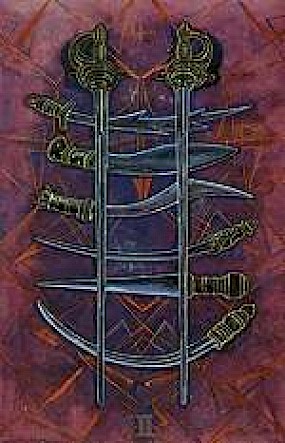
The Lord of Interference is the card that comes up to indicate deliberate or accidental interference with the natural flow of energy. This may come from inside ourselves, or from an outer (and possibly malicious) source. It often signals problems with endurance, inability to make decisions, lack of concentration on important details, and overall disturbance.
At best, the Eight of Swords will indicate a period where nothing goes quite the way you want it to. At worst it will indicate an obstructive and difficult period where serious damage can be done to our material environment, our emotional balance and our overall sense of well-being.
When you draw this card (or are interpreting it for another person) you need first to try to isolate the source of the problem. If it is an inner imbalance, then you’ll see cards like Seven of Cups,Seven of Swords or Ten of Wands coming up nearby. If it is an outer force which is causing trouble, then you’re more likely to see the Tower,Nine of Swords or a court card indicating another person.
The solution to this influence is more simple than you might at first imagine – if you’re giving yourself a hard time, then accept what is happening and drop the project for a short time, delay making the decision – in short, stop banging your head against the wall! Sometimes this kind of interference is exacerbated by astrological or lunar phases – so let seven days pass by during which you do things which satisfy you, which flow easily, and which help you to rest. Then come back and tackle the original matter again.
If interference comes form an outside source, then withdraw yourself from that source, and again, rest and do things you want to do. Return to the issue that has been causing the problem once you have had time to gain perspective and a little more insight.
If you are ever unfortunate enough to find the Eight of Swords coming up to indicate a long-term problem, it will almost always be deliberate and malicious interference from another person. If you have attracted unwelcome attention from somebody, and you are doing nothing whatsoever to feed their spite, then you must remove yourself as a target. No good can come of engaging in this type of situation. And often, when a person’s barbs are no longer hitting the mark (or even if they are, your attacker doesn’t know that they are) they will find somebody else to direct their negativity toward – there’s nothing more unsatisfying than making an enemy of somebody who completely ignores you!
(via angelpaths.com and Alan Blackman)
Consciousness, spirituality, biography, sexuality, androgyny, futurism, space, the arts, science, astrology, democracy, humor, books, movies and more




 We have no right to name a substance long-known, and to the story of which we have added only a few facts; however, we will propose, without granting it any importance, the name chlorophyll, from chloros, color, and φυλλον, leaf: a name that would indicate the role it plays in nature.