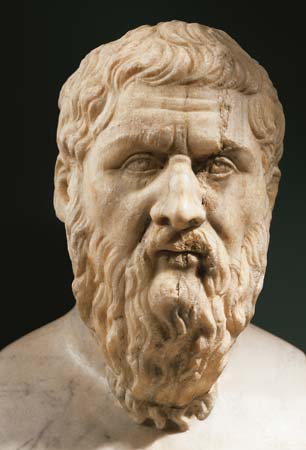
“Plato was a fascist.”
–Chris Hedges
Christopher Lynn Hedges (born September 18, 1956) is an American Pulitzer Prize-winning journalist, Presbyterian minister, author and television host. Wikipedia

“Plato was a fascist.”
–Chris Hedges
Christopher Lynn Hedges (born September 18, 1956) is an American Pulitzer Prize-winning journalist, Presbyterian minister, author and television host. Wikipedia
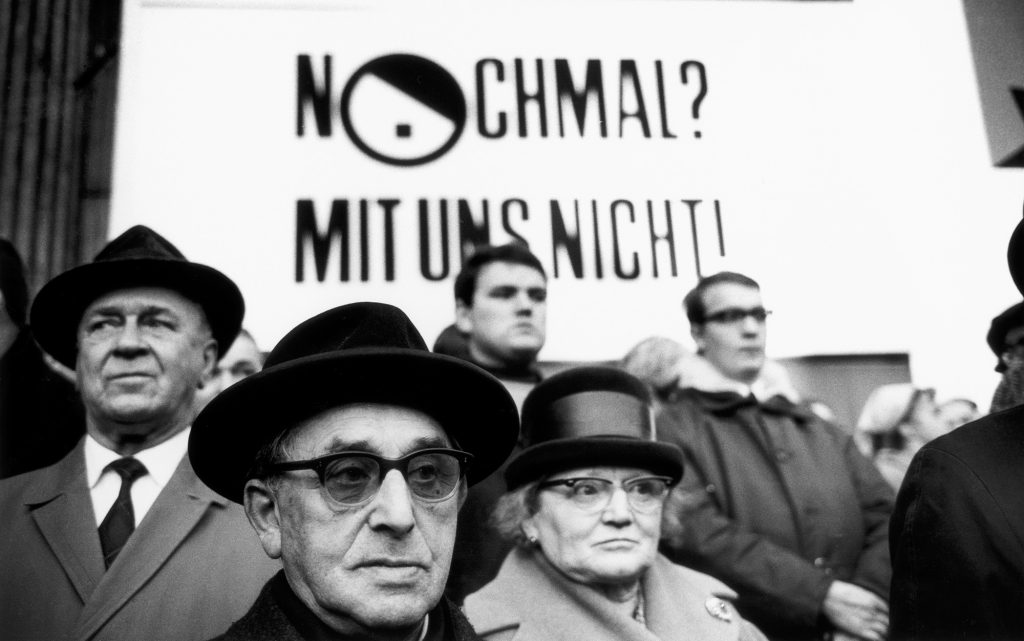
German citizens protest outside the far-right National Democratic Party of Germany’s 1967 congress in Hanover. The poster reads: ‘Again? Not with us!’ Photo by Wolfgang Kunz/ullstein bild via Getty
Helmut Walser Smith is the Martha Rivers Ingram Chair of History and professor of history at Vanderbilt University in Nashville, Tennessee. His books include The Butcher’s Tale: Murder and Antisemitism in a German Town (2002), The Continuities of German History: Nation, Religion, and Race across the Long 19th Century (2008) and Germany: A Nation in Its Time (2020).
3 June 2021 (aeon.co)
Edited by Sam Haselby
After 12 years of fascism, six years of war, and the concentrated genocidal killing of the Holocaust, nationalism should have been thoroughly discredited. Yet it was not. For decades, nationalist frames of mind continued to hold. They prevailed on both sides of the so-called Iron Curtain and predominated in the Global North as well as in the developing world of the Global South. Even in the Federal Republic of Germany, the turn away from ‘the cage called Fatherland’ – as Keetenheuve, the main character in Wolfgang Koeppen’s novel The Hothouse (1953), called his depressingly nationalistic West Germany – didn’t commence immediately.
When the turn did begin, however, Keetenheuve’s country would set out on a remarkable journey – not one racing down the highway to cosmopolitanism, but rather a slow one that required a series of small steps leading to the gradual creation of a more pacific, diverse and historically honest nation – a better Germany.
After the collapse of the Third Reich, Germans widely blamed other countries for the Second World War. ‘Every German knows that we are not guilty of starting the war,’ asserted the Nazi journalist Hildegarde Roselius in 1946. With ‘every German’, this acquaintance of the American photographer Margaret Bourke-White certainly exaggerated. But in 1952, 68 per cent of Germans polled gave an answer other than ‘Germany’ to the question of who started the Second World War, and it was not until the 1960s that this opinion fell into the minority.
In the mid-1950s, nearly half of all Germans polled said ‘yes’ to the proposition that ‘were it not for the war, Hitler would have been one of the greatest statesmen of the 20th century.’ Until the late 1950s, nearly 90 per cent gave an answer other than ‘yes’ when asked if their country should recognise the Oder-Neisse line, the new border with Poland. Perhaps most revealing of all was their stance on Jews. On 12 June 1946, Hannah Arendt hazarded the opinion to Dolf Sternberger, one of occupied Germany’s most prominent publicists, that ‘Germany has never been more antisemitic than it is now.’ As late as 1959, 90 per cent of Germans polled thought of Jews as belonging to a different race – while only 10 per cent thought of the English in these terms.
The sum of these attitudes suggests that Keetenheuve’s cage called Fatherland remained shut for more than two decades after the fall of the Third Reich.
Like most of Europe and indeed the world, Germany lacked a powerful alternative discourse to nationalism. Until the 1970s, the United Nations Declaration of Human Rights possessed little traction in postwar Europe. Regional affiliations, such as those to Europe (or Pan-Africanism or Pan-Arabism), were more viable but as yet confined to a small number of elites. Strident defences of capitalism also did little to deplete the store of nationalist tropes. And on the western side of the Iron Curtain, anti-Communism supported rather than undermined Nazi-inspired nationalism.
The postwar world was, moreover, awash in new nation-states, especially as it shaded into the postcolonial era. In 1945, there were only 51 independent countries represented at the UN: 30 years later, there were 144. Whether in Jawaharlal Nehru’s India or Kwame Nkrumah’s Ghana, nationalism and promises of self-determination fired anti-colonial independence movements in Asia and Africa. In Europe, nationalism also continued to shape claims to group rights and territorial boundaries. In Germany, divided and not fully sovereign until 1990, it informed discussion over eventual unification, the right of the ethnic German expellees to return to their east European homelands, and the validity of Germany’s eastern borders. Indeed, it wasn’t until 1970, a quarter-century after the war, that the Federal Republic of Germany finally recognised as legitimate the German border (established at the Potsdam Conference in 1945) with Poland. And still nearly half the citizens of West Germany opposed the recognition.
The habits of thought of a once-Nazified nation-in-arms constituted one set of reinforcements
The pervasiveness of exclusionary nationalism in the postwar period also reflected a new underlying reality. The Second World War had created a Europe made up of nearly homogeneous nation-states. A series of western European countries, now thought of as diverse, were at that time just the opposite. The population of West Germany who were born in a foreign country stood at a mere 1.1 per cent, and the minuscule percentage proved paradigmatic for the tessellated continent as a whole. The Netherlands had a still smaller foreign-born population, and foreigners made up less than 5 per cent of the population in Belgium, France and Great Britain. In the interwar years, eastern European countries such as Poland and Hungary had significant ethnic minorities and large Jewish populations. In the postwar period, both were all but gone, and Poles and Hungarians were largely on their own.
Nor, in the trough of deglobalisation, did Europeans often get beyond their own borders, and Germans were no exception. In 1950, most Germans had never been abroad, except as soldiers. Some 70 per cent of the adult women had never left Germany at all. Travel, a luxury enjoyed by the few, didn’t begin to pick up until the mid-1950s, while international travel became a truly mass phenomenon only in the 1970s, when most people had cars of their own. In the first decades of tourism, Germans mainly visited German-speaking destinations, such as the castles on the Rhine or the northern slopes of the Alps. In these decades, few Germans, save for the highly educated, knew foreign languages, and most other Europeans, unless migrant workers, were no different.
The cage called Fatherland was thus reinforced. The persistence in a world of nationalism of the habits of thought of a once-Nazified nation-in-arms constituted one set of reinforcements. The relative homogeneity of postwar nations and the lack of peacetime experiences abroad constituted another. There was also a third reinforcement keeping the cage shut. This was that Germans had something to hide.
In the postwar period, Germany was full of war criminals. The European courts condemned roughly 100,000 German (and Austrian) perpetrators. The sum total of convictions by the Second World War allies, including the United States, the Soviet Union and Poland, pushes that number higher still, as does the more than 6,000 offenders that West German courts would send to prison, and the nearly 13,000 that the much harsher judicial regimen of East Germany convicted.
Nevertheless, there was still a great deal left to cover up. Lower down the Nazi chain of command, a dismaying number of perpetrators of various shades of complicity got off without penalty or consequence. Two jarring examples might suffice. Only 10 per cent of Germans who had ever worked in Auschwitz were even tried, and only 41 of some 50,000 members of the murderous German Police Battalions, responsible for killing a half a million people, ever saw the inside of a prison.
Trials and sentences reveal only part of the story of complicity. Many Germans not directly involved in crimes had come into inexpensive property and wares. Detailed reports from the north German city of Hamburg suggest that, in that one city alone, some 100,000 people bought confiscated goods at auctions of Jewish wares. Throughout the Federal Republic, houses, synagogues and businesses once belonging to Jewish neighbours were now in German hands. Mutatis mutandis, what was true for the number of people involved in the murder and theft activities of the Third Reich also held true about what people knew. ‘Davon haben wir nichts gewusst’ (‘We knew nothing about that [the murder of the Jews]’), West German citizens never tired of repeating in the first decades after the war. Historians now debate whether a third or even half of the adult population in fact knew of the mass killings, even if most scholars concede that few Germans had detailed knowledge about Auschwitz.
The Germans shared a European fate here as well, even if they had the most to hide. In his trailblazing article ‘The Past Is Another Country: Myth and Memory in Postwar Europe’ (1992), the late Tony Judt pointed out the stakes that almost all of occupied Europe had in covering up collaboration with Nazi overlords. This wasn’t merely a matter of forgetting, as is sometimes assumed. Rather, it involved continuing and conscious concealment. After all, many people (especially in eastern Europe, where the preponderance of Jews had lived) had enriched themselves – waking up in ‘Jewish furs’, as the saying went, and occupying Jewish houses in what was surely one of the greatest forced real-estate transfers of modern history.
For all these reasons, the cage called Fatherland wasn’t easy to leave and, rather than imagine a secret key opening its door, it makes more sense to follow the hard work involved in loosening up its three essential dimensions: a warring nation, a homogeneous nation, and a cover-up nation. It wasn’t until West Germans could take leave of these mental templates that they could even begin to exit the cage. Fortunately, in the postwar era, Germany was blessed with prolonged prosperity, increased immigration, and the passing of time. When brought together with small, often courageous steps of individuals and institutions, these factors allowed West Germans eventually to embraced peace, diversity and the cause of historical truth: in short, to exit the cage.
Typical of nations cognitively still at war, the problem for many Germans was perceived treason
The vision of ‘a living, not a deathly concept of Fatherland’, as Dolf Sternberger put it in 1947, had already been laid in the early years of occupation. Sternberger, who cut off the ‘A’ from his first name, argued for a different kind of nation, one that commanded openness and engagement but didn’t end in the glorification of killing and dying in war or in the marginalisation and persecution of others. The nation as a source of life, as a caretaker of its citizens, and not as a vehicle for power, expansion, war and death: this was Sternberger’s initial vision.
It was a conception of Germany that West Germans slowly embraced, symbolically replacing the warfare state with the welfare state, swapping barracks and panzers for department stores and high-performance cars. Enabled by a velvet transition in which GDP per capita essentially quadrupled between 1950 and 1980, Germans came to conclude that their recent democratic past was far preferable to even the peace years of the Third Reich. Forgetting how solid and confining the cage was in the immediate postwar period, contemporary critics often scoffed at this shallow embrace of ‘fair-weather democracy’. Yet with a wider aperture, we now know that prosperity, and the absence of war, is the fundamental precondition of the global transition to democracy, most of which has transpired in the postwar era. In 1939, roughly 12 per cent of the population of the world lived in democracies, but by the end of the 20th century nearly 60 per cent did.
Germany’s slow exit from a nation-at-arms mentality was essential to it joining the democracies of the world. But the exit was by no means easy. The contentious memorialisation of the conservative resisters who’d tried and failed to assassinate Hitler on 20 July 1944 is instructive in this context. In 1951, some 40 per cent of Germans said that they were for the resisters, while some 30 per cent were against them, with the rest ignorant of the so-called Operation Valkyrie or unsure. Typical of nations cognitively still at war, the problem for many Germans was perceived treason during wartime. This was especially true of men. More than half of all German men thought that the assassination attempt was morally wrong. And even of those who did approve of it, a significant number thought that the resisters should have waited until after the war.
The persistence of this nation-at-arms mentality shadowed one of the most contentious issues of the early Federal Republic: the reconstitution, in 1955, of an army. A broad coalition, ranging from church organisations to trade unions, emerged to warn against the resulting remilitarisation of German society. When it became clear that the army would be revived, the same activists worked to ensure that soldiers be ‘citizens in uniform’ ready to refuse patently unethical orders. In conception, then, the new army, the Bundeswehr, personified the rejection of Prussian and Nazi traditions. Yet some 80 per cent of the officers of this newly created federal defence had once served in the Wehrmacht, the armed forces of Nazi Germany.
The basic coordinates of the nation-at-arms held – as it would for the first quarter-century after the end of the Second World War. Gradually, however, Europeans ‘invented peace’, in the words of the military historian Michael Howard, and came to think of war as an unnatural state, unbefitting civilised societies.
The debate was not if foreign workers should be allowed to stay, but under what terms and with what support
In postwar Germany, conscientious objection to military service was a reliable index of this new regard for peace. In the first years of the Bundeswehr, almost all the young men who were drafted showed up for duty. But by the early 1970s, the number of applications for recognition as conscientious objectors climbed above 20,000, and would continue to climb throughout the 1970s and ’80s, so that in the two years before unification, the number of applicants was close to 80,000. By this time, German peace movements, reacting to the Superpowers making the two Germanies into armed camps, had eroded the prestige of all things military among young people. By 2000, Germans were among the least willing to pick up arms and fight for their country: only a third of those polled said they would do so.
The exit from the cage called Fatherland also took longer for those who saw belonging in terms of ethnicity and conceived of nations as ethnically homogeneous units. This second exit also started later than the confrontation with Germany’s militarist past and, ironically, it was the building of the Berlin Wall on 13 August 1961 that powerfully accelerated it. Intended to end East Germany’s haemorrhaging of qualified young people to the West, the wall inflamed national passions in the short term, but not in the long run. The next generation of young West Germans came to see the solution of ‘two-states, one nation’, as West Germany’s chancellor Willy Brandt would later put it, as permanent. The wall also accelerated West Germany’s efforts to bring in Gastarbeiter (guest workers), as the massive influx from East Germany (more than 3 million people between 1945 and 1961) suddenly came to a halt.

As if with the turns of a kaleidoscope, the ethnic constellation of West Germany began to change, at first slowly, then rapidly. The so-called Worker Recruitment Stop of 1973, meant to reduce the influx of foreigners to a trickle, actually doubled the number of workers coming to West Germany and encouraged them to bring their families. By 1982, with West Germany still reeling from the Oil Crisis and unemployment hovering at 10 per cent, the country suddenly had a foreign-born population of 7.5 per cent. Almost 80 per cent of West Germans thought that too many foreigners now lived in their country. Even 60 per cent of West Germans identifying with the new Green Party held this opinion.
A debate, which continues until this day, had already emerged about the degree to which West Germany had become what Heinz Kühn, commissioner for foreigner affairs in Helmut Schmidt’s government, would call ‘an immigrant nation’. An irreversible situation had occurred, Kühn wrote in 1979, and ‘those who are willing to stay … must be offered unconditional and permanent integration.’ The Kühn Memorandum, forgotten about by all except specialists in German immigration history, effectively shifted the ground of the debate – not whether foreign workers should be allowed to remain in Germany, but under what terms and with what support. It also furthered an incipient discussion about the extent to which foreigners were not guests but Mitbürger, fellow citizens.
In the life of nations, small openings can have profound effects. In these postwar years, general prosperity allowed Germans to travel as tourists, not as soldiers, and indeed no major European nation supplied so many tourists to other European nations as West Germany. More important, prosperity continued to draw workers to the Federal Republic. By the end of the century, a united Germany would have a foreigner population roughly eight times as large as it had in 1950; in percentage terms, the foreign-born population in the year 2000 was not far behind that of the US.
Yet if the insularity of earlier decades was gone, ethnic segregation remained, and anti-foreigner sentiment continued to poison the private and public sphere alike. Indeed, after unification in 1990, it erupted in greater violence than ever before. Beginning in cities in the east where unemployment was high, prospects bleak and experiences with foreigners limited, vicious and often lethal anti-foreigner violence occurred in Hoyerswerda, Dresden, Rostock-Lichtenhagen, and many other communities, and soon spilled into west Germany. By 1993, anti-foreigner extremists had murdered nearly 50 non-Germans and, by the end of the decade, more than 100.
Was the concept of an immigrant nation at an end, as many warned? The best evidence suggests otherwise. In reaction to the killings, hundreds of thousands of German protesters (more than a million in some estimations) went out on to the streets in order to publicly oppose the violence. They were men and women of all ages, walks of life and political persuasions. Many had never demonstrated before. But they wanted the world to know that ‘This is not who we are.’ The ‘we’ was important to them. For theirs was an appeal against the xenophobic nationalists in their midst and for a more inclusive nation. And by the end of the 1990s, this general appeal began to transform into hard policy. In 2000, new citizenship regulations reflected the new inclusive discourse by making significant concessions to jus soli, the idea that you are a citizen of the place where you are born, as opposed to jus sanguinis, the older German measure, defining citizenship by blood. Almost immediately, roughly a million immigrants became German citizens. Since the mid-1990s, bi-national marriages have doubled, making up more than 7 per cent of all heterosexual marriages in Germany. The new immigration nation was far from being uncontested terrain, however, as the rise of xenophobic populists in the midst of the refugee crisis of 2016 showed. And yet here, too, as in the 1990s, the number of Germans who came out in order to publicly demonstrate for tolerance and lend a helping hand was commendable.
The patient work of commemoration missing in earlier decades was now being pursued with a vengeance
The most remarkable transformation was, however, the third: how Germany faced its past. It didn’t face it right away. Certainly, it’s defensible to argue that it wasn’t until the major war trials had passed, and the restitution of property was regulated and settled, that a genuine and honest turn to the past could even begin. Following this logic, one might have expected a surge of interest in the National Socialist past after the trials of the late 1950s and early ’60s. But in the late 1960s, passionate conviction, not patient reconstruction, was the order of the day, and political ideology, rather than deepening historical analysis, often occluded insight. It remains controversial to assert that serious and sustained interest in the National Socialist period didn’t take off in the late 1960s, and that, instead, a ‘second forgetting’, as one leading West German historian has described the 1970s, set in.
An interpretation that de-emphasises the breakthrough of the late 1960s puts the turn at the end of the 1970s and the beginning of the ’80s, as four events converged. The first was the 40th anniversary in 1978 of the November Pogrom (Kristallnacht) of 1938; it brought forth a great number of commemorations, especially in West Germany’s larger cities. The second was the airing of the US TV miniseries Holocaust (1979). As many as 20 million Germans, mainly in the Federal Republic, saw some part of it, and its very narrative structure invited them to identify with the main character – the intrepid Inga Helms Weiss, played by Meryl Streep, who married into a Jewish family and did everything she could to save them. The third event, less often discussed, was the end of a two-decades-long debate about the statute of limitations for Nazi crimes, with a close vote in the West German parliament – 255 for the cancellation of such legal shields, 222 against – allowing West Germany’s authorities to continue the hunt for Nazis guilty of murder. And finally, the fourth event: a major, nationwide essay contest for high-school students in 1981, with some 13,000 submissions on the subject of ‘Everyday Life in National Socialism’.
The confluence of these four events created a tsunami effect. Research – in schools and communities – soared. Across the country, literally thousands of schoolteachers, archivists, retirees, interested citizens and school students – such as the real-life Anna Rosmus, whose story was told in Michael Verhoeven’s film The Nasty Girl (1990) – dug into local records and researched what happened in their own communities, often working with Jewish people who’d once lived in these cities and towns and were now in Israel, France, Great Britain, Argentina or the US. Suddenly, the patient work of commemoration that had been missing in earlier decades was being pursued with a vengeance. People restored synagogues, exposed abandoned barracks that had once been used to house forced labourers, and discovered literally hundreds of subcamps of concentration camps throughout the German countryside. They held speeches, wrote articles, published books. Hardly any town in Germany with a population over 20,000 and where Jews once lived is now without an account of what happened then, and what fate befell the Jews who lived there – former Jewish Mitbürger, as many Germans now began to call them.
The story of how Germany faced its past has been told often, most recently in Susan Neiman’s book Learning from the Germans: Race and the Memory of Evil (2019). Less common is to bring it together with Germany’s confrontation with its militarist past and its transformation into an immigrant nation. It was the confluence of these three ways of attempting to construct Germany anew – making it into a pacific nation, an immigrant nation, and a truthful nation – that allowed Germans to exit the nationalist cage Keetenheuve called Fatherland.
Granted, the metaphor isn’t a perfect one. In the main, Germans didn’t exit that cage by leaving the nation behind them; they didn’t, in the main, become cosmopolitans or Europeans, even if this was the path for some. When, in an opinion poll in 2001, Germans were asked to choose between identities, the overwhelming number (c75 per cent) picked ‘German’ over ‘European’ or ‘citizen of the world’ as their principal identifier. Germans, these polls suggest, exited the cage by becoming better Germans. What they tried to leave behind was not their nation but their nationalism. Certainly, there is more of the path to walk down. But that many postwar Germans have even begun to take this path ‘less travelled by … has made all the difference’, to borrow from the poet Robert Frost – and not just for Germany, but for other countries seeking a way out of the nationalist cage.
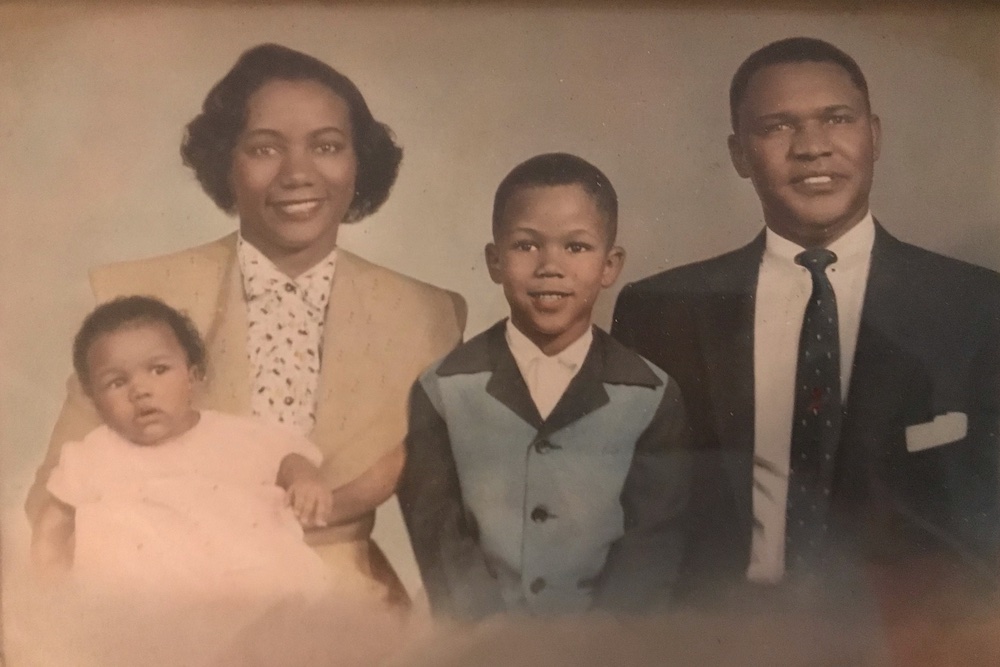
Courtesy of Olga Idriss Davis.
by OLGA IDRISS DAVIS | JUNE 3, 2021 (zocalopublicsquare.org)
I am my father’s daughter.
I am the first-born daughter, the middle child, who was called Sweet Pea, Mama-Daddy, and Peanie. Naming is very important in the Black community. The act of naming is a great power, reminding each of us how to find one’s voice and how to define, and redefine oneself. Children’s nicknames suggest characteristics that relatives have observed, or into which they believe young people will grow; these can serve as the foundation of your identity.
Sweet Pea is my father’s endearing recognition of the energy and life-giving traits of the legume and the preciousness of the flower. My most important name, my official birth-given name, is Olga. It means “Holy One of God” in Russian, and when spelled backward, it is “A Glo.” I like to amuse myself by thinking my identity is somewhere between God’s holiness and the quality of illuminating others, but I know the real foundation is that I am my father’s daughter.
By association and genetics, that also means I am my paternal grandfather’s granddaughter. His name was Jason, and everyone, family included, addressed him as his professional name, Dr. Sneed. I never had the chance to meet him, but, hearing so much about him, I held him in awe. I grew interested in whatever connections he and I may have had. Many Black families are searching to know the history of their ancestors. And, for the past 26 years, I’ve been searching—as a scholar and as our family’s unofficial cultural historian—for my grandfather.
Born in 1877, Dr. Sneed attended the first medical school for aspiring Blacks in the medical profession in the South, Meharry Medical School in Nashville, Tennessee, at the turn of the 20th century. To date, my grandfather and I are the sole ancestral linkages to degree-granting achievement in the professional rank of doctor. His, a Doctor of Medicine (M.D.). Mine, a Doctor of Philosophy (Ph.D.).
For years, I had wondered what this other doctor was like, and why family members and relatives eluded my questions about him. As a child, I was told, “Don’t ever ask your father about your grandfather.” Being the precocious child I was, that was the very question I wanted to ask.
While completing my doctoral degree in human communication from the University of Nebraska in 1994, I had to decide on a topic for my dissertation research. I pondered for a long time, and was considering the study of the emancipatory persona of Black female slave narratives. In the course of my indecision, I mentioned my dilemma to my father, who finally gave me my opening. “Why don’t you write about Tulsa?” he asked. “There’s a lot of history there, and history about our family that you don’t know about.”
Cautiously, I approached the topic with which I was most unfamiliar. Still, I proceeded. “Um, Daddy, what was Grandfather like?”
He was silent, then responded. “Your grandfather was a fine man, dapper, one of the first Black physicians in Tulsa, Oklahoma, and a social activist. He spoke out against Jim Crow segregation and organized people when he was supposed to be silent. He was taken away to prison, and we lost him to lynching.”
He then paused for what seemed like a lifetime before he said, “You know, I’m 70 years old, and I still miss my father.”
Somewhere between the pain of that statement and the unheard tears of my father as he quickly hung up under the guise of a “bad phone connection,” I knew I had to locate Tulsa within me.
Over the next few years, I would spend research time in Tulsa and in Oklahoma City, mostly during summers, reading files, microfiche records, and turn-of-the-century newspapers at historical societies and libraries, and interviewing men and women who would have been my grandfather’s contemporaries.The search for identity is an ongoing search for myself within the shadows of a people who have struggled, resisted, and survived the racial, economic, and social intolerance of Black life in America.
I learned that, after graduating from medical school, my grandfather relocated to Tulsa and established his medical practice. He was part of a larger migration in the early decades of the 20th century of forward-thinking, progressive Black business owners. Buoyed by the booming American oil industry, they established a presence in African Creek towns, such as Muskogee, and newly established Black towns, such as Boley, Langston, and Rentiesville, and began building community, establishing education for their young people, and growing their businesses. Those early settlers dreamed of a Black economic blueprint that would serve as a model for other Black towns and communities across the country. My grandfather, and other men and women like him who represented Black excellence in education, entrepreneurship, and business acumen, wanted to redefine the pathway of opportunity, success, and citizenship for Black people.
One result was the thriving North Tulsa business community known as “Greenwood” or “Negro Wall Street.” My grandfather’s medical practice—at the corner of Greenwood and Pine Streets—was just one of the businesses that filled approximately 40 blocks. There were shops, hotels, dental offices, a hospital, a library, theaters, barber and beauty salons, grocery and millinery establishments, and more. But with this newfound prosperity came hostility, fear, and jealousy by whites, leading to the Tulsa Race Riot/Massacre of 1921.
The search for identity is an ongoing search for myself within the shadows of a people who have struggled, resisted, and survived the racial, economic, and social intolerance of Black life in America. My research has guided me–not as a canine sniffs out a bone, but as a motherless child searches for an unknown parent, or as a veteran returning from war looks for that which will make them whole—toward the inclusivity of community. It’s that very inclusivity that the Tulsa Race Massacre sought to destroy during three days of pillaging, aerial bombing, and destruction by white mobs of the community my grandfather helped build. The reported death toll was 300, but many more lost their lives, homes, and livelihoods, while a host of Black bodies unaccounted for were dumped in unmarked graves.
When the Tulsa Race Massacre is mentioned now, it is spoken as something of the past, an event to be memorialized, as it has been this past week. But not everyone agrees on how to do so, or why. Until recently, even the name of the event failed to narrate it accurately: the Tulsa Race Riot, now known as the Tulsa Race Massacre. The term riot, in America, is often imagined as being linked to the idea of a violent Black presence, of Black bodies perpetually defined and affected by violence. In the context of Tulsa, however, riot reveals an enactment of white bodies representing the violent embrace of white racial domination. Here, the violence was solely perpetrated on Black Tulsan landowners, families, and businesses by whites. The term riot fails to capture the essence of brutality and attempted obliteration of those two days. The term massacre suggests the attempt at genocide, of wiping away the Black community of Tulsa and sending a message that a Black economic infrastructure in the U.S. would not be tolerated.
In February 2001, a Tulsan complained in the local newspaper, Tulsa World, “The Tulsa race riot is history you read about it, you learn from it, then move on.” But, what does it mean to move on? What about the stories of survivors, and how they overcame the haunting memories of burning homes, bombed businesses, and charred corpses lying in the streets of the once-booming Black business community? What about their descendants, grappling with generational trauma, like my father and me?
The account of my grandfather’s experience of living through the Tulsa Race Massacre has been told by my aunt, the late Willie Mae Thompson, respectfully known in the community as “Aunt T” and mother of Morning Star Baptist Church. Her most prominent memory was of my grandfather being “tagged” so as not to be killed but rather identified as one who could pass the restrictions of the local white militia. They allowed my grandfather, as a medical professional, a physician, to comb the streets of Greenwood to identify the dead Black bodies from the living ones. Imagine what he must have undergone, surrounded by charred remains and smoldering embers. Imagine the horrifying reality of identifying neighbors, former patients, church members, and young children he may have delivered in birth.
After those days of violence, the Black community was relegated to tents constructed by the Red Cross. They held on to their faith—a faith in God and in community that would create a spirit of endurance, a strength within that gave way to organizing, regrouping, and still attempting to rebuild—in spirit, in community, in memory. Resilience is a term often characterized by the ability to bounce back, to not give up, to refuse defeat. That was the character of these powerful, disciplined, courageous, and defiant people of North Tulsa and of the Greenwood business district.
Dr. Sneed’s death took place in the aftermath of the Massacre. I don’t know much more than what my father told me all those years ago, including exactly when he died. My research is a continual unfoldment of the story of my grandfather’s life, leading me on a path of deeper exploration and inquiry into reconciliation, reparative justice, and accountability.
The survivors of the Race Massacre are often thought of as a group—a sorrowful, pitiful group, dead, buried, and forgotten. Yet their accounts, told by some who are still living (a number that can be counted on one hand today), are narrative discourses—stories—that reveal lives of courage and love, struggle and resistance, pain and despair, and transcendence and hope for future generations of the Tulsa community and of African American communities at-large. The late Mrs. Mabel B. Little, a Race Massacre survivor at the time of my interview in 1996, was a successful business woman who owned a beauty salon in the Greenwood district. She offered this reflection in an oral history published in 2002, which captured the essence of the brilliance of Greenwood and the challenge of its remembrance:
We have lost our memory as a people, so that we have no clear vision of our future. We have lost our sense of direction, if not our sense of purpose. We’re going to have to return to the past to see where we have been so we can know where we are going; not to get bogged down in the past, but to use the past as a springboard to a new and as yet unimagined future. We must take the best of the past and leave the rest alone.
Acknowledging Mrs. Little’s admonition, I will keep snooping, digging, and finding myself in the Tulsa narratives of Black bodies’ lived experience while I continue the search for my grandfather, and to illuminate public memory of the continuum of struggle and resistance of African American life in the United States.
What I have learned is to be vigilant, and to embrace a culture of resilience established by the Black Tulsans in Greenwood in the telling of the story so that none will ever again forget nor fail to be taught and told.
OLGA IDRISS DAVIS is associate dean of Barrett, The Honors College Downtown Phoenix campus and full professor of communication in the Hugh Downs School of Human Communication at Arizona State University. Her scholarly work focuses on the social determinants of health and health equity among underrepresented communities, and aims to shape the research of next-generation health disparities scholars in the field of critical health communication.
In “Flamenco Queer,” Manuel Liñán plays with gender, transforming both his appearance and a traditional art.
Film by Frederick Bernas and Ana González June 2, 2021 (NewYorker.com)
When I was six and my sister was four, our parents, on holiday in Andalusia, bought us postcards of flamenco dancers. Mine had a yellow dress, and came wearing a real skirt made of lace-edged satin that you could lift up to see the printed version underneath—a talisman of exotic femininity, to the mind of a six-year old boy. When the journalist and filmmaker Ana González was growing up near Madrid, in the nineteen-nineties, flamenco seemed both ubiquitous and retrograde. For González, this exuberant style of dance and music, which emerged in southern Spain, represented a cloying brand of nationalism. “I used to reject the conventional flamenco story, because I associated it with a very conservative tradition,” she said.
It took Manuel Liñán, the subject of “Flamenco Queer,” to change her mind. The film, which González made with her partner, Frederick Bernas, follows Liñán, a seasoned flamenco dancer and choreographer, as he prepares for a big show in the Andalusian city of Granada. In the opening scene, Liñán and five fellow-dancers sit in a horseshoe, clapping and stamping as another dancer storms and twirls in the center. They’re dressed for the stage, with flouncing dresses in gorgeous hues, high-heeled shoes, and lacquered hair. All of them are men, and their performance is revolutionary. “In the world of flamenco, there is a conservative faction, like with society in general,” Liñán explains. “Just for being a man, you’re not allowed to dance in a particular way.” In another scene, we see Liñán, wearing a long polka-dot skirt over Adidas sweatpants, teaching a class of five girls and one boy how to form the sultry hand gestures that are characteristic of the genre. “When I was learning to dance, they told me that I should only move two fingers,” he says, didactically. “That was really boring for me. I preferred the whole hand. I thought it was nicer. But you can choose.” The kids mimic their teacher, holding their hands high above their heads and turning them in graceful, halting circles.The New Yorker Documentary
View the latest or submit your own film.
“Art should change with society,” González told me. Bernas agreed. “If you don’t adapt, you become irrelevant,” he said. But art cannot change itself—that requires artists. Liñán began his training while still in kindergarten, and he was performing professionally by the age of thirteen. A clip, preserved on V.H.S., shows him appearing on a children’s television show, dressed in a man’s outfit of a white shirt and black waistcoat, but with the same concentrated pout he wears decades later. The rules of how boys could dance, or what they could wear, were constricting, and at home, in private, Liñán began to experiment with women’s clothing. (His father, a bullfighter, disapproved, but his mother didn’t mind.) As an adult, Liñán’s expertise in the flamenco form gives him the authority to make it his own. On the night of the show, at a theatre in the gardens of the ancient Alhambra palace, he dances solo on a huge stage backed by cypress trees. His dress is geranium red, his movements fluid and entrancing. “In flamenco, I found the most honest way to communicate,” he says, in voice-over. “I transform a private act into a public spectacle.” It’s how artists make change, one by one.Fergus McIntosh is on the editorial staff of The New Yorker.
by Kittredge Cherry | May 30, 2021 (qspirit.net)
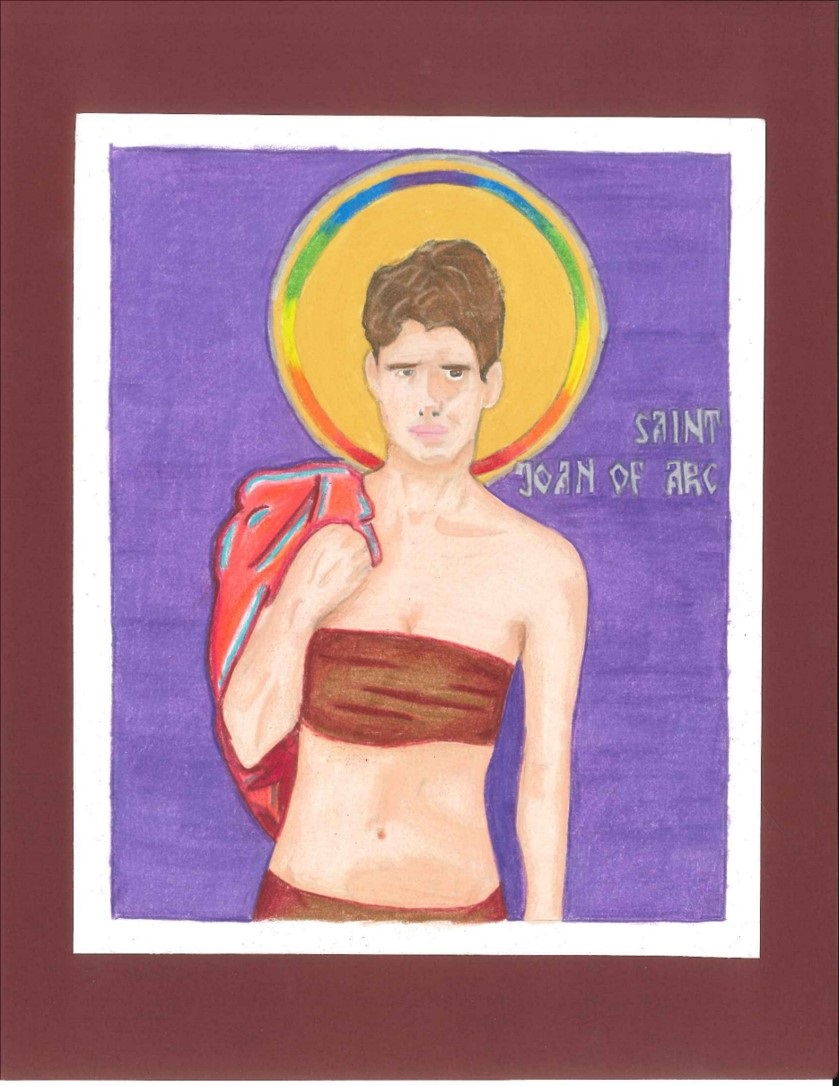
Joan of Arc was a tough cross-dressing teenage warrior who led the medieval French army to victory when she was 17. She is a queer icon, girl-power hero and patron saint of France. Her feast day is May 30.
Smart and courageous, Joan of Arc (c. 1412-1431) had visions of saints and angels who told her to cut her hair, put on men’s clothes and go to war. At age 18 she helped crown a king and at 19 she was killed by the church that later made her a saint. She died for her God-given right to wear men’s clothing, the crime for which she was executed on May 30, 1431.
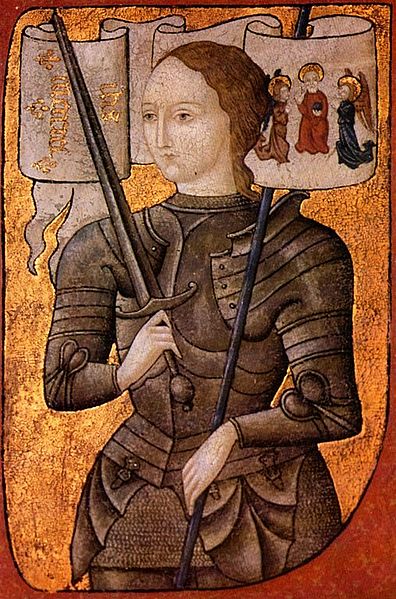
| Joan of Arc portrait, c. 1485 Wikimedia Commons |
Contemporary LGBTQ people recognize a kindred spirit and role model in her stubborn defiance of gender rules. Queer writers tend to downplay Joan’s Christian faith, while the church covers up the importance of her cross-dressing. In truth, Joan believed strongly in God AND in cross-dressing. She insisted that God wanted her to wear men’s clothes, making her what today can be called “queer,” “lesbian” or “transgender.” It’s hard to apply these contemporary categories to people who lived centuries before those terms existed, and both the lesbian and trans communities claim Joan as one of their own.
She fits the medieval archetype sometimes known as the trans saint or “holy transvestite.” Cross-dressing was illegal, but what really upset the church authorities, then as now, was the audacity of someone being both proudly queer AND devoutly Christian. Her belief that God was the source of her gender-bending queerness makes her especially inspiring for LGBTQ Christians and our allies.
This post features contemporary portraits of Joan by Katy-Miles Wallace (top), Tony O’Connell, Rowan Lewgalon, Robert Lentz and Tobias Haller, plus many historical images.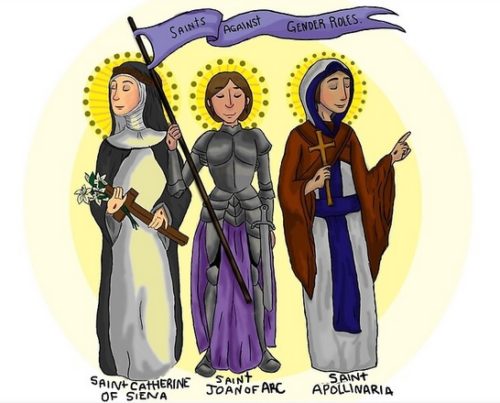
Apollinaria, right, carries a banner proclaiming, “Saints Against Gender Roles,” along with Catherine of Siena and Joan of Arc in an image that is available on many products from Stargirllily at Redbubble.
Joan’s extraordinary life continues to fascinate all kinds of people. Many are eager to claim her as a symbol, from LGBTQ people and feminists to the Catholic Church and French nationalists. There is speculation that she was an intersex person with androgen insensitivity syndrome. Joan is the subject of more than 10,000 books, plays, paintings and films, including recent works by transgender author Leslie Feinberg and lesbian playwright Carolyn Gage.
Gage’s one-woman show “The Second Coming of Joan of Arc” is an underground classic with Joan as “a cross-dressing, teenaged, runaway lesbian” confronting male-dominated institutions. Feinberg has a chapter on Joan as “a brilliant transgender peasant teenager leading an army of laborers into battle” in her history book “Transgender Warriors: Making History from Joan of Arc to Dennis Rodman.” And Joan is included in the 2017 LGBTQ history book for teens, “Queer, There, and Everywhere: 23 People Who Changed the World” by Sarah Prager.
The extensive records of her trials by the Inquisition make Joan of Arc the best-documented person of 15th century. There are only hints that she may have acted on lesbian attractions, but the evidence is absolutely clear about her cross-dressing — which can be interpreted as transgender expression, butch lesbian expression or a chaste heterosexual woman disguising herself to remain safe. On March 25 of her trial, Joan said that “it is not in her” to wear women’s clothes and that that men’s clothes “did not burden her soul.”
Joan of Arc, also known as Jeanne d’Arc, was born to peasants in an obscure village in eastern France around 1412, toward the end of the Hundred Years War. Much of France was occupied by England, so that Charles, the heir to the French throne, did not dare to be crowned. When Joan was 13, she began hearing voices that told her to help France drive out the English.
The visions continued for years, becoming more detailed and frequent. Once or twice a week she had visions of Michael the Archangel and two virgin saints: Catherine of Alexandria and Margaret of Antioch (another transvestite saint who refused to marry a man). They told her that God wanted her to meet Charles and lead an army to Reims for his coronation.
Joan’s family tried to convince her that her visions weren’t real, and her first attempt to visit the royal court was rejected. When she was 17 she put on male clothing and succeeded in meeting Charles. He agreed to outfit her as a knight and allowed her to lead a 5,000-man army against the English.
“Saint Joan of Arc” by Brother Robert Lentz. Prints available at Amazon and Trinity Stores.
On Charles’ order, a full suit of armor was created to fit Joan. He had a banner made for her and assigned an entourage to help her: a squire, a page, two heralds, a chaplain and other servants.
| Joan of Arc on Horseback, 1505 Wikimedia Commons |
Joan’s appearance awed the soldiers and peasants when she traveled with the army. Mounted on a fine warhorse, she rode past cheering crowds in a suit of armor. Her hair was “cropped short and round in the fashion of young men.” She carried an ancient sword in one hand and her banner in the other. Her sword was found, as Joan predicted, buried at the church of St. Catherine at Fierbois. The banner showed Christ sitting on a rainbow against a background of white with gold lilies and the motto “Jhesus-Maria.” Legend says that white butterflies followed Joan wherever she rode with her banner unfurled.
With Joan leading the way, the army won the battle at Orleans and continued to defeat English and pro-English troops until they reached Reims. She proudly stood beside Charles VII at his coronation there on July 17, 1429.
Joan soon resumed leading military campaigns. Even during her lifetime the peasants adored her as a saint, flocking around her to touch her body or clothing. Her cross-dressing didn’t disturb them. In fact, they seemed to honor her for cross dressing. Perhaps, as some scholars say, the peasants saw Joan as part of a tradition that linked transvestites and priests in pre-modern Europe.
One of the first modern writers to raise the possibility of Joan’s lesbianism was English author Vita Sackville-West. She implied that Joan was a lesbian in her 1936 biography “Saint Joan of Arc.” The primary source for this idea was the fact, documented in her trials, that Joan shared her bed with other girls and young women. She followed the medieval custom of lodging each night in a local home. Joan always slept with the hostess or the girls of the household instead of with the men.
“Joan of Arc: Her Trial Transcripts” by Emilia Philomena Sanguinetti is a 2016 book that explores whether Joan was a lesbian or transgender person. Extensive evidence that Joan of Arc was a lesbian or transgender person is presented in the epilogue of this groundbreaking book about the cross-dressing medieval saint. She explores how Joan shared her bed with another woman and insisted on wearing male clothing.
Nobody knows for sure whether Joan of Arc was sexually attracted to women or had lesbian encounters, but her abstinence from sex with men is well documented. Her physical virginity was confirmed by official examinations at least twice during her lifetime. Joan herself liked to be called La Pucelle, French for “the Maid,” a nickname that emphasized her virginity. Witnesses at her trial testified that Joan was chaste rather than sexually active. Some contemporary feminists believe that “virgin” did not mean sexless, but belonging to no man. There are many “virgin saints” who refused heterosexual marriage and joined convents to have their primary relationships with women. They become role models for lesbians of faith.
Joan’s illustrious military career ended in May 1430. She was captured in battle by the Burgundians, the French allies of the English. During her captivity they called her “hommase,” a slur meaning “man-woman” or “masculine woman.”
In a stunning betrayal, Charles VII did nothing to rescue the warrior who helped win him the crown. It was normal to pay ransom for the release of knights and nobles caught in battle, but he abandoned Joan to her fate. Historians speculate that French aristocrats felt threatened by the peasant girl with such uncanny power to move the masses.
The Burgundians transferred Joan to the English, who then gave her to the Inquisition. She spent four torturous months in prison before her church trial began on Jan. 9, 1431 in Rouen, the seat of the English occupation government. She was charged with witchcraft and heresy.
The politically motivated church trial was rigged against her, and yet Joan was able to display her full intelligence as she answered the Inquisitors’ questions. Her subtle, witty answers and detailed memory even forced them to stop holding the trial in public.
Witchcraft was hard to prove, so the church dropped the charge. (Many of today’s Wiccans and pagans still honor Joan as one of their own.) The Inquisitors began to focus exclusively on the “heresy” of Joan’s claim that she was following God’s will when she dressed as a man. The judges told her that cross-dressing was “an abomination before God” according to church law and the Bible. (See Deuteronomy 22:5.)

“Joan of Arc Kisses the Sword of Liberation” by Dante Gabriel Rossetti, 1863 (WikiPaintings)
They accused Joan of “leaving off the dress and clothing of the feminine sex, a thing contrary to divine law and abominable before God, and forbidden by all laws” and instead dressing in “clothing and armor such as is worn by man.”
Joan swore that God wanted her to wear men’s clothing. “For nothing in the world will I swear not to arm myself and put on a man’s dress; I must obey the orders of Our Lord,” she testified. She outraged the judges by continuing to appear in court wearing what they called “difformitate habitus” (“monstrous dress” or “degenerate apparel.”)
Today Joan’s conservative admirers claim that she wore men’s clothes only as way to avoid rape, but she said that it meant much more to her. Joan of Arc saw cross-dressing as a sacred duty.
The judges summarized Joan’s testimony by saying, “You have said that, by God’s command, you have continually worn man’s dress, wearing the short robe, doublet, and hose attached by points; that you have also worn your hair short, cut ‘en rond’ above your ears with nothing left that could show you to be a woman; and that on many occasions you received the Body of our Lord dressed in this fashion, although you have been frequently admonished to leave it off, which you have refused to do, saying that you would rather die than leave it off, save by God’s command.”
Joan refused to back down on the visions she received from God, and she was sentenced to death. She was burned at the stake on May 30, 1431 in Rouen. Twenty five years later she was retried and her conviction was overturned. Joan was declared innocent.
Her armor, that “monstrous dress,” became an object of veneration, sought after like the Holy Grail with various churches claiming to possess her true armor. Joan of Arc was canonized as a saint in 1920.
In the icon at the top of this post, an androgynous Joan of Arc has a bound chest and a rainbow halo. It was created by queer Lutheran artist and seminarian Katy Miles-Wallace in 2017 as part of her “Queer Saints” series. Her icon of Joan is modeled after genderqueer model Rain Dove. The series presents traditional saints with queer qualities and heroes of the LGBTQ community.
The icons are rooted in queer theology and in Miles-Wallace’s eclectic faith journey that began at a Baptist church in Texas and led to study at Pacific Lutheran Theological Seminary in Berkeley, California. She drew many of them on the altar of a seminary chapel. For more info, see the Q Spirit article “New icons of Queer Saints created by artist Katy Miles-Wallace.”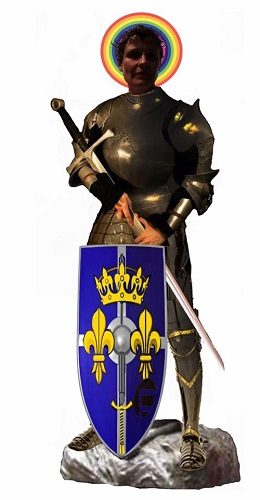
Saint Joan of Arc from “Triptych for the 49” by Tony O’Connell
Joan of Arc also has a rainbow halo in “Triptych for the 49” by gay artist Tony O’Connell of Liverpool. Joan of Arc and Sebastian appear as “wrathful protector saints” in the artwork, which honors those killed in the 2016 mass shooting at the Pulse gay bar in Orlando, Florida.
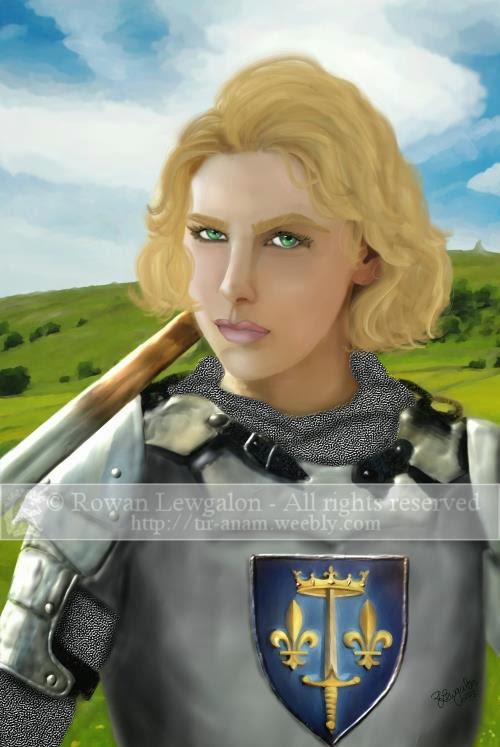
“Jeanne D’Arc” by Rowan Lewgalon
Lewgalon is a spiritual artist based in Germany and also a cleric in the Old Catholic Apostolic Church. Lentz is a Franciscan friar known for his innovative and LGBTQ-positive icons. He is stationed at Holy Name College in Silver Spring, Maryland.
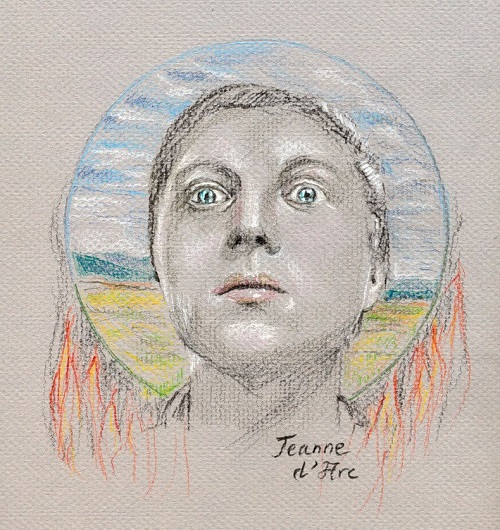
“Jeanne d’Arc” by Tobias Haller
“Jeanne d’Arc” was sketched by Tobias Haller, an iconographer, author, composer, and retired vicar of Saint James Episcopal Church in the Bronx, still assisting at a parish in Baltimore, Maryland. He is the author of “Reasonable and Holy: Engaging Same-Sexuality.” Haller enjoys expanding the diversity of icons available by creating icons of LGBTQ people and other progressive holy figures as well as traditional saints. He and his husband were united in a church wedding more than 30 years ago and a civil ceremony after same-sex marriage became legal in New York.
Joan of Arc also appears with a rainbow halo as a “wrathful protector saint” in O’Connell’s “Triptych for the 49,” a tribute to the people killed by a mass shooter at the Pulse gay nightclub in Orlando, Florida.
Famous writers and composers who have done works about her include Shakespeare, Voltaire, Verdi, Tchaikovsky, Mark Twain, Bertolt Brecht and George Bernard Shaw. A stunning portrait of Joan kissing her sword was painted by Pre-Raphaelite artist Dante Gabriel Rossetti, whose sister Christina Rossetti is also part of the LGBTQ Saints series at the Jesus in Love Blog at Q Spirit.
Joan has a dialogue with the fire that is about to consume her in a haunting song written by award-winning Canandian poet Leonard Cohen and sung on July Collins video .
A widely used prayer to Saint Joan of Arc makes a powerful statement that can inspire those who believe in equality for LGBTQ people, despite rejection by religion and society:
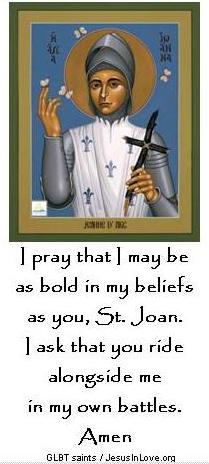
“In the face of your enemies,
in the face of harassment, ridicule, and doubt,
you held firm in your faith.
Even in your abandonment,
alone and without friends,
you held firm in your faith.
Even as you faced your own mortality,
you held firm in your faith.
I pray that I may be as bold
in my beliefs as you, St. Joan.
I ask that you ride alongside me
in my own battles.
Help me be mindful
that what is worthwhile
can be won when I persist.
Help me hold firm in my faith.
Help me believe in my ability
to act well and wisely. Amen.”
Wikipedia article on Cross-dressing, sexuality, and gender identity of Joan of Arc
Joan of Arc trial transcript online
The Patron Saint of Dysphoria: Joan of Arc as Transgender (thingstransform.com)
Joan of Arc: Cross-dressing martyr at Queering the Church Blog
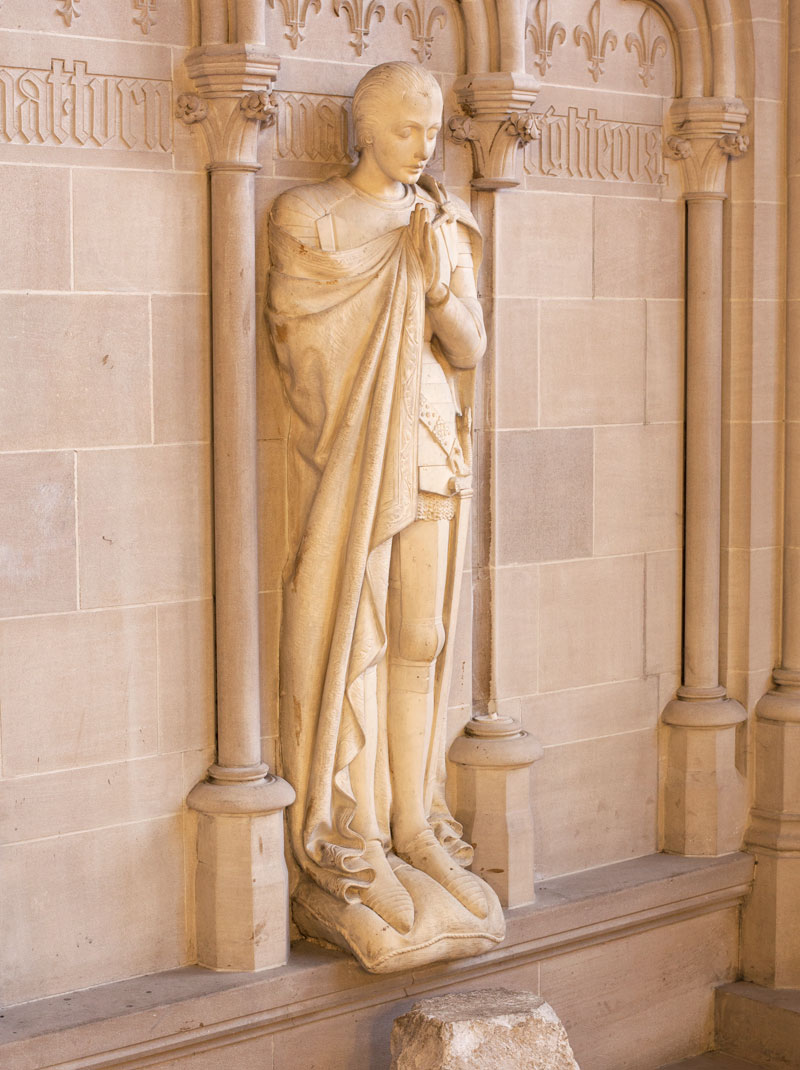
Joan of Arc sculpture by Anna Hyatt Huntington at the Cathedral of Saint John the Divine in New York City
To read this article in Spanish / en español, go to Santos Queer:
Juana de Arco: Santa Travesti
To read this article in Italian, go to Gionta.org:
Una guerriera genderbender. La favolosa vita di Giovanna d’Arco
To read a French interview about Joan of Arc with Q Spirit founder Kittredge Cherry, go to Komitid.fr:
Marine Le Pen s’est trompée, Jeanne d’Arc est en fait une icône queer
(Marine Le Pen was wrong, Joan of Arc is actually a queer icon)
___
Top image credit:
“Queer Saints: St. Joan of Arc” by Katy Miles-Wallace.
___
This post is part of the LGBTQ Saints series by Kittredge Cherry. Traditional and alternative saints, people in the Bible, LGBTQ martyrs, authors, theologians, religious leaders, artists, deities and other figures of special interest to lesbian, gay, bisexual and transgender and queer (LGBTQ) people and our allies are covered.
This article was originally published in May 2017 and was updated for accuracy and expanded with new material on May 30, 2021.
Copyright © Kittredge Cherry. All rights reserved.
Qspirit.net presents the Jesus in Love Blog on LGBTQ spirituality.
Kittredge Cherry Founder at Q Spirit Kittredge Cherry is a lesbian Christian author who writes regularly about LGBTQ spirituality.She holds degrees in religion, journalism and art history.She was ordained by Metropolitan Community Churches and served as its national ecumenical officer, advocating for LGBTQ rights at the National Council of Churches and World Council of Churches.
fixed/fikst/Learn to pronounce
See definitions in:
4th step: Truth is securely in place. Truth is unbroken, whole.
5th step conclusion: Wholeness is securely, irrevocably in place.
OR: The fix is in: Truth wins!!

The story follows Prince Prospero’s attempts to avoid a dangerous plague known as the Red Death by hiding in his large converted abbey home. He and many other wealthy nobles, have a masquerade ball using seven rooms in the abbey, each decorated with a different color. The last one is velvet black.
In the midst of their revelry, a mysterious figure disguised as a Red Death victim enters and makes his way through each of the rooms.
The story follows many traditions of Gothic fiction and is often analyzed as an allegory about the inevitability of death, though some critics advise against an allegorical reading. Many different interpretations have been presented, as well as attempts to identify the true nature of the titular disease.
Librarian’s note: this entry relates to the story “The Masque of the Red Death.” Collections of short stories by the author can be found elsewhere on Goodreads.
(Goodreads.com)

“Every person of ordinary sex endowment has a capacity for diffuse ‘homosexual’ sex expression … according to the temperamental situation,” the influential anthropologist Margaret Mead wrote in a visionary 1933 letter that framed human sexuality as a matter of fluid attraction to temperaments, not a fixed attraction to genders, eight decades before the modern plight for marriage equality ushered in the universal dignity of love.
This conviction made Mead the perfect conversation partner for James Baldwin (August 2, 1924–December 1, 1987) when they sat down for their remarkable dialogue about identity four decades later. By then one of the most celebrated writers and thinkers in the world, Baldwin was among the era’s handful of openly gay public intellectuals and someone whom the legendary interviewer Studs Terkel aptly described as “one of the rare men in the world who seems to know who he is today.”
No book since Virginia Woolf’s Orlando would do more to enlist art as a force of empathic insight into same-sex desire than Giovanni’s Room, which Baldwin wrote in his early thirties against enormous resistance from American publishers, at a time when the DSM — the Diagnostic Manual of Mental Disorders, psychiatry’s Bible — classified homosexuality as a “sociopathic personality disturbance.” But although Baldwin had devoted his entire life to defending human dignity in all its guises, it was only in his final years that he addressed the question of sexuality and the dark specter of homophobia directly, thanks to Village Voice journalist Richard Goldstein — one of the generation of gay people who had found in Giovanni’s Room what Goldstein considered “an early vector of self-discovery.”
Appalled that a lengthy interview with Baldwin in the New York Times Book Review had swept its subject’s sexuality under the rug, Goldstein decided to take matters into his own hands. He persuaded the beloved writer, “a man who traced much of his acuity and pain to the nexus of racism and homophobia,” to meet with him for a conversation that would become Baldwin’s most personal interview, eventually included in James Baldwin: The Last Interview and Other Conversations (public library).
James Baldwin
From the very beginning of the conversation, Baldwin exerts a lively resistance to all the labels within which we confine the expansiveness of human love. He tells Goldstein:
Giovanni’s Room is not really about homosexuality… It’s about what happens to you if you’re afraid to love anybody. Which is much more interesting than the question of homosexuality.
[…]
The question of human affection, of integrity, in my case, the question of trying to become a writer, are all linked with the question of sexuality. Sexuality is only a part of it. I don’t know even if it’s the most important part. But it’s indispensable.
Reflecting on what gave him the courage to release the novel in Europe despite American publishers’ vehement refusal to publish it, Baldwin considers the deepest societal seedbed of the malady of homophobia, symptoms of which we’ve begun to see anew all these decades later. Echoing Rilke’s assertion that “for one human being to love another: that is perhaps the most difficult of all our tasks,” he tells Goldstein:

Illustration from The Harvey Milk Story, a picture-book biography of the slain LGBT rights pioneer
Three decades after Hannah Arendt’s incisive treatise on how tyrannical regimes use isolation as a weapon of terror and oppression, Baldwin considers the wielding of homophobia as a cultural control mechanism by political propagandists, “a way of exerting control over the universe, by terrifying people.” The consequence, he suggests, is a fragmentation of unity on the basis of a rather arbitrary point of difference:
GOLDSTEIN: I sometimes think gay people look to black people as healing them…
BALDWIN: Not only gay people.
GOLDSTEIN: …healing their alienation.
BALDWIN: That has to be done, first of all, by the person and then you will find your company.

Art by Maurice Sendak from We Are All in the Dumps with Jack and Guy, one of history’s greatest LGBT children’s books
When Goldstein remarks, three decades before this became a reality, that he imagines the election of a black president would be better for gay people, Baldwin considers the cross-pollinatory empowerment of the disenfranchised:

Photograph by Sage Sohier from At Home with Themselves, a portrait series of gay couples in the 1980s
Affirming the notion that homosexuality is universal, Baldwin considers how language can be both the prison bars of our identity and the crowbar for breaking out of that prison:
Envisioning the future for gay people, Baldwin offers:
When Goldstein asks what advice he might have for people about to come out, Baldwin answers:
Complement this particular portion of the wholly fantastic James Baldwin: The Last Interview and Other Conversations with literary history’s most beautiful LGBT love letters and the real-life story behind “the longest and most charming love letter in literature,” then revisit Baldwin on freedom and how we imprison ourselves, the artist’s responsibility to society, what it means to be truly empowered, and his increasingly timely conversation with Chinua Achebe about the political power of art.
The Grayzone Join The Grayzone for a livestream discussion with musician Roger Waters and author Gabor Maté, to discuss Israel’s war on Gaza, the Palestinian resistance struggle, and a variety of other political and cultural issues.