
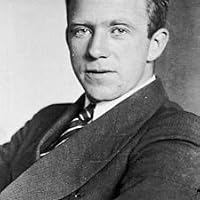
“Not only is the Universe stranger than we think, it is stranger than we can think.”
― Werner Heisenberg, Across the Frontiers
“What we observe is not nature itself, but nature exposed to our method of questioning.”
― Werner Heisenberg, Physics and Philosophy: The Revolution in Modern Science
“The first gulp from the glass of natural sciences will turn you into an atheist, but at the bottom of the glass God is waiting for you.”
― Werner Heisenberg
“There are things that are so serious that you can only joke about them.”
― Werner Heisenberg
“I remember discussions with Bohr which went through many hours till very late at night and ended almost in despair; and when at the end of the discussion I went alone for a walk in the neighbouring park I repeated to myself again and again the question: Can nature possibly be so absurd as it seemed to us in these atomic experiments?”
― Werner Heisenberg
“The reality we can put into words is never reality itself.”
― Werner Heisenberg
“Whenever we proceed from the known into the unknown we may hope to understand, but we may have to learn at the same time a new meaning of the word ‘understanding.”
― Werner Karl Heisenberg, Physics and Philosophy: The Revolution in Modern Science
“An expert is someone who knows some of the worst mistakes that can be made in his subject, and how to avoid them.”
― Werner Heisenberg
“I think that modern physics has definitely decided in favor of Plato. In fact the smallest units of matter are not physical objects in the ordinary sense; they are forms, ideas which can be expressed unambiguously only in mathematical language.”
― Werner Heisenberg
“Quantum theory provides us with a striking illustration of the fact that we can fully understand a connection though we can only speak of it in images and parables.”
― Werner Heisenberg
“[T]he atoms or elementary particles themselves are not real; they form a world of potentialities or possibilities rather than one of things or facts.”
― Werner Heisenberg
“In the history of science, ever since the famous trial of Galileo, it has repeatedly been claimed that scientific truth cannot be reconciled with the religious interpretation of the world. Although I an now convinced that scientific truth is unassailable in its own field, I have never found it possible to dismiss the content of religious thinking as simply part of an outmoded phase in the consciousness of mankind, a part we shall have to give up from now on, Thus in the course of my life I have repeatedly been compelled to ponder on the relationship of these two regions of though, for I have never been able to doubt the reality of that to which they point.”
― Werner Heisenberg
“We have to remember that what we observe is not nature in itself but
nature exposed to our method of questioning.
”
― Werner Heisenberg
“Revere those things beyond science which really matter and about which it is so difficult to speak.”
― Werner Heisenberg
“If nature leads us to mathematical forms of great simplicity and beauty—by forms, I am referring to coherent systems of hypotheses, axioms, etc.—to forms that no one has previously encountered, we cannot help thinking that they are “true,” that they reveal a genuine feature of nature…. You must have felt this too: the almost frightening simplicity and wholeness of the relationships which nature suddenly spreads out before us and for which none of us was in the least prepared.”
― Werner Heisenberg
“The positivists have a simple solution: the world must be divided into that which we can say clearly and the rest, which we had better pass over in silence. But can anyone conceive of a more pointless philosophy, seeing that what we can say clearly amounts to next to nothing? If we omitted all that is unclear, we would probably be left completely uninteresting and trivial tautologies.”
― Werner Heisenberg
“My mind was formed by studying philosophy, Plato and that sort of thing.”
― Werner Heisenberg
“Only a few know, how much one must know, to know how little one knows”
― Werner Heisenberg
“If we wanted to construct a basic philosophical attitude from these scientific utterances of Pauli‘s, at first we would be inclined to infer from them an extreme rationalism and a fundamentally skeptical point of view. In reality however, behind this outward display of criticism and skepticism lay concealed a deep philosophical interest even in those dark areas of reality of the human mind which elude the grasp of reason. And while the power of fascination emanating from Pauli‘s analyses of physical problems was admittedly due in some measure to the detailed and penetrating clarity of his formulations, the rest was derived from a constant contact with the field of creative processes, for which no rational formulation as yet exists.”
― Werner Heisenberg, Physics and Philosophy: The Revolution in Modern Science
“I am firmly convinced that we must never judge political movements by their aims, no matter how loudly proclaimed or how sincerely upheld, but only by the means they use to realize these aims.”
― Werner Heisenberg, Physics and Beyond: Encounters and Conversations
“Whether we like it or not, modern ways are going to alter and in part destroy traditional customs and values.”
― Werner Heisenberg, Physics and Philosophy: The Revolution in Modern Science
“The existing scientific concepts cover always only a very limited part of reality,
and the other part that has not yet been understood is infinite. Whenever we
proceed from the known into the unknown we may hope to understand, but we
may have to learn at the same time a new meaning of the word ‘understanding’.”
― Werner Heisenberg
“In classical physics, science started from the belief – or should one say, from the illusion? – that we could describe the world, or least parts of the world, without any reference to ourselves.”
― Werner Heisenberg
“Natural science, does not simply describe and explain nature; it is part of the interplay between nature and ourselves.”
― Werner Heisenberg
“In a darkened world no longer illuminated by the light of this center [God], technical advances are scarcely more than despairing attempts to make Hell a more agreeable place to live in. This must be particularly emphasized against those who think that by spreading the civilization of science and technology even to the uttermost ends of the earth, they can furnish all the essential preconditions for a golden age. One cannot escape the Devil so easily as that.”
― Werner Heisenberg, Across the Frontier
“[The probability wave] meant a tendency for something. It was a quantitative version of the old concept of “potentia” in Aristoelian philosophy. It introduced something standing in the middle between the idea of an event and the actual event, a strange kind of physical reality just in the middle between possibility and reality.”
― Werner Heisenberg
“We can never know anything.”
― Werner Heisenberg
“We may remark at this point that modern physics is in some way extremely near to the doctrines of Heraclitus. If we replace the word ‘fire’ by the word ‘energy’ we can almost repeat his statements word for word from our modern point of view. Energy is in fact the substance from which all elementary particles, all atoms and therefore all things are made, and energy is that which moves. Energy is a substance, since its total amount does not change, and the elementary particles can actually be made from this substance as is seen in many experiments on the creation of elementary particles. Energy can be changed into motion, into heat, into light and into tension. Energy may be called the fundamental cause for all change in the world.”
― Werner Heisenberg, Physics and Philosophy: The Revolution in Modern Science
“Any concepts or words which have been formed in the past through the interplay between the world and ourselves are not really sharply defined with respect to their meaning: that is to say, we do not know exactly how far they will help us in finding our way in the world. We often know that they can be applied to a wide range of inner or outer experience, but we practically never know precisely the limits of their applicability. This is true even of the simplest and most general concepts like “existence” and “space and time”. Therefore, it will never be possible by pure reason to arrive at some absolute truth.
The concepts may, however, be sharply defined with regard to their connections. This is actually the fact when the concepts become part of a system of axioms and definitions which can be expressed consistently by a mathematical scheme. Such a group of connected concepts may be applicable to a wide field of experience and will help us to find our way in this field. But the limits of the applicability will in general not be known, at least not completely.”
― Werner Heisenberg, Physics and Philsophy
“The renouncing of life and immediacy, which was the premise for the progress of natural science since Newton, formed the real basis for the bitter struggle which Goethe waged against the physical optics of Newton. It would be superficial to dismiss this struggle as unimportant: there is much significance in one of the most outstanding men directing all his efforts to fighting against the development of Newtonian optics.”
― Werner Heisenberg
“Here the attention of the research workers is primarily directed to the problem of reconciling the claims of the special relativity theory with those of the quantum theory. The extraordinary advances made in this field by Dirac … leave open the question whether it will be possible to satisfy the claims of the two theories without at the same time determining the Sommerfeld fine-structure constant.”
― Werner Heisenberg, Physics and Philosophy: The Revolution in Modern Science
“Modern physics plays perhaps only a small role in this dangerous process of unification. But it helps at two very decisive points to guide the development into a calmer kind of evolution. First, it shows that the use of arms in the process would be disastrous and, second, through its openness for all kinds of concepts it raises the hope that in the final state of unification many different cultural traditions may live together and may combine different human endeavors into a new kind of balance between thought and deed, between activity and meditation.”
― Werner Heisenberg, Physics and Philosophy: The Revolution in Modern Science
“When I meet God, I am going to ask him two questions: why relativity? And why turbulence? I really believe he will have an answer for the first.”
― Werner Heisenberg
“The ontology of materialism rested upon the illusion that the kind of existence, the direct ‘actuality’ of the world around us, can be extrapolated into the atomic range. This extrapolation, however, is impossible… Atoms are not things.”
― Werner Heisenberg, Physics and Philosophy: The Revolution in Modern Science
“[I]n the Copenhagen interpretation of quantum theory we can indeed proceed without mentioning ourselves as individuals, but we cannot disregard the fact that natural science is formed by men. Natural science does not simply describe and explain nature; it is part of the interplay between nature and ourselves; it describes nature as exposed to our nature of questioning. This was a possibility of which Descartes could not have thought, but it makes a sharp separation between the world and the I impossible.
If one follows the great difficulty which even eminent scientists like Einstein had in understanding and accepting the Copenhagen interpretation… one can trace the roots… to the Cartesian partition….it will take a long time for it [this partition] to be replaced by a really different attitude toward the problem of reality.”
― Werner Heisenberg, Physics and Philsophy
“Only a few know, how much one must know to know how little one knows.”
― Werner Heisenberg
“The first thing we could say was simply: ‘I believe in God, the Father, the almighty creator of heaven and earth.”
― Werner Heisenberg
“This [chaotic environment,] I felt, was only possible because all these types of order were partial, mere fragments that had split off from a central order; they might not have lost their creative force, but they were no longer directed toward a unifying center. Its absence was brought home to me with increasingly painful intensity the longer I listened. I was suffering almost physically, but I was quite unable to find a way towards the center through the thicket of conflicting opinions. …There was a hush as, high above us, [a young violinist] struck up the first great D minor chord of Bach’s Chaconne. All at once, and with utter certainty, I had found my link with the center….The clear phrases of the Chaconne touched me like a cool wind, breaking through the mist and revealing the towering structures beyond. There has always been a path to the central order in the language of music, in philosophy and in religion, today no less than in Plato’s day and in Bach’s. That I now knew from my own experience.”
― Werner Heisenberg
“It was around three o’clock in the morning when the final results of my calculations were before me. I felt profoundly shaken. I was so agitated that I could not sleep. I left the house and began walking slowly in the dark. I climbed on a rock overlooking the sea at the tip of the island, and waited for the sun to come up…”
― Werner Heisenberg
Werner Karl Heisenberg (1925) was a German physicist and philosopher who made significant contributions to 20th century theoretical physics. He is best known for developing the uncertainty principle in 1927 and receiving the 1932 Nobel Prize in Physics for his work. Heisenberg was a leader in the development of quantum mechanics, formulating it in terms of matrices and publishing a major reinterpretation of quantum theory in 1925. (Wikipedia.org)
Born December 5, 1901, Würzburg, Germany
Died February 1, 1976 (age 74 years), Munich, Germany