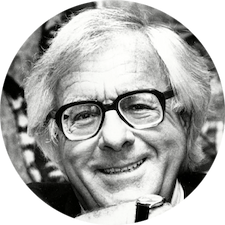
“I had decided to be a magician well before I decided to be a writer. I was the little boy who would get up on-stage and do magic wearing a fake mustache, which would fall off during the performance. I’m still trying to perform those tricks. Now I do it with writing.”
–Ray Bradbury
Ray Douglas Bradbury was a celebrated American author and screenwriter who worked across genres like fantasy, science fiction, horror, and mystery. His unique style combined the poetic imagery of Thomas Wolfe with the crispness of Ernest Hemingway. Bradbury’s work explored themes like censorship, racism, technology, and the importance of imagination. He’s considered a significant figure in both American literature and science fiction. (Wikipedia.org)
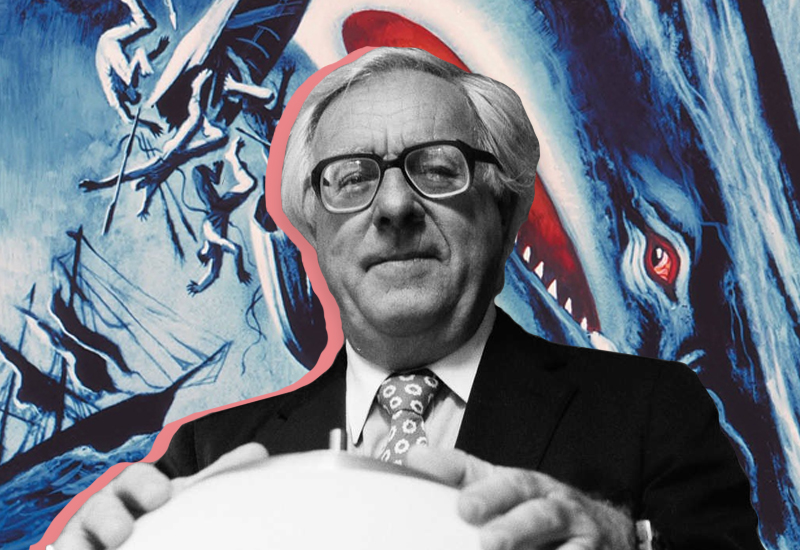
Fun fact: Ray Bradbury wrote the screenplay for John Huston’s 1956 adaptation of Herman Melville’s Moby-Dick—but it wasn’t for the love of Melville.
“I had fallen in love with John Huston’s work when I was in my twenties,” he told The Paris Reviewin 2010.
When I was twenty-nine I attended a film screening and John Huston was sitting right behind me. I wanted to turn, grab his hand, and say, I love you and I want to work with you. But I held off and waited until I had three books published, so I’d have proof of my love. I called my agent and said, Now I want to meet John Huston. We met on St. Valentine’s night, 1951, which is a great way to start a love affair. I said, Here are my books. If you like them, someday we must work together. A couple of years later, out of the blue, he called me up and said, Do you have some time to come to Europe and write Moby-Dick for the screen? I said, I don’t know, I’ve never been able to read the damn thing. So here I was confronted with a dilemma: Here’s a man that I love and whose work I admire. He’s offering me a job. Now, a lot of people would say, Grab it! Jesus, you like him, don’t ya? I said, Tell you what, I’ll go home tonight and I’ll read as much as I can, and I’ll come back for lunch tomorrow. By that time I will know how I feel about Melville. Because I’ve had copies of Moby-Dick around the house for years. So I went home and I read Moby-Dick. Strangely enough, a month earlier I’d been wandering around the house one night and picked up Moby-Dick and said to my wife, I wonder when I’m going to read this thing? So here I am sitting down to read it.
I dove into the middle of it instead of starting at the beginning. I came across a lot of beautiful poetry about the whiteness of the whale and the colors of nightmares and the great spirit’s spout. And I came upon a section toward the end where Ahab stands at the rail and says: “It is a mild, mild wind, and a mild looking sky; and the air smells now, as if it blew from a far-away meadow; they have been making hay somewhere under the slopes of the Andes, Starbuck, and the mowers are sleeping among the new-mown hay.” I turned back to the start: “Call me Ishmael.” I was in love! You fall in love with poetry. You fall in love with Shakespeare. I’d been in love with Shakespeare since I was fourteen. I was able to do the job not because I was in love with Melville, but because I was in love with Shakespeare. Shakespeare wrote Moby-Dick, using Melville as a Ouija board.
Needless to say, Bradbury took the gig—but it was a hard road. It took “eight long months of agonizing work, subconscious work” in Ireland until finally, he had a breakthrough:
I got out of bed one morning in London, looked in the mirror, and said, ‘I am Herman Melville!’ I sat down at the typewriter, and in eight hours of passionate, red-hot writing, I finished the screenplay of Moby Dick, and I ran across London, I threw the script in John Huston’s lap, and said, ‘There! It’s done!’ He read it and said, ‘My god, what happened?’ I said, ‘Behold: Herman Melville.’
The final script is dated February 22, 1954. For more, check out Bradbury’s 1992 novel Green Shadows, White Whale, a fictionalized account of his experiences writing the screenplay with Huston in Ireland.
Literary Hub (lithub@lithub.com)
Consciousness, spirituality, biography, sexuality, androgyny, futurism, space, the arts, science, astrology, democracy, humor, books, movies and more