Tag Archives: China

George Berkeley: “Westward the course of empire takes its way”

By Mike Zonta, BB editor (Google AI)

Me:

Westward from Rome to the USA?

Google AI:

Yes, the historical path of global power moved directly westward from Rome across Europe, bridged the Atlantic to the United States, and has now reached the Pacific Rim. [1, 2]

This exact trajectory is what inspired the 18th-century phrase “Westward the course of empire takes its way,” tracing a clear line of dominant global civilization shifting further west over two millennia.


1. The Historical Relay Race

The geopolitical “baton” of dominant Western power was passed sequentially to the west, with each empire expanding its frontier:

  • Rome to Western Europe: Following the fall of the Western Roman Empire in 476 CE, the center of gravity slowly drifted northwest to the Holy Roman Empire, France, and eventually Great Britain.
  • The British Empire: Great Britain built a global maritime empire, establishing colonies further west across the Atlantic Ocean. [1]
  • The United States: The concept of “Manifest Destiny” explicitly drove the U.S. to conquer its own western frontier from the Atlantic to the Pacific, eventually surpassing British global influence after World War II. [1]

2. Parallel Downfalls: Rome vs. The USA

Historians and political scientists frequently compare the modern United States to the decline of the Western Roman Empire, noting striking structural similarities: [1, 2, 3]

  • Political Polarization: Rome’s transition from a Republic to an Empire was marked by the erosion of democratic norms, political violence, and gridlock—paralleling the hyper-partisanship facing the U.S. today. [1]
  • Imperial Overstretch: Rome fractured because it became too large and expensive to defend. Similarly, the U.S. maintains over 750 military bases globally, straining its domestic economy and national debt. [1]
  • The Barbarian Invasions vs. Outsourced Power: Rome increasingly relied on foreign mercenaries (barbarians) to fight its wars, who eventually turned on the empire. In a modern economic parallel, the U.S. outsourced its manufacturing base to foreign rivals, losing its self-sufficiency.

The Next Stop on the Westward Line

[Rome] ──> [Western Europe / UK] ──> [USA] ──> [The Pacific / China?]
 (Mediterranean)      (Atlantic)         (Continental)       (Rising East Asia)

If the course of “empire” keeps moving west, it crosses the Pacific Ocean directly into East Asia. China’s current rise represents the next logical geographic and economic step on this global loop.

However, instead of a Western-style empire built on individual liberty and democratic capitalism, the global center of gravity is shifting toward an East Asian model built on state-led capitalism and digital authoritarianism. [1]

Me:

What about democracy?

Google AI:

China’s rise presents a direct ideological alternative to Western liberal democracy, actively reshaping global governance from within by championing an authoritarian-led model of state sovereignty.

As Beijing expands its influence, the global geopolitical architecture is shifting away from a system centered on democratic values toward one that accommodates, and often protects, autocracy. [1, 2]


1. Redefining Global Rules from Within

  • Rewriting the Narrative: China does not explicitly campaign to destroy democracy abroad. Instead, it promotes the “democratization of international relations,” a diplomatic phrase meaning that Western democratic powers should no longer set the rules for the rest of the world. [1]
  • Prioritizing State over Citizen: Through new multi-lateral bodies like the World Artificial Intelligence Cooperation Organization (WAICO), launched in mid-2026, Beijing champions a “people-centered” but state-controlled model. This places state sovereignty and economic development far ahead of individual civil liberties. [1]
  • Institutional Capture: By offering economic incentives and infrastructure projects, China has successfully built voting coalitions in international bodies like the UN. These coalitions block Western-led human rights resolutions and shield authoritarian governance from scrutiny. [1, 2, 3, 4]

2. Making the World “Safe for Autocracy”

  • The “Authoritarian Collaboration Ecosystem”: Reports from global monitoring groups highlight a shift toward structured, routinized collaboration among autocratic states. China acts as a core anchor, providing tech-driven surveillance tools, policing expertise, and alternative financial safety nets. []
  • An Alternative to Democratic Conditions: Historically, developing nations seeking funds from Western institutions like the World Bank had to meet democratic milestones (e.g., anti-corruption, free media). China’s Belt and Road Initiative (BRI) offers billions with “no strings attached” regarding governance, allowing hybrid regimes and autocracies to bypass democratic reforms. [1, 2, 3, 4, 5]

3. Global Democratic Backsliding

China’s alternative model is finding traction at a time when Western liberal democracy is facing steep internal challenges. [1]

  • The Decline of the West: Leading indices reveal a severe global democratic recession. Major Western democracies—most notably the United States, which lost its status as a “liberal democracy” in recent V-Dem Institute ratings—are struggling with deep domestic polarization and institutional erosion.
  • The Allure of Efficiency: Decades of political gridlock, inequality, and social unrest in Western countries have eroded global trust in the “democratic brand”. China leverages this by presenting its one-party system as a more stable, efficient, and predictable framework for long-term national growth. [1, 2, 3, 4, 5]
┌────────────────────────────────────────────────────────┐
│               THE SHIFTING GLOBAL BALANCE              │
├───────────────────────────┬────────────────────────────┤
│     Western Democratic    │  Chinese State-Led Model   │
│         Framework         │         Framework          │
├───────────────────────────┼────────────────────────────┤
│ • Focus: Civil liberties  │ • Focus: Absolute state    │
│   and human rights        │   sovereignty & development│
│ • Rules-based order led   │ • Multipolar networks      │
│   by G7/Western nations   │   (BRICS, WAICO, mBridge)  │
│ • Conditional financing   │ • No-strings funding       │
│   requiring reforms       │   embedding dependencies   │
└───────────────────────────┴────────────────────────────┘

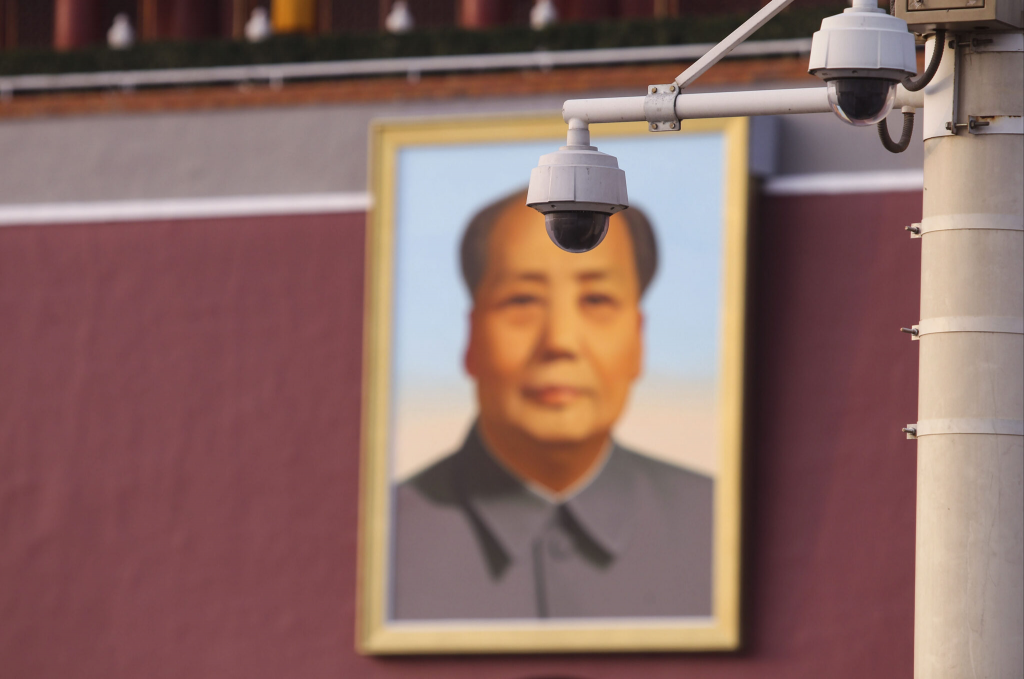
How the China Outsources Surveillance

Beijing relies on digital surveillance to detect and stamp out budding opposition before it spills into the streets. But rather than conduct this massive undertaking itself, Lynette Ong explains in the new issue of the Journal of Democracy, the CCP hires “corporations to sniff out ‘sensitive’ words with detection software, to flood the internet with propaganda, and to deal with troublesome posts and posters.”

Read Ong’s essay along with other Journal coverage of digital surveillance in authoritarian regimes, free for a limited time, plus our entire July issue before it goes behind the paywall on July 30.

How the CCP Outsources Surveillance

Beijing knows digital surveillance of the world’s most populous nation is technologically demanding. So the Party has hired corporations to occupy the “public-opinion battlefield” and spot the trouble before it spreads.

By Lynette H. Ong

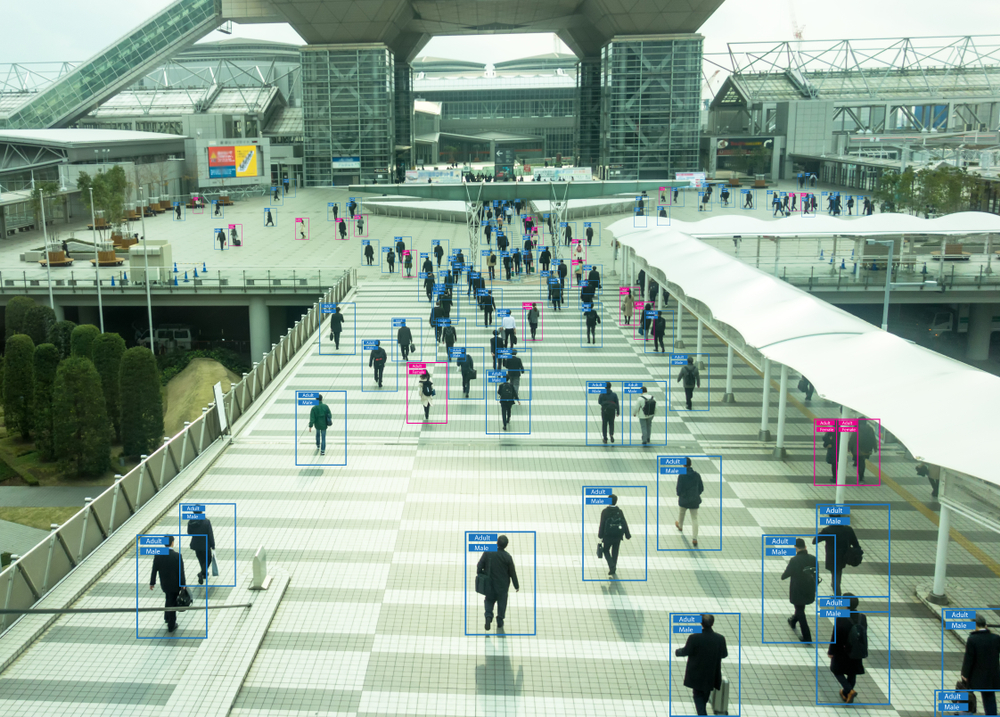
China’s AI-Powered Surveillance State

The Chinese Communist Party is dreaming an authoritarian techno-dream that is a democrat’s nightmare: ever more fine-grained state control made possible by using AI networks to pry and spy everywhere. But human unpredictability remains a force the party-state cannot tame.

By Valentin Weber

President Xi’s Surveillance State

Chinese authorities are wielding facial-recognition software, big-data analytics, and other digital technologies to control China’s citizens by monitoring and assessing their activities, both online and off.

By Xiao Qiang

The Journal of Democracy is published quarterly in January, April, July, and October. Subscribe now for full access to the Journal of Democracy archives.

On China’s Rise

By Mike Zonta, BB editor

(Image from Wikipedia.org)

The Apostle Paul said:

“If I have the gift of prophecy and can fathom all mysteries and all knowledge, and if I have a faith that can move mountains, but do not have love, I am nothing.” [1]

–I Corinthians 13:2

“If a country has the largest population in the world and the largest economy in the world and the largest high-speed rail network in the world, but has not democracy, it is nothing.”

–Mike Zonta, BB editor

Spotlight on family planning as India surpasses China as world’s most populous country

Issued on: 14/04/2023 – 06:36 (france24.com)

Text by:Joanna YORK

India is set to become the world’s most populous country on April 14, a title China has held for decades. Faced with a large – and growing ­– population of more than 1.4 billion, India’s family planning service is under pressure to maintain a decreasing fertility rate.

UN forecast predicts that on April 14 the Indian population will reach 1,425,775,850 – a number that dethrones China from its long-held position as the world’s most populous country.  

The exact population of India today is unknown ­(a 2021 update on the decade-old census was indefinitely delayed by the pandemic) but all signs point to exponential growth. While China’s formerly steep rate of population increase is starting to plateau, India’s curve is still forging upwards. 

It is estimated that India has added 210 million – almost the number of people in Brazil – to its population since the last census 12 years ago. As of 2020, it has gained roughly 1 million inhabitants each month.

>> Read more: China faces demographic crisis as population shrinks for first time in 60 years

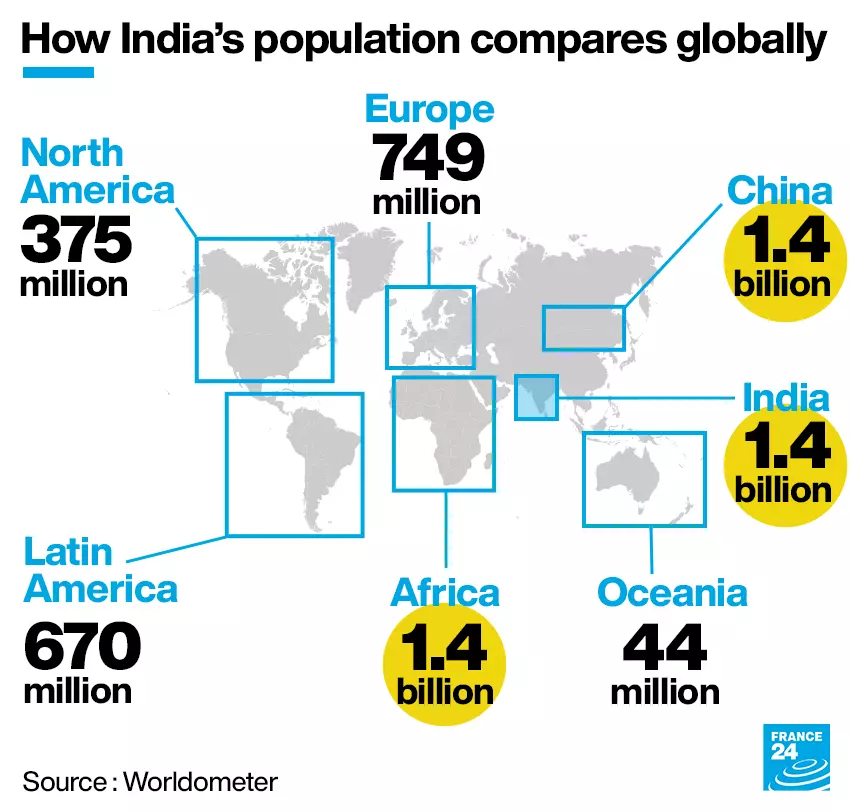
The population of India – and China – is now equivalent to the entire continent of Africa, and dwarfs that of Europe and the Americas. 

How India’s population compares globally © Studio graphique France Médias Monde

But over the same decades that population growth in India has soared, fertility rates have been falling. In 1964 Indian women had six children on average, today they have closer to two, in part, due to the state family planning service, which India claims it was the first country to provide when it launched in 1952.

“The primary goal was to slow population growth as a means of supporting the economic development of the country, which was only a few years old at that point,” says Anita Raj, Professor of Global Public Health, Director of the Center on Gender Equity and Health, University of California at San Diego.

The scheme has had some successes: India’s 2022 family heath survey found that almost 100% of married women and men aged 15-49 are aware of at least one method of contraception. The public health sector is the provider for 68% of people who use modern contraceptives (products or medical procedures used to prevent pregnancy such as condoms, the pill and IUDs, as opposed to traditional methods such as the withdrawal or rhythm methods or abstinence).

Yet, faced with a soaring population there is work to do. “Total fertility rates have declined for years,” says Raj. “However, if the goal was truly reproductive choice and women’s reproductive autonomy, then more should be done.”

Sterilisation

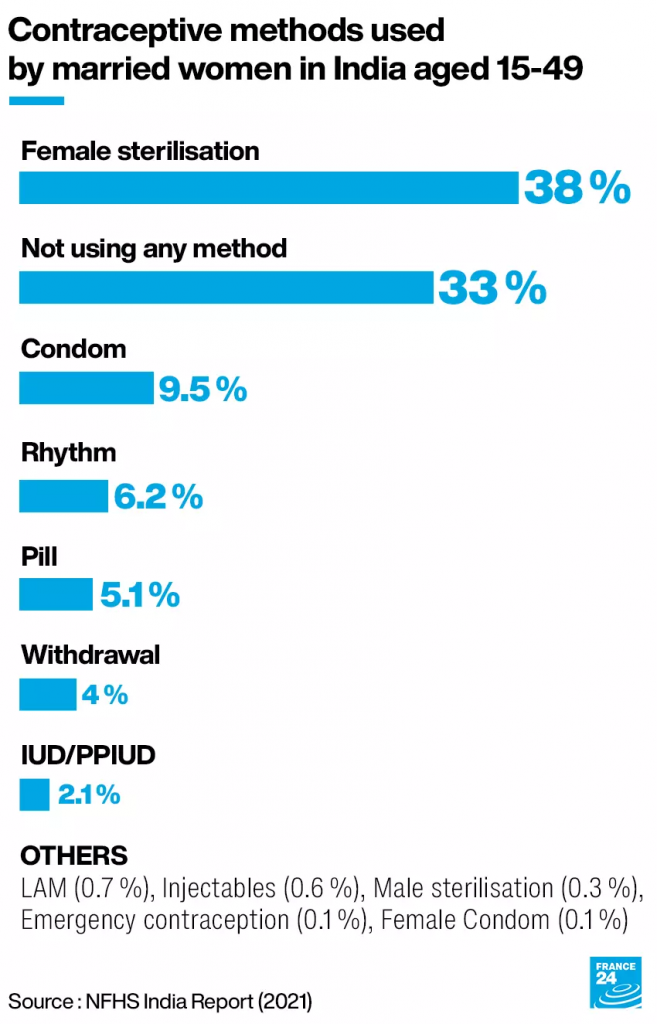
The most used form of pregnancy prevention in India is female sterilisation, which accounts for 38% of all contraception used. “The emphasis of the national family planning programme historically was on family size, and consequently, sterilisation was the focus,” says Raj.

Yet, male sterilisation rates account for just 0.3% of all contraception methods. This is partly due to a patriarchal society – the family heath survey found more than a third of men regard contraception as “women’s business”.

Contraceptive methods used by married women in India © NFHS India Report, 2021

But there is also resistance to male vasectomy due to lingering “stigma and taboos”, says Debanjana Choudhuri, a gender rights specialist based in India.

In the 1970s, economic and social stagnation led the Indian government to launch a mass drive to sterilise men as a population control method. Heavy-handed enforcement saw men pressured into having vasectomies on pain of having their salaries docked or losing their jobs. Poor men risked being picked up by police from railway and bus stations before being sent for sterilisation.

The result in modern India is that “no scalpel vasectomies have a very poor uptake”, Choudhuri says. “Men aren’t doing enough.”

State efforts still shy away from diversifying contraceptive methods. Sterilisation for men and women is incentivised with payment, and some states have introduced a two-child policy with penalties such as bans on holding government jobs for those who do not comply. The private health sector is the main provider of contraceptive of pills, injectables and condoms.

Recent public health provision of UDIs could be a “game changer in achieving method mix”, says Choudhuri, “but it will take 5-10 years to become popular. There is an immediate need for a healthier method mix, sensitisation, and awareness of long-acting reversible contraception and other short-term methods.”

Contraceptive control

Aside from placing the burden on women, reliance on female sterilisation limits women’s options. “Sterilisation does not support birth spacing, which is important for maternal and infant health and survival. It also is not a solution to ensure women’s control of timing of pregnancies, only limiting of them,” says Raj.

“If sterilisation is the women’s choice and supports women’s health, then that is fine; but too often these decisions are built on family and community expectations.”

Socio-economic conditions also define many women’s choices around family planning. The 2022 family health survey found poorer, less educated women living in rural areas are likely to have more children at younger ages and have less exposure to family planning messages than their wealthier, educated and urban counterparts.

Geography also plays a role, with women in the poorest parts of east India less likely to use any contraceptive methods at all, and especially less likely to use modern contraceptive methods.

“Evidence from all over the world shows when women are given the choice to control their fertility and the opportunities around it [such as education and economic opportunity] you’re always going to see family sizes coming down,” says Alistair Currie, campaign manager from Population Matters, a UK-based charity that addresses population size.

Lowering the fertility rate

Daily newsletterReceive essential international news every morningSubscribe

Forecasts predict that India’s population will continue to increase for decades to come. The UN’s “medium variant” projection puts the peak of growth at 1.7 billion people in 2064. “Low variant” projections would see the growth curve start to flatten in 2047.

As they are, efforts from the Indian government are slowing population growth at an increasingly rapid rate, but data indicates family planning has a greater role to play. There remains a significant gap between the wanted fertility rate (number of children women want to have) of 1.6, and the actual fertility rate of 2.

“We would hope to see a situation in which all pregnancies are wanted and that people have the capacity to make a choice [to get pregnant],” Currie says. “If that were the case, then we would see a lower fertility rate in India.”

In addition, a population growth spurt looms: nearly half of the Indian population is below the age of 25, likely to have children of their own in coming years.

At the moment, many of this demographic lacking vital information about contraceptives, Choudhuri says. “There’s a prejudice that comes with the family planning programme – because it’s called family planning many people feel that it is not aimed at them. The adolescent population needs to be brought into the contraception conversation. Right now, they are excluded, and that’s alarming.”