THE UNLIKELY CATHOLIC ACTIVIST WHO BELIEVED IN CIVIL DISOBEDIENCE ‘ANIMATED BY LOVE’

Dorothy Day’s Legacy Continues to This Day Through Followers Like Martin Gugino, the 75-Year-Old Protestor Shoved by Buffalo Police
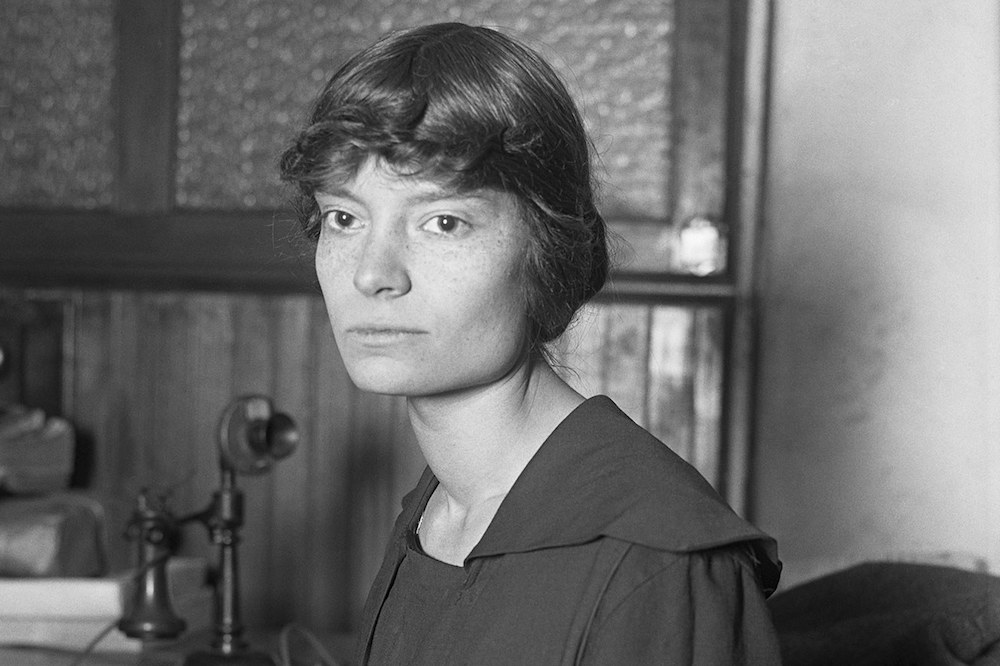
The Unlikely Catholic Activist Who Believed in Civil Disobedience ‘Animated by Love’ | Zocalo Public Square • Arizona State University • Smithsonian

Dorothy Day, pictured in 1916, was a founder of the Catholic Worker movement, worked to help disadvantaged people and promoted non-violence to protest Americans wars during the 20th century. Courtesy of Wikimedia Commons.

by JOHN LOUGHERY | JUNE 17, 2020 (zocalopublicsquare.org)

On June 5, 2020, in the midst of a nonviolent Black Lives Matter protest in Buffalo, New York, 75-year-old Martin Gugino, a longtime peace activist, approached a line of riot police to hand over an officer’s helmet that had dropped to the ground. He was pushed to the sidewalk by the riot police, who then proceeded to walk around him as he lay unconscious, bleeding profusely from his ear, on the concrete. When an officer attempted to bend down to see how badly Gugino was hurt, another officer pushed him away.

As video of Gugino’s assault was viewed around the world, it was reported that his activism grew out of his experiences with groups such as Witness Against Torture and the Catholic Worker—the latter formed in the first half of the 20th century by Dorothy Day. Though she is an obscure figure today, Dorothy Day was once very well known in the social-justice movement and in Catholic circles, having founded a newspaper, a network of “houses of hospitality” to serve the urban poor, and having given thousands of lectures. On her death in 1980, her obituary appeared on front pages around the country. While her name is no longer familiar, Day’s commitment to civil disobedience in response to America’s racism, militarism, and capitalist excess resonates today.

Day was an unlikely activist. Born in 1897 into a conservative Republican family with a disdain for religion, immigrants, racial minorities, and the indigent, she came to be America’s most ardent advocate for just those people, a deeply religious person, and—the ultimate paradox, to some—a political progressive and an orthodox Catholic. Day embodied contradictions—or seeming contradictions—leaving a legacy of thought and action that transcended her own times.

As a teenager, Day’s budding activism was a reaction to her parents’ way of life, which seemed to her to lack everything that would make one feel life had enduring meaning. As a girl, her reading—the social protest of Upton Sinclair and Jack London, the novels of Fyodor Dostoevsky and Leo Tolstoy—set her on a path that forever separated her from her family.

By the time she left college after two years, she was a committed progressive. She moved to Greenwich Village, then in its heyday, and worked as a journalist for left-wing publications like The Masses, entering into a milieu that took it for granted that Teddy Roosevelt’s and Woodrow Wilson’s America was far from the best of all possible worlds. She forged close relationships with people like the Communist activist Mike Gold and the playwright Eugene O’Neill. She took lovers. The late 1910s and early 1920s were a time when sexual experimentation and political activism went hand in hand, especially for a rebellious woman in her late teens and 20s.

While Dorothy Day was drifting further and further from the values and expectations of her family, she was never the typical bohemian that her Greenwich Village residence might imply. She was profoundly spiritual. After a night on the town with O’Neill and their hard-drinking friends, Day would find herself, almost inexplicably, drawn to a neighborhood Catholic church to watch devout men and women lost in prayer, to listen to the music, and to read the unnerving words of the New Testament.As Day defined it, civil disobedience needed to be animated by love, determination, and moral idealism—not by nihilistic fury.

Day’s decision to convert to Catholicism in 1927 amazed her secular friends, creatures of a society that was relentlessly rationalistic and disdainful of mystical things. Her need to believe in something larger than herself, something that gave the deepest possible meaning to life, was confusing to peers for whom the here-and-now was sufficient. Many Americans in the 1920s viewed Catholicism as a reactionary institution with an anti-modern outlook. For Day, the Church signified a total embrace of Christ’s teachings, a complete rethinking of the meaning of one’s life, a forsaking of one’s own comfort, while raising the possibility of transcendence.

Day’s combined passion for social justice and her deep religious faith led her to found, in the mid-1930s, what became the Catholic Worker movement. It encompassed the newspaper and the houses of hospitality, the thousands of young people who joined her, the thousands of lectures she delivered around the country for the next 40 years. Day’s organization was committed to seeing the human beings who came for succor—many of them suffering from hunger and mental illness—as embodiments of Christ. During the Depression and thereafter, Catholic Worker houses accepted “street people” whom city shelters or Salvation Army hostels would have turned away. They took literally Christ’s injunction that one does for God what one does “for the least of these.”

For Dorothy Day, this meant not only fighting against poverty and racism but also making an unbending commitment to pacifism. This was hard for many around her to accept—even some of her fellow Catholic Workers. Day had opposed America’s entry into World War I, as she would the U.S. involvement in Korea and Vietnam—but she also opposed the U.S. entry into World War II. It was a conflict that could have been avoided, she insisted, and the Fifth Commandment (“You shall not kill”) should be seen as absolute by anyone who claimed to be a Christian.

By the 1950s an America concerned principally with security, stability, and consumer growth had little interest in Day’s ethos. The Depression seemed like ancient history to many people, and the Pentagon’s massive budget during the Eisenhower years was an accepted fact of life. Not so in the eyes of the Catholic Worker. Day and her fellow activists went to jail several times for refusing to participate in nuclear drills, which required citizens to scurry into bomb shelters. They publicized their protests by refusing bail and accepting their sentences. To “normalize” a massive arms build-up, to imply that a nuclear war might be winnable, was the height of madness, they argued. The Cuban Missile Crisis, bringing the human race to the edge of extinction, was as much the fault of the United States, Day told astonished lecture audiences, as of the USSR and Cuba.

The mid and late 1960s presented profound challenges for Day. For years she had warned in the Catholic Worker about the possibility that the U.S. would instigate war in Vietnam. When the conflict escalated, Day welcomed the protests against President Lyndon Johnson and his policies. In December 1966, Cardinal Spellman of the New York archdiocese traveled to South Vietnam to bless American troops and urge them on to total victory against the North—and Day was dismayed. “Words are as strong and powerful as bombs, as napalm,” she wrote in her monthly column in the paper, chiding Spellman for his advocacy of continued violence rather than a negotiated peace. Day participated in the anti-war movement by harboring conscientious objectors, and she supported draft-card burners, including her friends the Berrigan brothers, priests whose occupation of Selective Service offices and burning of draft records earned them jail time.

Day called the Berrigans’ defiance “a kind of prayer.” Yet she also worried about the tone of the fiery protests of that decade. As an admirer of Mahatma Gandhi and Martin Luther King. Jr., she was uneasy about the destruction of property and aggression that the anti-war movement sometimes displayed. As Day defined it, civil disobedience needed to be animated by love, determination, and moral idealism—not by nihilistic fury. There was much about the counterculture she could not accept. Shortly after she criticized Spellman, Day attended an anti-war rally in Central Park and left dispirited; she could not support the shouted obscenities, expressions of rage, and personal attacks on the Cardinal. The kind of protest Day believed in asked its participants to accept jail time if necessary, to uphold the Sermon on the Mount as a statement of the highest good human beings can aspire to, and to rise above anger that objectifies one’s opponents, failing to see them as—like us—erring children of God.

There are ways in which Day would be sadly at home in this time of widespread advocacy for racial justice and police reform, and ways in which she would not. If she is remembered today it is through Pope Francis’s praise for her in his 2015 speech to the U.S. Congress and the Church’s investigation of her suitability for canonization, which have raised her profile somewhat.

But Day’s direct legacy is still active in American society. The socially conscious newspaper Day founded in the midst of the Depression, the Catholic Worker, is still in print, still a penny a copy, and still mailed out to 20,000 subscribers. (It had a readership of well over 100,000 at its peak.) The “houses of hospitality” Day opened in the 1930s for the urban homeless still feeds and offer shelter to the neediest of citizens.

And, of course, Day’s spirit animates the work of protesters like Martin Gugino. The officers who pushed Gugino have been charged with assault and indignation over the incident is widespread. How will all this play out? One thing we can expect: as a follower in Day’s footsteps, Gugino will probably not be silenced by the aggression shown him, and he will likely forgive his attackers. The example of Dorothy Day—in protesting injustice, in fearlessness in the face of aggressive authority, in infinite compassion—has not died out entirely.

JOHN LOUGHERY is the coauthor, with Blythe Randolph, of Dorothy Day: Dissenting Voice of the American Century.

Tulsa Still Faces Historical Trauma from 1921 Riot That Left 300 Dead on Black Wall Street

TOPICS
GUESTS
  • Hannibal B. Johnsonattorney and author of Black Wall Street: From Riot to Renaissance in Tulsa’s Historic Greenwood District.

(Democracy.org) As protests continue over the police killing of Terence Crutcher, we look at how Tulsa, Oklahoma, is no stranger to racial strife. On May 31, 1921, a white mob killed as many as 300 people, most of them black, after a black man was accused of assaulting a white elevator operator. Over two days, white mobs set fire to homes, businesses and churches in Greenwood, a thriving African-American business district known at the time as the Black Wall Street of America. When the smoke cleared, the area lay in ruins. Many blacks left and never returned. The National Guard rounded up thousands of others and held them at various locations around the city. We speak with author and attorney Hannibal Johnson, who examines this history in his book, “Black Wall Street: From Riot to Renaissance in Tulsa’s Historic Greenwood District.”

Book: “Fragments” by Heraclitus

Fragments

Fragments

by HeraclitusBrooks Haxton (Translator), James Hillman (Foreword)

Fragments of wisdom from the ancient world

In the sixth century b.c.-twenty-five hundred years before Einstein-Heraclitus of Ephesus declared that energy is the essence of matter, that everything becomes energy in flux, in relativity. His great book, On Nature, the world’s first coherent philosophical treatise and touchstone for Plato, Aristotle, and Marcus Aurelius, has long been lost to history-but its surviving fragments have for thousands of years tantalized our greatest thinkers, from Montaigne to Nietzsche, Heidegger to Jung. Now, acclaimed poet Brooks Haxton presents a powerful free-verse translation of all 130 surviving fragments of the teachings of Heraclitus, with the ancient Greek originals beautifully reproduced en face.

For more than seventy years, Penguin has been the leading publisher of classic literature in the English-speaking world. With more than 1,700 titles, Penguin Classics represents a global bookshelf of the best works throughout history and across genres and disciplines. Readers trust the series to provide authoritative texts enhanced by introductions and notes by distinguished scholars and contemporary authors, as well as up-to-date translations by award-winning translators.

(Goodreads.com)

Charles Bukowski on isolation

Charles Bukowski

“If you’re going to try, go all the way. Otherwise, don’t even start. This could mean losing girlfriends, wives, relatives and maybe even your mind. It could mean not eating for three or four days. It could mean freezing on a park bench. It could mean jail. It could mean derision. It could mean mockery–isolation. Isolation is the gift. All the others are a test of your endurance, of how much you really want to do it. And, you’ll do it, despite rejection and the worst odds. And it will be better than anything else you can imagine. If you’re going to try, go all the way. There is no other feeling like that. You will be alone with the gods, and the nights will flame with fire. You will ride life straight to perfect laughter. It’s the only good fight there is.”

Henry Charles Bukowski (August 16, 1920 – March 9, 1994) was a German-American poet, novelist, and short story writer. His writing was influenced by the social, cultural, and economic ambiance of his home city of Los Angeles. Wikipedia

Nietzsche on Christianity

Friedrich Nietzsche

“There was only one Christian, he died on the cross.”

Friedrich Wilhelm Nietzsche (15 October 1844 – 25 August 1900) was a German philosopher, cultural critic, composer, poet, philologist, and Latin and Greek scholar whose work has exerted a profound influence on Western philosophy and modern intellectual history. … Google Books

Bio: Zoroaster

From Wikipedia, the free encyclopedia

Zoroaster
??????????
Zaraθuštra
19th-century Indian Zoroastrian perception of Zoroaster derived from a figure that appears in a 4th-century sculpture at Taq-e Bostan in South-Western Iran. The original is now believed to be either a representation of Mithra or Hvare-khshaeta.[1]
Bornc. 1500 BC – 1000 BC[2][3]
Airyanem Vaejah[4]
Diedc. 1500 BC – 1000 BC[2][3] (aged 77)[5]
Airyanem Vaejah[4]
Venerated inZoroastrianism
Manichaeism
Bahá’í Faith
Mithraism
Ahmadiyya
Part of a series on
Zoroastrianism
Atar (fire), a primary symbol of Zoroastrianism
Primary topics[show]
Divine entities[show]
Scripture and worship[show]
Accounts and legends[show]
History and culture[show]
Adherents[show]
Related topics[show]
 Religion portal
vte

Zoroaster (/ˈzɒroʊæstər/, UK also /ˌzɒroʊˈæstər/Greek: Ζωροάστρης, Zōroastrēs), also known as Zarathustra (/ˌzærəˈθuːstrə/, UK also /ˌzɑːrə-/Avestan: ??????????‎, Zaraθuštra), Zarathushtra Spitama or Asho Zarathushtra [6] (Persian: زرتشت‎), was an ancient Iranian prophet, religious reformer and spiritual leader who founded what is now known as Zoroastrianism.

The Oxford Dictionary of Philosophy considers Zoroaster to have been the first philosopher.[7][8] Zoroaster has also been described as the father of ethics, the first rationalist and the first monotheist (having belief in just one God) as well as the first to articulate the notions of heaven and helljudgment after death and free will.[9][10][11]

The religion founded by Zoroaster was the first major world religion and has had significant influence on other religious and philosophical systems, including ChristianityJudaismIslamBuddhism, the Bahá’í FaithGnosticism and Greek philosophy.[12][13][14][15][16][17][18] His teachings challenged the existing traditions of the Indo-Iranian religion and inaugurated a movement that eventually became the dominant religion in Ancient Persia. He was a native speaker of Old Avestan and lived in the eastern part of the Iranian Plateau, but his exact birthplace is uncertain.[19][20]

There is no scholarly consensus on when he lived.[21] However, approximating using linguistic and socio-cultural evidence allows for dating to somewhere in the second millennium BC. This is done by estimating the period in which the Old Avestan language (as well as the earlier Proto-Indo-Iranian and Proto-Iranian languages and the related Vedic Sanskrit) were spoken, the period in which the Proto-Indo-Iranian religion was practised, and correlation between the burial practice described in the Gathas with the archeological Yaz culture. However, other scholars still date him in the 7th and 6th century BC as a near-contemporary of Cyrus the Great and Darius I to as far back as the sixth millennium BC.[22][23][2][24][25][26]

Zoroastrianism eventually became the official religion of Ancient Persia and its distant subdivisions from the 6th century BCE to the 7th century CE.[27] Zoroaster is credited with authorship of the Gathas as well as the Yasna Haptanghaiti, hymns composed in his native dialect, Old Avestan, and which comprise the core of Zoroastrian thinking. Most of his life is known from these texts.[19] By any modern standard of historiography, no evidence can place him into a fixed period, and the historicization surrounding him may be a part of a trend from before the 10th century that historicizes legends and myths.[28]

Name and etymology

Zoroaster’s name in his native language, Avestan, was probably Zaraϑuštra. His English name, “Zoroaster”, derives from a later (5th century BC) Greek transcription, Zōroastrēs (Ζωροάστρης),[29] as used in Xanthus‘s Lydiaca (Fragment 32) and in Plato‘s First Alcibiades (122a1). This form appears subsequently in the Latin Zōroastrēs and, in later Greek orthographies, as Ζωροάστρις Zōroastris. The Greek form of the name appears to be based on a phonetic transliteration or semantic substitution of Avestan zaraϑ- with the Greek ζωρός zōros (literally “undiluted”) and the Avestan -uštra with ἄστρον astron (“star“).

In Avestan, Zaraϑuštra is generally accepted to derive from an Old Iranian *Zaratuštra-; The element half of the name (-uštra-) is thought to be the Indo-Iranian root for “camel”, with the entire name meaning “he who can manage camels”.[30][a] Reconstructions from later Iranian languages—particularly from the Middle Persian (300 BCE) Zardusht,[further explanation needed] which is the form that the name took in the 9th- to 12th-century Zoroastrian texts—suggest that *Zaratuštra- might be a zero-grade form of *Zarantuštra-.[30] Subject then to whether Zaraϑuštra derives from *Zarantuštra- or from *Zaratuštra-, several interpretations have been proposed.[b]

If Zarantuštra is the original form, it may mean “with old/aging camels”,[30] related to Avestic zarant-[29] (cf. Pashto zōṛ and Ossetian zœrond, “old”; Middle Persian zāl, “old”):[31]

  • “with angry/furious camels”: from Avestan *zarant-, “angry, furious”.[32]
  • “who is driving camels” or “who is fostering/cherishing camels”: related to Avestan zarš-, “to drag”.[33]
  • Mayrhofer (1977) proposed an etymology of “who is desiring camels” or “longing for camels” and related to Vedic Sanskrit har-, “to like”, and perhaps (though ambiguous) also to Avestan zara-.[32]
  • “with yellow camels”: parallel to younger Avestan zairi-.[34]

The interpretation of the -ϑ- (/θ/) in Avestan zaraϑuštra was for a time itself subjected to heated debate because the -ϑ- is an irregular development: As a rule, *zarat- (a first element that ends in a dental consonant) should have Avestan zarat- or zarat̰- as a development from it. Why this is not so for zaraϑuštra has not yet been determined. Notwithstanding the phonetic irregularity, that Avestan zaraϑuštra with its -ϑ- was linguistically an actual form is shown by later attestations reflecting the same basis.[30] All present-day, Iranian-language variants of his name derive from the Middle Iranian variants of Zarϑošt, which, in turn, all reflect Avestan’s fricative -ϑ-.[citation needed]

In Middle Persian, the name is ?????? Zardu(x)št,[35] in Parthian Zarhušt,[36] in Manichaean Middle Persian Zrdrwšt,[35] in Early New Persian Zardušt,[35] and in modern (New Persian), the name is زرتشت Zartosht.

More at: https://en.wikipedia.org/wiki/Zoroaster

Get Rid of the Presidency [and the Deanship]

JUNE 17, 2020 (counterpunch.org)

by MATTHEW STEVENSON

Photograph Source: Rob Young from United Kingdom – CC BY 2.0

If the prospect of the Trump – Biden presidential election fills you with horror and despair, you might give some thought to not just replacing both candidates but the presidency as well, at least as we now conceive it.

For some time now, but maybe since the Kennedy administration (which ended in a hail of voter-suppressed gunfire), I have been thinking that one of the biggest problems with American democracy is the presidency itself, the idea that the chief magistrate of the country should be one person elected every four years by a few swing voters in Ohio, North Carolina, or Florida.

What good can be said of an office that regularly is awarded to the likes of Ronald Reagan, Richard Nixon, and George W. Bush, and that this year, for its finalists, has Donald Trump and Joe Biden, men who otherwise would not be eligible to coach Little League teams or lead Scout troops (pussy grabbers and hair sniffers need not apply).

Instead, every four years, because of a document drawn up more than two hundred years ago, the United States puts into its highest office men of stunning incompetence (think of W’s facial expression while reading The Pet Goat on 9/11) and low cunning (“Ike likes Nixon and we do too…”), who over time have managed to turn the office of the presidency into what it is today—a violent reality show that has brought you Vietnam, Watergate, the USA Patriot Act, and Barack Obama’s “necessary war” in Afghanistan.

***

According to James Madison’s notes from the 1789 constitutional convention, the job of the American president was to “execute” the laws that Congress passed. In times of war, the president was to serve as the commander-in-chief of the state’s militias—to exercise civilian control over the military.

At the Philadelphia constitutional convention, the dispute about the presidency concerned which model to follow in creating a template of the chief executive.

John Adams and Alexander Hamilton aspired to create a constitutional monarchy of sorts, with their favorite aristocrat, George Washington, on the throne.

At the very least they were in favor of a strong, lone-wolf executive with centralized powers, while Benjamin Franklin (with the emotional support of Thomas Jefferson from Paris) and others favored a federal council, something closer to the Swiss model, in which the powers of the chief magistrate would be devolved to a committee, not on one person.

James Madison, who had loyalties in both camps and a heavy hand in drafting the new constitution, came up the compromise and helped to shape the American presidency that we know today—that of an elected monarch.

In Philadelphia in 1789, the constitutional framers had hoped they were creating an office-holder along the lines of an auditor-in-chief, someone who would make sure that the Congress (notably the House of Representatives) spent the people’s money wisely and kept the trade lines flowing through (tariff-free) interstate commerce.

It never occurred to any of them that they were creating a monster along the lines of a political Frankenstein who might someday, as if with bolts protruding from his neck and an awkward square haircut, stump his way though Lafayette Square and hold up a Bible in front of St. John’s Episcopal Church.

***

Another problem with the original intent of the presidency in the U.S. Constitution is that it was a laissez-passer for slaveholders in southern states (not to mention their cotton brokers in New York City) to do pretty much as they pleased in terms of exploiting the means of production.

Until the corporate railroad lawyer Abraham Lincoln came along, American presidents functioned as trustees for slaveowners, and nearly all (in the manner of James Buchanan during the era of Dred Scott, the runaway slave of Supreme Court fame) bent over backwards to insure that indentured service remained an unenumerated right of the moneyed classes.

A few presidents, Andrew Jackson being one of them during the 1832 Nullification Crisis, pushed back against the notion of states’ rights, but Jackson—himself a slave owner—made up for the hurt Southern feelings by ethnically cleansing Florida and Georgia of the Cherokee Nation, and turning over the rich soil of its land to his slave-holding brethren.

Only Lincoln decided that the constitution (tolerating the slave trade until 1808 and otherwise silent on the question of human bondage) was a document inconsistent with the ideals of American liberty, and he waged a brutal civil war to amend the constitution.

An unintended consequence of that war, however, which broke the power of individual states to operate farms as prison labor camps, was to concentrate in Washington and in the office of the presidency a host of powers (over the budget and the military, especially) that the founding fathers had never intended to confer on one person.

I am not blaming Lincoln alone for the rise of the imperious presidency. Many others—Woodrow Wilson included—can share that poisoned chalice.

In particular, American wars (from Mexico in 1846 through to Iraq and Afghanistan) have remade the presidency into what it is today, a caricature of democracy dressed up in the raiments of a mail-order autocrat.

***

When it came to defining the presidency, the constitution got more wrong than it did right.

The vote wasn’t given to the citizenry but to electors, wise men in the provinces who would gather (in early December) every four years and pick a president. (Golf club membership committees work the same way.) But the way electors have been chosen over time has been a political variation of blind man’s buff.

What went wrong almost immediately were the so-called presidential elections, which since 1792 have been rigged, fixed, finagled, gerrymandered, massaged, bought, and sold—yet another cornered commodity market, although this one trading only in political influence.

Despite what you read about democracy-in-action in your high school civics classes, most accessions to presidential power have come as a result of a deal, bullets, blackmail, or fatal illnesses.

Yet this is the ritual held up to the rest of world, when someone in Washington is delivering one of those hectoring speeches about American exceptionalism.

Only in a handful of presidential elections has a candidate actually taken office after securing more than 50 percent of the votes cast.

Even in the last election, Hillary Clinton won the popular vote by 2.8 million but Trump was installed in office, for corralling more electoral votes.

Here’s a short list of brokered, anointed, non-elected, or somehow accidental American presidents: George Washington, Jefferson, John Quincy Adams, John Tyler, Andrew Johnson, Rutherford B. Hayes, Theodore Roosevelt, Calvin Coolidge, Harry Truman, Lyndon Johnson, Gerald Ford, and George W. Bush.

Mind you, not all of these presidents were bad. As was said of Hayes: “He did such a good job I almost wish he had been elected.”

And here’s a list of some presidents who took office by the grace of providence or its fix-it men: Abraham Lincoln (four candidates were running and he got only 39.8% of the vote), Benjamin Harrison (Cleveland won the popular vote in 1888), William McKinley (Mark Hanna sold him in 1896 as if he were a new line of soap and then bought some extra votes, just to be sure), John F. Kennedy (dead men voting in Mayor Richard J. Daley’s Cook County), Bill Clinton (he can thank Ross Perot), and Donald Trump (he lost the popular vote but won the Russian caucus).

My point is that the words “American democracy” and “ the presidency” have very little in common. Most elections in U.S. history are variations on the Supreme Court in 2000 giving the job to George W. Bush much as he was tapped at Yale for Skull and Bones.

Unless I miss my mark, 2020 will be a rerun of many earlier contested elections, with voter suppression, lost and shredded ballots, foreign interference, broken voting machines, absent absentee ballots, and hacked computers defining a dubious outcome.

***

How then to remake the presidency so that the office adds up to something more than a cereal-box kingdom?

Adopting Franklin’s and Jefferson’s Swiss federal council model might go a long way toward restoring trust in government, and it would work as follows.

Instead of the president being one person, the chief executive of the country would be a duly constituted collective body—say of seven individuals—that as a group would share the burdens and responsibilities of the highest office.

In Switzerland (where I live), while there is a person with the ceremonial title of president, it is only the Federal Council as a body that can make executive decisions.

Does it work? Swiss democracy and its Federal Charter have been around since 1291, so something about the consensus of a council at the head of government must function well.

More applicable to the United States: in 1848 the Swiss adopted a constitution largely based on the American model; the only exception is that they made the chief executive a committee, not one person.

The Federal Assembly—both branches of the Swiss parliament—elects the members of the Federal Council every four years in December. (If that sounds familiar, it should. The Federal Assembly is the electoral college of the Swiss system.)

Generally in Switzerland the federal council is a blend of the left, right, and center, and it also has geographic diversity.

Nor does Switzerland tear itself apart every four years with a presidential election that costs more than $1 billion and only gives the illusion of self-government.

Instead, Swiss voters cast about thirty to forty votes a year (in person, by mail, or on the internet, and it all works seamlessly; no one stands in eight-hour lines), on a host of questions, initiatives, and referenda. Every Swiss citizen, in effect, is a parliamentarian.

Only periodically do Swiss voters choose actual candidates; most of the time they are supporting one of the country’s many political parties or voting yes/no on specific questions.

The advantage of a federal council in the United States is that it would introduce into the government a coalition executive that would make decisions consistent with the views of the major political parties and hence (we hope) the electorate at large.

And the idea would be faithful to the original intent of the U.S. Constitution—that of having electors decide on the chief executive.

***

During 2020 I was thinking about a federal council when I followed the presidential campaign trails through Iowa and New Hampshire.

Over several weeks, I saw all of the candidates in person (including the carnival-barking Trump at one of his rallies), and I listened to most of them give more than one speech or interview.

Listening to the candidates speak, I found few of them (Biden in particular) to be persuasive as individuals, but it was easy to imagine that some of the candidates could be stronger if brought together as members of a governing body.

So here’s my federal council from the candidates in the 2020 election:

In no particular order, the most articulate candidates that I heard in 2020 were Bernie Sanders, Elizabeth Warren, William Weld (he ran against Trump in the Republican primaries), Deval Patrick (former governor of Massachusetts), Amy Klobuchar, Pete Buttigieg, and Joe Walsh (a Republican – Libertarian former Congressman who also opposed Trump).

Could those seven persons run the executive branch of the United States? I think they could. They would represent the left, right, and center; they would have ethnic and gender diversity; and they would speak for a wide variety of constituencies within the country. Plus there would be collective strength in numbers.

On his own as president Bernie Sanders might be little more than a left-wing version of Donald Trump, someone given to sweeping pronouncements (although in a more dignified manner and without the company of porn stars).

On a federal council, however, Bernie’s passion for social justice, education, climate initiatives, and a limited foreign policy might even find allies among conservatives Weld and Walsh, provided he was willing to compromise on monetary and fiscal restraints.

So too would a council be the obvious instrument to rein in some of Warren’s exuberance and professorial hectoring, but still allow her to bring to the government her commitment to economic fairness and health-care reform.

Buttigieg, Klobuchar, and Patrick are centrists who speak well for various constituencies, and all three would be valuable team members.

The way the council operates in Switzerland is that each member is responsible for certain ministries (education, foreign affairs, treasury, etc.) for a year’s term, and then they rotate jobs (including that of president), which means that council members become well-versed in various government issues.

For what it’s worth, in Switzerland Covid infections are down to about ten new cases a day, and there are only 18 persons with the virus in intensive care around the country, although in the early days infection rates were similar to those of the United States.

Yes, nominally, there is a Swiss president (in recent years very often a woman—there have been six in the country’s recent history), who is trotted out to meet world leaders and to represent Switzerland at forums. But executive authority rests in collective decision. On her or his own, the Swiss president cannot do very much.

***

For a variety of reasons most recent American presidencies have ended in failure. Lyndon Johnson saddled the country with the Vietnam War. Nixon went down over Watergate, clearly nothing a committee would have tolerated.

Carter, although a decent man, was over his head with inflation and Iran, and could have used some adults (more than Jody and Ham) in the room. Reagan was a part-time president and had little interest in the details of government, other than to pay off his friends and large companies.

George Herbert Walker Bush, in effect, served Reagan’s third term but found himself squeezed from the left and right, not to mention by his own incompetence. Clinton’s personal failings would have mattered less if he had been one of seven governing the executive branch.

Both George W. Bush and Obama were symbolic presidents, each representing some lost ideal of their parties, but neither had much to offer in terms of management capability, and each blundered into ruinous foreign wars.

On his own as the American chief executive, the narcissistic sociopath Trump is a train wreck, for the presidency and the country. Even if elected, Biden will be a lame, if not a dead, duck, his presidency over before it starts.

Do we need more examples, especially during a financial and health crisis, that the office is failing us?

I cannot promise that a presidential federal council would not make mistakes, but at least such a body would be aligned with the parties and political interests in the House and Senate, and most Americans would feel that there was at least someone at the executive level who was speaking for their interests. (Look through the list of my federal council, and you will find someone on it you admire and respect.)

Yes, for a council to succeed it needs compromise, but think of all the committees in your life that, on balance, function well. They exchange ideas, barter favors, and in the end move forward, generally for the common good. At least most of them don’t storm off in a cloud of tear gas across Lafayette Square, waving a Bible.

If you are interested to figure out where you fit on the Swiss political spectrum, go to SmartVote and answer the questions.

Join the debate on Facebook

More articles by: MATTHEW STEVENSON

Matthew Stevenson is the author of many books, including Reading the Rails and, most recently, Appalachia Spring, about the coal counties of West Virginia and Kentucky. He lives in Switzerland.  

Consciousness, spirituality, biography, sexuality, androgyny, futurism, space, the arts, science, astrology, democracy, humor, books, movies and more