Giordano Bruno: Forgotten Genius & Hermetic Martyr

BY LYNN PICKNETT & CLIVE PRINCE
From New Dawn 130 (Jan-Feb 2012) (newdawnmagazine.com)

In our last New Dawn article we listed the great pioneering discoveries of science that – unacknowledged by science historians – were directly inspired by the ancient Egyptian ideas as set out in the Hermetic texts which were ascribed to the demi-god Hermes Trismesgistus. These landmark breakthroughs were either drawn directly from the cosmology of the Hermetica – the most important being Copernicus’ heliocentric theory – or indirectly by applying their principles to different areas (as did Isaac Newton, to crack the code of gravity).

But most of the discoveries on our list involved a figure who, although not an experimental scientist himself, should be remembered as being equally important as Copernicus and Newton, but who until recently was virtually erased from history. This towering genius and truly extraordinary man was Giordano Bruno (1548-1600), the foremost Hermetic philosopher of his age whose influence over the scientific revolution has been scandalously downplayed. There’s even more to him than his intellectual and philosophical genius: he also applied the Hermetic principles to social, political and religious questions. And he presented such a serious challenge to the supremacy of the Church that for a time he even threatened to undermine it. But it also, with a sickening inevitability, lead to a date with a flaming pyre in Rome…

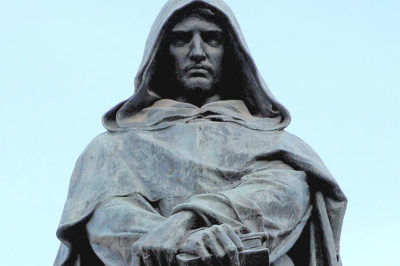
In recent years Bruno has begun to be rediscovered and appreciated, although still the truth is often distorted in order to crowbar him into the accepted history of science. Because of his remarkably advanced ideas he tends to be regarded as a martyr for scientific rationalism, victim of even greater Church persecution than Galileo (on whom he was hugely influential). Bruno has become a hero for freethinkers and, particularly ironically, atheists, who gather annually at the site of his execution in Rome’s Campo de’ Fiori – marked by a statue erected in the late nineteenth century – to honour his memory and sacrifice. But this is missing the point in a big way. Far from being an arch materialist-rationalist, in fact everything Bruno did was inspired by his passionate belief in magic and the esoteric. 

He is also being introduced to a wider audience through the historical thrillers of S.J. Parris (the pseudonym of British writer Stephanie Merritt), Heresy (2010) and Prophecy (2011). Although mainly concerned with Bruno as a kind of late Renaissance Hercule Poirot, she paints an authentic picture of Bruno as a dedicated and campaigning Hermeticist.

Privy Secrets

Ironically, Bruno began as a Dominican monk, a member of the same Order that gave rise to his nemesis, the Inquisition. He was born in 1548 in the small town of Nola – hence his nickname of ‘the Nolan’ – in the then huge Kingdom of Naples in Italy, which was under Spanish rule. Although he was christened Filippo, he took the name Giordano – from the River Jordan – on entering the Dominican monastery in Naples at the age of sixteen. In those days becoming a monk was the only way for a bright lad – and Bruno had already exhibited a prodigious intellect – from a humble background to get a good education.
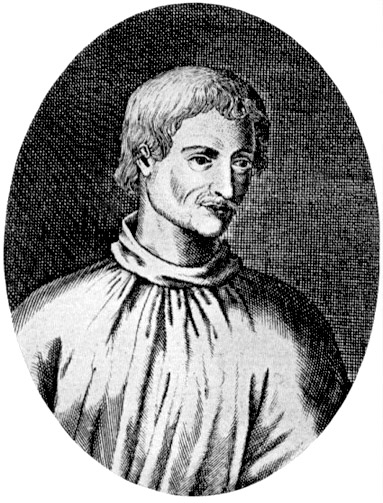
 The only known portrait of Bruno, published in 1715 in Germany, more than a century after his death.

The young monk soon distinguished himself with his extraordinary mastery of memory-training – even being summoned to Rome to demonstrate the ability to the Pope. The classical art of memory, based on the manipulation of mental images, had a magical counterpart which employed talismanic principles to induce, rather than simply recall, information. Clearly this possessed a heady allure to someone so hungry for knowledge as Bruno. 

As he grew in ability, exploring the powers of the mind through magic and psychology, Bruno became a powerfully confident man. Although never lacking in self-belief, he always respected those who deserved respect. On the other hand, he was disinclined to suffer fools gladly – indeed, at all. And he always, without fail, believed in his own mission… 

A side of this self-belief that was hardly welcome in a monk was his refusal to allow others to dictate what he could read or even think. Not only were monks’ studies tightly circumscribed by their very nature, but at that time the Catholic Church was desperately trying to combat the rise of Protestantism, so departing even marginally from the conventional line attracted great suspicion. Even listening to the arguments of those deemed heretics, or reading their works, was a crime for a monk – even if you disagreed with them. 

On the other hand, as the Dominicans were tasked with fighting heresy, they had easy access to banned books – much to the ever-curious Bruno’s delight. When his superiors discovered he had been secretly reading them in the monastery toilet he fled from Naples.

For five years he wandered round the intellectual centres of northern Italy, southern France and Switzerland – Padua, Milan, Geneva and Toulouse among other places, with frequent gaps in his biography. By the time he reappears fully, in Paris in 1581, he had become a hardcore believer in the Renaissance occult philosophy with Hermeticism at its heart. Quite how he developed this interest is unknown, but it fundamentally underpinned everything he did for the rest of his life.

Like everyone inspired by the Hermetic books since their rediscovery in Europe just over a century before (see our last article in New Dawn 129), Bruno was fired up with their vision of humans as glorious, miraculous beings of limitless potential – the polar opposite of what all Catholics were taught. To them, humans were little better than worms, only achieving a tiny bit of God’s grace through the intercession of the Church, and even that often depended on how much you were prepared to pay the priesthood to be let off a few years in purgatory. 

The more he studied, the more Bruno considered everything – every level of life and understanding of our place within the cosmos – could be illuminated by the principles of Hermeticism.

In Paris he gained the patronage of the French king, Henri III – a Catholic, but who still had a deep interest in the esoteric and was tolerant towards the French Protestants, the Huguenots. After two years Bruno moved to London, accompanying Henri’s new ambassador to Queen Elizabeth I’s court. Clearly he had Henri’s backing for whatever his mission might have been – probably establishing contact with English magi centred around John Dee. During his two-year stay in London he made friends with such luminaries as Sir Philip Sidney, and wrote some of his most important books. As we will see, Bruno left a rich intellectual legacy that influenced some of the great minds of the late-flowering English Renaissance. Many consider that the character of Berowne in Shakespeare’s Love’s Labours Lost was based on Bruno.

It was while in London that Bruno produced his major works on cosmology that were to inspire enormous scientific advances.

The Hermetic Key

To Bruno the Hermetic philosophy and cosmology was the great key to unlocking the secrets of nature and the cosmos. Having already seen the Hermetica inspire Copernicus to develop his heliocentric theory, he applied himself to scientific questions using the Hermetic principles. And very fruitful it proved, too…

A passage in Treatise X of the Corpus Hermeticum states that “the spirit, passing through the veins and arteries, moves the living thing.”1 Bruno realised the image suggests that the blood also moves, a concept that also reflected Hermetic ideas of man as a microcosm of the greater cosmos.2 Bruno’s interpretation was picked up by fellow Hermeticist Robert Fludd, who – writing in the late 1610s – inspired Charles I’s physician William Harvey with the idea of testing it. Harvey became the first person to demonstrate the circulation of the blood experimentally, “one of the greatest achievements of the Scientific Revolution.”3
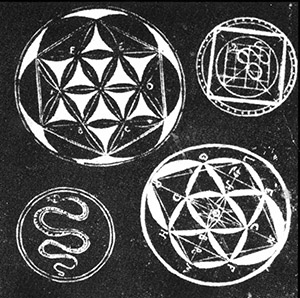
Woodcut illustrations from Giordano Bruno, Prague 1588. Upper left cut contains a version of the “Flower of Life” pattern.

Bruno’s Hermetic influence also extended to Elizabeth I’s physician William Gilbert’s 1600 masterwork, On the Magnet, Magnetic Bodies and the Great Magnet of the Earth, in which he proposed that magnets work because the Earth itself generates magnetic force – another landmark discovery. Without Bruno’s work, Gilbert would never have got there.4

In our bullet-point list of Hermetic-inspired discoveries in our last article we included “the basic principles of computer science and information theory.” At first glance this may seem rather unlikely but this, too, can be traced back to Bruno’s application of Hermetic principles. This time the seed he planted flowered in Gottfried Wilhelm Leibniz (1646-1716), the German genius whose life and career paralleled those of Isaac Newton. A great polymath, Leibniz is chiefly known today for inventing infinitesimal calculus, at about the same time as Newton – although Leibniz’s system was the one that caught on – and for the basic principles of information theory, including the binary system.

Yet even Leibniz was no hard-line materialist-rationalist. Like Newton, he was deeply versed in esotericism – almost certainly a Rosicrucian and certainly a scholar of the Cabala and, predictably, the Hermetica. Equally predictably, he owed an enormous debt to the works of Giordano Bruno.
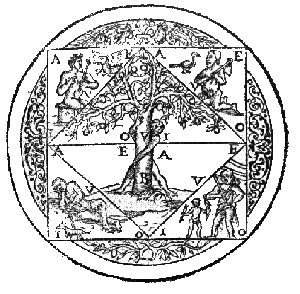
Woodcut illustration of one of Giordano Bruno’s less complex mnemonic (memory) devices. He planted this drawing – which acts as a portal – in his mind to recall massive amounts of information from memory.

Information theory was really just a by-product of a much more ambitious scheme. Leibniz believed it should be possible to devise a set of symbols – which he called characteristica universalis – to represent all the fundamentals of knowledge, and by manipulating them to make new discoveries (a process he described as ‘innocent magia’). He developed this idea from Bruno’s works, especially those on the magical art of memory and the manipulation of the imagination to produce desired results.

Although Leibniz was never to achieve the full dream of the characteristica universalis, his work developed into the idea of mathematical modelling, at first using pen-and-paper equations (which is where calculus came in) and later computer modelling. His pioneering computer work also saw him designing some of the first calculating machines.

But although Bruno can never be described as a scientist in his own right (he seems never to have undertaken a single experiment) basing his reasoning on the Hermetic principles led him to make some truly remarkable insights. (And given that he practised magical techniques to acquire information directly, we can be forgiven for wondering just how successful they were.)

In London in 1584 Bruno wrote and published On the Infinite Universe and Worlds in which he put forward some extraordinarily advanced – and for the time deeply shocking – propositions.

Shock and Awe

Bruno was a leading champion of Copernicus’ heliocentric theory which, although published five years before he was born, was still regarded as new and unproven, scholarly opinion being split over whether he was right, wrong or somewhere in between. Copernicus had merely proposed that the sun was at the centre of creation; he still stuck with the traditional model that the entire cosmos consists solely of the sun, moon and planets which move within an outer ‘shell’, the sphere of the fixed stars. In other words, the stars are simply fixed points of light of varying intensity, all stuck on the same crystalline sphere and therefore equidistant from Earth. 

But, as the title of his book implies, Bruno went further, arguing that the stars are really suns like our own, but immensely far away, and at varying distances. He rejected the concept of the sphere of the fixed stars entirely, proposing that the universe was in fact infinite. 

Bruno also took the next logical step: if stars are really suns, then at least some must have their own system of planets. And some of those planets must be like our own.

He wrote in On the Infinite Universe and Worlds:

There is a single general space, a single vast immensity which we may freely call Void; in it are innumerable and infinite globes like this on which we live and grow. This space we declare to be infinite, since neither reason, convenience, possibility, sense-perception or nature assign to it a limit. In it are an infinity of worlds of the same kind as our own… Beyond the imaginary convex circumference of the universe is Time.5

And making the final logical leap, Bruno concluded it was impossible to imagine that “these innumerable worlds, manifest as like to our own or even more magnificent, should be destitute of similar or even superior inhabitants.”6

Of course, time and telescopes have proven Bruno right about the scale of the universe and the existence of other solar systems – and, even if it has yet to be proven, few scientists also doubt that extraterrestrial life is a reality.

These were deeply shocking conclusions to the Church – and indeed they were high on the list of indictable offences for which Bruno was condemned to death 16 years later. Whereas Copernicus had shifted the physical centre to the sun, the focus of creation was still the Earth and human beings, which fitted the basic biblical model where God made the world as a unique place, and humans ‘in his own image’. Bruno was proposing that there was no centre, and that humans were no more or less important than other beings on other planets – and indeed, that some of the extraterrestrial races are superior to human beings. 

This was to mark the beginning of the Vatican’s antipathy towards heliocentricity that was to climax in its persecution of Galileo.

Where did Bruno get this radical notion? His immediate inspiration seems to have been the English mathematician Thomas Digges, a protégé and ward of John Dee, and England’s major champion of Copernican theory. Digges had argued that space is infinite in his defence of heliocentricity published in 1576, seven years before Bruno arrived in London. As they shared both interests and friends it is unlikely that Bruno and Digges never met during the former’s London years. But in any case Digges derived his idea from a section of the Hermetic treatise known as Asclepius.7

Bruno may have reached the same conclusion independently from his own study of Asclepius, but he added the concept of other inhabited worlds, which came from his contemplation of another key Hermetic principle: that the cosmos is imbued with life.

Bruno also showed remarkable insights into other areas of science. He understood that the body is perpetually being renewed, bit by bit, so it effectively becomes totally new over time. The current understanding is that our bodies are completely ‘replaced’, cell by cell, every seven to ten years.

In other writings he put forward basic ideas about relativity, and some academic writers regard some of his notions about the structure of matter as effectively laying the foundations for later atomic theory.8

So in the face of this astonishing catalogue of achievements and insights, it seems nothing short of an outright scandal that Giordano Bruno is so little known today. 
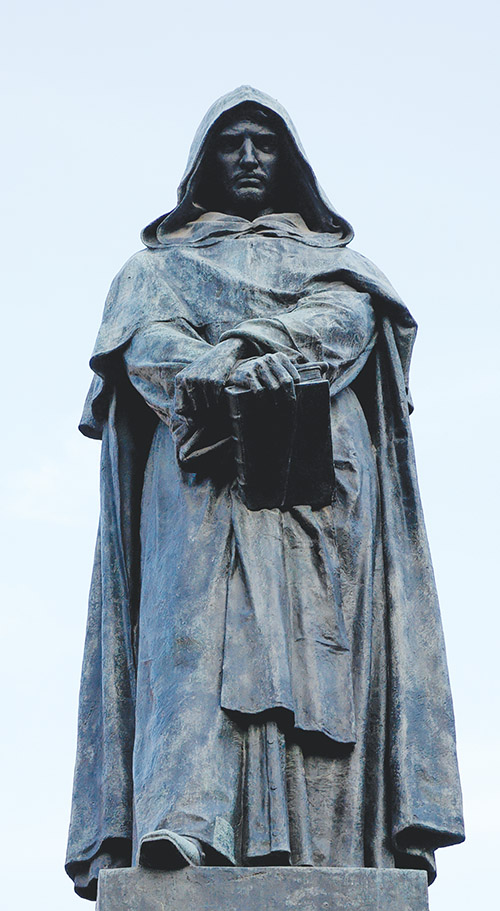
Bronze statue of Giordano Bruno by Ettore Ferrari, Campo de’ Fiori, Rome.

No Insignificant Ambition

Bruno’s hugely influential ideas about the workings of the universe were only part of the picture. It was his view of the religious significance of the Hermetic tradition that inspired his most radical message – and led to his downfall.

Another of the major works Bruno produced in London was Expulsion of the Triumphant Beast (1584). Modelled on a key Hermetic text, Kore Kosmou (Virgin of the World), and dedicated to Sir Philip Sidney, the book describes a gathering of the Egyptian and Greek deities – the goddesses Isis and Sophia taking the lead – in order to organise a great reform in the heavens. On the principle invoked in the celebrated Hermetic adage ‘as above, so below/as below, so above’, this would cause equally great changes on Earth.

Clearly it is the earthly transformation that interested Bruno most pressingly – and for which he called so passionately. How would that manifest? In Expulsion of the Triumphant Beast, Bruno reproduces in its entirety a key section from Asclepius – a celebrated passage known as the Lament – in which Hermes Trismegistus mourns the decline of the Egyptian religion, which has been eclipsed by foreign gods, Egypt’s own having abandoned the land. But it also predicts that they will return and the religion will be restored. 

Bruno believed this prophecy referred to his own time, and saw the religious turmoil then engulfing Europe as a sign that at least in its present form Christianity had run its course. The return of the magical religion of Egypt was imminent. 

Since the rediscovery of the Corpus Hermeticum in the 1460s it had been universally accepted – by Hermeticism’s enthusiasts and opponents alike – that the texts contained the wisdom of the high point of ancient Egyptian, then considered the oldest civilisation. (As we showed previously, in fact there is good evidence to support the Hermetica’s ancient Egyptian origins.) Many – Bruno among them – believed therefore that they preserved the original religious revelation to mankind.

But characteristically Bruno went further. He believed that the magical religion of ancient Egypt had been corrupted, first by the Jews and then by the Christians. (Bruno thought that Jesus had been sent to restore the Jewish religion to its true, Egyptian roots. From our own research into the origins of Christianity, detailed in our 2008 book The Masks of Christ, we would broadly agree. Without the benefit of recent historical discoveries, how did Bruno know this?)

Bruno wanted nothing less than a root-and-branch reform of the whole of society based on the Hermetic principles, or rather, as he saw it, the religion of ancient Egypt. His ultimate aim was the creation of a spiritually unified Europe in which the religious tension between and within nations – which if unchecked would inevitably lead to a Europe-wide cataclysmic war – would be swept away.

Bruno manifestly saw the authoritarian and dogmatically inflexible Catholic Church, rather than the Protestants, as the big stumbling block to his great reform. Indeed, although he explained the ‘triumphant beast’ of his title as a metaphor for human vices, many (including the Inquisition) took it as a not-very-thinly-veiled allusion to the Pope. This was not a good turn of events.
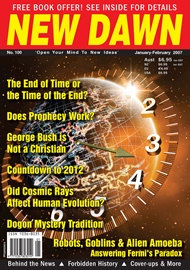
Get the issue this article appears in

The Predictable Unhappy Ending

The worry for the Inquisition was that Giordano Bruno was not just an easily-dismissed eccentric, but an energetic and charismatic campaigner with a sharp mind who, as we have seen, enjoyed considerable influence over the likes of Henri III of France, Elizabeth I and the Holy Roman Emperor Rudolph II. Put simply, he was an Inquisition magnet and his death by fire was only a matter of time.

Towards the end of 1585 Bruno returned to France, but found it descending into civil war as staunchly Catholic nobles challenged Henri III (who was soon to be assassinated). He then left France and for the next five years travelled the university towns of Protestant Germany preaching an increasingly hard-line message of the danger posed by the Catholic Church.

In 1591 he made a somewhat unwise return to Italian soil, accepting an invitation from a wealthy admirer to visit the Republic of Venice. There, in May 1592, he was denounced to the Inquisition, arrested and sent to Rome. After languishing in prison for eight years he was sent to the stake on 17 February 1600 – with his tongue tied so he couldn’t address the crowds.

Regarded as a diabolically-inspired magician who sought the destruction of God’s own Holy Church, it isn’t surprising that Bruno’s memory faded in the Catholic lands. What is less forgivable is that his great intellectual legacy was also allowed to fall by the wayside by the science historians. They seek to downplay – if not completely erase – the influence of the Hermetic tradition on science’s origins, and, whereas with the likes of Newton it was possible to pretend that their ‘occult’ interests were of no great consequence, it was utterly impossible to ignore the role of Hermeticism in Bruno’s work. Far easier just to forget him.

Bruno’s story was by no means over. During his last travels, fearing a Catholic onslaught that would bring Europe back under its domination, he had made plans for the underground continuation of his Hermetic reform movement. He formed a secret society, or more accurately a network of secret societies, based in the universities of Germany and in the Republic of Venice, which would outlive him. Known as the Giordanisti, after his death this clandestine group would have its own key part to play in the development of the Western esotericism…This article was published in New Dawn 130.If you appreciate this article, please consider a contribution to help maintain this website.

Footnotes

1. Brian P. Copenhaver, Hermetica: The Greek Corpus Hermeticum and the Latin Asclepius in a New English Translation (Cambridge University Press, 1992), 33.

2. Walter Pagel, ‘Giordano Bruno: The Philosophy of Circles and the Circular Movement of the Blood’, Journal of the History of Medicine, vol. VI, 1951.

3. Allen G. Debus, ‘Robert Fludd and the Circulation of the Blood’, Journal of the History of Medicine, vol. XVI, no. 4, 374.

4. Hilary Gatti, Giordano Bruno and Renaissance Science (Cornell University Press, 1999), 80-5.

5. Translated by Dorothea Waley Singer in Giordano Bruno: His Life and Thought (Henry Shuman, 1950), 363.

6. Singer, 323.

7. Robert S. Westman and J.E. McGuire, Hermeticism and the Scientific Revolution (William Andrews Clark Library, 1977),24.

8. See Ksenija Atanasijevic’s introduction to her The Metaphysical and Geometrical Doctrine of Bruno (Warren H. Green, 1972).

© New Dawn Magazine and the respective author.
For our reproduction notice, click here.
Prophecy: Does it Work?

BY RICHARD SMOLEY

From New Dawn 100 (Jan-Feb 2007) (newdawnmagazine.com)

Elie Wiesel, in his sombre memoir Night, describes a poignant incident from his time in a Nazi concentration camp. Amidst unimaginable suffering and despair, an inmate named Akiba Drumer “had discovered a verse from the Bible, which, translated into numbers, made it possible for him to predict Redemption in the weeks to come.”

There have been countless Akiba Drumers over the last 2,000 years. Confronting dismal memories of the past and the bleak actualities of the present, they have turned to the future for hope and solace.

The trend is not necessarily as old as humanity itself. While traditional mythologies ranging from those of the Hindus to those of the ancient Germans spoke of the rising and passing of ages in cycles, the Abrahamic religions – Judaism, Christianity, and Islam – have tended to see history as aimed toward a final destination point, an end of time in which the ledger books of justice will be balanced and all of humanity will be marched off to either salvation or perdition. This is sometimes called the Apocalypse, and literature devoted to it is called apocalyptic.

What exactly is prophecy? Can we trust it?

The esoteric tradition – the body of knowledge that underlies all the great spiritual traditions of humanity – teaches that the future is, at least in principle, knowable. There are several theories to account for such events (and they are not mutually exclusive). One of these holds that there exists a realm of images and forms, which has many names in many traditions. The Kabbalists call it the world of Yetzirah, or “formation”; quite possibly it is what Australian aborigines call the Dreaming and what some Western occultists refer to as the astral realm. This realm of images does not exist in any physical sense, but all the same it has a reality of its own. If you think of a light bulb, say, that image in your mind has some reality, even some substance, although not physically.

Esotericism also teaches that this world of images is prior to the physical world: events and things manifest in this realm before they appear in palpable reality. Consequently, someone with reasonably clear access to this dimension – deliberately, through divination or prophetic contemplation, or spontaneously, through dreams or hunches or intuitions – should be able to see the future.

Some readers may wonder what this theory may have to do with synchronicity, a concept that is often invoked when people attempt to understand such forms of divination as the Tarot or the I ChingSynchronicity in this sense is a coinage of the Swiss psychologist C.G. Jung, who defines it as an “acausal connecting principle.” Jung gives a case in point: “The wife of one of my patients, a man in his fifties, once told me in conversation that, at the deaths of her mother and her grandmother, a number of birds gathered outside the windows of the death-chamber.” Such incidents are common: I can tell similar stories from my own family. For Jung, the connection between these events – the deaths and the appearance of the birds – is not causal; that is, the impending death didn’t cause the birds to come or vice versa. But they are related by what he calls a “meaningful cross-connection.”

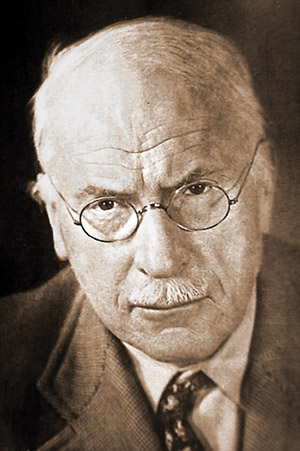
Swiss psychologist C.G. Jung defined synchronicity as an “acausal connecting principle.”

Jung’s attempt to characterise synchronicity as “acausal” appears misguided. He seems to be veering toward a connection that is not acausal in the strict sense; rather it implies a hidden factor lying outside the physical dimension that, so to speak, “caused” both the death and the appearances of the birds. Jung locates this hidden cause in the realm of the archetypes, the psychic forces that underlie the human mind and possibly reality itself. For Jung, “meaningful coincidences… seem to have an archetypal foundation.”

Granting this much, we are left with a theory very close to the esoteric doctrine sketched out above. Jung’s archetypal world is more or less identical to the realm of Yetzirah, of forms and images. As such it can give rise to two phenomena that have no obvious causal relation (such as a death and the sudden appearance of a flock of birds) and yet seem to be meaningfully connected. Jung made much of being scientific, and to a great degree he was – but his conclusions in many respects resemble those of the old occultists.

Another esoteric theory about seeing the future is based on the highly relative nature of time. Time, as Immanuel Kant argued, is one of the basic structural components of our experience, but it is a construct that our minds have imposed on reality. As hard as it may be to imagine, time has no absolute reality in itself (a conclusion to which contemporary physics may also point). If so, it may be possible to step past the portals of our own experiential framework and take some measure of events in the future.

Many spiritual traditions speak of a higher Self, a part of our being that stands over and above our selves as we customarily experience them. The names for this Self are countless. The ancient Greeks called it the daimon; the ancient Romans, the genius; to esoteric Christians, it is the kingdom of heaven or the Christ within. This Self stands outside the personality, the conscious self, and outside the categories of conscious experience, including time. It perceives our lives, not as a sequence of events and experiences that span several decades, but as a whole. It can see a lifetime as we can see a snapshot.

A famous instance of the workings of this Self appears in the Crito of Plato. Socrates, under sentence of execution, is urged to escape by his rich friend Crito, who assures him that he has bribed the guards and can furnish the necessary getaway. Socrates refuses, saying he has had a dream in which a beautiful woman dressed in white appeared to him and recited a line from the Iliad: “On the third day to the fertile land of Phthia thou shalt come.” Socrates takes this as a message from his daimon, the guiding spirit that has directed him all throughout his life, that he will be executed in three days, and that he should not try to escape. One way of understanding such episodes is that the daimon, the Self, can see the whole of one’s life from start to finish, apart from the linearity of time, and can give appropriate guidance. 

Note, however, that, as in Socrates’ case, these glimpses usually have to do with one’s deeper destiny. It’s not a question of picking next week’s lottery number or finding hot stocks. While these are in principle no more unknowable than anything else, one soon discovers that the higher Self is not terribly interested in them – and anyway, how helpful would the knowledge really be? I know directly of only one case where someone got this kind of information. A friend of my father’s once told me he had been awakened in the middle of the night by the image of some numbers that flashed in his mind. It struck him that they might be lottery numbers and that he should buy a ticket using them, but he never got around to it. Of course they were the winning numbers that week.

If these visions of the future are ultimately personal in nature – that is, they are meant to give guidance or inspiration to an individual at crucial junctures in his or her life – what then of prophecy in a grander sense, the prophecy that purports to open a window onto the fates of nations and peoples, and of humanity itself?

As a whole, the record of prophecy in predicting the future on a large scale is not good. We can see this as far back as the start of the apocalyptic genre in Palestine in the second century B.C.E. At the time the Jewish nation was living under the rule of the Hellenistic Seleucid monarchs, who were heirs to a portion of the empire of Alexander the Great. In 167 B.C.E., one of these rulers, Antiochus IV Ephiphanes, embarked on a program of forced Hellenisation of the Jews. He set up an altar, and perhaps an image, of Olympian Zeus in the Temple in Jerusalem.

The Jews’ outrage is reflected in the Book of Daniel, one of the earliest apocalyptic writings and the only one to make its way into the Hebrew Bible. Written during the ensuing revolt against the Seleucids, this book sets up Daniel, a legendary sage of the sixth century B.C.E., as the mouthpiece of a prophecy that would “foretell” events 400 years after his time. (The technical term for this practice is vaticinium ex eventu, “prediction after the event.”) Daniel refers to “a vile person” – Antiochus – who will “pollute the sanctuary of strength, and shall take away the daily sacrifice, and… shall place the abomination that maketh desolate” (Dan. 11:21, 31) – that is, the idol in the Temple (cf. 1 Macc. 1:54). The archangel Michael will come to Israel’s rescue; the dead will be raised, “some to everlasting life, and some to shame and everlasting contempt.” Antiochus “shall come to his end, and none shall help him” (Dan. 11:45, 12:1-2).

What happened in fact was that the Jews rose up under the priestly clan of the Maccabees and won back their religious liberties as well as a measure of political autonomy, but this obviously did not begin the end of time. Antiochus did not perish as a result of any obvious divine wrath: he died of natural causes.

Despite its failure as a prophecy, the Book of Daniel established the basic structure of the apocalyptic genre. Arising during some crisis, such texts predict that this event is the harbinger of the imminent Day of Judgment, when justice will be done and evildoers will receive their due. The Book of Revelation at the end of the New Testament follows this pattern. Most scholars agree that it is a response to the Roman persecution of Christians in the first century C.E. Here, too, the prophecy, taken as literal truth, is not accurate. The book seems to foretell the end of the Roman Empire and the coming of a millennial kingdom, but this did not happen. The Roman Empire did come to an end (close to 400 years after Revelation was written), but it did not usher in the reign of God on Earth. Rather it initiated a period of collapse and chaos that came to be known as the Dark Ages.

Even the prophecies of Jesus as related in the Gospels do not seem trustworthy. If we are to read what scholars call his Apocalyptic Discourse literally (three versions of it appear in Matthew 24, Mark 13, and Luke 21), we would conclude that he was predicting the destruction of the Temple by the Romans, to be followed by the return of the Son of God. This did not happen either. The Romans did sack the Temple, in 70 C.E., about a generation after Jesus’s lifetime, but Jesus did not return and did not establish a millennial kingdom. Things went on much as they had (except for the Jews, who were expelled from Palestine).

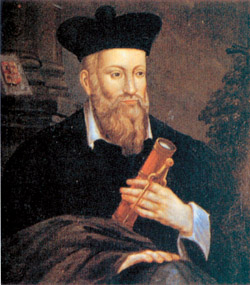
Michel de Nostra-dame (1503-1556), better known as Nostradamus.

I’m using instances from the Bible as it is by far the best-known work of prophecy, but if we were to look at prophecies from other sources, they would not look much better. The American trance medium Edgar Cayce foretold that much of California would be under water by 1972. Nostradamus predicted some kind of great manifestation in the sky for the seventh month of 1999, but the year 1999 had very little that was remarkable, much less cataclysmic, either in the seventh or in any other month. (For more on Nostradamus’s prophecies, see my new book The Essential Nostradamus.)

How, then, can we reconcile the abysmal performance of prophecy as a whole with the esoteric theory that I’ve sketched out above? If we can know the future, why don’t we?

The astral realm is a sea of images. We can think of it as containing every image and idea that every human being has ever thought and possibly will ever think. No sooner do we say this than we realise that this dimension must contain an enormous amount of psychic rubbish – the fears, dreads, and anxieties of humanity, most of which have nothing to do with reality past or present. This dimension is described most clearly in the spiritual text known as A Course in Miracles:

The circle of fear lies just below the level the body sees, and seems to be the whole foundation on which the world is based. Here are all the illusions, all the twisted thoughts, all the insane attacks, the fury, the vengeance and betrayal that were made to keep the guilt in place, so that the world could rise from it and keep it hidden. Its shadow rises to the surface, enough to hold its most external manifestations in darkness, and to bring despair and loneliness to it and keep it joyless.

Without going into the elaborate psychological system of the Course, I will simply point to the notion of the “circle of fear” – a zone of fears, hatreds, and anxieties that lie just below the surface of consciousness. This circle of fear is universal: each of us participates in its creation. Probably only the most enlightened human beings are entirely free from its effects. For the rest of us, it sits underneath our experience of reality like a water table. We all tap into it in our own ways.

This fear is not “about” anything particular; it is not necessarily connected to anything real or substantial; it is simply a nameless, objectless anxiety that can attach itself to anything. It holds tremendous power over each of us precisely because we are usually unconscious of it. We imagine that our fears and anxieties are about something real and justified, but there is something suspect about this belief: no sooner does one anxiety disappear than another pops up to take its place. For many people, this anxiety can manifest in fears about their personal future or about society or humanity or the Earth; for others, it is displaced onto a fear of an imminent end of the world.

Some say fear is a healthy and normal emotion, that without it we could not function in the world. So it may be under certain circumstances. If a man finds himself facing a wild animal, his fear will make him run away. But the kind of fear I am talking about is not healthy. It does not increase our chances for survival; instead it is weakening and debilitating. Much of mental dysfunction no doubt stems from too close a contact with this kind of fear.

Saying this much explains the horrific imagery of so many prophecies, but what about the nice part? What about the beautiful dreams of a utopian future that is always just around the horizon? The explanation is the same. The Yetziratic or astral realm is known to esotericists as the zone of illusion. We can think of it as literally a bandwidth of fantasies and illusions that surround us on a psychic level. While many of these fantasies are negative, there are also many that are positive; they are the flip side of the circle of fear. The power of wishful thinking – which is very strong – can easily lead someone to put all these images together into a picture of the future that involves both terrible calamities (usually visited on one’s enemies) and ultimate salvation (for oneself and one’s own sect). Akiba Drumer’s prophecy in the concentration camp most likely falls into this category.

Our age imagines itself to be more sophisticated than its predecessors, and yet the contemporary mind falls prey to many of the temptations of the past. Cataclysmic and millennialistic thinking is as much with us as ever. The religious-minded cast it in biblical images. The secular mindset translates it into visions of nuclear or environmental disaster. The problems posed by both nuclear power and environmental contamination are very great and should not be dismissed out of hand, but it is also well to separate them from unconscious apocalyptic expectations, which can erupt from the minds of supposedly rational scientists just as easily as they can from men wearing sandwich boards on streetcorners.

Having said this much, we might want to compare prophecy with prediction of a more conventional kind, which has evolved into an academic discipline (or pseudodiscipline) known as futurology. Futurology makes no supernatural assumptions. It is based entirely on what is currently known. It takes current statistics – about population, economic growth, political trends, resource capacity – and extrapolates them into the future. That is its strength but also its weakness. Futurology can only make predictions on the basis of current trends, but one thing we know is that current trends never continue. There are shocks, dislocations, cataclysms. Conventional forecasters cannot predict these; their unpredictability is at the root of their nature.

The apocalyptic prophet faces no such restrictions. He has no incentive to predict more of the same; who would pay attention to him then? So he is entirely happy to foretell all kinds of upheavals, natural and supernatural: the submerging of continents; the manifestation of extraterrestrials; the shifting of the Earth’s pole; the return of Jesus Christ. In a sense, he is right. Cataclysms do occur. But somehow they never occur in the way they were predicted.

Get the issue this article appears in

In the end, I personally would not base my plans for the future on any prophetic claims from any source. I can’t say that none of these prophecies will be fulfilled – that would be making a prophecy of my own – but to my mind they haven’t been proved reliable enough in the past to merit any serious attention now. Conventional futurology may offer some insights, but frequently it, too, better represents the analyst’s preconceptions than any reality that is likely to come.

All this still leaves us with the possibility of a knowable future, whose seeds are present in the astral realm amidst all the fears and fantasies. How can we have contact with it? Trying to glimpse the future on a collective level is extremely tricky, often because it is something into which we as individuals are not supposed to stick our noses. Recently a friend of mine used the divinatory technique of horary astrology to ask a question about a national issue. Horary astrology, though not practiced or understood even by most astrologers, can produce quite striking insights for one who knows how to use it. In my friend’s case, the answer was quite sharp: “None of your business.”

When we come to the personal future, the situation is different. I myself have often found that when I needed to be told of something that was going to happen to me, I was informed of it, usually through some form of inner perception, bidden or unbidden. I have not found divination methods like the Tarot or the I Ching to be particularly useful. Astrology, on the other hand, can have remarkable predictive value – provided one knows the system well enough to understand what the stars are saying.

These are my conclusions from my own experience. Others may have different results; these matters are more individual than popular books like to let on. In the end, for me nothing has proved to be of as much value as a clear-sighted determination to see what was going on both inside and outside myself, to look upon my own hopes and fears and wishes, and to bring them face to face to what Freud called “the reality principle.” A.R. Orage, a pupil of the great spiritual teacher G.I. Gurdjieff, defined conscience in a rather unusual way as “the simultaneous experience of all one’s emotions.” If one can do this with a naked and even remorseless honesty (and it is considerably harder than it may first seem), one is far more likely to have an accurate basis for future action than if one follows the advice of any number of psychics or prophets.This article was published in New Dawn 100.If you appreciate this article, please consider a contribution to help maintain this website.

© New Dawn Magazine and the respective author.
For our reproduction notice, click here.
About the Author

RICHARD SMOLEY is the author of Inner Christianity: A Guide to the Esoteric Tradition; The Dice Game of Shiva: How Consciousness Creates the Universe; Conscious Love: Insights from Mystical Christianity; The Essential Nostradamus; Forbidden Faith: The Secret History of Gnosticism; Supernatural: Writings on an Unknown History; The Deal: A Guide to Radical and Complete Forgiveness; How God Became God: What Scholars Are Really Saying about God and the Bible; and Hidden Wisdom: A Guide to the Western Inner Traditions (with Jay Kinney). A frequent contributor to New Dawn, he is editor of Quest: Journal of the Theosophical Society in America. Visit his blog at www.innerchristianity.com/blog.htm.

How the N-Word Became Unsayable

GUEST ESSAY

Fascinating essay! Written by a linguist whose work I’ve seen over the years, and in this essay reveals that he is Black!

There is also a companion piece by two NYT editors on how and why the Times decided to print…the  various words that are generally not printed in the Times, which are the subject the author is talking about.

–Michael Kelly, H.W.

April 30, 2021 (NYTimes.com)

Cinemagraph

By John McWhorter

Dr. McWhorter is a linguist who has written extensively about both race and language. He is the author, most recently, of “Nine Nasty Words: English in the Gutter,” from which this guest essay is adapted.

This article contains obscenities and racial slurs, fully spelled out. Ezekiel Kweku, the Opinion politics editor, and Kathleen Kingsbury, the Opinion editor, wrote about how and why we came to the decision to publish these words in Friday’s edition of the Opinion Today newsletter.


In 1934, Allen Walker Read, an etymologist and lexicographer, laid out the history of the word that, then, had “the deepest stigma of any in the language.” In the entire article, in line with the strength of the taboo he was referring to, he never actually wrote the word itself. The obscenity to which he referred, “fuck,” though not used in polite company (or, typically, in this newspaper), is no longer verboten. These days, there are two other words that an American writer would treat as Mr. Read did. One is “cunt,” and the other is “nigger.” The latter, though, has become more than a slur. It has become taboo.

Just writing the word here, I sense myself as pushing the envelope, even though I am Black — and feel a need to state that for the sake of clarity and concision, I will be writing the word freely, rather than “the N-word.” I will not use the word gratuitously, but that will nevertheless leave a great many times I do spell it out, love it though I shall not.

“Nigger” began as a neutral descriptor, although it was quickly freighted with the casual contempt that Europeans had for African and, later, African-descended people. Its evolution from slur to unspeakable obscenity was part of a gradual prohibition on avowed racism and the slurring of groups. It is also part of a larger cultural shift: Time was that it was body parts and what they do that Americans were taught not to mention by name — do you actually do much resting in a restroom?

  • Dig deeper into the moment.

Special offer: Subscribe for $1 a week.

That kind of concern has been transferred from the sexual and scatological to the sociological, and changes in the use of the word “nigger” tell part of that story. What a society considers profane reveals what it believes to be sacrosanct: The emerging taboo on slurs reveals the value our culture places — if not consistently — on respect for subgroups of people. (I should also note that I am concerned here with “nigger” as a slur rather than its adoption, as “nigga,” as a term of affection by Black people, like “buddy.”)

For all of its potency, in terms of etymology, “nigger” is actually on the dull side, like “damn” and “hell.” It just goes back to Latin’s word for “black,” “niger,” which not surprisingly could refer to Africans, although Latin actually preferred other words like “aethiops” — a singular, not plural, word — which was borrowed from Greek, in which it meant (surprise again) “burn face.”

English got the word more directly from Spaniards’ rendition of “niger,” “negro,” which they applied to Africans amid their “explorations.” “Nigger” seems more like Latin’s “niger” than Spanish’s “negro,” but that’s an accident; few English sailors and tradesmen were spending much time reading their Cicero. “Nigger” is how an Englishman less concerned than we often are today with making a stab at foreign words would say “negro.”

For Mandarin’s “feng shui,” we today say “fung shway,” as the Chinese do, but if the term had caught on in the 1500s or even the early 1900s, we would be saying something more like “funk shoe-y,” just as we call something “chop suey” that is actually pronounced in Cantonese “tsopp suh-ew.” In the same way, “negro” to “nigger” is as “fellow” is to “feller” or “Old Yellow” is to “Old Yeller”; “nigger” feels more natural in an Anglophone mouth than “negro.”

Editors’ Picks

What Doomed a Sprawling City Near St. Louis 1,000 Years Ago?‘While I Was Away, My Boss Had Flowers Delivered to My Apartment’Continue reading the main story

“Nigger” first appeared in English writings in the 1500s. As it happens, the first reference involved “aethiops,” as it had come to refer to Ethiopia, or at least that term as applied sloppily to Africa. We heard of “The Nigers of Aethiop” in 1577, and that spelling was but one of many from then on. With spelling as yet unconventionalized, there were “neger,” “nigur,” “niger,” “nigor” and “nigre” — take your pick.

It was, as late as the 1700s, sometimes presented as a novelty item. The Scottish poet Robert Burns dutifully taught, referring to “niger,” that it rhymes with “vigour, rigour, tiger.” Note, we might, that last word. If “tiger” rhymes with “vigor” and “rigor,” that means that “tiger” could once be pronounced “tigger,” which then sheds light on the rhyme:

Eeny, meeny, miny, moe
Catch a tigger by the toe
If he hollers, let him go
Eeeny, meeny, miny, moe.

“Tigger,” then, was a polite substitute for the original “nigger.” After all, do we really imagine a tiger hollering in protest? So, for one, we gain insight into why the Winnie-the-Pooh character is called “Tigger” and the books are so vague on why it’s pronounced that way. That was an available alternate pronunciation to A.A. Milne. But more to the point, the original version of the “Eeny, meeny” doggerel is a window into how brutally casual the usage of “nigger” once was, happily trilled even by children at play. For eons, it was ordinary white people’s equivalent of today’s “African-American.”

Someone wrote in passing in 1656 that woolly hair is “very short as Nigers have,” with the term meant as a bland clinical reference. “Jethro, his Niger, was then taken,” someone breezily wrote in a diary 20 years later. And this sort of thing went on through the 1700s and 1800s. Just as “cunt” was a casual anatomical term in medieval textbooks, “nigger,” however spelled, was simply the way one said “Black person,” with the pitiless dismissiveness of the kind we moderns use in discussing hamsters, unquestioned by anyone. After a while, the current spelling settled in, which makes the contrast with today especially stark.Related in OpinionMore on racism in America.Opinion | Dorothy A. BrownYour Home’s Value Is Based on RacismMarch 20, 2021Opinion | Damon YoungRacism Makes Me Question Everything. I Got the Vaccine Anyway.April 9, 2021Opinion | Caroline Randall WilliamsYou Want a Confederate Monument? My Body Is a Confederate MonumentJune 26, 2020

Its use straddling the 19th and 20th centuries is especially interesting: While America was becoming recognizable as its modern self, its denizens said “nigger” as casually as today we do “boomer” or “soccer mom.” Frank Norris’s anthropological realism is an example. In his “Vandover and the Brute,” set at the end of the 1800s, the white protagonist in San Francisco squires a gal about town who has been doing some teaching and tells him

about the funny little nigger girl, and about the games and songs and how they played birds and hopped around and cried, “Twit, twit,” and the game of the butterflies visiting the flowers.

Annals of popular dancing shortly after this era gaily chronicled dances such as the bunny hug, turkey trot and grizzly bear but discreetly left out that a girl like the one in “Vandover” was equally fond of one called the nigger wiggle, named as if Black people were just one more kind of amusing animal. (This dance entailed, for the record, a couple putting their hips together and holding each other’s rear ends.)

Of course, the word was also used in pure contempt. Not long after “Vandover,” William Jennings Bryan, the iconic populist orator, as secretary of state, remarked about Haitians, “Dear me, think of it, niggers speaking French.” Meanwhile, the Marine in charge of Haiti on the behalf of our great nation at the time, L.W.T. Waller, made sure all knew that whatever their linguistic aptitudes, the Haitians were “real nigs beneath the surface.”

There was a transitional period between the breeziness of “real nigs beneath the surface” and the word becoming unsayable. In the 20th century, with Black figures of authority insisting that Black Americans be treated with dignity, especially after serving in World War I, “nigger” began a move from neutral to impolite. Most Black thinkers favored “colored” or “Negro.” But “nigger” was not yet profane.

Film is, as always, illuminating. We have been told that early talkies were splendidly vulgar because, for instance, Barbara Stanwyck’s character openly sleeps her way to the top in “Baby Face.” But linguistically, these films are post-Victorian. That character never says “fuck,” “ass” or “shit” as the real-life version would, and in films of this genre, that reticence includes “nigger.” It is, despite the heartless racism of the era, almost absent from American cinema until the 1960s. Rather, we today can glean it in the shadows: There it reigned with an appalling vigor.

So in the film “Gone With the Wind” no one utters it, but in the book it was based on, which almost everyone had read, Scarlett O’Hara hauls off with, “You’re a fool nigger, and the worst day’s work Pa ever did was to buy you.” And she then thinks, “I’ve said ‘nigger’ and Mother wouldn’t like that at all.” As in, there was now a veil coming down, such that one was supposed to be polite — approximately in the book, conclusively in the movie. But still, it was always just under the same surface that our Marine saw “nig”-ness through.

Same period, 1937: a Looney Tunes cartoon (“Porky’s Railroad”) has Porky Pig as the engineer in a race between trains. Porky’s rival zooms past a pile of logs and blows them away to reveal a Black man sitting, perplexed. Today we wonder why this person was sitting under a pile of logs. The reason is that this was a joke referring to the expression “nigger in the woodpile,” an old equivalent of “the elephant in the room.” No Looney Tunes characters ever utter “nigger,” but this joke reveals that their creators were quite familiar with the word being used with joy.

Even into the 1970s, the word’s usage in the media was different from today’s. “The Jeffersons,” a television sitcom portraying a Black family that moves from working-class Queens to affluence in a Manhattan apartment tower, was considered a brash, modern and even thoughtful statement at the time. Here was the era when television shows took a jump into a realism unknown before, except in flashes: The contrast between the goofy vaudeville of “Here’s Lucy” and the salty shout-fests on “The Jeffersons” is stark. So it was almost a defining element of a show like “The Jeffersons” that loudmouthed, streety George Jefferson would use “nigger” to refer to Black people with (and without) affection.

George freely hurled it while playing the Dozens in an early episode. (“Take this elite nigga, wolfin’ at my door / With your yellow behind, I’m gonna mop up the entire floor!”) On the show the character began in, “All in the Family,” while bigoted Archie Bunker does not use the word, as his real-life counterpart would, George uses it, such as when he rages about the possibility of having (white) Edith Bunker help out at his dry-cleaning location. (“The niggers will think she owns the store, and the honkies will think we bleached the help!”)

Nor are only Black people shown using it; the writers air the “real” “nigger as well. White men use it a few times on an episode in which George meets modern Klansmen. But white people aren’t limited to it only in very special episode cases like this. George calls his white neighbor Tom Willis “honky,” and Tom petulantly fires back, “How would you like it if I called you ‘nigger’?” Then, that read as perfectly OK (I saw it and remember); he was just talking about it, not using it. But today, for Tom to even mention the word at all would be considered beyond the pale — so to speak.

The outright taboo status of “nigger began only at the end of the 20th century; 2002 was about the last year that a mainstream publisher would allow a book to be titled “Nigger,” as Randall Kennedy’s was. As I write this, nearly 20 years later, the notion of a book like it with that title sounds like science fiction. In fact, only a year after that, when a medical school employee of the University of Virginia reportedly said, “I can’t believe in this day and age that there’s a sports team in our nation’s capital named the Redskins. That is as derogatory to Indians as having a team called Niggers would be to Blacks,” the head of the N.A.A.C.P., Julian Bond, suggested this person get mandatory sensitivity training, saying that his gut instinct was that the person deserved to simply be fired. The idea, by then, was that the word was unutterable, regardless of context. Today’s equivalent of that employee would not use the word that way.

Rather, the modern American uses “the N-word.” This tradition settled in after the O.J. Simpson trial, in which it was famously revealed that Detective Mark Fuhrman had frequently used “nigger” in the past. Christopher Darden, a Black prosecutor, refused to utter the actual word, and with the high profile of the case and in his seeming to deliberately salute Mr. Read’s take, by designating “nigger” “the filthiest, dirtiest, nastiest word in the English language,” Mr. Darden in his way heralded a new era.

That was in 1995, and in the fall of that year I did a radio interview on the word, in which the guests and I were free to use it when referring to it, with nary a bleep. That had been normal until then but would not be for much longer, such that the interview is now a period piece.

It’s safe to say that the transition to “the N-word” wasn’t driven by the linguistic coarseness of a Los Angeles detective or something a prosecutor said one day during a monthslong trial. Rather, Mr. Darden’s reticence was a symptom of something already in the air by 1995: the larger shift in sensibility that rendered slurs, in general, the new profanity.

This occurred as Generation X, born from about 1965 to 1980, came of age. These were the first Americans raised in post-civil-rights-era America. To Generation X, legalized segregation was a bygone barbarism in black-and-white photos and film clips. Also, Generation X grew up when overt racist attitudes came to be ridiculed and socially punished in general society. Racism continued to exist in endless manifestations. However, it became complicated — something to hide, to dissemble about and, among at least an enlightened cohort, something to check oneself for and call out in others, to a degree unknown in perhaps any society until then.

For Americans of this postcountercultural cohort, the pox on matters of God and the body seemed quaint beyond discussion, while a pox on matters of slurring groups seemed urgent beyond discussion. The N-word euphemism was an organic outcome, as was an increasing consensus that “nigger” itself is forbidden not only in use as a slur but even when referred to. Our spontaneous sense is that profanity consists of the classic four-letter words, while slurs are something separate. However, anthropological reality is that today, slurs have become our profanity: repellent to our senses, rendering even words that sound like them suspicious and eliciting not only censure but also punishment.

John McWhorter (@JohnHMcWhorter) is an associate professor of linguistics at Columbia University. He is the author of “The Power of Babel: A Natural History of Language”and, most recently, “Nine Nasty Words: English in the Gutter — Then, Now, and Forever,” from which this guest essay is adapted.

The Times is committed to publishing a diversity of letters to the editor. We’d like to hear what you think about this or any of our articles. Here are some tips. And here’s our email: letters@nytimes.com.

Follow The New York Times Opinion section on FacebookTwitter (@NYTopinion) and Instagram.

The Aquarian Gospel of Jesus The Christ

Chapter 84: Verse 22: But Jesus said, The greatest power in heaven and earth is thought.

23. God made the universe by thought; he paints the lily and the rose with thought.

24. Why think it strange that I should send a healing thought and change the ethers of disease and death to those of health and life?

25. Lo, you shall see far greater things than this, for by the power of holy thought, my body will be changed from carnal flesh to spirit form; and so will yours.

26. When Jesus had thus said he disappeared, and no one saw him go.

27. His own disciples did not comprehend the change; they knew not where their master went, and they went on their way.

28. But as they walked and talked about the strange event, lo, Jesus came and walked with them to Nazareth of Galilee.

(en.wikisource.org)

Book: “The Theory and Practice of Hell: The German Concentration Camps and the System Behind Them”

The Theory and Practice of Hell: The German Concentration Camps and the System Behind Them

The Theory and Practice of Hell: The German Concentration Camps and the System Behind Them

by Eugen KogonNikolaus Wachsmann (Introduction), Heinz Norden (Translation) 

By the spring of 1945, the Second World War was drawing to a close in Europe. Allied troops were sweeping through Nazi Germany and discovering the atrocities of SS concentration camps. The first to be reached intact was Buchenwald, in central Germany. American soldiers struggled to make sense of the shocking scenes they witnessed inside. They asked a small group of former inmates to draft a report on the camp. It was led by Eugen Kogon, a German political prisoner who had been an inmate since 1939. The Theory and Practice of Hell is his classic account of life inside.

Unlike many other books by survivors who published immediately after the war, The Theory and Practice of Hell is more than a personal account. It is a horrific examination of life and death inside a Nazi concentration camp, a brutal world of a state within state, and a society without law. But Kogon maintains a dispassionate and critical perspective. He tries to understand how the camp works, to uncover its structure and social organization. He knew that the book would shock some readers and provide others with gruesome fascination. But he firmly believed that he had to show the camp in honest, unflinching detail.

The result is a unique historical document—a complete picture of the society, morality, and politics that fueled the systematic torture of six million human beings. For many years, The Theory and Practice of Hell remained the seminal work on the concentration camps, particularly in Germany. Reissued with an introduction by Nikolaus Waschmann, a leading Holocaust scholar and author of Hilter’s Prisons, this important work now demands to be re-read.

(Goodreads.com)

Rebecca Solnit: How Donald Trump Wanted the End of History

A Hundred Days Into the New Era, Looking Back on the Old

By Rebecca Solnit

April 29, 2021 (lithub.com)_

The impact of the Trump era will probably be remembered as crimes and outrages, but what it did to our psyches may be harder to recall. It did a lot to our psyches. The most valuable real estate Donald J. Trump ever acquired in his shady, shoddy career as a developer was the terrain inside our heads. And like so much else he got hold of, he wrecked it. During those four years of his presidency, our perception of time became disrupted and corrupted until it seemed to get stuck, stumble over itself into incoherence, loop, or crumble.

David J. Morris in his The Evil Hours: A Biography of Post-Traumatic Stress Disorder calls trauma “a disease of time.” With PTSD, the past refuses to become the past or stay there, and the traumatic event forces itself back, like a zombie rising from the dead, into the present, or the present of the source of trauma has never receded to become the past, either as something receding into the distance or incorporated into one’s historical narrative. When the Biden inauguration happened, I was surprised to find that I was not uplifted or relieved, but freed to feel how hideous the whole thing had been, how damaged I felt—and I heard from many others who had the same experience.

A hundred days since the end of that era and the beginning of the Biden Presidency, the texture of everyday life then does feel at times remote, almost unbelievable, and when some national event transpires, it’s a huge relief not to have the incendiary idiocy of Trump’s commentary added to it (which is a reminder that it was both a presidency the senate could have ended in early 2020 and a long run on Twitter that Jack Dorsey could have ended before he finally did, after the insurrection of January 6).

To those who opposed him, the years felt like a constant barrage of insults to fact, truth, science, of attacks on laws, on rights, on targeted populations from Muslims to trans kids, on the environment, on scientists, on institutions that might protect or promulgate any of these preceding things, and on memory itself. It was a disorder from which we were forever trying to emerge into order, like people clawing a slimy bank, only to slump back into the ooze.

The phrase “drain the swamp,” repeated over and over by the most corrupt administration in a century or more, was part of its promulgation of confusion, its swampiness. The pandemic felt like the final phase, throwing us deeper into uncertainty, isolation, anxiety, and a sea of lies and denials—and mass death. Because so much of what happened in our hard-hit country could have been avoided by a more compassionate and competent administration, it was part of the chaos.

Trump was constantly endeavoring to erase and revise the past and thereby to undermine the capacity of any of us to remember it or reference it. In 2016, he acknowledged that the Hollywood Access tape was real, and a year later he suggested maybe it was a fake, and in the summer of 2019 he falsified a weather chart to make himself right in what he said about a hurricane, and then doubled and tripled down on the petty lie. The Washington Post ran a headline last April that invited viewers to “watch Trump deny saying things about the coronavirus that he definitely said.” CNN put it thus: “President Trump falsely denies saying two things he said last week.”One got tired of outrage, and then more outrages came. This week was a hungry cannibal that devoured last week.

The political goal was presumably to discredit all sources of information other than himself, to build up a barrage of little lies so that when he floated his big lie he would have prepared the ground and recruited the suckers. His personal goal was surely the vanity of wanting to have never been wrong and the superpower of always being right—George Orwell speaks of the theological nature of totalitarians, who must constantly alter the past to claim to be always right in the present. But also it seemed that for Trump, who was at core a hustler, grifter, and salesman, truth and falsity were not categories into which he sorted reality. There was only what was expedient in the moment to promote himself and his agenda, as well as a psychopath’s or rich boy’s expectation of utter unaccountability. Which is to say he didn’t particularly seem to know, and it was the nihilism of sales pitches unanchored in reality that we were all dragged into, or rather contaminated by.

Whether or not you were buying what he was selling, he was winning by making noise and getting away with it. So something had happened and then it had not, and his followers on Twitter and in the House and the Senate would go along with whatever the current version was. The term gaslighting, hitherto mostly used mostly to describe bullying and manipulation in private relationships, became a term for what a politician and his party were trying to do to the public. To cite Orwell again, the Memory Hole in this era was Trump’s big mouth, swallowing up facts and spewing out delusions. With that mouth at its national headwaters, the river of time became a river of molasses and then a tar pit—it became the swamp plenty of us flailed furiously in without seeming to get anything other than more stuck. The past being constantly sabotaged, in other words, was one way time was disordered.

His obsessive tweeting, often in the early hours of the morning, meant that bizarre and venomous interjections into the political process could erupt at any time of day or night, that at any moment the ground might again shift beneath us. You would think you’d rounded up the facts like sheep, and then some would stray or a wolf would come in the night and devour a few or it would turn out to have been a flock of wolves all along. While the White House traditionally produced news on a weekday work schedule, there was no longer any recognizable workday, just a random spray of firings, scandals, denials, insults, executive orders, reheated lies from his mornings watching Fox and Friends, and more than 300 days without a press conference in which the media could demand explanations according to the customary rites.

It was like living in the aftermath of an earthquake, when the aftershocks can come at any time, or in a place where explosions happen unpredictably, or with an unstable abuser, and in fact it was living with an unstable abuser, who was on one hand not in the house with us and on the other hand was our president and the most powerful person on earth. It kept you on edge. It kept you thinking about him and them, speaking of the psychic real estate they occupied, and thinking about that also kept you from thinking about other things—about deeper meanings, longer timeframes, broader perspectives, things that were less tethered to electoral politics and the USA in this very moment. Alligators, speaking of swamps, drag their prey into the water; this dragged us all into the shallows. I felt like I and we became more banal and superficial, because this sense of having to attend to yesterday and the last ten minutes and tomorrow in national political life and struggle to refute another lie meant that everything else got pushed back, including deeper involvement in local and international issues.

The sheer volume of these outrages and eruptions also meant that it was hard to keep track of it all, which was surely part of the plan; how could you remember last week’s scandal or last month’s crimes when today something amazingly corrupt had just happened or been revealed? Or perhaps it only seemed unprecedented because it was so lurid that hindsight was blinded. What would have been the most memorable and shocking scandal of any previous presidency would disappear in the glare of the newest scandal; for example, Trump’s astounding weekend phone call trying to bully Georgia’s Republican Secretary of State to change the vote tally was forgotten in the drama of the coup attempt he also instigated a few days later (the coup attempt did add coherence to the stuffing of the Pentagon, a couple of months before, with thugs loyal to Trump rather than law or country, for those who in January remembered November).While the White House traditionally produced news on a weekday work schedule, there was no longer any recognizable workday, just a random spray of firings, scandals, denials, insults, executive orders, and reheated lies.

But this last attempt to stop Joe Biden from assuming the presidency was part of the sheer overload that made people forget the first attempt, in the fall of 2019, with the wielding of aid to Ukraine as a lever to try to force the president of that country to comply with a smear campaign. Someone remarked to me in the fall of 2020 that their college students did not remember that Trump had been impeached earlier that year for his Ukraine crimes, which meant they had surely also forgotten that Trump was trying to stop Biden almost before the campaign started, which meant that the pattern or maybe the arc and intent went undetected. In normal life—or at least a more sedately paced life—something happens and we commit it to memory, incorporate it into a narrative of meaning, but this stuff came at us too fast to process.

The present seemed so intense it left little room for the past, and sometimes that meant that this week rubbed out almost all memory of last week. Which made time seem both incredibly fast, in an action-movie car-chase-with-explosions way, and interminable with the sense that the barrage might never stop. In the first months of the Trump presidency, I saw a journalist joking on Twitter, “I went out to lunch. WHAT HAPPENED?” because the sheer unpredictability meant you might miss something dramatic if you took your eyes off the drama for even the length of a lunchtime.

For a lot of us this meant we entered a state I called “informational hypervigilance,” convinced that I needed to read the news constantly, scan Twitter for the very latest, check in after any absence to see what happened while I was out running or buying groceries. I read news obsessively, which meant that I didn’t read books nearly enough, and the very mindset of a reader was undermined by this jumpy, twitchy news surveillance. I heard from others that they too felt they had forgotten how to read, in the sense of how to pay attention to long complex narratives.

The writer and filmmaker Astra Taylor said to me earlier this year that what she was trying to do with her writing during the Trump Administration was to make sense out of it all. Sometimes I felt as if I could, with enough hours cutting from one news outlet’s website to another to all the journalists and politicians I follow on Twitter, do exactly that, find and document the pattern that would somehow make it sensible and something we could respond to adequately. But I was and we were Sisyphus, forever pushing boulders of coherence up a slippery hill, and the supply of boulders seemed inexhaustible, and they had a tendency to roll down again.

Other times I felt more like a sentry, keeping watch over it all, convinced somehow that the fact I was watching mattered (it did result in numerous articles and a lot of social media posts, but the fate of the world could have staggered along if I took more time off to read history or do something else pleasant).

Trump wanted to hide forever in his presidential immunity from the lawsuits, civil and criminal, waiting for him just outside the gates of the White House.

The links between Trump and his associates and the Putin regime was part of the incoherence. There had been more than enough news stories before the election to convince those who were paying attention—apparently vanishingly few were—that there was a strong case that the Trump campaign was in cahoots with the Putin regime and the election had been corrupted. The newspapers reporting those stories tended to play them down. Stories that should have blown up on the front pages and had follow-up stories to flesh them out—like Senator Harry Reid’s insistence on Halloween 2016 that FBI head James Comey was sitting on “bombshell” information the public had a right to know—were just dropped casually along the way to the election. Shortly thereafter came the news that Obama had called Putin on the nuclear phone to tell him to stop meddling in the election, and surely that was both major news and strong confirmation, but few seemed to notice it.

And then came investigation after investigation, by both media outfits and government institutions, and often a new source or small piece of the picture was delivered as though the whole story was new, or people forgot that we already knew its general outlines, players, and many of its details, or could have if we’d paid attention. Even after the Biden inauguration, when the Guardian reported that a former KGB agent asserted that Russia cultivated Trump as an asset for decades, people indignantly exclaimed to me that this information should not have been withheld. I replied that there had long been more than enough evidence for us to know all along; this was confirmation, not revelation. But they had forgotten. We were forever discovering and forgetting and rediscovering this story, as though a kind of amnesia had seized us, and that was another way that time itself seemed disordered. It was as though we were living in a version of Groundhog Day in which, unlike the plot of that movie, we would never get the story right enough for it to escape the cycle.

Another source of meaninglessness was how many things that normally had consequences turned out not to in the Trump era. Violations of the Hatch Act, emoluments violations, nepotism, scamming, lying to Congress, sometimes literal assaults on a free press, and all the rest kept taking place, brazenly. Key participants in the Russian business—Flynn, Manafort, Stone—got pardons, and there were indications that in some cases pardons may have been promised in advance. Cause and effect relations are one of the ways we track time, and in the moral universe that means consequences; the lack of consequences for innumerable violations of law and acts of public criminality was another form of temporal disorientation.

The blunt assault on fact and truth and meaning was moral nihilism and intellectual gibberish, a strategy of brute force that said you could have whatever version of reality you wanted, including one in which victims were really perpetrators and vice-versa (like trying to steal an election by pretending it had been stolen or preventing people who have the right to vote from voting by claiming they don’t—the wildly corrupt attorney general of Texas recently had his staff spend 22,000 hours looking for voter fraud, at the end of which they turned up 16 cases of wrong addresses). It’s worth remembering that did not begin with Trump, since the Republican Party has long promulgated lies about, to name a top few, climate change and the impact of huge numbers of guns in civic life and the vanishingly small issue of voter fraud and the largely positive economic impact and low crime rates of immigrants.

Another way time has form is in looking forward to what is to come, and this too became scrambled; it felt as though anything might happen, and the ways in which the past—for example past presidencies—unfolded was no longer a guide to much of anything. There was a reasonable fear that 45 might try to suspend future elections and make his reign as long as his lifespan, but also the sense that abused victims have that escape may be impossible, that the situation was irremediable, and this too stretched the elastic that time had become. This was why in the immediate aftermath of the transition of power, a lot of people began to obsess about Trump running again and winning, which by 2024 seems to me to be extremely unlikely for a number of reasons.

Did laws matter? Did the Constitution? If they didn’t matter now would they matter later? One got tired of outrage, and then more outrages came. This week was a hungry cannibal that devoured last week. There had previously been a pattern to a scandal, which was an event that stood out, had consequences which prevented sequels, and suddenly there were endless scandals in that cloud of inconsequentiality.

The Trump era ended with an extraordinary attempt to stop history. I had always heard “make America great again” as a promise and threat to make time roll backward to an America where only white men wielded power and cis-gender heterosexuality was enforced by threat, violence, and law (which it still is to some extent, but the fact that this is changing is what drives the backlash of MAGA). Of course Trump wanted to hide forever in his presidential immunity from the lawsuits, civil and criminal, waiting for him just outside the gates of the White House, so he had a very specific history to stop.

And then very real violence—the January 6 coup—was used in an endeavor to make the Trump era without end, the election have no meaning, the facts be whatever raging white men armed with bear mace and flagpoles repurposed as spears wanted them to be. It was inane—a few hundred or thousand brawlers were not going to change the outcome of history in a way satisfactory to the world’s other nations or the public here—but their belief they could was part of the madness of people convinced that facts can be bullied too. It felt as if the United States was a woman who had filed for divorce from her abuser, and here he came in all his furious confusion, convinced he could terrorize her into patching things up.

There may be one salutary consequence of those four ugly years: the blithe confidence that “it can’t happen here” is gone, and people are more aware that rights and truth and justice need defending and are more willing to do the work. Dread is a sense of wanting time to stand still, lest worse things come; and loathing is a desire to get away from the monstrosity already present. Those were the bookends to the Trump era and in between them was this turmoil in the White House, and the government more broadly, but also in the nation and in our own heads. Let us not forget.

Rebecca Solnit
Rebecca Solnit

Rebecca Solnit’s first media job was in fact-checking and her last book is the memoir Recollections of My Nonexistence. She’s sent a lot of mail to her nieces and nephews during the pandemic. http://rebeccasolnit.net

God Frustrated After Google Search Reveals Octopuses Already Exist

Wednesday 10:05AM (theonion.com)

THE HEAVENS—Expressing annoyance at losing nearly a millennium of good work following the discovery, The Lord God Almighty was reportedly frustrated Wednesday after a Google search revealed that octopuses already exist. “Goddamnit, I’ve been filling up Moleskins with sketches of suction cup-covered tentacles and spineless bodies for centuries and no one thought to tell me this had already been done—unbelievable,” said The Supreme Being, who became visibly disappointed after typing “beak suction 8 legs” into His laptop’s browser, resulting in thousands of images of a marine mollusk exactly matching the planned creation. “When this crazy eight-legged monster came to me in a dream, I thought ‘There’s no way anyone already came up with something this far out.’ Boy, I could not have been more wrong. Octopus is a much better name than flibberflap, too. No wonder St. Peter was acting all cagey when I mentioned my idea for this crazy creature.” At press time, God had decided to just add a few legs and the ability to squirt ink and hope that he could chalk up any other similarities to convergent thinking.

What frogs in hot water can teach us about thinking again

Adam Grant|TED@BCG (ted.com)

Why are humans so slow to react to looming crises, like a forewarned pandemic or a warming planet? It’s because we’re reluctant to rethink, say organizational psychologist Adam Grant. From a near-disastrous hike on Panama’s highest mountain to courageously joining his high school’s diving team, Grant borrows examples from his own life to illustrate how tunnel vision around our goals, habits and identities can find us stuck on a narrow path. Drawing on his research, he shares counterintuitive insights on how to broaden your focus and remain open to opportunities for rethinking.

This talk was presented at a TED Institute event given in partnership with BCG. TED editors featured it among our selections on the home page. Read more about the TED Institute.

ABOUT THE SPEAKER

Adam Grant · Organizational psychologistOne of Adam Grant’s guiding principles is to argue like he’s right and listen like he’s wrong.

Moonwobble peaks June 1

MoonWobble May/June 2021
Click here to see the chart:  MoonWobble_June_2021

*** General suggestions / observations ***• This cycle is based on empirical data meaning enough data was observed and recorded to make it possible to suggest attitudes and  reactions.  Keep in mind that we all have free will and thus results will vary from one individual to another.• The graph shows the energy high at the beginning of the cycle (not unlike any other astrological aspect) followed by a slow down before it gets strong and again this reflects years of tracking and noting feedback from our many students.• If you are making a decision during this time you might want to let it set for a day or two then check your decision again to see if it still makes sense. However, you can feel into the ebb and flow and find good times to work on self emotionally in both the low and high points. Impatience, emotion and acts without thinking are common.• With practice you can feel when the energy is there to help bring completion to tasks, goals and projects you may be working on.

Aloha,
The ProsperosCopyright © 2021 The Prosperos, All rights reserved.

Consciousness, spirituality, biography, sexuality, androgyny, futurism, space, the arts, science, astrology, democracy, humor, books, movies and more