
TURN TOWARDS THE DARK
Fear, Courage, and Surrender
by Hala Alyan
April 29th 2021 (emergencemagazine.org)
Hala Alyan reluctantly steps into the realm of fear, exploring its manifestations, the hold it can have over us, and practices of surrender.
If you slip or have a minor spill … [t]ake note of the circumstances of your fall, but don’t allow your body to brood on the memory.
—René Daumal, Mount Analogue
I REGRET PITCHING this essay.
It feels important to start here: I don’t want to write about fear. When I first came up with this topic, it felt important and appealing, something that might be edifying in the process of writing it. But then something odd happened: I started to procrastinate. Yes, that’s part of the writing process, but this was different. The summer came and peaked without me writing a single word. Every time I sat down to work, I’d get a headache or remember a household task. The year had taken a lot out of me—most of us—and it was nowhere near over. I was exhausted from fretting. I was bored with talking about fear. I didn’t want to think about it anymore. By August, with the deadline rapidly approaching, I had started organizing my notes.
Then the month collapsed on itself. First the port explosion in Beirut, where I’d lived for many years, which awoke in me—even from my distant, lucky perch in the United States—a roar of dread and nightmares. Three weeks later, I got a positive pregnancy test, promptly followed by concerning blood work, which left me scared—eight hours away from home, on a secluded island in Maine—and unsure whether I was miscarrying or having another ectopic. (It was, mercifully, the former.) By the time I got home to Brooklyn, I was certain that my nervous system was wrecked from all the fear. A week later, the strain on my marriage nearly ended it.
This trifecta bought me an extension on the deadline. The fear of violence, fear of illness, fear of abandonment, brought me eye to eye with the subject of this essay. The earlier procrastination suddenly seemed clear as day: I wasn’t bored with the subject matter; I was afraid of it.
IT WAS A RELIEF to get the extension. Of course I couldn’t work on this now, I thought. My thinking started to snowball. Why was I even writing this? What made me an authority?
“Who wants to read an essay about fear written by somebody perpetually stalked by it?” I fretted to a friend. She hesitated.
“Doesn’t that make you the perfect person for the job?”
The word exploded like a light bulb. I was waiting for perfection. I was waiting to vanquish the thing before writing about it. I was holding out for the version of me that had conquered fear to sit down and do it.
LAST YEAR IN PARIS, I got caught in the heat wave of July. Night after night, I’d sleeplessly roll around the sweaty sheets on the bed of my sublet, drifting in and out of unpleasant dreams about thunderstorms and feral cats. I got so sick with food poisoning, I could barely lift my head. My mother likes to tell the story of me as a toddler, how I ate cat shit in our backyard in Cyprus and got so ill that I needed to be hospitalized. I’ve had a weak stomach and paranoia about dehydration ever since. It frightens me to see my veins bulge and turn bluer.
My mother visited me in Paris. We went to a tiny restaurant, where we ordered salad and sandwiches, and I kept tapping the plate nervously with my fork.
“It’s funny,” my mother said. “You get a certain look in your eyes when you’re scared. It’s the same one you had when you were a child. I see it now.” Only she didn’t say “scared.” She said اكلتيها رعبة—a peculiar phrase in Arabic that translates literally to “You’ve eaten some terror.”
The comment made me spiral. For some reason, the very concept of my terror was terrifying, like looking into a mirror to see yourself altered. New eyes, new mouth.
THAT’S THE THING about fear. It’s an emotion that rarely exists in the present moment. Often it needs the past or future to feed on, a feedback loop to keep it alive. As psychiatrist Mark Epstein notes in his book Open to Desire, “We are the only animal that in the face of trauma continues to retraumatize itself, playing and replaying that which has already happened to frighten us.” This is the trick of fear: it often breeds itself.
As an experiencer, I loathe fear. But as a writer, as a therapist, as an observer, it fascinates me—more than any other emotion. It is essential for our survival, an emotion that propels us, moves us. But it can also immobilize us. In high doses, it can be deeply incorrect, sending false alarms throughout our psychological ecosystems: well intentioned, misguided.
That’s the thing about fear. It’s an emotion that rarely exists in the present moment. Often it needs the past or future to feed on, a feedback loop to keep it alive.
ONE SATURDAY EVENING, I’m discussing the essay with my husband Johnny when he suddenly interrupts me.
“You’re very brave,” he says. “I forget to tell you that. You’re always doing scary things.”
Up until recently, I would’ve dismissed this. But my understanding of courage is different now. I see how relentlessly it is linked to fear. We don’t acknowledge this enough in our culture. I was a fearful child—bred in the reverberation of wars and displacement, in the folds of a fearful mother and aunt—but I was also a brave child. I walked up the stairs into my elementary school every morning, dove sloppily off the board at the YMCA pool, extended a trembling hand toward the neighbor’s dog, all while being afraid. When I hit adolescence and my early twenties, that fear became masked in alcoholism and impulsive behaviors. But when I got sober, there it was again: my fear, my old buddy, awaiting me like a driver in an airport terminal, my name scrawled on a piece of cardboard.
After embracing sobriety, I found myself with worsening anxiety and a budding perfectionism (and eating disorder). Essentially a Molotov cocktail for fear, which thrived on my not knowing and my low tolerance for uncertainty. Over the years, I’ve had periods of unexplained panic, often lasting for a couple of months, accompanied by obsessiveness and dread. The fear in those times was less concrete and more whispery, existential: fear of nostalgia, fear of certain times of day, fear of remembering dreams.
I’ve been lucky in many ways. I’ve always remained functional. I’ve had enough language to explain it. But the legacy of those experiences is unmistakable: I’m afraid of fear, its very whiff.
FEAR PLAYS a particular role in suffering. As a therapist, I often see fear as a discrete phenomenon or sensation, one that’s attached to an object—the scary thing. A clown, perhaps. Or a tornado. Like most human emotions, it has a function. As a phenomenon, it heightens our perception and alertness, shepherding our fight-or-flight responses, which can be crucial in keeping us alive. It’s the jolt that makes you leap back at the sound of a car honk. I’ve found it useful to think of it as a well-meaning hijacker, one that lives and dies by a single code: keep her safe at all costs. It’s hard not to feel some gratitude toward fear when it’s conceptualized this way. But when you’re up at three in the morning, your heart racing, wincing at the sound of the air conditioner, that goodwill can quickly sour. The same mechanism that shields can go haywire, as brain imaging of trauma and other stress-related disorders shows: the medial prefrontal cortex functioning slows down and the amygdala lights up like Roman candles, interrupting the brain regions that control emotional regulation and higher-order thinking. With fear in the front seat, calm, rational reflection is quickly tossed to the curb.
Certain mental health conditions and prolonged exposure to stress can disrupt the fear circuitry in the brain, where the memory of trauma becomes imprinted in the limbic system and replayed in moments of objective safety. The metaphor often used is a faulty smoke detector: traditionally, smoke detectors are indicators of fire, but a hypersensitive one goes off when you’re cooking—namely, when there is no real threat.
Fear as a phenomenon is rampant in modern life. Why? Partly this is the legacy of industrial and technological advances, which have given us everything from plastics to pesticides, nuclear power to mobile phones, biotechnology to global travel, and more. The benefits of these advances are clear: lower childhood mortality, fewer wars, more accessibility than ever before to clean drinking water, vaccinations, etc. (Though it is worth noting that this is often within the so-called Global North; many places that are plagued with the legacy of colonization—or are currently under occupation—continue to struggle.) But these advances have their costs. They have left climate and ecological crises in their wake. Modern medicine has bolstered life expectancy, yes, but it’s also helped fuel a population explosion. But perhaps the most profound changes have come through communication technology. Most people I know—myself included—are rarely without their cell phones: little metal umbilical cords that feed us astounding amounts of information and breed an appetite for immediacy.
Risk perception contributes to the overall extent of our fear and is affected by factors like trust (the less we trust those supposed to protect us, from parents to corporations, the more afraid we will be) and control (for example, people tend to feel safer in cars than in airplanes because of the illusion of agency). Similarly, a risk we choose—such as cigarettes—seems less dangerous than one imposed on us, especially one that feels new—like COVID-19. Risk perception research reveals the same thing: it’s rarely logical and it’s driven by dread. Awareness of a risk makes it seem more likely to happen. If the press is covering a recent kidnapping, we feel more certain that it’s likely, even though the actual likelihood hasn’t changed. We dread things like cancer, while far fewer of us fear heart disease, despite the fact that it is statistically more likely to kill you.
In short? We often fear the wrong things because they feel right.
IT FEELS IRRESPONSIBLE to discuss fear without considering misinformation. It’s true that this isn’t solely emblematic of our times: reading articles from the time of the “Spanish flu,” when people protested mandatory mask wearing, one gets an eerie sense of déjà vu from the photographs of defiant, naked faces and snipped-off masks. One can argue that a white supremacist might be motivated by a fear bred from misinformation, but so were some Nazis. Misinformation isn’t the cause of fear so much as its accelerant, a gasoline methodically drizzled by those in power since the beginning of recorded history, from Octavian’s smear campaign of Mark Antony in ancient Rome to the “weapons of mass destruction” rhetoric behind the Iraq invasion.
What is different about our era is that technology spreads fear like wildfire. What took years to carefully seed in decades past can now be planted in an afternoon of tweeting. The “Pizzagate” conspiracy was first tweeted about on October 30, 2016, a mere month before a man arrived at the restaurant with an AR-15 rifle and opened fire on the walls. Fear is effective, and its effectiveness is what makes it dangerous. Often there is a classic create-a-problem-to-offer-the-solution tactic: creating an anxiety by sowing fear, then offering the solution to the panic—anything from a diet pill to an identifiable enemy.
The true resistance here, then, is our attention. As technology ethicist James Williams writes in Philosophers Take On the World: “In the short term, distractions can keep us from doing the things we want to do. In the longer term, however, they can accumulate and keep us from living the lives we want to live, or, even worse, undermine our capacities for reflection and self-regulation.”
THE RESEARCH IS CLEAR: we are unreliable narrators of our lives, and fear is an unreliable narrator of risk. Something that seems scary is likely to scare us. I always think about my years in Lebanon. I lived in the country for nearly a decade, including my undergraduate years, which saw the assassination of the prime minister, countless upheavals and protests, and the 2006 war. The amount of risk-taking behaviors that my friends and I participated in during those years is now astounding to me, from mouthing off to soldiers to sneaking into Hezbollah tents. And yet, there is one very prominent memory that stands out. During the war, my mother and aunt wanted to evacuate. The airport was bombed; one of the remaining routes was by sea. I dreamt that the ship exploded and we all died.
Faced with an uncertain future if we stayed in the country mid-war, I was more afraid of the ship exploding because it felt true.
(FEAR, LIKE OBSESSION, never apologizes. When the ship docked safely in Cyprus, the worry was promptly tossed out of my mind without a second thought. If I tried to interrogate its faultiness, it airily flapped its hand and countered, Well, this time it didn’t come true, but who knows about next time. Such logic is impossible to argue with.)
FEAR CAN BE a particularly challenging emotion because it is so deeply felt in the body. We crowd in when we’re afraid, instinctively protecting our organs. Our throats dry. Our hands tremble. Perhaps because of the brain-gut connection—that intimate link between the brain and the gastrointestinal system, wherein signals travel a two-way street. More recently, research has shown that the reason deep breathing helps ease fear is that it activates the vagus nerve—a key part of the parasympathetic nervous system—which is responsible for reducing stress responses, heart rate, and blood pressure. In certain Hindu and Buddhist traditions, fear is said to be a symptom of a blocked third chakra: the solar plexus chakra.
Although the systemic changes of fear ultimately protect us in the short term, the longer stress responses last, the worse the effect. Stress and ongoing fear responses are associated with a weakened immune system; increased cardiovascular damage; gastrointestinal problems, such as worsening ulcers and irritable bowel syndrome; compromised formation of long-term memories; and damage to certain parts of the brain, such as the hippocampus. This is known as living under an allostatic load, when our systems start to strain under the unrelenting stream of new triggers: the stream of news and media availability, the strain of urgency, constantly sounding alarms. Many of us aren’t just overwhelmed—we’re chronically afraid.
THE HUNT FOR a fear “cure” can be more damaging than the fear itself. It can create a precedent in the mind that the only safe state is one without fear, and that can become prime territory for conditions like anxiety and obsessive-compulsive disorder, where the hunt for relief becomes problematic, and in fact is the primary upholder of the fear. What was once a solution becomes the problem.
Different cultures intersect with fear differently. Capitalism feeds and stokes fear in our culture; values of production and accumulation lend themselves to perfectionism and control, and that trickles down. Our society is bent on erasing anxiety, sanitizing death, feeling “good.” At their core, these endeavors reflect a desire to establish control, when we would do well to accept that, frankly, we are not in control. And the more afraid we are, the more we rely on security in whatever form we can get it. Higher rates of fear have been shown to correspond with increased conservative voting and also authoritarianism of the mind. We become addicted to control. Uncertainty becomes more and more unacceptable.
We are unreliable narrators of our lives, and fear is an unreliable narrator of risk.
I GREW UP in a superstitious household, as many Arabs do. We turn over upside-down shoes. We touch bread to our lips and foreheads before throwing it away. When something good happens to someone, my mother—and, yes, now I—will circle the air around that person with pinched fingertips while making kissing sounds. Many people I grew up with believe that dreams foretell your future, that we all possess intuition; some of us are just listening harder. These traditions can feel beautiful to me, a way of being connected to our ancestors, who also read coffee grinds and shared their perplexing dreams; but at times I’ve struggled with superstition as a gateway drug to fear. That’s why I’ve always had a love-hate relationship with astrology; I had to delete the app Co–Star because I noticed that the prediction of a bad day became a guarantee of one.
And yet I hunger for it as well. I go to tarot readings. My impulse—my knee-jerk, first response—is to believe. One autumn afternoon last year, I went to my friend’s Reiki healer. The woman kept guessing things wrong. She’d touch my throat and say I should try storytelling.
“I’m afraid of a baby, but I want one,” I finally suggested helpfully.
“Ah, yes,” she said. Her hands shifted to my hip bone. “Yes, yes, I feel it now.” After the session, I nodded when she asked if I felt different. Maybe I do, I thought to myself as I left.
FEAR OVERWHELMS US when a once-appropriate signal misfires and becomes an eternal reliving of trauma, like a gear shift stuck in overdrive. This may exist beyond a particular life span too. Studies in which rats were given electric shocks while smelling orange blossoms have shown that their offspring flinch at the same scent, even when they’ve never encountered it before. The fear has been epigenetically passed down.
MY MEDITATION TEACHER once told me about a passage in psychotherapist Adam Phillips’s book On Kissing, Tickling, and Being Bored: Psychoanalytic Essays on the Unexamined Life: when a claustrophobic client says he might die if he goes into a crowded space, Phillips mentally retorts, “Why not agree to die and see what happens?”
I think about this often. Why not agree to die and see what happens? It speaks to the combination of courage and surrender that is essential when working with fear. Concepts like surrender and acceptance have become catchy buzzwords in what I think of as the Insta-fication of wellness, in which inspirational posts and memes are recycled with colorful, upbeat wallpapers. It’s the commodification of wellness and often not a true model of it.
MY FEAR WORSENED after Paris. I decided to try Exposure and Response Prevention (ERP) therapy. It’s a common mode of treatment for panic disorders, phobias, and obsessive-compulsive disorder, and I’d long been curious about it. Besides, I’d started to notice a curious phenomenon: the more I tried to unpack my fear, the worse it got. I wanted to try something different.
The exposure therapist’s office was a block from mine. She patiently listened to me ramble about my nerves being frayed and finding myself stuck on the same fears over and over. “Your mind has gone rogue,” she said at the end of our first session.
“And we’re going to rein it in?” I asked hopefully.
She smiled. “We’re going to fear the chaos less.”
EXPOSURE-BASED THERAPIES are founded on the tenet of habituation or learning, depending on whom you ask. (For many clinicians and researchers, it’s both.) From a conditioning perspective, you identify the thoughts, emotions, and body-based responses associated with a particular (feared) stimulus and then break the patterns that maintain the fear: avoidance, reassurance seeking, rumination, compulsions. This forces you face-to-face with the feared object, and eventually, the theory goes, you habituate. (This is a fancy way of saying that you get used to it.) From a learning-based perspective, the exposure to a feared stimulus eventually leads to less distress because you are learning that you can handle the distress; you are also learning what actually happens when you face the stimulus (versus creating catastrophic narratives around it). The only way to effectively expose yourself to the fear, however, is to simultaneously response prevent, which means eliminating safety behaviors and compulsions. They only serve to neutralize one’s distress and anxiety, which ironically just strengthens it in the long term.
When I talk with Dr. Judson Brewer, a psychiatrist and neuroscientist based at Brown University, he reminds me that part of what keeps fear alive is the pursuit of relief. I think of the relief as the comedown, the cooling part of the fever, as the poet Ada Limón describes in her piece “The Saving Tree”: when everything […] all of it, slows to a real nice drive by. Brewer, who studies mindfulness and the field of habit change, speaks of the symbiotic relationship between fear and worry (often employed as a means of coping with fear). I share that worry feels addictive to me at times, and he confirms, “Addiction is just an extreme form of habit.” Worry can certainly become an addiction. Referencing the avoidance theory of worry by Thomas Borkovec, which postulates that worry is reinforced in the mind by the belief that it is helpful, Brewer notes, “Worry becomes preferable to fear. Even worse,” he adds, “it feels productive.”
But this is faulty reasoning. Anxiety, or worry, is the mental equivalent of busywork: unnecessary, but superficially productive. In reality, worrying clouds higher-order thinking and etches itself onto our bodies. The more time we spend envisioning a catastrophic future, the more we convince our systems that it actually happened. I see this in my life. It’s like a taste for blood that I’ve never kicked. When I have nothing to worry about, I feel aimless, like being adrift at sea. What I seem to be attached to—as much as the actual worrying—is the sweet, sweet relief when something feared doesn’t come true. This is the true danger: in the end, most of what we worry about never happens; if you’re not careful, your mind can file this away—that delicious feeling of having narrowly escaped some terrible fate—as some perverse evidence of worry’s worth.
When your adrenal system and fear signals are properly functioning, that delicious feeling is well earned, not to mention accurate. Imagine that you’ve escaped a bear. You’ve safely made it to your cave. But now imagine that you start wondering whether every shadow is a bear. Even worse, the fact that there is no bear today no longer pacifies you. You want to know that there won’t be a bear tomorrow. Six months from now. A decade from now.
This is when what once was the solution becomes the problem. Not only are you frantically trying to hold on to sand, but you are telling a story about yourself, bit by bit, over years. Most of us start telling those stories as children. When I’m afraid, I fall apart. If I’m afraid, it means something is actually wrong. If I feel fear, nothing can be okay. I have to get rid of the fear whenever I feel it.
An expression I love: “The mind is always listening.” It’s why seemingly hokey things like positive self-talk and affirmations are shown to work. So if you need complete freedom from fear, present and future, you’re ultimately telling your mind that you can’t handle fear; that in fact, fear is crushing; that the only recourse is to never experience it. You are, in effect, reinforcing to your mind that something is indeed dangerous. We build our prisons and we build our freedoms. It’s as simple and as complicated as that.
(EXPOSURE AND RESPONSE PREVENTION would add this caveat: The mind is always listening, and it knows when you’re crossing your fingers. Meaning that the response prevention part of the therapy is even more important than the exposure part. Meaning that when you do an exposure—whether it’s in vivo or imagined—there’s a thousand ways to undo that exposure: quickly salt your sentence with a “God forbid,” ask your partner if you’re going to be okay. This is why there’s no such thing as a halfway-confronted fear. That’s just more testing, and the problem with testing is that you’re still looking over your shoulder, keeping half an eye on something; it just signals back to your brain that there is, undeniably, a threat.)
EXPOSURE THERAPY, based on the principle of extinction learning by Ivan Pavlov, is lauded as the brainchild of Western psychologists. But you can find elements of exposure and response prevention across cultures throughout the centuries, from the concept of “refraining” in Buddhism to various traditions of drawing out pain (such as sweat lodges, forest meditations, and spiritual retreats into the self): to heal the pain, one must face it, sit in a room with it, call it by its name. The psychologist Albert Ellis—the founder of Rational Emotive Behavior Therapy—based the model on tenets of Stoic wisdom, a tradition lauded by Seneca, who famously said, “There are more things … likely to frighten us than there are to crush us; we suffer more often in imagination than in reality.” This reminds me of a verse in the Qur’an where the devil admits, “I had no power over you except that I called you” (Qur’an, 14:22). Indeed, throughout the Qur’an and other holy texts, there are mentions of “whispers”: planting bad seeds; intimations.
ECOLOGICALLY, MANY CULTURES have long turned to nature for fear cures. In Jerusalem, a Palestinian woman told me to rub sage on my chest and sit in water when I was afraid. It draws the terror out. Ancient poets have long turned to the natural world—rain, forests, oceans—for both metaphors and anecdotes about human turmoil and suffering. “Deep in the wild mountains, is a strange marketplace,” Milarepa, a Tibetan siddha, is quoted as saying, “where you can trade the hassle and noise of everyday life, for eternal Light.”
One autumn afternoon, I speak with Four Arrows (he also goes by Don Jacobs)—a professor of education and Indigenous worldview at Fielding Graduate University and a member of the Oglala Lakota Medicine Horse Tiospaye—and his friend and writing collaborator R. Michael Fisher, an artist and author of several texts on fear from an Indigenous perspective. When I share my experience in Jerusalem, Four Arrows says cultures all over the world know that sage draws out negative energy. “This is the property of the spirit in it,” he says. Four Arrows speaks of the Indigenous view of fear being one that seeks transcendence and interconnectedness. “Once an immediate fight, flight, or freeze response is chosen for good or bad, any remaining fear becomes a catalyst for practicing a virtue in the Indigenous way. Once action is taken, then one becomes fearless no matter the possible outcome.” He goes on to say that all animals, including humans, learn to manage fear in this way. “You are not the only intelligence trying to manage fear,” Four Arrows says kindly. “Insects, plants, animals—all have to learn to manage fear” so that it ultimately turns to fearless courage. He talks of taking our fear bodies into “environments that are not-fear based” so that we can learn how to turn fear into courage, patience, and honesty.
Instead of thinking of nature as existing in service of the “I”—which persists in that individualistic notion of the human (really, the self) as being central, as that which all else exists to serve—Four Arrows and Fisher speak of an egalitarian relationship between human and nature, in which one turns to the natural world attentively, with an eagerness to learn. “The problem with our understanding of fear,” Fisher notes of the dominant culture, “is that it’s fear-based itself.” The preoccupation with fear keeps it front and center. By contrast, he and Four Arrows speak of fearlessness as being the heart of the Indigenous perspective. Nature—the Earth and all its inhabitants—displays this, whether humans take note or not; take your terror to nature, Fisher says, and find “a field of care that is already fearless, not fear-based.”
This is a radically different approach from those that seem to use nature—as a device, a way to regulate your nervous system or calm down. Instead, this is a viewpoint that reminds us that we are already in relationship with nature, and allows us to be taught about fear. It reminds me of a quote in Robin Wall Kimmerer’s luminous Braiding Sweetgrass: “Knowing that you love the earth changes you, activates you to defend and protect and celebrate. But when you feel that the Earth loves you in return, that feeling transforms the relationship from a one-way street into a sacred bond.” It is love like any other kind: hollow when conceptualized as transactional or one-sided.
IN ONE OF HIS poems, Jalāl ad-Dīn ar-Rūmī speaks of the “night travelers” who turn toward the dark as a willingness to know their own fear. I started meditating a few years ago. For the first couple of years, I did it obsessively, a means-to-an-end habit buoyed by the app’s Australian voice and my frantic desire to find quiet. It wasn’t until this past year that I started to see how deeply I missed the point. Meditation doesn’t salvage us; it teaches us the worth of our own attention. Being willing to attend to something is transformative, and fear is no exception. As Brewer says simply, “Bringing awareness to fear changes it.” This makes sense. Bringing awareness to anything changes it. That doesn’t mean we should sit cross-legged for hours thinking about it; that would be more like ruminating on the fear. That sort of investigation is likely to be propelled by what Brewer calls “deprivation curiosity”—that sense of urgency that comes with wanting to fix something, vanquish it. Why am I afraid? How can I stop? This is the opposite of curiosity motivated by interest, by true mindfulness, which is the capacity to nod at something, inspect it, and then set it to the side to attend to the things that truly matter to you in life.
Only tenderness seems to do anything worthwhile to fear. Only patience and curiosity can give it what it needs to morph or leave or stay.
THERE IS A VERSE in the Qur’an that reads, “We hurl the Truth against falsehood, and it knocks out its brain.” The best part of working with fear is the honesty. Meaning, it teaches you to be honest: honest about what you fear, honest about what you do to make it worse, honest about how willing you are to face it. Nearly a year has passed since I first pitched this essay. I’ve spent the months of the pandemic afraid and unsure of—what, exactly? My mind has been latching on to a carousel of fears: COVID-19, violence, breast cancer, writer’s block, infertility, the oncoming years of climate crisis, failure, myself. Even looking at this list makes me uneasy. The world feels precarious sometimes, so easily wrecked, and I don’t know how to forget that. Halfway through writing this essay, I realized something. I’d pitched it with the coy, subconscious desire for it to be a fear cure in itself. I was still seeking a trapdoor, a shortcut. Why not have it be this, my own writing? Maybe my research would lead me to some new, brilliant thing, some epiphany or trick.
There. My falsehood lies limply on the floor, its brains bashed in. What I’ve found instead is equally disenchanting and exciting: there aren’t shortcuts. The different generations and philosophers and prophets all seem to arrive at the same conclusion: square your shoulders and face the thing. Practice impulse control. Learn how to wait. Expose yourself to what scares you. Call upon the courage of your ancestors, the courage of the earth, and, if you’re so inclined, the courage of your past self.
If you let it, fear will erase you, but so will preoccupation with any emotion. Spend ten minutes with an addict and you’ll see the dark underbelly of pleasure. Just because something feels good doesn’t mean it is good. Fear feels terrible, but it isn’t necessarily so. What’s terrible is the place we give it on the mantel, the struggle and preoccupation, the resisting and pulling, the quick fixes. There is very little I can say with authority, but this I can: I have been afraid and accepted it, and I have been afraid and fought it. I think you know which was worse.
A FEW DAYS before I need to hand in this essay, I find out I’m pregnant for the second time this year. Two days later, the doctor calls with the follow-up blood work. “It’s not good,” she says sadly. It’s either another miscarriage or another ectopic. I won’t know for a week. I won’t know until after the essay is due. My instinct is to push the deadline. How can I possibly write while in the midst of this fear? I want resolution. I want a neat ending, to be on the other side of the suffering. I start writing the editor an email asking for an extension. I’ll get to it in the new year, I think to myself. I save the email in the draft folder. The messy, unedited essay is still open on my desktop, and I reread what I’ve written so far. Then I delete the drafted email. Over the coming days, I type out my remaining thoughts. I edit the lines, combing through each sentence slowly. The sentences wash over me like a balm. It’s not a cure, but it’s something.
THE OTHER THING I’ve learned: don’t rob yourself of your fear. That’s part of you too. There’s a story of Milarepa one day finding that his cave has been taken over by demons. He tries everything. Lunging at them, pleading with them. Finally, he surrenders. He sits on the floor and sings, “It is wonderful you demons came today. You must come again tomorrow. From time to time, we should converse.” The demons vanish. In another version, he goes to the biggest, scariest demon of all and puts his head in her mouth. The demon bows deeply and disappears. I like that version best.
I’VE LEARNED A LOT about fear this past year. I’ve learned that it cannot be commanded and it cannot be fought. I would venture to say that’s because those are tactics you’d use against an enemy, and fear is not an enemy. It is an enflamed, bruised apple of an emotion, trying to ensure welfare and keep you alive. Only tenderness seems to do anything worthwhile to fear. Only patience and curiosity can give it what it needs to morph or leave or stay. You might have to agree to die and see what happens.
One of my favorite refrains is, What does freedom look like right now? What does it look like? Right now. For you. For me, often the answer is turning my attention to something actually happening; remembering that a wasted moment is solely one that isn’t lived, not one that is lived in grief or discomfort. Freedom is turning toward my body—the cadence of my lungs, the rivering lines on my palms—or toward the world around me, the clouds and trees, even my tiny desk plant that every day paws itself toward the sun. The crucial thing is to untangle true freedom from feeling good (or calm or pleasure). One can be free in the midst of terror. I’ve seen it. I’ve lived it. I don’t remember to do it very often, but I’ve done it, and each time I have, it’s been truly radical, like discovering a secret power.
This morning, an old friend calls. We speak about fear and healing. I try to explain to her what I’m starting to understand: “I keep forgetting. And then I’ll remember. And then I’ll forget again.”
“That sounds exhausting.”
“It is,” I half shout at her in excitement. “But here’s the crazy thing—I always come back to the same point. It doesn’t matter how many times I break my brain against an obsession. It doesn’t matter how many circles I go around. How deeply I forget or spiral. In the end, I always come back home. I always remember the same point.”
“What is it?”
I pause. I don’t know how to describe it. I remember that it’s the same tired thing. Costumed as another. That’s the wall you hit your head against at the end of the day: Oh, that’s right. You again. It’s like being afraid of a basement. It’s like avoiding the basement. It’s like building another house away from the basement. But eventually you have to wander down there. And when you do, you remember: Oh yes, it’s just the basement.
Another way to explain it is: You dream you are dying. Or you are plummeting through clouds the exact shade of your mother’s favorite lipstick. Or you are watching something terrible happen. And then, sometimes, you remember that you are dreaming.
Another way to say it is: You wake up. And when you awaken, you remember what it is to wake up, and you laugh at yourself for always forgetting. You laugh at yourself for forgetting, and maybe you love yourself for doing it too—how predictable, how human—just a little.
Love and Symmetry: Poet A. Van Jordan Imagines the Undelivered Feynman Lecture About the Mystery Lying Between Scientific Truth and Human Meaning
By Maria Popova (brainpickings.org)

It is dazzling enough to live with the knowledge that everything around us — the fiery cardinal that evolved from the T-rex, the blooming daffodil that traded its sallow brown-green for blazing yellow to attract the primordial pollinators, the human eye millennia in the lensing, the eye that now beholds these wonders and inhales them into a consciousness endowed with the triumphal capacity for being wonder-smitten — is a living record of manifest possibility 13.8 billion years in the making.
Now consider living with the knowledge that all of it is not only the change log of the past, but also the pre-composed code of the future.
I consider this one April afternoon, sitting in a Brooklyn garden just coming alive with bud and bee, as I listen to a physicist-saxophonist friend electric with enthusiasm about his research exploring the radical mathematical implication that the universe might be autodidactic — that the fundamental forces, rather than abiding by the static and predictable laws we have so far discerned, might be the evolving self-perpetuating algorithms of the ultimate learning machine, algorithms that began as simple principles and went on to continually revise and elaborate on themselves, not unlike biological evolution is continually revising and elaborating on life. The fundamental poem, composing itself.
Brooklyn Cartesian Poem by Maria Popova. (Available as a print, benefitting The Nature Conservancy.)
In detailing the physics behind this model, Stephon skips no beat honoring one of his great heroes, on whose shoulders this theory stands: Richard Feynman (May 11, 1918–February 15, 1988), whose Nobel-winning work on quantum electrodynamics laid the foundation of quantum computing and its promise of enlisting phenomena like entanglement and superposition in computing the previously incomputable.
Feynman — physicist, philosopher, painter, bongo-drummer and safe-cracker — belonged to that rare species of scientist who reverenced the elemental poetics of reality in lyrical prose, who composed what may be the world’s most poetic footnote and loved as deeply as he thought and saw the poetic I of his human self as “a universe of atoms… an atom in the universe.” His science and his spirit come alive afresh in a stunning prose poem titled “Richard P. Feynman Lecture: Intro to Symmetry” from the slender and splendid Quantum Lyrics (public library) by A. Van Jordan — a rare poet who reverences the elemental science of reality.

Jordan writes:
Love begins in the streets with vibration and ends behind closed doors in jealousy. Creation and destruction. What do we pray for but the equation that helps us make sense of what happens in our daily lives? What do we believe in if not that which tells us we’re alive? Sex, laughter, sweat, and equations elegant enough to figure on our fingers. Math is spirit and spirit is faith in numbers; both take us to the edge but no further than we can imagine. You don’t believe in math? Try to figure the velocity of Earth’s orbit around the Sun to land a man on the Moon without it. You don’t believe in God? Try to use math to calculate what the eye does every second of any given moment. If Big Blue tried to work that differential equation in our lifetime, it couldn’t. Mysteries inside mysteries in our own bodies of which we can’t make sense, another world waiting for a religion or calculus to explain. Look into any mirror; it’s like sitting in a theater watching a silent movie, but you’re the one pantomiming your story. You think you have this world figured out, but you can’t tell which hand you’re using and using and using. And why do we try?
We try, of course, because curiosity is the true triumph of consciousness; because what Einstein called “the passion for comprehension” is the hallmark of our species. We comprehend by parsing the world into categories and classes, constantly computing the distances and differences between them. This, it bears repeating, is a beautiful impulse — to contain the infinite in the finite, to wrest order from the chaos, to construct a foothold so we may climb toward higher truth — but it is also a limiting one, a dangerous one, nowhere more so than in the artificial binaries we create in trying to orient ourselves by differentiation.
With an eye to the limiting binaries of our Cartesian inheritance, and perhaps with an eye to his own experience of love — which every artist cannot but factor into their cosmogony — Jordan writes:
Complement this fragment of Jordan’s thoroughly wonderful Quantum Lyrics — which imagines the inner lives and animating forces of Einstein, Schrödinger, and other titanic scientific minds who have revolutionized our understanding of external reality — with Feynman on why uncertainty is essential for morality and his touching effort to reconcile what he knows about science with what he knows of love after the death of his young wife, then revisit Ursula K. Le Guin on the complementarity of poetry and science.
Meditation is a Moral Force: Why Letting Go Ignites our Passion to Transform the World
Craig Hamilton For a transcript and mp3 version of this clip, visit: more inspiring videos, audios, and articles at https://craighamiltonglobal.com When we sit down to meditate, most of us make a conscious effort to let go of all of our worldly concerns in order to bring our attention to a deeper stillness, focus and presence. And spiritual teachings east and west often call us to transcend our attachments to the world in pursuit of a higher consciousness. So, why is it that when we encounter spiritually awakened people, they often seem to be on fire with a passion to transform the world? What is it about the discovery of awakened consciousness that catalyzes such intense care and conviction? And how do we reconcile that passion for change with the often detached transcendence we experience in meditation? In this video clip, Craig dives into the center of these questions, ultimately illuminating how the profound peace of meditation can open the door to an awakened heart and paradoxically transform us into a powerful force for evolution. For a transcript and mp3 version of this clip, visit: https://craighamiltonglobal.com/medit…
Book: “What Happened To You?: Conversations on Trauma, Resilience, and Healing”

What Happened To You?: Conversations on Trauma, Resilience, and Healing
by Bruce D. Perry, Oprah Winfrey
“Through this lens we can build a renewed sense of personal self-worth and ultimately recalibrate our responses to circumstances, situations, and relationships. It is, in other words, the key to reshaping our very lives.”
―Oprah Winfrey
This book is going to change the way you see your life.
Have you ever wondered “Why did I do that?” or “Why can’t I just control my behavior?” Others may judge our reactions and think, “What’s wrong with that person?” When questioning our emotions, it’s easy to place the blame on ourselves; holding ourselves and those around us to an impossible standard. It’s time we started asking a different question.
Through deeply personal conversations, Oprah Winfrey and renowned brain and trauma expert Dr. Bruce Perry offer a groundbreaking and profound shift from asking “What’s wrong with you?” to “What happened to you?” Our earliest experiences shape our lives far down the road, and What Happened to You? provides powerful scientific and emotional insights into the behavioral patterns so many of us struggle to understand.
Here, Winfrey shares stories from her own past, understanding through experience the vulnerability that comes from facing trauma and adversity at a young age. Joining forces with Dr. Perry, one of the world’s leading experts on childhood and brain development, Winfrey and Dr. Perry marry the power of storytelling with science to better understand and overcome the effects of our pasts.
In conversation throughout the book, the two focus on understanding people, behavior, and ourselves. It’s a subtle but profound shift in our approach to trauma, and it’s one that allows us to understand our pasts in order to clear a path to our future―opening the door to resilience and healing in a proven, powerful way.
(Goodreads.com)
(Contributed by Suzanne Deakins, H.W., M.)
The Essential Knowing Nature of Being
Your originally pure, empty nature (“I exist”) cannot be disputed. In its pure state, the essential knowing nature of mind is pure knowing, but without “knowledge.” It is like a radiant void that spontaneously, intrinsically, and mysteriously knows. When you discover this, and you strengthen your recognition and conviction about it, something changes in the organism—a re-wiring, or purification, happens. The more empty and pure your perception becomes, the more naturally and automatically you are able to recognize the indivisible power that is manifesting itself as you. In this video, Bentinho encourages you to practice direct investigation so that your sense of perception will purify itself and become more transparent to the way things are—actually and indisputably.
Bentinho’s teachings contain the essence of all major spiritual paths but zero in on what works and ignore what does not.
Coming Out to your Parents as HeterosexuaL
20th Century Studios Now On Digital: http://bit.ly/LoveSimonFoxMovies Now On Blu-ray and DVD: http://bit.ly/LoveSimon-Official Everyone deserves a great love story. But for seventeen-year old Simon Spier it’s a little more complicated: he’s yet to tell his family or friends he’s gay and he doesn’t actually know the identity of the anonymous classmate he’s fallen for online. Resolving both issues proves hilarious, terrifying and life-changing. Directed by Greg Berlanti (Dawson’s Creek, Brothers & Sisters), written by Isaac Aptaker & Elizabeth Berger (This is Us), and based on Becky Albertalli’s acclaimed novel, LOVE, SIMON is a funny and heartfelt coming-of-age story about the thrilling ride of finding yourself and falling in love. Cast: Nick Robinson, Katherine Langford, Alexandra Shipp, Jorge Lendeborg, Miles Heizer, Keiynan Lonsdale, Logan Miller, Jennifer Garner, Josh Duhamel, Tony Hale. Directed by: Greg Berlanti Screenplay by: Isaac Aptaker and Elizabeth Berger Produced by: Wyck Godfrey and Marty Bowen Connect with Love, Simon Online: Visit Love, Simon on our WEBSITE: http://LoveSimonMovie.com Like Love, Simon on FACEBOOK: https://www.facebook.com/LoveSimonMovie/ Follow Love, Simon on TWITTER: https://twitter.com/lovesimonmovie Follow Love, Simon on INSTAGRAM: https://www.instagram.com/lovesimonmovie #LoveSimon Order the soundtrack: http://smarturl.it/AlfiesSongLS About 20th Century FOX: Official YouTube Channel for 20th Century Fox Movies. Home of Avatar, Aliens, X-Men, Die Hard, Deadpool, Ice Age, Alvin and the Chipmunks, Rio, Peanuts, Maze Runner, Planet of the Apes, Wolverine and many more. Connect with 20th Century FOX Online: Visit the 20th Century FOX WEBSITE: http://bit.ly/FOXMovie Like 20th Century FOX on FACEBOOK: http://bit.ly/FOXFacebook Follow 20th Century FOX on TWITTER: http://bit.ly/TwitterFOX Love, Simon | “Why Is Straight The Default?” Clip | 20th Century FOX http://www.youtube.com/user/FoxMovies
Obituary: Irene Smith
by BAR staff
Wednesday Apr 28, 2021 (ebar.com)
Irene Smith
January 23, 1945 — April 4, 2021
San Francisco lost one of its greathearted citizens when the beloved Irene Smith, the first person to offer massage to people with AIDS, left her body from complications of esophageal cancer. As she transitioned, the woman whose touch was the last loving contact that so many received prior to their deaths was surrounded 24/7 by equally selfless caregivers who ensured she could die in her longtime Cole Valley garret.
Irene may have been born in Seattle, but it was the fierce independent spirit of a staunchly idiosyncratic Texan and niece of country singer Hank Williams that lived within her. Voted the prettiest girl in her high school, she migrated to San Francisco where a life of drugs, alcohol, and sex work was transformed through workshops with the foremost expert on death and dying, Elisabeth Kübler-Ross. Inspired by her mentor, Irene began offering massage through Hospice of San Francisco. When AIDS hit, she began going room-to-room on Ward 5B, the AIDS Ward of San Francisco General Hospital. Years later, Irene was the first person inducted into the National AIDS Memorial Grove for AIDS service.
After establishing massage programs for people living with AIDS worldwide through her organization, Service Through Touch, Irene founded Everflowing and taught mindful touch as an integral component to end-of-life care. Untold numbers of people worldwide have died feeling loved thanks to her book, “Massage in Hospice Care, An Everflowing Approach,” videos, workshops, and personal example.
An online memorial for Irene Smith will be held Thursday, May 27, at 3 p.m. To register, click here.
For more on her life, see the recent letter to the editor below:
Remembering a compassionate healer
San Francisco has lost one of its great citizens. When outer Haight resident Irene Smith left her body after a long illness on April 5, she did so knowing that her compassionate touch was, in many cases, the last act of love that graced many people’s lives.
After Irene’s life was transformed in 1980 through a workshop with her teacher, Dr. Elisabeth Kübler Ross, she became the first person in the Bay Area to offer massage to Hospice of San Francisco’s terminally ill clients. A year later, she began offering weekly massages to people with AIDS on Ward 5A/5B at San Francisco General Hospital.
On September 13, 1984, the Bay Area Reporter published a remarkable letter from Smith about her experience with people with AIDS. In retrospect, it seems enormously brave. At a time when the mass perception of AIDS was of a horrible and merciless death sentence, Smith reached beyond the surface to the true nature of the healing that AIDS had initiated. There was so much wisdom in her letter that I immediately resolved to contact her and put her letter in my book, “Psychoimmunity & the Healing Process: A Holistic Approach to Immunity and AIDS.” Thus began a friendship that lasted for almost 37 years.
While it is impossible to do justice to Smith’s letter through excerpts, it began, “What I believe we are dealing with here is a condition of fear, negativity, guilt and anger that has come to a head. We are being forced to see it manifested in the physical body, that we might begin to learn to grow, to sort out and confront the conditions that we have set up ourselves at this time. … The fear, sadness, and horror of this dis-ease must be overcome if we are to overcome the disease itself.”
Smith understood that the people with AIDS whom she met, many of whom had been rejected by their parents, were “the healers of our time. They are forcing us to grow. What greater memorial than to look at the lessons we are learning, the love we are sharing, and to continue to grow with it. We are being forced to reach the truth of our very existence. Love. Love in its purest form. … People are actually dying for love. We need to take a good look at what is going on here.”
In the decades that followed, Smith moved from working primarily with people with AIDS to teaching compassionate touch in workshops throughout the United States and abroad. Her everflowing voice, videos, writings and deeds inspired countless others who continue to selflessly channel love and caring to the dying. Throughout the world, people die graced with love because of Smith’s work.
After Smith was diagnosed with a mass in her esophagus and expressed a wish to die at home — an act made possible by her late landlord, who ensured that she could remain in her Carl Street apartment regardless of her ability to pay her rent on time — a huge international community of teachers, healers, and practitioners came to her aid. With enough money raised to enable 24/7 hospice care, Smith found her constant pain eased by countless individuals who showed up out of the blue and asked what they could do. Daily she received ear acupuncture gratis from a practitioner who said, “This is from the people of Germany, in thanks for all you have done.”
There are so many tales of love and compassion surrounding Smith’s work and death that I cannot possibly know from a distance. But what everyone who knew Smith understood is this: If anyone on this planet deserved all the love, care and nurturing that a community can offer, it was Smith. And it was Smith who understood that everyone else on the planet deserved as much love as she received in her last months in the body.
Bless you, Irene, for all you gave the gay community and the larger human community. Thank you for helping us know ourselves. The angels are dancing now that you are again among them.
Jason Victor Serinus
Port Townsend, Washington
It’s time to honor this landmark of lesbian history
by Christina Morris
Friday Apr 23, 2021 (ebar.com)
The home of late lesbian pioneers Phyllis Lyon and Del Martin sits on a hilly street in Noe Valley. Photo: Rick Gerharter
On a hilly residential street in Noe Valley, the small house at 651 Duncan Street gives no hint of its outsized role in influencing over 50 years of LGBTQIA+ civil rights. From the moment they purchased the property together in 1955, partners, advocates, and authors Phyllis Lyon and Del Martin energized the San Francisco LGBTQIA+ community, offering their home as a safe space for women to champion women’s rights. Over many decades they successfully fought to validate and decriminalize lesbian identity, shape anti-violence and anti-discrimination policies, and promote marriage equality and elder rights.
At a time when lesbianism was characterized as immoral or illegal, there were almost no public places lesbians could safely meet in 1955. This is why the Lyon-Martin House had to serve as the de facto headquarters for the Daughters of Bilitis, the first national lesbian rights organization and one of the most influential and enduring LGBTQIA+ organizations in the United States. Over the next four decades, Lyon and Martin would be instrumental in founding or supporting numerous organizations, councils, and commissions that advocated for gender equality and LGBTQIA+ civil rights.
Their lifetime of work touched the lives of countless women and men struggling with their identity and sexuality, who were seeking to achieve self-acceptance while also combatting discrimination, harassment, and violence. In her public comment letter to the San Francisco Historic Preservation Commission in February, Mary Means, the groundbreaking founder of the nationwide Main Street program, shared just how much the writings of Lyon and Martin meant to her — and many girls like her — growing up in the 1950s.
“Had it not been for courageous Phyllis Lyon and Del Martin, their pioneering visibility and their magazine The Ladder (which came in a brown paper wrapper), many more of us would have buried our silent pain with alcohol and drugs, or even ended our lives,” Means wrote.
Remarkably, Lyon and Martin continued to shatter barriers well into their 80s, achieving international recognition in 2004 as the first same-sex couple married in San Francisco by then-mayor Gavin Newsom. Lyon acknowledged the broad-reaching implications of their 2004 wedding saying, “We got it started for everybody else. We didn’t get married just for us. We knew it was important to a lot of other people.”
The couple married a second time in 2008 immediately following the California Supreme Court decision In re Marriage Cases — in which Lyon and Martin were plaintiffs — establishing that it is unconstitutional for the state to ban same-sex couples from obtaining a civil marriage. Upon the passing of Martin in 2008, House Speaker Nancy Pelosi (D-San Francisco) credited them with paving the way for so many other same sex couples, saying, “We would not have marriage equality in California if it weren’t for Del and Phyllis.”
While the many achievements of Lyon and Martin have earned accolades, from the American Civil Liberties Union to NLGJA: The Association of LGBTQ Journalists to the White House, the home where they lived together for 65 years and conducted much of their work is largely unknown and unprotected. In the documentary entitled “No Secret Anymore: The Life and Times of Phyllis Lyon and Del Martin,” Lyon observed that she and Martin never would have been able to achieve the level of political activism and organizing they did in San Francisco if not for their purchase of the Duncan Street property years earlier.
It is a problem that is all too common. Sites of women’s history and LGBTQIA+ history are woefully underrepresented in official designations, such as the National Register of Historic Places and city local landmark programs. Even in a city like San Francisco with such a rich LGBTQIA+ history, only four of the city’s hundreds of local landmarks are listed for their representation of LGBTQIA+ achievements. And none of them recognize the importance of lesbian activism.
It is this kind of systemic disparity that inspired the National Trust for Historic Preservation to launch a new national campaign for Where Women Made History to identify, honor, and elevate places across the country where women have changed their communities and changed the world. By galvanizing support for the preservation of sites like the Lyon-Martin House, we help create a more truthful and inclusive collective history where people can see themselves reflected in the places around them.
Thanks to the leadership of gay San Francisco Supervisor Rafael Mandelman, the Friends of Lyon-Martin House, and many others, the San Francisco Historic Preservation Commission took a critical step in February by approving designation of the Lyon-Martin House as San Francisco’s first local landmark of lesbian activism. Now, the responsibility falls to the Board of Supervisors Land Use and Transportation Committee to approve this designation at its April 26 meeting.
With its vote the Board of Supervisors panel can honor the pioneering roles that Lyon and Martin played in shaping policies that benefited not only the LGBTQIA+ communities in San Francisco, but across the nation. (The full board will then vote on the matter.) And a vote for landmark designation also will provide critical protection for this modest home so that the accomplishments of Lyon and Martin will be remembered and serve as a source of inspiration for years to come.
With the support of the property’s new owner and Mandelman, a coalition — including the Friends of Lyon-Martin House, the GLBT Historical Society, San Francisco Heritage, CyArk, and the National Trust — has formed to conduct extensive documentation of the Lyon-Martin House and make its history widely accessible to new audiences, while also identifying contemporary uses for the property that will encourage a new generation of activists to build on Lyon and Martin’s legacy.
The Board of Supervisors should embrace this opportunity to correct decades of oversight and inequity by approving the Lyon-Martin House as a San Francisco landmark of women’s history and LGBTQIA+ civil rights activism.
Christina Morris is senior field director of the Los Angeles Office of the National Trust for Historic Preservation and manager of the National Trust’s campaign for Where Women Made History.
[Editor’s Note: Del Martin and Phyllis Lyon were long time members of The Prosperos.]
Giordano Bruno: Forgotten Genius & Hermetic Martyr
BY LYNN PICKNETT & CLIVE PRINCE
From New Dawn 130 (Jan-Feb 2012) (newdawnmagazine.com)
In our last New Dawn article we listed the great pioneering discoveries of science that – unacknowledged by science historians – were directly inspired by the ancient Egyptian ideas as set out in the Hermetic texts which were ascribed to the demi-god Hermes Trismesgistus. These landmark breakthroughs were either drawn directly from the cosmology of the Hermetica – the most important being Copernicus’ heliocentric theory – or indirectly by applying their principles to different areas (as did Isaac Newton, to crack the code of gravity).
But most of the discoveries on our list involved a figure who, although not an experimental scientist himself, should be remembered as being equally important as Copernicus and Newton, but who until recently was virtually erased from history. This towering genius and truly extraordinary man was Giordano Bruno (1548-1600), the foremost Hermetic philosopher of his age whose influence over the scientific revolution has been scandalously downplayed. There’s even more to him than his intellectual and philosophical genius: he also applied the Hermetic principles to social, political and religious questions. And he presented such a serious challenge to the supremacy of the Church that for a time he even threatened to undermine it. But it also, with a sickening inevitability, lead to a date with a flaming pyre in Rome…
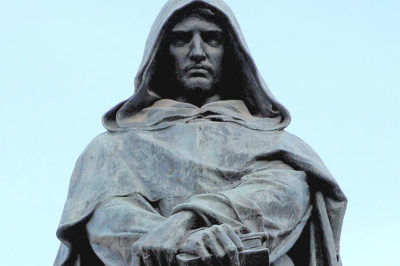
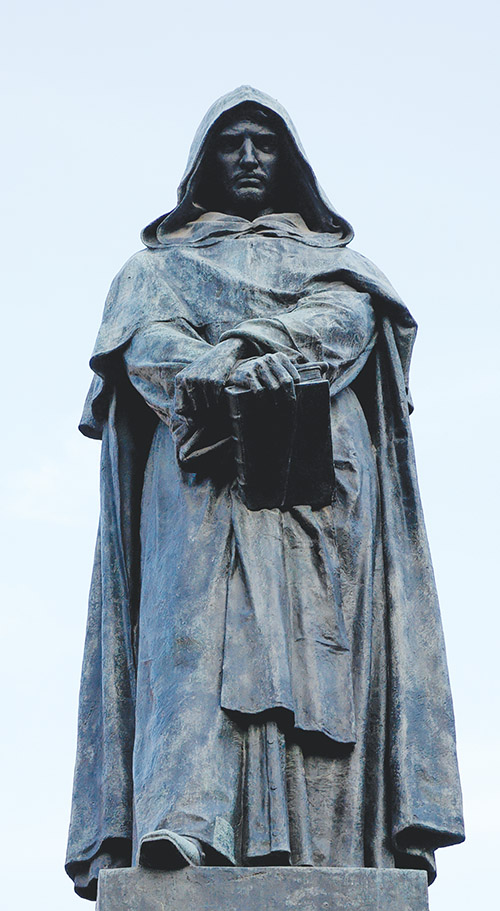
In recent years Bruno has begun to be rediscovered and appreciated, although still the truth is often distorted in order to crowbar him into the accepted history of science. Because of his remarkably advanced ideas he tends to be regarded as a martyr for scientific rationalism, victim of even greater Church persecution than Galileo (on whom he was hugely influential). Bruno has become a hero for freethinkers and, particularly ironically, atheists, who gather annually at the site of his execution in Rome’s Campo de’ Fiori – marked by a statue erected in the late nineteenth century – to honour his memory and sacrifice. But this is missing the point in a big way. Far from being an arch materialist-rationalist, in fact everything Bruno did was inspired by his passionate belief in magic and the esoteric.
He is also being introduced to a wider audience through the historical thrillers of S.J. Parris (the pseudonym of British writer Stephanie Merritt), Heresy (2010) and Prophecy (2011). Although mainly concerned with Bruno as a kind of late Renaissance Hercule Poirot, she paints an authentic picture of Bruno as a dedicated and campaigning Hermeticist.
Privy Secrets
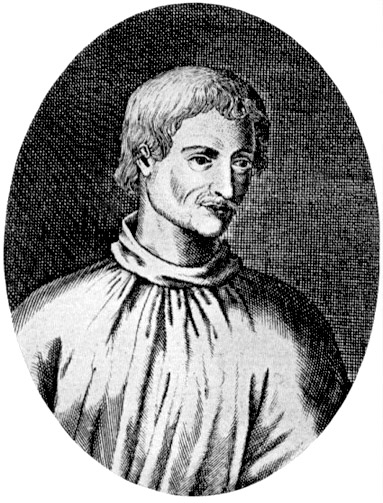
Ironically, Bruno began as a Dominican monk, a member of the same Order that gave rise to his nemesis, the Inquisition. He was born in 1548 in the small town of Nola – hence his nickname of ‘the Nolan’ – in the then huge Kingdom of Naples in Italy, which was under Spanish rule. Although he was christened Filippo, he took the name Giordano – from the River Jordan – on entering the Dominican monastery in Naples at the age of sixteen. In those days becoming a monk was the only way for a bright lad – and Bruno had already exhibited a prodigious intellect – from a humble background to get a good education.
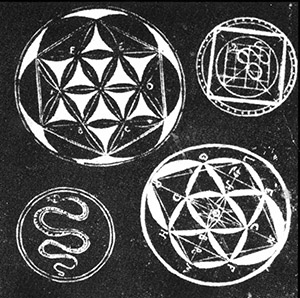
The young monk soon distinguished himself with his extraordinary mastery of memory-training – even being summoned to Rome to demonstrate the ability to the Pope. The classical art of memory, based on the manipulation of mental images, had a magical counterpart which employed talismanic principles to induce, rather than simply recall, information. Clearly this possessed a heady allure to someone so hungry for knowledge as Bruno.
As he grew in ability, exploring the powers of the mind through magic and psychology, Bruno became a powerfully confident man. Although never lacking in self-belief, he always respected those who deserved respect. On the other hand, he was disinclined to suffer fools gladly – indeed, at all. And he always, without fail, believed in his own mission…
A side of this self-belief that was hardly welcome in a monk was his refusal to allow others to dictate what he could read or even think. Not only were monks’ studies tightly circumscribed by their very nature, but at that time the Catholic Church was desperately trying to combat the rise of Protestantism, so departing even marginally from the conventional line attracted great suspicion. Even listening to the arguments of those deemed heretics, or reading their works, was a crime for a monk – even if you disagreed with them.
On the other hand, as the Dominicans were tasked with fighting heresy, they had easy access to banned books – much to the ever-curious Bruno’s delight. When his superiors discovered he had been secretly reading them in the monastery toilet he fled from Naples.
For five years he wandered round the intellectual centres of northern Italy, southern France and Switzerland – Padua, Milan, Geneva and Toulouse among other places, with frequent gaps in his biography. By the time he reappears fully, in Paris in 1581, he had become a hardcore believer in the Renaissance occult philosophy with Hermeticism at its heart. Quite how he developed this interest is unknown, but it fundamentally underpinned everything he did for the rest of his life.
Like everyone inspired by the Hermetic books since their rediscovery in Europe just over a century before (see our last article in New Dawn 129), Bruno was fired up with their vision of humans as glorious, miraculous beings of limitless potential – the polar opposite of what all Catholics were taught. To them, humans were little better than worms, only achieving a tiny bit of God’s grace through the intercession of the Church, and even that often depended on how much you were prepared to pay the priesthood to be let off a few years in purgatory.
The more he studied, the more Bruno considered everything – every level of life and understanding of our place within the cosmos – could be illuminated by the principles of Hermeticism.
In Paris he gained the patronage of the French king, Henri III – a Catholic, but who still had a deep interest in the esoteric and was tolerant towards the French Protestants, the Huguenots. After two years Bruno moved to London, accompanying Henri’s new ambassador to Queen Elizabeth I’s court. Clearly he had Henri’s backing for whatever his mission might have been – probably establishing contact with English magi centred around John Dee. During his two-year stay in London he made friends with such luminaries as Sir Philip Sidney, and wrote some of his most important books. As we will see, Bruno left a rich intellectual legacy that influenced some of the great minds of the late-flowering English Renaissance. Many consider that the character of Berowne in Shakespeare’s Love’s Labours Lost was based on Bruno.
It was while in London that Bruno produced his major works on cosmology that were to inspire enormous scientific advances.
The Hermetic Key
To Bruno the Hermetic philosophy and cosmology was the great key to unlocking the secrets of nature and the cosmos. Having already seen the Hermetica inspire Copernicus to develop his heliocentric theory, he applied himself to scientific questions using the Hermetic principles. And very fruitful it proved, too…
A passage in Treatise X of the Corpus Hermeticum states that “the spirit, passing through the veins and arteries, moves the living thing.”1 Bruno realised the image suggests that the blood also moves, a concept that also reflected Hermetic ideas of man as a microcosm of the greater cosmos.2 Bruno’s interpretation was picked up by fellow Hermeticist Robert Fludd, who – writing in the late 1610s – inspired Charles I’s physician William Harvey with the idea of testing it. Harvey became the first person to demonstrate the circulation of the blood experimentally, “one of the greatest achievements of the Scientific Revolution.”3
Bruno’s Hermetic influence also extended to Elizabeth I’s physician William Gilbert’s 1600 masterwork, On the Magnet, Magnetic Bodies and the Great Magnet of the Earth, in which he proposed that magnets work because the Earth itself generates magnetic force – another landmark discovery. Without Bruno’s work, Gilbert would never have got there.4
In our bullet-point list of Hermetic-inspired discoveries in our last article we included “the basic principles of computer science and information theory.” At first glance this may seem rather unlikely but this, too, can be traced back to Bruno’s application of Hermetic principles. This time the seed he planted flowered in Gottfried Wilhelm Leibniz (1646-1716), the German genius whose life and career paralleled those of Isaac Newton. A great polymath, Leibniz is chiefly known today for inventing infinitesimal calculus, at about the same time as Newton – although Leibniz’s system was the one that caught on – and for the basic principles of information theory, including the binary system.
Yet even Leibniz was no hard-line materialist-rationalist. Like Newton, he was deeply versed in esotericism – almost certainly a Rosicrucian and certainly a scholar of the Cabala and, predictably, the Hermetica. Equally predictably, he owed an enormous debt to the works of Giordano Bruno.
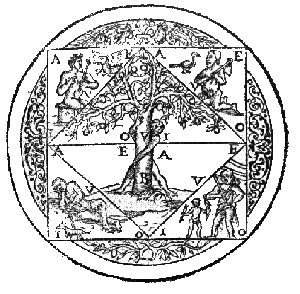
Information theory was really just a by-product of a much more ambitious scheme. Leibniz believed it should be possible to devise a set of symbols – which he called characteristica universalis – to represent all the fundamentals of knowledge, and by manipulating them to make new discoveries (a process he described as ‘innocent magia’). He developed this idea from Bruno’s works, especially those on the magical art of memory and the manipulation of the imagination to produce desired results.
Although Leibniz was never to achieve the full dream of the characteristica universalis, his work developed into the idea of mathematical modelling, at first using pen-and-paper equations (which is where calculus came in) and later computer modelling. His pioneering computer work also saw him designing some of the first calculating machines.
But although Bruno can never be described as a scientist in his own right (he seems never to have undertaken a single experiment) basing his reasoning on the Hermetic principles led him to make some truly remarkable insights. (And given that he practised magical techniques to acquire information directly, we can be forgiven for wondering just how successful they were.)
In London in 1584 Bruno wrote and published On the Infinite Universe and Worlds in which he put forward some extraordinarily advanced – and for the time deeply shocking – propositions.
Shock and Awe
Bruno was a leading champion of Copernicus’ heliocentric theory which, although published five years before he was born, was still regarded as new and unproven, scholarly opinion being split over whether he was right, wrong or somewhere in between. Copernicus had merely proposed that the sun was at the centre of creation; he still stuck with the traditional model that the entire cosmos consists solely of the sun, moon and planets which move within an outer ‘shell’, the sphere of the fixed stars. In other words, the stars are simply fixed points of light of varying intensity, all stuck on the same crystalline sphere and therefore equidistant from Earth.
But, as the title of his book implies, Bruno went further, arguing that the stars are really suns like our own, but immensely far away, and at varying distances. He rejected the concept of the sphere of the fixed stars entirely, proposing that the universe was in fact infinite.
Bruno also took the next logical step: if stars are really suns, then at least some must have their own system of planets. And some of those planets must be like our own.
He wrote in On the Infinite Universe and Worlds:
There is a single general space, a single vast immensity which we may freely call Void; in it are innumerable and infinite globes like this on which we live and grow. This space we declare to be infinite, since neither reason, convenience, possibility, sense-perception or nature assign to it a limit. In it are an infinity of worlds of the same kind as our own… Beyond the imaginary convex circumference of the universe is Time.5
And making the final logical leap, Bruno concluded it was impossible to imagine that “these innumerable worlds, manifest as like to our own or even more magnificent, should be destitute of similar or even superior inhabitants.”6
Of course, time and telescopes have proven Bruno right about the scale of the universe and the existence of other solar systems – and, even if it has yet to be proven, few scientists also doubt that extraterrestrial life is a reality.
These were deeply shocking conclusions to the Church – and indeed they were high on the list of indictable offences for which Bruno was condemned to death 16 years later. Whereas Copernicus had shifted the physical centre to the sun, the focus of creation was still the Earth and human beings, which fitted the basic biblical model where God made the world as a unique place, and humans ‘in his own image’. Bruno was proposing that there was no centre, and that humans were no more or less important than other beings on other planets – and indeed, that some of the extraterrestrial races are superior to human beings.
This was to mark the beginning of the Vatican’s antipathy towards heliocentricity that was to climax in its persecution of Galileo.
Where did Bruno get this radical notion? His immediate inspiration seems to have been the English mathematician Thomas Digges, a protégé and ward of John Dee, and England’s major champion of Copernican theory. Digges had argued that space is infinite in his defence of heliocentricity published in 1576, seven years before Bruno arrived in London. As they shared both interests and friends it is unlikely that Bruno and Digges never met during the former’s London years. But in any case Digges derived his idea from a section of the Hermetic treatise known as Asclepius.7
Bruno may have reached the same conclusion independently from his own study of Asclepius, but he added the concept of other inhabited worlds, which came from his contemplation of another key Hermetic principle: that the cosmos is imbued with life.
Bruno also showed remarkable insights into other areas of science. He understood that the body is perpetually being renewed, bit by bit, so it effectively becomes totally new over time. The current understanding is that our bodies are completely ‘replaced’, cell by cell, every seven to ten years.
In other writings he put forward basic ideas about relativity, and some academic writers regard some of his notions about the structure of matter as effectively laying the foundations for later atomic theory.8
So in the face of this astonishing catalogue of achievements and insights, it seems nothing short of an outright scandal that Giordano Bruno is so little known today.
No Insignificant Ambition
Bruno’s hugely influential ideas about the workings of the universe were only part of the picture. It was his view of the religious significance of the Hermetic tradition that inspired his most radical message – and led to his downfall.
Another of the major works Bruno produced in London was Expulsion of the Triumphant Beast (1584). Modelled on a key Hermetic text, Kore Kosmou (Virgin of the World), and dedicated to Sir Philip Sidney, the book describes a gathering of the Egyptian and Greek deities – the goddesses Isis and Sophia taking the lead – in order to organise a great reform in the heavens. On the principle invoked in the celebrated Hermetic adage ‘as above, so below/as below, so above’, this would cause equally great changes on Earth.
Clearly it is the earthly transformation that interested Bruno most pressingly – and for which he called so passionately. How would that manifest? In Expulsion of the Triumphant Beast, Bruno reproduces in its entirety a key section from Asclepius – a celebrated passage known as the Lament – in which Hermes Trismegistus mourns the decline of the Egyptian religion, which has been eclipsed by foreign gods, Egypt’s own having abandoned the land. But it also predicts that they will return and the religion will be restored.
Bruno believed this prophecy referred to his own time, and saw the religious turmoil then engulfing Europe as a sign that at least in its present form Christianity had run its course. The return of the magical religion of Egypt was imminent.
Since the rediscovery of the Corpus Hermeticum in the 1460s it had been universally accepted – by Hermeticism’s enthusiasts and opponents alike – that the texts contained the wisdom of the high point of ancient Egyptian, then considered the oldest civilisation. (As we showed previously, in fact there is good evidence to support the Hermetica’s ancient Egyptian origins.) Many – Bruno among them – believed therefore that they preserved the original religious revelation to mankind.
But characteristically Bruno went further. He believed that the magical religion of ancient Egypt had been corrupted, first by the Jews and then by the Christians. (Bruno thought that Jesus had been sent to restore the Jewish religion to its true, Egyptian roots. From our own research into the origins of Christianity, detailed in our 2008 book The Masks of Christ, we would broadly agree. Without the benefit of recent historical discoveries, how did Bruno know this?)
Bruno wanted nothing less than a root-and-branch reform of the whole of society based on the Hermetic principles, or rather, as he saw it, the religion of ancient Egypt. His ultimate aim was the creation of a spiritually unified Europe in which the religious tension between and within nations – which if unchecked would inevitably lead to a Europe-wide cataclysmic war – would be swept away.
Bruno manifestly saw the authoritarian and dogmatically inflexible Catholic Church, rather than the Protestants, as the big stumbling block to his great reform. Indeed, although he explained the ‘triumphant beast’ of his title as a metaphor for human vices, many (including the Inquisition) took it as a not-very-thinly-veiled allusion to the Pope. This was not a good turn of events.
The Predictable Unhappy Ending
The worry for the Inquisition was that Giordano Bruno was not just an easily-dismissed eccentric, but an energetic and charismatic campaigner with a sharp mind who, as we have seen, enjoyed considerable influence over the likes of Henri III of France, Elizabeth I and the Holy Roman Emperor Rudolph II. Put simply, he was an Inquisition magnet and his death by fire was only a matter of time.
Towards the end of 1585 Bruno returned to France, but found it descending into civil war as staunchly Catholic nobles challenged Henri III (who was soon to be assassinated). He then left France and for the next five years travelled the university towns of Protestant Germany preaching an increasingly hard-line message of the danger posed by the Catholic Church.
In 1591 he made a somewhat unwise return to Italian soil, accepting an invitation from a wealthy admirer to visit the Republic of Venice. There, in May 1592, he was denounced to the Inquisition, arrested and sent to Rome. After languishing in prison for eight years he was sent to the stake on 17 February 1600 – with his tongue tied so he couldn’t address the crowds.
Regarded as a diabolically-inspired magician who sought the destruction of God’s own Holy Church, it isn’t surprising that Bruno’s memory faded in the Catholic lands. What is less forgivable is that his great intellectual legacy was also allowed to fall by the wayside by the science historians. They seek to downplay – if not completely erase – the influence of the Hermetic tradition on science’s origins, and, whereas with the likes of Newton it was possible to pretend that their ‘occult’ interests were of no great consequence, it was utterly impossible to ignore the role of Hermeticism in Bruno’s work. Far easier just to forget him.
Bruno’s story was by no means over. During his last travels, fearing a Catholic onslaught that would bring Europe back under its domination, he had made plans for the underground continuation of his Hermetic reform movement. He formed a secret society, or more accurately a network of secret societies, based in the universities of Germany and in the Republic of Venice, which would outlive him. Known as the Giordanisti, after his death this clandestine group would have its own key part to play in the development of the Western esotericism…This article was published in New Dawn 130.If you appreciate this article, please consider a contribution to help maintain this website.
Footnotes
1. Brian P. Copenhaver, Hermetica: The Greek Corpus Hermeticum and the Latin Asclepius in a New English Translation (Cambridge University Press, 1992), 33.
2. Walter Pagel, ‘Giordano Bruno: The Philosophy of Circles and the Circular Movement of the Blood’, Journal of the History of Medicine, vol. VI, 1951.
3. Allen G. Debus, ‘Robert Fludd and the Circulation of the Blood’, Journal of the History of Medicine, vol. XVI, no. 4, 374.
4. Hilary Gatti, Giordano Bruno and Renaissance Science (Cornell University Press, 1999), 80-5.
5. Translated by Dorothea Waley Singer in Giordano Bruno: His Life and Thought (Henry Shuman, 1950), 363.
6. Singer, 323.
7. Robert S. Westman and J.E. McGuire, Hermeticism and the Scientific Revolution (William Andrews Clark Library, 1977),24.
8. See Ksenija Atanasijevic’s introduction to her The Metaphysical and Geometrical Doctrine of Bruno (Warren H. Green, 1972).
© New Dawn Magazine and the respective author.
For our reproduction notice, click here.