Over 60 hours of light data was used to create this stunning view of the gravitationally bound “Leo Triplet” galaxies.
The Leo Triplet shines in deep space. (Image credit: ing. Cornelis van Zuilen)
Astrophotographer ing. Cornelis Van Zuilen has shared a staggeringly detailed image of the galaxies known as the “Leo Triplet”, after spending 60 hours capturing the light of the cosmic heavyweights from his balcony in the Netherlands.
ZWO ASI533MC Pro
The ZWO ASI533MC Pro camera is the best dedicated astro camera out there, in our opinion. It features zero amp glow, 80% quantum efficiency and a 20FPS frame rate. It also features a 9MP sensor and you can check out our ZWO ASI533MC Pro review for a more in-depth look.
The Leo Triplet is made up of the spiral galaxies M65, M66 and NGC 3628, which are located about 30 million light-years from Earth in the constellation Leo. The group lies close to the bright star Chertan, which forms part of the hind leg of the great lion represented in the stellar formation, according to NASA.
“At the end of 2024, I bought my Askar 103APO telescope, giving me enough focal length to seriously focus on galaxies and begin my long-term project of photographing the entire Messier Catalogue,” Van Zuilen told Space.com in an email. “After finishing my first image of the Leo Triplet in 2025, I really wanted to see the gigantic tidal tail of NGC 3628 and decided to return with a much more ambitious goal.”
For 2026, Van Zuilen aimed to create a detailed composite shot of the galactic trio created from at least 60 hours of light data. “Beginning on April 6, I photographed the Leo Triplet over 18 clear nights, collecting 85 hours of data, of which exactly 60 hours and 3 minutes met my quality standards,” continued Van Zuilen.
Having met his target, Van Zuilen set to work combining and editing the data using the astronomy software PixInsight. The end result was a striking galactic portrait that revealed the intricate spiral structures of M65 and M66, along with the edge-on profile of NGC 3628, which is also colloquially known as the “Hamburger Galaxy” by dint of its distinctive dust lane.You may like
An annotated image of the Leo Triplet(Image credit: ing. Cornelis van Zuilen)The Leo Triplet shines in deep space.(Image credit: ing. Cornelis van Zuilen)An image of the Leo Triplet annotated with the positions of distant galaxies contained within the field of view.(Image credit: ing. Cornelis van Zuilen)A catalogue of galaxies contained within the Leo Triplet image.(Image credit: ing. Cornelis van Zuilen)
Van Zuilen’s image also reveals a 300,000-light-year-long “tidal tail” of stars and galactic material stretching away from NGC 3628. This structure is thought to have formed during a gravitational interaction with a galactic neighbor, according to the National Science Foundation’s Noir Lab.
“Using a PixInsight galaxy identification script, no fewer than 548 catalogued galaxies were identified within the image, highlighting the incredible depth achieved through 60 hours of integration time from my balcony here in Heiloo, a village in the Netherlands,” concluded Van Zuilen. “I hope you like this final image as much as I do!”
Editor’s Note: If you would like to share your astrophotography with Space.com’s readers, then please send your photo(s), comments, and your name and location to spacephotos@space.com.
Twice a year, the setting sun perfectly aligns with Manhattan’s street grid, creating one of New York City’s most spectacular skywatching events.
When you purchase through links on our site, we may earn an affiliate commission. Here’s how it works.
Manhattanhenge is a popular spectacle in New York City. This photo captures the May 29, 2025 event unfolding. (Image credit: Gary Hershorn/Getty Images)
Twice each year, New Yorkers gather along Manhattan’s cross streets to watch the setting sun perfectly align with the city’s grid, creating one of the most striking urban skywatching events in the world: Manhattanhenge.
In 2026, Manhattanhenge will occur on May 28-29 and on July 11-12. The best views are typically along 14th, 23rd, 34th, 42nd and 57th Streets looking west toward New Jersey.
On May 28 and July 12, viewers will see a “half sun” resting on the horizon, while May 29 and July 11 feature the dramatic “full sun” effect.
But why does Manhattanhenge happen in the first place?
The answer lies in the unique layout of Manhattan’s streets and the changing position of the setting sun throughout the year.
Let’s face it. If you live in New York City, where light pollution is among the worst in the United States, there aren’t too many celestial sights that you can look forward to seeing. And yet, twice each year, people not only from in and around New York, but from across the country and even perhaps from around the world come to Manhattan to be mesmerized by an uncommon phenomenon that occurs near sunset.
Around Memorial Day and again for a day or two around July 12, New Yorkers become intrigued by an unusual circumstance that allows the setting sun to be seen on many of Manhattan’s east-west cross streets simultaneously, provided you have a clear view down to the New Jersey horizon. Indeed, it is not unusual on those special evenings to see people clustered on the corners of favored cross streets watching the setting sun as it aligns with Manhattan’s canyons of brick, glass and steel, creating dramatic vistas. In recent years, the Manhattanhenge term has become very popular in pop culture, even being used for the title of a 2009 episode of the television series “CSI: NY,” as well as official clips for the TV Land series “Younger” (Season 3).
Enigma of Stonehenge
Of course, there are other places on Earth where the sun aligns with certain landmarks at specific times of the year. The most famous is Stonehenge, the Neolithic monument at Wiltshire in the Salisbury Plain of England, where on the day of the summer solstice, as seen from inside Stonehenge, the sun appears to rise directly above the so-called Heel Stone. It’s an event that attracts thousands each year.
Although we are certain that the massive upright stones that comprise Stonehenge took about 1,500 years to construct and that it probably once served as a burial ground, many mysteries about it still abound. More than half a century ago, British astronomer Gerald S. Hawkins (1928-2003) and co-author John B. White published a book, “Stonehenge Decoded” (Doubleday, 1965), which claimed that Stonehenge was used to predict a wide number of astronomical occurrences. While attracting a large following, the book also attracted some reputable scientific scholars who scoffed at its findings. All these years later, the issue remains a contentious one and the true nature of Stonehenge may forever be a mystery.
The Gridiron of Manhattan
So far as Manhattanhenge is concerned, its origins are not nearly as mysterious. It is based on a design for Manhattan outlined in “The Commissioners’ Plan of 1811” — for a rectilinear grid, or “gridiron” of straight streets and avenues which intersect each other at right angles. This design extends from north of Houston Street in lower Manhattan to just south of 155th Street in upper Manhattan. Most cross streets in between were arranged in a regular right-angled grid that was tilted 30 degrees east of true north to roughly replicate the angle of Manhattan Island.
And it is because of this 30-degree tilt in the grid that the magic moment of the setting sun aligning with Manhattan’s cross streets does not coincide with the June solstice, but rather with specific dates in late May and early July.
While we say that the sun sets in the west, most times that’s not exactly the case! Like the popular axiom, “A broken clock is correct twice a day,” the sun sets precisely due west only twice each year — on the equinox days in March and September. But between the first day of spring and the first day of autumn, the position on the horizon where the sun appears to set (known as the azimuth) occurs somewhat north of due west. The azimuth of the sunset slowly shifts northward until the day of the June solstice; thereafter, it reverses course and shifts back to the south. On June 21, the sun sets at an azimuth of 302 degrees or 32 degrees north of due west.
But for the setting sun to be seen from all of Manhattan’s cross streets, its azimuth must be 300 degrees or 30 degrees north of due west. That happens twice — first as the sun is climbing toward the solstice in late May — and then for a second time after the solstice, as the sun migrates back toward the south in early July.
And that first opportunity in late May is rapidly approaching.
Crowds gather to watch ”Manhattanhenge” at Tubor City Bridge in New York City, NY, on July 12, 2025 (Image credit: Austin DeSisto/NurPhoto via Getty Images)
Dates and times to look
Date 2026
Sun
Time (EDT)
May 28
Half sun
8:14 p.m.
May 29
Full sun
8:13 p.m.
July 11
Full sun
8:20 p.m.
July 12
Half sun
8:21 p.m.
The man who first brought attention to the Manhattanhenge phenomenon nearly 30 years ago is the noted astrophysicist and director of New York’s Hayden Planetarium, Dr. Neil deGrasse Tyson. He has written an interesting blog about the event.
For those who will be in New York City and hoping to get a view of, and maybe even photograph this year’s spectacle, here is a tip: While any cross street will suffice, Dr. Tyson suggests the wider, “two-way” cross streets that ensures the best views of the west-northwest horizon (toward New Jersey) at 14th, 23rd, 34th, 42nd and 57th Streets. “The Empire State Building and the Chrysler Building render (respectively) 34th street and 42nd streets especially striking vistas,” he notes.
Popular viewing locations can become crowded, especially on 34th and 42nd Streets, so arriving at least 30 minutes before sunset is recommended.
We should also note here that the times provided below are not for the exact moment of sunset. Sunset is defined as when the very top of the sun disappears below a “true” astronomical horizon (such as what one might see from a ship out at sea). For the Manhattanhenge effect, allowances must be taken for hills and any landmarks along the distant New Jersey landscape, so the sun’s altitude is assumed to be one degree (or slightly less) above the actual horizon.
In 2026, there are not two, but four possible dates.
For your first opportunity in May, the dates to circle on your calendar are May 28 and May 29. On the first date, at 8:14 p.m. EDT, you will see a “half sun,” that is, half above and half below the landscape. On the following night, at 8:13 p.m. EDT, you will see a “full sun,” with the entire solar disk resting above the horizon.
If you miss out in May, you’ll get a second chance in July, on the 11th and 12th. On the first July date a “full sun” appears at 8:20 p.m. EDT, while on the second date, we get the “half sun” effect at 8:21 p.m. EDT.
Manhattanhenge in the morning?
The sun rises over 42nd Street during a sunrise Manhattanhenge on Nov. 30, 2024, as seen from Weehawken, New Jersey. (Image credit: Gary Hershorn/Getty Images)
Some of you might be wondering if Manhattanhenge is visible at sunrise. The answer is yes, but you’ll have to wait until late in the year or at the very start of next year to see it. Once again, there are four opportunities, this time flanking the date of the winter solstice on Dec. 22. We now must look 180 degrees in the opposite direction, toward an azimuth of 120 degrees or 30 degrees south of due east. The first chance comes on Dec. 9 as the sun continues to shift to the south, with a “full sun” at 7:13 a.m. EST, followed by a “half sun” on Dec.10 at 7:12 a.m. EST.
After the solstice, the sun reverses course and begins to shift back to the north. On Jan. 1, we’ll see a “half sun” at 7:26 a.m. EST, followed the next morning by a “full sun” at 7:28 a.m. EST.
Keep in mind, however, that unlike with sunset, there are more likely to be local obstructions to your visibility of the rising sun. Those living in Upper Manhattan and Harlem must contend with buildings and structures rising up from The Bronx; those on the Upper East Side and Midtown will be looking toward Queens, while those in the East Village, down to Houston Street, are facing Brooklyn edifices.
Of course, in attempting to see or photograph Manhattanhenge in the morning, one must also consider that the ambient late fall/early winter morning air temperature is likely to be anywhere from 30 to 60 degrees F. colder compared to late spring/early summer evenings, and there could even be some snow underfoot (especially in January). And lastly, the weather odds for a clear and sunny winter morning are considerably less favorable compared to having a clear and sunny summer evening.
But whenever you attempt to see it, be it summer or winter, evening or morning, we wish you good luck and clear skies!
The base’s perimeter may be marked by hopping “MoonFall” drones, and new moon rovers built by AstroLab and Lunar Outpost will carry astronauts around the site.
NASA is definitely thinking big on the moon.
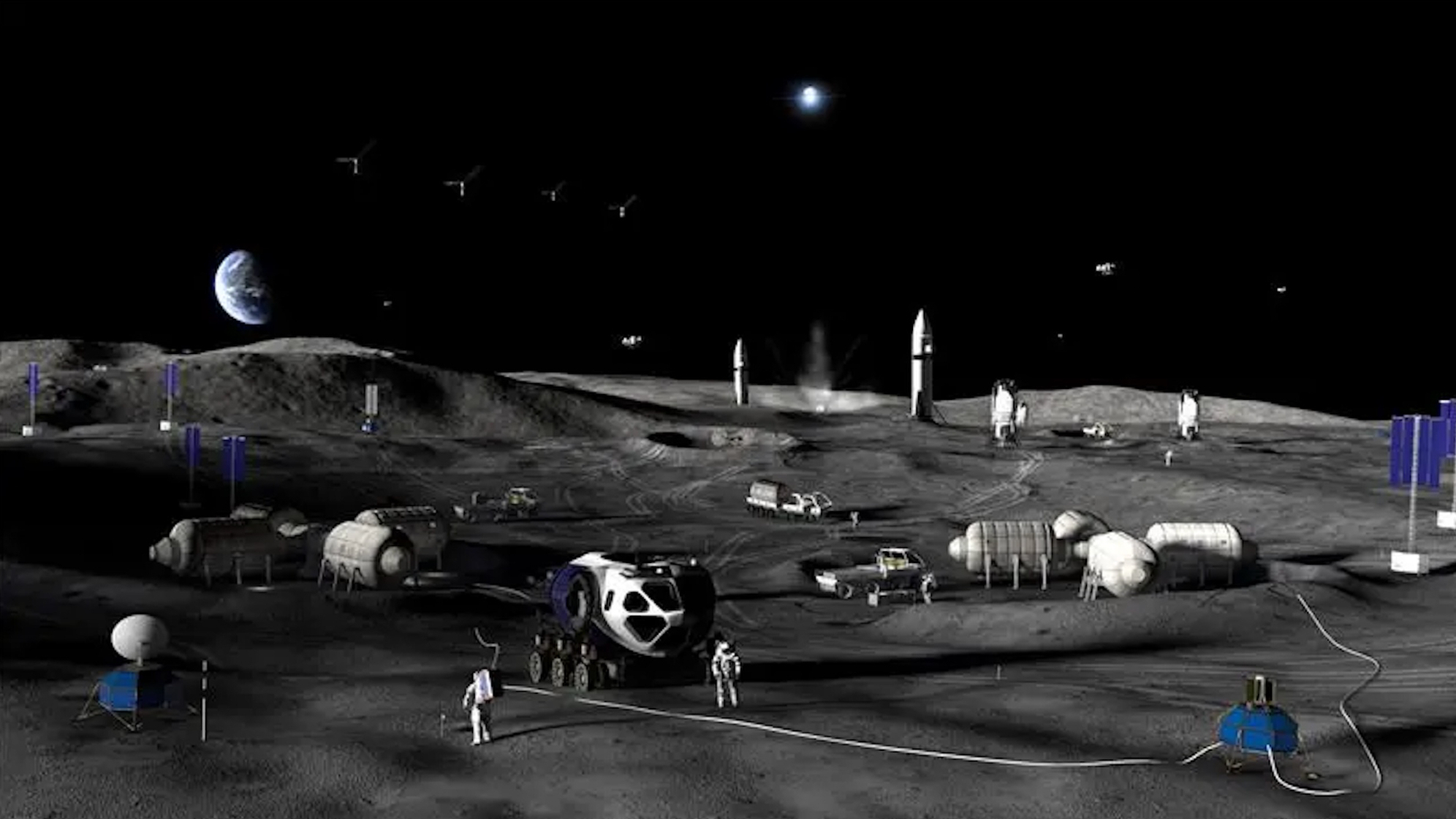
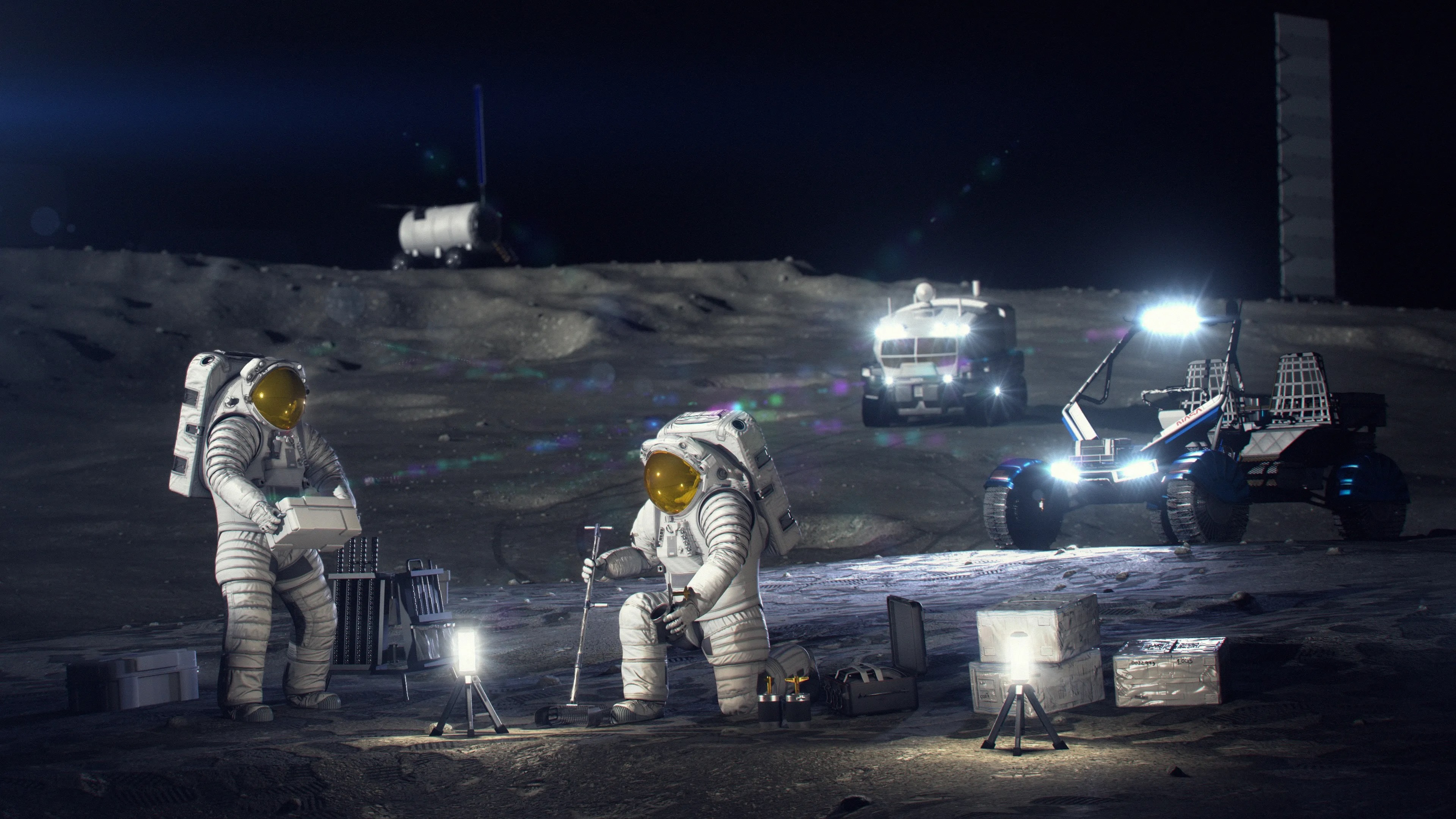
The U.S. space agency plans to build a crewed lunar base over the next decade or so via its Artemis program — and we just got a sense of that project’s impressive scope.
“We envision the moon base to be hundreds of square miles, with different assets all building up to the objective of permanent lunar presence on the moon,” Carlos García-Galán, the manager of NASA’s Moon Base program at the agency’s headquarters in Washington, D.C., said during a press conference Tuesday (May 26).You may like
This NASA chart outlines the three major steps of NASA’s Moon Base program from 2026 through 2032, starting with unpressurized rovers and sorties, and ending with a permanent lunar base. (Image credit: NASA)
The base will be constructed over the next decade or so near the lunar south pole, which is thought to harbor large amounts of water ice. This precious resource has been accumulating for billions of years on the permanently shadowed floors of craters in the region, scientists say.
NASA didn’t go into the moon base-planning process with a big footprint as a priority. Rather, it emerged naturally, as all of the envisioned elements started coming together in planners’ heads.
“There’s no one spot that covers all the science, all the technology, all the habitation needs of the surface, and even within the local area, you have to consider the terrain,” NASA’s Nujoud Merancy, chief architect of the Moon Base program, said during today’s briefing.
Artist’s impression of a NASA MoonFall drone helping to mark the perimeter of the agency’s planned lunar base. (Image credit: NASA)
“So, you’ll have the habitats on the tops of the hills where they get sunlight,” she added. “Power systems — nuclear systems — need to be a kilometer or more away for the radiation protection, so all of these things, when you start putting them together, end up sprawling a little bit more like a city as you start building it out.”
And scientists and mission planners still don’t know a lot about the lunar south pole, which is another reason for a settlement there to cover a lot of ground, according to García-Galán.
“We’re going to want to explore different sites to really maximize the mix of scientific objectives and viability of a permanent presence,” he said.
NASA plans to reduce the uncertainty via the use of MoonFall drones — small, hopping robots that will scout out the south polar region ahead of moon base construction. The first MoonFall batch, a set of three or four spacecraft, will launch to the moon in 2028 aboard a lander built by Firefly Aerospace, NASA announced today. (Firefly nabbed a $75 million contract for the mission, the company said.)What to read next
Those drones, or others like it, could also help mark the moon base’s borders, said García-Galán.
“We’re going to be able to basically put them at the corners of the areas where we think we have either key scientific objectives or we want to build up the moon base,” he said.
China plans to build a base on the moon in the coming years as well (its first astronaut landing is aimed for 2030), and U.S. officials have repeatedly stressed the importance of getting the American one up and running first. The U.S. wants to be the one establishing norms of responsible behavior on Earth’s nearest neighbor, the argument goes.
So, during today’s press conference, Ars Technica’s Eric Berger asked García-Galán and NASA Administrator Jared Isaacman, who also participated in the event, if the MoonFall drones could help delineate a keep-out zone of sorts.
“I think it’s important for us to get there first,” Isaacman said. “I think the idea that there are areas of great interest on the lunar surface — we do want to get there and explore them, and we also obviously want to be very mindful of the Outer Space Treaty, so that we are respectful of other nations that are putting assets on the on the lunar surface. We would expect that to be reciprocal.”
From left to right: Models of the Blue Origin Blue Moon Mark 1 lander, Astrolab Crewed Lunar Rover, Lunar Outpost Pegasus rover and Firely’s Elytra Dark orbiter are unveiled at NASA headquarters in Washington, D.C. on May 26, 2026. (Image credit: NASA/Aubrey Gemignani)
The moon base’s envisioned size was just a sidelight of today’s event. The main purpose was to announce contracts that the agency just awarded to get the ball rolling on the outpost’s construction.
Firefly wasn’t the only compay to win a NASA Moon Base program contract. NASA is giving California-based Astrolab $219 million and Colorado’s Lunar Outpost $220 million for production of their lunar terrain vehicles (LTVs).
LTVs are large rovers that Artemis astronauts will use to explore the lunar surface. These vehicles will also be capable of autonomous operation, meaning they can land before crewed missions, be remotely controlled from Earth, and meet up with astronauts at their touchdown sites. And that is indeed the goal: NASA wants to have at least one LTV on the lunar surface before Artemis 4 touches down near the lunar south pole in late 2028.
Both LTVs will be delivered to the lunar surface by Blue Origin’s Blue Moon lander, NASA announced today. Those two contracts are worth $234 million apiece, agency officials said during the briefing.
Blue Origin is also building a crewed variant of Blue Moon, which is in the running to fly the Artemis 3 and Artemis 4 astronaut missions, as well as future flights.
Artemis 3 is a docking test in Earth orbit between NASA’s Orion capsule and one or both of the program’s privately developed crewed lunar landers — Blue Moon and SpaceX’s Starship. NASA aims to launch Artemis 3 in mid-2027, Isaacman said today.
NASA plans to build the moon base in three phases. Phase One, which runs from now through 2029, will gather detailed information and “secure reliable access” to the lunar surface, according to the agency.
Phase Two runs from 2029 to 2032 and will set up the base’s “initial operating capability.” Phase Three, which runs from 2032 far into the future, will “achieve semi-permanent crew presence” on the moon.
“The Moon Base will be America’s and humanity’s first outpost on another celestial world,” Isaacman said in a NASA statement today. “Every mission, crewed and uncrewed, will be a learning opportunity as we return to the lunar surface, build the infrastructure to stay, and master the skills required to live and operate in one of the most demanding and dangerous environments imaginable.”
NASA has launched two Artemis missions to date. Artemis 1 sent an uncrewed Orion capsule to lunar orbit and back in late 2022, and Artemis 2 took four astronauts around the moon in Orion last month. Both missions were successful.