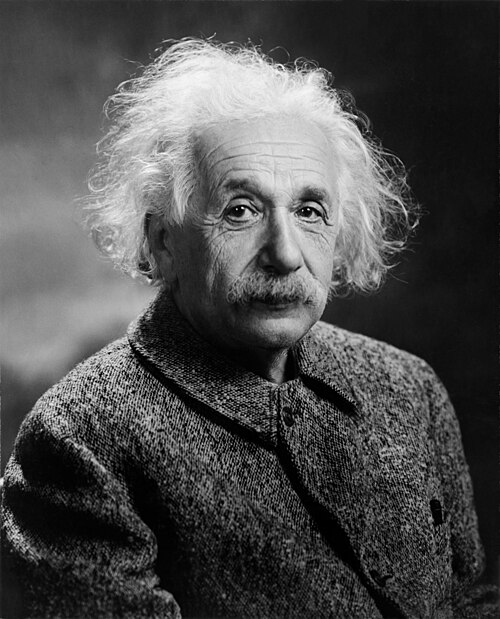
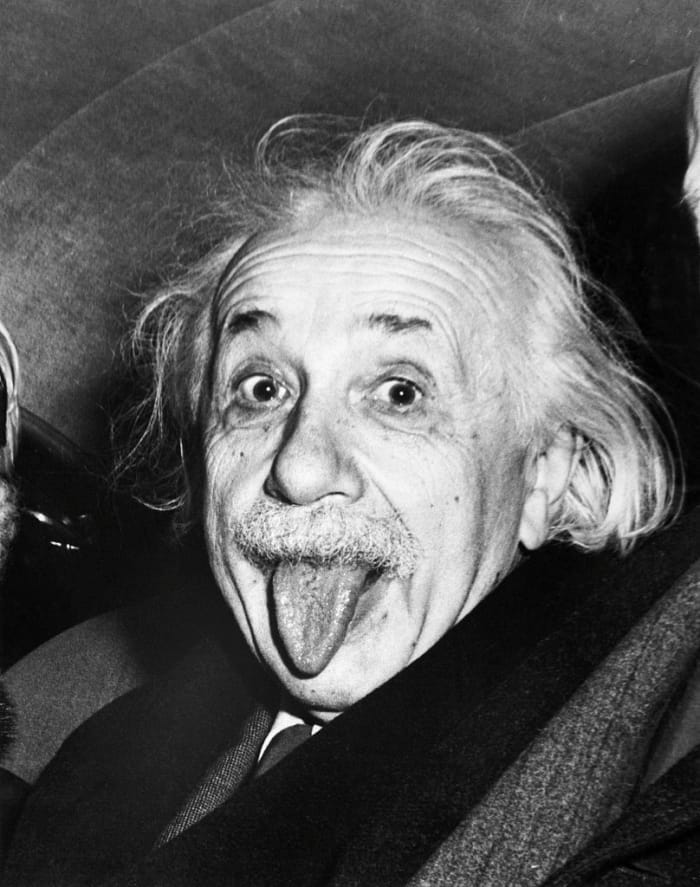
“The world as we have created it is a process of our thinking. It cannot be changed without changing our thinking.”
~ Albert Einstein
Albert Einstein was a German-born physicist who revolutionized physics and our understanding of the universe. He’s best known for his theory of relativity, which helped scientists understand how the universe works. His famous equation, E=mc², describes how matter can be converted into energy. Einstein’s work also contributed to quantum mechanics and statistics. He won the 1921 Nobel Prize in Physics for his explanation of the photoelectric effect.
“Our task must be to free ourselves… by widening our circle of compassion to embrace all living creatures and the whole of nature and it’s beauty.”
~ Einstein
Albert Einstein was a German-born mathematician and physicist who revolutionized physics and our understanding of the universe. He’s best known for his theory of relativity, which helped scientists understand how gravity works and how objects affect space and time. His famous equation, E=mc², which comes from special relativity, shows that mass and energy are equivalent. Einstein also made significant contributions to quantum theory. (Wikipedia.org)
“I must be willing to give up what I am in order to become what I will be.”
– Albert Einstein
Albert Einstein was a German-born physicist who revolutionized physics and our understanding of the universe. He’s best known for his theory of relativity, which helped scientists understand how the universe works. His famous equation, E=mc², describes how matter can be converted into energy. Einstein’s work also contributed to quantum mechanics and statistics. He won the 1921 Nobel Prize in Physics for his explanation of the photoelectric effect.
NOVA PBS Official May 28, 2026 To keep the universe static, Albert Einstein invented something called the cosmological constant. He later abandoned it. Decades afterward, astronomers discovered the universe’s expansion is accelerating—reviving Einstein’s controversial idea.
Einstein spoke of God frequently when talking about the beauty and elegance of the universe. He said,
I’m not an atheist, and I don’t think I can call myself a pantheist… I believe in Spinoza’s God who reveals himself in the orderly harmony of what exists, not in a God who concerns himself with fates and actions of human beings
Spinoza was a 17th century Jewish philosopher living in what is now the Netherlands. He developed an extensive theology and theodicy of God as well as ethics and political theory.
Although Jewish, Spinoza’s was not the God of the Bible. He was formally thrown out of the Jewish community in fact. Instead, Spinoza proposed a God that was impersonal, infinite, and who lends His nature to all things that He creates.
Although this conception of God is seen as pantheistic, it is more appropriate to see his God as consisting of abstract order which gives birth to physical reality rather than equivalent to physical reality.
Spinoza did not believe one should regard God with worship and awe. His attitude is purely a rational approach to learn and understand. By understanding nature and the laws that govern it, a seeker after God comes to better understand Him.
It’s not surprising that, as a great scientist, Einstein believed God could be found in understanding of nature rather than in worship. Indeed, he said,
The human mind, no matter how highly trained, cannot grasp the universe. We are in the position of a little child, entering a huge library whose walls are covered to the ceiling with books in many different tongues. The child knows that someone must have written those books. It does not know who or how. It does not understand the languages in which they are written. The child notes a definite plan in the arrangement of the books, a mysterious order, which it does not comprehend, but only dimly suspects. That, it seems to me, is the attitude of the human mind, even the greatest and most cultured, toward God. We see a universe marvelously arranged, obeying certain laws, but we understand the laws only dimly. Our limited minds cannot grasp the mysterious force that sways the constellations.
Einstein believed, therefore, that science is discovering truths about reality and, in fact, science is the only way to discover them. Religions that claim to have revelation from God such as Christianity, Judaism, and Islam have no access to God at all.
As he he said about his coming of age, “[t]hrough the reading of popular scientific books I soon reached the conviction that much in the stories of the Bible could not be true.”
Hence, the God of the Bible is a human invention while the God of Spinoza, a God who impersonally lends his essence to reality and thereby creates the laws of physics, is true and real.
Although Spinoza was writing at the birth of the Enlightenment, his is a thoroughly modernist, scientistic position that many scientists hold today. For example, Frank Wilczek, physics Nobel Laureate, has stated he is effectively a “pantheist”, writing in his book, Fundamentals: Ten Keys to Reality:
In studying how the world works, we are studying how God works, and thereby learning what God is. In that spirit we can interpret the search for knowledge as a form of worship, and our discoveries as revelations.
Why do these rational-types believe in God at all? Why not be an atheist?
I think the answer is simple. Any God provides a kind of religious underpinning to one’s life, a sense of meaning which avoids the ultimate absurdity and nihilsm of atheism. This belief system is necessary since, as the great atheistic philosophers, Sartre, Camus, and Nietzsche, showed, a life without God is meaningless, absurd, and catastrophic for the human mind in particular and the human species in general.
Human beings will endure the worst suffering for meaning because fundamentally we know that our small, finite lives are of no consequence unless they are entwined in something eternal.
Unless you have your head stuck in the sand and are thoroughly apathetic about whether your life means anything or whether anything you do or love matters, you have to have God, even if that God does not resemble the one our ancestors believed in.
For Einstein and Spinoza, God did not need to be (1) personal or loving, (2) involved in or care about human affairs, or (3) good or evil.
Spinoza’s theology of good and evil, his theodicy, in fact, is that good and evil are relative to human desires, not God’s desires. Spinoza argued that God has no specific purpose or desires because he is perfect. A desire comes from a lack, and God lacks nothing, therefore he needs nothing. God has no purpose for reality, he is anti-teleological, because, again, he is perfect. He needs no purpose.
As Spinoza said, “[t]hings are not more or less perfect because they please or offend men’s senses, or because they are of use to, or are incompatible with, human nature.”
Spinoza is often called a moral relativist in the sense that he considered morality to be relative to what humans believe is right and wrong and has no absolute standard outside humanity.
Truthfully, however, Spinoza wasn’t a moral relativist. Instead, he believed in deriving morality from natural law, i.e., that one could discover the correct moral laws from nature and how human beings interact with one another. This is a form of moral realism and very in line with the thinking of quite a few scientists and philosophers today.
Spinoza’s theory about human beings is that the more we grow in knowledge and rational thinking, the more “good” we become in terms of our own needs. What we perceive as evil comes from ignorance about ourselves, others, and the world. A world made of perfectly rational beings, Spinoza believed, would be perfectly harmonious.
Now that we understand something about the kind of God Einstein believed in, we can ask if this God is “real” or, more correctly, is this an accurate portrayal of God?
I would argue that this portrayal of God, while perfectly logical, falls short of what people need or want from God. Moreover, there is little reason to put one’s faith in a conception of God embedded in and tied to natural law.
Anti-realist philosophers, for example, question our ability to understand nature and regard the natural world to be fundamentally incomprehensible. Anti-realism suggests that human beings are free to define reality how they see fit in the same sense that moral anti-realism allows us to define morality as we see fit.
The anti-realist stance, which began with Kant and progressed through the German idealist school to Heidegger, proposes that we have either no or limited access to reality.
If this is true, then Spinoza’s God, even if the true God, is cut off from human beings. Einstein’s library of books are all blank, waiting to be filled in and arranged by human beings.
It isn’t that we don’t live in the real world at all, but rather than the real world becomes so filtered by our subjective perceptions that we end up with a thoroughly personal view of it. An objective view of reality, by contrast, doesn’t exist.
Anti-realists point to the existence of idealized models, none of which can be confirmed but only falsified with more data. These models are all conjectures that have not yet failed. Their longevity does not lend them additional reality but indicates that the data that will cause them to fail has not yet been collected or applied. When that does happen, we will say they are “approximate models”.
In the end, they argue, all science is a construct of the human mind, like a novel that we are writing about the universe that we all agree is true because none of us can prove it false.
Someone can be anti-realist about physics but not about God, but not if they subscribe to the God of Einstein which is fundamentally realist.
On the other hand, one could, hypothetically, still believe in the God of Spinoza but believe that we are cut off from Him, i.e., God is inherent in the nature of reality, too bad we can’t know what reality actually is, but this is hardly the attitude Spinoza or Einstein took. It’s hard to see value in placing one’s faith in such a God.
More recent philosophers, starting in the early to mid-20th century with Wittgenstein and continuing with Derrida, have taken a stance against the realism versus anti-realism debate, suggesting that neither viewpoint can be supported because all truth is relative to language alone.
In other words, there is no such thing as “truth” outside of human words. When we say that Newton’s law is “true” because it explains how planets orbit and how rocks fall, it is simply a statement about human experience.
Furthermore, the formulation of Newton’s laws as well as other scientific laws such as Einstein’s theory of General Relativity are merely language games that we play to help people predict future data in order to accomplish necessary tasks (or get papers published or win grants or win prizes, etc.). All truth, therefore, reduces to human activity. It is the information that makes us go as a species.
Wittgenstein’s isn’t an anti-realist stance because he is silent about reality. Whether we are perceiving real things or not, we cannot say because language cannot talk about anything that isn’t other language. When we communicate about the real world, it is because we have learned how to use language. We have learned the rules of the game and apply those to our actions. There is no inherent meaning.
Each religion or spiritual practice has its own language game that it plays in the same way that science plays its language game.
We play the game that best meets what we naturally desire: meaning and beyond that God.
This doesn’t necessarily mean that all roads lead to God or all religions are equal any more than all roads lead to useful scientific theories. Likewise, it does not mean that life is a meaningless game. Rather, it means that what we do and what we believe is, in large part, part of the games we have learned to play. A baby knows none of these games (save very simple ones with which it is born such as how to nurse and cry). All these have to be learned.
The convergence of knowledge-making onto the scientific method and the convergence of meaning-making on values such as innate human dignity and love one’s neighbor as one’s self, forgiveness, justice and mercy is no accident. These games lead to the best human flourishing and sense of personal fulfillment. We are all too aware of both our ignorance and our moral inadequacy to play other games happily.
Still, if all that we do is just a game, does that mean that there is no God behind it all?
Perhaps it simply means that we find God not in words or theories but in the stillness of contemplation. Words prepare us for that encounter but the encounter is nonetheless beyond spoken language or marks on a page.
This is what the great mystics believed such as the author of the 14th century primer The Cloud of Unknowing, Saint Teresa of Avila’s the Interior Castle, and the works of the 6th century author now known as Pseudo-Dyonisus the Areopagite.
While a mystical understanding of God is opposed to a rationalist approach, we do know that Saint Thomas Aquinas, who wrote some of the most rational statements about God ever written in his Summa Theologicae and other works, nevertheless, abandoned it all after such an experience (Alban Butler’s “Lives of the Saints”):
On the feast of St. Nicholas [in 1273], St. Thomas Aquinas was celebrating Mass when he received a revelation that so affected him that he wrote and dictated no more, leaving his great work the ‘Summa Theologiae’ unfinished. To Brother Reginald’s (his secretary and friend) expostulations he replied, ‘The end of my labors has come. All that I have written appears to be as so much straw after the things that have been revealed to me.’ When later asked by Reginald to return to writing, Aquinas said, ‘I can write no more. I have seen things that make my writings like straw.’ … Aquinas died three months later while on his way to the ecumenical council of Lyons.
Which goes to show that perhaps the only way for us to know God is for God to reveal Himself to us, one way or another. Whether that is in the discovery of a new law of nature or a mystical encounter is not up to us. It is up to Him.
Spinoza, Baruch, The Complete Works, Samuel Shirley, translator (Indianapolis: Hackett Publishing, 2002).
“A human being is a part of the whole, called by us ‘universe,’ a part limited in time and space. He experiences himself, his thoughts and feelings as something separate from the rest – a kind of optical delusion of his consciousness. This delusion is a kind of prison for us, restricting us to our personal desires and to affection for a few persons nearest to us. Our task must be to free ourselves from this prison by widening our circle of compassion to embrace all living creatures and the whole nature in its beauty. Nobody is able to achieve this completely, but striving for such achievement is in itself a part of the liberation and a foundation for inner security.”
Some of you may recognize the above passage as a quote from Albert Einstein in a letter he wrote in 1950 to an ordained rabbi, Norman Salit, who was seeking in vain to comfort his 19-year-old daughter over the death of her 16-year-old sister. In addition to his lifetime attempt to unify into a single, comprehensive theory the laws governing gravity and electromagnetism, his voluminous correspondences reflect a deep conviction that such a unity must exist throughout nature.
Albert Einstein (March 14, 1879 – April 18, 1955) was a German-born theoretical physicist who is widely held to be one of the greatest and most influential scientists of all time. Wikipedia
This essay is dedicated to my daughter, Elizabeth (aka Veida Čūska (lv), i.e., Wise Snake), who profoundly explores faith-related questions.
Faith and Infinity
Igrew up in a country known for its “scientific atheism,” an ideology hostile to religion. Throughout the history of the USSR, the state sought to eradicate religion from public life, utilizing the full force of its managerial, propagandistic, financial, and punitive apparatus.
But despite the efforts of the Soviet Leviathan, the successes of this endeavor remained embarrassingly modest. And when the USSR collapsed in 1991, Orthodox Christianity flourished again.
This story, of course, is not unique to Russia. Representatives of various faiths have been persecuted here and there, sometimes with monstrous cruelty (as is currently happening to Uighur Muslims in China or Christians in Afghanistan). Yet, no one has managed to eradicate faith from people’s hearts except by extinguishing the people themselves.
So, why do people tenaciously cling to what many intellectuals consider superstition?
God as inevitability
Myanswer lies in the fact that the human mind finds the notion of its own finitude unacceptable. The mind cannot perceive itself as a chance occurrence within infinity. It seeks assurance that it is an inseparable part of the Universe’s structure, that it has always been there, even before a particular human appeared in this world and after they disappeared. And since contemplating existence after death is challenging, as is anything beyond life’s experience, humans simply transferred their familiar images beyond the boundary of being.
Thus, God became inevitable. He makes the eternal existence of the mind (or, in different terminology, the soul) possible. In this sense, one could say that God was not so much invented as discovered, as the missing link of the Scheme of Things of the mind.
The opponents of religion in the USSR did not fully grasp this. They engaged in arguments with believers, asserting that there was no God based on logic. Of course, this was futile because people did not need an explanation for an inherently unacceptable reality. The mind easily replaces logic with blind spots when it needs to correct this picture. Your mind also contains a blind spot, regardless of whether you’re aware of it or not.
Atheistic Religion Warrior
The conditional paradox is that the atheist crusaders who waged a holy war against religion are as religious as those they persecuted. The difference between their faith and faith in God is only that their faith is turned inside out. They believe in nothing. Nevertheless, it is still a belief — a self-sufficient conviction in what cannot be proven. In this case — in the non-existence of God.
The most ardent atheists have a recognized leader — Richard Dawkins (born in 1941), a British ethologist, evolutionary biologist, and science communicator.
Dawkins’ name is widely known — not only in scientific circles but also beyond them. He is the author of several popular science bestsellers and of well-known concepts like the “selfish gene,” “meme,” and “extended phenotype.”
I became acquainted with Dawkins’ work a long time ago. From the very beginning, I considered him one of the brightest contemporary intellectuals, and I still hold that view. His works demonstrate an extraordinary, sharp, and creative mind.
For a long time, his militant atheism did not concern me. I myself have never been religious. It seemed natural to me that scientists could not be religious people, either. At least because the scientific worldview is based on the value of truth, and the truth is what can be proven. And since the existence of God is unproven, it is natural for a scientist to reject religion.
I used to think so for a long time. Dawkins was a weighty confirmation of this hypothesis for me. I watched several of his films dedicated to exposing religion. The views promoted in them were pretty reminiscent of Marx’s assertion that religion is the opium of the people.
On the screen, Dawkins appeared resolute and bold. He interviewed deeply religious people and did not hesitate to ask them challenging and sometimes painful questions. You understand, those that intellectuals like him always find for their opponents. Some of these opponents looked menacing; serious conflicts almost escalated to physical altercations in a couple of scenes. But Dawkins remained composed. His courage and self-control amazed me. I saw a true British gentleman in him — intelligent, courteous, refined, but ready to stand to death for his moral principles.
This continued for quite a while. But then something began to change. Something stopped fitting into the worldview where “religion is the root of all evils.” As it turned out, the faith behind religion sometimes enabled people to survive in the most extreme situations.
Voices of the Saints
The most obvious case was related to events of 600 years ago that everyone knows well. It was the story of a young Frenchwoman, Joan of Arc.
I first heard about her in middle school; we studied that during lessons. However, what we were told omitted a crucial detail: it all began with Joan hearing the voices of the archangels Michael, Gabriel, and Raphael, as well as the voices of the holy martyrs — Virgin Catherine and Margaret. They commanded her to go and save her country from foreign invaders.
As you know, that’s precisely what she did, becoming the foremost national heroine of France. Later, the Catholic Church canonized her as a saint.
Jean Auguste Dominique Ingres, Joan of Arc at the Coronation of Charles VII (1854). Louvre, Paris. Public domain, via Wikimedia Commons
The story of Joan of Arc was meticulously documented, and there is no doubt about its authenticity. The issue lies more with the personality of the central figure. What happened to her was exceptional. Not surprisingly, many researchers believed that she suffered from some form of mental disorder causing hallucinations.
However, if she lived in our time, she would likely fall under the category of neurodivergent individuals, and it wouldn’t cause much concern among those around her. Perhaps even what some would consider a pathology, others would perceive as a gift, enabling a person to achieve what is beyond others’ reach. And who knows what Joan of Arc could have become in the contemporary world. Although hostile foreigners no longer threaten la douce France, the world itself is still full of injustice, hatred, and violence.
Holy Lance
After some time, I watched an inspiring documentary by English historian Dr. Thomas Asbridge about the Crusades. Among other things, it recounted how, during the First Crusade after the capture of Antioch in 1098, the Crusaders found themselves trapped. A massive Muslim army, twice their numbers, encircled the city. Soon, the warriors of Christ were plagued by hunger and disease. Weakened and demoralized, they were willing to surrender to the Muslims, hoping for mercy and the chance to return to Europe. The Muslim commander Kerbogha refused their terms, and the Crusaders fell into despair, ready to accept their fate.
As the grip of horror almost paralyzed them, a peasant from southern France named Peter Bartholomew declared that in a dream, Saint Andrew revealed to him the location of an immensely powerful spiritual weapon — the Holy Lance — the very spear that pierced the body of Christ on the Cross.
He led a group of Crusaders to the Church of Saint Peter, where they began excavations.
They dug all day but found nothing. When faith was nearly lost, Peter passionately urged them to pray to God and continue digging. They followed his lead, and he worked harder than anyone. In a moment of jubilation, they did indeed uncover the Lance. Shaken and renewed in their faith, the Crusaders resolved to do what they hadn’t dared before — they left Antioch, confronted Kerbogha in battle, and emerged victorious.
Certainly, this story appears more like a parable than a historical event, but there is nothing implausible about it. Kerbogha’s army was not united; his military commanders were at odds and mistrusted their leader. At the same time, the motivation of the Crusaders was extraordinary. They believed that if they did not survive on sinful land, they would be transported directly to Heaven, into the embraces of Christ’s eternal love.
As for the “Holy Lance,” its authenticity required no proof; the Crusaders’ faith connected the dots in the entire story.
The early history of Christians offers another example of unbreakable faith.
The persecutions by the Romans were atrocious. It reached the perverse practice of throwing people into the amphitheater arena to be torn apart by wild predators for the entertainment of the city mob. Sometimes, however, victims were given a choice: renounce their faith to spare their lives. The steadfastness of the Christians was astonishing: time and time again, they chose a torturous death over apostasy.
Of course, these people were not different from the Romans. They felt pain, fear, and desperation just as profoundly. Yet, they saw the light of a new faith that the ruling pagans were blind to. Christians believed that the virtuous soul was immortal. Their minds gained the strength to step over the abyss of nothingness and find themselves in the realm of justice and eternal love. And this path began for them right here on Earth, in their tight-knit communities, where people cared for each other as if they were brothers and sisters.
The Romans did not understand or respect the Christian values. Among subjects of the Emperor, compassion was not highly regarded. The history of Rome began with fratricide; its power, magnificence, and grandeur were built upon the bones and blood of countless victims of imperial conquests. Unsurprisingly, the Romans called the Christian faith “Eastern superstition” and the “religion of slaves.” However, while Rome, with no other purpose than conquest, sank deeper into the abyss of moral decline, Christianity gained strength. Eventually, the ideas of virtue and justice that formed the foundation of the “religion of slaves” became the empire’s official religion.
I would not want the reader to suspect me of excessive Eurocentrism. Faith (and religion as its institution) is a universal phenomenon. There’s no doubt that stories like the ones mentioned above have been repeated countless times in regions all over the world among various peoples.
In the 20th century, the civil rights movement in the United States reflected this moral essence of true faith most vividly. Martin Luther King Jr., as we know, was a Baptist preacher. His speeches were infused with biblical metaphors and appeals to the same Christian values of justice, virtue, and human solidarity. This movement united America’s finest citizens and was an act of faith, simultaneously religious, spiritual, and moral. And its key characteristic was its commitment to nonviolence.
And once again, the person who altered the course of history became a martyr. I have no doubt that if he had known of his impending fate and had been faced with the choice, that choice would have been the same as that of the early Christians.
Unfortunately, the words “faith” and “religion” are often misused — sometimes out of ignorance, sometimes for selfish motives. Faith should not be confused with superstition. The former makes a person virtuous, while the latter turns them into a puppet in the hands of Evil. And, of course, ruling elites have always sought to make religion a means of their influence, and they succeeded so often that the very word acquired persistently ambiguous connotations. But this does not imply an inherent corruption of religion. It signifies a societal immune deficiency. In a healthy society, religion serves as a powerful medium of unifying identity and does not claim political power. In a sick society, it becomes an amplifier of tribalism or a tool of oppressive control over the masses.
Perversions of faith and religion begin when those who intermediate between the intricacies of reality and the judgments of ordinary people cease to serve society. If their reason falls asleep, malicious politicians can fabricate the judgments of ordinary people without let or hindrance. The uncomfortable truth for social sciences is that the fate of entire generations, and even whole societies, does not depend solely on each individual by themselves. In reality, it depends on the conscience, impartiality, and intellectual honesty of those who can imbue the picture of reality for the masses of individuals with one meaning or another.
We must give credit to one of the people who articulated this truth correctly. This wise person was a spiritual figure. I am referring to John Paul II (1920–2005). Among his works is the encyclical “Fides et Ratio” (1998), which reminds us precisely that faith without reason leads to superstitions, and reason without faith leads to nihilism.
And now it’s time to return to Dawkins. So, is he right in attacking religion as an unequivocal evil?
To avoid losing the point, it should be clarified that the discussion is not about the opposition between religion and science. Dawkins, though a scientist, cannot be considered the authoritative representative of the latter. The scientific community did not appoint him to such a mission, and not all scientists share his viewpoint. Moreover, some of his colleagues are believers and openly declare it.
A prominent example is Theodosius Dobzhansky (1900–1975), one of the most distinguished biologists of the 20th century. He was a renowned geneticist, one of the founders of evolutionary biology, and a major contributor to the development of the synthetic theory of evolution. He was also a philosopher of science, author of several scientific books, and numerous publications. At the same time, he was an Orthodox believer (Dobzhansky was born in Russia into a religious family and moved to the United States in 1927). Like several other scientists, he did not see irreconcilable contradictions between science and religion. In his view, they belong to different spheres of human activity, and one does not exclude the other.
T. Dobzhansky in Brazil in 1943. Flickr, Public domain, via Wikimedia Commons
Of course, Dawkins was aware of Dobzhansky’s views and those of many other recognized scientists (including Nobel laureates) who acknowledged their religiosity. This entered into a silent but recognizable contradiction with his promoted idea of the maliciousness of religion, something a seasoned writer shouldn’t ignore. It’s not surprising that Dawkins took preemptive action. In his book “The God Delusion,” he dedicated an entire section (“Deserved Respect” in Chapter 1) to the religious views of Albert Einstein.
The Religion of Einstein
One must credit Dawkins for his rhetorical skill. He subtly emphasizes the favorable nuances of the great physicist’s attitude towards matters of faith without drawing the reader’s attention to anything that could undermine his own position. The author cannot be accused of dishonesty because he never crosses the line between presenting his opinion and the factual side. However, a few remarks are in order since the latter can also be subject to interpretation to some extent.
Despite Dawkins’ attempts to utilize Einstein’s position to support his own convictions, there is a critical difference between them. While Dawkins strives to prove that religion is unnecessary for people, Einstein never asserted such a claim.
Dawkins insists that religion is nothing more than superstition, yet Einstein held a different opinion. Although the great physicist regarded religion epistemologically in an entirely rational manner, he clearly saw value in it, which Dawkins stubbornly refused to acknowledge.
Einstein detailed his opinion in some of his works. In particular, in the essay “Religion and Science” (1930) [1] and in the book “Out of My Later Years” (first published in 1950) [2].
Firstly, he viewed religion as not a dogma but an evolving social institution. Importantly, throughout this evolution, he noted a shift in the nature of this institution, as he put it, from “religion of fear” to “religion of morality” (he specifically refers to the transition from the Old Testament to the New Testament). Thus, there is a significant difference from superstition: superstition is static and limiting by nature, whereas religion is a progressively evolving system of moral beliefs. The efforts of the scholastics stand as evidence for this thesis. These medieval church scholars did not confine themselves to dogmatic interpretations of the nature of God; they sought to explain it through rational reasoning.
Secondly, and most importantly, religion was and still is an irreducibly important component of human worldview. Comparing it with science, Einstein noted:
…knowledge of what is does not open the door directly to what should be. One can have the clearest and most complete knowledge of what is, and yet not be able to deduct from that what should be the goal of our human aspirations. Objective knowledge provides us with powerful instruments for the achievements of certain ends, but the ultimate goal itself and the longing to reach it must come from another source. [2]
Here, although Einstein does not explicitly state it, he is effectively referring to the concept of a “Leap of faith,” describing an individual’s acceptance of a certain assumption as necessary truth (hardly can one find a person on Earth who has not taken such a step, and examples of scientist-believers could be considered the best).
Furthermore, Einstein says:
…mere thinking cannot give us a sense of the ultimate and fundamental ends. To make clear these fundamental ends and valuations, and to set them fast in the emotional life of the individual, seems to me precisely the most important function which religion has to perform in the social life of man. [2]
Like many other scientists, Einstein did not see an inevitable conflict between religion and science. Moreover, in a certain sense, religion preceded science:
The highest principles for our aspirations and judgments are given to us in the Jewish-Christian religious tradition. It is a very high goal which, with our weak powers, we can reach only very inadequately, but which gives a sure foundation to our aspirations and valuations.[2]
…
The individual feels the futility of human desires and aims and the sublimity and marvelous order which reveal themselves both in nature and in the world of thought. Individual existence impresses him as a sort of prison, and he wants to experience the Universe as a single significant whole.[1]
So, a scientist is driven to understand how the Universe works, but grasping the mechanics of it is not enough. Nobody can fully comprehend it, but the questions that arise within a person concerning the Cosmos will always demand answers. And these answers can only come from a system of beliefs rooted in a religious feeling, which should never be confused with dogma or superstition.
That is what the greatest of scientists believed about religion. He called upon spiritual leaders to reveal to believers this true, profound essence of faith that awakens the best qualities within humans.
But why did Dawkins not support Einstein’s opinion, which he certainly knew in detail?
This question is all the more important since Dawkins undoubtedly belongs to those who are capable of experiencing that very profound religious feeling about which Einstein wrote. After every massive attack on religion, he speaks of his reverence for the complexity and richness of the surrounding world, and his passionate language leaves no doubt about his sincerity.
Of course, it’s difficult for us to judge the deep motivations behind other people’s actions. But since the desire to understand them is integral to human nature, we cannot abandon it.
It seems that what annoys Dawkins the most is not frustration with the limitations of religious people, as one might think. He finds it unfair that by believing, they rid themselves of problems that are unsolvable for him. As an individual with highly developed emotional intelligence, he deeply understands the tragedy of human existence. Unlike believers, he is compelled to bear this burden in all its fullness. Debunking religion could distribute this burden more evenly among people. Of course, the factual side of the issue wouldn’t change, but knowing that everyone around you feels the same as you do and being alone with your misfortune are emotionally different things.
People who value being confident of their righteousness tend to try to “open the eyes” of others, especially when the “misguided beliefs” of these others seem to unfairly ease their lives. This is, of course, a trait of personal temperament, and in this sense, Dawkins is known as a not-very-tolerant person. He often walks the line in scientific debates, bordering on a faux pas, indicating a particular idiosyncrasy of perception. Agreement with an opponent requires the ability to compromise, and for some, this is extremely difficult, as it is perceived as forced submission. The problem is that the result can be denial for the sake of denial, which is a step away from nihilism.
A New Old Hypothesis
Dawkins seemed to be in an impasse that he could have avoided. This is quite sad, as anyone may get mistaken, but the cost of a mistake can be perceived very differently. One of Dawkins’ recent videos serves as evidence of this.
In this video, he discusses the so-called Substitution Hypothesis. This is not a widely known hypothesis about Jesus’ twin, but ironically, it directly connects to religious belief. Its essence is that there is a place reserved for religion in the human mind. And if the influence of one religion wanes, it is simply replaced by another.
I must admit that I don’t know what is new about this “hypothesis,” as such a assertion is not new. Dawkins himself mentions in this video a well-known saying by G. K. Chesterton (1874–1936, English essayist, novelist, and poet) —
When men stop believing in God, they don’t believe in nothing; they believe in anything.
And then he admits:
If it (the substitution hypothesis) is right, I’ve kind of wasted my life really… because I’ve been simply trying to persuade people to be influenced by evidence. If that’s a lost battle…
I found these words sorrowful because the actual illusion that Dawkins spent so many years and efforts to realize — trying to ‘convince’ human nature — has never succeeded. Dawkins should know this, and it’s hard for me to imagine he doesn’t. Thus, I can only assume that the issue is not ignorance but self-delusion.
Conclusion
So, Dawkins’ efforts led to nothing. Atheism remains nothing more than a modest worldview trend. The reason for this is not people’s ignorance, as we saw with examples of outstanding scientists considering themselves believers, but rather the futility of attempts to refute irrational faith. Demanding rationality from irrational beings existing in a world that lacks (from a rational standpoint) a definitive meaning is an extremely irrational intention. However, such attempts will never cease, as the obsession with exposing “wrong” beliefs itself has a religious nature.
No one can deny that religion can bring many misfortunes to people, but this is not an issue with religion itself; it’s a political or moral issue. Einstein expressed a wise perspective on the place of religion in individual and social life. Pope John Paul II conveyed a similar and equally wise idea in his encyclical. And since wisdom is universal, there are no contradictions between what the great scientist and the prominent cleric said.
I sincerely regret that R. Dawkins never reconciled with religion, and I’m unsure if he will ever choose to. It’s unfortunate that he reduced the metaphor of God to the God delusion and did not forgive others for their capacity to take the leap of faith.
But unfortunately, time takes its toll, whether we like it or not. Yes, scientists generally live long lives. Being 90 years old or older is more the norm than the exception for them. But it’s one thing to hope to live to 90 when you’re 30 and quite another when you’ve crossed 80.
I would sincerely like R. Dawkins to stay with us for as long as possible. He’s a very complex and even contradictory man, but I can’t call him bad or ordinary. He belongs to that generation of bright scientists who shaped the face of modern evolutionary biology, a discipline that had its most dynamic period of formation in the late 1970s and 1980s.
If I were religious, I would offer a prayer for this person. Perhaps there are other ways to do it. Einstein said that time is, in a sense, an illusion. Maybe he was right. Possibly, the past, present, and future sequences do not actually exist. In this sense, each of those we once knew is always present in one of the realities.
Certainly, it’s challenging for us to fully grasp the meaning of such a perspective opened by the mind of a genius. Still, at least this mind has given us hope.
And faith, too, as faith and hope are inseparable sisters.
“A human being is a part of the whole called by us universe, a part limited in time and space. He experiences himself, his thoughts and feeling as something separated from the rest, a kind of optical delusion of his consciousness. This delusion is a kind of prison for us, restricting us to our personal desires and to affection for a few persons nearest to us. Our task must be to free ourselves from this prison by widening our circle of compassion to embrace all living creatures and the whole of nature in its beauty.”
― Albert Einstein
Albert Einstein (March 14, 1879 – April 18, 1955) was a German-born theoretical physicist, widely ranked among the greatest and most influential scientists of all time. Wikipedia
From the man who once told his chef — “I am not a tiger” — comes another revelation. However, this one is perhaps more groundbreaking:
“Reality is merely an illusion, albeit a very persistent one”
He also developed the theory of relativity along with the most famous equation ever written: E=mc2.
He then went on to lay the foundations for modern quantum theory, win a Nobel Prize, and hold 50 patents including one for a refrigerator, a camera, and an electromagnetic pump.
He did all this while raising three children, being a loving husband, playing his beloved violin, and becoming synonymous with the word “genius.”
But I digress. So, let’s talk about the illusionary nature of life, shall we?
The illusion of light and colour
Life is (literally) upside down. According to sight savers, anyway.
Here’s what they have to say for themselves:
“Because the front part of the eye is curved, it bends the light, creating an upside down image on the retina. The brain eventually turns the image the right way up.”
Colours are also deceiving.
An object that we know as blue, for example, has absorbed all the colours except blue. So, if anything, it’s not blue at all.
This is just one example of how life is not what it seems.
The illusion of density
Science has long proven that all material things are in fact, 99.99% empty space. And they’re not that dense at all.
But what makes all of that empty space move and dance into crystallised versions of matter like trees, humans, ants, and whales?
Energy baby.
What moves energy then?
Quite incredibly, our thoughts do.
So, let’s unpack this mysterious universal law as it’s a fascinating topic.
How thoughts create reality
“The world as we have created it is a process of our thinking. It cannot be changed without changing our thinking.” Albert Einstein
It’s not just Albert Einstein who said such a thing though, lots of other great minds have said the same too:
“What you hope, you will eventually believe.
What you believe, you will eventually know.
What you know, you will eventually create.
What you create, you will eventually experience.
What you experience, you will eventually express.
What you express, you will eventually become.
This is the formula for all of life”
— Neale Donald Waslch
Mahatma Gandhi put it another way:
“Your beliefs become your thoughts. Your thoughts become your words. Your words become your actions. Your actions become your habits. Your habits become your values. Your values become your destiny”
Then Lao Tzu said:
“Watch your thoughts, they become your words; watch your words, they become your actions; watch your actions, they become your habits; watch your habits, they become your character; watch your character, it becomes your destiny.”
Buddha, of course, put it more humbly when he said:
“What we think, we become”
And surprisingly, Muhammed Ali did too:
“What you are thinking about, you are becoming”
All of the greats have had their unique way of saying the same thing but they’ve all said it.
And it seems they have all been patiently waiting for us to listen.
Is now the time?
Here’s a little food for thought
Mind-bogglingly, we think around 50,000 thoughts on a day.
Now, to put that into context, there are only 86,400 seconds in a day.
So, it doesn’t take a mathematician to work out that we think a thought every 1 and half seconds.
But what’s even more remarkable here though, is that of those 50,000 thoughts, 98% of them are the same thoughts we thought yesterday.
Now, if you’re thinking that you must have read that wrong, you didn’t. So, here it is again:
98% of the thoughts that you and I think today are the same thoughts we thought yesterday.
That means just 2% of our thoughts that you and I will think today are new.
And as thoughts and emotions go hand-in-hand, it can be hard to change existing patterns that are being fed by existing thoughts. That’s why they’re so hard to break.
That’s how the past literally carries into the future.
“The latest research supports the notion that we have a natural ability to change the brain and body by thought alone, so that it looks biologically like some future event has already happened. Because you can make thought more real than anything else, you can change who you are from brain cell to gene, given the right understanding” — Dr. Joe Dispenza
I don’t know about you but there isn’t a single more exciting or empowering discovery my little heart could learn.
Closing thoughts
To close, I’d like to leave you with one more pertinent quote from another of my favourites: Neale Donald Walsch (writer of Conversations with God).
“All that is required is to know this: For you are the creator of your reality, and life can show up no other way for you than that way in which you think it will”
So, what do you want to create? Who do you want to create with? And how big do you dare to dream?
Consciousness, spirituality, biography, sexuality, androgyny, futurism, space, the arts, science, astrology, democracy, humor, books, movies and more