I will begin by dismantling the compliment before anyone tries to hand it to me. When I strive to dismantle misogyny, homophobia, and transphobia, I’m not merely being kind. When I devote my wild imagination to enhancing and celebrating the lives of women and LGBTQ+ people, my motivation goes way beyond an expression of niceness. Niceness is a thin, well-behaved thing. It’s a way of being pleasant while changing nothing. What I’m doing is more selfish and sacred than that.Here’s my confession: I do this work because I want to live in a gorgeous world, and I have understood for as long as I can remember that I can’t live in a gorgeous world while so much of it is caged.+I was raised, as most straight white men are raised, inside an invisible bargain. The deal went like this: Accept a narrowed life, and in exchange you will be handed a little extra power. If you will only amputate your tenderness, ration your tears, treat your feelings as a security risk, and learn to dominate rather than to commune, then you will be permitted to stand a half-step above the women and the queer and nonbinary people and anyone else the culture diminishes.I saw through it early. As a young man I understood, in my body before I could have argued it, that this was a robbery disguised as a coronation. The patriarchy did its utmost best to train me to devalue the feminine. It also tried to train me to deprecate the feminine in myself, including my own capacity for sensitivity, deep feelings, receptivity, and a sense of wonder.The homophobia that the patriarchy tried to foist on me didn’t merely target other men who love men. It tried to install in me and every boy a low-grade panic that policed every unguarded affection and every place where male love might spill past its assigned borders. I watched it happen to other boys, but luckily it never took hold in me. I simply didn’t buy the fear. I didn’t accept that tenderness between men was a threat to be managed rather than one of the plain glories of being alive.And I could see, even then, where the whole apparatus was headed: toward the lie that the self is a prison sentence rather than a work of art and that a person is stuck being whatever rigid roles they were assigned. I refused to believe that about anyone, which meant I got to refuse to believe it about myself, too.I knew instinctively that every wall I was told to build against someone else’s freedom would turn out to be a wall inside my own imagination. So I refused to build them. And I as I emerged into adulthood, I got loud about it.In the 1970s I turned my rock bands into loudspeakers for a high-intensity feminism and an unapologetic advocacy for gay rights and safety. For a straight white man in those years, this wasn’t a fashionable stance to strike; it was closer to a provocation. I caught a lot of shit for it from men who felt betrayed by a defector, from people who couldn’t fathom why I’d volunteer for a fight that wasn’t, as they saw it, mine to fight. But it was mine. It has always been mine. I wasn’t slumming as an ally. I was refusing to be swindled.
So when I fight for women and LGBTQ+ people, I am also fighting for the exiled parts of myself. This isn’t altruism performing a good deed for the less fortunate. It’s a jailbreak motivated by my clarity that we’re all susceptible to being snared in the same trap.The Indigenous Australian activist Lilla Watson is often credited with a line I have carried for years: “If you have come here to help me, you are wasting your time. But if you have come because your liberation is bound up with mine, then let us work together.”I take that as scripture. My freedom and everyone else’s are not two freedoms. They are one thing pretending, under duress, to be separate.A culture that despises women is a culture that has declared war on its own source. A culture that persecutes queer and trans and nonbinary people is a culture that has made imagination a crime. I don’t want to be a citizen of that country. Not just because I am virtuous, but because I am greedy for beauty and liberation, and that country is a wasteland.+I will be specific about my winnings, because vague nobility bores me and specificity is a form of respect.When women rise into their full sovereign intelligence—their sublime, unbossed, uncontainable intelligence—the entire world grows smarter, kinder, wilder, and infinitely more interesting.And I get to live in that world. I get to be surrounded by people operating at full power instead of half-throttled by contempt. Who wouldn’t want that? Only a fool volunteers to be the smartest voice in a room emptied of geniuses.When queer, nonbinary, and trans people are free to invent themselves in private and public, they teach the rest of us that we, too, are permitted to be creative authors of our destinies. Every trans person who insists on becoming who they are is informing me that my life isn’t a fixed sentence but a living poem I am allowed to revise. That’s a gift of staggering value.When love is allowed to take whatever shape love takes, the total quantity of love in the culture increases. And love isn’t a scarce resource I have to hoard. It’s a fire that lights other fires without diminishing itself. A society drenched in permitted love is a warmer, wilder, more erotic and more alive place to spend one’s incarnation. This is what I mean by PRONOIA: the hypothesis, always worth testing, that reality is rigged in our favor, and that the liberation of the people I was urged to diminish is not a loss for me but a windfall. Their flourishing is my inheritance.+I want to be clear that I’m not offering to save anyone. The white male savior is one of patriarchy’s favorite cartoon characters, and I have no interest in auditioning for the role. Women don’t need me to rescue them from a burning building; they need me to stop stacking the kindling and, more often, to shut up and hand them the water and get out of the doorway.My job isn’t to lead the parade. My job is to be a fierce and joyful accomplice, to spend my inherited advantages recklessly and gladly, in service of a world where such advantages no longer exist.And I want to do it while fully embodied and incarnate, not as a bloodless moral position but as a visceral delight. Too much allyship is performed with a long, grave face, as though justice were a grim tax we pay to feel clean.I reject that funeral. The dismantling of misogyny and homophobia and transphobia isn’t a chore. It’s one of the most thrilling collaborative art projects our species has ever attempted: the reinvention of what a human being is allowed to be.+So yes, when I do this work I’m serving the higher good of my culture. A culture that liberates its women becomes more intelligent. A culture that honors its queer, nonbinary, and trans citizens becomes more imaginatively courageous and more capable of transformation. A culture that lets love run free becomes more beautiful. These aren’t sacrifices I make on the altar of goodness. They are the conditions of a life I actually want to live.I fight misogyny and homophobia and transphobia the way a person trapped in a stale room throws open every window. It’s not out of duty to the wind, but out of hunger for air.Call it selfish, then. I’ll accept the charge and raise the stakes: It’s the most enlightened selfishness I know. My liberation is bound up with everyone’s. And I have come, exuberantly and greedily and for the rest of my life, to work together.
For anyone counting who’s missing Someone is going to read my essay above and feel a sting: Why only these groups? Where is everyone else?The answer is built into the argument itself.I wrote about misogyny and homophobia and transphobia because those are prohibitions I felt pressing on my own life, and the freedoms I had to win for myself before I could recognize them in anyone else. This essay is the map of one particular jailbreak, mine. I won’t pretend I’ve made every escape or know every prison from the inside.But the thesis doesn’t halt at the borders of my biography. It can’t. My liberation is bound up with everyone’s isn’t a slogan I get to apply selectively. If it’s true, it’s true all the way down.So I’ll say more of it plainly.A culture that brutalizes Black people is at war with its own genius.A culture that works to erase Indigenous peoples is trying to amputate its own oldest memory and its deepest knowledge of how to actually live on this land.A culture that treats immigrants as invaders is starving itself of the exact hunger and nerve and reinvention that keep a nation alive.A culture that scorns its Latina and Latino people is spurning the very warmth and boldness it needs and secretly hungers for. A culture that demeans and diminishes its disabled people is throwing away its hardest-won wisdom about adaptation. A culture that punishes the poor is criminalizing a wound it inflicted in the first place. A culture that treats the homeless as inconvenient scenery to be cleared away is refusing to look at its own failure. A culture that pathologizes neurodivergent minds is narrowing the range of the ways it’s allowed to think. A culture at war with certain bodies that don’t match absurdly narrow beauty standards is at war with the fact of embodiment itself.Each of those cruelties impoverishes the world I have to live in. Each of those liberations is, by the same greedy logic, my inheritance too.I don’t say all of it every time I say any of it because no single essay can carry the whole weight of everything that needs undoing. But I will never pretend the wrong I named is the only wrong, or that the freedom I’m this greedy for has a color, a border, or a limit.The invitation is identical for all of it: not to help from a safe distance, but to work together, because we have always been in this together.
By R. Ayité Okyne, article from The Drumbeat July 2026*
I watched the fireworks from a rooftop in Hollywood last July, surrounded by men I love, and I thought about the particular quality of silence that falls over a group of gay men when the national anthem plays.
It is not disrespect.
It is something more complicated: the body bracing itself against a story that was never quite written for us.
We are taught, all of us, to feel a swell of pride on the Fourth of July. Independence. Self-determination. The right to pursue happiness on our own terms.
But that story has always had missing chapters.
This country declared freedom while people were still enslaved. It celebrated liberty while Black bodies were bought, sold, separated from families, and worked to exhaustion. It spoke of equality while women could not vote, Indigenous people were displaced, immigrants were demonized, and generations of gay, queer, and trans people learned to survive by hiding the very parts of themselves that most needed tenderness.
So when some of us feel complicated on Independence Day, it is not because we hate joy. It is because we know what it means to be handed a promise and then told to wait.
For many of us in this community, the pursuit of happiness has come at the cost of family dinners we were not invited to, jobs we quietly left before anyone could ask questions, hometowns we now visit as tourists in our own childhoods.
I think often about the men who write to me after a workshop or session, men in their fifties and sixties who still flinch when a hand brushes theirs in public. Not because they are ashamed. Because forty years of conditioning does not dissolve the moment a law changes.
Independence, for us, was never declared once and settled. It has been negotiated in increments: a marriage ruling here, a city ordinance there, a workplace policy there, a fragile sense of safety that still depends too much on which state line, family system, church, workplace, or neighborhood you happen to be standing in.
(view.flodesk.com)
And we are seeing, even now, how quickly rights can be questioned, narrowed, delayed, or taken for granted. Voting rights are still being contested. Racism still shapes whose bodies are treated as threatening, whose grief is believed, whose history is taught honestly, and whose pain is dismissed as “divisive.” Queer and trans people are still turned into political talking points by people who have never had to live inside the fear they casually create.
There is a particular loneliness in that kind of freedom. It arrives unevenly, and it arrives late, and by the time it reaches you, you may have already built a whole architecture of self-protection. Freedom on paper and freedom in the nervous system are two very different inheritances.
So what does it mean to celebrate a freedom you have had to win in pieces, in private, often alone?
I do not think the answer is cynicism. I think it is something closer to clarity.
The fireworks are still beautiful. The barbecue is still good. The laughter still matters. But there is a version of patriotism available to us that holds the contradiction without flinching from it.
We can love a country and still name the parts of it that did not love us back.
We can celebrate independence and still grieve the enslaved people who were denied it, the Black citizens who had to fight for the vote long after freedom was supposedly granted, the queer elders who did not survive long enough to marry, hold hands, transition safely, or be seen without shame.
This is not an argument for withholding joy. It is an argument for a more honest joy. The kind that does not require us to pretend the road here was simple. The kind that lets a man sit with his discomfort during the anthem instead of performing enthusiasm he does not feel. The kind that makes room for the brother still not out to his mother, alongside the one throwing a party with a rainbow flag on the porch.
Independence was never a single moment for us.
It is a practice.
Something we keep choosing, body by body, conversation by conversation, year after year, long after the fireworks have stopped.
That, to me, is worth celebrating.
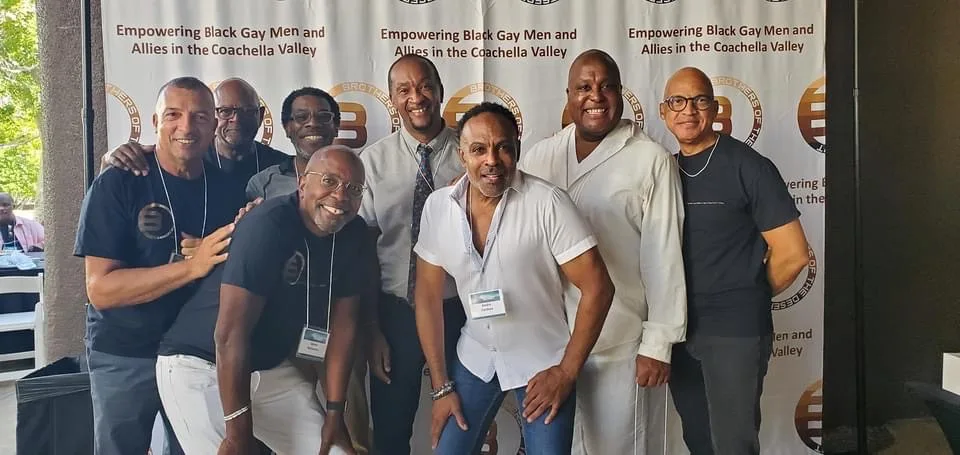
*The Drumbeat, a monthly newsletter of the Black Brothers of the Desert, Palm Springs California