There’s no getting around it: $787.5 million is a lot of money.
But when you divide that total by the number of lies Fox “News” has disgorged over the years, it doesn’t seem like all that much. And then there is this: Rupert Murdoch has an established record of buying his way out of legal troubles, and now he’s done it again. At an exceptionally high price, but still.
In the days since the sudden announcement that Fox “News” had settled the defamation lawsuit brought by Dominion Voting Systems, many who had been desperate for accountability were left wrestling with a sense of unfinished business. Already the legal proceedings represented a well-deserved black eye for Fox through damaging revelations in documents released during the discovery phase. But a trial, with the potential for a daily drip of damning information and sanctimonious Fox hosts and executives squirming under oath trying to defend the indefensible, could have proven to be much more — a bright spotlight on Fox’s perfidy and a cleansing exercise for American democracy.
Rupert Murdoch and his lavishly paid team of manure-spewers have consistently undermined the health and security of the United States by fracturing the country with their carefully cultivated lies and false narratives. The embarrassing texts, emails, and other communications brought to light in this case confirmed what many had long suspected: The well-coiffed hosts spouting off from Fox’s plush New York studios have a cynical contempt for their viewers and the truth. They knew what was real, and they didn’t care — even if it meant a violent insurrectionist mob storming the Capitol to undermine a free and fair election.
These people care about their narrow self-interest, which they define in terms of revenue and market share, over the well-being of the nation. They are eager to feature packs of liars on their shows if doing so means higher ratings. They long ago conditioned their audience to embrace conspiracy theories and false victimhood. So they feared that if they disengaged from the mendacity arms race, they would lose those viewers to the media upstarts clamoring to become the new home for the ill informed.
Sure, Fox has taken a significant financial hit, but the promise that it all could have been much more damaging to their destructive echo chamber leaves a sense of a major missed opportunity. Fox, and those who lied in service to its bottom line, had to issue no formal apologies. And that means that the millions of Fox faithful can continue to skate along in an alternative reality, unburdened by the realization that they were played for rubes.
At the same time, Fox does face other legal challenges for the geysers of lies it promoted around the 2020 election. Most notably, another voting technology company, Smartmatic, has filed a defamation lawsuit amounting to $2.7 billion. Perhaps some of what was missed with the settlement of the Dominion case — more documents and damaging testimony — will come to pass.
There is also the truth that in the (non-Fox) real world, a settlement of $787 million does translate to a major admission of guilt. Fox lied, and they had to pay. A lot of money. And that has to have some sort of deterrent effect. Yes, Fox has made so much money over the years that they can afford to weather this amount, but it is a hit.
Dominion deserves credit for bringing the lawsuit and taking it as far as it went; after all, Murdoch has a history of scaring away legal accountability. And now others who have cases against Fox will see vulnerability and a path to move forward. It is difficult to criticize Dominion for taking substantial guaranteed money rather than risking it in a trial they could lose. It should not be their job alone to hold the Fox empire to task for its abhorrent behavior.
One also has a sense that in our unsettled political and media landscape, this case and others that might follow could play out in ways we can’t currently predict. Fox “News,” with its misleading name and laughable tagline “fair and balanced,” has long claimed that it deserved respect as a legitimate outlet. Often a cowed press corps and politicians looking to minimize risk to their own interests tacitly played along. It was a game and always was. And it followed the well-worn playbook of its founder, Roger Ailes — reputation through intimidation.
Now, hopefully, some of that charade has been more fully exposed. As much as the network and its hosts claim not to care what the establishment thinks, there is a reason its headquarters are in midtown Manhattan. Fox wants respect. It just got a public shaming instead.
Fox has always nurtured a biting edge, and it has damaged America. But we got to see clearly with the Dominion lawsuit a level of desperate cravenness and shameless hypocrisy that was predictable but still shocking. We got a peek behind the curtain, and what we saw was as far from “news” as you can get. It was a joke. And it would be a hilarious farce if it weren’t so dangerous.
Hopefully, Fox will continue to have to deal with the fallout of the truth.
Translation is a 5-step process of “straight thinking in the abstract.” The first step is an ontological statement of being beginning with the syllogism: “Truth is that which is so. That which is not truth is not so. Therefore Truth is all there is.” The second step is the sense testimony (what the senses tell us about anything). The third step is the argument between the absolute abstract nature of truth from the first step and the relative specific truth of experience from the second step. The fourth step is filtering out the conclusions you have arrived at in the third step. The fifth step is your overall conclusion.
The claims in a Translation may seem outrageous, but they are always (or should always) be based on self-evident syllogistic reasoning. Here is one Translation from this week.
1) Truth is that which is so. That which is not truth is not so. Therefore Truth is all that is., Truth being all is therefore total, therefore whole, therefore complete, therefore plenary, therefore plentiful, therefore limitless, therefore infinite. I think therefore I am. Since I am and since Truth is all that is, therefore I am Truth. Since I am Truth therefore I, being, am total, whole, complete, plenary, plentiful, limitless, infinite. Since I, being, am Mind and I, being, am Truth, therefore Truth is Mind.
2) Fascists and oligarchs are taking over the country.
Word-tracking: fascist: a bundle of authoritative rods, dictatorial government, centralized control of private enterprise, extreme nationalism, no opposition oligarchy: rule by the few , akin to misfortune, illness, disease, death take over: to assume control, take power, potent (able to be) country: land set over (contra) another
3) Truth being all that is, there is nothing other than Truth, there is no contra (country) in Truth, therefore there are no countries in Truth. Truth being all that is and potent meaning the ability to be, therefore Truth is the only power/potent/Potentate. Since Truth is the only Potentate and since Truth is one, there can be no oligarchy (rule of the few) in Truth. Therefore Oneness is the only ruler. Oneness being the only ruler, there is no opposition to Truth. Since there are no contras/countries (nations) in Truth, there is no nationalism in Truth. Since Truth is all, nothing can be isolated from all or private, therefore there is no private enterprise OR Truth is an infinitely public enterprise. Truth being the sole Potentate, therefore Truth is only the only dictator.
4) There are no countries in Truth. Truth is the only power/potent/Potentate. Oneness is the only ruler. There is no opposition to Truth. There is no nationalism in Truth. There is no private enterprise Truth is an infinitely public enterprise. Truth is only the only dictator.
5) Truth is the only Potentate in the infinitely public (country-less, contra-less) enterprise of Itself.
The Weekly Invitational Translation Group invites your participation as well. If you would like to submit a Translation on any subject, feel free to send your weekly Translation to zonta1111@aol.com and we will anonymously post it on the Bathtub Bulletin on Friday.
The Lord of Change is a card that indicates the necessity of constant change in life if we are not to stagnate. It often marks a turning point – a new job, a shift of fortune, a move of home.
Disks are an earthy suit, covering matters of material life, and the manifest Universe. If you look at the planet we live on, though in itself it seems solid and predictable (less so in recent years, mind you) it is in a constant state of change and movement. It turns in space, and if it did not, we’d all be very unhappy with the consequences. The cycle of seasons swings past us each and every year. The tides ebb and rise. Constant change is natural, normal and positive.
We do, though, often fear change in our lives. We will struggle against anything that appears to alter the pre-planned pattern we have applied to our future. But that’s exactly what this card does – instigates change. Sometimes we think that the change is bad – and on the face of it, it may appear to be – yet whenever the 2 of Disks appears, it’s warning us that change has become imperative. Something is stagnating, demanding to be broken down and made over.
It’s worth remembering that if you resist the change advocated by the Lord of Change, you might find that life imposes it upon you anyway – and then you’ll feel the effects either of the Death card, or the Tower. When this card appears, it demands a thorough re-assessment of your overall position and willingness to go with the chances that come your way.
The card is especially strengthened by cards like Fortune, and positive Disks and Wands. You can usually track down which area of life it applies to by looking at the cards that surround it – Cups would suggest you need to look at your emotional life. Disks would imply that it’s either your working or financial area that needs attention. Swords would probably indicate conflict around whatever changes you need to make, and may point to a need for clear communication. Wands would be more connected with your own application of Will, and the way you are trying to build your life. Major Arcana cards would suggest an inner, more spiritual area needs to be looked at.
New Thinking Allo • Apr 20, 2023 Thomas Lombardo, PhD, is director of the Center for Future Consciousness in Glendale, Arizona. He is author of Future Consciousness: The Path To Purposeful Evolution; The Evolution of Future Consciousness; Wisdom, Consciousness, and the Future; and Mind Flight: A Journey Into The Future. He is also writing a four volume series, titled Science Fiction: The Evolutionary Mythology of the Future. The first volume was published in 2018. Here he shares his knowledge of the canon of great science fiction novels and films. He compares science fiction to ancient mythology, noting both similarities and differences. He reviews important themes such as the destruction of the world, alternative realities, encounter with aliens, the loss of human freedom, and the future of evolution. He notes that video games allow users to immerse themselves in a science fiction story. Edited subtitles for this video are available in Russian, Portuguese, Italian, German, French, and Spanish. New Thinking Allowed host, Jeffrey Mishlove, PhD, is author of The Roots of Consciousness, Psi Development Systems, and The PK Man. Between 1986 and 2002 he hosted and co-produced the original Thinking Allowed public television series. He is the recipient of the only doctoral diploma in “parapsychology” ever awarded by an accredited university (University of California, Berkeley, 1980). He is also the Grand Prize winner of the 2021 Bigelow Institute essay competition regarding the best evidence for survival of human consciousness after permanent bodily death. (Recorded on November 2, 2017)
On April 20th, 2023 we have a New Moon and Solar Eclipse at 29° Aries.
The Solar Eclipse is Hybrid, starting as an Annular Eclipse in the Indian Ocean and then changing to a Total Eclipse before reaching the land. Hybrid eclipses are even more rare than total and annular eclipses, taking place only once every 10 years.
The eclipse is the 2nd lunation in Aries. In March we had a New Moon at 0° Aries, at the beginning of the sign; this New Moon is at 29°, at the very end of the sign.
We are coming full circle.
The Solar Eclipse in Aries is a North Node eclipse, so it may stretch you outside your comfort zone. It may feel unnatural to just BE, to go with your gut, to get out there, to make a stand. But a North Node Eclipse is a nudge that the time has come. You’ll never feel 100% ready. So what? The future is for those who dare.
Occurring at a final, anaretic degree, the eclipse makes a strong statement. If the previous New Moon awakened us to the possibilities of living our life on our own terms, the Eclipse is a strong push forward. “Now I understand”. “I got this”.
We can only have two New Moons in the same sign when one New Moon is at 0° and the other at 29° of the sign. Two New Moons in the same sign are very rare, and they only occur about 3% of the time.
2 New Moons in the same sign are rare. Second chances are rare. The New Moon Eclipse in Aries is truly a unique moment in time when the sky aligns to give you all you need to birth something that’s important to you into existence.
Having a 2nd New Moon in the same sign is our second chance to bring something important into existence.
Ruled by Mars (now in Cancer) the Solar Eclipse in Aries asks a very important question: what is it that you want? Let your deepest desire drive your actions.
Just like the sprout naturally comes up out of the ground in spring, whatever comes from a place of truth and authenticity will eventually find a way to come into existence.
Pay attention to any messages that come your way. If something – however insignificant – happens when there’s a Solar Eclipse, it happens for a reason. Don’t forget that Eclipses are times of alignment. What is meant to be will be, what not, falls away.
At a North Node Eclipse, you want to LISTEN and you go with the tide, rather than against it.
Solar Eclipse In Aries Square Pluto
This Aries Eclipse is a dynamite Eclipse exactly square Pluto at 0° Aquarius. No more half-truths, no more living half-lives. The North Node Solar Eclipse in the last degree of Aries square Pluto is a call for total authenticity.
This Eclipse is a call to live fully and truthfully, without holding back or living halfheartedly.
A square is considered a dynamic, tense aspect. For two planets to be in a square, they have to be 90° away from each other. Buildings are square. Squares are a man-made thing. You can’t find them in nature.
Squares, and the number 4 represent an “intervention”. Squares are 4D. Unlike in the 3D (3D is an abbreviation for the 3 dimensions: breadth, height and width), in the 4D we also have the element of time. 4D means that something evolves over time.
When we have a square, something happens – in the environment – that changes the status quo. This change doesn’t happen from within ourselves.
An opposition for example, it’s a much more personal aspect. When we have an opposition, there are two aspects from within ourselves that ask for a reconciliation, or a superior understanding. When there’s an opposition, nothing factual may actually happen. When we have a square instead, something does happen.
The New Moon Eclipse in Aries is square Pluto (now at 0° Aquarius).
At the New Moon in Aries something from outside ourselves will require our attention. The Eclipse may come with an earth-shattering event OR with a more subtle invitation. When Pluto is involved, fate is knocking on our door.
Given the nature of the square (an event that feels unnatural and contrary to our purposes), our first temptation may be to shut the door.
But a different – better – approach is to pay attention and listen. There’s a reason why fate knocks at your door twice. It has something very important to deliver. Open the door.
Published March 28, 2023 Updated March 29, 2023 (NYTimes.com)
For most of his 40-year career, Carlos Moreno, a scientist and business professor in Paris, worked in relative peace.
Many cities around the world embraced a concept he started to develop in 2010. Called the 15-minute city, the idea is that everyday destinations such as schools, stores and offices should be only a short walk or bike ride away from home. A group of nearly 100 mayors worldwide embraced it as a way to help recover from the pandemic.
The conspiracy theorists came late, but suddenly.
In recent weeks, a deluge of rumors and distortions have taken aim at Mr. Moreno’s proposal. Driven in part by climate change deniers and backers of the QAnon conspiracy theory, false claims have circulated online, at protests and even in government hearings that 15-minute cities were a precursor to “climate change lockdowns” — urban “prison camps” in which residents’ movements would be surveilled and heavily restricted.
Many attacked Mr. Moreno, 63, directly. The professor, who teaches at the University of Paris 1 Panthéon-Sorbonne, faced harassment in online forums and over email. He was accused without evidence of being an agent of an invisible totalitarian world government. He was likened to criminals and dictators.
For the first time in his career, he started receiving death threats. People said they wished he and his family had been killed by drug lords, told him that “sooner or later your punishment will arrive” and proposed that he be nailed into a coffin or run over by a cement roller.
“I wasn’t a researcher anymore, I was Pol Pot, Stalin, Hitler,” Mr. Moreno said. “I have become, in one week, Public Enemy No. 1.”
For high-profile figures, such as the infectious-disease expert Dr. Anthony S. Fauci and the Microsoft co-founder Bill Gates, misinformation and the hostility it can cause have long been a part of the job description. But increasingly, even professors and researchers without much of a public persona have faced intimidation from extremists and conspiracy theorists.
Cutting Back: Job cuts in the social media industry reflect a trend that threatens to undo many of the safeguards that platforms have put in place to ban or tamp down on disinformation.
A Key Case: The outcome of a federal court battle could help decide whether the First Amendment is a barrier to virtually any government efforts to stifle disinformation.
Many of the recent threats have been directed at scientists studying Covid-19. In a survey of 321 such scientists who had given media interviews, the journal Nature found that 22 percent had received threats of physical or sexual violence and 15 percent had received death threats. Last year, an Austrian doctor who was a vocal supporter of vaccines and a repeated target of threats died by suicide.
One epidemiologist keeps a folder on her computer to store all the death threats she receives just “in case.” A professor of atmospheric science who studied global warming received a letter containing white powder (it looked like anthrax but turned out to be cornstarch). A professor of health law and science policy, in an article touching on his experiences with death threats, lawsuits and online trolling, wrote: “My skin is thick. I’m used to the hate.”
Mr. Moreno’s work has not been focused on the pandemic, though his 15-minute cities idea has become more popular since it began. Like many of his academic peers who have faced harassment and disinformation campaigns, he is at a loss for ways to protect himself.
“I’m not totally sure what is the best reaction — to respond, to not respond, to call a press conference, to write a press release,” he said. Academics, he said, “are relatively alone.”
Mr. Moreno, who grew up in Colombia, began working as a researcher in a computer science and robotics lab in Paris in 1983; the career that followed involved creating a start-up, meeting the Dalai Lama and being named a knight of the Légion d’Honneur. His work has won several awards and spanned many fields — automotive, medical, nuclear, military, even home goods.
Around 2010, he started thinking about how technology could help create sustainable cities. Eventually, he refined his ideas about “human smart cities” and “living cities” into his 2016 proposal for 15-minute cities. The idea owes much to its many predecessors: “neighborhood units” and “garden cities” in the early 1900s, the community-focused urban planning pioneered by the activist Jane Jacobs in the 1960s, even support for “new urbanism” and walkable cities in the 1990s. So-called low-traffic neighborhoods, or LTNs, have been set up in several British cities over the past few decades.
Critics of 15-minute cities have been outspoken, arguing that a concept developed in Europe may not translate well to highly segregated American cities. A Harvard economist wrote in a blog post for the London School of Economics and Political Science in 2021 that the concept was a “dead end” that would exacerbate “enormous inequalities in cities” by subdividing without connecting them.
Mr. Moreno did not face harassment, however, until conspiracy theorists mistakenly conflated 15-minute cities with the low-traffic-neighborhood idea in Britain.
Efforts to adopt LTNs, which were approved for testing last year in centuries-old Oxford, have drawn concerns about whether the traffic reduction measures could cause congestion to spill into surrounding areas or make some properties less accessible. Some people, however, seized on other elements of the plan — including cameras meant to monitor license plates.
The result, according to misinformed conspiracy theorists: A nightmare scenario in which residents would be confined in open-air prisons fenced off into siloed zones. On Feb. 18, when an estimated 2,000 demonstrators converged at a protest in Oxford, some carried signs claiming that 15-minute cities would become “ghettos” created by the World Economic Forum as a form of “tyrannical control.”
In fact, LTNs are championed by the Oxfordshire county council; the separate Oxford City Council has cited the 15-minute city as an inspiration for its vision of the city in 2040. As both government bodies noted in an attempt to debunk the rumors, neither proposal involves physical barriers. One concept is concerned with limiting cars, while the other is focused on bringing daily necessities closer to residents.
Still, Jordan Peterson, a Canadian psychologist with four million Twitter followers, suggested that 15-minute cities were “perhaps the worst imaginable perversion” of the idea of walkable neighborhoods. He linked to a post about the “Great Reset,” an economic recovery plan proposed by the World Economic Forum that has spawned hordes of rumors about a pandemic-fueled plot to destroy capitalism.
A member of Britain’s Parliament said that 15-minute cities were “an international socialist concept” that would “cost us our personal freedoms.” QAnon supporters said the derailment of a train carrying hazardous chemicals in Ohio was an intentional move meant to push rural residents into 15-minute cities.
“Conspiracy-mongers have built a complete story: climate denialism, Covid-19, anti-vax, 5G controlling the brains of citizens, and the 15-minute city for introducing a perimeter for day-to-day life,” Mr. Moreno said. “This storytelling is totally insane, totally irrational for us, but it makes sense for them.”
The multipronged conspiracy theory quickly became “turbocharged” after the Oxford protest, said Jennie King, head of climate research and policy at the Institute for Strategic Dialogue, a think tank that studies online platforms.
“You have this snowball effect of a policy, which in principle was only going to affect a small urban population, getting extrapolated and becoming this crucible where far-right groups, industry-sponsored lobbying groups, conspiracist movements, anti-lockdown groups and more saw an opportunity to insert their worldview into the mainstream and to piggyback on the news cycle,” she said.
The vitriol currently directed at Mr. Moreno and researchers like him mirrors “the broader erosion of trust in experts and institutions,” Ms. King said. Modern conspiracy theorists and extremists turn the people they disagree with into scapegoats for a vast array of societal ills, blaming them personally for causing the high cost of living or various health crises and creating an “us-versus-them” environment, she said.
The ramped-up rhetoric and the disintegration of safeguards has caused many people in the academic community to flee forums like Twitter for more niche sites like Mastodon, Ms. King said. Last year, the American Psychological Association published a feature suggesting that universities form safety offices to help professors filter menacing messages, scrub their personal information from the internet and gain access to counseling.
Mr. Moreno said he did not understand the intensity of the hate directed at him.
“I am not a politician, I am not a candidate for anything — as a researcher, my duty is to explore and deepen my ideas with scientific methodology,” he said. “It is totally unbelievable that we could receive a death threat just for working as scientists.”
Transhumanism is a philosophical and intellectual movement which advocates the enhancement of the human condition by developing and making widely available sophisticated technologies that can greatly enhance longevity and cognition.[1][2]
Transhumanist thinkers study the potential benefits and dangers of emerging technologies that could overcome fundamental human limitations, as well as the ethics[3] of using such technologies. Some transhumanists believe that human beings may eventually be able to transform themselves into beings with abilities so greatly expanded from the current condition as to merit the label of posthuman beings.[2]
Another topic of transhumanist research is how to protect humanity against existential risks, such as nuclear war or asteroid collision.[4][better source needed]
Julian Huxley was a biologist who popularised the term transhumanism in an influential 1957 essay.[5] The contemporary meaning of the term “transhumanism” was foreshadowed by one of the first professors of futurology, a man who changed his name to FM-2030. In the 1960s, he taught “new concepts of the human” at The New School when he began to identify people who adopt technologies, lifestyles, and worldviews “transitional” to posthumanity as “transhuman“.[6] The assertion would lay the intellectual groundwork for the British philosopher Max More to begin articulating the principles of transhumanism as a futurist philosophy in 1990, and organizing in California a school of thought that has since grown into the worldwide transhumanist movement.[6][7][8]
Influenced by seminal works of science fiction, the transhumanist vision of a transformed future humanity has attracted many supporters and detractors from a wide range of perspectives, including philosophy and religion.[6]
One of the early precursors to transhumanist ideas is Discourse on Method (1637) by René Descartes. In the Discourse, Descartes envisioned a new kind of medicine that could grant both physical immortality and stronger minds.[14]
There is debate about whether the philosophy of Friedrich Nietzsche can be considered an influence on transhumanism, despite its exaltation of the “Übermensch” (overman or superman), due to its emphasis on self-actualization rather than technological transformation.[2][16][17][18] The transhumanist philosophies of Max More and Stefan Lorenz Sorgner have been influenced strongly by Nietzschean thinking.[16] By way of contrast, The Transhumanist Declaration[19]“…advocates the well-being of all sentience (whether in artificial intellects, humans, posthumans, or non-human animals)”.
The late 19th to early 20th century movement known as Russian cosmism, by Russian philosopher N. F. Fyodorov, is noted for anticipating transhumanist ideas.[20]
Early transhumanist thinking
Julian Huxley, the biologist who popularised the term transhumanism in an influential 1957 essay[5]
Fundamental ideas of transhumanism were first advanced in 1923 by the British geneticist J. B. S. Haldane in his essay Daedalus: Science and the Future, which predicted that great benefits would come from the application of advanced sciences to human biology—and that every such advance would first appear to someone as blasphemy or perversion, “indecent and unnatural”.[21] In particular, he was interested in the development of the science of eugenics, ectogenesis (creating and sustaining life in an artificial environment), and the application of genetics to improve human characteristics, such as health and intelligence.
His article inspired academic and popular interest. J. D. Bernal, a crystallographer at Cambridge, wrote The World, the Flesh and the Devil in 1929, in which he speculated on the prospects of space colonization and radical changes to human bodies and intelligence through bionic implants and cognitive enhancement.[22] These ideas have been common transhumanist themes ever since.[2]
The biologist Julian Huxley is generally regarded as the founder of transhumanism after using the term for the title of an influential 1957 article.[5] The term itself, however, derives from an earlier 1940 paper by the Canadian philosopher W. D. Lighthall.[23] Huxley describes transhumanism in these terms:
Up till now human life has generally been, as Hobbes described it, ‘nasty, brutish and short’; the great majority of human beings (if they have not already died young) have been afflicted with misery… we can justifiably hold the belief that these lands of possibility exist, and that the present limitations and miserable frustrations of our existence could be in large measure surmounted… The human species can, if it wishes, transcend itself—not just sporadically, an individual here in one way, an individual there in another way, but in its entirety, as humanity.[5]
Huxley’s definition differs, albeit not substantially, from the one commonly in use since the 1980s. The ideas raised by these thinkers were explored in the science fiction of the 1960s, notably in Arthur C. Clarke‘s 2001: A Space Odyssey, in which an alien artifact grants transcendent power to its wielder.[24]
Japanese Metabolist architects produced a manifesto in 1960 which outlined goals to “encourage active metabolic development of our society”[25] through design and technology. In the Material and Man section of the manifesto, Noboru Kawazoe suggests that:
After several decades, with the rapid progress of communication technology, every one will have a “brain wave receiver” in his ear, which conveys directly and exactly what other people think about him and vice versa. What I think will be known by all the people. There is no more individual consciousness, only the will of mankind as a whole.[26]
Artificial intelligence and the technological singularity
Let an ultraintelligent machine be defined as a machine that can far surpass all the intellectual activities of any man however clever. Since the design of machines is one of these intellectual activities, an ultraintelligent machine could design even better machines; there would then unquestionably be an ‘intelligence explosion,’ and the intelligence of man would be left far behind. Thus the first ultraintelligent machine is the last invention that man need ever make.[27]
Computer scientistMarvin Minsky wrote on relationships between human and artificial intelligence beginning in the 1960s.[28] Over the succeeding decades, this field continued to generate influential thinkers such as Hans Moravec and Raymond Kurzweil, who oscillated between the technical arena and futuristic speculations in the transhumanist vein.[29][30] The coalescence of an identifiable transhumanist movement began in the last decades of the 20th century. In 1966, FM-2030 (formerly F. M. Esfandiary), a futurist who taught “new concepts of the human” at The New School, in New York City, began to identify people who adopt technologies, lifestyles and world views transitional to posthumanity as “transhuman“.[31] In 1972, Robert Ettinger, whose 1964 Prospect of Immortality founded the cryonics movement,[32] contributed to the conceptualization of “transhumanity” with his 1972 Man into Superman.[33] FM-2030 published the Upwingers Manifesto in 1973.[34]
Growth of transhumanism
The first self-described transhumanists met formally in the early 1980s at the University of California, Los Angeles, which became the main center of transhumanist thought. Here, FM-2030 lectured on his “Third Way” futurist ideology.[35] At the EZTV Media venue, frequented by transhumanists and other futurists, Natasha Vita-More presented Breaking Away, her 1980 experimental film with the theme of humans breaking away from their biological limitations and the Earth’s gravity as they head into space.[36][37] FM-2030 and Vita-More soon began holding gatherings for transhumanists in Los Angeles, which included students from FM-2030’s courses and audiences from Vita-More’s artistic productions. In 1982, Vita-More authored the Transhumanist Arts Statement[38] and, six years later, produced the cable TV show TransCentury Update on transhumanity, a program which reached over 100,000 viewers.
In 1986, Eric Drexler published Engines of Creation: The Coming Era of Nanotechnology,[39] which discussed the prospects for nanotechnology and molecular assemblers, and founded the Foresight Institute. As the first non-profit organization to research, advocate for, and perform cryonics, the Southern California offices of the Alcor Life Extension Foundation became a center for futurists. In 1988, the first issue of Extropy Magazine was published by Max More and Tom Morrow. In 1990, More, a strategic philosopher, created his own particular transhumanist doctrine, which took the form of the Principles of Extropy, and laid the foundation of modern transhumanism by giving it a new definition:[40]
Transhumanism is a class of philosophies that seek to guide us towards a posthuman condition. Transhumanism shares many elements of humanism, including a respect for reason and science, a commitment to progress, and a valuing of human (or transhuman) existence in this life. […] Transhumanism differs from humanism in recognizing and anticipating the radical alterations in the nature and possibilities of our lives resulting from various sciences and technologies […].
In 1992, More and Morrow founded the Extropy Institute, a catalyst for networking futurists and brainstorming new memeplexes by organizing a series of conferences and, more importantly, providing a mailing list, which exposed many to transhumanist views for the first time during the rise of cyberculture and the cyberdelic counterculture. In 1998, philosophers Nick Bostrom and David Pearce founded the World Transhumanist Association (WTA), an international non-governmental organization working toward the recognition of transhumanism as a legitimate subject of scientific inquiry and public policy.[41] In 2002, the WTA modified and adopted The Transhumanist Declaration.[19][4]The Transhumanist FAQ, prepared by the WTA (later Humanity+), gave two formal definitions for transhumanism:[42]
The intellectual and cultural movement that affirms the possibility and desirability of fundamentally improving the human condition through applied reason, especially by developing and making widely available technologies to eliminate aging and to greatly enhance human intellectual, physical, and psychological capacities.
The study of the ramifications, promises, and potential dangers of technologies that will enable us to overcome fundamental human limitations, and the related study of the ethical matters involved in developing and using such technologies.
In possible contrast with other transhumanist organizations, WTA officials considered that social forces could undermine their futurist visions and needed to be addressed.[6] A particular concern is the equal access to human enhancement technologies across classes and borders.[43] In 2006, a political struggle within the transhumanist movement between the libertarian right and the liberal left resulted in a more centre-leftward positioning of the WTA under its former executive director James Hughes.[43][44] In 2006, the board of directors of the Extropy Institute ceased operations of the organization, stating that its mission was “essentially completed”.[45] This left the World Transhumanist Association as the leading international transhumanist organization. In 2008, as part of a rebranding effort, the WTA changed its name to “Humanity+“.[46] In 2012, the transhumanist Longevity Party had been initiated as an international union of people who promote the development of scientific and technological means to significant life extension, that for now has more than 30 national organisations throughout the world.[47][48]
The Mormon Transhumanist Association was founded in 2006.[49] By 2012, it consisted of hundreds of members.[50]
The first transhumanist elected member of a parliament has been Giuseppe Vatinno, in Italy.[51]
Theory
It is a matter of debate whether transhumanism is a branch of posthumanism and how this philosophical movement should be conceptualised with regard to transhumanism.[52][53] The latter is often referred to as a variant or activist form of posthumanism by its conservative,[54]Christian[55] and progressive[56][57] critics.[58]
A common feature of transhumanism and philosophical posthumanism is the future vision of a new intelligent species, into which humanity will evolve and eventually will supplement or supersede it. Transhumanism stresses the evolutionary perspective, including sometimes the creation of a highly intelligent animal species by way of cognitive enhancement (i.e. biological uplift),[6] but clings to a “posthuman future” as the final goal of participant evolution.[59][60]
Nevertheless, the idea of creating intelligent artificial beings (proposed, for example, by roboticist Hans Moravec) has influenced transhumanism.[29] Moravec’s ideas and transhumanism have also been characterised as a “complacent” or “apocalyptic” variant of posthumanism and contrasted with “cultural posthumanism” in humanities and the arts.[61] While such a “cultural posthumanism” would offer resources for rethinking the relationships between humans and increasingly sophisticated machines, transhumanism and similar posthumanisms are, in this view, not abandoning obsolete concepts of the “autonomous liberal subject“, but are expanding its “prerogatives” into the realm of the posthuman.[62] Transhumanist self-characterisations as a continuation of humanism and Enlightenment thinking correspond with this view.
Some secular humanists conceive transhumanism as an offspring of the humanist freethought movement and argue that transhumanists differ from the humanist mainstream by having a specific focus on technological approaches to resolving human concerns (i.e. technocentrism) and on the issue of mortality.[63] However, other progressives have argued that posthumanism, whether it be its philosophical or activist forms, amounts to a shift away from concerns about social justice, from the reform of human institutions and from other Enlightenment preoccupations, toward narcissistic longings for a transcendence of the human body in quest of more exquisite ways of being.[64]
As an alternative, humanist philosopher Dwight Gilbert Jones has proposed a renewed Renaissance humanism through DNA and genome repositories, with each individual genotype (DNA) being instantiated as successive phenotypes (bodies or lives via cloning, Church of Man, 1978). In his view, native molecular DNA “continuity” is required for retaining the “self” and no amount of computing power or memory aggregation can replace the essential “stink” of our true genetic identity, which he terms “genity”. Instead, DNA/genome stewardship by an institution analogous to the Jesuits’ 400 year vigil is a suggested model for enabling humanism to become our species’ common credo, a project he proposed in his speculative novel The Humanist – 1000 Summers (2011), wherein humanity dedicates these coming centuries to harmonizing our planet and peoples.
The philosophy of transhumanism is closely related to technoself studies, an interdisciplinary domain of scholarly research dealing with all aspects of human identity in a technological society and focusing on the changing nature of relationships between humans and technology.[65]
Aims
You awake one morning to find your brain has another lobe functioning. Invisible, this auxiliary lobe answers your questions with information beyond the realm of your own memory, suggests plausible courses of action, and asks questions that help bring out relevant facts. You quickly come to rely on the new lobe so much that you stop wondering how it works. You just use it. This is the dream of artificial intelligence.
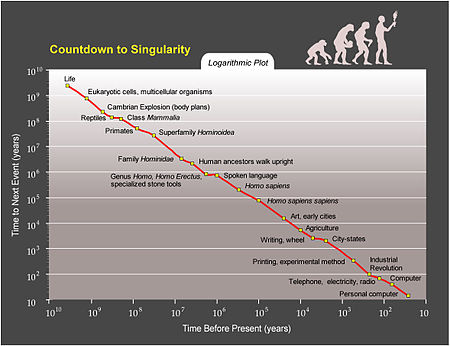
Ray Kurzweil believes that a countdown to when “human life will be irreversibly transformed” can be made through plotting major world events on a graph.
While many transhumanist theorists and advocates seek to apply reason, science and technology for the purposes of reducing poverty, disease, disability and malnutrition around the globe,[42] transhumanism is distinctive in its particular focus on the applications of technologies to the improvement of human bodies at the individual level. Many transhumanists actively assess the potential for future technologies and innovative social systems to improve the quality of all life, while seeking to make the material reality of the human condition fulfill the promise of legal and political equality by eliminating congenital mental and physical barriers.
Transhumanist philosophers argue that there not only exists a perfectionist ethical imperative for humans to strive for progress and improvement of the human condition, but that it is possible and desirable for humanity to enter a transhuman phase of existence in which humans enhance themselves beyond what is naturally human. In such a phase, natural evolution would be replaced with deliberate participatory or directed evolution.
Some theorists such as Ray Kurzweil think that the pace of technological innovation is accelerating and that the next 50 years may yield not only radical technological advances, but possibly a technological singularity, which may fundamentally change the nature of human beings.[67] Transhumanists who foresee this massive technological change generally maintain that it is desirable. However, some are also concerned with the possible dangers of extremely rapid technological change and propose options for ensuring that advanced technology is used responsibly. For example, Bostrom has written extensively on existential risks to humanity’s future welfare, including ones that could be created by emerging technologies.[68] In contrast, some proponents of transhumanism view it as essential to humanity’s survival. For instance, Stephen Hawking points out that the “external transmission” phase of human evolution, where knowledge production and knowledge management is more important than transmission of information via evolution, may be the point at which human civilization becomes unstable and self-destructs, one of Hawking’s explanations for the Fermi paradox. To counter this, Hawking emphasizes either self-design of the human genome or mechanical enhancement (e.g., brain-computer interface) to enhance human intelligence and reduce aggression, without which he implies human civilization may be too stupid collectively to survive an increasingly unstable system, resulting in societal collapse.[69]
While many people believe that all transhumanists are striving for immortality, it is not necessarily true. Hank Pellissier, managing director of the Institute for Ethics and Emerging Technologies (2011–2012), surveyed transhumanists. He found that, of the 818 respondents, 23.8% did not want immortality.[70] Some of the reasons argued were boredom, Earth’s overpopulation and the desire “to go to an afterlife”.[70]
Certain transhumanist philosophers hold that since all assumptions about what others experience are fallible, and that therefore all attempts to help or protect beings that are not capable of correcting what others assume about them no matter how well-intentioned are in danger of actually hurting them, all sentient beings deserve to be sapient. These thinkers argue that the ability to discuss in a falsification-based way constitutes a threshold that is not arbitrary at which it becomes possible for an individual to speak for themselves in a way that is not dependent on exterior assumptions. They also argue that all beings capable of experiencing something deserve to be elevated to this threshold if they are not at it, typically stating that the underlying change that leads to the threshold is an increase in the preciseness of the brain‘s ability to discriminate. This includes increasing the neuron count and connectivity in animals as well as accelerating the development of connectivity to shorten or ideally skip non-sapient childhood incapable of independently deciding for oneself. Transhumanists of this description stress that the genetic engineering that they advocate is general insertion into both the somatic cells of living beings and in germ cells, and not purging of individuals without the modifications, deeming the latter not only unethical but also unnecessary due to the possibilities of efficient genetic engineering.[71][72][73][74]
Ethics
Transhumanists engage in interdisciplinary approaches to understand and evaluate possibilities for overcoming biological limitations by drawing on futurology and various fields of ethics.[citation needed] Unlike many philosophers, social critics and activists who place a moral value on preservation of natural systems, transhumanists see the very concept of the specifically natural as problematically nebulous at best and an obstacle to progress at worst.[75] In keeping with this, many prominent transhumanist advocates, such as Dan Agin, refer to transhumanism’s critics, on the political right and left jointly, as “bioconservatives” or “bioluddites“, the latter term alluding to the 19th century anti-industrialisation social movement that opposed the replacement of human manual labourers by machines.[76]
A belief of counter-transhumanism is that transhumanism can cause unfair human enhancement in many areas of life, but specifically on the social plane. This can be compared to steroid use, where athletes who use steroids in sports have an advantage over those who do not. The same scenario happens when people have certain neural implants that give them an advantage in the work place and in educational aspects.[77] Additionally, there are many, according to M.J. McNamee and S.D. Edwards, who fear that the improvements afforded by a specific, privileged section of society will lead to a division of the human species into two different and distinct species.[78] The idea of two human species, one being at a great physical and economic advantage in comparison with the other, is a troublesome one at best. One may be incapable of breeding with the other, and may by consequence of lower physical health and ability, be considered of a lower moral standing than the other.[78]
Nick Bostrom stated that transhumanism advocates for the wellbeing of all sentient beings, whether in non-human animals, extra-terrestrials or artificial forms of life.[79] This view is reiterated by David Pearce, who advocates for the use of biotechnology to eradicate suffering in all sentient beings.[80]
Currents
There is a variety of opinions within transhumanist thought. Many of the leading transhumanist thinkers hold views that are under constant revision and development.[81] Some distinctive currents of transhumanism are identified and listed here in alphabetical order:
Abolitionism, the concept of using biotechnology to eradicate suffering in all sentient beings.[82]
Equalism, a socioeconomic theory based upon the idea that emerging technologies will put an end to social stratification through even distribution of resources in the technological singularity era.[84]
Extropianism, an early school of transhumanist thought characterized by a set of principles advocating a proactive approach to human evolution.[40]
Postpoliticism, a transhumanist political proposal that aims to create a “postdemocratic state” based on reason and free access of enhancement technologies to people.[87]
Although many transhumanists are atheists, agnostics, and/or secular humanists, some have religious or spiritual views.[41] Despite the prevailing secular attitude, some transhumanists pursue hopes traditionally espoused by religions, such as immortality,[85] while several controversial new religious movements from the late 20th century have explicitly embraced transhumanist goals of transforming the human condition by applying technology to the alteration of the mind and body, such as Raëlism.[88] However, most thinkers associated with the transhumanist movement focus on the practical goals of using technology to help achieve longer and healthier lives, while speculating that future understanding of neurotheology and the application of neurotechnology will enable humans to gain greater control of altered states of consciousness, which were commonly interpreted as spiritual experiences, and thus achieve more profound self-knowledge.[89] Transhumanist Buddhists have sought to explore areas of agreement between various types of Buddhism and Buddhist-derived meditation and mind-expanding neurotechnologies.[90] However, they have been criticised for appropriating mindfulness as a tool for transcending humanness.[91]
Some transhumanists believe in the compatibility between the human mind and computer hardware, with the theoretical implication that human consciousness may someday be transferred to alternative media (a speculative technique commonly known as mind uploading).[92] One extreme formulation of this idea, which some transhumanists are interested in, is the proposal of the Omega Point by Christian cosmologist Frank Tipler. Drawing upon ideas in digitalism, Tipler has advanced the notion that the collapse of the Universe billions of years hence could create the conditions for the perpetuation of humanity in a simulated reality within a megacomputer and thus achieve a form of “posthuman godhood“. Before Tipler, the term Omega Point was used by Pierre Teilhard de Chardin, a paleontologist and Jesuit theologian who saw an evolutionary telos in the development of an encompassing noosphere, a global consciousness.[93][94][95]
Viewed from the perspective of some Christian thinkers, the idea of mind uploading is asserted to represent a denigration of the human body, characteristic of gnostic manichaean belief.[96] Transhumanism and its presumed intellectual progenitors have also been described as neo-gnostic by non-Christian and secular commentators.[97][98]
The first dialogue between transhumanism and faith was a one-day conference held at the University of Toronto in 2004.[99] Religious critics alone faulted the philosophy of transhumanism as offering no eternal truths nor a relationship with the divine. They commented that a philosophy bereft of these beliefs leaves humanity adrift in a foggy sea of postmoderncynicism and anomie. Transhumanists responded that such criticisms reflect a failure to look at the actual content of the transhumanist philosophy, which, far from being cynical, is rooted in optimistic, idealistic attitudes that trace back to the Enlightenment.[100] Following this dialogue, William Sims Bainbridge, a sociologist of religion, conducted a pilot study, published in the Journal of Evolution and Technology, suggesting that religious attitudes were negatively correlated with acceptance of transhumanist ideas and indicating that individuals with highly religious worldviews tended to perceive transhumanism as being a direct, competitive (though ultimately futile) affront to their spiritual beliefs.[101]
Since 2006, the Mormon Transhumanist Association sponsors conferences and lectures on the intersection of technology and religion.[102] The Christian Transhumanist Association[103] was established in 2014.
Since 2009, the American Academy of Religion holds a “Transhumanism and Religion” consultation during its annual meeting, where scholars in the field of religious studies seek to identify and critically evaluate any implicit religious beliefs that might underlie key transhumanist claims and assumptions; consider how transhumanism challenges religious traditions to develop their own ideas of the human future, in particular the prospect of human transformation, whether by technological or other means; and provide critical and constructive assessments of an envisioned future that place greater confidence in nanotechnology, robotics and information technology to achieve virtual immortality and create a superior posthuman species.[104]
The physicist and transhumanist thinker Giulio Prisco states that “cosmist religions based on science, might be our best protection from reckless pursuit of superintelligence and other risky technologies.”[105] Prisco also recognizes the importance of spiritual ideas, such as the ones of Russian Orthodox philosopher Nikolai Fyodorovich Fyodorov, to the origins of the transhumanism movement.
A pedestrian uses an umbrella to protect herself from the sun during a heatwave in London on July 18, 2022. Image Credit: Bloomberg, Getty Images
You don’t have to live in Phoenix, Arizona, to notice that cities are getting hotter, but it helps. Consistently the hottest major metropolitan area in the country, Phoenix spent more than a third of 2022 in triple-digit temperatures. It has also seen a dramatic uptick in heat-related deaths in recent years, with the Maricopa County public health department reporting more than 300 heat-associated deaths in 2021, an increase of 450% from 2014.
“It’s a really unfortunate, tragic data point that we find ourselves sharing a lot,” David Hondula, director of the city’s Office of Heat Response and Mitigation, said in an interview for the NOVA documentary “Weathering the Future.” People are often surprised to learn that heat is the leading cause of weather-related death, he said. It “lurks as a background hazard and doesn’t always get the attention of hazards like thunderstorms, tornadoes, hurricanes, floods.”
Phoenix did not hire Hondula because the planet in general is getting hotter but because cities are the hottest of all. That’s due to what’s known as the “urban heat island” effect, which refers to the ways that the design and infrastructure of cities tend to make that environment hotter—up to 20 degrees warmer than surrounding rural areas.
We’ve known about the urban heat island effect for a long time; even the Romans noticed it. But it’s especially important now because of the health risks that come with heat, according Brian Stone, a professor of environmental planning at Georgia Institute of Technology. “Of all the stressors we associate with climate change, heat is the only one that has a physiological threshold that we know will lead to certain death,” he told NOVA.
There’s a flip side, though. Since “we’ve basically engineered cities to be hot,” he said, “we can reverse engineer them to be cooler.”
What creates an urban heat island?
Researchers have pinpointed four main factors that drive the urban heat island effect. First is vegetation, or lack thereof. Trees are often the first thing to go when cities expand. (Take Atlanta, which has lost nearly 80,000 trees to development since 2014.) Cutting down trees creates a double-whammy effect, since they not only offer shade but also soak up heat from their environment. When we cut down urban trees, “we reduce the capacity of the natural system to cool itself through evaporation, much like we cool ourselves through perspiration,” Stone said.
Then, the materials we install in place of that lost greenery tend to aggravate the problem further. Mineral-based materials such as asphalt, concrete, shingles, and other roofing have a high “thermal capacity,” meaning they absorb a lot of heat during the day and then release it slowly back into the environment as they cool, even well into the night. That’s a problem in particular because the atmosphere doesn’t actually heat up very much from direct sunlight; instead, it warms more as heat is released from the ground.
WATCH: HOW EXTREME HEAT OVERWHELMS THE HUMAN BODY
Next, urban morphology, or the three-dimensional structure of a city, also contributes to increasing temperatures, since tall buildings are particularly good at trapping heat between them. And lastly, there’s waste heat, another double whammy. The process of consuming energy to do work, by anything from a car engine to a lightbulb to a computer, generates heat as a byproduct. Since cities are where most humans live together, they’re also where we consume the most energy: for transit, heating and cooling our homes, and the myriad electrified activities of daily life. And the waste heat that escapes into the environment from those activities measurably affects city temperatures.
Urban heat islands and human health
As all of those factors accumulate, the consequences for human health add up, too. Human bodies can handle very hot temperatures briefly but are sensitive to heat over the long term. “It’s the warm nighttime temperatures that cause the health problems,” Marshall Shepherd, director of the atmospheric sciences program at the University of Georgia, told NOVA. “And that’s where the urban heat island comes in, because that’s when it tends to peak”— with all those mineral surfaces re-releasing heat after dark.
Our bodies respond to heat by elevating our heart rate, allowing us to better circulate moisture. That moisture becomes sweat, which we use to cool ourselves down. Most people can handle an elevated heart rate for a few hours a day. But “if you have to elevate your heart rate for 24 hours because it’s 85 degrees at night in your home, then you are overly taxing your physiologic capacity to deal with heat,” Stone said. Then things start to get dangerous.
Research shows that it’s generally the neighborhoods that can least afford it that get hit the hardest by urban heat. That’s in part because of discriminatory urban planning policies like redlining, which ensured that poorer neighborhoods had fewer trees and more industrial development. One recent study found a difference of 7 to 10 degrees between lower and higher income areas of the same cities. In another project, Shepherd and his colleagues compared redlining maps with satellite data tracking heat. The results showed “a clear heat island within the heat island for marginalized groups,” he said.
With Phoenix’s heat-related death rate doubling in just five years, the city went into crisis mode in 2021. Nighttime temperatures in Phoenix average about 10 degrees hotter than they were half a century ago, hovering around 85 degrees during the hottest part of the year. And there are some days when “we’ve measured pavement, for example, at 160 Fahrenheit, 170 Fahrenheit,” Hondula said, with similar numbers on, for example, metal playground slides—a temperature that can cause direct burns.
As he’s stepped into his role managing the city’s heat crisis, Hondula has remained hopeful. Phoenix’s trends aside, “we’ve seen decreasing heat-associated deaths over the past several decades, as our planet has been warming,” he said. He attributes that to increased understanding of the urban heat island effect, which is beginning to lead to meaningful change in many cities.
One place to start: more trees. Large cities such as Washington, D.C., Baltimore, Philadelphia, and New York currently average around 25%-40% tree canopy cover but could support up to 60% cover, the U.S. Forest Service has found. Even arid Phoenix has committed over $7 million to planting drought-tolerant trees over the next few years. Similar non-profit organizations all over the world have committed to planting trees in the coming decades: 170,000 in Paris, 1 million in Atlanta, 1 million in São Paulo, 4 million in Houston.
Professor David Sailor (left) and Professor Na’Taki Osborne Jelks (right) walk through a “cool corridor,” where trees have been planted to provide relief from the heat in Phoenix, Arizona. Image courtesy of GBH
But it will take years, maybe decades, for those trees to mature and start making a difference. So Stone also sees great potential in changing the materials we use to build cities. For example, dark-colored slate roof shingles with high thermal capacity might make sense in London, or somewhere else cold and wet, but are much less logical in the southern United States. “We can engineer any color we’d like of roofing material, and so part of what we need is not just a technological change in the way we build, but a cultural shift to be more accepting of lighter, more reflective materials,” he said. Other more immediate solutions include initiatives like Phoenix’s cool pavement program, which encourages the use of alternative road materials, as well as the city’s work prioritizing shade structures at bus stops or in other places where trees might not be suitable.
The powerful thing about recognizing the heat island effect is recognizing it as a phenomenon within local control. That means it’s possible to make progress without waiting for national or international policy change, Stone said. Research shows “we can substantially cool down cities in a relatively quick period of time without major expenditures.”
Hondula takes this optimism even further. Even in the context of global warming, he said, efforts to increase tree and other shade cover and promote use of materials with lower thermal capacity mean “we could wind up with a city of the future that’s cooler than the one we have today.”
Consciousness, spirituality, biography, sexuality, androgyny, futurism, space, the arts, science, astrology, democracy, humor, books, movies and more