Translation is a 5-step process of “straight thinking in the abstract.” The first step is an ontological statement of being beginning with the syllogism: “Truth is that which is so. That which is not truth is not so. Therefore Truth is all there is.” The second step is the sense testimony (what the senses tell us about anything). The third step is the argument between the absolute abstract nature of truth from the first step and the relative specific truth of experience from the second step. The fourth step is filtering out the conclusions you have arrived at in the third step. The fifth step is your overall conclusion.
The claims in a Translation may seem outrageous, but they are always (or should always) be based on self-evident syllogistic reasoning. Here is one Translation from this week.
1) Truth is that which is so. That which is not truth is not so. Therefore Truth is all that is. Truth being all is therefore whole, complete, all-inclusive, singular, the Singularity. I think therefore I am. Since I am and since Truth is all that is, therefore I am Truth. Since I, being, am Truth, therefore I, being, am total, whole, complete, all-inclusive, singular, the Singularity. Since I, being, am Truth and since, I, being, am Consciousness, therefore Truth is Consciousness.
2) Historical truth is often debatable.
Word-tracking: history: knowing, vision, story, narrative truth: faithful, troth, betrothal debate: to fight, to bat severely event: to come, arrive or happen
3) Truth being one and being that which knows, therefore Truth is one knowing one being. Truth being all one being, therefore Truth is all one happening, one taking place, one event. Truth being one event and Truth being all there is, there can no be event other than or different to or debatable with Truth, therefore Truth is one undebatable Event. Truth being one knowing and one being, there can no other knowing or being to counter Truth, therefore Truth is undebatable knowing and being. Since Truth is one, therefore Truth is betrothed to Itself, therefore what Truth is joined together, no man can rend asunder.
4) Truth is one knowing one being. Truth is all one happening, one taking place, one event. Truth is one undebatable Event. Truth is undebatable knowing and being. Truth is betrothed to Itself, therefore what Truth is joined together, no man can rend asunder.
5) Truth is one undebatable and unasunderable Event.
The Weekly Invitational Translation Group invites your participation as well. If you would like to submit a Translation on any subject, feel free to send your weekly Translation to zonta1111@aol.com and we will anonymously post it on the Bathtub Bulletin on Friday.
Friedrich Nietzsche was a German philosopher who is renowned for his revolutionary ideas on morality, religion, and culture. Nietzsche was a major influence in the development of existentialism, post-structuralism, and deconstruction.
He rejected the traditional values of morality and religion, which he believed to be oppressive, and instead advocated for self-assertion and individualism.
Nietzsche believed in a will to power and the idea of the übermensch, or “superman,” who would go beyond the limits of traditional morality and create their own values. Nietzsche’s philosophy was also highly critical of modernity, which he believed to be too reliant on rationalism and science.
He proposed a return to an organic and spiritual existence, which would allow humans to embrace their own unique passions and values. Nietzsche’s philosophies have had a lasting impact on philosophical and cultural thought, and his ideas remain widely influential today.
The History and Context of Nietzsche’s Last Man
Friedrich Nietzsche’s concept of the “Last Man” has been the subject of much scholarly inquiry since the philosopher first introduced it in his work, Thus Spoke Zarathustra. The Last Man is a figure Nietzsche presents as the antithesis of “Superman”, a being capable of divine creativity and self-overcoming.
“Alas, the time of the most despicable man is coming, he that is no longer able to despise himself.
Behold, I show you the last man. ‘What is love? What is creation? What is longing? What is a star?’ — thus asks the last man, and he blinks.
The earth has become smaller, and on it hops the man who makes everything small…’We have invented happiness’ — say the last men, and they blink.”
Nietzsche saw the Last Man as the end result of a society that had become enslaved to comfort and complacency, a “slave morality” that was in direct opposition to the “master morality” of Superman.
The Last Man is an apathetic, amoral creature who lives a life of comfort and ease, without any real pursuit of purpose or striving for greatness.
Nietzsche saw the Last Man as a warning of what would come if society continued to abandon its traditional values and embrace nihilism and materialism.
Nietzsche’s concept of the Last Man has been used to explain the history of Western civilization and has been a source of inspiration for those seeking to break out of the mundane routines of everyday life.
What Does Nietzsche Mean by ‘The Last Man’?
Friedrich Nietzsche’s concept of the Last Man has long been a source of fascination and inquiry. In his work, Thus Spoke Zarathustra, Nietzsche presents the Last Man as the antithesis of Superman, a being capable of rising above the mediocrity of modern society and living life to its fullest potential.
“The opposite of the overman [Übermensch] is the last man: I created him at the same time with that. Everything superhuman appears to man as illness and madness. You have to be a sea to absorb a dirty stream without getting dirty.”
— Nietzsche— Fragments November 1882 — February 1883
The Last Man is an apathetic, amoral creature who lives a life of comfort and ease, without any real pursuit of purpose or striving for greatness.
The Last Man is a warning of what will come if society continues to abandon its traditional values and embrace nihilism and materialism.
“For this is how things are: the diminution and leveling of European man constitutes our greatest danger, for the sight of him makes us weary. — We can see nothing today that wants to grow greater, we suspect that things will continue to go down, down, to become thinner, more good-natured, more prudent, more comfortable, more mediocre, more indifferent, more Chinese, more Christian — there is no doubt that man is getting ‘better’ all the time.”
— Friedrich Nietzsche, On the Genealogy of Morals
The concept of the Last Man has been used to explain the history of Western civilization and has been a source of inspiration for those seeking to break out of the mundane routines of everyday life.
To quote Nietzsche, “Man is something that shall be overcome. Man is a rope, tied between beast and overman — a rope over an abyss.” By this, Nietzsche meant that man must strive to become something greater than himself and overcome his own mediocrity. Only by doing so can he hope to avoid the fate of the Last Man.
The Characteristics of the Last Man
Friedrich Nietzsche’s concept of the Last Man is not merely a warning of what will come if society continues to embrace materialism and nihilism, but also a critique of the values and attitudes of modern society.
According to Nietzsche, the Last Man is apathetic, complacent, and lacking in creativity and ambition. He is driven only by the pursuit of pleasure, comfort, and security, rather than a pursuit of excellence, greatness, and moral virtue.
“Everything around them decays and produces decay, that nothing will endure until the day after tomorrow, except one species of man, the incurably MEDIOCRE. The mediocre alone have a prospect of continuing and propagating themselves — they will be the men of the future, the sole survivors.”
— Friedrich Nietzsche, Beyond Good and Evil : 262
The Last Man is a symbol of an entire culture which has become enslaved to mediocrity, comfort and complacency. He is an individual who has abandoned any sense of purpose or striving and instead seeks nothing more than the attainment of the most basic of pleasures and comforts.
He is a person who is unwilling to challenge himself or to take risks, and who does not have any desire to contribute anything of value to society.
The Last Man is a result of a society that has become obsessed with materialism and consumerism, and which has abandoned any sense of morality or spiritual values.
He is an individual who has given up on striving for greatness and instead seeks only the attainment of the most basic of pleasures and comforts. He has become enslaved to a life of comfort and ease and has abandoned any sense of higher purpose or moral virtue.
The Last Man is a symbol of a culture that has given up on striving for greatness and instead seeks only the attainment of the most basic of pleasures and comforts.
It is a warning of what will come if society continues to embrace materialism and nihilism and if individuals continue to ignore their responsibility to create their own values and strive for something greater than themselves.
Implications of the Last Man in Modern Times
The implications of the Last Man in modern times are far-reaching and often unsettling. Nietzsche’s concept of the Last Man serves as a warning of what will come if society continues to abandon its traditional values and embrace nihilism and materialism.
In the modern world, this warning is particularly relevant as our society increasingly values convenience and comfort over striving for excellence and moral virtue.
“The sick are the greatest danger for the healthy; it is not from the strongest that harm comes to the strong, but from the weakest.” ― Friedrich Nietzsche, On the Genealogy of Morals
The Last Man is a symbol of an entire culture that has become enslaved to mediocrity and complacency. The modern world is increasingly becoming obsessed with materialism, consumerism, and the pursuit of pleasure and comfort.
This has led to a society where individuals are no longer driven by a desire to create something meaningful or to strive for greatness, but instead are content to just exist and take the path of least resistance.
Nietzsche’s concept of the Last Man also speaks to the dangers of a society that has become increasingly focused on technology and efficiency. This focus on efficiency has led to a world where the individual is often seen as nothing more than a cog in a machine, and where human interaction is replaced by automation and convenience.
This has led to a culture where humans have become increasingly disconnected from each other and from nature, leading to a society where human relationships are often superficial and lack any real depth or meaning.
Ultimately, Nietzsche’s concept of the Last Man serves as a warning of what will come if society continues to abandon its traditional values and embrace nihilism and materialism.
Nietzsche’s Solution to Overcoming the “Last Man”
Nietzsche’s solution to overcoming the Last Man starts with developing an individual morality and striving for greatness. Individuals should strive to create their own values and pursue meaningful goals, rather than merely settling for the status quo.
These values should be based on a personal code of ethics and should focus on striving for excellence and virtue, rather than merely seeking pleasure and comfort.
“Dreams. ― We have no dreams at all or interesting ones. We should learn to be awake the same way ― not at all or in an interesting manner.” ― Friedrich Nietzsche, On the Genealogy of Morals
Nietzsche also believed that individuals should strive for creativity. This could involve pursuing a passion or hobby, taking up a new skill or craft, or striving to make a positive impact on the world.
Nietzsche also believed in the importance of human connection and relationships. Humans need meaningful relationships in order to find purpose and meaning in life.
“But a spirit who is sure of himself speaks softly; he seeks secrecy, he lets himself be awaited.” ― Friedrich Nietzsche, On the Genealogy of Morals
This means seeking out meaningful relationships with friends, family, and even strangers, and engaging in activities that bring people together.
By surrounding ourselves with people who share our values and beliefs, we can create a sense of community and mutual support.
Final Reflection on Nietzsche’s Warning
Nietzsche’s warning of the Last Man serves as an important reminder of the dangers of complacency and nihilism. His concept of the Last Man serves as a stark reminder of what could become of our society if we continue to embrace a culture of superficiality and materialism.
The Last Man is a symbol of what happens when a society forsakes its traditional values and instead embraces convenience and comfort. It is a cautionary tale of what can happen if we do not strive for greatness and moral virtue.
Nietzsche’s concept of the Last Man is a warning to us all that we must take responsibility for our own lives and strive to create our own values.
We must also strive to make a positive impact on the world and push back against the forces of materialism and convenience.
Ultimately, Nietzsche’s concept of the Last Man serves as a warning to us all to strive for greatness, create meaningful lives and relationships, and pursue our own individual morality. Only by doing so can we hope to create a better world and avoid the fate of the Last Man.
On May 5th, 2023 we have a Full Moon and Lunar Eclipse at 14° Scorpio.
The eclipse is a South Node Eclipse. South Node Eclipses are the culmination of our past actions: some things may come to fruition. Other things may come to their natural end.
The Full Moon Eclipse in Scorpio is opposite Uranus and Mercury retrograde in Taurus, and is trine Mars in Cancer.
With Uranus and Mercury retrograde, things may not go as planned. But sometimes when things don’t go as we want them to go, this doesn’t mean they don’t go as they should.
Perhaps you can remember a time in your life when things didn’t go as planned, but turned out better than expected.
You got fired but a few weeks later ended up in a much better job. You missed your flight, and met someone who changed your life.
During the Eclipse season, things like this happen ALL THE TIME. In fact, that’s exactly what the role of an Eclipse is: to change the course of things so that a better, superior order is found.
Lunar Eclipse In Scorpio – At Crossroads
Eclipses happen when the Sun and the Moon align with the Lunar Nodes.
The Lunar Nodes are points where the path of the Sun and the path of the Moon intersect. The Sun and the Moon are our identity. The Lunar Nodes are crossroads. When we deviate from our life purpose (Sun and Moon), the Lunar Nodes (and the eclipses) come to bring us back on track.
More than ever, at an Eclipse we want to go with the flow rather than against it. The eclipse season is not a time to “try harder” or to stick to our plan “no matter what”.
Eclipses are a time of adjustment. This is a time of noticing the gentle (or not so gentle) nudge that the universe is giving you.
Just think of the astronomy of an Eclipse. At a Solar Eclipse, the shadow of the Moon covers the disk of the Sun. The day becomes night. At a Lunar Eclipse, the shadow of the Earth covers the Moon.
Things are no longer the same – neither in the spiritual 5D world, nor in our material 3D existence. Life turns upside down. We can’t prevent an Eclipse from happening. Whatever is meant to be, will find its way to come into existence.
Full Moon And Lunar Eclipse In Scorpio – Fight Vs. Surrender
When we try to control our circumstances, we fight with the universe. And if you’re in a fight with the universe, who do you think will win?
When we say “universe” this is not some external force outside of ourselves. You are part of the universe. So when we try to control our circumstances, we’re in a war with ourselves.
When we try to control our circumstances we are trapped in our little personal bubble. We are disconnected from the universe. We can’t even see what’s happening around us. When we let go of control we finally see the signs that have been there all along.
The universe is ALWAYS trying to help us. The Universe is ALWAYS showing us the signs. But we are blind. We don’t want to see them because they go against what we think the reality is.
Even the most amazing opportunity is seen as an “obstacle” because it doesn’t go according to our inner narrative or what we think we should do.
Taurus And Scorpio – A New Paradigm
With Taurus and Scorpio, it may be more difficult to see the signs and be open to change. Taurus and Scorpio are fixed, stubborn signs. Their role is precisely to preserve the status quo.
The Lunar Eclipse in Scorpio may test your boundaries and resilience. Here the goal is not to be less of a Taurus, or less of a Scorpio. But at this Lunar Eclipse, we want to reinvent our relationship with these energies within our psyche.
Scorpio can be the sneaky manipulative partner who plays the victim to gain control over the relationship OR the loyal companion who stays through thick and thin not for personal gain, but because they know that intimacy can only emerge when 2 people meet each other halfway.
Taurus can be the stubborn, lazy Bull who says “no” just because there’s too much hard work to change, OR the firm boundary setter who knows that value creation requires focus and determination.
Full Moon And Lunar Eclipse In Scorpio – See The Signs
“I was blind but now I see”
Mercury is retrograde. At the Full Moon Lunar Eclipse in Scorpio we may feel we’re walking blindfolded. We may not have all the information.
And that’s a good thing. Because the information you’re so much relying on may be your own outdated narrative.
Not having to listen to the same old story (Mercury) means you create space for new insights and new perspectives (Uranus). It means you’ll finally be able to see the signs.
The Lunar Eclipse in Scorpio is an incredible opportunity to let go of toxic clinging to what no longer serves us.
At the Full Moon Lunar Eclipse in Scorpio, allow Uranus and Tarurus’ common sense energy to show you a new way, a better way to conduct your life.
This can be as easy as saying “no”. Or “yes” – depending on the circumstances. As easy as believing that a different outcome is possible for you. But you have to be open and listen.
The Scorpio lunation is a penumbral lunar eclipse, meaning the Earth blocks out just some of the Sun’s light from the Moon. The penumbra is described as the edge of the Earth’s shadow, and being outermost, it’s actually a lighter part of the shadow. The long and the short of this is that something in our lives might be somewhat obscured but not completely so. Therefore, we likely have some information that’s useful or valuable, and anything that comes to light now might not be such a shock because of it. It might be that we find a few missing puzzle pieces, but still don’t quite have them all — something that time itself could resolve.
Scorpio is a sign associated with a certain amount of secrecy or hidden factors. So maybe we’re trying to keep something covered up — but it’s not that easy! The cloth wants to slip a little. It might be worth double-checking how details are tethered down or simply realize that we don’t have complete control over the matter. Alternatively, maybe we realize that it’s OK to allow just a little bit more information to see the light of day.
This situation can be especially relevant to how we now feel about a set of past actions or decisions which, at the time, we really didn’t feel so great about. Perhaps we were judged harshly, either by ourselves or others. But with hindsight, we can adopt a new understanding and adjust our stance — maybe also finding that others don’t view us quite as severely as we once imagined!
The Scorpio Moon is opposed by retrograde Mercury, indicating a desire to put feelings and needs into words, yet struggling to do so fully at this time. Internally, this could be due to habitually getting caught up in deep feelings, causing distance and making it difficult to describe them. Or externally, because a situation somehow prohibits full expression — maybe we don’t risk saying something to prevent a flare-up, for example. This dynamic could also apply to restricted movement or travel. Remember, Mercury won’t always be retrograde, and our moment for greater flexibility is just ahead.
Also noticeable in this lunation is the collection of planets in water signs — Moon at 14° Scorpio, Mars at 21° Cancer, and Saturn at 5° Pisces. As we can see from the range of degrees, the planets are not close enough to be in a degree based trine. If they were, we might be looking at the unique gifts and blessings of a water grand trine. But in late-March 2023, the Mars– Saturn trine offered an opportunity towards harmony and cooperation, and distant echoes of this continue to prompt us to remember past attempts to manage a relationship or situation in a smoother way so everyone could benefit.
As Mars and Saturn are termed the “malefics” in traditional astrology, it’s easy to view or even experience them as cosmic villains when they show up in our lives. Yet, there are times when we need the brusqueness of Mars, alongside the insistence of by-the-book Saturn. And whilst a certain development or initiative may initially seem a bit harsh, perhaps we’ll be glad for such decisiveness and certainty at some level!
What we really can’t ignore, though, is the way that Uranus conjoins the Sun and opposes the Moon at this time, indicating that a breath of fresh air really is needed somewhere in our lives. Uranus has a way of delivering this as a short, sharp shock, like a lightning flash. In that moment, something is irrevocably changed. And once the dust settles and we get a chance to see the change, we may well sense relief as we survey a whole new vista ahead! The Moon’s ruler is the planet Pluto, in a square with Jupiter –– signalling disruption and awkwardness. Sticking to our own truth and integrity may necessitate a messy ending.
This article is from the Mountain Astrologer by Diana McMahon Collis
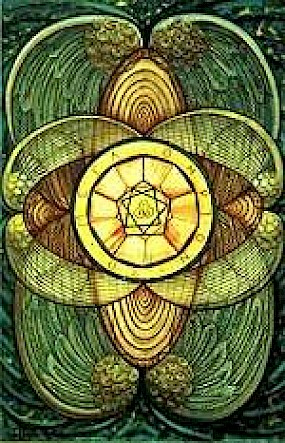
TheAce of Disks marks, on the everyday level, the start of a new project, which is likely to be successful. So it will come up to show a new job, or a new business venture. Usually this will be the sort of project that seems to continuously keep on growing, with each level of attainment producing – almost of itself – the next step in the journey.
Sometimes the Ace will come up to indicate a sudden change of material fortune, or a windfall – though either of these would have to be quite substantial to invoke the Ace. Aces are always big influences, marking the beginning of something new and important. So if we see the card coming up to represent a sudden input of funds, expect this to cause major changes in the querent’s life.
On a more spiritual level, this card relates to the Earth, and to the appreciation of Nature. It might mark a period where we draw closer to environmental issues, or where we engage in a period of study, contemplation and alignment with Earth forces.
One thing that we often miss, when considering spiritual development, is the way that each development grows out of the last. Anyone who has been involved in the search for spiritual truth will already have experienced the weirdly coincidental manner in which spiritual opportunities and teachers present themselves at the relevant stage in our growth.
There’s a saying – ‘The right teacher only appears when the student is ready’. It is as though we grow spiritually from the inside, the same way that trees do. And in so doing, maybe we develop inner rings – just like a tree’s trunk. The outer ring, just under the bark could not exist without all of the others it encircles.
We’re basically the same. The topic that we are exploring today has grown from all of the earlier topics we have looked into. Our experience is formed in layers, each of which is inter-dependent with the earlier ones. The Ace of Disks relates very closely with this method of human development – it shows us the way we grow. And warns us against trying to skip any of the stages!
Dr Ben Miles • Oct 23, 2022 • Alain Aspect, John Clauser and Anton Zeilinger conducted ground breaking experiments using entangled quantum states, where two particles behave like a single unit even when they are separated. Their results have cleared the way for new technology based upon quantum information. 0:00 The 2022 Physics Nobel Prize 0:51 Is the Universe Real? 1:58 Einstein’s Problem with Quantum Mechanics 5:09 The Hunt for Quantum Proof 7:37 The First Successful Experiment 11:06 So What?
BBC Select • Apr 17, 2023 How much is the personality of England intertwined with the visions of Shakespeare? Acclaimed historian Simon Schama tries to get beneath the skin of the playwright and understand why his stories are so relevant today. In this insightful documentary we are shown how Shakespeare knew the importance of not just reflecting the lives of the kings and queens who peppered his plays, but ordinary people too – including thieves, clowns and prostitutes.
Consciousness, spirituality, biography, sexuality, androgyny, futurism, space, the arts, science, astrology, democracy, humor, books, movies and more