
All posts by Mike Zonta

Healing Days – Day 3 | How to Reconnect with Your Authentic Self (with Gabor Maté)
MentorShow Started streaming 2 minutes ago HEALING DAYS – DAY 3 – VANCOUVER TIME You can join Gabor Maté’s masterclass with a 66% discount right here: https://mtor.sh/heal Theme: Reconnecting with Your Authentic Self In this emotional and deeply human session, Dr. Gabor Maté explores the core of trauma healing: your heart. Discover how trauma shapes your emotional life, and how to break free from cycles of reactivity, shame, and disconnection. In this event, you’ll learn: Why emotional reactivity keeps repeating, even when you “know better” How trauma hijacks your choices and keeps you stuck in pain What compassion really means, and why it’s essential for healing The different types of compassion, and how to practice them in daily life A powerful 5-step exercise to overcome inner conflict and access emotional clarity Q&A with Dr. Gabor Maté Part of Healing Days : How to finally heal the pain you carry inside A 3-step path to trauma healing – in your brain, body, and heart. With the world’s leading trauma experts: Gabor Maté, Bessel van der Kolk, Tim Fletcher & Marisa Peer Schedule: Day 1: Tuesday, Feb. 17 – 7PM Day 2: Wednesday, Feb. 18 – 7PM Day 3: Thursday, Feb. 19 – 7PM
Plato on being afraid of the light
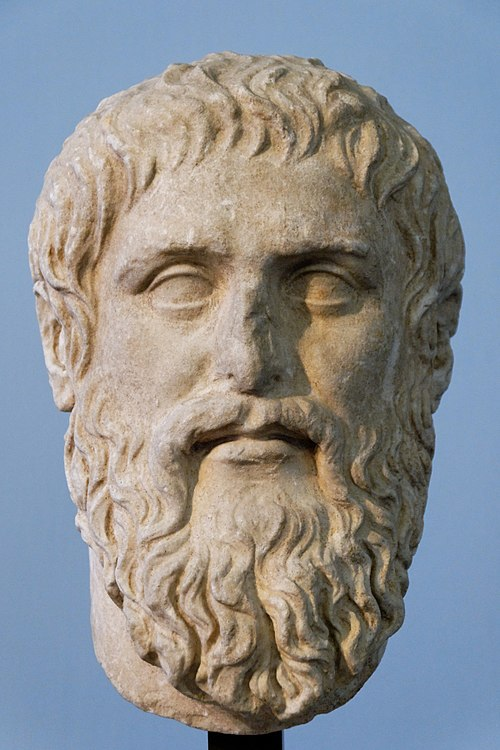
Roman copy of a portrait bust c. 370 BC
“We can easily forgive a child who is afraid of the dark; the real tragedy of life is when men are afraid of the light.”
― Plato
Plato (c. 428-347 B.C.) was an Athenian philosopher and student of Socrates who is considered a founder of Western philosophy. His influential writings on politics, philosophy, and mathematics laid the groundwork for Euclid’s mathematical approach. Plato’s philosophical teachings are presented in his dialogues, which combine drama, dialectic, and doctrine. His characters, often Socrates, debate questions of ethics, knowledge, metaphysics, and politics.
The Symposium is a Socratic dialogue by Plato, dated c. 385 – 370 BC. It depicts a friendly contest of extemporaneous speeches given by a group of notable Athenian men attending a banquet. The men include the philosopher Socrates, the general and statesman Alcibiades, and the comic playwright Aristophanes. Wikipedia
Author: Plato
Characters: Alcibiades, Phaedrus, Socrates, Aristodemus · See more
Date: c. 385 BC
Nancy Ryan, long-time Prospero, passed on February 15, 2025
According to Rio Rancho, New Mexico, police reports only recently come to light, Nancy Ryan aka Loretta Ryan died on February 15, 2025.
Nancy was a long time Prosperos student and former aide to the late Norma Keller H.W., M., former Dean of The Prosperos. Nancy was married to Derek Lamar, another long-time Prospero.
–compiled by Mike Zonta, BB editor
Zero is not ‘Nothing’ – Zero is Everything
(Astrobutterfly.com)
The Saturn-Neptune conjunction on February 20th, 2026, happens at Zero Aries.
The conjunction itself is a zero-degree aspect – it means that the 2 planets are separated by zero degrees, which basically means they are not separated at all – they are together, blended.
It’s precisely the Zero quality of this conjunction that makes Saturn conjunct Neptune such an epochal, reality-shifting event.
And this takes us to a more fundamental question – what is Zero? And why is it so important?

0 plus 2 equals 2. We take something, add zero, and we get the same ‘something’. From this, we tend to infer that Zero is ‘nothing’.
However, Zero is not ‘nothing’.
In mathematics, Zero is not absence. It is a reference point.
Zero is the boundary where sign changes occur. When a preexisting cycle or structure – like the 360-degree zodiac – comes to an end, and the next one starts again. Zero is a threshold, a reset, a change from one frame of reference to another.
Everything is measured against Zero. Zero is at the midpoint between minus one and plus one. Without Zero, there would be no direction. It’s Zero that sets the direction.
Zero is the anchor point.
If you try to divide a number by Zero, it breaks the system. Rules stop applying. Zero marks a transition where behavior changes, continuity breaks, and infinity can appear.
Symbolically and mathematically, Zero represents unexpressed potential, and the state before polarity emerges. In astrology, Zero is the conjunction aspect. The next aspect is the opposition – this is where polarity emerges.
In physics, Zero is where infinities appear. At the Zero point, equations blow up, and known laws fail.
We can think of Zero as a mathematical analogue of a black hole. At its center, everything collapses into an extreme point where our normal ideas about space and direction no longer apply. Zero isn’t empty – it’s a point of intensity, where something breaks down so something else can begin.
Outside the black hole horizon, physics behaves normally. At the horizon, rules change. Inside, direction collapses.
The same thing happens when a planet reaches the Zero point – the equinox point. The rules that applied before stop applying.
If we take Neptune’s 165-year cycle, anything that unfolds between 1 and 360 degrees already belongs to an existing story – a direction that has already been set.
–> when Neptune crosses Zero, that story ends. The existing direction collapses, and something entirely new begins.
What will emerge is impossible to predict. Because Zero is unmanifested potential – and from that cosmic soup of potential, anything can emerge.
Zero Aries is not just “the first degree” – it’s the origin point of the zodiac. It’s the place where archetypes have not yet differentiated, the moment before form takes shape.
Zero Aries is pure potential, and from that potential, something will emerge, setting the direction for both Neptune’s and Saturn’s cycles.
0° Aries is the spark plug – the firing pin – the moment where pressure becomes motion, and vision takes shape, and something entirely new enters existence.
And what makes this moment – 2 slow-moving planets meeting here – so unique is the kind of emergence that will occur when Neptune and Saturn come together.
Neptune is the intangible – the vast fields of potential that exist before form. Saturnis the planet that gives form to those possibilities, turning the intangible into tangible reality.
Think of electricity. Before infrastructure (Saturn) made its transmission and use possible, electricity existed as a phenomenon. Once electricity was containable and routable (Saturn), it reshaped the world.
Same thing with radio waves. They were invisible, everywhere, abstract (Neptune) before Saturn made their application possible. Same with the internet.
Something of THIS caliber is seeded at the Saturn-Neptune conjunction on February 20th, 2026.
The effects won’t be immediate, because 0° Aries is an emergence point – and full manifestation still has to operate under Saturn’s time-based rules.
But what’s important here is that something fundamentally important will be ignited. And that out of the infinite possibilities of Zero, we have the opportunity to consciously participate in what emerges.
We can do that by consciously aligning ourselves with the Zero moment – the time of the exact conjunction.
When we tap into that field without distraction, with full awareness, we have a unique chance to rewrite the script of our life – to articulate a new script, a new personal myth – one that will later be materialized by Saturn’s structures and timelines.
Genesis is the container that gives us the space and timing to do this consciously.
The first call starts at 11:00 AM, and the Saturn-Neptune conjunction at 0° Aries perfects during this call.
You can RSVP here:
>> Genesis 2-Day Event For Saturn-Neptune at 0° Aries <<
Saturn Conjunct Neptune at 0° Aries – Genesis
(Astrobutterfly.com)
On February 20th, 2026, Saturn conjuncts Neptune at 0° Aries.
Undoubtedly, this is one of the most important transits of our lifetime – and we don’t need to know astrology to note that the world is changing in ways we’ve never seen before.
Contradictory narratives, confusion about what to trust, and a feeling that the ground keeps shifting under our feet are all signs of a deeper shift – the slow collapse of old stories, and the necessary space that opens for new ones to form.

Why is Saturn Conjunct Neptune at 0° Aries so special?
A Saturn–Neptune conjunction is important in itself, because these two planets meet only once every 36 years, initiating a new cycle in which collective ideals, visions, and myths (Neptune) are translated into structures, systems, and lived reality (Saturn). Each cycle rewrites the rules our societies live by.
But what makes this particular conjunction so special is that it occurs at 0° Aries – the navel of the zodiac.
The Zero degree is the threshold between 360 degrees of accumulated experience and something entirely new.
Astronomically, 0° Aries marks the point where the ecliptic crosses the celestial equator.
When the Sun reaches this point, day and night are equal everywhere on Earth. And it’s at this moment of perfect balance between day and night, Yang and Yin, that creation emerges.
Ancient cultures were very much aware of the energetic significance of equinoxes.
Stonehenge, along with equinox and solstice temples around the world, stands as proof of just how important this threshold point has been across civilizations.
From an astrological perspective, when 2 slow-moving planets – Saturn and Neptune, the architects of collective reality – align at this navel point, the field is reset, the slate is wiped clean, and the system becomes receptive to entirely new possibilities.
0° Aries is different from 2° Aries, 16° Aries, or 24° Taurus – or any other of the 359 degrees of the zodiac – because once we move beyond Zero, we are already operating within an existing story.
Zero Aries means there is no story. That’s where we create it.
Saturn Conjunct Neptune at 0° Aries – Genesis
What will emerge at this point is not something we can predict or control, and no one holds authority over the Zero. Zero is a cosmic egg of pure potential, prior to form.
That’s why what matters now is not “watching the news.” The stories will continue to shift, and looking outward for certainty is not the point anyway.
What matters is witnessing the moment itself – this crossing of the threshold – being present, attentive, and allowing what is ready to emerge to do so.
This threshold crossing happens only once. Zero Aries is a fleeting moment in time – and we want to be there to witness it.
Witnessing follows the same principle as meditation: the goal is not to change anything or to achieve a particular state, but simply to be present – receptive to what enters awareness when we stop imposing meaning.
Genesis is Astro Butterfly’s 2-day live event (February 20–21) created to hold space for this rare threshold crossing.
There is real power in showing up, in being present together, and in allowing the energy of new beginnings to meet us without the filters of old narratives.
On Day 1 (February 20), ‘The Hatching of the Cosmic Egg‘, we explore the collective dimension of this transit – the larger cycle that is beginning and the themes being seeded at a global and archetypal level.
In Day 2 (February 21st) ‘A New Personal Myth‘ we rewrite our personal narrative, updating the story we’ve been living by so it reflects who we are today.
At Zero Aries, we have a unique chance to bathe in the energy of beginnings and press the reset button.
You can learn more about Genesis and RSVP here:
Genesis – 2-Day Event For Saturn-Neptune at 0° Aries
Manet, Morisot, and the language of the eyes

Two French masters living gender-differentiated realities are hung side-by-side at the Legion of Honor.
By Lou Fancher
February 17, 2026 (48hills.org)
Advice for visitors to the Fine Arts Museums of San Francisco’s “Manet & Morisot” exhibition at the Legion of Honor (runs through March 1): Do not read a single word. Ignore every introductory panel, artwork label, and sectional essay attempting to explain who made what, when, where, and why. This preemptive suggestion—coming from a writer!—may be counterintuitive, but might prove valuable, especially for first-time visitors to the exhibit.

Instead of, or at the very least before, reading, invest time and visual attention to the art of Édouard Manet (1832–1883) and Berthe Morisot (1841–1895). These two remarkable, avant-garde 19th-century painters became colleagues and were influenced by shared experiences. Manet and Morisot held each other in equal regard and underwent similar struggles as each resisted the conventions of the era’s Impressionist art. A dual enthusiasm for mucking around with paint unites their distinctive works. And yet, for all their many commonalities, in their work’s reception and daily lives in Paris of the mid-to-late 1800s, Manet and Morisot existed in gender-differentiated realities.
After taking in the visual stimulation, it’s time to turn to the texts. Learn that Morisot was not only the female founding member of the original Impressionist group—she was the only woman to exhibit with the group under her own name. Discovery continues: Morisot was Manet’s model in some of his paintings, but she, who became Manet’s sister-in-law after marrying his younger brother Eugène, never painted her elder peer. Another tidbit without explanation is that, although Morisot owned many of Manet’s paintings, he collected few of hers.

Even without reading the overly didactic texts that zero in on the topic of sexism and miss opportunity for greater depth, the exhibit’s roughly four dozen paintings form a fascinating timeline of each artist’s individual growth. Their efforts to achieve expressivity not through technique alone, but vigorous investigation of their materials and pursuit of the subject matter’s essential features, unites the work. Two vibrant personalties behind all the majestic artistry emerge, and prove inspiring.
The artwork was loaned by private collections and major art institutions including Musée d’Orsay in Paris, the National Gallery of Art in Washington, D.C., the National Gallery in London, and Pasadena’s Norton Simon Art Foundation. Turning attention to the chronologically arranged artworks, visitors will (hopefully) decide on their own favorites—but a few pieces shine in this writer’s memory.
Side-by-side on one wall are Manet’s “Before the Mirror” (1877) and Morisot’s “Woman at Her Toilette” (1879-’80). The models in each painting are viewed from behind; the bare skin on their backs and exposed necks is alluring, sensual without any hint of sensationalism. Standing and seated, respectively, in front of mirrors, Manet’s figure is composed of brushstrokes that appear authoritarian and swiftly rendered; Morisot’s handling of the paint is less linear, with strokes that swirl and swoop ambiguously. Her woman appears simultaneously pinned in place and spun in a snowstorm of fabric, powder puffs, and patterned wallpaper.
While Manet’s skillful rendering burns on in memory, it is Morisot’s humanity that causes deeper reflection beyond the artist’s deft handling of the paint. Queries abound: Is the woman undressing or dressing? Is she content or consumed in regret, at the end or start of a day? Is she alone in the room, or is there an observer (other than us)? We want to know her, not just look at her admiringly.
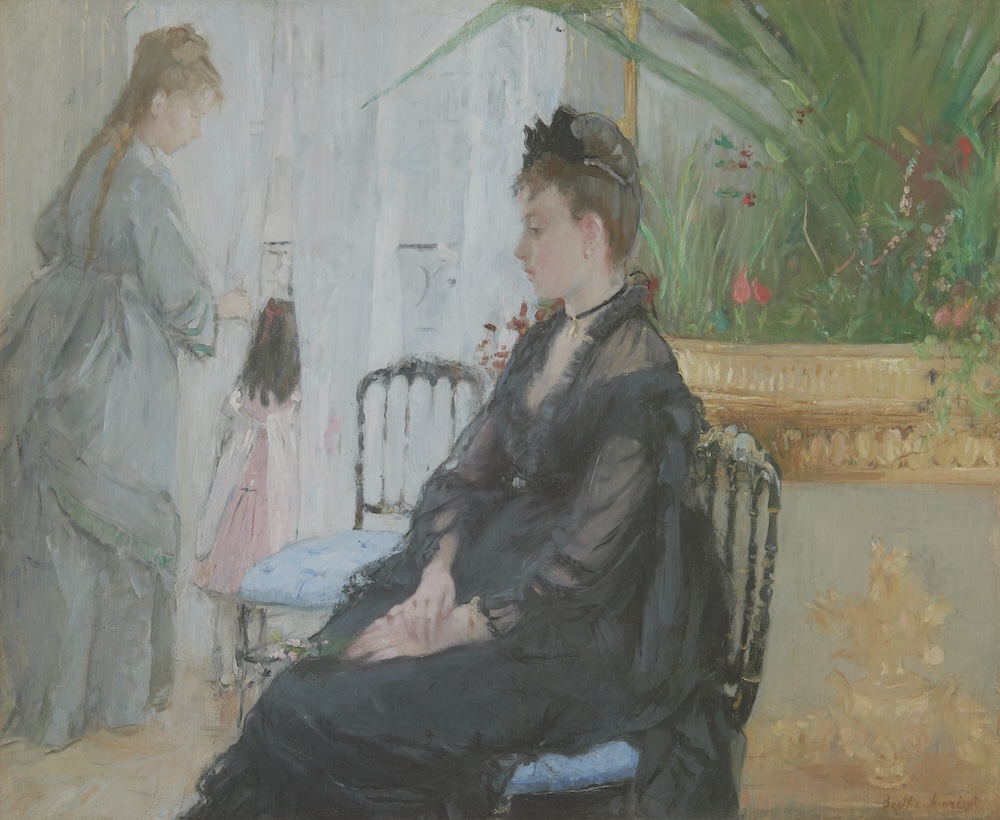
Morisot’s “Interior” carries a similar degree of nuance and imagined storylines. A woman sits, seemingly lost in thought, kept company by an empty nearby chair. A girl stands amid soft drapery, looking out a window while attended by a maid, or governess, or family member. Images reflected in a mirror and an unframed painting propped behind the seated woman suggest either an art studio or a private domestic space. The painting could be seen as an expression of Morisot’s own life, in which boundaries between professional and personal spaces and identities were often blurred or non-existent.
Sponsored link

Manet’s works in the exhibits are intriguing due to the lingering sense of isolation that emerges and lingers. The impression is partly attributable to his tendency to paint people standing alone or moving in small, separated clusters. Accompanying this compositional element is the coolness in his deliberate use of dense, black tones, which tend to undercut or reduce a work’s warmth. A third factor is the gaze of his figures. In “Interior at Arcachon,” two people seated on either side of a circular table, a glimpse of a coastal sea channel as a brilliant backdrop, do not engage with each other. Eyes averted, they exist in a shared space, seemingly unconnected.
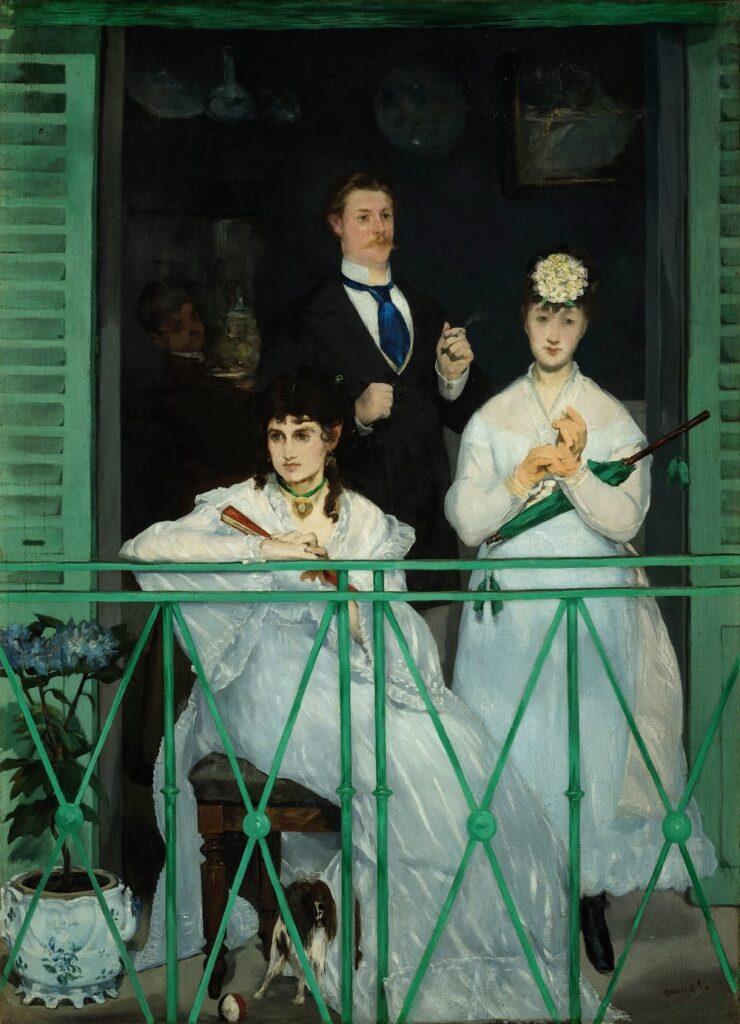
Similar detachment can be found in Manet’s most-famous “The Balcony,” as well as “View of the 1867 Exposition Universelle.” His aggressive approach to portraiture is put to great and powerful use in “Berthe Morisot Reclining,” and “Morisot with Bouquet of Violets.”
Additional standouts among Morisot’s work—impossible to resist naming a few more—are “In a Villa by the Sea,” “Before the Mirror,” and “The Harbor at Lorient.” There is mystery within each painting, but also the distinct relatability of her people and places. Even across the intervening decades between the art’s creation and the present moment, the humanity of her work sings.
Ultimately, Manet and Morisot speak out from canvases and paper in a language composed of color, line, light, and shadow. Theirs is the language of the eyes, not of the tongue.
MANET & MORISOT runs through March 1. Legion of Honor, SF. Tickets and more info here.
Scientists may have found a ‘missing-link’ black hole ripping up and devouring a star
By Robert Lea published 2 days ago (Space.com)
“It’s really difficult to overstate how bad we are at finding intermediate mass black holes.”
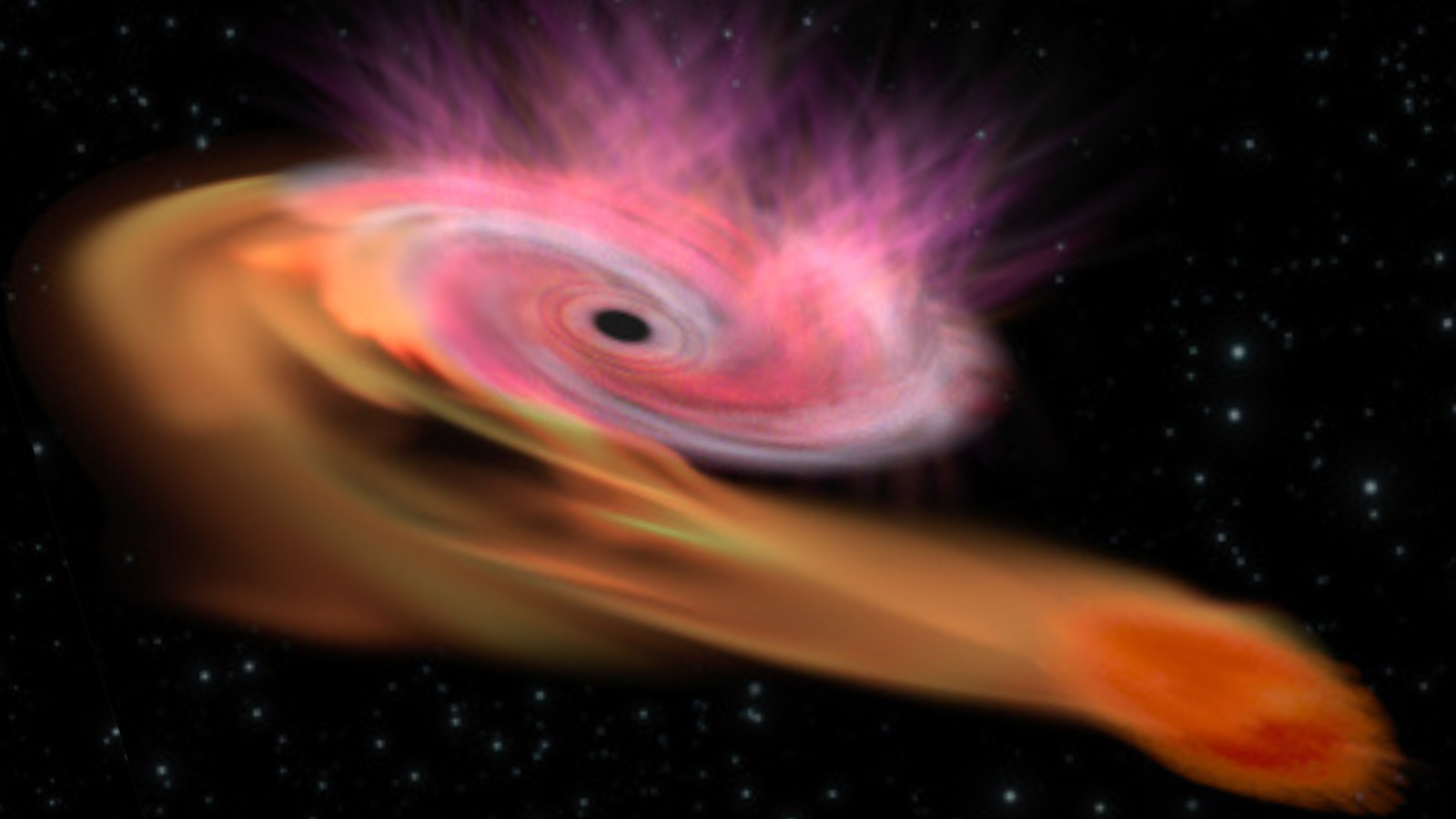
Astronomers have discovered that an unusual optical flare is the result of a star being ripped apart and devoured by a black hole — and what really sets this so-called Tidal Disruption Event (TDE) apart is the fact that the black hole involved seems to be an example of an elusive “intermediate mass black hole,” a class of this object that has challenged astronomers for decades.
TDEs generally occur when stars venture too close to the supermassive black holes that sit at the heart of large galaxies, resulting in the immense gravity of these cosmic titans simultaneously squashing the stellar body horizontally while stretching it vertically. This “spaghettification” creates a stellar noodle wrapping around the black hole. Some of the remains are fed to the central black hole, while much of it is blasted away at near-light speeds as high-energy jets. These events can take hundreds of days or even years to fade.
This optical flare, designated AT2022zod, was spotted in October 2022 and lasted just over a month. It was traced to the galaxy SDSS J105602.80+561214.7, located around 1.5 billion light-years away from Earth. What was intriguing about this was the fact that the TDE occurred around 10,000 light-years away from the center of this galaxy, where its supermassive black hole dwells. That was the first hint this was the work not of a central supermassive black hole, but of a non-central intermediate mass black hole.You may like
- Astronomers witness vanishing star collapse into a black hole in Andromeda galaxy
- Mysterious bright blue cosmic blasts triggered by black holes shredding stars, scientists say. ‘It’s definitely not just an exploding star.’
- Could the Milky Way galaxy’s supermassive black hole actually be a clump of dark matter?
Click here for more Space.com videos…
“AT2022zod has the characteristics of a TDE, a flare we observe when a star is ripped apart by interacting with a black hole. These events are, in general, not common, but since we expect a supermassive black hole in the center of almost every galaxy, TDEs are expected to be observed in the center of their host galaxy,” team leader Kristen Dage of Curtin University, Australia, told Space.com. “However, AT2022zod is slightly off-nuclear, and very short in comparison with previously observed TDEs, while still highly energetic.”
When observed at distances as great as this, TDEs generally last for hundreds of days, making AT2022zod’s month-long duration from Oct. 13 to Nov. 18 highly unusual. “The combination of being hosted by an elliptical galaxy, famously home to large populations of star clusters, while being off-nuclear and of short duration, made us intrigued that this may be one of the elusive intermediate mass black holes that might exist outside the center of the galaxy, and more importantly, open a new avenue to search for and study them,” Dage continued.
Intermediate black holes as cosmic middle men
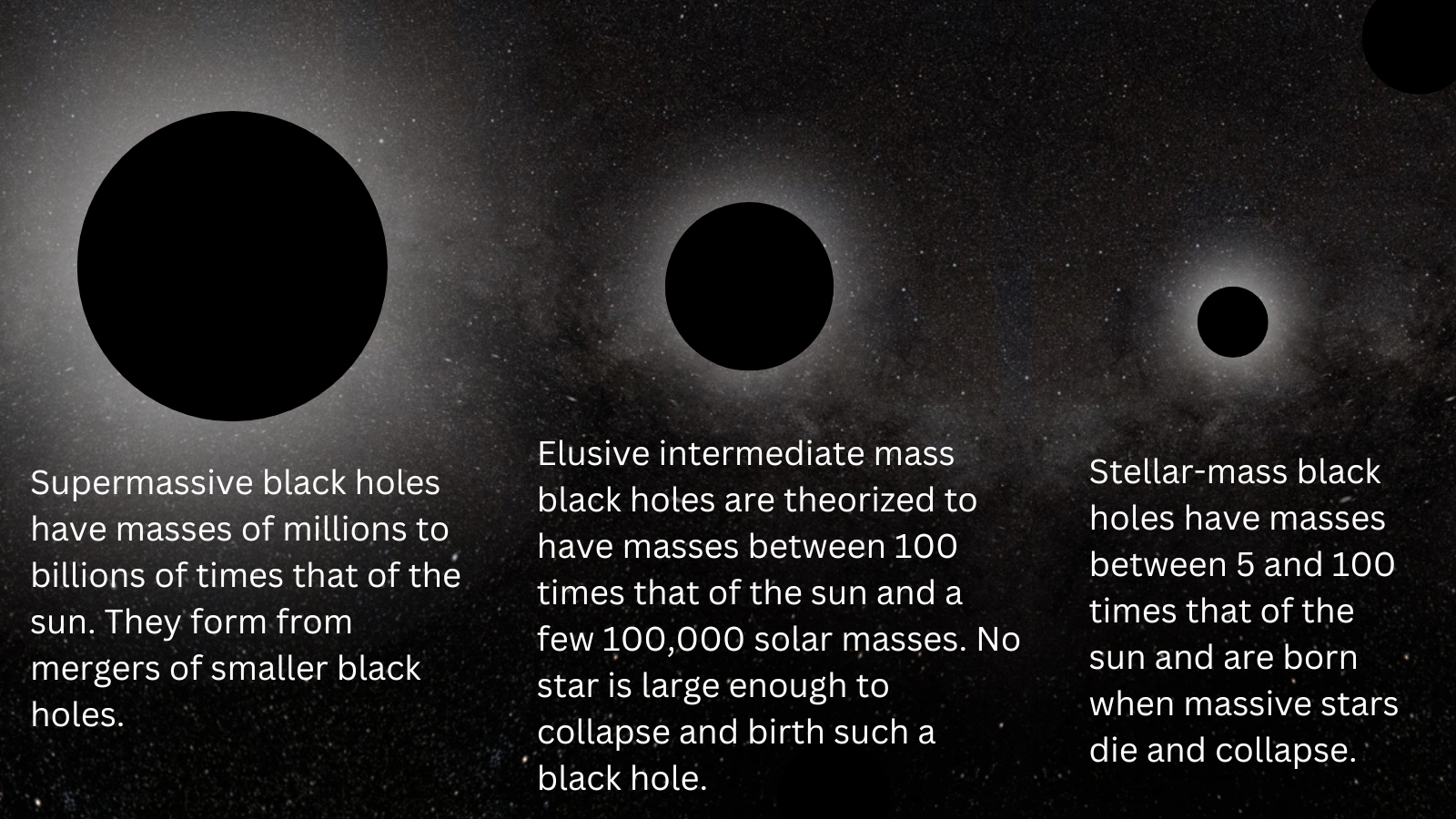
Supermassive black holes are thought to have masses millions or billions of times that of the sun, while stellar mass black holes, which form from dying massive stars, are thought to have masses from three to many hundreds of times the mass of the sun. That leaves a huge mass range between these two types of black holes in which the aptly named intermediate mass black holes are thought to sit.
Because supermassive black holes are thought to grow via merger chains between increasingly massive black holes, it is reasonable to presume that intermediate mass black holes play a key role in this growth process. That means black holes in this mass range should be fairly ubiquitous in the cosmos, yet astronomers have had a really tough time discovering them.
Get the Space.com Newsletter
Breaking space news, the latest updates on rocket launches, skywatching events and more!
“I think it’s really difficult to overstate how bad we are at finding intermediate mass black holes. We are excellent at finding supermassive black holes, and thanks to LIGO-Virgo-Kagra gravitational wave detectors, we are getting better at finding stellar mass black holes, but I could count on my hands the number of intermediate mass black hole candidates that have reached some kind of consensus within the astronomical community,” Dage said. “Up to this point, TDEs from intermediate black holes are known to exist, but are very difficult to observe. They are most of the time overshadowed by other activities within the galaxy’s central region.”
Astronomers can distinguish between TDEs caused by intermediate black holes and those generated when supermassive black holes rip up stars due to the location they occur and the duration of these events.
“With our current understanding of TDE behavior, we know that event duration scales as black hole mass, so all other things being equal, shorter timescale points to lower mass black holes,” Dage said. “What sold me on AT2022zod being special was when I compared it to other TDEs at similar distances or with similar host galaxies, and it didn’t fit in with the same behavior.”You may like
- Astronomers witness vanishing star collapse into a black hole in Andromeda galaxy
- Mysterious bright blue cosmic blasts triggered by black holes shredding stars, scientists say. ‘It’s definitely not just an exploding star.’
- Could the Milky Way galaxy’s supermassive black hole actually be a clump of dark matter?
The discovery of this off-center TDE could also reveal more about the environment occupied by this intermediate-mass black hole. For instance, it is pretty evident that TDEs are much more likely to occur in regions in which stars are densely packed together. “If you’re not in some kind of star cluster, generally the host galaxy’s central nuclear star cluster, then you’re just not going to have a TDE, because the odds of a given star waltzing in near the black hole are too low,” Dage said. This stellar density is found at the heart of galaxies, but there are also non-central regions of galaxies in which stars are also jammed together tightly.
Failed supermassive black holes?
The team theorizes that this TDE occurred in a globular cluster or an ultracompact dwarf galaxy (UCD) within SDSS J105602.80+561214.7 itself. Both globular clusters and UCDs are densely packed conglomerations of ancient stars reaching the end of their lives.
“These systems are basically black hole factories, and their crowded and dynamical systems provide opportunities for black holes to merge and grow into the intermediate mass range, particularly through runaway stellar collisions,” Dage said. “When you combine this with the observational evidence for kinematic studies of black holes in UCDs, it makes them very compelling environments to host intermediate mass black holes!”
The origins of UCDs are currently shrouded in mystery. These dense stellar regions could arise when two globular clusters are drawn together, collide and merge, or UCDs may be dwarf galaxies that have been stripped of their outer stars, leaving them as a compact and dense stripped galactic nucleus.
“These two different formation scenarios have very different implications for the black hole evolution. If they are stripped nuclei, then they are ‘failed’ supermassive black holes, with a similar formation pathway to the supermassive black holes and large galaxies,” Dage explained. “If they’re just big globular clusters, then things could be completely different, and dynamics play a vital role in black hole formation and evolution.”

Dage said scientists know elliptical galaxies host both globular cluster stellar systems and UCDs, but in this case, the host galaxy is so far away that the team can’t quite disentangle the nature of the actual environment of AT2022zod. “We just know it’s in some kind of star cluster,” Dage said. “I personally would love it if it were in a globular cluster, but from what we know of more nearby systems, a UCD makes a lot of sense as a host in the nearby universe.”
She added that many studies of the physics of UCDs show they host black holes in the mass range estimated for AT2022zod. This includes a system in the Milky Way called Omega Centauri, although Dage pointed out there is still some debate about whether this densely packed star cluster in our galaxy is a UCD or a globular cluster.
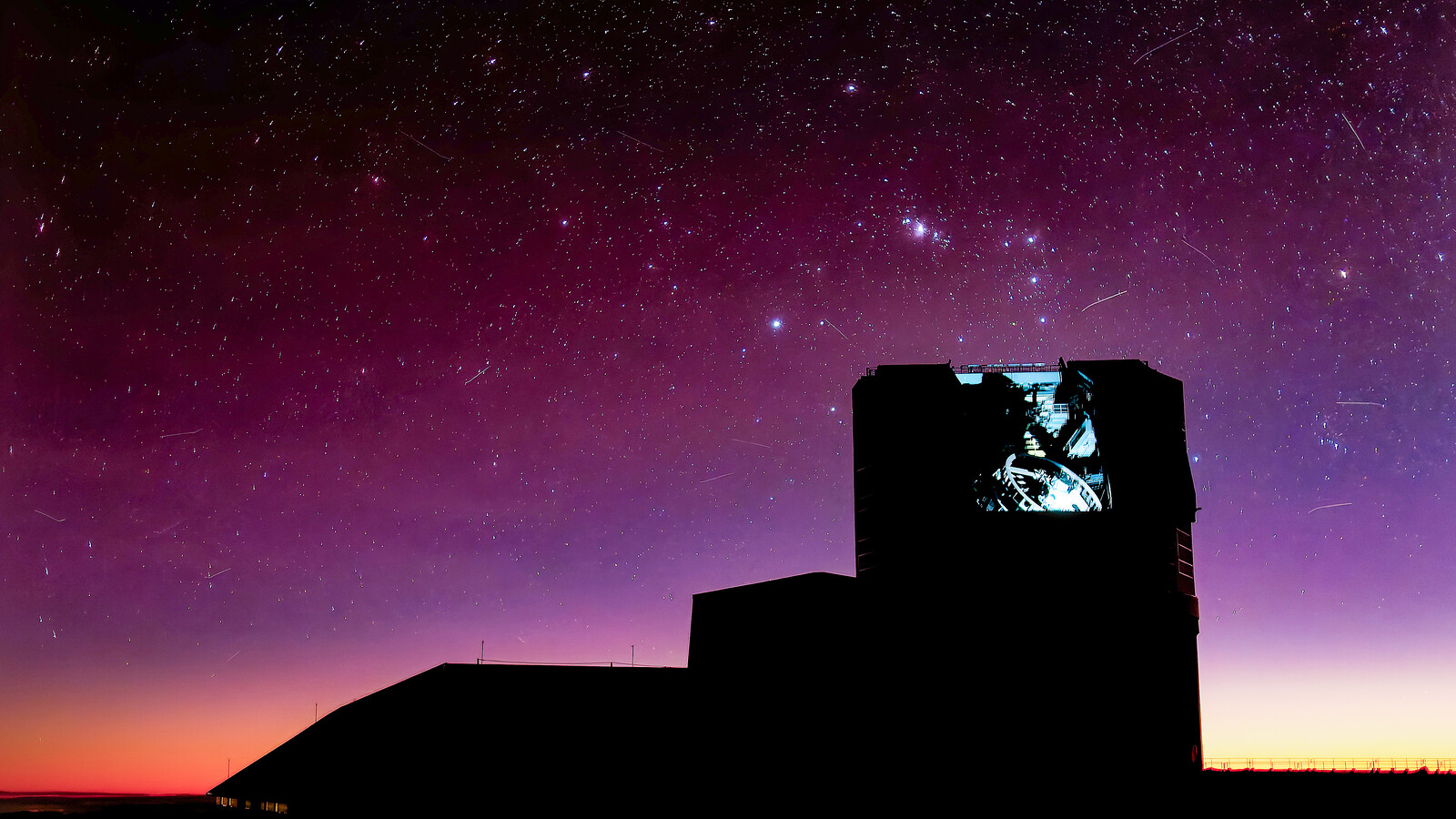
While the environment of the TDE AT2022zod may remain a mystery for the foreseeable future, the team’s research could provide a much-needed roadmap for discovering intermediate black holes, which will become especially relevant when the Vera C. Rubin Observatory begins conducting its decade-long Legacy Survey of Space and Time (LSST).
“Rubin is poised to make such a huge impact — it will provide incredibly sensitive 10-year optical coverage of millions of star clusters within 330 million light-years, and ought to be sensitive to populations of TDEs hosted by dense stellar environments,” Dage concluded. “We just need to make sure we are looking in the right places, can do prompt follow-up to better understand the physics and the host system, and be able to interpret what we see.”
The team’s results are available on the paper repository site arXiv.

Senior Writer
Robert Lea is a science journalist in the U.K. whose articles have been published in Physics World, New Scientist, Astronomy Magazine, All About Space, Newsweek and ZME Science. He also writes about science communication for Elsevier and the European Journal of Physics. Rob holds a bachelor of science degree in physics and astronomy from the U.K.’s Open University. Follow him on Twitter @sciencef1rst.
DHS is subpoenaing the names of Americans who criticize ICE. Akhmatova’s hallway never closed.
| W. A. Lawrence Feb 18, 2026 |
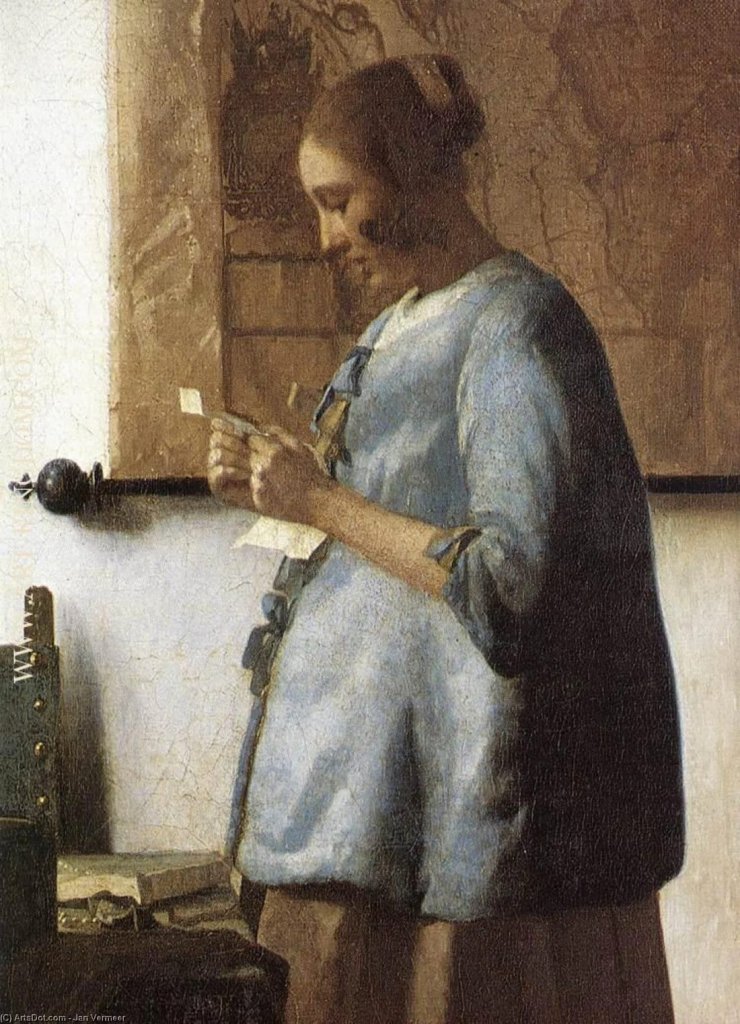
A woman alone with dangerous words. Credit: Johannes Vermeer, Woman in Blue Reading a Letter (c. 1663). Rijksmuseum, Amsterdam.
The most dangerous thing you can do right now is keep reading.
The tea has gone cold on the counter, and the windows are dark and the woman standing in the hallway has her mouth close to her friend’s ear. The words come out one breath at a time, barely louder than the radiator ticking in the wall, because writing them down would kill everyone in the apartment. The listener closes her eyes and memorizes. Tomorrow a different kitchen will host the same whispered exchange, and the verses will travel to another doorway in another city, and the line will hold, mouth to ear, for years, long after the empire that made the whispering necessary has crumbled into the kind of dust that requires a search engine to identify.
The woman in that hallway was Anna Akhmatova. The year was 1935. The poem was Requiem. And every reader who has ever encountered those lines, in every classroom on every continent where the morning coffee is still warm, arrived there because a chain of ordinary people decided, one after another, that a forbidden verse was worth the risk of carrying.
The corridor, the whispered verse, the cupped hands passing language too lethal to record. Every regime that ever ruled through fear was ultimately outlasted by someone who loved something the state had no way to kill.
The Architecture of Silence
Russia spent two centuries perfecting the erasure of dissent. The state absorbed the press, the judiciary, the military, the schools, the churches, the economy, and disappeared dissidents so efficiently that neighbors learned to treat the empty chair at dinner as furniture, until resistance came to seem clinically delusional, the affliction of people who had not yet made peace with gravity.
Fyodor Dostoevsky marched to a firing squad at twenty-seven for the crime of reading prohibited literature aloud. Rifles shouldered, the command traveling down the line, the young writer stood in the winter air of Semyonov Place watching the barrels rise until, in that held breath between order and execution, a messenger arrived with a commutation meant to break a man who thought reading aloud was worth his life. The state shipped the prisoner to Siberia, four years of labor in chains, confident the young radical had been converted into a cautionary anecdote, and instead forged the consciousness that would produce The Brothers Karamazov and Crime and Punishment, works that have reshaped how hundreds of millions of people understand guilt, redemption, and what we owe one another in the darkest hours.
Mikhail Bulgakov wrote The Master and Margarita knowing the secret police had already confiscated and incinerated an earlier draft. The man sat at his desk and wrote the book again, from memory. Dying in 1940 while readers would not encounter the novel until 1966, Bulgakov left behind sentences that millions of strangers would eventually carry inside their heads like stolen freight. The censors who destroyed those pages are nameless, every last one.
Victory does not require your own lifetime.
Two in the Morning
Some nights, the apartment quiet and the cursor blinking on a half-finished paragraph, a weight settles behind my sternum. Last Tuesday the weight arrived with a number attached: the actual count of paid subscribers keeping this publication alive. The number was pathetic. Saying so makes my face warm, but at two in the morning the only currency left is the truth. Then came a voice, specific and calm, reciting evidence: You are one woman, with no institutional backing, writing for an audience that might be empty. And the only response available at that hour was the one Akhmatova found whispering in the dark, that Dostoevsky discovered in Siberia, that Bulgakov reached with the secret police already in possession of the first draft. Keep writing the sentence, finish the paragraph, publish the piece, and trust the chain to hold.
The powerful understand one arithmetic above all others. Your isolation is cheaper than your participation.
Last Friday, the New York Times reported that the Department of Homeland Security has sent hundreds of administrative subpoenas to Google, Meta, Reddit, and Discord demanding the names, email addresses, and phone numbers of Americans who criticized ICE or tracked the location of its agents online. No judge approved the requests. Google, Meta, and Reddit complied with at least some of the requests.
A bilingual neighborhood watch page in Montgomery County, Pennsylvania, posting ICE sightings in English and Spanish for roughly 10,000 followers, was told that if its administrators did not hire a lawyer and get to federal court within ten days, the platform would hand their identities to the government.
When the ACLU intervened, DHS quietly withdrew the demand before a judge could rule on whether the request was legal, then issued new ones to other targets. The tool had previously been reserved for child abductions.
Read that paragraph again. A federal agency is demanding that private companies identify, by name, the citizens who criticized its conduct. The people running a neighborhood Facebook page in suburban Pennsylvania encountered the same choice Akhmatova confronted in the hallway: speak, and risk being identified by the state.
The hallway never closed. The hallway just got a loading screen.
Wherever You Are Sitting
Somewhere right now a woman is checking her phone for the third time since midnight, refreshing a government website to see whether the program her family depends on will still exist in the morning. The loading icon spins and her stomach drops before the page even renders, because the body learns to brace for loss faster than the mind can finish reading. Down the hall a teacher is staring at a revised curriculum, stomach tight, rehearsing what to say when a student asks why the chapter on civil rights has been shortened to a single page. At a kitchen table a father is composing a letter he already knows will be ignored, writing the sentences anyway.
And you are here. Reading.
Which means the choice at the center of this essay has already been made.
Somewhere between the first sentence and this one, the tab stayed open. The scroll continued downward. The screen did not go dark. All of that required choosing, the same stubbornness Akhmatova depended on when leaning toward a trusted ear to speak, because the chain does not perpetuate without someone deciding to carry the next link. Every link is a decision someone made to stay present when the room becomes uncomfortable.
The hallway where Akhmatova stood in 1935 never closed. Lip to memory, verse to trusted hand, the transmission survived the collapse of the Soviet Union and continues to run through every century, kept alive by two people deciding that the truth between them mattered more than the comfort of looking away. The current is on your screen at this moment, running beneath these sentences, and will vanish the instant you decide to let the signal go quiet.
The question was never whether you matter. The question is what you will do in the next ten seconds.
Power can compel obedience and enforce silence. Meaning is the one thing power has never once managed to produce, not in the whole record of civilization. Everything that endures was made by someone who had every rational reason to stop and chose, in the small hours, to keep writing the sentence.
The cupped hands belong to you now. The hallway is wherever you are sitting. And your mouth is already close enough to someone’s ear.
Glass Empires provides rigorous analysis that stands on its own, and I am grateful that you are reading. This publication is fully reader supported and depends on paid subscriptions. Annual plans are available at 40 % less than the monthly rate for a limited time.
Sources
Homeland Security Wants Social Media Sites to Expose Anti-ICE Accounts https://www.nytimes.com/2026/02/13/technology/dhs-anti-ice-social-media.html
God Wondering When Humans Will Realize Purpose Of Life Masturbating Continually
‘It Feels Good And The Parts To Do It Are Attached To Your Body,’ Says Supreme Deity

Published: February 18, 2026 (TheOnion.com)
THE HEAVENS—Expressing His confusion as to how their true calling continued to elude them, God Almighty, our Lord and Heavenly Father, was reportedly wondering Wednesday when humans would realize that the major purpose of life was to continually masturbate. “It feels good and the parts to do it are attached to your body—how much simpler could I have made it?” said the Lord, admitting He was frustrated that humanity had spent centuries engaged in pursuits such as war, art, commerce, and the construction of civilizations instead of using their hands to sexually gratify themselves at all times. “It’s so simple to do, and the sensation is amazing. It’s basically as close to heaven as you can get on earth, and yet still they barely jerk it at all. And while there have been moments when it seems like a few of My children have understood their divine mission to vigorously pleasure themselves around the clock, most of them still cease after seven or eight sessions. It is troubling indeed.” At press time, celestial sources confirmed an angry God was tearing pages out of the Bible after an angel reminded Him about the sin of Onan.