All posts by Mike Zonta

Hermann Hesse on Discovering the Soul Beneath the Self and the Key to Finding Peace

By Maria Popova (themarginalian.org)

“To be nobody-but-yourself — in a world which is doing its best, night and day, to make you everybody else — means to fight the hardest battle which any human being can fight,” E.E. Cummings told students from the hard-earned platform of his middle age, not long after Virginia Woolf contemplated the courage to be yourself.

It is true, of course, that the self is a place of illusion — but it is also the only place where our physical reality and social reality cohere to pull the universe into focus, into meaning. It is the crucible of our qualia. It is the tightrope between the mind and the world, woven of consciousness.

On the nature of the self, then, depends our experience of the world.

The challenge arises from the fact that, upon inspection, there is no single and static self but a multitude of selves constellating at any given moment into a transient totality, only to reconfigure again in the next situation, the next set of expectations, the next undulation of biochemistry. This troubles us, for without the sense of a solid self, it is impossible to maintain a self-image. There is but a single salve for this disorientation — to uncover, often at a staggering cost to the ego, the constant beneath this flickering constellation, a constant some may call soul.

Hermann Hesse (July 2, 1877–August 9, 1962) takes up the question of discovering the soul beneath the self in his 1927 novel Steppenwolf (public library).

Hermann Hesse

He writes:

Even the most spiritual and highly cultivated of men* habitually sees the world and himself through the lenses of delusive formulas and artless simplifications — and most of all himself. For it appears to be an inborn and imperative need of all men to regard the self as a unit. However often and however grievously this illusion is shattered, it always mends again… And if ever the suspicion of their manifold being dawns upon men of unusual powers and of unusually delicate perceptions, so that, as all genius must, they break through the illusion of the unity of the personality and perceive that the self is made up of a bundle of selves, they have only to say so and at once the majority puts them under lock and key.

Accepting the fact of the bundle is not easy, for it requires seeking the deeper unifying principle, the mysterious superstring binding the bundle. (After all, daily you confront the question of what makes you and your childhood self the same person despite a lifetime of physiological and psychological change — a question habitually answered with precisely this illusion of personality.)

With compassion for this universal human vulnerability to delusion, Hesse observes:

Every ego, so far from being a unity is in the highest degree a manifold world, a constellated heaven, a chaos of forms, of states and stages, of inheritances and potentialities. It appears to be a necessity as imperative as eating and breathing for everyone to be forced to regard this chaos as a unity and to speak of his ego as though it were a one-fold and clearly detached and fixed phenomenon. Even the best of us shares the delusion.

Illustration by Mimmo Paladino for a rare edition of James Joyce’s Ulysses

Considering this ego-self a kind of “optical illusion,” Hesse insists that, with enough courage to break the illusion and enough curiosity about these “separate beings” within, one can discern across them the “various facets and aspects of a higher unity” and begin to see this unity clearly. He writes:

[These selves] form a unity and a supreme individuality; and it is in this higher unity alone, not in the several characters, that something of the true nature of the soul is revealed.

A generation before Hesse, Whitman, after boldly declaring that he contains multitudes, recognized across them “a consciousness, a thought that rises, independent, lifted out from all else, calm, like the stars, shining eternal.”

We call this consciousness, this higher unity of personhood, soul.

I see my soul reflected in Nature — one of Margaret C. Cook’s illustrations for a rare 1913 English edition of Walt Whitman’s Leaves of Grass. (Available as a print.)

Knowing that even the soul is two-fold, Hesse offers his prescription for resisting the easy path of illusion and annealing the soul from the self. Half a century before Bertrand Russell insisted that the key to a fulfilling life is to “make your interests gradually wider and more impersonal, until bit by bit the walls of the ego recede, and your life becomes increasingly merged in the universal life,” Hesse writes:

Embark on the longer and wearier and harder road of life. You will have to multiply many times your two-fold being and complicate your complexities still further. Instead of narrowing your world and simplifying your soul, you will have to absorb more and more of the world and at last take all of it up in your painfully expanded soul, if you are ever to find peace.

It is only by nurturing and expanding the soul that the self, fluid and fractal, can be held with tenderness. And without tenderness for the self, Hesse reminds us a century before the self-help industry commodified the concept, there can be no tenderness for the world and no peace within:

Love of one’s neighbor is not possible without love of oneself… Self-hate is really the same thing as sheer egoism, and in the long run breeds the same cruel isolation and despair.

Couple with Virginia Woolf on how to hear your soul, then revisit Hesse on the courage to be yourselfthe wisdom of the inner voice, and how to be more alive.

Healing Days – Day 2 | How to Release Trauma Stored in the Body (with Bessel van der Kolk)

MentorShow Started streaming 75 minutes ago HEALING DAYS – DAY 2 – VANCOUVER TIME You can join Gabor Maté’s masterclass with a 66% discount right here: https://mtor.sh/heal Theme: Releasing Trauma From Your Nervous System Join world-renowned trauma expert Dr. Bessel van der Kolk (The Body Keeps the Score) for an essential session on how trauma lives in the body, and how to finally release it. In this powerful event, you’ll discover: Why trauma isn’t just a memory, it’s a body response How anxiety, panic, and emotional overwhelm come from your nervous system, not your mind Why you can’t “think” your way out of trauma, and what you need instead How to rewire your body’s sense of safety and restore balance 2 practices to help regulate your nervous system and move beyond post-traumatic stress Q&A with Dr. Bessel van der Kolk This isn’t about coping, it’s about real somatic healing. Part of Healing Days : How to finally heal the pain you carry inside A 3-step path to trauma healing – in your brain, body, and heart. With the world’s leading trauma experts: Gabor Maté, Bessel van der Kolk, Tim Fletcher & Marisa Peer Schedule: Day 1: Tuesday, Feb. 17 – 7PM Day 2: Wednesday, Feb. 18 – 7PM Day 3: Thursday, Feb. 19 – 7PM

Rep. James Talarico’s censored appearance on The Late Show with Stephen Colbert

4,218,020 views (and counting)  The Late Show with Stephen Colbert Feb 16, 2026 Stephen Colbert hosts Texas State Rep. James Talarico for an online-exclusive interview that touches on the issues raised in Talarico’s campaign for the Democratic nomination for Senate including the separation of church and state, the dangers of consolidated corporate-owned media, and the fabricated culture wars pushed by Republicans in states like Texas. If you’re curious why this interview with James Talarico was an online-exclusive, click here to watch Stephen Colbert explain:    • Why CBS Didn’t Broadcast Stephen Colbert’s…  .

Marcus Aurelius on the best revenge

Marcus Aurelius

“To refrain from imitation is the best revenge.”

― Marcus Aurelius, Meditations

  • Google AI Overview

“To refrain from imitation is the best revenge” is a famous Stoic quote from Marcus Aurelius‘ Meditations (Book 6, verse 6), often cited on Goodreads. It means the most effective way to deal with wrongdoers is to maintain your integrity and not lower yourself to their level of behavior. 

Key Aspects of the Quote:

  • Origin: The quote comes from Roman Emperor and Stoic philosopher Marcus Aurelius in his work Meditations.
  • Meaning: It advises against mimicking the poor behavior, immorality, or emotional reactions of those who harm you.
  • Translations: Variations include “The best revenge is to be unlike him who performed the injury” and “The best way of avenging thyself is not to become like the wrongdoer”.
  • Context: It promotes taking the high road and maintaining virtue rather than seeking vengeance, which Stoics believed only gives power to the offender.

This quote highlights the Stoic focus on controlling one’s own actions and reactions rather than focusing on the wrongdoings of others. 

Marcus Aurelius Antoninus was Roman emperor from 161 to 180 and a Stoic philosopher. He was a member of the Nerva–Antonine dynasty, the last of the rulers later known as the Five Good Emperors and the … Wikipedia

Born: April 26, 121 AD, Rome, Italy

Died: March 17, 180 AD 

Healing Days – Day 1 | How Trauma Rewires Your Brain (with Gabor Maté, Tim Fletcher & Marisa Peer)

MentorShow Started streaming 8 minutes ago HEALING DAYS – DAY 1 – VANCOUVER TIME Theme: Rewiring Your Mind for Healing Join Dr. Gabor Maté, Tim Fletcher, and Marisa Peer for an eye-opening session on how trauma reshapes the brain, and what it really takes to break free from the mental and emotional patterns it creates. In this powerful event, you’ll discover: What trauma actually is, and how it hijacks your brain’s wiring Why anxiety, shutdown, and self-sabotage aren’t personal failures but survival adaptations How to stop reliving the past and start reconnecting with your true self 2 simple, exercises to release emotional tension and relieve physical pain Q&A with Tim Fletcher and Marisa Peer This session is not just theory, it’s a step-by-step guide to start changing how you think, feel, and respond. Part of Healing Days : How to finally heal the pain you carry inside A 3-step path to trauma healing – in your brain, body, heart, and family legacy. With the world’s leading trauma experts: Dr Gabor Maté, Dr Bessel van der Kolk, Tim Fletcher & Marisa Peer Schedule: Day 1: Tuesday, Feb. 17 – 7PM Day 2: Wednesday, Feb. 18 – 7PM Day 3: Thursday, Feb. 19 – 7PM

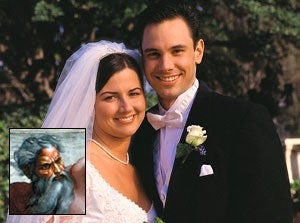
God Late For Local Wedding

Published: December 11, 2002 (TheOnion.com)

CARTHAGE, MO—An embarrassed God admitted Monday that He was late for the Saturday wedding of Patrick Moore and Dina Roble, arriving halfway through the ceremony but catching “most of the important stuff.”

undefined

“It was one heck of a day,” God said. “Yes, I can be all places at once, but it’s just so hard to keep it all straight sometimes. It’s been crazy all month, and this thing just came up so fast.”

The ceremony that forever joined Moore, 28, and Roble, 26, in holy matrimony was held at 11 a.m. at Sacred Heart Church on Gorman Avenue in Carthage. Neither bride nor groom was aware of the Lord’s tardiness.

“Religion is very important to my entire family, and Dina and I plan to raise our children in a Christian environment,” Moore said. “So it was important for us to have our wedding in a Roman Catholic church, and be united under the eyes of God.”

God admitted that His eyes were upon the couple for a little less than half of the ceremony—”which is a lot,” said God, considering the length of the Roman Catholic liturgy.

“The Catholics go through everything at a wedding,” God said. “There’s a sermon and readings and even Communion. With the songs and the procession and the ’I do’ stuff thrown in there, it takes so long. And the whole time, it’s stand, sit, kneel, stand, sing, recite, sit, stand, sing, kneel, sit.”

God added that the ceremony’s liturgy of the Word—which includes readings from the Old and New Testaments, a responsory Psalm, the “alleluia” before the Gospel, and a Gospel reading—is nothing He hasn’t already heard “billions of times.”

Calling Himself “free of sin,” the Lord blamed His late arrival on poor directions provided by the couple.

“I was running a bit behind and, admittedly, I probably should have left a little earlier,” He said. “But I really would have made it on time if I hadn’t been stupid enough to rely on that map Patrick included in the invitations. It was barely readable. Then, I come to find out that East Gorman is a totally different street than Gorman Avenue. They run parallel. So, for about 25 minutes, I’m cruising up and down East Gorman like an idiot, looking for 299—and, of course, there isn’t any.”

Finally, at 11:30 a.m., halfway through the ceremony, God located the small brick church. He slipped in unnoticed during the middle of the second reading.

“I came in the back, really quiet, like a thief in the night. Nobody turned around or anything, so I doubt they noticed,” God said. “Besides, I am in a form no human eyes can discern, so I’d have to be pretty clumsy to get busted.”

God said He does not feel a need to tell Moore and Roble that His spirit was not fully looking over them as they became husband and wife.

“Why point it out?” God said. “I got there for the exchange of the wedding vows, so, really, is any harm done?”

Among the parts of the wedding God missed were the prelude, in which Roble’s sister Tammy sang “Come And Journey With Me”; the processional; and the opening prayer, in which God was personally thanked for attending the ceremony.

“It was such a beautiful day,” Moore said. “Everything was absolutely perfect. We were married in the presence of our friends, our family, and, of course, our God. What more could we ask for?”

Even Father Michael White, who officiated the ceremony, was unaware of God’s absence, despite making numerous direct references to Him throughout.

“We always start off the ritual by welcoming God into His house and into the lives of the soon-to-be-married couple,” White said during the beginning of the ceremony. “He is as central to this as the bride and groom.”

God said He has “no regrets” about His tardiness.

“I really don’t mind weddings—they’re better than the funerals,” God said. “But I’ve already been to 892,245 of them in the past month alone. It’s not like I really needed to hear one more organ rendition of ’Nearer To Thee.’”