

| W. A. Lawrence Feb 18, 2026 |
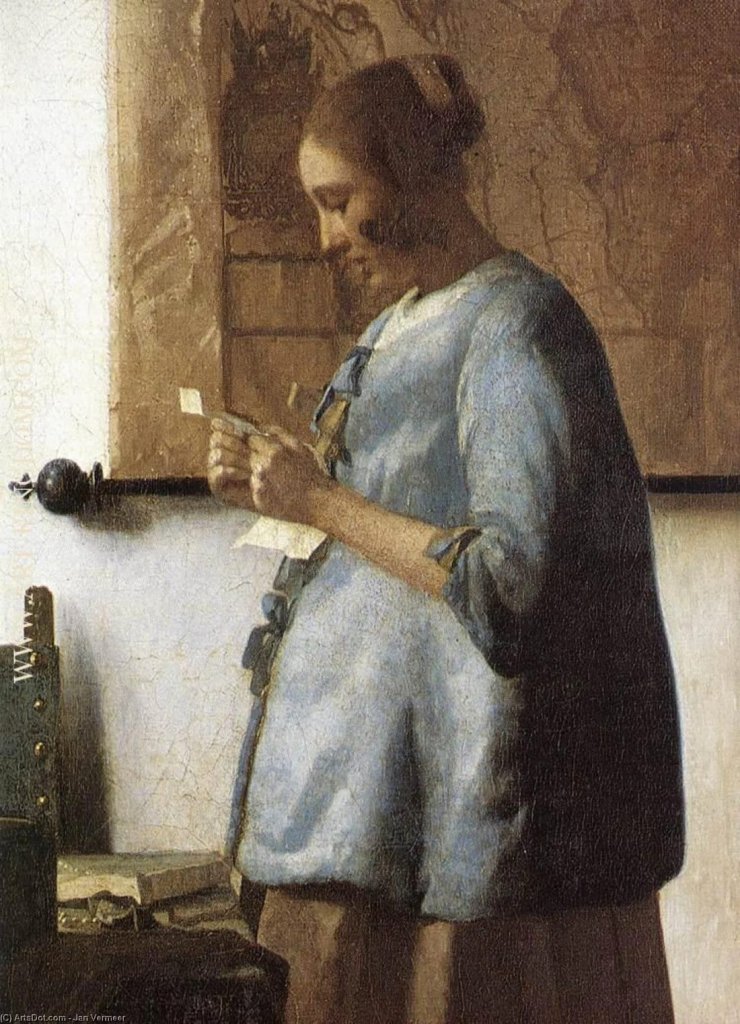
A woman alone with dangerous words. Credit: Johannes Vermeer, Woman in Blue Reading a Letter (c. 1663). Rijksmuseum, Amsterdam.
The most dangerous thing you can do right now is keep reading.
The tea has gone cold on the counter, and the windows are dark and the woman standing in the hallway has her mouth close to her friend’s ear. The words come out one breath at a time, barely louder than the radiator ticking in the wall, because writing them down would kill everyone in the apartment. The listener closes her eyes and memorizes. Tomorrow a different kitchen will host the same whispered exchange, and the verses will travel to another doorway in another city, and the line will hold, mouth to ear, for years, long after the empire that made the whispering necessary has crumbled into the kind of dust that requires a search engine to identify.
The woman in that hallway was Anna Akhmatova. The year was 1935. The poem was Requiem. And every reader who has ever encountered those lines, in every classroom on every continent where the morning coffee is still warm, arrived there because a chain of ordinary people decided, one after another, that a forbidden verse was worth the risk of carrying.
The corridor, the whispered verse, the cupped hands passing language too lethal to record. Every regime that ever ruled through fear was ultimately outlasted by someone who loved something the state had no way to kill.
The Architecture of Silence
Russia spent two centuries perfecting the erasure of dissent. The state absorbed the press, the judiciary, the military, the schools, the churches, the economy, and disappeared dissidents so efficiently that neighbors learned to treat the empty chair at dinner as furniture, until resistance came to seem clinically delusional, the affliction of people who had not yet made peace with gravity.
Fyodor Dostoevsky marched to a firing squad at twenty-seven for the crime of reading prohibited literature aloud. Rifles shouldered, the command traveling down the line, the young writer stood in the winter air of Semyonov Place watching the barrels rise until, in that held breath between order and execution, a messenger arrived with a commutation meant to break a man who thought reading aloud was worth his life. The state shipped the prisoner to Siberia, four years of labor in chains, confident the young radical had been converted into a cautionary anecdote, and instead forged the consciousness that would produce The Brothers Karamazov and Crime and Punishment, works that have reshaped how hundreds of millions of people understand guilt, redemption, and what we owe one another in the darkest hours.
Mikhail Bulgakov wrote The Master and Margarita knowing the secret police had already confiscated and incinerated an earlier draft. The man sat at his desk and wrote the book again, from memory. Dying in 1940 while readers would not encounter the novel until 1966, Bulgakov left behind sentences that millions of strangers would eventually carry inside their heads like stolen freight. The censors who destroyed those pages are nameless, every last one.
Victory does not require your own lifetime.
Two in the Morning
Some nights, the apartment quiet and the cursor blinking on a half-finished paragraph, a weight settles behind my sternum. Last Tuesday the weight arrived with a number attached: the actual count of paid subscribers keeping this publication alive. The number was pathetic. Saying so makes my face warm, but at two in the morning the only currency left is the truth. Then came a voice, specific and calm, reciting evidence: You are one woman, with no institutional backing, writing for an audience that might be empty. And the only response available at that hour was the one Akhmatova found whispering in the dark, that Dostoevsky discovered in Siberia, that Bulgakov reached with the secret police already in possession of the first draft. Keep writing the sentence, finish the paragraph, publish the piece, and trust the chain to hold.
The powerful understand one arithmetic above all others. Your isolation is cheaper than your participation.
Last Friday, the New York Times reported that the Department of Homeland Security has sent hundreds of administrative subpoenas to Google, Meta, Reddit, and Discord demanding the names, email addresses, and phone numbers of Americans who criticized ICE or tracked the location of its agents online. No judge approved the requests. Google, Meta, and Reddit complied with at least some of the requests.
A bilingual neighborhood watch page in Montgomery County, Pennsylvania, posting ICE sightings in English and Spanish for roughly 10,000 followers, was told that if its administrators did not hire a lawyer and get to federal court within ten days, the platform would hand their identities to the government.
When the ACLU intervened, DHS quietly withdrew the demand before a judge could rule on whether the request was legal, then issued new ones to other targets. The tool had previously been reserved for child abductions.
Read that paragraph again. A federal agency is demanding that private companies identify, by name, the citizens who criticized its conduct. The people running a neighborhood Facebook page in suburban Pennsylvania encountered the same choice Akhmatova confronted in the hallway: speak, and risk being identified by the state.
The hallway never closed. The hallway just got a loading screen.
Wherever You Are Sitting
Somewhere right now a woman is checking her phone for the third time since midnight, refreshing a government website to see whether the program her family depends on will still exist in the morning. The loading icon spins and her stomach drops before the page even renders, because the body learns to brace for loss faster than the mind can finish reading. Down the hall a teacher is staring at a revised curriculum, stomach tight, rehearsing what to say when a student asks why the chapter on civil rights has been shortened to a single page. At a kitchen table a father is composing a letter he already knows will be ignored, writing the sentences anyway.
And you are here. Reading.
Which means the choice at the center of this essay has already been made.
Somewhere between the first sentence and this one, the tab stayed open. The scroll continued downward. The screen did not go dark. All of that required choosing, the same stubbornness Akhmatova depended on when leaning toward a trusted ear to speak, because the chain does not perpetuate without someone deciding to carry the next link. Every link is a decision someone made to stay present when the room becomes uncomfortable.
The hallway where Akhmatova stood in 1935 never closed. Lip to memory, verse to trusted hand, the transmission survived the collapse of the Soviet Union and continues to run through every century, kept alive by two people deciding that the truth between them mattered more than the comfort of looking away. The current is on your screen at this moment, running beneath these sentences, and will vanish the instant you decide to let the signal go quiet.
The question was never whether you matter. The question is what you will do in the next ten seconds.
Power can compel obedience and enforce silence. Meaning is the one thing power has never once managed to produce, not in the whole record of civilization. Everything that endures was made by someone who had every rational reason to stop and chose, in the small hours, to keep writing the sentence.
The cupped hands belong to you now. The hallway is wherever you are sitting. And your mouth is already close enough to someone’s ear.
Glass Empires provides rigorous analysis that stands on its own, and I am grateful that you are reading. This publication is fully reader supported and depends on paid subscriptions. Annual plans are available at 40 % less than the monthly rate for a limited time.
Sources
Homeland Security Wants Social Media Sites to Expose Anti-ICE Accounts https://www.nytimes.com/2026/02/13/technology/dhs-anti-ice-social-media.html