Priyanka Vergadia | TEDNext 2025
• November 2025

The Spirit of Ekecheiria Can’t End Conflict, But Can Offer Nations and Individuals a Peaceful Ideal
by Jacques A. Bromberg February 19, 2026 (ZocaloPublicSquare.org)

As the Olympic flame flickers out in Milan, athletes, officials, and spectators will begin their journeys home to capitals and conflict zones. The closing ceremony marks not only the end of competition, but the end of a rare interval in which rival nations have occupied the same symbolic ground without violence.
The founding mission of modern Olympism is “to bring about a more peaceful world.” Central to that promise is ekecheiria (ancient Greek meaning “holding back the hands”), or the Olympic truce, which claims that sport can create conditions, however briefly, for restraint amid conflict.
The Olympic truce has long been understood as a promise that war would pause during the Games. But the reality of the historical truce is slimmer than its ideal. Wars do not stop when the Olympic torch is lit, and they never have.
In antiquity, no interstate conflict was suspended simply because athletes gathered at Olympia. One of the clearest examples comes from 416 B.C.E., during the long and devastating Peloponnesian War, a struggle for dominance between the Athenian empire and a Spartan-led alliance that drew in nearly the entire Greek-speaking world, from Sicily to the Bosporus. That summer, Athens turned its attention to the small island of Melos, a Spartan colony that had tried to remain neutral in the conflict. The Athenians sent a force to subjugate the Melians, under the pretense of offering them an allegiance with Athens.
Thucydides, in his History of the Peloponnesian War, wrote a fictionalized account of the negotiations between Athenian envoys and Melian leaders. When the talks come to a stalemate, the Athenian delegate states, “the strong do what they can, and the weak get out of the way.” The sentiment, invoked at Davos recently by Canadian Prime Minister Mark Carney, is a blunt and brutally pragmatic statement of realpolitik: power, not justice, determines outcomes.
You would never know from reading this frightening account that the games of the 91st Olympiad were underway at Olympia, and that the ekecheiria was formally in effect. Just months after the Games, the Athenians sacked Melos. They executed the men and sold the women and children into slavery. If the Olympic truce is measured by its ability to halt war, it failed spectacularly.
But that is a standard the ancient truce was never designed to meet.
The ancient ekecheiria did not aim to regulate warfare between states. It protected people, not politics: athletes, spectators, and envoys traveling to and from the sanctuary at Olympia, as well as the sacred space of the sanctuary itself. Its purpose was not to end wars, but to carve out a protected space within them.
The two known examples of the ekecheiria at work in antiquity support this understanding of the truce and its limits.
Reports of the first instance also come from Thucydide. In 420 B.C.E., he wrote, the Spartans were barred from competing in the 90th Olympiad after the Eleans accused them of violating the truce during the sacred period. The Spartans disputed the charge, arguing that the truce had not yet been formally proclaimed when their forces moved on the town of Lepreum. Elis, which was aligned with Athens, imposed a substantial fine. When Sparta refused to pay, its athletes were excluded from the Games, a public humiliation and a low point in the war for the Spartans.
If the Olympic truce is measured by its ability to halt war, it failed spectacularly. But that is a standard the ancient truce was never designed to meet.
The second instance occurred in 348 B.C.E., when an Athenian named Phrynon was seized by Macedonian privateers and held for ransom while traveling to Olympia. His capture was not an act of war but a disruption of safe passage to the Games, precisely the sort of violation the truce was meant to prevent. Phrynon was wealthy enough to pay his ransom and return home to Athens. According to the orator Aeschines, he then asked the Athenians to send an envoy to King Philip II of Macedon to recover the money he had been forced to pay. An embassy was dispatched on his behalf. Though Aeschines does not spell out the financial outcome, the mission’s broader diplomatic success suggests that Philip was willing to address the grievance.
The notion that the Olympic truce meant a general armistice and the cessation of hostilities first emerged not long after the end of the Peloponnesian War. Greek thinkers of the time attempted to craft post-war narratives that imagined interstate unity and stressed panhellenic cultural cohesion.
Some, such as the philosopher Aristotle, sought to ground the Olympic festival in a shared and authoritative past. Aristotle reportedly described a bronze discus displayed at Olympia bearing the names of ancient kings (Iphitus of Elis and Lycurgus of Sparta) alongside the terms of the ekecheiria. Whether or not such an object existed, the story is revealing: It aimed at locating the truce at the very founding of the Games, tying it to legendary lawgivers, and giving the custom the weight and legitimacy of antiquity.
Other writers sought sources of panhellenic unity by locating the origins of the ekecheiria in shared myths. In his Olympic Oration (circa 388/384 B.C.E.), Lysias claimed that Herakles established the contest because “the cities were unfavorably disposed to one another,” and that Herakles believed that the gathering would be “the beginning of mutual friendship among the Greeks.” A few years later, the rhetorician Isocrates praised the festival’s founders for handing down a custom whereby Greeks come together in one place, “having made treaties with one another and resolved our pending hostilities.”
Both speeches characterize the Games as a symbol of shared Hellenic identity, not simply a series of athletic contests. Over time, that symbolic meaning eclipsed the narrower historical reality. The Olympic truce endures precisely because of its mythic, morally compelling status.
Since the 1990s, the International Olympic Committee has revived and institutionalized the truce in its charter, and it has been invoked not only rhetorically but, at times, practically. During the 1994 Lillehammer Games, negotiations facilitated by the IOC and the U.N. helped secure a temporary ceasefire in Bosnia. That brief pause allowed humanitarian workers to vaccinate thousands of children and deliver relief to besieged Sarajevo, a city that had hosted the Olympics just a decade earlier.

The truce has also functioned as a stage for symbolic reconciliation. At the 2000 Sydney and 2004 Athens Games, athletes from North and South Korea marched together under a single flag. In 2016, the introduction of a Refugee Olympic Team signaled inclusion for displaced persons who no longer competed under national banners at all.
Since 1993, the United Nations General Assembly has adopted a resolution before every Olympic Games urging member states to observe the ekecheiria, typically from seven days before the opening ceremony until seven days after the closing. The language revives the ancient promise of safe passage and nonviolence around the Games, even as wars continue elsewhere.
At a moment when the Global Peace Index reports the world at its least peaceful level in modern history, the truce may appear naïve. Yet its persistence suggests something else: that even in periods of escalating conflict, the desire for bounded spaces of restraint has not disappeared.
In this way, the modern Games have built upon and even outdone the ancient festival. Not by ending violence, but by insisting that there should be moments when it is held back. In the Olympic Village, that insistence takes visible form on the Truce Wall, where athletes sign their names beside competitors from rival nations. The gesture is small. Yet it affirms a principle that has endured for centuries.
Jacques A. Bromberg is a historian of ancient Greece and adjunct professor of classics at the University of Pittsburgh. He is the author of Global Classics and numerous essays on the rhetoric and ideology of the ancient and modern Olympics.

Published: February 19, 2026 (TheOnion.com)
“Looksmaxxing,” a new trend that can involve jaw exercises, steroid use, and extreme cosmetic procedures, has taken off among many boys and young men. The Onion dispels common myths surrounding looksmaxxing.
MYTH: Regularly exercising your jaw muscles can make them bigger.
FACT: The most effective way to change your face shape is to contract mumps.
MYTH: Looksmaxxing is a troubling component of incel subculture.
FACT: Looksmaxxing is probably the least troubling part of incel subculture.
MYTH: If you have a negative canthal tilt, women will find you repulsive.
FACT: If you won’t shut the fuck up about canthal tilts, women will find you repulsive.
MYTH: Looksmaxxing is an unhealthy grasp for control amid economic and social instability.
FACT: Sounds like someone just got mogged.
MYTH: Limb-lengthening surgery is a reasonable option for men who want to be taller.
FACT: You can achieve far better results tying yourself between two horses.
MYTH: Looksmaxxing is a repackaging of body dysmorphia for men.
FACT: Looksmaxxing is a repackaging of body dysmorphia for everyone.

A.Word.A.Daywith Anu Garg
PRONUNCIATION:
MEANING:
adjective: Self-fertilizing.
ETYMOLOGY:
From autogamy, from German Autogamie, coined in 1876 by Austrian botanist Anton Kerner von Marilaun (1831-1898).Earliest documented use: 1880.
NOTES:
Being autogamous is capable of reproduction without a second individual. If you want something done right, do it yourself. The autogamous motto. It’s the scientific term for single-player mode. A related term is hermaphrodite.
As Trump becomes more desperate, citizen organizing only grows.
 by Robert Kuttner February 17, 2026 (Prospect.org)

Wesleyan University President Michael Roth, who has been a leader in organizing college presidents to resist Donald Trump’s demands, has come up with a terrific idea to help safeguard the midterm elections. He proposes something called Democracy Summer 2026, evoking the heroic Freedom Summer of 1964 that aimed to advance voting rights in Mississippi.
“Wesleyan University is reaching out to colleges across the country to build a network of institutions to protect our democracy,” Roth explains. “We hope that by the fall thousands of students will be working side by side with election administrators and civic organizations to support poll worker recruitment, election protection efforts, and lawful observation.”
He added, “During Democracy Summer 2026, many schools will offer internships for young people eager to join campaigns. In recent years Wesleyan students have been engaging with potential voters in places like Michigan and North Carolina, in Pennsylvania and New Hampshire. By the fall our network will launch thousands of students into meaningful work side-by-side with election administrators and civic organizations. The elections of 2026 are crucial, but we are building democratic muscles that should endure.”
Roth’s initiative is a nonpartisan cousin to Maryland Rep. Jamie Raskin’s Democracy Summer program, which trains students to be organizers and campaign workers for progressive candidates.
If we take stock of all the ways that Trump is threatening free and fair elections next fall, student election workers can’t do everything, but they can do a lot. Trump has tried to “nationalize” elections, meaning have the federal government take control of election administration, which the Constitution clearly delegates to the states. He issued an executive order to that effect back in March.
Trump’s Justice Department has demanded voter rolls from at least 44 states, and most have refused to provide them. The idea is to have the Justice Department take over voter lists and then conduct bogus purges. The courts have sided with the states, and if the case ever reaches the Supreme Court, even this high court is likely to disallow Trump’s demand.
In the case of the flagrantly illegal raid on Fulton County, Georgia, voting records from 2020, Trump is trying to relitigate his bogus claims that he lost Georgia in 2020 because of illegal voting. This has been disproven over and over again. Here again, even a Trump-friendly Supreme Court is likely to hold that such incursions are illegal.
Trump and the Republican House have also tried to narrow the franchise by passing legislation requiring proof of citizenship and photo ID for people to register and vote. The so-called SAVE America Act passed the House last week, but it won’t get the required 60 votes to pass the Senate.
Occasionally, Trump blurts out the truth. On February 5, he told the National Prayer Breakfast, “They rigged the second [2020] election. I had to win it. I needed it for my own ego.”
In a recent interview with NBC News, Trump was asked if he would accept election results. He replied, “I will accept the results of the election only if I think that it is fair.” As Susan Glasser observed in The New Yorker, “The point seems to be that, for Trump, any election won by a Democrat is, by definition, unfair, fake, rigged.”
At bottom, Trump is relying on two strategies to undermine free and fair elections: First, depress who is able to register and vote; second, create maximum chaos and intimidation on Election Day.
On the former, it is up to the courts and election integrity organizations to block Trump’s maneuvers. On the latter, the more that citizen activists work to prevent Election Day intimidation, the fairer and freer elections will be. A number of groups, such as Indivisible and Run for Something, have mobilized people to work to elect Democrats. That also becomes a force to insist on free and fair elections.
Several election protection groups have never been stronger, working to both track and litigate threats. They include the Brennan Center for Justice, the NAACP Legal Defense Fund, Protect Democracy, Democracy Docket, as well as Democratic secretaries of state and attorneys general.
Taken together, these and other groups have done a superb job of challenging all of Trump’s attempted incursions. Despite the conservative cast of the courts, Trump’s ploys have been so outlandish that the democracy groups have been winning key cases more than they have been losing.
One other risk, which may seem a little far-fetched (but with Trump, nothing is too far-fetched): If Democrats do take back the House, Trump may even try a variant of January 6, 2021, and try to prevent new House members from being seated, claiming massive (if totally invented) fraud.
Thus far, in special elections, Speaker Mike Johnson has not quite stooped to this, but he came close. Democrat Adelita Grijalva was sworn in as the representative for Arizona’s Seventh Congressional District last November 12, after a record-setting 50-day delay following her special-election victory on September 23. Johnson’s excuse for refusing to seat her was the government shutdown and House recess.
The old Speaker is no longer Speaker when the new Congress reconvenes on January 3, 2027. If the House changes hands, under the House rules the clerk of the House, who is a nonmember staffer, swears in the new House, which then elects the Speaker.
This adds one more obstacle to a coup. To overturn the election, Trump and Johnson would have to revise the House rules, and some anti-Trump Republicans might refuse to go along.
But if Trump and Johnson did find a way to refuse to recognize election results to avoid turning over control of the House, that would be a move to outright dictatorship. It would be more serious even than the constitutional crisis of 1876, when conservative Republicans in Congress lined up with Southern Democrats to fraudulently overturn the presidential election results in a deal that ended Reconstruction.
A citizen uprising, as in the case of Minneapolis and ICE, can’t guarantee that a desperate Trump won’t attempt another coup. But we can make it a lot harder for him to try.

Only a pro-employer labor law is keeping millions of American workers from the benefits of unionizing.
by Harold MeyersonFebruary 19, 2026

The private equity behemoth’s bid to acquire New Mexico’s largest electricity provider could be null and void. Will regulators be bold enough to apply the law?
by James BarattaFebruary 19, 2026

State attorneys general will have a say in whether Paramount ultimately succeeds in taking over CNN, HBO, and the rest of Warner Bros. Discovery.
by David DayenFebruary 19, 2026
You’ve just read one of the stories we published this week because readers like you made it possible.
The Prospect doesn’t answer to advertisers or billionaire owners. We answer to you. That’s not a slogan—it’s how we’re funded, and it’s why we can report without fear or favor.
Independent, reader-supported journalism is rare. We’d like to keep it going. If you believe this kind of reporting should exist and remain free to read we hope you’ll consider chipping in. Every contribution, however modest, makes a real difference.
Support independent journalism
With gratitude,

Robert Kuttner is co-founder and co-editor of The American Prospect, and professor at Brandeis University’s Heller School. His latest book is Going Big: FDR’s Legacy, Biden’s New Deal, and the Struggle to Save Democracy. Follow Bob at his site, robertkuttner.com, and on Twitter. More by Robert Kuttner
by Rob Brezsny | February 17, 2026 (newcity.com)

ARIES (March 21-April 19): Saturn has entered Aries. I see this landmark shift as being potentially very good news for you. Between now and April 2028, you will have enhanced powers to channel your restless heart in constructive directions. I predict you will narrow down your multiple interests and devote yourself to a few resonant paths rather than scattering your intense energy. More than ever before, you can summon the determination to follow through on what you initiate. My Saturn-in-Aries prayer: May you be bold, even brazen, in identifying where you truly belong, and never settle for a half certain fit.
TAURUS (April 20-May 20): I am issuing a Wow Advisory. Consider this your high-voltage wonder alert. Your future may offer you thrilling quests and epic exploits that could be unnerving to people who want you to remain the same as you have been. You will have a knack for stirring up liberating encounters with lavish pleasures and rich feelings that transform your brain chemistry. The rousing mysteries you attract into your sphere may send provocative ripples through your own imagination as well as your web of allies. Expect juicy plot twists. Be alert for portals opening in the middle of nowhere.
GEMINI (May 21-June 20): In Leonardo da Vinci’s notebooks, you find anatomical drawings next to flying machine designs, mathematical calculations alongside water flow observations, and philosophical musings interrupted by grocery lists. He moved from painting to engineering to scientific observation as curiosity led him. Let’s make him your inspirational role model for now, Gemini. Disobey categories! Merge categories! Mix and match categories! Let’s assume that your eager mind will create expanded knowledge networks that prove valuable in unexpected ways. Let’s hypothesize that your cheerful rebellion against conventional ways of organizing reality will spawn energizing innovations in your beautiful, mysterious life.
CANCER (June 21-July 22): In falconry, there’s a practice called “weathering.” It involves regularly exposing trained birds to the wild elements so they don’t become too domesticated and lose their wildness. The falconer needs a partner, not a pet. Does that theme resonate, Cancerian? Is it possible that you have been too sheltered lately? Either by your own caution or by well-meaning people who think they’re protecting you? Let’s make sure you stay in touch with the fervent, untamed sides of your nature. How? You could expose yourself to an experience that scares you a little. Take a fun risk you’ve been rationalizing away. Invite touches of rowdiness into your life.
LEO (July 23-Aug. 22): The loudest noise in history? It was the 1883 volcanic eruption of Krakatoa in Indonesia, heard thousands of miles away. The pressure wave circled the Earth multiple times. I am predicting a benevolent version of a Krakatoa event for you in the coming months. Not literal loudness, but a shiny bright expression of such magnitude that it redefines your world and what people thought was possible from you. Can you be prepared for it? A little. You’ll be wise to cultivate visionary equanimity: a calm willingness to stay focused on the big picture. I predict your big boom will be challenging but ultimately magnificent and empowering.
VIRGO (Aug. 23-Sept. 22): Buddhism teaches about “near enemies”: qualities that may appear to be virtues but aren’t. For example, pity masquerades as compassion. Clingy attachment pretends to be love. Apathy and indifference pose as equanimity. In the coming weeks, Virgo, I hope you won’t get distracted by near enemies. Your assignment: Investigate whether any of your supposed virtues are actually near enemies. After you’ve done that, find out if any of your so-called negative emotions might harbor interesting powers you could tap into.
LIBRA (Sept. 23-Oct. 22): Many intelligent people think astrology is dangerous nonsense perpetrated by quacks. For any horoscope writer with an ego, this affront tends to be deflating. Like everyone else, we want to be appreciated. On the other hand, I have found that practicing an art that gets so much disdain has been mostly liberating. It’s impossible for me to get bloated with excess pride. I practice astrology for the joy it affords me, not to garner recognition. So in a backhanded way, a seemingly disheartening drawback serves as an energizing boon. My prediction is that you, Libra, will soon harvest an analogous turnabout. You will draw strength, even inspiration, from what may ostensibly appear to be a liability.
SCORPIO (Oct. 23-Nov. 21): Mycologist Paul Stamets claims mushrooms taught him to think in networks rather than hierarchies. He sees how everything feeds everything else through vast webs of underground filaments. This is Scorpio wisdom at its most scintillating: homing in on the hidden circuitry working below the surface; gauging the way nourishment is distributed incrementally through many collaborative interconnections; seeing the synergy between seemingly separate sources. I hope you will accentuate this mode of understanding in the coming weeks. The key to your soulful success and happiness will be in how well you map the mycelial-like networks, both in the world around you and in your inner depths. PS: For extra credit, study the invisible threads that link your obsessions to each other, your wounds to your gifts, and your rage to your tenderness.
SAGITTARIUS (Nov. 22-Dec. 21): The peregrine falcon dives at speeds exceeding 240 miles per hour, making it the fastest animal on Earth. But before the dive, there’s often a period of circling, scanning and waiting. The spectacular descent is set up by the patient reconnaissance that precedes it. I believe you’re now in a phase similar to the falcon’s preparatory reconnaissance, Sagittarius. The quality of your eventual plunge will depend on how well you’re tracking your target now. Use this time to gather intelligence, not to second-guess your readiness. You’ll know when your aim is true.
CAPRICORN (Dec. 22-Jan. 19): There’s a certain miracle you could really use right now, Capricorn. But to attract it into your life would require a subtle and simple shift. In a related development, the revelation you need most is concealed in plain sight. To get these two goodies into your life, you shouldn’t make the error of seeking them in exotic locales. Ordinary events in the daily routine will bring you what you need: the miracle and the revelation that will change everything for the better.
AQUARIUS (Jan. 20-Feb. 18): Over the last 4,000 years, a host of things have been used as money in addition to precious metals and paper currency. Among them have been cows, seashells, cheese, tobacco, velvet, tulips, elephant tusks and huge stone wheels. I hope this poetic fact will inspire your imagination about financial matters. In the coming weeks, I expect you’ll be extra creative in drumming up new approaches to getting the cash you need. Here are questions to guide you. Which of your underused talents might be ready to boost your income? What undervalued gifts could you be more aggressive about giving? What neglected treasures or underutilized assets could you use to generate money?
PISCES (Feb. 19-March 20): Big bright transitions are at hand: from thrashing around in the educational mire to celebrating your sweet escape; from wrangling with shadows and ghosts to greeting new allies; from messing around with interesting but confounding chaos to seizing fresh opportunities to shine and thrive. Hallelujah! What explains this exhilarating shift? The Season of Dazzling Self-Adoration is dawning for you Pisceans. In the weeks ahead, you will be inspired to embark on bold experiments in loving yourself with extra fervor and ingenuity.
Homework: What imperfect but pretty good part of your life deserves more of your love? Newsletter.FreeWillAstrology.com
Call of the Soul Dec 11, 2025 ???? Edgar CayceSouls born between 1945 and 1965 carry a unique spiritual mission. According to Cayce, this generation came to break old cycles, awaken dormant memories, and illuminate the transition of human consciousness. ???? In this video, you will discover why your life has never been ordinary—and what your soul’s ultimate purpose is. Prepare for a profound and transformative revelation.
How this was made. Altered or synthetic content. Sound or visuals were significantly edited or digitally generated. Learn more
(Contributed by Zoë Robinson, H.W., M.)

Published: March 27, 2017 (TheOnion.com)
FRAMINGHAM, MA—Noting its high concentration of nightlife, droves of attractive singles, and atmospheric conditions allowing liquid alcohol to exist, the Princeton Review on Monday ranked Earth the Milky Way galaxy’s top party planet for the fifth year in a row. “More than any of its celestial neighbors, Earth is the place to let off some steam and get a little crazy with your friends every night of the week,” said associate editor Blake Kalfus, adding that the planet was the only known celestial body to possess sufficient oxygen for top EDM DJs like Afrojack and Steve Aoki to survive. “With its solid terrestrial surface layer capable of supporting millions of clubs and two-for-one drink specials, there’s no party destination within 1000,000 light-years that’s more electric than Earth. And that doesn’t even count the more relaxed vibe you get on its nearby moon.” Meanwhile, Kepler-138d, Earth’s longtime rival for most popular party planet, reportedly fell from second place to 16th after the gas giant banned fraternities.
| Robert Reich Feb 17, 2026 |
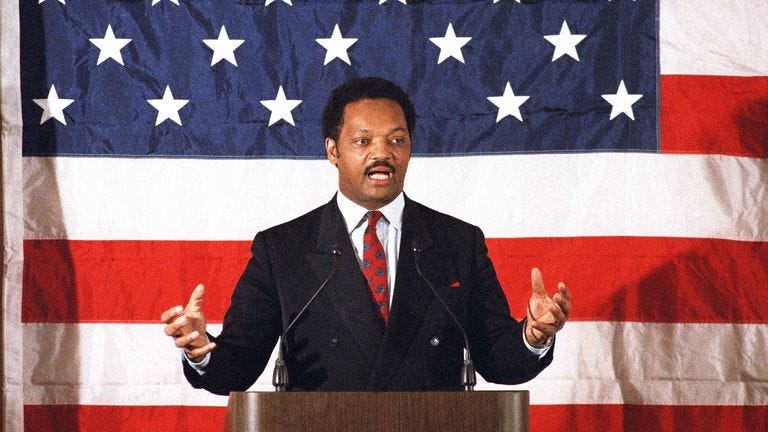
Tonight, we pause and give praise and honor to God for being good enough to allow us to be at this place, at this time. When I look out at this convention, I see the face of America: Red, Yellow, Brown, Black and White. We are all precious in God’s sight – the real rainbow coalition.
(Applause)
All of us – all of us who are here think that we are seated. But we’re really standing on someone’s shoulders. Ladies and gentlemen, Mrs. Rosa Parks. (Applause) The mother of the civil rights movement. [Mrs. Rosa Parks was brought to the podium.]
I want to express my deep love and appreciation for support my family has given me over the past months. They have endured pain, anxiety, threat and fear. But they have been strengthened and made secure by our faith in God, in America, and in you. Your love has protected us and made us strong. To my wife Jackie, the foundation of our family; to our five children whom you met tonight; to my mother, Mrs. Helen Jackson, who is present tonight; and to our grandmother, Mrs. Matilda Burns; to my brother Chuck and his family; to my mother-in-law, Mrs. Gertrude Brown, who just last month at age 61 graduated from Hampton Institute – A marvelous achievement. (Applause)
I offer my appreciation to Mayor Andrew Young who has provided such gracious hospitality to all of us this week.
And a special salute to President Jimmy Carter. (Applause) President Carter restored honor to the White House after Watergate. He gave many of us a special opportunity to grow. For his kind words, for his unwavering commitment to peace in the world, and for the votes that came from his family, every member of his family, led Billy and Amy, I offer special thanks to the Carter family.
(Applause)
My right and my privilege to stand here before you has been won, won in my lifetime, by the blood and the sweat of the innocent.
Twenty-four years ago, the late Fannie Lou Hamer and Aaron Henry – who sits here tonight from Mississippi – were locked out into the streets in Atlantic City; the head of the Mississippi Freedom Democratic Party.
But tonight, a Black and White delegation from Mississippi is headed by Ed Cole, a Black man from Mississippi; 24 years later. (Applause)
Many were lost in the struggle for the right to vote: Jimmy Lee Jackson, a young student, gave his life; Viola Liuzzo, a White mother from Detroit, called nigger lover, had her brains blown out at point blank range; [Michael] Schwerner, [Andrew] Goodman and [James] Chaney – two Jews and a Black – found in a common grave, boddies riddled with bullets in Mississippi; the four darling little girls in a church in Birmingham, Alabama. They died that we might have a right to live.
Dr. Martin Luther King Jr. lies only a few miles from us tonight. Tonight he must feel good as he looks down upon us. We sit here together, a rainbow, a coalition – the sons and daughters of slavemasters and the sons and daughters of slaves, sitting together around a common table, to decide the direction of our party and our country. His heart would be full tonight.
As a testament to the struggles of those who have gone before; as a legacy for those who will come after; as a tribute to the endurance, the patience, the courage of our forefathers and mothers; as an assurance that their prayers are being answered, their work have not been in vain, and hope is eternal; tomorrow night my name will go into nomination for the Presidency of the United States of America.
We meet tonight at the crossroads, a point of decision. Shall we expand, be inclusive, find unity and power; or suffer division and impotence?
We’ve come to Atlanta, the cradle of the old South, the crucible of the new South. Tonight, there is a sense of celebration, because we are moved, fundamentally moved from racial battlegrounds by law, to economic common ground. Tomorrow we will challenge to move to higher ground.
Common ground! Think of Jerusalem, the intersection where many trails met. A small village that became the birthplace for three religions – Judaism, Christianity and Islam. Why was this village so blessed? Because it provided a crossroads there different people met, different cultures, different civilizations could meet and find common ground. When people come together, flowers always flourish – the air is rich with the aroma of a new spring.
Take New York, the dynamic metropolis. What makes New York so special? It’s the invitation of the Statue of Liberty, “Give me your tired, your poor, your huddled masses who yearn to breathe free.” Not restricted to English only. (Applause) Many people, many cultures, many languages – with one thing in common, they yearn to breathe free. Common ground!
Tonight in Atlanta, for the first time in this century, we convene in the South; a state where Governors once stood in school house doors; where Julian Bond was denied a seal in the State Legislature because of his conscientious objection to the Vietnam War; a city that, through its five Black Universities, has graduated more black students than any city in the world. (Applause) Atlanta, now a modern intersection of the new South.
Common ground! That’s the challenge of our party tonight. Left wing. Right wing.
Progress will not come through boundless liberalism nor static conservatism, but at the critical mass of mutual survival – not at boundless liberalism nor static conservatism, but at the critical mass of mutual survival. It takes two wings to fly. Whether you’re a hawk or a dove, you’re just a bird living in the same environment, in the same world.
The Bible teaches that when lions and lambs lie down together, none will be afraid and there will be peace in the valley. It sounds impossible. Lions eat lambs. Lambs sensibly flee from lions. Yet when even lions and lambs will find common ground. Why? Because neither lions nor lambs can survive nuclear war. If lions and lambs can find common ground, surely we can as well – as civilized people. (Applause)
The only time that we win is when we come together. In 1960, John Kennedy, the late John Kennedy, beat Richard Nixon by only 112,000 votes – less than one vote per precinct. He won by the margin of our hope. He brought us together. He reached out. He had the courage to defy his advisors and inquire about Dr. King’s jailing in Albany, Georgia. We won by the margin of our hope, inspired by courageous leadership.
In 1964, Lyndon Johnson brought wings together – the thesis, the antithesis, and the creative synthesis – and together we won.
In 1976, Jimmy Carter unified us again, and we won. When do we not come together, we never win.
In 1968, the vision and despair in July led to our defeat in November. In 1980, rancor in the spring and the summer led to Reagan in the fall.
When we divide, we cannot win. We must find common ground as the basis for survival and development and change, and growth. (Applause)
Today when we debated, differed, deliberated, agreed to agree, agree to disagree, when we had the good judgment to argue a case and then not self-destruct, George Bush was just a little further away from the White House and a little closer to private life. (Applause)
Tonight I salute Governor Michael Dukakis. (Applause) He has run – He has run a well-managed and a dignified campaign. No matter how tired or how tried, he always resisted the temptation to stoop to demagoguery.
I’ve watched a good mind fast at work, with steel nerves, guiding his campaign out of the crowded field without appeal to the worst in us. I have watched his perspective grow as his environment has expanded. I’ve seen his toughness and tenacity close up. I know his commitment to public service. Michael Dukakis’ parents were a doctor and a teacher; my parents a maid, a beautician and a janitor. There’s a great gap between Brookline, Massachusetts and Haney Street in the Fieldcrest Village housing projects in Greenville, South Carolina. (Applause)
He studied law; I studied theology. There are differences of religion, region, and race; differences in experiences and perspectives. But the genius of America is that out of the many we become one.
Providence has enabled our paths to intersect. His foreparents came to America on immigrant ships; my foreparents came to America on slave ships. But whatever the original ships, we’re in the same boat tonight. (Applause) Our ships could pass in the night– if we have a false sense of independence– or they could collide and crash. We could lose our passengers. But we can seek a high reality and a greater good.
Apart, we can drift on the broken pieces of Reagonomics, satisfy our baser instincts, and exploit the fears of our people. At our highest we can call upon noble instincts and navigate this vessel to safety. The greater good is the common good.
As Jesus said, “Not My will, but Thine be done.” It was his way of saying there’s a higher good beyond personal comfort or position.
The good of our Nation is at stake. It’s commitment to working men and women, to the poor and the vulnerable, to the many in the world.
With so many guided missiles, and so much misguided leadership, the stakes are exceedingly high. Our choice? Full participation in a democratic government, or more abandonment and neglect. And so this night, we choose not a false sense of independence, and our capacity to survive and endure. Tonight we choose interdependency, and our capacity to act and unite for the greater good.
Common good is finding commitment to new priorities to expansion and inclusion. A commitment to expanded participation in the Democratic Party at every level. A commitment to a shared national campaign strategy and involvement at every level.
A commitment to new priorities that insure that hope will be kept alive. A common ground commitment to a legislative agenda for empowerment, for the John Conyers bill– universal, on-site, same-day registration everywhere. (Applause) A commitment to D.C. statehood and empowerment– D.C. deserves statehood. (Applause) A commitment to economic set-asides, commitment to the Dellums bill for comprehensive sanctions against South Africa. (Applause) A shared commitment to a common direction.
Common ground! Easier said than done. Where do you find common ground? At the point of challenge. This campaign has shown that politics need not be marketed by politicians, packaged by pollsters and pundits. Politics can be a moral arena where people come together to find common ground.
We find common ground at the plant gate that closes on workers without notice. We find common ground at the farm auction, where a good farmer loses his or her land to bad loans or diminishing markets. Common ground at the school yard where teachers cannot get adequate pay, and students cannot get a scholarship, and can’t make a loan. Common ground at the hospital admitting room, where somebody tonight is dying because they cannot afford to go upstairs to a bed that’s empty waiting for someone with insurance to get sick. We are a better nation than that. We must do better. (Applause)
Common ground. What is leadership if not present help in a time of crisis? So I met you at the point of challenge. In Jay, Maine, where paper workers were striking for fair wages; in Greenville, Iowa, where family farmers struggle for a fair price; in Cleveland, Ohio, where working women seek comparable worth; in McFarland, California, where the children of Hispanic farm workers may be dying from poisoned land, dying in clusters with cancer; in an AIDS hospice in Houston, Texas, where the sick support one another, too often rejected by their own parents and friends.
Common ground. America is not a blanket woven from one thread, one color, one cloth. When I was a child growing up in Greenville, South Carolina my grandmama could not afford a blanket, she didn’t complain and we did not freeze. Instead she took pieces of old cloth – patches, wool, silk, gabardine, crockersack – only patches, barely good enough to wipe off your shoes with. But they didn’t stay that way very long. With sturdy hands and a strong cord, she sewed them together into a quilt, a thing of beauty and power and culture. Now, Democrats, we must build such a quilt.
Farmers, you seek fair prices and you are right – but you cannot stand alone. Your patch is not big enough. Workers, you fight for fair wages, you are right – but your patch of labor is not big enough. Women, you seek comparable worth and pay equity, you are right – but your patch is not big enough. (Applause)
Women, mothers, who seek Head Start, and day care and prenatal care on the front side of life, relevant jail care and welfare on the back side of life – you are right – but your patch is not big enough. Students, you seek scholarships, you are right – but your patch is not big enough. Blacks and Hispanics, when we fight for civil rights, we are right – but our patch is not big enough.
Gays and lesbians, when you fight against discrimination and a cure for AIDS, you are right – but your patch is not big enough. Conservatives and progressives, when you fight for what you believe, right wing, left wing, hawk, dove, you are right from your point of view, but your point of view is not enough.
But don’t despair. Be as wise as my grandmama. Pull the patches and the pieces together, bound by a common thread. When we form a great quilt of unity and common ground, we’ll have the power to bring about health care and housing and jobs and education and hope to our Nation. (Standing ovation)
We, the people, can win!
We stand at the end of along dark night of reaction. We stand tonight united in the commitment to a new direction. For almost eight years we’ve been led by those who view social good coming from private interest, who view public life as a means to increase private wealth. They have been prepared to sacrifice the common good of the many to satisfy the private interests and the wealth of a few.
We believe in a government that’s a tool of our democracy in service to the public, not an instrument of the aristocracy in search of private wealth. We believe in government with the consent of the government with the consent of the governed, “of, for and by the people.” We must now emerge into a new day with a new direction.
Reaganomics. Based on the belief that the rich had too little money and the poor had too much. That’s classic Reaganomics. They believe that the poor had too much money and the rich had too little money so they engaged in reverse Robin Hood – took from the poor and gave to the rich, paid for by the middle class. We cannot stand four more years of Reaganomics in any version, in any disguise.(Applause)
How do I document that case? Seven years later, the richest 1 percent of our society pays 20 percent less in taxes. The poorest 10 percent pay 20 percent more. Reaganomics.
Reagan gave the rich and the powerful a multibillion-dollar party. Now the party’s over, he expects the people to pay for the damage. I take this principal position, convention, let us not raise taxes on the poor and the middle-class, but those who had the party, the rich and the powerful must pay for the party. (Applause)
I just want to take common sense to high places. We’re spending $150 billion a year defending Europe and Japan 43 years after the war is over. We have more troops in Europe tonight than we had seven years ago. Yet the threat of war is ever more remote.
Germany and Japan are now creditor nations; that means they’ve got a surplus. We are a debtor nation. It means we are in debt. Let them share more of the burden of their own defense. Use some of that money to build decent housing. Use some of that money to educate our children. Use some of that money for long-term health care. Use some of that money to wipe out these slums and put America back to work! (Applause)
I just want to take common sense to high places. If we can bail out Europe and Japan; if we can bail out Continental Bank and Chrysler– and Mr. Iaccoca, makes $8,000 an hour, we can bail out the family farmer. (Applause)
I just want to make common sense. It does not make sense to close down 650,000 family farms in this country while importing food from abroad subsidized by the U.S. Government. Let’s make sense.(Applause)
It does not make sense to be escorting all our tankers up and down the Persian Gulf paying $2.50 for every $1 worth of oil we bring out, while oil wells are capped in Texas, Oklahoma and Louisiana. I just want to make sense.(Applause)
Leadership must meet the moral challenge of its day. What’s the moral challenge of our day? We have public accommodations. We have the right to vote.
We have open housing. What’s the fundamental challenge of our day? It is to end economic violence. Plant closings without notice– economic violence. Even the greedy do not profit long from greed– economic violence.
Most poor people are not lazy. They are not black. They are not brown. They are mostly White and female and young. But whether White, Black or Brown, a hungry baby’s belly turned inside out is the same color– color it pain, color it hurt, color it agony.
Most poor people are not on welfare. Some of them are illiterate and can’t read the want-ad sections. And when they can, they can’t find a job that matches the address. They work hard everyday. I know, I live amongst them. They catch the early bus. They work every day. They raise other people’s children. They work everyday.
They clean the streets. They work everyday. They drive dangerous cabs. They change the beds you slept in in these hotels last night and can’t get a union contract. They work everyday. (Applause)
No, no, they’re not lazy. Someone must defend them because it’s right and they cannot speak for themselves. They work in hospitals. I know they do. They wipe the bodies of those who are sick with fever and pain. They empty their bedpans. They clean out their commodes. No job is beneath them, and yet when they get sick they cannot lie in the bed they made up every day. America, that is not right (Applause) We are a better Nation than that! (Applause)
We need a real war on drugs. You can’t “just say no.” It’s deeper than that. You can’t just get a palm reader or an astrologer. It’s more profound than that.(Applause)
We are spending $150 billion on drugs a year. We’ve gone from ignoring it to focusing on the children. Children cannot buy $150 billion worth of drugs a year; a few high-profile athletes– athletes are not laundering $150 billion a year– bankers are.(Applause)
I met the children in Watts who unfortunately, in their despair, their grapes of hope have become raisins of despair, and they’re turning on each other and they’re self-destructing. But I stayed with them all night long. I wanted to hear their case.
They said, “Jesse Jackson, as you challenge us to say no to drugs, you’re right; and to not sell them, you’re right; and to not use these guns, you’re right.” And by the way, the promise of CETA; they displaced CETA– they did not replace CETA. “We have neither jobs nor houses nor services nor training; no way out.
“Some of us take drugs as anesthesia for our pain. Some take drugs as a way of pleasure, good short-term pleasure and long-term pain. Some sell drugs to make money. It’s wrong, we know, but you need to know that we know. We can go and buy the drugs by the boxes at the port. If we can buy the drugs at the port, don’t you believe the Federal government can stop it if they want to?” (Applause)
They say, “We don’t have Saturday night specials anymore. They say, We buy AK47’s and Uzi’s, the latest make of weapons. We buy them across the along these boulevards.”
You cannot fight a war on drugs unless until you’re going to challenge the bankers and the gun sellers and those who grow them. Don’t just focus on the children, let’s stop drugs at the level of supply and demand. We must end the scourge on the American Culture! (Applause)
Leadership. What difference will we make? Leadership. We cannot just go along to get along. We must do more than change Presidents. We must change direction.
Leadership must face the moral challenge of our day. The nuclear war build-up is irrational. Strong leadership cannot desire to look tough and let that stand in the way of the pursuit of peace. Leadership must reverse the arms race. At least we should pledge no first use. Why? Because first use begets first retaliation. And that’s mutual annihilation. That’s not a rational way out.
No use at all. Let’s think it out and not fight it our because it’s an unwinnable fight. Why hold a card that you can never drop? Let’s give peace a chance.
Leadership. We now have this marvelous opportunity to have a breakthrough with the Soviets. Last year 200,000 Americans visited the Soviet Union. There’s a chance for joint ventures in space– not Star Wars and war arms escalation but a space defense initiative. Let’s build in space together and demilitarize the heavens. There’s a way out.
America, let us expand. When Mr. Reagan and Mr. Gorbachev met there was a big meeting. They represented together one-eighth of the human race. Seven-eighths of the human race was locked out of that room. Most people in the world tonight– half are Asian, one-half of them are Chinese. There are 22 nations in the Middle East. There’s Europe; 40 million Latin Americans next door to us; the Caribbean; Africa– a half-billion people.
Most people in the world today are Yellow or Brown or Black, non-Christian, poor, female, young and don’t speak English in the real world.
This generation must offer leadership to the real world. We’re losing ground in Latin America, Middle East, South Africa because we’re not focusing on the real world. That’s the real world. We must use basic principles, support international law. We stand the most to gain from it. Support human rights; we believe in that. Support self-determination, we’re built on that. Support economic development, you know it’s right. Be consistent and gain our moral authority in the world. I challenge you tonight, my friends, let’s be bigger and better as a Nation and as a Party! (Applause)
We have basic challenges – freedom in South Africa. We have already agreed as Democrats to declare South Africa to be a terrorist state. But don’t just stop there. Get South Africa out of Angola; free Namibia; support the front line states. We must have a new humane human rights consistent policy in Africa.
I’m often asked, “Jesse, why do you take on these tough issues? They’re not very political. We can’t win that way.”
If an issue is morally right, it will eventually be political. It may be political and never be right. Fanny Lou Hamer didn’t have the most votes in Atlantic City, but her principles have outlasted the life of every delegate who voted to lock her out. Rosa Parks did not have the most votes, but she was morally right. Dr. King didn’t have the most votes about the Vietnam War, but he was morally right. If we are principled first, our politics will fall in place. “Jesse, why do you take these big bold initiatives?” A poem by an unknown author went something like this: “We mastered the air, we conquered the sea, annihilated distance and prolonged life, but we’re not wise enough to live on this earth without war and without hate.”
As for Jesse Jackson: “I’m tired of sailing my little boat, far inside the harbor bar. I want to go out where the big ships float, out on the deep where the great ones are. And should my frail craft prove too slight for waves that sweep those billows o’er, I’d rather go down in the stirring fight than drowse to death at the sheltered shore.”
We’ve got to go out, my friends, where the big boats are. (Applause)
And then for our children. Young America, hold your head high now. We can win. We must not lose to the drugs, and violence, premature pregnancy, suicide, cynicism, pessimism and despair. We can win. Wherever you are tonight, now I challenge you to hope and to dream. Don’t submerge your dreams. Exercise above all else, even on drugs, dream of the day you are drug free. Even in the gutter, dream of the day that you will be up on your feet again.
You must never stop dreaming. Face reality, yes, but don’t stop with the way things are. Dream of things as they ought to be. Dream. Face pain, but love, hope, faith and dreams will help you rise above the pain. Use hope and imagination as weapons of survival and progress, but you keep on dreaming, young America. Dream of peace. Peace is rational and reasonable. War is irrational in this age, and unwinnable.
Dream of teachers who teach for life and not for a living. Dream of doctors who are concerned more about public health than private wealth. Dream of lawyers more concerned about justice than a judgeship. Dream of preachers who are concerned more about prophecy than profiteering. Dream on the high road with sound values.
And then America, as we go forth to September, October, November and then beyond, America must never surrender to a high moral challenge.
Do not surrender to drugs. The best drug policy is a “no first use.” Don’t surrender with needles and cynicism. (Applause) Let’s have “no first use” on the one hand, or clinics on the other. Never surrender, young America. Go forward.
America must never surrender to malnutrition. We can feed the hungry and clothe the naked. We must never surrender. We must go forward.
We must never surrender to inequality. Women cannot compromise ERA or comparable worth. Women are making 60 cents on the dollar to what a man makes. Women cannot buy meat cheaper. Women cannot buy bread cheaper. Women cannot buy milk cheaper. Women deserve to get paid for the work that you do. (Applause) It’s right and it’s fair. (Applause)
Don’t surrender, my friends. Those who have AIDS tonight, you deserve our compassion. Even with AIDS you must not surrender.
In your wheelchairs. I see you sitting here tonight in those wheelchairs. I’ve stayed with you. I’ve reached out to you across our Nation. Don’t you give up. I know it’s tough sometimes. People look down on you. It took you a little more effort to get here tonight. And no one should look down on you, but sometimes mean people do. The only justification we have for looking down on someone is that we’re going to stop and pick them up.
But even in your wheelchairs, don’t you give up. We cannot forget 50 years ago when our backs were against the wall, Roosevelt was in a wheelchair. I would rather have Roosevelt in a wheelchair than Reagan and Bush on a horse. (Applause) Don’t you surrender and don’t you give up. Don’t surrender and don’t give up!
Why I cannot challenge you this way? “Jesse Jackson, you don’t understand my situation. You be on television. You don’t understand. I see you with the big people. You don’t understand my situation.”
I understand. You see me on TV, but you don’t know the me that makes me, me. They wonder, “Why does Jesse run?” because they see me running for the White House. They don’t see the house I’m running from. (Applause)
I have a story. I wasn’t always on television. Writers were not always outside my door. When I was born late one afternoon, October 8th, in Greenville, South Carolina, no writers asked my mother her name. Nobody chose to write down our address. My mama was not supposed to make it, and I was not supposed to make it. You see, I was born of a teen-age mother, who was born of a teen-age mother.
I understand. I know abandonment, and people being mean to you, and saying you’re nothing and nobody and can never be anything.
I understand. Jesse Jackson is my third name. I’m adopted. When I had no name, my grandmother gave me her name. My name was Jesse Burns until I was 12. So I wouldn’t have a blank space, she gave me a name to hold me over. I understand when nobody knows your name. I understand when you have no name.
I understand. I wasn’t born in the hospital. Mama didn’t have insurance. I was born in the bed at [the] house. I really do understand. Born in a three-room house, bathroom in the backyard, slop jar by the bed, no hot and cold running water.
I understand. Wallpaper used for decoration? No. For a windbreaker. I understand. I’m a working person’s person. That’s why I understand you whether you’re Black or White.
I understand work. I was not born with a silver spoon in my mouth. I had a shovel programmed for my hand.
My mother, a working woman. So many of the days she went to work early, with runs in her stockings. She knew better, but she wore runs in her stockings so that my brother and I could have matching socks and not be laughed at at school. I understand.
At 3 o’clock on Thanksgiving Day, we couldn’t eat turkey because momma was preparing somebody else’s turkey at 3 o’clock. We had to play football to entertain ourselves. And then around 6 o’clock she would get off the Alta Vista bus and we would bring up the leftovers and eat our turkey– leftovers, the carcass, the cranberries– around 8 o’clock at night. I really do understand.
Every one of these funny labels they put on you, those of you who are watching this broadcast tonight in the projects, on the corners, I understand. Call you outcast, low down, you can’t make it, you’re nothing, you’re from nobody, subclass, underclass; when you see Jesse Jackson, when my name goes in nomination, your name goes in nomination. (Applause)
I was born in the slum, but the slum was not born in me. (Applause) And it wasn’t born in you, and you can make it. (Applause)
Wherever you are tonight, you can make it. Hold your head high, stick your chest out. You can make it. It gets dark sometimes, but the morning comes. Don’t you surrender. Suffering breeds character, character breeds faith. In the end faith will not disappoint.
You must not surrender. You may or may not get there but just know that you’re qualified. And you hold on, and hold out. We must never surrender. America will get better and better.
Keep hope alive. (Applause) Keep hope alive. (Applause) Keep hope alive. On tomorrow night and beyond, keep hope alive! (Applause)
I love you very much. (Applause) I love you very much. (Standing ovation and spontaneous demonstration)

