Essentia Foundation Jan 23, 2026 Our follow-up with CPU inventor Federico Faggin on • Quantum Information Panpsychism Explained … sponsored by Consensus AI: the AI powered science search engine with access to 220+ million studies. Click: https://get.consensus.app/essentia for a free trial of Consensus Pro and 30% discount on a yearly plan (offer until 3-31-26) In this conversation with Hans Busstra, the legendary CPU inventor explains his quantum theory of consciousness in more detail and outlines some of his novel ideas, to be presented in his upcoming new book. He discusses, for instance, how we should regard our material universe: “spacetime and matter are the permanent memory of the experience of the self knowing of One.” For a scientific elaboration of Federico’s theory, see: “Hard Problem and Free Will: an information-theoretical approach,” Giacomo Mauro D’Ariano and Federico Faggin: https://arxiv.org/pdf/2012.06580 Federico’s book “Irreducible: Consciousness, Life, Computers, and Human Nature”: https://www.collectiveinkbooks.com/es…
Introduction 4:31 Who are we truly as humans? 5:52 Why do we often feel separated? 7:35 Is the ego part of the ‘Seity’, the conscious field that we are? 8:31 Spacetime as One that knows itself… 9:55 Federico’s cosmology in contrast to the Big Bang story 15:37 John Wheeler’s participatory universe, and consciousness in relationship to our material universe 18:51 Why Einstein couldn’t make the leap to accept quantum reality 20:04 Quantum collapse as a free will decision of quantum fields 20:50 Hans gives a recap of his understanding of the drone metaphor 25:22 Where is the self-knowing of One coming from? 27:13 The first time that One knows itself 28:09 The identity of a Seity 28:42 Self-knowing as the true Big Bang 31:43 Any new knowing is a creation 33:37 Federico’s view on body, mind, and spirit 33:57 How to distinguish between mind and spirit? 36:15 Spacetime as the overlap between spirit and body 37:29 There is no past 40:11 Think of our shareable reality as the display of a quantum computer 41:24 Federico’s hypothesis of what dark matter is 43:07 About our materialist bias 44:33 How can we explain life as randomness? 45:51 To what extent do you need a transcendent experience? 47:42 On the object/subject divide people think they can uphold 50:49 Has your experience of oneness become a place you can revisit? 52:07 What is your response to people saying mystics and gurus already knew all of this? 52:47 About our sponsor: Consensus AI 56:35 The rubber hand experiment 59:39 What mechanism could be at play in out-of-body experiences (OBEs)? 1:02:11 On the ethical implications of Federico’s theory 1:03:26 On spirituality vs religion 1:04:58 There is no ontological evil 1:06:41 How this theory has affected Federico’s own life 1:08:30 Is everything ‘meant to be’? 1:12:10 Our incarnation as an equation simulated under different conditions 1:14:05 Federico’s thought compared to Christianity 1:17:48 On the dangers of AI 1:18:50 Why conscious AI is a fantasy 1:22:40 AI is not the beginning of a new era, but it marks the beginning of one 1:24:10 Federico’s hopes and fears 1:25:09 What is happiness? 1:27:37 How to discern when we take spiritual experiences more seriously 1:31:46 The help Federico sought after his own transformative experience 1:33:07 The hide and seek of the universe Ethics statement: Essentia Foundation accepts sponsorships to help us create more and better content but is editorially completely independent and not affiliated with its sponsors. We only accept sponsorships that are compatible with our mission and scientific standards.
At a party given by a billionaire on Shelter Island, the late Kurt Vonnegut informs his pal, the author Joseph Heller (author of Catch 22), that their host, a hedge fund manager, had made more money in a single day than Heller had earned from his wildly popular novel Catch 22 over its whole history. Heller responds, “Yes, but I have something he will never have . . .Enough.”
Attributed to John C Bogle (1929 – 2019) American Investor, Founder of Vanguard
AN OPPORTUNITY FOR DAILY REFLECTION BROUGHT TO YOU BY THE SCHOOL OF PRACTICAL PHILOSOPHY
Scientists are exploring new algorithms, hardware and computing methods to lower AI’s power demands. Strategic siting of datacenters and other steps to increase green energy use are also key.
Support sound science and smart stories Help us make scientific knowledge accessible to all Donate today
As I sip coffee in my Berlin apartment and fire a question at Google’s AI chatbot Gemini, it’s easy not to think about the energy it takes to generate a response. Once the signal reaches my router, it whizzes, I assume, through copper wires or fiber-optic cables to one of Google’s data center hubs. Somewhere inside the data center’s labyrinthine halls of stacked processors, my query gets converted into numbers and undergoes billions of computations to determine context and meaning. The answer, once assembled, races back, in the blink of an eye.
Data centers — the beating hearts of the internet, powering everything from email to web searches — have existed for decades, but with the growing popularity of AI to generate text, images and video, they’re using more energy than ever. According to Google’s own estimates, processing a median-length text prompt with its AI assistant Gemini consumes around 0.24 watt-hours.
These amounts, individually small — 0.24 watt-hours is equivalent to watching TV for about nine seconds — are adding up fast. In March 2026, OpenAI estimated that more than 900 million people use its AI chatbot, ChatGPT, every week, tallying billions of queries daily.
Data centers have existed for decades, powering everything from email to web searches. But now, in the age of AI, they’re rapidly expanding.CREDIT: ISTOCK.COM / ED LALLO
The exact amount of electricity consumed by data centers, globally or in the United States, which hosts more than any other nation, isn’t publicly reported by all tech companies, says Eric Masanet of the University of California, Santa Barbara, who researches data center sustainability. But according to the most recent estimates by the International Energy Agency, US data centers guzzled some 224 terawatt-hours of electricity in 2025 — more than 5 percent of the country’s electricity use. That’s a significant uptick from an estimated 1.9 percent consumed in 2018, well before the mainstream surge of generative AI.
This electricity use seems set to soar. In the race to secure market leadership for generative AI products, companies like Google, Meta, Amazon, OpenAI, Anthropic, Microsoft and Oracle are investing tens to hundreds of billions of dollars to build AI-focused data centers. Compared to data centers of the pre-AI days that consume, say, 100 megawatts of electricity — enough to power 83,000 homes with average demand — the newcomers are often “hyperscale” and can use a gigawatt or more, or roughly a tenth of the electrical capacity of Los Angeles.
Masanet and other experts have been alarmed to see much of this demand met by plants powered by fossil fuels, such as gas, whose burning releases planet-warming carbon dioxide. A key reason is that data centers are often constructed in places without abundant renewable energy sources like hydropower, geothermal, solar or wind.
Tech companies often offset emissions by investing in renewable energy elsewhere. But unless those clean energy plants make more energy than the data centers use, this strategy — at best — keeps CO2 emissions of centers in stasis rather than reducing them to a net of nothing, important for halting global warming. “For every megawatt for which we install fossil fuel power,” Masanet says, “it sets us back on our progress.”
And that’s not considering the resources spent on manufacturing the hardware that fills new data centers, or the impacts on communities living near them, which often suffer from air and noise pollution from gas plants and possible strain on local water resources, which are used to cool the data centers.
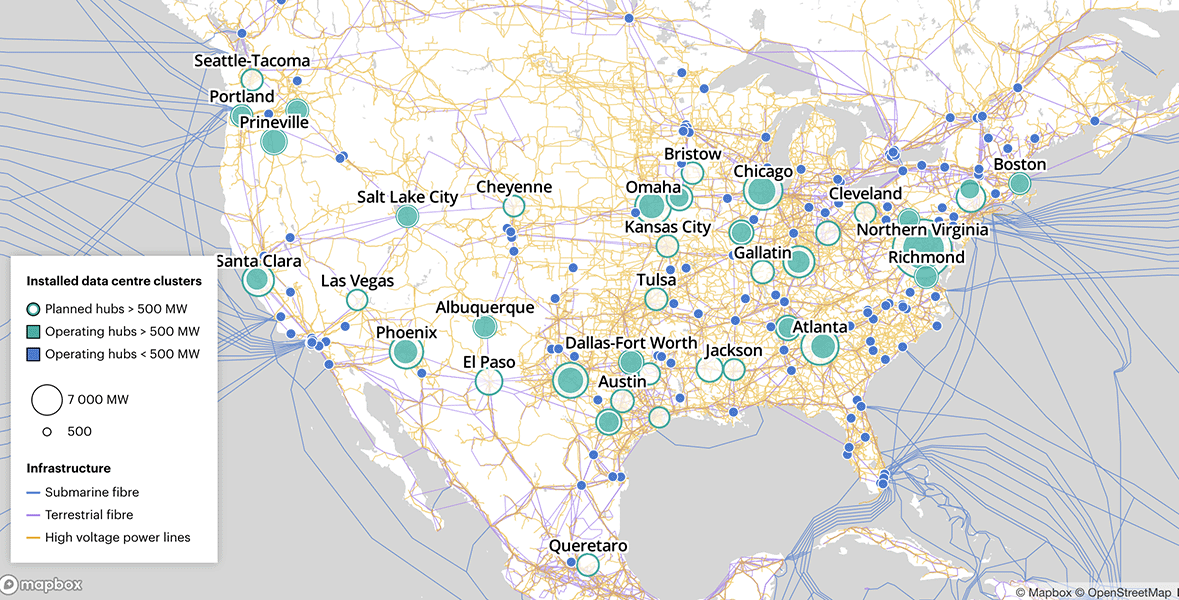
Many data centers in the US are concentrated in the Virginia area, according to a non-exhaustive database from the International Energy Agency.CREDIT: IEA / ENERGY AND AI OBSERVATORY 2025. CC BY 4.0
Although forecasts for AI’s energy impact remain devilishly tricky, especially since the size of payoffs from investments in AI are uncertain, it’s clear to experts that energy-saving strategies are urgently needed. Without them, according to one 2025 estimate, US data centers could soon be releasing the equivalent of 24 to 44 megatons of CO2 annually, the latter equivalent to the annual emissions of Norway.
And so computer scientists and engineers are rethinking some of the power-hungry hardware and software that fuel AI. They’re working to develop energy-saving algorithms and processor designs, and carefully considering where, and how, data centers are constructed.
“AI’s energy cost is not an accident: This is basically a product of how our systems are built,” says Fengqi You, an expert in energy systems at Cornell University. But with the right mix of solutions, he says, “we could really reshape the trajectory.”
The roots of AI’s energy problem
To comprehend AI’s energy cost, it helps to understand large language models (LLMs) — the lifeblood of AI text generation tools such as chatbots and AI assistants — specifically, ones based on a design described in 2017 by the machine-learning laboratory Google Brain. This design, transformer architecture, can process text at lightning speed by simultaneously taking each word and weighing its relationship to every other word it sees. It “learns” which words go together by computing how strongly each word relates to all other words in a text, examining each word in many contexts. (A similar design is used for AI image and video generators.)
On a computational level, this happens by converting words or word fragments into numbers and performing additions and multiplications between them. Key to the speed is being able to do these calculations in parallel, made possible by graphic processor units (GPUs) — mostly manufactured by the company NVIDIA — originally invented for rapid 3D rendering of imagery during gaming.
Manufacturers of the processing chips that fuel AI computations are working to make the chips more energy efficient; examples are the latest AI-specialized chips developed by NVIDIA.CREDIT: NVIDIA
The initial training of an LLM, required to learn all these relationships, consumes vast amounts of energy. Because each word it trains on must be weighed against all others in a given chunk of text, the number of computations the model performs — hence the energy required — increases quadratically relative to the length of text (i.e., doubling the length of text quadruples the number of computations). That adds up quickly given that most LLMs are trained on massive swaths of publicly available internet text. Some estimates suggest that training GPT-4 — the iteration of ChatGPT that launched in 2023 — guzzled between 50 and 60 gigawatt-hours of electricity, enough to power San Francisco for three to four days.
But experts are more worried about the energy costs of using the models to generate data once they’ve been trained, a process called inference. “You train once, then you inference for a billion people in the world,” says Mosharaf Chowdhury, an AI systems expert at the University of Michigan who has been measuring the electricity usage of a handful of large language models that have been made publicly available.
This process is surprisingly inefficient: Each time transformer models generate a word — by selecting the one with the highest probability of following the previous word, given context — they put the query and partially written answer through the model. In doing so, they apply all of the parameters they’ve calculated during training to understand language patterns — which number in the hundreds of billions or even trillions.
“The fact that you have to do a lot of calculations for a single word to be added — that’s a problematic thing,” says Günter Klambauer, an AI expert at Johannes Kepler University in Austria.
Tweaking AI software to save energy
This recognition has triggered interest in smaller language models specialized to specific tasks. These are trained more narrowly, have fewer parameters — say, tens or hundreds of millions — and perform substantially less computation than larger models. In one 2025 paper published by UNESCO, computer scientist Ivana Drobnjak of University College London and colleagues compared energy consumption of Meta’s language model Llama-3.1 with smaller AI models dedicated to particular tasks — ones called DistilBART and t5-small-xsum for summarization, and others for translation or answering questions. When used for their respective tasks, the smaller models consumed more than 90 percent less energy than Llama 3.1 on the same job.
And so computer scientists have been driven to build a similar kind of task specialization into LLMs themselves. In “mixture of expert” models, only particular parts of one big model are activated for certain tasks. These parts “learn to handle different patterns in language,” Drobnjak says.
This is thought to be one reason why R1, an LLM developed by the Chinese company DeepSeek, reportedly consumed significantly less energy than other models (independent experts have raised doubts about those figures). Udit Gupta, an expert in electrical and computer engineering at Cornell Tech, says that LLMs like Gemini or ChatGPT are similarly routing queries to more specialized sub-models. “There’s a lot of work being done on how to assess the complexity of the query or task that’s coming from users and then find the right model,” Gupta says. (While Google spokesperson Ralf Bremer notes that the 0.24 watt-hours currently spent on processing median-length Gemini prompts is already 33 times more efficient than it was back in 2024, some experts suspect that processing queries with an LLM still consumes more energy than an equivalent web search.)
Scientists are also exploring different kinds of LLMs, to break what Klambauer calls the “quadratic curse” of transformer models.
One alternative, called a long short-term memory (LSTM) model, gets around this alarming energy increase by temporarily storing a kind of summary of the prompt that was inputted by the user plus the text generated so far, akin to recalling important plot points instead of an entire movie. That way, it only has to process the summary, rather than all the words in the full text to date, every time it generates a new word. This prevents LSTM’s energy costs from skyrocketing as it responds to a query — using about 50 percent less energy than transformer-type models to process texts of around 8,000 words in length, Klambauer says.
LSTM models were developed in the 1990s but were abandoned because transformers could be trained much faster. But Klambauer says that recent advances have improved the performance of LSTM, now called xLSTM. He’s working with the Austrian startup NXAI to further develop and optimize xLSTM, “because we think it’s worth it for energy efficiency,” he says.
But major tech companies have invested so many years and resources into developing transformer-based models that switching to other models would be costly, says Wolfgang Maaß, an AI and business informatics researcher at the German Research Center for Artificial Intelligence. “We have to see whether this becomes as dominant, or whether it finds a niche in the whole market.”
Stay in the Know Sign up for the Knowable Magazine newsletter today
Computing with wafers and light
Though experts say the fastest energy savings will come from software tweaks, some are also taking aim at the energy-hungry processing chips that fuel AI computations. Engineers have made chips increasingly efficient over time by packing more computing capacity into individual processors — reducing the energy required to shuttle data between chips that are working together to perform AI computations. Engineers have done this by shrinking the size of transistors — microscopic electrical switches that process data — inside the chips.
But because engineers are reaching the physical limits of how small transistors can be, “we need to think of alternate ideas to improve the designs,” says computer architect Ajay Joshi of the Boston University Photonics Center.
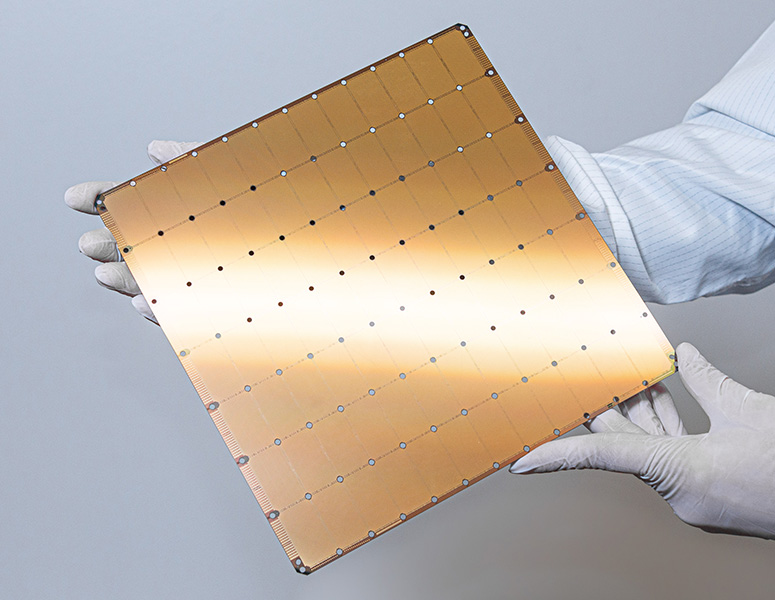
One strategy is to make the chips larger. Dinner-plate-sized “wafer-scale chips” can pack nearly 70 times as many transistors as a single, postage-stamp-sized GPU and consume 143 times less electricity for communication than comparable GPUs, says computer engineer Rakesh Kumar of the University of Illinois Urbana-Champaign. Commercially produced by the California company Cerebras, wafer-scale chips have drawbacks, including a greater risk of damage during manufacturing. But because of their energy-saving and other beneficial features, “they would be very attractive to many hyperscalers and AI companies,” Kumar says.
One strategy to make processors more efficient is to make them larger so they can contain more transistors, the building blocks of computers. “Wafer scale” chips, such as those developed by California-based manufacturer Cerebras, reduce the energy spent on shuttling information between individual chips.CREDIT: CEREBRAS SYSTEMS
Many tech companies have improved energy efficiency by fashioning their own processors that are tailor-made for AI computations — such as Amazon Web Service’s Trainium2 chip or Google’s Ironwood Tensor Processing Units — according to statements from those companies. As for NVIDIA, the company’s head of sustainability Josh Parker says its AI-specialized GPUs have come a long way from the ones used for gaming and are now designed to run AI tasks as efficiently as possible; other innovations, such as making the interconnections between GPUs more efficient, have also helped. “Over the past eight years, NVIDIA GPUs have improved 45,000 [times] in energy efficiency for large language model workloads,” he says.
Engineers are also exploring alternative computing methods. Conventional AI processors calculate by encoding numbers in a binary system of ones and zeros, which is achieved by turning transistors on and off (representing the number 5, for instance, requires four transistors to represent the code 0101). But transistors can do more than function as binary switches allowing electron flow or not; they can also work as analog dials and hold intermediate voltages representing different numbers. That requires fewer transistors, and less energy, for computations. “People have known for decades that doing certain things in analog … can be a lot more energy efficient,” Kumar says.
For example, electrical engineer Paul Manea of the German research institute Forschungszentrum Jülich and colleagues are working to develop devices called “gain cells” that are full of transistors working this way. Importantly, gain cells can both store the data required to process a query, and compute the answer. That overcomes another big energy bottleneck of conventional computing systems, where memory storage and computation occur on separate pieces of hardware.
That’s especially problematic for transformer-based LLMs, because each time they generate a word, they must shuttle the query and partially written answer from memory to a processor. Manea and colleagues estimate that gain cells in lieu of traditional GPUs can reduce the energy guzzled by one of the most energy-consuming parts of transformer-based LLMs by four orders of magnitude. But it will take more refining before they can be more widely used, Manea says.
The notion of devices that both store and compute information is a key idea of “neuromorphic” computing, an up-and-coming field of computer engineering inspired by the human brain, which consumes orders of magnitude less energy than computers. Another brain-inspired invention is chips that encode information not in continuous data streams but — like human nerve cells — in the timing of voltage “spikes” propagating through the system. Allowing components to rest until they’re needed “could potentially translate to less energy,” says Eleni Vasilaki, an expert in bioinspired machine learning at the University of Sheffield in England.
Maaß, for example, is part of a team that received roughly $5.8 million from the German government to test neuromorphic chips, among other strategies, to reduce the energy required for AI models. Some brain-inspired chips are already commercially available, but the technology is still far from being attractive for mainstream computing, says nanoelectronics expert Tony Kenyon of University College London, whose team recently received $17 million from the UK government to develop neuromorphic computing.
Other scientists are developing chips that process information not with electrons but through the interaction of photons — particles of light — with matter (fiber-optic cables, which encode and transmit data as light pulses, are used around the world). With photons, more information can be transmitted at the same time, and signals can be altered much faster, says Elena Goi, a photonic computing researcher at Friedrich Schiller University Jena in Germany.
Even without reinventing how computers work, much can be done to reduce AI’s impact not just on energy but also on water resources used for cooling data centers. Importantly, tech companies should reconsider where they build those centers, says energy systems expert You. Right now, existing US ones are concentrated in northern Virginia, which has limited water resources and renewable energy capacity compared with the Midwest, for instance. You recently estimated that better siting — along with energy-efficient hardware and software — could reduce future carbon and water footprints of US data centers by 73 percent and 86 percent, respectively.
Data centers —and the gas plants often built to power them — can cause air and noise pollution and add further strain on local water resources, leading many communities to oppose their construction.CREDIT: SARA DIGGINS / THE AUSTIN AMERICAN-STATESMAN VIA GETTY IMAGES
Masanet adds that tech companies already with data centers across the country could at least train their models in strategic places. “Some companies like Google have been doing this: They shift their loads to follow renewables,” he says. They also should address the electricity and resources spent on manufacturing processors for new data centers, as well as electronic waste as outdated tech is replaced every few years, he adds.
Minimizing e-waste by using hardware for longer periods and recovering old electronics is one of Amazon’s sustainability strategies, according to a statement to Knowable Magazine; so is designing data centers in energy- and water-saving ways and investing in a slew of renewable and nuclear energy projects. “We’ll continue to implement solutions that benefit our customers and the communities we operate in,” says Brandon Oyer, Amazon Web Services’ head of energy and water in the Americas.
Meanwhile, a press representative at Microsoft points to a number of sustainability initiatives the company has taken, including new cooling technologies, renewable energy investments and waste reduction. Google spokesperson Ralf Bremer emphasized the company’s goal of reaching net-zero emissions across its operations by 2030 and replenishing 120 percent of the fresh water consumed by its offices and data centers by 2030. An OpenAI representative points to a press release outlining efforts to minimize water use and plans for solar energy generation at one of its campuses. Anthropic, Meta and Oracle did not respond to requests for comment by deadline.
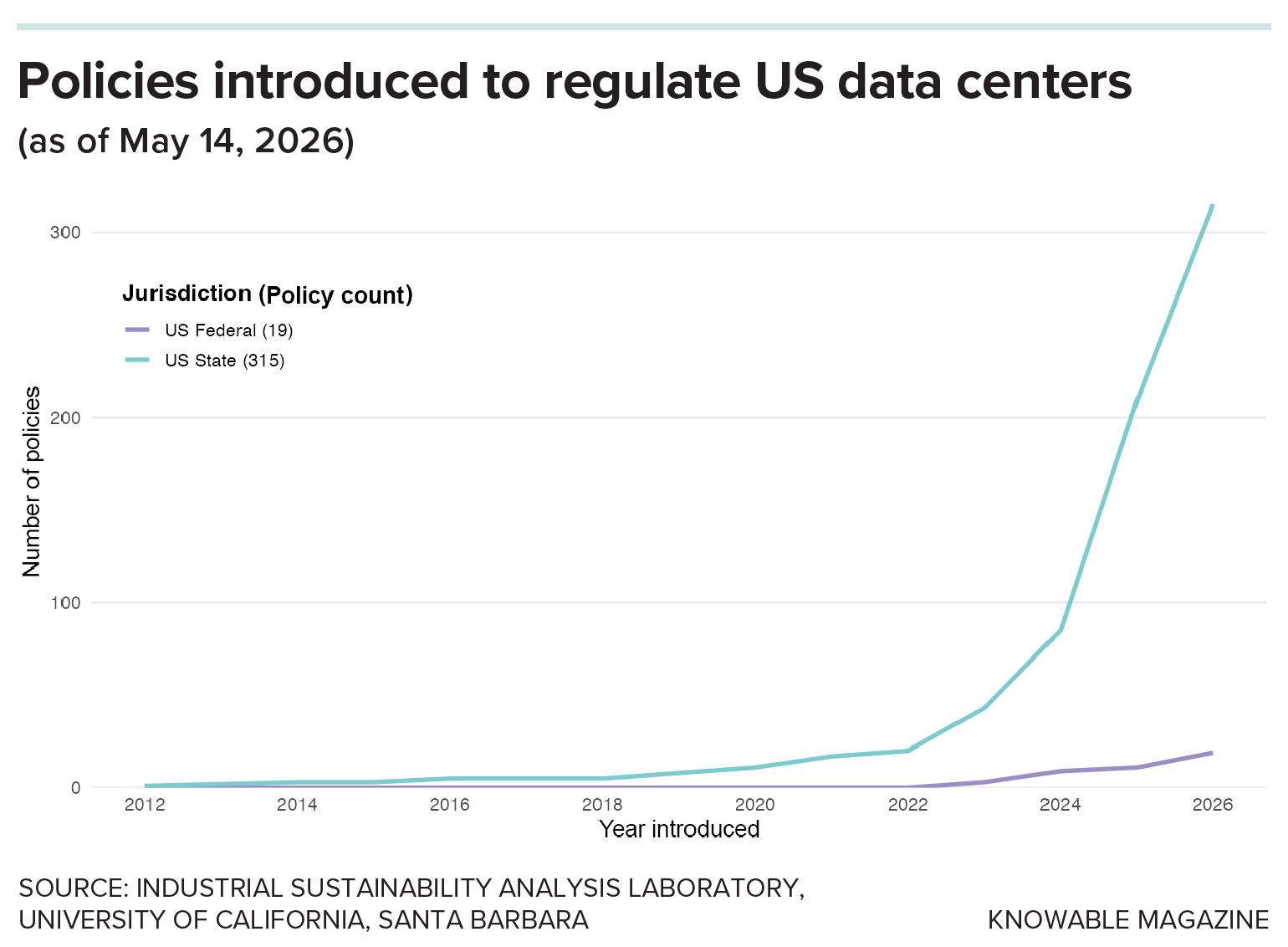
Though tech companies are taking sustainability into consideration, their main objective is to rapidly build out data center capacity, says computer engineer Benjamin Lee of the University of Pennsylvania. He predicts that, eventually, they’ll need to step up efforts to improve energy efficiency to reduce costs. Governments should help to accelerate this shift, Masanet says. So far, he and his team have counted nearly 220 policies introduced to address data center sustainability at the US state level, 18 at the federal level, and more from other countries, though not all were ultimately adopted.
“It’s clear that governments around the world are beginning to take action,” he says. However, he adds, “we also see some state and local governments with proposed policies that mostly aim to incentivize and accelerate data center builds.”
The Industrial Sustainability Analysis Laboratory at the University of California, Santa Barbara has been tracking state and federal policies related to data centers. The vast majority of these policies relate to data center sustainability in some way, although they also include some tax incentives. This dataset may not be exhaustive.
AI’s energy cost will ultimately be a balancing act: Will it save more resources through its problem-solving abilities deployed toward everything from finding cancer cures to improving logistics, than it demands? But though building a more frugal, energy-saving AI is important, so is carefully considering where AI is needed, Kenyon says. Is the world truly a better place, for example, with nonhuman “AI agents” providing customer support?
“I think it’s a common mistake, when a new technology comes in, to suddenly think, ‘Well, everything has to adopt that new technology,’” he says. “That approach really isn’t doing us any favors.”
Katarina Zimmer is a science and environment journalist based in Germany. She is a special contributor to Knowable Magazine, where she covers the energy transition and planetary health. Her other work is published in National Geographic, Scientific American, BBC Future and elsewhere. Check out more of her work at www.katarinazimmer.com.
I first heard about “Man Therapy” when I read an article in 2019 and reached out to Dr. Mahogany. It took me awhile before I met Joe Conrad, the man behind ManTherapy.org, and learned about the team that developed their successful program. Joe is a creative entrepreneur and a digital health pioneer who believes in the power of innovation, creativity and technology to solve any problem. I recently interviewed Joe about his work in support of men’s mental health, how the Man Therapy program was developed, and about his new book, Man Therapy: Therapy The Way a Man Does It.
I was interested in the “origin story” of this unique and innovative approach for helping men and their families. Here’s what Joe shared with me:
“At some point in my life, I went from acting like a boy to behaving like a man. For me, it happened at Colorado State University sometime during my senior year. I had a job writing for the Rocky Mountain Collegian, which is where I found my voice. I wrote a series of stories about US military veterans returning from Vietnam and their difficult transition back to civilian life. I covered issues around the growing environmental movement. I was creating something, putting it out into the world, and it felt great.
In 1990 I started Cactus, a purpose-driven ad agency focused on working with nonprofit organizations, foundations, and brands to help bring a powerful voice to their work. One day while leading a workshop for the Colorado Department of Public Health and Environment, I was approached by the director of the Office of Suicide Prevention. He said, “Joe, do you know that there is an epidemic out there and that working-age men are killing themselves at an alarming rate?”
I had no idea that five out of seven suicides were men from all walks of life, demographics, and socioeconomic backgrounds. Against all odd and on a shoe-string budget, my team at Cactus created our agency’s best and most impactful campaign. We treated this challenge like we do every project and gave the campaign the same love and attention to creativity, production craft and a meaningful digital experience where therapy happens.
We explored a number of creative approaches, but one idea stood out and was the obvious choice –– Man Therapy, which was launched on July 9, 2012. The centerpiece of the campaign is a website, ManTherapy.org, hosted by a fictional therapist named Dr. Rich Mahogany. However, Dr. Rich is not your typical therapist. He tells it like it is and uses humor to convince guys that taking care of their mental health is the manliest thing a man could do.
Man Therapy was created by a team of suicidologists, mental health experts, marketing strategists, creatives, and technologists to destigmatize mental health through humor, straight-shooting, and practical tools. And we know it works because the results of a 4-year, $1.2 million CDC-funded study show that Man Therapy not only reduces depression, suicide risk, and bad mental health days — it also improves help-seeking behavior in working-age men.
While we’re proud of the impact we have had to date, we believe we’re just getting started. Today, Man Therapy is the world’s leading men’s mental health brand and we believe it can be a powerful force for good in the world. Much more than helping reduce suicide, we hope to help men flourish.”
Man Therapy is Relevant to My Personal and Professional Life
When I was five years old my father took an overdose of sleeping pills. He had become increasingly depressed because he couldn’t support his family doing the work he loved. Luckily, he didn’t die, but our lives were never again the same. I grew up wondering what happened to my father, when it would happen to me, and what I could do to help other men and their families to avoid the suffering our family experienced.
For more than fifty years I have been a leader in the emerging field of gender-specific medicine and men’s mental, emotional, and relational health. When I came across Man Therapy and Joe Conrad, I immediately knew this was a program that could help men like my father and millions of other men and their families to live fully healthy lives, to love deeply and well, and to make a personal difference in the world.
The publication of their new book Man Therapy: Therapy The Way a Man Does It is the next step in this important men’s health movement. Man Therapy gives men straightforward tools for dealing with real-life challenges, without the lectures, jargon, or awkward therapy speak. You can watch the book trailer here.
The book is powered by the engaging and popular Man Therapy® brand and includes contributions from today’s leading men’s mental health experts. This guide delivers concrete strategies for managing stress, depression, anger, and the everyday pressures men face.
Think of it as a mental health tune-up for your brain: part therapist, part drill sergeant, and part wise uncle who tells it like it is.
In this book, you’ll find powerful strategies to:
Manage stress, anxiety, and burnout before they take over.
Deal with depression, low motivation, and feeling stuck.
Control anger and emotional reactions without blowing up relationships.
Navigate loneliness, friendships, and romantic relationships.
Build mental resilience when life knocks you down.
Grounded in evidence-based psychology, this guide includes the key basics of mental health, simple exercises, reflection prompts, and practical skills you can start using immediately. Whether you’re dealing with work pressure, family stress, relationship problems, or just trying to get your head on straight, these tools help you act, not just think about it.
You don’t have to pretend everything’s fine. And you don’t have to figure it out alone. This first-of-its-kind guide helps men take charge of their mental health with grit, clarity, and maybe even a few laughs along the way.
This is the book I wish my father had available when he was struggling with these issues. It is the book I am excited to give to my clients, family, and friends.
To find out more about Joe Conrad, the book, and the Man Therapy movement, you can visit him at https://mantherapy.org/.
Best Wishes,
Jed Diamond
Founder and VHS (Visionary Healer Scholar) of MenAlive
The hardest state for a human being to sustain is that of open-endedness. We may know that uncertainty is the crucible of creativity, we may know that uncertainty is the key to democracy and good science, and yet in our longing for certainty we keep propping ourselves up from the elemental wobbliness of life on the crutch of opinion. Few things are more seductive to us than a ready opinion, and we brandish few things more flagrantly as we move through the world, slicing through its fundamental uncertainty with our insecure certitudes. The trouble with opinion is that it instantly islands us in the stream of life, cutting off its subject — and us along with it — from the interconnected totality of deep truth.
A mighty antidote to that very human and very life-limiting impulse comes from The Log from the Sea of Cortez (public library) by John Steinbeck (February 27, 1902–December 20, 1968).
John Steinbeck
In 1940, as humanity’s most ferocious war was rupturing the world, Steinbeck and his marine biologist friend Ed Ricketts decamped to the nonhuman world and its elemental consolations of interdependence, embarking on an exploratory expedition in the Sea of Cortez, also known as the Gulf of California — “a long, narrow, highly dangerous body of water… subject to sudden and vicious storms of great intensity.”
Wading through the tide pools, his hands callused from collecting specimens, his feet stung by poisonous worms and spiked by urchins, his mind invigorated by the ravishing interconnectedness of life, the 38-year-old writer found himself contemplating the deepest strata of reality and its intercourse with the human imagination. What emerges is a meditation on the nature of knowledge — a kind of prose counterpart to Elizabeth Bishop’s deep-seeing poem “At the Fishhouses” — disguised as an expedition journal: a wanderer’s delight in the adjacent pleasure gardens of science and philosophy of mind, composed two decades before Steinbeck received the Nobel Prize for his fiction. Despite his magnificent novels, despite his large-souled letters, I consider this his slender book of nonfiction his finest work.
At its heart is Steinbeck’s passionate refutation of the Western compulsion for teleological thinking — the tendency to explain things in terms of the purpose they serve, antithetical both to science and to the Eastern notion of being: the idea that everything just is and any fragment of it, any one thing examined by itself, is simply because it is. Science — the supreme art of observation without interpretation, of meeting reality on its own acausal and impartial terms, free from the tyranny of why and its tendrils of blame — puts us a leap closer to understanding both particulate and pattern through non-teleological thinking — which, as Steinbeck astutely observes, is an inadequate term to begin with, for it asks of us more than thinking in how we parse any sort of information:
The method extends beyond thinking even to living itself; in fact, by inferred definition it transcends the realm of thinking possibilities, it postulates “living into.”
[…]
The greatest fallacy in, or rather the greatest objection to, teleological thinking is in connection with the emotional content, the belief. People get to believing and even to professing the apparent answers thus arrived at, suffering mental constrictions by emotionally closing their minds to any of the further and possibly opposite “answers” which might otherwise be unearthed by honest effort — answers which, if faced realistically, would give rise to a struggle and to a possible rebirth which might place the whole problem in a new and more significant light.
Such rebirth of perspective allows us to move beyond questions of cause in thinking and blame in feeling, which are related reflexes of the teleological mindset. The moment we regard something simply as it is, because it is, we have understood it more fully, for we have shed the narratives layer of why:
The non-teleological picture… goes beyond blame or cause. And the non-causal or non-blaming viewpoint… arises emergently from the union of two opposing viewpoints, such as those of physical and spiritual teleologies, especially if there is conflict as to causation between the two or within either. The new viewpoint very frequently sheds light over a larger picture, providing a key which may unlock levels not accessible to either of the teleological viewpoints. There are interesting parallels here: to the triangle, to the Christian ideas of trinity, to Hegel’s dialectic, and to Swedenborg’s metaphysic of divine love (feeling) and divine wisdom (thinking).
The factors we have been considering as “answers” seem to be merely symbols or indices, relational aspects of things — of which they are integral parts — not to be considered in terms of causes and effects. The truest reason for anything’s being so is that it is. This is actually and truly a reason, more valid and clearer than all the other separate reasons, or than any group of them short of the whole. Anything less than the whole forms part of the picture only, and the infinite whole is unknowable except by being it, by living into it.
A thing may be so “because” of a thousand and one reasons of greater or lesser importance… The separate reasons, no matter how valid, are only fragmentary parts of the picture. And the whole necessarily includes all that it impinges on as object and subject, in ripples fading with distance or depending upon the original intensity of the vortex.
In a passage of exquisite intellectual elegance and emotional truth, Steinbeck considers the continuum that is the essence of reality — the continuum we artificially sever into fragments with our teleological explanations and causally compulsive opinions:
No one thing ever merges gradually into anything else; the steps are discontinuous, but often so very minute as to seem truly continuous. If the investigation is carried deep enough, the factor in question, instead of being graphable as a continuous process, will be seen to function by discrete quanta with gaps or synapses between, as do quanta of energy, undulations of light. The apparently definitive answer occurs when causes and effects both arise on the same large plateau which is bounded a great way off by the steep rise which announces the next plateau. If the investigation is extended sufficiently, that distant rise will, however, inevitably be encountered; the answer which formerly seemed definitive now will be seen to be at least slightly inadequate and the picture will have to be enlarged so as to include the plateau next further out. Everything impinges on everything else, often into radically different systems, although in such cases faintly. We doubt very much if there are any truly “closed systems.”
Okay. Enough abstraction. Let us land this into the loveliness of the concrete:
The ocean, with reference to waves of water, might be considered as a closed system. But anyone who has lived in Pacific Grove or Carmel during the winter storms will have felt the house tremble at the impact of waves half a mile or more away impinging on a totally different “closed” system.
The Great Wave off Kanagawa by Japanese artist Hokusai, 1831. (Available as a print and as a face mask, benefitting The Nature Conservancy.)
This interconnectedness, this indivisibility, is the raw antidote to teleological thinking — something Steinbeck illustrates with a living wonder observed from the deck of his expedition vessel:
Seeing a school of fish lying quietly in still water, all the heads pointing in one direction, one says, “It is unusual that this is so” — but it isn’t unusual at all. We begin at the wrong end. They simply lie that way, and it is remarkable only because with our blunt tool we cannot carve out a human reason. Everything is potentially everywhere — the body is potentially cancerous, phthisic, strong to resist or weak to receive. In one swing of the balance the waiting life pounces in and takes possession and grows strong while our own individual chemistry is distorted past the point where it can maintain its balance. This we call dying, and by the process we do not give nor offer but are taken by a multiform life and used for its proliferation. These things are balanced. A man is potentially all things too, greedy and cruel, capable of great love or great hatred, of balanced or unbalanced so-called emotions. This is the way he is — one factor in a surge of striving. And he continues to ask “why” without first admitting to himself his cosmic identity.
Leaning once again on a living metaphor from the world of marine biology, he illustrates how our multitudes compose our totality in something beyond pure equivalence:
There are colonies of pelagic tunicates [Pyrosoma giganteum] which have taken a shape like the finger of a glove. Each member of the colony is an individual animal, but the colony is another individual animal, not at all like the sum of its individuals. Some of the colonists, girdling the open end, have developed the ability, one against the other, of making a pulsing movement very like muscular action. Others of the colonists collect the food and distribute it, and the outside of the glove is hardened and protected against contact. Here are two animals, and yet the same thing—something the early Church would have been forced to call a mystery. When the early Church called some matter “a mystery” it accepted that thing fully and deeply as so, but simply not accessible to reason because reason had no business with it. So a man of individualistic reason, if he must ask, “Which is the animal, the colony or the individual?”’ must abandon his particular kind of reason and say, “Why, it’s two animals and they aren’t alike any more than the cells of my body are like me. I am much more than the sum of my cells and, for all I know, they are much more than the division of me.” There is no quietism in such acceptance, but rather the basis for a far deeper understanding of us and our world. And now this is ready for the taboo-box.
Pyrosoma giganteum
Composing a sort of modern Aesopian fable of our faulty sensemaking, he adds:
It is not enough to say that we cannot know or judge because all the information is not in. The process of gathering knowledge does not lead to knowing. A child’s world spreads only a little beyond his understanding while that of a great scientist thrusts outward immeasurably. An answer is invariably the parent of a great family of new questions. So we draw worlds and fit them like tracings against the world about us, and crumple them when they do not fit and draw new ones. The tree-frog in the high pool in the mountain cleft, had he been endowed with human reason, on finding a cigarette butt in the water might have said, “Here is an impossibility. There is no tobacco hereabouts nor any paper. Here is evidence of fire and there has been no fire. This thing cannot fly nor crawl nor blow in the wind. In fact, this thing cannot be and I will deny it, for if I admit that this thing is here the whole world of frogs is in danger, and from there it is only one step to anti-frogicentricism.” And so that frog will for the rest of his life try to forget that something that is, is.
The whole is necessarily everything, the whole world of fact and fancy, body and psyche, physical fact and spiritual truth, individual and collective, life and death, macrocosm and microcosm (the greatest quanta here, the greatest synapse between these two), conscious and unconscious, subject and object. The whole picture is portrayed by is, the deepest word of deep ultimate reality, not shallow or partial as reasons are, but deeper and participating… And all this against the hot beach on an Easter Sunday, with the passing day and the passing time. This little trip of ours was becoming a thing and a dual thing, with collecting and eating and sleeping merging with the thinking-speculating activity. Quality of sunlight, blueness and smoothness of water, boat engines, and ourselves were all parts of a larger whole and we could begin to feel its nature but not its size.
Whereas, on the twenty-second day of September, in the year of our Lord one thousand eight hundred and sixty-two, a proclamation was issued by the President of the United States, containing, among other things, the following, to wit:
“That on the first day of January, in the year of our Lord one thousand eight hundred and sixty-three, all persons held as slaves within any State or designated part of a State, the people whereof shall then be in rebellion against the United States, shall be then, thenceforward, and forever free; and the Executive Government of the United States, including the military and naval authority thereof, will recognize and maintain the freedom of such persons, and will do no act or acts to repress such persons, or any of them, in any efforts they may make for their actual freedom.
“That the Executive will, on the first day of January aforesaid, by proclamation, designate the States and parts of States, if any, in which the people thereof, respectively, shall then be in rebellion against the United States; and the fact that any State, or the people thereof, shall on that day be, in good faith, represented in the Congress of the United States by members chosen thereto at elections wherein a majority of the qualified voters of such State shall have participated, shall, in the absence of strong countervailing testimony, be deemed conclusive evidence that such State, and the people thereof, are not then in rebellion against the United States.”
Now, therefore I, Abraham Lincoln, President of the United States, by virtue of the power in me vested as Commander-in-Chief, of the Army and Navy of the United States in time of actual armed rebellion against the authority and government of the United States, and as a fit and necessary war measure for suppressing said rebellion, do, on this first day of January, in the year of our Lord one thousand eight hundred and sixty-three, and in accordance with my purpose so to do publicly proclaimed for the full period of one hundred days, from the day first above mentioned, order and designate as the States and parts of States wherein the people thereof respectively, are this day in rebellion against the United States, the following, to wit:
Arkansas, Texas, Louisiana, (except the Parishes of St. Bernard, Plaquemines, Jefferson, St. John, St. Charles, St. James Ascension, Assumption, Terrebonne, Lafourche, St. Mary, St. Martin, and Orleans, including the City of New Orleans) Mississippi, Alabama, Florida, Georgia, South Carolina, North Carolina, and Virginia, (except the forty-eight counties designated as West Virginia, and also the counties of Berkley, Accomac, Northampton, Elizabeth City, York, Princess Ann, and Norfolk, including the cities of Norfolk and Portsmouth[)], and which excepted parts, are for the present, left precisely as if this proclamation were not issued.
And by virtue of the power, and for the purpose aforesaid, I do order and declare that all persons held as slaves within said designated States, and parts of States, are, and henceforward shall be free; and that the Executive government of the United States, including the military and naval authorities thereof, will recognize and maintain the freedom of said persons.
And I hereby enjoin upon the people so declared to be free to abstain from all violence, unless in necessary self-defence; and I recommend to them that, in all cases when allowed, they labor faithfully for reasonable wages.
And I further declare and make known, that such persons of suitable condition, will be received into the armed service of the United States to garrison forts, positions, stations, and other places, and to man vessels of all sorts in said service.
And upon this act, sincerely believed to be an act of justice, warranted by the Constitution, upon military necessity, I invoke the considerate judgment of mankind, and the gracious favor of Almighty God.
In witness whereof, I have hereunto set my hand and caused the seal of the United States to be affixed.
Done at the City of Washington, this first day of January, in the year of our Lord one thousand eight hundred and sixty three, and of the Independence of the United States of America the eighty-seventh.
By the President: ABRAHAM LINCOLN WILLIAM H. SEWARD, Secretary of State.
Is There a Way to Turn Off Your Reality Filter?Getty Images
“Hearst Magazines and Yahoo may earn commission or revenue on some items through these links.”
In 1956, British psychiatrist Humphry Osmond coined the word “psychedelic” from Greek roots meaning “mind-manifesting” or “soul-revealing.” The term proved fitting. Users report that seconds stretch into eternity, sounds turn into color, and you very self begins dissolving. And now, after decades in scientific exile, those same once-ostracized compounds are undergoing a dramatic scientific renaissance. Researchers are investigating them not only for depression, trauma, and addiction, but also as a potential window into one of neuroscience’s deepest mysteries: how the brain constructs reality itself. And a small, egg-shaped structure buried deep in the center of the brain, the thalamus, may play an important role in that process.
Scientists once viewed the thalamus largely as a relay station: a kind of biological switchboard routing sensory information to the cortex, the brain’s outer layer responsible for higher thought, perception, and conscious awareness. But newer theories suggest something far stranger. Increasingly, neuroscientists suspect reality may partly reflect the brain’s constantly updated “best guess” about the world—built from memory, expectation, sensory input, and context, as Michelle J. Redinbaugh, PhD, a neuroscientist at Stanford University, puts it.
In a 2024 review published in Neuron, Redinbaugh and colleagues examined evidence from anesthesia, sleep, coma studies, perception experiments, and deep brain stimulation research to better understand the thalamus’s role in awareness. They came to a striking conclusion: The structure may help shape not only whether we are conscious, but also how awareness itself feels from moment to moment: unified, continuous, and stable—rather than fragmented into disconnected sensory pieces.
“… What you are seeing, hearing, smelling, what your internal state is like, how your body feels. All these sorts of things coalesce into consciousness,” Redinbaugh says. The thalamus sits in a loop between many cortical regions, continuously coordinating integrated information across the brain. Without that stabilizing process, she says, experience could feel fragmented “like a bunch of boxes.”
“You could call it a compression in terms of data science,” Redinbaugh says, describing how this small ovoid hub condenses massive amounts of sensory information into a continuous stream of awareness. The brain’s ordinary mode of operation constantly screens and constrains perception. Evolution likely favored such filtering because processing every detail of reality in full precision would be catastrophically inefficient. If allowed in, the gargantuan soup of sensory stimuli out there could overwhelm the brain’s ability to offer us a seamless sense of self, pushing the system toward total breakdown. And the brain chose speed over perfection—or variety.
Redinbaugh points to vision itself as an example: humans only see sharply in a tiny central region of the eye, while the brain reconstructs much of the periphery using assumptions and predictions. Evolution may have selected for that tradeoff because taking in every detail of the visual world in infinite detail would be mentally chaotic and energetically unsustainable. Without these shortcuts, reality itself could arrive as an unbearable sensory avalanche.
But the thalamic gatekeeping system does have its own weak spots. Anesthesia is one of them. Under it, thalamic activity shifts into disrupted “on/off” rhythms that may destabilize the coordinated neural activity supporting awareness, Redinbaugh says. The seamless experience we normally take for granted may begin to fracture in those moments.
Psychedelics are now exposing another crack in the system.
In a massive 2026 mega-analysis published in Nature Medicine, researchers analyzing brain scans across multiple psychedelic drugs found widespread shifts in communication across large-scale brain networks, including networks involving the thalamus. Brain systems that normally remain relatively segregated appeared to interact in unusual and sometimes intensified ways.
Though Redinbaugh stresses that neuroscience is still evolving, she admits it is reasonable to think hallucinogens alter the reciprocal relationship between higher brain networks and the thalamus. These drugs generally increase cortical excitability, which then feeds back into the deep-brain structure itself. One influential theory, she explains, is that psychedelics effectively make the brain’s normal “rules” more lenient.
“If you are now tweaking how the thalamus interacts with cortex, and cortex is more excitable, and you have kind of this loosening… suddenly you’re in a situation where you can no longer use the rules to constrain your perception,” she continues. “And then you’re also increasing this sort of bottom-up activity that is telling you what you’re seeing, so all of a sudden you see a lot of weird stuff, or you experience a lot of weird stuff.”
But what exactly is this “weird stuff” psychedelics seem capable of unleashing when they tamper with the brain’s reality-gating systems? For some, they may be aspects of perception normally hidden from conscious awareness. Could they be signs of “higher consciousness?”
Redinbaugh isn’t quite ready to call it that. “But it’s certainly a very different state of consciousness,” she adds.
Others are even more skeptical of the phrase “higher consciousness.”
“It implies a single scale, and it’s not clear what that scale would measure,” says Anne-Laure Le Cunff, PhD, a neuroscientist at King’s College London. Different forms of awareness, she argues, may involve different dimensions, like attention, memory, perception, wakefulness; they don’t exist on a simple ladder from lower to higher. Psychedelics may feel expansive or meaningful, she says, but “that doesn’t make them globally higher or more conscious.”
Part of that expansiveness may stem from the way altered states appear capable of distorting some of the brain’s most fundamental organizing systems such as time—processes in which the thalamus itself may play a central role, according to James M. Shine, PhD, a professor of systems neuroscience at the University of Sydney, who worked with Redinbaugh on the 2024 Neuron review.
One reason may be biochemical, he says. This integrative node and its cortical inputs are densely covered in 5-HT2A serotonin receptors, the primary receptors through which classic hallucinogenic drugs exert many of their effects. At the same time, Shine continues, the thalamus appears deeply involved in coordinating neural activity across radically different timescales, from the milliseconds required to perceive an image to massive state changes like the transition between wakefulness and sleep.
The implications quickly become existential. If the brain actively builds stable reality by orchestrating perception, time, and prediction, what happens if humans eventually learn to deliberately tweak those systems?
“Who is to say that this isn’t already the mechanism by which we learn to navigate our perceptual [subjective world] as our brains develop over our life spans?” Shine says. Of course, neuroscience doesn’t yet understand how awareness emerges from the brain. This does not deter Shine from saying that the developing brain may already provide natural examples of what scientists call “thalamocortical gain modulation,” though—suggesting that lived experience may leave lasting biological imprints on the neural machinery through which we experience the world.
For Redinbaugh, years spent studying consciousness seem to have left their own imprint on how she views the subject. As a young researcher, she once saw consciousness as uniquely human. Now, she says, it seems increasingly likely that animals such as rats possess their own vastly different forms of experience. Mammalian brains appear capable of generating rich subjective experience with remarkable energy efficiency, something even the world’s most advanced artificial intelligence systems still struggle to replicate, she says. And the deeper scientists probe consciousness, the more the question spills beyond neuroscience into ethics, medicine, and society itself, from animals to coma patients unable to communicate their awareness.
“Consciousness has a very important sociological role… How do we protect the most vulnerable among us who cannot easily explain that they’re conscious?” asks Redinbaugh.
“The more you learn about consciousness,” she says, “the more you really equate it with life, or what gives life value.”
New Thinking Allowed with Jeffrey Mishlove May 24, 2026 Vladimir Miskovic was formerly Assistant Professor of Psychology and Integrative Neuroscience at Binghamton University (SUNY) and a research scientist at X: The Moonshot Factory, previously known as Google X. He is also a former novice monk. He is coauthor with Stephen Jay Lynn of Dreaming Reality: How Neuroscience and Mysticism Can Unlock the Secrets of Consciousness. Vladimir explores Hesychasm, the mystical contemplative tradition of Eastern Orthodoxy centered on interior stillness, the Jesus Prayer, and the transformative process known as theosis. Drawing from both neuroscience and monastic experience, he discusses how practices such as nepsis (watchfulness) may reshape consciousness, regulate the default mode network, and cultivate deeper states of compassion, awareness, and spiritual embodiment. Miskovic also examines parallels between Eastern Orthodox mysticism, Sufism, Buddhism, Kabbalah, and other contemplative traditions while preserving the unique theological vision of Christian mystical life. 00:00:00 Introduction 00:06:15 Hesychasm and interior stillness 00:13:02 Image and likeness of God 00:16:41 Transformation and theosis 00:23:11 Nepsis and watchfulness 00:27:21 Default mode network and mystical practice 00:37:29 Jesus prayer and prayer of the heart 00:45:19 Neuroscience and transformed consciousness 00:46:31 Sufism and comparative mysticism 01:01:02 Conclusion (Recorded on Friday, May 1, 2026)
Consciousness, spirituality, biography, sexuality, androgyny, futurism, space, the arts, science, astrology, democracy, humor, books, movies and more