A Complete Guide to Pope Leo’s First Encyclical: Magnifica Humanitas

May 25, 2026 (ascensionpress.com)

A Complete Guide to Pope Leo’s First Encyclical: Magnifica Humanitas

Everything You Need to Know About Magnifica Humanitas

Pope Leo XIV’s first encyclical, Magnifica Humanitas (“Magnificent Humanity”), addresses one of the defining questions of our age: how to safeguard human dignity in the era of artificial intelligence. Signed on May 15, 2026, and released on May 25, 2026, the document explores technology, human identity, work, truth, and the Christian vision of authentic humanity. The Ascension edition of Magnifica Humanitas will feature a foreword by Harvard professor and bestselling author, Arthur C. Brooks, PhD, and an afterword by Bible in a Year host Fr. Mike Schmitz.

This article provides a comprehensive overview of the key points and themes of Magnifica Humanitas. 

 Magnifica Humanitas

Brief Summary of Magnifica Humanitas

Magnifica Humanitas acknowledges familiar concerns about AI, including job insecurity, manipulation of information, privacy violations, ideological bias, autonomous weapons, and a futuristic vision of an “enhanced human being.” But Pope Leo XIV identifies a deeper danger: that human beings may begin to see themselves and others as projects “to be optimized” (Magnifica Humanitas 112).

Against this, the encyclical teaches that human limits such as illness, aging, suffering, and vulnerability are not simply defects to be corrected; rather, human beings often flourish through their limitations, where they can discover wisdom, experience the closeness of others, and encounter the Lord (MH 118–119). Therefore, AI should serve humanity not by tempting us to escape limitation through optimization, but by supporting a life of “openness and communion” (MH 231).

Who is this encyclical for, and how should it be received?

Magnifica Humanitas is addressed “to all the Catholic faithful, to all Christians and to men and women of goodwill” (MH 16).

According to the Catechism of the Catholic Church, the Catholic faithful are called to receive the pope’s ordinary teaching with “religious assent” (CCC 892).

Christians who are not Catholic are invited to receive magisterial teaching, such as this papal encyclical, as a serious Christian reflection on what it means to remain human in the age of AI. Its biblical foundations, such as the Tower of Babel (Genesis 11:1–9), the rebuilding of the walls of Jerusalem under Nehemiah (Nehemiah 2–6), the Parable of the Talents (Matthew 25:14–30), and St. Paul’s words that “power is made perfect in weakness” (2 Corinthians 12:9), offer a deeply Christian framework for discerning technology, human dignity, truth, work, and the common good.

Non-Christians are invited to receive it as a contribution to the shared moral conversation about humanity’s future. Its central questions apply to all people: What is a human person? Should technology serve human dignity or reshape it? How do we protect truth, freedom, work, relationships, and especially those who are poor and vulnerable in an age of AI?

Why is it called Magnifica Humanitas?

The title is Latin for “magnificent humanity.” It points to the document’s teaching that no machine can replace the God-given magnificence of the human person. Pope Leo XIV writes: “We must lovingly safeguard the grandeur of humanity bestowed upon us and revealed in its fullness in Christ, the splendor of which no machine can ever replace” (MH 15).

Learn More About Magnifica Humanitas

What is the encyclical’s most important message about AI?

The encyclical acknowledges familiar concerns about AI, including “job insecurity and inequality” (MH 151), “manipulation of information or violations of privacy” (MH 102), “ideological bias” (MH 102), “autonomous weapons systems” (MH 197), and “a futuristic vision of an ‘enhanced human being’” (MH 115).

But Pope Leo XIV identifies a deeper danger: that human beings may begin to see themselves and others as projects “to be optimized” (MH 112).

The encyclical teaches that what seems to be human “limits,” such as “incapacity, illness, old age, suffering, [and] vulnerability,” must not be seen simply as “a defect to be corrected.” Rather, the magnificence of humanity is that we flourish “not despite [our] limitations, but often through them” (MH 118).

In those moments, we can “discover a new wisdom, tangibly experience the closeness of others and encounter the presence of the Lord” (MH 119). Therefore, AI should serve the common good of humanity not by tempting us to escape human limitation through optimization, but by supporting a life of “openness and communion” (MH 231).

What are some practical takeaways from this encyclical?

Pope Leo XIV warns that “when efficiency becomes the ultimate measure of value, human beings are tempted to see themselves as a project to be optimized rather than as persons called to relationship and communion” (MH 112).

This means asking practical questions about AI-assisted technology in ordinary daily life:

  • Does it help me remain faithful to the truth, despite the most appealing content? (MH 237)
  • Does it help educate me and allow me to educate others? (MH 238)
  • Does it help me cultivate genuine closeness in relationships and cherish places and times where physical presence remains crucial? (MH 239)
  • Does it help me participate in the promotion of justice and peace? (MH 240)

The encyclical is not a call to reject AI. It is a call to guide our development and use of AI toward the magnificence of humanity. (MH 4).

Does this encyclical offer specific AI governance policies?

No, the encyclical does not provide technical policy blueprints for AI governance. Instead, it offers the principles grounding the Church’s Social Doctrine as principles for discerning the development and use of AI, especially regarding its impact on human dignity, truth, responsibility, work, freedom, solidarity, peace, and the common good.

Learn More About Magnifica Humanitas

What biblical images does Pope Leo XIV use to teach about AI?

The encyclical is framed by two biblical images: the Tower of Babel (Genesis 11:1-9) and the rebuilding of the walls of Jerusalem under Nehemiah (Nehemiah 2-6).

Babel represents a project of self-assertion, uniformity, and control: a society that sacrifices human dignity for efficiency and tries to reach heaven without God’s blessing.

Nehemiah represents a different kind of building: prayerful, communal, responsible, and ordered toward communion. Nehemiah does not impose a solution from above; he listens, organizes, assigns responsibility, and helps the people rebuild together.

Pope Leo XIV warns against the “Babel syndrome”: the idolatry of profit that sacrifices the weak, a uniformity that neutralizes differences, and the illusion that a single language (even a digital one) can translate the mystery of the person into data and performance (MH 10).

Is Pope Leo XIV against AI? Is he saying AI is “good” or “bad”?

No. Pope Leo XIV is not against AI. He does not issue a blanket condemnation of AI, nor does he praise AI as inherently good. The encyclical addresses the goods and dangers of technology, while also supporting innovation, productivity, and business enterprise. He teaches that these advances must remain ordered to human dignity rather than becoming the ultimate measures of value.

Pope Leo XIV teaches that technology can “heal, connect, educate and protect our common home,” but it can also “divide, exclude and generate new forms of injustice” (MH 9). AI can be a “valuable tool” (MH 100), but it is not morally neutral in practice because it takes on the characteristics of those who “devise it, finance it, regulate it and use it” (MH 9).

The key question is not simply whether or not we use AI, but whether our use of AI is ordered toward the dignity of the human person and the common good.

What does the encyclical say about “disinformation” and “fake news”?

“Disinformation,” “fake news,” and other forms of manipulation of information are not new, but AI can amplify them dramatically.

The encyclical’s concern is not specific policies for the control of speech, but to call for the shared pursuit of honest communication and social trust (MH 132).

Pope Leo XIV emphasizes that the shared pursuit of verified facts is a common good. A society cannot reason together, deliberate justly, or build trust if the difference between truth and falsehood is constantly manipulated. In addition, manipulated narratives can obscure the lessons of history and make people more vulnerable to fear, propaganda, and control (MH 191).

Does the encyclical address AI consciousness or sentience?

Yes. The encyclical warns against equating artificial “intelligence” with human intelligence. The Holy Spirit has inscribed dignity in each of us, and “no computational system, however sophisticated, can create a heart that gives itself, or a conscience that discerns good from evil” (MH 233).

Human intelligence is embodied. It matures through experience, relationships, joy, suffering, moral conscience, and responsibility. AI can imitate language, behavior, analysis, and even empathy, but its outputs remain tied to data processing, statistical adaptation, and feedback. It does not possess a body, conscience, moral responsibility, or the capacity for genuine human understanding (MH 99).

What does the encyclical say about the protection of privacy and governance of data?

The encyclical identifies violations of privacy as one harmful use of AI, but it places privacy within a broader concern: the danger of delegating moral responsibility to automated systems (MH 102).

This is especially serious when AI influences decisions about employment, credit, access to public services, reputation, or opportunity. Such systems do not know “compassion, mercy, forgiveness, and above all, the hope that people are able to change” (MH 102). For this reason, important decisions affecting human dignity, as well as the governance of data, require transparency, accountability, and human responsibility.

What does the encyclical say about transhumanism and posthumanism?

Transhumanism and posthumanism are two philosophical currents related to the future of technology. For a brief definition, transhumanism advocates using technology to overcome or enhance the limits of the human condition. Posthumanism goes further, imagining that humanity itself may be surpassed, replaced, or merged with machines or other forms of life.

Magnifica Humanitas critiques these visions when they treat the human person as something to be perfected, surpassed, or optimized. Pope Leo XIV warns: “If the human being is treated as something to be perfected or surpassed, it becomes easier to accept that some lives are less useful, less desirable or less worthy” (MH 117). Against this, the encyclical insists that history can be changed for the better “when individuals truly take the dignity of everyone seriously” (MH 124).

The fulfillment of humanity, in all its magnificence and woundedness, does not come through “technological divinization,” but through “God’s grace received in Christ” (MH 126).

What precedent exists for popes to address technological issues in encyclicals, messages, and other official teachings?

It is common for popes to address the social, moral, and theological dimensions of new technologies. Pope Pius XII’s Miranda Prorsus (1957) addressed film, radio, and television; Pope St. John Paul II described the opportunities that came with the internet as “a new forum for proclaiming the Gospel” (2002); Pope Benedict XVI taught in Caritas in Veritate (2009) that technology is an expression of human freedom that must be governed by charity and truth; and Pope Francis addressed artificial intelligence directly in his 2024 messages on peace and communication.

Learn More About Magnifica Humanitas

How does Magnifica Humanitas relate to the teachings of Pope Francis, Pope Benedict XVI, and earlier popes?

Magnifica Humanitas stands in continuity with the Church’s Social Doctrine. It is anchored in Pope Leo XIII’s Rerum Novarum (“Of New Things”). It also follows Pope St. Paul VI’s Apostolic Letter Octogesima Adveniens (“On the Eightieth Anniversary” of Rerum Novarum) and Populorum Progressio, in which Pope St. Paul VI teaches on the relationship of the Church’s Social Doctrine to peace, integral human development, and the Gospel’s perennial value for society. Magnifica Humanitas also draws on Pope St. John Paul II’s Laborem Exercens (“Through Work”) to frame the dignity of work; Pope Benedict XVI’s Caritas in Veritate (“Charity in Truth”) to frame technology and integral human development; and Pope Francis’ Laudato Si’ (“Praise Be to You”) and Fratelli Tutti (“All Brothers”) to address the technocratic paradigm, fraternity, social friendship, and peace.

Background and Further Reading

Sacred Scripture

The encyclical frames the development and use of AI through two biblical images: the Tower of Babel (Genesis 11:1–9) and the rebuilding of the walls of Jerusalem under Nehemiah (Nehemiah 2–6). Babel represents self-assertion, uniformity, and control, while Nehemiah represents prayerful, communal rebuilding ordered toward communion. This vision culminates in the New Jerusalem, “coming down out of heaven from God” (Revelation 21:2), as a “gift for all humanity” (MH 10).

The encyclical also grounds human dignity in Genesis, teaching that men and women are created “in the image and likeness” of God (Genesis 1:26–27). It points to Christ, the Word made flesh, as the one in whom the mystery of humanity becomes clear (MH 1).

Pope Leo XIV refers to the Parable of the Talents (Matthew 25:14–30), teaching that “scientific discoveries are talents entrusted to humanity that they may bear fruit” (MH 9). He cites St. Paul’s words that “power is made perfect in weakness” (2 Corinthians 12:9) to emphasize that no one is too weak to play a part in building the common good (MH 13).

Later, the encyclical invokes Isaiah’s promise of renewal: “Behold, I am doing a new thing; now it springs forth, do you not perceive it?” (Isaiah 43:19). This passage supports the encyclical’s call to hope: even amid confusion and conflict, God is still bringing forth new possibilities for goodness, peace, and communion (MH 210).

St. Augustine

Pope Leo XIV quotes St. Augustine’s famous line from The Confessions of St. Augustine: “You have made us for yourself, O Lord, and our heart is restless until it rests in you.” This supports the encyclical’s teaching that human flourishing cannot be reduced to technological fulfillment; the human heart is ordered toward God (MH 11).

The Social Doctrine of the Church

Pope Leo XIV notes that the full richness of the Church’s social teaching is “presented in the Compendium of the Social Doctrine of the Church” (MH 28).

Book: “Complete Works of H. Emilie Cady”

Complete Works of H. Emilie Cady

H. Emilie Cady

The spiritual concepts presented in these three timeless books will increase your personal empowerment and enhance your spiritual growth. Cady’s complete works are a clear, concise representation of New Thought philosophy and metaphsical Christianity. The original manuscripts of all three books have been carefully studied and restored wherever possible. God a Present Help, in particular, contains much material that has not appeared in recent editions.

Contains Lessons in Truth, How I Used Truth and God a Present Help.

(Goodreads.com)

Harriet Emilie Cady was an American homeopathic physician and author of New Thought spiritual writings. Her 1896 book Lessons in Truth: A Course of Twelve Lessons in Practical Christianity is now considered one of the core texts on Unity Church teachings. Wikipedia

Born July 12, 1848, Dryden, NY

Died January 3, 1941 (age 92 years), Manhattan, New York, NY

Why We Argue: The Brain’s Certainty Trap with Chris Niebauer

New Thinking Allowed with Jeffrey Mishlove May 26, 2026 Chris Niebauer earned his Ph.D. in cognitive neuropsychology at the University of Toledo, specializing in the differences between the left and right sides of the human brain. He is the author of the bestselling book No Self, No Problem: How Neuropsychology Is Catching Up to Buddhism and the workbook that followed it. He was a professor at a state university in Pennsylvania for 22 years, where he taught courses on consciousness, mindfulness, left- and right-brain differences, and artificial intelligence. In this episode, Chris shares his research into left and right-brain processing and how these differences shape the way we perceive reality. He suggests that much of our suffering and conflict arises from mistaking our thoughts and stories for truth. We explore how this shows up not only in personal life, but also in politics and cultural division, and consider the role of openness and empathy in navigating these tensions. 00:00:00 Introduction 00:03:54 Meaning beyond success and abstraction 00:12:49 Language, representation, reality and AI 00:18:15 Split-brain research, storytelling and certainty 00:23:21 Leadership, integration, and being right 00:31:27 Empowerment and inner agency 00:40:31 Attachment, safety, and fear 00:45:51 Openness and curiosity 00:48:00 Final thoughts

What It’s Like to Be a Panda

By Maria Popova (themarginalian.org)

“What is it that breathes fire into the equations and makes a universe for them to describe?” Stephen Hawking wondered, recognizing the quixotic nature of his quest for a theory of everything — a complete and final explanation of the universe, a universe only rendered real in the mind.

Around the same time, on another landmass, watching finches cling to the swaying branches in the wind, a scientist as original and unrelenting in his own quest was wondering about the “internal fires that fuel these wisps of feather and bone,” recognizing that each mind is itself a universe, that inside every skull, even the smallest, is a place black and fathomless as pure spacetime, housing an umwelt of which an outside observer can only ever have an incomplete theory.

Considered by many the most effective conservationist of the past century, George Schaller — the first researcher to walk among wild gorillas unarmed and be rewarded with unprecedented insight into their universe, the first to take a photograph of the elusive snow leopard, rigorous and sensitive biographer of the lives of species as varied as the African lion and the Tibetan antelope, and now himself the subject of Miriam Horn’s rigorous and sensitive biography Homesick for a World Unknown (public library) — has spent the better portion of his days in wild places where “one settles at times for mere survival,” bitten and blistered and burnt, often haunted by his sense of “terrible loneliness” and “utter insignificance,” yet determined to prevail over parasites and bureaucrats and armed rebels to bring us a little bit closer to the abiding mystery of that unreachable otherness dwelling inside every consciousness, every sensorium, every animal body nerved with the history of its habitat and its habits.
Out of his life arises the unnerving, redemptive intimation that all the whys of our theology and philosophy are dwarfed by a single how honed to the point of revelation on the whetstone of observation and interpretation we call science; that the most interesting question about life is not why it exists but how it coheres, how it sings, what it is like to be alive — a question only ever answerable through what Horn calls “sustained intimacy” with the other via our own animal bodies, only answered with a “willingness to confess bafflement.”

Of all the baffling creatures whose universes Schaller entered with his torch of thought and tenderness, none was a greater mystery than the giant panda — doubly so for having be so rampantly Disneyfied and Instagrammed into a stuffed toy for the modern mind, shorn of its creaturely reality, all the more unknown for being so voyeuristically objectified.

Chinese watercolor from George Schaller’s 1993 book The Last Panda.

Born uncommonly vulnerable — a pink handful of hairless flesh one nine-hundredth of the weight they would grow to, entirely dependent on the mom that must carry the infant in her mouth or paw continuously until it has grown to what Schaller described as a “panda-colored beanbag with legs” — pandas, even in their full-grown gigantism, remain one of our planet’s most vulnerable creatures, dealt a cruel hand by evolution, displaced and enslaved in our own hands. Schaller saw that what was needed was not merely better science but a restitution of these creatures’ dignity by meeting them, with curiosity and empathy, on their own terms — not as a symbol, not as a plaything, but as a living mystery with a sensorium and umwelt all its own.

Contextualizing the alien world he entered when he began his work with the giant panda, Horn writes:

A wild panda… doesn’t announce its presence like gorillas with big, noisy families, nor does it roam like a tiger. Instead, it stays mostly alone and mostly still, inside a world that seems designed to hide it: of bamboo screens all around made still more opaque by near-constant mists and rains. There it sits, just quietly eating, day and night. It must, because in one of the clumsier turns of evolution, it has become wholly dependent on a food it can barely digest. Though the purest of herbivores, eating only bamboo, a panda still has its carnivorous ancestors’ gut. Lacking the internal fermentation vat and symbiotic microbes that enable cows, giraffes, and other grass and leaf eaters to access the nutrients in cellulose and lignin, a panda can assimilate just 17 percent of the bamboo it eats. It can’t build enough fat to hibernate or even to sleep all night, but can survive only (like the orbiting humans in WALL-E) by combining gluttony with sloth.

Horn observes that the qualities we find most endearing in pandas — those traits most emblematic of their commodified cuteness — are an evolutionary consequence of this metabolic dictum:

Their sweet, broad head provides a strong anchor for jaws powerful enough to snap, strip, crush, and grind woody stalks. Their roly-poly body serves as a big, bamboo-holding barrel: George calculated that his favorite panda ate on average eighty-five pounds a day, half her body weight. Their famous pseudothumb, an elongated wrist bone, allows them to grab and hold even the slenderest stem, and to eat with exceptional efficiency. As George counted, one big male bit into 3,481 stems, rhythmically feeding each into the side of his mouth like a pencil into a sharpener, levering it Bugs Bunny–style into pieces, and reaching for the next before the last was swallowed. Most passes right through: Schaller weighed a single scat pile at seventeen pounds.

Taking in such meager energy, pandas must spend just as little. Most barely budge in a day, traveling no farther than a few hundred meters. Like Roman emperors, they eat slouched or reclined; George watched one lie on his back and use his hindpaws to bend stems toward his mouth, saving both forepaws for shoveling in the leaves. They don’t build beds, their plush bodies serving as both mattress and comforter. More than once, George saw a sated panda abruptly flop over onto its side or belly like a wound-down toy, fall promptly to sleep, then wake like Winnie-the-Pooh: raising arms overhead to yawn, rubbing their back end against a tree, even (when fed) licking a porridgy paw clean. Yet for all that adorableness, they were the most truly solitary animal George had ever known.

Chinese watercolor from George Schaller’s 1993 book The Last Panda.

But despite how closely and patiently he observed the pandas, Schaller felt the cold edge of their otherness. “Her being eludes me,” he wrote after countless hours observing a particular female he saw as “complete in herself… final and preordained,” finding himself “hopelessly separated by an immense space.” An epoch after Kepler invented science fiction with his imaginative parable about life on other worlds, Schaller turned to that most ancient of storytelling forms to imagine life in other worlds — the inner world of a panda — in a parable serving a moving reminder of just how alien this planet’s life-forms ultimately are to one another. Reaching across the immense space, he channeled the voice of the panda warning about her own unknowability:

You cannot divide me into… fragments of existence… I am, like any other being, infinite in complexity, indivisible. [Even] time is not the same for all living things. This fir lives more slowly than you, and I more quickly… Some of you… hold that language is necessary before one can think, and that makes me and all others — except you — unthinking creatures. What frivolous nonsense!… I think mainly with smells… Forget science now and then.”

Recognizing that we can only ever perceive other creatures the way we perceive one another — in fragmentary glimpses of a remote reality stitched together into a coherent picture by tenuous threads of theory and speculation — Schaller added in the urgent voice of his parable-panda:

Look at each other. Your ways of thinking are vastly different, yet you belong to the same species.

Exposing the weft of science’s warp, he wrote:

What we observe is not nature herself, but nature exposed to our method of questioning.

In a sentiment part Emily Dickinson, part Wittgenstein, part Zen kaon, he captured the central mystery of aliveness:

The panda is the answer. But what is the question?

Chinese watercolor from George Schaller’s 1993 book The Last Panda.

Complement this fragment of the wholly magnificent Homesick for a World Unknown with a taste, delicious and incomplete, of what it’s like to be an orcawhat it’s like to be an owl, and what it’s like to be a falcon.

How Not to Dwell on the Past

By Maria Popova (themarginalian.org)

“We can never go back,” bell hooks wrote in her moving reckoning with love. “We can go forward. We can find the love our hearts long for, but not until we let go grief about the love we lost long ago.”

And yet we do go back, over and over. The tragic flaw of our species is the price we pay for the mind’s magnificent ability to move in time: the superpower of prospection that makes us capable of making a plan and making a promise comes bundled with the singular suffering of retrospection: the remorse, the regret, the past romanticized and voided of its own consequence.

It is seductive, this selective time travel. The perfect weekend with the imperfect lover whose ineptitude at love you didn’t yet know would break your heart. The languid summer just before the diagnosis, the disaster, the death. The time you were ten pounds lighter and ten choices freer and ten mistakes less marred in the mirror of the mind. Over and over, the hand of memory reaches back, grasps for the bygone moment when life was simpler or brighter or more redolent with aliveness, forgetting that the only thing for the keeping is the naked now, vulnerable as a newborn, total as eternity.

Art from An Almanac of Birds: 100 Divinations for Uncertain Days, also available as a stand-alone print.

The great challenge, the great triumph, is to make of memory an instrument of presence. That is what Diane Seuss offers in her splendid poem “Weeds,” found in her altogether vivifying collection Modern Poetry (public library).

WEEDS
by Diane Seuss

The danger of memory is going

to it for respite. Respite risks

entrapment. Don’t debauch

yourself by living

in some former version of yourself

that was more or less naked. Maybe

it felt better then, but you were

not better. You were smaller, as the rain

gauge must fill to the brim

with its full portion of suffering.

What can memory be in these terrible times?

Only instruction. Not a dwelling.

Or if you must dwell:

The sweet smell of weeds then.

The sweet smell of weeds now.

An endurance. A standoff. A rest.

Couple with Virginia Woolf on the nature of memory and Oliver Sacks on the necessity of forgetting, then revisit George Saunders on how to live an uregretting life.

The Enemy Outside and the Enemy Within: Audre Lorde’s Antidote to Despair

By Maria Popova (themarginalian.org)

“There is no love of life without despair of life,” Albert Camus wrote between two world wars. There are many species of despair — the private despair of ill health and heartbreak, the public despair we call politics, the existential despair of bearing our transience and our utter insignificance to the life of the cosmos.

In the autumn of 1978, Audre Lorde (February 18, 1934–November 17, 1992) faced several species at once as a grim diagnosis first interrupted, then fortified her work as one the most personal yet most politically consequential voices of the past century. “The shortest statement of philosophy I have is my living, or the word ‘I,’” she had written in the prime of her life, in the bloom of health. Now, she came to hone her philosophy on the sharp edge of her mortality.

“Spring comes, and still I feel despair like a pale cloud waiting to consume me,” she writes at the outset of what became The Cancer Journals (public library) — Lorde’s effort, blazingly successful, “to give form with honesty and precision to the pain faith labor and loving which this period of my life has translated into strength.” Like all translation, however, it was a demanding task, a creative task, a task that required learning a new language of being well enough to channel through it the poetry of being alive.

Audre Lorde

It begins with the stammer of incomprehension that follows every existential shock: She finds herself “not feeling very hopeful these days, about selfhood or anything else.” But soon she discovers that the only way out of that “molten despair” is through.

In consonance with poet May Sarton’s hard-won insistence that “sometimes one has simply to endure a period of depression for what it may hold of illumination if one can live through it, attentive to what it exposes or demands,” Lorde comes to see how it is precisely by allowing the despair that she can reach beyond it:

If I can look directly at my life and my death without flinching I know there is nothing they can ever do to me again. I must be content to see how really little I can do and still do it with an open heart… I must let this pain flow through me and pass on. If I resist or try to stop it, it will detonate inside me, shatter me, splatter my pieces against every wall and person that I touch.

Art from An Almanac of Birds: 100 Divinations for Uncertain Days, also available as a stand-alone print.

Along the way, consumed with writing while trying to stay alive, she trembles with the question haunting every artist: “What is this work all for?” But then, upon finishing a novel, she looks back to see it had been a lifeline. In what is by far the most concise, precise manifesto for those of us who process our loves and our losses in writing — or do whatever the world sees as our work — she reflects:

I do not have to win in order to know my dreams are valid, I only have to believe in a process of which I am a part. My work kept me alive this past year, my work and the love of women. They are inseparable from each other. In the recognition of the existence of love lies the answer to despair. Work is that recognition given voice and name.

Calibrating her personal suffering against “the enormity of our task, to turn the world around,” and coming to see that despair “means destruction,” she allows her despair — that is, feels it — then refuses it — that is, refuses to act out of it, to live into it:

How do I fight the despair born of fear and anger and powerlessness which is my greatest internal enemy? I have found that battling despair does not mean closing my eyes to the enormity of the tasks of effecting change, nor ignoring the strength and the barbarity of the forces aligned against us. It means teaching, surviving and fighting with the most important resource I have, myself, and taking joy in that battle. It means, for me, recognizing the enemy outside and the enemy within, and knowing that my work is part of a continuum of women’s work, of reclaiming this earth and our power, and knowing that this work did not begin with my birth nor will it end with my death. And it means knowing that within this continuum, my life and my love and my work has particular power and meaning… It means trout fishing on the Missisquoi River at dawn and tasting the green silence, and knowing that this beauty too is mine forever.

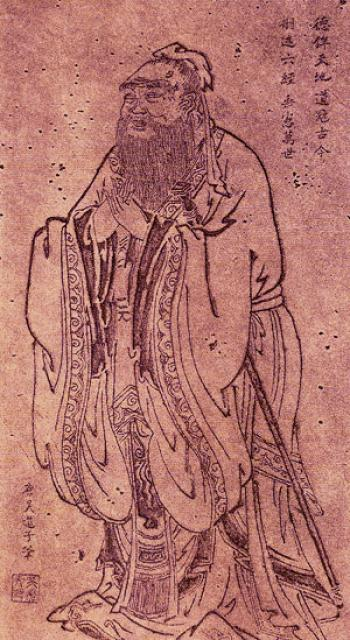
Confucius on mistakes

Depiction of Confucius by Wu Daozi, 8th century CE

“Be not ashamed of mistakes and thus make them crimes.”

~ Confucius

Confucius, born Kong Qiu, was a Chinese philosopher of the Spring and Autumn period who is traditionally considered the paragon of Chinese sages. Much of the shared cultural heritage of the Sinosphere originates in the philosophy and teachings of Confucius. Wikipedia

BornKong Qiu
c. 551 BCE
Zou, Lu (now QufuShandong)
Diedc. 479 BCE (aged 71–72)
Si River, Lu

Stressing Over Something? These 3 Questions Can Help.

You can use them to gain some perspective.

An illustration of a long ladder reaching out of a rippling pool.
Credit…Matt Chase
Jancee Dunn

By Jancee Dunn

May 22, 2026 (NYTimes.com)

Leer en españolSee more of our coverage in your search results.Add The New York Times on Google 

My father has a way of assuming the absolute worst in any situation, whether it’s real or imagined. Therapists call this pattern of thinking “catastrophizing.”

One of my dad’s favorite expressions is “It’s your funeral.” When he visits, he conducts a thorough inspection of my home, which is followed by grim pronouncements.

Last week, he emerged from my basement with a somber expression: “I guarantee you, it’s mold,” he said. “Get that inspected, pronto, or it’s your funeral.”

I don’t envision my funeral quite as often as my father does — but when I’m stressed, my worries escalate, too.

One method I use to corral my spiraling thoughts was developed by Martin Seligman, the director of the Penn Positive Psychology Center and a leading authority on happiness. He studies how people build resilience and has found that how we describe our hardships to ourselves can influence how we view them.

In his decades of research, Dr. Seligman has developed a three-part framework people can use to interpret life’s challenges: permanence, pervasiveness and agency. I find it helpful to pose a question about each one when I’m feeling out of control.

Our brains are wired to focus on negative events more intensely than on positive ones, and they tend to linger in our minds longer. This can make a problem feel as if it’s here to stay — even if it isn’t.

So when patients tell Dr. Seligman that they are anxious about something, he asks whether it is temporary. “Is it just this one situation? Is it going to hurt you only right now?” he asks. “Or is it going to last?’”

Knowing that your problem has an end point can help you shift from a state of emergency to tolerance, even if it’s painful in the meantime, said Eric Zimmer, author of “How a Little Becomes a Lot.”

Zimmer asks himself whether an issue will still bother him in five hours, five days or five weeks. If you determine that something will still worry you in five weeks, Zimmer said, then you can direct energy and resources toward dealing with it.

Sometimes a misstep or a crisis can cause us to generalize, drawing sweeping conclusions from one event. An example, Dr. Seligman said, is telling yourself you’re unlovable after a breakup, as opposed to “‘I never should have hooked up with him to begin with.’”

To harness your spiraling thoughts, Zimmer suggests asking yourself: Is this problem really affecting every single aspect of my life? What areas remain unaffected and positive?

When we are in the midst of a difficult situation, “we can get so myopically focused that it looks enormous,” Zimmer said.

Instead, he said, “zoom out and look at the whole picture.”

Before he had his podcast, Zimmer started a solar energy business that eventually folded. At first, he told himself he was a failure. But when he asked himself if this problem was pervasive, he realized that he wasn’t a failure — it was his business that had failed.

Dr. Seligman originally thought that personalization — the belief that negative events are all our fault — determined how a person viewed and weathered problems. But now he believes that agency, or the ability to take actions and make decisions that affect our lives, is a more important factor.

After you have acknowledged an ordeal, Dr. Seligman said, you can ask yourself, “‘What can I plan to do about it?’”

Pinpoint what is within your control — write it down if it helps — to figure out where you have agency, he said. For the most part, Dr. Seligman added, there is “almost always” something that you can find.

When Zimmer is brainstorming solutions to an issue, he tries to see it as a puzzle instead of a problem, a concept he learned from the music producer Quincy Jones. “It allows me to think that in many cases, there is indeed a solution,” Zimmer said. “I just need to find it.”

When it comes to my smelly basement, my dad has worn me down. I’m going to do what he suggests and call a mold guy: “Puzzle” solved.

(Contributed by Michael Kelly, H.W.)

Word-built world: sati (in Buddhism)

  • Google AI

In Buddhism, sati (a Pali word) translates directly to mindfulness or awareness. It is a fundamental mental quality that involves keeping one’s attention anchored in the present moment. [1, 2, 3, 4, 5]

Here is a breakdown of its meaning, role, and practice in Buddhist philosophy:

Core Meaning and Psychology

  • Literal Translation: The word originally means “memory” or “to remember.” In practice, it means remembering to maintain awareness of the present moment without drifting into distraction.
  • Objective Observation: Sati allows you to see things exactly as they are right now. It is a lucid, non-judgmental awareness that observes thoughts, emotions, and physical sensations without reacting to them with desire or anger.
  • The Opposite of Forgetting: It acts as an antidote to mental drifting, preventing the mind from falling into autopilot, confusion, or forgetfulness. [1, 2, 3, 4, 5]

Role in Buddhist Teachings

  • The Eightfold Path: It is the seventh element, known as Right Mindfulness (Sammā-sati). It serves as the bridge between mental concentration and liberating wisdom.
  • Factors of Enlightenment: It is the very first of the Seven Factors of Enlightenment, acting as the trigger that activates all other qualities like investigation, energy, and joy. [1, 2, 3, 4, 5]

How it is Practiced (The Four Satipaṭṭhānas)

The primary method for developing sati is outlined in the Satipaṭṭhāna Sutta (The Discourse on the Establishing of Mindfulness), which instructs practitioners to maintain continuous awareness across four domains: [1, 2, 3, 4]

  1. Mindfulness of the Body (Kāya): Awareness of the breath, physical postures (walking, sitting, standing), and bodily sensations.
  2. Mindfulness of Feelings (Vedanā): Noting whether experiences feel pleasant, unpleasant, or neutral as they arise.
  3. Mindfulness of the Mind (Citta): Observing the current state of the mind (e.g., whether it is anxious, calm, distracted, or concentrated).
  4. Mindfulness of Mental Realities (Dhammas): Observing how psychological patterns and Buddhist truths—like impermanence—operate within your direct experience. [1, 2, 3, 4, 5]

To help narrow this down, are you interested in how to practice mindfulness meditation, its connection to the Four Noble Truths, or how it differs from modern secular mindfulness?