
Monthly Archives: January 2026

Ashtavakra Gita on ‘me’ liberation and ‘me’ bondate

Tagore on singing your song

Autochrome portrait, 1926
“I have spent many days stringing and unstringing my instrument
while the song I came to sing remains unsung.”
~ Tagore
Rabindranath Thakur FRAS, also known by his pseudonym Bhanusimha (May 7, 1861 – August 7, 1941) was a Bengali polymath of the Bengal Renaissance period. In 1913, Tagore became the fourth non-European to win a Nobel Prize in any category, and also the first lyricist and non-European to win the Nobel Prize in Literature. Wikipedia
Word-Built World: broligarchy
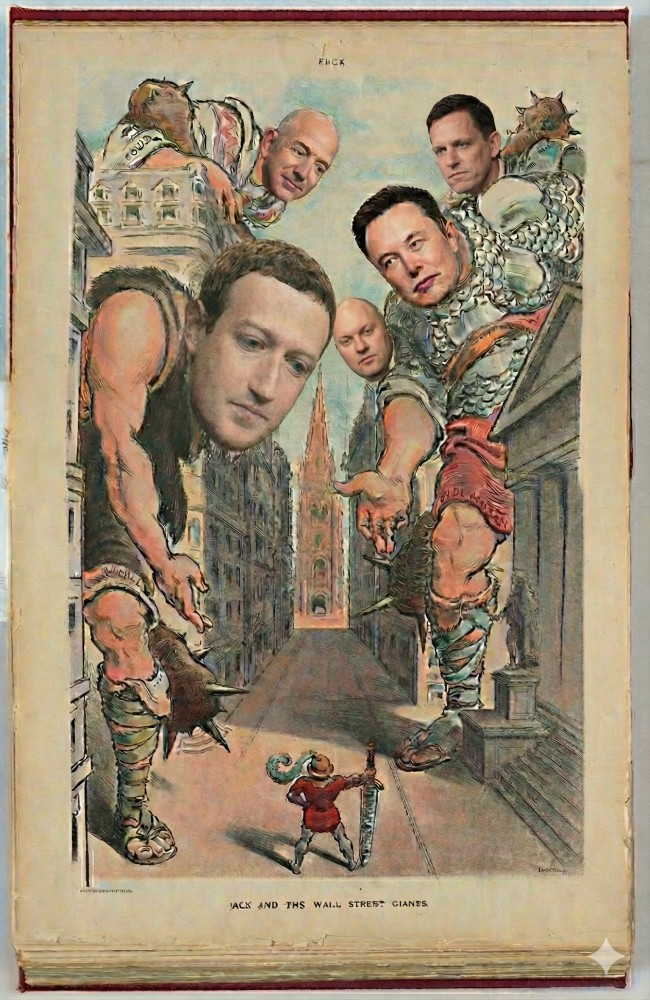
Original cartoon “Jack And The Wall Street Giants” by Udo J. Keppler in Puck magazine, 1904
A.Word.A.Daywith Anu Garg
broligarchy
PRONUNCIATION:
MEANING:
noun: A small group of extremely wealthy men who wield disproportionate influence in government.
ETYMOLOGY:
A blend of bro, a clipping of brother, used to refer to a male member of the same in-group + oligarchy (a system in which a few people control power). Earliest documented use: early 2000s.
Bhagavad Gita on ‘I’ and ‘Mine’
| “Free from all thoughts of ‘I’ and ‘Mine’, that man finds utter peace.” Bhagavad Gita |
 AN OPPORTUNITY FOR DAILY REFLECTION BROUGHT TO YOU BY THE SCHOOL OF PRACTICAL PHILOSOPHY |
The I Ching on chaos and opportunity
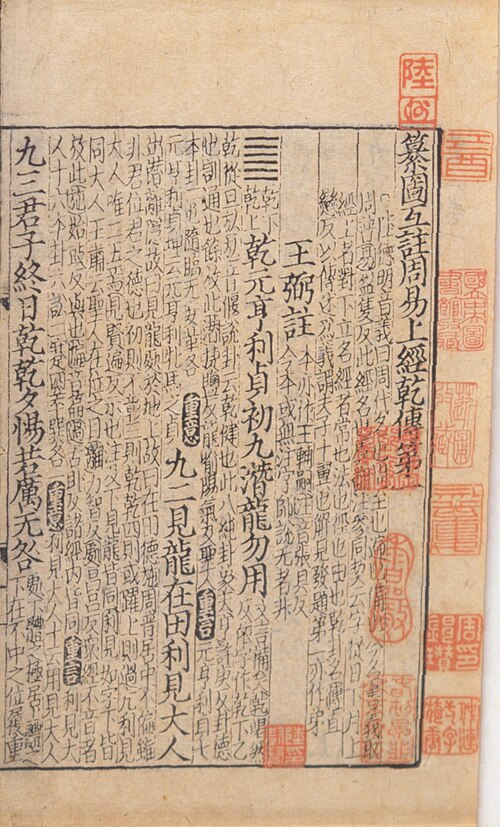
Title page of a Song dynasty (c. 1100) edition of the I Ching
“Chaos is another name for opportunity”
~ I Ching
The I Ching or Yijing, usually translated Book of Changes or Classic of Changes, is an ancient Chinese divination text that is among the oldest of the Chinese classics. The I Ching was originally a divination manual in the Western Zhou period. Wikipedia
Mysterious polar weather on Jupiter and Saturn could be key to understanding their insides
By Robert Lea published 2 days ago (Space.com)
“I don’t think anyone’s made this connection between the surface fluid pattern and the interior properties of these planets.”
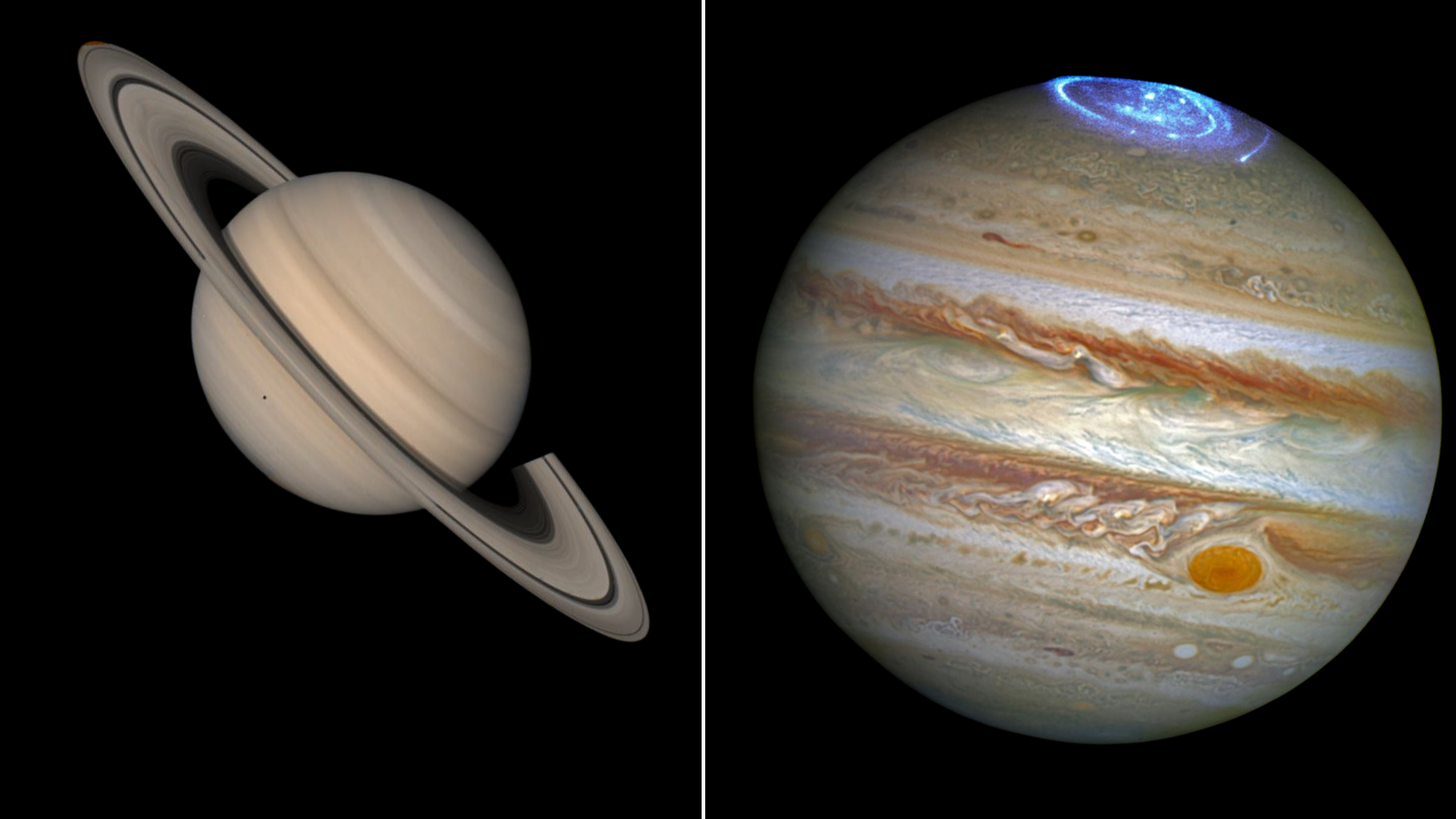
(Left) the ringed gas giant Saturn (Right) Jupiter as seen by Hubble with a glowing polar vortex (Image credit: NASA/JP/ESA/J. Nichols (University of Leicester))Share
Scientists may finally know why Jupiter and Saturn have very different weather patterns at their poles, despite having similar sizes and compositions. The discovery could help researchers probe deep into the interiors of these giant gaseous planets.
Observations of the two solar system gas giants have revealed that Jupiter‘s north pole hosts a central polar vortex surrounded by eight smaller vortices, while Saturn has a single, strangely hexagonal, massive atmospheric whirlpool over its north pole.
While performing complex simulations of these types of vortexes of gas giants, the team behind this research found that the difference between a single vortex configuration and a multi-vortex pattern depended on how “hard” the base of the vortex was, meaning how heavy the gas is in this region (the softer the gas, the lighter it is). This “hardness” is in turn related to the interior composition of the gas giant.You may like
- Jupiter has more oxygen than the sun, new simulations reveal
- Uranus may have more in common with Earth than we thought, 40-year-old Voyager 2 probe data shows
- James Webb Space Telescope discovers a hot Jupiter exoplanet leaking twin gas tails that defy explanation
Click here for more Space.com videos…
Video: https://cdn.jwplayer.com/previews/BFfRexGZ
“Our study shows that, depending on the interior properties and the softness of the bottom of the vortex, this will influence the kind of fluid pattern you observe at the surface, research team member Wanying Kang, of the Massachusetts Institute of Technology (MIT), said in a statement. “I don’t think anyone’s made this connection between the surface fluid pattern and the interior properties of these planets. One possible scenario could be that Saturn has a harder bottom than Jupiter.”
Softer than Saturn?
Kang and colleagues were inspired to conduct their simulations after viewing images of Jupiter captured by the Juno spacecraft, which has been orbiting the solar system’s largest planet since 2016, and by images of Saturn delivered by Cassini over 13 years of observations before it was deliberately plunged into the ringed planet at the end of its mission in 2017.
The Juno images revealed the immense scale of Jupiter’s polar storms, which are around 3,000 miles (4,800 kilometers) wide. For context, that is around half the width of Earth. Cassini’s observations of Saturn, meanwhile, showed its single hexagonal vortex is a staggering 18,000 miles (29,000 kilometers) wide.
Astronomers aren’t sure why there is such a size discrepancy between the two planets’ vortices. “People have spent a lot of time deciphering the differences between Jupiter and Saturn,” team leader and MIT scientist Jiaru Shi said. “The planets are about the same size and are both made mostly of hydrogen and helium. It’s unclear why their polar vortices are so different.”
Breaking space news, the latest updates on rocket launches, skywatching events and more!Contact me with news and offers from other Future brandsReceive email from us on behalf of our trusted partners or sponsorsBy submitting your information you agree to the Terms & Conditions and Privacy Policy and are aged 16 or over.
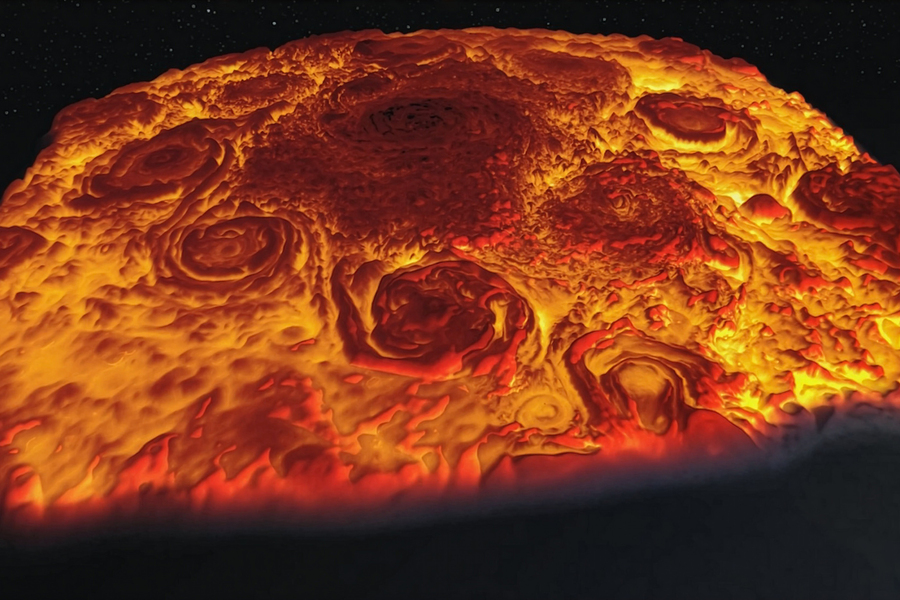
To answer this question, the team developed a 2D model of how vortices at the poles of gas giants like Saturn and Jupiter would evolve over time, applying this to a range of different scenarios. This included changing characteristics like the planets’ sizes, the speed of their rotation, their internal heating, and the hardness of rotating fluid within their vortices.
After ensuring the fluid in these vortices flowed in random patterns, the scientists were ready to determine how the fluid evolved under specific conditions. This led to the discovery that a single mechanism could determine if a single vortex or multiple vortices developed;the softer the gas rotating at the bottom of the vortex is, the smaller that vortex is. That allows for the formation of multiple vortices, just as is seen at the poles of Jupiter.
If the team is right, then this implies that Jupiter consists of softer, thus lighter, gas, while Saturn seems to be composed of heavier gaseous material.
“What we see from the surface, the fluid pattern on Jupiter and Saturn, may tell us something about the interior, like how soft the bottom is, and that is important because maybe beneath Saturn’s surface, the interior is more metal-enriched and has more condensable material, which allows it to provide stronger stratification than Jupiter,” Shi concluded. “This would add to our understanding of these gas giants.”
The team’s research has been accepted for publication in the journal Proceedings of the National Academy of Sciences.

Senior Writer
Robert Lea is a science journalist in the U.K. whose articles have been published in Physics World, New Scientist, Astronomy Magazine, All About Space, Newsweek and ZME Science. He also writes about science communication for Elsevier and the European Journal of Physics. Rob holds a bachelor of science degree in physics and astronomy from the U.K.’s Open University. Follow him on Twitter @sciencef1rst.
3 possible futures for AI — which will we choose?
Enchantment and the Courage of Joy: René Magritte on the Antidote to the Banality of Pessimism
By Maria Popova (themarginalian.org)

In a world pocked by cynicism and pummeled by devastating news, to find joy for oneself and spark it in others, to find hope for oneself and spark it in others, is nothing less than a countercultural act of courage and resistance. This is not a matter of denying reality — it is a matter of discovering a parallel reality where joy and hope are equally valid ways of being. To live there is to live enchanted with the underlying wonder of reality, beneath the frightful stories we tell ourselves and are told about it.
Having lost his mother to suicide, having lived through two World Wars, the Belgian surrealist artist René Magritte (November 21, 1898–August 15, 1967) devoted his life and his art to creating such a parallel world of enchantment.
The Lovers II by René Magritte, 1928
In a 1947 interview included in his Selected Writings (public library) — the first release of Magritte’s manifestos, interviews, and other prose in English, thanks to the heroic efforts of scholar Kathleen Rooney — he reflects:
Experience of conflict and a load of suffering has taught me that what matters above all is to celebrate joy for the eyes and the mind. It is much easier to terrorize than to charm… I live in a very unpleasant world because of its routine ugliness. That’s why my painting is a battle, or rather a counter-offensive.
Magritte revisits the subject in his manifesto Surrealism in the Sunshine, indicting the cultural tyranny of pessimism and fear-mongering — a worldview we have been sold under the toxic premise that if we focus on the worst of reality, we are seeing it more clearly and would be prepared to protect ourselves from its devastations. A quarter century before the great humanistic philosopher and psychologist Erich Fromm insisted that “pessimism [is] an alienated form of despair,” Magritte writes:
This notion is the result of philosophies (materialist or idealist), that claim that the real world is knowable, that matter is of the same essence as mind, since the perfect mind would no longer be distinct from the matter it explains and would thus deny it. The man on the street is unknowingly in harmony with this idea: he thinks there is a mystery, he thinks he must live and suffer and that the very meaning of life is that it is a dream-nightmare.
In his art and the worldview from which it springs, Magritte presents an antidote to this warped thinking — a backdoor out of our elective suffering. An epoch before we began to understand the neurophysiology of enchantment, he echoes his contemporary Egon Schiele’s exhortation to “envy those who see beauty in everything in the world,” and writes:
We are capable of transforming it and giving it a charm which makes life more valuable. More valuable since life becomes more joyful, thanks to the extraordinary effort needed to create this charm.
Life is wasted when we make it more terrifying, precisely because it is so easy to do so. It is an easy task, because people who are intellectually lazy are convinced that this miserable terror is “the truth”, that this terror is knowledge of the “extra-mental” world. This is an easy way out, resulting in a banal explanation of the world as terrifying.
Creating enchantment is an effective means of counteracting this depressing, banal habit.
[…]
We must go in search of enchantment.
Complement with Viktor Frankl on saying “yes” to life in spite of everything and Walt Whitman on optimism as a force of resistance, then revisit Rebecca Solnit on hope in dark times.
Book: “I Paid Hitler”

I Paid Hitler
Fritz Thyssen, Emery Reves
Friedrich ‘Fritz’ Thyssen was a leading German industrialist. In 1923 General Ludendorff advised Thyssen to attend a speech to be given by Hitler, and Thyssen was very impressed, and primarily due to his strident opposition to the Treaty of Versailles he began to make large donations to the party. His principal motive appears to have been his fear of communism, but he was not initially politically aligned to the Nazis, and remained a member of the German National People’s Party until 1932.
The following year he overcame his inhibitions and formally joined Hitler’s National Socialists. In November, 1932 Fritz Thyssen and Hjalmar Schacht were the main organizers of a letter to President von Hindenburg urging him to appoint Hitler as Chancellor. Thyssen also persuaded the Association of German Industrialists to donate three million Reichsmarks to the Party for the March, 1933 Reichstag election. As a reward, he was elected a Nazi member of the Reichstag. He welcomed the suppression of the Communist Party, the Social Democrats and the trade unions and gained enormously by the strict control over workers’ rights. His financing of the Nazis initially proved to be a sound investment. Thyssen accepted the exclusion of Jews from German business and professional life by the Nazis, and dismissed his own Jewish employees. But as a Catholic, he objected to the increasing repression of the Roman Catholic Church, which gathered pace after 1935.
Thereafter he experienced his ‘awakening’ to what was happening and drifted away from Hitler. He was against the violent pogrom against the Jews in November 1938, known as Kristallnacht, which caused him to resign from the Council of State. By 1939 he was also bitterly criticizing the regime’s economic policies, which were subordinating everything to rearmament in preparation for war. At the beginning of September 1939, following his son-in-law’s death in Dachau―and knowing that his opposition to Hitler made him a ‘marked man’―he escaped to Switzerland.
In 1940 Thyssen took refuge in France, but was caught up in the German invasion of France and the Low Countries while he was visiting his sick mother in Belgium. He was arrested and sent back to Germany, where he was confined, first in a sanatorium near Berlin, then from 1943 in Sachsenhausen. In February 1945 he was sent to Dachau but survived the war. Prior to his arrest he had dictated his memoirs which he entrusted to an American journalist, Emery Reves, and these memoirs―the subject of this book―was first published in the USA at the end of 1941.
(Goodreads.com)