How did MLK Jr. Become a Socialist?

A forgotten network of radicals helped teach King how to organize—and how to link civil rights to economic redistribution for all

Eric Blanc Jan 19, 2026 (laborpolitics@substack.com)

Almost everyone left of center now understands that Martin Luther King Jr. was more radical than the milquetoast, “I Have a Dream”-only version many Americans grew up with.

MLK Jr. was a political radical who spent his final years opposing militarism, denouncing capitalism, and demanding a massive economic redistribution. That’s why Zohran Mamdani’s go-to definition of socialism has been to quote King: “Call it democracy, or call it democratic socialism, but there must be a better distribution of wealth within this country for all God’s children.”

And yet, even many of the most sympathetic “radical King” accounts still cling to a familiar American fairy tale: the Great Man who simply had it in him—born with moral courage, hatched fully formed, and then leading history forward by sheer force of charisma.

That story is wrong in a specific way that matters for today’s left. King’s radicalism wasn’t a private attribute. It was the outcome of apprenticeship inside an organized tradition—a network of socialists, labor radicals, and movement educators who did the unglamorous work of training leaders, building institutions, writing drafts, running logistics, teaching strategy, and connecting civil rights demands to bread-and-butter class politics.

It’s unfortunate that this institutional legacy has been scrubbed out so successfully that people might end up thinking King invented his own politics in isolation. In reality, he came up inside a web of socialist organizers and “movement schools” that treated racial justice and economic justice as inseparable—and, crucially, treated organizing as a craft you could teach.

Part of what makes the erasure so effective is an accompanying myth: that early American socialists—especially those associated with the old Socialist Party—“ignored race,” full stop, and therefore couldn’t possibly have helped seed the Black freedom struggle’s mass politics. There’s a kernel of truth there (the history includes shameful racism and exclusion), but it’s also a caricature that turns a complex tradition into a straw man—and, conveniently, makes it easier to pretend that socialism and antiracism only meet in the 1960s as a kind of happy accident. In reality, the US Socialist movement—including former racists like Victor Berger— after 1917 forcefully attacked white supremacy and empire rather than accommodating them, establishing an organized legacy that went on to play a central role in MLK Jr.’s politics.

This isn’t an argument for diminishing King’s heroism or agency. King was extraordinary. But if we care about the kind of politics he practiced—mass organization, movement discipline, and democratic socialism—we have to pay attention to the scaffolding that made it possible.
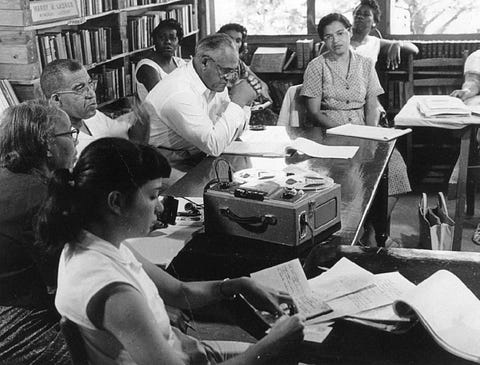
Rosa Parks at the Highlander School

Myles Horton and The Highlander School

It’s tempting to treat the 1955 Montgomery bus boycott as the instant birth of the modern civil rights movement—one brave woman refuses to stand, a young pastor gives a speech, history turns. But the boycott succeeded because it sat on top of years of organizing: NAACP networks, church infrastructure, labor-style discipline, and political education.

Rosa Parks is often flattened into a symbol—quiet seamstress, tired feet, spontaneous defiance. But Parks was a serious organizer, a student of movement strategy, and someone who had been steeped in the traditions of interracial radicalism and labor solidarity. Her decision to sit in the front of the bus in December 1955 didn’t come from nowhere. It came from training, relationships, and political formation—including her relationship to one of the most important movement institutions of the twentieth century: the Highlander Folk School.

Highlander, based in Tennessee, was a radical training ground born out of the labor left of the 1930s. Its founder, socialist Myles Horton, saw it as a place to build power from below—first in the labor movement, and later in the southern freedom struggle.

Myles Horton

Myles Horton came out of a world where socialism was a practical current in working-class life. Horton had studied under Christian socialist Reinhold Niebuhr and in his autobiography he describes learning politics from people like “the old Socialist, Joe Kelley Stockton,” a friend of Eugene Debs who made socialism tangible through his generous daily life and fierce class struggle politics.

Highlander, launched with financial support from Niebuhr and the Socialist Party, wasn’t designed to produce charismatic leaders, but to produce collective capacity—to teach ordinary people to analyze their conditions, talk to each other across divisions, and act together.

As Horton put it, Highlander existed so people didn’t wait for “some government edict or some Messiah” to improve their lives. Its radically democratic pedagogy insisted that “the best teachers of poor and working people are the people themselves,” and that the point was not adjustment to an unjust society but its transformation.

And though it often gets forgotten today, Highlander’s early political DNA was explicitly socialist. In one fundraising appeal, Horton described Highlander’s goal as “education for a socialistic society” and he made clear the school’s commitments: it existed “to help create a new social order.”

The school’s early focus was heavily labor-oriented—mostly white textile and mine workers in the mountains—but Horton and his team moved toward racial justice as they confronted the South’s core system of rule. Horton reached out to Black labor organizers in the 1940s and by the 1950s shifted Highlander’s focus “completely” toward fighting segregation.

Rosa Parks and Montgomery

Rosa Parks’s relationship to Highlander is one of those threads that gets cut out of the story because it complicates the heroic myth. Parks didn’t just feel her way into resistance. She prepared.

Montgomery’s movement anchor, Black labor organizer E. D. Nixon, insisted that effective civil disobedience required “careful planning” and “a well-trained and disciplined core of leadership.” This was the logic he had been taught at Highlander: organization first, then disruption. Thus Nixon arranged for Parks and other local Black activists to attend the school in August 1955 for a two-week intensive multi-racial training. Parks later recalled:

At Highlander, I found out for the first time in my adult life that this could be a unified society, that there was such a thing as people of different races and backgrounds meeting together in workshops, and living together in peace and harmony. It was a place I was very reluctant to leave. I gained there the strength to persevere in my work for freedom, not just for blacks, but for all oppressed people.
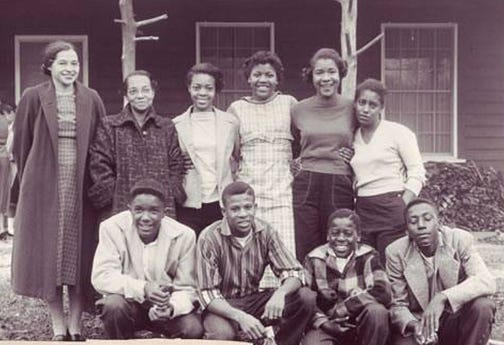
Rosa Parks with the Clinton 12 at Highlander

Montgomery’s subsequent boycott matters here not only because it propelled that as-then-still-unknown King into national leadership, but because it was the first major breakthrough of the modern civil rights movement’s mass-action model: sustained collective discipline, economic pressure, and moral confrontation with Jim Crow power. It turned the struggle from courtroom battles into a social insurgency. King’s gifts—his voice, his steadiness under pressure, his ability to frame the fight in moral and democratic terms—were real. But the movement around him was also teaching him what kind of leader he needed to be.

That teaching came from people who already knew how to organize. And a surprising number of those people came out of socialist and labor traditions.

Bayard Rustin

If you want to point to a single figure who helped turn King from a gifted local leader into the organizer of a national movement, Bayard Rustin is hard to beat. Rustin treated nonviolent mass organizing as a technology of power. It was something you trained for, drilled, organized, and executed with precision.

Rustin is sometimes remembered as the man behind the 1963 March on Washington. That’s true—but it sells him short. Rustin wasn’t just an event planner. He was a strategist who carried decades of political experience in labor coalition-building, in Gandhian nonviolence, and in building structure and discipline. He was also a committed democratic socialist. As he put it in a 1958 report on his recent trip abroad, “The problem in Europe—as in the United States—is the absence of a vital socialist movement.”

MLK Jr. and Bayard Rustin

Rustin also helped shape the intellectual and strategic framing of Montgomery. He constantly pushed King and other leaders to think bigger: don’t treat the boycott as a local dispute; treat it as a model. Don’t treat segregation as a “Southern problem”; treat it as a national crisis of democracy. And don’t separate civil rights from economic rights.

That last point is crucial. Rustin’s politics came out of a socialist tradition that understood racism as inseparable from political economy. He was relentless about moving from protest to power via majoritarian working-class politics.

This is also where Rustin’s own life shaped his political commitments. He lived as an openly gay man in a movement world that was often hostile to homosexuality. He survived repression, marginalization, and surveillance. Those experiences sharpened his sense that moral purity is not enough. You need organization strong enough to win.

King absorbed a lot of this. The “King style” people now admire—moral clarity fused with disciplined organizing and broad coalition politics—didn’t come only from the pulpit.

A. Philip Randolph

If Rustin helped professionalize strategy, A. Philip Randolph helped define the movement’s relationship to labor and economic justice.

Randolph became a Socialist Party leader in a Harlem milieu that fused class struggle with a Black freedom politics. In New York he and his co-thinker Chandler Owen tried organizing unions, got fired for telling the truth about low wages, and, with backing from the left-wing Jewish Daily Forward, launched The Messenger in 1917, which they advertised as “The Only Radical Negro Magazine in America.”

Randolph’s socialism was a way of reading power and a way of building it. He believed Black freedom couldn’t be won only through courtroom victories or moral persuasion, because segregation was anchored in material domination: jobs controlled by bosses, housing controlled by landlords, and politics controlled by those who owned the economy. That conviction pushed him toward the hardest terrain in American life — Black labor struggles — and the belief that democracy required economic power for working people.

MLK Jr. and A. Philip Randolph

Randolph’s Brotherhood of Sleeping Car Porters wasn’t simply a successful union—founded in 1925 to organize the thousands of Black men working as Pullman porters on the railroads, it was the first major Black-led union to win a charter from the American Federation of Labor. It became a training ground for a generation of Black working-class organizers—including E. D. Nixon in Montgomery—who understood how to pressure institutions, bargain collectively, and build durable organizations.

Randolph also pioneered a tactic that would define the civil rights era: the threat of mass action as leverage. His proposed March on Washington in 1941—aimed at forcing federal action against discrimination in defense industries—was a model of using mobilization to extract concessions. It showed that you didn’t have to wait for goodwill. You could force change.

By 1963, that Randolph tradition culminated in the March on Washington for Jobs and Freedom, an event that is often sanitized into a warm memory of one speech about a dream. But the march’s very framing was a statement: jobs and freedom. Not just rights on paper, but economic demands.

And Randolph’s language was militant in its insistence on pressing forward. Randolph declared, “This march will not be stopped. It will go on.” That line was a warning to the political establishment that the movement would escalate until its demands were met.

Stanley Levison

Stanley Levison might be the least known of King’s key socialist advisers, but his impact was no less significant. Levison—introduced to King by Bayard Rustin during the Montgomery bus boycott—was a wealthy Jewish businessman and lawyer with a deep Marxist past, someone the government treated as a dangerous contaminant. Indeed, he was “a dyed-in-the-wool leftist” and “a full-blooded Marxist” until he severed formal ties with the Communist Party in 1956.

As his biographer notes, Levison did much of the backend work that made King’s work possible. Levison “counseled, raised funds for, ghostwrote articles and speeches for, did the accounting of, and often bailed out King” from 1955 to 1968.

That doesn’t mean Levison “made” King. It means King operated inside a support system built by seasoned organizers and radical intellectuals—precisely the kind of system that Great Man stories erase.

MLK Jr. with Stanley Levison

Levison also shaped King’s message in important ways, especially around class. As King put it in his book on Montgomery, the labor movement “must concentrate its powerful forces on bringing economic emancipation to white and Negro by organizing them together in social equality.” Levison’s politics mattered here. He was a Marxist with real ties to labor radicalism, someone who saw economic structure as the key to racial hierarchy. And he helped King articulate that link in public language.

Levison also brought a kind of ethical discipline that helped shaped King’s choices. When King considered a profitable lecture tour, Levison snapped, “You can’t do that,” and when King asked why, Levison answered: “Because the kinds of people that you will be preaching to about nonviolence are too poor to pay for your lectures.” King quickly agreed. It’s a small detail, but it underscores how personal virtue emerged from political discipline—one rooted in socialist movement culture.

A Forgotten History

If this socialist tradition mattered so much, why is it so absent from popular memory?

One answer is repression. Levison, Rustin, and others were targeted by the FBI and by politicians who believed civil rights could be discredited by association with socialism. J. Edgar Hoover treated Levison as “Mr. X,” a Communist figure supposedly infiltrating King’s circle.

Another answer is American political culture. Many people find it comforting to believe change comes from exceptional individuals, not from organization. It reduces history to biography. It lets you admire King without asking what kind of collective apparatus is needed to produce more leaders like him and to win real change.

And then there is the myth about early socialists and race: the idea that socialism is inherently blind to racism, making it easy to treat socialist influence on King as irrelevant or accidental. There were real failures and compromises across the white socialist and labor left. But there were also profound contributions—Randolph and Rustin’s entire careers being one of the most obvious. And their politics came straight out of the Socialist Party, which had made a sharp anti-racist turn after World War I.

The point is that King’s movement was built inside a broader left ecosystem that treated racial justice and economic justice as inseparable. None of this reduces King to a puppet. The opposite is true. King’s greatness was not just that he had advisers. It was that he listened, learned, and evolved. Many leaders resist that kind of learning. King actively sought it.

He also chose, again and again, to accept the risks that came with these relationships. Staying close to Rustin and Levison—both targets of intense repression—was not safe. It wasn’t politically convenient. King did it because he recognized that movements need thinkers, strategists, and builders, not just preachers.

The story of King’s radicalism is not the story of a lone genius. It is the story of a gifted leader who joined a tradition—and helped bring its best instincts to national scale.

No Solitary Heroes

We live in a moment when Donald Trump has helped hurl the United States back toward some of its worst legacies of racism, exclusion, and oligarchy. In this environment, the right lesson from King is that moral clarity has to be fused with organization, mass leverage, and material demands.

King’s most dangerous idea was never simply that racism is wrong. It was that democracy requires redistribution—what he and his circle increasingly framed as a kind of democratic socialism in practice: building a society where working people have power, where rights are real because they are backed by economic security, and where the fight against racism is inseparable from a fight for a better life for all workers.

That vision did not emerge from King alone. It was shaped and sharpened by a broader socialist tradition—through figures like Bayard Rustin, A. Philip Randolph, Myles Horton, Rosa Parks, and Stanley Levison—who taught him how to organize, how to think structurally, and how to connect the struggle for dignity to the struggle for material freedom for all.


More

  • Organizations in Minnesota have called for a mass day of “no work, no school, no shopping” on January 23. Each of us, and all our organizations, should try to participate nationwide. It’s all hands on deck to protect our communities from ICE terror.
  • In NYC, students will be walking out on January 23. The UFT, NYC’s teachers union, has also committed to participating in the day of action. Students and unions nationwide should follow their lead.
  • The fight to tax the rich in NYC has taken on an increased urgency after it was announced that the city is facing an unexpectedly large budget shortfall due to Eric Adam’s mismanagement. We need your help to canvass and phonebank our fellow New Yorkers — sign up here.

How JFK Saved MLK’s Life And So Won The Presidency

  • by Greg Palast
  •  January 19, 2026 (palastreport@gregpalast.com)

It was a Republican, Martin Luther King Sr., who made John Kennedy president of the United States — for JFK’s saving Daddy King’s son, Martin Jr., from lynching.

This harrowing and little known drama of terror and courage, confirmed for me by Martin Luther King III, changed American politics — and America — forever.

On October 19, 1960, Martin Luther King Jr. was arrested in Georgia for driving with an Alabama driver’s license and sentenced to six months hard labor. No one expected King to survive the sentence — he’d be lynched at the outset.

His father, Martin King Sr., had one desperate chance to save his son. Daddy King had endorsed Richard Nixon, a family friend, for the presidency. Nixon could count on King, a Republican like many African-Americans, who chose the party of Lincoln over the racist Democratic party of Jim Crow segregation.

A desperate King called Vice-President Nixon — who refused to answer. But MLK’s wife, Coretta, had a single hope. She called a friend, pacifist activist Harris (later Senator) Wofford who called Bobby Kennedy.

RFK didn’t hesitate, calling from a pay phone on Long Island to his brother, demanding John save MLK Jr.

Palast at King’s Atlanta Church on assignment for Al Jazeera. Photo by Zach D. Roberts.

It was just three weeks before the presidential election, a race too close to call. This was a crisis. Three Southern governors warned the Kennedys that any help for Dr. King and JFK would lose three Deep South states.

John Kennedy, who’d just won the Pulitzer Prize for Profiles in Courage, knew this was his test. He gave Bobby the go-ahead to save King.

Bobby called Atlanta and told the judge he’d post King’s bond — though the judge had never offered bond. But this Democratic judge knew that with his party, the Kennedys could employ and destroy.

Meanwhile, according to Martin King III, his father was pulled from his Atlanta jail at 2am and told he would be transferred to Reidsville Prison hours from the city. King was certain he would not live to see the dawn.

But the judge had let it be known that King now was now under the protective gaze of the Kennedys. And MLK, said his son, was “the first prisoner ever to be thrilled and thankful to enter the gates of Reidsville Prison.”

But the warning came true. Word of Kennedy saving King cost JFK the electoral votes of Louisiana, Mississippi and Georgia. But then there was the miracle. Daddy King had written a pamphlet beginning, in block letters:

“No Comment” Nixon
versus
A Candidate with a Heart,
Senator Kennedy
*
THE CASE OF
MARTIN LUTHER KING

The pamphlet, on blue paper, was carried to the churches of half a million African-Americans.

Daddy King said, “I have a suitcase full of votes for the Senator that I’m carrying to Chicago.”

The mass outpouring of sermon-inspired African-Americans won Kennedy razor-close victories in Illinois, Michigan and New Jersey.

Even historian Ted White cites the King family’s powerful campaign of gratitude, and the pamphlet now known as “The Blue Bomb,” as the deciding factor in John F. Kennedy’s victory over Nixon.

The Democrats’ once-solid hold on the South was no longer solid — but a new voting block, would hold hard as a hammer for the Democratic Party for the next half century to today.

It was this profile in courage — the Kings and the Kennedys — that truly made America great and morally mighty.

Those mighty Kings and Kennedys are gone.

So it’s left to us to stand up to the gelatinous orange pustule of bloviating bigotry that has, against the democratic will, seized this White House and Congress.

Today, we honor a man whose courage must now be ours; and then we can make America truly great again.

Darrow Palast contributed research for this article. Photo of Palast at King’s church by Zach D Roberts for Al Jazeera.

New Years Resolution or Reframing Your Story

By Calvin Harris H.W., M

Happy New Year to you… some of you have come up with New Year’s Resolutions.  I have come up with the idea that instead of Resolutions, to do a “Reframe”, that is a cognitive reappraisal of our story for the next year.

I was surprised to get inspiration for this, as well as to be reminded of some life lessons through two films that I watch at the close of 2025.

Life lessons that somehow get ignored or forgotten but were brought back to me in the last weekends of December 2025.

Watching the films, I was reminded of that phrase: “All I Really Needed to Know I Learned in Kindergarten” Well, it was one of those moments, Yep, those lessons in memory that can come flooding back to you from elementary school years.

The two films gave a realignment of a fairy tale about a place called Oz. Now Oz was a place I was introduced to during my elementary school years.  The original story was about what happened when a circus traveling showman (a carny) blows into Oz and mistakenly becomes that country’s most powerful Wizards.  

Speaking about elementary school years lessons, before I continue  I have a story, a lesson I learned during that time, something my Mother had instilled in me, and that was, “there is more than one way to look at a story”.  

This lesson was painfully brought home to me anytime something happened where objects were mislaid or broken, usually caused by negligence or unawareness of the object by myself and either a brother or sister which then caused an accident or something to be broken.

Because we each blamed the other sibling, my Mother would break up the argument, and then she would ask questions and listen for the answer. She would hear first their side of the story, then hear my side of the story, and once she’d done that, and felt she had the facts, she then would spank us both. She had discerned in her listening, right in the midst of our retelling of the story the facts, facts that we both had said, and more importantly, facts from what was not said, thus the Truth emerged. The fact that one of us was no less guilty than the other of negligence or unawareness.  

That lesson of listening for and acting on the truth, brought about by hearing all sides of a story, has been invaluable to me in my personal life as well as in my coaching career.

Truth verses what people are willing or wanting to believe was another of the lessons in the Wicked movies.  An Idea that is as old as time. This idea was brought to the pages of  the Wicked book when it was written in 1997 (over 20 years ago), of course the original book was titled: “Wicked: The Life and Times of the Wicked Witch of the West”, by Gregory Maguire.

I must admit the full impact of the Wicked story was not understood from reading the book, nor was it felt that deeply from the musical when I saw it in 2008, but it did hit hard seeing the story come to life, crafted and presented by director Jon M. Chu,  in his two movie version I saw in 2025.

Another integral part of the lessons came to me, through my journaling about the two films.  I recalled  being a student at the Prosperos ® School of Ontology, our interactions with each other as students, while engaged in projects and activities, and the lessons we were learning about ourselves and each other through the class work and classes with the dean and master teacher of the School, Thane Walker.

Thane’s words to advise or admonish us were: “If you want to change what’s going on around you, then change what is going on within you.”

That message was  poignant and carries throughout these  films as a coming-of-age story about two young women, one popular and one a nerd. who have met at a school to become potential witches. They are Galinda Upland and Elphaba Thropp (You may know them as the Good and Bad Witches of Oz).  

The Key to the movies begins with the tagline from the original book, when it asks: “Are people born Wicked? Or do they have wickedness thrust upon them?” 

The stories brought up for me memories of junior and senior high school peer- pressure nonsense, of  who to  stay away from because they were uncool or bad, and the other  side of that was who you must be seen with if you want to appear cool or good (I am sure you have had  similar experiences).

Thus the major theme of the movies – What is Good and What is Bad?

I know a lot of people have struggled with that issue throughout their lives.  I in fact, as a young man of 23 years old,  struggled with it, until one day while in the home library of an older wiser friend, I pull off his book shelf a signed copy of Auntie Mame and on the first page of the book was written this  quote by Patrick Dennis the author:  To Haven: “Evil spelled backwards is to Live.”  (But I digest).

In these two films, we are taken on what Joseph Campbell would identify as the Hero’s Journey. Campbell would suggest a type of journey each of us in our own way has been challenged to do image.jpeg

 The first film deals with Elphaba’s journey, being born green and different, causing her a journey of being alone while in a crowd, and later being alone in a “purpose of doing good, earning her the label – bad – for wanting to right a wrong.

We the audience discover, as the character uncovers herself, that there is a reality about her that is underneath and beyond personality and skin color; it is not until she embarks on her journey, moving through phases of what she thinks she needs to be; and what she thinks she wants to be;  and what she determines her identity is (call them  roles).   Roles that Elphaba thinks she has to play,  and yet, there is a glimmer of insight about her authentic self she gains through her relationship with Galinda.  

That brings us to the end of the first movie but not to the end of questions we have of Elphaba, such as, what happens next after  your  world of expectations and  beliefs are shattered?

This first film (Wicked),  also introduces us to Galinda. Who is outwardly beautiful, with all of the trappings of popularity, status, and influence.  Someone who seems to have it all. Yet who is also a person alone in the crowd.   Early on in the film there are indications in Galinda’s behavior as to the choices she will make, given her chosen role in life; the beliefs, and expectations she has about herself and others, a role –  beliefs – and expectations – that keeps her from her true goal and life purpose.  

What we find in the first story, are two young women, Elphaba and Galinda drawn together as much by their similarity as they are by their differences.

image.png

The second film (Wicked for Good) – We find Elphaba, fully developed in a role that does not speak her truth, a role that she soon comes to know as too restrictive and eventually she will have to dissolve, if her true self is to be realized beyond a label of evil and bad.

This second film is where Galinda begins her hero’s journey beyond the role she has always accepted about herself, which is as mechanized as her “bubble” she travels in.  

Her transformation happens through situations and encounters between herself and Elphaba.  Galinda becomes aware of her persona, and then questions it internally – Who does she want to be? What does she think she wants in life?  Followed by what actions to take? 

It is not until her expectations and dreams become shattered right in front of her, that Glenda is made to address her “shadow” self, her darkness, as she struggles to find what she really wants. Then how she handles her struggle towards  true goodness and light.

Her quest is about her choices; her expectations of situations that do not match up to how her life is actually being lived. She confronts the lies that surround her.  When she realizes the repercussions of playing a role rather than being the person she ought to be, and finally her surrender to that which is authentic about herself,  that which propels  her to do what she must and serve a purpose beyond herself.

The two films are very different yet complementary in their poignant themes of friendship, working alone and in tandem to reach a higher goal and sense of self.

image.png

Which brings me back to  a Resolutions or Reframing.  Instead of resolutions, maybe this year, try a Reframing challenge, which is to consciously change your perspective of negative thoughts, beliefs, and outcomes that contribute to holding you in certain roles and challenges.  Let us rather  actively work to change thoughts and habit patterns to align with a more realistic principled view of  yourself and situations.

The films gave us clues to move us forward in doing this –  Such as to work in tandem with others to flesh out our character roles from our authentic self.  

A Prospero’s® technique called Releasing the Hidden Splendor©(RHS), I have found to be a helpful means for realignment of beliefs and expectations with the reality of truth and the authentic self.

RHS can be enhanced as a relational orientation tool, when coupled with Group dynamics, this provides you with an abstract understanding and a working hypothesis of Truth that is under and back of  the situations and the roles people are casted in.

Used in tandem you will find people can work consciously to challenge and question the shadow self. It is this engagement with others while working on projects and in causes, that people will meet themselves… their own undigested desires, hurt, grief, and feelings of loneliness.  This “shadow self”.  

Through working with others, and the use of RHS technique they can move past toxic interpersonal relationships –  To move to social connections and bonds between people, ranging from brief acquaintances to deep family or romantic ties, vital for human health and development. Relationship connections, built on communication, trust, and empathy, and involving the mutual sharing of emotions and information – that leads to self-disclosure on a scale that produces unpredictable good in their lives… and to allow themselves a future of unpredictable good.

So, are you in?

Happy New Years to You!

Calvin

Community Update — January 2026

 
Community Update
January 2026

  Student News…and… 
** Class, Meetings, Activities to begin the year! **

(see below Pam’s article)


Finding the Real God
as an Abstractionist
by Pam Rodolph, H.W.,M.

I begin Everything in the third dimension was created from an idea. Ideas are abstract, as it doesn’t matter how many times you use an idea, it is never used up. An idea is immortal because it cannot be attacked and destroyed. It is timeless because it cannot be changed. If another idea takes its place, destroys its validity, you can still think it. It is unendable!


Pam Rodolph, H.W.,M.     

Where do the ideas come from? Well, to be all, God has to be abstract. All cannot apply to the third dimension. There sits a chair. The chair sits in the third dimension. Right behind the chair is the idea — “to sit.” And right behind that idea is the thinker. This thinker is perfect intelligence, so perfect, it does not know or ever need to know what some problem is before it delivers a perfect miracle.

Look, the third dimension is a wreck. But it’s where all the fun is.     

God cannot be a dead bug. God is life. God cannot be a birth defect. WHAT God would wish a birth defect on an innocent baby? What kind of garbage are we sitting in to even conceive of such nonsense! GOD IS GOOD — ALWAYS — but in his environment: the genesis of Abstract ideas. That never promises to affect our world at all. Everything else is an established pattern, of human creation or chaos, which is actually nonlinear order. All of anything makes no sense in the third dimension, except in a relative manner. And then it’s not all anymore, if it’s limited in some way.

God gave us the ABILITY to create, and then let us go. We were given absolute freedom to chose our life, along with the responsibility for it. But those are OUR choices, often leaving behind OUR mess. If my mess is God, as determined by applying “all” to the third dimension, then he’s responsible for my life, which pretty much strikes down personal responsibility AND freedom of choice.

Birth defects happen because something collides with something else which starts a ripple effect that bangs too many molecules…

In saying or thinking, “God is all,” we can educate a knee-jerk response in ourselves to envision the Abstract world. It doesn’t make sense in the third dimension to say God is All—including the most abominable acts that a sick and disgusting mind can think up. “How can someone think that is God! Jesus Christ…”        

I don’t know what happens to people when they “get God”. Some call it a “Paul-on-the-road-to-Damascus” experience. I guess in getting something, they think they must give up something. Why they always choose to give up common sense is beyond me.

If God is good, his domain MUST be an environment that allows him to be good. Does this world look like it allows him to be good, for Christ’s sake?! It won’t even allow a paper bag to do its job without getting ripped!

Okay, I’m breathing, counting to ten. Slowing down. Got it. Sorry.       

Only the Abstract can be perfect. Something may look perfect to you — a painting, a movie star, your girlfriend, but it is always flawed in some way. So perfect is not a term ever meant for this world. It spilled out of some God’s pocket and accidentally landed here, and everyone runs around thinking they know what it means.

So, all of me is not God sitting here. But I AM godly, and what I wish to write is godly.       The Abstract is other-worldly because there is nothing like it in this world, nor can there ever be. Perfection of anything is stopped dead at the door of the third dimension.

When people who are at home in the Abstract, think their words and hear their ideas in their heads, they don’t come with a fence around them. No borders. They are gelatinous, ready to take other, sometimes even kinder shapes.

And since the government stopped making pennies, I don’t need anyone’s two cents. I only need one kind of “cents”…and it’s called, “Common”!
Or, I could be wrong!
Student NewsThe Central Midwest study group has certainly been busy. In addition to studying Thane’s “Find Yourself and Live” series, they have been getting together for dinner once a month. Great way to build community!
New students James and Lynn Bissland, along with Mara Pennell, her sister, and Sandy Sparks, all enjoyed a cruise after the holidays. Mara and Sandy had also taken a trip to Paris in December. Globetrotting is good for you!
Paul Tanswell, H.W.,m. drove south from Canada in December to visit family in Arizona, and then stopped in Los Angeles for a get-together with several other Prosperos — Anne Bollman, Rick Thomas, Elliott Derzaph, and Janet Cornwell — for dinner and conversation. Good to see everyone!
Coming Events

**  Sunday Meetings  **
 
–  The Truth Behind Appearances  
with Mara Pennell, H.W.,m.
Sunday, January 25, 2026  –  11:00 AM PT
SWhat is the Truth behind those troublesome Appearances?S
Delve into the way to find it at this upcoming Sunday Meeting!
More information:
 https://www.theprosperos.org/prosperos-events/sunday-talk-tba-wemx4-l66wa-jhcxl
 
–  The Saturn-Neptune Conjunction in Aries:
the Evolutionary Change We Can Expect
  

Swith Anne Bollman, H.W.,M.S
Sunday, February 1, 2026  –  11:00 AM PT
On February 20, 2026, a major astrological event, the conjunction of
Saturn and Neptune, takes place in Aries. Anne will discuss this event
and why it is important for all of us.
SMore information: https://www.theprosperos.org/prosperos-events/sunday-meeting-08-07-2025-shmk6-2dym7 

**  Class  **
 
–  Translation®
with Heather Williams, H.W.,M.
Saturday/Sunday, February 21-22, 2026
Translation® provides an easy-to-use method for stripping away false ideas and releasing your Innate Self — that wholeness and integrity which is your birthright.
More information:
https://www.theprosperos.org/prosperos-events/translation202403-kxjpk

**  Ongoing Events  **

–  DreamGroup
with HughJohn Malanaphy, H.W.,M.
Thursday evenings — explore the conscious-unconscious connection 

–  Translation® Saturday Meeting
with Mike Zonta, H.W.,M.
Saturday mornings (for those who have taken Translation® class only)

More information about these groups: https://www.theprosperos.org/events
How Can We Help You?

High Watch Translation® ServiceThe High Watch Translation® Service is supported by our High Watch members, and all requests made through this link or via our website are confidential. Mara Pennell, H.W., m. is our liaison for all requests. You may add additional information, or inform us of any changes or requests for further Translation® in your situation, at any time through the link below.
Translation® is our form of prayer. It is used to get to the Truth of any situation or dilemma, and access the Unpredictable Good. Did you know that you can request Translation® from the High Watch Translation® Service for any situation going on in your life?           
This is the primary purpose of the High Watch – 
            To hold the High Watch for you and with you.

 For more about the HWTS: https://www.theprosperos.org/hwts

FOR MORE INFORMATION…We invite you to visit our websites for information about the School, as well as for descriptions of our wide selection of printed, recorded, and online resources (many are free; others are available for purchase).General Information – For our calendar, class descriptions and blog, as well as other articles and information, please visit https://TheProsperos.org.
 Audio Center – This site offers free podcasts, talks and lectures, plus a wealth of other recorded material for our students and friends. To see what’s available, please visit https://TheProsperos.com.
A Publication of The Prosperos High Watch
Copyright © 2026 The Prosperos, All rights reserved.


Our mailing address is:
The Prosperos
P.O. Box 4969
Culver City, CA 90231

Primate Mind – Buddha Mind with Paul LeMay

New Thinking Allowed with Jeffrey Mishlove Jan 19, 2026 Psychology and Psychotherapy Paul LeMay is coauthor, with Hifzija Bajramovic, MD, of a two-volume series of books titled Primal Mind, Primal Games. His website is http://www.primalmindprimalgames.com. Here he explains how three mindsets observed in primate behaviors can be viewed as the nucleus of most human activities – fighting, appeasement, and defeat. During the course of his research, he discovered — to his surprise — a series of higher psychological functions relating to telepathy and spiritual awareness. He suggests that quantum biology provides the means by which transcendental mind is integrated with our animal consciousness. New Thinking Allowed host, Jeffrey Mishlove, PhD, is author of The Roots of Consciousness, Psi Development Systems, and The PK Man. Between 1986 and 2002 he hosted and co-produced the original Thinking Allowed public television series. He is the recipient of the only doctoral diploma in “parapsychology” ever awarded by an accredited university (University of California, Berkeley, 1980). He is also the Grand Prize winner of the 2021 Bigelow Institute essay competition regarding the best evidence for survival of human consciousness after permanent bodily death. He is Co-Director of Parapsychology Education at the California Institute for Human Science. (Recorded on March 18, 2020)

Martin Luther King Jr. Day Compilation 2026

The Majority Report w/ Sam Seder Premiered 12 hours ago Happy Martin Luther King Day! MR’s compilation of MLK-related audio returns! Excerpts include: -A previously unheard speech from MLK on reparations, white economic anxiety and guaranteed income -Dr. King’s first TV “interview” from the show “The Open Mind – The New Negro” in 1957, hosted by Professor Richard D. Hefner. -“Beyond Vietnam”, the speech delivered on April 4, 1967 at Riverside Church in New York City. -MLK’s last speech, “Remaining Awake Through a Great Revolution“, delivered at the National Cathedral, Washington, D.C., on 31 March 1968. -Walter Cronkite reporting King’s assassination in 1968. -Nina Simone performing the song “Why?” live, 3 days following MLK’s assassination at the Westbury Music Fair on Long Island in April 1968.

MLK, Jr., on true peace

Martin Luther King Jr.

“True peace is not merely the absence of tension: it is the presence of justice.”

― Martin Luther King Jr.

Martin Luther King Jr. (January 15, 1929 – April 4, 1968) was an American civil rights activist and Baptist minister who was a leader of the civil rights movement from 1955 until his assassination in 1968. Wikipedia

Book: “Utopia or Oblivion: The Prospects for Humanity”

Utopia or Oblivion: The Prospects for Humanity

R. Buckminster Fuller

Utopia or Oblivion

About the author

R. Buckminster Fuller

132 books772 followersFollow

Richard Buckminster “Bucky” Fuller was an American architect, systems theorist, author, designer, and inventor.

Fuller published more than 30 books, coining or popularizing terms such as “Spaceship Earth”, ephemeralization, and synergetic. He also developed numerous inventions, mainly architectural designs, and popularized the widely known geodesic dome. Carbon molecules known as fullerenes were later named by scientists for their structural and mathematical resemblance to geodesic spheres.

Buckminster Fuller was the second president of Mensa from 1974 to 1983.

Learning to Listen to Plants

An Interview with Monica Gagliano

“I think it’s our responsibility to question [Western science] all the time. And to ask, does it actually stand? Is this the only way to see? Is this the only way to think about things? Because nothing changes if we don’t question.”

Ecologist Monica Gagliano listens to plants through dreams, visions, and sensations, and brings the knowledge they impart into her study of plant communication and cognition. While connecting with plants in this way is an ancient and intuitive practice, and one still honored within Indigenous sciences, Monica’s methodologies offer a radical, real-world example of what reimagining Western scientific knowledge can look like. In this conversation, she speaks about the space of reciprocity in which plant voices are revealed and the attitude of humility needed to expand what we can understand about the mysteries around us. Sharing stories of her profound mystical experiences with Socoba and Tobacco plants, alongside remarkable experiments on the sensory capabilities of peas and the synchronization of trees during a solar eclipse, she models how we can bridge the rigor of scientific methodology with the deeply human act of listening to plants.

Listen to Conversation


(hello@emergencemagazine.org)

How to Bring Would-Be Autocrats to Justice

When a democratically elected president acts undemocratically, how do you hold him accountable? It isn’t easy. Most leaders — even those who attempt to hold power through coups — evade justice. But there are exceptions. Former Brazilian president Jair Bolsonaro was convicted last year of leading a coup plot after his failed reelection bid in 2022. He is now serving a 27-year prison sentence. Last week, former South Korean president Yoon Suk Yeol was sentenced to five years for charges relating to his imposition of martial law in late 2024.   
 
In the new issue of the Journal of Democracy, Luciano Da Ros and Manoel Gehrke reveal what it takes to bring an authoritarian justice, focusing on the example of Bolsonaro. Also, check out our coverage of Yoon’s failed attempt to impose martial law and how South Korea got to such a dangerous moment. 

How to Bring Authoritarians to Justice
Brazil did something that few democracies achieve: It convicted a former president of attempting a coup. How did the country’s courts hold would-be autocrat Jair Bolsonaro accountable when so many other coup plotters go unpunished?
Luciano Da Ros and Manoel Gehrke

(jod@ned.org)