
Monthly Archives: September 2025

Ken Burns on Trump’s America
MSNBC Sep 1, 2025 The Best People with Nicolle Wallace Ken Burns is America’s documentarian: From the Civil War to Vietnam, baseball to the Brooklyn Bridge, his films are gospel for generations of Americans curious about the world and our history. This November, in a new six part, 12-hour documentary series Burns turns his attention to the American Revolution – and the counterintuitive revelation that democracy was not on the table when the fighting first broke out. Burns says what this film showed him is that the tension we feel today in 2025 arcs back to and mirrors the tension that gave birth to our nation. And Burns believes the American story boils down to a simple choice – a question posed in the timeless Frank Capra classic “It’s a Wonderful Life”: Do you want to live in Pottersville or Bedford Falls? (HINT: Ken Burns only wants to live in Bedford Falls)
By Contacts We Are Saved: The Forgotten Visionary Jane Ellen Harrison on Change, the Meaning of Faith, and the Courage of Heresy
By Maria Popova (themarginalian.org)
Alpha and Omega, originally published in 1915, is the third title in Marginalian Editions. Below is my foreword to the new edition, as it appears in on its pages.
“Have faith,” someone I loved said to me, holding my face in her hands — the face of a lifelong atheist. And suddenly, there in the lacuna between love and reason, in the warmth between her palms, I found myself reckoning with the meaning of faith — this ancient need for something to keep us from breaking the possible on the curb of the known, to keep the heart from breaking on the cold hard floor of a world that has always mistaken the limits of the imagination for the limits of reality. And I thought of Jane Ellen Harrison (September 9, 1850–April 15, 1928) — the classicist who brought Ancient Greece to the modern world, who declared herself a “deeply religious atheist” and devoted her life to excavating the roots of the religious impulse from the clay of the psyche, teaching us that it is not who or what we pray to but what we pray for that reveals and redeems our lives; that what we pray for, not on our knees but in our choices and the stories we tell about them, conjures up the world we yearn to live in and it is our yearning that we act upon to make the world. Every choice we make in our political and personal lives is a prayer. All change is prayerful action toward a different kind of world — an act of faith toward the future and an act of heresy toward the status quo.
Altarpiece by Hilma af Klint, 1907. (Available as a print and as stationery cards.)
“To be a heretic today is almost a human obligation,” Jane Ellen Harrison declared from the peak of her thoroughly heretical life. She loved a woman a generation younger than her, loved a world millennia older than hers, loved ideas epochs ahead of her time. Virginia Woolf was taken by “her superb high thinking agnostic ways.” In the nascent evolutionary theory, which Harrison she insisted every thinking person should read, she saw a lens on the human soul and its constellation in societies, saw “how the whole of animal life sets towards the making of the individual, and yet how the individual never is, never can be, complete,” saw how science and spirituality both reach for that “invisible prepotent force on which and through which we can possibly act, with which we are in some way connected.” She believed in the power of collective consciousness and equally in “the value of each individual manifestation of life,” and above all in the merging of the two in “the strange new joy, and even ecstasy, that comes of human sympathy.”
She cherished the “inward and abiding patience” of science, its “gentleness” in understanding the true timescales of change, how long it takes to uproot an invasive untruth from the garden of culture. Religion she regarded as a “necessary step in the evolution of human thought,” but she detested its dogmas — its “net of illusive clarity cast over life and its realities,” the way its doctrines “distract attention from that divinity which is ourselves.” She sought to understand the need for it: “Man,” she wrote when we were all men, “feels and acts, and out of his feeling and action, projected into his confused thinking, he develops a god.” Her god was not our maker but our making, not a pacifier for the lonely confusion of being a self but a clarifying force for the cosmos of connection between us and everything that is — that recognition of universal consciousness she believed not only is “the new religion for which the world wait” but “already is, if unconsciously, our religion.” She insisted that in order to attain “real freedom and full individual life, life based on sympathy and mutual interdependence,” we must place this recognition at the center of our institutions. “Repression, vengeance, disunion, are the keynotes of our old disastrous system,” she warned in the first year of the world’s first global war, urging us to take “a step, and a big one, out of the prison of self.”
Art by Margaret C. Cook from a rare 1913 edition of Whitman’s Leaves of Grass. (Available as a print.)
Because she recognized that faith is an adaptation of the self, she was especially fascinated by experiences of religious conversion, by all mystical experiences, fascinated by how they tend to come just after moments of profound personal crisis or heartbreak, when “some shattering blow has been dealt to a man’s personality, to his affection or ambition.” Here was a cathartic unselfing, a submergence of the self into the oneness — in conversion, “the individual spirit is socialized.” She saw science as another instrument of unselfing, the way “it holds immediate personal reaction in suspense” to reveal a larger reality — “the whole, the unbounded whole,” to which religion is a reaction: In our inability to hold “the real mystery of the universe, the force behind things, before which we all bow,” we create “various and shifting” eikon — Greek for image, figure, or likeness, origin of the English icon. This “attempted expression of the unknown in terms of the known” is our self-expatriation from the mystery we live with, the mystery we are. Here speaks Harrison the heretic:
To be an Atheist, then, […] is to me personally almost an essential of religious life.
Harrison came to the study of faith through the back door. Raised “Evangelical, almost, though not quite, to the point of Calvinism,” she grew quickly disenchanted with the unthinking dogmas of religion, but remained “a ritualist at heart.” By her mid-twenties, she had become “a complete Agnostic.” She would later recall:
But that secular passion took her back to the sacred — Greek art led her to Greek mythology, where she could suddenly see religion’s myriad tendrils into every tissue of human thought and feeling, into the gloaming regions of the psyche, where our half-conscious hopes and fears dwell, into everything animating our search for meaning in these transient lives between atom and dust; she could suddenly touch the “vital and tremendous impulse” beneath all the “pernicious superstitious errors” of dogmatism, recognized it as “a thing fraught indeed with endless peril, but great and glorious, inspiring, worth all a lifetime’s devotion.”
“It was not that I was spiritually lonely or ‘seeking for the light,’” she recalled, “it was that I felt religion was my subject.” It held no interest to her as a “personal question,” but she was drawn to how, across cultures and civilizations, it has voiced and shaped the questions our species asks of the universe, the questions we ask of ourselves — the unanswerable questions the only answer to which is life.
Pillars of Creation, Eagle Nebula, Messier 16. Infrared photograph. NASA / Hubble Space Telescope. (Available as a print and as stationery cards.)
This is why Harrison never faulted religion for the divisive dogmas sundering humanity, for she saw that it only “embodies and reflects social fact,” the fact of our need to feel right and right together, breaking our fingers on the faults of the designated other — a gesture we mistake for belonging, a false kind of faith. She could have been writing about the herd righteousness of social media when she admonished, ahead of two world wars, that “the only human will to which we bow nowadays is the collective will of the people of which we are ourselves a part.” Righteousness is a species of certainty, mortised and tenoned with the myth of control, and the sense of control has always been what we reach for in the absence of faith.
She drew on St. Paul and Darwin, on Whitman and Tagore, guarding religion from theology and defining it simply as “that commerce with the unseen and unknown” that is the natural consequence of our imagination and our capacity for free thought. Theology, she thought, is a metastasis of our unease with the unknown, of our need to create a referent for it in the known — something to make us feel “relieved, comforted, reassured, at home” — and bow to it, calling it God. But such gods, she cautioned, are “a moving away from religion . . . a rationalizing into the known, not a relation of faith to the unknown.” It was faith she was interested in — the psychology of it, the source of it, the different meanings and manifestations of it to different people at different times across different cultures. The questions at the heart of faith — what we believe in, what we pray for, how we ritualize our beliefs in opinions and actions — became her lens for understanding nearly every aspect of human culture and society.
Art by Carson Ellis from In the Half Room
In consonance with Willard Gibbs’s koan-like pronouncement that in science “the sum is simpler than its parts,” Harrison knew that in society “the real issue of a problem is always best seen when its factors are so far as possible simplified.” Equality was the great problem of her time and dismantling the wall society has always erected against it — the wall called bias — was the great occupation of her mind. She recognized bias as a species of belief, related therefore to the religious impulse, and she saw the “serious spiritual danger” that all systems of oppression pose — to all whose lives they touch, but most of all to the oppressor, the warden of bias.
Because she knew that “thought, to be living, does and must arise straight out of life,” she knew that to understand a style of thinking — a belief, an opinion, a bias — one must understand the life from which it arose. “What always interests and often helps me,” she wrote, “is to be told of any conviction seriously and strongly felt by another mind, especially if I can at the same time learn in detail the avenues by which that conviction has been approached.” When a young colleague declared that no one over the age of thirty is worth speaking to, Harrison delighted in the live specimen on her dissection table:
[…]
It is my business to understand and, if I can, learn from it. Give me an honest prejudice, and I am always ready to attend to it.
She saw right and wrong as distractions from what must always be the aim and the end:
This way of thinking is, of course, not only countercultural but downright heretical in our own era of blame-thirsty opinions ossified into identities — because understanding is a dynamic thing, evolving as it integrates and relates new information, it is the antithesis to the stasis of opinion and an antidote to it, a way of remembering that we must go on changing in order to go on living. This is why Harrison held her own opinions lightly — she knew that life changes us, changes the fabric of a person, “dyes and alters the whole personality, so that it never is, never can be the same.” She reflects on her changed views on suffrage, to which she was initially indifferent — that Stockholm syndrome of the psyche that hypnotizes the oppressed, even the brilliant among them, into siding with the oppressor:
[…]
I am not ashamed of my lack of interest in politics. That deficiency still remains and must lie where it has always lain, on the knees of the gods. But that I failed to sympathize with a need I did not feel, of that I am truly ashamed. From that inertia and stupidity I was roused by [the] delicate and fastidious women who faced the intimate disgusts of prison life because they and their sister-women wanted a Vote. Something caught me in the throat. I felt that they were feeling, and then, because I felt, I began to understand. To feel keenly is often, if not always, an amazing intellectual revelation. You have been wandering in that disused rabbit-warren of other people’s opinions and prejudices which you call your mind, and suddenly you are out in the light.
Suddenly, she could see the patriarchy for the dogma that it is, gender for the dogma that it is, socially constructed and morally enforced. Long before her friend Virginia Woolf threw the gauntlet of Orlando at the binaries of gender, Jane Ellen Harrison set out to dismantle the dogma. The mind, she insisted, has no gender, but each mind has elements of the feminine and the masculine — the feminine being more “resonant,” the masculine more “insulated.” This word choice is too peculiar not to betray Jane Ellen Harrison’s influence on Woolf, who would soon write in A Room of One’s Own that the most “naturally creative” mind is “the androgynous mind,” which is “resonant and porous.” Each person, Harrison wrote in a blazing public letter to an anti-suffragist, is the product of “an accident of sex” within and around which are gender roles that play out politically, socially, and personally — artificial binaries that are a product of a “moral industry” resting upon a “rather complex confusion of thought . . . dangerous and disastrous to the individual, dangerous and disastrous to the society of which he or she is a unit.”
These were heretical ideas, a century ahead of their time. Suffrage was to her merely an instrument for breaking down these binaries in order to liberate the human potential in each person and thus elevate the whole of society. I don’t know if even Jane Ellen Harrison could envision a world in which women enter politics in large numbers and in leadership positions — even the greatest visionaries can never fully bend their gaze past the horizon of their culture’s given — but I do think she understood both the vector of change and the long axis of time along which it progresses, always against the tremendous counterforce of the status quo. More than a century before the world’s second-largest democracy twice rejected a female president, she observed:
Art by Anna Read from The Wanting Monster by Martine Murray
It is sobering to find ourselves still in the restless shadows a century hence. But she understood the paradox of why even in our reach for light we are prone to self-sabotage: “Perfect sanity can never fairly be demanded from those in bondage or in pain.” This, perhaps, can only be so: All substantive change requires reaching for something so different from what is as to border on the unimaginable, which in turn requires trusting that the unimaginable is possible — a supreme act of faith. Faith is always larger than reason in its imagination and is therefore saner.
This is why, although she lamented living through an “anti-rational age” in which reason seemed to have “suffered a certain eclipse,” Jane Ellen Harrison never ceased believing that love is superior to reason, further along the evolutionary axis of human development. Pulsating beneath all of her writing is the quiet, unfaltering conviction that change is the work of time and love, that religion and politics are just symptoms of the ferment that roils deep inside the philosophical and poetic superstructure of human life, that time is the richest subject of philosophy, that the poet’s job is to love people and show them “the bigness, the beauty, of their lives,” that science should resist the push toward specialization and break down the artificial boundaries between disciplines that keep us from seeing the full picture of reality. Out of her life and her work, out of her politics and her passions, arises her simple animating ethos: “By contacts we are saved.”
And so, having made a life in scholarship, she returned over and over to love — the supreme unselfing, the great cathedral of the mystery to which all science and all religion are an incomplete response, the light looking out from the face between the palms that we may call faith. “Learning severs us from all but a few — love reunites us,” she wrote. “Such is the mystery of life.”
The day after Jane Ellen Harrison died at age seventy-seven — an unseasonable spring day of “bitter windy rain” — Virginia Woolf took a break from working on Orlando — her four-century love letter to Vita Sackville-West, the great love of her own life — and went for a walk in the cemetery, where she ran into the poet and novelist Hope Mirrlees, Jane’s partner, “the colour of dirty brown paper,” distraught and “half sleep” with grief.
Hope Mirrlees and Jane Ellen Harrison
Virginia recounted her encounter with the broken Hope:
Virginia got to the funeral just as the service was ending. The clergyman was reading “some of the lovelier, more rational parts of the Bible,” but she felt unmoved.
Outside, “a bird sang most opportunely; with a gay indifference, & if one liked, hope, that Jane would have enjoyed.”
Later, Hope later received a note of condolence from Virginia, containing a single line. “It was more comforting than all my other letters put together,” she told a friend half a lifetime later. It read:
Embodiment and the (Re)invention of Emoji, from the Aztecs to Humboldt and Darwin to AI
By Maria Popova (themarginalian.org)
By the time he published Vues des Cordillères, et monumens des peuples indigènes de l’Amérique, Alexander von Humboldt (September 14, 1769–May 6, 1859), barely in his forties, was the world’s most eminent and polymathic naturalist (the word scientist was yet to be coined). Napoleon hated him for his impassioned anticolonial and abolitionist views. Goethe cherished him as his greatest thinking partner, whose briefest company and conversation felt like “having lived several years.” Thoreau thought his very eyes “natural telescopes & microscopes.” Whitman declared himself a “kosmos” after the title of Humboldt’s epoch-making book. Darwin, looking back on his life, readily acknowledged that without Humboldt’s inspiring memoir-travelogue, entire passages of which he could recite by heart, he never would have boarded the Beagle, never would have written On the Origin of Species, never would have had his most transcendent experience while ascending the Andes in Humboldt’s footsteps.
Alexander von Humboldt by Friedrich Georg Weitsch, 1806
Unlike his contemporaries, Humboldt saw nature not as an obstacle for “Man” to conquer but as the magnificent superorganism of which human nature is a fractal.
Unlike other naturalists, who collected isolated specimens and sought to classify the living world into neat taxonomies, he was collecting and connecting ideas to “establish the unity and harmony of this stupendous mass of force and matter,” in which “no single fact can be considered in isolation” — a view of nature as a system that paved the way for everything from the Gaia hypothesis of biology to the unified field theory of physics to the concept of ecology.
Unlike other explorers, he disdained the view of non-European peoples as savages who needed to be civilized and saw them rather as sages with much older cultural and folkloric traditions, complex, fascinating, and full of lore about the natural world.
Published in French in 1810, Vues des Cordillères — a record of his time in the Cordilleras, the extensive mountain ranges of Latin America where he had invented the modern concept of nature as a web of relations — was Humboldt’s most lavish book. Amid the scrumptious engravings of mountains, volcanos, and archeological artifacts is a series of strange, scintillating fragments from ancient Incan and Aztec pictorial hieroglyphics, full of faces and bodies, affect and action.


The alphabets of most writing systems begin as pictograms. Europeans had certainly seen other ancient hieroglyphics — particularly the Egyptian, though the Rosetta Stone was yet to be decoded — but they were languages of symbolic logic composed of unfeeling graphic elements. Here was an entirely different visual alphabet of emotion and interaction — the OG emoji.
Detail from Aztec hieroglyphic manuscript
Humboldt, who believed that we must “trace the mysterious course of ideas” across history in order to apprehend the world we live in, must have recognized the significance of this visual language for he devoted nearly half of the book’s expensive engravings to it, effectively introducing the ancient invention of emoji into the modern world.


Vues des Cordillères was so popular that its English translation was published by London’s trendiest publisher, who had brought Lord Byron to the world.
Darwin was fifteen when he acquired his copy.
No one can trace perfectly the golden threads of influence that link minds across generations and disciplines, or measure the unconscious quickenings of inspiration in the mind of another, or know the germination period of an idea. We only know that, as a young man, Darwin paged with a passionate curiosity through his scientific hero’s record of ancient emoji and, as an old man, he created a pioneering visual dictionary of human emotion.
Although he had intended it as a chapter in The Descent of Man, he recognized the singular importance of the subject and published The Expression of the Emotions in Man and Animals as a stand-alone book a year later — one of the first scientific books illustrated with photography, a practice Anna Atkins had pioneered a generation earlier with her self-published study of sea algae.
Depicting basic emotions like fear, anger, joy, sorrow, and disgust as “movements of the features and gestures,” Darwin’s dictionary of affect shares one crucial aspect with the Incan pictograms — both portray emotion as a phenomenon of the total human being, head to toe.


“A purely disembodied human emotion is a nonentity,” William James would write a decade after Expression in his landmark investigation of the physiology beneath the psychology of feeling. The paradox of our time is that although we now know that consciousness itself is a full-body phenomenon, we have continued our campaign of denying the animal nature of the human animal by negating the significance, the relevance, the very fact of the body. Encountering each other as faces on screens, scaling startups rather than mountains, outsourcing our experience of the world to the disembodied pseudo-minds of AI, we have become disembodied ourselves. Our emoji reflect this willing amputation of the body, this cult of the head. “By its predilection for symbols,” Humboldt had written in Kosmos contemplating ancient cultures, “[the imagination] influences ideas and language.” Our symbols influence our ideas about what it means to be human and shape our imagination in turn. If we are to reclaim our creaturely aliveness, it may be time to reimagine our visual language and invent a new alphabet of embodied emoji.
Krishnamurti on ambition
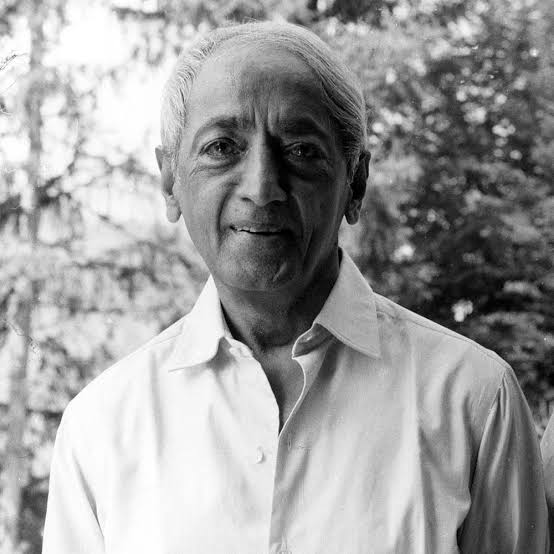
“The ambitious man has never found his true vocation.”
~ Krishnamurti.
Ambition: “a strong desire to do or to achieve something, typically requiring determination and hard work.” Once I find my true vocation, that is to remember the Self, I may well ‘achieve’ something but it no longer has the purpose of proving my worth. It is simply how I express my birthright.
Love,
Diederik
* Diederik is the Founder and Program Director of Choose Again
Jiddu Krishnamurti (May 11, 1895 – February 17, 1986) was an Indian spiritual speaker and writer. Adopted by members of the Theosophical Society as a child because of his aura as perceived by Theosophic leader Charles Leadbetter, “without …
Source: Wikipedia
Edith Sitwell on poetry

“Poetry is the deification of reality.”
–EDITH SITWELL
Dame Edith Louisa Sitwell DBE (September 7, 1887 – December 9, 1964) was a British poet and critic and the eldest of the three literary Sitwells. She reacted badly to her eccentric, unloving parents and lived much of her life with her governess. Wikipedia
(lithub.com)
Blue Zones, Planet Aqua, and the End of American Empire: Finding Your Purpose in Today’s World
September 3, 2025 (menalive.com)
By Jed Diamond

Dan Buettner is an educator, explorer, National Geographic Fellow, and author of numerous books including, The Blue Zones: Secrets for Living Longer—Lessons From the Healthiest Places on Earth.
“In the early 2000s I set out to reverse engineer longevity,” says Buettner. “Rather than searching for answers in a test tube or a petri dish, I looked for them among populations that have achieved what we want — long, healthy lives, and sharp brains until the end.”
After locating the world’s blue zones areas, Buettner and National Geographic took teams of scientists to each location to pinpoint lifestyle characteristics that might explain the unusual longevity. They found that though the blue zones communities are located in vastly different parts of the world, their residents share nine specific traits that lead to longer, healthier, happier lives. These traits are called the Power 9.

- Move Naturally — “The world’s longevity all-stars don’t pump iron, run marathons, or join gyms,” says Buettner. “Instead, they live in environments that constantly nudge them into moving without thinking about it.”
- Purpose — “People in the blue zones don’t wake up feeling rudderless. They’re interested in family, keeping their minds engaged. The Nicoyans called it plan de vida and the Okinawans called it Ikigai. For both, it translates to ‘why I wake up in the morning.’”
- Downshift — “Even people in the blue zones experience stress. But what the world’s longest-lived people have that we don’t are routines to shed that stress. Ikarians take a nap and Sardinians do happy hour. Costa Ricans have a knack for creating happy moments every day.”
- 80% Rule — “Eat until you’re 80% full. Unlike most Americans, who keep eating until their stomachs are full, traditional Okinawans stop as soon as they no longer feel hungry.”
- Plant Slant — “Until the late 20th century, the diets of every blue zone consisted almost entirely of minimally processed plant-based foods–mostly whole grains, greens, nuts, tubers, and beans.”
- Wine @ 5 — People in the blue zones (except Adventists) drink alcohol moderately and regularly. The trick, if you do drink, is to drink one to two glasses per day with friends and food.”
- Belong — “Healthy centenarians everywhere have faith. All but a handful of the centenarians we’ve interviewed belonged to a faith-based community. Denomination doesn’t seem to matter.”
- Loved Ones First — “Successful centenarians in the blue zones put their families first. This means keeping aging parents and grandparents nearby or in the home.”
- Right Tribe — “One of the most profound, measurable, and long-lasting things you can do to adopt a blue zones lifestyle is to build a social circle around yourself that supports healthy eating, activity, and emotional well-being.”
These are all worth exploring. Those that work for you, build into your life. Yet, it is not easy to live with these healthy practices in today’s world.
The Rise of Domination Systems Throughout the World
Social systems scientist Riane Eisler, one of the most original thinkers of our time, first wrote about the two contrasting systems in our world in her book, The Chalice & The Blade: Our History, Our Future:
“The first, which I call the dominator model, is what is popularly termed either patriarchy or matriarchy — the ranking of one half of humanity over the other. The second, in which social relations are primarily based on the principle of linking rather than ranking, may best be described as the partnership model.In this model — beginning with the most fundamental difference in our species, between male and female — diversity is not equated with either inferiority or superiority.”
In her most recent book written with anthropologist Douglas Fry, Nurturing Our Humanity: How Domination and Partnership Shape Our Brains, Lives, and Future, they say that for most of our two-million-year history humans have lived in balance with nature in true partnership. But in the last six thousand years 6,000 years (less than 1% of our history) domination systems have been on the rise.
Planet Aqua: Rethinking Our Home in the Universe
Like Riane Eisler, Jeremy Rifkin is a maverick social scientist who is changing the way we perceive our world. He is the author of 23 books including The Empathic Civilization, The Age of Resilience and most recently Planet Aqua: Rethinking Our Home in the Universe.
Rifkin says that when humans decided to attempt to tame the vast waters of our planet six-thousand years ago, it set in motion a time-bomb of destruction that is causing damage that puts our very existence at risk. Jane Goodall, Founder of the Jane Goodall Institute and UN Messenger of Peace, says,
“Planet Aqua will shock most people. Rifkin points out that instead of living on a land planet, we actually live on a water planet — fresh, salt, and frozen — and this changes all of our long-held beliefs. Now, climate change is rapidly disrupting the hydrosphere, taking us into a foreboding future of floods, droughts, heatwaves, wildfires, and hurricanes, pushing many species to extinction, including our own.”
Nature Bats Last: The Imminent Collapse of Hydraulic Civilization
“Our earliest ancestors were animists and conceived of the world around them as alive, vibrant, and brimming with spirits continually interacting in a boundaryless nature, of which our species’ agency was intimately intertwined,” says Jeremy Rifkin. “Six millennia ago along the Euphrates and Tigris Rivers in what is now Turkey and Iraq and, shortly thereafter, the Nile River in Egypt, the Ghaggar-Hakra and Indus rivers in the Indus Valley, the Yellow River in the Huang He Valley of China and later across the Roman Empire, our forebears began to harness the planetary waters for the exclusive use of our humanity. Now, in the grips of a warming planet, brought on in large part by a fossil fuel-driven water/energy/food nexus, the urban hydraulic civilization is collapsing in real time.”
Anthropologist Joseph Tainter studied numerous civilizations throughout history and recognized patterns of collapse which he described in his book The Collapse of Complex Societies. In The Fate of Empires and the Search for Survival, Sir John Glubb noted a similar pattern, that all “superpowers” from ancient Persia to the Roman and British Empires, collapsed after ten generations or approximately 250 years.
Thomas Berry was a “geologian” and a historian of religions. He spoke eloquently to our connection to the Earth and the consequences of our failure to remember we are one member in the community of life.
“We never knew enough. Nor were we sufficiently intimate with all our cousins in the great family of the earth. Nor could we listen to the various creatures of the earth, each telling its own story. The time has now come, however, when we will listen or we will die.”
Another visionary who has been sounding the alarm about the times in which we live is evolutionary scientist, Rebecca D. Costa. In her book, The Watchman’s Rattle: A Radical New Theory of Collapse, she says,
“The uneven rate of change between the slow evolution human biology and the rapid rate at which societies advance eventually causes progress to come to a standstill.”
She quotes her mentor world-renowned biologist E.O. Wilson, who has been called “the Darwin of the 21st Century.” According to Wilson,
“The real problem of humanity is that we have paleolithic emotions; medieval institutions; and god-like technology.”
In an article I wrote about Cost’s work, “We Can Handle the Truth,” I quoted her:
“From an evolutionary perspective, social progress moves fast, but our brains — the apparatus that must process all this new information — evolve over millions of years. So, while the world is changing in picoseconds, my brain is struggling to keep up.”
This is the underlying reason, she believes, that all complex civilizations eventually come to an end.
The Truth Can Set You Free: Who Do You Choose to Be?
I wrote about the collapse in numerous articles including, “How You Can Survive and Thrive as the Ship of Civilization Collapses.” In the article I introduced readers to another visionary leader, Margaret J. Wheately, who more than anyone I know tells the truth about what we face and guides us towards a better future.
“This is the Age of Threat,” says Wheatley, “when everything we encounter intensifies fear and anger. In survival mode, we flee from one another, abandon values that held us together, withdraw from ideas and practices that encouraged inclusion and created trust in leaders. And, most harmfully, we stop believing in one another.”
She recognized that what we are seeing in the U.S. today is following the same pattern of collapse after 250 years of domination that were recognized by other experts.
But there is a better way. As Jeremy Rifkin says,
“We must give up our belief that it is our duty to dominate and control nature and reconnect as partners in all life on Earth. We must rethink the waters as a ‘life source’ rather than another ‘resource’ to exploit and learn to adapt to the hydrosphere rather than trying to get the hydrosphere to adapt to us.”
We must find our tribe outside the confines of “civilization.” The captains of “Ship of Civilization” would have us believe that even if the Ship is sinking, we might as well go down with the ship because we are all doomed (except the captains who imagine they will survive and thrive as the rest of us go under). That is the big lie of civilization. As my vision showed me, there are millions of alternatives and more and more lifeboats in the water every day, but you won’t learn about them in the corporate-controlled media. You can learn more here.
Each of us must claim our own path of service. Only by joining with others who have the courage to face the truth and to become “warriors of the human spirit,” as Margaret Wheatly call us, can we work together to create “Islands of sanity.”
We must act now, or we will be swept away by the currents of change. Wheatley says,
“My aspiration is for you to see clearly so that you may act wisely. If we don’t know where we are, if we don’t know what to prepare for, then any path we choose will keep us wandering in the wilderness, increasingly desperate, increasingly lost.”
One positive action you can take now is to learn about a new course that Wheatley will be offering. Claiming Your Path of Service: Choosing to Serve This Age of Collapse and Possibility, developed with the extraordinary platform Advaya.life.”
You can also follow my own work and offerings at MenAlive.com. I look forward to hearing from you. If you have not yet subscribed to my free weekly newsletter you may do so here.

Best Wishes,
Jed Diamond
Founder and VHS (Visionary Healer Scholar) of MenAlive
Full Moon in Pisces Eclipse, September 07, 2025

Wendy Cicchetti
Explore how the energies of this Full Moon Lunar Eclipse can impact your life. This Eclipse will be seen throughout the world bringing global energies to a halt for approximately 6 minutes; extra long. Stay mindful and expect powerful changes.
- Set intentions around release, surrender, and trust in the unknown
This New Moon eclipse isn’t about forcing outcomes but about planting seeds in the fertile darkness. Encourage clients to let go of rigid control and invite new pathways to unfold organically. - Focus on spiritual practices such as meditation, prayer, or dream journaling
Pisces energy heightens connection to the unseen realms. Suggest they lean into stillness, pay attention to dream messages, or use rituals to strengthen their spiritual alignment. - Allow emotions to flow without judgment; use the eclipse as a cleansing tide
Emotions may swell under this influence. Rather than resisting, remind them that tears, release, or even confusion are part of the healing process. - Let go of illusions, addictions, or escapist habits that cloud clarity
The eclipse can act like a cosmic reset, shining light on patterns of avoidance. Clients can use this moment to begin breaking cycles that keep them from full presence. - Open to heightened intuition and subtle guidance from within
The veil is thinner now. Encourage clients to listen to gut instincts, synchronicities, and subtle nudges — the universe may be whispering through them. - Create space for rest, stillness, and creative inspiration
Pisces thrives in imagination. Suggest scheduling downtime, engaging in art, music, or writing, and letting inspiration emerge from quiet moments. - Be mindful of boundaries — Pisces energy can blur them easily
Compassion is beautiful, but without boundaries it can lead to overwhelm. Help them recognize where they’re absorbing others’ energy and practice gentle but firm self-protection. - Lean into compassion and forgiveness, starting with the self
This eclipse supports deep healing through softness. Clients can reflect on where they’re holding onto guilt or resentment, and use this lunar reset to cultivate acceptance and grace.
Heather Cox Richardson
Pod Save America Sep 7, 2025 Pod Save America It can feel like all is lost under Trump 2.0, but America has faced extremely dark chapters before and come out on the other side. Heather Cox Richardson—professor, historian and author of the most-read newsletter on Substack, Letters from an American—joins the show to share her long-view approach for this shortsighted era. She walks Dan through the biggest challenges to American democracy throughout history, how she believes we got to this MAGA moment, and what fuels her optimism about the future of the country. CHECK OUT OUR SPONSORS: SIMPLISAFE – http://simplisafe.com/crooked STAMPS – http://stamps.com CODE: CROOKED COOK UNITY – http://cookunity.com/crookedfree CODE: CROOKEDFREE QUINCE – http://quince.com/crooked CHAPTERS 00:00 – Intro to Heather Cox Richardson 01:25 – Finding a Voice (and Audience) on Substack 08:44 – Writing “Letters from an American” 12:24 – Trump and the Myth of the “American Cowboy” 23:43 – Subscribe for Ad-Free Videos 25:00 – Ad Break 1 27:49 – Republicans vs Conservatives vs Radical Extremists 30:37 – Is the Trump Era Actually Unprecedented? 35:09 – Hiding Racism Under an Economic Argument 37:50 – What Drives Political Change? 46:07 – From Barack Obama to Trump and MAGA 50:52 – Ad Break 2 54:06 – Trump’s Deployment of Federal Troops 58:48 – Is Democracy Losing? 01:06:44 – Lessons for Today
Robert Reich In Conversation
Robert Reich Sep 4, 2025 I had the pleasure of joining hundreds of Texans recently at the Houston Progressive Forum. Watch our full conversation about my new book, the gerrymandering wars, and standing up to tyrants. To learn more about my new book (and potentially purchase a copy if you feel inclined), please purchase it from an independent bookseller or from Bookshop: https://bookshop.org/p/books/coming-u… And special thanks to Randall Morton, Progressive Forum executive director.