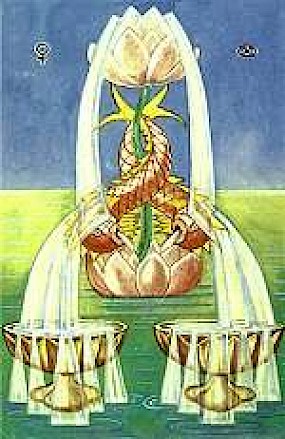
And here we have the Lord of Love, a card of bliss, deep joyous love reciprocated fully and with great enthusiasm, a card of reconciliations and new growth! Here we see harmonious and contented exchanges of emotion, which vibrate with an ecstatic undercurrent of passion and heat.
Because this card is a reflective and receptive one, there’s an issue that people sometimes forget when reading it – to be truly loved, deeply treasured, valued highly by others, we must first and foremost strive to feel those things for ourselves. When we work toward loving ourselves, we hold our inner nature in high regard, treating it with deference and proper respect. When we see ourselves in that light, other people cannot help but respond to our personal sense of value.
Furthermore, when we work to love ourselves, we release so many areas of self-doubt and uncertainty that we become infused by a new energy – and this we can lavish on others. The Two of Cups is about engaging in a caring and tender fashion with our own needs, first and foremost.
It isn’t so much about achieving self-love, as about, in every single day of our lives, striving towards self-love. That action leads us into a positive, self-supportive and accepting approach to life. And also, when we stop wasting energy telling ourselves what’s wrong with us, we have lots more energy to enjoy being who we are.
When this card comes up in a reading, if it relates to the inner journey, then it tells you to put your attention in the moment, to leave the past behind, and to let yourself be free to enjoy everything that comes your way.
If it relates to outer events, it may point to a forthcoming reconciliation in a relationship where there has been pain and disappointment – this need not be a love affair, it can cover many different types of loving relationship.
It might point up a new relationship which has recently begun and which will grow into a deep and lasting friendship or affair.
And finally, it may reassure you that the meaningful relationship in your life will strengthen and grow, developing into exactly what you need it to be!!
I don’t feel okay and probably never have. But I long to. I’ve been clenched in fear for as long as I can remember. I’ve talked about my feelings to great expense, but have only recently begun to feel them.
The more I do, the more I realize that I have the same feelings I have had since childhood. But until recently, I couldn’t entertain them. That’s changing now.
I don’t know another way past my pain other than directly through it. I wish there was some other way, not just for me, but for everyone. I want everyone on the planet to be able to heal. I want there to be an easier way.
It’s not even that I mind this so much. I kind of like it. Connecting to my pain is, after all, connecting to parts of myself I haven’t felt in a long time. But I also understand why I ran away from it. A culture of facing emotional pain might help, but I also take solace in the fact that maybe healing hurts more for some of us than others. I like to think it will hurt less for you.
Either way, there is lots of replenishing hope in it and only more suffering without it. Much worse suffering actually. I’m more in touch with my feelings than ever. Instead of quickly reacting in the same knee-jerk ways, my adult self is now online and present enough to take in the info and make choices. Every day brings more options and greater freedom from the prison of my unconscious fears. I’m opening and expanding.
The price of healing by feeling may be temporarily high, but the payoff appears to be everything I’ve longed for.
That one mind can reach out from its lonely cave of bone and touch another, express its joys and sorrows to another — this is the great miracle of being alive together. The object of human communication is not the exchange of information but the exchange of understanding. If we are lucky enough, if we are attentive enough, communication then becomes a system for the transfer of tenderness. That we have invented so many forms of it — the language of words, the language of music, the language of flowers — is a testament to our elemental need for this exchange.
A bright and immeasurably tender celebration of that need comes from French author Élise Fontenaille and Spanish artist Violeta Lópiz in their lovely collaboration At the Drop of a Cat (public library).
We meet a six-year-old boy just learning to read and write in his grandfather Luis’s house — a house Luis has built with his own hands, surrounded by a garden full of artichokes the size of heads and green beans climbing into the sky — a garden that “feels like a whole other world.”
Through the little boy’s unjudging eyes, in illustrations as textured and layered as a life well lived, a loving portrait of Luis emerges — his green thumb and the way he “speaks bird language,” his gifts for painting and cooking, his many tattoos, his thick Spanish accent and his charming misuse of idioms: He calls his grandson “the apple of his pie” and loves the expression “at the drop of a cat,” of which the little boy is so fond that he continues using it in school despite his teacher’s correction.
As the portrait unfolds, we realize that Luis misuses idioms because he has only ever heard them spoken, in a foreign tongue: When he was a little boy himself, having spent his childhood working in the fields, he fled war-torn Spain and “crossed mountains and hills and the countryside until he got to France.” He never went to school, never learned to write. Instead, he developed his own language of belonging — a living lexicon for feeling at home in the living world.
And that is how Luis communicates with his grandson — in the language of plants, in the language of paintings, in the language of love.
They draw together in the garden, forage in the meadow, and luxuriate in each other’s light as Luis plays his guitar under the cherry tree.
Radiating from the pages is the great tenderness that blooms between the young boy and the old man as they try to understand each other, to inhabit each other’s inner garden.
The day comes when the child reads a poem to his grandfather — he has finally learned to read and write, but he has also learned something else: that there are many languages of connection, each with its own dignity and delight, each an outstretched hand reaching for another.
Couple At the Drop of a Cat with What Is Love? — a kindred reckoning with the consolations of connection, told through the tender relationship between a child and a grandparent — then revisit The Forest — a love letter to our bond with the wilderness, also illustrated by Violeta Lópiz.
That one mind can reach out from its lonely cave of bone and touch another, express its joys and sorrows to another — this is the great miracle of being alive together. The object of human communication is not the exchange of information but the exchange of understanding. If we are lucky enough, if we are attentive enough, communication then becomes a system for the transfer of tenderness. That we have invented so many forms of it — the language of words, the language of music, the language of flowers — is a testament to our elemental need for this exchange.
A bright and immeasurably tender celebration of that need comes from French author Élise Fontenaille and Spanish artist Violeta Lópiz in their lovely collaboration At the Drop of a Cat (public library).
We meet a six-year-old boy just learning to read and write in his grandfather Luis’s house — a house Luis has built with his own hands, surrounded by a garden full of artichokes the size of heads and green beans climbing into the sky — a garden that “feels like a whole other world.”
Through the little boy’s unjudging eyes, in illustrations as textured and layered as a life well lived, a loving portrait of Luis emerges — his green thumb and the way he “speaks bird language,” his gifts for painting and cooking, his many tattoos, his thick Spanish accent and his charming misuse of idioms: He calls his grandson “the apple of his pie” and loves the expression “at the drop of a cat,” of which the little boy is so fond that he continues using it in school despite his teacher’s correction.
As the portrait unfolds, we realize that Luis misuses idioms because he has only ever heard them spoken, in a foreign tongue: When he was a little boy himself, having spent his childhood working in the fields, he fled war-torn Spain and “crossed mountains and hills and the countryside until he got to France.” He never went to school, never learned to write. Instead, he developed his own language of belonging — a living lexicon for feeling at home in the living world.
And that is how Luis communicates with his grandson — in the language of plants, in the language of paintings, in the language of love.
They draw together in the garden, forage in the meadow, and luxuriate in each other’s light as Luis plays his guitar under the cherry tree.
Radiating from the pages is the great tenderness that blooms between the young boy and the old man as they try to understand each other, to inhabit each other’s inner garden.
The day comes when the child reads a poem to his grandfather — he has finally learned to read and write, but he has also learned something else: that there are many languages of connection, each with its own dignity and delight, each an outstretched hand reaching for another.
Couple At the Drop of a Cat with What Is Love? — a kindred reckoning with the consolations of connection, told through the tender relationship between a child and a grandparent — then revisit The Forest — a love letter to our bond with the wilderness, also illustrated by Violeta Lópiz.
Born into a world with no clocks, telescopes, microscopes, or democracy, Ḥasan Ibn al-Haytham (c. 965–c. 1040), known in the West as Alhazen, began his life studying religion, but grew quickly disenchanted by its unquestioned dogmas and the way it turned people on each other with the self-righteous fist of zealous subjectivity. Instead, he devoted himself to the search for objective truth, pure and impartial, taken from the open hand of Mother Nature — the study of reality raw and rapturous, unmediated by interpretation.
Eight centuries before the birth of photography, Alhazen gave the first clear description of a camera obscura, which he constructed to observe a partial solar eclipse. Drawing on his experiments with pinhole projection, he became the first person to proffer a correct theory of vision, refuting the two competing theories that had been dominating since Ancient Greece: that we see by emitting rays of light from our eyes, as Euclid and Ptolemy believed, and that sight is the product of objects entering the eye as physical forms, as Aristotle believed. After conducting various experiments on reflection and refraction with lenses and mirrors, he correctly described the anatomy of the eye as an optical system, laying the groundwork for the entwined history of vision and consciousness.
Alhazen’s description of the human optical system.
To avoid persecution by the tyrannical caliph whose ire he had spurred, Alhazen feigned insanity and was placed under house arrest. There, he spent a decade detailing his experiments and reckoning with their far-reaching implications in his revolutionary seven-volume Book of Optics, which went on to influence Galileo and Kepler, Descartes and Newton, Da Vinci and Chaucer.
Half a millennium before Copernicus, he criticized Ptolemy’s cosmology in a treatise titled Dubitationes in Ptolemaeum (Doubts on Ptolemy). On its pages, he formulates what is essentially the first succinct description of the scientific method, five centuries ahead of its bloom in the Renaissance. In this regard, Alhazen could be considered the first true scientist, eight centuries before the word itself was coined (incidentally, for a woman).
Truth is sought for itself; and in seeking that which is sought for itself one is only concerned to find it… The seeker after the truth… is not he* who studies the writings of the ancients and… puts his trust in them, but rather the one who suspects his faith in them and questions what he gathers from them, the one who submits to argument and demonstration, and not to the sayings of a human being whose nature is fraught with all kinds of imperfection and deficiency. It is thus the duty of the man who studies the writings of scientists, if learning the truth is his goal, to make himself an enemy of all that he reads, and, applying his mind to the core and margins of its content, attack it from every side. He should also suspect himself as he performs his critical examination of it, so that he may avoid falling into either prejudice or leniency. If he follows this path, the truths will be revealed to him, and whatever shortcomings or uncertainties may exist in the discourse of those who came before him will become manifest.
It says something about our species that we have eradicated smallpox and invented vaccines and antibiotics for yellow fever and the Black Death, but war continues to plague us; that in the past century — this supposed pinnacle of enlightened modernity — war has claimed or maimed more of our children’s lives than any virus or bacterium. It says something about both our immense imagination and our immense blind spots: Our species’ failure to eradicate war is a failure of the imagination, a failure to imagine what it is like to be anybody else, without which there can be no empathy and compassion — those vital molecules of harmony, the other name for which is peace.
While I stand with Kathleen Lonsdale on the question of war, I also understand that there are myriad complexities keeping human beings from simply refusing to take part. On the phone with a poet friend the other night, sorrowing with heartbreak for the lives with hopes and dreams and loves slain at that very moment on the other side of our pale blue dot by this failure of the imagination, she read to me a passage from Sapiens author Yuval Harari’s op-ed in TIME Magazine, capturing with such openhearted clarity the human predicament in wartime. His words, so deeply personal yet so perspectival, came as a spell against hatred, summoning into being the part of the human spirit we must nourish so that there may be no more war — in the world, and in the heart. Hearing them was a salve for me that night.
Illustration by Oleksandr Shatokhin from Yellow Butterfly — a tender wordless story about war, hope, and keeping the light alive.
Harari writes:
Most Israelis are psychologically incapable at this moment of empathizing with the Palestinians. The mind is filled to the brim with our own pain, and no space is left to even acknowledge the pain of others. Many of the people who tried to hold such a space… are dead or deeply traumatized. Most Palestinians are in an analogous situation — their minds too are so filled with pain, they cannot see our pain.
But outsiders who are not themselves immersed in pain should make an effort to empathize with all suffering humans, rather than lazily seeing only part of the terrible reality. It is the job of outsiders to help maintain a space for peace. We deposit this peaceful space with you, because we cannot hold it right now. Take good care of it for us, so that one day, when the pain begins to heal, both Israelis and Palestinians might inhabit that space.
“My own experience and development deepen everyday my conviction that our moral progress may be measured by the degree in which we sympathize with individual suffering and individual joy.”
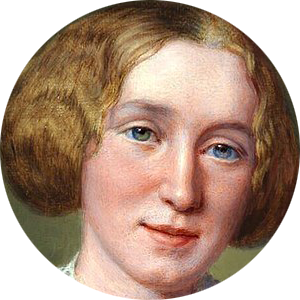
–GEORGE ELIOT
Mary Ann Evans, known by her pen name George Eliot (November 22, 1819 – December 22, 1880), was an English novelist, poet, journalist, translator, and one of the leading writers of the Victorian era. She wrote seven novels: Adam Bede, The Mill on the Floss, Silas Marner, Romola, Felix Holt, the Radical, Middlemarch and Daniel Deronda. Wikipedia
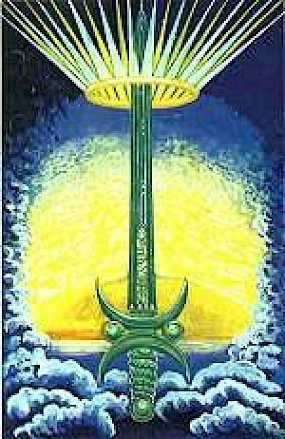
As a Suit, Swords are about thought, communication, and, sadly, often also about conflict and emotional turmoil. People often become confused about why that should be – this Suit contains more ‘bad’ cards than any of the others. But when you consider that one thing which inevitably happens when we are hurt and unhappy is that objectivity and clarity go out of the window, you might be able to understand why so many harsh cards turn up here.
Aces are always about the beginning of something – usually related to the Suit they are from. From that you can see that the Ace of Swords is about the ability to see things from a clear perspective. When this card rules, we are able to cut away the rubbish and confusion which tends to cloud out major issues. We can see what is important and worth fighting for. And we can also identify the red herrings that keep us from seeing clearly.
We become more able to make good decisions, more ready to see other points of view, more clear about what we really think about things. When this happens we often choose totally new directions for ourselves, reaching a point where we can transform and empower our experiences.
So when this card comes up in a reading, or to rule a day, then it means that we need to step back, and think rationally about everything which crosses our path. We need to cut away rubbish and clutter, so we can see the inner truth we seek.
There is a decisive and powerful energy which flows from this card, and engaging with it will allow us to understand ourselves, and others more thoroughly than before.
In a spiritual sense the appearance of the Ace of Swords will often mark a turning point or breakthrough into new clarity and wisdom
Recent archaeological research has pushed back the date of the known origin of wine making in Persia far beyond that which writers earlier in the 20th century had envisaged. Excavations at the Godin Tepe site in the Zagros mountains (Badler, 1995; McGovern and Michel, 1995; McGovern, 2003), have revealed pottery vessels dating from c. 3100–2900 BC containing tartaric acid, almost certainly indicating the former presence of wine. Even earlier evidence was found at the site of Hajji Firuz Tepe, also in the Zagros mountains. Here, McGovern et al. (1996) used chemical analyses of the residue of a Neolithic jar dating from as early as 5400–5000 BC to indicate high levels of tartaric acid, again suggesting that the fluid contained therein had been made from grapes.[1]
Pre-Islamic period
The modern historian Rudi Matthee explains that in Zoroastrianism wine was a symbol for liquid gold as well as the moving fire of the radiant sun.[2] Therefore, wine held a ritual function in Zoroastrianism, being part of a liberation ritual, in which it substituted for blood.[2] Matthee adds that the history of the Iranian elite of ancient and late antique Iran “could be written as the history of razm va bazm (fighting and feasting), with wine at the centre”.[2]
Islamic period
Wine drinking was prominent in Classical Islam, from Al-Andalus in the west to Khorasan in the east.[3] The Iranian Saffarid and Samanid rulers, the first to look for autonomy from their Abbasid suzerains, were known, as Matthee explains, “for the gusto with which they and their entourage indulged in wine-drinking.”[3] The 11th-century Qabus-nama, written by Keikavus of the Ziyarid dynasty, explicitly records that the Quran prohibits wine consumption, yet also states advice (same goes for Nizam al-Mulk‘s Siyasatnama) on what the proper fashion is for drinking wine while also taking it for granted that wine will be served at feasts.[4]
The English traveller and writer Thomas Herbert wrote in 1627 about the difference between wine consumption of the Ottomans and Iranians.[5] According to Herbert, the Ottomans, who, although were prohibited to drink wine by law, still drank it covertly.[5] The Iranians on the other hand, Herbert asserted, since a long period of time, drunk wine openly and with excess.[5] According to the French traveller Jean Chardin, who was in 17th-century Safavid Iran, drinking was mainly done in order to get drunk fast hence the appreciation of Iranians for strong wines.[6]
Alcoholic drinks were commonly drunk amongst the elite, and Muslims often visited the taverns; however, alcohol was “formally outlawed”, hence it could not operate in the reality of everyday life.[7] Thus, in turn, as Matthee explains, the drinking of wine “became a metaphor for the ardent feelings of the lover for the beloved in the imaginary world of (mystical) poetry”.[7]
In modern Iran, wine cannot be produced legally due to the prohibition of alcohol. Before the Islamic Revolution in 1979, there were up to 300 wineries in Iran; now there are none. As a whole, Iran is no longer a wine-producing country, but Iranian Christians are legally allowed to ferment wine.[8]
Legends and myths
According to Iranianlegend, wine was discovered by a girl despondent over her rejection by the king. The girl decided to commit suicide by drinking the spoiled residue left by rotting table grapes. Instead of poisoning the girl, the fermentedmust caused her to pass out to awaken the next morning with the realization that life was worth living. She reported back to the king her discovery of the intoxicating qualities of the spoiled grape juice and was rewarded for her find.[9]
Depiction in Persian miniatures
Miniature painting in Persia developed into a sophisticated art in which the most important element that all these paintings share is their subjects. The subjects that are mainly chosen from Hafez’s “Ghazaliyat” or Khayyam’s Rubaiyat. Therefore, the Persian wine, Mey, and Persian wine server (or cup bearer), Saghi, are essential parts to a majority of these paintings. Usually, the old man in the painting is Hafez or Khayyam, who, having left his scholarly position and books behind, is now drunk in Kharabat (a mystical rundown tavern located in a remote and poor corner of town) or in Golshan (garden) drinking wine from the hands of gorgeous Saghis.
In Persian poetry, grapes and wine appear frequently with symbolic, metaphorical, and actual meanings.
New Thinking • Nov 19, 2023 Gary Gach is an adjunct faculty member at the University of San Francisco. He is author of The Complete Idiot’s Guide to Buddhism as well as Pause, Breathe, Smile – Awakening Mindfulness When Meditation is Not Enough. He is cotranslator of three Korean books of poetry by Ko Un. He is editor of What Book!? Buddha Poems From Beat to Hiphop. He recently served as cotranslator for Hafiz’s Little Book of Life. Here he describes the life and work of Hafiz who was of great inspiration to Goethe, Emerson, and Nietzsche. 00:00 Introduction 04:25 Politics 09:26 Poetry & mysticism 21:24 The Beat poets 28:02 Mysticism: East & West 35:49 Language 46:07 Poetry reading 50:00 Conclusion Edited subtitles for this video are available in Russian, Portuguese, Italian, German, French, Swedish, and Spanish. New Thinking Allowed host, Jeffrey Mishlove, PhD, is author of The Roots of Consciousness, Psi Development Systems, and The PK Man. Between 1986 and 2002 he hosted and co-produced the original Thinking Allowed public television series. He is the recipient of the only doctoral diploma in “parapsychology” ever awarded by an accredited university (University of California, Berkeley, 1980). He is also the Grand Prize winner of the 2021 Bigelow Institute essay competition regarding the best evidence for survival of human consciousness after permanent bodily death. (Recorded on October 17, 2023)
A five-day pause in fighting, monitored by aerial surveillance, could see dozens of women and children freed from captivity in Gaza, according to people familiar with the terms of an emerging agreement
Updated November 18, 2023 at 10:52 p.m. EST|Published November 18, 2023 at 8:29 p.m. EST (WashingtonPost.com)
Israel and Hamas are close to agreement on a U.S.-brokered deal that would free dozens of women and children held hostage in Gaza in exchange for a five-day pause in fighting, say people familiar with the emerging terms.
The release, which could begin within the next several days — barring last-minute hitches — could lead to the first sustained pause in conflict in Gaza.
Consciousness, spirituality, biography, sexuality, androgyny, futurism, space, the arts, science, astrology, democracy, humor, books, movies and more



 Truth is sought for itself; and in seeking that which is sought for itself one is only concerned to find it… The seeker after the truth… is not he