How Ayn Rand Became the Spirit of Our Time

VIA UNIVERSITY OF CALIFORNIA PRESS

Lisa Duggan on the Influence of the Original Mean Girl

By Lisa Duggan


May 31, 2019 (lithub.com)

As I write in 2018, every news day delivers a fresh jolt. Since the election of President Donald Trump, the questions arise: Is the news surreal, hyperreal, or unreal? How do we grasp the daily spectacle of cultural contempt—for immigrants and minorities, for women, for political dissent, for “losers”? How do we comprehend the level of social and political indifference—toward those who cannot buy security and access to power? How can the US Congress pass a hugely unpopular tax “reform” bill that vastly expands economic inequality? Who are these people in power, making these decisions, and what makes them tick?

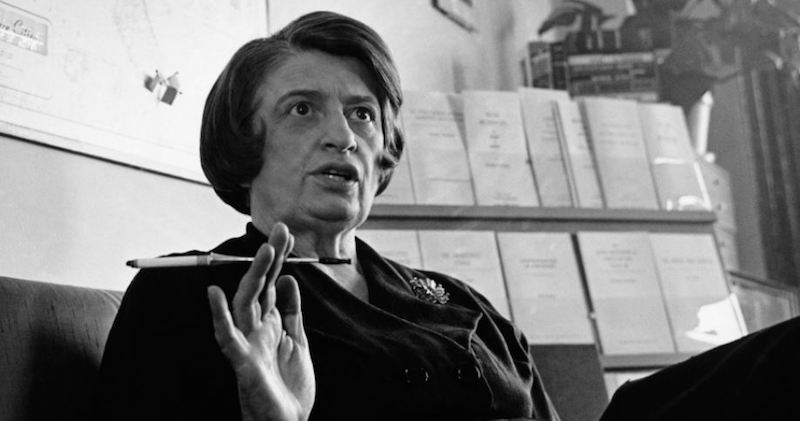
Ayn Rand is the writer whose dour visage presides over the spirit of our time. Author of the hugely popular novels The Fountainhead and Atlas Shrugged, Rand is the original Mean Girl. Her heroes and heroines prevail over inferior others in ruthless hierarchical worlds not unlike the high school at the center of the 2004 megahit movie Mean Girls, the quotable bible of millennial meme culture—now also a Broadway musical. The mass popularity of Mean Girls, which was based on interviews with high school girls conducted by Rosalind Wiseman for her 2002 book Queen Bees and Wannabes, reflects the emotional atmosphere of the age of the Plastics (as the most popular girls at fictional North Shore High are called), as well as the era of Wall Street’s Gordon Gekko, whose motto is “Greed is Good.”

The culture of greed is the hallmark of the neoliberal era, the period beginning in the 1970s when the protections of the US and European welfare states, and the autonomy of postcolonial states around the world, came under attack. Advocates of neoliberalism worked to reshape global capitalism by freeing transnational corporations from restrictive forms of state regulation, stripping away government efforts to redistribute wealth and provide public services, and emphasizing individual responsibility over social concern. From the 1980s to 2008, neoliberal politics and policies succeeded in expanding inequality around the world. The political climate Ayn Rand celebrated—the reign of brutal capitalism—intensified. Though Ayn Rand’s popularity took off in the 1940s, her reputation took a dive during the 1960s and 70s. Then after her death in 1982, during the neoliberal administrations of Ronald Reagan in the United States and Margaret Thatcher in the United Kingdom, her star rose once more.

During the global economic crisis of 2008 it seemed that the neoliberal order might collapse. It lived on, however, in zombie form as discredited political policies and financial practices were restored. But neoliberal capitalism has always been contested, and competing and conflicting political ideas and organizations proliferated and intensified after 2008 as well.

Protest politics blossomed on the left with Occupy Wall Street, Black Lives Matter, and opposition to the Dakota Access oil pipeline at the Standing Rock Sioux reservation in the United States, and with the Arab Spring, and other mobilizations around the world. Anti-neoliberal electoral efforts, like the Bernie Sanders campaign for the US presidency, generated excitement as well. But protest and organizing also expanded on the political right, with reactionary populist, racial nationalist, and protofascist gains in such countries as India, the Philippines, Russia, Hungary, and the United States rapidly proliferating. Between these far-right formations on the one side and persistent zombie neoliberalism on the other, operating sometimes at odds and sometimes in cahoots, the Season of Mean is truly upon us.Ayn Rand’s influence is ascendant across swaths of our political culture—including among public figures who see her as a key to the zeitgeist, without having read a word of her writing.

We are in the midst of a major global, political, economic, social, and cultural transition—but we don’t yet know which way we’re headed. The incoherence of the Trump administration is symptomatic of the confusion as politicians and business elites jockey with the Breitbart alt-right forces while conservative evangelical Christians pull strings. The unifying threads are meanness and greed, and the spirit of the whole hodgepodge is Ayn Rand.

Rand’s ideas are not the key to her influence. Her writing does support the corrosive capitalism at the heart of neoliberalism, though few movers and shakers actually read any of her nonfiction. Her two blockbuster novels, The Fountainhead and Atlas Shrugged, are at the heart of her incalculable impact. Many politicians and government officials going back decades have cited Rand as a formative influence—particularly finance guru and former Federal Reserve chairman Alan Greenspan, who was a member of Rand’s inner circle, and Ronald Reagan, the US president most identified with the national embrace of neoliberal policies. Major figures in business and finance are or have been Rand fans: Jimmy Wales (Wikipedia), Peter Thiel (Paypal), Steve Jobs (Apple), John Mackey (Whole Foods), Mark Cuban (NBA), John Allison (BB&T Banking Corporation), Travis Kalanik (Uber), Jeff Bezos (Amazon), ad infinitum.

There are also large clusters of enthusiasts for Rand’s novels in the entertainment industry, from the 1940s to the present—from Barbara Stanwyck, Joan Crawford, and Raquel Welch to Jerry Lewis, Brad Pitt, Angelina Jolie, Rob Lowe, Jim Carrey, Sandra Bullock, Sharon Stone, Ashley Judd, Eva Mendes, and many more. The current Trump administration is stuffed to the gills with Rand acolytes. Trump himself identifies with Fountainhead character Howard Roark; former secretary of state Rex Tillerson listed Atlas Shrugged as his favorite book in a Scouting magazine feature; his replacement Mike Pompeo has been inspired by Rand since his youth. Ayn Rand’s influence is ascendant across broad swaths of our dominant political culture—including among public figures who see her as a key to the zeitgeist, without having read a word of her writing.

But beyond the famous or powerful fans, the novels have had a wide popular impact as bestsellers since publication. Along with Rand’s nonfiction, they form the core texts for a political/philosophical movement: Objectivism. There are several US-based Objectivist organizations and innumerable clubs, reading groups, and social circles. A 1991 survey by the Library of Congress and the Book of the Month Club found that only the Bible had influenced readers more than Atlas Shrugged, while a 1998 Modern Library poll listed The Fountainhead and Atlas Shrugged as the two most revered novels in English. Atlas Shrugged in particular skyrocketed in popularity in the wake of the 2008 financial crash. The U.S. Tea Party movement, founded in 2009, featured numerous Ayn Rand-based signs and slogans, especially the opening line of Atlas Shrugged: “Who is John Galt?” Republican pundit David Frum claimed that the Tea Party was reinventing the GOP as “the party of Ayn Rand.”

During 2009 as well, sales of Atlas Shrugged tripled, and GQ magazine called Rand the year’s most influential author. A 2010 Zogby poll found that 29 percent of respondents had read Atlas Shrugged, and half of those readers said it had affected their political and ethical thinking. In 2018, a business school teacher writing in Forbes magazine recommended repeat readings: “Recent events—the bizarro circus that is the 2016 election, the disintegration of Venezuela, and so on make me wonder if a lot of this could have been avoided had we taken Atlas Shrugged’s message to heart. It is a book that is worth re-reading every few years.” Rand biographer Jennifer Burns asserts simply that Ayn Rand’s fiction is “the gateway drug” to right-wing politics in the United States—although her influence extends well beyond the right wing.In a word: sex. Ayn Rand made acquisitive capitalists sexy.

But how can the work of this one novelist (also an essayist, playwright, and philosopher), however influential, be a significant source of insight into the rise of a culture of greed? In a word: sex. Ayn Rand made acquisitive capitalists sexy. She launched thousands of teenage libidos into the world of reactionary politics on a wave of quivering excitement.This sexiness extends beyond romance to infuse the creative aspirations, inventiveness, and determination of her heroes with erotic energy, embedded in what Rand called her “sense of life.” Analogous to what Raymond Williams has called a “structure of feeling,” Rand’s sense of life combines the libido-infused desire for heroic individual achievement with contempt for social inferiors and indifference to their plight. Lauren Berlant has called the structure of feeling, or emotional situation, of those who struggle for a good life under neoliberal conditions “cruel optimism”—the complex of feelings necessary to keep plugging away hopefully despite setbacks and losses. Rand’s contrasting sense of life applies to those whose fantasies of success and domination include no doubt or guilt. The feelings of aspiration and glee that enliven Rand’s novels combine with contempt for and indifference to others. The resulting Randian sense of life might be called “optimistic cruelty.” Optimistic cruelty is the sense of life for the age of greed.

Ayn Rand’s optimistic cruelty appeals broadly and deeply through its circulation of familiar narratives: the story of “civilizational” progress, the belief in American exceptionalism, and a commitment to capitalist freedom. Her novels engage fantasies of European imperial domination conceived as technological and cultural advancement, rather than as violent conquest. America is imagined as a clean slate for pure capitalist freedom, with no indigenous people, no slaves, no exploited immigrants or workers in sight. The Fountainhead and especially Atlas Shrugged fabricate history and romanticize violence and domination in ways that reflect, reshape, and reproduce narratives of European superiority and American virtue. Their logic also depends on a hierarchy of value based on racialized beauty and physical capacity—perceived ugliness or disability are equated with pronounced worthlessness and incompetence.

Through the forms of romance and melodrama, Rand novels extrapolate the story of racial capitalism as a story of righteous passion and noble virtue. They retell The Birth of a Nation through the lens of industrial capitalism. They solicit positive identification with winners, with dominant historical forces. It is not an accident that the novels’ fans, though gender mixed, are overwhelmingly white Americans of the professional, managerial, creative, and business classes. Ayn Rand’s identification with dominance was not seamless, however. As a Russian Jewish woman, her experiences of ethnic/religious and gender inequality gave her fiction’s sense of life some important kinks, some twists and turns. These kinks attracted readers from a range of viewpoints, not all unalloyed procapitalist zealots.

Where are we now? Is the long career of optimistic cruelty, of contempt and indifference to human inequality, at its height? Or is the culture of greed surrounding zombie neoliberalism so pronounced now that it is effectively exposed and may finally be displaced as an acceptable political feeling? Cultural critic Slavoj Žižek has argued that Rand’s mad adoration of capitalism, her excessive overidentification with it, only serves to make its inherent ridiculousness clearly perceptible.

__________________________________
Excerpted from Mean Girl. Used with permission of University of California press. Copyright © 2019 by Lisa Duggan.

Seven Reasons Why Suffering Makes Me Believe in God Even More

Discovering Purpose Amidst Pain

Dan Foster

Dan Foster

Published in Backyard Church

3 days ago (Medium.com)

Image by Valentina Shilkina on iStock

The longer I live, the more qualified I become to speak on the topic of suffering. I don’t write about suffering as one who stands on the sideline, like an armchair expert who makes comments on a football game that he’s never played in his life. I write as someone who has played the game. In fact, I am in the middle of the game, and I’m not winning.

Two weeks ago, my wife was diagnosed with advanced stage four bowel cancer.

It came at us out of nowhere.

I can’t begin to tell you the shock, the grief, and the sense of utter powerlessness that I felt and am still feeling. There have been moments of utter despair and of shaking my fists at the sky.

There was an assumption amongst some of my friends that I might be angry at God for all of this. Is he in control or not? At the very least, my faith should have been shaken to the core. And, to a certain extent, it is.

However, certain things about suffering actually make me believe in God even more. You might think that’s crazy, but I’ve come up with seven reasons why suffering points me to God:

Suffering makes me ask the “why” question.

My wife is a 42-year-old mother of three. It feels completely unfair that she should have cancer. When we were given the diagnosis, it was like being slapped in the face with a piece of two-by-four.

On the tail of the shock inevitably comes the question…

Why?

Why is this happening to us?

It’s a natural response, I suppose, to search for some semblance of reason or meaning in the face of such adversity. But here’s the thing… if you look behind the question to the reason that the question is asked, you are forced to arrive at an astounding conclusion.

We all assume, subconsciously or otherwise, that the universe is somehow on our side. And when it is not, we get angry. The fact that we feel this profound sense of injustice points us to a truth: Human beings struggle with the idea that maybe there isn’t someone steering the ship.

When something goes wrong, we scream at the universe, “I demand to speak to the manager!” And the reason we do this is that we believe that there is one… or at least there should be.

That’s God.

Suffering makes me recognize that there is a moral order

People ask me all the time, “If God is so good, then why do bad things happen?” It’s a fair question, but it’s not a problem exclusive to Christianity. Every worldview has to answer the question: The Buddhist, the Hindu, the Muslim, and even the Atheist are all confronted with the same dilemma.

The atheistic worldview, in particular, has little to offer the suffering person. It says to the sufferer: “Your suffering is statistically unfortunate but ultimately meaningless.”

But this does not satisfy us, nor should it. If we were hard-wired to suffer, we would not be asking, “Why?” Suffering would not bother us in the slightest.

But, the very act of questioning why something unjust or painful is happening implies an inherent belief in a moral order. We intuitively grasp the concepts of right and wrong, fairness and injustice. This sense of moral framework suggests that there is a higher power that defines and governs these principles.

Suffering brings out the best in humans

Moving from the philosophical to the intensely practical, suffering simply brings out the best in human beings.

When news of my wife’s battle with cancer spread, it felt like we were surrounded by a warm embrace from all corners of the world. Our friends rallied around us with breathtakingly generous support and care. But what truly took me by surprise was the kindness that came from complete strangers.

From a man in Colorado who offered to buy me a coffee, despite the oceans between us, to a woman who sent us a heartfelt card from halfway around the world — these gestures touched our hearts in ways I can hardly put into words. It’s moments like these that remind me of the extraordinary goodness that exists in people, even in the face of adversity.

Such kindness points me toward belief in a higher power — a benevolent force that orchestrates moments of grace and solidarity, gently nudging us, urging us to recognize that there is something greater than ourselves, something that transcends the boundaries of our individual lives.

Photo by Priscilla Du Preez ?? on Unsplash

Suffering turns us toward what is really important

This is absolutely crazy, but our marriage is the best it’s ever been since the diagnosis.

I feel such intense compassion and love toward my wife — unrivaled by any other time in our twenty-year relationship. In the midst of the uncertainty, somehow, we’ve been gifted with a newfound clarity about what truly matters. The petty grievances and trivial concerns that once occupied our thoughts have faded into insignificance.

For example, I have tended to be a bit of a cheapskate, but I am suddenly finding it much easier to open my wallet and share what I have. The impulse to hold onto every penny has given way to a profound understanding that there are far more important things in life than money. I knew this already, of course, in an intellectual sense, but now my behavior is finally catching up to my intellect.

My only regret is that it took cancer to make me more compassionate, generous, and kind.

Sigh.

Suffering leads us to the end of ourselves

In a world that often celebrates self-sufficiency, it’s easy to forget that there are some challenges we simply can’t conquer. However, real faith begins when we reach the end of our own resources. And nothing announces your powerlessness more than a disease you cannot heal or fix.

Suffering has a way of humbling us, of showing us that we’re not invincible. It’s in these moments of vulnerability that we realize we need faith in something beyond our own strength, ability and understanding.

Now, some may deride faith as some kind of cosmic crutch, dismissing it as a sign of weakness. Yet, I believe it takes immense strength to admit our need for something greater. It’s an act of courage to set aside our pride, to lay bare our vulnerabilities, and to seek solace and guidance beyond ourselves.

But without the gift of suffering, many people continue to live comfortably with the illusion that they are in control — until one day, when life teaches them the truth.

Suffering brings us back to the now

When you are faced with uncertainty, there is a risk that your mind will constantly try to wander into the land of “what ifs.” I know I have visited “Dr Google” many times over the past few weeks to try to get some certainty about what the future may hold for my wife.

But, here’s the thing: When you worry about what will be in your future, anxiety is your constant companion. Therefore, suffering invites us to make NOW the primary focus of our lives. After all, NOW is all we have. Those who live too much in the past or the future rarely experience peace.

As Eckhart Tolle says, “All negativity is caused by a denial of the present. Unease, anxiety, tension, stress, worry — all forms of fear — are caused by too much future and not enough presence. Guilt, regret, resentment, grievances, sadness, bitterness, and all forms of non-forgiveness are caused by too much past and not enough presence.”

I think he is right.

And, what is more, I think the only place to find God is in the “Now.” There’s a reason God is called the “Great I Am “— not the “I Was” or the “I Will Be.” The presence is always in the present.

Suffering can be accompanied by unexplainable peace

In amongst the tears, the anger, and the sense of utter despair, there have been moments of inexplicable peace. This peace doesn’t make any sense, given the circumstances.

There is a whisper from the universe that I cannot explain. It’s a quiet reassurance that we are held in a greater embrace, even when life’s storms rage around us. I do not pretend to have an explanation for this phenomenon, and perhaps you think I am crazy. But, ask virtually anyone who has suffered, and you will discover that somehow, despair is so often punctuated by peace.

Some, like me, call that sense of peace “ God.”

The Last Word

C.S. Lewis once said: “God whispers to us in our pleasures but shouts to us in our suffering.”

I agree with him.

In the crucible of suffering, where pain and uncertainty converge, amidst life’s harshest trials, God shouts to us!

The “why” questions, the search for order, the outpouring of human kindness, the newfound clarity about what truly matters, and the acknowledgment of our own limitations — all these facets of suffering converge to point me back to God.

In a way, it doesn’t make sense to find greater faith in the midst of all this trouble, because there are no guarantees of a positive outcome. In fact, the odds are completely against us.

And that is how I know this faith is real.

The Backyard Church is not just a blog. It’s a real online community for people who have faith but can’t, don’t, or won’t go to church. Join today.

Dan Foster is the author of “Leaving Church, Finding God: Discovering Faith Beyond Organized Religion.”

For more articles on life, faith, and spirituality, Sign-up for my newsletter. Also, feel free to send questions and story ideas to thebackyardchurch@gmail.com

Dan Foster

Written by Dan Foster

·Editor for Backyard Church

Writer, Poet, Blogger: Tackling life, faith, culture, religion, politics, and spirituality. Connect with me: https://linktr.ee/DanFosterWriter

How Socrates Distinguished Good Opinions From Bad Opinions

Or good doxa from bad doxa

A.P. Bird

A.P. Bird

Published in Original Philosophy

2 days ago (Medium.com)

By Jr Korpa on Unsplash.

Original Philosophy

A space on Medium for serious philosophers to post their research and thinking for a broader audience.

medium.com

Good Doxa and Bad Doxa

In Plato’s dialogue “Meno,” Socrates discusses, among other things, the distinction between good and bad “doxa.” The term “doxa” in ancient Greek philosophy generally refers to belief or opinion, as opposed to certain knowledge (episteme) or science. However, Socrates takes this further. According to him, we can distinguish between good non-scientific opinions (or speculation, or accurate predictions) from bad non-scientific opinions (or inaccurate speculation, or incorrect predictions).

In his dialogue with Meno, Socrates appears to demonstrate how speculative thinking is necessary to find the right path. He asserts that good doxa (or true opinion) “is as effective a guide for correct action as knowledge (…). Therefore, correct opinion is no less valuable than knowledge.”

If someone were to say, “What you’re saying is just an opinion. It’s not science,” you can respond: “According to the dialogue between Meno and Socrates, as recorded by Plato, there are good opinions and bad opinions. A good opinion is one that is on the path to being proven correct.”

Nevertheless, it’s essential to remember that Socrates is extremely rigorous in his definition of a good opinion: it must be flawless. We, who live in the 21th are aware that imperfections are inevitable during scientific progress, but the purpose of science is as least to try to confront and address them, I think.

Yes, We Must Educate Ourselves to Express Opinions and to Dialogue

In the context of the dialogue, which begins with the discussion of the concept of virtue (its funny but sometimes, when trying to answer one question, we discover other equally important ones), the issue of good and bad opinions is addressed because one of Socrates’ few conclusions in this dialogue is that science, or knowledge, is the highest virtue. That is to say, for Socrates, remaining in ignorance is always detrimental (or at least quite risky).

In this sense, we should then give great importance to scientific work, which includes speculation, literature review, and constant experimentation. I completely agree. Particularly, I believe that scientific work should become as popular as democracy has gradually become over the years. And if we allow ourselves to vote, then we should certainly invest heavily in educating ourselves as well, or we will end up voting for all kinds of sophists.

Here is another lessons we can take from Socrates: he emphasized the importance of debating what the common good means in order to determine the best ideas, whereas his opponents, the sophists or those educated by sophists, tended to focus on overly individual and highly circumstantial examples.

How to Read the Socratic Dialogues

I understand that irony can be challenging to grasp, but Socrates employed it extensively. Therefore, it’s essential to be alert to its presence when reading his works. Additionally, when teaching my students about these dialogues, I aim to make the dialogue more concise and colloquial. I believe they should be approached as everyday conversations between two individuals, often attempting to challenge each other, or at the very least, provoke thought.

For instance, in the beginning of the dialogue with Meno, Socrates suggests that Meno should be intelligent, given that he received lessons from the renowned teacher, Gorgias. This is, of course, ironic. Socrates doesn’t genuinely believe that Gorgias or Meno are more intelligent than he is. It’s as if Socrates is saying, ‘Don’t you know it all? Didn’t you receive lessons from Gorgias, who claimed to have answers to everything?’

This is how Socrates encourages Meno to present his best ideas and defend them against the Socratic method of dialogue. The Socratic method is designed to guide his interlocutors from specific examples to more general concepts, often by making ‘good’ synonymous with ‘excellent,’ among other techniques. Plato and Socrates developed many theories throughout their philosophical journey.

Here is the link to the MIT version of Socrates’ dialogue with Meno:

The Internet Classics Archive | Meno by Plato

Meno by Plato, part of the Internet Classics Archive

classics.mit.edu

A.P. Bird

Written by A.P. Bird

·Writer for Original Philosophy

M.A. in Philosophy. Fritz Lang’s Metropolis, and a King Kong graphic novel got me into science fiction when I was a kid. alexand3r.bird@gmail.com

Mike Tyson’s classic quip

Mike Tyson

“Everyone has a plan until they get punched in the mouth.”

― Mike Tyson

Michael Gerard Tyson (born June 30, 1966) is an American former professional boxer who competed from 1985 to 2005. Nicknamed “Iron Mike” and “Kid Dynamite” in his early career, and later known as “the Baddest Man on the Planet”, Tyson is regarded as one of the greatest heavyweight boxers of all time. Wikipedia

Gun Death Rate Among Children in US Grew 87 Percent Over Past Decade — Study

Since 2020, firearms have been the leading cause of death in children.

By Chris WalkerTRUTHOUT Published October 5, 2023 (truthout.org)

Empty chairs displaying the names of students killed during school shootings are shown during an event on the National Mall calling for action on preventing gun violence on September 13, 2023, in Washington, D.C.

Support justice-driven, accurate and transparent news — make a quick donation to Truthout today! 

Anewly published study finds that pediatric deaths due to gun violence in the U.S. have dramatically increased over the past decade, with researchers noting that not enough is being done to address the horrifying trend.

The study, authored by Rebekah Mannix and Mark Neuman, pediatric emergency medicine physicians at Boston Children’s Hospital, as well as by Cordelia Mannix, Rebekah Mannix’s high school-aged daughter, found that 2,590 people under the age of 18 died due to firearm-related incidents in 2021. That number was an 87 percent increase from the 1,311 who died due to firearms in 2011.

Around two-thirds of the deaths were homicides, while around 30 percent were suicides, the study found. Those rates are consistent with other studies that arrived at similar numbers, with a smaller percentage being attributed to accidental discharge of firearms.

The study also analyzed other causes of premature death in children, and found that vehicular fatalities — once the most common type of premature death among kids — had declined significantly over the past 10 years. The decrease was attributable to an increase in preventive changes taken on car safety over that time, including changes to state laws on booster seats, the standardization of airbags in most vehicles, and other actions.

Unfortunately, “the opposite is happening with firearms,” said the study’s lead author, Rebekah Mannix. “It’s just getting worse, and kids are dying at higher rates from firearms.”

RELATED STORY

A memorial outside of Oxford High School continues to grow on December 3, 2021, in Oxford, Michigan.

Guns Killed a Record Number of Children in the US in 2021

Gun deaths of children increased by over 40 percent between 2018 and 2021. By Sharon ZhangTRUTHOUT

August 28, 2023

Mannix emphasized:

As a society, we’ve done a great job at targeted interventions. But what we’ve missed is that the most lethal means of injury are still incredibly accessible to kids.

Since 2020, firearms have been the leading cause of death in children.

Toni Gross, the medical director of the emergency department at Children’s Hospital New Orleans, told The New York Times that the trend could change if the gun industry took proactive measures to prevent gun violence. However, the industry “has not signed on to making safety modifications,” including fingerprint identification on firearms, that could limit the number of child deaths per year, Gross said.

A separate analysis of firearm-related deaths in children, published by the American Academy of Pediatrics in August, suggested that the number of pediatric firearm deaths is much higher, with around 4,752 children dying from a firearm in 2021.

“This is undoubtedly one of our chief public health crises in this country,” Chethan Sathya, lead author of the study and pediatric trauma surgeon in New York, said at the time of its publication. “The most likely reason that your child will die in this country is at the hands of a firearm. That’s not acceptable.”

THANK YOU FOR READING. SPARE JUST A FEW SECONDS?

Whether you’re a first-time visitor or a long-time reader, we appreciate you taking the time to read TruthoutIf you found value in what you read today, we need your help.

Truthout is going through a challenging time as nonprofit donations have declined across the board in 2023. News media organizations across the country are closing or laying off staff almost every week. But we’re absolutely determined to make it through this painful moment – because without Truthout, who else would publish the piece you read today?

Please consider making a tax-deductible gift to Truthout. If you want to take your support further, a monthly gift is one of the best ways to strengthen our work. Thank you in advance for anything you can do.

about:blankThis article is licensed under Creative Commons (CC BY-NC-ND 4.0), and you are free to share and republish under the terms of the license.

CHRIS WALKER

Chris Walker is a news writer at Truthout, and is based out of Madison, Wisconsin. Focusing on both national and local topics since the early 2000s, he has produced thousands of articles analyzing the issues of the day and their impact on the American people. He can be found on Twitter: @thatchriswalker

“How to Be Alone” by Pádraig Ó Tuama, A Poetry Film by Leo G Franchi

The On Being Project Oct 19, 2020“ How to Be Alone” by Pádraig Ó Tuama is part of our “Poetry Films” series, which features animated interpretations of beloved poems from our archive. Check out the full series here:    • Poetry Films  . We know poetry to be a critical pillar of public life. It rises up when official language fails us. And it gives voice to what is human and what is true, how we connect and what questions we hold. Poetry has moved to the heart of what we offer, which is why we’re excited to have partnered with talented illustrators, animators, and directors to reimagine poetry in visual, dynamic ways. You can listen to and read this poem here: https://onbeing.org/poetry/how-to-be-… Illustration & Animation by Leo G Franchi (http://www.lacar.tv/) Sound by Chris Heagle Music by Gautum Srikishan STAY IN TOUCH Facebook: https://www.facebook.com/onbeing Instagram: https://www.instagram.com/onbeing/ Newsletter: https://onbeing.org/newsletter/ OUR PODCASTS On Being with Krista Tippett: https://onbeing.org/series/podcast/ Poetry Unbound: https://onbeing.org/series/poetry-unb…

What is Christian Mysticism?

Let’s Talk Religion Premiered Oct 5, 2023 Join me as I turn to explore Christian mysticism as we delve into the fascinating treasures of this tradition. From ancient practices, mystical experiences, and profound wisdom that have shaped the lives of countless of people throughout history. Support Let’s Talk Religion on Patreon: https://www.patreon.com/letstalkreligion Or through a one-time donation: https://www.paypal.com/paypalme/letst… Also check out the Let’s Talk Religion Podcast: https://open.spotify.com/show/0ih4sqt… Music by: Filip Holm Johannes Bornlöf Christoffer Moe Ditlevsen Most of my music can be found here: Filip Holm: https://open.spotify.com/artist/2O7FL… Zini: https://open.spotify.com/artist/0jy5K… Sources/Recomended Reading: Gendle, Nicholas (translated by) (1982). “Gregory Palamas: The Triads”. In the “Classics of Western Spirituality Series”. Paulist Press. Greer, Rowan A. (1979). “Origen: Selected Writings”. Classics of Western Spirituality. Paulist Press. Hart, Columba (translated by) (1980). “Hadewijch: Complete Works”. Classics of Western Spirituality Series. Paulist Press. Laird, Martin (2004). “Gregory of Nyssa and the grasp of faith: union, knowledge and divine presence”. Oxford University Press. Lossky, Vladimir (1944). “The Mystical Theology of the Eastern Church”. James Clarke & Co. Luibheid, Colm (Translated by) (1987). “Pseudo-Dionysius: The Complete Works”. Classics of Western Spirituality. Paulist Press International. McGinn, Bernard. “The Presence of God” Series, in several volumes. Perhaps the best and most comprehensive introduction to Christian mysticism. Published by Crossroad Publishing Co. McGinn, Bernard (2001). “The Mystical Thought of Meister Eckhart: The Man From Whom God Hid Nothing”. Crossroad Publishing Co. “Meister Eckhart: The Essential Sermons, Commentaries, Treatises and Defense”. Classics of Western Spirituality. Paulist Press. “Meister Eckhart: Teacher and Preacher”. Classics of Western Spirituality Series. Paulist Press. Tobin, Frank (translated by) (1997). “Mechthild of Magdeburg: The Flowing Light of the Godhead”. Classics of Western Spirituality. Paulist Press. Walshe, Maurice O.C. (translated by) (2010). “The Complete Mystical Works of Meister Eckhart”. Crossroad Publishing Company. Ware, Timothy (2015). “The Orthodox Church: An introduction to Eastern Christianity”. New Edition. Penguin Books. Chapters: 00:00 Intro 01:49 What is ‘Mysticism’? 06:56 Mysticism before Christianity 08:02 Mysticism in early Christianity: Contemplation & Theosis 14:28 Pseudo-Dionysius & Mystical Theology 18:30 The Great Schism: Catholicism vs. Orthodoxy? 19:26 Hesychasm 20:08 High Middle Ages & Monastic Orders 21:55 Hildegard of Bingen 23:06 The Beguines (Mechtild, Hadewijch) 26:17 Love & Union with God 28:45 Marguerite Porete & The Mirror of Simple Souls 31:09 Bernard of Clairvaux & Symeon the New Theologian 33:14 Mystical Practice (Hesychasm, Cloud of Unknowing) 37:30 Mystical Philosophy: Meister Eckhart 45:56 Gregory Palamas 48:47 Later Mystics 50:37 Protestant Mysticism? 53:37 Mysticism today & Conclusions

Psychotherapy and Spiritual Paths with Seymour Boorstein (1932 – 2021)

New Thinking Allowed with Jeffrey Mishlove Oct 6, 2023 This video is a special release from the original Thinking Allowed series that ran on public television from 1986 until 2002. It was recorded in about 1987.  While meditation may be ideal for some individuals, others with poorly developed ego structures may be harmed by engaging in intensive spiritual practices designed to dissolve the boundaries of the ego, according to Seymour Boorstein, MD. A psychoanalyst and editor of Transpersonal Psychotherapy, Dr. Boorstein discusses his transformation from a conventional – and athiestic –psychiatrist to a student of spirituality. Now you can watch all of the programs from the original Thinking Allowed Video Collection, hosted by Jeffrey Mishlove. Subscribe to the new Streaming Channel (https://thinkingallowed.vhx.tv/) and watch more than 350 programs now, with more, previously unreleased titles added weekly. Free month of the classic Thinking Allowed streaming channel for New Thinking Allowed subscribers only. Use code THINKFREELY.