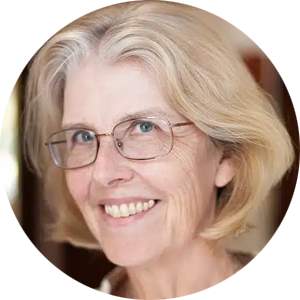
“Be only being, know only being and love only being. This does not imply any rejection of people or things but rather the felt understanding that all people and things are an appearance of the one infinite reality, God’s being, our being.“
–Rupert Spira
Rupert Spira (born March 13, 1960) is an English spiritual teacher, philosopher and author of the Direct Path based in Oxford, UK. Wikipedia
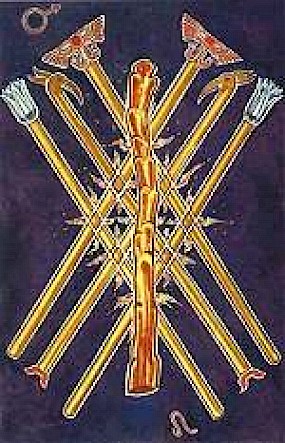
The Lord of Valour can best be summed up by the phrase ‘feel the fear and do it anyway’. It is a card about encountering demanding and formidable situations in life, and having the courage to be true to your own desires, ambitions and needs.
Life is full of challenges. And sometimes we find it difficult to seize the moment, grasp our opportunities and live life to the full. The Seven of Wands comes up to indicate that you are facing one of those momentous happenings in life, and advises you to believe in yourself, grab your courage in both hands and go forward.
This will not only apply to difficult things – it can also point out to you that there is an opportunity to make your wildest dream come true, if only you will throw caution to the winds and dive right in!
The Lord of Valour is an exciting card, but when it comes up you will probably also feel a bit apprehensive. Don’t let caution dampen your enthusiasm. Go ahead! Fight for what you want. If you do, you’ll stand a good chance of getting it.
Because Wands are a suit much concerned (at their deepest level) with the ethics of right living, there is another instance when this card might show in a reading. That is when you find yourself in a position where you are forced to fight for what you believe in. Whilst sometimes reluctant to take up the fight, you will feel compelled to stand up and be counted. Identify this aspect if you have the Aeon (the Last Judgement) or Adjustment (Justice) coming up. Often, if we acquit ourselves well in times like these, we will achieve major progress in our own spiritual journey.
And remember – there’s no courage without fear. If you don’t feel fearful, courage is not required!!
A martial arts student approached his teacher with a question;
“I’d like to improve my knowledge of the martial arts. In addition to learning from you, I’d like to study with another teacher in order to learn another style.”
“What do you think of this idea,” he asked.
“The hunter who chases two rabbits,” answered the master, “catches neither one.”
Author Unknown
AN OPPORTUNITY FOR DAILY REFLECTION BROUGHT TO YOU BY THE SCHOOL OF PRACTICAL PHILOSOPHY
ETYMOLOGY: After Goshen, a fertile region in Egypt, east of the Nile delta. In the Bible, it was allotted to the Israelites. They were also spared from the plagues of flies and hail. Earliest documented use: 1625.
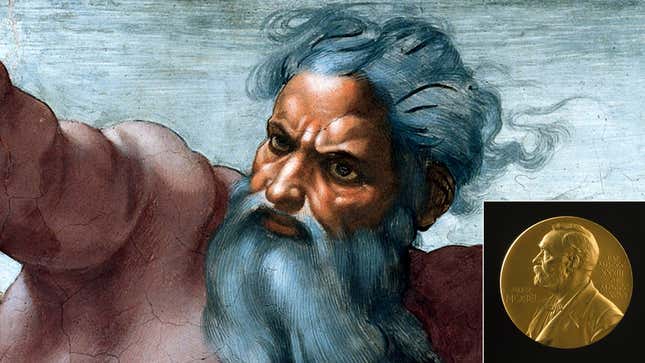
STOCKHOLM—Honoring the deity’s transformational and enduring contributions to the scientific field, the 2023 Nobel Prize in Physics was awarded Monday to God, our Creator, who devised the Heavens and the Earth in all their brilliance. “This prize recognizes the Lord’s foundational work in developing the sun, the moon, and all the manifold stars in the cosmos,” said Hans Olsson, a member of the Nobel Committee for Physics, who went on to praise the elegance of God’s insight in separating the day and night, thereby developing the very concept of time, without which physics itself would be functionally meaningless. “Beyond that, this year’s laureate also created the laws of physics, which continue to be of inestimable importance to the field. In that sense, this is really long overdue.” At press time, God’s Nobel Prize had been rescinded after it was discovered that He had taken credit for the work of Lise Meitner, the late Austrian physicist who first created light and set the universe into motion but was overlooked for the prize because she was a woman.
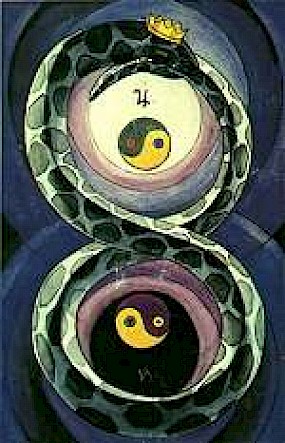
The Lord of Change is a card that indicates the necessity of constant change in life if we are not to stagnate. It often marks a turning point – a new job, a shift of fortune, a move of home.
Disks are an earthy suit, covering matters of material life, and the manifest Universe. If you look at the planet we live on, though in itself it seems solid and predictable (less so in recent years, mind you) it is in a constant state of change and movement. It turns in space, and if it did not, we’d all be very unhappy with the consequences. The cycle of seasons swings past us each and every year. The tides ebb and rise. Constant change is natural, normal and positive.
We do, though, often fear change in our lives. We will struggle against anything that appears to alter the pre-planned pattern we have applied to our future. But that’s exactly what this card does – instigates change. Sometimes we think that the change is bad – and on the face of it, it may appear to be – yet whenever the 2 of Disks appears, it’s warning us that change has become imperative. Something is stagnating, demanding to be broken down and made over.
It’s worth remembering that if you resist the change advocated by the Lord of Change, you might find that life imposes it upon you anyway – and then you’ll feel the effects either of the Death card, or the Tower. When this card appears, it demands a thorough re-assessment of your overall position and willingness to go with the chances that come your way.
The card is especially strengthened by cards like Fortune, and positive Disks and Wands. You can usually track down which area of life it applies to by looking at the cards that surround it – Cups would suggest you need to look at your emotional life. Disks would imply that it’s either your working or financial area that needs attention. Swords would probably indicate conflict around whatever changes you need to make, and may point to a need for clear communication. Wands would be more connected with your own application of Will, and the way you are trying to build your life. Major Arcana cards would suggest an inner, more spiritual area needs to be looked at.
Once, Octavia Butler (June 22, 1947–February 24, 2006) set out to write a memoir. But she found that “it felt too much like stripping in public,” so she abandoned it. Today, all of her autobiographical reflections, all of her overt politics, all of her creative credos come down to us solely through her interviews, now collected in Octavia E. Butler: The Last Interview and Other Conversations (public library).
These conversations are also the reliquary of Butler’s hard-honed wisdom on the craft of writing, which she taught herself and mastered against the odds of her time and place to become one of the most abiding and beloved literary voices of the past century — part prophet, part poet of possibility.
Octavia Butler by Katy Horan from Literary Witches — an illustrated celebration of women writers who have enchanted and transformed our world.
In an interview given just as she was beginning what would become her iconic Parable of the Sower, she offers young writers the pillars of the craft:
The first, of course, is to read. It’s surprising how many people think they want to be writers but they don’t really like to read books… The second is to write, every day, whether you like it or not. Screw inspiration.
Forget about inspiration, because it’s more likely to be a reason not to write, as in, “I can’t write today because I’m not inspired.” I tell them I used to live next to my landlady and I told everybody she inspired me. And the most valuable characteristic any would-be writer can possibly have is persistence. Just keep at it, keep learning your craft and keep trying.
Forget about talent, whether or not you have any. Because it doesn’t really matter. I mean, I have a relative who is extremely gifted musically, but chooses not to play music for a living. It is her pleasure, but it is not her living. And it could have been. She’s gifted; she’s been doing it ever since she was a small child and everyone has always been impressed with her. On the other hand, I don’t feel that I have any particular literary talent at all. It was what I wanted to do, and I followed what I wanted to do, as opposed to getting a job doing something that would make more money, but it would make me miserable.
It was not easy for Butler to follow what she wanted to do. She did have to take terrible job after terrible job. She worked at a hospital laundry. She worked as a telemarketer. (“I have a good phone voice,” she says apologetically. “I am told I have a good phone presence, and I actually sold things to people. I’m very ashamed.”) But all along, she was writing and writing. Looking back on the dogged devotion of those early days, that vital time when the foundations of one’s craft and credo are laid down, she reflects:
I remember another writer and I corresponding, and he had dropped out. I said, “Why haven’t I seen more from you?” He said, “Well, I didn’t make anything on my first three books.” My comment was, “Who makes anything on their first three books?” I remember that the time I quit that laundry job, it was to go to a Worldcon in Phoenix… I decided I was going to try to live as frugally as possible, and at that time you really could live very frugally. My rent was one-hundred dollars a month. So if you were content not to drive, and if you were content to wear the same clothes that you’d been getting along on for a long time… and there were other ways of not spending lots of money. I didn’t eat potatoes for years after that. I decided that I was going to live off the writing, somehow.
[…]
No matter how tired you get, no matter how you feel like you can’t possibly do this, somehow you do.
When an interviewer relays the apocryphal story of how Bram Stoker spent years producing mediocre writing without anyone’s notice until one day lightning struck him and out came Dracula, Butler immediately refutes this myth of divine inspiration with its dangerous intimation that excellence is the product of circumstance or chance. Having placed at the heart of her Parable of the Talents the question of creative drive, having framed it as a matter of “a sweet and powerful positive obsession,” she insists once again on the immense creative power of simply showing up for the work:
It’s one of the things that I try to keep young writers from thinking, that you have to wait, that it’s all luck, lightning will strike and then you’ll have a wonderful bestseller. So I think it’s like the old idea that fortune favors the prepared mind. If you’ve developed the habit of paying attention to the things that happen around you and to you, then, yeah, you’ll get hit by lightning.
California is poised to become the first state to outlaw discrimination based on a person’s caste. The system of social stratification, which dates back thousands of years, has been outlawed in India and Nepal for decades.
Amy Qin, a correspondent who covers Asian American communities for The Times, explains why so many believe that a prejudice that originated on the other side of the globe now requires legal protection in the U.S. — and why so many are equally convinced that it would be a bad idea.
On today’s episode
Amy Qin, a national correspondent covering Asian American communities for The New York Times.
The issue has prompted fierce debate over how pervasive caste discrimination is within the South Asian community in America.Credit…José Luis Villegas/Associated Press
Meena Kotwal, a Dalit journalist, started a news outlet focused on marginalized groups in India, hoping that telling their stories would help improve their lives.
There are a lot of ways to listen to The Daily. Here’s how.
We aim to make transcripts available the next workday after an episode’s publication. You can find them at the top of the page.
Amy Qin contributed reporting.
Fact-checking by Susan Lee.
Special thanks to Aisha Khan.
The Daily is made by Rachel Quester, Lynsea Garrison, Clare Toeniskoetter, Paige Cowett, Michael Simon Johnson, Brad Fisher, Chris Wood, Jessica Cheung, Stella Tan, Alexandra Leigh Young, Lisa Chow, Eric Krupke, Marc Georges, Luke Vander Ploeg, M.J. Davis Lin, Dan Powell, Sydney Harper, Mike Benoist, Liz O. Baylen, Asthaa Chaturvedi, Rachelle Bonja, Diana Nguyen, Marion Lozano, Corey Schreppel, Rob Szypko, Elisheba Ittoop, Mooj Zadie, Patricia Willens, Rowan Niemisto, Jody Becker, Rikki Novetsky, John Ketchum, Nina Feldman, Will Reid, Carlos Prieto, Ben Calhoun, Susan Lee, Lexie Diao, Mary Wilson, Alex Stern, Dan Farrell, Sophia Lanman, Shannon Lin, Diane Wong, Devon Taylor, Alyssa Moxley, Summer Thomad and Olivia Natt.
Our theme music is by Jim Brunberg and Ben Landsverk of Wonderly. Special thanks to Sam Dolnick, Paula Szuchman, Lisa Tobin, Larissa Anderson, Julia Simon, Sofia Milan, Mahima Chablani, Elizabeth Davis-Moorer, Jeffrey Miranda, Renan Borelli, Maddy Masiello, Isabella Anderson and Nina Lassam.
(Contributed by Michael Kelly, H.W.)
Consciousness, spirituality, biography, sexuality, androgyny, futurism, space, the arts, science, astrology, democracy, humor, books, movies and more







 The first, of course, is to read. It’s surprising how many people think they want to be writers but they don’t really like to read books… The second is to write, every day, whether you like it or not. Screw inspiration.