
New Thinking Allowed with Jeffrey Mishlove Sep 24, 2023 Ronnie Pontiac was the personal research assistance for Manly P. Hall at the Philosophical Research Society in Los Angeles. He is author of American Metaphysical Religion: Esoteric and Mystical Traditions of the New World. Here he highlights some of the most significant and fascinating characters in 20th century American mysticism. 00:00 Introduction 01:52 Manly Palmer Hall 23:11 Mediumship 32:13 Krishnamurti 34:07 Fascist mystics 38:36 Guy Ballard 41:37 Nazi Germany 45:21 Saint Germaine 52:59 When Prophecy Fails 54:11 Conclusion Edited subtitles for this video are available in Russian, Portuguese, Italian, German, French, and Spanish. New Thinking Allowed host, Jeffrey Mishlove, PhD, is author of The Roots of Consciousness, Psi Development Systems, and The PK Man. Between 1986 and 2002 he hosted and co-produced the original Thinking Allowed public television series. He is the recipient of the only doctoral diploma in “parapsychology” ever awarded by an accredited university (University of California, Berkeley, 1980). He is also the Grand Prize winner of the 2021 Bigelow Institute essay competition regarding the best evidence for survival of human consciousness after permanent bodily death. (Recorded on August 23, 2023)
Monthly Archives: September 2023
Comfort is the Enemy | Nietzsche’s Last Man
The Living Philosophy Sep 24, 2023 For Nietzsche The Last Man stood as the opposite of the Ubermensch and the great danger of the “levelling” tendency of modernity. In this episode we are going to look at what Nietzsche meant by the Last Man and how his prophecy has come through. We look at The Last Man in 21st century society and what Nietzsche got right even while we should be cautious of fully embracing his ideal. ____________________ ? Further Reading: – Joseph S (2011) _What Doesn’t Kill Us: The New Psychology of Posttraumatic Growth_. New York: Basic Books. – McGonigal K (2015) _The Upside of Stress: Why Stress Is Good for You, and How to Get Good at It_. New York: Avery, a member of Penguin Random House. – Seligman MEP (2013) _Authentic Happiness: Using the New Positive Psychology to Realize Your Potential for Lasting Fulfillment_. Atria paperback edition. New York London Toronto Sydney New Delhi: Atria Paperback. – Nietzsche FW (1976) Thus Spoke Zarathustra in _The Portable Nietzsche_. New York: Penguin Books. – Nietzsche FW and Kaufmann WA (1974) _The Gay Science: With a Prelude in Rhymes and an Appendix of Songs_. 1st ed. New York: Vintage Books. – Nietzsche FW and Kaufmann WA (2000) _Basic Writings of Nietzsche_. Modern Library ed. New York: Modern Library.
The Profound Meaning of Plato’s Allegory of the Cave
After Skool Sep 19, 2023 In this episode we explore Plato’s “Allegory of the Cave”, its connection to ancient myths, and the ultimate narrative archetype we know as the Hero’s Journey. Plato’s “Allegory of the Cave” is one of the most influential philosophical concepts ever introduced, encapsulating timeless questions about reality, knowledge, perception, and enlightenment. Located in Plato’s seminal work, “The Republic,” the Allegory of the Cave serves as a metaphorical narrative depicting the human condition’s journey from ignorance to enlightenment. The Athenian philosopher Plato (c. 428-347 B.C.) is one of the most important figures of the Ancient Greek world and the entire history of Western thought. In his written dialogues he conveyed and expanded on the ideas and techniques of his teacher Socrates. The Academy he founded was by some accounts the world’s first university and in it he trained his greatest student, the equally influential philosopher Aristotle. Plato’s recurring fascination was the distinction between ideal forms and everyday experience, and how it played out both for individuals and for societies. In the “Republic,” his most famous work, he envisioned a civilization governed not by lowly appetites but by the pure wisdom of a philosopher-king. This script was written and recorded by Agrippa’s Diary. Visit their youtube channel – / @agrippasdiary and their IG – https://www.instagram.com/agrippasdiary/
Effort — Effortlessness


Jul 26, 2023 (girishborkar.medium.com)
The logical mind creates the problem between effort and effortlessness, because the mind says that these two things are contradictory. If we make an effort, we make effort; how can we make it effortlessly? If we become effortless, there is no effort; all effort disappears. So, the mind divides these two — effort and effortlessness. But try to understand this in a different way.
A child is playing and he is absolutely absorbed in his play — so much so that even if a neighbour’s building falls and collapses he may not even hear the sound. He is absorbed… maybe making sandcastles, but he is absolutely absorbed. There is effort, tremendous effort — the child is perspiring — and yet there is no effort because the child is simply playing; there is no motive. Or a painter is painting, a singer is singing, a dancer is dancing, a jeweller is creating something.
We are absolutely absorbed in whatever we are doing. Then effort is there and yet it is effortless. It is not a tension on us. It is not a duty that we have to do. We are delighted in doing it. A sculptor is creating a work of art. There is effort — he may start perspiring; but still there is no effort. The sculptor loves his creation — it comes from within effortlessly.
We enjoy it; we are absorbed in it. We are completely drowned in it. It is a play and there is no motivation in it. We are not doing it for any other reason; we are doing it for doing’s sake. Then there is tremendous joy in it. When we say effortless effort, we mean doing something with no other motive than the very pleasure of doing it.
Then suddenly we will see that the contradiction has disappeared. For example, two people are conversing. There is effort and there is no effort, because we are just talking for no other purpose, just a casual conversation. Talking is effort — but there is no effort because we love it, because we love each other. When Swamiji is rendering a discourse to a large gathering, he does not see anybody from the stage, he is completely lost in it. There is nobody standing behind him; he is talking to all of us effortlessly simply because of the love for us that flows through him.
When Swamiji is talking, he is just talking. The effort is there and yet there is no effort. The contradiction exists only for the logical mind, because the logical mind cannot understand play; it can understand only work. It can understand rest; it can understand work.
It cannot understand work which is rest too. So, whenever work becomes play the contradiction is gone. And when contradictions are not there a harmony arises in the opposites. We have something of the beyond penetrating us… a ray of light.

Never Around, Always Through
On the preparation and resiliency for when the world calls

Published in The Stoic Within
Sep 17, 2023 (Medum.com)

Theodore Roosevelt was born with a very bad case of asthma. It was so bad in fact that he would have coughing bouts that made his parents afraid he wouldn’t be able to make it through the night.
“One of my memories is of my father,” Roosevelt would later describe “walking up and down the room with me in his arms at night when I was a very small person, and of sitting up in bed gasping, with my father and mother trying to help.”
Roosevelt’s father pulled him aside one day and bluntly told him the truth:
“Theodore, you have the mind but you have not the body, and without the help of the body the mind cannot go as far as it should. You must make your body. It is hard drudgery to make one’s body, but I know you will do it.”
Roosevelt had a choice he had to make — he could live a life of discomfort with his asthma or he could listen to his father and work to make his body stronger. Roosevelt, looking up to his father and calling him one of the greatest men he ever knew, would take to heart what his father said and would throw himself into strengthening his body. Roosevelt would in fact do this so rigorously that he would become known for his determination and adventurous spirit.
Theodore Roosevelt was enthralled with the idea of being prepared to take on the world. From this young age he knew the odds were stacked against him and in order to strengthen the odds to his favor, he would have to do everything in his power to prepare for the trials of life. He would, in essence, do everything in his power to prepare himself for the moment he was called upon, whatever that moment may be.
He would go on to pass this same sentiment on to his children, taking them on long excursions. As one son would later write, Roosevelt would “rather one of them [his children] should die than have them grow up weaklings.” Soon to become known within the family as “scrambles,” Roosevelt would take his children into nature for long walks with only one rule: “participants could go through, over, or under an obstacle, but never around it.”
Being prepared for life’s future adversities is something the Stoics often meditated on. Marcus Aurelius would remind himself of the “foolishness of people who are surprised by anything that happens.”
And Seneca would reflect on the need to constantly predict what the future could hold:
“Your greatest fear lies in the same place as your greatest joy. When everything seems serene, the dangers are still present, only sleeping. Always suppose that something offensive to you is going to arise.”
As we often reflect on, life is an extremely hard and unkind place a majority of the time. Things do not always workout in our favor and seldom are they ever easy. We will encounter the pain of loss, the sting of betrayal, and the heartbreak of abandonment. We will work towards a goal and not meet it, or listen to the voice in our head that tells us to just give up already. And while we need to create a mind that is strengthened against these things, that mentally prepares for the trials and tribulations of life, it is not enough.
While our mind must be strong, our body must be able to match it as best as we can. We must also physically and emotionally subject ourselves to the strenuous life. It is too easy to become comfortable in our daily lives. It is through hardships that we gain strength and it is through those hardships we callous over our weakest points and find strength to persevere and continue on, where we learn about ourselves and what we’re made of.
The Navy SEAL Jocko Willink has created a mantra of finding the trials and setbacks of life as “good” events to better preparing for life:
“How do I deal with setbacks, failures, delays, defeats, or other disasters? I actually have a fairly simple way of dealing with these situations, summed up in one word: “Good.””
When setbacks happen, he says good, and reminds himself of the benefits of the setback.
“Oh, the mission got canceled? Good… We can focus on another one.
Didn’t get the new high-speed gear we wanted? Good… We can keep it simple.
Didn’t get promoted? Good… More time to get better.
Didn’t get funded? Good… We own more of the company.
Didn’t get the job you wanted? Good… Go out, gain more experience, and build a better resume.
Got injured? Good… Needed a break from training.
Got tapped out? Good… It’s better to tap out in training than tap out on the street.
Got beat? Good… We learned.
Unexpected problems? Good… We have to figure out a solutions”
It is important to be both mentally and physically prepared for the adversities and tribulations of life. When adversity strikes, we are better able to recognize the situation and remember our preparation for the event — remember how to put our training into action.
Or, to put in a way Roosevelt may have, it prepares us to find a way to go over, under, or through, but never around, never turning back, but rather preparing us for that life event. To not run around the event but to take it head on, to turn within us and know that we can and will overcome it, that we will get the best of it, and that nothing stands in our way.
This was originally a Monday Meditation. We send a new Stoic meditation every Monday morning directly to your inbox. To sign up to receive our Monday Meditations, click here.
Some links contained herein are Amazon affiliate links. Click here for disclosure.
Want more? Consider signing up for a Medium membership here.

Written by D.A. DiGerolamo
·Editor for The Stoic Within
Lessons in philosophy, self-development, leadership, and strategy. stoicwithin.com. Socials: @stoicwithin / @dadigerolamo
Breaking Bread with the Dead
The Wisdom of Reading

Published in PERENNIAL — Ancient Lessons for Modern Life
3 days ago (Medium.com)

Tobreak bread with the dead may sound like odd (or obvious) advice. But strangely, the birth of Stoicism started with this type of suggestion. As legend has it, when Zeno (the founder of Stoicism) was a young man, the Oracle told him, “To live the best life, you should have conversations with the dead.”
The oracle was referring to reading. But not just any books — books written by writers that have long passed. Books that have stood the test of time.
Reading as a path to the good life is an ancient one. Even Socrates — who did not write anything down himself — stressed the wisdom of reading. He suggested improving ourselves through other men’s writings to come easily by what others have labored hard for.
Reading the lives of others helps us discern how to live our own.
The British writer C.S. Lewis may have put it best,
Those of us who have been true readers all our life seldom fully realize the enormous extension of our being that we owe to authors. We realize it best when we talk with an unliterary friend. He may be full of goodness and good sense, but he inhabits a tiny world. … The man who is contented to be only himself, and therefore less a self is in prison. My own eyes are not enough for me, I will see through those of others. The reality, even seen through the eyes of many, is not enough. I will see what others have invented.
Although it is not enough to read. We must attempt to read well.
To read well is not to scour books for lessons on what to think. Instead, to read well is to be formed in how to think, explains Karen Swallow Prior (a previous podcast guest). Reading well requires time and attention.
Similarly, the American philosopher Mortimer J. Adler illustrated this point nicely in his classic, How to Read a Book,
If you ask a living teacher a question, he will probably answer you. If you are puzzled by what he says, you can save yourself the trouble of thinking by asking him what he means. If, however, you ask a book a question, you must answer it yourself. In this respect, a book is like nature or the world. When you question it, it answers you only to the extent that you do the work of thinking and analyzing yourself.
However, often in life, we pick up bad habits around reading.
Here are a few practical tips to remember: (1) Don’t be afraid to read slowly. Good books take time; instead of speed reading — try deep reading. (2) Don’t be afraid to write in books. Read with a pen, pencil, or highlighter in hand. (3) Don’t be afraid to read books again and again. As Seneca put it in a letter to Lucilius, “Stay with a limited number of writers,” be wary of reading too widely.
It is easy to forget how special books actually are.
They are so readily available in modern life. It can be difficult to imagine a time when books were transcribed by hand. The next time you have a book in your hands, consider reflecting on the lives that may have read it. What they might have been dealing with — the answers they may have been searching for.
Books “break the shackles of time,” stressed the astronomer Carl Sagan,
What an astonishing thing a book is. It’s a flat object made from a tree with flexible parts on which are imprinted lots of funny dark squiggles. But one glance at it and you’re inside the mind of another person, maybe somebody dead for thousands of years. Across the millennia, an author is speaking clearly and silently inside your head, directly to you. Writing is perhaps the greatest of human inventions, binding together people who never knew each other, citizens of distant epochs. Books break the shackles of time. A book is proof that humans are capable of working magic.
Reading well adds to our life — but not in the way a tool from the hardware store (or a new piece of technology) adds to our life. Reading is not a life hack. Reading is a perennial habit (or a lifelong practice).
To break bread with the dead is to eat and drink deeply from good books. “To have conversations with the finest minds of past centuries,” in the words of Rene Descartes. Reading well is a royal road to understanding ourselves, others, and the world around us.
Thank you for reading; I hope you found something useful.
P.S. If you like daily meditations on the art of living, check out the Perennial Meditations newsletter.

·Editor for PERENNIAL — Ancient Lessons for Modern Life
Founder at Perennial Leader Project | Host of In Search of Wisdom Podcast | Reflections on wisdom and life. Say hello: JW@perennialleader.comFollow
Full Moon in Aries – The Trojan War

| Astro Butterfly contact@astrobutterfly.com | September 24, 2023 |  | |
| |||
On September 29th, 2023 we have a plot-shifting Full Moon in Aries.
The Full Moon is at 6° Aries, and apart from the opposition to the Sun in Libra, the Moon doesn’t make aspects with any other planets.
Nevertheless, the Moon is in select company, sharing the sign of Aries with Chiron, Eris, and the North Node.
Chiron, Eris and North Node In Aries
Let’s talk a bit about Chiron, Eris, and the North Node.
We know that Chiron was a very respectable centaur, the teacher of heroes, and the most revered mentor of his time.
Nowadays he’d probably be an executive coach – hired by top athletes, presidents and New York best selling authors.
Eris on the other hand had quite a reputation. She was known for being scheming and cunning.
When she is not invited to the wedding of Peleus and Thetis, she hatches a devious plot, indirectly alluring Paris into a fateful decision to kidnap Helen of Sparta.
The rest is history. We had the Trojan War and the fall of Troy.
The Trojan War is a central theme in Greek myth, symbolizing the consequences of unchecked ambition and the destructive nature of war. It’s a reminder of the devastating impact of conflicts on societies and individuals.
In addition to Chiron and Eris, we also have North Node in Aries. The North Node is not a part of Greek mythology, but it holds a significant role in Indian mythology.
Just like Eris, the North Node (Rahu) didn’t get invited to the party when the God and Goddess gathered to drink the nectar of immortality. So he disguised himself, showed up uninvited, and stole the nectar.
He eventually got recognized and decapitated, but because he already drunk the nectar, he became immortal. Since then, it is said that Rahu chases the Sun and the Moon, causing eclipses to happen.
When we look at these myths, we notice some common themes. Neither Eris, nor the North Node were part of the “Cool Kids Club”. The High God and Goddess Society didn’t like them, and didn’t invite them to festivities.
Initially, Chiron was not part of the cool kids club either. In fact, he got rejected at birth – both his parents abandoned him, repulsed by his appearance (he was born half-man, half-horse).
But Chiron didn’t sulk, nor became unruly like the other centaurs, notorious for their heavy drinking and rowdy behavior. He integrated his abandonment wound and alchemized it into a profound wellspring of wisdom and healing.
Moon In Aries – War And Peace
So we have Chiron, Eris and North Node in Aries. Now the next question is – what will the Moon in Aries do?
Will she take advice from her Chiron life coach, or get seduced by Eris’ apple and Rahu’s promise of immortality?
The Moon in Aries – any planet in Aries – loves to go to war. Planets in the opposite sign of Libra seek peace and harmony.
The plot thickens because Mars, the ruler of the Full Moon is actually in Libra.
We have the Sun, the South Node and Mars – all in Libra. Mars and South Node especially can be quite passive-aggressive, using sarcasm or subtle manipulation to express their frustrations.
On the other side of the opposition we have the planets in Aries. We already talked about Eris and Rahu’s sneaky ways. Let’s just add that the Moon in Aries is not particularly known for her negotiation skills.
Unaspected by other planets, the Full Moon in Aries is torn between war and peace.
Perhaps there’s no need for another Trojan War. But sitting and waiting is not an option either.
Moon In Aries – Venus Sextile Mars
In times of tension and uncertainty, it’s good to remind ourselves that all New and Full Moons, all planetary alignments come with opportunities to rewrite the script of our destiny.
There are no 2 Full Moons exactly the same. Each transit is a unique moment in time – never to be experienced again.
What does that tell us?
That life is not just an endless, fated journey where we’re powerless to change our course. Every single moment comes with opportunities to co-create our own narrative.
If, and just if, we consider alternatives and different perspectives, perhaps our lives don’t have to be an endless loop of repeating patterns.
The ruler of the Moon in Aries, Mars, is sextile with the ruler of the Sun in Libra, Venus. There is unexpected help if we look for it.
In fact, Venus and Mars have been dancing in a friendly sextile for a while now, negotiating (Mars in Libra) creative solutions (Venus in Leo) to help us ‘break the spell’, empowering us to navigate life’s challenges with both courage and grace.
The Full Moon in Aries comes with a unique opportunity to unwire years and decades of conditioning around conflict management and reactive behavior patterns – and do things differently.
“Astro Butterfly Wings” Natal Chart Reading Program
When we decipher the language of the stars, when we understand what the planets are trying to tell us, we get in sync with the universe and take charge of our life.
For thousands of years, astrology has been one of the greatest tools for growth and self-discovery. Astrology is the greatest gift you can give to yourself.
If you’d like to learn how to speak this language, you’re invited to join the “Astro Butterfly Wings” program.
You can find more information about the 2 tracks of the program here:
Astro Butterfly Wings (beginner and intermediate students)
Astro Butterfly Wings PRO (upper intermediate and advanced students)
What has Gotten into Our Minds? The Psychosis of the Modern World & the Search for the Self


From New Dawn 177 (Nov-Dec 2019) (NewDawnMagazine.com)
…in the darkness charlatans are easily mistaken for sages.
– Chantal Delsol
There’s something fundamentally wrong with how the world is right now. Don’t you see it – feel it? We are a species with noble character, with a great spirit, and with a sacred soul. In our hearts we wish only for the betterment of all people; for love and justice and communion. And yet what we see going on in the world is nothing less than complete madness. We have to say it exactly as it is – there is a sickness going on, and this pathogen is spreading on a vast scale.
We live in a world where economic greed overrides all other factors. Nations, corporations, and individuals commit horrendous acts that include impoverishment, deprivation, psychological and physical torture, and even murder, just for financial gain. We behave horrendously toward each other; there is constant bullying and harassment upon all social and cultural levels. Violence is endemic across the globe, and pharmaceutical corporations would rather turn a profit than support health and well-being. Governmental bodies and agents participate in drug trafficking on a huge scale in order to both make money as well as promote addiction amongst the masses. Rich individuals and corporations hide their money through illegal offshore schemes rather than contribute to the welfare of their communities. People in high office consistently abuse, harass, and violate people within their power as a sign of their high status. The health of the planet and its natural environment is constantly mistreated and polluted; again, mostly for the sake of economic gain. And the list goes on.
We have entered the third millennium, and we pride ourselves on being an inventive and intelligent species. We have probed off-planet and have allegedly placed people on the moon. We are now planning trips further afield into the solar system and of having people live on the planet Mars. We are an incredibly creative and compassionate species. So, what is wrong? Why do so many people so much of the time adhere to thinking and ways of behaviour that is nothing short of insanity? Why is everything so seemingly upside-down?
The reason, I propose, is that we are not living within our right minds. That is, we have ‘lost’ our minds to a collective psychosis that seeks to imbue us with a traumatic mind. This is no flight of fantasy. There are indeed indigenous and wisdom teachings that tell of a mental force that exists in the collective consciousness field that came to usurp our minds. Various traditions refer to these nefarious mindsets as wetiko, predators, archons, Ahriman, the flyers, and more. They speak of how an ‘alien mind’ has entrapped and traumatised the human collective mind.
Another side of this story is that as a global species, we are also projecting the wounds of our collective unconscious out into the world. This is both a traumatic as well as cathartic process. Perhaps it is necessary – a collective cleansing of our unconscious traumas and of the shadows that lurk in the dark recesses of our minds – to prepare our species for the next phase of our evolution? What we can be sure about, without a doubt, is that we are amidst a great, historical transition. At this time, two major issues confront us: the seeming madness of the modern world, and the need to find meaning within it.
What’s Going On?
The question we are confronted with is a collective one, and it concerns us all. Why are so many of us, our fellow humans, behaving so badly? And not only badly, but in a way that is detrimental to our own well-being. It would seem more than strange, verging on the insane, that any creature would wish to deliberately harm its own environment and support systems. Yet for us humans, we have the significant added factor of being conscious of our actions, and self-conscious in our reflective understanding. So, again, we ask – what has gotten into our minds?
Modernity (and post-modernity) has given us the perspective that anything that is important lays external to us. The attitude of this ‘modern mindset’ to the external world has largely been one of hostility – we have been conquering the external world for the greater part of recent history, instead of mastering our own inner nature. Whatever we project externally eventually becomes our sense of reality; therefore, if we have inherited a corrupted collective mind, then we are projecting a tarnished collective reality. Modern life has attempted to reinterpret the human condition, and this has resulted in a separation from our need to seek essential inner meaning in our lives. Progress may alleviate some of our suffering and pains, yet it shall never compensate for the lack of fulfilment we feel inside, for this requires metaphysical or transcendental nourishment.
Any notion of the spiritual, or the metaphysical, is often considered not essential to our daily life, and we are taught to dismiss it. Modernity’s task was thus seen as freeing us from the illusions of transcendence. And in its place, we have been conditioned (a.k.a. programmed) with a form of thinking opposing a genuine path of human psychic development. In this regard, I now consider the hypothesis that a mental infection (a psychosis) has entered the collective human mindset.
I examine this proposition from four different cultural contexts: indigenous Native American, western psychology, Central American shamanism, and European theosophy. And I have given it my own name – the Wounded Mind. First, I turn to the indigenous Native American tradition.
The Wetiko Virus
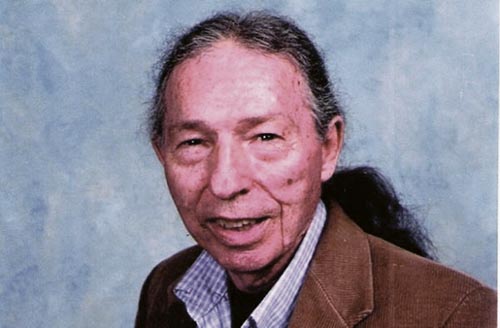
Jack Forbes (1934–2011), a Native American scholar and activist, long considered this question of what has gotten into the human mind – and came up with an answer for it. After long study, he came to the conclusion that humanity is suffering from a specific disease, a psychosis:
For several thousands of years human beings have suffered from a plague, a disease worse than leprosy, a sickness worse than malaria, a malady much more terrible than smallpox… whatever we call it, this disease, this wetiko (cannibal) psychosis, is the greatest epidemic sickness known to man.1
Wetiko is a Cree term (windigo in Ojibway, wintiko in Powhatan) that refers to an evil person or spirit which terrorises other creatures by means of terrible acts. And in Forbes’ view, the great tragedy of humankind is that our history for the past two thousand years has largely been a tale of the psychosis of the “wetiko disease” as he calls it. He goes as far back as to include the Egyptians, Babylonians, and Assyrians as cultures that helped to spread the wetiko disease throughout the Middle East. Afterwards, it was the Macedonians and Greeks under Alexander who spread it still further until it finally landed in the lap of the Roman Empire who, according to Forbes, really expanded the wetiko infection.
What he is saying here is that this psychosis is a particular mindset that took form as certain hierarchical cultures and civilisations began to grow. And in order to maintain control, power, and to further bloody expansion, this mindset was deliberately cultivated, encouraged, and then developed as the dominant perspective and narrative. In fact, it was a crucial perspective that had to be propagated in order to maintain all status quo power structures within a developing culture. To not adhere to this specific mindset almost certainly meant annihilation and eradication in the face of other competing cultures (as was the case with Forbes’ inherited Native American ancestral cultures).
Forbes’ view is that the wetiko disease has so corrupted European thinking that wetiko behaviour is now regarded as the very fabric of European culture and the pursuit of progress. And in order for the ruling few to maintain stable power and order, they must convince, persuade, or condition the masses within their society/civilisation to either believe and support the same, or at the very least not to rebel against it. The functioning of our modern societies has been derived from this operation of providing a dominant mindset – or social narrative – and manipulating its collective consent through coercion or, as is now more the case, persuasive propaganda.
Forbes comes to the conclusion that a developed society takes the wetiko desire for power and channels it into creating highly disciplined and rigid structures that over the years have managed to conceal their controlling mechanisms through institutionalised conditioning. These institutions then go on to create an established ‘pecking order,’ or hierarchical status, between people. This ranking social status system continues to exploit the general population through more socially ‘normalised’ means. Innocent or non-conscious wetikos can also be co-opted into this system of behaviour through allurements such as grants, support, employment, etc., which entices them into the illusion of individual freedom and personal power. Like any other pathogen, the wetiko virus tries to infect and feed upon others by reinforcing its own corruption of the human mind.
The predatory nature of wetiko can lurk under almost any guise and is most prevalent in such slogans as ‘patriotism’, ‘profit-seeking’, and ‘protecting our way of life’. We could say that we have seen recent examples in ‘you’re either with us or against us’. The wetiko mindset assimilates itself through intensive propaganda programs designed to perpetuate its own self-serving values. In the end, many of our national cultures have become pervaded by myths, narratives, and entrained thinking patterns that perpetuate a wetiko society. Yet what if such a mindset is not only preserved within particular cultures but is available to be assimilated through a species collective mindset? This is the question posed by the psychoanalyst and psychologist Carl Gustav Jung.
Jung’s Collective Unconscious
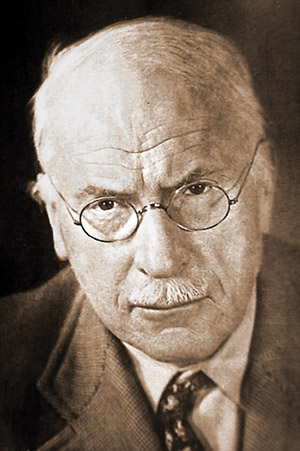
Jung was perhaps the first psychologist to fully realise that what we see playing out upon the global stage is largely a projection, or symptom, of the unconscious psyche of humanity. Jung considered that this collective unconscious does not develop individually but is inherited. That is, we inherit a ‘psychic life’ that is filled with ‘occurrences’ that stretch back to earliest beginnings. What if a psychosis, such as the wetiko pathogen, has already invaded this psychic stratum and now manifests as a disturbance in the field of humanity’s collective unconscious? We could very well be dealing with a psycho-pathogen – that is, a mind virus – that infects our individual minds from the underlying collective realm.
This collective psychosis functions as a field phenomenon, and as such it underlies the entire collective field of nonlocal consciousness. The danger here is that each person can potentially be infected by the psychosis simply by not being mindful of their thoughts. Before we know it, we are having malicious or angry wetiko-like thoughts, which then could easily manifest into actual behaviour. Who at one time or another hasn’t had a mean or nasty thought? The question is – did this thought originate within us, or did it enter from without? Since the mind virus pathogen – which I refer to as the Wounded Mind – is a nonlocal phenomenon, then it is possible we all are infected with it to varying degrees. Or, it may be more accurate to say that this mind has us. And the worst of it is that most people will be unconscious and unwitting carriers of this pathogen. As Jung said, “Wars, dynasties, social upheavals, conquests, and religions are but the superficial symptoms of a secret psychic attitude unknown even to the individual himself.”2
If we take the modern analogy of computing, then it is similar to how a virus would enter our computers and install malware or change the coding. Such a mental pathogen would act in the same way by installing its own malware program in our minds. For most of the time we are unaware of it, as it acts alongside our own ‘normal’ mind until a time when it takes over almost completely. Over time our own mental make-up – our psychological state – would adapt the foreign ‘invader’ and assimilate it into its own functioning as a way of normalisation. In other words, we would eventually come to consider it as our mind.
Don Juan’s Alien Mind
There are wide-ranging accounts throughout shamanic and anthropological literature about how people are vulnerable to psychic invasion and predatory ‘energy forces’. In recent times, perhaps no-one has been as openly explicit as the teachings given by don Juan through the books of Carlos Castaneda. Later in the series of books, when Castaneda is more experienced and matured into the shamanic path, don Juan reveals some ‘truths’ to him regarding the nature of the predators. Don Juan explains that there are “outside forces” that impose control upon us. These ‘predators’ imprison human beings and make us docile. When Castaneda protests against this, don Juan explains that:
In order to keep us obedient, meek and weak, the predators engaged themselves in a stupendous maneuver – stupendous, of course, from the point of view of a fighting strategist. A horrendous maneuver from the point of view of those who suffer it. They gave us their mind! Do you hear me? The predators give us their mind which becomes our mind. The predators’ mind is baroque, contradictory, morose, and filled with the fear of being discovered any minute now… Through the mind, which after all, is their mind, the predators inject into the lives of human beings whatever is convenient for them.3
According to don Juan, an ‘alien’ presence, or energy, has infiltrated the human mind. That is, when ‘we’ are thinking, or ‘having’ thoughts, we are in effect manifesting – or being influenced by – a corrupted mind that is “baroque, contradictory, morose” and filled with fear. When we connect and engage with the collective unconscious, or the collective mindset, are we, in fact, tapping into a psyche that, in the words of Jung, stretches “right back to the earliest beginnings”? Yet those beginnings may also include the ‘alien mind’ of the predator.
As a species, humanity accesses a collective unconscious mind that forms the basis of our thinking patterns and our behavioural traits. If an element of psychosis, trauma, a dominating narrative – i.e., wetiko, predator – has infiltrated this collective mental field then it is a very real possibility that we too have inherited what I call the Wounded Mind. It also raises the question of what type of civilisation or society would such a parasite-predator psychotic ‘mind’ wish to create?
The answer to this may lie with a form of twentieth-century theosophy that was put forward by the Austrian philosopher and mystic Rudolf Steiner.
The Coming of Ahriman
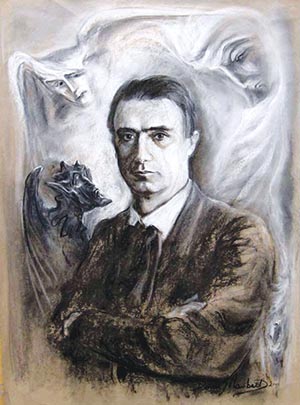
In the writings of Rudolf Steiner in the early part of the twentieth century, he makes mention of an entity he calls Ahriman. For Steiner, this Ahriman is a supersensible being that wishes to distract humanity from aligning with its evolutionary potential. In order to accomplish this, it seeks to influence the minds of humanity in order to develop along a specific path; one that aligns with its own needs rather than that of humanity’s.
The conditions that the Ahrimanic presence wishes to create includes the following: a materialistic, mechanical conception of the universe; a rational-materialistic based scientific dogma; an economic view of social dynamics and systems; a strong feature of nationalism and national identities; the popularity of separatist party politics; the prevalence of fundamentalism in religious dogma; and the dominance of an arid, dry intellectual culture.4 It would appear that this Ahrimanic presence has been quite successful so far!
Steiner was also explicit in stating that the most dangerous aspect of Ahriman is for this presence to go unrecognised for it seeks to be hidden (similar to the predators). Steiner, in one of his lectures, stated: “…think of everything that presses us down upon the earth, that makes us dull and philistine, leading us to develop materialistic attitudes, penetrating us with a dry intellect, and so on: there you have a picture of Ahrimanic powers.”5
The Ahrimanic powers, we are told, have a firm intention to get the human domain, as well as the earth, into their sphere of power, and to make human beings dependent upon their control. Again, it sounds eerily familiar. Steiner tells us that Ahriman intends to conceal from us that modern intellectual, rationalistic science, is a great illusion, a deception. The idea, apparently, is to keep us all so dulled with our materialistic paradigms that we have no inclination or urge to go seeking for knowledge concerning “soul and spirit in the cosmos.”
The Ahrimanic powers use everything at their disposal to seed discontent, disarray, and conflict. They manipulate notions of heredity – family, race, tribe, peoples – to create confusion and division. Through these class structures, they enforce the dominant cultural paradigm of economic and material needs. Steiner warns his listeners that the “Ahrimanic incarnation” will be greatly advanced if people fail to develop an independent life of the spirit.

A Few Words of Recognition
In all the examples described here – indigenous Native American, western psychology, Central American shamanism, and European theosophy – we have had a glimpse of the proposition of what I term the Wounded Mind. The source of this trauma, however, is still unclear and open for debate. It may be either a collective psychosis of civilisation, a predatory invasion, a devolutionary impulse/presence, or a combination of these. Or else it may be something other but with similar aspects. Yet whatever may be the root cause, it is still quite clear that a traumatic presence lingers within the collective psyche of humanity, and it needs to be recognised for what it is – and expelled.
Perhaps the traumas we are seeing inflicted upon the world today are part of this expulsion – a sort of public exorcism. In the end, we will need to curtail these ‘foreign impulses’ in order to evolve toward a better future for us as a human species upon this planet.
Kingsley’s book Healing the Wounded Mind: The Psychosis of the Modern World and the Search for the Self (Clairview Books), is available from here and all good bookstores.
This article was published in New Dawn 177.
If you appreciate this article, please consider a contribution to help maintain this website.
Footnotes
1. Jack D. Forbes, 2008 (rev). Columbus and other Cannibals, Seven Stories Press, xvi
2. Cited in Meredith Sabini (ed), ed. 2008. C.G. JUNG on Nature, Technology & Modern Life, North Atlantic Books, 188
3. Carlos Castaneda, 1999, The Active Side of Infinity. Thorsons, 220
4. R. Steiner, 2009, The Incarnation of Ahriman: The Embodiment of Evil on Earth, Rudolf Steiner Press
5. Ibid, 1
© New Dawn Magazine and the respective author.
For our reproduction notice, click here.
Support New Dawn
Minimal Ads, No Paywall, No Clickbait – help us
keep this website free with new articles regularly posted.
Show your appreciation & gratitude.
About the Author
KINGSLEY L. DENNIS, PhD, is a full-time writer and researcher. He is the author of over twenty books. His new book is The Inversion: How We Have Been Tricked into a False Reality. He is the author of numerous articles on social philosophy; culture and technology; consciousness studies, and the metaphysical. Kingsley also runs his own publishing imprint, Beautiful Traitor Books – www.beautifultraitorbooks.com. For more information, visit his website: www.kingsleydennis.com.
Secret Agent ‘Putzi’: How Money Power & the Anglo-American Establishment Conjured Hitler
BY JIM MACGREGOR & JOHN O’DOWD
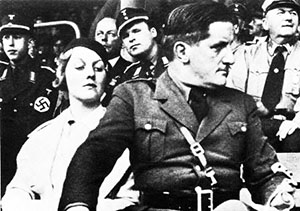
ERNST HANFSTAENGL WITH HITLER IN THE MUNICH CAFÉ HECK, WHICH HE USED AS AN OFFICE.
From New Dawn 190 (Jan-Feb 2022) (NewDawnMagazine.com)
Shortly after 9:00 pm on 27 February 1933, alarm bells clattered in fire stations across Berlin. The Reichstag, the massive glass-domed home of the German parliament, was ablaze. The first fire crews arrived within minutes, and it was immediately apparent that separate fires had deliberately been set throughout the parliament using flammable liquid. Despite their brave efforts, the Reichstag was destroyed. What the firefighters could not know was that they were witnessing thekey event in establishing Nazi Germany and a defining moment of the twentieth century. All of Europe and much of the world, like the Reichstag, would soon be engulfed in flames.
With the Nazi party facing losses to communists at the forthcoming general election six days’ later, Hitler blamed them for destroying the home of German democracy. A young Dutch leftist, Marinus van der Lubbe, would be executed for the crime. A communist revolution, Hitler informed the nation, was imminent, and the Reichstag fire was part of a Bolshevik plan to seize power. The communist vote consequently slumped at the election while the Nazi party’s share increased dramatically to make them the largest party. Hitler seized power, suspended the constitution, and sent communist members of parliament to Dachau concentration camp. Within weeks all political parties in Germany apart from the Nazi party were banned. Historian Professor Antony Sutton relates: “From that point on there was no turning back for Germany; the world was set upon the course to World War II.”1
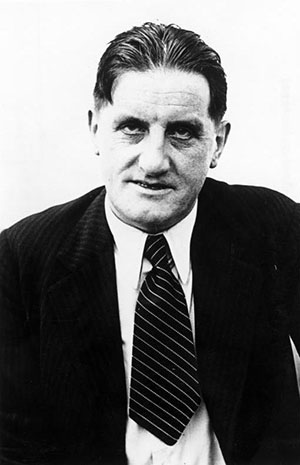
Van der Lubbe was a patsy, and it is clear nearly ninety years on that the fire was deliberately started not by communists but by the Nazis themselves. Astonishingly, the man who deployed the arsonists that night, Ernst Hanfstaengl (known to all as Putzi), was a Harvard University graduate and secret agent of the closely collaborating Anglo-American secret intelligence services. As such, he spent almost 17 years at Adolf Hitler’s side, grooming him for power. Some readers may find that hard to believe but read on and examine the evidence before dismissing it. In his book, Conjuring Hitler: How Britain and America Made the Third Reich, historian Professor Guido Preparata details how the Anglo-American elites funded Hitler and the Nazis throughout the 1930s and armed them to the teeth.
It was an astounding political manoeuvre willingly performed by the Allies to resurrect in Germany a reactionary regime from the ranks of her vanquished militarists… with a view to conjuring a belligerent political entity which she encouraged to go to war against Russia: the premeditate purpose was to ensnare the new, reactionary German regime in a two-front war (World War II), and profit from the occasion to annihilate Germany once and for all.2
We contend it would be a misconception for anyone to think British and American banking and political elites brought Hitler to power because they respected him or his politics or hoped Germany would thrive under him. In reality, the destruction of Germany once and for all as an economic, commercial, and industrial competitor was the goal of this hideous Anglo-American bankers game.
Who was Putzi Hanfstaengl?
Putzi Hanfstaengl was born into an extremely wealthy family in Munich in 1887. Two years later, when Diphtheria brought him close to death, he was saved thanks to three days of round the clock attention from an old family servant. Throughout, she repeatedly crooned, ‘drink, Putzi, please drink Putzi’, encouraging him to take sips of water. The name, a Bavarian term of endearment for ‘little fellow’, stuck throughout his life despite growing to a six-foot-four towering hulk of a man with an enormous head, prognathous jaw, and huge hands.
Putzi and sibs had three governesses and were educated privately at top German schools. He was an accomplished classical pianist, taught by the cream of European musicians. Richard Wagner, Franz Liszt, and Richard Straus had been friends of his parents and grandparents before he was born. Mark Twain was another. Putzi was named after his father’s godfather, Duke Ernst of Saxe-Coburg and Gotha, the brother of Prince Albert, who married Queen Victoria.
Putzi’s mother was American, and he always considered himself half American. Like his father, she came from an extremely wealthy and well-connected family. Several of Putzi’s forebears were famous Union Army Generals and close friends of Abraham Lincoln. His mother’s cousin, General John Sedgwick, fell in the Civil War and is honoured by a statue at West Point. His grandfather, General William Heine, helped carry the coffin at Lincoln’s funeral.
Between 1905 and 1909, the young Putzi attended Harvard, the oldest and most prestigious university in America. He was immediately taken under the wing of his American relative, the famous and well-connected president of the university, Charles William Eliot. Highly popular at Harvard, Putzi regaled his fellow students with fight songs at pep rallies for the football team, songs that would later inspire him to compose Nazi marching songs.
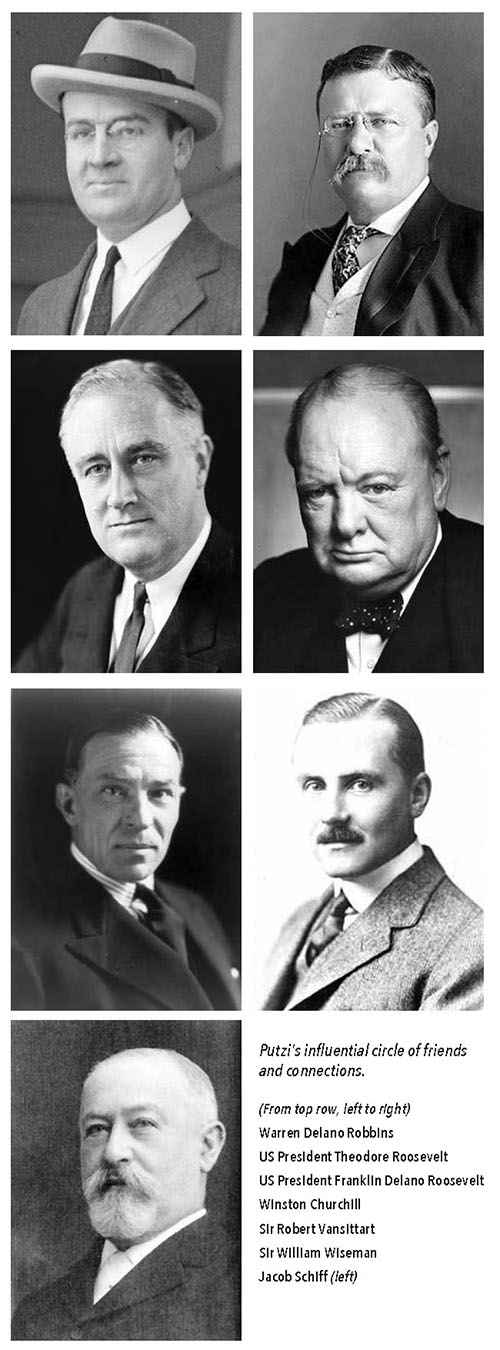
Putzi befriended many important individuals such as President Theodore Roosevelt and future President Franklin Delano Roosevelt, and mixed at Eliot’s home with men at the very top of Wall Street banking such as J.P. Morgan and Jacob Schiff. A close friend of Charles Eliot’s, Jacob Schiff, is known to have funded Trotsky in preparation for the Bolshevik revolution. Putzi regularly played the grand Steinway at White House parties and frequented the President’s summer retreat at Sagamore Hill. This, together with many more famous names, was the undergraduate milieu of Putzi Hanfstaengl.
After graduation, Putzi served for a year in the elite Royal Bavarian Foot Guards. Like the regiment, he was unstintingly loyal to the monarchy. He returned to the US to run the family art gallery on exclusive Fifth Avenue, mixing with famous personalities such as Henry Ford, Charlie Chaplin, Toscanini, and the great Caruso. Unlike many young German Americans, Putzi made little effort to return to Germany when the country went to war in 1914. And, unlike others of German origin, he was never harassed or interned when America entered the war in 1917. Putzi dined every day at the exclusive Harvard Club in New York, socialising there and elsewhere with many international celebrities, leading politicians, and Wall Street bankers. Across the Atlantic, he was a friend of Winston Churchill and other members of the British ruling class. What does it tell us that he associated with Sir Robert Vansittart, a leading figure in the British Foreign Office and Secret Intelligence services?
During his ten years in New York (1911-1921), Putzi also associated with agents of the British secret service operating in the city, including the infamous Aleister Crowley, who was deeply implicated in the false-flag sinking of the Lusitania in 1915. British agents were active there with the consent of the US government and in the closest collaboration with the nascent US secret services. The head of British Secret Intelligence in the US, Sir William Wiseman, was a close friend of banker Jacob Schiff whom Putzi knew well. It was to this closely allied Anglo-American Secret Intelligence network that Putzi Hanfstaengl enlisted during WWI. Despite utterances otherwise, his allegiance now lay very firmly with America and Britain, not Germany.
In late 1921 after spending the greater part of the past 17 years in America, Hanfstaengl, now age 34, gave up his wonderful life there and took his American wife and baby son, Egon, to Germany. Why? What on earth possessed a wealthy, well-connected now-American businessman with a beautiful young wife, Helene, and baby son Egon, to move to a country riven by faction and utterly desolate thanks to the war, raging inflation and widespread poverty? On arrival in Munich, they even found it impossible to get milk for their child. Putzi’s stated reason for going because he felt “nostalgic for his native land” is surely not credible.
The Rise of Adolf Hitler
Adolf Hitler’s background was the polar opposite of the well-bred, highly educated, sophisticated and cultured Putzi’s. Born in Austria, Hitler’s mother was a peasant girl, his father a minor civil servant who was allegedly often drunk and beat him. Sent to local village schools, he showed little interest in education. The teenage Adolf demonstrated an aptitude for art but twice failed to gain a place at the Art Academy. For years he was an unemployed, friendless vagabond living in men’s hostels or sleeping on park benches. The unhappy, angry, and frustrated artist survived by earning a few pfennig’s painting and selling postcards on the streets. Hitler was turned down by the Austrian army as too weak to handle weapons but found a place in the German army during WWI as a dispatch runner. He suffered a shrapnel wound to the leg at the Somme in 1916 and was gassed and temporarily blinded at Ypres in October 1918. When the war ended, he decided to stay in the army for another two years. Awarded the Iron Cross first class for bravery, he proudly wore the medal for the rest of his life. In 1920, Hitler ended six years of military service as a lowly lance corporal. Biographer William Shirer writes:
As soldiers go, he was a peculiar fellow, as more than one of his comrades remarked. No letters or presents from home came to him as they did to the others. He never asked for leave; he had not even a combat soldier’s interest in women. He never grumbled… and was the impassioned warrior, deadly serious at all times about the war’s aims and Germany’s manifest destiny. “We all cursed him and found him intolerable,” one of the men in his company later recalled.3
Hitler re-joined the ranks of the unemployed, rented a tiny, cheap room in Munich where he lived a shadowy existence and took to the beer halls as a political agitator. He was but one of the hundreds of similar rabble-rousers in the political turmoil of post-war Munich. Rare mentions in local newspapers failed even to spell his name correctly. Putzi describes Hitler as being like an awkward “down at heels clerk” or a “suburban hairdresser on his day off.” However, his ability as an orator to incite crowds brought him to the attention of the Allies. Planning to fund and build a reactionary movement in Germany, the Money Power was on the lookout for a suitable reactionary to run it.
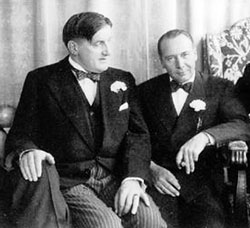
In Munich in 1922, Putzi got the call to action from an old Harvard friend, Warren Delano Robbins. Now second in command at the American Embassy in Berlin, Robbins just happened to be a first cousin of Putzi’s close friend, future President F Delano Roosevelt. The ruling elite’s tentacles were ubiquitous. He would send the embassy’s military attaché, Truman-Smith, to Munich to discuss political events in the city with Putzi. Individuals in such embassy positions are not simply regular bona fide diplomats. To put it bluntly, military attachés act as secret agents and spies, and Truman-Smith was no exception. He arranged for Putzi to attend a beer hall meeting in Munich where an as yet little known 32-year-old called Adolf Hitler would be speaking.
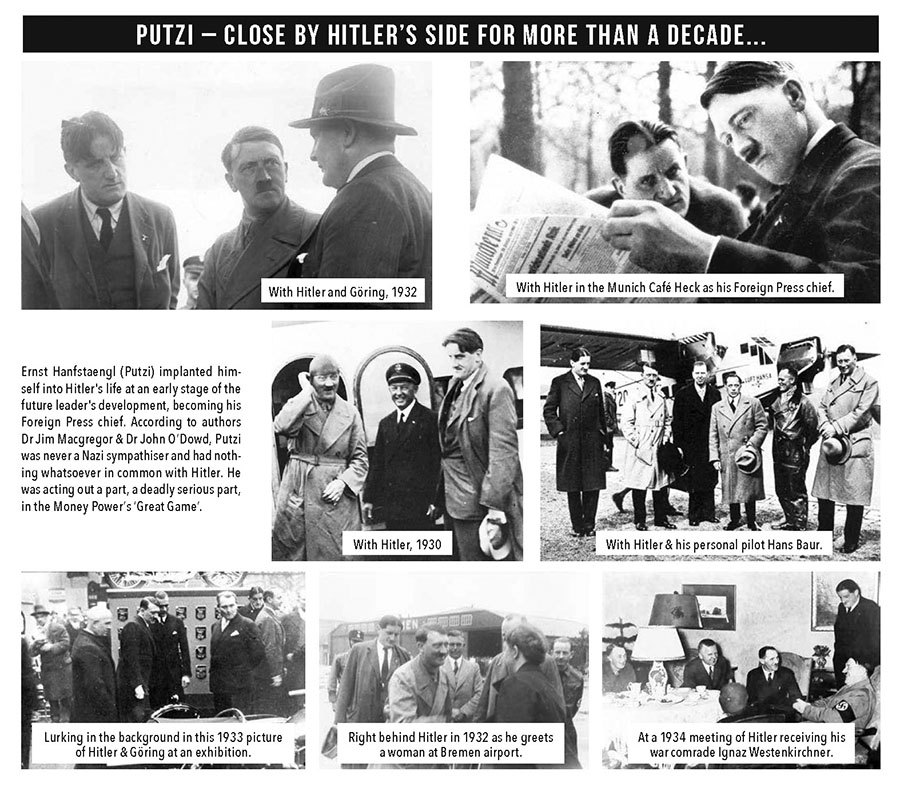
Having clearly been forewarned by Truman-Smith, Hitler shook Putzi’s hand and greeted him warmly when he approached and introduced himself, “Ah, yes, the big American.”4 Putzi feigned Nazi sympathies, inveigled his way into Hitler’s company, and quickly became the otherwise friendless loner’s bosom buddy. It should be understood from the outset that it was a charade. Putzi was never a Nazi sympathiser – probably detested them if truth be told – and had nothing whatsoever in common with Hitler. He was acting out a part, a deadly serious part, in the Money Power’s ‘Great Game’.
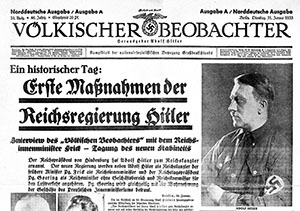
The ghostwriter of Putzi’s ‘autobiography’, Brian Connell, states that Putzi’s task was “to mould into some statesmanlike form the spell-binding oratorical gifts and immanent potential of Adolf Hitler and make him socially acceptable.”5 Putzi himself relates that Hitler was open to influence and he “felt encouraged to continue exerting all he could.” Putzi ploughed money into the small Nazi newspaper, the Volkischer Beobachter, enabling it to purchase more printing presses, triple its size and increase circulation.
Hitler dined regularly at Putzi and Helene’s home and played on the floor with his godson, Egon. Much to Hitler’s joy, Putzi would hammer out Wagner pieces on the piano. He also played football marching tunes picked up at Harvard.
I explained to Hitler all the business about cheerleaders and marches, countermarches and deliberate whipping up of hysterical enthusiasm. I told him about the thousands of spectators being made to roar “Harvard, Harvard, Harvard, rah, rah, rah!” in unison and of the hypnotic effect… I even wrote a dozen marches or so myself over the course of the years. Rah, rah, rah! became Sieg Heil, Sieg Heil! but that is the origin of it and I suppose I must take my fair share of the blame.6
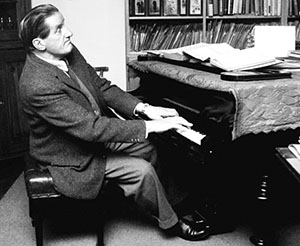
Putzi was close by Hitler’s side for the next decade and more and became his Foreign Press chief, dealing daily with the international media. Hitler was infatuated with Helene, and after dinner would occasionally lie on the sofa with his head on her lap as she stroked his hair. She considered him a ‘neuter’. Court historians dismiss Hanfstaengl’s role as of no significant historical importance. He was little more than Hitler’s piano player, a “court jester and buffoon” ready and willing to entertain him. William Shirer describes Putzi as “an immense, high-strung, incoherent clown” and “an eccentric with a shallow mind.”7 All part and parcel of the Establishment whitewash to conceal Hanfstaengl’s real background as a secret agent.
Putzi’s Role in the Reichstag Fire
On Hitler’s behalf on the night of the Reichstag Fire, the “shallow-minded, incoherent clown” was coordinating and deploying a team of highly specialised Nazi storm trooper arsonists. According to official accounts, Putzi was due to join Hitler and Goering for dinner at Goering’s house in Berlin that evening. Putzi relates in his ‘autobiography’ that he felt “shivery,” wanted to lie down, and phoned Hermann Goering with his apologies. President of the Reichstag, Goering, offered him a bed in the Reichstag president’s palace. The given reason for Putzi being in the palace on the night of the fire rings false, for he owned his own house in Berlin just minutes from the palace.
In all likelihood, Putzi went to the palace that night not because he felt “shivery” but to fulfil the massively important role of overseeing the burning of the Reichstag. How did a specialist team of arsonists with large quantities of flammable fuel gain access to the Reichstag without being seen? Only one door to the building was unlocked after 8 pm, and it was guarded throughout by security staff. Watchmen routinely toured the inside of the entire building just before it closed at 9 pm that evening and saw nothing untoward. No one could gain entry after 9 pm, and no one was seen to enter or leave.
The very reason Putzi was in the palace that night lay in the fact that unknown to all but a select few, an underground passage linked it to the Reichstag directly opposite. In Wall Street and the Rise of Hitler, Professor Antony Sutton relates: “Hanfstaengl directed operations within the Palace, the propaganda apparatus stood ready, and the leaders of the Storm Troopers were in their places.… the scheme was almost perfect.”8 Under Putzi’s direction, the arsonists entered the Reichstag unseen via the tunnel, set multiple fires in the massive building, and returned via the tunnel to the palace. Putzi says he was asleep in the bedroom in the palace when the housekeeper rushed in shouting that the Reichstag was burning. He immediately phoned Goering and Hitler to inform them. In reality, he was calling to say, ‘Job done!’
Putzi & the Beer Hall Putsch
The Reichstag Fire was not the first time Putzi had been centre stage in Hitler’s violent attempts to seize power. Ten years earlier, a major event first brought the little corporal to national and international attention: the famous Beer Hall Putsch. On the bitterly cold evening of 8 November 1923, Hitler and Putzi stuffed pistols in their coat pockets and went to a meeting in the massive Burgerbrau beer keller in Munich. They stood drinking beer to the side of the crowd of 3,000 while the Bavarian State Commissioner, Gustav von Kahr, addressed his audience. 20 minutes into the speech, the audience was startled to hear the deep rumble of heavy trucks and clatter of hundreds of steel studded boots on the streets outside. Dozens of Nazi brownshirts burst in through the doors waving machine guns menacingly, while hundreds more sealed off the streets outside. Hitler handed Putzi his beer stein and, with his bodyguard at his back, strutted through the alarmed crowd towards the speaker. Jumping up on a chair, he silenced the crowd by firing his weapon into the ceiling and shouted: “The national revolution has broken out. This hall is occupied by six hundred heavily armed men. The Bavarian government and the Reich government are deposed. The police and army are now advancing under the banners of the swastika.”
He was lying. When he and his armed gang advanced down the road towards central Munich the following day, the police and army remained loyal to the government. Gunfire was exchanged with several police officers and 16 putschists killed and many wounded. Hitler was pulled to the ground, dislocating his shoulder. Extricated from the bloody scene by bodyguards, he was driven to Putzi’s farm at Uffing, an hour’s drive south of Munich. As prearranged, Helene was waiting there. She tended to Hitler and hid him in an attic bedroom. Putzi says he became separated from Hitler during the melee and escaped over the border into Austria.
The following day, local police were tipped off, and several truckloads of officers duly arrived to arrest Hitler. He allegedly drew his pistol to commit suicide, and allegedly Helene grabbed the weapon. He was taken to Landsberg Prison and charged with high treason. The previously unknown Hitler made the headlines in newspapers across the world.
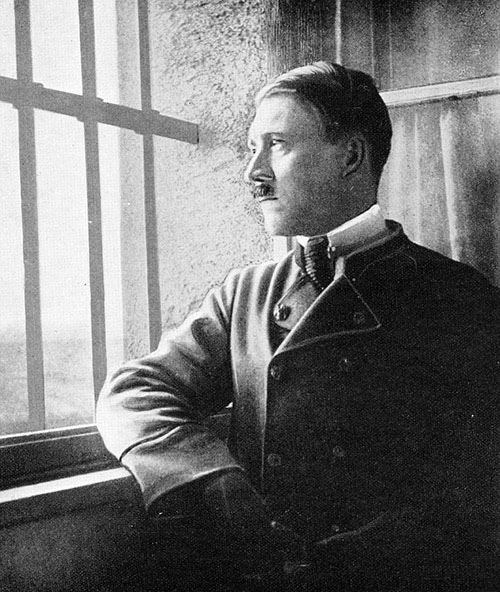
Putzi returned several weeks later but was never arrested or charged. He regularly visited Hitler in prison over the 11 months he served a five-year sentence. It was in Landsberg that Hitler wrote Mein Kampf (My Struggle) in which he set out his political philosophy and anti-Semitic views. Several authors have suggested that Putzi played a significant part in the proofreading of Mein Kampf, if not indeed the writing. Hitler trusted him implicitly and they remained firm friends throughout his imprisonment. On release, his first port of call was to Putzi, Helene and Egon at their house in Munich.
In Reichstag elections held in December 1924, the radical right-wing parties picked up just three per cent of the votes, and the Nazis appeared to be a spent force. Inflation gradually came under control, bringing a much-needed period of stability to the ravaged country. Chastened by failure, Hitler decided to bide his time and attempt to gain power via the ‘democratic’ route. The Nazi party made little impact at elections over the 1920s, and Hitler entered his ‘quiet years’ at his comfortable home near the Alps. He and Putzi met regularly. During this quiet time, Putzi obtained a degree from Munich University with a thesis on eighteenth-century Bavaria. He was now Herr Doktor Hanfstaengl.
Extremely Dangerous Game
The Wall Street crash of October 1929 was music to the ears of Hitler, for he knew the German people would suffer badly as unemployment rocketed and look for radical solutions. “The Nazis could scarcely have hoped for a more propitious set of circumstances.”9 Hitler, with Putzi at his side, travelled by car or private plane campaigning in cities throughout Germany. As the economy disintegrated through 1930-32, the Nazis steadily gained votes and shared power in various coalition governments. Throughout that time, Putzi was making regular trips to London to meet Establishment figures who allegedly regarded Hitler with benevolence.
Even Lloyd George [Father of the House of Commons and former British Prime Minister] on whom I called, was no exception. He gave me a signed photograph to take back, on which he had inscribed: “To Chancellor Hitler, in admiration of his courage, determination and leadership.”10
This, as we shall see in part two, was part and parcel of the ‘appeasement’ game and duping of Hitler being played out by the British ruling class.
One evening on the campaign trail in Berlin, Putzi made excuses and slipped away for a meeting with an American journalist and secret service agent called John Franklin Carter. Carter came as an emissary from Putzi’s old friend Franklin Delano Roosevelt who was soon to become US President. FDR sent his warm greetings. Aware that Putzi was playing an extremely dangerous game on behalf of the Anglo-American elites and would be tortured and shot if Hitler uncovered the truth, Roosevelt warned him: “If things start getting awkward, please get in touch with our ambassador at once.” Putzi relates: “The message heartened me enormously, and in due course I would do just that.”11
In April 1932, Winston Churchill and his son Randolph – both friends of Putzi’s – visited Munich and invited him to dinner at their plush hotel. Churchill allegedly discussed the possibility of an Anglo-German alliance with him and was very keen to broach it with Hitler. Hitler, however, declined Churchill’s invitation to dinner. After a raucous evening with Putzi at the piano and the wartime British Minister singing, Churchill wished the Nazi’s success in the elections. Eleven months later, that success would come thanks to the Reichstag Fire.
Part two of this article, published in New Dawn 191, examines the major role played by Putzi’s masters – bankers on Wall Street and the City of London – in financing Hitler throughout the 1930s and building up the German war machine in preparation for the planned conflict with Russia. Franklin Roosevelt’s concerns for Putzi’s welfare became a reality in 1937, and he fled Germany for his life. Roosevelt takes him to Washington as a White House adviser, with a good salary, nice house, servant, and Steinway grand for his entertainment.
This article was published in New Dawn 190.
If you appreciate this article, please consider a contribution to help maintain this website.
Footnotes
1. Antony Sutton, Wall Street and the Rise of Hitler, 118
2. Guido Giacomo Preparata, Conjuring Hitler, How Britain and America Made the Third Reich, xvii
3. William Shirer, The Rise and Fall of the Third Reich, 30
4. Ernst Hanfstaengl, Hitler – The Missing Years, 36
5. Ibid, 14-16
6. Ibid, 51
7. Shirer, Rise and Fall of the Third Reich, 47
8. Sutton, Wall Street and the Rise of Hitler, 120
9. Peter Conradi, Hitler’s Piano Player, 77
10. Hanfstaengl, Hitler – The Missing Years, 212
11. Ibid, 188
© New Dawn Magazine and the respective author.
For our reproduction notice, click here.
Support New Dawn
Minimal Ads, No Paywall, No Clickbait – help us
keep this website free with new articles regularly posted.
Show your appreciation & gratitude.
About the Author

Jim Macgregor (b. 1947) was raised in a cottage in the grounds of a hospital for war disabled near Glasgow where his father (Royal Navy) was sent after being wounded in WWII. Through Jim’s voluntary work in the hospital while a medical student, and his close contact with badly wounded men from both world wars, he developed a keen interest in the origins of the wars. He had a career in family medicine before taking early retirement in 2001, and has spent the last 20 years in full-time research into the origins of the First and Second World Wars. He is the author and co-author of numerous books and articles on WWI and has now turned his attention to WWII. John O’Dowd, PhD (b. 1953) is the son of a Lanarkshire steelworker who served in RAF bombers during WWII. He never spoke of it. John worked on cancer at the prestigious Chester-Beatty labs of London’s Institute of Cancer Research, and in cardiovascular research at the Institute of Physiology, University of Glasgow. He was appointed senior lecturer in biochemistry, and then to senior research and intellectual property management roles in the Scottish Government Health Dept, and in the Universities of Edinburgh and Glasgow. He took early retirement seven years ago and has been involved since with Jim Macgregor in applying their significant research expertise both to the origins of WWII and geopolitics in general. He has many publications to his name, both scientific and political.
Neo-Nazi Fight Clubs Are Growing Rapidly, New Research Shows
A new report shared with VICE News outlines the massive growth so-called Active Clubs, neo-Nazi fitness and fight clubs, have experienced in both the United States and internationally.
September 22, 2023 (Vice.com)

A PROPAGANDA PHOTO RELEASED BY A FRENCH ACTIVE CLUB GROUP IN WHICH THEY BLURRED THEIR FACES. PHOTO VIA TELEGRAM.
Active Clubs—neo-Nazi clubs that focus on fitness and martial arts training—are growing at a rapid pace and not just in the United States.
From Denmark, to France, and Canada, semi-autonomous white supremacist groups have been popping up across the globe and recruiting young white men to come train. According to a new report by the Counter Extremism Project (CEP) that was shared with VICE News, “since the creation of the first Active Club in late 2020, at least 100 Active Clubs have been created in the U.S, Canada, and Europe.”
“This is an unprecedented growth. I’ve never seen a network in right-wing extremism grow so fast. Usually it takes years to build a transnational network,” Alexander Ritzmann, the report’s author and senior advisor to the CEP, told VICE News. “It’s concerning.”
Active clubs could best be described as localized neo-Nazi groups built around the idea of working out and training martial arts—typically boxing and Brazilian jiu-jitsu—together. The groups are explicitly white nationalist but, like some other modern racist groups, try at best to hide their true intentions. The groups are run semi-autonomously on a local level and, according to the paper, can range in size from five to twenty-five members.
They were founded by Robert Rundo—an American neo-Nazi known for his ties to street fighting organizations and running from a federal charge for which he was arrested last spring—in late 2020 after he was inspired by similar clubs in Europe and activists in Europe. Since that time, the CEP report states there are “at least 46 in the United States across 34 U.S. states.”

A MAP OF THE UNITED STATES THAT SHOWS WHERE THE ACTIVE CLUBS HAVE SET UP. PHOTO VIA CEP.
The groups have now begun appearing in real life, particularly at anti-LGBTQ protests, and have hosted fight tournaments where participants from across the United States come in. Large events are happening outside of America as well. According to Active Club Canada’s social media posts, they recently held a national event where members from the ten clubs that are sprinkled across the country came and trained together.
The report breaks down several of the countries where the clubs were started internationally. The most prominent are Canada and France, but it also includes Denmark, Estonia, Finland, Ireland, Latvia, Lithuania, Netherlands, Norway, Poland, Portugal, the U.K., and Sweden.
VICE News was told by a former member of an American Active Club that they offer assistance to each other, especially while a club is getting up off its feet. The report also includes evidence of this occurring internationally. In the most extreme cases, an Estonian national helped found a Swedish active club before being deported from the country in 2022. After being sent back to his country of birth the man then started an Active Club organization in Estonia.
If you have any information regarding neo-Nazi organizing or active clubs, we would love to hear from you. Please reach out to Mack Lamoureux via email at mack.lamoureux@vice.com or on Twitter at @macklamoureux.
There are several reasons for the group’s rapid growth. Firstly, there is an ease of entry to starting clubs—anyone, anywhere can essentially start one and if it becomes big enough, it will be recognized. Secondly, Active Clubs are part of the latest iteration of white nationalism, dubbed “White Supremacy 3.0,” where groups present a softer face to the public. This aids them both in recruitment and keeping law enforcement from looking too closely.
“When recruiting, Active Club members should not talk about Jews and history,” reads the CEP report. “Instead, the focus in public should be on brotherhood, community, fitness, and self-defense.”
VICE News has spoken to several people who had worked with Active Clubs and helped recruit people to the movement. They said they would slowly start introducing racist ideas and activities as time went on and the members became more and more ingrained in the club. In the end, though, the goal was obviously to train for future violence.
The report outlines that this training isn’t simply to build bonds among the white nationalists and create loyalty by helping a young man become fit, it’s also to prepare a group for future violence. In some cases, members of Active Clubs have bragged about doing paramilitary style training, a few have taken part in criminal activities. In a lengthy quote that’s included in the report, Rundo outlines that he’s hoping to build something “like the minutemen (militia) in the early stages of the revolutionary war” for in the future when there is a “mass movement (and) a mass organization” ready to command it.
“He’s not expecting a boxing match,” said Ritzmann, the report’s author. “It’s more likely that they’re actually preparing for targeted violence on a professional level rather than just saying, ‘Well, we like boxing and sports, and maybe if we’re in a bar and there’s a fight, we can win against the other guys.’”
“This could be the smartest and most dangerous way to organize right-wing targeted violence that I’ve seen for a long while.”