No one has written about what it takes to see — and how to do the looking — more poignantly than Jacques Lusseyran (September 19, 1924–July 27, 1971) in his stirring memoir And There Was Light (public library).
Looking back on his blissful early childhood, Lusseyran recounts his formative enchantment with the world:
Light cast a spell over me. I saw it everywhere I went and watched it by the hour… flowing over the surface of the houses in front of me and through the tunnel of the street to right and left. This light was not like the flow of water, but something more fleeting and numberless, for its source was everywhere. I liked seeing that the light came from nowhere in particular, but was an element just like air. We never ask ourselves where air comes from, for it is there and we are alive. With the sun it is the same thing.
There was no use my seeing the sun high up in the sky in its place in space at noon, since I was always searching for it elsewhere. I looked for it in the flickering of its beams, in the echo which, as a rule, we attribute only to sound, but which belongs to light in the same measure. Radiance multiplied, reflected itself from one window to the next, from a fragment of wall to cloud above. It entered into me, became part of me. I was eating sun.
Nightfall didn’t end the spell of the light, for he felt it in the very fabric of being:
Darkness, for me, was still light, but in a new form and a new rhythm. It was light at a slower pace. In other words, nothing in the world, not even what I saw inside myself with closed eyelids, was outside this great miracle of light.
And then, one May morning when he was seven, the light of the world went out — a classroom scuffle ended in a violent fall onto the corner of the teacher’s desk, leaving Lusseyran completely blind.
Somehow, he adapted, guided by the light within and by the discovery that the light without is a kind of vibration can we feel whenever we assume “the attitude of tender attention” — a vibration that reveals the world, its materiality and its mystery:
Objects do not stand at a given point, fixed there, confined in one form. They are alive, even the stones. What is more they vibrate and tremble. My fingers felt the pulsation distinctly, and if they failed to answer with a pulsation of their own, the fingers immediately became helpless and lost their sense of touch. But when they went toward things, in sympathetic vibration with them, they recognized them right away… Being blind I thought I should have to go out to meet things, but I found that they came to meet me instead.
If my fingers pressed the roundness of an apple, each one with a different weight, very soon I could not tell whether it was the apple or my fingers which were heavy. I didn’t even know whether I was touching it or it was touching me. As I became part of the apple, the apple became part of me. And that was how I came to understand the existence of things.
[…]
The reality — the oneness of the world — left me in the lurch, incapable of explaining it, because it seemed obvious. I could only repeat: “There is only one world. Things outside only exist if you go to meet them with everything you carry in yourself. As to the things inside, you will never see them well unless you allow those outside to enter in.”
Lusseyran was still a teenager when, unnerved by Hitler’s rise to power, he set out to teach himself German in order to understand the menacing radio broadcasts. In 1941, shortly after the Nazi invasion of France, he formed a resistance group and began publishing an underground newspaper that soon became the voice of the French freedom fighters. He was seventeen.
Two months before his nineteenth birthday, Lusseyran was betrayed by a member of the resistance, arrested by the Gestapo, and sent to the Buchenwald concentration camp. For six months, he was kept in “a space four feet long and three feet wide, with walls like a medieval fortress, door three fingers thick with a peephole through which the jailers watched day and night, and a sealed window.” But his bright spirit remained undimmed — devoted to stirring the spirit of resistance among the thousands of inmates, he came to see the place not as a prison but as “a church underground.” He would recount:
The mechanism of hope in our hearts must have a thousand springs, almost all of them unknown to us.
Jacques Lusseyran
When liberation finally came two years later, Lusseyran was one of thirty inmates to leave the camp alive. Looking back on how he survived the unsurvivable, he returns to the lifeline of the light and the radiance of what the poet Muriel Rukeyser called “the living moment… in which we touch life and all the energy of the past and future.” Aliveness, he intimates, is a matter of our receptivity to light, which is the quality of attention we pay the world — no matter our circumstance:
When a ray of sunshine comes, open out, absorb it to the depths of your being. Never think that an hour earlier you were cold and that an hour later you will be cold again. Just enjoy. Latch on to the passing minute. Shut off the workings of memory and hope… Take away from suffering its double drumbeat of resonance, memory and fear. Suffering may persist, but already it is relieved by half. Throw yourself into each moment as if it were the only one that really existed.
In the late autumn of 1890, four years after Emily Dickinson’s death, her poems met the world for the first time in a handsome volume bound in white. Beneath the gilded title was a flower painting by Mabel Loomis Todd — the complicated woman chiefly responsible for editing and publishing Dickinson’s poems and letters.
Any flower would have been a fitting emblem for the poet who spent her life believing that “to be a Flower is profound Responsibility,” but none more than this one — a flower she had collected in the woods of Amherst as “a wondering Child,” then pressed into her teenage herbarium and into her poems, enchanted by its “almost supernatural” appearance.
She considered it “the preferred flower of life.”
Monotropa uniflora, known as ghost pipe, is unlike the vast majority of plants on Earth. White as bone, it lacks the chlorophyll by which other plants capture photons and turn light into sugar for life.
Throughout the summer — usually after rainfall, usually under beech trees — the ghost pipe emerges from the darkest regions of the forest floor in clusters, from the Himalayas to Costa Rica to Amherst. Each stem bears a single nodding flower — a tiny chandelier of several translucent petals encircling its dozen stamens and single pistil. Bumblebees, drawn to the pale beauty despite their astonishing ultraviolet vision, are the ghost pipe’s most passionate pollinators.
Monotropa uniflora. (Photograph: Walter Siegmund.)
The secret of Earth’s most “supernatural” flower is its uncommon relationship with the rest of nature:
Rather than reaching up for sunlight like green plants, the ghost pipe reaches down. Its cystidia — the fine hairs coating its roots — entwine around the branching filaments of underground fungi, known as hyphae. So connected, the ghost pipe begins to sap nutrients the fungus has drawn from the roots of nearby photosynthetic trees.
Out of this second-hand survival, such breathtaking beauty.
The mystery of how the ghost pipe flourishes without chlorophyll has enchanted scientists since the dawn of botany. The answer began bubbling up with the discovery of the mycorrhizal network undergirding the forest — a term coined in 1885 by the German botanist, plant pathologist, and mycologist Albert Bernhard Frank, from the Greek mykos (fungus) and rhiza (root). But for nearly a century, the mycorrhizal network — and its relation to the mystery of the ghost pipe — remained a purely theoretical notion, until in 1960 the Swedish botanist Erik Björkman used sugars laced with the radioactive carbon-14 isotope to trace how nutrients move between trees and nearby ghost pipes via the underground fungi.
It was a revelatory notion — an entirely new type of relationship we had never before imagined, as old as the living world.
Less than a century later, we know that 90% of plants rely on these mycorrhizal relationships for their survival — an interdependence for which the English botanist David Read coined the term “the Wood Wide Web,” to describe the groundbreaking research of Canadian plant ecologist Suzanne Simard, who furnished the definitive evidence for it in the 1990s.
By late autumn, the ghost pipe has turned black and brittle. By winter, it has vanished.
“That it will never come again,” Dickinson wrote, “is what makes life so sweet.”
From the brevity and beauty of the ghost pipe’s bloom emerges a tender living poem about the transience of life, about its mystery, about the delicate interdependence that deepens its sweetness.
“What makes Heroic?” asked Nietzsche as he was emerging from depression, then answered: “To face simultaneously one’s greatest suffering and one’s highest hope.” And yet one of the supreme challenges of humans life is, to borrow Rilke’s lovely phrase, to “go to the limits of your longing” — to fully surrender to your suffering, to fully step into your hope and own your desire for a grand life, desire not fueled by the grandiosity of ego but aimed at the grandeur of the cosmos that betokens our longing for homecoming to the Ultimate. The ability to do that is the deepest root of heroism and our mightiest, most vulnerable means of wresting meaning from our mortality.
How to own our heroism and our cosmic longing is what the cultural anthropologist Ernest Becker (September 27, 1924–March 6, 1974) explores in his 1973 classic The Denial of Death (public library), published just before his untimely return to the Ultimate.
Society itself is a codified hero system, which means that society everywhere is a living myth of the significance of human life, a defiant creation of meaning.
Echoing Milan Kundera’s admonition about knowing what we really want, he considers how modern culture cauterizes the heroic impulse within us:
When we appreciate how natural it is for man* to strive to be a hero, how deeply it goes in his evolutionary and organismic constitution, how openly he shows it as a child, then it is all the more curious how ignorant most of us are, consciously, of what we really want and need. In our culture anyway, especially in modern times, the heroic seems too big for us, or we too small for it.
We disguise our struggle by piling up figures in a bank book to reflect privately our sense of heroic worth. Or by having only a little better home in the neighborhood, a bigger car, brighter children. But underneath throbs the ache of cosmic specialness, no matter how we mask it in concerns of smaller scope. Occasionally someone admits that he takes his heroism seriously, which gives most of us a chill… We may shudder at the crassness of earthly heroism, of both Caesar and his imitators, but the fault is not theirs, it is in the way society sets up its hero system and in the people it allows to fill its roles. The urge to heroism is natural, and to admit it honest. For everyone to admit it would probably release such pent-up force as to be devastating to societies as they now are.
The templates of heroism, Becker observes, are handed down to us by our particular culture as proscribed roles to be assumed in our struggle to give shape to the creative impulse — that supreme expression of our yearning for a counterforce to mortality:
The fact is that this is what society is and always has been: a symbolic action system, a structure of statuses and roles, customs and rules for behavior, designed to serve as a vehicle for earthly heroism. Each script is somewhat unique, each culture has a different hero system. What the anthropologists call “cultural relativity” is thus really the relativity of hero-systems the world over. But each cultural system is a dramatization of earthly heroics; each system cuts out roles for performances of various degrees of heroism: from the “high” heroism of a Churchill, a Mao, or a Buddha, to the “low” heroism of the coal miner, the peasant, the simple priest; the plain, everyday, earthy heroism wrought by gnarled working hands guiding a family through hunger and disease.
It doesn’t matter whether the cultural hero-system is frankly magical, religious, and primitive or secular, scientific, and civilized. It is still a mythical hero-system in which people serve in order to earn a feeling of primary value, of cosmic specialness, of ultimate usefulness to creation, of unshakable meaning. They earn this feeling by carving out a place in nature, by building an edifice that reflects human value: a temple, a cathedral, a totem pole, a skyscraper, a family that spans three generations. The hope and belief is that the things that man creates in society are of lasting worth and meaning, that they outlive or outshine death and decay, that man and his products count.
And yet, half-opaque to ourselves as we are, we remain largely unconscious that much of what we do, we do to earn this feeling of heroism — an admission that would come as “a devastating release of truth,” making us demand of our culture what we most long for: “a primary sense of human value as unique contributors to cosmic life.” In a sentiment of extraordinary cultural sensitivity and pertinence to the social tumult of our own time, he writes:
The minority groups in present-day industrial society who shout for freedom and human dignity are really clumsily asking that they be given a sense of primary heroism of which they have been cheated historically… But the truth about the need for heroism is not easy for anyone to admit, even the very ones who want to have their claims recognized. There’s the rub… To become conscious of what one is doing to earn his feeling of heroism is the main self-analytic problem of life.
Becker observes that modern culture has supplanted the cosmic heroism we long for with the counterfeit heroism of demagogues and the “silly heroics of the acquisition and display of consumer goods, the piling up of money and privileges that now characterizes whole ways of life,” selling us on a simulacrum of life:
The social hero-system into which we are born marks out paths for our heroism, paths to which we conform, to which we shape ourselves so that we can please others, become what they expect us to be. And instead of working our inner secret we gradually cover it over and forget it, while we become purely external men, playing successfully the standardized hero-game into which we happen to fall by accident, by family connection, by reflex patriotism, or by the simple need to eat and the urge to procreate.
Writing a decade before Lewis Hyde’s epochal manifesto for the gift of creativity, Becker considers the relationship between the heroic and the creative impulse in the singular blessing and curse of the artist:
The whole thing boils down to this paradox: if you are going to be a hero then you must give a gift. If you are the average man you give your heroic gift to the society in which you live, and you give the gift that society specifies in advance. If you are an artist you fashion a peculiarly personal gift, the justification of your own heroic identity, which means that it is always aimed at least partly over the heads of your fellow men… To renounce the world and oneself, to lay the meaning of it to the powers of creation, is the hardest thing for man to achieve — and so it is fitting that this task should fall to the strongest personality type.
Throughout the book, Becker examines various hero-systems across the history of our species, all inseparable from our struggle to live with our transience. “All historical religions addressed themselves to this same problem of how to bear the end of life,” he writes, then traces how death became “the muse of philosophy” from its dawn in Ancient Greece to its golden hour in twentieth-century existentialism. With an especially keen eye to the cosmology of Kierkegaard, he considers our search for meaning and spiritual fulfillment through the lens of the heroic in us:
Man breaks through the bounds of merely cultural heroism; he destroys the character lie that had him perform as a hero in the everyday social scheme of things; and by doing so he opens himself up to infinity, to the possibility of cosmic heroism, to the very service of God. His life thereby acquires ultimate value in place of merely social and cultural, historical value. He links his secret inner self, his authentic talent, his deepest feelings of uniqueness, his inner yearning for absolute significance, to the very ground of creation. Out of the ruins of the broken cultural self there remains the mystery of the private, invisible, inner self which yearned for ultimate significance, for cosmic heroism. This invisible mystery at the heart of every creature now attains cosmic significance by affirming its connection with the invisible mystery at the heart of creation. This is the meaning of faith… The truly open person, the one who has shed his character armor, the vital lie of his cultural conditioning… is absolutely alone and trembling on the brink of oblivion — which is at the same time the brink of infinity.
With an eye to the diversity of our gifts, he adds:
The debt to life has to be paid somehow; one has to be a hero in the best and only way that he can.
If you’ve been following this series, by now you’ve seen me write about the reason this whole project came about. I don’t know what I believe. Don’t misunderstand – I am a grown woman who has lived a lot of life at this point and I have learned some things and I have uncovered some deep truths about the world and myself for that matter. But when it comes to questions of faith – I don’t have it figured out. The religion my parents brought me up with doesn’t fit anymore but I still long for a spiritual community. According to the academic types who study social trends, there’s a name for someone like me – a none. As in, when it comes to a religious identity – well, I have none.
According to a study by PRRI from 2022, almost 30 percent of Americans consider themselves to be “unaffiliated” from any religious institution. Compare that 1991 when only 6 percent of respondents said they were religiously unaffiliated.
So there’s clearly something going on. America is getting less churchy. But is it getting any less spiritual? I don’t think so. I think it just means our faith communities and institutions aren’t giving people what they need anymore, which is probably why Perry Bacon’s recent column in the Washington Post caught my eye.
Perry and I both grew up in really religious households. Both of our fathers preached at the pulpit on Sundays. And going to church was never an option – it was just what we did – what was expected of us.
But, like me, Perry has grown away from the church he grew up in. His family’s Black charismatic church doesn’t reflect the totality of his values anymore. He started feeling distant from his faith when he left his home in Louisville, Kentucky to start college at Yale.
This interview has been edited for length and clarity.
Perry Bacon: It was New Haven, Connecticut, so there weren’t a lot of Black charismatic churches to go to. So I probably went to church like one of every three Sundays.
Rachel Martin: If you didn’t go to church on a Sunday during that time did you feel unmoored in any way or did that time get eaten up real quick?
Bacon: I was always very aware that someone was not quite right, there was some level of guilt. I know where I am supposed to be and I’m not there.
I had internalized that it would be easier when I was back in Louisville, or when I was older. So I thought, let me write off these four years and I’m sure I’ll get back to it afterward. And that’s actually what ended up happening.
Martin: If we move through time, As a young, successful adult, where was your faith at? Was your spiritual identity still evolving?
Bacon: So in my twenties I moved to D.C. and a few of my high school friends were living there. They had a church and while not being the one I grew up with it was multiracial. It didn’t have hymnals, there was a praise band, so I felt very comfortable in that environment actually.
There was also less of a focus on God talking to you personally, I found that part of my childhood religion to be sort of hard. It was more of an optimistic christianity. It felt a little bit like home and I was in a community.
So I felt like that college thing was sort of a weird four year cycle, but this is where I thought I would be.
Martin: It’s a slow burn up to this question, but like, what happened, Perry? It sounds like you felt like you belonged, you found a place to express your spiritual self and now you’re a “none.” What happened?
Bacon: While being Black and having grown up in a Black church, the Black Lives Matter movement and the ideas around that were challenging to me. I had been someone who was kind of taking the Obama-ish route through their career in a certain way. The idea of being palatable enough to the powers that be and not talking about racial issues in a very direct way.
A lot of the ideas that came out of that time were coming from scholars who were not religious. And some of the people I was reading were secular humanists, they thought the Black church actually had some elements that were not very helpful. That the church created a level of acceptance of American society as it is instead of challenging it. So that was part of it.
Martin: You saw a different way to be a Black moral person in America who was concerned with social justice and prioritized those issues.
Bacon: Yes, exactly.
The second thing had to do with an experience I had. The church would have these small groups where people would come to your house during the week and you’re supposed to help build a fellowship. So I was hosting one, it was a men’s group, a group would come to my house and we would read together and discuss the latest sermon.
This was probably back in 2015, and one of the people who was in my group came up to me and wanted to have lunch. He told me that he wanted to be a small group leader but the church said he couldn’t because he’s gay. He was told he could be a member but couldn’t lead a group unless he wasn’t in any kind of same-sex relationship.
When I heard that I was surprised. I honestly hadn’t spent a lot of time thinking about the church’s policies on gay rights because it was a church that was very pro-immigration, pro-refugee, you know the pastor would talk about how Black Lives Matter is important. So I hadn’t really noticed.
Martin: You made an assumption.
Bacon: Yeah. I made an assumption. And I think a lot of non-denominational churches make it hard to figure out their stances on this. I’ve spent a lot of time looking into this and as I’ve explored churches in both D.C. and Louisville. At one point I went to go ask another pastor what their views on the issues were, because I had tried to find it on the website and couldn’t.
He actually said to me, “Well we’re welcoming of everyone but we would not do a same sex wedding. Is that good enough for you?” So he seemed to know exactly what I was asking. He actually said we would not put that on a website. So the goal is obscure.
So I was struggling at church. But we were thinking about moving to Louisville anyway.
Martin: Oh, that was convenient for you.
Bacon: I didn’t have to have the church breakup I was headed toward. So then I’m in a new city. Or rather a new old city. I still had other questions and the church I grew up with still exists, so when I got back to Louisville it wasn’t like these questions were unresolved.
Mm-hmm. It’s smaller, so I had to, so when I get back to Louisville, it wasn’t like these questions were unresolved. Right. So even more profound
Martin: Right, they were even more profound in a certain way.
Bacon: And my belief was sort of weak too, I wasn’t sure about the Jesus Christ parts of the sermon. So I was struggling with whether I believe this.
Martin: So it wasn’t just the politics, you yourself were having existential doubts about the core beliefs of Christianity?
Bacon: Yeah, I was treating being Christian like some people treat being Jewish. I was culturally Christian. Like I was born into this, there’s no reason to sort of drop it. Maybe if I was born into a Muslim family I’d be Muslim. And then the pandemic hit.
The first year, 2020, I watched church services online at the start but that year definitely sort of made my separation from church complete.
Martin: You wrote that having your daughter Charlotte is actually one of the reasons you stepped away from organized religion because you don’t want to explain to her some of these problematic beliefs versus the tenets that you agree with. And for me it’s kind of the opposite.
I grew up in a super religious household and my dad was also like a volunteer assistant pastor. And as a young adult, I fell away from that faith. But having kids, as a parent, I want other people to be involved in talking to my kids about right and wrong and the nature of forgiveness and humility.
From my point of view a church was an easy place to get that. Plus, some organized volunteer activities and you know, coffee hour where you meet your neighbors. It’s just like one stop shopping. And so my kids were really the impetus for me to find a church and, and I haven’t been able to. But for you, it seems like it was the reason you stepped away.
Bacon: Well, it’s both. I want all that stuff too. So if I could find a church, and this may already exist, where the Sunday school is very low on the beliefs of Jesus and very high on the community part, that’s what I’m looking for.
I’m guessing if I went to 30 churches in Louisville I could probably find a Sunday school like that, that’s focused less on Jesus rising from the dead and more about being compassionate, caring people. Since my piece ran I’ve been emailed by about 15 churches in Louisville who said, “We’re perfect for you.”
Martin: I’m sure. Do you think though, to even loosely wear the identity of a cultural Christian, don’t you need the resurrection part? Or else it loses its backbone altogether, right?
Bacon: I have not thought through this part in great detail, this is also vexing me.
So there’s one version where I can be a cultural Christian. There’s another route where I could be the recruiter for the Unitarians in Louisville or something. That’s not out of the realm of possibility either.
Martin: Right.
Bacon: I live in a very white liberal environment, my neighborhood his pretty white, so there’s a farmer’s market that I take my daughter to every Saturday from March to November.
Martin: I love how you caveated that.
Bacon: Well, the reason I say that is because I’m sure I should care about buying fresh vegetables, but I really do not go there to shop at all. I go there because we see the same people almost every week. And therefore we talk to them and I know their kids and they know Charlotte and it ends up serving the same kind of function.
Martin: It’s like the farmers market is your church.
Bacon: I’m not gonna repeat that sentence or say yes to it precisely. But it has ended up having some of the sort of community functions that I’m looking for. And I now think of it that way. Like we’re going to spend an hour here and we’re going to talk to people. I think I’m much more interested in community spaces. I think the sacred spaces thing I haven’t totally figured out yet.
Martin: Yeah, it’s the community that’s really at the heart of it for you. A community of shared values.
Bacon: It is.
Martin: Are you still searching?
Bacon: Yes. Well…
Martin: Oh, unclear?
Bacon: I don’t think I’m being unreasonable, but I’m getting close to accepting that the church I want to go to could exist but maybe doesn’t exist currently. And rather than invest in a church that I might leave in another 10 years, I think I might take more time thinking about how we build a community of people with shared values.
I’m asking myself, what are the ways to educate Charlotte about those values? And what are the ways to make sure that we’re living to those values ourselves? So I’m thinking about answering those questions and I’m open to the idea that the answers might not come through a place that’s open from 10 to 12 on a Sunday.
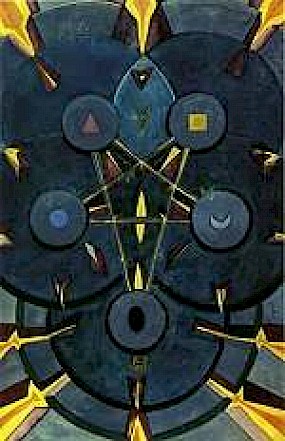
The Lord of Worry is most aptly titled, for when this card comes up in a reading, there looks to be financial, material or domestic trouble on the horizon. Something poses a threat to your overall security. This might be an unexpected expense, or job worries, or maybe even a disturbance in your family life.
There will always be something to worry about, when the Five of Disks comes up. But there’s one important thing to bear in mind – whatever is causing the problem is much more of a threat than it is a reality. Worrying about it might just make it worse than it needs to be!
When the Lord of Worry is about, anxiety is the emotion of the moment. We look to the future and we see something nasty ahead. Then we sit and worry about it. Try to remember – what you put your attention on grows. So if you worry about your overdraft, it will get bigger! That’s not, of course, to say you should not do all you are able to DO, in an awkward situation – just that once you have, there’s no point in worrying about it.
Sometimes we go through a stage in our lives where we feel as though, whatever good comes to us, it is bound to be undermined and darkened by negativity and sadness, that we cannot help but be disappointed. Yet just by holding that view, we invite negativity in, to add to the real problems we already had.
It isn’t easy to try to be accepting and positive and trusting when life is giving us a hard time – but accept we must, if we don’t want to make things worse!
So – the Five of Disks indicates a possible threat to our security. It is important not to feed that possibility with our own fear. Fear is a powerful emotion. It can rule if we let it. When this card comes up, remember that disturbance is possible – not probable. Do all you can to avert it.
New Thinking Sep 10, 2023 Adam Crabtree, RP, is a trainer of psychotherapists and has a private therapy practice in Toronto, Ontario, Canada, He is author of From Mesmer to Freud: Magnetic Sleep and the Roots of Psychological Healing, Multiple Man: Explorations in Possession and Multiple Personality, Trance Zero: Breaking the Spell of Conformity, Evolutionary Love and the Ravages of Greed, and The Land of Hypnagogia. He is also coauthor of Irreducible Mind: Toward a Psychology for the 21st Century, and he is coeditor of Beyond Physicalism: Toward Reconciliation of Science and Spirituality. He recently completed a translation from French of Pierre Janet’s masterpiece, Psychological Automatism. Here he compares Janet’s discoveries concerning dissociation with the insights of Sigmund Freud and Carl Jung. 00:00 Introduction 02:26 Pierre Janet 10:45 Artificial somnambulism 18:46 Clairvoyance 22:27 Dissociation 29:31 Conflicts 31:43 Spirit entities 38:07 Creativity 52:32 Fear of the abyss 55:43 Conclusion Edited subtitles for this video are available in Russian, Portuguese, Italian, German, French, and Spanish. New Thinking Allowed host, Jeffrey Mishlove, PhD, is author of The Roots of Consciousness, Psi Development Systems, and The PK Man. Between 1986 and 2002 he hosted and co-produced the original Thinking Allowed public television series. He is the recipient of the only doctoral diploma in “parapsychology” ever awarded by an accredited university (University of California, Berkeley, 1980). He is also the Grand Prize winner of the 2021 Bigelow Institute essay competition regarding the best evidence for survival of human consciousness after permanent bodily death. (Recorded on August 14, 2023)
The last in this series was about the muskrat, otherwise known as Elon Musk. Elon is doubtless innovative, perspicacious and talented, and has had a great deal of help from the American Government; he’s also a million moons away from the saintly soil of genius.
The next in our series of why someone isn’t a genius is Mr. Steve Jobs. And before you cry out, ‘how about saying who IS a genius instead of saying who isn’t’ or ‘why are you being so negative?’ or ‘who the hell are you to judge?’, I’ll save you the trouble of crying out and address all those perty little perturbances from the start.
Despite the human predilection for the positive, it’s just as valuable to disprove something as it is to prove something. And I think I understand enough about big business, capitalism and luck to know when I smell charlatanism. Not that the golden boys of Silicon Valley are simply snake oil salesmen and women; they’re just not geniuses.
Negative? Well, it’s all about balance, and when there are so many fanboys who trenchantly believe the richer and more visible a tech giant becomes, the more their genius is assured, it’s imperative to balance out the bullshit.
And I don’t think I’m any more or less qualified than most apropos the assignation of genius. But I know what I know and I think what I think, and, as always, I’ll back up what I say with argumentation and fair analysis.
So, Steve Jobs. A titan of a man in terms of the shadow he cast on contemporary society. We all know his story; the driving ideological and conceptual force behind Apple, a tyrant to work for who could lead with the best of them, the poster child for the tech revolution and someone who has sadly passed away.
What Steve Jobs didn’t do
In the film Steve Jobs of 2015, the fictionalised Steve Wozniak turns to Jobs and asks:
‘What do you do?’
Jobs responds:
‘I play the orchestra.’
I don’t know if such an exchange is apocryphal or did indeed take place, but regardless it raises the very real and most persistent of flies in the ointment when it comes to Steve Jobs — what did he actually do?
It’s the sort of thing that sounds great and makes Jobs look like a visionary propelling the whole enterprise onwards to a future that only he can perceive. I don’t know if such an exchange is apocryphal or did indeed take place, but regardless it raises the very real and most persistent of flies in the ointment when it comes to Steve Jobs — what did he actually do?
If Jobs was blessed with any sort of genius, it is essential that we understand where his talents lay and where they did not. And for this, we need to do a little bit of whittling.
Jobs was neither a scientist nor an engineer nor a philosopher. He was not an inventor or creator of devices or technology. He did not come up with any theory or idea that helped to unravel the universe or better explain the workings of our species.
Neither Jobs nor Apple invented the graphical user interface (GUI) which makes a computer usable for the general public. This was the work of Xerox PARC in 1979 drawing from a number of earlier systems.
Neither Apple nor Stevie Jobs had any hand in creating the smartphone. That was IBM in 1992.
Jobs didn’t come up with the iPad; that was other folks at Apple, with Steve acting as the ‘visionary’ leading the orchestra on to ever loftier heights.
And it can be argued that the underlying technology upon which Apple’s most famous creations are based had nothing to do with the company itself and actually owe their existence to the American Department of Defence.
Jobs is not an inventor of wheels. But perhaps he was the sort of person who could perfectly tap into the collective imagination to bring wheelness to the masses.
If we are being very generous, Jobs stood in that poorly-lit seldom-understood space where the forces of invention and utility meet the forces of desire and imagination — that penumbra where science and business, creation and capitalism merge and intermingle.
If we’re being less generous, Jobs was a master of marketing, packaging and form who understood (sometimes) how to sell other people’s ideas and creations to the public.
What Steve Jobs did do
So, we’ve got the lay of the land. Letting Jobs into the rarified ranks of genius-level thinkers and we will be saying the man was blessed with a business acumen second to none, that he could spur people on, through fear and adulation, to heights they could barely hope to fathom, and that he could take any company or idea and with his Midas touch turn all to gold dust.
Business, marketing, leadership, presentation — this the narrow bandwidth wherein the mind of Jobs plays its music, be that the music of a genius or merely an uncommonly talented human.
Let’s take a look at business and leadership first.
Steve Wozniak was the brains behind the first Apple computer, completed and fully functioning in 1976. He was responsible for everything you would imagine goes into creating something of such sophistication — the planning, designing, configurating, the continual testing and endless back and forth, the optimising and the marriage of hardware and software.
Wozniak had tried to sell his idea to Hewlett Packard, the company where he worked, but they turned him down a reputed five times. It’s obvious that Wozniak was aware of the power and potential of his idea; albeit not quite as aware as Jobs was.
And it was Steve Jobs that convinced Wozniak to found a company to get his creation out there and so Apple was born. Jobs clearly understood the broad implications of the concept of a personal computer. Just how far he saw into the future and how broad he perceived these implications is impossible to tell. He knew enough to fully buy into the idea and to convince Wozniak to buy in too; and the two threw everything they had into the idea — money, time, dedication, obsession.
Jobs was clearly gifted with prescience and refined business instincts from the get-go.
If we fast-forward to when Jobs returned to Apple in 1997 after being fired in 1985, we can see, on top of his foresight and business savvy, just how potent and powerful he was as a steward of a large company, most especially the company he founded.
Apple were tanking and had been on a downward spiral for some time. Stock prices for the company hit an all-time low of $3.19 by the end of the year; grim times for the company when it almost collapsed.
Apple lost $1.04 billion in 1997 but just over a year later, after the second coming of their erstwhile CEO, the company turned a profit of $309 million. By the time of Jobs’ death on the 5th of October 2011, after having left the company a few months prior due to his cancer, Apple stock was valued at $378.25.
This is a gargantuan transformation; from crumbling giant to thriving behemoth. And despite the presence of forces in big business that are beyond the will and control of any human, Jobs should probably be given the lion’s share of the credit for the resurrection of his brainchild with Steve Wozniak.
And how did Jobs achieve such a miraculous 180-degree change in fortunes? — chopping, changing, tweaking, integrating, streamlining, bringing in and doing away with.
The iMac, the iPhone, iTunes and the Mac OS X (later MacOS) were all rolled out to great success during his second tenure. Jobs was also shrewd enough to accept investment from Apple’s great rival Microsoft during the initial fallow years.
To further bolster his business credentials and nose for what will be big if only given the right push, we need only look at Jobs and his investment into Pixar.
Yet, even within the narrow bandwidth of Jobs’ business, leadership and marketing qualities, there are a number of salient caveats.
This is hugely impressive stuff and the results speak for themselves: rescuing companies and turning them into world-beaters, helping to spearhead the rise of CGI films and continually changing the fabric of popular culture.
Yet, even within the narrow bandwidth of Jobs’ business, leadership and marketing qualities, there are a number of salient caveats.
Firstly, under Tim Cook, company CEO since 2011, Apple have done pretty well. Scratch that ‘pretty’; astoundingly well.
Under his guidance Apple became the first US company to reach a $2- trillion valuation, and in 2021 it was worth six times what it was worth in 2011.
Is Cook a genius then too? Or just an extremely shrewd CEO who knows how to make the market work for him in a system where the market usually has a habit of favouring the big fish, the biggest fish most of all?
And then there’s that matter that just won’t go away — who exactly came up with all these wonderous ideas?
I always thought the little ‘i’ idea was inspired. It is the perfect antithesis of the big state; that capitalised monolith and coldest of all cold monsters looking down from on high at its lowly subjects. The little i is down here with us as we search for individuality, innovation and intelligence, all together on the boundless expanse of that other little i, the internet.
It’s a touch of genius, but actually an executive at Apple’s ad agency called Ken Segall came up with it. Jobs had been pitching the clunky and just plain woeful ‘MacMan’ for what came to be known as the iMac.
And we have iTunes, the idea for which may have been stolen from Scott Sanders.
And the groundbreaking MacOS was made without Jobs.
The same deal with the iPad which would come later.
So, at the end of all this, we’re left with an extremely skilled CEO and leader. Someone who could tweak other people’s ideas and creations. Someone who would pillage and plunder the minds of others. A man with an uncanny sense for how to get technology, innovation and invention from the laboratory and research facilities over into the hands, minds and imaginations of the public who firmly believed that the ends justified the means — Steven Paul Jobs.
Does what Steve Jobs did constitute genius?
We live in the scientific episteme, which is the epoch when all discourse, meaning and truth are weighed according to the yardstick of hard science.
In the past, we existed within the religious episteme which meant all knowledge and thought was judged according to its comportment or conflict with dogma, scripture, the decree of the Church and the Word of God.
The upshot of this is that science acts as the lodestar for what constitutes truth and valid knowledge, and in this case, for whether one is or isn’t a genius.
List off a few geniuses and see how many are scientists and inventors; you’ll probably find that these top the list, as well as a few writers and painters.
Einstein developed the theory of relativity, which, among many other earth-shattering implications, predicted the existence of black holes 107 years ago.
Both Gottfried Leibnitz and Isaac Newton independently discovered calculus in the 18th century.
Nicolaus Copernicus turned the human universe upside down with his heliocentrism.
The scientific episteme is superior to the religious episteme because of what science can prove and predict, because of the power it gives to shape and make use of the world around us, and because it shows its workings.
The above humans and their achievements should really be on everyone’s lists of geniuses.
Then there are the great writers and artists who possess the most superlative of abilities to reify the human condition in their works.
Tolstoy, Shakespeare, Joyce, Michelangelo, Dali, Hendrix, Kubrick — all creators who were at the very top of the art of creation.
We also have the philosophers whose thoughts and theories sometimes spill off into realms beyond science and the scientific method — into the moral and ethical, the metaphysical and the subjective.
Aristotle, Descartes, Hegel, Nietzsche, Jung — all thinkers occupying the highest echelons of human questioning and understanding.
And, of course, we have the sportsmen and women, blessed with prodigious physical prowess and skill — Lionel Messi, Sierra Williams, Mike Tyson, Michael Jordan, Usain Bolt and the like.
Despite superhuman fleetness of thought, I wouldn’t include this last group as it mostly revolves around the physical and not around the mental and cognitive, which I see as the quintessence of genius.
So, where does this leave Mr. Steve Jobs? Well, there are two points here.
The first is that I don’t see businessmen and women as being folks that trade in the currency of genius. So, even if a CEO were to have a very successful run with their companies and products, I would see this as more about being extremely shrewd and cunning, about possessing a refined instinct and being good at inspiring people.
More to the point, there are just so many unknowns and unknowables in the world of business that luck plays a huge role, which becomes ever greater, the bigger you get.
CEOs are more like captains of ships negotiating the wild seas. This necessitates an admixture of action, instinct and thought; it is not primarily or solely a game of the mind.
And let’s not forget just how much government will bend over backwards for you when you become one of those big fat fish.
CEOs are more like captains of ships negotiating the wild seas. This necessitates an admixture of action, instinct and thought; it is not primarily or solely a game of the mind.
The second is that so much of Jobs’ success is down to the reshaping, rebranding and recalibrating of the creations and ideas of others. And this often extended to outright theft, as with Xerox, as with iTunes, as with the Department of Defence, which Jobs openly admitted.
Even within the small bandwidth of Jobs’ aptitudes he seems to be equal parts tweaker and thief.
Tweaking is central to innovation, as it has been for a long time. Jobs was an arch-tweaker who would stand back from the work of others and understand more often than not what needed adjusting to make it viable and buyable. He was also a master magpie when it came to the creations of others.
And lastly, he was a great leader. No one should question this; the man knew how to get where he wanted to be going and how to get there.
Be that as it may, the first means that genius is all but debarred for a man like Jobs from the get-go. And the second means that even if it weren’t, Jobs was a giant who, though possessing a number of great qualities, became so big by standing on the shoulders of giants.
Steve Jobs — leader, innovator, tweaker, thief, inspired, ingenious? Yes. Genius? No, never.
Inlate 2020, I was invited to sit in on a Zoom call of scholars, curators, and historians who were planning a Holocaust memorial monument in Ukraine. The session occurred just over a year before Putin’s invasion; in the time since, I’ve often wondered about the fate of some of those on the call that day.
I was invited by a friend, a distinguished curator, who was delivering a presentation to the committee. He spoke on primeval funerary traditions to examine how the ancients abided death, memory, and interment rites and whether such practices held ideas for the nature and design of the planned memorial. He discussed burial mounds, markers, and pyres, as well as numeric, calendric, and astronomical formulas used to calculate their direction and placement. The presentation was, in my estimation, thorough and brilliant.
When the floor opened, an eminent professor, from whom others seemed to be waiting to hear, spoke up in a rather dramatic way. “It is particularly ironic that you’re giving this presentation,” he told my friend, “because the Nazis were an occult and green movement. In fact, if Heinrich Himmler himself had been on this call he would have liked your presentation very much.”
Personally, I detected both extravagance and reductionism in his remarks. As a guest on the call, I didn’t feel it my place to enter a debate. My friend took the comments in great spirits. The following day he asked me, “Now that I’ve been named Heinrich Himmler’s favorite intellectual, what did you think of the talk?”
I thought highly of it, I said. But, I added, there exists today, in both academia and on social media, willful overestimation of the extent to which occult themes were present or doted upon within Nazi circles. In general, I believe we overdetermine the sources of Nazism. There existed little constancy, aside from nationalism and race hatred, within Nazi ideology; wide-ranging symbolic and historical material was embraced, copied, discarded, and contradicted.
Indeed, over-reading occult themes into Nazism is an easy trap to fall into because the Nazis, as with nearly all fascist and absolutist movements, made broad use of heraldry, symbolism, and pageantry, often of a primeval and archetypal nature. Occultism itself is a revivalist movement of ancient and readapted religious forms. Hence, when political movements harken backwards for heraldry and symbol, whether the eye-and-pyramid, obelisk, or grimmer repurposings, they look familiarly “occult.” (I define occult from its Latin root “hidden;” the term was adopted by Renaissance thinkers to reference pre-Christian spirituality.) These judgments, in my experience, are heightened by the general distaste many intellectuals feel toward occultism and metaphysics, which chafe against modern values of physicalism, replication, and classification.
Europe was suffused with competing ideologies in the early twentieth century and the impact of an occult revival appeared almost everywhere, including in the germination of abstract art through the second-generation Theosophical book, Thought Forms. Occult ideas sometimes spilled into social movements, both authoritarian-fascistic and democratic, with no definitive plurality in either.
But the Nazi-occult connection, not only for the reasons noted but due to general (and I aver prurient) fascination with the regime, sustains a popular thought current, appearing in scholarly works, like Eric Kurlander’s celebrated Hitler’s Monsters(Yale University Press, 2017), and popular media, such as podcasts, YouTube videos, and below-the-radar bestsellers.
An example recent to this writing appears in the widely read article, “Nazi Hippies: When the New Age and Far Right Overlap” by Jules Evans (Medium, September 4, 2020). Among its claims: “The Nazis were also huge fans of organic farming and of Rudolf Steiner’s biodynamic agriculture which sees farming as a mystical communion with the land and its spirits/energies.” Heinrich Himmler and Rudolf Hess were interested in organic farming — including Steiner’s methods — but Steiner’s movement of Anthroposophy was attacked and then banned in 1935 for its universalistic humanism.
Again: “The first ever institute devoted to parapsychology research — the Paracelsus Institute — was set up under the Nazis, at the Nazi-founded Reich University of Strasbourg.” Both Kurlander’s book and Anne Harrington’s Reenchanted Science(Princeton University Press, 1996) briefly reference “the Paracelsus Institute,” an idea hatched in 1942. J.B. Rhine’s Parapsychology Laboratory at Duke University in Durham, North Carolina, was founded twelve years earlier.
The “green” charge is increasingly heard, which localizes to Nazism a sprawling fin de siècle movement ranging from back-to-nature and natural health to arts-and-crafts and physical culture. For fuller context, I recommend Eco-Alchemy: Anthroposophy and the History and Future of Environmentalismby Dan McKanan (University of California Press, 2017) who achieves an admirable blend of historical sensitivity and sharp critique.
That much said, the sympathetic critic — me included — must never propagate a defense of occultism, or any other philosophy, for the sake of perfumery; the full spectrum must be considered. Indeed, several early twentieth century proto-fascist movements seized upon esoteric ideas and symbols, including the Vedic swastika, from Madame H.P. Blavatsky’s 1888 opus The Secret Doctrine.
Detail of the Vedic swastika from Vol. II of The Secret Doctrine.
Movements that foster spiritually emancipatory attitudes often produce socially liberatory counterparts, such as: Spiritualism and suffragism, New Thought and democratic socialism, Freemasonry and abolitionism, Romantic-era Satanism and feminism, and Theosophy and the Indian independence movement. At the same time, movements that idealize “lost” or “hidden” traditions — which also include some I’ve just mentioned — can subtly degrade precious modern values, including democratic liberalism.
To meaningfully address occultism and politics, including extremist variants, requires definitions. The term “fascism” is commonly used and misused. Historically, I find three defining traits of fascism-authoritarianism, which extend to Nazism as well as other totalitarian movements, including Soviet-style Communism: 1) A compact of government, judicial, military, and economic power. 2) Some degree of national, racial, or class-based exclusivity, or a combination. 3) Pageantry: the mass rally, ceremony, badge, banner, flag, and national symbol. Usually, these symbols are intended to reinvigorate a sense of lost pride or grievance, either real or imagined, ethnic or economic. Indeed, a key feature of fascistic or undemocratic movements is conviction among those who hold power, such as national majorities, that they hold no power. Tapping this grievance, political actors offer programs, emblems, and slogans of national rebirth.
The Nazis exemplified this to the furthest extent. The most obvious representation of Nazism was the aforementioned swastika, an ancient Vedic symbol of eternal recurrence with no relation to nationalism or exclusivity. In Vedic literature, the swastika is a symbol of the individual’s continuity with the cosmos and all of life. At the same time, it must be stated plainly that racialist demagogues who formulated what became Nazi ideology almost certainly discovered this Vedic symbol in Madame Blavatsky’s The Secret Doctrine or direct offshoots of it.
Theosophy emblem. (Wikimedia Common)
As early as 1875, the Theosophical Society combined the symbol with other religious images — including the Egyptian ankh, star of David, and ouroboros (serpent swallowing its tail) — to fashion its organizational insignia. For Theosophy, the swastika represented karma and recurrence. Around its emblem revolved a Vedic maxim, added in 1880: There Is No Religion Higher than Truth. Yet a handful of racial mystagogues — including pan-German theorist Guido von List (1848–1919) — falsely conflated the swastika with images found in Germanic runes, which had been experiencing an early twentieth century revival. The symbol began appearing in Austrian occult journals as early as 1903.
List in 1913. (Wikimedia Commons)
List was a nationalist-racialist mystagogue who yearned to revive worship of Wotan, or Odin, and instigate resurgence of Nordic religion. In that vein, he can justly be called occult. Some of his followers coalesced around the Thule Society, which was connected to the early German Workers Party, the vehicle that eventually provided machinery for Hitler’s National Socialist movement. In this connection appears organizational lineage between an occultic and völkisch religious movement and Hitler’s early apparatus.
List was loosely part of a trend during the late-industrial age that favored getting “back to nature,” engaging in arts and crafts versus factory-made goods, and resuming the supposed idyls of rural versus urban life. This movement ventured both benign and corrupt expressions, as it was given to nostalgizing the distant past in opposition to consumerism and automation. With his eye for runes and symbols, it was probably List who laid hands on Madame Blavatsky’s introduction of the swastika to Western readers and who made its first decontextualization as an insignia for German rebirth.
Likewise, in the years preceding World War I, a handful of German pamphleteers and racial–mystical demagogues — List chief among them — seized upon the concept of the “Aryan” race, probably from The Secret Doctrine again. The term Aryan, as used by Blavatsky, also derived from Vedic literature, where it described some of the earliest Indian peoples. Competing notions of “Aryanism” began to appear in the late eighteenth century, but Blavatsky’s was among those that German occultists would most likely have heard of in the early twentieth century.
Blavatsky adapted the term Aryan to include the present epoch of human beings, which she classified as the fifth of seven “root races.” These races, like the cycles of Vedic yugas, stretch from the ancient past into the faraway future, eventually birthing a new branch of humanity, possibly exhibiting greater psychical or extraphysical development. Blavatsky was writing expressly in terms of spiritual evolution; at times, however, the smasher of convention lapsed into language that smacked of bastardized Darwinism or racial conventions of the day. [1]
For German racialists, the notion of a primordial race emergent from Asia had long been appealing: “If the Germans could link their origins to India,” wrote Joscelyn Godwin in his 1993 Arktos: The Polar Myth in Science, Symbolism, and Nazi Survival, “then they would be forever free from their Semitic and Mediterranean bondage” — that is, from Abrahamic lineage. How exactly Germany’s racial theorists came to conflate these patently Asian “Aryans” with their blond, blue-eyed ideal is the essence of muddled thinking. Especially since Blavatsky wrote that the Aryan race would reach its zenith in centuries ahead in America — a nation whose good character she unambiguously, if oddly, praised as, “owing to a strong admixture of various nationalities and inter-marriage.”
With these facts stated, the following cannot be made clear enough: Hitler was not a philo-occultist. He contemptuously dismissed the work of fascist theorists who dwelled upon mythology and mystico-racial theories. In Mein Kampf, he specifically condemned “völkisch wandering scholars” — that is, second tier mythically and mystically inclined intellects who might have belonged to occult–nationalist groups, such as the Thule Society, with which the Nazis shared symbols.
From the earliest stirrings of Hitler’s career in the German Workers’ Party and its street-rabble rallies, he was consumed with brutal political and military organization, not theology or myth. He employed a symbol as a party vehicle when necessary and immediately discarded the flotsam around it, whether people or ideas. He castigated those members of his inner circle who showed excessive devotion to Nordic mythology, dismissing the theology of Nazi theorist Alfred Rosenberg as “stuff that nobody can understand” and a “relapse into medieval notions!” [2]
Historian Nicholas Goodrick-Clarke (1953–2012), who I believe has done more than any other scholar to clarify these issues, noted:
Hitler was certainly interested in Germanic legends and mythology, but he never wished to pursue their survival in folklore, customs, or place-names. He was interested in neither heraldry nor genealogy. Hitler’s interest in mythology was related primarily to the ideals and deeds of heroes and their musical interpretation in the operas of Richard Wagner. Before 1913 Hitler’s utopia was mother Germany across the border rather than a prehistoric golden age indicated by the occult interpretation of myths and traditions in Austria. [3]
Under the Nazi regime, Theosophical chapters, Masonic lodges, and even sects that had produced some of the occult pamphlets a young Hitler may have encountered as a Vienna knockabout were shunted or savagely oppressed, their members murdered or harassed.
Despite astrology’s well-publicized appeal to a few of Hitler’s cadre, the ancient practice was effectively outlawed under Nazism, and many of its practitioners were jailed or killed.
The man sometimes mislabeled “Hitler’s astrologer,” Karl Ernst Krafft, had no contact with Hitler but briefly reached the attention of mid-level Reich officials for predicting the 1939 assassination attempt on him. Krafft later died en route to Buchenwald. Nazi authorities sentenced Karl Germer (1885–1962), the German protégé of British occultist Aleister Crowley, to a concentration camp on charges of recruiting students for Crowley, whom they branded a “high-grade Freemason.” [4] History has recorded a few self-styled magi or occult impresarios, like the philo-Hindu Savitri Devi, (born Maximiani Julia Portas)who, often from the safety of distant borders, venerated Hitler as a dark knight of myth. Those same figures would have suffered the fate of Krafft and Germer had they lived within the Reich’s reach.
Devi in 1937. (Wikimedia Commons)
What of the aforementioned Heinrich Himmler, Hitler’s deputy and an architect of the Holocaust? The Nazi officer was dedicated to reviving or reimagining certain Nordic or pagan ceremonies, which he saw as a replacement for Christianity. Indeed, he was impassioned to create initiatic orders, including the SS, and ceremonial liturgies that would replace Catholicism and Protestantism because, given the nature of fascism as I’ve described it, there could exist no alternate center of cultural or religious power. Hence, in Himmler’s machinations, a novelized and reconstructed Nordic spirituality — intimately wed to Nazism, extermination, antisemitism, racial exclusivity, and Germanic expansion — was envisioned to usurp extant churches and congregations.
As noted, some Nazi theorists, Himmler included, wanted to free the movement from perceived associations with Abrahamic religions. In that vein, starting in 1936 he sponsored the work of speculative archeologist Otto Rahn (1904–1939), whom he sent on excursions to Southern France and Iceland searching for the Holy Grail and links to a mythologized pagan past. Rahn was openly gay and ran afoul of SS brass who decided to add fiber to his spine by drafting him into guard duty at Dachau in 1937. Rahn was horrified, writing a friend, “I have much sorrow in my country…impossible for a tolerant, liberal man like me to live in a nation that my native country has become.” [5]
He quit the SS in early 1939, submitting his resignation to Himmler himself. Two weeks later, the bookish thirty-four-year-old was found frozen to death on a mountainside in Austria, whether by suicide or murder is unknown. Around that time, Himmler endorsed a new SS-led excursion into Tibet with the aim of unearthing mythical threads of Aryanism. Himmler also sponsored a pet project of leasing Renaissance-era Wewelsburg castle in the Northern Rhine region to serve as headquarters for an initiatory order within the SS, a fascistic revival of King Arthur’s Knights of the Roundtable. It was never acted on in a more than spotty way, according to most records, although esotericist and neofascist Julius Evola, who is soon met, apparently lectured initiates. [6]
Wewelsburg Castle today. (Wikimedia Commons)
Personally speaking, I grew up during a period when these topics were of great interest on cable documentaries and in speculative books. But often whole garments were woven from spare threads. The urtext of this way of thought is an intriguing historical work, The Morning of the Magiciansby Louis Pauwels and Jacques Bergier published in French in 1960 and translated into English in 1963.
First edition of Morning of the Magicians, 1960.
With a degree of artfulness, the authors introduce a wide variety of esoteric themes, including the Nazi-occult connection, which tapped the imagination of later writers. On this topic, Pauwels and Bergier were highly speculative, sometimes intentionally provocative, and inspired a wave of future literature and documentaries. Most of it descended in scale from their work, such as Trevor Ravenscroft’s widely read 1972 book The Spear of Destiny, an almost wholly imagined account of Hitler’s pursuit of the lance said to have pierced the side of Christ on the cross.
Ravenscroft’s popular work.
The case of Ravenscroft’s bestseller is ably settled by historian Stephen E. Flowers, Ph.D., who writes in The Occult in National Socialism(Inner Traditions, 2022):
the largely fictional character of the story told in The Spear of Destiny came out in a court case in 1980, when Ravenscroft sued novelist James Herbert for copyright infringement in the latter’s novel titled The Spear (1978). Ravenscroft asserted that the contents of his own book were fictional creations, and not historical material. Herbert had wrongly assumed that the material was actually a matter of history, and so not subject to copyright. The court ruled in Ravenscroft’s favor: the contents of The Spear of Destiny are indeed fictional. Evidence shows that Ravenscroft originally offered the book as a work of fiction, but the initial publisher preferred that it be cast as a historical reality.
It is important to note that the Nazi-occult theme began, and has continued, as a literary genre — heavily amped up following Pauwels and Bergier — which has left much of the public with the impression of settled history; this genre uses historicism as a device to support a foreordained thesis. This approach appears even in scholarly works like Kurlander’s Hitler’s Monsters, which relies on the apriorism of there being a Nazi-occult connection, thereafter filled in with historical episodes and stories, rather than foundationally arguing for one.
This tendency is again illuminated by Flowers, whose 2022 volume provides a valuable “Chronological Annotated Bibliography” of Nazi-occult literature from 1940 to 2017. Careful readers will note a paucity of scholarly or journalistic books on the topic, which, excluding fiction, is dominated by works of sensationalism.
Unlike Nazi racial theorists, controversial and fascist-adjacent Italian philosopher of esotericism Julius Evola (1898–1974) regarded “Indo-Aryan civilization” primarily from the perspective of its spiritual organizing principles or his extrapolative interpretation of them, seen in his 1934 book Revolt Against the Modern World.
Evola in the early 1940s. (Wikimedia Commons)
From a certain perspective, Evola’s philosophy sought to recreate in earthly existence the dimensions of spiritual battle emanant from myth, oral tradition, and religious scripture. It is precisely the dangers of this approach, inherent if not pronounced, that have resurrected Evola’s reputation on both the intellectual far-right and the anti-fascist left — the former hallows his writing as a modern manifesto and the latter as the incantation of an evil “wizard behind the curtain.”
These passions, rather than critical reading of Evola (which is not always absent), render him a source of fascination. Indeed, mere mention of his name summons charges and countercharges, usually falling into two categories: those who embrace his work resist nearly any effort at classification and those who presume to oppose it rush toward classification. Neither, in my view, suffices. Both approaches beckon the surface politics that Evola claimed, not always convincingly, to oppose. I know of few twentieth century philosophers — classical conservative Leo Strauss is one — who have done a fuller job ensuring their posterity of mystique.
The earliest English translation of Evola, who wrote in Italian, was The Doctrine of Awakening with British publisher Luzac & Co. in 1951. A more popular work, The Metaphysics of Sex, did not follow until 1983 from Inner Traditions, with future translations of his books arriving from that press in the 1990s and early 2000s. Except for readers versed in Italian, the esotericist was not much read until the present generation. Today, Evola’s is a rare headline-making name among esoteric philosophers because of references to him by American rightwing activist Stephen K. Bannon and Russian nationalist Alexander Dugin.
Asof this writing, Russian politico-mystic Dugin dotes on a mélange of nationalist, occult, and Traditionalist ideas like Evola’s and those of French intellectual René Guénon (1886–1951). Guénon was a powerful and formative force in the movement called Traditionalism (he used the term “Primordial Tradition”), which seeks esoteric wisdom within the historic faiths and disdains perceived bastardizations of ancient religious ideals within modern occult and alternative spiritual movements.
Guénon’s anti-modernist approach is a vivifying tonic against careless or burlesque adaptations of ancient religious forms. At the same time, the philosopher sometimes issued erroneous polemics of his own, such as arguing against the existence of doctrines of eternal recurrence or reincarnation in ancient traditions, although often couched, like the concept of planetary epicycles, in brilliant reasoning. If an insight can be accidental, so can an error be brilliant.
That said, there can be no dismissing the intellectual power of Guénon and many of the Traditionalist writers, a fact lost on most journalists encountering their ideas randomly when analyzing Traditionalist influence on the intellectual right in Europe or America.
The chief critique of Guénon from an informed liberal perspective arrived in 1974 from philosopher Jacob Needleman in his pioneering anthology of Traditionalist writings, The Sword of Gnosis (Penguin). In his introduction, Needleman scrutinized Guénon as a critic who read rather than read about the French philosopher, concluding: “He seems never to have considered the possibility of a Way that does not demand the immediate alteration of the conditions of twentieth-century life, but that nevertheless emanates from the same source as the recognized traditions.”
Ripples from tossed stones are not always predictable: one of Guénon’s admirers was radically ecumenical scholar of religion Huston Smith (1919–2016) whose widely read textbook The World’s Religions argued for a common core to the historic faiths and posited a universalistic spirituality — themes Guénon opposed.
Ona dimmer note, we return to Dugin, a vocal supporter of Putin’s 2022 invasion of Ukraine. The nationalist philosopher selected for the symbol of his Eurasia Party the eight-pointed “chaos star” of the Illuminates of Thanateros, an international order of chaos magickians, many of whom want no association with him. Rightwing American political operative Steve Bannon, who reached out to me shortly after the publication of my first book and was a source of encouragement in the writing of my second — since Bannon’s destructive election denialism our communication has ceased — has cited Julius Evola and evinced interest in a wide range of esoteric ideas, including the metaphysics of mind causation or New Thought.
The “Chaos Star” as adapted by Dugin’s Eurasia Party. (Wikimedia Commons)
Historian Gary Lachman notes in Dark Star Rising:
As a wide-ranging esoteric scholar and practitioner, in the 1920s Evola edited an occult journal called UR, which focused on a number of magical themes. Evola contributed many articles to UR, under several pseudonyms, and one of the themes he came back to regularly was the magician’s ability to alter reality through the power of the mind alone, something, we’ve seen, that both New Thought and chaos magick are interested in. For Evola, the aim of the magician is to develop his own personal power, his will, which is a kind of force that he can exert in order to refashion the world as he would like it.
In our hyper-politicized era, many commentators find it enticingly easy to view the Traditionalists as simply a reactive political force. That is inadequate. As a thought movement, Traditionalism is not monochromatic. Its ranks, broadly speaking, include Kabbalist Leo Shaya, Vedic philosopher Ananda K. Coomaraswamy, classicist Philip Sherrard, Islamic scholars Martin Lings, Frithjof Schuon, and Seyyed Hossein Nasr, symbolist Titus Burckhardt, Catholic theologian Valentin Tomberg, and — arguably — Cardinal Hans Urs von Balthasar and esoteric Egyptologist R. A. Schwaller de Lubicz, all widely read scholars of belief, some possessed of controversy but none whose work is limited to subculture or occultism.
“On close reading,” Needleman wrote in 1974 of the Traditionalists, “I felt an extraordinary intellectual force radiating through their intricate prose. These men were out for the kill…They were clearly men ‘under authority’ — but under what authority, and from where did they receive the energy to speak from an idea without veering off into apologetics and argumentation?”
In a 2020 assessment almost laughable in intellectual conceit and unrecognizable in strawman examples, Fulbright scholar Nick Burns (whose accompanying biographical note stated he is “studying intellectual history”) wrote of Traditionalism in political journal The American Interest:
As a philosophy it is entirely worthless, a confection of middle-school-level readings of Hegel, Marx, and Spengler attached to a wild caricature of ancient Persian or Indian civilization . . . The role of shadowy, esoteric, occultist ideologies has turned out to be, if initially broader than anyone would have guessed, still in the end more or less as self-limiting as could be expected. Now, imaginably, these fanatics can get back to reading their tarot cards and going to black metal shows, or whatever it is they do. [7]
Ironically — and with notable exceptions — some of the chief mangling of esoteric history and ideas emerges from mainstream letters due to under-research, apathy, and cultural disdain. Many journalists and bloggers (never mind downstream on social media) paint with a broom when a liner brush is required. As essayist Michel de Montaigne (1533–1592) wrote in another context, “nothing is so firmly believed, as what we least know.”
Something in human nature, probably fear of disorder and accident, overdetermines patterns after the fact — a particular pitfall to those of us who experiment with metaphysics. This tendency also informs conspiracist reaction to secret societies. Regarding political dimensions of the occult, historical observers often overlook or misunderstand that Europe in the early twentieth century was a hothouse of ideas — political, scientific, cultural, and occult — all of which crisscrossed through every movement, whether democratic, fascistic, liberal, anarchistic, conservative, including those that ostensibly rejected religious underpinnings, such as communism and socialism.
The metaphor of Lucifer or Satan was, for example, embraced in the late nineteenth century by some social democrats, socialists, anarchists, and feminists because it was seen as the post-Romance image of the rebel and purposeful malcontent. [8] In 1894, Sweden’s Social Democrats issued Lucifer, a “worker’s calendar.” Never one to go gently, Blavatsky herself inaugurated a journal called Lucifer in 1887; it ran for a decade after which it got redubbed with the less-than-thunderous title, The Theosophical Review.
Lucifer: A Worker’s Calendar, 1894.
Bolshevik movements seized upon the mass rally, imposing banner, heroic statue, and badge, even as such things had their earliest forms in Hellenic and Baltic pagan antiquity, because they celebrated the human form and, hence, idealized the image of the worker. The hammer-and-sickle itself was designed in its official form in 1918 by artist Yevgeny Kamzolkin, who was not a communist but a member of the mystical artists’ circle, Society of Leonardo da Vinci. In occult revivalist vein, the artist used the hammer of the Slavic thunder god Svarog and the sickle of the earth goddess Mara. [9]
Contemporary imagining of Mara by Marek Hapon. (Wikimedia Commons)
Asnoted, archetypal symbols are part of any on-the-march political movement. This turns us to psychologist Carl Jung, sometimes accused of a too-accommodating stance toward early Nazism. This indictment hinges partly on Jung’s political maneuverings to balance between Nazi blacklists and continued international membership of Jews in psychological organizations within which he was active from Zurich. Jung, operating as Agent 488, also created a personality profile of Hitler for Allen Dulles at the Office of Strategic Services (OSS), precursor to the CIA.
“Shortly after the war,” wrote venerable journalist Christopher Dickey in 2018, “Allen Dulles told one of Agent 488’s longtime disciples, ‘Nobody will probably ever know how much Professor Jung contributed to the Allied Cause during the war, by seeing people who were connected somehow with the other side.’ But Dulles said there was no way to reveal them: Jung’s services were ‘highly classified,’ they ‘would have to remain undocumented,’ and so they are.” [10]
In a 1938 interview, published in the February 1942 issue of Omnibook Magazine, the scholar of archetype and myth remarked,
Hitler’s power is not political; it is magic. To understand magic you must understand what the unconscious is. It is that part of our mental constitution over which we have little control and which is stored with all sorts of impressions and sensations; which contains thoughts and even conclusions of which we are not aware…Now the secret of Hitler’s power is not that Hitler has an unconscious more plentifully stored than yours or mine. Hitler’s secret is twofold; first, that his unconscious has exceptional access to his consciousness, and second, that he allows himself to be moved by it. He is like a man who listens intently to a stream of suggestions in a whispered voice from a mysterious source, and then acts upon them.
That this “stream of suggestions” included mythical symbols and concepts is not surprising; only their absence would be.
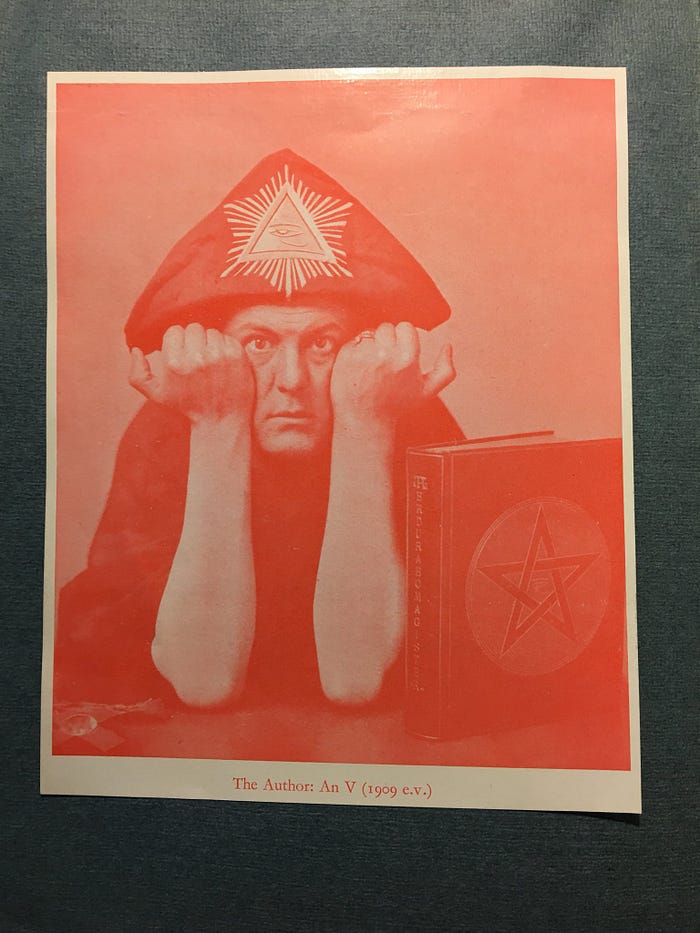
For clarity, I must add a word about magician Aleister Crowley’s controversial activities during wartime; which, with respect to controversy, differed little from other periods in the occultist’s life. Several biographers have wrestled with whether Crowley functioned as a spy for one side or another. The answer is elusive.
During World War I, Crowley lived in New York City with few sources of income. Proclaiming himself an Irish nationalist, he wrote bombastic, pro-German articles for a weekly called The Fatherland. Some British commentators denounced him as a traitor to the Allied cause. But several biographers, including Richard B. Spence, Tobias Churton, and Lawrence Sutin, have presented evidence from intelligence files and correspondence suggesting that Crowley was actually employed by British intelligence to write purposefully absurd pieces in order to sully the pro-German position. Crowley later claimed as much himself.
Twentieth century intelligence authorities from time to time showed interest in occultists either for propaganda purposes or in hopes they could penetrate certain innards of enemy or foreign thought, since occult groups were frequently international in activity. That Crowley was in dire need of funds suggests a motive for his activities.
Crowley generally stood aloof from overt politics although there exist inconclusive letters and claims that during Hitler’s rise he sought to place a copy of The Book of the Lawin front of the future führer as a potential exemplar of his radically self-determinative philsophy of Thelema (Greek for “will”), which Crowley insisted was free from racial animus. Following Karl Germer’s arrest in 1935, any such chimeras burst on the rocks of reality. Crowley then tried to tailor Thelema’s appeal to British war needs, with little official interest.
In 1941, the magician wrote a pamphlet of poems for Allied victory titled, “Thumbs Up!” It was a natural extension of wartime patriotism and self-interest. He privately printed 100 copies; a signed edition appears in the special collections of the New York Public Library. Crowley apparently offered his services to British Intelligence during World War II but no need for them was found, especially with the capture of Rudolf Hess after his misbegotten flight to Scotland in 1941, when the Allies held a prisoner who could provide whatever information was significant about occult groups around the Nazis.
Here and below are front matter of Crowley’s privately printed anthem to Allied war victory, “Thumbs Up!” Signed by the author. Copy 76 of 100. New York Public Library Special Collections.
Although occultism has a calico history across modern politics, intermingling with a myriad array of movements, only a few of which I’ve noted here, evidence for a Nazi-occult connection exists more in the proclivities of the observer than the complexities of historicism.
This article is adapted from the author’s forthcoming Modern Occultism (September 19, 2023)
Notes
[1] For a well-contextualized critique of this issue, see “Mythological and Real Race Issues in Theosophy” by Isaac Lubelsky, Handbook of the Theosophical Current edited by Olav Hammer and Mikael Rothstein (Brill, 2013).
[2] Inside the Third Reich by Albert Speer (Macmillan, 1970).
[3] This passage is from Goodrick-Clarke’s now-classic The Occult Roots of Nazism (New York University Press, 1992). Goodrick-Clarke’s title is odd, and prone to misunderstanding, insofar as his vital study rebuts willful or excessive interpretations of occult influences behind Nazism.
[4] E.g., see Aleister Crowley: The Beast in Berlin by Tobias Churton (Inner Traditions, 2014).
[5] “The original Indiana Jones: Otto Rahn and the temple of doom” by John Preston, The Telegraph, May 22, 2008.
[6] Dark Star Rising: Magick and Power in the Age of Trump by Gary Lachman (TarcherPerigee, 2018). Lachman’s book — which is singularly outstanding — attracts attention online from several who urge it upon me as a perceived rejoinder. As Gary notes within, I commissioned, titled, and published the book.
[7] “The Occultists Who Almost Ran Your Country,” May 9, 2020.
[8] See Per Faxneld’s masterful study Satanic Feminism: Lucifer as the Liberator of Women in Nineteenth-Century Culture (Oxford University Press, 2017).
[9] The Occult Roots of Bolshevism: From Cosmist Philosophy to Magical Marxism by Stephen E. Flowers (Lodestar, 2022).
[10] “The Shrink as Secret Agent: Jung, Hitler, and the OSS,” The Daily Beast, October 22, 2018.
LOS ANGELES—Spitting into their palms to cement the deal, Nick, Joe, and Kevin Jonas reportedly made a tree-house pact Friday to divorce their mean wives and marry each other. “Everything was so much better when it was just us Jonas boys, and that’s how it should always be,” said newly separated Joe Jonas, slipping a Funyun onto his brother Nick’s ring finger and whispering, “Brother, you’re my wife now.” “We don’t need any gross, mean girls making everything complicated—we’ll just live in our cool tree fort forever and ever and have mom bring us snacks. What else could we need? It’s settled, I’m officially sending Sophie’s lawyer this sign that says ‘NO GIRLS ALLOWED.’ Well, except Mom, but she has to know the code word to enter. Now let’s practice kissing like we used to.” At press time, Kevin was seen sobbing and threatening to tattle to their mother after neither of his brothers wanted to marry him.
“The human experiences of peace, joy, love and beauty are not really human experiences; they are instances where the infinite, the divine, has entered through a crack in the world. It has seeped through the veil of appearances and is announcing itself in our world.“
–Rupert Spira
Rupert Spira (born March 13, 1960) is an English spiritual teacher, philosopher and author of the Direct Path based in Oxford, UK. Wikipedia
(newsletter@rupertspira.com)
Consciousness, spirituality, biography, sexuality, androgyny, futurism, space, the arts, science, astrology, democracy, humor, books, movies and more


Light cast a spell over me. I saw it everywhere I went and watched it by the hour… flowing over the surface of the houses in front of me and through the tunnel of the street to right and left. This light was not like the flow of water, but something more fleeting and numberless, for its source was everywhere. I liked seeing that the light came from nowhere in particular, but was an element just like air. We never ask ourselves where air comes from, for it is there and we are alive. With the sun it is the same thing.