
BY MARIA POPOVA (themarginalian.org)


Four months before her twentieth birthday, Emily Dickinson (December 10, 1830–May 15, 1886) met the person who became her first love and remained her greatest — an orphaned mathematician-in-training by the name of Susan Gilbert, nine days her junior. Throughout the poet’s life, Susan would be her muse, her mentor, her primary reader and editor, her fiercest lifelong attachment, her “Only Woman in the World.”
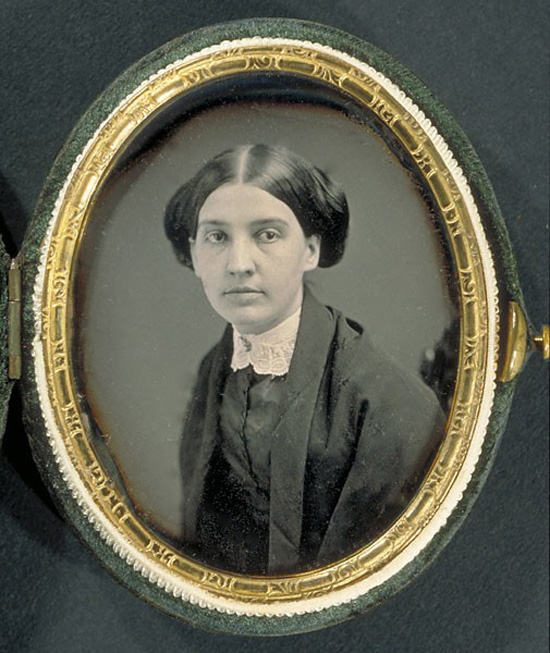
I devote more than one hundred pages of Figuring to their beautiful, heartbreaking, unclassifiable relationship that fomented some of the greatest, most original and paradigm-shifting poetry humanity has ever produced. (This essay is drawn from my book.)Emily Dickinson at seventeen. The only authenticated photograph of the poet. (Amherst College Archives & Special Collections, gift of Millicent Todd Bingham, 1956)
Susan Gilbert had settled in Amherst, to be near her sister, after graduating from the Utica Female Academy — one of a handful of academically rigorous educational institutions available to women at the time. She entered Dickinson’s life in the summer of 1850, which the poet would later remember as the season “when love first began, on the step at the front door, and under the Evergreens.”
Poised and serious at twenty, dressed in black for the sister who had just died in childbirth and who had been her maternal figure since their parents’ death, Susan cast a double enchantment on Emily and Austin Dickinson. Sister and brother alike were taken with her poised erudition and her Uranian handsomeness — her flat, full lips and dark eyes were not exactly masculine, her unchiseled oval face and low forehead not exactly feminine.
“Best Witchcraft is Geometry,” Emily Dickinson would later write. Now both she and her brother found themselves in a strange bewitchment of figures, placing Susan at one point of a triangle. But Emily’s was no temporary infatuation. Nearly two decades after Susan entered her heart, she would write with unblunted desire:
To own a Susan of my own
Is of itself a Bliss —
Whatever Realm I forfeit, Lord,
Continue me in this!
A tempest of intimacy swirled over the eighteen months following Susan’s arrival into the Dickinsons’ lives. The two young women took long walks in the woods together, exchanged books, read poetry to each other, and commenced an intense, intimate correspondence that would evolve and permute but would last a life- time. “We are the only poets,” Emily told Susan, “and everyone else is prose.”
By early 1852, the poet was besotted beyond words. She beckoned to Susan on a Sunday:
Come with me this morning to the church within our hearts, where the bells are always ringing, and the preacher whose name is Love — shall intercede for us!
When Susan accepted a ten-month appointment as a math teacher in Baltimore in the autumn of 1851, Emily was devastated at the separation, but tried to keep a buoyant heart. “I fancy you very often descending to the schoolroom with a plump Binomial Theorem struggling in your hand which you must dissect and exhibit to your uncomprehending ones,” she teased in a letter. Susan was science personified, capitalized — she would haunt Dickinson’s poems for decades to come as “Science.”

In a comet of a letter from the early spring of 1852, eight months into Susan’s absence, Emily hurls a grenade of conflicted self-revelation:
Will you be kind to me, Susie? I am naughty and cross, this morning, and nobody loves me here; nor would you love me, if you should see me frown, and hear how loud the door bangs whenever I go through; and yet it isn’t anger — I don’t believe it is, for when nobody sees, I brush away big tears with the corner of my apron, and then go working on — bitter tears, Susie — so hot that they burn my cheeks, and almost scorch my eyeballs, but you have wept much, and you know they are less of anger than sorrow.
And I do love to run fast — and hide away from them all; here in dear Susie’s bosom, I know is love and rest, and I never would go away, did not the big world call me, and beat me for not working… Your precious letter, Susie, it sits here now, and smiles so kindly at me, and gives me such sweet thoughts of the dear writer. When you come home, darling, I shan’t have your letters, shall I, but I shall have yourself, which is more — Oh more, and better, than I can even think! I sit here with my little whip, cracking the time away, till not an hour is left of it — then you are here! And Joy is here — joy now and forevermore!
That year, in a Prussian lab, the physician and physicist Hermann von Helmholtz measured the speed of nerve conduction at eighty feet per second. How unfathomable that sentiments this intense and emotions this explosive, launched from a mind that seems to move at light-years per second, can be reduced to mere electrical impulses. And yet that is what we are — biomechanical creatures, all of our creative force, all of our mathematical figurings, all the wildness of our loves pulsating at eighty feet per second along neural infrastructure that evolved over millennia. Even the fathoming faculty that struggles to fathom this is a series of such electrical impulses.
The electricity of Dickinson’s love would endure, coursing through her being for the remainder of her life. Many years later, she would channel it in this immortal verse:
I chose this single star
From out the wide night’s numbers —
Sue — forevermore!
But now, in the dawning fervor of early love, forevermore collides with the immediacy of want. Midway through her spring outpouring, Emily suddenly casts Susan in the third person, as if beseeching an omnipotent spectator to grant her desire in the drama of their impending reunion:
I need her — I must have her, Oh give her to me!
The moment she names her longing, she tempers its thrill with the lucid terror that it might be unspeakable:
Do I repine, is it all murmuring, or am I sad and lone, and cannot, cannot help it? Sometimes when I do feel so, I think it may be wrong, and that God will punish me by taking you away; for he is very kind to let me write to you, and to give me your sweet letters, but my heart wants more.
Here, as in her poetry, Dickinson’s words cascade with multiple meanings beyond literal interpretation. Her invocation of “God” is not a cowering before some Puritanical punishment for deviance but an irreverent challenge to that very dogma. What kind of “God,” she seems to be asking, would make wrong a love of such infinite sweetness?
Four years earlier, during her studies at Mount Holyoke — the “castle of science” where she crafted her stunning herbarium — Emily had begun giving shape to the amorphous doubt about the claims of religion that had been gnawing at her since childhood — doubt she would later immortalize in verse:
It troubled me as once I was —
For I was once a child —
Deciding how an atom — fell —
And yet the heavens — held.
Facing her desire for Susan, her deepest fear was not punishment from “God” but that her wayward heart was its own retribution — as well as its own reward. She writes plaintively that heated summer:
Have you ever thought of it, Susie, and yet I know you have, how much these hearts claim; why I don’t believe in the whole, wide world, are such hard little creditors — such real little misers, as you and I carry with us, in our bosom every day. I can’t help thinking sometimes, when I hear about the ungenerous, Heart, keep very still — or someone will find you out!… I do think it’s wonderful, Susie, that our hearts don’t break, every day… but I guess I’m made with nothing but a hard heart of stone, for it don’t break any, and dear Susie, if mine is stony, yours is stone, upon stone, for you never yield, any, where I seem quite beflown. Are we going to ossify always, say Susie — how will it be?
There is palpable restlessness in Emily’s oscillation between resignation and demand, between love’s longing to be unmasked and the fear of being found out. Later that month, she exhorts Susan: “Loved One, thou knowest!” — an allusion to Juliet’s speech in Romeo and Juliet: “Thou knowest the mask of night is on my face.”
By June, anticipating Susan’s return from Baltimore in three weeks, Emily is pining with unbridled candor:
When I look around me and find myself alone, I sigh for you again; little sigh, and vain sigh, which will not bring you home.
I need you more and more, and the great world grows wider… every day you stay away — I miss my biggest heart; my own goes wandering round, and calls for Susie… Susie, forgive me Darling, for every word I say — my heart is full of you… yet when I seek to say to you something not for the world, words fail me… I shall grow more and more impatient until that dear day comes, for til now, I have only mourned for you; now I begin to hope for you.
She ends her letter with aching awareness of the dissonance between her private desire and the public norms of love:
Now, farewell, Susie… I add a kiss, shyly, lest there is somebody there! Don’t let them see, will you Susie?
Two weeks later, with Susan’s return now days away, her anticipatory longing rises to a crescendo:
Susie, will you indeed come home next Saturday, and be my own again, and kiss me as you used to?… I hope for you so much, and feel so eager for you, feel that I cannot wait, feel that now I must have you — that the expectation once more to see your face again makes me feel hot and feverish, and my heart beats so fast — I go to sleep at night, and the first thing I know, I am sitting there wide awake, and clasping my hands tightly, and thinking of next Saturday… Why, Susie, it seems to me as if my absent Lover was coming home so soon — and my heart must be so busy, making ready for him.
Dickinson would frequently and deliberately reassign gender pronouns for herself and her beloveds, recasting her love in the acceptable male-female battery of desire. Throughout her life, she would often use the masculine in referring to herself — writing of her “boyhood,” signing letters to her cousins as “Brother Emily,” calling herself a “boy,” “prince,” “earl,” or “duke” in various poems, in one of which she unsexes herself in a violent transfiguration:
Amputate my freckled Bosom!
Make me bearded like a Man!
Again and again, she would tell all the truth but tell it slant, unmooring the gender of her love objects from the pronouns that befit their biology. Later in life, in flirting with the idea of publication, she would masculinize the pronouns in a number of her love poems — “bearded” pronouns, she called these — to fit the heteronormative mold, so that two versions of these poems exist: the earlier addressed to a female beloved, the later to a male.
That insufferable spring, she had already declared to Susan that her “heart wants more.” Twenty Augusts after they met, Dickinson would write:
Enough is so vast a sweetness, I suppose it never occurs, only pathetic counterfeits.

But when Susan returned from Baltimore on that long-awaited Saturday, something had shifted between them. Perhaps the ten-month absence, filled not with their customary walks in the woods but with letters of exponentially swelling intensity, had revealed to Susan that Emily’s feelings for her were not of a different hue but of a wholly different color — one that she was constitutionally unable to match. Or perhaps Emily had always misdivined the contents of Susan’s heart, inferring an illusory symmetry of feeling on the basis not of evidence but of willfully blind hope.
Few things are more wounding than the confounding moment of discovering an asymmetry of affections where mutuality had been presumed. It is hard to imagine how Dickinson took the withdrawal — here was a woman who experienced the world with a euphoria of emotion atmospheres above the ordinary person’s and who therefore likely plummeted to the opposite extreme in equal magnitude. But she seems to have feared it all along — feared that her immense feelings would never be wholly met, as is the curse of those who love with unguarded abandon. Five months earlier, she had written to Susan:
I would nestle close to your warm heart… Is there any room there for me, or shall I wander away all homeless and alone?
She suspected, too, that she might injure — and not only herself — with the force of her love:
Oh, Susie, I often think that I will try to tell you how dear you are… but the words won’t come, tho’ the tears will, and I sit down disappointed… In thinking of those I love, my reason is all gone from me, and I do fear sometimes that I must make a hospital for the hopelessly insane, and chain me up there such times, so I won’t injure you.
Even in her ardent anticipatory letter penned before Susan’s return, she questions for a moment whether the love that stands as the central truth of her daily being is real:
Shall I indeed behold you, not “darkly, but face to face” or am I fancying so, and dreaming blessed dreams from which the day will wake me?
Now she had been awakened — not rudely, but unmistakably and irreversibly. In the anxious insistence of her entreaty is the sorrowful sense that Susan is slipping away from her — and toward Austin, who commenced an open courtship of her.
That summer, Emily Dickinson cut off her auburn hair.
The following autumn, Susan Gilbert married Austin Dickinson, largely to be near Emily, and they moved into the Evergreens — the house erected for the newlyweds by Austin and Emily’s father, across the lawn from the Homestead, the house where the lovesick poet lived.
A corridor denuded of grass soon formed between the Homestead and the Evergreens as Emily and Susan traversed the lawn daily to see each other or to press into the other’s hand a letter unpinned from the bosom of a dress. A “little path just wide enough for two who love,” Dickinson called it. Over the next quarter century, 276 known poems would travel between their homes — some by hand and foot, but many by post. I have often wondered what prompted the poet to head for the mailbox and not the hedge, stuffing her sentiments into an envelope addressed to a house a stone’s throw from her own. And yet the heart is not a stone — it is a thing with feathers.

“She loved with all her might,” a girlhood friend of Dickinson’s would recall after the poet’s death, “and we all knew her truth and trusted her love.” No one knew that love more intimately, nor had reason to trust it more durably, than Susan. Where Austin’s love washed over her with the stormy surface waves of desire, Emily’s carried her with the deep currents of devotion — a love Dickinson would compare to the loves of Dante for Beatrice and Swift for Stella. To Susan, Dickinson would write her most passionate letters and dedicate her best-beloved poems; to Susan she would steady herself, to her shore she would return again and again, writing in the final years of her life:
Show me Eternity, and I will show you Memory —
Both in one package lain
And lifted back again —
Be Sue — while I am Emily —
Be next — what you have ever been — Infinity.
Something of the infinite would always remain between them. Thirty years into the relationship, Susan would give Emily a book for Christmas — Disraeli’s romance novel Endymion, titled after the famous Keats poem that begins with the line “A thing of beauty is a joy for ever” — inscribed to “Emily, Whom not seeing, I still love.”
Some loves lodge themselves in the tissue of being like mercury, pervading every synapse and sinew to remain there, sometimes dormant, sometimes tortuously restive, with a half-life that exceeds a lifetime.
Their uncommon love, the splendors and sorrows of which I explore further in Figuring, would become the pulse-beat of Dickinson’s body of work, which radicalized its era and forever changed the landscape of literature — a shimmering testament to the fact that love, longing, and the restlessness of the human heart are the catalyst for every creative revolution.


