Tag Archives: Georgia O’Keeffe

How to Live in Light: A Blind Hero of the French Resistance on Seeing the Heart of Life and Contacting the Oneness of Being

By Maria Popova (themarginalian.org)

“To see takes time, like to have a friend takes time,” Georgia O’Keeffe wrote as she contemplated the art of seeing just before the Little Prince sighed his timeless sigh: “What is essential is invisible to the eye.”

No one has written about what it takes to see — and how to do the looking — more poignantly than Jacques Lusseyran (September 19, 1924–July 27, 1971) in his stirring memoir And There Was Light (public library).

Looking back on his blissful early childhood, Lusseyran recounts his formative enchantment with the world:

Light cast a spell over me. I saw it everywhere I went and watched it by the hour… flowing over the surface of the houses in front of me and through the tunnel of the street to right and left. This light was not like the flow of water, but something more fleeting and numberless, for its source was everywhere. I liked seeing that the light came from nowhere in particular, but was an element just like air. We never ask ourselves where air comes from, for it is there and we are alive. With the sun it is the same thing.

There was no use my seeing the sun high up in the sky in its place in space at noon, since I was always searching for it elsewhere. I looked for it in the flickering of its beams, in the echo which, as a rule, we attribute only to sound, but which belongs to light in the same measure. Radiance multiplied, reflected itself from one window to the next, from a fragment of wall to cloud above. It entered into me, became part of me. I was eating sun.

Art by Ping Zhu from The Snail with the Right Heart by Maria Popova

Nightfall didn’t end the spell of the light, for he felt it in the very fabric of being:

Darkness, for me, was still light, but in a new form and a new rhythm. It was light at a slower pace. In other words, nothing in the world, not even what I saw inside myself with closed eyelids, was outside this great miracle of light.

And then, one May morning when he was seven, the light of the world went out — a classroom scuffle ended in a violent fall onto the corner of the teacher’s desk, leaving Lusseyran completely blind.

Somehow, he adapted, guided by the light within and by the discovery that the light without is a kind of vibration can we feel whenever we assume “the attitude of tender attention” — a vibration that reveals the world, its materiality and its mystery:

Objects do not stand at a given point, fixed there, confined in one form. They are alive, even the stones. What is more they vibrate and tremble. My fingers felt the pulsation distinctly, and if they failed to answer with a pulsation of their own, the fingers immediately became helpless and lost their sense of touch. But when they went toward things, in sympathetic vibration with them, they recognized them right away… Being blind I thought I should have to go out to meet things, but I found that they came to meet me instead.

In a passage evocative of Virginia Woolf’s transcendent epiphany about the oneness of the world, he adds:

If my fingers pressed the roundness of an apple, each one with a different weight, very soon I could not tell whether it was the apple or my fingers which were heavy. I didn’t even know whether I was touching it or it was touching me. As I became part of the apple, the apple became part of me. And that was how I came to understand the existence of things.

[…]

The reality — the oneness of the world — left me in the lurch, incapable of explaining it, because it seemed obvious. I could only repeat: “There is only one world. Things outside only exist if you go to meet them with everything you carry in yourself. As to the things inside, you will never see them well unless you allow those outside to enter in.”
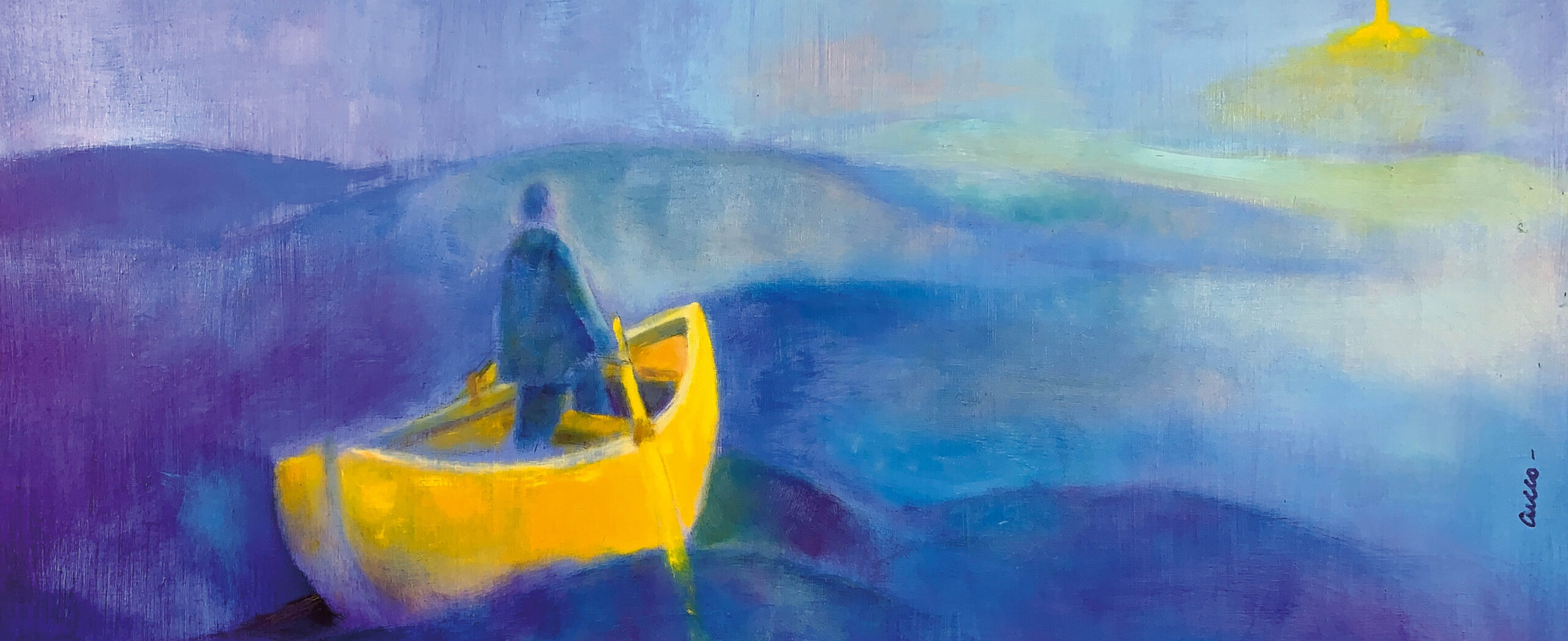
Art by Giuliano Cucco from Before I Grew Up

Lusseyran was still a teenager when, unnerved by Hitler’s rise to power, he set out to teach himself German in order to understand the menacing radio broadcasts. In 1941, shortly after the Nazi invasion of France, he formed a resistance group and began publishing an underground newspaper that soon became the voice of the French freedom fighters. He was seventeen.

Two months before his nineteenth birthday, Lusseyran was betrayed by a member of the resistance, arrested by the Gestapo, and sent to the Buchenwald concentration camp. For six months, he was kept in “a space four feet long and three feet wide, with walls like a medieval fortress, door three fingers thick with a peephole through which the jailers watched day and night, and a sealed window.” But his bright spirit remained undimmed — devoted to stirring the spirit of resistance among the thousands of inmates, he came to see the place not as a prison but as “a church underground.” He would recount:

The mechanism of hope in our hearts must have a thousand springs, almost all of them unknown to us.

Jacques Lusseyran

When liberation finally came two years later, Lusseyran was one of thirty inmates to leave the camp alive. Looking back on how he survived the unsurvivable, he returns to the lifeline of the light and the radiance of what the poet Muriel Rukeyser called “the living moment… in which we touch life and all the energy of the past and future.” Aliveness, he intimates, is a matter of our receptivity to light, which is the quality of attention we pay the world — no matter our circumstance:

When a ray of sunshine comes, open out, absorb it to the depths of your being. Never think that an hour earlier you were cold and that an hour later you will be cold again. Just enjoy. Latch on to the passing minute. Shut off the workings of memory and hope… Take away from suffering its double drumbeat of resonance, memory and fear. Suffering may persist, but already it is relieved by half. Throw yourself into each moment as if it were the only one that really existed.

And There Was Light is a remarkable read in its entirety. Complement it with Viktor Frankl, shortly after his release from the concentration camps, on life’s deepest source of meaning, then revisit Rebecca Elson’s poetic love letter to the light of the universe.

Georgia O’Keeffe on Success, Public Opinion, and What It Means to Be an Artist, in a Letter to Sherwood Anderson

By Maria Popova (themarginalian.org)

Georgia O’Keeffe (November 15, 1887–March 6, 1986), celebrated as America’s first great female artist, was a woman of strong opinions on art, life, and setting priorities and an uncommon gift for committing to words what she committed to canvas. But some of her most revelatory insights on art and the creative experience were shared in a series of letters to writer Sherwood Anderson, who had befriended legendary photographer Alfred Stieglitz — O’Keeffe’s husband and her correspondent in volumes of passionate love letters. Encountering O’Keeffe’s art in the early 1920s had inspired Anderson to pick up the paintbrush for the first time and begin painting himself. Meanwhile, the two developed an epistolary fellowship around their shared ideas about art and their amicable intellectual disagreements. (Only three years later, Anderson would come to articulate his own unforgettable wisdom on art in a letter to his son, very likely influenced by O’Keeffe and their creative rapport.)

Found in Georgia O’Keeffe: Art and Letters (public library) — an altogether unputdownable out-of-print volume released in 1987, a year after O’Keeffe’s death, to mark her centennial — the letters stand as a sublime paean to the kind of creative integrity that rises above public opinion and blazes with crystalline clarity of conviction. At the same time, one can’t help but wonder how O’Keeffe’s art — how her sanity — might have suffered had she lived in our present era of perpetual sprinting on the social-media hamster wheel of public opinion.

Georgia O’Keeffe by Alfred Stieglitz, 1918

On August 1, 1923, she writes to Anderson:

This morning I saw an envelope on the table Stieglitz addressed to you—I’ve wanted so often to write you—two things in particular to tell you—but I do not write—I do not write to anyone—maybe I do not like telling myself to people—and writing means that.

First I wanted to tell you—way back in the winter that I liked your “Many Marriages”—and that what others have said about it amused me much—I realize when I hear others speak of it that I do not seem to read the way they do—I seem to—like—or discard—for no particular reason excepting that it is inevitable at the moment.—At the time I read it I saw no particular reason why I should write you that I liked it—because I do not consider my liking—or disliking of any particular consequence to anyone but myself—And knowing you were trying to work I felt that opinions on what was past for you would probably be like just so much rubbish—in your way for the clear thing ahead—And when I think of you—I think of you rather often—it is always with the wish—a real wish—that the work is going well—that nothing interferes —

I think of you often because the few times you came to us were fine—like fine days in the mountains—fine to remember—clear sparkling and lots of air—fine air.

After a characteristically evocative note about Stieglitz’s health that spring had rendered him “just a little heap of misery—sleepless—with eyes—ears—nose—arm—feet—ankles—intestines—all taking their turn at deviling him,” O’Keeffe expresses deep gratitude for the very thing that led Virginia Woolf to term letter writing “the humane art”—the soul-salving power of a letter sent by one human being to another:

You can see why I appreciated your letters—maybe more than he did—because of what they gave him—I don’t remember now what you wrote—I only remember that they made me feel that you feel something of what I know he is—that it means much to you in your life—adds much to your life—and a real love for him seemed to have grown from it

And in his misery he was very sad—and I guess I had grown pretty sad and forlorn feeling too—so your voice was kind to hear out of faraway and I want to tell you that it meant much—Thanks

Aware of misfortune’s one-way mirror of hindsight, she adds, “I can only write you this now because things are better.”

‘The Lawrence Tree’ by Georgia O’Keeffe, 1929

O’Keeffe and Anderson continue their correspondence and in another letter sent a month later, she defies her self-professed distaste for “telling [herself] to people” and instead divulging — with the exhilarating intensity of expression that both her art and her letters to loved ones emanate — a magnificent glimpse of her inner life and creative spirit. She considers the role of form in art and the experience from which art stems:

I feel that a real living form is the result of the individual’s effort to create the living thing out of the adventure of his spirit into the unknown—where it has experienced something—felt something—it has not understood—and from that experience comes the desire to make the unknown—known. By unknown—I mean the thing that means so much to the person that wants to put it down—clarify something he feels but does not clearly understand—sometimes he partially knows why—sometimes he doesn’t—sometimes it is all working in the dark—but a working that must be done—Making the unknown—known—in terms of one’s medium is all-absorbing—if you stop to think of the form—as form you are lost—The artist’s form must be inevitable—You mustn’t even think you won’t succeed—Whether you succeed or not is irrelevant—there is no such thing. Making your unknown known is the important thing—and keeping the unknown always beyond you—catching crystallizing your simpler clearer version of life—only to see it turn stale compared to what you vaguely feel ahead—that you must always keep working to grasp—the form must take care of its self if you can keep your vision clear.

In a remark of extraordinary humility and wisdom, especially in the hindsight of both O’Keeffe’s present status in the canon of art and Anderson’s in that of literature, she considers the feebleness of any present metric of success against a creator’s ultimate significance for posterity:

You and I don’t know whether our vision is clear in relation to our time or not—No matter what failure or success we may have—we will not know—But we can keep our integrity—according to our own sense of balance with the world and that creates our form—

In a sentiment that calls to mind Maurice Sendak’s famous dissent with a common classification of his work — “I don’t write for children. I write — and somebody says, ‘That’s for children!’” — O’Keeffe adds:

What others have called form has nothing to do with our form—I want to create my own and I can’t do anything else—if I stop to think of what others—authorities or the public—or anyone—would say of my form I’d not be able to do anything.

I can never show what I am working on without being stopped—whether it is liked or disliked I am affected in the same way—sort of paralyzed—.

All of Georgia O’Keeffe: Art and Letters is a treat for eye and spirit alike. Complement this particular bit with Anna Deavere Smith on how to stop letting others define us and Rilke on why external interference in the artist’s private experience poisons the art.