
Monthly Archives: September 2023
 There was a person coming to a new village, relocating, and he was wondering if he would like it there, so he went to the Zen master and asked: “Do you think I will like it in this village? Are the people nice?”
Tarot Card for September 12: The Ace of Wands
The Ace of Wands
The Ace of Wands begins the explosion of energy which runs throughout the Suit of Wands. Here we see massive out-rushing power, high levels of force, the beginning of whatever the Will desires.
When this card appears in a reading it often signifies the beginning of new life – whether as in pregnancy, or to represent the beginning of a whole new phase in life. In order to confirm pregnancy, you need to look for other ‘baby’ cards like the Princess/Page of Cups, or the Ace or Three of Cups.
When the card comes up to indicate a new phase in life, there will often be other cards surrounding it which indicate the area that will be most affected by the new force.
This is a good card for healing energies, indicating high levels of vitality and vigour. This effect is much strengthened if the Sun also appears in the reading. It also indicates a period in life where we can forge forward toward our goals, having sufficient stamina and enthusiasm to follow through effectively.
It’s worth bearing in mind, though, that this is a very raw energy – potent and powerful, but somewhat reckless and headstrong. Make sure that you don’t get carried away with new projects, rushing heedlessly into something you have not considered thoroughly enough.

(via angelpaths.com and Alan Blackman)
The Book of Revelation with Dr. Elaine Pagels
MythVision Podcast Jul 8, 2021 From the religious historian whose The Gnostic Gospels won both the National Book Award and the National Book Critics Circle Award comes a dramatic interpretation of Satan and his role on the Christian tradition. With magisterial learning and the elan of a born storyteller, Pagels turns Satan’s story into an audacious exploration of Christianity’s shadow side, in which the gospel of love gives way to irrational hatreds that continue to haunt Christians and non-Christians alike. https://www.elaine-pagels.com/
Astrology in Psychotherapy
The Astrology Podcast Sep 11, 2023 A discussion about incorporating astrology into psychotherapy, and explaining what it looks like to use astrology as a tool in a therapeutic context, with astrologers Shawna Marie McGrath and Chris Brennan. The premise of the episode is that despite a huge amount of literature on psychological astrology, astrology in psychotherapy is rarely discussed. Nearly all literature written on the topic of therapeutic astrology is either geared toward “counseling skills for astrologers” or “how to read a birth chart therapeutically”. Though these are valuable topics, neither address the practical application of astrology in therapy over time (what does it look like, what should clinicians/clients know, what are the pros, cons, risks, etc.). This is what we set out to discuss in this episode, by answering the question “what does it look like to incorporate astrology into psychotherapy?” Within this context we get into astrology as a tool for psychotherapists to conceptualize and understand their client, as well as astrology being used more openly as a psychotherapeutic tool that is discussed with the client directly. We also discuss a number of the ethical considerations surrounding the use of astrology in psychotherapy, and talk about some pros and cons, in order to help clarify situations where astrology might be a helpful or appropriate tool to use versus when it might not be. Shawna is a a psychotherapist and astrologer based in California, and you can find out more about her work on her website: https://www.theastropsyche.com This is episode 418 of The Astrology Podcast:
Stepping into the Liminal – A Talk by Emmanuel Vaughan-Lee
Emergence Magazine Podcast

42 min
- Society & Culture
When we are both left with the fragments of a dying world and given glimpses of an emerging one; when there is so much beauty and destruction to be witnessed, how can we find our bearings? In this talk, given at Emergence’s recent Shifting Landscapes retreat held at Sharpham Trust in Devon, England, Emmanuel Vaughan-Lee offers a frame for how we might navigate our current moment of unprecedented transition and transformation. Speaking to what can take root when we truly open ourselves to grief, love, and ultimately kinship with the living world, he urges us to step into the liminal—the space between worlds—to recognize an invitation into new ways of being.
Read the transcript.
Sign up for our newsletter to hear more stories as they are released each week.
Learn more about your ad choices. Visit megaphone.fm/adchoices
Nietzsche: Intelligence is A Sign Of Weakness
The Strenght Beyond Smartness and Hyperspecialization

Published in Nietzsche’s Philosophy
Aug 23, 2023 (Medium.com)

You must have heard that “Knowledge is power” right? Almost all of us think intelligence is a sign of strength, right? Most of us think that intelligence helps us in our survival, right; But up to what extent?
Then why most of the species in the world are still surviving even if they lack basic intelligence? Human beings can trap any species including lions or any big fish with their intelligence. But still, we have found that intelligence is very rare among most of species.
You may have heard about the fact that intelligent people work all day just for their survival and livelihood but there are many people who are less intelligent and do less work but make more money than intelligent people and these people are in the most powerful positions in our country including politics and topmost business positions.
You must have noticed that less intelligent people make more money in the stock market and live a more lavish lifestyle. Less intelligent people spend extravagantly and live a less stressful life than intelligent people.
As per my experience, wherever I have seen a highly intelligent man, I have seen a man with inborn frustration. A man who is ready to argue on any topic. A man who just wants to win the argument but does not appreciate the differences.
I can surely say that joyfulness and intelligence work against each other. The more intelligent you are, there is more chance that your body must be producing more cortisol (stress-producing Harmon) as compared to normal human beings.
These people take lots of stress about everything whatever is happening in the world. That is why they are more prone to lose their calm. I am not saying all people who are intelligent are not joyful people.
But I have found that people who are very intelligent live in their own subjective world. They have their limitations of topics and beyond those topics they do not want to hear and talk.
For example, when I was at IIT, I used to hear people just talking about conferences, exams, grades, and assignments all the time. I can understand that those things are important but there are many things and topics like philosophy and psychology where people do not want to talk but are of equal value.

People are stuck in their hyperspecialization field and only want to talk with people who have at least a little knowledge about those fields. The worst part is that most people think that their own profession is better than someone else.
For example; artists think that their work is more valuable, businessmen think that their work is more valuable and difficult, and writers, doctors, and engineers think with the same logic.
What I have understood is that “Thinking kills actions”. Most of the people who are very intelligent are less action taker, they takes very less and calculated risk, whereas people who have less knowledge are ready to do new things. They are ready to burn themself in the quest for new horizons. They are the one who really creates history.
People who are very intelligent always face the problem that their creative work has been stolen, these are the people who usually assuced other people to use their ideas and formulas. These are the people who file intellectual property rights claims on their business partners.
I am convinced that the more intelligent you are the more struggle you will face in making great connections with other people. The more intelligent you are, it is for sure more you are going to mess up with your relationships and sexual life.
Even Albert Einstein has been accused of not giving proper time to her wife and she was about to file divorce against him.
There is a problem with more intelligent people, they suffer a lot for no reason, and they are more prone to depression and other mental problems. They sleep less.
They sleep with sleeping pills and most of them use so many health supplements just to survive their normal day. They complain and criticize everything about this word. You can easily see them complaining about the system and life itself.
These people are the ones if you meet with them they are more likely to observe negative traits in you instead of talking about your positive traits. Most of the females must have observed this while dating so-called hyper-intellectuals.
These people are just looking for problems in the world because they claim themselves problem solvers. Therefore their brain is nurtured in a way to only see defects in the world.
But they have to understand that the world is more beautiful when things are not perfect. Perfection kills the real beauty.
For example, when we visit a forest or nature we feel more joyful as compared to when we visit a perfectly designed building or skyscraper.
An AI can write better and perfect articles but still, we prefer to read articles written by humans because in AI articles that imperfection is missing. That magic is missing that gives us the feeling of connection.
Now comes the main point of the story.
Our obsession with intelligence reveals our inner weakness. People who are less intelligent actually value more intelligent men. People who are cowardly enjoy action movies.
There is something that Sigmund Freud called death drives inside each of us. But due to societical constraints, we cannot enjoy this dead drive therefore we start loving people who love to fight because we are too weak to fight and therefore we enjoy someone else fighting and winning. For example, children love to play shooting and Death Valley games.

People who live boring lives enjoy comedy shows. In India, I have seen many people who work in great companies and are so-called very intelligent people who love to go to comedy shows on the weekend and they tend to laugh at even every stupid joke that reflects to me how lonely and boring their life is. That they need someone else to do lots of hard work and perform at comedy shows to make them laugh.
In India, parents who are less educated are obsessed with education and want to see their children studying in very prestige colleges because in their hearts they have this notion that they want their children to take such education that they were not able to take in their childhood days.
People who are poor are more desperate for money as compared to people who are rich. Still, both need money.
Friedrich Nietzsche saw this pursuit of knowledge, and intelligence as arising from a lack of courage to deal with reality.
Rather than appreciating and enjoying life, “highly intelligent people” trap themself in their own subjectivity and withdraw into abstraction, reason, and logic, avoiding too many risks and vulnerabilities.
Intelligent people just want to fight with everyone on a talking basis but they do not have any courage even to give any bold statement in front of powerful people.
These people are like those Instagram, Reddit, and Twitter Trollers or Army who just want to do only Talk! Talk! Talk! and no action in real life against any authority.
High intelligence acts as a buffer against the rawness of real actions and lived authentic and joyful experiences.
We see these archetypes of highly educated people endlessly gathering knowledge and studying about the world at a distance rather than directly participating in life.
These are the people who love to read books and watch movies on love stories and relationships and start thinking of themselves as relationship advisors but when the real love arrives in their own life, they mess up with it.
Society has the tendency to glorify the life of highly intellectual people while looking down on those who live a more primal and instinctual existence.
In Nietzsche’s view, the celebration and pursuit of intelligence is a sign of weakness and disguises a fear of life itself.
Those who pride themselves and label themself “highly intelligent” are wrapped up in concepts, logic, theories, logic, and mental construction.
There is a reason that highly intelligent people know everything about “How to reduce body fat” and “What diet is bad for them” but are still unable to reduce belly fat. They just go on Google and gather all the information about reducing visceral fat but when it comes to applying that knowledge into action they mess up.
This is why I said, “Knowledge kills action”.
While intelligence seeks calculated risks, safety, and predictability, true strength comes from embracing life’s contradictions and uncertainties. It means having the courage to trust one’s gut instinct and act spontaneously without always needing confirmation from a rational mind and reasoning justification.
This does not completely mean that we should reject our thoughts and knowledge and stop acquiring knowledge altogether. Nietzsche was not anti-intellectual but he was against the way we gather knowledge in our educational institutions and real life.
He did warn us against allowing our abstract ideas, logic, reasoning, and theories to dominate our direct life experience. The truth is found not just in books, Google, blogs, and facts, but in the wisdom of the body, its passions and directly engaging with life and people.
At worst, a fixation totally dependent on knowledge and intelligence can become a tool for the weak to criticize and complain to the strong. Those who feel powerless can compensate by claiming intellectual superiority over those who are actually in power and those they resent the most.
What you can see is a bullied intelligent but weak man who prides himself on being smarter than his athletic tormentors.
Nietzsche’s philosophy reminds us that true strength lies not in how much we know, but in our capacity to overcome resistance, capacity for awe, vulnerability, and commitment in the face of life’s mysteries. To taste the full human experience, we cannot remain protected behind a wall of logic, idea, reason, and technical analysis.
By acknowledging the limits of logic and rationality, we should open ourselves to forms of understanding beyond IQ. This could unleash a power, creativity, and new horizons that our cultural worship of intelligence rarely reaches and teaches.
The comfort of being intelligent and smart must be left behind for the exhilarating terror of being fully alive and joyful.
The solution may be a balance- valuing the authentic, imperfect, and raw experience but also engaging in contemplation when required to integrate with life. With creativity, art, joyfulness, authenticity, and courage, we can integrate heart and mind to fully experience and thrive.
Why Are You Afraid?
Fear is paying attention

Published in The Taoist Online
Jul 27, 2023 (thetaoist.online)

When was the last time you felt fear? For me, it was a few weeks ago, descending a mountain bike trail. Suddenly, I see a steep rock and the track on the other side. A pang of fear hits. I pull on the brake. The bike freezes with a squeal. I hang over the edge of the rock, a rock I’ve seen other bikers roll over with ease. Unlike them, I step off and gingerly walk beside my bike, carrying it down.
It’s the fear of death. A fear of pain. Imagining myself going over the handlebars and headfirst into a tree. The thought of walking the rest of the track screaming with a broken arm. I feel the mortal blow of embarrassment imagining another biker pulling up from the ground.
So there I go down, walking my bike alongside me over the rocks. As I reach the bottom, the track levels out. I hop back on, slowly finishing the rest. Yet I’m filled with disappointment, an existential regret. What if that was the last time I ever rode? Did I even come close to pushing myself? As I came out of the trees, the thought hit me:
I’d much rather break my arm trying than play it safe like that again.
I had let fear control me. But more so, I felt I had let my body down. I wasn’t just thinking about how I could do better next time. Instead, I felt that I had already failed at the run I just tried. It was a sense that I had failed as a human, in my duty to fully live every moment.
This was the second time I tried the track. The first time I went down with a blast, rolling over and falling over a few times, grazing against rocks and blood streaming down my ankles. If luck had turned the other way, I’d have broken a bone. Yet it was thrilling: I was fully engaged, just me against the track. The second time, however, every obstacle seemed larger. I stopped where I had just gone over the first time. It wasn’t the physical obstacles, it was the obstacles in my mind.
When was the last time you felt fear?
1. Fear is paying attention
The Oxford Dictionary defines fear as an “unpleasant emotion caused by the threat of danger, pain, or harm.” Of course, fear is useful and necessary. If a cheetah is running towards you, not feeling fear probably means you’ll become his dinner.
But on the everyday, fear is very simple. Fear is simply the result of thinking too much. It isn’t even about whether you accurately perceive the risks. It’s simply about focusing too much. When you think about anything it magnifies the risk; risk isn’t objective. You can take a 5% risk and focus so much on it that 5% feels like 90%. Risk is an attitude, it’s only a perception. When we pay attention to anything, we single it out. We bring it to the front of our mind and blow it out of proportion. That’s the nature of paying attention.
Just have a look around you. You are choosing to pay attention to this screen, yet there are so many other things that you could notice instead. Look at the light in the room. Now it suddenly becomes important. What if it exploded and noxious gases flooded the room, choking you to death?
Whenever we think too much, we imagine harm. What else can you do? Even if there is no “objective” harm at all, if you’re standing there thinking you’re only possible reaction is, “Oh, I am not acting, there must be a reason. There must be something I should fight or avoid. Something I am fearing.” So even if the cliff is just a small drop, simply pausing to look at it teaches you to be afraid of it.
2. Fear is disunity with the world
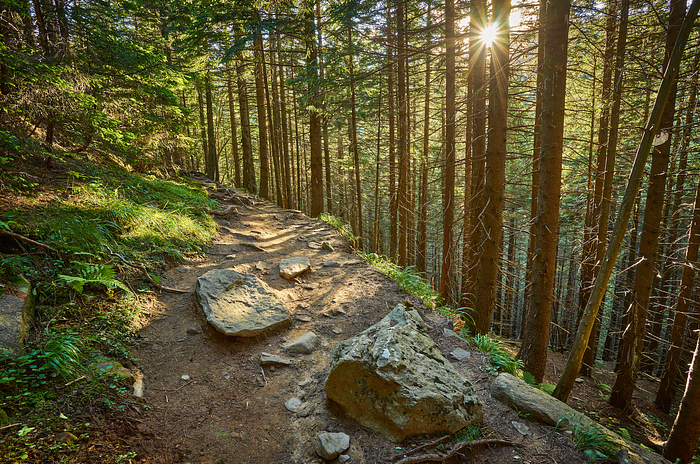
Thus, fear is simply a lens through which we view the world. It’s not an objective assessment of risk. Being fearful is a decision. Whenever we fear, we are uncomfortable with the world. We don’t accept what we’re presented with. Instead, we try to negotiate. We compete and view our world as the other, instead of freely moving through our environment. It’s a choice that we make to break our natural unity with everything around us. We can roll down the track, one whole environment of trees, soil, rocks and air. Instead, to be fearful is to single out the rock. To see something and view it as foreign to you.
I made the habit of riding slowly, and so I couldn’t pick up speed. Every small rock seemed massive. Instead of rolling over everything smoothly and falling once in a while, I made my own obstacles. I made obstacles because I forced myself to slow down and confront everything there. Yes the rocks were there, but there was nothing special about those rocks compared to the other rocks around, or even the trees surrounding me. I just chose to view them as threatening obstacles. We always have a choice: are we fighting against the world, or flowing with it?
3. Fear is looking at your feet
In the book of Matthew, Jesus asks Peter to walk on water to reach his boat:
“Lord, if it’s you,” Peter replied, “tell me to come to you on the water.”
“Come,” he said.
Then Peter got down out of the boat, walked on the water and came toward Jesus. But when he saw the wind, he was afraid and, beginning to sink, cried out, “Lord, save me!”
Immediately Jesus reached out his hand and caught him. “You of little faith,” he said, “why did you doubt?”
And when they climbed into the boat, the wind died down. Then those who were in the boat worshiped him, saying, “Truly you are the Son of God.”
While Peter looks towards Jesus, he walks on the water. But as soon as he feels the wind and looks at the depths below him, he sinks. Peter sank because he was worried about whether the water would hold his feet. Yet as soon as he stopped worrying, as soon as he looked towards Jesus, he walked over the water. Who is your Jesus? You don’t have to look at a Jesus. Just look around you. Just embrace the world you’re living in. Stop focusing on the water and you will never sink. You choose if you fall, and you fall by focusing on falling. Even if you go into the water, you won’t drown. Instead you’ll just become one with the water, sinking fully into the reality of life.
4. Fear is respect and admiration
Fear is respect, fear is admiration. We fear those we respect and admire. You don’t want to disappoint an idol or model. But what about your other fears? Heights? A large spider? The public speech you have to give?
To fear something is to elevate it. You feel the full height of the barriers in front of you. You realise you can’t climb over them. Now you have a choice: Do you want to cower, looking up hesitantly at all the walls you face, or smash through them like the Hulk? Stop respecting the world. What does that rock on your path have over you? Stop admiring the world. The world has nothing on you. You aren’t small and the world isn’t here to break you. You don’t need to hop over the rock, you need to don’t avoid it. Instead you and the rock roll over each other, together. The trail of life is not laid out as a maze for you to navigate. There is no way for you to become lost. You have no need for a compass or map. Just move and the world will move with you.
When we treat anything with respect or admiration, we imagine that it is something special. We stop before the barrier and gasp in terror. We imagine the thick brick wall instead of actually walking up to touch it. There we find it’s just plastic foam. From the ground, the Hulk appears to be the most destructive. Yet from the sky, we see that he moves through the world with ease.
Four points to eliminate fear
In summary:
- Stop focusing your attention
- Remember your unity with the world
- You will walk on water. Don’t worry about how
- Stop respecting your obstacles. Smash through them.
The power of the world is here in your hands. You can either fear your awesome potential, or live fully in it.

·Writer for The Taoist Online
Don’t think. Just start writing
Is Democracy Committing Suicide?
Does Democracy Fail Every Time Human Beings Try It? And Is it Failing Again Today?

Published in Eudaimonia and Co
Sep 2, 2023 (eand.co)

Here’s a tiny question. Is the age of democracy drawing to a close? Now, before you accuse me of exaggerating, or baiting you, let me assure you — it’s a question I mean to ask, and I think we should all be asking.
We tend to think of democracy as something like a grand, permanent turning point in history. Before, there was not democracy, and then — bang! — our forefathers and mothers discovered, or created, this wonderful and noble thing, and, like the internet or antibiotics, it was here to stay forever.
Is it? The truth is subtler. Feudalism lasted millennia. Tribalism, millennia before that. Empire, another millennia. And so maybe democracy is not something like a permanent turning point. Perhaps it was just an experiment — which has failed. Just as it has so many times before in history. Athens. Rome. The French Revolution — Napoleon’s coronation just 15 years later. Has democracy ever lasted, when you think about it? In fact, every single time in history democracy has been tried — people seem incapable of it (and discussing why is the point of this essay), hence soon enough, within a few centuries, if that long, it collapses right back into tyranny, war, and strife.
Are we being arrogant when we suppose that pattern won’t repeat itself in our time? Why should we think we are above it? Perhaps what we are learning today, all over again, is that enough people are simply incapable of the demands of democracy — no matter how hard the rest of us, who are usually a minority, try to educate, civilize, or liberate them, as equals, citizens, and peers. Perhaps enough of us will always reject those principles, which are altogether too noble and idealistic, for those of supremacy, superiority, violence, and power. Perhaps enough of us can only ever see others as rivals, subjects, and possessions to be had — and themselves as victims and martyrs, who deserve to be chieftains and rulers. Perhaps no good goes unpunished — and of all these, democracy is the greatest of all.
(First, a caveat. I’m not saying “democracy’s going to die!!” Not at all. What I am suggesting is that we should consider the idea, at this point, that democracy isn’t something like a permanent phase change — solid turning to liquid, forevermore — but maybe something more like a verdict upon ourselves — on which the jury’s out.)
Let’s unearth that for a second. When did this age of democracy really begin? Was it in 1776 — when America became the world’s first constitutional democracy — or was it in 1971, when America finally ended segregation? Was it in 1789, with the French Revolution, which culminated in a dictatorship — or in the 1940s, when colonialism was dismantled? Perhaps you see my point. Democracy is a thing which has always struggled to grow and evolve and become a truer version of itself. We have never really had anything resembling a “real” democracy, to any reasoning person, until very, very recently in history — so recently, in fact, that it’s scarcely the blink of an eye.
So democracy is a living, breathing thing. Does that mean it can “die”? In fact, it means something much more striking. For that reason, democracy has a strange and unique power. The power to destroy itself.
How many other things have the power to destroy themselves? Not many. A hammer, axe, mountain can’t. Even many living things can’t, like trees and microbes. There are very, very few things in existence with the power to destroy themselves. Only, if we think about, things with intent can commit suicide. And unfortunately for us, democracy is just such a thing.
And that brings me to why I think the age of democracy might be drawing to a close. It seems to me — and it should seem to you, if you reflect upon it — that more and more people today appear incapable of democracy. They are using democracy only to destroy itself. Democracy isn’t “dying”, as the headlines go — it is committing suicide.
Let me give you a statistic that might surprise you (or not, depending). Trump is still neck and neck with Biden in the polls. Even after being indicted. Despite the obvious harm to themselves and their own, the job losses, the kleptocracy, the corruption, the fascism, and so on. But that is hardly the only example. In Sweden, a party with Nazi “roots” (LOL) came to power — and then immediately dissolved the Environment Ministry. The far right is in power in Italy, where lesbian parents are being stripped of their parental status on birth certificates. Then there’s Hungary, Poland, Turkey, India, China, and so on. I could go on.
Do you see what I mean? Many people — more and more people, in fact, every day — are incapable of democracy. Not mentally incapable, as in they can’t “handle it.” But incapable in another, truer way. To be capable of democracy is first of all to understand why one should want it. But today people do not. They prefer authoritarians and tyrants and demagogues, for the sake of self-preservation, over the preservation of democracy.
Now, at this juncture, the kind of person I am describing will object, and cry: “but what you are talking about is democracy in action! You fool, you are talking about the exercise of democracy! It is the voice of the people! The vox populi has spoken!” Ah, but that’s not what democracy is at all. That’s mere majoritarianism. A democracy is something much more powerful than that. What is it, really? It is first and foremost a set of rights. That give us powers, and therefore liberate us. Those rights are inalienable for a reason — because when they are excised, removed, shattered, and destroyed, a democracy is undone. And yet a democracy can do just that, if it is foolish enough, and in that way, destroy itself. And that is precisely what the world is doing now. It is taking rights and powers away from people. Which ones? All kinds. I already mentioned Italy’s targeting of gay parents. In America, women have been stripped of bodily autonomy. Again, the examples are endless.
What is really being destroyed today are the fundamentals of democracy itself. They consist of three things. Equality, personhood, and freedom. Not just for you, or the chosen few. For everyone, or no one at all. Those are the qualities which rights really grant us. And yet those are the three things which more and more people wish to deny others, to take apart, to destroy. But when those things are destroyed, a democracy is no longer a democracy at all. It is something else entirely. What, precisely?
We see democracies around the globe degenerating in a now familiar, almost funny, pattern, because it is so predictable. First comes plutocracy. Then oligarchy. Then kleptocracy. And finally authoritarianism and fascism and theocracy, various flavors of tyranny and ruin. That is the pattern, the sequence, of how a democracy implodes and collapses. It doesn’t die — it commits suicide, one slash of the razor blade at a time. Who is the world’s finest exemplar of that precise pattern today? Sadly, America. It has raced through these five stages in the space of a few decades. And now it is hovering around the bottom. Yet more and more nations seem hell-bent on following America down into the abyss, where democracy goes to commit suicide.
Why is that? Well, it is primarily because people have lost faith in democracy’s promise — to ever improve their lives. That is the social contract offered by a democracy — and the truth is it is a fragile one. It is the same one Athens and Rome promised, too. But because it is a very, very difficult thing to deliver — perpetual prosperity, abundance, and plenty — democracy is also a vulnerable thing, historically scarce, easily broken, tending not to last. Rome couldn’t deliver it — bang! Emperors rose, as living standards fell for the enraged plebes. Athens couldn’t deliver it — wham! Citizens turned to tyrants.
And here we are again, we are in just such a juncture of history. In America, incomes have been flat for half a century. Hence, today, living standards are cratering — everything from longevity to mortality to happiness to suicide is going in the wrong direction, ruinously fast. In Europe, incomes have been flat for the last two decades or so — hence, it’s not as badly in decline as America, but it’s not that far behind, either: people are using democracy to destroy itself, there, too. And so on.
(Then there’s technology, too. It seems as if we’re replacing democracy with algorithms now. And who needs democracy when you have algorithms managing every aspect of your life for easy, simple pleasure, always a tap away — even if it’s the cheap thrill of hate, spite, and ruin? But that is what algorithms do now: they manage all of us. They manage our information — Twitter, Google. They manage our sociality — Facebook, WhatsApp. They manage our feelings, our self-worth, our esteem — Instagram and Tinder. They manage our entertainment — Netflix. They manage our consumption and finances and jobs — Amazon, Uber, credit ratings.
But algorithms are not the idols we have made them out to be. They are just sets of preferences aggregated by someone else’s preference. And yet they are a cheap, easy substitute for democracy, precisely because they give us the feeling of self-governance and self-directedness, without the work and trouble necessary to really accomplish it. They replace selfless virtue with egoistic self-absorption, thinking with immediate gratification, reflection with reaction, contemplation with resentment, and, perhaps worst of all, ideas with numbers. But I digress. The point is simple. Algorithms are replacing the structures, institutions, and norms of genuinely democratic societies, with something more like a kind of soft, hidden authoritarianism.)
Yet that is precisely what people seem to want today. When more and more people use democracy to destroy itself, what are they really doing? They are not “acting democratically”, but precisely the opposite. They are saying that democracy is too much of a struggle and a challenge, too much work and effort, too dangerous and threatening. It’s not that they can’t be bothered with it — it is that they genuinely do not want it. Let me put that more sharply, so you understand what I really mean. In today’s extremist movements, people are revoking their consent to the foundational principles of democracy — equality, personhood, and freedom, as shared, universal goods, which are inalienable and inherent in all people. In that way, today, we differ from Rome and Athens — because they never developed those principles, or consent to them, nearly so far as we have today. What a shame, then, to regress, yet again.
What is to be done about all this, then — democracy committing suicide, as it has so many times before? Perhaps history, as ever, is our guide. Perhaps democracy is a failed experiment, every time in history that it has been tried, for a very good reason. People are simply not capable of it — enough of them, at any rate. People simply do not have the courage, wisdom, or strength necessary to really make this noble experiment last — they turn on it savagely the moment that it’s promise seems to waver for even a moment.
Perhaps, then, if the world goes on as it is, for much longer, the best you and I can hope for is protection and safety from such people. People who want to remove and excise away our personhood and equality and freedom — with genuine harm and viciousness and violence. And maybe that can only be found in systems where such foolish people do not have the power to corrupt and corrode the principles inside democracy in the first place — for those of us who desire equality, freedom, and personhood.
Perhaps the best we can hope for — ever — is a kind of rule of the wise and courageous and just over the foolish and ignorant and violent — which is to say, a benevolent sort of aristocracy, of a Platonic or Socratic kind. I should hope otherwise. But there is something inside me which says that one of the great lessons of this age might just be that whenever human beings attempt democracy, we are learning all over again — history and the devil hold hands and laugh.
Umair
September 2023
Ocean CleanUp Launches Huge System in Pacific Garbage Patch to Clean a Football Field Every 5 Seconds
Sep 3, 2023 (goodnewsnetwork.org)
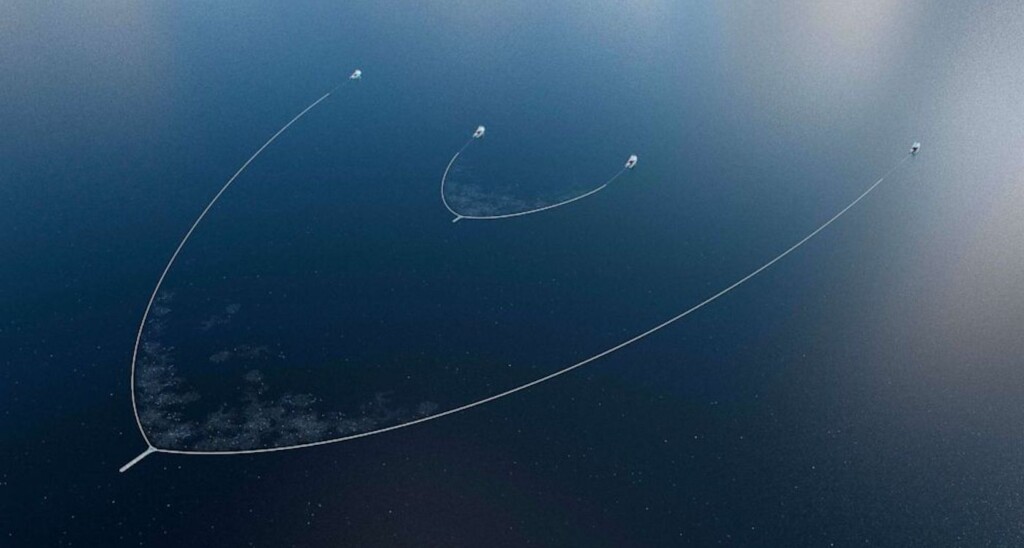
Last week, The Ocean Cleanup organization that has been tackling the Great Pacific Garbage Patch deployed their System 03 for the first time—nearly three times larger than the previous technology and capable of cleaning the area of a football field every five seconds.
This follows testing of their two smaller systems which succeeded in extracted over 275 tons of plastic from the Garbage Patch since 2021.
The arrival of System 03 marks a huge leap forward for the Dutch CEO Boyan Slat and his team, and their mission of ridding the oceans of at least 90% of the plastic trash by 2040.
System 03 consists of a floating barrier approximately 1.4 miles (2.2 km) long, which is towed between two slow-moving vessels. This barrier suspends a screen extending 13 feet (4 meters) below the surface of the water, where most floating plastic is encountered.
Once the trash is removed, an onboard crew sorts it to ensure the plastic is put to good use, by recycling it into sustainable new products.
Watch a video to see how it works…
This week we had our largest ever extraction from the Great Pacific Garbage Patch: 11,353 kg of plastic out of the ocean for good.
— The Ocean Cleanup (@TheOceanCleanup) August 11, 2023
As we transition to System 03, we see that increasing system size leads to bigger catches. pic.twitter.com/5UcrpATHbi
Most recently, they teamed up with automaker Kia to incorporate the salvaged plastic into their new electric vehicles, with the first batch delivered to Kia on System 002’s final return to port earlier this summer.
To prove we could turn this trash into treasure, we used our first ocean catch to produce The Ocean Cleanup Sunglasses – made from plastic extracted directly from the GPGP with System 001/B in 2019. These sold out within 18 months and helped fund future cleanups.
ALOHA HAUL: Hawaii Group Sets Record For Largest Haul of Plastic Removed From The Great Pacific Garbage Patch
“By making System 03 so much bigger than our previous efforts (alongside the multiple upgrades we’ve implemented) we can cover a much larger area of ocean in less time and using fewer resources,” says The Ocean Cleanup. “This brings down our cost per kilogram of plastic removed and maximizes our benefit on the marine environment.”
There is even a Marine Animal Safety Hatch on the new model, which is monitored by underwater cameras, letting crew members provide any animals with a clear exit from their plastic Retention Zone.
What about trash flowing out from rivers?
Simultaneously, Slat and his engineering team are also tackling a related issue—a facet that is just as critical to the overall plastic pollution problem: the world’s most littered rivers. By “turning off the taps” and catching plastic along the river’s course, the much more difficult task of capturing it in the ocean can be mostly avoided.
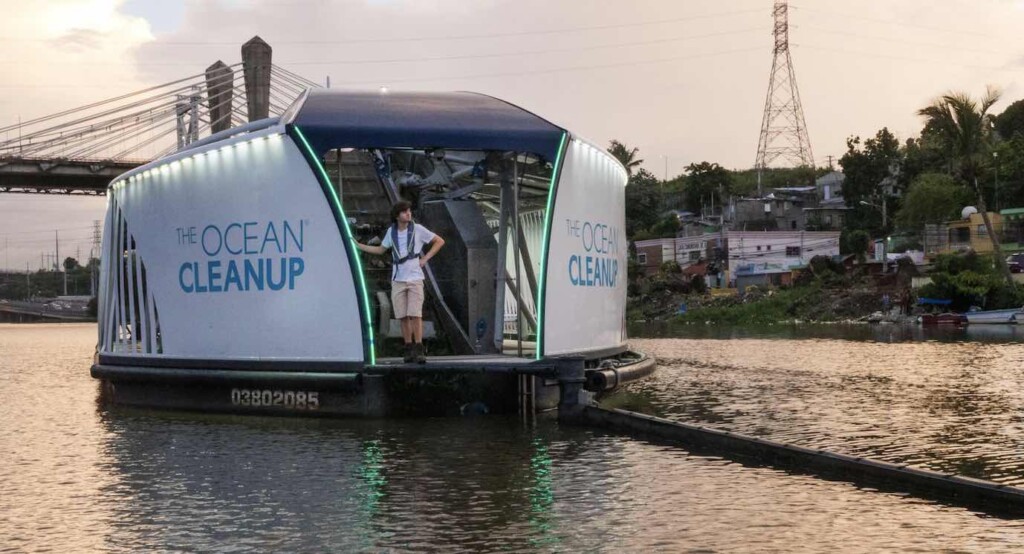
Their Interceptor machines are efficient solar-powered barges that gobble up plastic river garbage. At top performance, the Interceptors can extract 220,000 pounds (100,000 kilograms) of trash per day
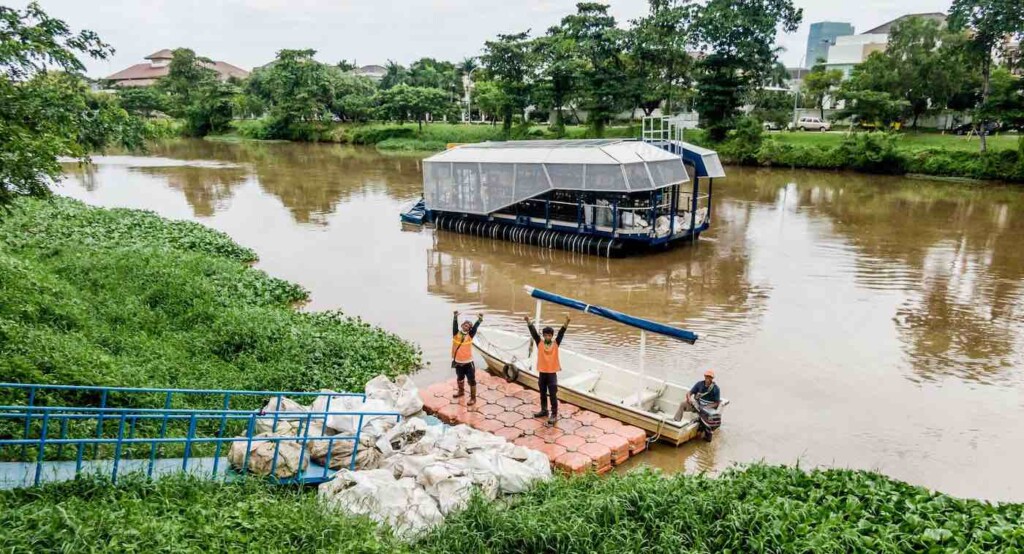
Indonesia announced an ambitious goal to reduce plastic litter in its waterways by 70% in three years—and got help from The Ocean Cleanup river barge.
After positive results in Jakarta, the Interceptor was deployed in other locations—Malaysia, the Dominican Republic, Vietnam, and Jamaica—and most recently, in Los Angeles on Ballona Creek which flows next to Venice Beach carrying plastic into the Pacific Ocean.
CHECK OUT THIS IDEA: City Pays Homeless to Learn Job Skills While Beautifying Riverbanks
“It’s very encouraging to see this positive collaboration between our two governments and The Ocean Cleanup continue, ” said Lambert Grijns, Ambassador of the Netherlands in Indonesia. “Despite the scale of the plastic challenge, the endorsement of these innovative solutions and partnerships gives me hope that we can work together to finally solve this problem for the benefit of all.”
Explore the ways you can help on their website.
Degrowth 101: Everything You Need to Know
By: Olivia Rosane
Published: February 20, 2023 (ecowatch.com)
 Edited by Chris McDermott

Stave Hill Ecological Park on the former site of the Surrey Commercial Dock in London, UK. blue sky in my pocket / Photodisc / Getty Images
Quick Key Facts
- Degrowth is the idea that we should prioritize sustainability and human well-being over economic growth.
- It comes from the French “décroissance,” which was coined in 1972 by social philosopher André Gorz.
- It first emerged as a distinct movement and theory in the early 21st century and entered the English language in 2008.
- Between 2000 and 2019, increased renewable energy capacity covered only 16 percent of new energy demand.
- Human activity has surpassed five out of nine planetary boundaries: global heating, plastic and chemical pollution, biodiversity loss, habitat loss and nitrogen and phosphorous pollution.
- Global North countries are responsible for 92 percent of greenhouse gas emissions in excess of planetary boundaries, and wealthy economies are responsible for 74 percent of unsustainable resource use.
- The U.S. has the highest GDP in the world but scores behind several countries on well-being indicators, including Panama and Costa Rica.
- Green growth and ecomodernism are two main schools of thought that propose an alternative vision to degrowth and favor technological change over economic alteration.
- The degrowth program includes a jobs guarantee, reduced work time, the end of planned obsolescence and debt forgiveness for the Global South.
- Doughnut Economics is an idea developed by Kate Raworth that the goal of economies should be to ensure flourishing within the “doughnut” between meeting everyone’s “social foundation” and the “ecological ceiling” of the nine planetary boundaries.
What Is Degrowth?
Degrowth is the idea that the purpose of the economy should not be growth as such but rather ensuring the well-being of everyone in a society without exceeding planetary boundaries. On the most basic level, it can be summarized by the maxim that people in wealthier nations “should live simply so others, human and non-human may simply live.” Proponents of degrowth argue that capitalism as practiced today — with an emphasis on increasing Gross Domestic Product and short-term corporate profits — is incompatible with avoiding the worst impacts of the climate and biodiversity crises. Degrowth would mean reducing the energy use of the global economy by curbing the activity of ecologically harmful or wasteful industries in wealthy nations such as advertising or plastics. It is different from a recession because it would not be an unplanned shrinking of the existing economy, which typically leads to job losses and other hardships, but rather a planned reimagining of economic priorities that would focus on a more equitable distribution of existing resources.
More From EcoWatch
What Is Economic Growth?
To understand what is meant by degrowth, it’s important to first understand what kind of growth the movement is advocating against. Economic growth is an increase in the production of goods and the provision of services between two consecutive periods of time. It is typically measured using something called Gross Domestic Product (GDP), which is the value — adjusted for inflation — of all the goods and services generated by an economy.
Economic growth is broadly associated with capitalism, an economic system based on private property in which individuals or corporations control the means of producing goods or value and are incentivized to produce or trade by the chance to earn financial profits. The search for greater profits stimulates growth because it encourages businesses to produce more goods or services and finds more efficient ways of doing so. Capitalism emerged during the end of the 17th century around the time of the industrial revolution. It was then that economic growth really took off on a global level, with global GDP only really beginning to rise after 1700.
Growth has often been posited as a way to compensate for one of capitalism’s main weaknesses: inequality. Because certain individuals or corporations tend to own the means of production, everyone else can only make ends meet by working for them, earning income but not sharing in the profits. The argument goes that growth compensates for this because a rising tide lifts all boats. Even if a worker does not make as much as a CEO, they still have a better standard of living than their ancestors who did not have access to ready energy or consumer goods. However, since the industrial revolution and the beginning of global economic growth, the toll of human activity on the environment has accelerated. It’s not an accident that the climate crisis is monitored according to degrees of warming beyond pre-industrial levels.

What Is the History of Degrowth?
The word “degrowth” comes from the French word “décroissance,” which was coined in 1972 by social philosopher André Gorz. “Is the earth’s balance, for which no-growth – or even degrowth – of material production is a necessary condition, compatible with the survival of the capitalist system?” he asked. The same year, a group of scientists at the Massachusetts Institute of Technology (MIT) published The Limits to Growth. This was a warning based on modeling of population growth, agricultural production, nonrenewable resource use, industrial output and pollution generation to determine that current levels of population and economic growth would surpass the planet’s carrying capacity by around 2100, even when taking technological advances into account.

This warning caused a stir when it debuted, but was soon drowned out by the pro-growth mood of the 1980s and 1990s. This was when President Ronald Reagan embraced the trickle-down theory of economics that cutting taxes for the wealthy would stimulate the economy and therefore these tax breaks would eventually “trickle down” to everyone else. It wasn’t until the early 21st century that degrowth emerged as both an economic theory and movement. As a movement, it started in Lyon, France, where the “Institute for Economic and Social Studies on Sustainable Degrowth” was founded. It then spread to Italy in 2004 and Spain in 2006. The term entered the English lexicon in 2008 with the First Degrowth Conference in Paris. Since then, more than 100 academic papers have been published on the idea. Important degrowth proponents and theorists include Serge Latouche, Mauro Bonaiuti, Paul Ariès, Jacques Grinevald, François Schneider, Pierre Rabhi, Gabriela Cabaña and Jason Hickel.
What Are Arguments in Favor of Degrowth?
The main arguments for degrowth are both social and ecological. It posits that the best way to respond to the climate and biodiversity crises is to reimagine economic life to make it at once more just and more fulfilling while reducing unnecessary consumption.
Degrowth as Climate Solution
In 2018, the Intergovernmental Panel on Climate Change (IPCC) noted that limiting global warming to 1.5 degrees Celsius above pre-industrial levels — and avoiding the worst impacts of the climate crisis — would require a level of social and technological change for which “there is no documented historic precedent.” The question is whether that change can be managed through a transition to renewable sources of energy alone without reducing the total energy demand of the economy.
Degrowth theorist Jason Hickel argues that this is not possible because economic growth is currently outpacing renewable energy adoption — between 2000 and 2019, only 16 percent of new energy demand from a growing economy was met by increased renewable energy. If GDP continues to rise at around three percent per year, that would require the economy to decarbonize at 10.5 percent per year to limit warming to 1.5 degrees, when the most ambitious decarbonization policies would only facilitate a decarbonization rate of four percent per year. In the past, the IPCC has made up for this by assuming scientists would develop the technology to remove carbon dioxide from the atmosphere. However, in the 2018 report, the IPCC included a “low energy demand” scenario that would cut global energy consumption by 40 percent and the material production of the economy by nearly 20 percent, which Hickel said was essentially a “degrowth” scenario. “Its inclusion in the IPCC report as the only scenario that does not rely on questionable negative emissions technologies suggests that degrowth may be the only feasible way to achieve the emissions reductions required by the Paris Agreement,” he wrote.

Degrowth as Solution to Broader Environmental Crisis
The climate crisis isn’t the only symptom of an unsustainable economic system. Scientists have defined nine planetary boundaries that have kept Earth stable for the last 10,000 years. Human activity has so far breached five of them. In addition to global heating, those are biodiversity loss, habitat loss, nitrogen and phosphorous pollution and the pollution of novel entities such as chemicals and plastic. Resolving the climate crisis through a technological switch to renewable energy coupled with somehow removing sufficient amounts of carbon dioxide from the atmosphere would not remedy an economic model that sees the Earth as a collection of natural resources to be extracted and exploited for economic gain. The destruction of ecosystems and the sacrifice of frontline communities for intensive agriculture or the rare earth and other minerals needed for the energy transition would continue.

Biodiversity loss, for example, is a major environmental crisis with a million plant and animal species now at risk from extinction, primarily because of land use change, hunting and harvesting, the climate crisis, other pollution and the introduction of invasive species. It is well documented that, as GDP rises, so do many of the drivers of biodiversity loss. Land used for agriculture and the use of fertilizer and pesticides have all risen alongside GDP since the 1960s. Meat consumption also rises with per capita GDP. GDP growth is also associated with an increase in urban area and greenhouse gas emissions, while the expansion of international trade facilitates the spread of invasive species. Although correlation is not causation, it is clear to see how economic growth would naturally lead to more resource use and trade, which would each increase the boot print of human activity on the natural world. A 2022 Intergovernmental Science-Policy Platform on Biodiversity and Ecosystem Services (IPBES) Assessment Report on the Diverse Conceptualization of the Multiple Values of Nature and Its Benefits concluded that the current mainstream values of economic growth and prioritizing short term profits were a major contribution to the ecological crisis. It suggested “degrowth” as one possible alternative model that could lead to a more sustainable and equal future.

Degrowth as Environmental Justice
One of the chief injustices of the climate crisis is that some of the countries most vulnerable to its impacts and least able to fund a response did the least to contribute to its effects. A pair of studies published in the Lancet Planetary Health considered each nation’s “fair share” of both greenhouse gas emissions and resource use consistent with planetary boundaries. The first found that the Global North was responsible for 92 percent of excess emissions, while wealthier countries were responsible for 74 percent of excess resource use. At the same time, around half of the resources consumed by Global North economies were extracted from Global South nations in the first place. Therefore, Hickel calls Degrowth “a demand targeted at the Global North.” Degrowth advocates tend to focus on reducing the material and energy consumption of wealthy economies in the Global North while allowing the Global South to maintain control of its own resources and pursue its own path without necessarily having to copy the Global North roadmap to industrialization and development. The IPCC’s low energy demand emissions scenario saw the production and consumption in the Global North decline by 42 percent by 2050 while that of the Global South only declined by 12 percent.
At the same time, there is a great amount of inequality within wealthy nations, both in terms of income levels and contribution to the climate crisis. A recent study found that there is now a bigger emissions gap between the wealthiest and the poorest within nations than between them. If growth has been boosted as a way to compensate for inequality within capitalism, degrowth seeks to actually reduce that inequality. Degrowth proponents advocate policies that would share resources more evenly within larger economies and therefore increase well-being for most of the population. A degrowth program would shrink the parts of the economy that are harmful, excessive or predominantly favor the wealthy — such as SUV production, private jets, fast fashion and weapons manufacturing — while funneling resources towards social goods like health care, education or designing more walkable cities.
Degrowth as Emphasis on Well-Being v. GDP
The argument for degrowth dovetails with the argument against using GDP as an effective indicator of general well-being within a society. While certain markers of social welfare like life expectancy do increase with GDP up to a point, this does not continue beyond that threshold. In most wealthy countries, well-being stopped rising with GDP between the 1950s and 1970s and, in fact, actually reversed in some cases. The U.S., which has the highest GDP in the world, scores lower on the Global Gallup Well-Being survey than several European countries with lower GDPs and more robust social safety nets as well as other nations including Costa Rica, Brazil, Canada and Panama.
Degrowth proponents argue in favor of moving away from GDP as the end-all-be-all marker of a society’s progress. Some countries have experimented with alternative metrics. Bhutan introduced the concept of “Gross National Happiness” (GNH) in the 1970s, which it measures via a survey administered every five years. Its GNH Index considers psychological well-being, health, time use, education, cultural diversity and resilience, good governance, community vitality, ecological diversity and resilience and living standards. In 2013, Ecuador added a state secretary of buen vivir — or the good life, and in 2016, the UAE added a minister of state for happiness and well-being to its cabinet. In 2019, New Zealand became the first country to announce a “well-being budget” that tied government spending to five well-being goals: reducing the economy’s emissions, supporting Indigenous communities, bolstering mental health, curbing child poverty and fostering well-being in the digital sphere.
What Would a Degrowth Economy Look Like?
Degrowth may seem like a daunting abstraction, but the policies suggested by degrowth advocates include many concrete ideas that governments and businesses are already experimenting with. In a 2022 Nature article, leading degrowth scholars proposed a series of policies that would foster degrowth. These included
- Curbing unnecessary production by shrinking harmful or luxury industries and combating the planned obsolescence of consumer goods.
- Ensuring universal access to necessities and benefits like health care, healthy food, housing, transportation, Internet and renewable energy.
- Passing a green jobs guarantee to make sure everyone has meaningful work as polluting industries are scaled back.
- Reduce overall work time through initiatives like a four-day work week or a lower retirement age.
- Support sustainable development in the Global South by forgiving burdensome debts and ending trade inequalities.
- Changing corporate governance so that the “fiduciary duty” of a company’s leaders shifts from maximizing short term shareholder profits to considering social and ecological impacts.
What Are Arguments Against Degrowth?
Given how important growth has been to the past two centuries of economic thinking, it is to be expected that there are many criticisms of the degrowth movement. Many argue that turning away from growth means turning away from historical progress towards greater prosperity and standards of living. MIT research scientist Andrew McAfee imagined that people living in wealthy nations would experience degrowth like the first years of the coronavirus pandemic without the social distancing requirement. He and others have further argued that such a proposition is unlikely to be popular with a majority of voters in these countries. Bill Gates has called it unrealistic.
Degrowth opponents and proponents often seem to be talking at cross-purposes when they imagine what degrowth would look like. (McAfee compares degrowth to a planned recession while Hickel is adamant that it would not be like a recession. The 2008 recession, for example, did not include a jobs guarantee.) But the other main argument of degrowth proponents is that it is not actually necessary. McAfee points to something called the environmental Kuznets curve. This is the observation that, when a country first industrializes or develops, environmental harm also increases. However, once GDP passes a certain level, environmental harm begins to decrease again. In the U.S., for example, GDP increased by 285 percent since 1970 while the levels of six common air pollutants fell by 77 percent, mostly due to successful regulations. When it comes to carbon dioxide emissions, some argue that it is also possible to “decouple” these emissions from economic growth, largely by embracing alternative forms of energy. Emissions per GDP unit have declined over the last 60 years. In the U.S., UK, France, Germany and Japan, emissions have fallen overall as GDP has increased between 2005 and 2019.
Another argument against degrowth focuses less on the ideas behind it than the name itself. Some argue that it is unappealing because it emphasizes what it opposes instead of a more positive vision of a sustainable future. The term may be alienating especially for impoverished communities in the Global North or the Global South who do not have access to enough resources to meet their basic needs. Relatedly, the degrowth movement emerged in Europe and centers wealthier cultures and economies in its program and analysis. While degrowth proponents see themselves as in solidarity with Global South movements like Environmentalism of the Poor, Sumak Kawsay or Buen Vivir, Ecological Swaraj and Via Campesina and Hickel cites the 2010 People’s Agreement of Cochabamba as inspiration, some environmental justice movements in the Global South feel the term ignores other positive conceptions of growth such as the growth of children, plants, animals or movements.
What Could Be Done Instead of Degrowth?
The primary alternatives proposed to degrowth are green growth or ecomodernism. The Organisation for Economic Co-operation and Development defines green growth as “fostering economic growth and development while ensuring that natural assets continue to provide the resources and environmental services on which our well-being relies” and argues it can be accomplished through “investment and innovation.” Green growth means using the capitalist system to invest in nature so that there are economic incentives for protecting the environment.

Nico De Pasquale Photography / Moment / Getty Images
According to the Ecomodernist Manifesto, ecomodernism focuses on using “knowledge and technology” to resolve environmental problems. Specifically, the manifesto argues that human societies should use technology to decrease their dependence on the natural world by designing more efficient and intensive ways of farming, living and creating energy and leaving more of the Earth available for nature to reclaim. Both of these strains of thought emphasize the development of new technologies as the solution to the environmental crisis rather than a major change in the current economic system.
Proponents of degrowth argue that there is not time for a purely technological solution to the climate crisis if human societies are to limit global warming to 1.5 degrees Celsius above pre-industrial levels. They also think it is unrealistic that the economy could continue to grow without having a large impact on natural resources, even if the climate problem were resolved.
What Is Doughnut Economics and How Is It Related to Degrowth?
One idea that shares many concepts with degrowth is Doughnut Economics by Oxford economist Kate Raworth. Raworth argues that the goal of society should not be the growth of GDP but rather helping people to thrive within the “doughnut,” defined on its inside by ensuring everyone has the “social foundation” of water, food, energy, health, education, income and work, peace and justice, political voice, social equity, gender equality, housing and access to networks and on its outside by an “ecological ceiling” that consists of the nine planetary boundaries.
While Raworth’s goal aligns with degrowth advocates in many ways, she has argued that the movement has ironically “out-grown” the term, arguing that it is unnecessarily negative and alienating when many of its ideas would be more attractive if framed differently. The Latin American buen vivir, or good living, for example, conjures a much more positive image.
What Are Examples of Degrowth in Action?
While degrowth sounds ambitious, many of the policies advocated by its proponents have been tried in the real world.
- In April, 2020, the city of Amsterdam in the Netherlands became the first city to officially embrace Doughnut Economics, deciding to use the idea as its model for recovering from the coronavirus pandemic. Copenhagen, the Brussels region, Dunedin, New Zealand, and Nanaimo, British Columbia, followed suit. In the U.S., Portland, Oregon and Philadelphia have joined Amsterdam in the Thriving Cities Initiative that is experimenting with ways to meet residents’ needs sustainably.
- Several countries and companies have experimented with a four-day work week. Australia, Ireland, Scotland, South Africa, Spain and the UK are all running pilot programs. Nearly 2,000 employees and 35 companies in the U.S. and Canada are also experimenting with a four-day work week pilot program. Studies have shown that four-day work weeks can improve both productivity and employee well-being. At the halfway point in the UK trial, 88 percent of participating companies said it was working well and 86 percent said they would be likely or extremely likely to continue it past the trial period.
- There is an active Right to Repair movement working to make it easier for people to fix their own digital devices — from cell phones to tractors — or to take them to independent repair shops. So far, Colorado and New York have passed Right to Repair laws, and John Deere recently struck an agreement with farmers to give them access to the tools, software and information needed to repair their own tractors or have them repaired by independent mechanics.
- Some communities have experimented with a Universal Basic Income (UBI), which is favored by degrowth proponents because it would free people from working harmful or wasteful jobs in order to survive. Several U.S. cities have launched pilots since Stockton, California, led the way in 2019.
Takeaway
The climate and biodiversity crises force us to confront the fact that the way we have designed our economies and societies for the past few centuries needs to change. The rapid pace of environmental degradation means that we do not have time to wait for conditions to gradually improve. Even if wealthy economies do not embrace the entire degrowth program or philosophy, several of the policies it espouses could help people to lead more sustainable and meaningful lives.
On an individual or community basis, it is possible to embrace degrowth principles by buying fewer new consumer goods, growing one’s own food or purchasing local or organic produce or advocating for a right to repair, a less car-dependent city or a program offering empty homes to people without them. While the name may be challenging or unappealing to some, learning about the movement behind the term can help one to imagine an economy built around different priorities than GDP growth and profits for the already wealthy.

Subscribe to get exclusive updates in our daily newsletter!
By signing up, you agree to the Terms of Use and Privacy Policy & to receive electronic communications from EcoWatch Media Group, which may include marketing promotions, advertisements and sponsored content.
Olivia Rosane is a freelance writer and reporter with a decade’s worth of experience. She has been contributing to EcoWatch daily since 2018 and has also covered environmental themes for Treehugger, The Trouble, YES! Magazine and Real Life. She holds a Ph.D. in English Literature from the University of Cambridge and a master’s in Art and Politics from Goldsmiths, University of London.