TAE Technologies’ reactor used to carry out the hydrogen-boron fusion Photo: TAE Technologies
California-based TAE Technologies and Japan’s National Institute for Fusion Science claim success testing new fuel cycle, opening door to cleaner, lower cost energy than produced by conventional deuterium-tritium-based process
An innovative nuclear fusion technology that uses no radioactive materials and is calculated capable of “powering the planet for more than 100,000 years”, has been successfully piloted by a US-Japanese team of researchers.
California-based TAE Technologies, working with Japan’s National Institute for Fusion Science (NIFS), have completed first tests of a hydrogen-boron fuel cycle in magnetically-confined plasma, which could generate cleaner, lower cost energy that that produced by the more common deuterium-tritium (D-T) fusion process.
“This experiment offers us a wealth of data to work with and shows that hydrogen-boron has a place in utility-scale fusion power. We know we can solve the physics challenge at hand and deliver a transformational new form of carbon-free energy to the world that relies on this non-radioactive, abundant fuel,” said Michl Binderbauer, CEO of TAE Technologies.
A spokesperson for NIFS, which formed its partnership with TAE in 2021, noted: “Hydrogen-boron… enables the concept of cleaner fusion reactors – this achievement is a big first step towards the realisation of a fusion reactor using advanced fusion fuel.”
The experiments were carried out in NIFS’ large helical device, known as a stellarator, but TAE is developing a so-called field-reversed configuration reactor that promises “a variety of benefits over stellarator and tokamak reactors, including having a compact footprint and more efficient magnetic confinement that will yield up to 100 times more power output, according to the scientists, who published their findings today in the journal Nature.
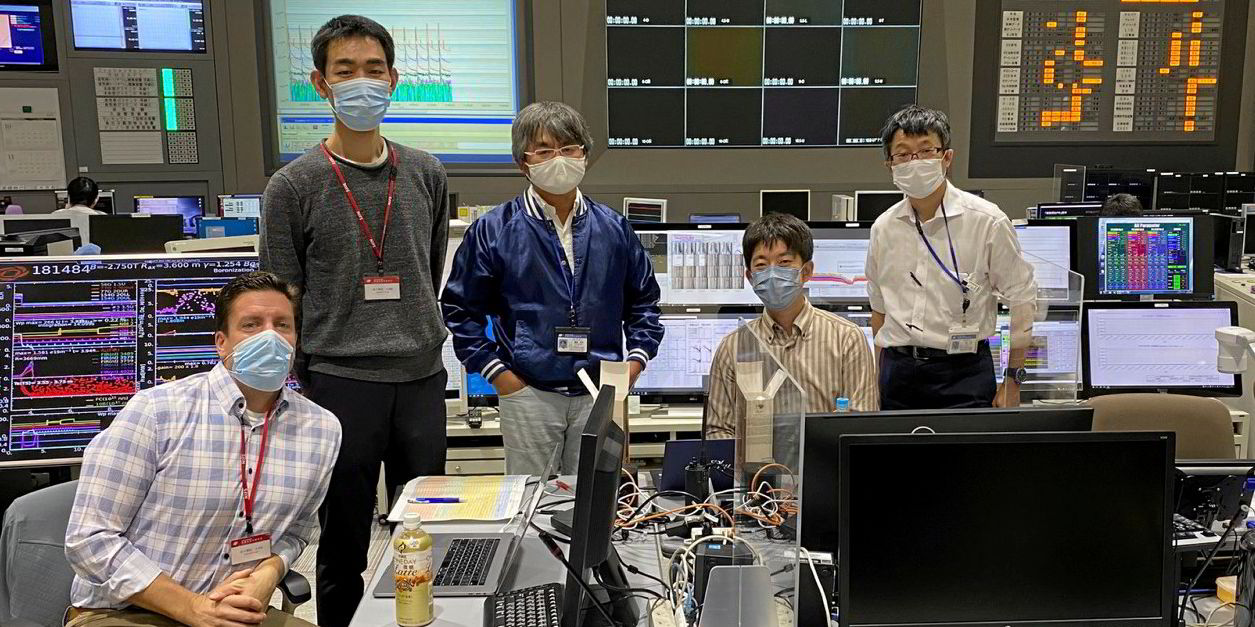
The TAE Technologies/Japanese National Institute for Fusion Science team Photo: TAE
“Inventing fusion reactors that produce net energy is one thing, delivering it as a reliable, grid-ready source of electricity is another. By choosing to pursue hydrogen-boron as a fuel cycle, TAE has anticipated the true demands of commercial, daily use of fusion energy.
“Most fusion efforts around the world are focused on combining DT hydrogen isotopes to use as fuel, and the donut-shaped tokamak machines commonly used are limited to DT fuel. Unlike those efforts, [our] design uses an advanced accelerator beam-driven field-reversed configuration that is versatile, and can accommodate all available fusion fuel cycles.”
This fuel-agnostic reactor design, which features a sensor able to detect helium nuclei alpha particles– the only emissions from H2-boron fusion, is expected to make it possible for TAE to license its technology “on the way to its ultimate goal” of connecting the first hydrogen-boron fusion power plant to the grid in the 2030s.
More than 30 research groups around the world are racing to commercialise fusion, seen as the “perfect power” source as the planet shifts away from the CO2 emitting fossil fuels that are contributing heavily to global heating
TAE highlighted that it had built five “national laboratory-scale” devices – with which it had generated and confined fusion plasma “more than 140,000 times” – and is currently building two further machines, dubbed Copernicus and Da Vinci, with a view to “demonstrating net energy and deliver power to the grid, respectively”.
US researchers at the US National Ignition Facility in California in December hailed fusion experiments that had achieved “ignition gain or energy gain”, where the energy released was greater than was pumped in the high-powered lasers used in the fusion process.
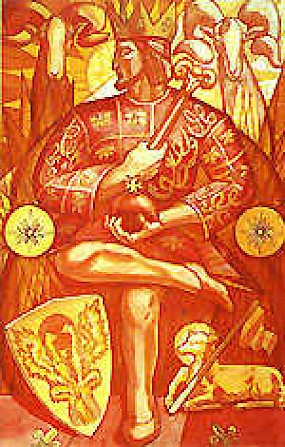
The Emperor is numbered four and is the Empress’s other half. Here is a man in the prime of life – successful, confident, secure and well-established. Where the Empress is allied with the Moon, the Emperor is aligned with the Sun.
The Emperor is quick and energetic, exerting dynamic control over his life. He feels born to rule and at his best is a thoughtful and sensitive leader. He listens to others but always the final decision is his own.
This is a man who has proved himself worthy. He has won most of his battles and now is the time to rule over a rich and bountiful land. He is the King Arthur type. He also represents fatherhood – fertile man, protector and providor.
When we are the Emperor, we are taking hold of our power. We are prepared to protect and defend the vulnerable, as well as to shed the lazy and weak. Finally, we are willing and ready to pass on what we have discovered to others who are ready to learn.
The Virgo Full Moon prompts us to find balance between practical, down-to-earth tasks and emotional, spiritual connections. Sometimes it’s difficult to access the deeper, subtler sides of life experiences, but when we become attuned — working from feelings and intuition — we can find the handling of ordinary, mundane affairs distressing! The focus on the Virgo/Pisces axis during this Full Moon challenges our sense of reality and urges us to work out our true priorities.
Examples include: someone fighting through a difficult divorce for economic reasons, staying in an unsatisfying job, or remaining in a less-than-ideal domestic situation. But ultimately, an untenable point could be reached and prompt us to step away for mental health reasons. Managing such extreme situations can be trying — but it doesn’t have to be that way!
This lunation shows the Sun in between Neptune and Mercury and the Moon in direct opposition to them all. These aspects are slightly wide for a typical “allowed orb” of eight degrees — but when the Lights are concerned, we may allow a few extra degrees for major aspects. With the Moon in Virgo, a range of options are offered through Neptune, the Sun, and Mercury. Some physical, mundane actions or connections, informed by choices related to Mercury and Neptune, could be important.
Mercury typically plays devil’s advocate, which means that even where we think we have no choice, our thoughts present another option! With Neptune, we may need a temporary escape: our job has to be done, so we build in a break with a walk through the park or woods, or by the stream or sea. Or we connect with music, poetry, fluid physical movements in exercise or dance — or any other activity with a flowing, freeing Neptunian quality that raises our sense of consciousness above the harsh moment of “now.”
Thus, we may be able to talk or write our way through something: anything from plotting out dialogue between characters in a novel to a straightforward text conversation with a friend — even in short-form and symbols! Or maybe we journal our thoughts — “I feel ‘X’ about what happened with ‘Y’ …” and, before we know it, we connect with feelings that reveal how a recent incident is rooted in memories of a more distant event. Instead of feeling stuck in a loop or flummoxed by too many choices, we find clarity — and some sort of release.
The closest aspect of the Moon is a trine to Uranus in Taurus, helping us connect afresh with the real world. Often, when Uranus plays a part in our affairs, the universe has our back and sweeps us forward with little effort of our own! We may hit snags or get messy here and there, but surely we’ll have something up and running quickly under this transit, and we’ll be supported by other people’s efforts. Jagged edges can be smoothed later.
As Taurus is Venus-ruled, a new opportunity promises pleasure, or at least basic satisfaction and fulfillment. Even if we experience slight shocks or over-excitement dealing with the unknown and quick developments, we can trust that something good is coming!
This article is from the Mountain Astrologer by Diana McMahon Collis
“Be not the slave of your own past – plunge into the sublime seas, dive deep, and swim far, so you shall come back with new self-respect, with new power, and with an advanced experience that shall explain and overlook the old.”
― Ralph Waldo Emerson
Ralph Waldo Emerson, who went by his middle name Waldo (May 25, 1803 – April 27, 1882), was an American essayist, lecturer, philosopher, abolitionist, and poet who led the transcendentalist movement of the mid-19th century. Wikipedia
In the age of the Anthropocene and entrenched politics of whiteness, Bayo Akomolafe brings us face-to-face with our own unresolved ancestry, as it becomes more and more apparent that we are completely entwined with each other and the natural world.
A STUNNING INVITATION is in the air, urging us to rethink ourselves, our bodies, our hopes for justice, and how we respond to the politics of whiteness. In these times of painful displacements, unavertable crises, and unexpected entanglements (the Anthropocene), the logic of race and identity collides with genetic technologies and splinters into new emergent insights into how bodies come to be enfleshed—granting us hope for becoming otherwise.
The story I write here might have a neat beginning and an ending, but this story is really about the middle-ingspace that gives birth to beginnings and endings. To be sure, it is about a good number of things—about race and racism, about black bodies, about the exterminations perpetrated in the name of superiority, about healing and decolonization, and about technology. And yet, it is at heart a letter about middles—not mathematical middles or the morality of balance in the way we often strive to find the golden mean between two extremes, but about how things interpenetrate each other, and how that leads us to interesting places. The middle I speak of is not halfway between two poles; it is a porousness that mocks the very idea of separation.
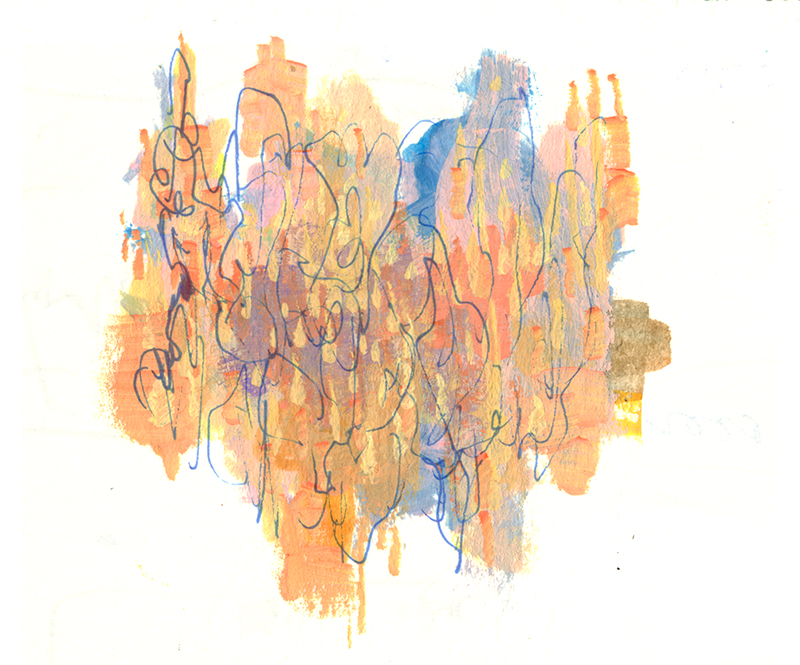
This is a tale about the brilliant betweenness that defeats everything, corrodes every boundary, spills through marked territory, and crosses out every confident line. The Yolngu people of Arnhem Land in northeastern Australia have a name for this “brilliance”: bir’yun (meaning “brilliance” or “shimmer”). It refers to a Yolngu aesthetic that is effected in paintings by crosshatching patterns and lines, which leave an optical impression of a shimmer. Bir’yun, more than just an artistic technique, speaks of ancestry cutting into the present, identities queered, tongues rendered unintelligible, and im/possibilities opening up. Bir’yun speaks of middles. And everything dies and begins in the middle.
When I was a child, I heard a story of beginnings from our Yoruba traditions about how the world came to be: they say there were once primal seas and raging waters below—and no land mass to counter their fury. Up above, the sky churned with the politics of a restless pantheon of Òrìshàs, non-human mythical beings who lived before humans. Olókun ruled the waters, and Olodumare—supreme above all—ruled the heavens. Between them, there was nothing. But, you see, “nothing” is never really as empty as some might think.
Obatálá, son of Olodumare—curious, restless, and uneasy with endless bliss—was inspired to create a people and the land they would rest on. With Olodumare’s blessings, he took leave of heavenly places and made his way down to the waters to begin his task. Just before he made his way, Obatálá consulted with Orunmila, Òrìshà of prophecy, who told him that he must prepare a chain of gold; gather palm nuts, with which he might hold the sand to be thrown over the waters; and obtain a sacred egg which contained a bird that would come in handy along the way. Obatálá did as instructed and secured these items. At the moment of departure, he fastened the golden chain to the sky and climbed down.
Can you take an instant to visualize this event? Imagine it for a moment: sky and swirling blue traversed by a shimmering chain that irrevocably and rudely links the heavens to the terrestrial, the divine to the mundane, the transcendent to the immanent, the infinite to the finite, nature to culture, masculine to feminine, beginnings to endings, unsettling both, re-configuring both just as well. In a sense, Obatálá’s epic adventure recreated everything.
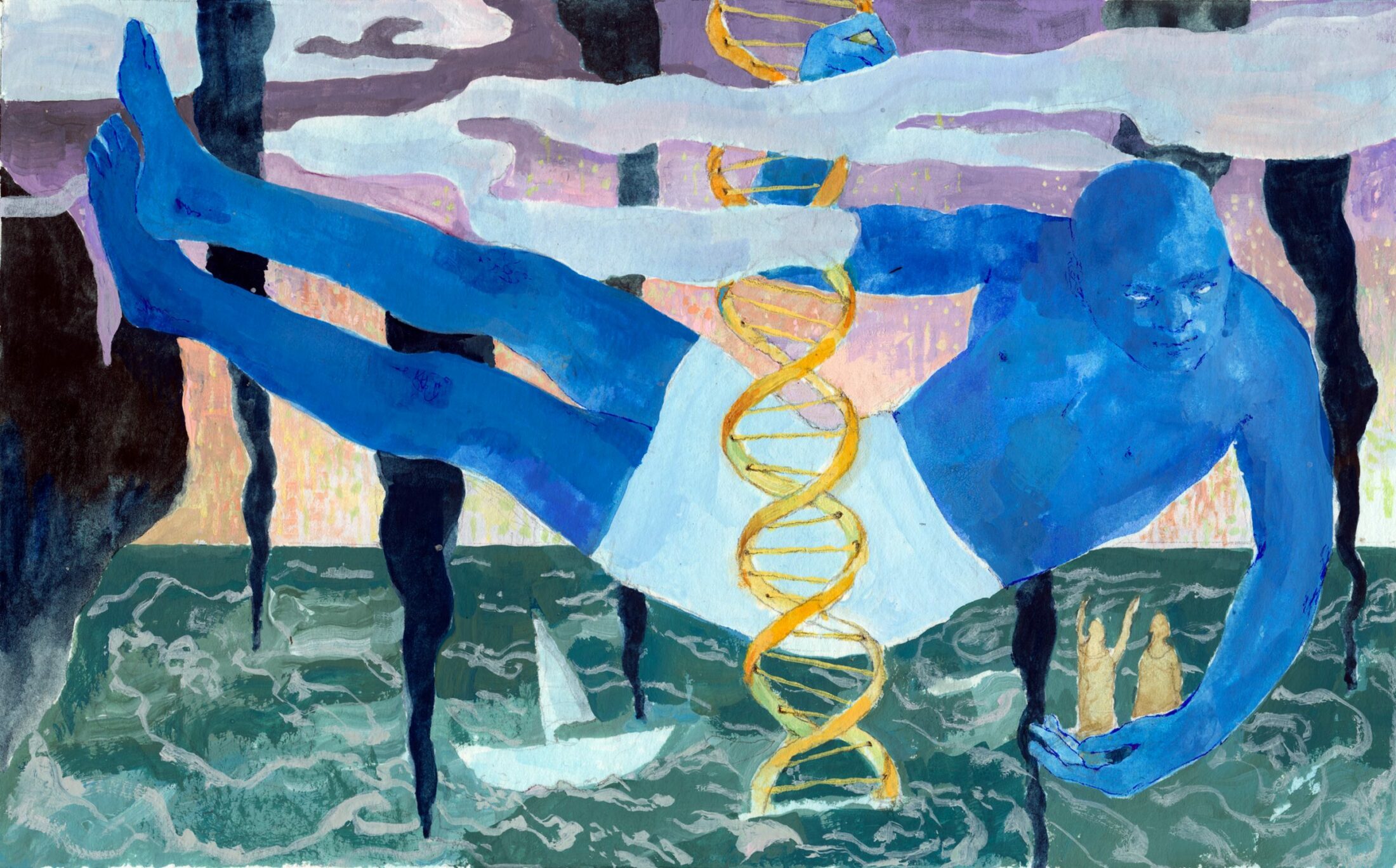
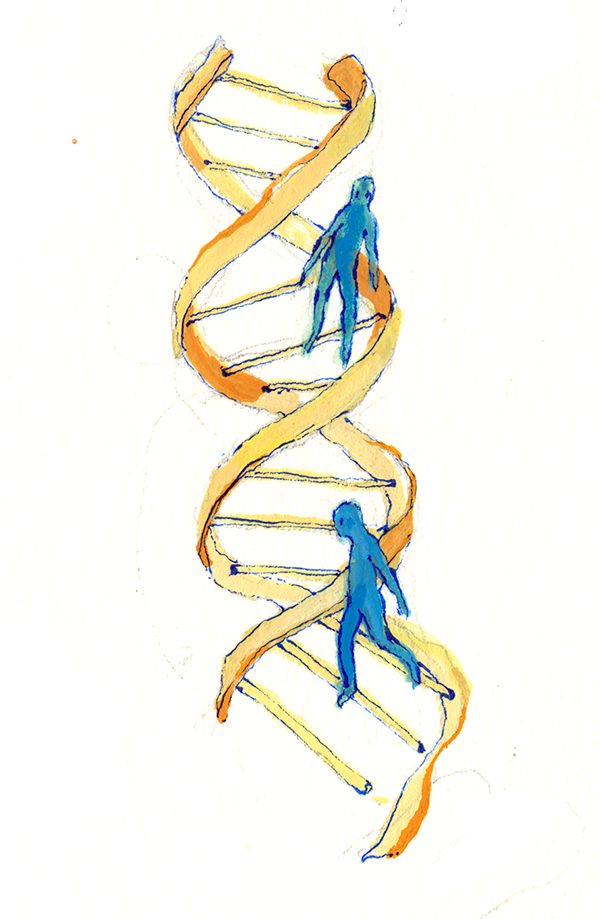
On Obatálá’s golden chain, poised in the grand between, hangs not just a riveting account of beginnings-that-are-not-originary (or “middles”), but a figure of shocking intersections or transversal happenings—a figure that is particularly alive and much needed right now. This chain—like Obatálá’s golden chain—disturbs everything, remakes everything … rethinks everything. Its helixes weave together new practices that open up new considerations about how to ask questions related to identity and racial justice. I speak of deoxyribonucleic acid, or DNA.
DNA IS THE HEREDITARY material found in humans and most organisms. Its molecular structure was discovered in 1953: two chains that wrap around each other to form a double helix shape.1 These chains, called nucleotides, hold genetic information and instructions that tell organisms how to behave, grow, eat, develop, become susceptible to disease, and heal themselves. In the years following its “discovery,” this molecule has become a site for different imaginings of what it means to be human, and our place in a larger web of mattering. Finding it was like a sentient pot of soup discovering the recipe book that created it. The closer we have looked, the more the wondrous molecule has divulged secrets about our “deep material” connections with the world around us.
DNA is frequently portrayed in popular culture (and even in scientific discourse) as something unchanging, as divine code that determines biology—how we think, eat, look, and grow. DNA as destiny. Although a thrilling consideration, it is from this bio-determinist take on DNA that some have insisted the molecule serves as a stern foundation upon which they might construct racist structures, or show why women are less well-off than men. This view attempts to reduce behavior, traits (phenotype), and everything that makes us human to changes in genetic sequence (genotype). It is a view that simplifies the complexity of life and makes way for absolutist thinking. We can now contest these claims to bio-determinism, racial superiority, and sexism by noting that the DNA molecule is not an essentialist script whose text—like some divine revelation—tells us what we really are.
DNA, like any other “discovery,” isn’t innocent or static: it isn’t just out there, awaiting the perfect lab instruments to open it up for scrutiny, pristine and disconnected from our approach. How we talk about it or the technologies we employ to measure it actively “create” it. The means and the end are intimately connected, and to change the former is to alter the latter. In this sense, the molecule most often shows up as a vector of determinism, inheriting the thinking that life’s startling complexity can ultimately be categorized, hierarchized, and reduced to a single or few sources. Over time, however, the idea of bio-determinism, though sticky and influential, has become largely discredited:2 The burgeoning influence of epigenetics has turned our attention to the environment as a critical contributor to the traits we exhibit. And feminist thinkers—reading determinism as oppression—have also tended to resist any attempt to deny the impact of culture, power, gendered privilege, and perspective on these supposedly neutral measurements of DNA and insist that the more popular iteration of the molecule (DNA as destiny) engenders racism and sexism.
A different vision of the DNA molecule is gaining ground, one which does not read the code as essentialist—a “beginning” or a source—but as an ongoing worldly practice, a meeting of bodies and environments, open to alterations. A middle. A crossroad of surprising intersections. The processes by which bodies become bodies are more complicated than simply attributing how bodies materialize to a linear causal flow from a single source (DNA) to bodily traits.3 A lot more is happening than racial or sexist categories can contain.
This is a tale about the brilliant betweenness that defeats everything, corrodes every boundary, spills through marked territory, and crosses out every confident line.
This is why we re-turn to DNA. Because “it” now unfolds within the Anthropocene—a time of blurred boundaries, a time of noticed confusion, when essences and static identities have become untenable. Because a curious inflection of events means Obatálá, Òrìshà of middles, now holds the molecule in his corrosive grip. With it, he whips open simple categories and established hierarchies of flow, making things spill out of their old containers. A new story soils the ground, one which confounds the neatness of racial order and racial justice. A complex portrait of how bodies come to matter is becoming definable and discernible. Like bir’yun art—composed with crosshatched lines, lending to the appreciative eye a visage of brilliance and movement—Obatálá’s chain perversely connects things to each other in unexpected ways.
We are not precisely who we thought we were. We are composite creatures, and our ancestry seems to arise from a dark zone of the living world, a group of creatures about which science, until recent decades, was ignorant. Evolution is trickier, far more complicated, than we realized. The tree of life is more tangled. Genes don’t just move vertically. They can also pass laterally across species boundaries, across wider gaps, even between different kingdoms of life, and some have come sideways into our own lineage—the primate lineage—from unsuspected, nonprimate sources.
—David Quammen4
I LEARNED THE WORD “Anthropocene” quite late, not in my younger days, when fiery gods and their pagan escapades were whispered about at the edges of our Christian lives, but when I put on a tie and began teaching in the university. The term means “Age of Man”; but it spells trouble, because it tells us of all the havoc we’ve caused by presuming ourselves lords over the earth, by not listening to the pollination songs of bees and the sermons of roots. Stories have consequences; ideas have bodies. And today, the idea of Man—phallic and independent—is in crisis.
Here’s what characterizes the Anthropocene: corrosive spillages and a frightening excess of broken ecological boundaries, damaged ecosystems, poisoned oceans, plastic landscapes, deforested landscapes, toxic multi-species exchanges, nuclear holocausts and mushroom clouds piercing the once-sacred demarcation between ground and heaven, rising carbon emissions, rising sea levels, oil spillages, loss of biodiversity, and proliferation of the horrific, evinced not merely in terms of genetic mutation but in our evolving analyses and capacities to notice how bodies interpenetrate other bodies, often in monstrous and unpredictable ways. What the Anthropocene refers to is the stunning impact of human activity on a now damaged planet; the very conditions of this epoch imperil both those who are blameworthy and those who are “innocent.”
But perhaps most important about this time is that the image of the human is being composted—or, we are experiencing great difficulty determining where the nonhuman stops and the human begins. Everything touches everything else in the Anthropocene—an observation that is supported by, say, current thinking about “holobionts,” assemblages of bodies within bodies within bodies, or intersecting communities that toss out notions of separable individuality. We are holobionts. We live and are lived through; we are composite beings, companion species, emerging within and among assemblages.
It is not only bodies that melt into other bodies in the Anthropocene. Time itself is shorn of its noble disinterestedness, and the past and future touch each other. In fact the Anthropocene does something queer and perverse to spacetime5—upsetting its presumed linearity and unidirectionality, making the past contemporaneous with the present, and resituating the “future” with the present and the past in the thick “now.” Time folds and melds in the Anthropocene the way taffy folds in on itself in the levers of a machine. My people, the Yoruba people, speak of circular time, slushy time, or time that collapses on itself. There are no arrows of time that fly forwards in Yoruba indigenous imagination; none of the incessant tick-tocking that has fuelled progress, that has become the soundtrack of our busy, delimited lives.
Indeed, it has been said that the Anthropocene is some sort of time travel—a sinful glimpse of the present from the vantage point of the deep future (“sinful” in that it upsets the supposed order of things). It is almost as if we are looking “back” at ourselves from the devastation of a toxic post-human world, trying to understand our age. What we see from this vantage point is allowing us to tell new stories about everything.
That’s why Obatálá is also the Òrìshà of the Anthropocene. Today, he is silhouetted against a wounded sky sewn with the rising plumes of smoke and dust, just above waters poisoned by oil and plastic and fed with the bodies of black slaves who drowned as ships carried their families to dehumanizing fields of labor. He hangs in the middle, redefining everything that precedes and succeeds. In revealing him as the deity of the Anthropocene, we notice another aspect of Obatálá. Later in the story, we learn that—after establishing the first settlement and populating it with humans that he himself creates from the dirt—Obatálá gets careless and gets drunk on palm wine. Tragically, in this state of stupor, he creates more people with broken limbs, bent-over backs, blind eyes, and bent bodies. He proliferates monstrous deviations from his original models, but then calls these his “special children,” loving them no less. By embracing the monstrous, the occluded, the forgotten, the queer, the disenchanted, and the displaced, not as a gesture of pity or compassion but as an act of acknowledgment, Obatálá foregrounds the strange—and calls them by a familiar name. He wields his shimmering chain today, showing hospitality to the monstrous—where we must now go to bring forward a different vision of race.
The future is necessarily monstrous: the figure of the future, that is, that which can only be surprising, that for which we are not prepared, you see, is heralded by species of monsters.
—Jacques Derrida6
MONSTERS ARE ADMITTEDLY horrific entities. But monsters did not sprout autonomous of context or history; they have always been in dynamic interaction with the “city” that exiles them to the wilderness. This is why monstrosity can serve as a cultural means to examine ourselves. To meet ourselves as if for the first time.
And, perhaps, there could be no better time to confront ourselves than now, in these times charged with racism and extermination.
I read monsters as cultural technology—as mythic figures that have always been intimately entwined with human becomings. From a time past remembering, we’ve needed monsters to define ourselves, to teach our children what not to do, to sound warnings about the future, to define the territorial boundaries of our habitats (and therefore carve out the wilderness), and to dream about the impossible. Indeed, monsters play a crucial social role: they challenge our addictions to particular forms and disturb the familiar. Their unusual appearances and queer bodies have long been employed as warnings of divine wrath to come, or something gruesome and perverse happening behind the scenes. In the sense that monsters cut through the parallelity of our lives, upsetting the business of the hour … astonishing us and opening up new considerations that were previously unavailable, they are transversal disruptions of order. They are playful reconfigurations of flesh and therefore embodiments of the radical openness of the real. Monsters teach us about the otherwise.
The emerging picture is that we are truly monstrous, composite all the way down, and that if we were to meet the meaty dimensions of our bodies, we would be frightened by just how unwieldy identities are. What we are learning about material embodiment is that to a certain degree we really are at a loss for words when it comes to making affirmative statements about our core identities: where we come from, where we belong, and what makes us, us.
Monstrosity can serve as a cultural means to examine ourselves. To meet ourselves as if for the first time.
THE IDEA OF RACE as a basis for human identity has a rich and troubled history, often dated back to the early seventeenth century when English colonists established Jamestown in the New World, hoping to happen upon gold but settling for tobacco and cotton when the prospects of finding the former began to dim. I wish there were space and time to follow the meandering paths carved out by this history, allowing us to notice that what we think of now as “natural” prejudices against colored people may not even have been present in 1607; and that there were Africans living in the “New World” as early as 1619 who were accepted as members of the turbulent colonies, some of whom had servants of their own, even European servants. There were marriages between “blacks” and “whites” that were not considered “intermarriages,” and there doesn’t seem to be any evidence that Africans were discriminated against for their physical appearance. In fact, in one of the New World colonies, Africans were deemed more “civilized” than the Irish.
After the armed rebellion of Nathaniel Bacon in 1676 (the agitation against the repressive policies and rule of Governor Sir William Berkeley of Virginia), the rulers of the colony began to institute laws that discriminated between Africans and their European siblings in the same socioeconomic class. These laws restricted Africans’ mobility, rescinded their claims to property, allowed them to be classified as property, and led to the importation of more Africans directly from Africa in the transatlantic slave trade.
In time, physical appearance (colorism) and other phenotypic features, like musculature, would become symbols of social status, and differences between populations would be exaggerated in order to justify the dehumanization of a “lower” class of people for economic motivations. Black blood, black brains, and black bodies became reified in this new atmosphere—and the emergent technoscientific enterprise, entangled with political-patriarchal-religious-economic interests (as is still the case today), began to write reports and produce knowledge that reinforced these increasingly white epistemologies of newfound supremacy. Eighteenth-century American physician Samuel Morton wrote extensively on the subject of craniometry, establishing a classificatory system that ranked Caucasian brains over African brains and Native American brains. Brain size was indicative of intellectual capacity, and the eventual demotion of non-Caucasian brains concretized white bodies as emblems of rational superiority: a stratagem for ensuring permanence and the longevity of the embryonic concept of whiteness.
In short, the fabric of the growing English colonies and, eventually, their American counterparts (post-1776), comprised of the emerging institutions and governance structures, was stitched with this superintending desire and intergenerational longing to maintain control over the dissident bodies that agitated against the ruling elite. The politics of racial segregation harks back to these twilight moments.
BUT STILL I WONDER: why does racism exist?
Why were black bodies in West Africa sold to seafaring traders from America? Why were they bought? Did the whip-bearer not see the humanity in the eyes of those whose backs he embroidered with scars and death? Did their stories not bleed out to query his fury? Did the Muselmänner prisoners in the Nazi concentration camps, standing gaunt and stripped of humanity, know the fleeting intervention of a passing smile—an acknowledging glance? What are the conditions making it possible for American immigration officials—themselves fathers and mothers—to participate in the incarceration of migrant children stripped away from their families at US borders? What stirred in spacetime or squirmed in gut-microbial-courtrooms when that white Starbucks store employee called the Philadelphia police on two black men, who had committed no crime except to delay their orders? Or when that white Subway employee decided that the Dobson family—black parents and their four black children on their way home from their grandmother’s birthday party—were about to rob her restaurant? Or when that gentleman called the police because a black woman using a public pool was “suspicious”? Or when those presumably well-meaning police officers gunned down a young black man in his own backyard as he clutched his phone?
Do we call these disturbing behaviors “evil”? Is this some DNA issue? Do we chalk it up to “hate,” “ignorance,” “wickedness” (as some religious folk back home might call it), or some attitudinal issue—this sticky and bewildering refusal to grant other-than-white bodies their humanity? What about my melanin-rich body makes some folks pucker up or wilt away in stereotypic fright?
Who will love my children? Who will love my stories?
The stark reality is that in our global order of intra-connected nation-states, black and brown bodies still occupy lower rungs on the ladder of humanity.
Dougal Robertson (January 29, 1924–September 22, 1991) was still a teenager, the youngest of a Scottish music teacher’s eight children, when he joined the British Merchant Navy. After a Japanese attack on a steamship during WWII killed his wife and young son, he left the navy and moved to Hong Kong, where he eventually met and married a nurse.
Together, they began a new life as dairy farmers in the English countryside, on a farm without electricity or running water. Eventually, they had a daughter, then a son, then a pair of twins.
After nearly two decades on the farm, the family had an unorthodox idea for how to best educate their children, how to show them what a vast and wondrous place the world is, full of all kinds of different people and all kinds of different ways of living: They sold everything they had, bought a schooner, and set out to sail around the world, departing on January 27, 1971.
The Robertson family
After more than a year at sea, just as they were rounding the tip of South America to begin their Pacific crossing, killer whales attacked the schooner 200 miles off the coast of Galapagos, sinking it in less than a minute. They piled into the inflatable life-raft, managed to grab a piece of sail from the water, and rigged it to the 9-foot dinghy they had on board to use it as a tugboat for the raft now housing six human beings.
Suddenly, they were a tiny speck in Earth’s largest ocean, enveloped by the vast open emptiness of infinite horizons. With no nautical instruments or charts, powered only by their makeshift sail, they had no hope of reaching land. Their only chance was rescue by a passing vessel. Given the immensity of the Pacific Ocean, it was an improbability bordering on a miracle.
The Great Wave off Kanagawa by Japanese artist Hokusai, 1831. (Available as a print and as a face mask, benefitting The Nature Conservancy.)
Seventeen days into their life as castaways, the raft deflated. All they had now was the narrow fiberglass dinghy, its rim barely above the water’s edge with all the human cargo.
By that blind resilience life has of resisting non-life, they persisted, eating turtle meat and sweet flying fish that landed in the bottom of the boat, drinking rainwater and turtle blood. Storms lashed them. Whales menaced them. Thirst and hunger subsumed them. Their bodies were covered in salt-water sores. Enormous ships passed within sight, missing their cries for help. But they pressed on, hoping against hope, toiling in every conceivable way to keep the spark of life aflame.
After 37 days as castaways, chance smiled upon them — a Japanese fishing boat spotted their distress flare and came to their rescue. Their tongues were so swollen from dehydration that they could hardly thank their saviors.
Restaging of the rescue, demonstrating how the family fit inside the dinghy.
Throughout it all, Dougal kept a journal in case they lived — an act itself emblematic of that touching and tenacious optimism by which they survived. He later drew on it to publish an account of the experience, then distilled his learnings in Sea Survival: A Manual (public library).
Nested amid the rigorously practical advice is a poetic sentiment that applies not only to survival at sea but to life itself — a soulful prescription for what it takes to live through those most trying periods when you feel like a castaway from life, beyond the reach of salvation, depleted of hope.
He writes:
I have no words to offer which may comfort the reader who is also a castaway, except that rescue may come at any time but not necessarily when you expect it; and that even if you give up hope, you must never give up trying, for, as the result of your efforts, hope may well return and with justification.
You can expect good and bad luck, but good or bad judgment is your prerogative, as is good or bad management.
This simple advice reads like a Zen koan, to be rolled around the palate of the mind, releasing richer and richer meaning, deeper and deeper assurance each time.
We are accidents of biochemistry and chance, moving through the world waging wars and writing poems, spellbound by the seductive illusion of the self, every single one of our atoms traceable to some dead star.
In the interlude between the two World Wars, days after the stock market crash that sparked the Great Depression, the German-American poet and future Nazi sympathizer George Sylvester Viereck sat down with Albert Einstein (March 14, 1879–April 18, 1955) for what became his most extensive interview about life — reflections ranging from science to spirituality to the elemental questions of existence. It was published in the Saturday Evening Post on October 29, 1929 — a quarter century after Einstein’s theory of relativity reconfigured our basic understanding of reality with its revelation that space and time are the warp and weft threads of a single fabric, along the curvature of which everything we are and everything we know is gliding.
Albert Einstein by Lotte Jacobi. (University of New Hampshire Museum of Art.)
Considering the helplessness individual human beings feel before the immense geopolitical forces that had hurled the world into its first global war and the decisions individual political leaders were making — decisions already inclining the world toward a second — Einstein aims in his sensitive intellect at the fundamental reality of existence:
I am a determinist. As such, I do not believe in free will. The Jews believe in free will. They believe that man shapes his own life. I reject that doctrine philosophically. In that respect I am not a Jew… I believe with Schopenhauer: We can do what we wish, but we can only wish what we must. Practically, I am, nevertheless, compelled to act is if freedom of the will existed. If I wish to live in a civilized community, I must act as if man is a responsible being.
When asked about any personal responsibility for his own staggering achievements, he points a steadfast finger at the nonexistence of free will:
I claim credit for nothing. Everything is determined, the beginning as well as the end, by forces over which we have no control. It is determined for the insect as well as for the star. Human being, vegetables or cosmic dust, we all dance to an invisible tune, intoned in the distance by a mysterious player.
For Einstein, the most alive part of the mystery we live with — the mystery we are — is the imagination, that supreme redemption of human life from the prison of determinism. With an eye to his discovery of relativity, he reflects:
I believe in intuitions and inspirations. I sometimes feel that I am right. I do not know that I am. When two expeditions of scientists, funded by the Royal Academy, went forth to test my theory of relativity, I was convinced that their conclusions would totally tally with my hypothesis. I was not surprised when the eclipse of May 29, 1919, confirmed my intuitions. I would have been surprised if I had been wrong.
[…]
I am enough of an artist to draw freely from the imagination. Imagination is more important than knowledge. Knowledge is limited. Imagination encircles the world.
“To lose the appetite for meaning we call thinking and cease to ask unanswerable questions,” Hannah Arendt wrote in her exquisite reckoning with the life of the mind, would be to “lose not only the ability to produce those thought-things that we call works of art but also the capacity to ask all the answerable questions upon which every civilization is founded.”
I have returned to this sentiment again and again in facing the haunting sense that we are living through the fall of a civilization — a civilization that has reduced every askable question to an algorithmically answerable datum and has dispensed with the unasked, with those regions of the mysterious where our basic experiences of enchantment, connection, and belonging come alive. A century and half after the Victorian visionary Samuel Butler prophesied the rise of a new “mechanical kingdom” to which we will become subservient, we are living with artificial intelligences making daily decisions for us, from the routes we take to the music we hear. And yet the very fact that the age of near-sentient algorithms has left us all the more famished for meaning may be our best hope for saving what is most human and alive in us.
Once a theologian in the making, studying at a fundamentalist Bible school, O’Gieblyn left the faith for a life as a rational materialist, but remained animated by the selfsame questions that course through the human-made story myths we call religion — questions about the relationship between the body and the tremors of consciousness we call soul, about the nature of reality, about the wellspring of meaning in an austere universe governed by fundamental forces and impartial laws with no room for blame or mercy. She takes up these questions with rigor and passion, tracing tendrils that reach into the vast and varied body of culture, from a robot dog to The Brothers Karamazov, from vitalism to transhumanism, from Descartes to Arendt.
To discover truth, it is necessary to work within the metaphors of our own time, which are for the most part technological. Today artificial intelligence and information technologies have absorbed many of the questions that were once taken up by theologians and philosophers: the mind’s relationship to the body, the question of free will, the possibility of immortality. These are old problems, and although they now appear in different guises and go by different names, they persist in conversations about digital technologies much like those dead metaphors that still lurk in the syntax of contemporary speech. All the eternal questions have become engineering problems.
1573 painting by the Portuguese artist Francisco de Holanda, a student of Michelangelo’s. (Available as a print and as stationery cards.)
O’Gieblyn recounts her early encounter with transhumanism and its patron saint, Ray Kurzweil, with his blazing prophecy that we shall reach the Singularity by the year 2045 — a point by which we would have so merged our bodies with our machines that we would survive death, our consciousness itself “resurrected” in a supercomputer. I have long marveled at the comical symmetry between such supposedly materialist models of reality and the religious mythologies of life after death from epochs past — a touching reminder of that elemental human yearning for permanence in a universe governed by constant change, a reminder that everything we dream up, everything we poetize and prophesy and code, is just our coping mechanism for the eternal struggle to bear our own mortality. O’Gieblyn arrives at a kindred conclusion:
It became clear to me that my interest in Kurzweil and other technological prophets was a kind of transference. It allowed me to continue obsessing about the theological problems I’d struggled with in Bible school, and was in the end an expression of my sublimated longing for the religious promises I’d abandoned.
[…]
Most transhumanists are outspoken atheists, eager to maintain the notion that their philosophy is rooted in modern rationalism and not in fact what it is: an outgrowth of Christian eschatology.
Our restlessness about mapping the relationship between mind and matter far predates the transhumanist movement. The dawn of quantum mechanics in the early twentieth century only complicated things, with its strange ricochets of causality between observer and observed. Drawing on the influential theoretical physicist John Archibald Wheeler’s It from Bit theory — in which he argued that “all things physical are information-theoretic in origin and this is a participatory universe,” that “observer-participancy gives rise to information” — O’Gieblyn writes:
Once you enter the quantum realm, the smallest particles, at a certain scale, dissolve into energy and fields, entities that have so little substance they appear nearly inseparable from the conceptual tools — math, probabilities — we use to describe them. This is baffling. How can objects as solid as rocks and chairs have nothing substantial at their core?
Wheeler’s answer was that matter itself does not exist. It is an illusion that arises from the mathematical structures that undergird everything, a cosmic form of information processing. Each time we make a measurement we are creating new information — we are, in a sense, creating reality itself. Wheeler called this the “participatory universe,” a term that is often misunderstood as having mystical connotations, as though the mind has some kind of spooky ability to generate objects. But Wheeler did not even believe that consciousness existed. For him, the mind itself was nothing but information. When we interacted with the world, the code of our minds manipulated the code of the universe, so to speak. It was a purely quantitative process, the same sort of mathematical exchange that might take place between two machines.
The reason that cybernetics privileged relationships over content in the first place was so that it could explain things like consciousness purely in terms of classical physics, which is limited to describing behavior but not essence — “doing” but not “being.” When Wheeler merged information theory with quantum physics, he was essentially closing the circle, proposing that the hole in the material worldview — intrinsic essence — could be explained by information itself.
Nowhere have our models of reality inclined further past the comprehension limits of the human mind than in multiverse theory — the idea that ours is not the only universe but one of numberless coexistent universes all forged by randomness, and ours, by a lucky play of statistical mechanics and probability theory, just happens to be hospitable to the chance-configuration of us. At first glance, multiverse theory appears like the ultimate antidote to the illusion that we are special — the same illusion that once placed us at the center of the universe, then at the center of the biosphere, and now at the center of consciousness. But O’Gieblyn exposes the basic human bias of even this model:
The multiverse theory and other attempts to transcend our anthropocentric outlook so often strike me as a form of bad faith, guilty of the very hubris they claim to reject. There is no Archimedean point, no purely objective vista that allows us to transcend our human interests and see the world from above, as we once imagined it appeared to God. It is our distinctive vantage that binds us to the world and sets the necessary limitations that are required to make sense of it. This is true, of course, regardless of which interpretation of physics is ultimately correct.
Delving into the far fringes of the speculative, that strange lacuna between science and spiritualism, she arrives at panpsychism — a theory particularly fashionable in our age of alienation and disconnection, satisfying that aching need for belonging, for communion, for interbeing with the world. She writes:
What interests me most about panpsychism is not what it says about the world but what it suggests about our knowledge of it. While popular debates about the theory rarely extend beyond the plausibility of granting consciousness to bees and trees, it contains far more radical implications. To claim that reality itself is mental is to acknowledge that there exists no clear boundary between the subjective mind and the objective world.
If consciousness is the ultimate substrate of everything, these distinctions become blurred, if not totally irrelevant. It’s possible that there exists a symmetry between our interior lives and the world at large, that the relationship between them is not one of paradox but of metonymy — the mind serving as a microcosm of the world’s macroscopic consciousness. Perhaps it is not even a terrible leap to wonder whether the universe can communicate with us, whether life is full of “correspondences,” as the spiritualists called them, between ourselves and the transcendent realm.
[…]
Panpsychism clearly satisfies a longing to escape modern alienation and merge once again with the world at large. But it’s worth asking what it means to reenchant, or reensoul, objects within a world that is already irrevocably technological. What does it mean to crave “connection” and “sharing” when those terms have become coopted by the corporate giants of social platforms?
At every turn, with every theory, we inevitably collide with the blinders of human bias, encoded in our machines — in algorithms that perpetuate the systemic biases of our society, in artificial intelligences that repeat the same pitfalls of reason that pock our own minds. Having begun with the observation that “for centuries we said we were made in God’s image, when in truth we made him in ours,” O’Gieblyn ends with the question of what it would take to dehumanize the universe and rehumanize ourselves:
The more we try to rid the world of our image, the more we end up coloring it with human faults and fantasies. The more we insist on removing ourselves and our interests from the equation, the more we end up with omnipotent systems that are rife with human bias and prejudice.
And yet pulsating beneath this hard-edged realism is a buoyancy, a largehearted curiosity, something we might even call faith — faith that “the most fascinating thing about the world [is] that we don’t know why it exists.” Radiating from it, at least for me, is a hint at how all of our why-probing instruments, from religion to ChatGPT, are but a gasp of gladness at the improbable fact that the world exists.
MEHDI HASAN’S DEBATES tend to go viral, like those against John Bolton, Erik Prince, or a Saudi ambassador. Hasan wipes the floor during debates and interviews. But it’s not an easy process; as Hasan says, it requires a lot of preparation. In “Win Every Argument: The Art of Debating, Persuading, and Public Speaking,” Hasan outlines the best ways to win debates against all sorts of opponents. This week on Deconstructed, Ryan Grim is joined by Hasan, where they discuss some of his greatest viral debate clips, along with helpful tips to win debates.
Consciousness, spirituality, biography, sexuality, androgyny, futurism, space, the arts, science, astrology, democracy, humor, books, movies and more







 I have no words to offer which may comfort the reader who is also a castaway, except that rescue may come at any time but not necessarily when you expect it; and that even if you give up hope, you must never give up trying, for, as the result of your efforts, hope may well return and with justification.


