Tarot Card for March 6: The Ace of Disks

The Ace of Disks

The Ace of Disks marks, on the everyday level, the start of a new project, which is likely to be successful. So it will come up to show a new job, or a new business venture. Usually this will be the sort of project that seems to continuously keep on growing, with each level of attainment producing – almost of itself – the next step in the journey.

Sometimes the Ace will come up to indicate a sudden change of material fortune, or a windfall – though either of these would have to be quite substantial to invoke the Ace. Aces are always big influences, marking the beginning of something new and important. So if we see the card coming up to represent a sudden input of funds, expect this to cause major changes in the querent’s life.

On a more spiritual level, this card relates to the Earth, and to the appreciation of Nature. It might mark a period where we draw closer to environmental issues, or where we engage in a period of study, contemplation and alignment with Earth forces.

One thing that we often miss, when considering spiritual development, is the way that each development grows out of the last. Anyone who has been involved in the search for spiritual truth will already have experienced the weirdly coincidental manner in which spiritual opportunities and teachers present themselves at the relevant stage in our growth.

There’s a saying – ‘The right teacher only appears when the student is ready’. It is as though we grow spiritually from the inside, the same way that trees do. And in so doing, maybe we develop inner rings – just like a tree’s trunk. The outer ring, just under the bark could not exist without all of the others it encircles.

We’re basically the same. The topic that we are exploring today has grown from all of the earlier topics we have looked into. Our experience is formed in layers, each of which is inter-dependent with the earlier ones. The Ace of Disks relates very closely with this method of human development – it shows us the way we grow. And warns us against trying to skip any of the stages!

The Ace of Disks

(via angelpahts.com and Alan Blackman)

Book: “Enough Is Enough: A Step-by-Step Plan to Leave an Abusive Relationship with God’s Help”

Enough Is Enough: A Step-by-Step Plan to Leave an Abusive Relationship with God’s Help

David E. ClarkeWilliam G. Clarke (Contributor)

You need to get to safety. Now.

When the abuse starts, that’s when you know enough is enough. It’s time to find a haven somewhere else. There will be a chance down the road to assess where your marriage is headed in the long term. No one is saying divorce is the inevitable outcome. God can transform anyone.

But He doesn’t promise to do that. People choose to persist in sin. And that’s why it’s imperative for you to leave . . . so you can think clearly, take stock of the situation, and most of all, protect yourself and those whom you love.

Dr. David Clarke, a licensed psychologist specializing in marital therapy for more than 30 years, wants to help you make the break from your abusive relationship. Whether or not divorce is on the horizon is beside the point. You need to get out so you can sort it out.

Dr. Clarke understands this journey won’t be easy. That’s why he provides a step-by-step plan that includes practical advice as well as biblical guidance. But leave you must, because abuse is a sin that doesn’t come from above. Let this book help you get away from your abuser so you can give your marriage the best chance to succeed. Because only with some distance will you be able to see what your loving, ever-faithful God has in store for you.

(Goodreads.com)

Bio: Francisco Goya

From Wikipedia, the free encyclopedia

In this Spanish name, the first or paternal surname is de Goya and the second or maternal family name is Lucientes.

Francisco de Goya
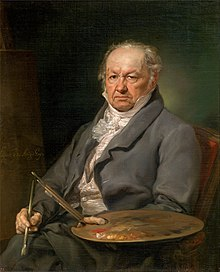
Portrait of Goya by Vicente López Portaña, c. 1826. Museo del Prado, Madrid
BornFrancisco José de Goya y Lucientes
30 March 1746
FuendetodosAragonSpain
Died16 April 1828 (aged 82)
BordeauxFrance
Known forPaintingdrawing
Notable workList of paintings and engravings
MovementRomanticism

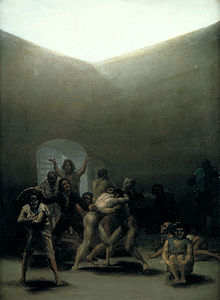
Yard with Lunatics, c. 1794

Francisco José de Goya y Lucientes (/ˈɡɔɪə/Spanish: [fɾanˈθisko xoˈse ðe ˈɣoʝa i luˈθjentes]; 30 March 1746 – 16 April 1828) was a Spanish romantic painter and printmaker. He is considered the most important Spanish artist of the late 18th and early 19th centuries.[1] His paintings, drawings, and engravings reflected contemporary historical upheavals and influenced important 19th- and 20th-century painters.[2] Goya is often referred to as the last of the Old Masters and the first of the moderns.[3]

Goya was born to a middle-class family in 1746, in Fuendetodos in Aragon. He studied painting from age 14 under José Luzán y Martinez and moved to Madrid to study with Anton Raphael Mengs. He married Josefa Bayeu in 1773. Their life was characterised by a series of pregnancies and miscarriages, and only one child, a son, survived into adulthood. Goya became a court painter to the Spanish Crown in 1786 and this early portion of his career is marked by portraits of the Spanish aristocracy and royalty, and Rococo-style tapestry cartoons designed for the royal palace.

He was guarded, and although letters and writings survive, little is known about his thoughts. He had a severe and undiagnosed illness in 1793 which left him deaf, after which his work became progressively darker and pessimistic. His later easel and mural paintings, prints and drawings appear to reflect a bleak outlook on personal, social and political levels, and contrast with his social climbing. He was appointed Director of the Royal Academy in 1795, the year Manuel Godoy made an unfavorable treaty with France. In 1799, Goya became Primer Pintor de Cámara (Prime Court Painter), the highest rank for a Spanish court painter. In the late 1790s, commissioned by Godoy, he completed his La maja desnuda, a remarkably daring nude for the time and clearly indebted to Diego Velázquez. In 1800–01 he painted Charles IV of Spain and His Family, also influenced by Velázquez.

In 1807, Napoleon led the French army into the Peninsular War against Spain. Goya remained in Madrid during the war, which seems to have affected him deeply. Although he did not speak his thoughts in public, they can be inferred from his Disasters of War series of prints (although published 35 years after his death) and his 1814 paintings The Second of May 1808 and The Third of May 1808. Other works from his mid-period include the Caprichos and Los Disparates etching series, and a wide variety of paintings concerned with insanitymental asylumswitchesfantastical creatures and religious and political corruption, all of which suggest that he feared for both his country’s fate and his own mental and physical health.

His late period culminates with the Black Paintings of 1819–1823, applied on oil on the plaster walls of his house the Quinta del Sordo (House of the Deaf Man) where, disillusioned by political and social developments in Spain, he lived in near isolation. Goya eventually abandoned Spain in 1824 to retire to the French city of Bordeaux, accompanied by his much younger maid and companion, Leocadia Weiss, who may or may not have been his lover. There he completed his La Tauromaquia series and a number of other, major, canvases.

Following a stroke which left him paralyzed on his right side, and with failing eyesight and poor access to painting materials, he died and was buried on 16 April 1828 aged 82. His body was later re-interred in the Real Ermita de San Antonio de la Florida in Madrid. Famously, the skull was missing, a detail the Spanish consul immediately communicated to his superiors in Madrid, who wired back, “Send Goya, with or without head.”[4]

Early years (1746–1771)

Birth house of Francisco Goya, Fuendetodos, Zaragoza

Francisco de Goya was born in FuendetodosAragónSpain, on 30 March 1746 to José Benito de Goya y Franque and Gracia de Lucientes y Salvador. The family had moved that year from the city of Zaragoza, but there is no record why; likely José was commissioned to work there.[5] They were lower middle-class. José was the son of a notary and of Basque origin, his ancestors being from Zerain,[6] earning his living as a gilder, specialising in religious and decorative craftwork.[7] He oversaw the gilding and most of the ornamentation during the rebuilding of the Basilica of Our Lady of the Pillar (Santa Maria del Pilar), the principal cathedral of Zaragoza. Francisco was their fourth child, following his sister Rita (b. 1737), brother Tomás (b. 1739) (who was to follow in his father’s trade) and second sister Jacinta (b. 1743). There were two younger sons, Mariano (b. 1750) and Camilo (b. 1753).[8]

His mother’s family had pretensions of nobility and the house, a modest brick cottage, was owned by her family and, perhaps fancifully, bore their crest.[7] About 1749 José and Gracia bought a home in Zaragoza and were able to return to live in the city. Although there are no surviving records, it is thought that Goya may have attended the Escuelas Pías de San Antón, which offered free schooling. His education seems to have been adequate but not enlightening; he had reading, writing and numeracy, and some knowledge of the classics. According to Robert Hughes the artist “seems to have taken no more interest than a carpenter in philosophical or theological matters, and his views on painting … were very down to earth: Goya was no theoretician.”[9] At school he formed a close and lifelong friendship with fellow pupil Martín Zapater; the 131 letters Goya wrote to him from 1775 until Zapater’s death in 1803 give valuable insight into Goya’s early years at the court in Madrid.[5][10]

Visit to Italy

At age 14 Goya studied under the painter José Luzán, where he copied stamps[which?] for 4 years until he decided to work on his own, as he wrote later on “paint from my invention”.[11] He moved to Madrid to study with Anton Raphael Mengs, a popular painter with Spanish royalty. He clashed with his master, and his examinations were unsatisfactory. Goya submitted entries for the Real Academia de Bellas Artes de San Fernando in 1763 and 1766 but was denied entrance into the academia.[12]

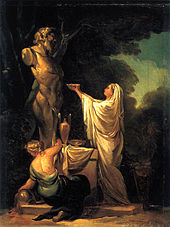
Sacrifice to Pan, 1771. Colección José Gudiol, Barcelona

Rome was then the cultural capital of Europe and held all the prototypes of classical antiquity, while Spain lacked a coherent artistic direction, with all of its significant visual achievements in the past. Having failed to earn a scholarship, Goya relocated at his own expense to Rome in the old tradition of European artists stretching back at least to Albrecht Dürer.[13] He was an unknown at the time and so the records are scant and uncertain. Early biographers have him travelling to Rome with a gang of bullfighters, where he worked as a street acrobat, or for a Russian diplomat, or fell in love with a beautiful young nun whom he plotted to abduct from her convent.[14] It is possible that Goya completed two surviving mythological paintings during the visit, a Sacrifice to Vesta and a Sacrifice to Pan, both dated 1771.[15]

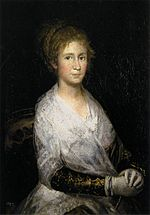
Portrait of Josefa Bayeu (1747–1812)

In 1771 he won second prize in a painting competition organized by the City of Parma. That year he returned to Zaragoza and painted elements of the cupolas of the Basilica of the Pillar (including Adoration of the Name of God), a cycle of frescoes for the monastic church of the Charterhouse of Aula Dei, and the frescoes of the Sobradiel Palace. He studied with the Aragonese artist Francisco Bayeu y Subías and his painting began to show signs of the delicate tonalities for which he became famous. He befriended Francisco Bayeu and married his sister Josefa (he nicknamed her “Pepa”)[16] on 25 July 1773. Their first child, Antonio Juan Ramon Carlos, was born on 29 August 1774.[17]

Madrid (1775–1789)

See also: List of Francisco Goya’s tapestry cartoons

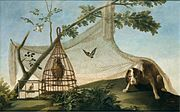
Caza con reclamo (1775)

The Parasol, 1777

Francisco Bayeu (Josefa Bayeu’s brother), 1765 membership of the Real Academia de Bellas Artes de San Fernando, and directorship of the tapestry works from 1777 helped Goya earn a commission for a series of tapestry cartoons for the Royal Tapestry Factory. Over five years he designed some 42 patterns, many of which were used to decorate and insulate the stone walls of El Escorial and the Palacio Real del Pardo, the residences of the Spanish monarchs. While designing tapestries was neither prestigious nor well paid, his cartoons are mostly popularist in a rococo style, and Goya used them to bring himself to wider attention.[18]

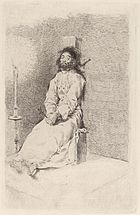
The cartoons were not his only royal commissions, and were accompanied by a series of engravings, mostly copies after old masters such as Marcantonio Raimondi and Velázquez. Goya had a complicated relationship to the latter artist; while many of his contemporaries saw folly in Goya’s attempts to copy and emulate him, he had access to a wide range of the long-dead painter’s works that had been contained in the royal collection.[19] Nonetheless, etching was a medium that the young artist was to master, a medium that was to reveal both the true depths of his imagination and his political beliefs.[20] His c. 1779 etching of The Garrotted Man (“El agarrotado”[21]) was the largest work he had produced to date, and an obvious foreboding of his later “Disasters of War” series.[22]

The Garroted Man, before 1780. National Gallery of ArtWashington, D.C.

Goya was beset by illness, and his condition was used against him by his rivals, who looked jealously upon any artist seen to be rising in stature. Some of the larger cartoons, such as The Wedding, were more than 8 by 10 feet, and had proved a drain on his physical strength. Ever resourceful, Goya turned this misfortune around, claiming that his illness had allowed him the insight to produce works that were more personal and informal.[23] However, he found the format limiting, as it did not allow him to capture complex color shifts or texture, and was unsuited to the impasto and glazing techniques he was by then applying to his painted works. The tapestries seem as comments on human types, fashion and fads.[24]

Other works from the period include a canvas for the altar of the Church of San Francisco El Grande in Madrid, which led to his appointment as a member of the Royal Academy of Fine Art.

Court painter

See also: List of works by Francisco Goya

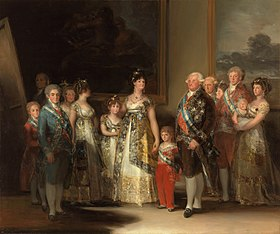
Charles IV of Spain and His Family, 1800–01[A]

In 1783, the Count of Floridablanca, favorite of King Charles III, commissioned Goya to paint his portrait. He became friends with the King’s half-brother Luis, and spent two summers working on portraits of both the Infante and his family.[26] During the 1780s, his circle of patrons grew to include the Duke and Duchess of Osuna, the King and other notable people of the kingdom whom he painted. In 1786, Goya was given a salaried position as painter to Charles III.

The Family of the Infante Don Luis, 1784. Magnani-RoccaParma

Goya was appointed court painter to Charles IV in 1789. The following year he became First Court Painter, with a salary of 50,000 reales and an allowance of 500 ducats for a coach. He painted portraits of the king and the queen, and the Spanish Prime Minister Manuel de Godoy and many other nobles. These portraits are notable for their disinclination to flatter; his Charles IV of Spain and His Family is an especially brutal assessment of a royal family.[B] Modern interpreters view the portrait as satirical; it is thought to reveal the corruption behind the rule of Charles IV. Under his reign his wife Louisa was thought to have had the real power, and thus Goya placed her at the center of the group portrait. From the back left of the painting one can see the artist himself looking out at the viewer, and the painting behind the family depicts Lot and his daughters, thus once again echoing the underlying message of corruption and decay.

Portrait of Manuel Godoy, 1801. Real Academia de Bellas Artes de San Fernando

Goya earned commissions from the highest ranks of the Spanish nobility, including Pedro Téllez-Girón, 9th Duke of Osuna and his wife María Josefa Pimentel, 12th Countess-Duchess of BenaventeJosé Álvarez de Toledo, Duke of Alba and his wife María del Pilar de Silva, and María Ana de Pontejos y Sandoval, Marchioness of Pontejos. In 1801 he painted Godoy in a commission to commemorate the victory in the brief War of the Oranges against Portugal. The two were friends, even if Goya’s 1801 portrait is usually seen as satire. Yet even after Godoy’s fall from grace the politician referred to the artist in warm terms. Godoy saw himself as instrumental in the publication of the Caprichos and is widely believed to have commissioned La maja desnuda.[27]

Middle period (1793–1799)

La maja desnuda, 1790–1800

La maja desnuda, 1790–1800

La maja vestida, 1800–1805

La Maja Desnuda (La maja desnuda) has been described as “the first totally profane life-size female nude in Western art” without pretense to allegorical or mythological meaning.[28] The identity of the Majas is uncertain. The most popularly cited models are the Duchess of Alba, with whom Goya was sometimes thought to have had an affair, and Pepita Tudó, mistress of Manuel de Godoy. Neither theory has been verified, and it remains as likely that the paintings represent an idealized composite.[29] The paintings were never publicly exhibited during Goya’s lifetime and were owned by Godoy.[30] In 1808 all Godoy’s property was seized by Ferdinand VII after his fall from power and exile, and in 1813 the Inquisition confiscated both works as ‘obscene’, returning them in 1836 to the Academy of Fine Arts of San Fernando.[31] In 1798 he painted luminous and airy scenes for the pendentives and cupola of the Real Ermita (Chapel) of San Antonio de la Florida in Madrid. Many of these depict miracles of Saint Anthony of Padua set in the midst of contemporary Madrid.

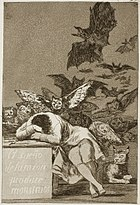
The Sleep of Reason Produces Monsters, c. 1797, 21.5 cm × 15 cm (8+12 in × 5+78 in)

At some time between late 1792 and early 1793 an undiagnosed illness left Goya deaf. He became withdrawn and introspective while the direction and tone of his work changed. He began the series of aquatinted etchings, published in 1799 as the Caprichos—completed in parallel with the more official commissions of portraits and religious paintings. In 1799 Goya published 80 Caprichos prints depicting what he described as “the innumerable foibles and follies to be found in any civilized society, and from the common prejudices and deceitful practices which custom, ignorance, or self-interest have made usual”.[32] The visions in these prints are partly explained by the caption “The sleep of reason produces monsters”. Yet these are not solely bleak; they demonstrate the artist’s sharp satirical wit, particularly evident in etchings such as Hunting for Teeth.

While convalescing between 1793 and 1794, Goya completed a set of eleven small pictures painted on tin that mark a significant change in the tone and subject matter of his art, and draw from the dark and dramatic realms of fantasy nightmare. Yard with Lunatics is a vision of loneliness, fear and social alienation. The condemnation of brutality towards prisoners (whether criminal or insane) is a subject that Goya assayed in later works[33] that focused on the degradation of the human figure.[34] It was one of the first of Goya’s mid-1790s cabinet paintings, in which his earlier search for ideal beauty gave way to an examination of the relationship between naturalism and fantasy that would preoccupy him for the rest of his career.[35] He was undergoing a nervous breakdown and entering prolonged physical illness,[36] and admitted that the series was created to reflect his own self-doubt, anxiety and fear that he was losing his mind.[37] Goya wrote that the works served “to occupy my imagination, tormented as it is by contemplation of my sufferings.” The series, he said, consisted of pictures which “normally find no place in commissioned works.”

Goya’s physical and mental breakdown seems to have happened a few weeks after the French declaration of war on Spain. A contemporary reported, “The noises in his head and deafness aren’t improving, yet his vision is much better and he is back in control of his balance.”[38] These symptoms may indicate a prolonged viral encephalitis, or possibly a series of miniature strokes resulting from high blood pressure and which affected the hearing and balance centers of the brain. Symptoms of tinnitus, episodes of imbalance and progressive deafness are typical of Ménière’s disease.[39] It is possible that Goya had cumulative lead poisoning, as he used massive amounts of lead white—which he ground himself[40]—in his paintings, both as a canvas primer and as a primary color.[41][42]

Other postmortem diagnostic assessments point toward paranoid dementia, possibly due to brain trauma, as evidenced by marked changes in his work after his recovery, culminating in the “black” paintings.[43] Art historians have noted Goya’s singular ability to express his personal demons as horrific and fantastic imagery that speaks universally, and allows his audience to find its own catharsis in the images.[44]

More at: https://en.wikipedia.org/wiki/Francisco_Goya

Jung on the irritations of others

C.G. Jung

“Everything that irritates us about others can lead us to an understanding of ourselves.”

― Carl Gustav Jung

Carl Gustav Jung (July 26, 1875 – June 6, 1961) was a Swiss psychiatrist and psychoanalyst who founded analytical psychology. Jung’s work has been influential in the fields of psychiatry, anthropology, archaeology, literature, philosophy, psychology, and religious studies. Wikipedia

IT’S A MAD, MAD WORLD—BUT ANOTHER UTOPIA ISN’T THE ANSWER

People Are Fed Up With Modernity’s False Promises, Says Author Pankaj Mishra, and It’s Time for a New Experiment

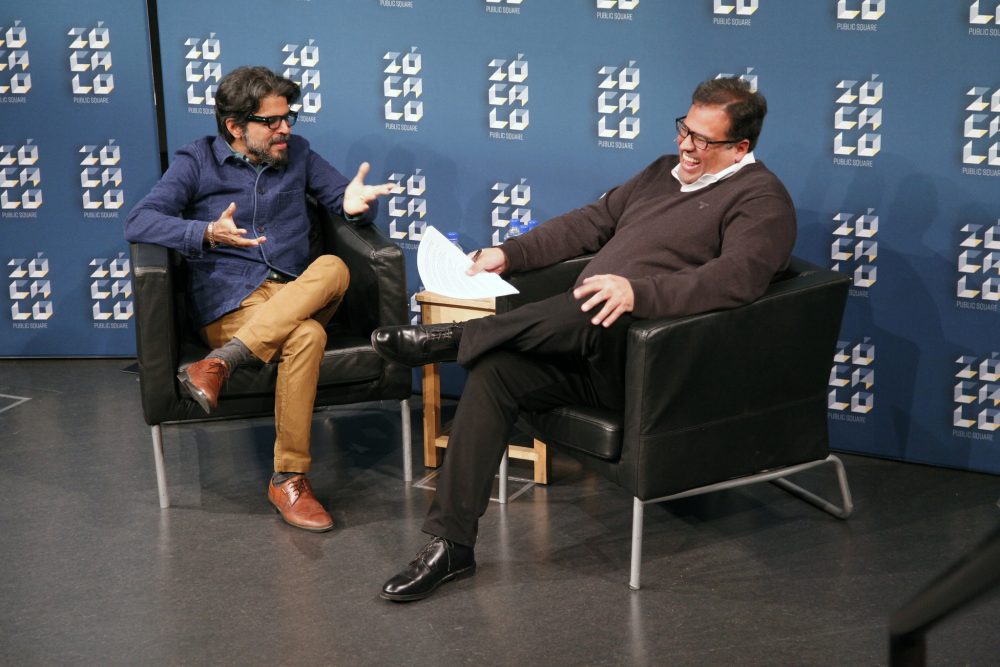
by REED JOHNSON | MARCH 2, 2018 (zocalopublicsquare.org)

The writer Pankaj Mishra has a name for an era in which frustrated young men commit savage acts of violence, society is starkly split into economic winners and losers, and despotic leaders exploit the public’s bitter resentments. He calls it the “Age of Anger,” which is also the title of his 2017 book, subtitled “A History of the Present.”

But that history begins long before our own benighted century. A pervasive and alarming sense of uprootedness and spiritual dislocation began brewing in the late 18th century in Europe, Mishra believes, and has mutated into “a global, universal experience.”

The resulting “contradictions are felt most painfully within one’s own soul, within one’s divided self,” Mishra said, setting the tone for a Zócalo event titled “Why Is the Modern World So Angry?” The fantastical promises of Western neo-liberal democracy, that all humanity could attain lives of prosperity and “enlightenment,” have proven “unfulfillable,” Mishra said. That has left millions of people feeling alienated not only from society but from themselves; their sense of disillusionment and fury has deepened since the fall of the Berlin Wall, leading to what Mishra calls a global “manic tribalism.”

GET MORE ZÓCALO

Ideas journalism with a head and heart.

You may opt out or contact us anytime.

How did Mishra come to this conclusion? Gregory Rodriguez, founder and editor-in-chief of Zócalo Public Square and the evening’s moderator, launched the conversation by asking Mishra about his self-characterization as a “stepchild of the West.” How did growing up in rural India during a period of intense and rapid change help shape Mishra’s ideas about a planetary maelstrom that has produced ISIS guerrillas, Russian cyber-hackers, and neo-Nazi skinheads wielding tiki torches in Charlottesville?

Mishra said that “practically everything I’ve written”—from histories to travel essays—has come out of his knowledge of friends and acquaintances who left college and plunged into a world of personal frustrations and constricted professional opportunities.

“I was really writing about the kind of young men I have grown up with, and you can find in large parts of Asia and Africa,” he said, “people uprooted from their traditional habitats who have been brought out of traditional village life.”

Their frustration and rage, widely shared in many parts of the world, hasn’t been reflected in popular media, said Mishra. Instead, we’re accustomed to seeing images of the “slumdog millionaire,” a poor parochial who somehow manages to realize the American Dream.

“My instinct has been to push back against this boosterish narrative,” said Mishra.

The narrative of “ambition, aspiration, and disappointment” is a new one. Millions of Indians in Mishra’s parents’ generation underwent the trauma of having to migrate from their ancestral villages in search of work, and reinvent themselves as urbanites. Yet often they were able to preserve some traditional aspects of their prior small-town lives without having to fully embrace modernity.

“My generation had to make a cleaner break,” Mishra said. He and his friends knew that learning English, and acquiring a knowledge of Western culture, was an essential “passport” for any kind of success in the modern world—for becoming what the West conceives of as a modern individual. But that process of self-reinvention comes at an excruciating psychological and spiritual price for many people in Asia, Africa, Latin America, and other places that for centuries have been scrambling to catch up materially with the United States and Europe.

Picking up on that point, Rodriguez asked whether the tone of Mishra’s 2004 book, An End to Suffering: The Buddha In the World, hadn’t posited a more hopeful, and healing message. How had Mishra’s thinking evolved between that book and Age of Anger?

Mishra jokingly cited Proust’s observation that everything that can be said has already been said, since nobody listens. “Perhaps the change of tone may be put down to the fact that I just got pissed off because nobody was listening.”

“You were younger, you seemed happy!” Rodriguez told him.

“I’m very happy today!” Mishra shot back. More seriously, he added, “There is something therapeutic about understanding. That has certainly motivated me to get to the bottom of things.” When he arrives at understanding, he said, it does feel somewhat “redemptive.”

Asked about his feelings toward the United States—and, in particular, the man serving in the White House—Mishra replied that he has many friends and colleagues here, feels very connected to American intellectual life, and sees America as “the most radical experiment in human history.”

But as someone who comes from India, and “who also has felt the sharp edge of American imperial power, it’s difficult not to be critical, and sometimes stridently, of American power in that part of the world.” He views the American faith in boundless expansion, and the inevitability of progress, with a sense of foreboding.

“I feel like we’ve come to the end of that experiment, and a new American experiment has to begin,” he said.

Some audience members followed up on this theme during the question-and-answer period. One asked about the relationship of the “age of anger” to the decline of U.S. power. Mishra said that what the United States is facing, and sometimes struggling with, is that many countries have been experiencing rising upward mobility at a time when U.S. growth has been relatively decelerating, and many Americans are watching their opportunities shrink relative to those of previous generations.

Another audience member asked what Mishra thinks the world should be like in the future. Mishra replied that he could only make such prescriptions for the limited locality in which he grew up. “The world is something too abstract for me,” he said. “Prescribing what the world should look like might be repeating the same error that has brought us to this point.”

Rodriguez also pressed Mishra about how the future world might reassemble itself, once the age of anger burns itself out. Could “some new broad sense of transcendence” emerge? What sort of structures would we need to foster and support a good society?

“I think we’ve invested far too much in utopias, in the idea that we’ve arrived at the end of history,” Mishra concluded. Such ideas are a cover for preserving the rights and privileges of a very small minority, he added.

As a writer and a native of rural India who now makes his home in cosmopolitan London, Mishra is comfortable at least knowing that his own future will remain rooted in a place in-between.

“Feeling too much at home in the world,” Mishra summed up, “is a recipe for complacency and intellectual laziness.”

REED JOHNSON is managing editor at Zócalo Public Square

A nascent men’s movement eschews orgasms for health reasons. Experts say the science doesn’t add up

How an online community became obsessed with the idea that ejaculation was hurting their mental and physical health

By TROY FARAH

Staff Writer (Salon.com)

PUBLISHED FEBRUARY 26, 2023 10:00AM (EST)

 Back view of shirtless man (Getty Images/Jonathan Knowles)Back view of shirtless man (Getty Images/Jonathan Knowles)

Never before in the history of humanity has so much pornography been so accessible to anyone with an internet connection. While one can debate whether this is socially healthy, a growing number of men contend that it isn’t physically healthy. This belief, which (naturally) has spread online, consists of men who are convinced that ejaculation — especially when coupled with pornography — is causing them major health issues. The only solution, they say, is to abstain from both.

Their internet circles include the million-plus members of Reddit’s “NoFap” community. There, you will find porn and masturbation blamed for everything from deficient penis size to low energy to lack of mental clarity. Above all, this self-pleasure is accused of causing erectile dysfunction, or the inability to sustain a satisfying erection.

A sort of cottage industry has sprouted around the idea of retaining semen and abstaining from masturbation and porn, despite a lack of evidence they work.

Sometimes self-describing as “fapstronauts,” — “fap” being onomatopoeic slang for male self-pleasure — these self-pleasure abolitionists are convinced that cutting out porn and masturbation will lead to a more fulfilling, healthy life. They also believe that using porn — even at a rate many sex researchers would consider “normal” — constitutes “addiction,” despite there being no scientific basis for porn addiction.

In the NoFap world, abstaining for long enough is called “rebooting,” based on the belief that abstinence resets the body and brain, which has been “rewired” by porn or masturbation. This, too, is not supported by neuroscience, psychology or basic human biology.

Related

Experts aren’t entirely sure why humans evolved orgasms

It may be true that porn and masturbation are problematic for some people. It may also be true that some people personally benefit from this sort of abstinence. Online support groups, which offer the benefit of pseudo-anonymity, might be the type of community that helps someone out of such a rut, if they need it. But some people may use similar online tools to cut alcohol or sugar out of their life — it doesn’t mean everyone has a problem with it or that it inherently destroys one’s life.

Yet these forums are quite militant in their beliefs that porn is a scourge on society that is emasculating men, an activity for “cucks” or “beta males” — all of which is part of a larger conspiracy to control and subjugate the masses. NoFap and other communities claim to be secular, but nonetheless, much of the language is reminiscent of Christian moralizing about masturbation. They’ve also adopted militant, often violent language, self-describing as “warriors” who are waging a battle against lust.

“Semen retention has a history that’s a lot longer than the internet, and still lingers today. Eighteenth-century philosopher Immanuel Kant considered masturbation morally worse than suicide,” Cole wrote.

There are many different subgroups that have adopted various rules about porn and self-pleasure, so it can be hard to make generalizations about all of them, but subreddits like “SemenRetention” (which has 134,000 subscribers) and the online forum NoFap.com do have something in common in that they present warped scientific evidence and misrepresent the concept of addiction.

Indeed, there’s no evidence that ejaculating makes one weaker, less intelligent or produces lower levels of testosterone, a hormone produced in both men and women. Low amounts of testosterone are implicated in reduced sex drive, but this is a bit of an oversimplification of a complex molecule our bodies uses for many processes.

Even though pornography has existed for thousands of years (just ask the ancient Egyptians), “porn addiction” is a relatively new category that arose in the ’90s as the modern web emerged. Samantha Cole, a journalist that covers the intersection of sex and tech, traces this history in her 2022 book “How Sex Changed the Internet and the Internet Changed Sex.”

“There’s a whole industry where people are going to, like, rehab for porn. And obviously, there’s something else going on there with them.”

“Semen retention has a history that’s a lot longer than the internet, and still lingers today. Eighteenth-century philosopher Immanuel Kant considered masturbation morally worse than suicide,” Cole wrote. “John Harvey Kellogg, the maker of Kellogg’s cereal, and Rev. Sylvester Graham, the creator of graham crackers, invented corn flakes and graham crackers to be so boring they’d kill libido.”

Even today, a sort of cottage industry has sprouted around the idea of retaining semen and abstaining from masturbation and porn, despite a lack of evidence they work.

“There’s a whole industry where people are going to, like, rehab for porn. And obviously, there’s something else going on there with them,” Cole told Salon. “They think it’s gonna be some kind of like magical fix for their lives and they feel better because it’s something that they can control. But that’s the thinking around a lot of different mental illnesses. Control some part of your physical self and maybe you can fix your emotional or your mental state. It’s brilliant marketing if you want to control people, but obviously, it’s so damaging in the long run.”

To those following MGTOW, porn is just another way for women to “shamelessly” use their bodies to “take financial advantage of men’s biological weakness.”

Perhaps unsurprisingly, these beliefs appeal to many right-wing figures, who perhaps see common cause in their puritanical nature. Hence, being anti-porn and anti-masturbation have become tenets of many misogynist groups, including the Proud Boys, an alt-right extremist group that forbids its members from ejaculating alone more than once a month. “If he needs to ejaculate it must be within one yard of a woman with her consent,” one of their rules read. “The woman may not be a prostitute.”

Not everyone on boards like NoFap are associated with misogynist groups, of course, but there is considerable overlap between the two.

“Whatever people want to do with their bodies is totally fine. It’s just that a lot of the communities become so evangelical about it, they have to recruit more people into the idea to then justify the behavior,” Cole says. “That’s kind of how it ends up snowballing into incels [involuntary celibates] or Men Going Their Own Way, or some of these other communities that are really toxic and damaging.”

Men Going Their Own Way (MGTOW) is just one anti-feminist, misogynistic realm of the broader “manosphere,” the digital manifestation of the Men’s Liberation Movement, which views women’s rights as an affront to male dominance. MGTOW specifically believe feminism has ruined society and the only solution is for men to “mobilise against a supposed gynocratic conspiracy,” as an article in The Guardian put it. To those following MGTOW, porn is just another way for women to “shamelessly” use their bodies to “take financial advantage of men’s biological weakness.”


Want more health and science stories in your inbox? Subscribe to Salon’s weekly newsletter The Vulgar Scientist.


Not everyone who dislikes porn or shuns masturbation has such extremist views. Regardless, there is not really much evidence to back up claims that porn or masturbation ruins one’s mental or physical health. However, when Dr. Nicole Prause, a neuroscientist and sexual psychophysiologist who founded Liberos, a sexual biotech company in Los Angeles, published research pushing back against these groups, she says she received death threats and harassment.

“I didn’t understand why you would threaten to kill someone over study results,” Prause told Salon. “It does color the kind of research that’s done. I’ve definitely had colleagues who don’t ask certain questions because they don’t want to get in their crosshairs. I do think scientists are fearful of getting involved in anything that might make them targets of these kinds of groups.”

NoFap was founded by Alexander Rhodes, a Pittsburgh web developer, in 2011. It began with a Reddit thread posted by Rhodes linking to a 2002 Chinese study that found participants that abstained from masturbation for a week experienced a 45 percent increase in testosterone levels.

But when Prause contacted the study authors to request some of their data (a normal procedure in scientific circles), she was met with a series of angry emails refusing to disclose anything. The paper was later retracted when it was discovered only one of the four authors could be accounted for and that the study had already been published. Scientific communities generally frown on self-plagiarism. The original, which had a small sample size and was not blinded, also showed a return to baseline on the 8th day, so the spike in testosterone wasn’t entirely significant, if it truly existed. Those are all some serious strikes against the conclusions drawn from this paper.

Masturbating doesn’t seem to lower testosterone levels — and why would it? If the body and mind are engaged sexually, they will produce more of the hormones involved, including testosterone. Both semen and testosterone are produced for a reason, but our bodies also like homeostasis. If someone tries to retain their semen, it will likely be expelled eventually through a nocturnal emission or “wet dream.” So much for trying to hold it in.

In fact, “long-term abstinence is more likely to decrease testosterone over time,” Prause says. “So I always find it strange that that’s one of their central claims. It’s literally the opposite. But we can’t get that myth dislodged.”

Though testosterone is related to sexual desire or libido, its levels in the blood don’t change much following orgasm. Instead, following climax, the brain releases many chemicals used for cellular signaling including dopamine, oxytocin and prolactin, which a 2019 study described as generating “a deep sense of well-being.” It’s not associated with brain damage, because obviously, humans evolved the ability to orgasm for a reason.

Stimulating this aspect of the brain artificially through pornography doesn’t automatically mean it will ruin one’s ability to enjoy sex, let alone permanently rewire the brain. This might go without saying, but porn will likely never be an adequate replacement for in person sex with other people, at least for the majority of folks. No amount of videos or virtual reality or silicon toys can replicate another person’s touch.

“The stimulus from porn cannot generalize to the partner context,” Prause says. “For example, within the dermis of your skin, there are things called afferent fibers. These only become active when stroked at a moderate velocity — not slow or fast — by another human hand. Porn cannot do that.”

Furthermore, porn is not addictive in the same way as drugs can be, though that doesn’t mean it can’t be problematic. Addiction is a very precise medical term defined by the American Psychiatric Association (APA) as uncontrolled use of a drug despite negative consequences. The APA does not classify viewing porn, even compulsively, as an addiction or a mental disorder.

Last year, the World Health Organization added compulsive sexual behavior disorder, (defined as inability to control intense sexual urges), to its eleventh edition of the International Classification of Diseases. The condition includes “extensive use of pornography,” but fits under a much broader umbrella of impulse control disorders related to sexual behavior and is still not classified as an addiction.

This might seem pedantic, but it’s an important distinction. Addiction, technically known as substance use disorder, really only applies to drugs. Addiction is really far more complex than being horny and relieving oneself with a video. At a certain age, it’s natural to have sexual urges and want to alleviate them. That’s why it’s so hard for some people to stop masturbating, because it’s fighting an innate part of human physiology. And for most people, it’s unlikely that porn will damage their sex lives or lead to less frequent sex with other people.

“We have decades of studies saying the opposite. That is, you view more porn, you have more partners, you want more sexual things in general,” Prause says. “We call it a breadth of sexual stimuli.”

Research suggests that porn isn’t the cause of poor mental health, but depression and anxiety are, in and of themselves, causing problems with sexual satisfaction.

In other words, porn can be part of a healthy, satisfying sex life. But some people do experience problems with being unable to stop watching porn, even when they want to abstain. This may create feelings of distress, depression, shame and anxiety, which can translate into the bedroom as reduced sexual performance.

Yet dozens of studies have failed to find a link between porn and erectile dysfunction (ED), and some of Prause’s research suggests that ED has more to do with poor mental health than viewing naked people online.

In a study published last October in the Journal of Psychosexual Health, Prause and her colleague James Binnie at London South Bank University’s department of psychology surveyed 669 people who were familiar with “rebooting.”

They found that those who participated in NoFap or Reboot treatments were more like to report ED, but also more likely to report anxiety. The worse their anxiety, the more they struggled with keeping it up, but this relationship was not influenced by how much porn was consumed.

In other words, this study and other research suggests that porn isn’t the cause of poor mental health, but depression and anxiety are, in and of themselves, causing problems with sexual satisfaction.

“We and others have found a lot of evidence for depression in these populations,” Prause says, referring to the anti-orgasm crowd. “You may really be struggling with something real, but it ain’t porn. You have depression and you’re trying to figure out how to feel better.”

Masturbation is quite normal. Many animals do it, including primates, bats, walruses, dolphins, rodents and even some birds. However, just because there is no scientific evidence that porn will cause brain damage or ruin your sex life, it’s never a bad thing to reevaluate your relationship with a behavior or habit. Ask yourself: Is this really serving me? Do I enjoy this? Is this harming my relationships or social responsibilities?

If porn or masturbation aren’t causing you harm, why feel ashamed of it? But if they are, shame still won’t help. No one is worthless or a pervert just for enjoying sexual content or self-pleasure, but self-control is key.

“I don’t doubt that people struggle with their sexual behaviors, and that people view more pornography than they intend to sometimes. The question is, when someone comes in and presents with that, what do you do?” Prause says. She recommends talking to a therapist or looking into Acceptance and Commitment Therapy, a process-based intervention that incorporates mindfulness strategies and acceptance to open up more psychological flexibility.

Read more about sexual health

By TROY FARAH

Troy Farah is a science and public health journalist whose reporting has appeared in Scientific American, STAT News, Undark, VICE, and others. He co-hosts the drug policy and science podcast Narcotica. His website is troyfarah.com and can be found on Twitter at @filth_filler

Rupert Spira on having an agenda

Don’t have any agenda with the content of experience. The reason why awareness is always at peace and happy is precisely because it does not have any agenda with the content of experience. It simply allows experience be as it is and, as a result, experience allows awareness to remain as it is.

–Rupert Spira

Rupert Spira (born March 13, 1960) is an English spiritual teacher, philosopher and author of the Direct Path based in Oxford, UK. Wikipedia

(newsletter@rupertspira.com)

My child taught me to challenge the gender binary

article image

LAURIN MAYENO

FEBRUARY 28, 2023 (DailyCal.org)

“You had a baby boy!” were some of the first words I heard after the birth of my child. But, within Danny’s first few years, I began to wonder. They loved little ponies, dolls, unicorns, dresses and princesses, and only befriended the girls at preschool.

At first, I worried that something was wrong with Danny and it was my fault. When they told me they wanted to be a princess for Halloween, I tried to gently dissuade them from it. But they knew exactly what they wanted, and I relented. I worried about their future and cringed when I saw reactions from other adults. At that initial stage of parenting a nonbinary child, although I loved Danny with all my heart, I failed to give them the wholehearted affirmation they needed. 

Over time, I realized that it wasn’t Danny that needed to change. Their way of being was a gift that helped me look inward and challenge my own ideas: Why did I worry that behaviors considered normal and healthy for a girl might be wrong for my child? Why did it scare me to think that my child might be gay or transgender?  

I didn’t realize it, but like many people who grew up in this colonized world, I was trained in either/or thinking. When it came to gender, I took it for granted that humans were one of two genders, without questioning our method for assigning gender based on genitalia. 

During my childhood, nobody spoke to me about gender roles. Rather, I absorbed this information through the world around me. The books I read or the TV shows and movies I watched all presented a heterosexual and binary world; transgender, nonbinary and queer people did not exist in the media I consumed. 

I saw rewards and punishments being doled out to people based on how well they played the assumed roles of their assigned genders. I internalized that girls were rewarded for being pretty and well-behaved, which would lead to the ultimate reward of marrying a charming prince. Boys were rewarded for being tough and strong and one of the worst put-downs for a boy was to be called a girl. 

Even with my child,  I didn’t learn about the gender binary until Danny was in their teens. After they came out, I got involved in organizing and supporting families with LGBTQ+ children in Latine and Asian communities. From queer and trans activists, I learned that the gender binary imposes rules and expectations on us throughout our lives. These include how to dress, look, behave, move, speak and identify, who to love and which bathroom or locker room to use. People who live by the rules are privileged in their ability to do so. Those who don’t are marginalized and punished. I was the mother of a child who couldn’t live by those rules and be themself. 

I also learned that the either/or way of looking at gender is anything but natural and that gender diversity has existed within many cultures throughout history. For centuries, the gender binary system has been forced on Indigenous cultures and used to treat Black people, Indigenous people and people of color as less than human because of their divergence from it. The gender binary impacts many aspects of how our lives and institutions are organized and reinforces hierarchies of racial oppression and privilege. 

Unlearning the gender binary helped me wholeheartedly embrace and celebrate my queer, nonbinary child for who they are. Now, nothing brings me more joy than seeing Danny live their truth loudly and proudly. Unlearning systemic gender directives has also given me more freedom to be myself: I’m more at peace with who I am, less fearful of others’ judgment and more able to speak and live my own truth.

I have come to believe that freeing ourselves from binary thinking around gender can significantly reduce the pain we inflict on ourselves and others. If binary ideas about masculinity and femininity weren’t used to measure our worth, we would all have more freedom to discover ourselves. We wouldn’t be compelled to assign gender to our children even before they are born. Trans and nonbinary children wouldn’t have to fight against these assignments just to be who they are. Trans people wouldn’t face discrimination in most areas of their lives, or have their lives cut short by violence. Parents wouldn’t be investigated for child abuse for supporting their transgender children. LGBTQ+ books wouldn’t be banned and Drag Story Hours wouldn’t be attacked. 

Rather than suppressing the rights of queer, trans and nonbinary folks, we should support their leadership and liberation. If we can move beyond the gender binary as we work for social justice, we can all live more authentic and joyful lives. Imagine a world with no pressure to live up to gender rules. Imagine families, schools and communities where we grow up feeling safe, loved and affirmed for who we are. This is a world I want to live in.

Contact Laurin Mayeno at laurin@mayenoconsulting.com

LAST UPDATED FEBRUARY 28, 2023