exuviate
PRONUNCIATION: (ig-ZOO-vee-ayt)
MEANING: verb tr., intr.: To shed or cast off.
ETYMOLOGY: From Latin exuere (to take off). Earliest documented use: 1855.
Wordsmith (wsmith@wordsmith.org)




We are multidimensional phoenixes who rise out of every fire.
Art by Torus Energy Artworks: https://torusenergyart.com/
(Courtesy of Rob Brezsny)
Jason Silva: Shots of Awe Jun 1, 2018 For non commercial, educational use only – dedicated to Michael Pollan’s book HOW TO CHANGE YOUR MIND CREDITS: PRODUCED and PERFORMED by Jason Silva DIRECTED and EDITED by Marija Guar Coneva https://nobody.persona.co/ MUSIC – Joel Thomas || NCM Epic Music Ender Guney || Gunnbladez || Plagasul || Toiletrolltube
(Contributed by John Atwater, H.W.)
The Lord of Strife usually appears in a reading to indicate quarrels, conflict and discord. There is rarely anything of value to be gained from the disharmony introduced by this card – in fact, it will often indicate bitterness and argument for argument’s sake.
To try to determine how serious the strife will be, look for cards like Nine of Swords, Ten of Swords or the Tower to indicate a really bad situation. With cards such as the Eight of Wands or the Six of Wands it’s probable that the friction may clear an outstanding problem area.
This card will often come up when some-one is very unhappy with a working situation – there is, perhaps, a clash of personality with somebody else; or perhaps the individual is unhappy with working practises. Often in this situation there’s a tendency toward rashness and loss of control which can lead to further problems.
Another time that the Lord of Strife will make an appearance is when we are in inner conflict – most often about something we consider to be immoral. This is probably the most significant type of problem that can be highlighted with this card. For instance, if we have taken an easy option, or a dishonest turn, and are now troubled by the voice of our conscience, we could expect to see the Lord of Strife appearing.
In this case we need to set right whatever we believe we have done wrong – or failed to do altogether. We will not be at peace until we do. The Five of Wands is a card that reminds us quite firmly about the ethical considerations that underpin the Suit of Wands.

(via angelpaths.com and Alan Blackman)
From Wikipedia, the free encyclopedia

Look up jamais vu in Wiktionary, the free dictionary.
In psychology, jamais vu (/ˌʒæmeɪ ˈvuː/ ZHAM-ay VOO, US: /ˌʒɑːm-/ ZHAHM-, French: [ʒamɛ vy]), a French loanword meaning “never seen”, is the phenomenon of experiencing a situation that one recognizes in some fashion, but that nonetheless seems novel and unfamiliar.
Jamais vu is often described as the opposite of déjà vu. Jamais vu involves a sense of eeriness and the observer’s impression of experiencing something for the first time, despite rationally knowing that they have experienced it before. Jamais vu is sometimes associated with certain types of aphasia, amnesia, and epilepsy.
Jamais vu is more commonly explained as when a person momentarily does not recognise a word or, less commonly, a person or place, that they already know.[1] This can be achieved by anyone by repeatedly writing or saying a specific word out loud. After a few seconds one will often, despite knowing that it is a real word, feel as if “there’s no way it is an actual word.”
The phenomenon is often grouped with déjà vu and presque vu (tip of the tongue, literally “almost seen”).
Theoretically, a jamais vu feeling in a sufferer of a delirious disorder or intoxication could result in a delirious explanation of it, such as in Capgras delusion, in which the patient considers someone they know to be a false double or impostor. If the patient sees themselves as the impostor, the clinical setting would be the same as the one described as depersonalization; hence, jamais vus of oneself, or of the very “reality of reality”, are termed depersonalization and derealization, respectively.
 | Astro Butterfly March 7, 2023 |
On March 7th, 2023 we have a Full Moon at 16° Virgo.
Every Full Moon is an opportunity to integrate the energy of 2 opposite signs.
At a Full Moon, the Moon and the Sun are opposite each other. Since we are in Pisces season (so the Sun is in Pisces), the Moon can only be in the opposite sign, Virgo.
We can only reach the potential of a sign if we employ the qualities of the opposite sign. We can only birth Pisces qualities through Virgo.
Pisces is the vast ocean of Oneness – that space where we are stripped of our personal identity and become one with everything. Pisces feel their way through the world.
But when things get too “mushy” we need Virgo. Virgo brings order into chaos and comes with practical approaches to help us navigate through the sea of change.
Perhaps you’re familiar with Exodus of the Old Testament, and the Crossing Of The Red Sea led by biblical figure Moses. “Exodus” is a Greek term that literally means “the road out”.
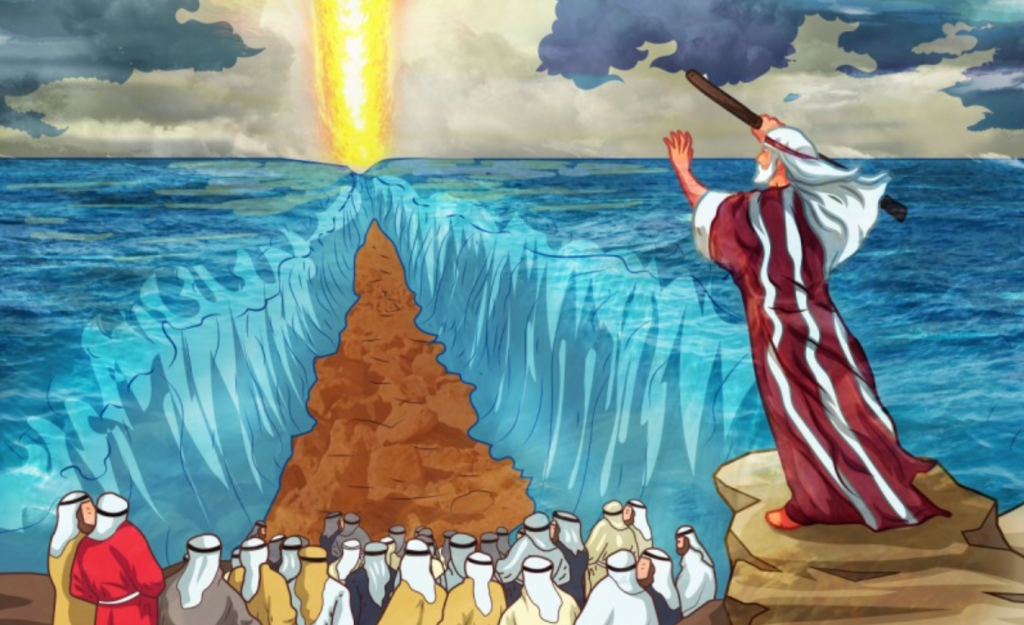
The Egyptian army followed and the Red Sea was ahead, so Moses had to do something. With nothing to lose, he lifted his staff to the skies. Suddenly, the waters miraculously parted.
The Crossing Of The Red Sea is a great metaphor for the ways the universe supports us when we’re committed to walking the path.
Virgo’s solution to our never ending, existential Piscean crisis may be totally out of the box (Full Moon trine Uranus). But it will give us that extra push to move forward (Full Moon square Mars).
Less than one hour after the Full Moon in Virgo, Saturn moves into Pisces.
We know that change is inevitable. We can feel it in the air. A new chapter of our life is about to begin.
The Sabian symbol of the Full Moon in Virgo is “A Volcanic Eruption”.
The Sabian symbol speaks about the importance of releasing the old, before inviting the new.
With Saturn at 29° 59’ Aquarius, minutes away from ingressing into Pisces, the Full Moon in Virgo will remind us that change is an inevitable part of life.
To make space for the new, everything must be released. 100%.
Change is not easy. But real change only happens when we start from a zero state. That’s why sometimes we need something of the magnitude of a volcanic eruption. The old must be burned to ashes. Even if we have no idea yet where we’re headed towards.
“Change” doesn’t necessarily mean you quit your job tomorrow and buy a one-way ticket to the Amazonian jungle. Change is not what we do. What we do is a reaction to change. Change always starts from within.
Sometimes change is an epiphany around why we’ve been stuck in the same old pattern. Other times it’s a moment of clarity: “THIS is what’s actually happening”. And other times it’s a decision “I will no longer walk this path”.
At the Full Moon in Virgo, ask yourself:
“Where is there an inevitable exodus in my life?”
“How do I cross my own metaphorical sea to arrive at my promised land?”
By Leo Sands and Dino Grandoni
Updated March 5, 2023 (WashingtonPost.com)
U.N. agrees on long-awaited treaty to protect the high seas
More than 190 countries agreed on a long-awaited pact to help safeguard the high seas and reverse biodiversity loss, at a United Nations conference on Mar. 4 (Video: Reuters)
More than 190 countries have reached a landmark deal for protecting the biodiversity of the world’s oceans, agreeing for the first time on a common framework for establishing new protected areas in international waters.
The treaty, whose text was finalized Saturday night by diplomats at the U.N. headquartersafter years of stalled talks, will help safeguard the high seas, which lie beyond national boundaries and make up two-thirds of Earth’s ocean surface. Member states have been trying to agree on the long-awaited treaty for almost 20 years.
Environmental advocacy groups heralded the finalized text — which still needs to be ratified by the United Nations — as a new chapter for Earth’s high seas. Just 1.2 percent of them are currently environmentally protected, exposing the vast array of marine species that teem beneath the surface — from tiny plankton to giant whales — to threats such as pollution, overfishing, shipping and deep-sea mining.
“Two-thirds of the ocean has just been exposed to the will and want of all,” said Rebecca Hubbard, the director of the High Seas Alliance consortium of nongovernmental organizations that participated in the negotiations, in a telephone interview Sunday. “We have never been able to protect and manage marine life in the ocean beyond countries’ jurisdictions,” she said. “This is absolutely world-changing.”
Ocean conservation success stories offer hope and inspiration
Despite U.N. members agreeing to a final version of the text, it is expected to take years for the treaty to be formally adopted by member states and come into force. The United States, in particular, is often slow to ratify environmental treaties — and often will decline to approve them at all.
Once the treaty takes legal effect, nations can begin proposing the establishment of new marine protection areas. Even then, enforcement will remain a challenge. International waters today are a Wild West of sorts, with little to no policing. Illegal fishing runs rampant and some seafood vessels even use slave labor.
Still, the treaty is a much-needed start to conservation on the high seas as the pressures on the world’s oceans increase.
Climate change is making the oceans less hospitable for many species by driving up aquatic temperatures and making the seas more acidic. Global trade means more ships that can strike whales and other animals near the surface. Much deeper underwater, the need for minerals that drive international commerce has companies preparing to mine the seafloor. At the same time, the degradation of the oceans’ ecosystems reduces their ability to absorb carbon and help keep climate change in check.
The treaty also advances a way to tackle a pressing issue: how to divvy up the profits from deep-sea scientific discoveries.
“This action is a victory for multilateralism and for global efforts to counter the destructive trends facing ocean health, now and for generations to come,” Stéphane Dujarric,spokesman for the U.N. secretary general, said in a statement after the agreement. “It is crucial for addressing the triple planetary crisis of climate change, biodiversity loss and pollution.”
A country’s legal authority generally extends 200 nautical miles from its shores. After that are the high seas, where no one nation is in charge.
The new agreement will not automatically establish any new marine protection areas in the high seas, but it creates a mechanism for nations to begin designating them in international waters for the first time. That ability is crucial for enforcing the promises made at last year’s U.N. biodiversity summit, COP15, where delegates pledged to protect nearly a third of Earth’s land and oceans by 2030 as a refuge for the planet’s remaining wild plants and animals.
The high seas treaty makes it easier for that goal to be reached, as it allows vast swaths of vulnerable marine ecosystems in international waters to be subject to protections. It will also offer protections for millions of organisms inhabiting the high seas — Earth’s largest physical habitat, Hubbard said.
The race to stop starfish from melting into goo
In the oceans, many sea stars, sturgeon and other species are already on the decline. Sharks are threatened by overfishing, and coral reefs are succumbing to the acidification of the oceans. The deterioration of marine ecosystems could hurt billions of coastal residents who depend on seafood for protein.
Among the biodiversity hot spots to which marine conservationists want to extend protections are the Sargasso Sea in the Atlantic and the Costa Rica Thermal Dome in the Pacific.
The new agreement is the first of its kind to protect oceans since 1982, when the U.N. Convention on the Law of the Sea was adopted, establishing a single set of rules that governed the world’s oceans and their resources.
The treaty’s final text had not yet been published in full as of Sunday, but according to the State Department, it also establishes frameworks for nations to coordinate on environmental impact assessments and to share marine genetic resources — scientific knowledge about deep-sea organisms found in remote waters that could be of value to humankind.
One of the biggest sticking points in negotiations between rich and poor nations was determining who would benefit financially from discoveries made on the high seas.
Who profits, for example, when scientists find a compound in a sea creature that treats a disease in humans? In 2010, for instance, the Food and Drug Administration approved the use of a cancer-fighting drug derived from a sea sponge.
Nations promise to protect 30 percent of planet to stem extinction
“Developing countries typically don’t have the technology, the access and the resources to do research in the high seas,” said Liz Karan, director of ocean governance at the Pew Charitable Trusts.
Ultimately, developed nations agreed to share some of those profits with developing ones, Karan said.
Though the treaty’s main goal is safeguarding life in Earth’s seas, it will also help efforts to fight climate change. Research published in the journal Nature in 2021 suggested that efforts to protect more of the world’s waters would not only support marine diversity, but would also boost the amount of carbon absorbed by the ocean.
How protecting the ocean can save species and fight climate change
“The ocean is also — physically — our biggest ally in the fight against climate change,” said Hubbard of the High Seas Alliance. “Without an ocean full of marine life, it cannot continue to sequester and store carbon.”
“We have a degraded ocean on our hands, but the ocean has a phenomenal capacity to restore itself.”
Sarah Kaplan contributed to this report.


