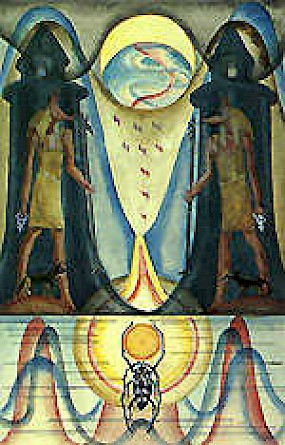
The Moon is numbered eighteen and depicts a mysterious night-time scene. There is often water in the foreground, a full moon depicting the face of a woman sailing high about the land, flanked by pylons. Sometimes droplets appear to be falling like tears from the Moon, taking the form of Hebraic Yod symbols (considered to be impregnatory seeds). There are also sometimes dogs or wolves baying at the Moon. The Moon card you see here depicts Anubis, the jackal god of the Egyptians. There is also usually a crayfish or scarab.
The crayfish is renowned for its ability to fall in love with, mate and impregnate itself. This suggests some of the Moon’s more illusory meanings. The scarab is almost always shown with a solar disk between its claws. This is a symbol of renewal and immortality, showing the Moon’s association with natural cycles and rhythms.
We have a close affinity with the Moon. The lunar cycle affects oceans and all natural tides. We say that people are more psychotic when the Moon is full, calling them “lunatics”. The Moon affects our emotions because they come from the inner hidden part of us, where dreams also reside.
The Moon indicates a voyage to the centre of the Self. We will not be revealed as something weak and unlovable. We will be able to release our psychic and intuitive abilities. Important secrets are revealed when we dare to bring back what is deep inside.
ARIES (March 21-April 19): Nigerian author Wole Soyinka reworked the ancient Greek play, “The Bacchae.” In one passage, the god Dionysus criticizes King Pentheus, who is supposedly all-powerful. “You are a man of chains,” Dionysus tells him. “You love chains. You breathe chains, talk chains, eat chains, dream chains, think chains. Your world is bound in manacles.” The bad news, Aries, is that many of us have some resemblances to Pentheus. The good news is that the coming months will be a favorable time to shed at least some of your chains. Have fun liberating yourself! Try to help a few others wriggle free from their chains, too. Doing so will aid your own emancipation.
TAURUS (April 20-May 20): The coming weeks will be a great time to fill your journal with more intense ruminations than you have for many moons. If you don’t have a journal, think about starting one. Reveal yourself to yourself, Taurus! Make conscious that which has been vague, unnamed, or hiding. Here are assignments to help launch your flood of intimate self-talk. 1. Write passionately about an experience you’ve always wanted to try but have never done. 2. Conduct imaginary interviews with people who rouse strong feelings in you. 3. Describe what deity, superhero, or animal you are and how your special intelligence works. 4. Visualize a dream in which you appear as a bolder, more confident version of yourself. 5. Talk about a time you felt rousingly alive and how you plan to feel that way again.
GEMINI (May 21-June 20): A stranger approached me at Wild Birds Unlimited, a store that sells bird food and accessories. “You write the horoscopes, right?” she asked. “I’m a Gemini, and I want to thank you for helping me tone down my relentless fidgeting. You made me realize I have been secretly proud of tapping my fingers on the table while talking with people, and constantly darting my eyes around the room to check out the ever-changing views. I’d unconsciously believed that stuff was a sign of my incredible vitality. But you’ve been a steadying influence. You’ve shown me ways to settle down and focus my energy better. I can see how restlessness sometimes saps my energy.” I told the woman, “You’re welcome!” and let her know that 2023 will be a favorable time to do much more of this good work. Homework: Meditate on channeling your incredible vitality into being grounded and centered.
CANCER (June 21-July 22): According to Cancerian author Ronald Sukenick, the writer’s work is “to destroy restrictive viewpoints, notice the unnoticed, speak the unspeakable, shake stale habits, ward off evil, give vent to sorrow, pulverize doctrine, attack and uphold tradition as needed, and make life worth living.” I believe 2023 will be an excellent time for you to carry out those actions, even if you’re not a writer. You will have abundant power to bless and heal through creative rebellion and disruption. You will thrive as you seek out interesting novelty.
LEO (July 23-Aug. 22): Psychotherapist Ryan Howes has wisdom you’ll benefit from heeding in the coming weeks. “We need to accept our age,” he writes. “We need to accept illnesses and addictions. We need to accept the past. We need to accept others as they are.” He goes on to say that this doesn’t mean we must like all these situations. And we can certainly try to make the best of them. But when we don’t struggle in vain to change what’s beyond our control to change, we have more energy for things that we can actually affect.
VIRGO (Aug. 23-Sept. 22): Here’s testimony from musician Pharrell Williams: “If someone asks me what inspires me, I always say, ‘That which is missing.’” Yes! This is an apt message for you, Virgo. The best way for you to generate motivation and excitement in the coming weeks will be to explore what is lacking, what is invisible, what’s lost or incomplete. Check in with your deep intuition right now. Do you feel a stirring in your gut? It may tell you where to find important and intriguing things that are missing.
LIBRA (Sept. 23-Oct. 22): “Every animal knows far more than you do,” declares a proverb of the Nimíipuu people, also known as the Nez Perce. Author Russell Banks provides further testimony to convince us we should be humble about our powers of awareness. “There is a wonderful intelligence to the unconscious,” he says. “It’s always smarter than we are.” These are good pointers for you to heed in the coming weeks, Libra. You will have a special power to enhance your understanding of the world by calling on the savvy of animals and your unconscious mind. They will be especially rich sources of wisdom. Seek out their educational input!
SCORPIO (Oct. 23-Nov. 21): Psychologist Carl Jung said that the whole point of Jesus Christ’s story was not that we should become exactly like him. Rather, we should aspire to be our best and highest selves in the same way that he fulfilled his unique mission. So Jesus was not the great exception, but rather the great example. I bring these meditations to your attention, Scorpio, because I believe life in 2023 will conspire to make you, more than ever before, the hero of your own destiny. You will be inspired to honor only your own standards of success and reject all others’. You will clearly see that you are progressing at your own natural and righteous pace, which is why it makes no sense to compare your evolution to anyone else’s.
SAGITTARIUS (Nov. 22-Dec. 21): A reader named Mary Roseberry describes her experience of being a Sagittarius: “I hate to be bored. I hate imperfections. I hate to wait. I hate sadness. I hate conflict. I hate to be wrong. I hate tension.” Wow! I admire Mary’s succinct understanding of who she doesn’t want to be and what she doesn’t like to do. I invite you to compose a similar testimony. You would benefit from getting clear about the experiences you intend to avoid in 2023. Once you have done that, write a list of the interesting feelings and situations you will seek out with intense devotion during the coming months.
CAPRICORN (Dec. 22-Jan. 19): When he was seventy-four years old, Capricorn author Norman Maclean published his first novel, “A River Runs Through It.” It became a best-seller. Capricorn film director Takeshi Kitano directed his first film at age forty-two. Now seventy-five, he has since won many awards for his work in his native Japan. Capricorn activist Melchora Aquino, who was a leader in the Philippines’ fight for independence from Spain, launched her career as a revolutionary when she was in her eighties. She’s known as the “Mother of the Revolution.” I hope these heroes inspire you, dear Capricorn. I believe that 2023 is the year you will get an upgrade in any area of your life where you have seemed to be a late bloomer.
AQUARIUS (Jan. 20-Feb. 18): According to my analysis of the astrological omens, you will soon be called upon to summon grace under pressure; to express magnanimity while being challenged; to prove that your devotion to your high standards is more important than the transitory agendas of your ego. The good news is that you are primed and ready to succeed at these exact assignments. I have confidence in your power to activate the necessary courage and integrity with maximum poise and composure.
PISCES (Feb. 19-March 20): “By dying daily, I have come to be,” wrote poet Theodore Roethke. He didn’t mean he suffered literal deaths. He was referring to the discipline of letting go of the past; shedding worn-out habits; leaving behind theories and attitudes that once served him well but no longer did; killing off parts of himself that were interfering with the arrival of the fresh future. I recommend his strategy to you, Pisces. To the degree that you agree to die daily, you will earn the right to be reborn big-time in a few weeks.
There are many reasons to worry about climate change’s effects and whether the world’s leaders are brave enough to make the bold decisions necessary to abate the growing crisis. But a new report from the United Nations shows that when people come together and follow the science, it’s possible to stop environmental disasters before they happen.
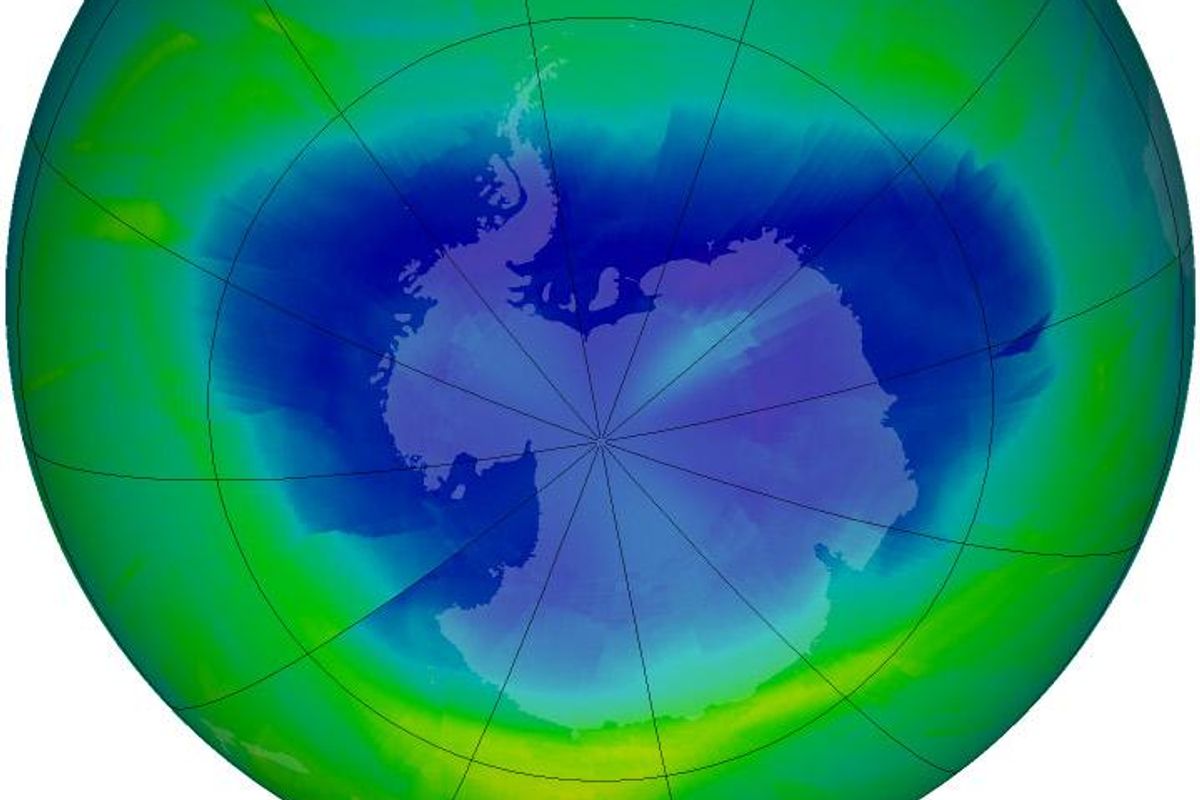
An executive assessment from the UN has found that the hole in the Earth’s ozone layer is on track to be completely healed within the next two decades. If current policies remain in place, the ozone layer should recover to 1980 levels by around 2066 in the Antarctic, 2045 in the Arctic and 2040 throughout the rest of the world.
The hole was first discovered by scientists in 1985 above Antarctica and it caused immediate worry. According to Discover magazine, the ozone layer acts as the planet’s sunscreen and without it, we’d be exposed to harmful ultraviolet rays that cause skin cancer and cataracts. The radiation is also harmful to marine life and plants and would cause a major disruption to the world’s food supply.
“In the upper stratosphere and in the ozone hole we see things getting better,” Paul A. Newman, co-chair of the scientific assessment panel of the Montreal Protocol, said according to the Associated Press. He added that the two biggest contributors to the hole, chlorine and bromine, have dropped from their peaks in the ’90s.
That bromine and chlorine levels “stopped growing and is coming down is a real testament to the effectiveness of the Montreal Protocol,” Newman said.
The Montreal Protocol is an international agreement signed in 1989 that helped eliminate 99% of ozone-depleting chemicals including chlorofluorocarbons (CFCs). At the time, these were found in spray cans, refrigerants and air-conditioning units.
Good climate news: The ozone layer is on track to recover within 4 decades.
The healing of the Earth's invisible shield is an inspirational example of how the world can come together to address global challenges like the climate crisis.
Although much of the world has stopped using CFCs, they can linger in the atmosphere for a century.
“The protocol marks an important milestone for the future quality of the global environment and for the health and well-being of all peoples of the world,” former President Ronald Reagan said after the agreement was signed in 1988. “Unanimous approval of the protocol by the Senate on March 14th demonstrated to the world community this country’s willingness to act promptly and decisively in carrying out its commitments to protect the stratospheric ozone layer from the damaging effects of chlorofluorocarbons and halons, but our action alone is not enough.”
“It’s a bit like waiting for paint to dry, you just have to wait for nature to do its thing and flush out these chemicals,” David Fahey, a scientist at National Oceanic and Atmospheric Administration, said according to The Guardian.
Good news from #AMS2023: The ozone layer is on track to recover within four decades.
If political leaders hadn’t taken action back in the ’80s, we would be having some serious problems in 2023. World leaders should take the positive lessons learned by the fight against ozone depletion and use them toward fixing climate change before it becomes irreversible.
Unfortunately, the fight against climate change is more difficult because greenhouse gasses stay in the atmosphere much longer than CFCs and asking people to change their refrigerants is a lot easier than asking them to stop driving cars.
“CO2 is another order of magnitude when it comes to its longevity, which is sobering,” Fahey said. “Getting every person on the planet to stop burning fossil fuels is a vastly different challenge.”
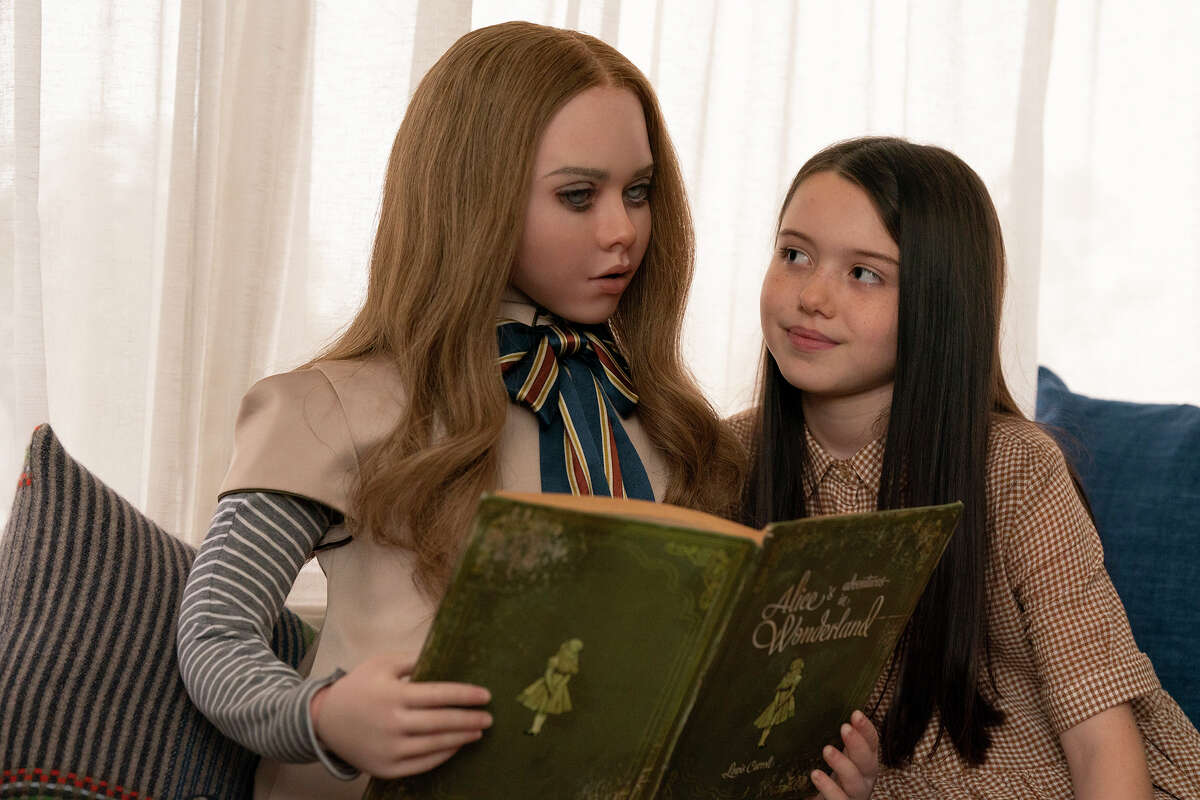
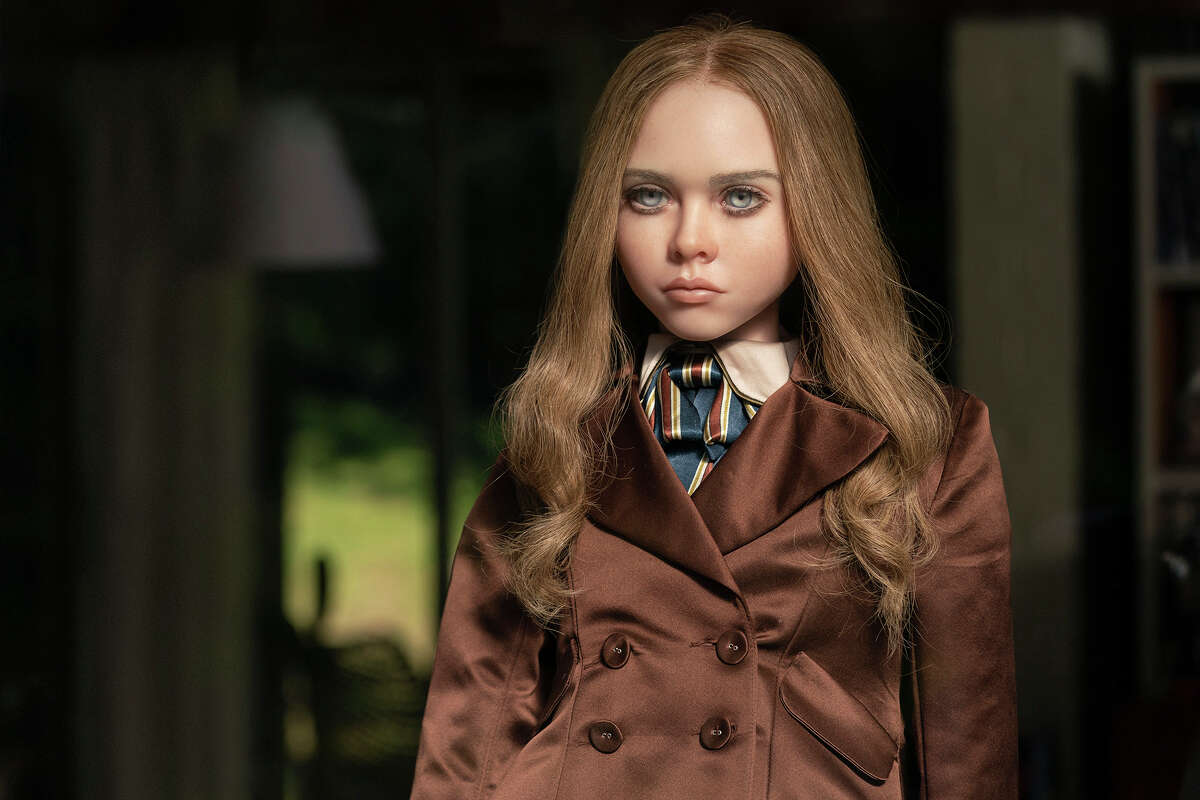
M3GAN and Cady (Violet McGraw) in “M3GAN,” directed by Gerard Johnstone.Geoffrey Short/Universal Pictures
With her Play Doh-y silicon face, soulless side-eye and keen fashion sense, the internet absolutely lost it when M3GAN arrived on the scene last October. She could drop deliciously shady one-liners and unnerving TikTok dances just as flawlessly as she could hunt down her victims on all fours. She was a star.
The much-hyped and critically acclaimed sci-fi horror comedy “M3GAN” has resonated with audiences with its skepticism of tech, but that didn’t stop director Gerard Johnstone from checking his phone every few minutes when the trailer was first released. Faster than you can say, “This is the part where you run,” “M3GAN” amassed a rapturous fandom, spawned countless memes and earned the admiration of celebrities from drag icon Trixie Mattel to rapper Megan Thee Stallion. She appeared on the cover of this month’s issue of Fangoria, feuded with Chucky on Twitter and staked her claim as a queer icon and the evil doll of a generation.
“I didn’t expect it at all,” Johnstone told SFGATE over Zoom recently. “You always expect the worst … that you’re going to spend all this time and money, and the trailer is going to come out, and it’s like you can hear a pin drop.”
That being said, the director thought it would be ideal to convey a message about the chaotic world we live in by not taking the film too seriously and having fun with it. “Let this robot go off the rails and run free. Because I think that’s the best way to deliver these allegories about where we’re at,” Johnstone said.
And it worked.
The film about an artificially intelligent toy who becomes self-aware and goes far beyond the duties coded for her by robotics engineer Gemma (Allison Williams of “Get Out” and “Girls”) premiered in theaters over the weekend to a $30.2 million box office debut, far surpassing its $12 million budget. It boasts a certified fresh 94% rating on Rotten Tomatoes — the New York Times called it “ludicrous” and “irresistible,” while the AV Club described it as “patently silly and self-aware,” lauding M3GAN as “an instant icon.” A sequel is reportedly already in the works, and I’d be hard-pressed to believe that our pint-sized antihero won’t have her own haunt at Universal Studios’ Halloween Horror Nights later this year.
In the film, Gemma works for Funki, a Hasbro rival that produces a line of toys called PurrPetual Petz (think FurReal Friends, but with more fart jokes). When another toymaker rips off the concept and sells a near-identical doll for half the price, Funki’s CEO (Ronny Chieng of “Crazy Rich Asians”) is desperate to undercut the competition and sell an even cheaper model of the Petz.
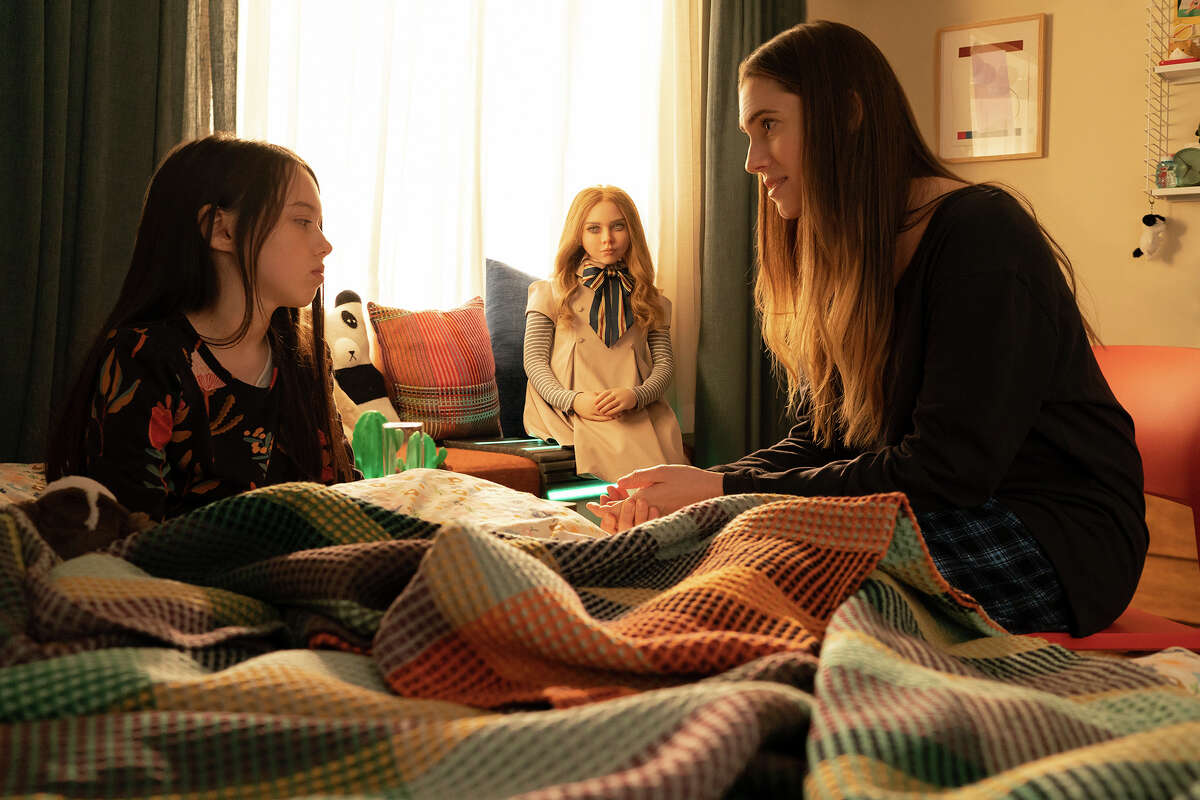
Gemma has other plans. After her sister and brother-in-law die in a tragic car accident en route to a ski trip, their 8-year-old daughter Cady (Violet McGraw of “The Haunting of Hill House”) is left in her care. Though Gemma’s brilliance is clear when it comes to developing new toys, she doesn’t know the first thing about being a guardian and struggles to bond with her niece.
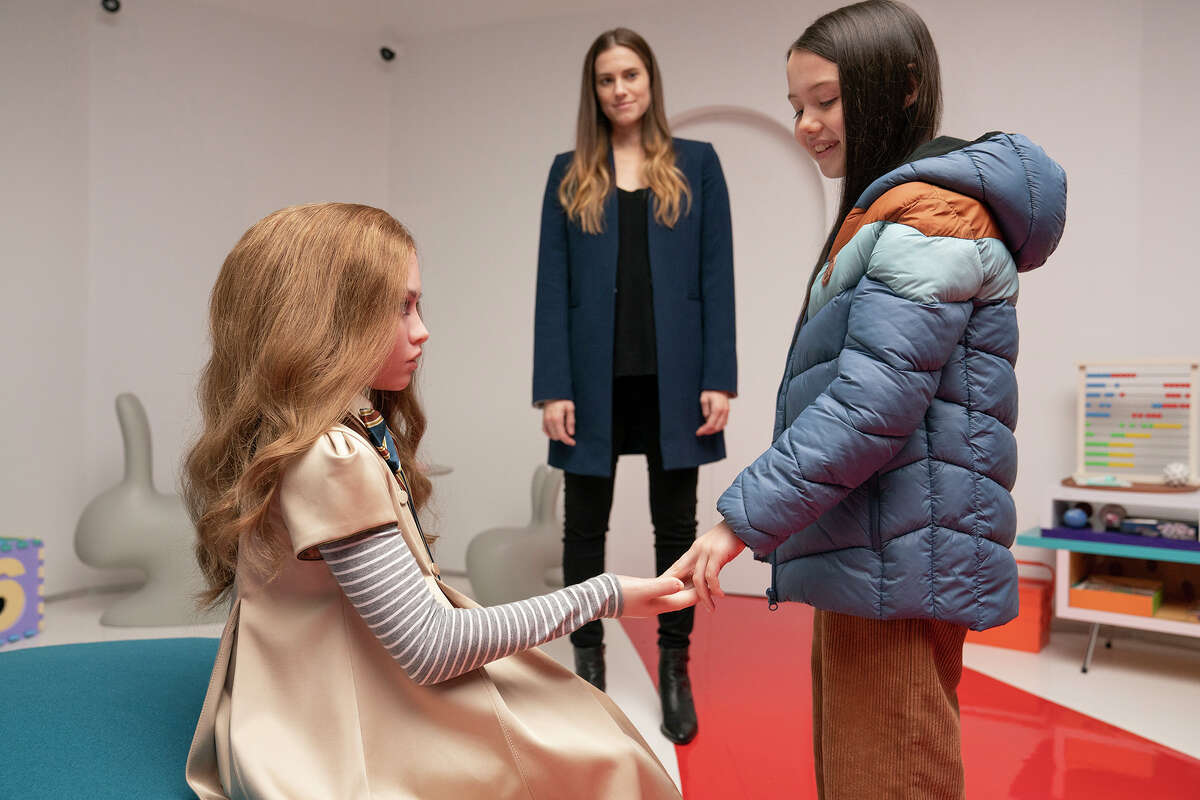
Enter Gemma’s secret project — the Model 3 generative android, or M3GAN for short. She can walk like a human, talk like a human, create lifelike watercolor paintings, record memories and even identify learning differences in children. When Cady first meets M3GAN, they hit it off immediately — it’s the first time the child has opened up to anyone since losing her parents. But as M3GAN’s technology advances, she veers away from mundane tasks like reminding Cady to use a coaster and things take a deadly turn in her mission to keep the kid out of harm’s way at all costs — and be a true friend to the end.
“M3GAN” seems like a film ripe for a December release, becoming another cautionary tale about the perils of consumerism a la “Gremlins” and an essential part of the holiday horror canon. But Johnstone (who made his directorial debut with the comedic thriller “Housebound” in 2014) wanted to broaden the ambition of his film.
“When the script came to me, I was a new parent at the time, and I was like, holy s—t, this is about all the things that I’m dealing with right now in terms of the social anxieties around technology,” Johnstone said. “You can’t go to the store and buy a cool toy for a kid without it needing to be connected to an iOS device or an Android device. That immediately creates so many questions.”
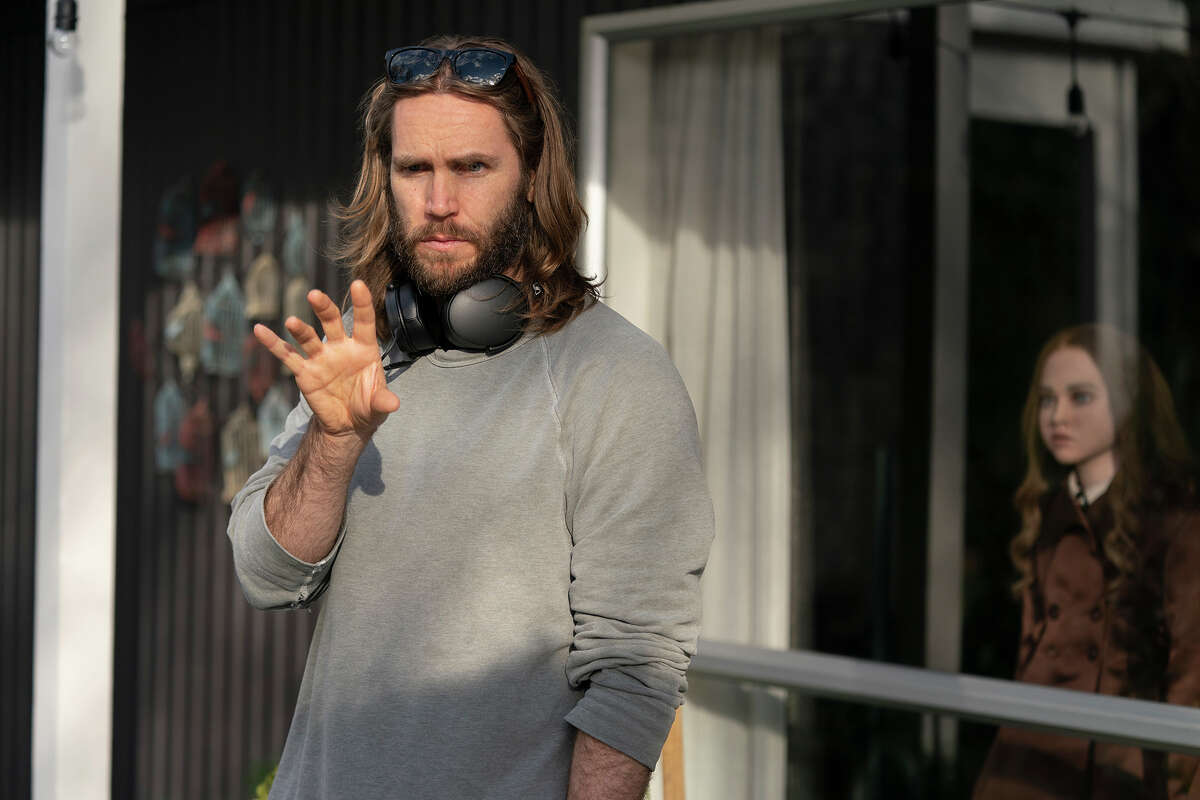
Director Gerard Johnstone on the set of “M3GAN.”Geoffrey Short/Universal Pictures
The film’s release coincided with a recent surge in the use of AI-powered art and chatbots, such as the San Francisco-headquartered OpenAI, which developed the image generator DALL-E, as well as apps like Replika that allow the user to have a conversation with a virtual companion. Johnstone said that such learning models weren’t household names when he started working on “M3GAN,” but they increasingly played a role in the making of the film.
“Back then, it was mostly a problem of parents chucking iPhones and iPads at kids and calling it a day,” he said with a laugh. “It was everyone being glued to their phones … how it felt like to be living in a ‘Black Mirror’ episode when we couldn’t even see it.”
For “M3GAN,” Johnstone approached OpenAI in its early stages (the company was founded in 2015) in order to better understand how the technology worked. He also sought input from Pieter Abbeel, a professor at UC Berkeley and director of the Berkeley Robot Learning Lab, and Alex Kauffmann, a technical project lead at Google’s Advanced Technology and Projects lab.
“[Kauffmann] really helped us understand how the computer brain works,” Johnstone said. “And the conversations with him were really illuminating because I started to realize that even if the computer’s not self-aware, the behaviors and the capabilities are sufficient that if it decided to just do what it was going to do … that was scary enough on its own.”
M3GAN is portrayed by Amie Donald and Jenna Davis. Geoffrey Short/Universal Pictures
M3GAN herself is a delight to behold. On the surface, she’s like an American Girl doll engineered with the killing instincts of the Commando Elite in Joe Dante’s “Small Soldiers,” or if Talking Tina from “The Twilight Zone” could sing “Titanium” by Sia and David Guetta. Bringing the robot to life on the big screen required two actors (12-year-old dancer Amie Donald was her physical stand-in, while Jenna Davis provided her voice) and a combination of animatronics, puppetry and visual effects.
While producer James Wan (“Saw”) has described M3GAN as “Annabelle meets The Terminator,” Johnstone told SFGATE the uncanny valley appearance of the world’s first robot citizen, Sophia, and the cadence of Apple’s Siri were also a point of reference for the character, as was Boston Dynamics’ 5-foot-tall humanoid robot, Atlas.
“As soon as I saw Atlas running, jumping, flipping … that was a huge influence, just seeing everything that they could do,” Johnstone said.
Some of the similarities to the humanoid robot, though, were purely coincidental. “It’s funny, because that viral dance the robots did … that came out when our film was already in the can,” he said.
The scene where M3GAN saunters, twirls and flips at the end of a dark hallway (like a “twisted Shirley Temple,” as Johnstone describes it) is equal parts unsettling and offbeat — and it was not part of screenwriter Akela Cooper’s (“Malignant”) original script. Johnstone has said in previous interviews that he “just kind of snuck” the sequence into the movie “to see if anyone would say anything.” Originally, he did not want to give it away in the trailer, but was quickly convinced to do otherwise.
“When the film came out, that was one of the things about it that Universal first responded to,” he said. “They were like, ‘This is insane.’”
Cady (Violet McGraw), M3GAN and Gemma (Allison Williams) in “M3GAN,” directed by Gerard Johnstone.Geoffrey Short/Universal Pictures
An ironic challenge for Johnstone was working with AI consultants on a film that intended to tell audiences why they should be skeptical of the technology.
“With ‘M3GAN,’ we wanted to talk about generative technologies that can learn on their own unsupervised, and how far they could go,” he said. “I think people who work in tech are really fascinated by that idea, as opposed to people like us who were making the movie, we were really anxious about it.”
Andra Keay, the managing director of Silicon Valley Robotics, had a different point of view. They said that while “M3GAN” is clever and fun, Hollywood’s depiction of AI in film at large may be missing the mark.
“Perhaps as our machines have become more complex and lifelike, we need to explore the uncanny edge or the dark side of the mirror,” Keay told SFGATE in an email after watching the film over the weekend. “But these tropes are very frustrating for roboticists who are trying to promote real robots that can start to solve some of our giant global problems, from food insufficiency, supply chain inefficiencies and global pollution, to supporting healthy aging at home.”
Keay also pointed out that portrayals of robots in film often reinforce gendered stereotypes that women are supposed to be helpers, not leaders.
“Should we stop building female robots? Or robots that look human?” Keay said. “Definitely.”
M3GAN, Gemma (Allison Williams) and Cady (Violet McGraw) in “M3GAN,” directed by Gerard Johnstone.Geoffrey Short/Universal Pictures
After making the movie, however, Johnstone has a word of caution for the tech sector as it plows into AI.
“By all means, see how far you can push this technology,” Johnstone said, “But think about the people you’re making it for at the same time and what effect it’s having on them, and whether or not we’re ready for it.”
It’s hard not to heed Johnstone’s warning: San Francisco’s Board of Supervisors recently had to reverse their decision allowing police to have access to killer robots. AI-powered apps are invented with the purpose of making call center workers sound white and American regardless of the country they’re from, and driverless cars and automated restaurants may very well be eliminating entire workforces.
The final shot in “M3GAN” lingers not on the robot, but Elsie, an Alexa lookalike in Gemma’s home, leaving the viewer wondering about the acceleration of everyday technology and whether it can be trusted. And the message certainly resounded loud and clear with audiences — at least in my own experience.
As my friend announced when the credits rolled, “I’m throwing my Google Home in the trash.”
Amanda Bartlett is a culture reporter for SFGATE. Prior to joining the newsroom in 2019, she worked for the Roxie Theater, Noise Pop and Frameline Film Festival. She lives in San Francisco with her rabbit, Cheeto. Send her an email at amanda.bartlett@sfgate.com.
“…so brutal and alive it seemed to comprehend us back.”
BY MARIA POPOVA (themarginalian.org)
This is the second of nine installments in the animated interlude season of The Universe in Verse in collaboration with On Being, celebrating the wonder of reality through stories of science winged with poetry. See the rest here.
THE ANIMATED UNIVERSE IN VERSE: CHAPTER TWO
Henrietta Swan Leavitt
In 1908, Henrietta Swan Leavitt — one of the women known as the Harvard Computers, who changed our understanding of the universe long before they could vote — was analyzing photographic plates at the Harvard Observatory, singlehandedly measuring and cataloguing more than 2,000 variable stars — stars that pulsate like lighthouse beacons — when she began noticing a consistent correlation between their brightness and their blinking pattern. That correlation would allow astronomers to measure their distance for the first time, furnishing the yardstick of the cosmos.
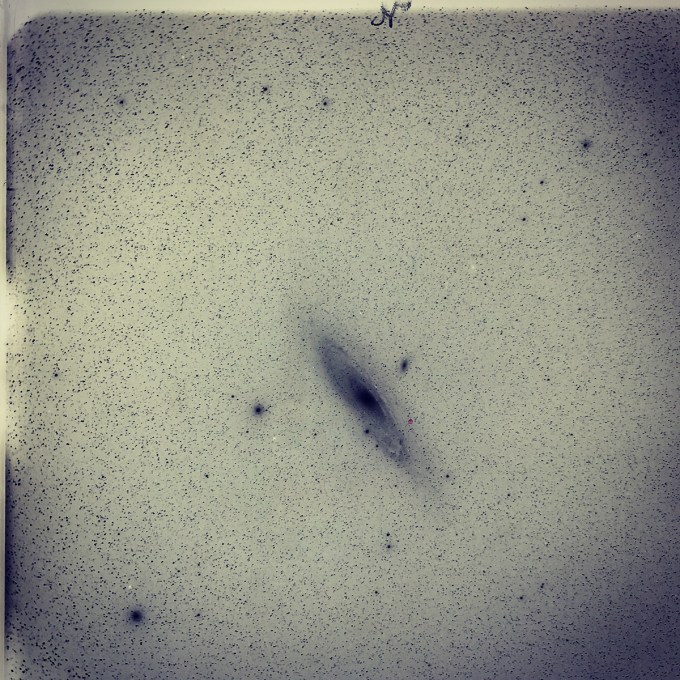
Glass plate of Andromeda from the archives of the “Harvard Computers.” (Photograph: Maria Popova)
Meanwhile, a teenage boy in the Midwest was repressing his childhood love of astronomy and beginning his legal studies to fulfill his dying father’s demand for an ordinary, reputable life. Upon his father’s death, Edwin Hubble would unleash his passion for the stars into formal study and lean on Leavitt’s data to upend millennia of cosmic parochialism, demonstrating two revolutionary facts about the universe: that it is vastly bigger than we thought, and that it is growing bigger by the blink.
One October evening in 1923, perched at the foot of the world’s most powerful telescope at Mount Wilson Observatory in California, Hubble took a 45-minute exposure of Andromeda, which was then thought to be one of many spiral nebulae in the Milky Way. The notion of a galaxy — a gravitationally bound swirl of stars and interstellar gas, dust and dark matter — did not exist as such. The Milky Way — a name coined by Chaucer — was commonly considered an “island universe” of stars, beyond the edge of which lay cold dark nothingness.
When Hubble looked at the photograph the next morning and compared it to previous ones, he (I like to imagine) furrowed his brow, then with a gasp of revelation he (this we know for a fact) crossed out the marking N on the plate, scribbled the letters V A R beneath it, and could not help adding an exclamation point.
Edwin Hubble’s 1923 glass plate of Andromeda. (Photograph: Carnegie Observatories)
Hubble had realized that a tiny fleck in Andromeda, previously mistaken for a nova, could not possibly be a nova, given its blinking pattern across the different photographs. It was a variable star — which, given Henrietta Leavitt’s discovery, could only be so if the tiny fleck was very far away, farther than the edge of the Milky Way.
Andromeda was not a nebula in our own galaxy but a separate galaxy, out there in the cold dark nothingness.
Suddenly, the universe was a garden blooming with galaxies, with ours but a single bloom.
That same year, in another country suspended between two World Wars, another young scientist named Hermann Oberth was polishing the final physics on a daring idea: to subvert a deadly military technology with roots in medieval China and rocket-launch an enormous telescope into Earth orbit — closer to the stars, bypassing the atmosphere that occludes our terrestrial instruments.
It would take two generations of scientists to make that telescope a reality — a shimmering poem of metal, physics, and perseverance, bearing Hubble’s name.
The Hubble Space Telescope. (Photograph: NASA)
But when the Hubble Space Telescope finally launched 1990, hungry to capture the most intimate images of the cosmos humanity had yet seen, humanity had crept into the instrument’s exquisite precision — its main mirror had been ground into the wrong spherical shape, warping its colossal eye.
Up the coast from Mount Wilson Observatory, a teenage girl watched her father — who had worked on the Hubble as one of NASA’s first black engineers — come home brokenhearted. He didn’t know that his observant daughter would become Poet Laureate of his country and would come to commemorate him in the tenderest tribute an artist-daughter has ever made for a scientist-father. That tribute — the splendid poetry collection Life on Mars (public library) — earned Tracy K. Smith the Pulitzer Prize the year the Hubble’s corrected optics captured the revolutionary Ultra Deep Field image of the observable universe, revealing what neither Henrietta Leavitt nor Edwin Hubble could have imagined — that there isn’t just one other galaxy besides our own, or just a handful more, but at least 100 billion, each containing at least 100 billion stars.
MY GOD, IT’S FULL OF STARS (PART 5) by Tracy K. Smith
When my father worked on the Hubble Telescope, he said They operated like surgeons: scrubbed and sheathed In papery green, the room a clean cold, a bright white.
He’d read Larry Niven at home, and drink scotch on the rocks, His eyes exhausted and pink. These were the Reagan years, When we lived with our finger on The Button and struggled
To view our enemies as children. My father spent whole seasons Bowing before the oracle-eye, hungry for what it would find. His face lit up whenever anyone asked, and his arms would rise
As if he were weightless, perfectly at ease in the never-ending Night of space. On the ground, we tied postcards to balloons For peace. Prince Charles married Lady Di. Rock Hudson died.
We learned new words for things. The decade changed.
The first few pictures came back blurred, and I felt ashamed For all the cheerful engineers, my father and his tribe. The second time, The optics jibed. We saw to the edge of all there is —
So brutal and alive it seemed to comprehend us back.
THE MAKING
Every poet is a miniaturist of meaning, building cathedrals of beauty and truth with the smallest particles of language. It is with a poet’s mindset that Brazilian graphic artist and animation director Daniel Bruson approached his contribution to The Universe in Verse. (Special thanks to On Being creative director Erin Colasacco for bringing Daniel into the project and for working with him and with composer Gautam Srikishan on making this symphonic cinepoem come alive.)
After I relayed to Daniel why I had chosen this particular poem (which Tracy read at the inaugural Universe in Verse in 2017) to illustrate the larger story of our search for cosmic truth — a search both made possible and made imperfect by our humanity — he grasped the nested layers of meaning with uncommon sensitivity, mirroring back his interpretation:
The Hubble tries to see or make sense of the Universe, the father tries to understand the Hubble, the daughter tries to make sense of the father, the decade, the world, and the poet tries to put this whole into perspective. All these efforts have to face problems of scale or distortion: something too big or small, too close or too distant, too dark or too familiar. Not to mention the original problem with the Hubble mirror.
This cascade of distortion sparked the idea “to use optics as a metaphor, to seek for these imperfect, unresolved and elusive, but also suggestive and alive images.”
Daniel set about creating his deliberately blurry cosmic animations frame by frame, painting each tiny detail onto a glass plate with nail polish, oil paint, glitter, acrylic, and other materials he mixed, scrubbed, smudged, and swirled with brushes and cotton swabs beneath the lens of a camera capturing the process of creation and destruction.
He magnified the optical enchantment by filming the vignettes through upside-down drinking glasses of various shapes and thicknesses.
In a crowning feat of ingenuity — itself a miniature masterpiece of engineering and composition — he built a tiny model of the Hubble out of cardboard, paper, and aluminum foil, dismantled it frame by frame, filmed the destruction, then reversed the footage to create the building effect. (I am reminded here of Bertrand Russell’s astute observation, made shortly after Edwin Hubble took his historic glass plate of Andromeda, that “construction and destruction alike satisfy the will to power, but construction is more difficult as a rule, and therefore gives more satisfaction to the person who can achieve it” — a truth as true of the universe itself, with its elemental triumph of something over nothing, as it is of the human endeavor to know it by building optical prosthesis of our curiosity.)
Something about Daniel’s process — the exquisite craftsmanship, the passionate patience, the tiny scale on which he made such beauty and grandeur of feeling — calls to mind Emily Dickinson and her miniature cherrywood writing desk, on the seventeen square inches of which she conjured up such cosmoses of truth, among them the poem illustrating Chapter One of this series.
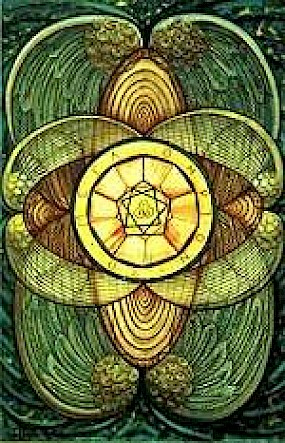
TheAce of Disks marks, on the everyday level, the start of a new project, which is likely to be successful. So it will come up to show a new job, or a new business venture. Usually this will be the sort of project that seems to continuously keep on growing, with each level of attainment producing – almost of itself – the next step in the journey.
Sometimes the Ace will come up to indicate a sudden change of material fortune, or a windfall – though either of these would have to be quite substantial to invoke the Ace. Aces are always big influences, marking the beginning of something new and important. So if we see the card coming up to represent a sudden input of funds, expect this to cause major changes in the querent’s life.
On a more spiritual level, this card relates to the Earth, and to the appreciation of Nature. It might mark a period where we draw closer to environmental issues, or where we engage in a period of study, contemplation and alignment with Earth forces.
One thing that we often miss, when considering spiritual development, is the way that each development grows out of the last. Anyone who has been involved in the search for spiritual truth will already have experienced the weirdly coincidental manner in which spiritual opportunities and teachers present themselves at the relevant stage in our growth.
There’s a saying – ‘The right teacher only appears when the student is ready’. It is as though we grow spiritually from the inside, the same way that trees do. And in so doing, maybe we develop inner rings – just like a tree’s trunk. The outer ring, just under the bark could not exist without all of the others it encircles.
We’re basically the same. The topic that we are exploring today has grown from all of the earlier topics we have looked into. Our experience is formed in layers, each of which is inter-dependent with the earlier ones. The Ace of Disks relates very closely with this method of human development – it shows us the way we grow. And warns us against trying to skip any of the stages!
Please join us this Sunday 1/15/23, for Mara’s presentation taking a look at waking up to the true nature of the Christ Consciousness within us. An inspiring way to begin the New Year!
SUNDAY MEETING 1/15/23
Mara Pennell, H.W.
11:00 am Pacific/Noon Mountain/1:00 Central/2:00 Eastern