Why you shouldn’t shrink from challenging your loved ones’ views

Why you shouldn’t shrink from challenging your loved ones’ views | Psyche

Photo by Reuters

Matt Ferkanyis an associate professor in philosophy at Michigan State University. His writing has been published in the journals Pacific Philosophical QuarterlyEnvironmental Values and Theory and Research in Education, among others, and he is currently working on a book about ethics in science and environmental education. He lives in East Lansing, Michigan.

Edited by Matt Huston

22 June 2022 (psyche.co)

Suppose a parent, an uncle or an old friend starts making claims that seem obviously wrong to you – about vaccines, the climate crisis, GMO foods, or some other topic. You’ve heard enough and feel an urge to challenge them. What should you do? What moves might you make?

In recent years, media outlets have published advice on the subject, much of it similar in that it encourages friendliness and gentle questioning, and discourages direct challenges. Based on this sort of advice, we might work up the following menu of commonly recommended and discouraged options:

Recommended

  • Tailor your message: Appeal to their existing beliefs and values (‘Think about this in terms of economic efficiency…’)
  • Be friendly: Listen kindly and ask (seemingly) open-ended questions (‘What do you really believe about GMO foods anyway?’)

Discouraged

  • Fact-dump: Challenge your audience with contrary facts and information (‘No, a cabal of vaccine manufacturers did not pressure the editors to retract the autism-and-vaccines article; it was just bad science, because…’)
  • Consistency-check: Point out that they seem to have some contradictory beliefs (‘You still see your doctor for medical advice, right?’)

To be sure, listening, being friendly and appealing to your audience’s existing beliefs are all important tools. There is good evidence to suggest that we need to be thoughtful in how we approach arguing. But should we never fact-dump or consistency-check? I believe that all of these approaches have a place in effective argumentation.

A beloved uncle of mine once bluntly stated that employers require too much education these days. Far fewer workers need a college degree than are getting one, he claimed. As a university professor (and a philosopher, no less), I think higher education is valuable even when it’s basically useless. Talking trash about it is a pretty good way to get my goat. So you can imagine my reaction, which was something like: ‘But isn’t college worthwhile anyway? Shouldn’t we want our workforce to be more knowledgeable? And what about people who work in, say, healthcare? Surely you want medical care provided by people who know more rather than less, right?’ My reaction was to consistency-check him: our beliefs, values and practices ought to be consistent with each other, and we should be able to explain any apparent inconsistencies.

It wasn’t too difficult for my uncle to provide such an explanation: the practice of administering healthcare and the practice of something like repairing radiological equipment both involve significant knowledge and skill. But in the latter case it can be attained a bit quicker, and more on-the-job. Different sorts of work require different degrees of knowledge and skill. In reply to my consistency-check, my uncle fact-dumped.

These more direct methods of arguing can sometimes seem confrontational. A colleague’s brother, a climate-change denier, once complained about the unfairness of ‘all these renewable energy subsidies’. The implication was that the government was meddling in the market merely to benefit special interests. My colleague’s husband couldn’t resist fact-dumping, pointing out that the fossil fuel sector has historically been subsidised at far higher rates than renewables.

Many of us are driven to find reasons to be content with the social status quo

I don’t recall the precise conclusion of my conversation with my uncle, nor do I know exactly how things turned out with my colleague’s brother. But I do recall thinking my uncle and I both made some relevant points. I’d like to think he thought so, too. So what’s behind the scepticism about our approaches to arguing?

The prevailing advice on arguing is supported by ideas and evidence in argumentation theory and cognitive science, according to which actually thinking things through is difficult and rare, and reasoning doesn’t really serve this purpose anyway. Instead, in this view, reasoning mainly enables us to justify our existing beliefs and try to persuade others. Therefore, we are susceptible to ‘myside bias’, whereby we prefer evidence that is favourable to our preconceived beliefs, while ignoring facts that are contrary to them. Many of us are also driven to find reasons to be content with the social status quo. Life is hard enough already: why upset ourselves by thinking about how unfair or unjust it is? For many people, the defensible status quo includes things like massive inequality, and fuel-burning practices that scientists tell us are degrading the planet.

A valuable lesson from this research is that, because we often fail to handle facts in an objective manner, there is more to persuasion than simply presenting our audience with contrary information. We have to think about the experiences and values of people who have very different beliefs, to imagine what is important to them, and to expect that it might be difficult for them to update their beliefs. (We also have to be mindful of our own perspectives and values, and remember that we are likely to be indifferent about relevant counter-evidence ourselves.)

It might be tempting, therefore, to conclude that if we are going to interrogate someone’s beliefs, it is pointless to ever challenge them with facts or point to apparent contradictions. This isn’t going to suddenly change their mind, so why bother?

We should still bother, at least sometimes, for a few reasons. First, even if presenting facts and consistency-checking won’t immediately change someone’s mind – indeed, even if they dig in their heels a little deeper – it’s still possible that it could ultimately influence their beliefs. Change can be plodding and difficult. We may have to argue (respectfully, even lovingly, in a spirit of exchange) many times before change occurs. Even then, we might only cause a certain amount of doubt about pre-existing views, such as occurred between my uncle and me. But that can be better than nothing.

There is now experimental evidence suggesting that, in the context of science denial, at least, declining to engage at all with a problematic source of information can result in a worse effect on attitudes than responding with facts does. If your aunt still questions the medical establishment’s refutation of a link between vaccines and autism, it is likely better to share facts with her again than to just let it go. It could be that the best outcome for now is getting her to see the tension between her view on this and something like going to the doctor for medical advice. Sowing doubt, prompting more careful thought, and raising awareness about other possibilities can all be valuable in themselves and might even lead to bigger changes later. The transformation of Megan Phelps-Roper is an incredible example of what change can happen through slow, patient engagement that prompts self-questioning. Once the social media coordinator for the Westboro Baptist Church (really, a hate group), Phelps-Roper eventually left as a consequence of engagement with critics online.

The tactics of asking open-ended questions or appealing to someone’s beliefs and values won’t always help to persuade on their own. Indeed, listening without judgment while someone shares very ignorant or prejudiced beliefs might even embolden them. As the philosopher José Medina has described it, our own ignorance is frequently invisible to us until it is met with some resistance. Without a mirror, one needs other people to tell them when food is stuck in their teeth. Similarly, the disagreement (or even disapproval or anger) of close others in response to objectionable claims can serve as a mirror through which a person might start to see themselves more clearly.

Appealing to someone’s pre-existing beliefs can be manipulative if it involves bending the truth

If your views are genuinely at odds with someone else’s, tailoring your message to their beliefs and values often won’t get you where you really want to go, at least without bending the truth. It might be possible to convince your relative to support some climate-change mitigation, for example, if you could convince him that it will be economically better in the long run. But if what he really cares about are coal jobs, this argument will not get you very far; in a transition to clean energy, those jobs must eventually go away. That is a simple fact of the difference between your views. Obscuring that will ultimately be ineffective.

It’s also important to consider that we have a responsibility to treat other people with respect –and that the bonds of love are their own source of duties, a point that the philosopher Barrett Emerick has explored. Love entails duties of care. If we do not try to help improve the moral personhood of friends and family members by engaging with their beliefs, we fail to care for them in a crucial way; we let them be or become less good than they might.

Some ways of arguing with a loved one – such as insulting them or lying – are obviously neither respectful nor loving. Yet even seemingly gentle methods of talking about controversial topics can easily become misleading or manipulative. Appealing to someone’s pre-existing beliefs can be manipulative if it involves bending the truth in a way that hides the real differences between your views. And while friendliness in argumentation is always a good policy, if your loved one’s beliefs or behaviour really threaten your ability to respect or get along with them, you ought to find some way to communicate that. Being superficially friendly with an ‘angry uncle’ figure, while secretly resenting and complaining about him, is ultimately not very respectful or loving.

Finally, arguing about the kind of world we want to create is part of how social progress is made, and we have a responsibility to contribute to this where we can. We are uniquely positioned to do this with family and friends, with whom we bear a special bond. Because of this bond, we might be able to re-engage in difficult conversations with them, perhaps many times over many years.

This will not always be easy. While we are often well positioned to help those closest to us improve their beliefs, we might feel especially wary of engaging with them because of our closeness. Doing so requires courage, patience and, sometimes, forgiveness. If the person you disagree with occupies a position of social power, they might not be accustomed to being challenged (or being challenged by you). When you are liable to be ignored or even harmed in some way, it might be best to leave it to others to take up an argument. You have to make careful decisions based on these factors. But the point is that respectfully – and directly – arguing with people we care about can be an opportunity, and even a duty of responsible citizenship and love. We should do so when we might make inroads with someone ‘on the other side’ – and, sometimes, even when we might not.

Book: “The Myth of Normal: Trauma, Illness, and Healing in a Toxic Culture”

The Myth of Normal: Trauma, Illness, and Healing in a Toxic Culture

Gabor MatéDaniel Maté (With)

By the acclaimed author of In the Realm of Hungry Ghosts, a groundbreaking investigation into the causes of illness, a bracing critique of how our society breeds disease, and a pathway to health and healing.

In this revolutionary book, renowned physician Gabor Maté eloquently dissects how in Western countries that pride themselves on their healthcare systems, chronic illness and general ill health are on the rise. Nearly 70 percent of Americans are on at least one prescription drug; more than half take two. In Canada, every fifth person has high blood pressure. In Europe, hypertension is diagnosed in more than 30 percent of the population. And everywhere, adolescent mental illness is on the rise. So what is really “normal” when it comes to health?

Over four decades of clinical experience, Maté has come to recognize the prevailing understanding of “normal” as false, neglecting the roles that trauma and stress, and the pressures of modern-day living, exert on our bodies and our minds at the expense of good health. For all our expertise and technological sophistication, Western medicine often fails to treat the whole person, ignoring how today’s culture stresses the body, burdens the immune system, and undermines emotional balance. Now Maté brings his perspective to the great untangling of common myths about what makes us sick, connects the dots between the maladies of individuals and the declining soundness of society–and offers a compassionate guide for health and healing. Cowritten with his son Daniel, The Myth Of Normal is Maté’s most ambitious and urgent book yet.

(Goodreads.com)

Free Will Astrology: Week of June 23, 2022

JUNE 21, 2022 AT 7:00 AM BY ROB BREZSNY (newcity.com)

Photo: Etienne Girardet

ARIES (March 21-April 19): Aries actor Marilu Henner has an unusual condition: hyperthymesia. She can remember in detail voluminous amounts of past events. For instance, she vividly recalls being at the Superdome in New Orleans on September 15, 1978, where she and her actor friends watched a boxing match between Leon Spinks and Muhammad Ali. You probably don’t have hyperthymesia, Aries, but I invite you to approximate that state. Now is an excellent time to engage in a leisurely review of your life story, beginning with your earliest memories. Why? It will strengthen your foundation, nurture your roots, and bolster your stability.

TAURUS (April 20-May 20): Poet Elizabeth Bishop noted that many of us are “addicted to the gigantic.” We live in a “mostly huge and roaring, glaring world.” As a counterbalance, she wished for “small works of art, short poems, short pieces of music, intimate, low-voiced, and delicate things.” That’s the spirit I recommend to you in the coming weeks, Taurus. You will be best served by consorting with subtle, unostentatious, elegant influences. Enjoy graceful details and quiet wonders and understated truths.

GEMINI (May 21-June 20): In the coming weeks, you will need even more human touch than usual. Your mental, physical and spiritual health REQUIRE you to have your skin in contact with people who care for you and are eager to feel their skin against yours. A Tumblr blogger named Friend-Suggestion sets the tone for the mood I hope you cultivate. They write, “I love! human contact! with! my friends! So put your leg over mine! Let our knees touch! Hold my hand! Make excuses to feel my arm by drawing pictures on my skin! Stand close to me! Lean into my space! Slow dance super close to me! Hold my face in your hands or kick my foot to get my attention! Put your arm around me when we’re standing or sitting around! Hug me from behind at random times!”

CANCER (June 21-July 22): Author John Banville wrote what might serve as a manifesto for some of us Crabs: “To be concealed, protected, guarded: that is all I have ever truly wanted. To burrow down into a place of womby warmth and cower there, hidden from the sky’s indifferent gaze and the harsh air’s damagings. The past is such a retreat for me. I go there eagerly, shaking off the cold present and the colder future.” If you are a Crab who feels a kinship with Banville’s approach, I ask you to refrain from indulging in it during the coming months. You’re in a phase of your long-term astrological cycle when your destiny is calling you to be bolder and brighter than usual, more visible and influential, louder and stronger.

LEO (July 23-Aug. 22): “We wish to make rage into a fire that cooks things rather than a fire of conflagration,” writes author Clarissa Pinkola Estés. That’s good advice for you right now. Your anger can serve you, but only if you use it to gain clarity—not if you allow it to control or immobilize you. So here’s my counsel: Regard your wrath as a fertilizing fuel that helps deepen your understanding of what you’re angry about—and shows you how to engage in constructive actions that will liberate you from what is making you angry.

VIRGO (Aug. 23-Sept. 22): Virgo author Jeanette Winterson was asked, “Do you fall in love often?” She replied, “Yes, often. With a view, with a book, with a dog, a cat, with numbers, with friends, with complete strangers, with nothing at all.” Even if you’re not usually as prone to infatuation and enchantment as Winterson, you could have many experiences like hers in the coming months. Is that a state you would enjoy? I encourage you to welcome it. Your capacity to be fascinated and captivated will be at a peak. Your inclination to trust your attractions will be extra high. Sounds fun!

LIBRA (Sept. 23-Oct. 22): Libran lexicographer Noah Webster (1758-1843) worked hard to create his dictionary, and it became highly influential in American culture. He spent over twenty-six years perfecting it. To make sure he could properly analyze the etymologies, he learned twenty-eight languages. He wrote definitions for 70,000 words, including 12,000 that had never been included in a published dictionary. I trust you are well underway with your own Webster-like project, Libra. This entire year is an excellent time to devote yourself with exacting diligence to a monumental labor of love. If you haven’t started it yet, launch now. If it’s already in motion, kick it into a higher gear.

SCORPIO (Oct. 23-Nov. 21): “Shouldn’t the distance between impossible and improbable be widened?” asks poet Luke Johnson. I agree that it should, and I nominate you to do the job. In my astrological view, you now have the power to make progress in accomplishing goals that some people may regard as unlikely, fantastical and absurdly challenging. (Don’t listen to them!) I’m not necessarily saying you will always succeed in wrangling the remote possibilities into practical realities. But you might. And even if you’re only partially victorious, you will learn key lessons that bolster your abilities to harness future amazements.

SAGITTARIUS (Nov. 22-Dec. 21): Sagittarian novelist George Eliot wrote, “It is very hard to say the exact truth, even about your own immediate feelings—much harder than to say something fine about them which is not the exact truth.” I believe you will be exempt from this rule during the next seven weeks. You will be able to speak with lucid candor about your feelings—maybe more so than you’ve been able to in a long time. And that will serve you well as you take advantage of the opportunity that life is offering you: to deepen, clarify and refine your intimate relationships.

CAPRICORN (Dec. 22-Jan. 19): Author bell hooks expressed advice I recommend for you. She said, “Knowing how to be solitary is central to the art of loving. When we can be alone, we can be with others without using them as a means of escape.” As you enter a phase of potential renewal for your close relationships, you’ll be wise to deepen your commitment to self-sufficiency and self-care. You might be amazed at how profoundly that enriches intimacy. Here are two more helpful gems from bell hooks: “You can never love anybody if you are unable to love yourself” and “Do not expect to receive the love from someone else you do not give yourself.”

AQUARIUS (Jan. 20-Feb. 18): In April 2005, a sixty-four-year-old Korean woman named Cha Sa-soon made her first attempt to get her driver’s license. She failed. In fairness to her, the written test wasn’t easy. It required an understanding of car maintenance. After that initial flop, she returned to take the test five days a week for three years—and was always unsuccessful. She persevered, however. Five years later, she passed the test and received her license. It was her 960th try. Let’s make her your role model for the foreseeable future. I doubt you’ll have to persist as long as she did, but you’ll be wise to cultivate maximum doggedness and diligence.

PISCES (Feb. 19-March 20): In the eighth century, Chinese poet Du Fu gave a batch of freshly written poems to his friend and colleague, the poet Li Bai. “Thank you for letting me read your new poems,” Li Bai later wrote to Du Fu. “It was like being alive twice.” I foresee you enjoying a comparable grace period in the coming weeks, Pisces: a time when your joie de vivre could be double its usual intensity. How should you respond to this gift from the Fates? Get twice as much work done? Start work on a future masterpiece? Become a beacon of inspiration to everyone you encounter? Sure, if that’s what you want to do. And you could also simply enjoy every detail of your daily rhythm with supreme, sublime delight.

Homework: Tell a story that imagines what you will be like a year from now. Newsletter.FreeWillAstrology.com

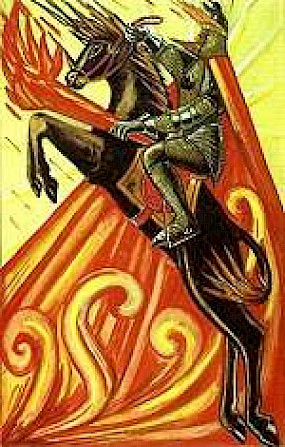
Tarot Card for June 23: The Knight of Wands

The Knight of Wands

The man represented by the Knight of Wands will be a loving and open-hearted person, with a strong sense of morality and a great sense of humour. He will be active, energetic and willing to help. You often find these types of men in the healing professions, or in other areas where they are required to assist, guide and support others.

He’s a man with a deep respect for life and all living things, attuned to Nature and to the creatures of the earth. He has a deep well of compassion which spills over readily to anyone who needs his help, but he also has the restraint to know when too much assistance is a bad thing. Then he will act to enable and empower, rather than to assisting.

He’s a faithful, and dedicated family man, being fully engaged in the domestic situation. His life reflects his high ethical standards, though he is not given to sermonising, nor standing in judgement on others. He could be defined as an idealistic realist – accepting the frailties of the race, whilst doing his best to strengthen it.

His faults spring from his good points – for instance, he dislikes causing pain, and will therefore delay when he needs to act if he thinks it will hurt other people. He will sometimes remain in limiting or painful circumstances because of this. His sense of rightness and duty is intense, and sometimes drives him to make foolish choices and decisions. He will shy away from conflict and unpleasant situations, especially when these arise as a result of his own needs, though he will never walk away from a struggle on behalf of somebody else.

If you are regarding this card as a spiritual change, then see it as an indication that the warrior of right and light is required – you’ll need to stand up for something that matters, and which is unable to defend itself.

The Knight of Wands

(via angelpaths.com and Alan Blackman)

UKRAINE EMERGENCY TRANSLATION GROUP

The Ukraine Emergency Translation Group meeting is scheduled for this Friday, June 24, at 11:00 AM Pacific Time, noon Mountain time, 1pm Central time, 2pm Eastern time, 8pm Greece, 9pm Turkey.  

We will share your Translation with the group, if you like.  You can email your Translation to me at zonta1111@aol.com.

Or perhaps you have a sense testimony you’d like to share.  Or other insights or comments you may have.

Open to all Translators.  Translate whatever you like or don’t Translate anything at all.  Your choice.

See you Friday.

Mike Zonta
Ukraine Emergency Translation Group

Prosperos Meetings is inviting you to a scheduled Zoom meeting.
Topic: Ukraine Emergency Translation Group
Time: June 24, 2022 11:00 AM Pacific Time (US and Canada)

Join Zoom Meeting: https://us02web.zoom.us/j/84023755291

Meeting ID: 840 2375 5291

One tap mobile
+19292056099,,84023755291# US (New York)
+13017158592,,84023755291# US (Washington DC)
Dial by your location       
+1 929 205 6099 US (New York)       
+1 301 715 8592 US (Washington DC)       
+1 312 626 6799 US (Chicago)       
+1 669 900 6833 US (San Jose)       
+1 253 215 8782 US (Tacoma)       
+1 346 248 7799 US (Houston)

Meeting ID: 840 2375 5291
Find your local number: https://us02web.zoom.us/u/kdNwwZt760

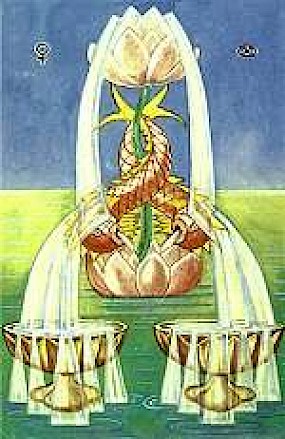
Tarot Card for June 22: The Two of Cups

The Two of Cups

And here we have the Lord of Love, a card of bliss, deep joyous love reciprocated fully and with great enthusiasm, a card of reconciliations and new growth! Here we see harmonious and contented exchanges of emotion, which vibrate with an ecstatic undercurrent of passion and heat.

Because this card is a reflective and receptive one, there’s an issue that people sometimes forget when reading it – to be truly loved, deeply treasured, valued highly by others, we must first and foremost strive to feel those things for ourselves. When we work toward loving ourselves, we hold our inner nature in high regard, treating it with deference and proper respect. When we see ourselves in that light, other people cannot help but respond to our personal sense of value.

Furthermore, when we work to love ourselves, we release so many areas of self-doubt and uncertainty that we become infused by a new energy – and this we can lavish on others. The Two of Cups is about engaging in a caring and tender fashion with our own needs, first and foremost.

It isn’t so much about achieving self-love, as about, in every single day of our lives, striving towards self-love. That action leads us into a positive, self-supportive and accepting approach to life. And also, when we stop wasting energy telling ourselves what’s wrong with us, we have lots more energy to enjoy being who we are.

When this card comes up in a reading, if it relates to the inner journey, then it tells you to put your attention in the moment, to leave the past behind, and to let yourself be free to enjoy everything that comes your way.

If it relates to outer events, it may point to a forthcoming reconciliation in a relationship where there has been pain and disappointment – this need not be a love affair, it can cover many different types of loving relationship.

It might point up a new relationship which has recently begun and which will grow into a deep and lasting friendship or affair.

And finally, it may reassure you that the meaningful relationship in your life will strengthen and grow, developing into exactly what you need it to be!!

The Two of Cups

(via angelpaths.com and Alan Blackman)

A God beyond logic

A God beyond logic | Aeon

The history of natural theology shows that Intelligent Design and New Atheism both got it wrong, in strangely similar ways

Spirit of the mountains. A bearded vulture unsettles a flock of Alpine choughs in the Aosta Valley, Italy. Photo by Stefano Unterthiner

Adam R Shapiro is a historian of science and religion. He is the author of Trying Biology: The Scopes Trial, Textbooks, and the Antievolution Movement in American Schools (2013) and co-author with Thomas Dixon of Science and Religion: A Very Short Introduction (2022). He lives in Lancaster, PA.

Edited by Cameron Allan McKean

21 June 2022 (aeon.co)

Love Aeon?

Support our work

DONATE

The first thing I learned about natural theology was that it was wrong. The idea that God’s existence could be proven by simply observing life on Earth – that divine presence could be found in human eyes, the wings of bees, the order of orchids or the movements of the planets – seemed archaic in a secular world where science reigned. And by the late 20th century, even those who rejected this secular world had started to turn away from natural theology: in the United States, evangelical Christians and other groups looked to the Bible, not nature, to justify their values. The very grounds of natural theology became something worthy of parody. I remember the British author Douglas Adams’s depiction of the Babel fish in The Hitchhiker’s Guide to the Galaxy (1979). This improbable living creature could provide instant universal translation to anyone who placed it inside their ear canal. For Adams, its existence served as the definitive disproof of a deity:

The argument goes something like this: ‘I refuse to prove that I exist,’ says God, ‘for proof denies faith, and without faith I am nothing.’

‘But,’ says Man, ‘the Babel fish is a dead giveaway, isn’t it? It could not have evolved by chance. It proves you exist, and so therefore, by your own arguments, you don’t. QED.’

‘Oh dear,’ says God, ‘I hadn’t thought of that,’ and promptly vanishes in a puff of logic.

Adams’s fantastical parody of the design argument came at a time when natural theology was increasingly regarded as both obsolete and absurd. Just under a decade later, Richard Dawkins wrote The Blind Watchmaker (1986), which also took aim at arguments that God was revealed through the natural world. Dawkins wrote that there was compelling evidence and logic behind the natural theology arguments of previous centuries – particularly those made popular by the British clergyman and philosopher William Paley in 1802 – but that these arguments had been rendered obsolete by Charles Darwin’s accounts of living creatures that were not designed. Instead, they had ‘evolved by chance’. By the early 1990s, even antievolutionists were latching on to a version of this argument. These groups, including evangelical Christians in the US, claimed that the fault was not in natural theology’s inherent logic, but in the out-of-date scientific examples that informed its argument. All of this came to a head in 2005, during the Kitzmiller vs Dover Area School District court case in the US, which determined whether intelligent design could be taught in a Pennsylvania school’s biology classes. The opposing sides in the courtroom could agree on only one thing. The central question of natural theology, they affirmed, was this: Can a God, creator, or ‘Intelligence’ be proven to exist? This is the version of natural theology we inherit today. The problem is, reducing natural theology to a question of proof loses much of what it stood for. If the first thing you learned about natural theology was that it was wrong, the second should be that you didn’t really learn about natural theology – you learned a truncated version rooted in historical misunderstanding.

During the past millennium, the arguments for natural theology were about much more than proving God’s existence. Natural theology advocates were not writing to merely dissuade atheists; their foils were other religious believers whose doctrinal or denominational differences might be arbitrated by the public evidence of empirical science. Natural theology was never about ‘proof’ as we have come to understand it. We see this in the writings of the Italian friar Thomas Aquinas in the 13th century; in the works of the English naturalist John Ray and the clergyman Paley in the 17th and 18th centuries; and among myriad other texts, including the eight Bridgewater Treatises, commissioned in 19th-century England to document the ‘goodness of God as manifested in Creation’. For natural theologians, the specific line of reasoning used to arrive at a ‘proof’ of God determined the kind of answers one could reach about moral and political questions, about the nature of salvation, the toleration of other faiths, and the validity and interpretation of scripture. Natural theology was never exclusively about proving God’s existence through the complexity of the natural world. And yet, our contemporary rejections of natural theology have focused almost exclusively on this argument. Natural theologians and philosophers were instead motivated by a search for answers to the pressing moral and political questions of their day, and their arguments were as much about considering the epistemological grounds of proof, as they were about finding God in nature.

To understand how the natural theologians made their arguments requires us to understand the purpose of ‘proof’ differently. Many of the arguments put forward by Aquinas, Ray, Paley and others follow specific rules of reasoning. They also follow commonly accepted rules of logical inference and conventions of citing publicly observable matters of fact. And yet, the demonstrations of ‘proof’ made by these writers – that is, descriptions of the natural world – also served as a literary genre through which rhetorical and emotional appeals could be made that go beyond logic. At the time when they were published, these appeals to rhetoric and emotion would not just have been seen as displays of wit or cleverness. They also showed an understanding of how humans think: an expression of how nature and divinity can open one’s mind and spirit to be moved and persuaded. Perhaps anticipating what scholars of psychology and communication would only conclude centuries later, natural theologians knew that people are rarely persuaded by reason alone.

Although Paley is less well known than the two other scholars he is most often contrasted with, David Hume and Darwin, his examples of natural theology remain ubiquitous today – and, for that reason, also distorted. Paley’s book Natural Theology: Or, Evidences of the Existence and Attributes of the Deity (1802) begins with perhaps the most misinterpreted discussion in the entire history of theology: the analogy of the watch. Should a person happen to come across a stone, Paley argued, one would not draw grand conclusions from it. But upon stumbling across a watch, a reasonable observer would quickly grasp that its many parts had been assembled for a purpose. There must be, he wrote, a kind of watchmaker. Paley later shows that the interpretation of the watch as something that has a purpose logically parallels how we might interpret various animal organs (eyes, ears, wings and more) and other natural systems as demonstrating purpose, too.

This ‘watchmaker argument’ is commonly described as an argument about origins and complexity. In calling his 1986 book The Blind Watchmaker, Dawkins argued that both watches and complex living things could have, in the terms of the Babel fish argument, ‘evolved by chance’. By this logic, if things such as body parts and living systems didn’t require an interventionist creator, then Paley’s argument crumbles. No creator? No purpose.

Except that Paley wasn’t writing in total ignorance of the theological arguments that had come before him.

Think of the argument about the initial creation of the observable world: the argument of the ‘first cause’. This is sometimes posed as a question, ‘Why is there something rather than nothing?’, which has taken on various forms since it was included in Aquinas’s Summa Theologica (written c1265-73). Hume, writing about a quarter-century before Paley, offered an incisive criticism of the first-cause argument, claiming that it was an error to presume that a deity or creative designer would have purposes akin to human ones, or that the analogy between human intentions and nonhuman ones could be justified through anything other than circular arguments.

Paley would have been familiar with these ideas, and his Natural Theology is partially an attempt to offer answers to the logical criticisms that Hume raised decades earlier. Paley’s opening comparison of the stone with the watch is one such answer – a response to Hume’s argument about first causes. By rejecting the idea that the stone provides useful evidence of a creator, Paley avoids the oversimplified argument that the existence of anything proves God’s existence. But the watch provides something different: evidence of purpose. That’s not the same thing as evidence of a creator. In a later chapter of the book, Paley considers the possibility of a mechanical watch-like object that creates a replica of itself. Logically, these self-replicating watches were directly created by their predecessors, and the watch could have been the most recent generation of an infinite cycle of reproducing watches that exist eternally. Paley avoids discussion of first causes to sidestep, rather than refute, Hume’s criticism, and focus his logic instead on the question of purpose.

For Hume, purpose could not be proven without presupposing that God had an anthropomorphic nature, with desires, goals and plans like our own. We can’t assume, he argued, that a God has the same purposes as human artisans. Paley’s argument took a different direction. His view that nature has purposes is based on observations that objects seem adapted to make use of natural laws even when those laws did not play a direct role in fabricating them. A watch uses its springs, chains and other mechanical laws in a way that coincides with astronomical laws that define the day. Observing this, we may infer that there is a purpose found in the ability of the material world to make use of natural laws. Paley is suggesting that Hume’s argument can be cleaved in two: whether purposes can be revealed by objects in nature is a separate question to understanding exactly what those purposes are. For Paley, we observe this through the parts of the eye that seem arranged to make use of the laws of optics, or through birds’ wings that make use of aerodynamics, or through an ear’s expression of acoustic principles. We can observe this adaptation even if we don’t understand sight or flight.

This argument was intended as a logical response to Hume. But, more importantly, it unveils an expanded view of Paley’s beliefs. This version of natural theology reveals a deity who is known not by the instances where science fails, but at the moments when it most elegantly works. The reductive ‘argument from design’ so often faulted by atheists and praised by antievolutionists suggests God is the best explanation remaining whenever we can’t account for why things came to be as they are. It’s based on a thin process of elimination – with a vision of a creator that the Scottish theologian Henry Drummond derided as the ‘God of the Gaps’ – and it can testify to nothing other than mere existence. By contrast, and design, Paley’s arguments are focused on getting beyond existence to questions of the attributes of the designer. In his view, because natural laws are found universally on Earth and beyond, then surely the author of those laws is both singular and omnipresent. More debatably, Paley’s writing indicates that the world seems to minimise purposeless suffering and permits creatures to experience pleasure without any apparent ulterior purpose – a suggestion that there is goodness in the governance of the world.

To understand Paley’s argument, readers had to exist in a society that built, sold, regulated and consumed watches

This latter point gets at the heart of ethics and politics in Paley’s day. In The Principles of Moral and Political Philosophy (1785), Paley responds to the question of whether (and by what means) a well-ordered society would prove naturally beneficial to its inhabitants. The reason for his affirmative answer was the chaos and suffering caused by the French Revolution, which he abhorred. He cautioned against the possibility of a similar uprising in Britain. Paley’s views were in conversation with those of the English economist Thomas Malthus, whose primary aim in An Essay on the Principle of Population (1798) was not simply to demonstrate that societies naturally and inevitably outgrow their resources, but that the suffering caused by population growth was neither inherently the result of failed governance nor incompatible with the moral edicts prescribed by a good and caring God.

Paley’s awareness of and conversation with the political and economic order of the day plays a key role in his arguments for natural theology, in particular his example of the watch. In his day, the people who fabricated individual parts of timepieces – chains, gears, dials and faces – were not considered ‘watchmakers’ (nor were those who assembled those pieces). That title was accorded only to those who supervised and managed such people. When Paley’s Natural Theology was published in 1802, he understood that English watchmaking was a geographically and financially complex industry that had as many moving parts as individual watches themselves. This context changes the nature of the watchmaker argument considerably. To fully understand Paley’s argument, readers of his Natural Theology had to exist in a society that built, sold, regulated and consumed watches, a society in which timepieces had become objects of form and fashion. To even consider the argument’s merits, one must already be part of a complex human mechanism that relied on the adaptation of human parts to a unified purpose. In this way, the argument is self-confirming in a more convincing way than any argument that God exists because existence is a necessary attribute of God – the ontological argument for a ‘God of the Gaps’.

In October 1802, weeks after Natural Theology was published, Paley received a letter from Bishop John Law, his close friend, former schoolmate and intellectual confidant. Paley had dedicated his first major work, The Principles of Moral and Political Philosophy, to Law’s father, who was the Bishop of Carlisle and a patron and supporter of Paley. Having just read Natural Theology, Law told Paley that his ‘arguments for the divine goodness are so strong, that not only our reason is convinced, but as Barrow would say, “we even touch and feel it with our senses.”’

Law quotes from a published sermon by the 17th-century English mathematician and theologian Isaac Barrow, perhaps best known as Isaac Newton’s mathematics teacher at Cambridge. Barrow draws from both the Book of Psalms and from the evidence of nature to explain ‘the Goodness of God’:

The Earth is full of the goodness of the Lord: The Earth, O Lord, is full of thy Mercy. Thy Mercy is great unto the Heavens; thy Mercy is great above the Heavens. ’Tis indeed because Divine Goodness is freely diffusive and communicative of it self …

For Barrow, the goodness of God, which is attested to throughout the Psalms, is also demonstrated to us by the sensual ways in which it is experienced:

Every pleasant object we view, every sweet and savoury morsel we taste, every fragrancy we smell, every harmony we hear; the wholesome, the cheering, the useful, yea, the innocent and inoffensive qualities of every thing we do use and enjoy, are so many perspicuous arguments of divine goodness; we may not only by our reason collect it, but we even touch and feel it with all our senses.

Barrow’s sermon remained topical enough 125 years after his death that Law would quote it in a personal letter to his old friend. This says much about the long tradition of natural theology as an engagement of embodiment and emotion, through touching, feeling and sensing in ways that are separate from, though perhaps complementary to, our faculties of logic and reason.

That history extends from Barrow through other natural theologians such as John Ray, whose book The Wisdom of God Manifested in the Works of the Creation (1691) provides an account of awe-inspiring contrivances of nature, and suggests that humanity was created with both the mental and physical abilities to perceive God’s wisdom. This synthesis of knowledge as both thinking and sensing was key to the emergence of empiricism, as exemplified by Barrow and Ray’s contemporary John Locke, and was deeply influential on both the theological and political thought of Edmund Law and Paley. Both believed that religious truths could be accessed through universally available human experience, making them staunch defenders of religious toleration. Unlike private revelation or doctrinally demanded interpretations of scripture, the evidence of religious empiricism – sensing and feeling God – could arbitrate the long history of religious disputes in England. For Law, Paley and others, religious toleration took the form of rejecting the mandatory oath-taking required in England to hold office or access society. They argued that the moral harm from swearing false oaths caused greater spiritual damage than believing in the wrong doctrine.

Paley’s appeal to readers’ sensations as a form of argument is a practical application of his view of how the mind processes the emotions that come from sensory experience. He discusses this early in The Principles of Moral and Political Philosophy, which leads him to navigate a morally conservative tightrope, insisting that experiences of pleasure and happiness were necessary to understanding God, but also that overindulgence in pleasurable experience for its own sake makes divine knowledge harder to grasp. Paley notes that over time and through repetition the emotional force of a sensation becomes ‘blunted’. Paley suggests that this blunting of the emotional response to certain sensations comes from the strengthening or relaxation of the fibres of the nervous system. Much later in his same work, he suggests that the biblical injunction against taking the name of God in vain may be understood as a caution against ‘that familiar levity with which some learn to speak of the Deity’ – a deity who should evoke feelings of awe and reverence. This injunction, which is at the heart of Paley’s concern about false oaths, is not merely about moral harm; it’s also about one’s easily blunted ability to grasp an embodied knowledge of God.

And yet, upon opening Natural Theology in 1802, Paley’s first readers did not engage with his new book with all their senses directly. The texture of cut quarto pages, the smell of leather binding and the visual contrast of ink on paper are not what revealed God to them. Rather it was a remembered sensory experience, built upon Paley’s expectation that his readers have been in the world, observed birds in flight and caught the scent of flowers in bloom. They’ve looked at the lights in the night-time skies and they’ve heard the ticking of their watches. Paley relies upon that shared context of observing, sensing and knowing. His words contrive to evoke memories of moments of awe, experiences of beauty and wonder. However, this was often done with such skill that Paley was later dismissed as a populariser or educator rather than a theologian engaged in original argument and analysis.

They saw evolution not as a logical disproof of God, but as a tangible demonstration of divine power

In truth, natural theologians such as Paley and his successors were often doing both, and finding success in doing so for a variety of reasons. Their writing was not just a pragmatic marriage of natural philosophy and religious pluralism; nor was it a simple rejection of either the a priori rationalism that so often characterised continental European philosophy or the mystical-revelatory religious knowledge that took hold in some evangelical Christian movements in the 19th century. The English-language religious tradition of that period did not reject Darwin’s theory of evolution as incompatible with a Genesis account of creation or as a rejection of theism. This was not merely an attempt to broker a ceasefire between the opposing forces of science and religion. And it was not simply a compromise of compatibility. Rather, it was born out of a strong sense that the natural world revealed divine knowledge in a way that could be expressed logically and appeal extra-logically to emotion and sentiment. Many readers of Natural Theology have understood that a deity must be known not only through reason, but also sensed and felt.

This commitment to logic and feeling remained, even as new scientific discoveries compelled revisions to some of the naturalistic explanations that prior natural theologians had pointed to. By the 1830s, some editions of Paley’s Natural Theology contained a footnote stating that it was now possible to explain not just the watch but also how the stone came to be. Paley’s own writing, which Law had praised for its ability to evoke sensory memory, helped natural theology inspire a subgenre that gradually became what we call ‘popular science’ or ‘nature writing’.

The union of logic and feeling reveals itself through theologian-scholars such as the US botanist Asa Gray and the English historian Charles Kingsley, who embraced Darwin’s theory of evolution in the 1860s. These same scholars also embraced the idea of a deity who could have enabled the living world to evolve into complex life, which they saw as testament to the wisdom, power and benevolence of a creator (one who hadn’t simply created each species on an ad hoc basis). They saw evolution not as a logical disproof of God, but as an evocative and tangible demonstration of divine power, one that was felt every day in their own bodies.

However, efforts to promote more secular versions of science and less politically pluralistic interpretations of Christianity eventually came to dominate not just the debate over evolution, but the broader discussion of ‘science and religion’. To some concerned Christians, natural theology became associated with efforts to analyse the Bible through scientific tools and was subsequently derided as anti-Biblical. For them, biblical authority, not natural theology, was at the root of science-religion conflicts in the early 1900s. After the Second World War, English-language scientists tried to distinguish themselves from the militant atheism of their Soviet rivals, while also distancing themselves from caricatures of creationist fundamentalism. The compatibility of science and religion took hold as a logical possibility: one could now be both scientist and Christian. And so, over time, the work of Paley, Ray, William Buckland and many others was thinned out, and relegated to a mere God-proof that could, at best, be mounted as a defence against scientific debunking.

By the mid-20th century, natural theology was dying of the slow strangulation of faint praise. It was nothing more than a misguided – if clever and well-intended – attempt to prove that God exists without any recourse to scripture or revelation. The US scholar Ian Barbour, widely recognised as one of the founders of the interdisciplinary field of ‘science and religion’, rejected the fundamental premise of natural theology when he wrote in 1966 that ‘theology should not be based primarily on nature’. Instead, Barbour suggested doing ‘theology of nature’ – something that was not natural theology. The primary difference seemed to be that one would do theology of nature from within a religious tradition, that is, after one was already convinced (by other means than nature) that there was a God worth doing theology about.

By the end of the century, this caricature of natural theology as a vaguely Christian effort to use nature to prove that God is real had taken root among both outspoken atheists and antievolutionists who had been compelled by American court rulings to demonstrate that they had an alternative to natural selection that was ‘scientific’. This version of natural theology’s aims and origins became a rare point of consensus between those who wanted to prove that God didn’t exist (thanks to Darwin) and those who wanted to prove that something exists (even if they couldn’t say exactly what). It was further abetted by acolytes of Barbour and those of the science-religion ‘dialogue’ whose positions rarely moved beyond statements that science and religion were logically or technically compatible. Mere existence, therefore, became the minimal and ultimate stakes for the argument from design – a profoundly reductive vision of natural theology.

Intelligent Design and New Atheism converge on questions about the ethical and political nature of science

The erasure of the psychological and rhetorical complexity of natural theology – that is, its recourse to embodied knowledge – has had a damaging effect on religious philosophy in recent decades. It’s contributed to the persistence of a so-called Intelligent Design movement, which, for years, has focused on trying to prove the existence of an intelligent agent without fully acknowledging or seeming to care that specific approaches to such proofs have implications for theology, politics or ethics. At the same time, the reduction of natural theology into a kind of logical proposition has allowed those who reject its repackaged proposition – such as the ‘New Atheists’ – to assert that the disproofs of God and the secular science that they claim to be doing are value-neutral, apolitical and objective.

On the surface, it appears that Intelligent Design and New Atheism fundamentally disagree about the nature of biological evolution. However, the erasure of their shared intellectual history has allowed both movements to converge on more fundamental questions about the ethical and political nature of science. And often, they’ve done this without acknowledging either their own biases or the ways that these arguments are inseparable from the cultural uses to which they are put. To get past the senseless duality that these two movements offer us, we may have to follow Law and Barrow, recalling that, in the synthesis of religion and science, ‘we even touch and feel it with our senses’.

History of ideas Philosophy of religion Nature and landscape

The philosophy of selfhood became real when my mother got dementia

The philosophy of selfhood became real when my mother got dementia | Psyche

The author’s mother Anne Atic in April 2006. Drawing by Avigdor Arikha. Private collection and courtesy of the author

Noga Arikhais a philosopher and historian of ideas. She is an associate fellow of the Warburg Institute (London), an honorary fellow of the Center for the Politics of Feelings, and a research associate at the Institut Jean Nicod of the Ecole Normale Supérieure (Paris). She is the author of various books including Passions and Tempers: A History of the Humours (2007) and, most recently, The Ceiling Outside: The Science and Experience of the Disrupted Mind (2022).

Edited by Marina Benjamin

21 June 2022 (psyche.co)

There are times when life interrupts one’s best efforts at contemplating it from a safe distance. So I wrote, in the opening pages of a book into which I gathered the stories of patients I had witnessed being examined over 18 months, as an anonymous onlooker of weekly sessions in a neuropsychiatry clinic. Sitting in on these sessions, I wanted to understand how the self studies itself, and how it loses itself: how disruptions of the sense of self can throw light on what it takes for there to be a sense of self in the first place.

As a philosopher and historian who has long studied ideas about the mind, I wasn’t looking at extremes of psychopathology, or the follies underlying our most destructive actions. I was interested in gradations of ordinary confusion – the porous border between normality and pathology. Since anyone is a potential patient, I wanted to know how each clinical patient I saw seemed, on entering the consulting room, to be a quite ordinary, healthy person, their sometimes terrible difficulties revealed only once doctors had poked around for a while, asking questions, enquiring like empathic detectives.

Some patients stood out. One awoke from a coma having forgotten 10 years of her life. Another could not take the glove off her chronically painful hand. One man heard voices and couldn’t sleep. Another felt too guilty to live. Some ailments were clearly neurological. Others resisted diagnosis, even categorisation. Once I’d stopped attending the sessions, I wrote up these stories, trying to understand their disrupted selves with the tools of experimental psychology.

That perspective was upended when my mother, with whom I was close, began developing signs of dementia. I was now the family of the patient, helpless before the inevitable unravelling of my closest kin, and trying to make sense of ailments of the mind when there was no safe distance to be had.

At first, my mother, the poet Anne Atik, had seemed just ordinarily confused. Then, very gradually, the confusion took on a pathological aspect. She awoke in the middle of the night thinking it was morning. On what turned out to be her last Eurostar journey, she thought she had arrived in London when we had just left it. Though her sentences remained grammatically coherent, they stopped making sense. A poet and writer, she became unable to write, even to read. But she remained a poet, distilling her emotions and humour into one-liners that I took to writing down. It was as if the confusion bred by the dementia had set her free, distilling her poetic fire.

I had been observing doctors observing patients, but once my mother started entering the text, the patient ‘out there’ became a ‘you’

It was a bewildering experience – dementia always is. But my questions about the self, and the loss of self, became all the more poignant now that I could see what in my mother remained, and what was disappearing. I also better understood the patients whose stories I was writing about – while their stories helped me better understand her.

This was the perspectival shift: from third-person reader, thinker and onlooker, to a feeling, second-person interaction. I had been observing doctors observing patients, but once my mother started entering the text, re-shaping the stories I was telling, the patient ‘out there’ became a ‘you’. And not any ‘you’: the mother is begetter, within whom, and then in whose arms, one first interacts as a developing ‘I’, and without whom there would be no ‘I’ at all.

This shift in perspective was an enactment of so-called ‘second-person psychology’ or ‘interpersonal neuroscience’, the study of which is a rapidly growing field within psychology and neuroscience, which involves, for instance, scanning the brains of two people engaged in the same task. The psychiatrist Leonhard Schilbach characterises it as an ‘interaction with the other [that] can be thought of as essential or even constitutive for social cognition’. In the words of the philosopher Anna Ciaunica, ‘the second person comes first’.

The idea that ‘you’ matters centrally to ‘I’ – that we are defined by others – is not new in philosophy. Emmanuel Lévinas wrote of intersubjectivity as the foundation for ethics, which is defined in contemporary psychology, by Hanne De Jaegher and others, as ‘the meaningful engagement between subjects’. For Paul Ricœur, the very meaning of a self was constituted by the ‘other’. At the start of his aptly titled Soi-même comme un autre (1990) – translated by Kathleen Blamey as Oneself as Another (1992) – Ricœur notes the frittering away of the Cartesian ego. The inward-looking, disembodied, potentially immortal thinker that René Descartes had conjured with his ‘cogito, ergo sum’ is today recognised as a figment of our, in fact, very embodied imaginations – a fantasy that breeds unsolvable puzzles.

It may seem evident that interaction is all. Psychotherapists have always known it. But neuroscience and experimental psychology focused until recently on the brains and minds of subjects operating alone, not in the midst of engagement with others – perpetuating the traditional border between the studying gaze and the experiencing self. The understanding of the human mind hits against its own internal borders by its being at once the subject and object of study: we cannot escape ourselves. No other species needs mirrors, real or figured, and no other species gets caught up in the complexities bred of mirroring, which we simultaneously wish to transcend.

Phenomenology, primarily the kind shaped by the philosopher Maurice Merleau-Ponty in the mid-20th century, was a conceptual effort at embracing just this seeming paradox, grounding the very possibility of thought within the felt, communicating body of the subject. The tradition of enactivism that has since developed out of this position has merged with research in psychology around the embodied self, and also established a footing within feminist philosophy where it makes room for the inter-subjective, embodied self that develops from infancy onwards. Enactivism acknowledges that to study the self is also to experience ourselves with others, and that this very experience is a form of study. But it continues to privilege the subjective, first-person perspective.

I saw that what was happening to her had an impact on my capacity to make sense of what was happening to her

This is how the growing study of the mind as intersubjective is helping us make sense of our capacity to self-reflect. Each person develops their own conceptual space, their own thinking habits, in the privacy of their mind. But that privacy is flimsy, as evanescent as thought itself. The child who feels embraced and held by her parents progressively realises that her thoughts and feelings are internal, separate from those of her parents. As we grow older, so we define and refine those private spaces of being. We all partake in and share the experience of privacy: we recognise it in each other, just as the words we use to cultivate our inner secrets partake of a shared language. Private and public overlap – just as do self and other. I overlapped with my mother, into my adulthood. And so her dementia was akin to a tectonic faultline in the terrain we had shared. She still saw me as her daughter, but the daughter I had been had to adapt to a new mode of relating. We no longer inhabited the same temporality.

From conception on, we are embedded within a constantly changing environment. The dynamics of embryonic processes and foetal development; the dependence of the infant on its carers for survival; the development of perceptual and cognitive capacities; and the evolution of linguistic competencies – all of these can be best understood ‘bottom up’, as embodied, evolved functions, rather than ‘top down’ in representational terms. The self is a process, rather than a state. It is that which progressively becomes differentiated from other selves without whom it would not exist, while remaining in constant, dynamic interaction with those others – and via all the senses, including, importantly, the sense of touch. We feel others through our skin, which also marks our boundary with the world. Because psychology and philosophy have long treated sight as the primary sense modality, we’ve crucially overlooked the fact that our interaction with the environment begins, in utero and then at birth, with touch. This understanding is a vital aspect of the turn towards second-person psychology, since embodied cognition is necessarily social – ‘people reuse their own mental states or processes represented with a bodily format in functionally attributing them to others,’ in the words of the neuroscientist Vittorio Gallese. Observation, interaction and action are all entwined.

Touch is in part how ‘through others, we become ourselves’. The phrase, originating with the Russian psychologist Lev Vygotsky, now characterises research on ‘collective psychophysiology’ by Schilbach and Dimitris Bolis. The complex processes at work in our dynamic interaction with our environment and each other have been mathematically modelled by the computational neuroscientist Karl Friston. His theory of predictive coding, derived from the 19th-century physics of Hermann von Helmholtz, redescribes the brain as an organ that predicts the sensory inputs from the external and internal world out of internal models of it, in a constant to and fro. Predictive coding is a potent theory that is currently being refined, discussed and critiqued. But my point is not to explain it: it is to ask what our very capacity to imagine ourselves as predictive, interdependent creatures does for our experience, what we can do with a third-person theory about how we function.

The main story is not the scientific theory, which is contingent and provisional. Existence is always prior to its explanations. This is why the best scientific theories, including predictive coding, are as dynamically flexible as what they describe. In bringing these theories from psychology and neuroscience about the embodied sense of self to bear on my mother’s dementia, I saw that what was happening to her had an impact on my capacity to make sense of what was happening to her, as well as to the patients whose stories I was telling.

Writing is itself ‘altercentric’, that is, the product of our interactions with others. The writing ‘I’ is a transcendence of selfhood, directed as it is to ‘you’. I had fooled myself into thinking I could be a mere observer, forgetting that I am ‘as another’, to use Ricœur’s phrase, and that there is no proper understanding from afar without the second person. Because the first-person perspective is inevitably entangled with the other, it was as if my mother held my hand while I wrote, throughout her cognitive decline. And in fact the feel of her touch remained unchanged, as did her affect, and the maternal nature of her presence to me. Verbal meaning had gone, but not her feeling self.

What I was studying turned out to be what I was living. I see in my mind’s eye her edition of Martin Buber’s I and Thou (1923) on her bookshelf. She might have made a good joke of it all, or gotten a poem out of it. Instead, I chose as a title for the book I wrote – somehow with, and through her – a poetic phrase of hers, ‘the ceiling outside’. I hope she would have appreciated the poetry in that.

Lauritz Melchior, tenor – “Because” (1950)

GregNichols1953

GregNichols1953

Because, you come to me, 
With naught save love, 
And hold my hand and lift mine eyes above, 
A wider world of hope and joy I see, 
Because you come to me! 

Because you speak to me in accent sweet, 
I find the roses waking 'round my feet, 
And I am led through tears and joy to thee, 
Because you speak to me! 

Because God made thee mine, 
I'll cherish thee, 
Through light and darkness through all time to be, 
And pray His love may make our love divine, 
Because God made thee mine!

(Courtesy of Alan Blackman)