New Thinking Allowed with Jeffrey Mishlove Jun 3, 2022 This video is a special release from the original Thinking Allowed series that ran on public television from 1986 until 2002. It was recorded in about 1992. Joseph Rael, aka Beautiful Painted Arrow, discusses the Tiwa language of the Pueblo Indians and its capacity for apprehending all of life as a metaphor for sacred reality. He recalls the visionary experiences of his childhood and develops his philosophical perspective that all physical manifestation is a consequence of vibrations from eternity Now you can watch all of the programs from the original Thinking Allowed Video Collection, hosted by Jeffrey Mishlove. Subscribe to the new Streaming Channel (https://thinkingallowed.vhx.tv/) and watch more than 350 programs now, with more, previously unreleased titles added weekly. New!! Free month of the classic Thinking Allowed streaming channel for New Thinking Allowed subscribers only. Use code THINKFREELY.
Highly respected Ute healer and visionary Joseph Rael teaches that the nature of all existence is vibration. From human breath and heartbeat to the pulsating energies of subatomic particles, to expansion and contraction of stars and of the universe itself, there is pulsation-vibration inherent in all that exists. Rael’s teachings show how we may experience spiritual reality in its totality through drumming, chanting, and vision quests. The book includes practical instructions and visualizations around breath, chant, and sound.Since its publication in 1993, Being and Vibration has gained a growing audience, including followers of Gurdjieff. Over 45 Peace Chambers have been established throughout the world, based on Rael’s teachings -and the number keeps growing
SubjectiveTruths Sep 20, 2008 Un estratto sottotitolato in italiano dello spettacolo “Jesus is Magic” della comica americana Sarah Silverman. Un monologo che racchiude i principali temi satirici: politica, sesso, religione e morte.
“On seeing one thing, you see all things. On perceiving an individual’s mind, you perceive all mind. Glimpse one truth and all truth is present in your vision. There is nowhere at all that is devoid of the Truth.” Huangbo Xiyun (?-850) Chinese Zen Master
AN OPPORTUNITY FOR DAILY REFLECTION BROUGHT TO YOU BY THE SCHOOL OF PRACTICAL PHILOSOPHY
Liberia found a stunningly effective way to reduce violent crimes. Now the US is trying a similar experiment.
By Sigal Samuel May 31, 2022, 8:20am EDT (Vox.com)
A man looks out over Monrovia, the capital city of Liberia in West Africa.
This story is part of a group of stories called
Finding the best ways to do good.
What if someone told you that you could dramatically reduce the crime rate without resorting to coercive policing or incarceration? In fact, what if they said you could avert a serious crime — a robbery, say, or maybe even a murder — just by shelling out $1.50?
That’s such an incredibly good deal that it sounds too good to be true. But it’s been borne out by the research of Chris Blattman, Margaret Sheridan, Julian Jamison, and Sebastian Chaskel. Their new study provides experimental evidence that offering at-risk men a few weeks of behavioral therapy plus a bit of cash reduces the future risk of crime and violence, even 10 years after the intervention.
Blattman, an economist at the University of Chicago, never intended to conduct this study. But in 2009, he was hanging out with an acquaintance in Liberia named Johnson Borh, who showed him around the capital city of Monrovia. Since Blattman studies crime and violence, Borh took him to visit the pickpockets, drug sellers, and others living on the margins of society.
Along the way, they kept running into guys who were sitting on street corners, eking out a meager living by shining shoes or selling clothes. When these men spotted Borh, they’d run to give him a hug. Blattman recalls that when he asked the men how they knew Borh, they’d say something like, “I used to be like them,” and point to the nearby pickpockets or drug sellers. “But then I went through Borh’s program.”
That’s how Blattman learned about the program Borh had been running for 15 years: Sustainable Transformation of Youth in Liberia. It offered men who were at high risk for violent crime eight weeks of cognitive behavioral therapy. CBT, as it’s called, is a popular, evidence-based method of dealing with issues like anxiety, but Borh adapted the therapeutic strategy to deal with issues like violence and crime.
Meeting with a counselor in groups of around 20, the men would practice specific behavioral changes, like managing anger and exerting self-control. They’d also rehearse trying on a new identity unconnected to their past behavior, by changing their clothes and haircuts and working to reintegrate themselves into mainstream society through community sports, banks, and more.
Blattman wanted to formally study just how effective this kind of program could be. He decided to run a big randomized controlled trial with 999 of the most dangerous men in Monrovia, recruited on the street. The results were so promising that they’ve already inspired a sister program in a very different city: Chicago.
In Chicago, the murder rate is troublingly high, and the police fail to solve 95 percent of all shootings. Finding a way to prevent shootings and other violent crimes is an urgent priority — not only in that city, but across the US, as the recent mass shootings in Buffalo, New York, and Uvalde, Texas, remind us. Given that direct interventions like removing guns are largely blocked by political polarization, and trying to crack down on crime after the fact carries with it risks of policy brutality, we desperately need new solutions to the problem of violence.
Therapy plus cash was a surprisingly successful combo
The 999 Liberian men were split into four groups. Some received CBT, while others got $200 in cash. Another group got the CBT plus the cash, and finally, there was a control group that got neither.
A month after the intervention, both the therapy group and the therapy-plus-cash group were showing positive results. A year after the intervention, the positive effects on those who got therapy alone had faded a bit, but those who got therapy plus cash were still showing huge impacts: crime and violence were down about 50 percent.
But Blattman didn’t dare to hope that this impact would persist. Experts he surveyed predicted that the effects would steeply diminish over the years, as they do in many interventions.
So it was a great surprise when, 10 years later, he tracked down the original men from the study and reevaluated them. Amazingly, crime and violence were still down by about 50 percent in the therapy-plus-cash group.
Blattman estimates that there were 338 fewer crimes per participant over 10 years. Given that it had cost just $530 per participant to implement the program, that works out to $1.50 per crime avoided.
In short, it worked extremely well. But why did the combination of CBT and some cash work?
Practice makes perfect
The most plausible hypothesis, according to Blattman, is that the $200 in cash enabled the men to pursue a few months of legitimate business activity — say, shoe shining — after the therapy ended. That meant a few extra months of getting to cement their new non-criminal identity and behavioral changes. “Basically, it gave them time to practice,” Blattman told me.
A couple of caveats: The study relied largely on self-reported data about what behaviors participants were and weren’t engaging in, which could raise concerns of experimenter demand (where participants tell experimenters what they want to hear). Also, of the 999 men initially recruited into the study, 103 had died by the time of the 10-year follow-up.
That might make you wonder whether the more violent men, who could have been more resistant to the effects of the program, were just missing from the reevaluation, artificially making it look as if violent crime had dropped more than it really had.
But there are caveats to the caveats. For one thing, the study authors didn’t rely only on self-reported data; they also observed how participants acted in incentivized games where, for example, they’re given a choice between getting $1 now or $5 next week (a good example of self-control and future-oriented thinking). “Our treatment effects are strong and persistent in these outcomes,” the study notes.
By interviewing friends and relatives of each participant who died, the authors also determined the cause of death. They identified only 26 violent deaths. And even when they modeled what would happen to their results if they plugged in “good” outcomes for missing control group members and “bad” outcomes for missing treatment group members, the positive treatment effect for therapy-plus-cash largely remained.
Upending the mainstream approach to crime
Inspired by the program in Liberia, Chicago has been implementing a similar but more intensive program called READI. Over the course of 18 months, men in the city’s most violent districts participate in therapy sessions in the morning, followed by job training in the afternoon. The rationale for the latter is that in a place with a well-developed labor market like Chicago, the best way to improve earnings is probably to get people into the market, whereas in Liberia, the labor market is much less efficient, so it made more sense to offer people cash.
“We’ll have more results this summer,” said Blattman of the READI program, which he is helping to advise. So far, “it doesn’t look like a slam dunk.”
Still, Chicago is eager to try these therapy-based approaches, having already had some success with them. The city is also home to a program called Becoming a Man (BAM), where high schoolers do CBT-inspired group sessions. A randomized controlled trial showed that criminal arrests fell by about half during the BAM program. Even though effects dissipated over time, the program looks to be very cost-effective.
But this isn’t just a story about the growing recognition that therapy can play a useful role in preventing crime. That trend is part of a broader movement to adopt an approach to crime that is more carrot, less stick.
“It’s all about a progressive, rational policy for social control. Social inclusion is the most productive means of social control,” David Brotherton, a sociologist at the City University of New York, explained to me in 2019.
Brotherton has long argued that mainstream US policy is counterproductively coercive and punitive. His research has shown that helping at-risk people reintegrate into mainstream society — including by offering them cash — is much more effective at reducing violence.
To give one striking example from Brotherton’s research: In 2007, the crime-riddled nation of Ecuador legalized the gangs that had been the source of much of the violence. The country allowed the gangs to remake themselves as cultural associations that could register with the government, which in turn allowed them to qualify for grants and benefit from social programming.
Can you guess what happened to the murder rate over the next few years?
Lighting up the TED stage, Nobel laureate Al Gore takes stock of the current state of climate progress and calls attention to institutions that have failed to honor their promises by continuing to pour money into polluting sectors. He explains how the financial interests of fossil fuel companies have blocked the policymaking process in key countries — and calls for a global epiphany to take on the climate crisis. “Do not give up hope,” Gore says. “And remember always that political will is itself a renewable resource.”
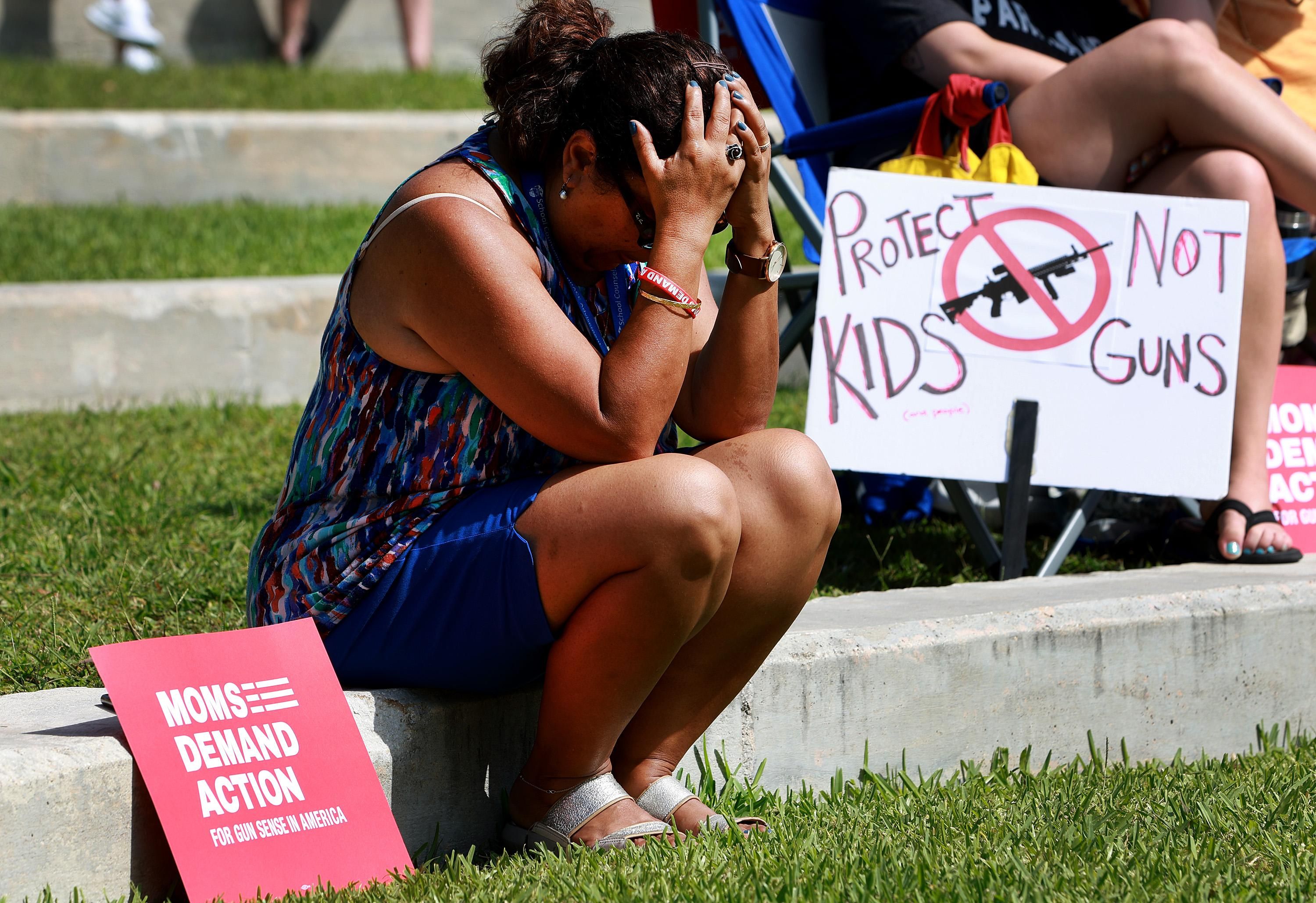
Tirza Clarke listens as the names of victims of recent mass shootings are read aloud during a vigil at the Sunrise Amphitheater on May 28, 2022 in Sunrise, Florida. Moms Demand Action, a national organization that works to prevent gun violence, held the vigil to mourn the victims of the mass shootings in Buffalo, New York, and Uvalde, Texas. (Photo: Joe Raedle/Getty Images)
If a mass shooter doesn’t have an assault rifle, he can’t kill a mass number of people. This is crucial. However, if we want to eliminate this problem altogether, we also need to focus on the deeper reasons of how these killers are created.
In 2009, I wrote a short op-ed for The Oregonian on why men—and it is almost always men—become mass shooters. Re-reading the piece, I think it still holds up fairly well, though what is distressing is how 13 years later, we still find ourselves with this disturbing phenomenon. Considering the massacre of little children at Robb Elementary School and the Buffalo massacre, I felt compelled to re-visit my thoughts, amplify some key points. Most pointedly, like so many others, I am especially tormented by this recent atrocity, the killing of children aged 9 thru 11. Like how I felt about the Sandy Hook tragedy, I cannot fathom how such horrors can be inflicted on our children. And like so many others, I am with those who stress guns as the simplest way to ameliorate these mass shootings. Gun regulation is absolutely essential to at least cutting down on the number of mass shootings, legislation like background checks and assault rifle bans especially—obviously—key to keep weapons of war out of the hands of potential deranged killers.
Monsters Are Not Born, They Are Created
But, to my mind, as I touched on in that earlier piece—titled “Young mena and violence“—to truly end these horrors and to just create a safer society in general, we need to get at the root causes of what turns these people/kids into killers. After all, as I’ve said so many times to whomever will listen, monsters are not born, they are created. And if we want to stop them from being created, just subjecting them to our hate and/or punishing them is not enough. We must get at the root causes of what creates them and stop them from being created.
While there are many root causes to this complex issue, to my mind, the most crucial element are toxic masculinity ideologies that create toxic masculinity men. I’ve been researching masculinity for over twenty years, and it has become clear to me that toxic masculinity ideologies (compounded by other toxic ideologies—I’ll come back to this in a moment) are a crucial root cause for what is to my mind a deeply unhealthy (toxic) masculinity in our culture.
Defining Toxic Masculinity
By toxic masculinity ideologies I’m referring to patriarchy, phallocentrism, and hypermasculinity. Patriarchy is a way of being that entails normalizing such toxic attributes as dominance, power, control, and authority/hierarchizing. Patriarchy is associated with paternalism or what psychoanalyst/theorist Jacques Lacan called “the law of the father,” the belief that men—and it usually is men though not always (think Margaret Thatcher!)—are the inexorable authority figure, determining the choices and ways of being of Others. Patriarchal/toxic masculinity men believe that this is their entitled position in the world and when they don’t get it, they feel aggrieved. Phallocentrism is defined by how we center and encourage phallic (masculine) power, the phallus being a symbol for masculine power and that which is used to reinforce and prove one’s masculinity. Guns of course are the prototypical phallic symbol of masculine power. Hypermasculinity is defined as the suppression of attributes ideologically associated with the “feminine” and the accentuation of those attributes ideologically defined as “masculine,” e.g., the suppression of emotion and other “feminine” attributes (empathy, sympathy, compassion, etc.), dominating Others (people of color, people of different nationalities/ethnicities, women, LGBTQ+ people, those deemed un-masculine or “weak,” etc.), violence as a natural and necessary outlet and response, stressing “manly” (phallic) characteristics and behavior (showy displays of one’s power and dominance, etc.) and so on. All the above are the ingredients for creating sociopaths; all told, toxic masculinity ideologies turn men into unempathetic sociopaths.
Of course, only a tiny percentage of such toxic masculinity sociopaths become mass killers, but the point is not that this is the singular root cause but rather that it is a crucial base ingredient. I would argue that all toxic masculinity men are sociopaths, they just exhibit that sociopathy in different ways. In short, the combination of a striving for power, dominance, control, and authority—the constant need to reinforce one’s sense of a phallic masculine self—combined with a low degree or even zero degree of empathy and compassion for Others creates the conditions for sociopathy. We see this not only with these (mostly white) male mass shooters (and other destructive males) but also with the men who create the conditions for these mass shooters to exist, phallic men both keeping in place this unhealthy and dangerous hypermasculinity in men (be “manly,” don’t show emotions, exert your authority, don’t seek help for mental health issues, etc.) and giving such men an outlet to constantly reinforce their never ending need to reinforce their masculinity, whether that be in the form of phallic guns or seeing other people as Others. In terms of latter, toxic masculinity men have always needed an Other to differentiate the self, people of color, women, LGBTQ+ people, Jewish people, etc. existing for them to constantly give them an Other that distinguishes their self as superior, the feeling and expression of “superiority” itself registering for them their sense of their own phallic (masculine) power. (I’m not specifically focusing on this element here but when toxic masculinity and white supremacy/xenophobia/LGBTQphobia/misogyny/anti-Semitism are combined we get yet another root cause for many of these mass shootings, the Buffalo mass shooting being the latest example.)
Compounding Toxic Ideologies
I should just touch on here a compounding element in this toxic stew, other toxic ideologies. Capitalism especially exacerbates toxic masculinity ideologies. In short, capitalism is a mercenary, predatory, survival of the fittest economic system/ideology and it breeds this way of being in people. Indeed, I would argue that capitalism is a patriarchy ideology, which is in part why it became the economic system/ideology of choice, since it too informs in so many ways toxic masculinity ways of being. One could even make the case that our most successful capitalists are successful because they must be sociopaths, their entire way of being living for constant and relentless—albeit unsustainable—profit increases and growth, which can only happen at the expense of Others and the planet, which are constantly dominated, controlled, and exploited. As I suggest above, other toxic ideologies also compound toxic masculinity ideologies, such as religious belief systems, white supremacy, and heteronormativity, all of which are Othering ideologies that potentially feed that need for toxic masculinity men to reinforce their sense of (superior) phallic power.
Of course, more pointedly, capitalism is also behind the drive by the NRA to keep assault rifles on the market, a key source of much of their profit and power. That, in turn, is why the NRA pours so much money into the coffers of politicians, mostly Republicans but some Democrats as well. Both the NRA and NRA owned politicians can’t come out and say that, so they use toxic masculinity ideologies for their own self-interest, exploiting toxic masculinity ideologies in ways that feed toxic masculinity men’s need for their phallic power, guns again being a key reinforcer but also just doing what right wingers have learned to do so well, create alternative realities (disinformation, conspiracy theories) that also feed into phallic drives that reinforce masculinity. We see this with the NRA’s disinformation campaigns that Democrats wanting to ban assault rifles is just the first step to “taking your guns away.” The many conspiracy theories on the dangers of our government all are based on the tried and true tactics of using fear, hatred, and rage to create a threat that needs to be engaged, the source of (white nationalist) militias and assault rifle ownership.
The Essential Need for Gun Safety
Bringing this back to mass shooters, the easiest response (or one would think!) to addressing this horrifying “new normal” we seem to have come to disturbingly accept is to just create stringent gun regulations, like so many other countries have done with success, especially in terms of banning these weapons of war (assault guns) and installing rigorous background checks. The common sense of this is incontrovertible: If a mass shooter doesn’t have an assault rifle, he can’t kill a mass number of people. For certain, that would cut way down on mass shooters, as it did during the time period that assault guns were actually banned in this country, from 1995 to 2004.
Making the Explicit Link to Mass Shooters
However, if we want to eliminate this problem altogether (and ameliorate other issues, such as the ever present threat of authoritarianism and fascism, which are direct toxic masculinity ideologies), we also need to focus on the root causes of these killers and that means understanding and addressing how these killers are created. The shooter who slaughtered our children at Robb Elementary purportedly had a speech impediment and was cruelly bullied when he was young, bullying also a symptom of our unhealthy toxic masculinity culture. He also apparently had a terrible home environment. Such an upbringing couldn’t have but led to a thoroughly dysfunctional individual and untreated mental health issues. That doesn’t mean of course that every such young person with mental illnesses will become a killer, but it does mean that many if not most toxic masculinity young men will have issues that left untreated could potentially lead to (self) destructive choices. That is, when young toxic masculinity men with mental illnesses grow up in a society permeated with toxic masculinity ideological indoctrination and messaging, that influence—that combination—can potentially lead to the most disturbing of (self) destructive choices.
More pointedly, like so many other young toxic masculinity males who are filled with a sense of victimization or lack of control—all of which for toxic masculinity males can only induce a feeling of emasculation—the Robb Elementary shooter chose to express that rage and hate in the only way that toxic masculinity men can, through acts of phallic violence. Most if not all shooters feel wronged or persecuted in some way and thus need to fight back in a way that gives them back a feeling of power and dominance and control—gives them back their sense of phallic power—mass shootings becoming one avenue to that end. Even the suicide aspect of this act could be seen as empowering, since this final act is part of their need to reassert control, not to mention that in their twisted minds, they can only see their heinous act as some glorious act of (phallic) retribution or pay back against a society that has caused them so much pain and suffering.
The Struggle for Fundamental Change Continues
In some ways, talking just about guns is an easy way out for well-intentioned (Democratic) politicians and pundits, since focusing on the real root causes—yes, toxic masculinity ideologies but also capitalism, consumerism, white supremacy/xenophobia, heteronormativity, misogyny—is challenging to say the least especially in terms of forcing us to confront aspects of ourselves that would necessitate real radical (progressive) change. But since the very politicians, pundits, and general populace who we need to enact such change are also deeply entwined in the very (toxic) ideological norms that we need to change, I’m afraid such changes mean a very long struggle indeed for those of us doing the heavy lifting of enacting such changes. Still, we have seen the beginnings of this radical change, both here in this country and around the world (for one thing, masculinity is getting healthier, especially with younger generations). And so even though this struggle to progress humanity to a more humanitarian way of being is long and hard and ongoing, it is happening and that becomes the impetus for all of us to never end the struggle for a better, healthier masculinity/humanity.
Our work is licensed under Creative Commons (CC BY-NC-ND 3.0). Feel free to republish and share widely.
Reagan Ross is an assistant professor at Montana State University. He teaches film and media studies, with a focus on gender studies and masculinity studies.
Translation is a 5-step process of “straight thinking in the abstract.” The first step is an ontological statement of being beginning with the syllogism: “Truth is that which is so. That which is not truth is not so. Therefore Truth is all there is.” The second step is the sense testimony (what the senses tell us about anything). The third step is the argument between the absolute abstract nature of truth from the first step and the relative specific truth of experience from the second step. The fourth step is filtering out the conclusions you have arrived at in the third step. The fifth step is your overall conclusion
The Ukraine Emergency Translation Group meets every Friday at 11 a.m. Pacific time via Zoom. We call it the Ukraine Emergency Translation Group but we welcome Translations about anything. Here are sense testimonies (2nd steps) we translated and their corresponding conclusions: (5th steps) this week.
2) People behave in a bratty manner ’cause they know they can get away with it. 5) Truth is ripe with blameless right action.
2) Mindset is Polarized 5) TRUTH includes ALL HUMANITY as ONE Balanced ENERGY
2) Some think murdering children is a sign of power. 5) All is conscious beingness being whole, complete, everpresent oneness.
Some comments from group members about this group:
“I like the group interaction and different perspectives. Also, at least for me, it gives me a sense of accountability and keeps the practice fresh in my mind. ” –Sarah Flynn
“This group has freed me up to have more fun with my Translations.” –Mike Zonta
This six-minute visual exploration of the Hubble Ultra Deep Field showcases the characteristics and contents of this landmark observation, as well as its four-dimensional nature across both space and time. In particular, galaxies are seen to be more than 12 billion light-years away / 12 billion years ago, allowing astronomers to trace the development of galaxies across cosmic time.
A deep field is a long exposure on a small field of view to observe the faintest objects possible.
The Ultra Deep Field (UDF) represents the deepest visible-light observation of the universe (deeper views are extensions/subsets of this 2004 image). Containing about 10,000 sources, the UDF provides a statistical sample of galaxies across the universe.
In this sequence, the three-dimensional model of the UDF data set uses NASA and other images and source catalogs. More than 5000 galaxies with cross-matched image cutouts and distance measures are placed in their correct relative position throughout the long thin pyramid of the observation. To keep the fly-throughs succinct, the depth of the pyramid is shortened by a factor of a few hundred.
The visualization encompasses a suite of UDF science points in a single-camera shot journey. Zooms, fades, fly-throughs, and overlay graphics visually express and highlight aspects such as the field of view, long exposure time, variety of galaxies, and extent across the observable universe. The critical idea that “looking farther out into space is also looking farther back in time” leads to examples, drawn directly from the data, of galaxy structure changing and growing over time.
The Ultra Deep Field and other deep field studies help astronomers study the distribution, characteristics, and development of galaxies across space and time.
~ The National Aeronautics and Space Administration’s Universe of Learning project



/cdn.vox-cdn.com/uploads/chorus_image/image/70926592/monrovia_GettyImages_1237634828.0.jpg)