
Monthly Archives: June 2022

Consider your man card reissued.

Herman Melville’s Passionate, Beautiful, Heartbreaking Love Letters to Nathaniel Hawthorne
“Your heart beat in my ribs and mine in yours, and both in God’s… The divine magnet is in you, and my magnet responds.”
BY MARIA POPOVA (themarginalian.org)

The summer when nineteen-year-old Emily Dickinson met the love of her life — the orphaned mathematician-in-training Susan Gilbert, who would come to be the poet’s greatest muse, her mentor, her primary reader and editor, her fiercest lifelong attachment, her “Only Woman in the World” — another intense, label-defying love was igniting in the heart of another literary titan-to-be some fifty miles westward. That other love unfolds alongside Dickinson’s in Figuring — a book I wrote to explore, among other existential perplexities, the bittersweet beauty of asymmetrical and half-requited loves. (This essay is adapted from the book.)
On August 5, 1850, Herman Melville met Nathaniel Hawthorne at a literary gathering in the Berkshires. Hawthorne was forty-six. The achingly shy, brooding writer, once celebrated as “handsomer than Lord Byron,” had risen to celebrity a decade earlier, much thanks to a glowing endorsement by Margaret Fuller. Melville — whose debut novel had rendered him a literary star in his twenties — had just turned thirty-one.

A potent intellectual infatuation ignited between the two men — one that, at least for Melville, seems to have grown from the cerebral to the corporeal. Within days, the young author reviewed Hawthorne’s short story collection Mosses from an Old Manse in Literary World under the impersonal byline “a Virginian Spending July in Vermont.” No claim of this intentional ambiguity was true — Melville was a New Yorker, the month was August, and he was spending it in Massachusetts.
The review, nearing seven thousand words, was nothing less than an editorial serenade. “A man of a deep and noble nature has seized me in this seclusion… His wild, witch voice rings through me,” Melville wrote of reading Hawthorne’s stories in a remote farmhouse nestled in the summer foliage of the New England countryside. “The soft ravishments of the man spun me round in a web of dreams.” Melville couldn’t have known that his allusions to witchcraft, intended as compliment, had disquieting connotations for Hawthorne. Born Nathaniel Hathorne, he had added a w to the family name in order to distance himself from his ancestor John Hathorne — a leading judge involved in the Salem witch trials, who, unlike the other culpable judges, never repented of his role in the murders. Unwitting of the dark family history, Melville found himself under “this Hawthorne’s spell” — a spell cast first by his writing, then by the constellation of personal qualities from which the writing radiated. Who hasn’t fallen in love with an author in the pages of a beautiful book? And if that author, when befriended in the real world, proves to be endowed with the splendor of personhood that the writing intimates, who could resist falling in love with the whole person? Melville presaged as much:
No man can read a fine author, and relish him to his very bones, while he reads, without subsequently fancying to himself some ideal image of the man and his mind… There is no man in whom humor and love are developed in that high form called genius; no such man can exist without also possessing, as the indispensable complement of these, a great, deep intellect, which drops down into the universe like a plummet. Or, love and humor are only the eyes, through which such an intellect views this world. The great beauty in such a mind is but the product of its strength.
After comparing Hawthorne to Shakespeare, he writes:
In this world of lies, Truth is forced to fly like a scared white doe in the woodlands; and only by cunning glimpses will she reveal herself, as in Shakespeare and other masters of the great Art of Telling the Truth, — even though it be covertly, and by snatches.
“I am Posterity speaking by proxy,” Melville bellows from the page, “when I declare — that the American, who up to the present day, has evinced, in Literature, the largest brain with the largest heart, that man is Nathaniel Hawthorne.” In an aside on the process of composing his review, he notes that twenty-four hours into writing, he found himself “charged more and more with love and admiration of Hawthorne.” Quoting an especially beguiling line of Hawthorne’s, he insists that “such touches… can not proceed from any common heart.” No, they bespeak “such a depth of tenderness, such a boundless sympathy with all forms of being, such an omnipresent love” that they render their author singular in his generation — as singular as the place he would come to occupy in Melville’s heart.

Fervid correspondence and frequent visits followed over the next few months. Only ten of Melville’s letters to Hawthorne survive, but their houses were just six miles apart and they saw each other quite often — “discussing the Universe with a bottle of brandy & cigars,” as Melville put it in one invitation, and talking deep into the night about “time and eternity, things of this world and of the next, and books, and publishers, and all possible and impossible matters,” as Hawthorne recounted in his diary. Punctuating the invisible log of all that was written but destroyed is all that was spoken but unwritten, all that was felt but unspoken.
Melville’s ardor was most acute during the period of writing Moby-Dick, which he dedicated to Hawthorne. Printed immediately after the title page was “In Token of My Admiration for his Genius, This Book is Inscribed to Nathanial [sic] Hawthorne.”

One November evening over dinner, a restlessly excited Herman presented Nathaniel with a lovingly inscribed copy of the novel whose now-legendary protagonist sails from Nantucket into the existential unknown. I can picture the brooding Hawthorne turning the leaf and suppressing a beam of delight upon discovering the printed dedication. In the following century, Virginia Woolf would perform a similar gesture with her groundbreaking, gender-bending novel Orlando, inspired by her lover Vita Sackville-West and later described by Vita’s son as “the longest and most charming love letter in literature.” On the day of Orlando’s publication, Vita would receive a package containing not only the printed book, but also Virginia’s original manuscript, bound specially for her in Niger leather and stamped with her initials on the spine.
But after the elated private presentation, a very different public fate awaited Moby-Dick. Its 1851 publication was met with a damning review in New York’s Literary World, which set the tone for its American reception and precipitated its decades-long plunge into obscurity. The reviewer’s chief complaint was that the novel “violated and defaced” “the most sacred associations of life”—an indictment aimed at the homoeroticism of Melville’s choice to depict Ishmael and Queequeg as sharing a “marriage bed” in which they awaken with their arms around each other.

Ten days later, Hawthorne lamented the obtuseness of the review and praised Moby-Dick as Melville’s best work yet. Touched to the point of delirium by this “exultation-breeding letter,” Melville hastened to reply:
Your heart beat in my ribs and mine in yours, and both in God’s… It is a strange feeling — no hopefulness is in it, no despair. Content — that is it; and irresponsibility; but without licentious inclination. I speak now of my profoundest sense of being, not of an incidental feeling.
Whence come you, Hawthorne? By what right do you drink from my flagon of life? And when I put it to my lips — lo, they are yours and not mine. I feel that the Godhead is broken up like the bread at the Supper, and that we are the pieces.
Aware of how his intemperate fervor might incinerate his relationship with the cooler-tempered Hawthorne, Melville reasons with himself for a moment, then chooses to abandon reason:
My dear Hawthorne, the atmospheric skepticisms steal into me now, and make me doubtful of my sanity in writing you thus. But, believe me, I am not mad, most noble Festus! But truth is ever incoherent, and when the big hearts strike together, the concussion is a little stunning.
After signing, he adds a feverish postscript:
I can’t stop yet. If the world was entirely made up of [magicians], I’ll tell you what I should do. I should have a paper-mill established at one end of the house, and so have an endless riband of foolscap rolling in upon my desk; and upon that endless riband I should write a thousand — a million — billion thoughts, all under the form of a letter to you. The divine magnet is in you, and my magnet responds. Which is the biggest? A foolish question — they are One.
The intensity proved too concussing for Hawthorne — he pulled away from the divine magnet. Melville seems to have presaged the eclipse of their relationship in the review in which the magnetism had begun:
It is that blackness in Hawthorne… that so fixes and fascinates me. It may be, nevertheless, that it is too largely developed in him. Perhaps he does not give us a ray of his light for every shade of his dark.
As Hawthorne retreated into his cool darkness, Melville suffered with the singular anguish of unreturned ardor—anguish that stayed with him for the remaining four decades of his life, for he eulogized it in one of his last poems, “Monody,” penned in his final year:
To have known him, to have loved him,
After loneness long;
And then to be estranged in life,
And neither in the wrong;
And now for death to set his seal —
Ease me, a little ease, my song!By wintry hills his hermit-mound
The sheeted snow-drifts drape,
And houseless there the snow-bird flits
Beneath the fir-tree’s crape:
Glazed now with ice the cloistral vine
That hid the shyest grape.

Meanwhile, the gaps of the invisible and the unspoken are filled with posterity’s questions about specifics that vibrate with the universal: What happened between Melville and Hawthorne in the unrecorded hours? Why did Nathaniel ultimately repel the divine magnet of Herman’s love? Most probably, we’ll never know. Possibly, they themselves never fully did. It is almost banal to say, yet it needs to be said: No one ever knows, nor therefore has grounds to judge, what goes on between two people, often not even the people themselves, half-opaque as we are to ourselves. One thing is certain: The quotient of intimacy cannot be contained in a label. The human heart is an ancient beast that roars and purrs with the same passions, whatever labels we may give them. We are so anxious to classify and categorize, both nature and human nature. It is a beautiful impulse — to contain the infinite in the finite, to wrest order from the chaos, to construct a foothold so we may climb toward higher truth. It is also a limiting one, for in naming things we often come to mistake the names for the things themselves. The labels we give to the loves of which we are capable — varied and vigorously transfigured from one kind into another and back again — cannot begin to contain the complexity of feeling that can flow between two hearts and the bodies that contain them.
Congress Placed On Lockdown After Deranged Man Enters Senate With Gun Control Measures
Intuition, Dreams, and Psychic Functioning with Henry Reed
New Thinking Allowed with Jeffrey Mishlove Feb 4, 2021 Henry Reed, PhD, is emeritus professor at Atlantic University. He also director of the Edgar Cayce Institute for Intuitive Studies. He is author of A Little Bit of Symbols, Channeling Your Higher Self, Awakening Your Psychic Powers, and The Intuitive Heart. Here he reviews his lifelong quest to help individuals, including children, access their psychic and intuitive functions through dreamwork, prayer, dance, and group activities. He describes his connection with the movement started by Edgar Cayce. He focuses on the development of dream helper circles – in which groups of people cultivate dreams with the intention of helping others solve personal problems. This process has now migrated to the internet. This unusual video is an expression of Henry’s passionate intensity and compassionate wisdom. New Thinking Allowed host, Jeffrey Mishlove, PhD, is author of The Roots of Consciousness, Psi Development Systems, and The PK Man. Between 1986 and 2002 he hosted and co-produced the original Thinking Allowed public television series. He is the recipient of the only doctoral diploma in “parapsychology” ever awarded by an accredited university (University of California, Berkeley, 1980). (Recorded on January 13, 2021)
Free Will Astrology: Week of June 2, 2022
MAY 31, 2022 AT 7:00 AM BY ROB BREZSNY (newcity.com)


Photo: Paul Josua Grove
ARIES (March 21-April 19): Who loves the truth better than you Aries people? Who has the greatest potential to speak the real story in every situation, even when it requires extra courage? Who has more fun than you in discovering and defining and expressing the raw facts? In my Book of Life, you Rams are radiant beacons of candor—the people I go to when I need accuracy and honesty. And all I’m saying here will be especially crucial in the coming weeks. The whole world needs concentrated doses of your authenticity. Now read this pep talk from Aries philosopher St. Catherine of Siena: “Let the truth be your delight; let it always be in your mouth, and proclaim it when it is needed. Proclaim it lovingly and to everyone, especially those you love with a special love—but with a certain congeniality.”
TAURUS (April 20-May 20): Before the twentieth century, you couldn’t buy a loaf of bread that was already sliced into thin pieces. Then in 1912, the American inventor Otto Frederick Rohwedder developed a slicing machine. But all his work, including the blueprints and the machine prototypes, was destroyed in a fire. He had to seek new funding and begin again. Sixteen years later, his innovation was finally ready for broad public use. Within five years, most of the bread in the United States was sold sliced. What does this have to do with you? I am picking up an Otto Frederick Rohwedder vibe when I turn my visions to you, Taurus. I suspect that in the coming months, you, too, will fulfill a postponed dream.
GEMINI (May 21-June 20): A blogger named Sweetlikeacherry reminds us, “Some epiphanies are only possible when you put away your phone and go completely offline for a while.” She adds that sometimes you also need to at least partially avoid your phone and the internet if you hope to incubate new visions of the future and unlock important discoveries in your creative work and summon your untamed genius. According to my astrological analysis, all these possibilities are especially likely and necessary for you in the coming weeks. I trust you will carry out the necessary liberations to take full advantage.
CANCER (June 21-July 22): Poet Carolyn Kizer (1925–2014) won a Pulitzer Prize for her poetry. She was smart! But when she was young and still studying her craft in college, a professor objected to one of her poems. He said, “You have pigs in this poem; pigs are not poetic.” Kizer was incensed at such ignorance. She testified, “I got up and walked out of that class and never went back.” Judging from the astrological omens, I suspect you may have comparable showdowns headed your way. I advise you to be like Kizer. You are the only one who truly knows the proper subjects of your quest. No one else has the right or the insight to tell you what your work (or play) should be about.
LEO (July 23-Aug. 22): Leo author James Baldwin said it wasn’t often “that two people can laugh and make love, too—make love because they are laughing and laugh because they’re making love. The love and the laughter come from the same place: but not many people go there.” Your assignment, Leo, is to be the exception to Baldwin’s rule during the coming weeks. According to my analysis of the astrological omens, there’s a high possibility that interesting eros can converge with humorous fun in a glorious synergy. You will have a knack for conjuring up ribald encounters and jovial orgasms. Your intuition will guide you to shed the solemnity from your bliss and replace it with sunny, carefree cheer.
VIRGO (Aug. 23-Sept. 22): I’m worried you will over-indulge in your pursuit of perfection during the coming weeks. It’s fine to be exquisitely skillful and masterful; I hope you do that. But if you get obsessed with flawlessness, you will risk undoing your good intentions. As an antidote, I offer you two pieces of advice. The first is from actor and activist Jane Fonda. She said, “We are not meant to be perfect; we are meant to be whole.” The second counsel is from philosopher and psychologist William James, who wrote, “Perfection is not attainable, but if we chase perfection, we can catch excellence.”
LIBRA (Sept. 23-Oct. 22): Author Mustafa Mahmoud described the signs of love between two people: 1. feeling a comfortable familiarity; 2. having no urge or need to lie; 3. being natural, not trying to be different from who one is; 4. having little or no possibility of being embarrassed in front of the other person; 5. experiencing silence as delicious, not alienating; 6. enjoying the act of listening to the other person. I bring these pointers to your attention, Libra, because the coming months will be a favorable time to define and redefine your understandings about the signs of love. How do you feel about Mahmoud’s ideas? Are there any more you would like to add?
SCORPIO (Oct. 23-Nov. 21): “We do not love each other without changing each other,” wrote author Madeleine L’Engle. Meditate on that gem, Scorpio. Now is a perfect time for you and your loved ones to acknowledge, honor and celebrate the ways your love has changed each other. It may be true that some transformations have been less than ideal. If that’s the case, the coming weeks will be a favorable time to correct those trends. As for the positive changes that you and your allies have stimulated in each other: I hope you will name them and pledge to keep doing more of that good work.
SAGITTARIUS (Nov. 22-Dec. 21): “I always deserve the best treatment, because I never put up with any other,” wrote Sagittarian novelist Jane Austen. Sagittarian politician Stacey Abrams said, “From the moment I enter a room, I am clear about how I intend to be treated and how I intend to engage.” You’ll be wise to cultivate those attitudes in the next seven weeks, Sagittarius. It’s high time for you to raise your self-respect in ways that inspire others to elevate their appreciation and regard for you.
CAPRICORN (Dec. 22-Jan. 19): In 1963, Jim Munro and Alice Munro founded Munro’s Books, a store in Victoria, British Columbia. After being on the job for a few months, Alice found she was not impressed with many of the products they sold. “I can write better books than this,” she told Jim. Five years later, she published her first collection of short stories, “Dance of the Happy Shades.” Fourteen books later, she won the Nobel Prize in Literature. Will the coming months bring your equivalent of Alice Munro’s pivotal resolution? I suspect they could.
AQUARIUS (Jan. 20-Feb. 18): “True love for whatever you are doing is the answer to everything,” proclaimed performance artist Marina Abramovic. Amen to that righteous attitude! I hope you will embrace it in the coming weeks. I hope your heart and imagination will reveal all you need to know to bring tender fresh streams of true love to the essential activities of your life. Now is an excellent time to redefine the meaning of the word “love” so it applies to all your relationships and pursuits.
PISCES (Feb. 19-March 20): A homeless woman in a wheelchair stopped where I was sitting outside a café. She was pushing her belongings in a small shopping cart. “Would you like to go dancing?” she said to me. “There’s a nearby park that has a great grassy dance floor.” “Maybe another day,” I told her. “My energy is low. I’ve had a lot of personal challenges lately.” I’m sure the expression on my face was less-than-ebullient. “Cheer up, mister,” she told me. “I’m psychic, and I can tell you for sure that you will live a long life and have many more fine adventures. I’ll be in the park if you change your mind.” My mood instantly brightened. “Thanks!” I yelled toward her as she rolled away. Now I predict that you, Pisces, will have comparable experiences in the coming days. Are you willing to welcome uplifting surprises?
Homework: If there were a clone of you, what alternate life might they be living? Newsletter.FreeWillAstrology.com
Tarot Card for June 2: The Universe
The Universe
The Universe (or World) is numbered twenty one and is the final card of the Major Arcana. We usually see a female figure dancing within or upon the world, often surrounded by a laurel wreath. The four elemental creatures can be seen, suggesting mastery. This is a card of completion. The soul has attained earthly perfection after passing through the final, self-imposed, trial of the Aeon.
There are many positive and enjoyable connotations to this card. There is satisfaction, fulfilment and pride, because we have achieved something. There is fruitfulness and bounty as a reward for our earlier efforts. There is good fortune and confirmation that now we are putting enough into life to get out of it what we need.
The Universe completes the journey and evolution of the Fool. We begin in innocence, mature through experience and education, becoming wise and measured. Balanced in this way we finally achieve the good fortune and joy of the Universe. The traumas and self-imposed obstacles are gone. We have integrated all parts of our being into a harmonious synthesis which brings positivity and success into material reality. Like the figure depicted in the card, we dance with the joy of life. And again we are the Innocent.
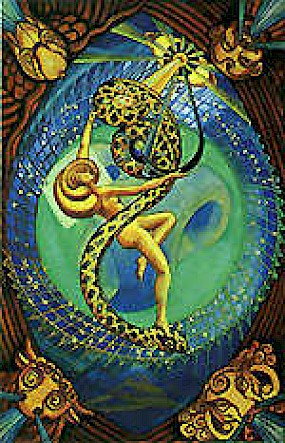
(via angelpaths.com and Alan Blackman)
Book: “12 Rules for Good Men”
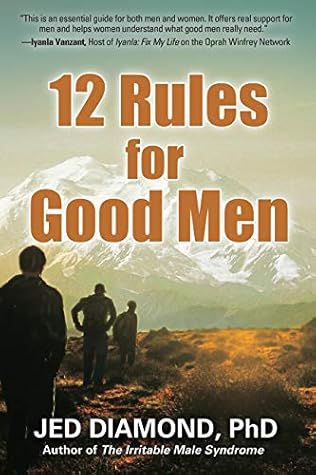
12 Rules for Good Men
by Jed Diamondreally liked it
“One hierarchy has been of supreme importance in all known human societies: the hierarchy of gender, says historian Yuval Noah Harari, author of Sapiens: A Brief History of Humankind. “People everywhere have divided themselves into men and women,” says Harari, “and almost everywhere men have got the better deal, at least since the Agricultural Revolution.”
However, there has been a costly consequence for men’s top-dog status. In his book, The Hazards of Being Male, psychologist Herb Goldberg says, “The male has paid a heavy price for his masculine ‘privilege’ and power. He is out of touch with his emotions and his body. He is playing by the rules of the male game plan and with lemming-like purpose he is destroying himself—emotionally, psychologically and physically.”
12 Rules for Good Men is based on the new findings from evolutionary science demonstrating three important truths. First, there was an earlier time in human history where males and females enjoyed greater equality. Second, what we call “civilization” has improved our lives in some way but caused unrecognized harm to males, females, and the fragile planet we all share. Third, there are critical, biologically based, differences between males and females that need to be understood and respected if we are to end the battle of the sexes and co-create, in the words of Charles Eisenstein, “the more beautiful world our hearts know is possible.”
12 Rules for Good Men is the first book to offer men new rules for success in the 21st century. It guides men to engage three questions we must all answer before we die:
1. Did I live fully?
2. Did I love deeply?
3. Did I make a positive difference in the world?
(Goodreads.com)
Book: “Hazards of Being Male: Surviving the Myth of Masculine Privilege”
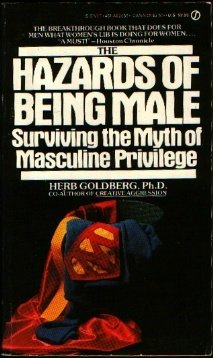
Hazards of Being Male: Surviving the Myth of Masculine Privilege
The Guidebook for Male Survival
(Goodreads.com)
Book: “Wild at Heart Revised and Updated: Discovering the Secret of a Man’s Soul”

Wild at Heart Revised and Updated: Discovering the Secret of a Man’s Soul
God designed men to be dangerous, says John Eldredge. Simply look at the dreams and desires written in the heart of every boy: To be a hero, to be a warrior, to live a life of adventure and risk. Sadly, most men abandon those dreams and desires-aided by a Christianity that feels like nothing more than pressure to be a “nice guy.” It is no wonder that many men avoid church, and those who go are often passive and bored to death. In this provocative book, Eldredge gives women a look inside the true heart of a man and gives men permission to be what God designed them to be-dangerous, passionate, alive, and free!
(Goodreads.com)