From sexual union to the divine – the teachings of Ibn al-‘Arabi

From sexual union to the divine – the teachings of Ibn al-‘Arabi | Psyche

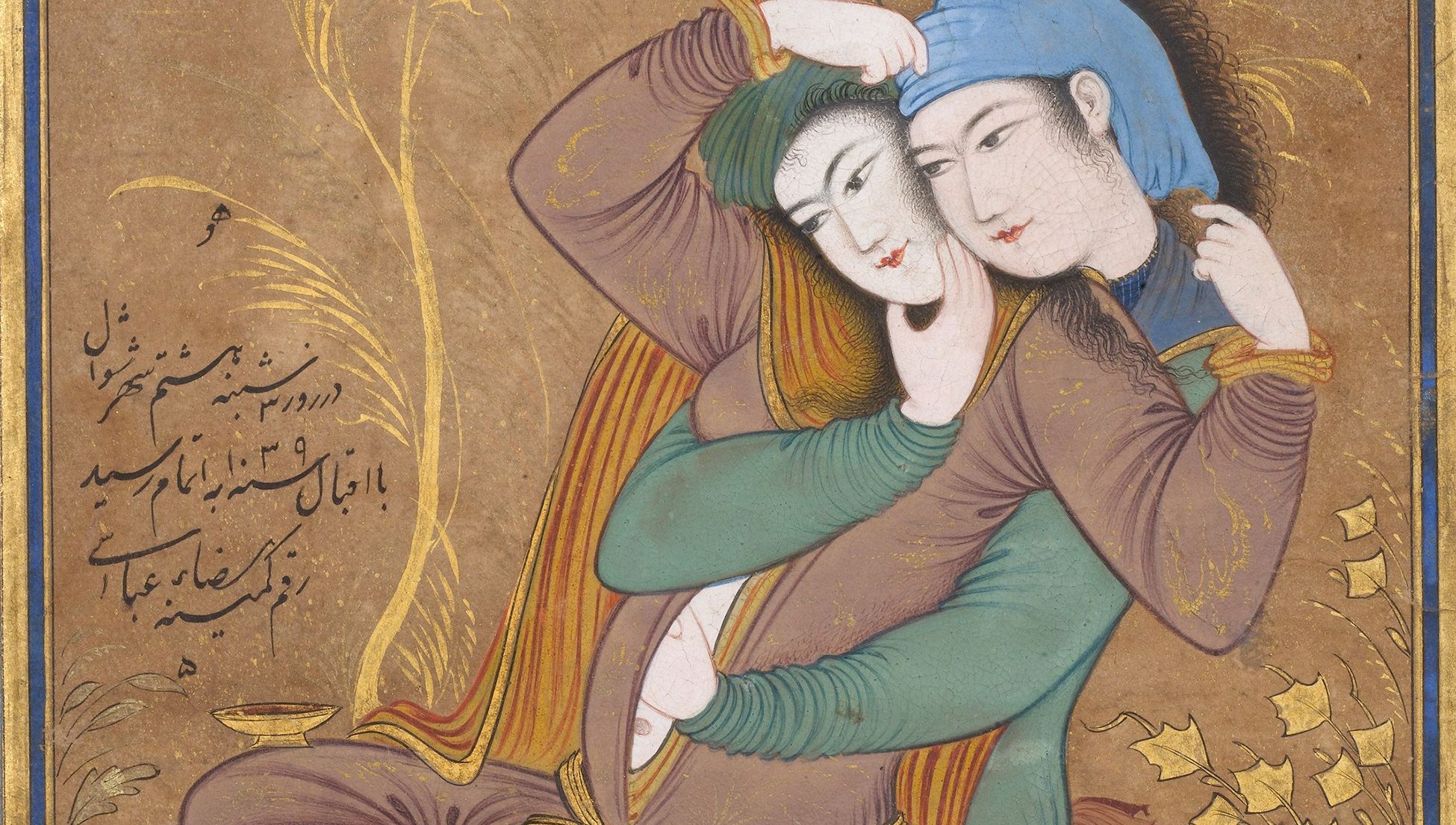
The Lovers (1039 AH/1630 CE), by Riza-yi ‘Abbasi. Courtesy of The Met Museum, New York

Heba Yosryteaches psychology and philosophy in Cairo, specialising in Arabic literature and philosophy. She is interested in gender studies, metaphysics and language.

Edited by Sam Haselby

4 January 2022 (Psyche.co)

For a generation or more, we have heard about the ugliness and terror of Islam. There’s been a narrative of absolute oppression surrounding Islam, especially concerning how feminism and sexual and reproductive rights are somehow part of a foreign agenda that is anti-Muslim. The Taliban, for example, claim to be ‘protecting’ Afghan women from the intrusions forced on them by the imperialist West. Their version of ‘protection’ entails, of course, a rollback of all the efforts to empower or educate women because they are incongruent with their Islam.

Another example of less extreme interpretations of Islam that are nonetheless still seen as preventing Muslim women from fully acquiring the autonomy they deserve is that women don’t inherit equally to their male counterparts; a law that aims to rectify this is being currently discussed in the Egyptian parliament. In some countries, such as Saudi Arabia and Qatar, as well as some Egyptian villages, and even within some Muslim communities in Europe and the United States, women aren’t able to travel freely, pursue higher education or, in some extreme cases, even seek immediate medical attention without the consent of their male guardians.

Muslim women are still fighting for the right to be fully assimilated in the public space, undeterred by those calling for them to stay in the home. When this is the milieu in which Muslim women are currently forced to exist, then perhaps we must appeal to our historical grounding to validate our public presence, and provide our evidence to the rest of the world that Islam shouldn’t be defined by the narrow perceptions of the ideologues. Once, Islam entailed a pioneering spirit of openness and freedom that is now sadly extinguished.

Feminism has become in many circles a dirty word. A concept that was propagated by the West will always be viewed with distrust, a front for imperialism and finally, inevitably, rejected as a bid‘ah, an innovation. In the US, discussion is under way to ban abortion, jeopardising decades of female autonomy and reproductive rights. Meanwhile, historically, Islam has granted women the right to abortion under certain conditions – yet if a Muslim person dares to speak about this, they will be automatically charged with being Westernised and decadent. The truth is that any attempt to achieve Islamic progress must primarily emanate from Muslim history. It must be a continuation of the efforts of Muslims; of those who preceded us. Among them are former lovers who were intoxicated with divine love and saw its manifestation mirrored in human relations: lovers such as Muhyi al-Din Ibn al-‘Arabi, the 12th-century Andalusian Sufi scholar, whose writings have inspired many worldwide ever since. Ibn al-‘Arabi believed that sexuality is the metaphysical path, par excellence, towards the divine.

I found myself naturally gravitating to the Akbarian realm, based on Ibn al-‘Arabi’s teachings, where the religion of love usurps the religion of fear

Sexuality has always been a central issue even within orthodox Islam. As a non-Muslim man once explained to me: of course men want to embrace Islam – they get to take four wives! Needless to say, polygamy is one of the most popular and widely publicised characteristics of our religion. Men, who can’t be expected to control their unrelenting lust, are allowed not only to marry up to four women concurrently, but could also keep as many concubines as they chose, back in the day. This sexual positivity was normalised, codified in law, and granted to men – but it didn’t exactly extend to women, or not in the same way at least. Rather, the sexual core of orthodox Islam has been manifest in shrouding women with garbs that conceal any elusive signs of femininity that could arouse base desires in the feeble hearts of men. In this view, women were condemned for their sexuality, and sometimes this sexuality was utterly eradicated – whether metaphorically, by assuming that women aren’t entitled to sexual feelings, or physically, which in some extreme cases led to female genital mutilation, even if the practice is outlawed in Egypt, for example, and is repudiated as un-Islamic by al-Azhar and Dar al-Iftaa, the most prestigious Muslim institutions in the region. This sordid form of thought still reigns over women’s lives and is allowed to mutilate women’s bodies.

These pervasive conceptions enshrined for me the idea that spirituality and sexuality, at least for women, are two separate spheres that can meet only to collide. Even if my household – mainly constituted of women, except for my father – didn’t diligently impose restrictions on interactions with the opposite sex or enforce a certain kind of attire, still the shadow of fear that good Muslim girls should strictly adhere to stern teachings caused a form of internal dissonance. I was perplexed and torn, with the calm feeling inside my home starkly contradicting what was mandated to me outside it. This is why I found myself naturally gravitating to the Akbarian realm, based on Ibn al-‘Arabi’s teachings, where the religion of love usurps the religion of fear.

Ibn al-‘Arabi presents an understanding of women and sexual relations at odds with much of today’s Muslim orthodoxy. For him, sexual union is the multifaceted path towards witnessing the imminent divine presence. It is a path that allows humanity to know, to be and to witness His presence in the multiplicity of His existence. Ibn al-‘Arabi sees feminine and masculine elements that suffuse all existence, and the yearning between woman and man parallels this quality of the Universe. For Ibn al-‘Arabi:

a woman in relation to a man is like Nature in relation to the Divine Command, since the woman is the locus for existence of the children, just as Nature in relation to the Divine Command is the locus of manifestation for the entities of the corporeal bodies.

The synchronicity between feminine and masculine elements in the cosmological or ontological realms creates an impenetrable circle of life through complimenting masculinity with its Other. Here, Ibn al-‘Arabi’s thought has roots in ancient Greece, especially in Plato whom Ibn al-‘Arabi calls a sage. The relationship between masculine and feminine isn’t one of utility for Ibn al-‘Arabi – rather, it is one of unison and complementarity, where each is drawn to the other because of the apparition of a memory of prior unity. The ancient story of creation offers clues about the flames of desire between feminine and masculine.

Women and men both seek, with vehemence, a unity that fulfils their original teleology, which culminates in sexual union

In The Bezels of Wisdom, Ibn al-‘Arabi wrote:

Then God drew forth from him [man] a being in his own image, called woman, and because she appears in his own image, the man feels a deep longing for her, as something yearns for itself, while she feels longing for him as one longs for that place to which one belongs.

Man and woman both recollect the androgynous prototype of the being they once were. The feeling that man has towards woman is one of lack, where the whole yearns for its part, while woman’s feeling is that of a being severed from her origin, her home. Man signifying home for a woman marks a reversal of the Western philosophical depiction, where women were associated with home ever since Aristotle’s distinction between the public and the private realm placed man in the public space and woman in the private, or home. This is opposite to the Akbarian situation, where man is associated with the home. Though Ibn al-‘Arabi’s associations emanate from the ‘archaic’ primordial story of creation, he presents the feminine and masculine as an organic duo who desire each other with the same intensity. Women, in Ibn al-‘Arabi’s reading of this story, do not reach out to men due to society’s patriarchal structures, which inform them that their public presence isn’t welcomed. Women and men both seek, with vehemence, a unity that fulfils their original teleology, which culminates in sexual union.

For Ibn al-‘Arabi, sexual intercourse isn’t merely about the orgiastic union of feminine and masculine whose lust drives them to unite on the physical realm. It also ushers an opening towards the metaphysical horizon that mimics the initial act of creation. Describing the sexual union as divine, he wrote:

The greatest union is that between man and woman, corresponding as it does to the turning of God toward the one He has created in His own image, to make him His vicegerent, so that He might behold Himself in him.

Within this union of feminine and masculine, an intimate space opens – one that is both creative and interpretive. Because in this communal horizon of intermingling, feminine and masculine identities are constantly reinterpreted rather than abolished. Instead, their relation is dialogical, since in their yoking together there is no domination of one over the other. Enmeshed as one in fleeting orgasmic pleasure compels the question ‘Who am I?’ within the bewilderment of sexual ecstasy. Ibn al-‘Arabi emphasises that the pleasure one experiences is the pleasure of encountering the divine.

Thus, it is the face of the divine veiled from the eyes of humanity that calls us to unite on the physical plane to approach through orgasm the beauty and awe that can be experienced in the divine presence. It is through pleasure, happiness and the dizzying heights of ecstasy that we were meant to experience the sweetness of faith.

Tarot Card for January 5: The Four of Swords


The Four of Swords

The Lord of Truce marks a period where we are able to rest and recover, after a difficult time in our lives. It will appear after trauma – the breakdown of a relationship; a troublesome and worrying time financially; an operation or major illness.

There will always have been conflict and stress beforehand, this card marks the kind of breathing space we often need in order to clarify our view of the situation, to gather our strength and to decide how best to move forward. When this card appears in a reading, the first thing it tells us is that it is time to rest, time to stop worrying about the things that have happened.

However, it must be noted that Truce is not peace. This is a respite – a down time in which we can catch our breath, ease our tension and relax for a brief time. But once that has been done, we need to recognise that there is still more to be done – the battle isn’t over yet. So when acting under the influence of this card, bear in mind that first you must take it easy, but then you must begin to plan your next step.

If we fail to do that, then when the effect of the Lord of Truce passes away, we shall be left high and dry, with no route planned for our future. And in that case the turmoil which preceded this card may well manifest again.

Sometimes, when the card comes up with a ‘person’ card, it indicates that a rift can begin to be mended between two people who have been at loggerheads previously. In this case, again, it is important to stress that this card does not indicate peace – as before, much more work will need to be done before the damage is entirely healed. We need to be on our guard, too, for other people running personal agendas which may mean that the ‘truce’ is more convenient than sincere.

The Four of Swords

(via angelpaths.com and Alan Blackman)

Earth Emergency

Special | 52m 24s|Video has closed captioning.

Link to video: https://www.pbs.org/video/earth-emergency-6njifx/

This revealing film examines how human activity is setting off dangerous warming loops that are pushing the climate to a point of no return – and what we need to do to stop them. With captivating illustrations, stunning footage and interviews with leading climate scientists as well as support from Greta Thunberg, “Earth Emergency” adds the missing piece of the climate puzzle.

Aired: 12/29/21

Expires: 01/28/22

Rating: TV-PG

(Contributed by Michael Kelly, H.W.)

MoonWobble peaks February 16, 2022

MoonWobble February 2022
Click here for Moon Wobble Chart

*** General suggestions / observations ***

• This cycle is based on empirical data meaning enough data was observed and recorded to make it possible to suggest attitudes and  reactions.  Keep in mind that we all have free will and thus results will vary from one individual to another.

• The graph shows the energy high at the beginning of the cycle (not unlike any other astrological aspect) followed by a slow down before it gets strong and again this reflects years of tracking and noting feedback from our many students.

• If you are making a decision during this time you might want to let it set for a day or two then check your decision again to see if it still makes sense. However, you can feel into the ebb and flow and find good times to work on self emotionally in both the low and high points. Impatience, emotion and acts without thinking are common.

• With practice you can feel when the energy is there to help bring completion to tasks, goals and projects you may be working on.

Aloha,
The Prosperos
(theprosperos.org)

French dictionary includes gender-neutral pronoun, sparking linguistic debate

Thomas Adamson The Associated Press

November 18, 2021 (USAToday.com)

PARIS (AP) — It’s a neutral pronoun that’s proving anything but: A nonbinary pronoun added to an esteemed French dictionary has ignited a fierce linguistic squabble in the country.

Le Petit Robert introduced the word “iel” — an amalgamation of “il” (he) and “elle” (she) — to its online edition last month. The term is still far from being widely used, or even understood, by many French-speakers.

Though at first the change went mostly unnoticed, boisterous debate broke out this week in a nation that prides itself on its human rights tradition but that also fiercely protects its cultural heritage from foreign meddling. In one camp are the traditionalists, including political leaders, who criticize the move as a sign that France is lurching toward an American-style “woke” ideology. In the other is a new generation of citizens who embrace nonbinary as the norm.

More on pronouns: Lizzo defended Demi Lovato’s new they/them pronouns. Why you should respect pronouns too

Francois Jolivet, a lawmaker from President Emmanuel Macron’s (pictured) centrist party, also made his distaste plain. Nonbinary pronouns are, he suggested, a worrying sign that France is embracing a “woke” ideology.

Education Minister Jean-Michel Blanquer is not among the latter. He went to Twitter on Wednesday to say that “inclusive writing is not the future of the French language.” The 56-year-old former law professor warned that schoolchildren should not use “iel” as a valid term despite its inclusion in Le Robert, seen as a linguistic authority on French since 1967.

Francois Jolivet, a lawmaker from President Emmanuel Macron’s centrist party, also made his distaste plain. Nonbinary pronouns are, he suggested, a worrying sign that France is embracing a “woke” ideology.

Jolivet wrote a letter to the bastion of French language, the 400-year-old Academie Francaise, claiming that Le Robert’s “solitary campaign is an obvious ideological intrusion that undermines our common language and its influence.”

The general director of Le Robert editions, Charles Bimbenet, jumped to the dictionary’s defense Wednesday in a statement. Far from dictating which terms should be used, he said, Le Petit Robert was elucidating the word’s meaning, now it is growing in currency nationwide.

Since “the meaning of the word iel cannot be understood by reading it alone,” Bimbenet said, “it seemed useful to us to specify its meaning for those who encounter it, whether they wish to use it or … reject it.”

“Robert’s mission is to observe and report on the evolution of a changing and diverse French language,” he said.

The decision has been welcomed by nonbinary French.

Bookmark this: LGBTQ definitions every good ally should know

“It is very important that dictionaries include the “iel” pronoun in their referencing as it reflects how the use of the term is now well accepted,” said Dorah Simon Claude, a 32-year-old doctoral student, who identifies as “iel.”

“It is,” they added, “also a way of confronting the Academie Francaise that stays in its conservative corner and continues to ignore and scorn users of the French language.”

In 2017, the institution warned that moves to make French more gender neutral would create “a disunited language, with disparate expression, that can create confusion verging on illegibility.”

Gendered languages like French are seen as a particular hurdle for advocates of nonbinary terms as all nouns are categorized as either masculine or feminine, unlike in English.

Not all European countries are moving at the same speed as France. In Greece, where all nouns have not two, but three possible genders, there is no official nonbinary pronoun, but groups who support them suggest using “it.”

In Spain, after former deputy prime minister and affirmed feminist Carmen Calvo asked the Royal Spanish Academy to advise on the use of inclusive language in the Constitution, its reply the next year was crystal clear: “Inclusive language” means “the use of the masculine to refer to men and women.”

Associated Press writers Arno Pedram in Paris, Derek Gatopoulos in Athens, Greece and Alberto Arce in Valbuena, Spain contributed.

COMPLACENCY—NOT HUBRIS—IS WHAT KILLED THE ROMAN REPUBLIC

Over the Years, Democratic Norms Quietly Eroded, Not Unlike in Today’s America

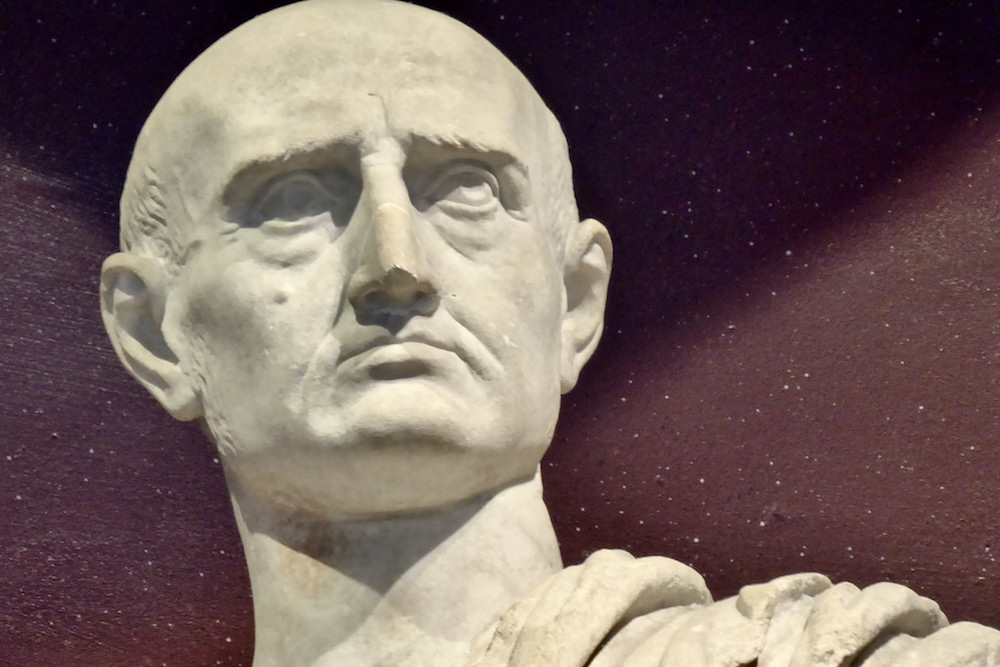
In 63 B.C., Cicero successfully pleaded for unity. But in 58 B.C., he was in exile from Rome, forced from the city by a violent populist backed by a mob. Courtesy of Flickr.

by EDWARD J. WATTS | FEBRUARY 26, 2019 (zocalopublicsquare.org)

Representative democracies have wildly different life expectancies, but they tend not to live long.

Democratic governments have existed for more than 2,500 years, but most democracies have historically failed to survive more than a generation. Indeed, the strongmen whose policies are currently warping the democracies that emerged in the 1980s and 1990s in Turkey, Hungary, and the Philippines are similar to the ancient tyrants who seized control of young democratic regimes in ancient Syracuse and Cyrene.

When a representative democracy makes it through its first generation without falling into tyranny, political norms often take deep root and patterns of democratic government become quite strong. This is as true of current republics like France and the United States as it was of ancient republics like Rome. In states like these, citizens prize the voice that representative government brings and robustly defend their freedoms against the sudden and direct attacks of tyrants. Their representative democracies can last for centuries.

But even these old democracies are mortal.

As Americans living through the past 25 years know well, citizens of representative democracies are less easily roused to defend against the slow erosion of political norms. In the years since the Newt Gingrich-inspired Republican takeover of the Congress in 1994, Americans have seen government shutdowns become political tools, the confirmation of judges routinely blocked, and even the denial of a hearing for a Supreme Court justice. None of these things were normal a generation ago. Many of them were unimaginable.

And yet American voters, feeling secure that their Republic will endure such assaults on American political norms, have responded with surprising indifference to these radical actions.

This is a mistake.

The Roman Republic shows the danger that arises from this sort of complacency. Rome lived under a republic for nearly 500 years—more than twice as long as the United States has existed—and its success caused our Founding Fathers to model the nascent American Republic on its Roman predecessor.

The Romans inspired the American separation of powers, the system of checks and balances, and the presidential veto—because Rome showed how these constitutional elements compelled lawmakers to compromise with one another by preventing narrow majorities from enacting policies that did not enjoy broad support. Both Rome and the United States developed into economically sophisticated world powers because their republics gave them an unmatched ability to build broad political consensus behind difficult national decisions.

But ancient Romans eventually grew to take the survival of their Republic for granted. In the second century B.C., the tools that had encouraged compromise and fostered political consensus for more than 300 years were transformed into weapons as Roman economic expansion opened a large wealth gap between the richest Romans and everyone else.

This transformation occurred at a moment when living standards for most citizens began to plateau after two generations of rather steady growth. Romans first hoped and then demanded that the Republic respond to this widening divide between the super-rich and the struggling middle classes. In the 140s and early 130s B.C., two different politicians sponsored laws that would distribute public land to the Roman urban poor, but wealthy rivals used vetoes to block their proposed laws. These wealthy opponents of economic reform did not use the veto so that they might work out a more broadly acceptable compromise. They simply did not want to see the issue of wealth inequality addressed at all.

Finally, in 133 B.C., after nearly a decade of inaction, frustrated Romans turned to a populist named Tiberius Gracchus who was willing to use all means available to him to push economic reforms into law. Backed by angry crowds of supporters, Tiberius removed a rival lawmaker who threatened to veto his proposals and then funded his reforms by appropriating money normally controlled by his opponents in the Roman Senate. All of these things violated the political norms of the Republic, but Roman voters seemed disinclined to punish Tiberius for any of them. He was stopped only when opponents killed him in a riot.But ancient Romans eventually grew to take the survival of their Republic for granted. In the second century B.C., the tools that had encouraged compromise and fostered political consensus for more than 300 years were transformed into weapons.

The final century of the Roman Republic saw the Romans repeatedly look away as politicians followed the path set by Tiberius Gracchus and his rivals. Roman political life slowly but progressively degenerated into multi-year cycles of legislative gridlock that broke only when Romans voted overwhelmingly for figures who promised to do anything necessary to solve long-neglected problems. Then, when these populists inevitably overreached, their opponents often responded violently. This cycle of political dysfunction became increasingly destructive each time it reset. It ended only when Rome fell into the civil wars in the 40s and 30s B.C. that killed the Republic and enabled Augustus, Rome’s first emperor, to take power as an autocrat.

Romans failed to stop these cycles of political dysfunction in large part because they did not imagine their republic could die. Indeed, no single person or choice destroyed the Roman Republic. It was much too robust for that. But the individual Roman politicians and voters who chose not to punish political obstruction, reckless populism, and intimidation steadily eroded the Republic’s integrity.

Throughout the Republic’s final century some Romans tried to unify their fellow citizens around the defense of the political liberty they all shared. None did this more eloquently than Cicero in the aftermath of a failed insurrection in the year 63 B.C.

At the end of a speech he gave on November 8 of that year, Cicero implored Romans that “if we preserve forever this unity now established…no civil and domestic calamity can ever again reach any part of the Republic.” Relieved at avoiding civil war, nearly all Romans applauded this sentiment on that day.

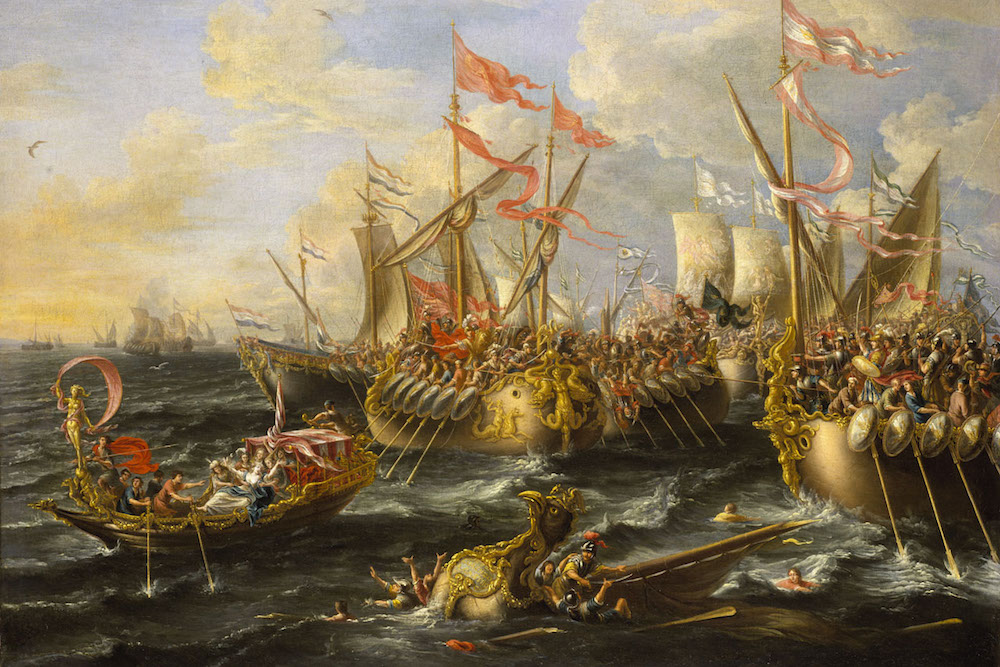
The painting Battle of Actium—by the 17th-century Flemish painter Laureysa Castro—shows a decisive naval battle in the Final War of the Roman Republic. Courtesy of Wikimedia Commons.

But the unity Cicero called upon Romans to protect lasted for only a few weeks and Romans quickly began to take stability for granted. On January 1 of 62 B.C., a political opportunist harangued Cicero in the senate. By 58 B.C. Cicero found himself an exile from Rome, forced from the city by a violent populist backed by a mob of supporters.

Cicero’s allies engaged in similarly destructive policies. His friend Cato so disliked Julius Caesar that he filibustered an entire senate meeting in which proposals that could benefit Caesar were discussed. He bribed voters to support candidates other than Caesar. By claiming a dubious religious prohibition, he even worked with his son-in-law to try to block all public business for the entire year when Caesar held Rome’s highest office.

All of these figures agreed with Cicero that Romans should come together to protect their Republic, but, taking the strength of their republic for granted, they never let republican principles dissuade them from a potent line of attack against a political opponent. This shortsightedness normalized a form of political combat in which the Republic no longer set the rules and no longer protected the losers. Robbed of its institutional defenses, the Republic could not prevent Rome’s descent into civil war or stop the emergence of a Roman autocracy. And Romans were shocked when the Republic’s impotence was finally revealed.

This is the real risk of political complacency. Until Donald Trump’s election, Americans largely turned a blind eye to the damage that the past generation of political dysfunction has done to our republic. Morally and legally dubious political tactics often seemed relatively harmless when they benefitted people and policies that one approved. But today Americans who continue to vote for the senators who block judicial nominations made by the opposing party, representatives who endorse government shutdowns, and presidents who traffic in threats and intimidation should realize that these decisions weaken our republic. We can avoid the complacency that doomed the Roman Republic. If we do not, there is a real risk that Americans will repeat Rome’s mistake.

EDWARD J. WATTS holds the Alkiviadis Vassiliadis endowed chair and is professor of history at the University of California, San Diego. He is the author most recently of Mortal Republic: How Rome Fell Into Tyranny.

A Course in Miracles: Lesson 166

Lesson 166 I am entrusted with the gifts of God.

All things are given you. God’s trust in you is limitless. He knows His Son. He gives without exception, holding nothing back that can contribute to your happiness. And yet, unless your will is one with His, His gifts are not received. But what would make you think there is another will than His?

Here is the paradox that underlies the making of the world. This world is not the Will of God, and so it is not real. Yet those who think it real must still believe there is another will, and one that leads to opposite effects from those He wills. Impossible indeed; but every mind that looks upon the world and judges it as certain, solid, trustworthy and true believes in two creators; or in one, himself alone. But never in one God.

The gifts of God are not acceptable to anyone who holds such strange beliefs. He must believe that to accept God’s gifts, however evident they may become, however urgently he may be called to claim them as his own, is to be pressed to treachery against himself. He must deny their presence, contradict the truth, and suffer to preserve the world he made.

Here is the only home he thinks he knows. Here is the only safety he believes that he can find. Without the world he made is he an outcast; homeless and afraid. He does not realize that it is here he is afraid indeed, and homeless, too; an outcast wandering so far from home, so long away, he does not realize he has forgotten where he came from, where he goes, and even who he really is.

Yet in his lonely, senseless wanderings, God’s gifts go with him, all unknown to him. He cannot lose them. But he will not look at what is given him. He wanders on, aware of the futility he sees about him everywhere, perceiving how his little lot but dwindles, as he goes ahead to nowhere. Still he wanders on in misery and poverty, alone though God is with him, and a treasure his so great that everything the world contains is valueless before its magnitude.

He seems a sorry figure; weary, worn, in threadbare clothing, and with feet that bleed a little from the rocky road he walks. No one but has identified with him, for everyone who comes here has pursued the path he follows, and has felt defeat and hopelessness as he is feeling them. Yet is he really tragic, when you see that he is following the way he chose, and need but realize Who walks with him and open up his treasures to be free?

This is your chosen self, the one you made as a replacement for reality. This is the self you savagely defend against all reason, every evidence, and all the witnesses with proof to show this is not you. You heed them not. You go on your appointed way, with eyes cast down lest you might catch a glimpse of truth, and be released from self-deception and set free.

You cower fearfully lest you should feel Christ’s touch upon your shoulder, and perceive His gentle hand directing you to look upon your gifts. How could you then proclaim your poverty in exile? He would make you laugh at this perception of yourself. Where is self-pity then? And what becomes of all the tragedy you sought to make for him whom God intended only joy?

Your ancient fear has come upon you now, and justice has caught up with you at last. Christ’s hand has touched your shoulder, and you feel that you are not alone. You even think the miserable self you thought was you may not be your Identity. Perhaps God’s Word is truer than your own. Perhaps His gifts to you are real. Perhaps He has not wholly been outwitted by your plan to keep His Son in deep oblivion, and go the way you chose without your Self.

God’s Will does not oppose. It merely is. It is not God you have imprisoned in your plan to lose your Self. He does not know about a plan so alien to His Will. There was a need He did not understand, to which He gave an Answer. That is all. And you who have this Answer given you have need no more of anything but this.

Now do we live, for now we cannot die. The wish for death is answered, and the sight that looked upon it now has been replaced by vision which perceives that you are not what you pretend to be. One walks with you Who gently answers all your fears with this one merciful reply, “It is not so.” He points to all the gifts you have each time the thought of poverty oppresses you, and speaks of His Companionship when you perceive yourself as lonely and afraid.

Yet He reminds you still of one thing more you had forgotten. For His touch on you has made you like Himself. The gifts you have are not for you alone. What He has come to offer you, you now must learn to give. This is the lesson that His giving holds, for He has saved you from the solitude you sought to make in which to hide from God. He has reminded you of all the gifts that God has given you. He speaks as well of what becomes your will when you accept these gifts, and recognize they are your own.

The gifts are yours, entrusted to your care, to give to all who chose the lonely road you have escaped. They do not understand they but pursue their wishes. It is you who teach them now. For you have learned of Christ there is another way for them to walk. Teach them by showing them the happiness that comes to those who feel the touch of Christ, and recognize God’s gifts. Let sorrow not tempt you to be unfaithful to your trust.

Your sighs will now betray the hopes of those who look to you for their release. Your tears are theirs. If you are sick, you but withhold their healing. What you fear but teaches them their fears are justified. Your hand becomes the giver of Christ’s touch; your change of mind becomes the proof that who accepts God’s gifts can never suffer anything. You are entrusted with the world’s release from pain.

Betray it not. Become the living proof of what Christ’s touch can offer everyone. God has entrusted all His gifts to you. Be witness in your happiness to how transformed the mind becomes which chooses to accept His gifts, and feel the touch of Christ. Such is your mission now. For God entrusts the giving of His gifts to all who have received them. He has shared His joy with you. And now you go to share it with the world.