Shambhala Film Studios “Return of the Lotus-Born Master” Decrypting the Dakini Code Directed by Laurence Brahm Imagine secret teachings that can only be downloaded from parallel universes by prophets with the help of divine consorts. These teachings can help future generations at a time when our planet is suffering from self-destruction due to shortsighted greed and aggression. In his 2019 documentary film, “Return Lotus-Born Master,” director Laurence Brahm leads an expedition team into the “hidden realms” of the Himalayan Kingdom of Bhutan, searching for secret teachings concealed by the Lotus-Born Master during the Eighth Century. These “hidden realms” are portals to parallel universes where the teachings of the Lotus-Born Master are concealed in the hologram of our universal subconscious. These teachings can lead us to a future of peace, harmony and mutual respect called Shambhala. Shrouded in myth and mystery, the Lotus-Born Master, is recognized as the founder of Vajrayana or Tibetan Buddhism. “Return of the Lotus-Born Master” filmed in 2019, is a sequel to the international award winning documentary film “Searching for the Lotus-Born Master” directed by Laurence Brahm in 2018. In “Searching the Lotus-Born Master,” documentary film director Laurence Brahm beckoned to ask: was the founder of Tibetan Buddhism also the father of quantum physics? Now in the sequel, “Return of the Lotus-Born Master” he proves it. “Return of the Lotus-Born Master,” produced by William Lou and Laurence Brahm, presents amazing previously unseen cinematography of Bhutan and explores previously un-filmed locations in the this Himalayan kingdom.
ARIES (March 21-April 19): In the fantasy tale “The Wizard of Oz,” a tornado lifts the hero Dorothy from her modest home in rural Kansas to a magical realm called Oz. There she experiences many provocative and entertaining adventures. Nonetheless, she longs to return to where she started from. A friendly witch helps her find the way back to Kansas, which requires her to click her ruby slippers together three times and say, “There’s no place like home, there’s no place like home.” I suspect, Aries, that there’ll be a different ending to your epic tale in 2022. At some point, you will decide you prefer to stay in your new world. Maybe you’ll even click your ruby slippers together and say, “There’s no place like Oz, there’s no place like Oz.” (Thanks to author David Lazar for that last line.)
TAURUS (April 20-May 20): Fifty-five percent of the people who live in Toronto speak primarily English or French. But for the other forty-five percent, their mother tongue is a different language, including Portuguese, Tagalog, Italian, Tamil, Spanish, Cantonese and Mandarin. I wish you could spend some time there in the coming months. In my astrological opinion, you would benefit from being exposed to maximum cultural diversity. You would thrive by being around a broad spectrum of influences from multiple backgrounds. If you can’t manage a trip to Toronto or another richly diverse place, do your best to approximate the same experience. Give yourself the gift of splendorous variety.
GEMINI (May 21-June 20): One of your primary meditations throughout 2022 should be the following advice from “The Laws of Human Nature,” a book by motivational author Robert Greene. He writes, “In ancient times, many great leaders felt that they were descended from gods and part divine. Such self-belief would translate into high levels of confidence that others would feed off and recognize. It became a self-fulfilling prophecy. You do not need to indulge in such grandiose thoughts, but feeling that you are destined for something great or important will give you a degree of resilience when people oppose or resist you. You will not internalize the doubts that come from such moments. You will have an enterprising spirit. You will continually try new things, even taking risks, confident in your ability to bounce back from failures and feeling destined to succeed.”
CANCER (June 21-July 22): I would love to unabashedly encourage you to travel widely and explore wildly in 2022. I would rejoice if I could brazenly authorize you to escape your comfort zone and wander in the frontiers. It’s not often the planetary omens offer us Cancerians such an unambiguous mandate to engage in exhilarating adventures and intelligent risks. There’s only one problem: that annoying inconvenience known as the pandemic. We really do have to exercise caution in our pursuit of expansive encounters. Luckily, you now have extra ingenuity about the project of staying safe as you enlarge your world.
LEO (July 23-Aug. 22): I suspect that your life in 2022 might feature themes beloved by Leo author Emily Brontë (1818-1848). “No coward soul is mine,” she wrote, “No trembler in the world’s storm-troubled sphere.” I suggest making that one of your mottoes. Here’s another guiding inspiration from Emily, via one of her poems: “I’ll walk where my own nature would be leading: / It vexes me to choose another guide: / Where the grey flocks in ferny glens are feeding; / Where the wild wind blows on the mountain-side.” Here’s one more of Brontë’s thoughts especially suitable for your use in the coming months: “I’ll be as dirty as I please, and I like to be dirty, and I will be dirty!”
VIRGO (Aug. 23-Sept. 22): What reversals and turnabouts would you like to experience in 2022, Virgo? Which situations would you like to transform dramatically? Are there imbalances of power you would like to rectify? Contradictions you’d love to dissolve? Misplaced priorities you could correct? All these things are possible in the coming months if you are creative and resourceful enough. With your dynamic efforts, the last could be first, the low could be high, and the weak could become strong.
LIBRA (Sept. 23-Oct. 22): “Everything good I’ve ever gotten in my life, I only got because I gave something else up,” wrote author Elizabeth Gilbert. That has often been true for me. For example, if I hadn’t given up my beloved music career, I wouldn’t have had the time and energy to become a skillful astrology writer with a big audience. What about you, Libra? In my reckoning, Gilbert’s observation should be a major theme for you in 2022.
SCORPIO (Oct. 23-Nov. 21): Author C. S. Lewis wrote that we don’t simply want to behold beauty. We “want to be united with the beauty we see, to pass into it, to receive it into ourselves, to bathe in it, to become part of it.” If there were ever a time when you could get abundant tastes of that extravagant pleasure, Scorpio, it would be in the coming months. If you make it a goal, if you set an intention, you may enjoy more deep mergers and delightful interactions with beauty than you have had since 2010.
SAGITTARIUS (Nov. 22-Dec. 21): Sagittarian singer-songwriter Tom Waits began his career in 1969. He achieved modest success during the next eleven years. But his career headed in an even more successful direction after he met Kathleen Brennan, who became his wife and collaborator. In a 1988 interview, Waits said, “She’s got the whole dark forest living inside of her. She pushes me into areas I would not go, and I’d say that a lot of the things I’m trying to do now, she’s encouraged.” In 2022, Sagittarius, I’ll invite you to go looking for the deep dark forest within yourself. I’m sure it’s in there somewhere. If you explore it with luxuriant curiosity, it will ultimately inspire you to generate unprecedented breakthroughs. Yes, it might sometimes be spooky—but in ways that ultimately prove lucky.
CAPRICORN (Dec. 22-Jan. 19): Capricorn-born Muhammad Ali was far more than a superb professional boxer. He was an activist, entertainer and philanthropist who gathered much wisdom in his seventy-four years. I’ve chosen one of his quotes to be your guide in the coming months. I hope it will motivate you to rigorously manage the sometimes pesky and demanding details that will ultimately enable you to score a big victory. “It isn’t the mountains ahead to climb that wear you down,” Ali said. “It’s the pebble in your shoe.”
AQUARIUS (Jan. 20-Feb. 18): At a pivotal moment in his evolution, Aquarian playwright Anton Chekhov (1860-1904) swore an oath to himself. I’ll tell you about it here because I hope it will inspire you to make a comparable vow to yourself about how you’ll live your life in 2022. Author Robert Greene is the source of the quote. He says that Chekhov promised himself he would engage in “no more bowing and apologizing to people; no more complaining and blaming; no more disorderly living and wasting time. The answer to everything was work and love, work and love. He had to spread this message to his family and save them. He had to share it with humanity through his stories and plays.”
PISCES (Feb. 19-March 20): Here’s what Piscean author Anais Nin wrote in one of her diaries: “When I first faced pain, I was shattered. When I first met failure, defeat, denial, loss, death, I died. Not today. I believe in my power, in my magic, and I do not die. I survive, I love, live, continue.” According to my analysis of the astrological omens, Pisces, you could claim her triumphant declaration as your own in 2022, with special emphasis on this: “I believe in my power, in my magic. I survive, I love, live, continue.” This will be a golden age, a time when you harvest the fruits of many years of labor.
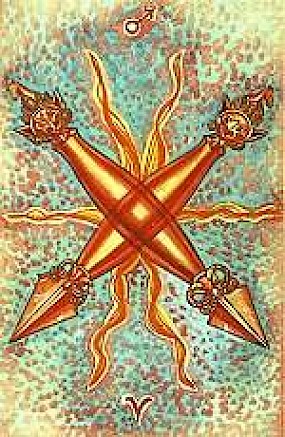
The Lord of Dominion is an important card when we consider our personal freedom of choice, for it relates to the way in which we live in accordance with our own Will, and the consequent results of this.
The card indicates that we are in charge of the way that our lives are unfolding, and that this happens in the fashion we had anticipated. It does not rule out the occasional nice surprise, nor obstacle, but it does promise us that we are in a state of mind which allows us to fulfil our needs and chase our destiny.
There’s harmony and contentment when we manage to achieve this position in life. Events take place in an ordered and positive fashion. Things unfold around us the way that we want them to. Everything goes according to plan.
In fact, this is probably a natural state for a healthy human being. The fact that we have to struggle so hard to achieve it, and then maintain it, is more a comment on the type of life we lead, than anything else.
When we can bring ourselves in harmony with the forces of our Universe, achieving our dreams becomes far more possible than at any other time. We attain harmony when we are centred and at ease with ourselves.
Careful planning is always important when this card comes up – again there is a need to order our future so that we know where we’re headed. And it’s also important to reconcile any uncertainty or confusion generated within us. Both of these actions will ensure that nothing interferes with the flow of our own Will out into the Universe.
On very rare occasions this card will come up with others like the Star, or the Priestess, to indicate periods of huge spiritual breakthrough. Make the best of them when they arrive!!
FM-2030 (originally born as Fereidoun M. Esfandiary; Persian: فریدون اسفندیاری); October 15, 1930 – July 8, 2000) was a Belgian-born Iranian-American author, teacher, transhumanist philosopher, futurist, consultant and Olympic athlete.[1]
He became notable as a transhumanist with the book Are You a Transhuman?: Monitoring and Stimulating Your Personal Rate of Growth in a Rapidly Changing World, published in 1989. In addition, he wrote a number of works of fiction under his original name F.M. Esfandiary.
In the mid-1970s F.M. Esfandiary legally[2] changed his name to FM-2030 for two main reasons: firstly, to reflect the hope and belief that he would live to celebrate his 100th birthday in 2030; secondly, and more importantly, to break free of the widespread practice of naming conventions that he saw as rooted in a collectivist mentality, and existing only as a relic of humankind’s tribalistic past. He viewed traditional names as almost always stamping a label of collective identity – varying from gender to nationality – on the individual, thereby existing as prima facie elements of thought processes in the human cultural fabric, that tended to degenerate into stereotyping, factionalism, and discrimination. In his own words, “Conventional names define a person’s past: ancestry, ethnicity, nationality, religion. I am not who I was ten years ago and certainly not who I will be in twenty years. […] The name 2030 reflects my conviction that the years around 2030 will be a magical time. In 2030 we will be ageless and everyone will have an excellent chance to live forever. 2030 is a dream and a goal.”[5]
Personal life
He was a lifelong vegetarian and said he would not eat anything that had a mother.[6] FM-2030 once said, “I am a 21st century person who was accidentally launched in the 20th. I have a deep nostalgia for the future.”[7] He taught at The New School, University of California, Los Angeles, and Florida International University.[1] He worked as a corporate consultant for Lockheed and J. C. Penney.[1] He was also an atheist.[8] FM-2030 was, in his own words, a follower of “upwing” politics, in which he meant that he endorsed universal progress.[9][10] He had been in a non-exclusive “friendship” (his preferred term for relationship) with Flora Schnall, a lawyer and fellow Harvard Law Class of 1959 graduate with Ruth Bader Ginsburg, from the 1960s until his death.[11]
Death
On July 8, 2000, FM-2030 died from pancreatic cancer and was placed in cryonic suspension at the Alcor Life Extension Foundation in Scottsdale, Arizona, where his body remains today. He did not yet have remote standby arrangements, so no Alcor team member was present at his death, but FM-2030 was the first person to be vitrified, rather than simply frozen as previous cryonics patients had been.[6] FM-2030 was survived by four sisters and one brother.[2]
New Thinking Allowed with Jeffrey Mishlove Jason Reza Jorjani, PhD, is a philosopher and author of Prometheus and Atlas, World State of Emergency, Lovers of Sophia, Novel Folklore: The Blind Owl of Sadegh Hedayat, and Iranian Leviathan: A Monumental History of Mithra’s Abode. Here he discusses the convergence of genetics, robotics, information, and nanotechnologies towards a singularity, beyond which we will enter a transhuman condition. These ideas are explored with a view to incorporate evidence from parapsychology and consciousness research. The discussion includes numerous examples from both popular culture and film. (Recorded on January 8, 2020)
A wild, compelling idea without a direct, practical test, the Multiverse is highly controversial. But its supporting pillars sure are stable.
KEY TAKEAWAYS
One of the most successful theories of 20th century science is cosmic inflation, which preceded and set up the hot Big Bang.
We also know how quantum fields generally work, and if inflation is a quantum field (which we strongly suspect it is), then there will always be more “still-inflating” space out there.
Whenever and wherever inflation ends, you get a hot Big Bang. If inflation and quantum field theory are both correct, a Multiverse is a must.
When we look out at the Universe today, it simultaneously tells us two stories about itself. One of those stories is written on the face of what the Universe looks like today, and includes the stars and galaxies we have, how they’re clustered and how they move, and what ingredients they’re made of. This is a relatively straightforward story, and one that we’ve learned simply by observing the Universe we see.
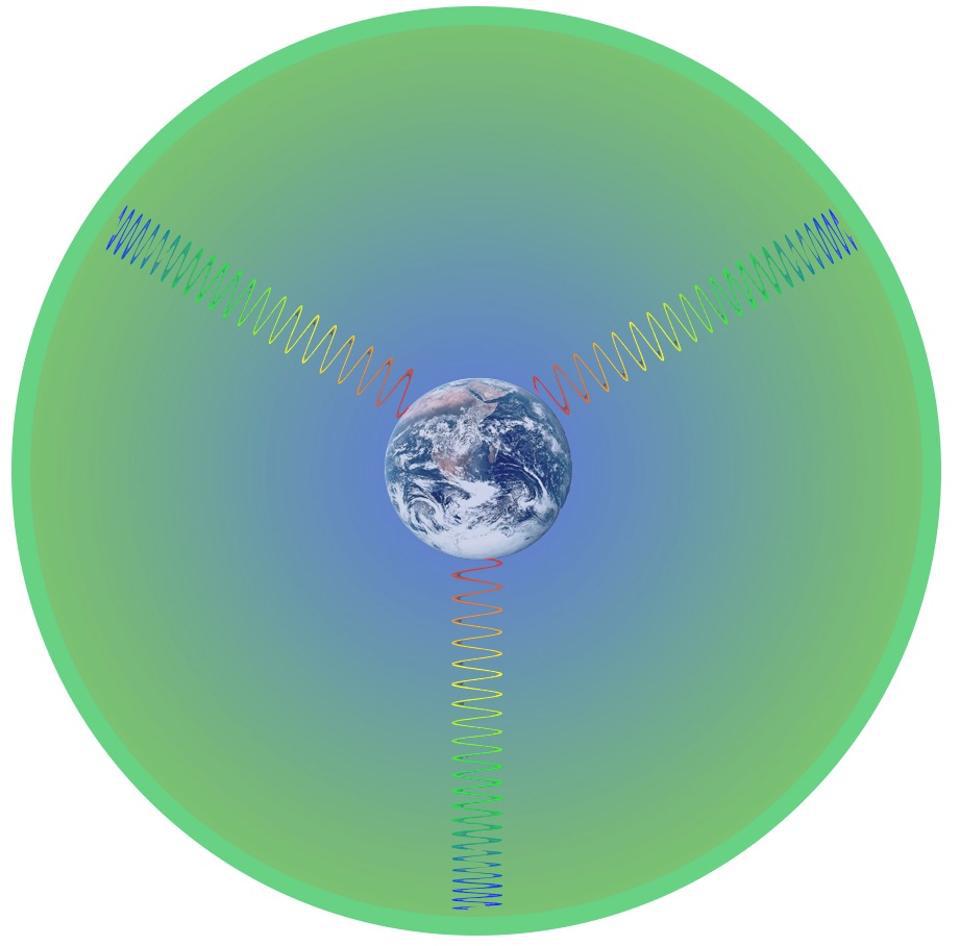
But the other story is how the Universe came to be the way it is today, and that’s a story that requires a little more work to uncover. Sure, we can look at objects at great distances, and that tells us what the Universe was like in the distant past: when the light that’s arriving today was first emitted. But we need to combine that with our theories of the Universe — the laws of physics within the framework of the Big Bang — to interpret what occurred in the past. When we do that, we see extraordinary evidence that our hot Big Bang was preceded and set up by a prior phase: cosmic inflation. But in order for inflation to give us a Universe consistent with what we observe, there’s an unsettling appendage that comes along for the ride: a multiverse. Here’s why physicists overwhelmingly claim that a multiverse must exist.
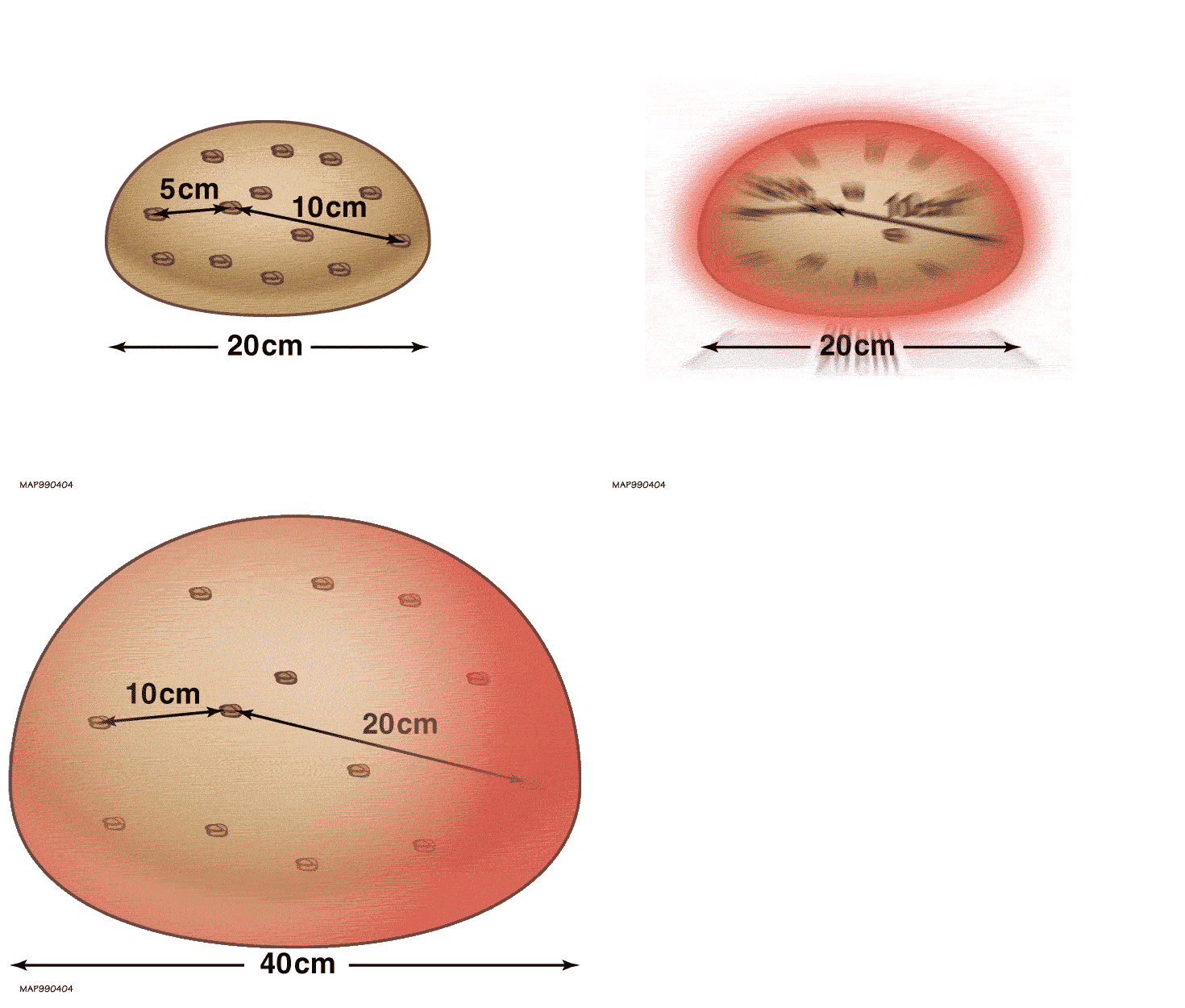
The ‘raisin bread’ model of the expanding Universe, where relative distances increase as the space (dough) expands. The farther away any two raisin are from one another, the greater the observed redshift will be by time the light is received. The redshift-distance relation predicted by the expanding Universe is borne out in observations, and has been consistent with what’s been known all the way back since the 1920s. (Credit: NASA/WMAP Science Team)
Back in the 1920s, the evidence became overwhelming that not only were the copious spirals and ellipticals in the sky actually entire galaxies unto themselves, but that the farther away such a galaxy was determined to be, the greater the amount its light was shifted to systematically longer wavelengths. While a variety of interpretations were initially suggested, they all fell away with more abundant evidence until only one remained: the Universe itself was undergoing cosmological expansion, like a loaf of leavening raisin bread, where bound objects like galaxies (e.g., raisins) were embedded in an expanding Universe (e.g., the dough).
If the Universe was expanding today, and the radiation within it was being shifted towards longer wavelengths and lower energies, then in the past, the Universe must have been smaller, denser, more uniform, and hotter. As long as any amount of matter and radiation are a part of this expanding Universe, the idea of the Big Bang yields three explicit and generic predictions:
a large-scale cosmic web whose galaxies grow, evolve, and cluster more richly over time,
a low-energy background of blackbody radiation, left over from when neutral atoms first formed in the hot, early Universe,
and a specific ratios of the lightest elements — hydrogen, helium, lithium, and their various isotopes — that exist even in regions that have never formed stars.
This snippet from a structure-formation simulation, with the expansion of the Universe scaled out, represents billions of years of gravitational growth in a dark matter-rich Universe. Note that filaments and rich clusters, which form at the intersection of filaments, arise primarily due to dark matter; normal matter plays only a minor role. (Credit: Ralf Kaehler and Tom Abel (KIPAC)/Oliver Hahn)
All three of these predictions have been observationally borne out, and that’s why the Big Bang reigns supreme as our leading theory of the origin of our Universe, as well as why all its other competitors have fallen away. However, the Big Bang only describes what our Universe was like in its very early stages; it doesn’t explain why it had those properties. In physics, if you know the initial conditions of your system and what the rules that it obeys are, you can predict extremely accurately — to the limits of your computational power and the uncertainty inherent in your system — how it will evolve arbitrarily far into the future.
But what initial conditions did the Big Bang need to have at its beginning to give us the Universe we have? It’s a bit of a surprise, but what we find is that:
there had to be a maximum temperature that’s significantly (about a factor of ~1000, at least) lower than the Planck scale, which is where the laws of physics break down,
the Universe had to have been born with density fluctuations of approximately the same magnitude of all scales,
the expansion rate and the total matter-and-energy density must have balanced almost perfectly: to at least ~30 significant digits,
it must have been born with the same initial conditions — same temperature, density, and spectrum of fluctuations — at all locations, even causally disconnected ones,
and its entropy must have been much, much lower than it is today, by a factor of trillions upon trillions.
If these three different regions of space never had time to thermalize, share information or transmit signals to one another, then why are they all the same temperature? This is one of the problems with the initial conditions of the Big Bang; how could these regions all obtain the same temperature unless they started off that way, somehow? (Credit: E. Siegel/Beyond the Galaxy)
Whenever we come up against a question of initial conditions — basically, why did our system start off this way? — we only have two options. We can appeal to the unknowable, saying that it is this way because it’s the only way it could’ve been and we can’t know anything further, or we can try to find a mechanism for setting up and creating the conditions that we know we needed to have. That second pathway is what physicists call “appealing to dynamics,” where we attempt to devise a mechanism that does three important things.
It has to reproduce every success that the model it’s trying to supersede, the hot Big Bang in this instance, produces. Those earlier cornerstones must all come out of any mechanism we propose.
It has to explain what the Big Bang cannot: the initial conditions the Universe started off with. These problems that remain unexplained within the Big Bang alone must be explained by whatever novel idea comes along.
And it has to make new predictions that differ from the original theory’s predictions, and those predictions must lead to a consequence that is in some way observable, testable, and/or measurable.
The only idea we’ve had that met these three criteria was the theory of cosmic inflation, which has achieved unprecedented successes on all three fronts.
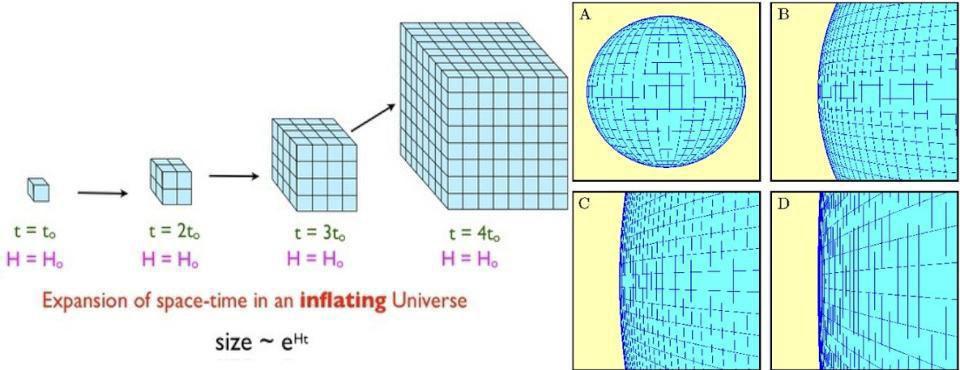
Exponential expansion, which takes place during inflation, is so powerful because it is relentless. With every ~10^-35 seconds (or so) that passes, the volume of any particular region of space doubles in each direction, causing any particles or radiation to dilute and causing any curvature to quickly become indistinguishable from flat. (Credit: E. Siegel (L); Ned Wright’s Cosmology Tutorial (R))
What inflation basically says is that the Universe, before it was hot, dense, and filled with matter-and-radiation everywhere, was in a state where it was dominated by a very large amount of energy that was inherent to space itself: some sort of field or vacuum energy. Only, unlike today’s dark energy, which has a very small energy density (the equivalent of about one proton per cubic meter of space), the energy density during inflation was tremendous: some 1025 times greater than dark energy is today!
The way the Universe expands during inflation is different from what we’re familiar with. In an expanding Universe with matter and radiation, the volume increases while the number of particles stays the same, and hence the density drops. Since the energy density is related to the expansion rate, the expansion slows over time. But if the energy is intrinsic to space itself, then the energy density remains constant, and so does the expansion rate. The result is what we know as exponential expansion, where after a very small period of time, the Universe doubles in size, and after that time passes again, it doubles again, and so on. In very short order — a tiny fraction of a second — a region that was initially smaller than the smallest subatomic particle can get stretched to be larger than the entire visible Universe today.
In the top panel, our modern Universe has the same properties (including temperature) everywhere because they originated from a region possessing the same properties. In the middle panel, the space that could have had any arbitrary curvature is inflated to the point where we cannot observe any curvature today, solving the flatness problem. And in the bottom panel, pre-existing high-energy relics are inflated away, providing a solution to the high-energy relic problem. This is how inflation solves the three great puzzles that the Big Bang cannot account for on its own. (Credit: E. Siegel/Beyond the Galaxy)
During inflation, the Universe gets stretched to enormous sizes. This accomplishes a tremendous number of things in the process, among them:
stretching the observable Universe, irrespective of what its initial curvature was, to be indistinguishable from flat,
taking whatever initial conditions existed in the region that began inflating, and stretching them across the entire visible Universe,
creating minuscule quantum fluctuations and stretching them across the Universe, so that they’re almost the same on all distance scales, but slightly smaller-magnitude on smaller scales (when inflation is about to end),
converting all that “inflationary” field energy into matter-and-radiation, but only up to a maximum temperature that’s well below the Planck scale (but comparable to the inflationary energy scale),
creating a spectrum of density and temperature fluctuations that exist on scales larger than the cosmic horizon, and that are adiabatic (of constant entropy) and not isothermal (of constant temperature) everywhere.
This reproduces the successes of the non-inflationary hot Big Bang, provides a mechanism for explaining the Big Bang’s initial conditions, and makes a slew of novel predictions that differ from a non-inflationary beginning. Beginning in the 1990s and through the present day, the inflationary scenario’s predictions agree with observations, distinct from the non-inflationary hot Big Bang.
The quantum fluctuations that occur during inflation get stretched across the Universe, and when inflation ends, they become density fluctuations. This leads, over time, to the large-scale structure in the Universe today, as well as the fluctuations in temperature observed in the CMB. Its a spectacular example of how the quantum nature of reality affects the entire large-scale universe. (Credit: E. Siegel; ESA/Planck and the DOE/NASA/NSF Interagency Task Force on CMB research)
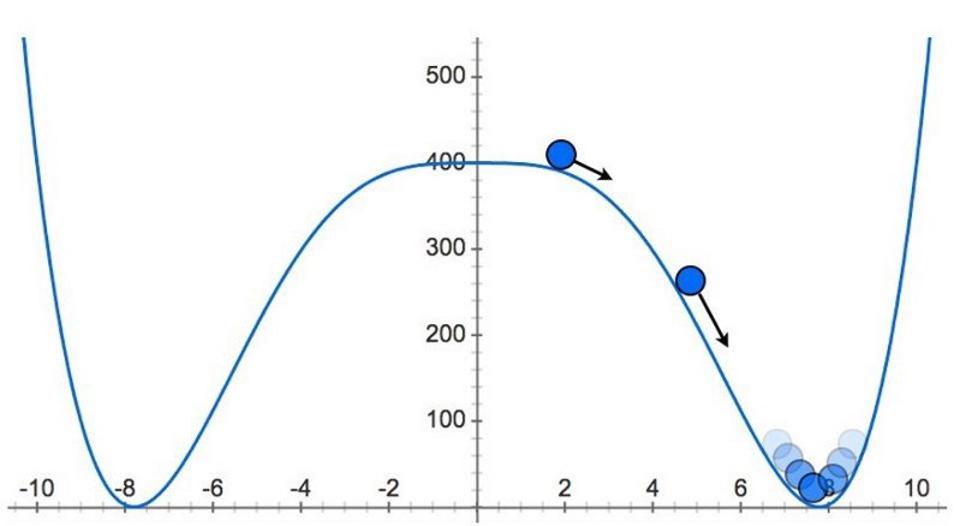
The thing is, there’s a minimum amount of inflation that must occur in order to reproduce the Universe we see, and that means there are certain conditions that inflation has to satisfy in order to be successful. We can model inflation as a hill, where as long as you stay on top of the hill, you inflate, but as soon as you roll down into the valley below, inflation comes to an end and transfers its energy into matter and radiation.
If you do this, you’ll find that there are certain “hill-shapes,” or what physicists call “potentials,” that work, and others that don’t. The key to making it work is that the top of the hill need to be flat enough in shape. In simple terms, if you think of the inflationary field as a ball atop that hill, it needs to roll slowly for the majority of inflation’s duration, only picking up speed and rolling quickly when it enters the valley, bringing inflation to an end. We’ve quantified how slowly inflation needs to roll, which tells us something about the shape of this potential. As long as the top is sufficiently flat, inflation can work as a viable solution to the beginning of our Universe.
The simplest model of inflation is that we started off at the top of a proverbial hill, where inflation persisted, and rolled into a valley, where inflation came to an end and resulted in the hot Big Bang. If that valley isn’t at a value of zero, but instead at some positive, non-zero value, it may be possible to quantum-tunnel into a lower-energy state, which would have severe consequences for the Universe we know today. (Credit: E. Siegel/Beyond the Galaxy)
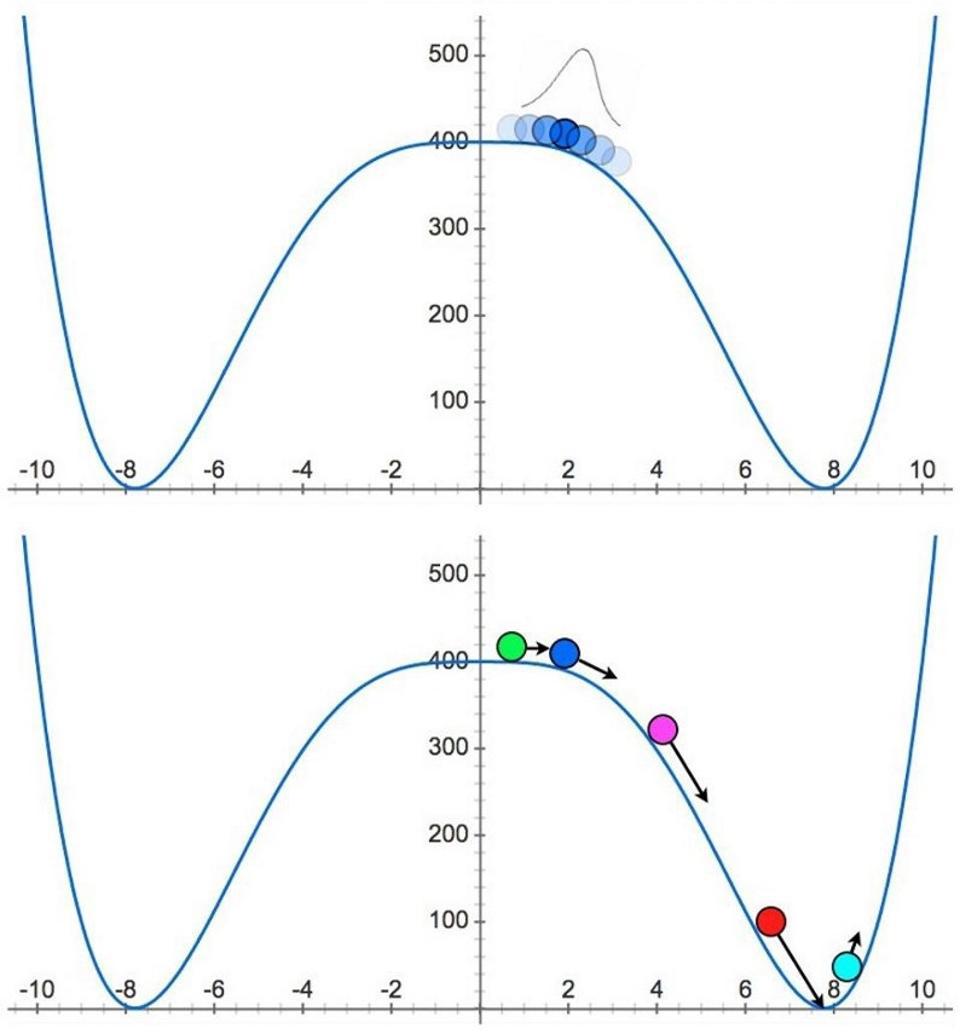
But now, here’s where things get interesting. Inflation, like all the fields we know of, has to be a quantum field by its very nature. That means that many of its properties aren’t exactly determined, but rather have a probability distribution to them. The more time you allow to pass, the greater the amount that distribution spreads out. Instead of rolling a point-like ball down a hill, we’re actually rolling a quantum probability wavefunction down a hill.
Simultaneously, the Universe is inflating, which means it’s expanding exponentially in all three dimensions. If we were to take a 1-by-1-by-1 cube and call that “our Universe,” then we could watch that cube expand during inflation. If it takes some tiny amount of time for the size of that cube to double, then it becomes a 2-by-2-by-2 cube, which requires 8 of the original cubes to fill. Allow that same amount of time to elapse, and it becomes a 4-by-4-by-4 cube, needing 64 original cubes to fill. Let that time elapse again, and it’s an 8-by-8-by-8 cube, with a volume of 512. After only about ~100 “doubling times,” we’ll have a Universe with approximately 1090 original cubes in it.
If inflation is a quantum field, then the field value spreads out over time, with different regions of space taking different realizations of the field value. In many regions, the field value will wind up in the bottom of the valley, ending inflation, but in many more, inflation will continue, arbitrarily far into the future. (Credit: E. Siegel/Beyond the Galaxy)
So far, so good. Now, let’s say we have a region where that inflationary, quantum ball rolls down into the valley. Inflation ends there, that field energy gets converted to matter-and-radiation, and something that we know as a hot Big Bang occurs. This region might be irregularly shaped, but it’s required that enough inflation occurred to reproduce the observational successes we see in our Universe.
The question becomes, then, what happens outside of that region?
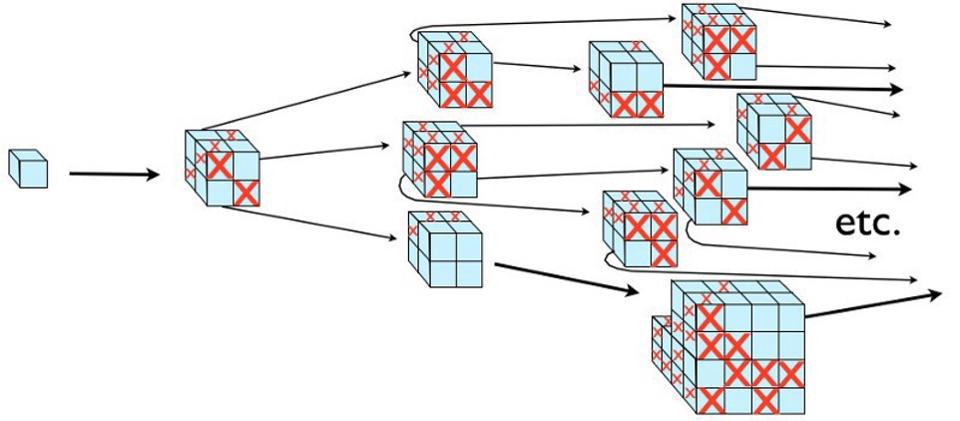
Wherever inflation occurs (blue cubes), it gives rise to exponentially more regions of space with each step forward in time. Even if there are many cubes where inflation ends (red Xs), there are far more regions where inflation will continue on into the future. The fact that this never comes to an end is what makes inflation ‘eternal’ once it begins, and where our modern notion of a multiverse comes from. (Credit: E. Siegel/Beyond the Galaxy)
Here’s the problem: if you mandate that you get enough inflation that our Universe can exist with the properties we see, then outside of the region where inflation ends, inflation will continue. If you ask, “what is the relative size of those regions,” you find that if you want the regions where inflation ends to be big enough to be consistent with observations, then the regions where it doesn’t end are exponentially larger, and the disparity gets worse as time goes on. Even if there are an infinite number of regions where inflation ends, there will be a larger infinity of regions where it persists. Moreover, the various regions where it ends — where hot Big Bangs occur — will all be causally disconnected, separated by more regions of inflating space.
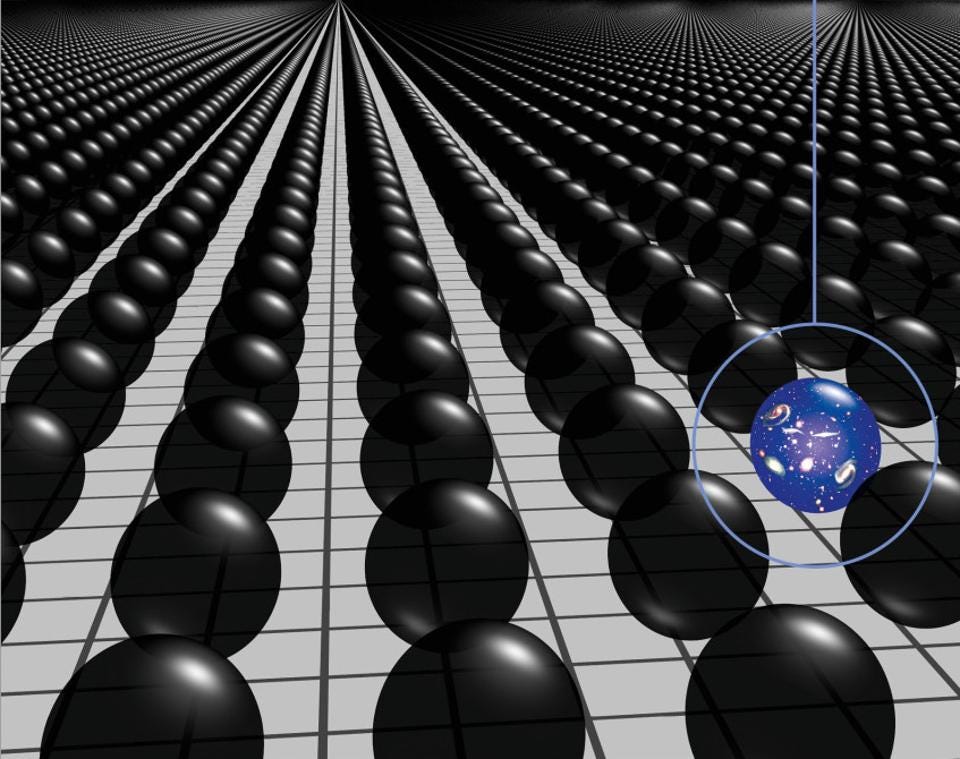
Put simply, if each hot Big Bang occurs in a “bubble” Universe, then the bubbles simply don’t collide. What we wind up with is a larger and larger number of disconnected bubbles as time goes on, all separated by an eternally inflating space.
An illustration of multiple, independent Universes, causally disconnected from one another in an ever-expanding cosmic ocean, is one depiction of the Multiverse idea. The different Universes that arise may have different properties from one another or they may not, but we do not know how to test the multiverse hypothesis in any way. (Credit: Ozytive/Public Domain)
That’s what the multiverse is, and why scientists accept its existence as the default position. We have overwhelming evidence for the hot Big Bang, and also that the Big Bang began with a set of conditions that don’t come with a de facto explanation. If we add in an explanation for it — cosmic inflation — then that inflating spacetime that set up and gave rise to the Big Bang makes its own set of novel predictions. Many of those predictions are borne out by observation, but other predictions also arise as consequences of inflation.
One of them is the existence of a myriad of Universes, of disconnected regions each with their own hot Big Bang, that comprise what we know as a multiverse when you take them all together. This doesn’t mean that different Universes have different rules or laws or fundamental constants, or that all the possible quantum outcomes you can imagine occur in some other pocket of the multiverse. It doesn’t even mean that the multiverse is real, as this is a prediction we cannot verify, validate, or falsify. But if the theory of inflation is a good one, and the data says it is, a multiverse is all but inevitable.
You may not like it, and you really may not like how some physicists abuse the idea, but until a better, viable alternative to inflation comes around, the multiverse is very much here to stay. Now, at least, you understand why.
(This article is re-run from earlier in 2021 as part of a “best of 2021” series that will run from Christmas Eve until the New Year. Happy holidays, everyone.)
Research was driven by observations of fluctuations in autoluminescence caused by seed germination in cycles regulated by gravitational tides. Credit: Cristiano de Mello Gallep/UNICAMP
The rhythms of activity in all biological organisms, both plants and animals, are closely linked to the gravitational tides created by the orbital mechanics of the sun-Earth-moon system. This truth has been somewhat neglected by scientific research but is foregrounded in a study by Cristiano de Mello Gallep at the University of Campinas (UNICAMP) in the state of São Paulo, Brazil, and Daniel Robert at the University of Bristol in the United Kingdom. An article on the study is published in the Journal of Experimental Botany.
“All matter on Earth, both live and inert, experiences the effects of the gravitational forces of the sun and moon expressed in the form of tides. The periodic oscillations exhibit two daily cycles and are modulated monthly and annually by the motions of these two celestial bodies. All organisms on the planet have evolved in this context. What we sought to show in the article is that gravitational tides are a perceptible and potent force that has always shaped the rhythmic activities of these organisms,” Gallep told.
The study is both an extensive review of the literature and a meta-analysis of the data from three previously published cases in which gravitational causality was not fully explored: The swimming activity of isopods, small shell-less crustaceans whose appearance on Earth dates from at least 300 million years ago; reproductive effort in coral; and growth modulation in sunflower seedlings inferred from autoluminescence. In the latter case, the researchers analyzed results of their own investigations as well as data from the literature.
“The data shows that in the absence of other rhythmic influences such as lighting or temperature, local gravitational tides are sufficient to organize the cyclical behavior of these organisms. This evidence questions the validity of so-called free-run experiments, in which several environmental factors are controlled but gravitational oscillations are not taken into consideration. These oscillations continue to exist, and may modulate the behavior of living organisms,” Gallep said.
Many of the rhythmic patterns displayed by organisms are well-known and have been widely studied. They include circadian rhythms, which are linked to the day-night or light-dark cycle. However, some rhythmic cycles are maintained even when the factor light is isolated under laboratory conditions, and the contributions of other environmental factors have been investigated and demonstrated, although their effects are comparatively weak in many cases. The study in question considered, among others, the persistence of tidal cycles in the behavioral patterns of coastal organisms such as crustaceans, when they are removed from their natural habitats.
“These animals modulate their behavior in tune with the ebb and flow of the tides, in a cycle of approximately 12.4 hours that derives from lunisolar dynamics, even when they’re moved to a laboratory with stable and controlled aquatic conditions,” Gallep said. “The pattern persists for several days, matching lunisolar tidal timing at the site where the organisms were collected in nature.”
Although the combined gravitational effect of the sun and moon corresponds to only a millionth of Earth’s gravity, it is sufficient not just to cause large-scale tidal fluctuations in oceans, rivers and lakes, but also to move the tectonic plates. The Large Hadron Collider (LHC), operated by the European Organization for Nuclear Research (CERN), with a circumference of 27 kilometers, is vertically displaced by 1 millimeter by this gravitational fluctuation, and its scientists must adjust their experimental calculations accordingly.
Gallep first noted these periodicities in experiments involving the autoluminescence associated with seed germination, conducted in Limeira (São Paulo state). “I observed that changes in the signal collected appeared every 12 or 24 hours, but differed in each germination test. When I looked for support in the literature, I found studies pointing to a possible correlation with gravitational tides. We explored this phenomenon in subsequent tests on various types of seed, and also added results obtained in the laboratory by collaborators in Prague, Czech Republic, in Leiden, Netherlands, and in Hamamatsu, Japan,” he said.
Gravitational cycles do not only affect the simplest organisms. Scientific studies have found that humans kept in the dark tend to establish a cyclical fluctuation lasting 24.4-24.8 hours, in harmony with the lunar cycle. This tendency has also been noted in people who spend long periods in caves. It conditions the alternation of sleep and wakefulness, meal times, and other metabolic functions.
University of California Television (UCTV) The best-selling author and UCSF endocrinologist Dr. Robert Lustig explores how industry has contributed to a culture of addiction, depression and chronic disease. Always provocative, Lustig reveals the science that drives these states of mind and offers solutions we can use. [10/2017] [Show ID: 32572] Please Note: Knowledge about health and medicine is constantly evolving. This information may become out of date. More from: Wellbeing (https://www.uctv.tv/wellbeing) Explore More Health & Medicine on UCTV (https://www.uctv.tv/health) UCTV features the latest in health and medicine from University of California medical schools. Find the information you need on cancer, transplantation, obesity, disease and much more. UCTV is the broadcast and online media platform of the University of California, featuring programming from its ten campuses, three national labs and affiliated research institutions. UCTV explores a broad spectrum of subjects for a general audience, including science, health and medicine, public affairs, humanities, arts and music, business, education, and agriculture. Launched in January 2000, UCTV embraces the core missions of the University of California — teaching, research, and public service – by providing quality, in-depth television far beyond the campus borders to inquisitive viewers around the world. (https://www.uctv.tv)
Directed by Charles and Ray Eames, the legendary husband-and-wife filmmaking and design team, the classic short Powers of Ten (1977) invited viewers to contemplate the edges of our understanding of reality. Starting from a picnic blanket in a Chicago park, that film took viewers on a journey that stretched to the scale of 100 million light years away, and then back down to a single proton. Narrated by the BBC TV presenter Brian Cox – a professor of particle physics in the School of Physics and Astronomy at the University of Manchester – this new short pays homage to the Eames classic by transposing its elegantly simple premise to today. This time, the picnic blanket is in Sicily, and the time horizon stretches to a scale of 100 billion light years away; the resulting film integrates updates in astronomy, astronomical imaging and human understanding into its journey far into the cosmos and back again.
Lesson 167There is one life, and that I share with God.
There are not different kinds of life, for life is like the truth. It does not have degrees. It is the one condition in which all that God created share. Like all His Thoughts, it has no opposite. There is no death because what God created shares His life. There is no death because an opposite to God does not exist. There is no death because the Father and the Son are One.
In this world, there appears to be a state that is life’s opposite. You call it death. Yet we have learned that the idea of death takes many forms. It is the one idea which underlies all feelings that are not supremely happy. It is the alarm to which you give response of any kind that is not perfect joy. All sorrow, loss, anxiety and suffering and pain, even a little sigh of weariness, a slight discomfort or the merest frown, acknowledge death. And thus deny you live.
You think that death is of the body. Yet it is but an idea, irrelevant to what is seen as physical. A thought is in the mind. It can be then applied as mind directs it. But its origin is where it must be changed, if change occurs. Ideas leave not their source. The emphasis this course has placed on that idea is due to its centrality in our attempts to change your mind about yourself. It is the reason you can heal. It is the cause of healing. It is why you cannot die. Its truth established you as one with God.
Death is the thought that you are separate from your Creator. It is the belief conditions change, emotions alternate because of causes you cannot control, you did not make, and you can never change. It is the fixed belief ideas can leave their source, and take on qualities the source does not contain, becoming different from their own origin, apart from it in kind as well as distance, time and form.
Death cannot come from life. Ideas remain united to their source. They can extend all that their source contains. In that, they can go far beyond themselves. But they can not give birth to what was never given them. As they are made, so will their making be. As they were born, so will they then give birth. And where they come from, there will they return.
The mind can think it sleeps, but that is all. It cannot change what is its waking state. It cannot make a body, nor abide within a body. What is alien to the mind does not exist, because it has no source. For mind creates all things that are, and cannot give them attributes it lacks, nor change its own eternal, mindful state. It cannot make the physical. What seems to die is but the sign of mind asleep.
The opposite of life can only be another form of life. As such, it can be reconciled with what created it, because it is not opposite in truth. Its form may change; it may appear to be what it is not. Yet mind is mind, awake or sleeping. It is not its opposite in anything created, nor in what it seems to make when it believes it sleeps.
God creates only mind awake. He does not sleep, and His creations cannot share what He gives not, nor make conditions which He does not share with them. The thought of death is not the opposite to thoughts of life. Forever unopposed by opposites of any kind, the Thoughts of God remain forever changeless, with the power to extend forever changelessly, but yet within themselves, for they are everywhere.
What seems to be the opposite of life is merely sleeping. When the mind elects to be what it is not, and to assume an alien power which it does not have, a foreign state it cannot enter, or a false condition not within its Source, it merely seems to go to sleep a while. It dreams of time; an interval in which what seems to happen never has occurred, the changes wrought are substanceless, and all events are nowhere. When the mind awakes, it but continues as it always was.
Let us today be children of the truth, and not deny our holy heritage. Our life is not as we imagine it. Who changes life because he shuts his eyes, or makes himself what he is not because he sleeps, and sees in dreams an opposite to what he is? We will not ask for death in any form today. Nor will we let imagined opposites to life abide even an instant where the Thought of life eternal has been set by God Himself.
His holy home we strive to keep today as He established it, and wills it be forever and forever. He is Lord of what we think today. And in His Thoughts, which have no opposite, we understand there is one life, and that we share with Him, with all creation, with their thoughts as well, whom He created in a unity of life that cannot separate in death and leave the Source of life from where it came.
We share one life because we have one Source, a Source from which perfection comes to us, remaining always in the holy minds which He created perfect. As we were, so are we now and will forever be. A sleeping mind must waken, as it sees its own perfection mirroring the Lord of life so perfectly it fades into what is reflected there. And now it is no more a mere reflection. It becomes the thing reflected, and the light which makes reflection possible. No vision now is needed. For the wakened mind is one that knows its Source, its Self, its Holiness.
Consciousness, spirituality, biography, sexuality, androgyny, futurism, space, the arts, science, astrology, democracy, humor, books, movies and more