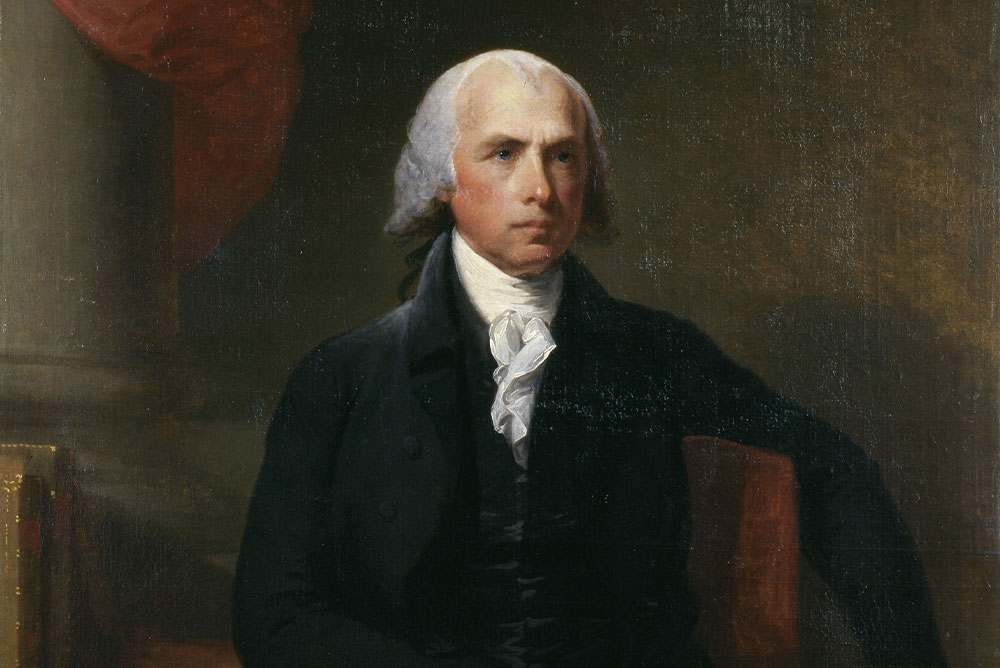
James Madison’s Call for a ‘Defensive Concert’ Against Political Factions and Careerism Resonates Today
Portrait of James Madison by Gilbert Stuart, circa 1805-07, oil painting. Courtesy of Wikimedia Commons.
by STEPHEN ERICKSON | JANUARY 3, 2022 (zocalopublicsquare.org)
One of the many law firms advertising in my part of Florida proclaims on a big billboard: “Size matters.” The crude innuendo is by now old and hackneyed. But America’s tiniest founding father, James Madison, co-author of the highest law in the land, would have agreed. Size matters a lot.
James Madison was 5 feet, 4 inches and slightly built. There’s little evidence to suggest that he was especially preoccupied with his own physical stature, but as “the father of the U.S. Constitution,” Madison was an intellectual giant who thought a great deal about size. In fact, Madison’s reflections on size can help explain why Americans today tend to be so disgusted with their political system but often seem at a total loss to know what to do about it.
Bear with me on this.
In 1787, Madison and his fellow Founding Fathers proposed to replace the Articles of Confederation with a new Constitution featuring a relatively powerful central government. Anti-federalist critics were aghast. They said it would never work because—as anyone who had studied history knew—republics had to be small, like Greek city-states. The republic proposed by Madison and his fellow federalists, stretching from New Hampshire to Georgia, would be enormous by comparison and was clearly destined to grow still larger. The anti-federalists dismissed Madison as a would-be power-centralizing aristocrat, and short too.
But Madison was thorough and persistent with his argument. The biggest problem faced by all republics was their tendency to split into narrow, self-serving, special interests, which Madison called “factions.” These self-serving interests can have a variety of natures. They can be political, religious, ideological, or commercial, the last being especially common. Such narrow selfish interests are normal in a free society, and can only be quashed through oppression—which in theory, at least, everyone’s against.
Madison turned on its head the conventional wisdom about the proper size of a republic. He argued that small republics easily became corrupt or tyrannical because it was relatively easy for one group or interest to form a majority, capture the government and oppress a minority. In a vast continental republic like the Unites States, however, there would be so many competing interests that none were likely to become powerful enough to take control of the government. Instead, those many interests would check each other.
Madison’s concept of interests checking and balancing each other, therefore, was not only applied to the various branches of government, as we are taught in school, but was considered a constitutional design feature that would be found within American society itself. Our large American republic, Madison concluded, had a good chance of being just, stable, and durable.
Madison was so enamored of his theory about the relative safety of a large republic that he obsessively argued it again and again, to anyone who would listen. The argument appears in Madison’s notes he kept while serving in the Continental Congress, in personal correspondence, in the records from the floor of the Constitutional Convention in 1787, and most famously, in “Federalist No. 10.”
Madison’s theory held up reasonably well for the first 60 years of the American republic, until an extremely powerful faction—the slave-labor-based economy of the Southern states—rose up in rebellion, resulting in the American Civil War, which is to this day both the nation’s bloodiest war and its most epic contest with a special interest.Today, a voracious hoard of selfish corporate and political interests gorges itself at the trough of power at the public’s expense. The common and long-term well-being of the American people is an afterthought, at best.
After the Civil War, the power of the federal government began to grow. Progressives demanded government oversight to combat various social problems. The New Deal and Great Society expanded the government’s role in the economy and created large entitlement programs. The Cold War birthed the military industrial complex.
For good or ill, depending on one’s politics, today the federal government is many orders of magnitude larger and more powerful than the one imagined by Madison and his fellow founders. And that reality throws a big monkey wrench into Madison’s scheme for a government capable of resisting selfish interests. It is no longer necessary for a self-serving interest to gain majority support to corrupt the government, and thereby subvert the common good, because when government is immensely powerful it can serve innumerable selfish interests simultaneously.
Today, a voracious hoard of selfish corporate and political interests gorges itself at the trough of power at the public’s expense. The common and long-term well-being of the American people is an afterthought, at best. The public understands this quite well. When asked in an NBC/Wall Street Journal Survey, over 80 percent of respondents agreed with the following unattributed statement:
A small group in the nation’s capital has reaped the rewards of government while the people have borne the cost.
The quote, by the way, is from Donald Trump’s inaugural address. Would 80 percent still agree if they knew it was Trump who said it?
Probably not. Which points to another problem associated with size. In our time, it’s not only government that has become corrupted by interests. Large institutions that produce the knowledge, information, and ideas that a republic depends upon are also compromised. Media, which once at least went through the motions of taking journalistic standards seriously, now nakedly behave like other corporations; non-stop sensationalism and partisan narratives drive a views-and-clicks business model that sows division, and even hatred, among citizens. Tidal waves of corporate and politically-driven government money have corrupted universities, funding narrowly confined agendas. Independent scientific research is increasingly rare, particularly when it is costly.
The United States’ free market economy has always been a paradise for loosely bridled interests to run wild. Economically, the formula for channeling selfishness has been wonderfully productive. But when corporate interests capture the government, the free market is no longer free or safe for consumers. When politicians collude with corporate and other professional interests to form an entrenched political class, then the government no longer represents the people.
This should terrify everyone who is not part of the system and shame anyone with a conscience who is.
Our diminutive “Father of the Constitution” James Madison would have something big to say about all of this. In fact, he did say it. Again, Madison feared what selfish interests could do to his beloved American republic. He reasoned that in a large republic interests would check each other, and none become powerful enough to capture the government. It was a point that he reiterated so much that he must have been a bore at parties.
But Madison once revealed a dark fear he never expressed in public, because it would have undermined his signature argument about the relative safety of a large republic. To his friend, Thomas Jefferson, Madison wrote:
As in too small a sphere oppressive combinations may too easily be formed against the weaker party, so in too an extensive one, a defensive concert [author’s emphasis] may be rendered too difficult against the oppression of those trusted with administration.
By “defensive concert,” Madison is not referring to oboes and violins. What he means is that in a large and diverse society, people are easily splintered into squabbling factions when, instead, unity is needed to resist corruption, or worse. Madison’s prescience is astounding since this is exactly where “we the people” find ourselves today—in need of concerted action against public institutions captured by special interests.
Would-be citizen leaders need to step back and see what is really happening.
Ralph Nader, the famous consumer advocate, channeled his inner Madison when in 2014 he said, “It was quite clear to me many years ago, that power structures believe in dividing and ruling by distracting attention from areas where different groups agree to where they disagree.” At the time, Nader was promoting a new book, Unstoppable: The Emerging Left–Right Alliance to Dismantle the Corporate State. The subtitle was sadly premature.
Today, whenever an isolated leader stands up to truly challenge the system, he or she is likely to be demonized and demonetized. Platforms are withdrawn, public personalities smeared, reputations attacked, voices censored, private lives harassed, and employment terminated. For real leaders whose only desire is to serve the public, the public square has become an increasingly dangerous and authoritarian place.
We need, in Madison’s words, “a defensive concert.”
The first step to ending this endemic corruption and rising authoritarianism should be obvious: unified opposition balanced by authentic leaders on the left and right. Real leaders need to find each other in our large and cacophonous nation. Currently, dissenting voices are hunkered down in their silos, building their own brands when they should be uniting to build a movement together. Each voice alone is too puny to make a real difference but uniting and organizing could change everything. And it must.
Madison would argue that such a movement should have a clear overarching mission: to remove from the political system every incentive that favors service to selfish interests, or factions, over the common and long-term good of the American people. For starters, that means terminating political careerism and making it impossible for elected officials to take money, or otherwise benefit, from the various corporate and other selfish interests they are supposed to regulate.
It’s an enormous and complicated task, but it must begin somewhere. The people are ready. It’s leadership we need for the concerted action that James Madison, the tiny founder with his big ideas, begs us to take.
The US could be under a rightwing dictatorship by 2030, a Canadian political science professor has warned, urging his country to protect itself against the “collapse of American democracy”.
“We mustn’t dismiss these possibilities just because they seem ludicrous or too horrible to imagine,” Thomas Homer-Dixon, founding director of the Cascade Institute at Royal Roads University in British Columbia, wrote in the Globe and Mail.
“In 2014, the suggestion that Donald Trump would become president would also have struck nearly everyone as absurd. But today we live in a world where the absurd regularly becomes real and the horrible commonplace.”
Homer-Dixon’s message was blunt: “By 2025, American democracy could collapse, causing extreme domestic political instability, including widespread civil violence. By 2030, if not sooner, the country could be governed by a rightwing dictatorship.”
The author cited eventualities centered on a Trump return to the White House in 2024, possibly including Republican-held state legislatures refusing to accept a Democratic win.
Trump, he warned, “will have only two objectives, vindication and vengeance” of the lie that his 2020 defeat by Joe Biden was the result of electoral fraud.
A “scholar of violent conflict” for more than four decades, Homer-Dixon said Canada must take heed of the “unfolding crisis”.
“A terrible storm is coming from the south, and Canada is woefully unprepared. Over the past year we’ve turned our attention inward, distracted by the challenges of Covid-19, reconciliation and the accelerating effects of climate change.
“But now we must focus on the urgent problem of what to do about the likely unraveling of democracy in the United States. We need to start by fully recognising the magnitude of the danger. If Mr Trump is re-elected, even under the more optimistic scenarios the economic and political risks to our country will be innumerable.”
Homer-Dixon said he even saw a scenario in which a new Trump administration, having effectively nullified internal opposition, deliberately damaged its northern neighbor.
“Under the less-optimistic scenarios, the risks to our country in their cumulative effect could easily be existential, far greater than any in our federation’s history. What happens, for instance, if high-profile political refugees fleeing persecution arrive in our country and the US regime demands them back. Do we comply?”
Trump, he said, “and a host of acolytes and wannabes such as Fox [News]’s Tucker Carlson and Georgia representative Marjorie Taylor Greene”, had transformed the Republican party “into a near-fascist personality cult that’s a perfect instrument for wrecking democracy”.
Worse, he said, Trump “may be just a warm-up act”.
“Returning to office, he’ll be the wrecking ball that demolishes democracy but the process will produce a political and social shambles,” Homer-Dixon said.
“Still, through targeted harassment and dismissal, he’ll be able to thin the ranks of his movement’s opponents within the state, the bureaucrats, officials and technocrats who oversee the non-partisan functioning of core institutions and abide by the rule of law.
“Then the stage will be set for a more managerially competent ruler, after Mr Trump, to bring order to the chaos he’s created.”
Xenia Hanusiakis a cultural commentator, essayist and writer whose work has been published by the Financial Times, Music & Literature and TheNew York Times, among others. As an operatic soprano, writer for the stage and curator, she has contributed to festivals from National Sawdust and BAM in New York to the Beijing Music Festival.
The soundtrack of our lives is the sound of striving. Psychologists, philosophers and behavioural scientists are all coaxing us to strive with variations of the same loop: strive for accomplishment, strive for prosperity, and strive for happiness. We must act fast and slow, or think big and small; be calm, be on edge, eat more, eat less, dance more and sleep more, want more – or less; practise for 10,000 hours or don’t practise at all; be deliberate, habitual, and intuitive, or just simply Zen out to zero.
Naturally, we all want to optimise our ways of being. But every once in a while, and for every one of our aspirations, there’s a contrarian voice screaming: Enough already! Can’t we stop succeeding for just one moment? Cease trying to be exceptional at something? The answer is yes, but to do so you must embrace your inner amateur.
I discovered my inner amateur and haven’t looked back since. It happened while listening to a recent recording of Études by the American minimalist composer Philip Glass, performed by his fellow American pianist Simone Dinnerstein. The performance was so inspirational that I leapt from the couch and found my fingers at the piano – searching for the same profundity of poeticism that spoke to me in the performance. When Glass set out to compose his 20 studies, he did so expressly to develop his own piano technique. Études are a form of composition written specifically to test a musician’s skillset. Glass was, in effect, custom-composing for his own inner amateur.
My musical upbringing involved constant striving across hours of laborious practice. Every morning, throughout my childhood, I diligently practised scales and études. Every week, I returned to my lesson anxiously awaiting the approval of the tick or the reprimand of the black cross. I don’t recall happiness, fulfilment or engagement. I just remember two states of mind: was I a success or was I a failure? If only my teacher (and I) had realised that I was an amateur. Then my life of striving might have stopped.
In the kingdom of music, the amateur who doesn’t know her place courts humiliation. Think of the opera aspirant Florence Foster Jenkins, the quirky American soprano and socialite, vividly portrayed by Meryl Streep in Stephen Frears’s 2016 biopic. In 1944, at the age of 76, the tone-deaf dilettante booked Carnegie Hall in New York, where she performed the grandest arias of the repertoire – arias that only the most seasoned singers would dare – and earned the disastrous reviews you might expect. She died a month later, following a sudden illness, but she died having fulfilled the aspirations of her inner amateur. Those aspirations might have exceeded her talent, but the metrics of success is hardly the point. For anyone who witnessed Streep’s beaming smile in Frears’s film, the message is clear: Foster Jenkins experienced far more personal pleasure than public pain. However, the idea of the amateur as an artistic and social liability is a fairly contemporary one.
The role of practice ought to be revised so that striving is replaced by fulfilment, and notions of success and failure are erased
The word ‘amateur’ didn’t establish itself in the English language until the 18th century, even if the distinction between the so-called dilettante and the professional is ancient. Plato’s discussion of musical education in Book III of The Republic implies the existence of amateurs as well of professionals. For Aristotle, skill in performance is to be carried to the point at which it enables the pupil to enjoy good music – and no further. If only these ancient wisdoms had been passed on to Foster Jenkins.
The amateur has always had a rightful place in society. In his 1779 sonata, C P E Bach dedicated his work ‘für Kenner und Liebhaber’, or to connoisseurs and lovers, expressly excluding professionals. In the Victorian era, playing the piano was viewed as a particular accomplishment for women, that is, as a ‘home art’ that might advance their marriage prospects. When the concept of the amateur was first referenced in English in the Universal Dictionary of Arts, Sciences and Literature (1803), the amateur was defined as ‘a foreign term introduced as a now passing current amongst us, to denote a person understanding and loving or practising the polite arts of sculpture, or architecture, without any regard to pecuniary advantage.’
More than a century later, the French theorist and philosopher Roland Barthes argued on similar lines, that:
The Amateur engages in painting, music, sport, science, without the spirit of mastery or competition … he establishes himself graciously (for nothing) in the signifier: in the immediately definitive substance of music, of painting …
But Barthes, did more than valorise the vocation. He personified the role. From his interviews, published posthumously in The Grain of the Voice (1981), we know that, as a student, Barthes practised J S Bach’s The Well-Tempered Clavier (1722-42) daily to assist him in his recuperation from tuberculosis. We also know from his autobiography Roland Barthes by Roland Barthes (1975) that, as part of his daily ritual, he would record his piano practice to assist his memory. His repertoire was restricted, yet under ‘likes’ in the inventory of ‘likes/dislikes’ that Barthes logged, he listed Handel, the Canadian pianist Glenn Gould, the piano, and all Romantic music, alongside too-cold beer and the Marx Brothers. If Barthes can lead us to a new appreciation of the amateur, then the role of practice ought to be similarly revised so that striving is replaced by fulfilment, and notions of success and failure are erased.
The art of amateurship pivots on us knowing our capabilities and realising the boundaries of what we seek. Once we remove goal-seeking from the amateur’s aspirations, we can focus on the psychology of optimal experience articulated by the psychologist Mihaly Csikszentmihalyi’s theory of flow, which the journalist Ariel Gore links to happiness:
When we strike a balance between the challenge of an activity and our skill at performing it, when the rhythm of the work itself feels in sync with our pulse, when we know that what we’re doing matters, we can get totally absorbed in our task. That is happiness.
In not aiming to perform a four-part fugue by memory, or looking to debut at Carnegie Hall à la Foster Jenkins, the amateur finds fulfilment by being completely absorbed in the music at hand, and undergoing an immersion journey that, at its best, can act as a metaphor for understanding the preciousness of time and the need for deliberate concentration.
Practising heightens my awareness of being alone with myself … Suddenly, I find that I’m not alone at all. The piano becomes my significant other
Our daily lives already overemphasise competition, ambition and deadlines. We don’t need to reproduce such pressures in our pleasure lives. The joy of amateurship allows you to find beauty in simplicity, setting smaller goals and searching for the aesthetics; allowing you to discover the wonder of tactility, the action and release of the key, and the lyricism of the piano’s sound. If we focus on our proactive enjoyment of conquering (and luxuriating) in a few bars at time or playing a piece of music that truly connects us with our spirit, we enter into dialogue with pleasure. As Daniel Levitin writes in The Organized Mind (2014):
During the flow state, attention is focused on a limited perceptual field, and that field receives your full concentration and complete investment. Action and awareness merge.
So, despite not conquering a Chopin waltz, the sense of fulfilment prevails.
Taking ownership of your inner amateur doesn’t mean sacrificing your inner aspirations to play a challenging piece of music. It simply means that you become the custodian and narrator of your own experience of striving.
For so many amateur musicians, the pattern of criticism and the hierarchical relationship of the teacher-pupil relationship can be crushing. The student becomes disengaged from music but more importantly from themselves. I’m reminded here of Joni Mitchell’s experience of piano lessons. In a New York Times article, Lindsay Zoladz recalls Mitchell saying: ‘I played … for my piano teacher, who slapped me across the wrist with a ruler for playing by ear … she said: “Why would you play by ear when you have the masters under your fingers?”’ The young Mitchell (then Joan Anderson) replies: ‘Well, the masters had to play by ear to come up with that stuff.’ That was her last piano lesson.
I’ve come to realise that the time I spend practising the piano is perhaps the only private moment I might have on any given day. Practising heightens my awareness of being alone with myself, and the sense that I’m controlling the experience. I can then be engaged and enlivened by the encounter, relinquishing a sense of passivity for one of self-engagement. Suddenly, I find that I’m not alone at all. The piano becomes my significant other.
Practising invites a kind of intimacy, a moment of mindfulness that we can cut and paste into our daily routines. Once we appreciate that practice is not an endgame, our ego falls away and we enter the experience with complete commitment. Csikszentmihalyi talks about this state as an autotelic experience, the word deriving from the Greek autos, meaning self, and telos meaning goal. Our inner amateur is therefore self-directed. As Aristotle reminds us, amateur musicians define their own goals and their own enjoyment.
Perhaps it’s time to revise the mantra ‘practice makes perfect’, which has been revived in recent years by Malcolm Gladwell. In The Outliers: The Story of Success (2008), Gladwell argued that, in almost any given area, expertise could be guaranteed by 10,000 hours of practice. But what if we turn our conditioning upside down in line with the precepts of amateurship, and begin to practise with expressions of fearlessness, spontaneity, commitment and aliveness? This doesn’t mean that we forgo our scales and our repetitions. It simply entails that we practise without the anxiety of quantifying our results. This analogue moment is a communion with your lyrical self.
But my experience with the piano might not be yours. Your moment could be in baking, weaving, painting or doodling. In each case, it’s about appreciating a feeling of the mesmeric, and honouring the aesthetic experience: the paintbrush against the grain of the paper, or the gentle rhythm of kneading dough. Chances are that the mindfulness and consciousness that you bring to the moment will increase your accomplishments a thousand-fold. The destructive emotions of success and failure will slip away, and the word ‘practice’ will be replaced by the word ‘pleasure’.
Since I rekindled my new relationship with my piano and tapped into my inner amateur, I discovered a quiet room of my own. My piano became silent witness. Perhaps – if I think of the mute heroine Ada in Jane Campion’s film The Piano (1993) and the determination and salvation that the piano offered her – it even became my voice.
In America (and around the world) the year 2021 was one of great sadness and frustration. By many indications, 2022 may be even worse.
America’s democracy crisis continues to escalate. The alarm is blaring but the American people, for the most part, continue to ignore it. Last Jan. 6, Donald Trump and his regime attempted a coup with the goal of nullifying the results of the 2020 presidential election and, in effect, ending American democracy. In many respects, Trump’s coup attempt was atypical, if not wholly unique.
It was publicly announced by Donald Trump and his agents months or even years in advance. Despite those warnings, law enforcement officials and national security leaders did little to prepare for it. Most of the mainstream news media and pundit class did not take the threat seriously, instead choosing to mock those truth-tellers who kept sounding the alarm.
Nearly a year after the attack, Donald Trump and the other high-level planners and conspirators have not been punished, and remain free to continue plotting the overthrow of American democracy. As has been widely observed, the Trump regime’s coup attempt may be the least-punished such high crime in recent history.Advertisement:
Even Trump’s foot soldiers have not been punished to the full extent of the law for their participation in the Capitol attack. While some have faced prosecution, the Justice Department has acted with great restraint.
Some “good news”: Donald Trump’s coup attempt was an example of what experts on authoritarianism and democracy describe as an attempt at an “autocratic breakthrough.” Most democracies quickly fall before such assaults. This one was repelled, which is something of a unique accomplishment.
In other ways, the Trump regime’s coup attempt was not so unusual. As in other places and times in history, Trump’s loyalists are continuing with their efforts, both through more or less legal means and otherwise. When a coup fails the first time, the second attempt is usually successful. All of this is happening in real time and in plain sight, with minimal attempt at deception. For the American people and their responsible leaders to ignore such threats is a willful choice.Advertisement:
What warnings should we be heeding now? In a recent op-ed for the Washington Post, retired U.S. Army generals Paul D. Eaton, Antonio M. Taguba and Steven M. Anderson are sounding the alarm about the possibility of a second civil war in the aftermath of a future presidential election, if Donald Trump or another Republican refuses to accept the results:
We — all of us former senior military officials — are increasingly concerned about the aftermath of the 2024 presidential election and the potential for lethal chaos inside our military, which would put all Americans at severe risk….
Imagine competing commanders in chief — a newly reelected Biden giving orders, versus Trump (or another Trumpian figure) issuing orders as the head of a shadow government. Worse, imagine politicians at the state and federal levels illegally installing a losing candidate as president.
All service members take an oath to protect the U.S. Constitution. But in a contested election, with loyalties split, some might follow orders from the rightful commander in chief, while others might follow the Trumpian loser. Arms might not be secured depending on who was overseeing them. Under such a scenario, it is not outlandish to say a military breakdown could lead to civil war.
In this context, with our military hobbled and divided, U.S. security would be crippled. Any one of our enemies could take advantage by launching an all-out assault on our assets or our allies.
Advertisement:
This is but the most recent in a series of public warnings by America’s senior national security leadership, both before and after Jan. 6, about the spiraling danger of a new civil war, a right-wing insurgency and other forms of terrorism and political violence. Such warnings are without precedent in modern American history and highlight the extreme peril the country now faces from the Republican fascist movement.
It has also been reported that military leaders were seriously concerned that Trump might order the National Guard to intervene on his behalf on or around Jan. 6 by invoking the Insurrection Act. If he had given such an order, the country would have come dangerously closer to an authoritarian takeover and perhaps widespread violence, with elements of the military battling one another. Experts on civil war have warned that the U.S. is well along such a path.
Domestic terrorism experts have also warned that right-wing extremists and paramilitary groups are organizing on the local and state level to intimidate, harass and target “liberals,” Black and brown people, Muslims, Jews, immigrant communities and others deemed to be their enemies. This is part of a nationwide campaign by Republican fascists and the larger white right to attack American democracy on the local and state level in order to facilitate Trump’s return to power (or the “election” of his designated successor). Advertisement:
It is reasonable to feel angry about the American people’s apparent passivity in the face of these obvious threats against democracy. But the more important question is why they are responding that way, and what that tells us about the health of American democracy and political culture? In essence, why do so many people simply not care?
There are many explanations. Most Americans do not follow politics closely. They also do not understand it very well. As we approach the one-year anniversary of Jan. 6, opinion polls show that fewer people are paying attention to the investigation into those events.
This is not, in itself, surprising. A large percentage of Americans, if not a majority, do not closely follow the news. At least half the population cannot read at a sixth-grade level. The average American’s understanding of politics also ebbs and flows, most obviously in response to shared crises or calamities, but also in response to those events that the news media and leading political figures focus on most intensely. In this case, if the Democrats and others who support democracy do not consistently highlight the existential threat posed by the Republican-fascist movement, then most Americans will not pay attention.Advertisement:
American voters are also strikingly poor at attributing responsibility to the correct political leaders or parties for their policy failures. Most people receive information about current events from a trusted network that may include friends, relatives, community leaders, clergy members, favored politicians and media voices and, increasingly, social media such as Facebook or Instagram. Such a network is likely to be insular and inaccurate, serving as a type of echo chamber — especially for Republicans and “conservatives.”
In an era of extreme right-wing asymmetrical polarization and negative partisanship, disinformation and a coordinated assault on truth and reality, as well as an overall culture of spectacle, unrestrained consumerism, cruelty and endless distraction, many Americans lack the capacity to make informed and responsible political and social decisions.
A large percentage of Americans believe (quite correctly) that the country’s political elites and other leaders have failed in their responsibilities to society and are increasingly detached from the experiences of everyday Americans. This reflects a 60-year trend of declining faith and trust in the country’s leaders and the legitimacy of “the system.”
There is also a worrisome decline in the American people’s faith in democracy itself, especially among younger people. A recent poll by Grinnell College offers additional context about the deep political and cultural divides that are driving the country’s democracy crisis:
The poll shows incredibly few Americans (7%) have high trust in the federal government to offer good ideas to solve problems facing their communities. Even among Democrats, whose party currently holds the White House and the majority in both houses of Congress, only 14% say they have high trust in the federal government.
Americans were somewhat more likely to have high trust in state governors (25%) and city or county elected leaders (19%) to offer good ideas to solve problems in their communities. In both cases, only a minority of Americans had high trust in elected officials.
Advertisement:
“Trust in political institutions is the glue that holds democracies together and allows them to weather crises over time,” said Grinnell political scientist Danielle Lussier. “While there will always be some skepticism toward the government, when a majority of people express distrust in elected officials, the legitimacy of the constitutional order is called into question.”
Further analysis reveals the depth of partisan division: While doctors, scientists and teachers are highly trusted by Democratic voters, “among Republicans, doctors are highly trusted by only 48%, scientists by 28%, and teachers by 31%. Republicans place high trust in police officers (65%) but only 22% of Democrats have that same level of trust.”
“Americans lack a collective sense of whom to trust,” Lussier said, which “helps to explain why it is so hard to build a consensus for solving the country’s problems.”
Perhaps most important of all, for at least the last 50 years right-wing libertarians and other extremists have advanced a strategy to undermine faith in American democracy and the idea of government itself. This has created a space for right-wing political entrepreneurs to expand their power and influence by convincing large portions of the white American public that democratic government is illegitimate if it does not secure continued white supremacy.Advertisement:
In total, Americans are collectively experiencing a moment of social and political alienation, in which many of their fellow citizens are willingly surrendering to the forces of demobilization and authoritarianism.
Antidemocracy does not take the form of overt attacks upon the idea of government by the people. Instead, politically it means encouraging what I have earlier dubbed “civic demobilization,” conditioning an electorate to being aroused for a brief spell, controlling its attention span, and then encouraging distraction or apathy. The intense pace of work and the extended working day, combined with job insecurity, is a formula for political demobilization, for privatizing the citizenry. It works indirectly. Citizens are encouraged to distrust their government and politicians; to concentrate upon their own interests; to begrudge their taxes; and to exchange active involvement for symbolic gratifications of patriotism, collective self-righteousness, and military prowess. Above all, depoliticization is promoted through society’s being enveloped in an atmosphere of collective fear and of individual powerlessness: fear of terrorists, loss of jobs, the uncertainties of pension plans, soaring health costs, and rising educational expenses.
Advertisement:
Ultimately, who is to blame for the American public’s passivity in the face of an escalating neofascist threat? Of course Republicans and other members of the “conservative” movement are the most clearly guilty. President Biden and the other leaders of the Democratic Party and the “liberal” or “centrist” leadership class are also responsible, to the degree they did not rapidly identify the threat and respond accordingly.
Right-wing libertarians and neoliberal gangster capitalists, who for years have longed who to destroy the commons and social democracy in order to create a society where profits rule over people in all areas of life, are also responsible. They weakened the social fabric to such an extent that it was much easier for neofascism to take root.
However this dark chapter in American history concludes, and whatever the next chapter may hold, there will be many Americans (largely white people in the privileged classes) who will exclaim in all sincerity: How could such a thing have happened? Are we not better than this? Advertisement:
The answer to such questions will stare back at them from the mirror every morning — and even then they will deny responsibility.
Read more on the real and rising threat of fascism in America:
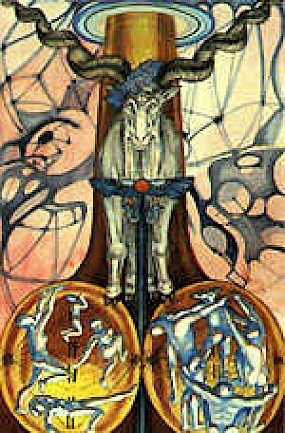
The Devil is numbered fifteen and shows a figure, usually male and satyr-like, half-man and half-animal. Sometimes, male and female forms are shown chained or trapped at his feet. The Thoth deck (shown here) has the Devil as a goat, appearing against a background of the male sex organs. His third eye represents the Eye of God and the staff across his chest is topped with the Winged Disk symbol and double-headed snakes.
The Devil card is often misunderstood and feared. However, before Christianity became a leading religion, there were several pantheons which contained fertility gods and they were often depicted as animals – the Horned God of the Wicca for example, servant and consort of the Goddess. The Devil does not therefore necessarily represent an evil being.
The Devil is the personification of the animal, instinctual and even bestial parts of us. Pre-occupation with matters connected to the Devil can lead to degradation and sheer ugliness, but by identifying and accepting the darkness within we learn to discover that it is simply the dark side of our light.
New Thinking Allowed with Jeffrey Mishlove This video is a special release from the original Thinking Allowed series that ran on public television from 1986 until 2002. It was recorded in about 2000. Anna Halprin, author of Dance as a Healing Art, has spent many years of practical experience in collaborative programs incorporating modern American dance with treatment protocols for cancer and AIDS patients. As a cancer survivor herself, eighty year old Anna Halprin brings a genuine authenticity to her presentation, offering uplifting insights and the wisdom off a great creative artist, teacher, and facilitator for healing. Now you can watch all of the programs from the original Thinking Allowed Video Collection, hosted by Jeffrey Mishlove. Subscribe to the new Streaming Channel (https://thinkingallowed.vhx.tv/) and watch more than 350 programs now, with more, previously unreleased titles added weekly. New!! Free month of the classic Thinking Allowed streaming channel for New Thinking Allowed subscribers only. Use code THINKFREELY.
Tim Thornborough | October 23rd 2017 (thegoodbook.com)
There are some parts of the Bible that seem seriously weird to us. Take the end of Matthew 27 for example, with its image of the undead wandering around Jerusalem. It’s one of those passages that I’ve never heard anyone preach on, possibly because it seems to raise more questions than it answers.
And yet, as always, when we take the time to dig a bit deeper some things start to come in focus.
“And when Jesus had cried out again in a loud voice, he gave up his spirit. At that moment the curtain of the temple was torn in two from top to bottom. The earth shook, the rocks split and the tombs broke open. The bodies of many holy people who had died were raised to life. They came out of the tombs after Jesus’ resurrection and went into the holy city and appeared to many people. When the centurion and those with him who were guarding Jesus saw the earthquake and all that had happened, they were terrified, and exclaimed, “Surely he was the Son of God!” Matthew 27 v 50-54
Matthew’s description of the death of Jesus, written for a Jewish audience steeped in scripture, is packed with hints and echoes from the Old Testament. Jesus’ final breath causes rocks to split, the temple curtain to rend, the earth to shake, graves to split open. Powerful symbols of the significance of Jesus sacrificial death. The son of God dies and the world he created shudders in horror.
But there is more to come. Since the fall, the world has been locked into the “life-death cycle”. But as the Son of God rises, death starts to work backwards. Life flows generously and abundantly from and through Jesus into the bodies of those who knew him (the “saints”). Suddenly the life-death cycle becomes the life-death-life cycle. It is a powerful statement of what he died and rose to achieve: he brings life to all who belong to him.
The zombies of popular imagination are rotting corpses, filled with evil intent and the hunger for human flesh. But at the very first Night of the Living Dead, on the very first Easter Sunday, everything is different. This is not a story of terror, but of hope. There is life beyond the grave for those who know Jesus and the power of his resurrection. It is a promise of life in a resurrection body for all eternity.
Of course, there remain many unanswerable questions: who were these “saints”? What became of them? What did they look like, and what did they do. As with many other questions about life and death, we do not know the answers; we are not told.
But what we do know is that those who are connected to Jesus find glorious, joyous, rock splitting, curtain-cleaving life for ever.
Now that’s something that’s worth talking about on halloween, or any day of the year. Is Hell For Real?and Did The Devil Make Me Do It?are both titles from our Questions Christians Ask series; short, readable books which clearly explain how the Bible answers the questions Christians are asking.
In the field of psychology, cognitive dissonance is the perception of contradictory information. Relevant items of information include a person’s actions, feelings, ideas, beliefs, values, and things in the environment. Cognitive dissonance is typically experienced as psychological stress when persons participate in an action that goes against one or more of those things.[1] According to this theory, when two actions or ideas are not psychologically consistent with each other, people do all in their power to change them until they become consistent.[1][2] The discomfort is triggered by the person’s belief clashing with new information perceived, wherein the individual tries to find a way to resolve the contradiction to reduce their discomfort.[1][2][3]
Coping with the nuances of contradictory ideas or experiences is mentally stressful. It requires energy and effort to sit with those seemingly opposite things that all seem true. Festinger argued that some people would inevitably resolve the distance by blindly believing whatever they wanted to believe.
Relations among cognitions
To function in the reality of society, human beings continually adjust the correspondence of their mental attitudes and personal actions; such continual adjustments, between cognition and action, result in one of three relationships with reality:[3]
Consonant relationship: Two cognitions or actions consistent with each other (e.g. not wanting to become drunk when out to dinner, and ordering water rather than wine)
Irrelevant relationship: Two cognitions or actions unrelated to each other (e.g. not wanting to become drunk when out and wearing a shirt)
Dissonant relationship: Two cognitions or actions inconsistent with each other (e.g. not wanting to become drunk when out, but then drinking more wine)
Magnitude of dissonance
The term “magnitude of dissonance” refers to the level of discomfort caused to the person. This can be caused by the relationship between two different internal beliefs, or an action that is incompatible with the beliefs of the person.[2] Two factors determine the degree of psychological dissonance caused by two conflicting cognitions or by two conflicting actions:
The importance of cognitions: the greater the personal value of the elements, the greater the magnitude of the dissonance in the relation. When the value of the importance of the two dissonant items is high, it is difficult to determine which action or thought is correct. Both have had a place of truth, at least subjectively, in the mind of the person. Therefore, when the ideals or actions now clash, it is difficult for the individual to decide which takes priority.
Ratio of cognitions: the proportion of dissonant-to-consonant elements. There is a level of discomfort within each person that is acceptable for living. When a person is within that comfort level, the dissonant factors do not interfere with functioning. However, when dissonant factors are abundant and not enough in line with each other, one goes through a process to regulate and bring the ratio back to an acceptable level. Once a subject chooses to keep one of the dissonant factors, they quickly forget the other to restore peace of mind.[4]
There is always some degree of dissonance within a person as they go about making decisions, due to the changing quantity and quality of knowledge and wisdom that they gain. The magnitude itself is a subjective measurement since the reports are self relayed, and there is no objective way as yet to get a clear measurement of the level of discomfort.[5]
Reduction
Cognitive dissonance theory proposes that people seek psychological consistency between their expectations of life and the existential reality of the world. To function by that expectation of existential consistency, people continually reduce their cognitive dissonance in order to align their cognitions (perceptions of the world) with their actions.
The creation and establishment of psychological consistency allows the person afflicted with cognitive dissonance to lessen mental stress by actions that reduce the magnitude of the dissonance, realized either by changing with or by justifying against or by being indifferent to the existential contradiction that is inducing the mental stress.[3] In practice, people reduce the magnitude of their cognitive dissonance in four ways:
Change the behavior or the cognition (“I’ll eat no more of this doughnut.”)
Justify the behavior or the cognition, by changing the conflicting cognition (“I’m allowed to cheat my diet every once in a while.”)
Justify the behavior or the cognition by adding new behaviors or cognitions (“I’ll spend thirty extra minutes at the gymnasium to work off the doughnut.”)
Ignore or deny information that conflicts with existing beliefs (“This doughnut is not a high-sugar food.”)
Three cognitive biases are components of dissonance theory. There is a bias where one feels they do not have any biases. The bias where one is “better, kinder, smarter, more moral and nicer than average” is confirmation bias.[6]
That consistent psychology is required for functioning in the real world also was indicated in the results of The Psychology of Prejudice (2006), wherein people facilitate their functioning in the real world by employing human categories (i.e. sex and gender, age and race, etc.) with which they manage their social interactions with other people.
Based on a brief overview of models and theories related to cognitive consistency from many different scientific fields, such as social psychology, perception, neurocognition, learning, motor control, system control, ethology, and stress, it has even been proposed that “all behaviour involving cognitive processing is caused by the activation of inconsistent cognitions and functions to increase perceived consistency”; that is, all behaviour functions to reduce cognitive inconsistency at some level of information processing.[7] Indeed, the involvement of cognitive inconsistency has long been suggested for behaviors related to for instance curiosity,[8][9] and aggression and fear,[10][11] while it has also been suggested that the inability to satisfactorily reduce cognitive inconsistency may – dependent on the type and size of the inconsistency – result in stress.[7][12]
Selective exposure
Another method to reduce cognitive dissonance is through selective exposure theory. This theory has been discussed since the early days of Festinger’s discovery of cognitive dissonance. He noticed that people would selectively expose themselves to some media over others; specifically, they would avoid dissonant messages and prefer consonant messages.[13] Through selective exposure, people actively (and selectively) choose what to watch, view, or read that fit to their current state of mind, mood or beliefs.[14] In other words, consumers select attitude-consistent information and avoid attitude-challenging information.[15] This can be applied to media, news, music, and any other messaging channel. The idea is, choosing something that is in opposition to how you feel or believe in will increase cognitive dissonance.
For example, a study was done in an elderly home in 1992 on the loneliest residents—those that did not have family or frequent visitors. The residents were shown a series of documentaries: three that featured a “very happy, successful elderly person”, and three that featured an “unhappy, lonely elderly person.”[16] After watching the documentaries, the residents indicated they preferred the media featuring the unhappy, lonely person over the happy person. This can be attested to them feeling lonely, and experiencing cognitive dissonance watching somebody their age feeling happy and being successful. This study explains how people select media that aligns with their mood, as in selectively exposing themselves to people and experiences they are already experiencing. It is more comfortable to see a movie about a character that is similar to you than to watch one about someone who is your age who is more successful than you.
Another example to note is how people mostly consume media that aligns with their political views. In a study done in 2015, participants were shown “attitudinally consistent, challenging, or politically balanced online news.”[This quote needs a citation] Results showed that the participants trusted attitude-consistent news the most out of all the others, regardless of the source. It is evident that the participants actively selected media that aligns with their beliefs rather than opposing media.[citation needed]
In fact, recent research has suggested that while a discrepancy between cognitions drives individuals to crave for attitude-consistent information, the experience of negative emotions drives individuals to avoid counterattitudinal information. In other words, it is the psychological discomfort which activates selective exposure as a dissonance-reduction strategy.[17]
Paradigms
There are four theoretic paradigms of cognitive dissonance, the mental stress people suffer when exposed to information that is inconsistent with their beliefs, ideals or values: Belief Disconfirmation, Induced Compliance, Free Choice, and Effort Justification, which respectively explain what happens after a person acts inconsistently, relative to their intellectual perspectives; what happens after a person makes decisions and what are the effects upon a person who has expended much effort to achieve a goal. Common to each paradigm of cognitive-dissonance theory is the tenet: People invested in a given perspective shall—when confronted with contrary evidence—expend great effort to justify retaining the challenged perspective.[citation needed]
The contradiction of a belief, ideal, or system of values causes cognitive dissonance that can be resolved by changing the challenged belief, yet, instead of effecting change, the resultant mental stress restores psychological consonance to the person by misperception, rejection, or refutation of the contradiction, seeking moral support from people who share the contradicted beliefs or acting to persuade other people that the contradiction is unreal.[18][19]: 123
The early hypothesis of belief contradiction presented in When Prophecy Fails (1956) reported that faith deepened among the members of an apocalyptic religious cult, despite the failed prophecy of an alien spacecraft soon to land on Earth to rescue them from earthly corruption. At the determined place and time, the cult assembled; they believed that only they would survive planetary destruction; yet the spaceship did not arrive to Earth. The confounded prophecy caused them acute cognitive-dissonance: Had they been victims of a hoax? Had they vainly donated away their material possessions? To resolve the dissonance between apocalyptic, end-of-the-world religious beliefs and earthly, material reality, most of the cult restored their psychological consonance by choosing to believe a less mentally-stressful idea to explain the missed landing: that the aliens had given planet Earth a second chance at existence, which, in turn, empowered them to re-direct their religious cult to environmentalism and social advocacy to end human damage to planet Earth. On overcoming the confounded belief by changing to global environmentalism, the cult increased in numbers by proselytism.[20]
The study of The Rebbe, the Messiah, and the Scandal of Orthodox Indifference (2008) reported the belief contradiction that occurred in the Chabad Orthodox Jewish congregation, who believed that their Rebbe (Menachem Mendel Schneerson) was the Messiah. When he died of a stroke in 1994, instead of accepting that their Rebbe was not the Messiah, some of the congregation proved indifferent to that contradictory fact and continued claiming that Schneerson was the Messiah and that he would soon return from the dead.[21]
Induced compliance
See also: Forced compliance theoryAfter performing dissonant behavior (lying) a person might find external, consonant elements. Therefore, a snake oil salesman might find a psychological self-justification (great profit) for promoting medical falsehoods, but, otherwise, might need to change his beliefs about the falsehoods.
In the Cognitive Consequences of Forced Compliance (1959), the investigators Leon Festinger and Merrill Carlsmith asked students to spend an hour doing tedious tasks; e.g. turning pegs a quarter-turn, at fixed intervals. The tasks were designed to induce a strong, negative, mental attitude in the subjects. Once the subjects had done the tasks, the experimenters asked one group of subjects to speak with another subject (an actor) and persuade that impostor-subject that the tedious tasks were interesting and engaging. Subjects of one group were paid twenty dollars ($20); those in a second group were paid one dollar ($1) and those in the control group were not asked to speak with the imposter-subject.[22]
At the conclusion of the study, when asked to rate the tedious tasks, the subjects of the second group (paid $1) rated the tasks more positively than did either the subjects in the first group (paid $20) or the subjects of the control group; the responses of the paid subjects were evidence of cognitive dissonance. The researchers, Festinger and Carlsmith, proposed that the subjects experienced dissonance between the conflicting cognitions. “I told someone that the task was interesting” and “I actually found it boring.” The subjects paid one dollar were induced to comply, compelled to internalize the “interesting task” mental attitude because they had no other justification. The subjects paid twenty dollars were induced to comply by way of an obvious, external justification for internalizing the “interesting task” mental attitude and experienced a lower degree of cognitive dissonance than did those only paid one dollar.[22]
Forbidden behaviour paradigm
In the Effect of the Severity of Threat on the Devaluation of Forbidden Behavior (1963), a variant of the induced-compliance paradigm, by Elliot Aronson and Carlsmith, examined self-justification in children.[23] Children were left in a room with toys, including a greatly desirable steam shovel, the forbidden toy. Upon leaving the room, the experimenter told one-half of the group of children that there would be severe punishment if they played with the steam-shovel toy and told the second half of the group that there would be a mild punishment for playing with the forbidden toy. All of the children refrained from playing with the forbidden toy (the steam shovel).[23]
Later, when the children were told that they could freely play with any toy they wanted, the children in the mild-punishment group were less likely to play with the steam shovel (the forbidden toy), despite the removal of the threat of mild punishment. The children threatened with mild punishment had to justify, to themselves, why they did not play with the forbidden toy. The degree of punishment was insufficiently strong to resolve their cognitive dissonance; the children had to convince themselves that playing with the forbidden toy was not worth the effort.[23]
In The Efficacy of Musical Emotions Provoked by Mozart’s Music for the Reconciliation of Cognitive Dissonance (2012), a variant of the forbidden-toy paradigm, indicated that listening to music reduces the development of cognitive dissonance.[24] Without music in the background, the control group of four-year-old children were told to avoid playing with a forbidden toy. After playing alone, the control-group children later devalued the importance of the forbidden toy. In the variable group, classical music played in the background while the children played alone. In the second group, the children did not later devalue the forbidden toy. The researchers, Nobuo Masataka and Leonid Perlovsky, concluded that music might inhibit cognitions that induce cognitive dissonance.[24]
Music is a stimulus that can diminish post-decisional dissonance; in an earlier experiment, Washing Away Postdecisional Dissonance (2010), the researchers indicated that the actions of hand-washing might inhibit the cognitions that induce cognitive dissonance.[25] That study later failed to replicate.[26]
Free choice
In the study Post-decision Changes in Desirability of Alternatives (1956) 225 female students rated domestic appliances and then were asked to choose one of two appliances as a gift. The results of the second round of ratings indicated that the women students increased their ratings of the domestic appliance they had selected as a gift and decreased their ratings of the appliances they rejected.[27]
This type of cognitive dissonance occurs in a person who is faced with a difficult decision and when the rejected choice may still have desirable characteristics to the chooser. The action of deciding provokes the psychological dissonance consequent to choosing X instead of Y, despite little difference between X and Y; the decision “I chose X” is dissonant with the cognition that “There are some aspects of Y that I like”. The study Choice-induced Preferences in the Absence of Choice: Evidence from a Blind Two-choice Paradigm with Young Children and Capuchin Monkeys (2010) reports similar results in the occurrence of cognitive dissonance in human beings and in animals.[28]
Peer Effects in Pro-Social Behavior: Social Norms or Social Preferences? (2013) indicated that with internal deliberation, the structuring of decisions among people can influence how a person acts. The study suggested that social preferences and social norms can explain peer effects in decision making. The study observed that choices made by the second participant would influence the first participant’s effort to make choices and that inequity aversion, the preference for fairness, is the paramount concern of the participants.[29]
Cognitive dissonance occurs to a person who voluntarily engages in (physically or ethically) unpleasant activities to achieve a goal. The mental stress caused by the dissonance can be reduced by the person exaggerating the desirability of the goal. In The Effect of Severity of Initiation on Liking for a Group (1956), to qualify for admission to a discussion group, two groups of people underwent an embarrassing initiation of varied psychological severity. The first group of subjects were to read aloud twelve sexual words considered obscene; the second group of subjects were to read aloud twelve sexual words not considered obscene.[30]
Both groups were given headphones to unknowingly listen to a recorded discussion about animal sexual behaviour, which the researchers designed to be dull and banal. As the subjects of the experiment, the groups of people were told that the animal-sexuality discussion actually was occurring in the next room. The subjects whose strong initiation required reading aloud obscene words evaluated the people of their group as more-interesting persons than the people of the group who underwent the mild initiation to the discussion group.[30]
In Washing Away Your Sins: Threatened Morality and Physical Cleansing (2006), the results indicated that a person washing their hands is an action that helps resolve post-decisional cognitive dissonance because the mental stress usually was caused by the person’s ethical–moral self-disgust, which is an emotion related to the physical disgust caused by a dirty environment.[25][31]
The study The Neural Basis of Rationalization: Cognitive Dissonance Reduction During Decision-making (2011) indicated that participants rated 80 names and 80 paintings based on how much they liked the names and paintings. To give meaning to the decisions, the participants were asked to select names that they might give to their children. For rating the paintings, the participants were asked to base their ratings on whether or not they would display such art at home.[32]
The results indicated that when the decision is meaningful to the person deciding value, the likely rating is based on their attitudes (positive, neutral or negative) towards the name and towards the painting in question. The participants also were asked to rate some of the objects twice and believed that, at session’s end, they would receive two of the paintings they had positively rated. The results indicated a great increase in the positive attitude of the participant towards the liked pair of things, whilst also increasing the negative attitude towards the disliked pair of things. The double-ratings of pairs of things, towards which the rating participant had a neutral attitude, showed no changes during the rating period. The existing attitudes of the participant were reinforced during the rating period and the participants suffered cognitive dissonance when confronted by a liked-name paired with a disliked-painting.[32]
Examples
In the fable of “The Fox and the Grapes”, by Aesop, on failing to reach the desired bunch of grapes, the fox then decides he does not truly want the fruit because it is sour. The fox’s act of rationalization (justification) reduced his anxiety over the cognitive dissonance from the desire he cannot realise.
Meat-eating
Meat-eating can involve discrepancies between the behavior of eating meat and various ideals that the person holds.[33] Some researchers call this form of moral conflict the meat paradox.[34][35] Hank Rothgerber posited that meat eaters may encounter a conflict between their eating behavior and their affections toward animals.[33] This occurs when the dissonant state involves recognition of one’s behavior as a meat eater and a belief, attitude, or value that this behavior contradicts.[33] The person with this state may attempt to employ various methods, including avoidance, willful ignorance, dissociation, perceived behavioral change, and do-gooder derogation to prevent this form of dissonance from occurring.[33] Once occurred, he or she may reduce it in the form of motivated cognitions, such as denigrating animals, offering pro-meat justifications, or denying responsibility for eating meat.[33]
The extent of cognitive dissonance with regards to meat eating can vary depending on the attitudes and values of the individual involved because these can affect whether or not they see any moral conflict with their values and what they eat. For example, individuals who are more dominance minded and who value having a masculine identity are less likely to experience cognitive dissonance because they are less likely to believe eating meat is morally wrong.[34]
Smoking
The study Patterns of Cognitive Dissonance-reducing Beliefs Among Smokers: A Longitudinal Analysis from the International Tobacco Control (ITC) Four Country Survey (2012) indicated that smokers use justification beliefs to reduce their cognitive dissonance about smoking tobacco and the negative consequences of smoking it.[36]
Continuing smokers (Smoking and no attempt to quit since the previous round of study)
Successful quitters (Quit during the study and did not use tobacco from the time of the previous round of study)
Failed quitters (Quit during the study, but relapsed to smoking at the time of the study)
To reduce cognitive dissonance, the participant smokers adjusted their beliefs to correspond with their actions:
Functional beliefs (“Smoking calms me down when I am stressed or upset.”; “Smoking helps me concentrate better.”; “Smoking is an important part of my life.”; and “Smoking makes it easier for me to socialize.”)
Risk-minimizing beliefs (“The medical evidence that smoking is harmful is exaggerated.”; “One has to die of something, so why not enjoy yourself and smoke?”; and “Smoking is no more risky than many other things people do.”)[37]




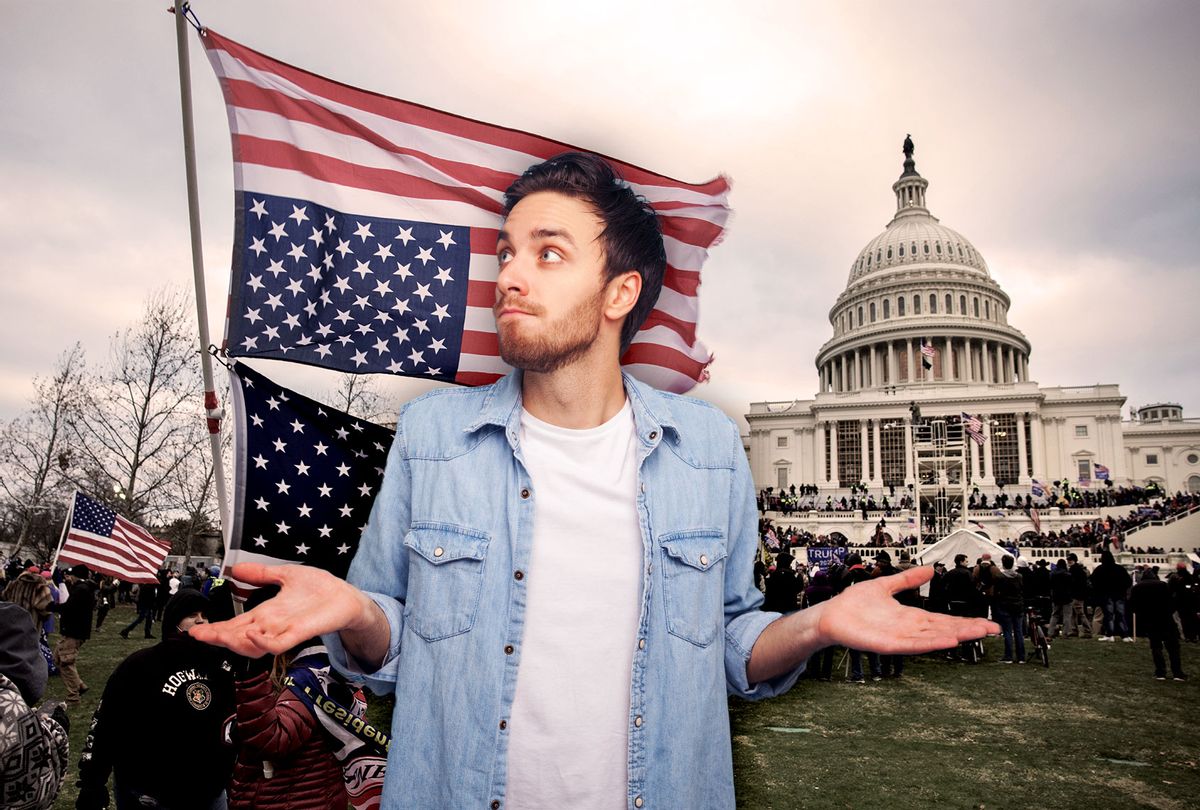 Man Shrugging | January 6, 2021 Capitol Riot (Photo illustration by Salon/Getty Images)