A Course in Miracles: Lesson 154

Lesson 154 I am among the ministers of God.

Let us today be neither arrogant nor falsely humble. We have gone beyond such foolishness. We cannot judge ourselves, nor need we do so. These are but attempts to hold decision off, and to delay commitment to our function. It is not our part to judge our worth, nor can we know what role is best for us; what we can do within a larger plan we cannot see in its entirety. Our part is cast in Heaven, not in hell. And what we think is weakness can be strength; what we believe to be our strength is often arrogance.

Whatever your appointed role may be, it was selected by the Voice for God, Whose function is to speak for you as well. Seeing your strengths exactly as they are, and equally aware of where they can be best applied, for what, to whom and when, He chooses and accepts your part for you. He does not work without your own consent. But He is not deceived in what you are, and listens only to His Voice in you.

It is through His ability to hear one Voice which is His Own that you become aware at last there is one Voice in you. And that one Voice appoints your function, and relays it to you, giving you the strength to understand it, do what it entails, and to succeed in everything you do that is related to it. God has joined His Son in this, and thus His Son becomes His messenger of unity with Him.

It is this joining, through the Voice for God, of Father and of Son, that sets apart salvation from the world. It is this Voice which speaks of laws the world does not obey; which promises salvation from all sin, with guilt abolished in the mind that God created sinless. Now this mind becomes aware again of Who created it, and of His lasting union with itself. So is its Self the one reality in which its will and that of God are joined.

A messenger is not the one who writes the message he delivers. Nor does he question the right of him who does, nor ask why he has chosen those who will receive the message that he brings. It is enough that he accept it, give it to the ones for whom it is intended, and fulfill his role in its delivery. If he determines what the messages should be, or what their purpose is, or where they should be carried, he is failing to perform his proper part as bringer of the Word.

There is one major difference in the role of Heaven’s messengers, which sets them off from those the world appoints. The messages that they deliver are intended first for them. And it is only as they can accept them for themselves that they become able to bring them further, and to give them everywhere that they were meant to be. Like earthly messengers, they did not write the messages they bear, but they become their first receivers in the truest sense, receiving to prepare themselves to give.

An earthly messenger fulfills his role by giving all his messages away. The messengers of God perform their part by their acceptance of His messages as for themselves, and show they understand the messages by giving them away. They choose no roles that are not given them by His authority. And so they gain by every message that they give away.

Would you receive the messages of God? For thus do you become His messenger. You are appointed now. And yet you wait to give the messages you have received. And so you do not know that they are yours, and do not recognize them. No one can receive and understand he has received until he gives. For in the giving is his own acceptance of what he received.

You who are now the messenger of God, receive His messages. For that is part of your appointed role. God has not failed to offer what you need, nor has it been left unaccepted. Yet another part of your appointed task is yet to be accomplished. He Who has received for you the messages of God would have them be received by you as well. For thus do you identify with Him and claim your own.

It is this joining that we undertake to recognize today. We will not seek to keep our minds apart from Him Who speaks for us, for it is but our voice we hear as we attend Him. He alone can speak to us and for us, joining in one Voice the getting and the giving of God’s Word; the giving and receiving of His Will.

We practice giving Him what He would have, that we may recognize His gifts to us. He needs our voice that He may speak through us. He needs our hands to hold His messages, and carry them to those whom He appoints. He needs our feet to bring us where He wills, that those who wait in misery may be at last delivered. And He needs our will united with His Own, that we may be the true receivers of the gifts He gives.

Let us but learn this lesson for today: We will not recognize what we receive until we give it. You have heard this said a hundred ways, a hundred times, and yet belief is lacking still. But this is sure; until belief is given it, you will receive a thousand miracles and then receive a thousand more, but will not know that God Himself has left no gift beyond what you already have; nor has denied the tiniest of blessings to His Son. What can this mean to you, until you have identified with Him and with His Own?

Our lesson for today is stated thus:

I am among the ministers of God, and I am grateful that
I have the means by which to recognize that I am free.

The world recedes as we light up our minds, and realize these holy words are true. They are the message sent to us today from our Creator. Now we demonstrate how they have changed our minds about ourselves, and what our function is. For as we prove that we accept no will we do not share, our many gifts from our Creator will spring to our sight and leap into our hands, and we will recognize what we received. 

Free Will Astrology: Week of December 23, 2021

DECEMBER 21, 2021 AT 7:00 AM BY ROB BREZSNY (NewCity.com)

“Three Friends in a Field,” 1900/courtesy Smithsonian American Art Museum, Museum purchase from the Charles Isaacs Collection made possible in part by the Luisita L. and Franz H. Denghausen Endowment

ARIES (March 21-April 19): You may become a more audacious storyteller in 2022. You could ripen your ability to express the core truths about your life with entertaining narratives. Bonus: The experiences that come your way will provide raw material for you to become even more interesting than you already are. Now study these words by storyteller Ruth Sawyer: “To be a good storyteller, one must be gloriously alive. It is not possible to kindle fresh fires from burned-out embers. The best of the traditional storytellers are those who live close to the heart of things—to the earth, sea, wind, and weather. They have known solitude, silence. They have been given unbroken time in which to feel deeply, to reach constantly for understanding.”

TAURUS (April 20-May 20): Taurus author May Sarton wrote a poem celebrating her maturation into the person she had always dreamed she would be. “Now I become myself,” she exulted. “It’s taken time, many years and places; I have been dissolved and shaken, have worn other people’s faces.” But at last, she said, “All fuses together now, falls into place from wish to action, word to silence. My work, my love, my time, my face: gathered into one intense gesture of growing like a plant.” I invite you to adopt Sarton’s poem as a primary source of inspiration in 2022. Make it your guide as you, too, become fully and richly yourself.

GEMINI (May 21-June 20): In 2012, the writer Gore Vidal died the day after Gemini writer Maeve Binchy passed away. They were both famous, though Binchy sold more books than Vidal. Vidal was interesting but problematic for me. He was fond of saying that it wasn’t enough for him to succeed; he wanted others to fail. The misery of his fellow humans intensified his satisfaction about his own accomplishments. On the other hand, Binchy had a generous wish that everyone would be a success. She felt her magnificence was magnified by others’ magnificence. In 2022, it will be vital for your physical and mental health to cultivate Binchy’s perspective, not Vidal’s. To the degree that you celebrate and enhance the fortunes of others, your own fortunes will thrive.

CANCER (June 21-July 22): Cancerian political leader Nelson Mandela was wrongly incarcerated for twenty-seven years. After his release, he became president of South Africa and won the Nobel Peace Prize. About leaving jail in 1990, he wrote, “As I walked out the door toward the gate that would lead to my freedom, I knew if I didn’t leave my bitterness and hatred behind, I’d still be in prison.” Although you haven’t suffered deprivation anywhere close to what Mandela did, I’m happy to report that 2022 will bring you liberations from limiting situations. Please adopt Mandela’s approach as you make creative use of your new freedom.

LEO (July 23-Aug. 22): French poet André Breton wrote, “Je vous souhaite d’être follement aimée.” In English, those words can be rendered as “My wish is that you may be loved to the point of madness” or “I wish you to be loved madly.” That’s got a romantic ring to it, but it’s actually a curse. Why would we want to be loved to the point of madness? A person who “loved” you like that might be fun for a while, but would ultimately become a terrible inconvenience and ongoing disruption. So, dear Leo, I won’t wish that you will be loved to the point of madness in 2022—even though I think the coming months will be an interesting and educational time for amour. Instead, I will wish you something more manageable and enjoyable: that you will be loved with respect, sensitivity, care and intelligence.

VIRGO (Aug. 23-Sept. 22): Many people in our culture are smart intellectually, but not very smart emotionally. The wisdom of feelings is undervalued. I protest! One of my great crusades is to champion this neglected source of insight. I am counting on you to be my ally in 2022. Why? Because according to my reading of the astrological omens, you have the potential to ripen your emotional intelligence in the coming months. Do you have ideas about how to take full advantage of this lucky opportunity? Here’s a tip: Whenever you have a decision to make, tune in to what your body and heart tell you as well as to what your mind advises.

LIBRA (Sept. 23-Oct. 22): Holocaust survivor Viktor Frankl said that a sense of meaning is crucial. It’s the key gratification that sustains people through the years: the feeling that their life has a meaning and that particular experiences have meaning. I suggest you make this your theme for 2022. The question “Are you happy?” will be a subset of the more inclusive question, “Are you pursuing a destiny that feels meaningful to you?” Here’s the other big question: “If what you’re doing doesn’t feel meaningful, what are you going to do about it?”

SCORPIO (Oct. 23-Nov. 21): Scorpio guitarist Rowland S. Howard spoke of “the grand occasions when love really does turn into something far greater than you had ever dreamed of, something auto-luminescent.” Judging from the astrological configurations in 2022, I have strong hopes and expectations that you will experience prolonged periods when love will fit that description. For best results, resolve to become more generous and ingenious in expressing love than you have ever been.

SAGITTARIUS (Nov. 22-Dec. 21): “I’ve been trying to go home my whole life,” writes poet Chelsea Dingman. I know some of you Sagittarians resist the urge to do that. It’s possible you avoid seeking a true and complete home. You may think of the whole world as your home, or you may regard a lot of different places as your homes. And you’d prefer not to narrow down the feeling and concept of “home” to one location or building or community. Whether or not you are one of those kinds of Centaurs, I suspect that 2022 will bring you unexpected new understandings of home—and maybe even give you the sense that you have finally arrived in your ultimate sanctuary.

CAPRICORN (Dec. 22-Jan. 19): To ensure that 2022 will bring you the most interesting and useful kind of progress, take good care of your key friendships and alliances, even as you seek out excellent new friendships and alliances. For best results, heed these thoughts from author Hanya Yanagihara: “Find people who are better than you are—not smarter, not cooler, but kinder, and more generous, and more forgiving—and then appreciate them for what they can teach you, and listen to them when they tell you something about yourself, no matter how bad—or good—it might be.”

AQUARIUS (Jan. 20-Feb. 18): Sometime during the Northern Song Dynasty that ruled China from 960 to 1127, an artisan made a white ceramic bowl five inches in diameter. About a thousand years later, a family in New York bought it at a garage sale for $3. It sat on a mantel in their home for a few years until they got a hunch to have it evaluated by an art collector. A short time later, the bowl was sold at an auction for $2.2 million. I’m not saying that 2022 will bring a financial event as dramatic as that one. But I do expect that your luck with money will be at a peak.

PISCES (Feb. 19-March 20): In the Quechua language spoken in parts of Peru, the word takanakuy means “when the blood is boiling.” Every year at this time, the community of Chumbivilcas stages a holiday called “Takanakuy.” People gather at the town center to fight each other, settling their differences so they can forget about them and start over fresh. If my friend and I have had a personal conflict during the previous year, we would punch and kick each other—but not too hard—until we had purged our spite and resentment. The slate between us would be clean. Is there some humorous version of this ritual you could enact that wouldn’t involve even mild punching and kicking? I recommend you dream one up!

Homework: A year from today, what do you want to be congratulating yourself for? Newsletter.FreeWillAstrology.com

Nobel-Winning Physicist Wolfgang Pauli on Science, Spirit, and Our Search for Meaning

By Maria Popova (brainpickings.org)

“The fact that religions through the ages have spoken in images, parables, and paradoxes means simply that there are no other ways of grasping the reality to which they refer,” physicist and quantum mechanics pioneer Niels Bohr observed while contemplating the nature of reality five years after he received the Nobel Prize, adding: “But that does not mean that it is not a genuine reality. And splitting this reality into an objective and a subjective side won’t get us very far.”

Bohr, who introduced the notion of complementarity, went on to influence generations of thinkers, including a number of Nobel laureates. Among them was the Swiss-Austrian physicist Wolfgang Pauli (April 25, 1900–December 15, 1958) — another pioneering figure of particle physics and quantum mechanics. Invested in the conquest of truth at the deepest strata of nature, Pauli took up this question of reality as a physical and metaphysical object of inquiry in a rather improbable arena: his friendship with the influential Swiss psychiatrist Carl Jung, whose entire body of work was centered on the conviction that “man cannot stand a meaningless life.”

Carl Jung and Wolfgang Pauli

Pauli’s longtime correspondence and collaboration with Jung occupies a small but significant portion of Figuring (public library) — an exploration of the tessellated facets of our search for meaning, from which this essay is adapted. Their unlikely friendship, which precipitated the invention of synchronicity, bridged the world of science and the world of spirit, entwining the irrepressible human impulses for finding truth and making meaning — a kind of non-Euclidean intersection of our parallel searches for understanding the reality within and the reality without.

Long before he won the Nobel Prize in Physics for his exclusion principle — the tenet of quantum physics stating that multiple identical particles within a single quantum system cannot occupy the same quantum state at the same time — and around the time he theorized the neutrino, Pauli was thrust into existential tumult. His mother, to whom he was very close, died by suicide. His tempestuous marriage ended in divorce within a year — a year during which he drowned his unhappiness in alcohol. Caught in the web of drinking and despair, Pauli reached out to Jung for help.

Jung, already deeply influenced by Einstein’s ideas about space and time, was intrigued by his brilliant and troubled correspondent. What began as an intense series of dream analyses unfolded, over the course of the remaining twenty-two years of Pauli’s life, into an exploration of fundamental questions regarding the nature of reality through the dual lens of physics and psychology — a testament to Einstein’s assertion that “every true theorist is a kind of tamed metaphysicist.” Each used the tools of his expertise to shift the shoreline between the known and the unknown, and together they found common ground in the analogy between the atom, with its nucleus and orbiting electrons, and the self, with its central conscious ego and its ambient unconscious.

Art by Derek Dominic D’souza from Song of Two Worlds by Alan Lightman

While there is a long and lamentable history of science — physics in particular — being hijacked for mystical and New Age ideologies, two things make Jung and Pauli’s collaboration notable. First, the analogies between physics and alchemical symbolism were drawn not only by a serious scientist, but by one who would soon receive the Nobel Prize in Physics. Second, the warping of science into pseudoscience and mysticism tends to happen when scientific principles are transposed onto nonscientific domains with a false direct equivalence. Pauli, by contrast, was deliberate in staying at the level of analogy — that is, of conceptual parallels furnishing metaphors for abstract thought that can advance ideas in each of the two disciplines, but with very different concrete application.

Jung had borrowed the word “archetype” from Kepler, drawing on the astronomer’s alchemical symbolism. More than three centuries after Kepler’s alchemy, Pauli’s exclusion principle became the basic organizing principle for the periodic table. The alchemists had been right all along, in a way — they had just been working on the wrong scale: Only at the atomic level can one element become another, in radioactivity and nuclear fission. Even the atom itself had to transcend the problem of scale: The Greek philosopher Democritus theorized atoms in 400 BC, but he couldn’t prove or disprove their existence empirically — a hundred thousand times smaller than anything the naked eye could see, the atom remained invisible. It wasn’t for another twenty-three centuries that we were able to override the problem of scale by the prosthetic extension of our vision, the microscope.

What had originally attracted Pauli to the famous psychiatrist was Jung’s work on symbols and archetypes — a Keplerian obsession that in turn obsessed Pauli, who devoted various essays and lectures to how Kepler’s alchemy and archetypal ideas influenced the visionary astronomer’s science. In physics, he saw numerous analogies to alchemy: In symmetry, he found the archetypal structure of matter and in elementary particles, the substratum of reality that the alchemists had sought; in the spectrograph, which allowed scientists for the first time to study the chemical composition of stars, an analogue of the alchemist’s oven; in probability, which he defined as “the actual correspondence between the expected result… and the empirically measured frequencies,” the mathematical analogue of archetypal numerology.

A 1573 painting by Portuguese artist, historian, and philosopher Francisco de Holanda, a student of Michelangelo’s and a contemporary of Kepler’s, found in Cosmigraphics: Picturing Space Through Time

But Pauli recognized that the dawn of quantum physics, in which he himself was a leading sun, introduced a new necessity to reconcile different facets of reality. Nearly a century after the trailblazing astronomer Maria Mitchell — a leading figure in Figuring — asserted that “every formula which expresses a law of nature is a hymn of praise to God,” Pauli reflected in one of his Kepler lectures:

It would be most satisfactory of all if physics and psyche could be seen as complementary aspects of the same reality. To us [modern scientists], unlike Kepler and Fludd, the only acceptable point of view appears to be one that recognizes both sides of reality — the quantitative and the qualitative, the physical and the psychical — as compatible with each other, and can embrace them simultaneously.

[…]

In my own view it is only a narrow passage of truth (no matter whether scientific or other truth) that passes between the Scylla of a blue fog of mysticism and the Charybdis of a sterile rationalism. This will always be full of pitfalls and one can fall down on both sides.

Illustration by Hugh Lieber from Human Values and Science, Art and Mathematics by Lillian Lieber

Four decades before the revered physicist John Archibald Wheeler, who popularized the term black hole, made his influential assertion that “this is a participatory universe [and] observer-participancy gives rise to information,” Pauli wrote to Jung:

Modern [particle physics] turns the observer once again into a little lord of creation in his microcosm, with the ability (at least partially) of freedom of choice and fundamentally uncontrollable effects on that which is being observed. But if these phenomena are dependent on how (with what experimental system) they are observed, then is it not possible that they are also phenomena (extra corpus) that depend on who observes them (i.e., on the nature of the psyche of the observer)? And if natural science, in pursuit of the ideal of determinism since Newton, has finally arrived at the stage of the fundamental “perhaps” of the statistical character of natural laws… then should there not be enough room for all those oddities that ultimately rob the distinction between “physics” and “psyche” of all its meaning?

And yet Pauli was careful to recognize that “although [particle physics] allows for an acausal form of observation, it actually has no use for the concept of ‘meaning’” — that is, meaning is not a fundamental function of reality but an interpretation superimposed by the human observer.

Complement with Carl Sagan on science and spirituality and Einstein’s historic conversation with the Nobel-winning Indian poet and philosopher Tagore, then revisit other excerpts from Figuring: Emily Dickinson’s electric love letters to Susan Gilbert, Margaret Fuller on what makes a great leader, the story of how the forgotten pioneer Harriet Hosmer paved the way for women in art, Herman Melville’s passionate and heartbreaking love letters to Nathaniel Hawthorne, and astrophysicist Janna Levin’s stunning reading of the Auden poem that became the book’s epigraph.

Nickel oxide is a material that can ‘learn’ like animals and could help further artificial intelligence research

December 21, 2021 9.55am EST (theconversation.com)

Author

  1. Shriram RamanathanProfessor of Materials Engineering, Purdue University

Disclosure statement

S. Ramanathan receives funding from the National Science Foundation, Department of Defense agencies for basic research in physical sciences and engineering.

Partners

Purdue University provides funding as a member of The Conversation US.

View all partners

CC BY NDWe believe in the free flow of information

Republish our articles for free, online or in print, under a Creative Commons license.

The big idea

A unique material, nickel oxide demonstrates the ability to learn things about its environment in a way that emulates the most basic learning abilities of animals, as my colleagues and I describe in a new paper.

For over half a century, neuroscientists have studied sea slugs to understand basic animal learning. Two fundamental concepts of learning are habituation and sensitization. Habituation occurs when an organism’s response to a repeated stimulus continuously decreases. When researchers first touch a sea slug, its gills retract. But the more they touch the slug, the less it retracts its gills. Sensitization is an organism’s extreme reaction to a harmful or unexpected stimulus. If researchers then shock a sea slug, it will retract its gills much more dramatically than when it was merely touched. This is sensitization.

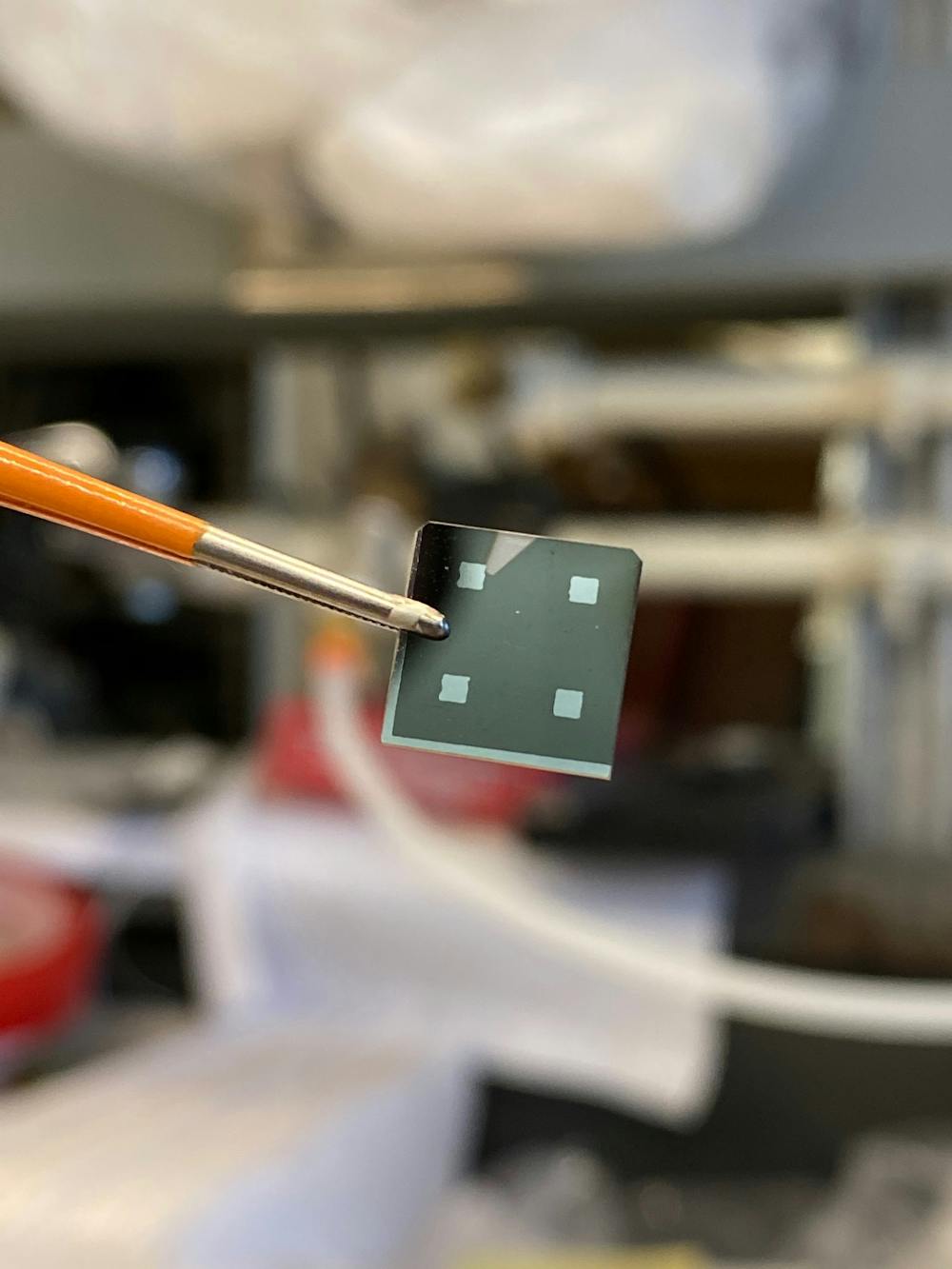
A small square of material inside a test chamber of metal with tubes.
When nickel oxide is alternately bathed in hydrogen gas and air, its behavior changes. Purdue University/Kayla Wiles, CC BY-ND

Nickel oxide has features that are strikingly similar to this learning behavior. Instead of gills retracting, we measured the change in electrical conductivity of the material. The stimulus, instead of a finger poke, was repeatedly alternating the environment of the nickel oxide between normal air and hydrogen gas.

Get facts about the coronavirus pandemic and the latest research

Science newsletter

Nickel oxide is interesting because when you expose it to hydrogen gas, its crystalline structure subtly changes and more electrons become available to generate an electrical current. In our experiment, we kept switching between the hydrogen-only and regular air environments. You would expect the electrical conductivity to oscillate up and down directly in relation to the exposure to hydrogen or air. But just as with the sea slugs, the change in conductivity of the nickel oxide slowly went down the more we stimulated it. It got habituated to the hydrogen.

When we exposed the material to bright light or ozone, though, it rapidly changed its conductivity – the same way a slug will always respond dramatically to a small shock.

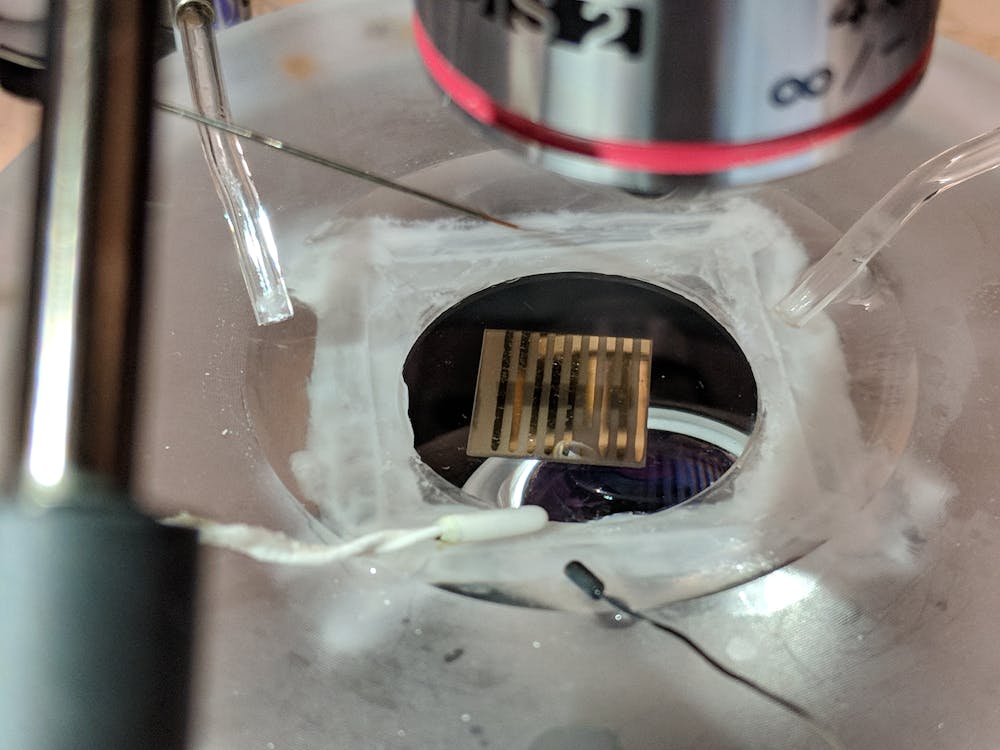
A small piece of material underneath a large piece of scientific equipment.
The conductivity of nickel oxide stores information similarly to the way slugs learn. Purdue University/Kayla Wiles, CC BY-ND

Why it matters

The ability to learn, remember or forget information as needed is a powerful skill for any animal or machine. So far, the vast majority of research in the field of artificial intelligence has focused on software-based approaches to machine learning, with far less effort dedicated to studying the learning abilities of materials.

At the center of these two related areas of research lies the field of brain-inspired computers. For intelligence to be encoded into hardware, scientists need semiconductors that can learn from past experience and adapt to dynamic environments in a physical way similar to that of neurons in animal brains. Our new research showing how nickel oxide demonstrates features of learning hints at how this or similar materials could serve as building blocks for computers of the future.

What still isn’t known

Before such materials can be incorporated into computer chips there are some knowledge gaps that need to be addressed. For instance, it is not yet clear at what time scales a material needs to learn for it to be useful in electrical systems. How quickly does something need to learn or forget to be useful? Another unknown is how or whether it is possible to change the structure of nickel oxide to produce different learning behaviors.

A small square of gray material with stripes.
It is unclear whether nickel oxide itself can be used for computing, but the concepts at play could inspire further innovation. Purdue University/Erin Easterling, CC BY-ND

What’s next

In addition to further experiments on the material itself, there are theoretical lessons to explore. Observations of collective behavior of animals in nature – such as bird flocks and schools of fish – have inspired researchers to develop fields of AI like swarm intelligence. In a similar fashion, the interesting collective motion of atoms and electrons in materials could inspire AI and hardware design in the future.

As new materials that can accommodate mobile atoms are discovered, I am optimistic we will see further breakthroughs that can bring researchers one step closer to designing computers that emulate animal brains.

How The Conversation is different

Every article you read here is written by university scholars and researchers with deep expertise in their subjects, sharing their knowledge in their own words. We don’t oversimplify complicated issues, but we do explain and clarify. We believe bringing the voices of experts into the public discourse is good for democracy.

Beth Daley

Editor and General Manager

(Contributed by Janet Cornwell, H.W., m.)

NASA will be launching the James Webb space telescope in about 3 days

NASA will be launching the James Webb space telescope in about 3 days, Dec. 25. It’s a big deal.* NASA’s latest flagship observatory* It took close to 3 decades to build* At a cost of $10B USD* It’s the successor to the great Hubble telescope * It can detect 100 times fainter than what the Hubble can observe* It will orbit the sun (not the Earth like the Hubble telescope) at a distance of about 1 million miles (1.5 million km) * 4 times farther than the moon * We get only one shot at getting everything right * It will help us to learn more about the cosmos and our place within in* It is an engineering and technological marvel* This is one of the most complicated things that humans have ever doneIt’s inspiring to know that with dedication and perseverance it’s possible to overcome even the most difficult of problems. The scientists and engineers making this possible deserve our highest respect. Their dedication, integrity to their craft and following truth made their dreams and hopes a reality. Showing what humans are capable of through thinking, engineering and overcoming tough challenges and pushing human innovation to its limits. For the chance to better human understanding. Beautiful. ❤️We get only one shot at getting it right in 3 days. Share it and mark the ? on your calendar.When: December 25, 2021 07:20am EST (2021-12-25 12:20 GMT)Data/Image source: NASAInsta @farhad.gha7

May be an image of 7 people and indoor
May be an image of 1 person and indoorMay be an image of text that says 'JWST primary mirror Hubble primary mirror'May be an image of sky

Technology, philosophy, randomness – how Merce Cunningham pushed dance to its limits

Widely considered the most influential dance artist of the 20th century, the US dancer and choreographer Merce Cunningham (1919-2009) possessed an inexhaustible drive for experimentation that forever reshaped his medium, and contemporary art itself. By testing the limits of dance through technological innovation, collaborations across mediums and even employing the concept of randomness to power his works, Cunningham both expanded and eroded his art form’s boundaries. This video from the Walker Art Center in Minneapolis, Minnesota explores six aspects to Cunningham’s 70-year career, from dance maker, collaborator and chance taker, to innovator, film producer and teacher, to put his influence and legacy in context.

Video by Walker Art Center 21 December 2021