Why life is faster but depression is lower in bigger cities

Why life is faster but depression is lower in bigger cities | Psyche

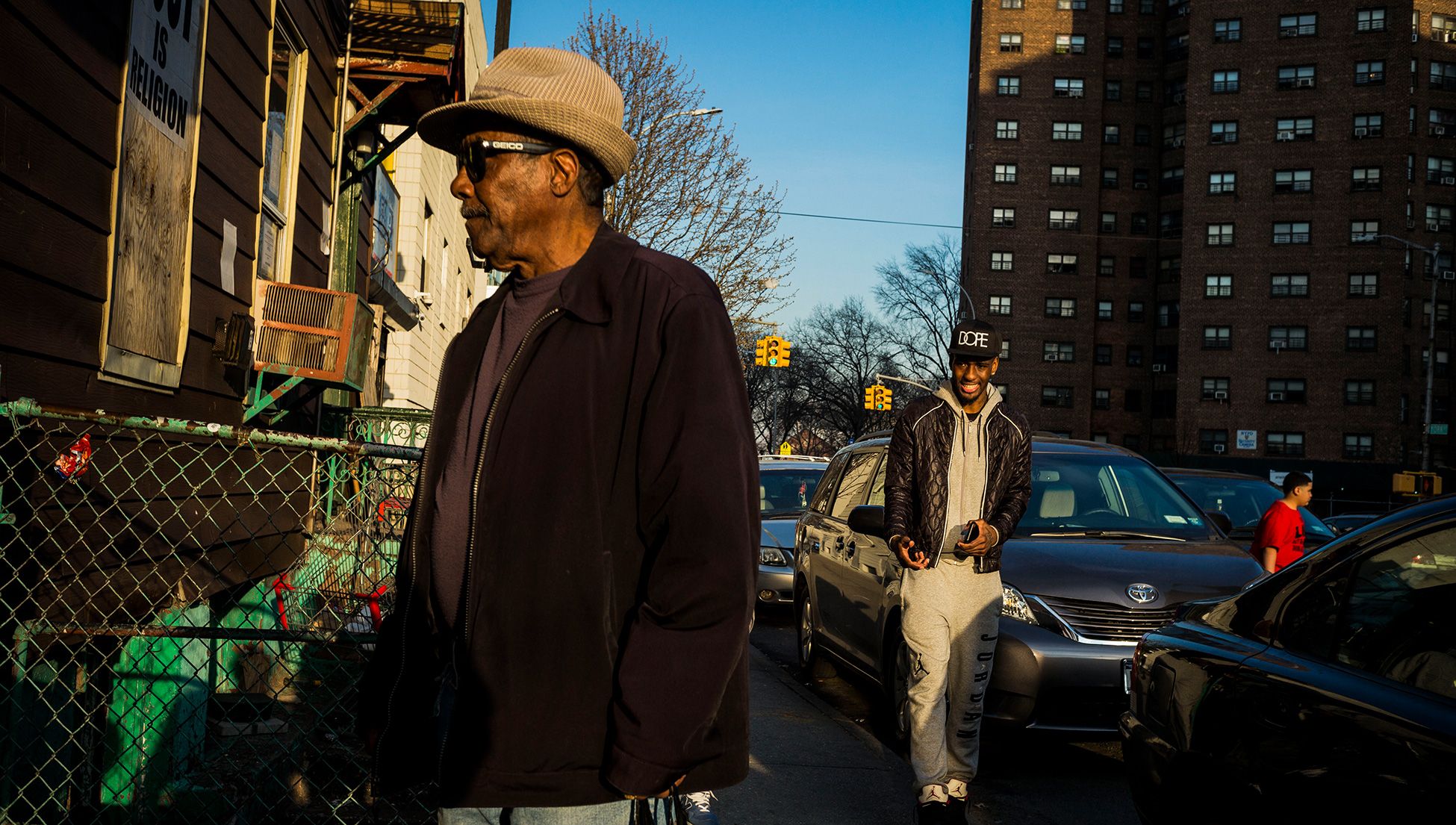
Brooklyn, New York City, March 2016. Photo by Alex Webb/Magnum

Andrew Stieris a doctoral student in integrative neuroscience at the University of Chicago. His research focuses on systematic understandings of thought content and mental health in cities.

Edited by Matt Huston

21 December 2021 (psyche.co)

Cities are bastions of opportunity. They are filled with vast numbers of people meeting friends and family, visiting restaurants, museums, concert halls and sporting events, and travelling to and from jobs. Yet many of us who live in cities have occasionally been overwhelmed by the activity. At other times, we might feel ‘alone in the crowd’. For decades, the conflicting experiences of city living have led urbanites and scholars to ask: are cities bad for mental health?

The conventional wisdom and scientific answer for more than half a century has been ‘yes’. This question is becoming increasingly important as global urbanisation unfolds: around two-thirds of the world’s population will live in cities by 2050. Bigger cities, which have more of what makes a city a city, would seem to be particularly bad for mental health. A typical explanation invokes factors such as noise, crime and short, callous social interactions (think about New York City’s reputation for rudeness) to argue that big cities create sensory and social burdens that city dwellers constantly have to combat psychologically. While this explanation appears to be supported by some evidence that rural areas might, on the whole, have lower depression rates than cities, there is scant evidence that these particular factors cause higher depression rates in cities, and no investigation of how bigger cities compare with smaller cities.

As it turns out, the relationship between cities and mental health is more complex than conventional explanations suggest. A study that I recently conducted with my colleagues at the University of Chicago demonstrates that larger cities in the United States actually have substantially lower rates of depression than smaller cities. Our team looked at depression rates calculated by the Centers for Disease Control and Prevention, other depression rates from the Substance Abuse and Mental Health Services Administration, and additional rates estimated by us, using geolocated Twitter posts and a machine-learning algorithm. Despite the fact that differing methods were used to assess depression rates – some were based on clinical criteria, one involved phone surveys, etc – and each source included different (though overlapping) sets of US cities, we found a consistent result. Specifically, a doubling of city population was associated with a 12 per cent decrease in depression rates, on average.

Lower rates of depression in larger cities seem to be a consequence of how cities are built and can be explained by a new scientific view of cities called urban scaling theory. Urban scaling theory has helped us understand why some experiences are common to all urbanites and provides us with new perspectives on how these collective experiences influence innovation, crime, economic productivity and, now, mental health.

For me, the hustle and bustle of life in the biggest cities became especially salient when I first travelled from my hometown of New York City to Chicago for college. When I stepped off the plane, the slower pace and midwestern ease of Chicago seemed to hang in the air. I found myself immediately slowing down and acclimatising to the somewhat more relaxed lifestyle of a metropolitan area of 9.6 million (compared with the New York metro area’s 20.1 million).

The infrastructure networks of cities are similar to the human circulatory system, and the branching patterns of trees

This experience was, in all likelihood, due to my internalisation of the fact that the pace of life is faster in bigger cities, a fact that is predicted quantitatively and precisely by urban scaling theory. In particular, a city with twice as many people as another city will have an approximately 12 per cent faster pace of life (the same percentage by which depression rates decrease). What does this mean concretely? Research shows that people literally walk faster in larger cities. People in towns with around 10,000 inhabitants tend to walk at a leisurely pace of 3.5 km per hour, while people in cities of around 1 million tend to walk at a pace of 5.8 km per hour, almost a jog.

In addition to walking speed, studies have found evidence that inventionjob diversitysocial interactionsrestaurant diversity and crime also increase in bigger cities, and also follow the 12 per cent rule. There is some variability from city to city, but the average increase is 12 per cent per doubling of the population. These studies show that, in general, cities foster greater social interaction (both positive and negative), diversity, culture and generation of ideas. These principles are summarised by the 12 per cent rule (and a few others) and seem to apply across cultures and over time, as far back as 1150 BCE.

How is it possible that we can make such precise predictions given all the factors that make each city and neighbourhood unique? At its core, urban scaling theory is a collection of mathematical models explaining how cities are organised. These models, to borrow a phrase from Plato, ‘bring together in one idea the scattered particulars’ of modern city living, and explain and contextualise some of the experiences that city dwellers have every day. One key insight is that the physical layouts of cities follow simple rules. Cities have layered infrastructure networks – made up of electrical lines, streets, railway lines, etc – with larger components branching off into smaller ones that serve smaller groups of people. In this sense, the infrastructure networks of cities are similar to the human circulatory system’s network of branching arteries, veins and capillaries, and the branching patterns of trees. To add to this, people’s semirandom movement through cities is constrained by these infrastructure networks. This means that we can borrow some mathematical tools from physics to construct equations that describe how people move through cities.

With a few additional considerations, the equations of urban scaling theory ask what happens when we balance the costs and benefits associated with the movement of individuals, goods and information over cities’ infrastructure networks. While the maths is complicated, the results are simple relationships between the size of a city’s population and a variety of urban metrics. This is where the prediction of a 12 per cent increase in social metrics such as crime and innovation with a doubling of city size comes from: it is the result of how cities’ infrastructure networks are built and facilitate interactions between the people who move through them.

With regard to depression, the most important insight is that larger cities facilitate more social interactions. And yes, this too follows the 12 per cent rule. To ground this in some hypothetical numbers, if residents of a city of 1 million people averaged 43 social contacts within the same city, then residents of a city of 10 million people would be expected to average 63 social contacts. Why is this important for depression? For about 10 years, we have known that the number of social contacts people have is strongly associated with the risk for depression: the more people you interact with, the lower your risk of experiencing depressive symptoms. Given this, it makes sense that we have found that depression rates are lower in larger cities, and that this reduction in depression rates follows the 12 per cent rule.

The character of a city, the collective influence of its inhabitants, hangs in the air

This observation has profound implications for how we think about depression. In the context of an ongoing global pandemic, a notable one is that depression within cities can be partly understood as a collective ecological phenomenon. Individual factors are of course important for any one person’s experience with depression, but so is the larger social network in which people are embedded. Unfortunately, we still do not fully understand the exact dynamics that connect social interactions to depression. However, my research suggests that the effect of social interactions is cumulative: close, supportive friendships and family relationships might be more important than passing interactions with strangers, but it is likely that there is more of both (and every other type of social interaction) in bigger cities.

Importantly, the physical environment of the city – its roads, train and bus lines, sidewalks and bike paths – shapes these social networks. Specifically, at the level of entire cities, infrastructure facilitates the delivery of goods, services and information, which help support all of the opportunities that cities have to offer. At the same time, these infrastructure networks allow people to move throughout the city to access these opportunities and, as a result, they also facilitate opportunities for a greater diversity and number of social interactions.

In this sense, it is true that the character of a city, the collective influence of its inhabitants, hangs in the air, ready to have an effect on whoever is around to breathe it in.

This analogy takes on a more concrete meaning with respect to COVID-19 – which, unsurprisingly (since social contact facilitates airborne transmission), follows the same 12 per cent rule in the speed at which it spreads through cities. As is the case with infectious diseases such as COVID-19, there is a strong rationale for frequent, local measurements of depression rates. Depressive disorders appear to be increasingly prevalent, are extremely debilitating, and cost the global economy billions of dollars each year in lost economic production. I suspect such a tracking effort for depression would reveal better ways of distributing mental healthcare access to the communities that need it most.

In addition, repeated local tracking could pave the way for better understanding other mental health conditions. Some of these, such as anxiety, are highly comorbid with depression and probably follow similar patterns. Others, such as schizophrenia or autism, might show different patterns across cities of differing sizes. Such tracking might also help us understand why depression rates are lower in some rural areas despite the fact that social networks are generally smaller. Perhaps in rural areas, higher-quality social interactions make up for a lack of quantity, while in large cities quantity makes up for reduced quality?

Cities have historically had a bad reputation for mental and physical health. However, in a fast-urbanising world, the higher social connectivity of larger cities could have positive influences on city dwellers’ mental health. While more social contacts make containing epidemics such as COVID-19 harder, they also lead to greater economic opportunity, more political and technological innovation, and, apparently, lower rates of depression. As more people live in cities every year, it is important that we acknowledge, measure and internalise how the physical places we inhabit – and the people we share those spaces with – influence our wellbeing in ways we might not expect.


A Course in Miracles: Lesson 153


Lesson 153
 In my defenselessness my safety lies.

You who feel threatened by this changing world, its twists of fortune and its bitter jests, its brief relationships and all the “gifts” it merely lends to take away again; attend this lesson well. The world provides no safety. It is rooted in attack, and all its “gifts” of seeming safety are illusory deceptions. It attacks, and then attacks again. No peace of mind is possible where danger threatens thus.

The world gives rise but to defensiveness. For threat brings anger, anger makes attack seem reasonable, honestly provoked, and righteous in the name of self-defense. Yet is defensiveness a double threat. For it attests to weakness, and sets up a system of defense that cannot work. Now are the weak still further undermined, for there is treachery without and still a greater treachery within. The mind is now confused, and knows not where to turn to find escape from its imaginings.

It is as if a circle held it fast, wherein another circle bound it and another one in that, until escape no longer can be hoped for nor obtained. Attack, defense; defense, attack, become the circles of the hours and the days that bind the mind in heavy bands of steel with iron overlaid, returning but to start again. There seems to be no break nor ending in the ever-tightening grip of the imprisonment upon the mind.

Defenses are the costliest of all the prices which the ego would exact. In them lies madness in a form so grim that hope of sanity seems but to be an idle dream, beyond the possible. The sense of threat the world encourages is so much deeper, and so far beyond the frenzy and intensity of which you can conceive, that you have no idea of all the devastation it has wrought.

You are its slave. You know not what you do, in fear of it. You do not understand how much you have been made to sacrifice, who feel its iron grip upon your heart. You do not realize what you have done to sabotage the holy peace of God by your defensiveness. For you behold the Son of God as but a victim to attack by fantasies, by dreams, and by illusions he has made; yet helpless in their presence, needful only of defense by still more fantasies, and dreams by which illusions of his safety comfort him.

Defenselessness is strength. It testifies to recognition of the Christ in you. Perhaps you will recall the text maintains that choice is always made between Christ’s strength and your own weakness, seen apart from Him. Defenselessness can never be attacked, because it recognizes strength so great attack is folly, or a silly game a tired child might play, when he becomes too sleepy to remember what he wants.

Defensiveness is weakness. It proclaims you have denied the Christ and come to fear His Father’s anger. What can save you now from your delusion of an angry god, whose fearful image you believe you see at work in all the evils of the world? What but illusions could defend you now, when it is but illusions that you fight?

We will not play such childish games today. For our true purpose is to save the world, and we would not exchange for foolishness the endless joy our function offers us. We would not let our happiness slip by because a fragment of a senseless dream happened to cross our minds, and we mistook the figures in it for the Son of God; its tiny instant for eternity.

We look past dreams today, and recognize that we need no defense because we are created unassailable, without all thought or wish or dream in which attack has any meaning. Now we cannot fear, for we have left all fearful thoughts behind. And in defenselessness we stand secure, serenely certain of our safety now, sure of salvation; sure we will fulfill our chosen purpose, as our ministry extends its holy blessing through the world.

Be still a moment, and in silence think how holy is your purpose, how secure you rest, untouchable within its light. God’s ministers have chosen that the truth be with them. Who is holier than they? Who could be surer that his happiness is fully guaranteed? And who could be more mightily protected? What defense could possibly be needed by the ones who are among the chosen ones of God, by His election and their own as well?

It is the function of God’s ministers to help their brothers choose as they have done. God has elected all, but few have come to realize His Will is but their own. And while you fail to teach what you have learned, salvation waits and darkness holds the world in grim imprisonment. Nor will you learn that light has come to you, and your escape has been accomplished. For you will not see the light, until you offer it to all your brothers. As they take it from your hands, so will you recognize it as your own.

Salvation can be thought of as a game that happy children play. It was designed by One Who loves His children, and Who would replace their fearful toys with joyous games, which teach them that the game of fear is gone. His game instructs in happiness because there is no loser. Everyone who plays must win, and in his winning is the gain to everyone ensured. The game of fear is gladly laid aside, when children come to see the benefits salvation brings.

You who have played that you are lost to hope, abandoned by your Father, left alone in terror in a fearful world made mad by sin and guilt; be happy now. That game is over. Now a quiet time has come, in which we put away the toys of guilt, and lock our quaint and childish thoughts of sin forever from the pure and holy minds of Heaven’s children and the Son of God.

We pause but for a moment more, to play our final, happy game upon this earth. And then we go to take our rightful place where truth abides and games are meaningless. So is the story ended. Let this day bring the last chapter closer to the world, that everyone may learn the tale he reads of terrifying destiny, defeat of all his hopes, his pitiful defense against a vengeance he can not escape, is but his own deluded fantasy. God’s ministers have come to waken him from the dark dreams this story has evoked in his confused, bewildered memory of this distorted tale. God’s Son can smile at last, on learning that it is not true.

Today we practice in a form we will maintain for quite a while. We will begin each day by giving our attention to the daily thought as long as possible. Five minutes now becomes the least we give to preparation for a day in which salvation is the only goal we have. Ten would be better; fifteen better still. And as distraction ceases to arise to turn us from our purpose, we will find that half an hour is too short a time to spend with God. Nor will we willingly give less at night, in gratitude and joy.

Each hour adds to our increasing peace, as we remember to be faithful to the Will we share with God. At times, perhaps, a minute, even less, will be the most that we can offer as the hour strikes. Sometimes we will forget. At other times the business of the world will close on us, and we will be unable to withdraw a little while, and turn our thoughts to God.

Yet when we can, we will observe our trust as ministers of God, in hourly remembrance of our mission and His Love. And we will quietly sit by and wait on Him and listen to His Voice, and learn what He would have us do the hour that is yet to come; while thanking Him for all the gifts He gave us in the one gone by.

In time, with practice, you will never cease to think of Him, and hear His loving Voice guiding your footsteps into quiet ways, where you will walk in true defenselessness. For you will know that Heaven goes with you. Nor would you keep your mind away from Him a moment, even though your time is spent in offering salvation to the world. Think you He will not make this possible, for you who chose to carry out His plan for the salvation of the world and yours?

Today our theme is our defenselessness. We clothe ourselves in it, as we prepare to meet the day. We rise up strong in Christ, and let our weakness disappear, as we remember that His strength abides in us. We will remind ourselves that He remains beside us through the day, and never leaves our weakness unsupported by His strength. We call upon His strength each time we feel the threat of our defenses undermine our certainty of purpose. We will pause a moment, as He tells us, “I am here.”

Your practicing will now begin to take the earnestness of love, to help you keep your mind from wandering from its intent. Be not afraid nor timid. There can be no doubt that you will reach your final goal. The ministers of God can never fail, because the love and strength and peace that shine from them to all their brothers come from Him. These are His gifts to you. Defenselessness is all you need to give Him in return. You lay aside but what was never real, to look on Christ and see His sinlessness. 

Use your voice, vote and wallet for climate action

Halla Tómasdóttir|TEDWomen 2021 (ted.com)

Recently back from the COP26 UN climate conference in Scotland, former Icelandic presidential candidate Halla Tómasdóttir sums up the outcomes of the gathering, the progress she saw and the work that’s left to be done this way: “The most difficult work of our lifetimes has to happen in the next few years.” In conversation with TEDWomen curator Pat Mitchell, Tómasdóttir urges us all to recognize our power and to use our voice, vote and wallet to catalyze meaningful climate action.

This talk was presented at an official TED conference, and was featured by our editors on the home page.

ABOUT THE SPEAKER

Halla Tómasdóttir · Change catalystHalla Tómasdóttir is CEO of The B Team, a group of global business and civil society leaders driving a better way of doing business for the well-being of people and the planet.

Changing of the Gods – Official Trailer

Changing of the Gods Website: https://changingofthegods.com // FB: https://www.facebook.com/changingofth…

We’ve been deep underground finishing our groundbreaking “Changing of the Gods” 10-episode series, and we’re elated to announce that it will be released into the wild on February 22nd, 2022. We could hardly be happier with the final film, and we can’t wait for you to get to see it. In January, we will send along details about the launch, and how to register for a free online screening of the series during the 2-week limited window beginning February 22nd. And please tell all your friends and relations!

Here’s a link to the trailer, and you can find more information at Changing of the Gods.com. As you know, it’s been a very long haul, and with good reason. What began as a 2-hour feature documentary morphed into a groundbreaking 10-episode series that runs about 6 hours. We ended up chronicling the entire earthshaking Uranus-Pluto world transit right to its explosive grand finale in January 2020.

Naturally, as one world transit recedes, others come into play. The final episode of the series peers into the archetypal present and coming decade for cues and clues about what archetypal forces are and will be at work. “Changing of the Gods” is kaleidoscopic and has many facets. In part, it’s a journey into the mystery of consciousness itself – do we live in a cosmos saturated with consciousness? In part, it’s about an emerging new worldview that envisions a very different and restored world. In part, it’s a deep deconstruction of the worldview that has brought humanity to this precipice of annihilation. In part, it suggests paradigmatic and practical solutions to this crisis of crises. In part, it’s a deeply healing transformational journey into our relationship to the cosmos, nature, and each other.

Altogether, it’s a gripping, spellbinding movie – a political thriller wrapped inside a cosmic mystery story! But hey, now what matters is what you think! Soon enough you’ll have the chance to see for yourself. We appreciate you so much. Let us know if you can help spread the word. “The greatest story
never told” is on its way!

With Deep Gratitude and Appreciation –
Kenny Ausubel
Producer-Writer-Co-Director, “Changing of the Gods”

Tarot Card for December 21: Adjustment

Adjustment

Justice (or Adjustment) is numbered eight in some decks and eleven in others. We see a female figure, holding the scales to represent the balance between good and evil, right and wrong within our lives. She also holds the sword which knights us or which claims retribution.

Justice is the supreme Judge. Here we see the effects of Karma, the idea that everything we do today has either a positive or negative effect upon our future. Every dark thought or deed weighs against us, balanced out (hopefully) by every good deed and loving thought.

We can be angels and we can be demons, it is our choice. We shape our futures by what we do and think now. If we stop blaming other people, or forces, if things go wrong then we take control of our own lives. Justice shows us that the natural cycles of the Universe will reflect back upon us exactly what we expect – so expect joy and happiness!

Adjustment

(via angelpaths.com and Alan Blackman)

Tarot Card for December 22: The Emperor

The Emperor

The Emperor is numbered four and is the Empress’s other half. Here is a man in the prime of life – successful, confident, secure and well-established. Where the Empress is allied with the Moon, the Emperor is aligned with the Sun.

The Emperor is quick and energetic, exerting dynamic control over his life. He feels born to rule and at his best is a thoughtful and sensitive leader. He listens to others but always the final decision is his own.

This is a man who has proved himself worthy. He has won most of his battles and now is the time to rule over a rich and bountiful land. He is the King Arthur type. He also represents fatherhood – fertile man, protector and providor.

When we are the Emperor, we are taking hold of our power. We are prepared to protect and defend the vulnerable, as well as to shed the lazy and weak. Finally, we are willing and ready to pass on what we have discovered to others who are ready to learn.

The Emperor

(via angelpaths.com and Alan Blackman)

The Androgynous Godhead Archetype with James P. Driscoll

New Thinking Allowed with Jeffrey Mishlove James P. Driscoll, PhD, is one of the foremost critics of Renaissance literature from a Jungian perspective. He is author of Identity in Shakespearean Drama and The Unfolding God of Jung and Milton. Here he points out that, in Jungian psychological theory, the godhead archetype is representative of the larger self. This larger self includes many unconscious processes and is vastly greater than the ego. It can also be thought of as the self of society, or of the biosphere, or even of the cosmos. Jung was critical of the Christian view of the trinity, insofar as it excluded a specifically feminine principle. James Driscoll points out, however, that in the earliest Jewish and Christian traditions, the holy spirit itself was viewed as feminine. This feminine element was removed under the influence of Greek philosophy that regarded the feminine as imperfect. Driscoll also emphasizes the importance of the struggle between the two hostile brothers (i.e., Christ and Satan) as a key component of the western godhead archetype. New Thinking Allowed host, Jeffrey Mishlove, PhD, is author of The Roots of Consciousness, Psi Development Systems, and The PK Man. Between 1986 and 2002 he hosted and co-produced the original Thinking Allowed public television series. He is the recipient of the only doctoral diploma in “parapsychology” ever awarded by an accredited university (University of California, Berkeley, 1980). He is also past-president of the non-profit Intuition Network, an organization dedicated to creating a world in which all people are encouraged to cultivate and apply their inner, intuitive abilities. (Recorded on July 2, 2017) For a complete, updated list with links to all of our videos — as well as many other opportunities to engage with and support the New Thinking Allowed video channel — please visit the New Thinking Allowed Foundation at http://www.newthinkingallowed.org.

On This Winter Solstice…

Gwyllm Llwydd December 21, 2021
(gwyllmllwydd.substack.com)

Winter Solstice has always been a special time for our family and friends. For 30 some years we have had gatherings on or around it. The turning of the year, the return of the light. A true Holy Time…

It has been strange not have a Solstice celebration with all that we love. The last two years certainly have been game changers for our yearly round. Yet, there is hope for future gatherings with the Beloved. We have had gatherings from as few as 4, to 76… we settled in at about 40 15 years ago. There is lots of food, mulled wine, mulled cider, good company, the recitation of poetry and ritual. Nothing heavy, a fire ceremony of lighting the last years yule log (the Solstice tree), lighting of candles for the dead, lighting of candles for the living. Ritual burning of what we want to give up individually, and ritual burning of what we want to draw to us in the coming year. Then it becomes a Saturnalia of food, wine, laughter, joy.

In years past, Absinthe would be served to all who wanted it at Midnight to the rising of the sun. Those days sadly are gone. (aging perhaps?) Amazing conversation, with the fire blazing away in the fireplace. Good friends, Beloved all.

We awoke today to sunshine. it was absolutely glorious. It has been quite dark and wet for what seems for weeks, and amidst all of that, my biggest urge has been to hibernate. I love winter sleeps, but especially the dreaming. The nightly has been quite adventurous as of late I have to confess. Strangely, the current world has started to seep into Dreamtime. Most disturbing on a few levels. Usually, my dreams have been of anything but the world at large. It must be the times. Still, I am having dreams that carry into waking hours, as I try to grasp at the symbology, and guidance that I have always found in that state.

I pray your Solstice has been brilliant. I wish the best of a coming year to you all. We plan to inaugurate a Summer Solstice Gathering this year. Even with Covid, this is possible on the main, being outside and all. Plans are in the making.

News: The Invisible College #11 “Alchemy” has arrived, and is being mailed to all who ordered copies, along with the print “Her Alchemical Dream” . It looks really wonderful! Happy to see it.

We have a Solstice Radio Show! Check it out if you get a chance. It is on until December 26th.

Here is one of the songs on the show. Not Bing Crosby, I assure you:https://www.youtube-nocookie.com/embed/rA6pjZonkXE?rel=0&autoplay=0&showinfo=0&enablejsapi=0

I lit candles for departed friends. People I knew for 50 years. Wonderful Souls. The world is full of beauty, remember always.

Bright Blessings To You All!

Cheers,

Gwyllm

Hallelujah! The remarkable story behind this joyful word

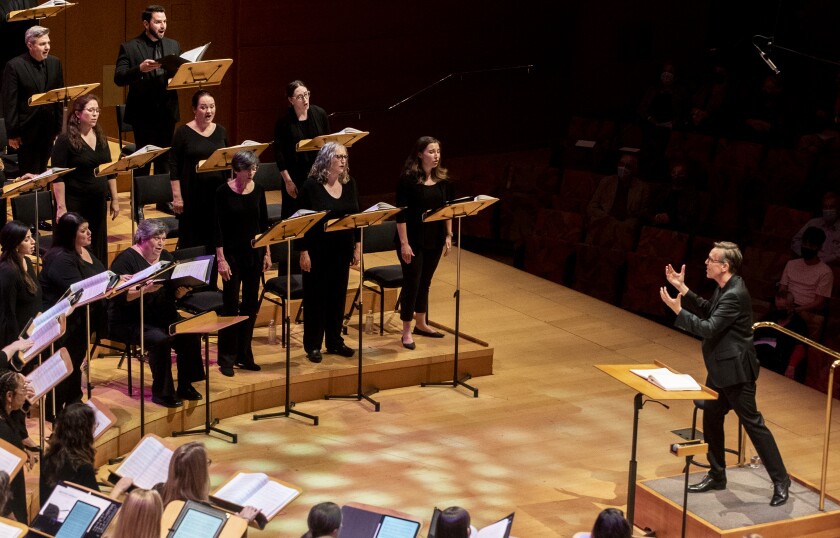
A conductor gestures toward singers onstage at Walt Disney Concert Hall

BY DEBORAH NETBURN STAFF WRITER DEC. 20, 2021 (LATimes.com)

It begins with the violins — orderly and baroque. The choir rises. The audience rises. And before you know it, the concert hall, church, rec center or school auditorium fills with the triumphant sound of one of the most beloved musical works of the season: Handel’s “Hallelujah” chorus.

Over the next four minutes (and change) the choir will repeat the word hallelujah 48 times, but the audience and musicians never seem to tire of it. Credit Handel’s vibrant melody, but also the almost mystical power of that combination of vowels and consonants.

HalleLUjah!

HalleLUjah!

Hah-lay-ay-loo-YAH!

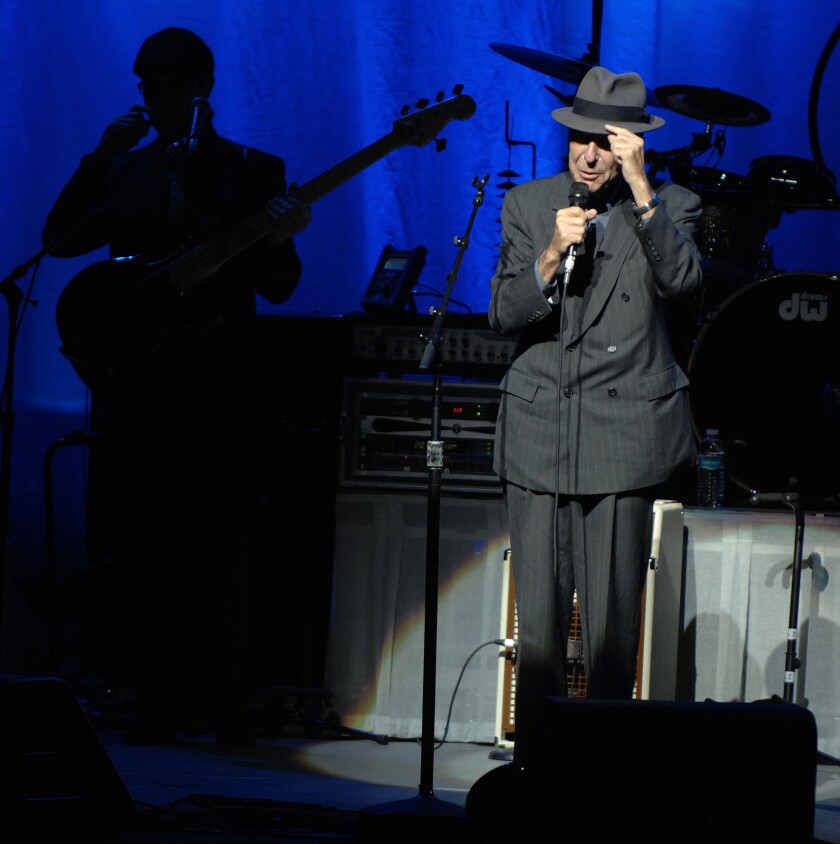
Leonard Cohen, right, performs onstage in a gray double-breasted suit and matching hatLeonard Cohen performs at England’s Manchester Opera House in 2008. His 1984 song “Hallelujah” has been covered innumerable times by a wide variety of artists.(Shirlaine Forrest / WireImage)
But what does hallelujah mean, exactly? And why does it continue to resonate with us, untranslated, thousands of years after it first appeared in the Hebrew bible?

And what is it about hallelujah that inspires composers and songwriters to deploy it so frequently and reverentially from Handel to Ray Charles to Leonard Cohen?

The Oxford English Dictionary defines hallelujah as “a song or shout of praise to God,” but biblical scholars will tell you it’s actually a smash-up of two Hebrew words: “hallel” meaning “to praise” and “jah” meaning Yahweh, or God.

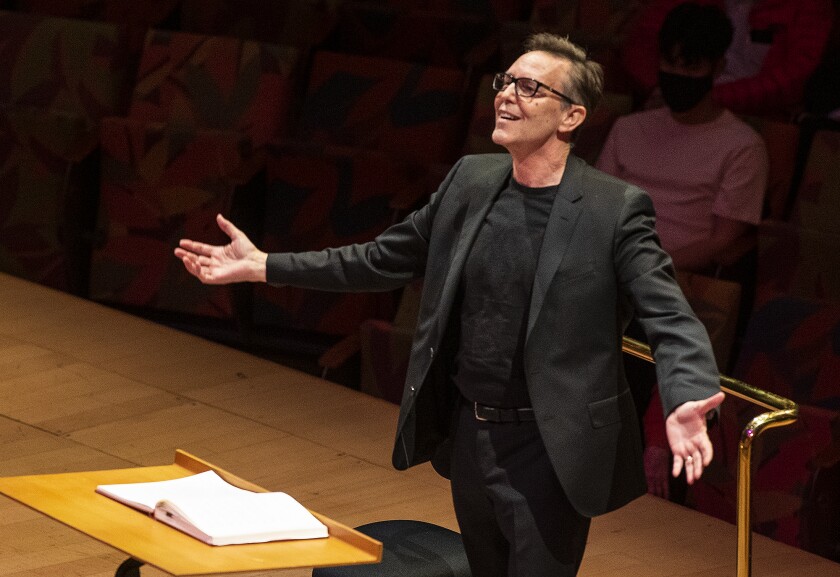
But that’s just the official meaning. For Grant Gershon, director of the Los Angeles Master Chorale, hallelujah is a perfect word because it can take on different meanings.

“It’s this sound that is just so full of possibilities,” he said. “You can fill it with whatever you need to say or communicate.”

In Handel’s great chorus, the word is joyous, victorious, accompanied by trumpets and drums. In Sergei Rachmaninoff’s “All Night Vigil,” however, hallelujah reflects a more quiet devotion. Repeated over and over again, it serves almost as a mantra.

Grant Gershon conducts onstage in a black suit

“I imagine an older Russian person in front of an icon, just murmuring to themselves, ‘Hallelujah, hallelujah, hallelujah,’ ” Gershon said.

As a side note, the Russians add an extra vowel sound to their hallelujah and drop the “H” so it is pronounced Ah-lay-lu-ee-yah. That opens up even more possibilities to the liquid, fluid approach to the word, Gershon said.

Hallelujah first appears in the Book of Psalms — a compendium of sacred poems in the Jewish Bible that dates to the 5th or 4th century BC. There it generally prefaces the beginning of a passage or shows up at its conclusion.

“Hallelujah functions as a summary,” said Chris Blumhofer, assistant professor of New Testament at Fuller Theological Seminary in Pasadena. “It’s meant to usher you into the experience of praising who God is and what God’s done.”

Sarah Bunin Benor, director of the Jewish Language Project and a professor at Hebrew Union College in Los Angeles, said hearing the word makes her think of the Hallel — a recitation of Psalms 113-118 chanted by observant Jews on holidays.

“We say it on Rosh Hodesh, the first day of the month celebration. It’spart of the Passover Seder,” she said. “It’s a very joyous prayer, very beautiful and very meaningful.”

Column One

A showcase for compelling storytelling from the Los Angeles Times.More stories

Hallelujah shows up just four times in the New Testament, all in the Book of Revelation. All four come at the climax of the text, when God delivers his people from the destructive power of Babylon. In response to this deliverance the people cry out, “Hallelujah!”

“They are praising the salvation from oppression and violence,” Blumhofer said. “They are praising God for delivering his promises and protecting his people.”

Scholars can’t say for sure why hallelujah was preserved intact when nearly every other Hebrew word in the Bible was translated first into Greek and then into Latin (amen is another notable exception). Markus Rathey, a professor of early Christian music at Yale University, said it suggests the word was already charged with an emotion that transcended its linguistic meaning.

“I must say, personally, hallelujah sounds so much more beautiful than simply just ‘Praise the Lord,’” Rathey said. “Hallelujah is almost music already, even without a musical setting.”

That musical power comes through no matter the spelling. The Oxford English Dictionary lists eight English transliterations from the Hebrew, including alleluia, allelujah and hallelujiah. There’s even an adjective: hallelujatic.

All those vowels lend themselves to music.

“It’s like the perfect word to sing,” Gershon said. “It has all these long vowels, and all the consonants are liquid as well. It feels like this beautiful flowing stream of sound.”

Historically, the word has offered composers and vocalists the opportunity to use the voice in unusual ways, Rathey said.

“Because it’s only one word and it has that final long ‘ah,’ it inspired composers to write very beautiful, almost instrumental lines that put celebration and the sound of music in the foreground,” he said. “The focus is not on the word anymore; it’s really on playing with sound and virtuosity.”

Thousands of works of classical liturgical music use hallelujah, in part because there was a great need for them. In the first half of the traditional Mass in the Catholic, Anglican and Lutheran traditions, there are two biblical readings separated by several musical pieces. One of them is “Hallelujah.”

“There were ‘Hallelujahs’ that were sung by the congregation, but at a major church it could be an opportunity for a composer to create a larger-scale piece that is performed by a choir,” Rathey said.

Hallelujah was seen as so joyous that it had to be put away for the 40 days of Lent. It was considered too celebratory for such a subdued time of the ecclesiastical year.

There are stories of choir boys in the Renaissance making a tiny coffin and putting the word hallelujah in it, only to resurrect it at Easter.

“Even if you don’t notice that it’s gone, I know the feeling on Easter morning when all of a sudden you are singing it again,” Rathey said. “It’s almost like a beautiful dress that you get out for celebration on Easter morning.” (In fact, Handel’s “Messiah,” composed in 1741, was originally intended for Easter week.)

There is no set time that the word is sung (or not sung) in the nondenominational church that Deborah Smith Pollard attends in Michigan, but she said it shows up when the spirit, emotion and joy begin to crescendo.

“When the praises are so high, somebody is saying hallelujah,” said the professor who studies gospel music at the University of Michigan-Dearborn. “Maybe it’s pastor, or maybe it’s somebody in the choir singing it. All of a sudden, you might see members of the audience singing or saying hallelujah.”

Smith Pollard also sees the word being used outside the church. She is also a radio host, and for the last two years she’s hosted an annual gospel concert and fundraiser put on by DTE Energy, which provides heat for many people in the Detroit area. The event is called “Hallelujah for Heat.”

Smith Pollard thought it was a cute name for when she first heard it. Then her furnace broke down in a cold Detroit winter.

Hallelujah, here’s a playlist

The word “Hallelujah” has been set to music for centuries, but no matter the genre or subject, this ancient Hebrew word conveys rich emotion.

Gregorian Chant
“Alleluia” brackets the words to this medieval chant: “The day of the sanctified has shone upon us: come, you nations, and worship the Lord, for today a great light descended over the earth.

Alleluya, a Newe Werke
This English carol was first published in a collection of carols in 1430. The Middle English lyrics tell of Christ’s birth: A nywe werke is come on honde. A new work has come on hand.

Hallelujah, I love her so
Ray Charles uses the word not to praise God but to exclaim about “a girl I know, she’s my baby and she lives next door.” It’s been covered by various artists, including Frank Sinatra and Harry Belafonte. Ella Fitzgerald and Peggy Lee sang it as “Hallelujah, I love him so.”

Hallelujah
In this 2019 release, the band Haim uses the word in an introspective fashion, asking, “Why me? How’d I get this hallelujah?” Angelenos might recognize the filming location as the Los Angeles Theatre in downtown L.A. Note the marquee at the end.

Hallelujah, Salvation and Glory
Performed at one of Kanye West’s “Sunday Services,” this song exults in the joyfulness of the word, with propulsive percussion and leaping singers. The music starts at the 1-minute mark.

Alleluia
American composer Randall Thompson had been commissioned to write a fanfare-like work, but after France fell to Nazi Germany in World War II, he wrote a more reflective piece that debuted in 1940. “The word alleluia has so many interpretations,” Thompson said. “The music in my particular Alleluia cannot be made to sound joyous…here it is comparable to the Book of Job, where it is written, ‘The Lord gave and the Lord has taken away. Blessed be the name of the Lord.’”

“When we got it working again, the first thing I said was, ‘Hallelujah!’” she said. “You immediately go: Praise God, I’ve got heat again!”

“You don’t have to be in the church, or a Christian, or tied to the Jewish community to use that word,” she said. “Hallelujah shows up in the community.”

It shows up in Ray Charles’ “Hallelujah I Love Her So,” where the singer uses it to implicitly thank the divine for bringing the woman next door into his life. Hip-hop artists like Chief Keef and Logic have titled songs “Hallelujah” as they celebrate their own success. Recently, the L.A.-based band Haim released a Fleetwood Mac-inspired song in which the word serves as a way to acknowledge the blessing of having friends and family help them through life’s challenges.

But by far the most popular and famous use of hallelujah in popular music is Leonard Cohen’s haunting and frequently covered “Hallelujah,” written in 1984.

The song does not rely on biblical quotations, but it does make use of biblical stories: It’s about David, who consorts with Bathsheba, and orchestrates her husband’s death so he can marry her. And it’s about Samson, who, instead of saving his people from a hostile army, runs off with Delilah, who cuts his hair, leaving him powerless.

But ultimately, the song is about all of us — our failings, our imperfections, and our desire to have a relationship with the unknowable divine, said Marcia Pally, author of “From This Broken Hill: God, Sex and Politics in the Work of Leonard Cohen.”

“He articulates in the song what we know about ourselves,” she said. “It’s about our relationship with the transcendent and with other people, how we breach those relationships, and sever them, and yet still we have to come back to hallelujah.”

Amen. (But that’s another story.)

Deborah Netburn

Deborah Netburn is a features writer at the Los Angeles Times. She joined the paper in 2006 and has covered entertainment, home and garden, national news, technology and most recently, science.

Los Angeles Times logo

(Contributed by Janet Cornwell, H.W., m.)