
New Thinking Allowed with Jeffrey Mishlove Jason Reza Jorjani is a philosopher and faculty member at the New Jersey Institute of Technology. He is author of Prometheus and Atlas. Here he suggests that converging technologies are forcing humanity to reconsider what it means to be human. Biotechnology will enable us to significantly increase human intelligence from generation to generation. In the absence of global regulation, this development could lead to a caste system. In addition, we face the prospect of human cloning and the potential of mixing human genes with those of other species. The fields of artificial intelligence and robotics offer additional possibilities for the creation of bionic species. It may be that our technological advances are outpacing our ability to trust each other to wisely use the new powers that will become available. New Thinking Allowed host, Jeffrey Mishlove, PhD, is author of The Roots of Consciousness, Psi Development Systems, and The PK Man. Between 1986 and 2002 he hosted and co-produced the original Thinking Allowed public television series. He is the recipient of the only doctoral diploma in “parapsychology” ever awarded by an accredited university (University of California, Berkeley, 1980). He is a past vice-president of the Association for Humanistic Psychology; and is the recipient of the Pathfinder Award from that Association for his contributions to the field of human consciousness exploration. He is also past-president of the non-profit Intuition Network, an organization dedicated to creating a world in which all people are encouraged to cultivate and apply their inner, intuitive abilities. (Recorded on June 25, 2016)
Monthly Archives: December 2021
Holiday Greetings from The Prosperos


Be Amazed
![May be an image of 1 person, beard and text that says '"Our goal should be to live life in radical amazement, [to] get up in the morning and look at the world in a way that takes nothing for granted. Everything is phenomenal; everything is incredible; never treat life casually. To be spiritual is to be amazed." -Abraham Joshua Heschel-'](https://scontent-bos3-1.xx.fbcdn.net/v/t39.30808-6/269603316_7330498546975970_6584398206757606352_n.jpg?_nc_cat=108&ccb=1-5&_nc_sid=730e14&_nc_ohc=grDcyvAqbxUAX_mFoNl&_nc_ht=scontent-bos3-1.xx&oh=00_AT_6RwPehrBNUApAOEJN-ky8d7Y011PH66JMoSCD_TR2fg&oe=61CB021C)
Beyoncé – SPIRIT (From Disney’s “The Lion King”)
Beyoncé The Lion King: The Gift album featuring “Spirit” available now: https://smarturl.it/lionkingthegift Amazon Music: https://smarturl.it/lionkingthegift/az Apple Music: https://smarturl.it/lionkingthegift/a… Deezer: https://smarturl.it/lionkingthegift/d… iTunes: https://smarturl.it/lionkingthegift/i… Soundcloud: https://smarturl.it/lionkingthegift/s… Spotify: https://smarturl.it/lionkingthegift/s… Tidal: https://smarturl.it/lionkingthegift/t… YouTube Music: https://smarturl.it/lionkingthegift/y… Beyoncé: https://www.Beyonce.comhttps://www.instagram.com/Beyoncehttps://www.facebook.com/Beyoncehttps://twitter.com/Beyonce#Beyonce#Spirit#Bigger
Music in this video
Learn more
Listen ad-free with YouTube Premium
Song
SPIRIT (From Disney’s “The Lion King”)
Artist
Licensed to YouTube by
SME (on behalf of Parkwood Entertainment/Columbia); UNIAO BRASILEIRA DE EDITORAS DE MUSICA – UBEM, CMRRA, AMRA, Walt Disney Music Company (Publishing), LatinAutor – PeerMusic, ASCAP, LatinAutor, LatinAutorPerf, LatinAutor – UMPG, UMPI, and 11 Music Rights Societies
(Contributed by Richard Branam)
A Course in Miracles: Lesson 155

Lesson 155 I will step back and let Him lead the way.
There is a way of living in the world that is not here, although it seems to be. You do not change appearance, though you smile more frequently. Your forehead is serene; your eyes are quiet. And the ones who walk the world as you do recognize their own. Yet those who have not yet perceived the way will recognize you also, and believe that you are like them, as you were before.
The world is an illusion. Those who choose to come to it are seeking for a place where they can be illusions, and avoid their own reality. Yet when they find their own reality is even here, then they step back and let it lead the way. What other choice is really theirs to make? To let illusions walk ahead of truth is madness. But to let illusion sink behind the truth and let the truth stand forth as what it is, is merely sanity.
This is the simple choice we make today. The mad illusion will remain awhile in evidence, for those to look upon who chose to come, and have not yet rejoiced to find they were mistaken in their choice. They cannot learn directly from the truth, because they have denied that it is so. And so they need a Teacher Who perceives their madness, but Who still can look beyond illusion to the simple truth in them.
If truth demanded they give up the world, it would appear to them as if it asked the sacrifice of something that is real. Many have chosen to renounce the world while still believing its reality. And they have suffered from a sense of loss, and have not been released accordingly. Others have chosen nothing but the world, and they have suffered from a sense of loss still deeper, which they did not understand.
Between these paths there is another road that leads away from loss of every kind, for sacrifice and deprivation both are quickly left behind. This is the way appointed for you now. You walk this path as others walk, nor do you seem to be distinct from them, although you are indeed. Thus can you serve them while you serve yourself, and set their footsteps on the way that God has opened up to you, and them through you.
Illusion still appears to cling to you, that you may reach them. Yet it has stepped back. And it is not illusion that they hear you speak of, nor illusion that you bring their eyes to look on and their minds to grasp. Nor can the truth, which walks ahead of you, speak to them through illusions, for the road leads past illusion now, while on the way you call to them, that they may follow you.
All roads will lead to this one in the end. For sacrifice and deprivation are paths that lead nowhere, choices for defeat, and aims that will remain impossible. All this steps back as truth comes forth in you, to lead your brothers from the ways of death, and set them on the way to happiness. Their suffering is but illusion. Yet they need a guide to lead them out of it, for they mistake illusion for the truth.
Such is salvation’s call, and nothing more. It asks that you accept the truth, and let it go before you, lighting up the path of ransom from illusion. It is not a ransom with a price. There is no cost, but only gain. Illusion can but seem to hold in chains the holy Son of God. It is but from illusions he is saved. As they step back, he finds himself again.
Walk safely now, yet carefully, because this path is new to you. And you may find that you are tempted still to walk ahead of truth, and let illusions be your guide. Your holy brothers have been given you, to follow in your footsteps as you walk with certainty of purpose to the truth. It goes before you now, that they may see something with which they can identify; something they understand to lead the way.
Yet at the journey’s ending there will be no gap, no distance between truth and you. And all illusions walking in the way you travelled will be gone from you as well, with nothing left to keep the truth apart from God’s completion, holy as Himself. Step back in faith and let truth lead the way. You know not where you go. But One Who knows goes with you. Let Him lead you with the rest.
When dreams are over, time has closed the door on all the things that pass and miracles are purposeless, the holy Son of God will make no journeys. There will be no wish to be illusion rather than the truth. And we step forth toward this, as we progress along the way that truth points out to us. This is our final journey, which we make for everyone. We must not lose our way. For as truth goes before us, so it goes before our brothers who will follow us.
We walk to God. Pause and reflect on this. Could any way be holier, or more deserving of your effort, of your love and of your full intent? What way could give you more than everything, or offer less and still content the holy Son of God? We walk to God. The truth that walks before us now is one with Him, and leads us to where He has always been. What way but this could be a path that you would choose instead?
Your feet are safely set upon the road that leads the world to God. Look not to ways that seem to lead you elsewhere. Dreams are not a worthy guide for you who are God’s Son. Forget not He has placed His Hand in yours, and given you your brothers in His trust that you are worthy of His trust in you. He cannot be deceived. His trust has made your pathway certain and your goal secure. You will not fail your brothers nor your Self.
And now He asks but that you think of Him a while each day, that He may speak to you and tell you of His Love, reminding you how great His trust; how limitless His Love. In your Name and His Own, which are the same, we practice gladly with this thought today:
I will step back and let Him lead the way,
For I would walk along the road to him.
A Day on Consciousness
(TheWeekendUniversity.com)

Lectures & Speakers

Consciousness, Purpose, and Values
Dr Iain McGilchrist is a Psychiatrist and Writer, who lives on the Isle of Skye, off the coast of North West Scotland. He is committed to the idea that the mind and brain can be understood only by seeing them in the broadest possible context, that of the whole of our physical and spiritual existence, and of the wider human culture in which they arise – the culture which helps to mould, and in turn is moulded by, our minds and brains. He was formerly a Consultant Psychiatrist of the Bethlem Royal and Maudsley NHS Trust in London, where he was Clinical Director of their southern sector Acute Mental Health Services.
Dr McGilchrist has published original research and contributed chapters to books on a wide range of subjects, as well as original articles in papers and journals, including the British Journal of Psychiatry, American Journal of Psychiatry, The Wall Street Journal, The Sunday Telegraph and The Sunday Times. He has taken part in many radio and TV programmes, documentaries, and numerous podcasts, and interviews on YouTube, among them dialogues with Jordan Peterson, David Fuller of Rebel Wisdom, and philosopher Tim Freke. His books include Against Criticism, The Master and his Emissary: The Divided Brain and the Making of the Western World, The Divided Brain and the Search for Meaning, and Ways of Attending. He published his latest book: The Matter With Things, a book of epistemology and metaphysics. You can keep up to date with his work at https://channelmcgilchrist.com
Reading Recommendations:
The Matter with Things – Dr Iain McGilchrist
The Master and his Emissary – Dr Iain McGilchrist

Non-Duality and the Nature of Consciousness
Rupert Spira was deeply interested in the nature of reality and the source of lasting peace and happiness since his early age. After spending twenty years immersed in the teachings of classical Advaita Vedanta, he met his teacher, Francis Lucille, who introduced him to the Direct Path approach whereby one may recognise the source of peace and happiness in oneself. Rupert has written several books and holds regular meetings and retreats online, as well as in Europe and the United States. He is also a noted potter, trained in the British Studio Pottery school, with work in public and private collections. www.rupertspira.com
Reading Recommendations:
Rupert’s books: Being Myself, Being Aware of Being Aware and The Nature of Consciousness
Essay: Idealism, Realism, Solipsism and Non-Duality
Youtube: How Does Consciousness Veil Itself? (along with many more on the channel)Social Media Links: Facebook, Twitter, Instagram, Youtube

The Extended Mind
Annie Murphy Paul is an acclaimed science writer whose work has appeared in the New York Times Magazine, Scientific American, and The Best American Science Writing, among many other publications. Her latest book is The Extended Mind: The Power of Thinking Outside the Brain. Published in June of 2021, it was selected as an Amazon Editors’ Pick for Best Nonfiction, one of “50 Notable Works of Nonfiction” by the Washington Post, and one of “100 Notable Books of 2021” by The New York Times. She is the author of Origins, also named by the New York Times as a “Notable Book,” and The Cult of Personality, hailed by Malcolm Gladwell in the New Yorker as a “fascinating new book.” Her TED Talk has been viewed more than 2.7 million times. Paul is a recipient of the Rosalynn Carter Mental Health Journalism Fellowship, the Spencer Education Journalism Fellowship, and the Bernard L. Schwartz Fellowship at New America. A graduate of Yale University and the Columbia University Graduate School of Journalism, she is currently a Learning Sciences Exchange Fellow at New America.
Reading Recommendations:
The Extended Mind: The Power of Thinking Outside the Brain – Annie Murphy Paul
The Extended Mind by Andy Clark and David Chalmers, Analysis
How to Think Outside Your Brain by Annie Murphy Paul, The New York Times
Supersizing the Mind: Embodiment, Action, and Cognitive Extension, by Andy Clark
Mind in Motion: How Action Shapes Thought, by Barbara Tversky
Out of Our Heads: Why You Are Not Your Brain, and Other Lessons from the Biology of Consciousness, by Alva Noë
How disruptions happen
We offer fine writing, mind-opening ideas and intriguing videos as a gift, free to all. We believe that generosity and open-mindedness are essential to our shared future: this belief infuses our work at Aeon.

A riot on Nevsky Prospekt in Petrograd (St Petersburg) on 17 July 1917 after troops of the provisional government opened fire; this unrest was a precursor to the October revolution. Photo by Viktor Bulla/Public domain
Major disruptions in world history follow a clear pattern. What can upheavals of the past tell us about our own future?
David Potter is Francis W Kelsey Collegiate Professor of Greek and Roman History and Arthur F Thurnau Professor at the University of Michigan. His books include Constantine the Emperor (2013), Theodora: Actress, Empress, Saint (2016), The Origin of Empire: Rome from the Republic to Hadrian (2019), and Disruption: Why Things Change (2021).
Edited byMatt Huston
23 December 2021 (aeon.co)
On 3 April 1917, a crowd gathered to meet a train arriving from Helsinki at Petrograd’s Finland Station. The train carried Vladimir Ilyich Lenin. He greeted his audience with a speech calling for the overthrow of Russia’s government – and, six months later, he made this happen. The world changed.
Lenin, who had been living outside of Russia for more than a decade, was known as a theorist on the fringe of Russian political society, shaping Marxist thought to support his own theory of change. Karl Marx had envisioned a number of ways for a society to move to a system in which workers controlled the means of production. But Lenin saw only one way: through the violent overthrow of the existing government, organised by a dedicated group of professional revolutionaries. Lenin brought this scheme with him to Petrograd (now St Petersburg). There, his party took charge of the worker’s organisation that had been sharing power with a provisional government since the abdication of the tsar. But it would be more than five years before Lenin’s party secured absolute power in Russia. Millions died along the way.
Lenin’s theory of change was a theory of social disruption, of imposing a shift so radical that a society could not go back to the way it had been. Such disruptions don’t just happen randomly. There is a set of conditions required to launch them, and there are particular circumstances in which the initiators of the disruption tend to succeed in their aims.

The core characteristics of the kind of disruption I’m describing, as we’ll see in the historical episodes that follow, are that it: 1) stems from a loss of faith in a society’s central institutions; 2) establishes a set of ideas from what was once the fringe of the intellectual world, placing them at the centre of a revamped political order; and 3) involves a coherent leadership group committed to the change. These disruptions are apparent in, but not synonymous with, some of the events commonly called revolutions. Disruptions don’t always change who is in charge – they are, in fact, sometimes necessary to preserve a government that is on the verge of failure. But they will at the very least change the way that a governing group thinks and acts.
Disruptions bring a profound shift in people’s understanding of how the world around them works. They contrast in this way with less radical societal changes, based on an existing thought system: for example, the English ‘revolutions’ of the 17th century, which changed the balance of power between king and parliament without altering the basic system of government. Ideological change is crucial for major societal change, such as that pursued by Lenin, because societies promote ideologies that support their way of doing business – and if the way of viewing the world doesn’t change, the way of doing business isn’t going to change either. It’s easy enough to look to the past to find discarded ideas that were once central, such as the theory that kings rule by ‘divine right’.
Importantly, periods of challenge that have similar causes will not always have similar ends. One could argue – as Barrington Moore Jr did in his 1966 study of the social origins of dictatorship and democracy – that a change of political system will occur in a society where there is a serious disjuncture between coexisting modes of economic activity, such as traditional agriculture and capitalist enterprise. Or one could argue that a split between those who drive economic activity and those who hold political power is a precondition for change. But there is a lot of room for leaders to make choices in such circumstances that will shape very different outcomes. The first of these scenarios could quite reasonably be taken as describing both the United States and Russia at the turn of the 20th century, but there was no US equivalent of Lenin’s seizure of power.
The model for disruption that I’m proposing does not predict that radical change will occur because of specific structural issues such as those described by Moore, or that there is an inevitable outcome to a set of issues. What I am suggesting is that, when a political system is undermined by events such as economic failure, defeat in war or environmental catastrophe, that political system is going to have to change or fail. Success or failure depends on the choices that leaders make, and the ability to give people a fresh set of ideas that will help them see a new way forward.
The outcome of a disruption is often completely unexpected to contemporaries, and that is precisely because ideas from outside the mainstream were used to shape the solutions to the problems of the time. We can’t know in advance exactly how a disruption will end. What history can teach us is what the circumstances are that lead to a disruption. It can make us realise what we might be facing as a result of the situation we are in today.
When we look at one of the first major disruptions, one that is still influencing the world in which we live – the Roman emperor Constantine’s conversion to Christianity in the 4th century CE – we have a case where change had been in the air for a while. In the half-century before Constantine staged the coup that set him on the path to unifying the Roman Empire under his own control, the empire had suffered through plague, massive inflation and a series of military disasters, but the tendency of leadership had been simply to try to make old systems work better.
Constantine sent a completely different message when his regime imported concepts from a fringe movement, Christianity, to support its own legitimacy. In doing so, Constantine made use of a small number of Christian advisers, who shaped a new relationship between the Church and Roman society, and joined the closely knit group upon which he depended to run the empire.
This early example exhibits the key characteristics of a disruption: a loss of faith in central institutions (the imperial system of government), the establishment of previously fringe ideas (those of Christianity) at the centre of the political order, and a cohesive, committed leadership group that initiated the change. In elevating Christianity’s role in the empire, Constantine altered patterns of thought, replacing old ideas about imperial authority with a fresh, obviously different model of authority that told people they were moving in a new direction.
We can observe these characteristics, too, in a disruption that unfolded in the 7th century CE, when a centuries-old Middle Eastern political order collapsed. After the old system had fallen apart, the Umayyad caliph ‘Abd al-Malik adapted the teachings of the Prophet Muhammad to provide the ideology for a new government – one that would ultimately stretch from North Africa to central Asia. Muhammad, who had died decades earlier, had been interested in using his visions to shape a community of believers. His revelation did not suggest that the longstanding system based on the Roman and Persian empires was soon to be overturned. But inept leadership had undermined the legitimacy of both governments through years of disastrous warfare, and tightly knit groups of Muhammad’s followers managed the rapid defeat of these failed states. When it looked like their movement would implode, ‘Abd al-Malik recognised the need to rebuild the centre of Islamic society, introducing new rules for the community so it could move forward.
The deft use of media was crucial in the next great disruption to shape European history
One thing that helped both Constantine and ‘Abd al-Malik in spreading previously marginal ideas was that they could effectively control the available media for mass communication – such as coinage bearing their message and the pronouncements that would have to be read out at public festivals. Another way to get the message across was through impressive building projects, such as the Dome of the Rock shrine in Jerusalem, built by ‘Abd al-Malik. These monuments enabled people to visualise the new order as something stable.
The deft use of media was crucial in the next great disruption to shape European history: the Protestant Reformation of the early 16th century. Around 70 years before Martin Luther posted his 95 theses challenging the notion of purgatory – the place where souls had to wait before going to heaven – and the validity of the indulgences one could purchase to hasten the path forward, Johannes Gutenberg had invented the printing press. Luther proved to be a master of the new medium, recognising that successful communication needed to be short, to the point and in his audience’s own language. The Catholic Church still issued its pronouncements in Latin. Luther told people they could receive God’s word in German.
.jpg)
Luther was a brilliant polemicist with a powerful message, but he was not alone. He wouldn’t have survived without the support of Frederick of Saxony, his patron before the decisive moment in 1517 when he posted his challenge to Catholic doctrine. Frederick remained his protector even after the dramatic moment in 1521 when Luther defied the Holy Roman emperor Charles V, standing up before the emperor and his court and refusing to retract his writings.
Charles was ill prepared. He grew up in the Netherlands, was a teenager when he took the throne, and knew little of Germany. There were concerns about his capacity among the leaders of German society, and concerns about the way the Catholic Church’s sale of indulgences was draining money from Germany at the very time more cash was needed to fund prospective wars with the advancing Ottoman Turks. The Catholic Church was damaged by widespread accounts of papal corruption.
Frederick represented German political leaders who had lost faith in the political direction of the Holy Roman Empire. Luther’s alternative ideology gave their movement a substance that previous efforts at reining in the power of emperors and popes had lacked. In the decades after Luther’s defiance of Charles, the princes of Germany formed a political league, drawing from Charles the concession that ‘Protestant’ states could be legitimate states, and inspiring further Protestant movements in England and the Netherlands.
Ultimately, the Protestant disruption would end Catholic dominance of intellectual life, open the door to new forms of scientific enquiry, and enable the development of European nation states. One further result was to allow new thinking based on classical political theory instead of the Bible.
More than a century later, the English philosopher John Locke mounted his own momentous challenge to religious ideas – and the events that followed further illustrate the chief characteristics of disruption. Locke opened his Two Treatises on Government (1689) by demolishing an argument that the divine right of kings was based upon the political structure, authorised by God, of the Garden of Eden. In the second treatise, he announced his view that the main reason that people agreed to put themselves under a government was the preservation of their property, which could happen only if there was ‘common consent’ as to the standard of right and wrong. Tyranny, he wrote, is ‘the exercise of power beyond right’.
Locke argued that a person who exercised power in a way the community did not authorise did not have the right to be obeyed. Eventually, this idea helped to justify the rebellion of England’s 13 North American colonies against the king, George III. An extreme version of Locke’s thought was popularised by Thomas Paine in his widely read pamphlet Common Sense (1776), in which he made the case that the English monarchy was illegitimate – that it had been imposed on an unwilling population.
A successful disruption creates space in which people can discuss new ideas
George III had the better army, but military might was insufficient to quell a rebellion based on Locke and his followers’ powerful ideas about what a just society should look like. Just as important for the Americans’ ultimate success was the development of a group of people around George Washington, including his allies Alexander Hamilton and James Madison, who knew how to work together to turn the abstract ideas of political theorists into viable institutions.
The Americans who opposed George III were opposed to the idea that a powerful central government could order them around. However, they soon realised that the weak Articles of Confederation that had united them in the war were insufficient to hold them together for the future. The fact that a constitutional convention could be summoned to create a new government is a sign that one of the crucial aspects of a successful disruption is that it creates space in which people can discuss new ideas. It was precisely the failure to maintain such a centre that would destroy the effort to form a new government in France following its own uprising.
Lenin was an avid reader of histories of the events in France between 1789 and the emergence of Napoleon Bonaparte as France’s ruler 10 years later. There were meaningful parallels. Just as the Russian tsar Nicholas II undermined his regime with his conduct of a war with Germany, so the French king Louis XVI persistently undermined his own government and allies in the years after he summoned the Estates General, a governmental assembly, in 1789. The king hoped to solve a financial crisis stemming from France’s vigorous support for the American rebellion against Britain. But people had already lost faith in a court they regarded as inept and corrupt. France had not developed elective institutions prior to that point, so the French court lacked a clear idea of how to manage the Estates General when it came together.
Louis XVI was soon a virtual prisoner in his own palace, while groups antithetical to his interests established an alternative military structure and a national guard, and began writing a new constitution. Even then, Louis could have survived if he had allowed that becoming a constitutional rather than absolute monarch was a reasonable option. But he didn’t. He conspired with other monarchs to overthrow the reform movement in France, thereby undermining centrists who would have allowed him to retain his throne. In so doing, he opened the door to Maximilien Robespierre and other radicals with bold ideas, who claimed that moderation was undermining the revolution – that it could succeed only if traitors were removed and a new state, founded upon the promotion of virtue, replaced the dysfunctional civic constitutions favoured by moderates.
Robespierre, who achieved dominance in French politics as chair of a committee to oversee France’s war effort, defended and enhanced his power by pressing French politics to the extreme. He established a quasi-judicial process whereby political opponents (including former allies) could be speedily executed. Depending on terror to support his vision of a new society, Robespierre wrecked the emergent democratic institutions that had been shaped in repeated efforts to draw up a new French constitution. After Robespierre himself was executed, the force of the revolution dissipated until Napoleon took over.
The French example stands as a disruption that succeeded in destroying previous institutions without succeeding in building a lasting alternative. It underscores the importance of having political leadership with a clear vision at the moment an existing system of government is overthrown. This was the sort of leadership Frederick of Saxony provided, as had Constantine and ‘Abd al-Malik. And the great strength of the framers of the Constitution of the United States was their understanding that radical change could be achieved through compromise. As Robespierre showed, resorting to violence to impose new standards on a population was a recipe for disaster.
The disruption led by Hitler relied on a collapse of faith in institutions
How does Lenin fit into this picture? When he returned to Russia, the central institutions of the tsarist regime had collapsed and the existing provisional government had no electoral mandate. Lenin dominated the small revolutionary group taking over the worker’s movement that shared power with the government. Without Lenin’s ability to organise a cadre of subordinates, the revolution that he hoped for would not have come to pass in October 1917.
Lenin maintained power through a brutal civil war. He created a secret police apparatus that murdered thousands, as millions more died through starvation, battle and disease. Eventually, however, he realised that the policies he had used in wartime would not work in peacetime – reflecting an ability to adjust to circumstances that had made leaders successful during previous disruptions. Lenin’s New Economic Policy, essentially state-sponsored capitalism, gave people a vested interest in what might generously be described as a modified communist regime. Yet Lenin’s successor, Joseph Stalin, destroyed the New Economic Policy with his programme of forced collectivisation. His homicidal regime ensured that the Soviet Union could never offer a viable alternative to Western capitalism.
Another profoundly violent 20th-century disruption, the rise of Nazism, had roots in a theory that implied that nations must inevitably be in competition. Just as within each nation there was an ongoing contest for survival, and government should be geared towards supporting ‘winners’ over ‘losers’ in this struggle, so too there could only be ‘winners’ and ‘losers’ in foreign affairs. This view, promulgated by Herbert Spencer, became known as social Darwinism, and it was supported by the pseudoscience of eugenics, developed by Spencer’s contemporary Francis Galton. Although he was English, Spencer’s theories gained greater currency in the US, where Galton’s eugenic theories were taken up to support restrictive immigration policies and the state-sponsored sterilisation of prisoners on the grounds of ‘mental deficiency’. One person who found such laws appealing was Adolf Hitler.
Hitler’s political success stemmed in large part from the fact that his assertions about Germany’s path – that it could have won the First World War, that it had been stabbed in the back, and that its problems could be solved by undoing the treaty that had ended the war – were familiar to the electorate from other sources. These positions were lies, but the lies were popular. Hitler’s extreme version of racist social Darwinism was initially on the fringe of German thought but, linked to his anticommunism, it was tolerated outside Nazi circles.
Yet an anticommunist message backed by lies would not be sufficient to explain Hitler’s rise to power. Echoing previous disruptions, this required the disintegration of faith in government. In this case, the loss of faith resulted in large part from the policies pursued by Germany’s centrist chancellor: in response to the Great Depression, he followed conventional wisdom by cutting public spending, thereby increasing the impact of the downturn and damaging the centre-Right alliance that had ensured his election. As the depression deepened, Hitler’s Nazi Party attracted ever more attention, something enhanced by Hitler’s ability to make use of new technologies, especially radio, and his vigorous style of campaigning. Still, when Germany’s president, Paul von Hindenburg, made Hitler chancellor in January 1933, Hindenburg had been convinced that Hitler could be controlled.
It would not be two full months before Hitler created the legal conditions for his dictatorship. The Nazi Party was still not yet recognised for the murderous institution it was when, in 1936, the world gathered in Berlin to celebrate the Olympic Games. Hitler sounded enough like other conservatives – the parallel between Jim Crow laws in the US and Germany’s antisemitic legislation was adduced in support of the appearance of the US at the games – and he had strong anticommunist credentials. These factors, along with dread of another war, made European governments unwilling to stand up to Hitler until war became inevitable.
The disruption led by Hitler relied on a collapse of faith in institutions, on the appeal of Hitler’s novel version of German nationalism to a society reeling from economic collapse and violence, and on the high level of discipline in the Nazi movement, within which Hitler had built a core leadership group. And his rise was aided by the blindness of the political establishment.
What can disruptions of the past – with their diverse outcomes – tell us today? The value of history is that it enables us to detect patterns of behaviour in the present that have had serious consequences in the past.
Today, there are signs that the US and European liberal democratic systems are under threat. The most obvious of these is a loss of trust in public institutions. Factors such as the willingness of Western governments to allow widespread impoverishment, the weakening of labour organisations, and the failure to provide adequate healthcare and other necessities, feed into powerful movements seeking to undercut the mainstream political system.
So too we see ideas from the intellectual fringe informing these increasingly powerful political movements. Some of these movements use social Darwinist ideas to claim, for instance, that public welfare is undercut by immigration. In Europe, the normalisation of nationalist groups such as the one supporting Éric Zemmour’s bid for the French presidency, or Viktor Orbán’s Fidesz Party in Hungary, is threatening established political norms. In the United Kingdom, some advocates of Brexit have translated traditional English exceptionalism into a form of hypernationalism in terms that, like those of the former US president Donald Trump’s supporters, echo social Darwinist doctrines. The prevalence of belief in lies, such as the lie that Trump won the 2020 election, is evocative of the universe of false assumptions that spread in Germany during Hitler’s rise to power. To combat the fissures that election lies, immigration fantasies or antivaccination movements represent, Western governments should recognise that the prevalence of fringe thinking is a sign that they are failing.
The path to restoring faith – which could lead through the sort of disruption that has preserved societies in the past – will offer real help to those who have been left behind. The underlying principle of liberal democracy is the contract between government and the governed. Government has a responsibility to reign in corporate power that undermines public welfare and spreads falsehood, just as it has a responsibility to ensure that people have access to the goods and services they need. This will require practices very different from ‘politics as normal’. It is a critical lesson from history that, when normality fails, change will come.
The signs are that we’re in a time that is ripe for disruption. But what sort will it be?
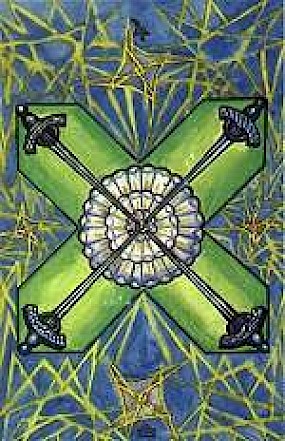
Tarot Card for December 24: The Four of Swords
The Four of Swords
The Lord of Truce marks a period where we are able to rest and recover, after a difficult time in our lives. It will appear after trauma – the breakdown of a relationship; a troublesome and worrying time financially; an operation or major illness.
There will always have been conflict and stress beforehand, this card marks the kind of breathing space we often need in order to clarify our view of the situation, to gather our strength and to decide how best to move forward. When this card appears in a reading, the first thing it tells us is that it is time to rest, time to stop worrying about the things that have happened.
However, it must be noted that Truce is not peace. This is a respite – a down time in which we can catch our breath, ease our tension and relax for a brief time. But once that has been done, we need to recognise that there is still more to be done – the battle isn’t over yet. So when acting under the influence of this card, bear in mind that first you must take it easy, but then you must begin to plan your next step.
If we fail to do that, then when the effect of the Lord of Truce passes away, we shall be left high and dry, with no route planned for our future. And in that case the turmoil which preceded this card may well manifest again.
Sometimes, when the card comes up with a ‘person’ card, it indicates that a rift can begin to be mended between two people who have been at loggerheads previously. In this case, again, it is important to stress that this card does not indicate peace – as before, much more work will need to be done before the damage is entirely healed. We need to be on our guard, too, for other people running personal agendas which may mean that the ‘truce’ is more convenient than sincere.
(via angelpaths.com and Alan Blackman)
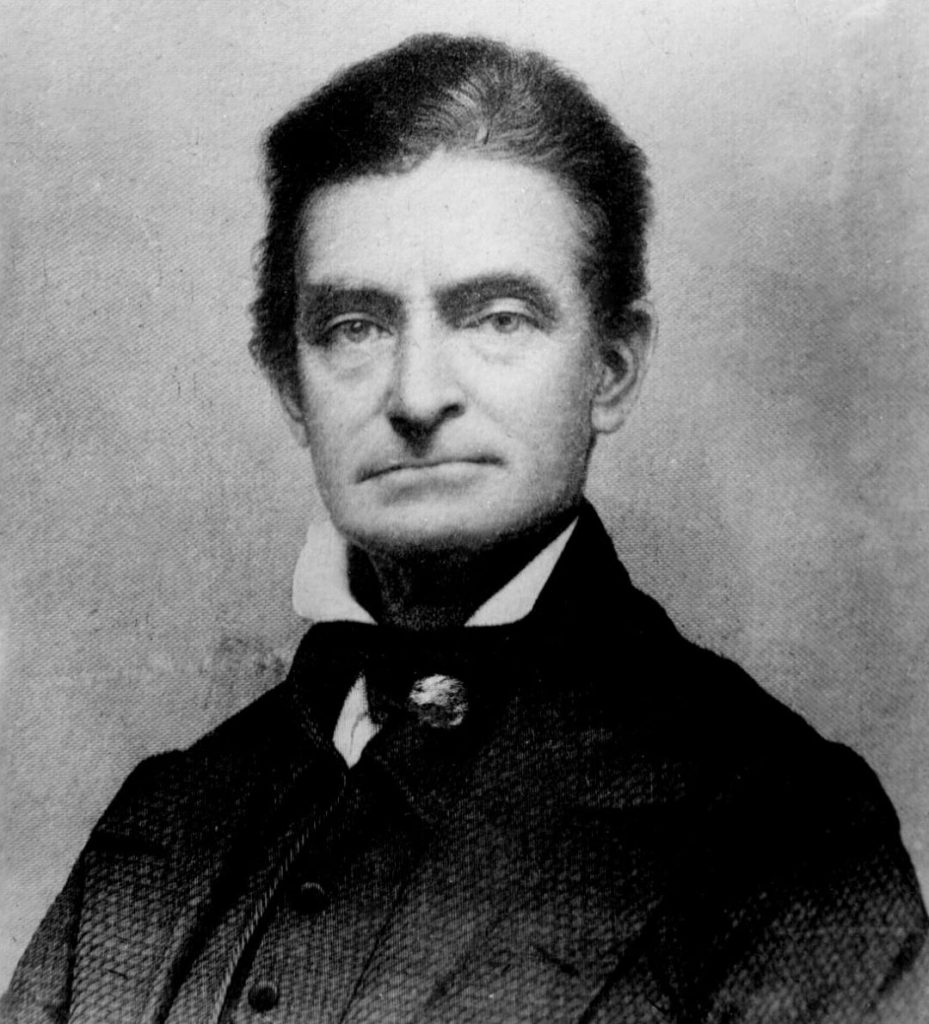
John Brown’s last speech
From Wikipedia, the free encyclopedia
What his first biographer, James Redpath, called John Brown‘s last speech was delivered on November 2, 1859, at his sentencing, in a packed courtroom of whites in Charles Town, Virginia, after his conviction for murder, treason against the Commonwealth of Virginia, and inciting a slave insurrection.[2]: 340 According to Ralph Waldo Emerson, the speech’s only equal in American oratory is the Gettysburg Address.[3][4][5]
As was his custom, Brown spoke extemporaneously, without notes, although he had evidently thought about what he would say; he knew the opportunity was coming. Taken down by a phonographer (reporter-stenographer) such as newspapers used for important speeches, it was on the front page of multiple newspapers, including the New York Times, the next day.
Content
Virginia court procedure required that those found guilty should be asked if there was any reason sentence should not be imposed. Asked this by the clerk, Brown immediately rose, and in a clear, distinct voice said:[6]
I have, may it please the court, a few words to say.
In the first place, I deny everything but what I have all along admitted, the design on my part to free the slaves. I intended certainly to have made a clean thing of that matter, as I did last winter, when I went into Missouri and there took slaves without the snapping of a gun on either side, moved them through the country, and finally left them in Canada. I designed to have done the same thing again, on a larger scale. That was all I intended. I never did intend murder, or treason, or the destruction of property, or to excite or incite slaves to rebellion, or to make insurrection.
I have another objection; and that is, it is unjust that I should suffer such a penalty. Had I interfered in the manner which I admit, and which I admit has been fairly proved (for I admire the truthfulness and candor of the greater portion of the witnesses who have testified in this case), had I so interfered in behalf of the rich, the powerful, the intelligent, the so-called great, or in behalf of any of their friends, either father, mother, brother, sister, wife, or children, or any of that class, and suffered and sacrificed what I have in this interference, it would have been all right; and every man in this court would have deemed it an act worthy of reward rather than punishment.
This court acknowledges, as I suppose, the validity of the law of God. I see a book kissed here which I suppose to be the Bible, or at least the New Testament. That teaches me that “all things whatsoever I would that men should do to me, I should do even so to them” [Matthew 7:12]. It teaches me, further, to “remember them that are in bonds, as bound with them” [Hebrews 13:3]. I endeavored to act up to that instruction. I say, I am yet too young to understand that God is any respecter of persons. I believe that to have interfered as I have done as I have always freely admitted I have done in behalf of His despised poor, was not wrong, but right. Now, if it is deemed necessary that I should forfeit my life for the furtherance of the ends of justice, and mingle my blood further with the blood of my children and with the blood of millions in this slave country whose rights are disregarded by wicked, cruel, and unjust enactments, I submit; so let it be done!
Let me say one word further.
I feel entirely satisfied with the treatment I have received on my trial. Considering all the circumstances and animosity toward me, it has been fair and more generous than I expected. But I feel no consciousness of guilt. I have stated from the first [day] what was my intention and what was not. I never had any design against the life of any person, nor any disposition to commit treason, or excite slaves to rebel, or make any general insurrection. I never encouraged any man to do so, but always discouraged any idea of that kind.
Let me say, also, a word in regard to the statements made by some of those connected with me. I hear it has been stated by some of them that I have induced them to join me. But the contrary is true. I do not say this to injure them, but as regretting their weakness. There is not one of them but joined me of his own accord, and the greater part of them at their own expense. A number of them I never saw, and never had a word of conversation with, till the day they came to me; and that was for the purpose I have stated.
Now I have done.[2]: 340–342
Reaction in the courtroom
While Brown was speaking, there was “perfect quiet” in the courtroom. Under Virginia law, a month had to elapse between a death sentence and its execution, so the judge, Richard Parker, then sentenced Brown to be hanged a month later, on December 2, and specified that, for the sake of example, the execution would be more than usually public.[2]: 244
Those in the courtroom continued to be silent after the reading of the death sentence. “One indecent fellow, behind the Judge’s chair, shouted and clapped hands jubilantly; but he was indignantly checked, and in a manner that induced him to believe that he would do best to retire.”[2]: 244 “This undecorum was promptly suppressed and much regret was expressed by citizens at its occurrence.”[7]
Publication of the speech
Poster (broadside) of John Brown’s last speech, published by Wm. Lloyd Garrison

There were multiple reporters covering Brown’s trial. Thanks to the recently invented telegraph, they sent out immediate copy. Brown’s speech was distributed by the Associated Press[8] and was the next day, November 3, on the front page of the New York Times,[6] the Richmond Dispatch,[9] the Detroit Free Press,[10] the Milwaukee Daily Sentinel,[11] and other newspapers. Over the next few days it appeared in full in some 50 other papers across the country (see below). Wm. Lloyd Garrison printed it as a poster (broadside) and had it for sale in The Liberator‘s office in Boston. The American Anti-Slavery Society published it in a pamphlet, together with extracts from Brown’s letters. A verse on the title page: “He, being dead, yet speaketh” (Hebrews 11:4), compares Brown with Abel, killed by Cain.[12]
Immediate reactions
Supporting Brown
In the evening of December 1, as many of the papers reported together with Brown’s speech, the abolitionist Wendell Phillips gave a speech in Brooklyn, in Henry Ward Beecher‘s Plymouth Church, an important abolitionist center and Underground Railroad station.[13] While the talk had been scheduled in advance, the topic of John Brown had not been announced, and was a surprise to those present. According to Phillips, in the lead story on page 1 of the New York Herald:
It is a mistake to call him an insurrectionist. He opposed the authority of the Commonwealth of Virginia. The Commonwealth of Virginia!—there is no such thing. There is no civil society, no government; nor can such exist except on the basis of impartial equal submission of its citizens—by a performance of the duty of rendering justice between God and man. The government that refuses this is none but a pirate ship. Virginia herself is to-day only a chronic insurrection. I mean exactly what I say—I consider well my words—and she is a pirate ship. John Brown sails with letters of marque from God and Justice against every pirate he meets. He has twice as much right to hang Governor Wise as Governor Wise has to hang him.[14]
Frederick Douglass, having escaped to Canada from a Virginia warrant, also referred to “the thing calling itself the Government of Virginia, but which in fact is but an organized conspiracy by one party of the people against the other and weaker”.[15]
Hostile to Brown
Andrew Hunter, the Prosecuting Attorney
The Prosecuting Attorney, Andrew Hunter, published 30 years later his recollections of the speech:
When called upon and asked whether he had anything to say why sentence should not be executed according to the verdict of the jury, he rose and made a formal and evidently well considered speech, in which, to my great surprise, he declared that his purpose in coming here was not to arm the slaves against their masters and incite an insurrection, but it was simply to do on a larger scale what he had done in Kansas; to run them off, so as to secure their freedom, into the free states. The speech was evidently a well considered one and was slowly and deliberately delivered. At the close of it sentence was pronounced, and he was remanded to jail. The speech was published immediately afterward in many papers. Gov. Wise came on to Charlestown not long after it made its appearance, and mentioned to me his great surprise to have read such a speech coming from Capt. Brown, and thereupon he went to the jail to visit Brown.[16]: 171
Rev. Samuel Leech, a young minister
“Brown’s statement was not exactly sustained by the facts. Why had he collected the Sharpe’s rifles, the pikes, the kegs of powder, many thousands of caps and much war-like material at the Kennedy farm? Why did he and other armed men break into the United States Armory and Arsenal, make portholes in the engine house, shoot and kill citizens, and surround their own imprisoned persons with prominent men as hostages? But everybody in the court house believed the old man when he said that he did everything with a solitary motive, the liberation of the slaves.”[17]
Modern commentary
Brown’s speech contains what two modern writers have called “lies”; Alfred Kazin called it Brown’s “great, lying speech”.[18] It is not correct that he helped slaves escape from Missouri “without the snapping of a gun on either side”. One man, David Cruise, was killed. And his statement that he was not trying to start a slave insurrection does not jibe with many other comments he made before the raid. Yet according to Brown’s biographer David S. Reynolds, “the Gettysburg Address similarly glossed over disturbing details in the interest of making a higher point. Lincoln left out the bloody horrors of the Civil War, just as Brown minimized his bloody tactics.”[8]
Also according to Reynolds, with this speech, both North and South stopped seeing Brown as only an irritating extremist. It was clear that he was a Christian, and he was an American. The South scrambled to denounce him as a villain, pure and simple. The North began to regard him as a hero.[8] The need to abolish slavery immediately was no longer a fringe position in the North.
More at: https://en.wikipedia.org/wiki/John_Brown%27s_last_speech
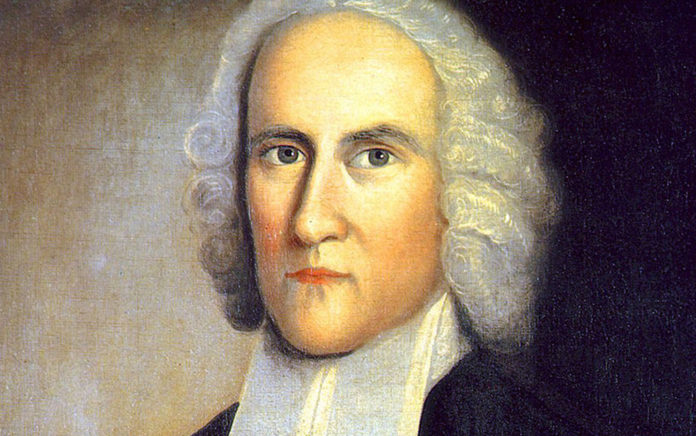
Sinners in the Hands of an Angry God
From Wikipedia, the free encyclopedia
| “Sinners in the Hands of an Angry God, A Sermon Preached at Enfield, July 8th 1741.” | |
| Author | Jonathan Edwards |
|---|---|
| Country | British Colonies |
| Language | English |
| Genre | Sermon |
| Publication date | 8 July 1741 |
| Text | Sinners in the Hands of an Angry God (1741) at Wikisource |

“Sinners in the Hands of an Angry God” is a sermon written by the American theologian Jonathan Edwards, preached to his own congregation in Northampton, Massachusetts, to profound effect,[1] and again on July 8, 1741 in Enfield, Connecticut. The preaching of this sermon was the catalyst for the First Great Awakening.[2] Like Edwards’ other works, it combines vivid imagery of Hell with observations of the world and citations of Biblical scripture. It is Edwards’ most famous written work, is a fitting representation of his preaching style,[3] and is widely studied by Christians and historians, providing a glimpse into the theology of the First Great Awakening of c. 1730–1755.
This was a highly influential sermon of the Great Awakening, emphasizing God’s wrath upon unbelievers after death to a very real, horrific, and fiery Hell. [4] The underlying point is that God has given humans a chance to confess their sins. It is the mere will of God, according to Edwards, that keeps wicked men from being overtaken by the devil and his demons and cast into the furnace of hell – “like greedy hungry lions, that see their prey, and expect to have it, but are for the present kept back [by God’s hand].” Mankind’s own attempts to avoid falling into the “bottomless gulf” due to the overwhelming “weight and pressure towards hell” are insufficient as “a spider’s web would have to stop a falling rock“. This act of grace from God has given humans a chance to believe and trust in Christ.[5] Edwards provides much varied and vivid imagery to illustrate this main theme throughout.
Doctrine
A monument in Enfield, Connecticut commemorating the location where this sermon was preached.

“There is nothing that keeps wicked men at any one moment out of hell, but the mere pleasure of God.“
Most of the sermon’s text consists of ten “considerations”:
- God may cast wicked men into hell at any given moment.
- The wicked deserve to be cast into hell. Divine justice does not prevent God from destroying the Wicked at any moment.
- The wicked, at this moment, suffer under God’s condemnation to Hell.
- The wicked, on earth—at this very moment—suffer a sample of the torments of Hell. The wicked must not think, simply because they are not physically in Hell, that God (in Whose hand the wicked now reside) is not—at this very moment—as angry with them as He is with those miserable creatures He is now tormenting in hell, and who—at this very moment—do feel and bear the fierceness of His wrath.
- At any moment God shall permit him, Satan stands ready to fall upon the wicked and seize them as his own.
- If it were not for God’s restraints, there are, in the souls of wicked men, hellish principles reigning which, presently, would kindle and flame out into hellfire.
- Simply because there are not visible means of death before them at any given moment, the wicked should not feel secure.
- Simply because it is natural to care for oneself or to think that others may care for them, men should not think themselves safe from God’s wrath.
- All that wicked men may do to save themselves from Hell’s pains shall afford them nothing if they continue to reject Christ.
- God has never promised to save us from Hell, except for those contained in Christ through the covenant of Grace.
Purpose
One church in Enfield, Connecticut, had been largely unaffected during the First Great Awakening of New England. Edwards was invited by the pastor of the church to preach to them. Edwards’s aim was to teach his listeners about the horrors of hell, the dangers of sin, and the terrors of being lost. Edwards described the position of those who do not follow Christ’s urgent call to receive forgiveness. Edwards scholar John E. Smith notes that despite the apparent pessimism of the notion of an angry God, that pessimism is “overcome by the comforting hope of salvation through a triumphant, loving savior.” Whenever Edwards preached terror, it was part of a larger campaign to turn sinners from their disastrous path and to the rightful object of their affections, Jesus Christ.”[6]
Application
In the final section of “Sinners in the Hands of an Angry God,” Edwards shows that his theological argument holds throughout scripture and biblical history. He invokes stories and examples throughout the whole Bible. Edwards ends the sermon with one final appeal: “Therefore let everyone that is out of Christ, now awake and fly from the wrath to come.” According to Edwards, only by returning to Christ can one escape the stark fate he outlines.
Effect and legacy
Edwards was interrupted many times during the sermon by people moaning and crying out, “What shall I do to be saved?”.[citation needed] Although the sermon has received criticism, Edwards’ words have endured and are still read to this day. Edwards’ sermon continues to be the leading example of a First Great Awakening sermon and is still used in religious and academic studies.[7]
Since the 1950s, a number of critical perspectives were used to analyze the sermon.[8] The first comprehensive academic analysis of “Sinners in the Hands of an Angry God” was published by Edwin Cady in 1949,[9] who comments on the imagery of the sermon and distinguishes between the “cliché” and “fresh” figurative images, stressing how the former related to the colonial life. Lee Stuart questions that the message of the sermon was solely negative and attributes its success to the final passages in which the sinners are actually “comforted”.[10] Rosemary Hearn argues that it is the logical structure of the sermon that constitutes its most important persuasive element.[11] Lemay looks into the changes in the syntactic categories, like grammatical tenses, in the text of the sermon.[12] Lukasik stresses how in the sermon Edwards appropriates Newtonian physics, especially the image of the gravitational pull that would relentlessly bring the sinners down.[13] Gallagher focuses on the “beat” of the sermon, and on how the consecutive structural elements of the sermon serve different persuasive aims.[14] Choiński suggests that the rhetorical success of the sermon consists in the use of the “deictic shift” that transported the hearers mentally into the figurative images of hell.[15]
Ironically, Jonathan Edwards wrote and spoke a great deal on heaven and angels, writes John Gerstner in Jonathan Edwards on Heaven and Hell, 1998,[16] and those themes are less remembered, namely “Heaven is a World of Love”.[17]
More at: https://en.wikipedia.org/wiki/Sinners_in_the_Hands_of_an_Angry_God