How can a brain tumor diagnosis be a gift? And how can a book about this experience be full of joy … and have the potential to change your life? After a decade exploring the nature of reality and researching and experimenting with human potential Will Pye experienced an initiation at the age of thirty-one via a Grand Mal seizure and the subsequent diagnosis of a golf-ball-sized brain tumor. Will shares how he was able to experience the development with no stress or suffering, how the diagnosis became an opportunity for profound growth and how we too can access the gifts of such a wake-up call. Will reveals scientifically proven tools and perspectives to transform our lives by changing our minds and opening our hearts. Learn how accessing these untapped powers and potentials causes positive changes in those around us and throughout the world. Catalyze your own transformation, contribute to the global shift in consciousness and discover life purpose everywhere you look with this extraordinary book. Will Pye is a social entrepreneur, consultant, coach, speaker and workshop leader working with individuals and groups globally facilitating transformation at the most fundamental level. He divides his time between Melbourne, Australia and Cambridge, England. www.willpye.com
In Your Mind In your mind One foot on Jacob’s ladder and one foot in the fire And it all goes down in your mind Livin’ at the bottom of the stairs of life Never a smile knockin’ on your door The air is blue and so are you Prehistoric monsters on the floor Last verse of your last song And God don’t hear dead men The end of the line is in your mind Then you’ll be stayin’ in In your mind In your mind Bone for bone and skin for skin Eye for eye and tooth for tooth Heart for heart and soul for soul Somebody said “What is truth”? Lock it up and close it down The sound of mournin’ like a dove High beyond the rattlin’ roar Lookin’ to the face of love [Chorus:] In your mind In your mind It all goes down in your mind One foot on Jacob’s ladder and one foot in the fire And it all goes down in your mind In your mind In your mind Sunday words are back again And you eat your fundamentalist pie But just a piece you understand You get the rest up in the sky Praise and glory, wounded angels Shufflin’ ’round the room Eternity is down the hall And you sit there bendin’ spoons In your mind In your mind Father, Son, and Holy Ghost Sacrificial drops of pain On a silver plated cross Sanctification on a chain Thay say redemption draweth nigh The storms of silence from above Stop your ears and close your eyes And try to find the face of love [Repeat Chorus twice]
The bestselling book on childhood trauma and the enduring effects of repressed anger and pain
Why are many of the most successful people plagued by feelings of emptiness and alienation? This wise and profound book has provided millions of readers with an answer–and has helped them to apply it to their own lives.
Far too many of us had to learn as children to hide our own feelings, needs, and memories skillfully in order to meet our parents’ expectations and win their “love.” Alice Miller writes, “When I used the word ‘gifted’ in the title, I had in mind neither children who receive high grades in school nor children talented in a special way. I simply meant all of us who have survived an abusive childhood thanks to an ability to adapt even to unspeakable cruelty by becoming numb…. Without this ‘gift’ offered us by nature, we would not have survived.” But merely surviving is not enough. The Drama of the Gifted Child helps us to reclaim our life by discovering our own crucial needs and our own truth.
Shunryu Suzuki (鈴木 俊隆 Suzuki Shunryū, dharma name Shōgaku Shunryū 祥岳俊隆, often called Suzuki Roshi; May 18, 1904 – December 4, 1971) was a Sōtō Zen monk and teacher who helped popularize Zen Buddhism in the United States, and is renowned for founding the first Zen Buddhist monastery outside Asia (Tassajara Zen Mountain Center). Suzuki founded San Francisco Zen Center which, along with its affiliate temples, comprises one of the most influential Zen organizations in the United States. A book of his teachings, Zen Mind, Beginner’s Mind, is one of the most popular books on Zen and Buddhism in the West.[1][2][3]
Biography
Childhood
Shunryu Suzuki was born May 18, 1904, in Kanagawa Prefecture southwest of Tokyo, Japan.[4] His father, Butsumon Sogaku Suzuki, was the abbot of the village Soto Zen temple.[4] His mother, Yone, was the daughter of a priest and had been divorced from her first husband for being too independent. Shunryu grew up with an older half-brother from his mother’s first marriage and two younger sisters. As an adult he was about 4 feet 11 inches (1.5 m) tall.[5]
His father’s temple, Shōgan-ji, was located near Hiratsuka, a city on Sagami Bay about fifty miles southwest of Tokyo. The temple income was small and the family had to be very thrifty.[4]
When Suzuki entered school he became aware that his family was very poor. Suzuki was sensitive and kind but prone to quick bursts of anger. The other boys ridiculed him for his shaved head and for being the son of a priest. He preferred staying in the classroom to playing in the schoolyard, and was always at the top of his class. His teacher told him that he should grow up to be a great man, and to do this he needed to leave Kanagawa Prefecture and study hard.
Apprenticeship
In 1916, 12-year-old Suzuki decided to train with a disciple of his father, Gyokujun So-on Suzuki.[4] So-on was Sogaku’s adopted son and abbot of Sogaku’s former temple Zoun-in. His parents initially thought he was too young to live far from home but eventually allowed it.
Zoun-in is in a small village called Mori, Shizuoka in Japan. Suzuki arrived during a 100-day practice period at the temple and was the youngest student there. Zoun-in was a larger temple than Shōgan-ji.
At 4:00 each morning he arose for zazen. Next he would chant sutras and begin cleaning the temple with the others. They would work throughout the day and then, in the evenings, they all would resume zazen. Suzuki idolized his teacher, who was a strong disciplinarian. So-on often was rough on Suzuki but gave him some latitude for being so young.
When Suzuki turned 13, on May 18, 1917, So-on ordained him as a novice monk (unsui).[4] He was given the Buddhist name Shogaku Shunryu,[4] yet So-on nicknamed him Crooked Cucumber for his forgetful and unpredictable nature.
Shunryu began again attending upper-elementary school in Mori, but So-on did not supply proper clothes for him. He was the subject of ridicule. In spite of his misfortune he didn’t complain. Instead he doubled his efforts back at the temple.
When Shunryu had first come to Zoun-in, eight other boys were studying there. By 1918, he was the only one who stayed. This made his life a bit tougher with So-on, who had more time to scrutinize him. During this period Suzuki wanted to leave Zoun-in but equally didn’t want to give up.
In 1918 So-on was made head of a second temple, on the rim of Yaizu, called Rinso-in. Shunryu followed him there and helped whip the place back in order. Soon, families began sending their sons there and the temple began to come to life. Suzuki had failed an admissions test at the nearby school, so So-on began teaching the boys how to read and write Chinese.
So-on soon sent his students to train with a Rinzai master for a while. Here Shunryu studied a very different kind of Zen, one that promoted the attainment of satori through the concentration on koans through zazen. Suzuki had problems sitting with his koan. Meanwhile, all the other boys passed theirs, and he felt isolated. Just before the ceremony marking their departure Suzuki went to the Rinzai teacher and blurted out his answer. The master passed Suzuki; later Shunryu believed he had done it simply to be kind.
In 1919, at age 15, Suzuki was brought back home by his parents, who suspected mistreatment by So-on. Shunryu helped out with the temple while there and entered middle school. Yet, when summer vacation came, he was back at Rinso-in and Zoun-in with So-on to train and help out. He didn’t want to stop training.
In school Suzuki took English and did quite well. A local doctor, Dr. Yoshikawa, hired him to tutor his two sons in English. Yoshikawa treated Suzuki well, giving him a wage and occasional advice.
Higher education
In 1924 Shunryu enrolled in a Soto preparatory school in Tokyo[4] not far from Shogan-ji, where he lived on the school grounds in the dorm. From 1925 to 1926 Suzuki did Zen training with Dojun Kato in Shizuoka at Kenko-in. He continued his schooling during this period. Here Shunryu became head monk for a 100-day retreat, after which he was no longer merely considered a novice. He had completed his training as a head monk.
In 1925 Shunryu graduated from preparatory school and entered Komazawa University, the Soto Zen university in Tokyo.[4] During this period he continued his connections with So-on in Zoun-in, going back and forth whenever possible.
Some of his teachers here were discussing how Soto Zen might reach a bigger audience with students and, while Shunryu couldn’t comprehend how Western cultures could ever understand Zen, he was intrigued.
On August 26, 1926, So-on gave Dharma transmission to Suzuki.[4] He was 22.[4] Shunryu’s father also retired as abbot at Shogan-ji this same year, and moved the family onto the grounds of Zoun-in where he served as inkyo (retired abbot).
Later that year Suzuki spent a short time in the hospital with tuberculosis, but soon recovered. In 1927 an important chapter in Suzuki’s life was turned. He went to visit a teacher of English he had at Komazawa named Miss Nona Ransom, a woman who had taught English to such people as the last emperor of China, Pu-yi, and more so his wife, the last empress of China, Jigoro Kano (the Founder of Judo), the children of Chinese president Li Yuanhong, and some members of the Japanese royal family. She hired him that day to be a translator and to help with errands. Through this period he realized she was very ignorant of Japanese culture and the religion of Buddhism. She respected it very little and saw it as idol worship. But one day, when there were no chores to be done, the two had a conversation on Buddhism that changed her mind. She even let Suzuki teach her zazen meditation. This experience is significant in that Suzuki realized that Western ignorance of Buddhism could be transformed.
On January 22, 1929, So-on retired as abbot of Zoun-in and installed Shunryu as its 28th abbot. Sogaku would run the temple for Shunryu. In January 1930 a ten’e ceremony was held at Zoun-in for Shunryu. This ceremony acknowledged So-on’s Dharma transmission to Shunryu, and served as a formal way for the Soto heads to grant Shunryu permission to teach as a priest. On April 10, 1930, at age 25, Suzuki graduated from Komazawa Daigakurin with a major in Zen and Buddhist philosophy, and a minor in English.
Suzuki mentioned to So-on during this period that he might be interested in going to America to teach Zen Buddhism. So-on was adamantly opposed to the idea. Suzuki realized that his teacher felt very close to him and that he would take such a departure as an insult. He did not mention it to him again.
Eihei-ji and Sōji-ji
Upon graduation from Komazawa, So-on wanted Shunryu to continue his training at the well known Soto Zen temple Eihei-ji in Fukui Prefecture. In September 1930 Suzuki entered the training temple and underwent the Zen initiation known as tangaryo. His mother and father stayed on at Zoun-in to care for his temple in his absence.
Eihei-ji is one of the largest Zen training facilities in Japan, and the abbot at this time was Gempo Kitano-roshi. Prior to coming to Japan, Kitano was head of Soto Zen in Korea. He also was one of the founders of Zenshuji, a Soto Zen temple located in Los Angeles, California. Suzuki’s father and Kitano had a tense history between them.[6] Sogaku had trained with Kitano in his early Zen training and felt that he was such a high priest due to familial status and connections. Shunryu did not see this in Kitano, however. He saw a humble man who gave clear instruction, and Shunryu realized that his father was very wrong in his assessment.
Often monks were assigned duties at the monastery to serve certain masters. Shunryu was assigned to Ian Kishizawa-roshi, a well known teacher at the time who had previously studied under two great Japanese teachers: Sōtan Oka and Bokusan Nishiari. He was a renowned scholar on Dōgen’sShōbōgenzō, and was also an acquaintance of his father from childhood.
Kishizawa was strict but not abusive, treating Suzuki well. Suzuki learned much from him, and Kishizawa saw a lot of potential in him. Through him Suzuki came to appreciate the importance of bowing in Zen practice through example. In December Suzuki sat his first true sesshin for 7 days, an ordeal that was challenging initially but proved rewarding toward the end. This concluded his first practice period at Eihei-ji.
In September 1931, after one more practice period and sesshin at Eihei-ji, So-on arranged for Suzuki to train in Yokohama at Sōji-ji. Sōji-ji was the other main Soto temple of Japan, and again Suzuki underwent the harsh tangaryo initiation. Sojiji was founded by the great Zen master Keizan and had a more relaxed atmosphere than Eihei-ji. At Sōji-ji Suzuki travelled back to Zoun-in frequently to attend to his temple.
In 1932 So-on came to Sōji-ji to visit with Shunryu and, after hearing of Suzuki’s contentment at the temple, advised him to leave it. In April of that year Suzuki left Sōji-ji with some regret and moved back into Zoun-in, living with his family there. In May he visited with Ian Kishizawa from Eiheiji and, with So-on’s blessing, asked to continue studies under him. He went to Gyokuden-in for his instruction, where Kishizawa trained him hard in zazen and conducted personal interviews with him.
Sometime during this period Suzuki married a woman who contracted tuberculosis. The date and name of the woman is unknown, but the marriage was soon annulled. She went back to live with her family while he focused on his duties at Zoun-in.
Suzuki reportedly was involved with some anti-war activities during World War II, but according to David Chadwick, the record is confusing and, at most, his actions were low-key.[7] However, considering the wholesale enthusiastic support for the war expressed by the entire religious establishment in Japan at the time, this fact is significant in showing something of the character of the man.
San Francisco Zen Center
On May 23, 1959, Shunryu Suzuki arrived in San Francisco to attend to Soko-ji, at that time the sole Soto Zen temple in San Francisco. He was 55.[4] Suzuki took over for the interim priest, Wako Kazumitsu Kato. Suzuki was taken aback by the Americanized and watered-down Buddhism practiced at the temple, mostly by older immigrant Japanese. He found American culture interesting and not too difficult to adjust to, even commenting once that “if I knew it would be like this, I would have come here sooner!” He was surprised to see that Sokoji was previously a Jewishsynagogue (at 1881 Bush Street, now a historic landmark). His sleeping quarters were located upstairs, a windowless room with an adjoining office.
At the time of Suzuki’s arrival, Zen had become a hot topic amongst some groups in the United States, especially beatniks. Particularly influential were several books on Zen and Buddhism by Alan Watts. Word began to spread about Suzuki among the beatniks through places like the San Francisco Art Institute and the American Academy of Asian Studies, where Alan Watts was once director. Kato had done some presentations at the Academy and asked Suzuki to come join a class he was giving there on Buddhism. This sparked Suzuki’s long-held desire to teach Zen to Westerners.
The class was filled with people wanting to learn more about Buddhism, and the presence of a Zen master was inspiring for them. Suzuki had the class do zazen for 20 minutes, sitting on the floor without a zafu and staring forward at the white wall. In closing, Suzuki invited everyone to stop in at Sokoji for morning zazen. Little by little, more people showed up each week to sit zazen for 40 minutes with Suzuki on mornings. The students were improvising, using cushions borrowed from wherever they could find them.
The group that sat with Suzuki eventually formed the San Francisco Zen Center with Suzuki. The Zen Center flourished so that in 1966, at the behest and guidance of Suzuki, Zentatsu Richard Baker helped seal the purchase of Tassajara Hot Springs in Los Padres National Forest, which they called Tassajara Zen Mountain Center. In the fall of 1969, they bought a building at 300 Page Street near San Francisco’s Lower Haight neighborhood and turned it into a Zen temple. Suzuki left his post at Sokoji to become the first abbot of one of the first Buddhist training monasteries outside Asia. Suzuki’s departure from Sokoji was thought to be inspired by his dissatisfaction with the superficial Buddhist practice of the Japanese immigrant community and his preference for the American students who were more seriously interested in Zen meditation, but it was more at the insistence of the Sokoji board, which asked him to choose one or the other (he had tried to keep both roles). Although Suzuki thought there was much to learn from the study of Zen in Japan, he said that it had grown moss on its branches, and he saw his American students as a means to reform Zen and return it to its pure zazen- (meditation) and practice-centered roots.
Suzuki died on December 4, 1971, presumably from cancer.[8]
I am excited to bring to you my upcoming guess Aalsa Lee, a woman that has made an art form out of living. A woman, of incredible Strength, Will, and Independence. Some call her Unique. Some say she lived as if a woman from the future.
Come to hear:
A Unique Woman’s Insight into Maximizing Your Life
There are opportunities everywhere for those who have the courage to seize them! You have more than you think you have. You can do more than you think you can. You alone are responsible to use your natural intelligence, talents, abilities, and what some would call your Devine given gift to create a life of your choice. Expose yourself to your possibilities.
A Prosperos SundayMeeting
Zoom Presentation
For this free, one-hour event beginning at 11: 00 a.m. Pacific time- Sunday, June 27, 2021, on Zoom.
William Fennie, H.W., M. 11:00 am Pacific/Noon Mountain/1:00 Central/2:00 Eastern https://us02web.zoom.us/j/332275676 This Sunday William Fennie, H.W., M., examines the underlying Reality Self, ever-present for each of us, that offers guidance and the key to meaningful engagement.
These talks are presented by contribution. Everyone from fundamentalists to atheists are welcome!
One tap mobile+16699006833,,579891643# US (San Jose)+13462487799,,579891643# US (Houston)Dial by your location +1 669 900 6833 US (San Jose) +1 346 248 7799 US (Houston) +1 301 715 8592 US +1 312 626 6799 US (Chicago) +1 929 205 6099 US (New York) +1 253 215 8782 USMeeting ID: 579 891 643Find your local number: https://zoom.us/u/abtcyLDACK
George Berkeley is known for his doctrine of immaterialism: the counterintuitive view that there’s no material substance underlying the ideas perceived by the senses. We tend to think of a horse-drawn coach as a thing, but Berkeley tells us it’s really a set of ideas – the sound of the coach in the street, the sight of it through a window, the feel of it as we get in. We regularly perceive these ideas going along with each other, but there’s no material thing, beyond the ideas, that supports or holds them together – the ideas are all there is. It’s a hard view for a present-day reader to stomach. It was hard on the stomachs of readers even in Berkeley’s day in the early 1700s. He acknowledged that ‘it sounds very harsh to say we eat and drink ideas’ but insists that nourishment is nothing more than various ideas of the senses.
Berkeley also says that pain, real pain, is an idea. This assertion seems to have antagonised and amused his contemporaries. John Arbuthnot, physician to Queen Anne, engages in some light-hearted teasing when writing to his and Berkeley’s friend Jonathan Swift in 1714 that the ‘Poor philosopher Berkley [sic]; has now the Idea of health which was very hard to produce in him, for he had an Idea of a strange feaver upon him so strong that it was very hard to destroy it, by introducing a contrary one.’ It was and is hard to think of all phenomena as ideas and nothing more; even harder to think of our own perceiving, feeling, digesting bodies as ideas and nothing more.
Nevertheless, Berkeley is clear on this: such things as coaches don’t exist independently of being perceived, because they consist of ideas and perceptions. Without there being a perceiver, they simply can’t exist. Do things exist when not perceived by any human mind? Here Berkeley gives a positive answer in the notebooks he kept while he was developing this new doctrine, as he called it: the horses are in the stable, the books are in the study despite no one being there to see, smell, hear or touch them. That is, even when I’m not there to perceive these things, they exist. How so? After all, things exist only when perceived by a mind.
Here, God comes in: because God wills things into existence when she (Berkeley would have said ‘he’) perceives them, then anything that God creates has an existence in her mind. Because God knows and perceives all, those things that are at any given time unperceived or unconsidered by any finite mind have an existence through the infinite mind. God comes into this picture as a saviour, preventing Berkeley from having to say that objects enter and leave existence continually as they’re perceived and then not perceived and then perceived again by particular finite minds.
But God’s role in Berkeley’s thought is not only or most importantly as a backstop for his immaterialism. It is as the giver of laws that other minds must try to follow. These God-given laws structure the moral, social and political world, just as others structure the phenomenal world. I would like to reorient the understanding of Berkeley by bringing the social and political consequences of his religious beliefs to the centre and seeing his immaterialism in relation to them. This aspect of his philosophy is often neglected by those who want to introduce Berkeley as a specimen in the history of philosophy, someone who took empiricism to its limits. A fuller appreciation of the role of God in Berkeley’s philosophy explains why he adopted immaterialism, and why he thought his immaterialist philosophy would serve a social purpose, something that isn’t immediately obvious from the narrow view of Berkeley’s approach that we find in histories of philosophy.
At an early stage in his intellectual development, Berkeley realised that the created universe depends on God, a universe that is known to humans through the relatively dependable series of ideas they experience. God is, then, central to Berkeley’s thought, providing the context in which the human world elaborates itself: he described the biblical creation as God progressively revealing to other minds some of the eternal contents of her own mind. It’s only because God determines that human acts of will have certain consequences in visual, tactile and other sensory ideas that we have any ideas of our bodies, and that human agency has consequences in the world at all, let alone dependable consequences. It is for these reasons that Berkeley said that the visual world was a universal language ‘whereby we are instructed how to regulate our actions’, that the phenomenal world was designed by God to demonstrate his grandeur and show us how to behave. Berkeley’s purpose in writing was to convince his readers that we have a ‘most absolute and immediate dependence’ on God.
The precise conception Berkeley has of dependence on God and its consequences for human obligation – to God, to other humans, and to the rest of the creation – isn’t an aspect of his thinking that can be bracketed and ignored (as it has been so often by philosophers). The relationship of dependence on God is one of subordination to laws that humans, as responsible agents, are obliged to try to follow. These two things, the existence of a God and the moral responsibility of humans, would have made up the second part of Berkeley’s most famous book, A Treatise Concerning thePrinciples of Human Knowledge (1710), had the manuscript not been lost while he was touring Europe. Berkeley’s universe is best understood as a body of law that human agents and other finite minds attempt to read and then follow through their actions.
This is where I think we should start, with a legible world dictated by God, when interpreting Berkeley today. Such a reading will give us a philosopher who is not just or even foremost an immaterialist, but rather a social and religious philosopher who is constantly emphasising the need for subordination, the following of rules and laws, and the necessity of obedience. His immaterialism, indeed, somewhat surprisingly, serves that end. That is why Berkeley conceived of his immaterialism as part of his lifelong struggle against what he variously called atheism, scepticism or free-thinking – the challenge to religious authority over the social world.
We’re under an obligation to conform to natural and moral laws because a superior agent wills them
Immaterialism is not (just) a counterintuitive doctrine that surprised Berkeley’s contemporaries and still surprises his readers, nor is his God just the saviour of that doctrine. Rather, Berkeley expressed, through a wide range of writing including his great immaterialist texts, the necessity of social, political, moral and religious dependence on higher beings. He was a thoroughly religious philosopher, and his religion implied a politics. That politics was of a conservative cast, and included (disappointingly) the defence of slavery, as well as some more progressive or emancipatory forms of conservatism such as the promotion of education and economic development. Appreciating the role of God-given laws in his outlook unlocks a fuller understanding of his immaterialism. Without this, it’s very hard to appreciate why immaterialism is so relevant to some of his other somewhat eclectic concerns, including economic development, the swearing of oaths, and slavery.
In a text built up from three discourses delivered in the Chapel at Trinity College Dublin as part of his duties as a fellow, and published in 1712 under the controversial title Passive Obedience, Berkeley asked ‘what relation is there more extensive and universal than that of subject and law?’ He was talking about humans living under human laws, but just a few paragraphs earlier he’d made a case for the comparability of natural and moral laws. The laws of nature are ‘nothing else but a series of free actions produced by the best and wisest Agent’. The natural and moral worlds are to be conceived of as the free actions of God, and binding as laws for all other spirits. We should recognise both the kinds of law that govern events beyond our wills, such as those of gravity, and also those that require us to exercise our wills, such as the absolute negative moral law against rebellion that Berkeley elaborated in this short book. This conception of the human relationship to God as conforming to the will of a superior should remain central to our understanding of Berkeley’s philosophical project. We’re under an obligation to conform to natural and moral laws because a superior agent wills them, and wills that we conform to them.
In his roles as fellow of a college, chaplain, dean and bishop, Berkeley preached, and a significant part of his preaching addressed the question of how people should manifest in their behaviour the duty they owe to God. Religion, he said, ‘is nothing else but the conforming our faith and practice to the will of god’. ‘What else is the design and aim of vertue or religion,’ he asked in the same sermon, ‘but the making our several distinct wills coincident with, and subordinate to, the one Supreme will of God?’ We honour and show love for superiors ‘by performing their will, & endeavouring that others perform it’. This subordination isn’t of all finite spirits equally to the one infinite spirit: there are degrees of conformity to God’s will. Berkeley says there is ‘Some sort of union with the Godhead’ in all people ‘but with men, Xtians, inspired persons, Xt in different degrees.’ Different degrees of conformity are different degrees of unity with God.
Conformity brings spiritual rewards. It also brings temporal privileges. As Berkeley said in an early sermon on zeal: ‘As we are Christians we are members of a Society which entitles us to certain rights and privileges above the rest of mankind.’ In his ‘Address on Confirmation’, Berkeley said that, while the whole world might be understood as the kingdom of Christ, the phrase also had a more restrictive sense and applied to ‘a Society of persons, not only subject to his power, but also conforming themselves to his will, living according to his precepts, and thereby entitled to the promises of his gospel.’ That is, when Berkeley talked about the phenomenal world of ideas forming an instructive discourse directed to us by God, the God he had in mind requires conformity to his will. Greater or lesser degrees of conformity result in privileges expressed in the social and religious hierarchy of this world.
The God who produces the immaterial world, then, requires specific behaviours of different kinds of people, and grants them specific privileges. The distinction is not just between Christians and non-Christians, but between various types and classes of person in Christian societies. Here Berkeley is quite in line with his times and the large number of books dedicated to differentiating and specifying the duties of types and classes of people – children, parents, spouses, magistrates and so on. Berkeley’s sense of stratification and distinction by social status or rank is most obvious in his economic writings of the mid-1730s, chiefly the three volumes of rhetorical questions called The Querist, which put forward a programme for Irish economic renewal. The (‘native’, Catholic) peasantry are to give up their alleged sloth and dirtiness for habits of cleanliness and industry. The (absentee, Protestant) gentry are to give up imported wines and textiles for Irish cider and linen. Both classes will find they have higher desires – the peasants for beef and better clothes; the gentry for local productions of the fine and useful arts. A national bank will support the increased rate of circulation in the economy, or its momentum, as Berkeley calls it. And a class of philosophical educators such as Berkeley himself will manage the necessary transformation of opinions, desires and practices, chiefly by educating the gentry. Different classes of people – the higher, the lower, the educators – have different roles in practising and producing conformity to God’s will.
All classes of people have responsibilities to God that are in part expressed through their behaviour towards their own and other classes of people. ‘Charity’ is the term that, for Berkeley, captures the fulfilment of these responsibilities. He preached on charity at the English merchant colony in Livorno in Italy in 1714, saying – perhaps with an eye to the background of his audience – that the mutual satisfaction of wants through commerce was a form of charitable action within the reach of all. Duty to God and charity to his neighbour will make the true Christian attempt the conversion of heathens and infidels, Berkeley said in the sermon he preached to the Society for Propagation of the Gospel in Foreign Parts on his return from his failed expedition to found a university in Bermuda. That project was itself geared towards the conversion of Native Americans, as well as the religious reform of white colonists.
Berkeley wrote Alciphron (1732) while in Rhode Island awaiting the funds for the university he hoped to found, which never arrived. One of the characters who voices views closest to those Berkeley expressed elsewhere says that it’s an obligation to dispense ‘Medicine for the Soul of Man’. In 1734, Berkeley became Bishop of Cloyne in southern Ireland. He described the poor of Cloyne, a small town in Cork, as ‘objects of charity’, and the employment of around 100 men in agriculture led by his wife Anne as ‘a charity which pays it self’. Berkeley’s last major work, Siris (1744), is an idiosyncratic text that begins with instructions on how to mix water with pine resin to create a medicinal drink for treating the epidemic of dysentery that swept Ireland in 1740-41, and continues to argue for the compatibility of ancient and Christian accounts of the soul and the Trinity. He said there that he was ‘indispensably obliged by the duty every man owes to mankind’, and that ‘charity obligeth me to say what I know’.
‘Obedience to all civil power is rooted in the religious fear of God’
Charity is, if you like, the positive side of an obligation to other people, and to God. In contrast, Berkeley frequently expressed a negative or restrictive obligation that’s broadly concerned with implicitly or explicitly giving one’s word. It’s one of the assumptions of Passive Obedience that any social order is better than none, and that accepting the benefits of social order (simply those of not ‘anarchy’) is to accept the legitimacy of the sovereign who governs that order and the absolute obligation not to rebel against that sovereign. When Berkeley wrote to persuade Tories not to break their oaths of allegiance to George I as the Jacobite uprising of 1715 unfolded, he noted that:
Common mutual faith is the great support of society; and an oath, as it is the highest obligation to keep our faith inviolate, becomes the great instrument of justice and intercourse between men. Whatever, therefore, lessens the sacredness or authority of an oath must be acknowledged at the same time to be highly detrimental both to the Church and the Commonwealth.
Berkeley presented similar views in 1738 when he thought the social fabric was under threat from the atheistical blasphemies of a rogueish Dublin society called the Blasters. ‘Obedience to all civil power is rooted in the religious fear of God,’ and only reverence for God ‘can beget and preserve a true respect for subordinate majesty in all the degrees of power, the first link of authority being fixed at the throne of God.’ Misusing oaths is to threaten the very source of civil life, submission to the authority of God.
More specific oaths also concerned Berkeley. He took a strong view of the obligations of the marriage vow. When one of his brothers was condemned to death for bigamy, but saved by the interventions of Berkeley’s friends, Berkeley wrote to reimburse them for the expense. He noted, however, he ‘would not have disbursed half the sum to have saved that villain from the gallows’. When Berkeley excerpted a discussion of the marital vow of obedience from a book on The Relative Duties of Parents and Children, Husbands and Wives, Masters and Servants (1705) for his anthology The Ladies Library (1714), he inserted some thoughts of his own: that it is ‘a Command, the Breach of which is a Sin, and the Punishment of all Sin, Death eternal’. If we have any interest in order at all, if we have an interest in the world appearing to us as a regular, dependable, interpretable chain of events, an interest in our own wills producing predictable and stable outcomes, then we must obey the source of this order, the supreme authority of God.
Obedience can be presented more positively as charity, but it remains an attempt to conform to a higher will, in the expectation of gaining privileges and responsibilities in this world and the next. Humans depend on God for an orderly sequence of ideas and experiences as they interact with the physical world; they also depend on God for social and moral order. To maintain social and moral order, humans must feel religious awe towards God, and acknowledge the legitimacy of subordination of people into different classes and ranks, with different privileges and responsibilities. God doesn’t exist to repair the problem of occasionally existing objects in Berkeley’s immaterialism. Berkeley’s immaterialism exists to give his readers a sense of their entire dependence – social, moral and political as well as experiential – upon God. Dependence upon God models forms of human dependence and relation that Berkeley described in a wide range of writings.
As we have just seen, Berkeley’s God is the source of all authority, subordination and order. Finite spirits aren’t obliged to obey only God, but also to obey their superiors in the social order. Servants are obliged to obey their masters. In a way that distinguishes him from immediate predecessors such as John Locke or Samuel Pufendorf, Berkeley blurred the line between servitude and slavery, between contractual and forced, temporary and permanent servitude. In TheQuerist, Berkeley asked: whether ‘other nations have not found great benefit from the use of slaves’ for public infrastructure projects? ‘Whether temporary servitude would not be the best cure for idleness and beggary …?’ ‘Whether all sturdy beggars should not be seized and made slaves to the public for a certain term of years?’
Berkeley’s language here minimises the difference between slavery and servitude. Likewise, in notes for a sermon preached in Rhode Island, he said that in the New Testament ‘servants’ signified ‘slaves’. I’m not suggesting that Berkeley believed slavery was a positive good. Rather, he believed that what he understood to be dissolute, dirty, cynical, slothful, asocial forms of life were a great ill, and that being forced to participate in projects promoting the public good was better than being left at liberty to dehumanise. Such a view, of course, legitimises slavery.
Berkeley supported obedience to forms of temporal subordination now recognised as morally repugnant
Berkeley presents slavery within an orderly Christian society as preferable to forms of liberty that, he believes, limit the development of important human capacities. When Berkeley was in Rhode Island waiting for his college funding, there’s evidence of him buying two and baptising three enslaved people. The historian Travis Glasson has convincingly argued that the Yorke-Talbot legal opinion, issued in 1729, that baptism and slavery were compatible was the result of the activism of Berkeley or his circle, trying to facilitate the baptism of enslaved people in America. Berkeley had argued in his Proposal for the Better Supplying of Churches (1725) for the college that would take Native American and Black students, as well as the sons of white planters, that ‘Slaves would only become better Slaves by being Christian’. Berkeley supported obedience to forms of temporal subordination that are now recognised as morally repugnant, and argued that some forms of forced labour, perhaps temporary, perhaps not, were a social good – a greater good than the ills of servitude or slavery.
There’s much about this picture of Berkeley’s God, and the human and divine relationships it implies, that Berkeley shares with other Christian writers of the 17th and 18th centuries. It’s not surprising to see Christianity connected to subordination and obedience, both in political and social life, and encompassing slavery, for instance. It’s more unusual, perhaps, in the precise obligations it entails for someone like Berkeley, a philosophical educator. This person has to conform to God’s will by following laws, by accepting privileges and responsibilities to shape and govern other people through discourse and through the founding and maintenance of social institutions, from colleges to farms, in order to produce the same great good for them – conformity to the highest will. In doing these things, the philosophical educator is imitating God. God discourses continually to humans through the phenomenal world, through its regularities and dependable phenomena; but also through its less predictable events, such as illness, earthquakes and extreme weather. The philosopher should also learn to read these phenomena.
The immaterialist doctrine exists to promote this understanding of and conformity to God, rather than God being a convenient backstop for immaterialism. In both its typical and its more idiosyncratic respects, therefore, Berkeley’s sense of the religious foundation and lived texture of social life isn’t something that can be set aside without the risk of mischaracterising his immaterialism and his philosophical ambitions in general.
The central realisation Berkeley wanted his readers to undergo is that of absolute and continual dependence upon the will of a superior for everything in their world – their sensory experiences, the laws of nature, the capacity of their wills to bring about consequences, the complex coordination and subordination of wills involved in producing a social world. This realisation issues in the striking doctrine of immaterialism. But it also issues in the particular form of conservative political and social life that Berkeley lived and promoted in his varied activities as a churchman, economist, husband, brother, slave-owner and so on. Understanding Berkeley’s immaterialism, and the role of God in his immaterialism, requires an acknowledgement of his religious view of political and social life. Some of that view is closely shared with other Christian writers of his time, some of it more idiosyncratic and characteristic of the visionary immaterialist that he was.
World work is a spiritual practice that Joel Goldsmith invited his students to follow. He believed that individual spiritual illumination was not solely for the purpose of advancing our own spiritual consciousness, but that its greater importance and purpose was to lift world consciousness.
Joel realized that the world is living in a sense of separation from God, and that this sense of separation is the root of all world problems. Yet he also recognized that the illumined consciousness of individuals—the developed Christ-consciousness—can dissolve that material sense. So Joel constantly encouraged students to refrain from fighting, bemoaning, or trying to solve the problems of the world in human ways, but rather to work to elevate our own consciousness by going within to the silence, realizing the omnipresence of God and communing with the Christ of being. Joel said,
“Our goal is not stopping wars. Our goal is not emptying hospitals of sick people. Our goal is not making all poor people have abundance. Our goal is the destruction of material sense, so that the new creature, Christ, may be revealed as individual being.”[1]
Joel believed that those who have gone one step ahead in spiritual understanding had to accept responsibility not only for their own family, community, and nation, but for world conditions. He said that our concern should embrace the whole world, so that the spiritual kingdom would be manifest on earth.
The Practice: Three Daily Meditations
Joel’s world work practice consists of dedicating three meditation periods each day to uplifting the consciousness of the world and dissolving the material sense that keeps it in bondage. We go into these meditations with no personal desires or intentions, and without criticism, judgment, or condemnation of others. We do not seek to change the conditions of “this world,” recognizing that “My kingdom is not of this world,”[2] and that the realization of the Presence will reveal divine law, order, and harmony. As we go into these meditations, we simply have the intention to experience the Presence, to realize the Christ within, and by so doing, release the influence of the Christ into the world. As Joel said,
“It has been given to me that if a band of realized Christ-consciousness is formed around the world, it will touch and awaken individual consciousness and bring lasting freedom to the world.”[3]
These are Joel’s simple directions for the three meditation periods:
“Let your first meditation period be only for the purpose of feeling a consciousness of God’s presence. When that has been achieved, that is the end of that period of meditation for the world.
In your second meditation, again achieve a conscious awareness of God’s presence and realize that this realization of the Christ is dispelling material sense in human consciousness.
Begin your third meditation once again with a realization of the Christ, and then recognize that that realization of the Christ is dispelling material sense and opening human consciousness to a receptivity to Truth.”[4]
Doing these world work meditations is our gift to the world and our contribution to world freedom. It is a part of our tithing, or giving back to God of our first fruits.
The Effect
Joel said that we cannot measure the degree of power that may flow through an individual who is realizing the omnipresence of God. We have no idea who might be touched by the Christ as a result of our world work and be in a position to take some beneficial and effective action.[5] The person who is in the right place at the right time with some degree of receptivity will be the one through whom the Christ will seem to come. But we do not need to know who it is, or when it happens, or where. Our function in world work is just to be instruments through which the presence of God can touch and awaken humanity. Joel believed that through our spiritual realization, we can help to settle the affairs of the world, not by might and not by power, but by the Spirit of God.
Further Reading on World Work
Joel spoke often of World Work, but never more eloquently than in “Spiritual Freedom,” the Infinite Way Letter of July 1959, now found in the book The Heart of Mysticism.
[1] Recording #155, Side A, 1956 Barbizon Private Class for “25”, “Three Daily Meditations—Realized Consciousness”
[3]The Heart of Mysticism, pp. 1157 (1959 July Letter: “Spiritual Freedom” )
[4]The Heart of Mysticism, pp. 1156-1157 (1959 July Letter: “Spiritual Freedom” )
[5] In her book, The Spiritual Journey of Joel S. Goldsmith, Lorraine Sinkler tells a story that illustrates this point. In 1937, the Congress under President Roosevelt proposed legislation to “pack” the Supreme Court in order to make it more amenable to the New Deal. When Joel heard about this, he saw the risk. The night before the bill was to come up for a vote, the “Voice” told him to stay up and pray that night, meditating and reading, not praying for defeat of the bill, but simply waiting for something to come through. At four o’clock a.m. the answer came that the work had been done. The bill did not pass, and years later, the editor of a chain of newspapers told that he had been awakened at four o’clock in the morning on that particular day by a voice in his ear saying that the bill must be stopped. He sent out word to all his newspapers to enlist public opinion against the bill, with the result that the nation was so aroused that the bill was defeated.
Iwihub Collection of talks that comprise the book “The Mystical I” London Special Class 1964 tape 562 B “World Work 1964 We may not pass by on the other side” Transcript: https://theinfiniteway.files.wordpres…
Joel Solomon Goldsmith (March 10, 1892 – June 17, 1964) was an American spiritual author, teacher, spiritual healer, and modern-day mystic. He founded The Infinite Way movement. Wikipedia
Larry Williams Buried by ABC at the time, the segment has resurfaced over four decades later, revealing a unique glimpse into Baldwin’s private life—as well as his resounding criticism about white fragility, as blisteringly relevant today as it was in 1979. Conducted by the late Sylvia Chase, the interview took place at 137 West 71st Street—the Manhattan apartment building Baldwin bought for himself and his family in 1965.
Epic in scope, this book examines the many different and complex sources of racism
The book is hugely impressive in following the often complex threads of various racist attitudes and sources from pamphlets, pulpits and political discourse to the arts.
This book, epic in scope, is a detailed look at the history of racist and anti-racist ideas in America. It traces their antecedents in the thoughts of Aristotle and Christianity, citing Greek ideas of Greek superiority and the curse theory – Noah’s son Ham as the cursed Black person. Equally the antecedents of anti-racist thinking were also present. “‘The deity gave liberty to all men, and nature created no one a slave,’ wrote Alkidamas, Aristotle’s rival in Athens.”
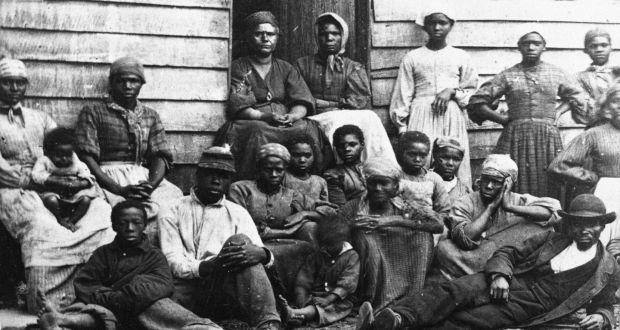
Before the 1400s the slave trade was in East European Slavs (this is the origin of the word slaves). By the 1400s the Slavs had built better fortifications and Africa became the main area of operation for slave traders. This then allowed the curse theory to be fully activated as now the slaves were exclusively black.
Gomes Eanes de Zurara is credited with writing the first “recorded history of anti-Black racist ideas…” with The Chronicle of the Discovery and Conquest of Guinea, in 1453.
Gomes Eanes de Zurara is credited with writing the first “recorded history of anti-Black racist ideas…” with The Chronicle of the Discovery and Conquest of Guinea, in 1453. It was a record of the Portuguese slavery trade in the 1440s under Prince Henry. As the author Dr Ibram X Kendi points out, his words were “a product of, not a producer of, Prince Henry’s racist policies…”
Kendi asserts that “…self-interest leads to racist policies, which lead to racist ideas leading to all the ignorance and hate. Racist policies were created out of self-interest.’’
Time and again Kendi illustrates this as in the case of Thomas Jefferson who wrote: “No person living wishes more sincerely than I do…to see racial equality proven”. This from a man whose entire life and comfort relied on the use of slaves (estimated at 600 in his lifetime).
Anti-slavery concerns were often subordinate to other considerations as Abraham Lincoln reveals in this quote: “If I could save the Union without freeing any slaves I would…”.
Kendi surveys the racist thinking of major figures such as Hegel, Hume and Voltaire, saying that “…most of the leading Enlightenment intellectuals were producers of racist ideas and abolitionist thought”.
Different sources
The book is hugely impressive in following the often complex threads of various racist attitudes and sources from pamphlets, pulpits and political discourse. And in culture, from Shakespeare to Spike Lee. There is a very interesting reading of Harriet Beecher Stowe’s 1852 book Uncle Tom’s Cabin. Although it was written to aid the anti-slavery lobby, Kendi identifies a multitude of racist ideas in it including the idea that black people had soul and white people had intellect. Black male activists of the time “united in their distaste of Uncle Tom for disseminating the stereotype of the weak black male”.
Kendi brilliantly lays out chronologically complex and conflicting ideas and actions. In 1851, at a women’s rights conference in Ohio, a sole black woman, Sojourner Truth, got up to speak even though some of the white women tried to prevent her. A series of male ministers had previously outlined the superiority of men over women. Truth said “Ain’t I a woman? I can outwork, out eat, outlast any man!” Thus she struck a blow against sexism and racism.
Kendi is critical of the idea of ‘uplift suasion’, the idea that blacks have to be model people to disprove racist ideas
The author skilfully locates racist and anti-racist ideas in a matrix of race, gender and class, through the Declaration of Independence (“all men are created equal”), the War of Independence, the 1960s civil rights and black power movements (noting at one point the “inverted racism” of the darker the colour of the skin the better) and on through US presidents Richard Nixon, Bush 1, Bill Clinton, Bush 2 and Barack Obama.
He sees the ultimate ending of racism as tied into gender and class equality: he points out that anti-racism ultimately only benefits the top one per cent and that at the height of slavery there was a majority of poor whites in the American south.
Five parts
The book is divided into five parts each with a major figure from the history of the racist/anti-racist struggle as its centre: Cotton Mather, Thomas Jefferson, William Lloyd Garrison, WEB Du Bois and Angela Davis. Kendi calls them “tour guides” and they provide an excellent organisational framework for his material. Kendi also returns to certain key terms again and again in the book: monogenesis, polygenesis, assimilationism, abolitionism; there is also a climate theory that claimed that black people exposed to a moderate climate effectively could become white! In both racist and anti-racist positions Kendi identifies racist tendencies.
He is critical of the idea of “uplift suasion”, the idea that blacks have to be model people to disprove racist ideas: “Individual blacks are not race representatives”. Besides, Kendi maintains that racism persists despite any rational evidence – just look at the crazy Birther accusations levelled at Obama.The hugely impressive figure of Obama could be seen as the ultimate model person. However, Kendi accuses Obama of dealing in racist attitudes: he criticises Obama’s NAACP speech in 2009, saying that Obama’s call that black people needed to “free themselves from their ‘internalised sense of limitation’” was promoting a racist view that there is something wrong with black people. There are points in the book where what seems to be an attempt to name damage that black people have suffered at the hands of centuries of racism is unfairly named as racism by Kendi. Or perhaps that’s a racist observation on my part.
This is a powerful book, bracingly challenging and impressive in its scholarship and the brilliant organisation of its substantial material. Its message is one for all of us: “Black is beautiful and ugly, intelligent and unintelligent, law-abiding and law-breaking, industrious and lazy – and it is those imperfections that make black people human, make black people equal to all other imperfectly human groups.”
In a way it is a call to arms (“power will never self-sacrifice away from its self-interest”) but more than that, a call to human evolvement.
Consciousness, spirituality, biography, sexuality, androgyny, futurism, space, the arts, science, astrology, democracy, humor, books, movies and more






.jpeg)