Why trees don’t ungrow

The cliché that life transcends the laws of thermodynamics is completely wrong. The truth is almost exactly the opposite
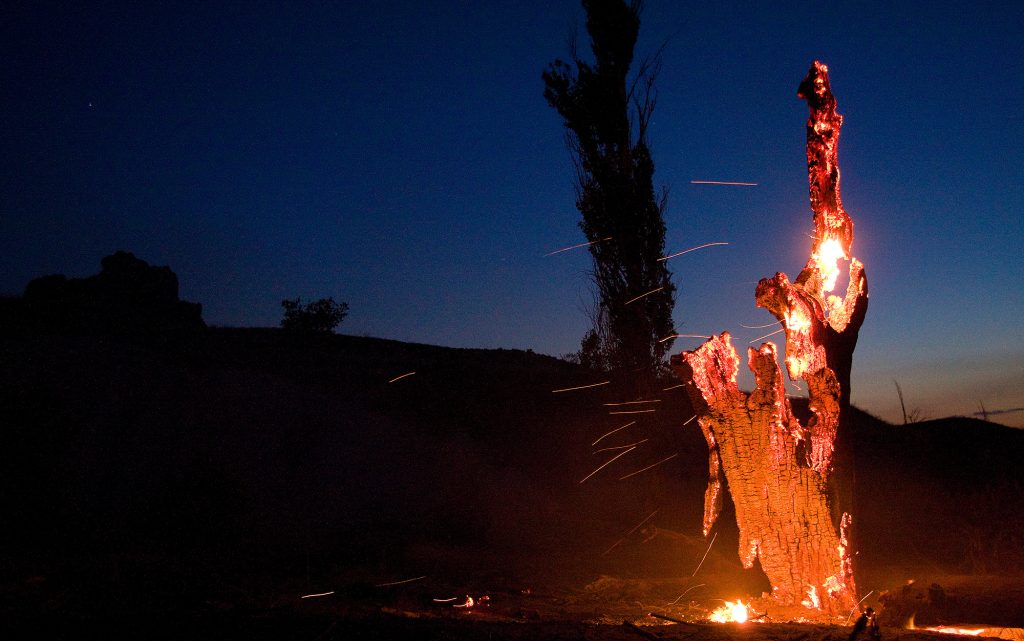
Photo by József L Szentpéteri/National Geographic

Jeremy England is associate professor of physics at Massachusetts Institute of Technology. His research has been published in Nature Nanotechnology and Proceedings to the National Academy of Sciences, among others. His work into the emergence of life-like behaviour has been profiled in Quanta Magazine and Nautilus.

1 November 2017 (aeon.co)

Edited by Sally Davies

Aeon for Friends

Living things are so impressive that they’ve earned their own branch of the natural sciences, called biology. From the perspective of a physicist, though, life isn’t different from non-life in any fundamental sense. Rocks and trees, cities and jungles, are all just collections of matter that move and change shape over time while exchanging energy with their surroundings. Does that mean physics has nothing to tell us about what life is and when it will appear? Or should we look forward to the day that an equation will finally leap off the page like a mathematical Frankenstein’s monster, and say, once and for all, that this is what it takes to make something live and breathe?

As a physicist, I prefer to chart a course between reductionism and defeat by thinking about the probability of matter becoming more life-like. The starting point is to see that there are many separate behaviours that seem to distinguish living things. They harvest energy from their surroundings and use it as fuel to make copies of themselves, for example. They also sense, and even predict things about the world they live in. Each of these behaviours is distinctive, yes, but also limited enough to be able to conceive of a non-living thing that accomplishes the same task. Although fire is not alive, it might be called a primitive self-replicator that ‘copies’ itself by spreading. Now the question becomes: can physics improve our understanding of these life-like behaviours? And, more intriguingly, can it tell us when and under what conditions we should expect them to emerge?

Increasingly, there’s reason to hope the answer might be yes. The theoretical research I do with my colleagues tries to comprehend a new aspect of life’s evolution by thinking of it in thermodynamic terms. When we conceive of an organism as just a bunch of molecules, which energy flows into, through and out of, we can use this information to build a probabilistic model of its behaviour. From this perspective, the extraordinary abilities of living things might turn out to be extreme outcomes of a much more widespread process going on all over the place, from turbulent fluids to vibrating crystals – a process by which dynamic, energy-consuming structures become fine-tuned or adapted to their environments. Far from being a freak event, finding something akin to evolving lifeforms might be quite likely in the kind of universe we inhabit – especially if we know how to look for it.

The understanding that life and heat are intertwined is very old knowledge. Moses, for one, was launched into his first encounter with the Creator of all life by the sight of a tree ablaze, burning with a marvellous fire that left the living organism unscathed.

In physics, heat is a form of energy, made up of the random movements and collisions of molecules as they bounce off each other at the nanoscale. Much of the world’s energy is tied up as heat. Although it sounds like something that just wobbles around in the background as other factors take centre stage, it actually plays a crucial role in making some of the most interesting kinds of behaviour possible. In particular, we’ll see that heat and time are bound together in an intricate dance, and the release of heat is what stops time going backwards.

Some things in the world seem reversible: I can kick a ball upward and it will rise, or I can drop a ball from a height, and it will fall. Putting it this way just seems like common sense, but it turns out that this pairing of dynamical trajectories, where one path looks like the time-reversed movie of the other, is a symmetry built into the basic mathematical structure of Newton’s laws. Anything that can go one way can go the other, if you just set it moving back the way it came. As a consequence, the most ‘normal’ thing in physics would be for events to be able to reverse themselves in time, just like the ball that goes up and then down.

We don’t immediately grasp the sweeping significance of time-reversal symmetry because a whole lot of what we see doesn’t seem to have this property. Little green shoots soak up the Sun and grow into mighty trees, but we never see a full-grown pine ‘ungrow’ itself into a cone buried in the dirt. Sandcastles disintegrate under the waves, but we never see them splash back together when the tide recedes. Countless examples of ordinary occurrences around us would look extraordinary if they happened in rewind. The ‘arrow of time’ seems to point in one direction, but there’s no obvious reason in principle to think it should. So what’s going on?

The short answer is that we’re not looking closely enough. When a piece of wood burns, an enormous amount of heat and chemical product is exchanged with the surrounding air. In order to run the tape backwards and spontaneously generate wood from ash and anti-flame, we’d have to somehow give every little molecule in the ash and atmosphere a backwards push to send it bouncing along the reverse track. That is not going to happen.

In a rigorous, quantitative sense, the dissipation of heat is the price we pay for the arrow of time

Many scientific commentators have noted the connection between heat and the arrow of time. However, only in the past 20 years or so have physicists developed a crisp, comprehensive formulation of the relationship. One of the most important contributions came from a theorist named Gavin Crooks, now at the Lawrence Berkeley National Lab in the United States. He asked the following question: given that I have a movie (say, of a piece of wood burning to ash or a plant growing) and the rewind version of that movie, how would I tell which one is more likely to happen?

By applying some basic assumptions, he was able to mathematically prove the following. If you have a system (a piece of wood or a plant, for example) surrounded by a ‘bath’ of randomly jiggling particles (say, the atmosphere), the more heat the system releases into its bath, the less likely it is to rewind itself. In a rigorous, quantitative sense, the dissipation of heat is the price we pay for the arrow of time.

Why? Another way of phrasing this insight is to note that the more a system increases the entropy of its surroundings, the more irreversible it becomes. Now, it must be said that in the grand contest for the most misunderstood idea in the history of physics, entropy is probably the winner. Even people who are normally averse to any mention of the natural sciences will sagely volunteer that entropy – read: messiness, dysfunction, chaos, disorder, who knows? – must increase, all the time. It’s the second law of thermodynamics, obviously. But this simple picture can’t be right. Living organisms, for one, seem to defy this misleading gloss on the second law. They take disorganised bits and pieces of matter, and put them together in fiendishly complex and refined ways.

Thankfully, the full story is substantially more nuanced. Connoisseurs use entropy in a technical, microscopic sense, as a statistical measure of the number of different ways the same kind of arrangement of matter can be constructed out of its constituent parts. For a room full of air, for example, it turns out there are just many, many more ways of spreading out the molecules uniformly than there are of squishing them into clumps. That’s why uniform air density wins the entropic game, and nature abhors a vacuum. The particles diffuse themselves evenly because that’s just the most likely thing to happen over time.

The connection between entropy and heat is more subtle. Remember that heat is energy diffused randomly among the particles in a substance. The more energy, the more ways of sharing it around; and the more ways of sharing the energy around, the higher the entropy. Back to Crooks’s example of a system in a bath, then, the more heat a system releases, the more it increases the entropy of its surroundings – and, as Crooks showed, the less likely it is that this sequence of events could rewind itself.

This is what the second law means: the reason a heat-producing movie is more likely than its heat-absorbing re-run has to do with the number of ways you can disperse that heat in the surrounding bath. The more heat you throw into the bath, the less hope you have of getting it back from a freak fluctuation, and the less likely it is that you will have the energy you need to retrace your steps once the movie has run forward. It’s like releasing a bagful of feathers into a gusting wind and hoping to catch them with a net. If you only release one feather, the gale might blow it back to you; but if you release hundreds or thousands, the chance of capturing them all is basically nil.

Now we can bring life into the picture. Living things clearly have energy to burn, and they get this energy from being worked on. Like heat, ‘work’ in thermodynamics involves units of energy. But instead of the uncoordinated wiggling of molecules, here it’s a measure of how much and how fast energy has been transferred to a system from its surroundings in a way that produces a change. There are a variety of versions, such as movement, volume change and chemical transformation. What unites these processes is that energy is being forced, pushed or driven into a system from the outside, in a way that modifies the system’s shape or location. When you hit a car, it might move, or you might dent it, or both. In any case, you’ve done work on it.

Life is superb at capturing energy through work. Growing a plant means doing work on it, no less than when we put shoulder to yoke and drag a cart up a hill. In these situations the conservation of energy required by Newton’s laws implies one of two things: either all the energy put in as work stays stored in the system, like the compressed spring in a Jack-in-the-box; or else it’s released into the surroundings as heat. Recall, too, what we said before about the release of heat and time-reversal symmetry. So the question of how much work gets done, and when, makes all the difference to which events are more or less likely in the movie we’re watching.

Now we know why mighty trees don’t ungrow themselves: because life produces heat. From a physics perspective, a tree harvests energy from its surroundings – work is done on it – and in the process, it dissipates energy to the surrounding air as heat. The differences in probability between forward and reverse in such cases are staggering. Even ungrowing a single photosynthetic bacterium is less likely than growing one by a factor of roughly 1050 billion! Suffice it to say, once the work gets flowing (and dissipating), backwards movies usually cease to be worth even talking about.

With a few tricks of algebra, you can use Crooks’s equation to compare the likelihoods of two future events in a system that’s being pushed by external forces and surrounded by a bath of randomly jiggling molecules. That includes the plant growing in the air, and anything that’s alive, in fact. So, if I zap a chemical mixture with electric shocks, or mechanically vibrate the container of a viscous fluid – does thinking about work and heat help me to predict if something resembling life might eventually emerge, after some energy has been allowed to flux through the system? Perhaps, but with a twist.

To probe the implications of work for how life (and evolution) evolved, a more versatile analogy is required. Let’s imagine a battery-powered car, exploring a rugged mountain range. Mathematically, the car’s location can be thought of as corresponding to the full microscopic configuration of a system composed of many different particles. Every spot on the terrain that the car might be, we can think of as a unique and different way of arranging all the molecular building blocks of some larger object. Accordingly, we have to think of the car not as having four cardinal directions to drive in, but rather, 1025 or more! And somewhere, out on that vast sierra, there’s a spot that represents a bacterium, a plant, a cat.

At any given moment, our car is furiously spinning its wheels, winding its way slowly up over a narrow pass, or bouncing rapidly down into another ravine. From time to time, the car randomly swerves and changes direction. This is a reasonable metaphor for a system that undergoes changes in energy, but doesn’t experience external drives that do work on it. Sometimes, the car goes uphill; this corresponds to our system absorbing heat and storing the energy, like the spring in a jack-in-the-box. Sometimes, the car goes downhill, which we’d liken to the clown popping out of the box as the spring is released.

So where does the exploring car end up? Both intuition and a more rigorous treatment of the physics tell us that two basic factors are going to affect what happens. First, the car is more likely to drive to places that are close to its starting point, and separated from that point by relatively flat terrain. Second, it will tend to go downhill more than it tends to go uphill. After a very long time, we might expect the car to wander so much that we’d have no idea where it was at the beginning – but its avoidance of hilltops and preference for valleys would probably remain.

Think of an opera singer who shatters a goblet with the perfect pitch of her song, due to a phenomenon known as resonance

To bring work into the picture, we just need to give the car a solar panel. This makes its wheels spin more vigorously when it’s positioned and angled so that the Sun is brightest. Now the rules of thumb for how the car explores are going to get dramatically more complicated. All things being equal, we’d still expect the car to stay close to home, go downhill, and avoid rugged terrain (at least until it gets stuck). In addition, we now have to think about the places and times that the car will get a power-boost from the Sun overhead. There are going to be cases where the car can more readily traverse a sunny hill than a shady plain, because of the extra help it gets by staying in the bright spots.

Given enough time, we can no longer be confident that we’ll find the car in some deep valley near home base; instead, we have to think about how far and how fast it might have travelled if it found a path on which the Sun kept shining. Described in this way, the vehicle’s dynamics are affected by a dizzying variety of factors, and there are many more possibilities for where the mountain-rover might go.

The solar-powered mountain-rover metaphor helps us to think about the evolution of a very diverse range of work-absorbing systems. Of course, the prospect of sifting through such a vast space of possibilities and landing on life at first seems hopeless. But things look different once we ask a simple question, namely: what determines which places are sunny, and which places aren’t?

At least part of the answer comes from the peculiarities of how a system’s structure allows it to connect with its surrounding energy source. Children often notice that a wineglass will ring at a different pitch depending on how much water is poured into it. A different, but related observation is that vessels made from the same amount of glass, and filled with the same amount of water, can ring at different pitches depending on their shape.

What this reveals is that the way matter is arranged can significantly affect how it tends to move and vibrate. Not only that, but the details of such an arrangement also change how matter absorbs work energy from its surroundings. Think of an opera singer who shatters a goblet with the perfect pitch of her song, due to a phenomenon known as resonance. Here, because the glass tends to vibrate at a frequency that is well-matched to the frequency of the sound, the oscillations in the glass produced by the energy in the sound waves are violent enough to break it.

We encounter the work-absorbing peculiarities of how matter is arranged all around us: from the ways pigment molecules absorb and scatter light so that we perceive them as having colours, to the fact that we can digest and be nourished by the starch in a potato more than by the cellulose in a bale of hay. From the perspective of chemical physics, a human being’s inability to eat grass is just about how the atoms that comprise a person’s digestive system are arranged. If these same carbons, nitrogens, oxygens and so on were re-fashioned into a cow stomach, the chemical work stored in grass would be ours for the taking.

It’s when we take this idea back to our solar-powered rover that things get interesting. Suppose we start with a collection of chemical building blocks in a thrown-together, uninteresting structure. That corresponds to parachuting the car into a randomly chosen starting location in the mountain range. But now, suppose that we subject these chemical building blocks to a challenging external environment – to a collection of energy sources that are accessible in principle, but only available in practice when the chemicals are arranged in rare, specially-matched shapes that happen to solve the problem of how to absorb work. For the rover, which we have said has unimaginably many possible directions to drive in, the challenging environment manifests as a landscape that’s mostly not very sunny, except when you are driving in just the right direction, in the right place, at the right time.

The system exhibits a self-reinforcing process that grows its ability to absorb work

Sure, it’s still not easy to tell where the rover must go in general. But there are particular scenarios where the matters become significantly clearer. We might think of a case in which the rover starts off in a sunny spot, spins its wheels furiously, and speeds to a new place in the shade, where its wheels grind mostly to a halt. Having been carried irreversibly to a new place by the absorption and dissipation of work, it then gets stuck in a shape that is bad at absorbing energy. That’s roughly equivalent to the opera singer shattering the goblet. At the beginning, the glass resonates and absorbs a lot of work from the song, which gets largely dissipated as heat when the glass shatters and settles into an inert heap of shards. Once in this state, the shards no longer resonate, and the rate of work absorption drops significantly.

We can also envision the opposite scenario. Suppose we have a single bacterium sitting in a big jar of food and oxygen. After 20 minutes or so, we should have two bacteria, and 20 minutes later gets us two more. What we expect to see, in the short term, is a process of exponential population growth. Individual bacteria harness the chemical work available in their surroundings, and pay the thermodynamic cost of making copies of themselves. Since the number of bacteria is growing, the rate of work absorption is also constantly increasing – at least until the food runs out and the party stops. We can liken this process to a rover that gets a bit of sunshine, which helps it edge its way a bit further out of the shade, so that its wheels speed up even more and carry it to an ever-sunnier location over time. The system in this case exhibits a sustained, self-reinforcing process that grows its ability to absorb work from the environment.

Note that there’s nothing in this thermodynamic description of reproduction that specifically picks out the notion of a discrete entity (such as a bacterium) reproducing itself. Rather, self-replication is just one example of a more general class of processes that exhibit what we call positive feedback. Positive feedback can happen whenever there’s a quantity in a system whose increase brings about a rise in its own rate of growth. In the case of self-replicating cells, the quantity in question is the number of cells itself: a larger number of cells can make more cells faster. However, one can also envision self-reinforcing behaviours that have to do with the shape or arrangement of a system as a whole; and in that case, the exploring rover story remains the same as ever. Looking at life this way allows us to recognise a similar feedback signature in cases where no self-copying self is apparent.

Just to recap where we’ve travelled. Living things manage not to fall apart as fast as they form because they constantly increase the entropy around them. They do this because their molecular structure lets them absorb energy as work and release it as heat. Under certain conditions, this ability to absorb work lets organisms (and other systems) refine their structure so as to absorb more work, and in the process, release more heat. It all adds up to a positive feedback loop that makes us appear to move forward in time, in accordance with the extended second law.

This process takes on a special significance in a setting like that of the vibrating glass. Here, the environmental energy source presents a particular challenge, such that the system (the glass) can only absorb energy if it adopts the right shapes. That’s equivalent to our rover finding that rare sliver of sunlight and managing to drive in just the right way to stay in the bright spots. If something about the system’s configuration lets it use the absorbed energy to power a feedback loop in a challenging scenario, you end up with a recipe for a system that evolves over time into more and more finely-tuned, specialised, energy-absorbing shapes. If you leave a lump of glass in the presence of a soprano for long enough, the shape it ultimately takes should depend on the precise pitch(es) she chooses to sing at.

In my research group’s first theoretical papers on this subject, we have referred to this mechanism of self-organisation as dissipative adaptation. Recently, we conducted two tests of the idea with computer simulations. In one study, we took a mixture of simple dots or points floating in viscous fluid. To make the environment more challenging, we imposed a simple rule: each pair of points was connected by a stretchy spring, which could randomly hook or unhook when close together. We then took one of the points amongst a group of 20 of them and pushed on it with an oscillating force of a single frequency.

What we saw next was intriguing. As the springs randomly hooked and unhooked, a specific network of tangled connections formed. These connections tended to vibrate at the frequency of the external force – hence they absorbed an exceptionally large amount of energy. Alternatively, when we engineered it so that the springs snapped more readily when stretched, we saw the opposite effect, like the opera singer’s shattered glass: a network formed that was attuned to not vibrate at that frequency. That is, the points adapted their shape to not absorbing energy.

The life-like specialness of organisms, which allows them to eat and survive and reproduce, might be recognisable in a broader physical class of systems

We got similar results in a second study. Here we put an initially randomly arranged collection of atoms in the presence of a rich but challenging source of energy that could only be accessed by a special combination of those atoms. After letting the atoms react for a long time, the composition of chemicals was biased to be either unusually bad or extremely good at extracting energy. In other words, the system exhibited a tendency to find and stay stuck in states that look adapted to their environment.

In both these cases, the point is not that all matter everywhere is trying to absorb and dissipate more energy all the time; nor is it that the second law of thermodynamics is magically guiding the discovery of organised structures that are better at increasing entropy. Rather, when particles interact under the challenging conditions created by an energy source, their resulting shapes tend to be fine-tuned to that energy source – even without the help of self-replication and natural selection.

As it happens, living things are both marvellously complex and breathtakingly good at meeting the challenges of their environments. We know this is because the life we see today has inherited many of the structural and behavioural adaptations that proved so useful to previous generations. In the biological context, ‘usefulness’ is that which enables survival and self-reproduction. But what’s beginning to emerge from some of this thermodynamic thinking – and what a few of us are eagerly exploring in simulation and experiment – is the possibility that some of the distinctively life-like specialness of how organisms are organised, and which allows them to eat and survive and reproduce, might be recognisable in a broader physical class of systems that do not contain self-copying selves. Instead, they are propelled towards strikingly special shapes by the thermodynamic laws governing positive feedback in the presence of a challenging energy source. This process might explain how evolution can get going in inert matter.

Whether this will ultimately make a big or small difference in how we understand living things at the microscopic level, we don’t know. There’s still more work to be done. But what our new vantage point on thermodynamics reveals is that a great many uncharted, and seemingly random, explorations of shape and form have a surprisingly good chance of ending up somewhere interesting – perhaps even the summit of the very distant mountaintop that we occupy on that unimaginably huge terrain, with a tiny flag reading ‘humanity’.
PhysicsBiologyEvolution

Elaine Pagels, “Why Religion?”

Politics and Prose Elaine Pagels discusses her book, “Why Religion?”, at Politics and Prose on 11/30/18. When Pagels, author of groundbreaking studies of the Gnostic Gospels, was asked, “Why religion?” she found that her own life illuminates both why she’s made a career of studying religious texts as well as why religion itself still exists in the supposedly secular 21st-century. The daughter and wife of scientists, Pagels was taught to trust the rational, but she found herself attracted to religious music and rituals for how they engaged the imagination. After the loss of her five-year-old son in 1987, followed by her husband’s death in an accident in 1988, Pagels turned to religion for help in facing her grief and anger. Interweaving the fascinating scholarship behind books such The Origin of Satan and Revelations with her own experiences, Pagels’s memoir is as emotionally affecting as it is thought-provoking. Pagels is in conversation with Dr. Eric Motley, executive vice president at the Aspen Institute and author of the memoir Madison Park. https://www.politics-prose.com/book/9… Elaine Pagels is a preeminent academic whose impressive scholarship has earned her international respect. The Harrington Spear Paine Professor of Religion at Princeton University, Pagels was awarded the Rockefeller, Guggenheim, and MacArthur Fellowships in three consecutive years. She is the author of The Gnostic Gospels, Beyond Belief, and Revelations. Founded by Carla Cohen and Barbara Meade in 1984, Politics and Prose Bookstore is Washington, D.C.’s premier independent bookstore and cultural hub, a gathering place for people interested in reading and discussing books. Politics and Prose offers superior service, unusual book choices, and a haven for book lovers in the store and online. Visit them on the web at http://www.politics-prose.com/ Produced by Tom Warren

The Beginnings of Anti-Semitism (Hint: it was in the Bible)

Kaufman Interfaith Institute On October 30, 2019, we hosted Dr. Elaine Pagels as the featured speaker at our annual interfaith academic conference. She gave two lectures, the first being “What do ‘secret gospels’ suggest about Jesus and his teaching?” (https://youtu.be/ZAQ8DsXDxQ) which was followed by a Panel discussion with Robert Van Voorst, Professor Emeritus of Western Theological Seminary, Sheldon Kopperl, Professor Emeritus, GVSU, Diane Madoush-Pitzer, Professor of Religious studies, GVSU with Douglas Kindschi, Kaufman Interfaith Institute’s director, moderating. The panel discussion is viewable here: https://youtu.be/3EC5WYiQ0_Q The evening session was a conversation between Dr. Pagels and Calvin University’s Frans van Liere which focused on her latest book, “Why Religion: A Personal Story” in which she reflects on the persistence and nature of belief and why religion matters in the wake of her own great personal tragedy: the death of her young son, followed a year later by the shocking loss of her husband. The evening session is available here: https://youtu.be/nROIfIK9csU Dr. Pagels is an American religion historian. She is the Harrington Spear Paine Professor of Religion at Princeton University. Pagels conducted extensive research into early Christianity and Gnosticism as a part of her graduate study at Harvard University. Her best-selling book The Gnostic Gospels examines the divisions in the early Christian church, and the way women were viewed throughout Jewish and Christian history. Modern Library named it as one of the 100 best books of the twentieth century. In 2001, Sylvia Kaufman brought together a group called the West Michigan Academic Consortium in order to extend the work of the West Shore Committee for Jewish-Christian Dialogue and the Kaufman Interfaith Institute. The mission of these groups is to provide programming that leads to greater interfaith understanding and mutual acceptance. The committee consists of representatives from Aquinas College, Calvin College, Calvin Theological Seminary, Cornerstone University, Grand Valley State University, Hope College, Kuyper College and Western Theological Seminary. They jointly choose the speakers and plan the conferences; the participating schools rotate hosting the conferences.

The Abusive Society

Why Abuse Seems to Reach Into Every Corner of Modern Life

umair haque · May 27 · May 2021

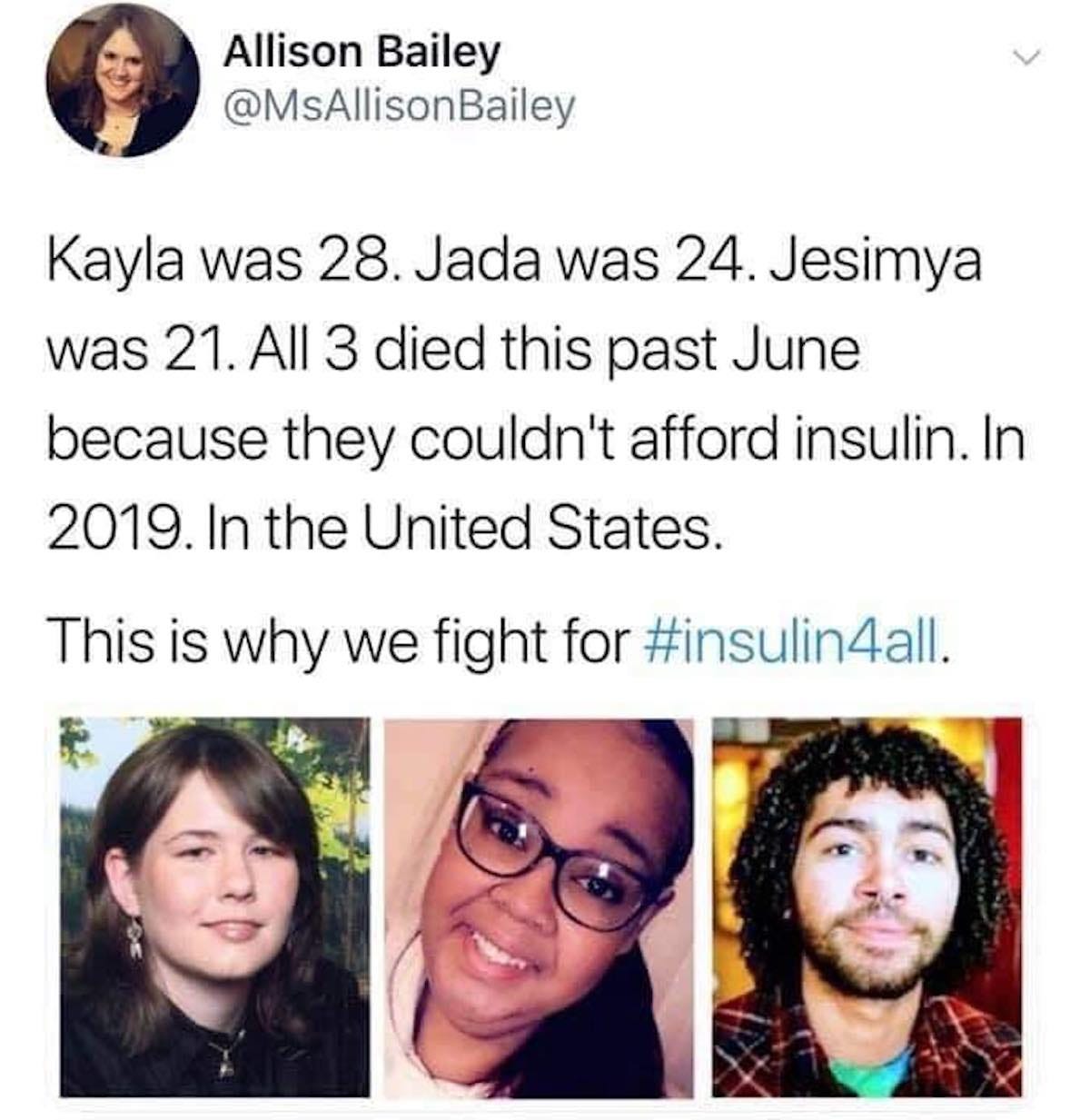
Image Credit: Allison Bailey on Twitter

I’d love to have kids. I don’t have kids. If I did, I’d be worried about them. Abuse, it seems, reaches crookedly into every tiny nook and cranny of life. We discovered that the hard way, from Weinstein to Spacey to Cosby to all the predators yet to be named. But what does that itself begin to hint at? An abusive society.

Let’s chart the journey of an average American. They’re born. Thanks to a deficient healthcare system, that costs around $20,000, where in most countries, this most basic of human rights, reproduction, is free. That tiny fact will play a theme in the story I’ll tell: the struggle to exist creates an abusive society, where people forever crave what they can never have. We’ll return to that.

Soon enough, our average American goes to school. Schools where rules about bullying and harassment simply don’t exist like they do in other rich countries, and even many poor ones. Schools where mass shootings and metal detectors are commonplace. Where disciplines like ethics and civics and economics and politics aren’t really taught, where the basics of science and art and literature must be fought over.

The child is taught in all these ways to feel afraid, hostile, anxious; to be confused, unsure, hesitant, about what it means to be a child, to be an adult, to be a person at all; that everything seems always to be a perpetual battle — not what a child should be taught, which is that his or her world is a gentle, safe, happy place, which can be explored and challenged and even upended, and things will still be alright.

He or she is left with a red-light sense of danger and caution. Here we begin to see the first great failure of American life: a failure to civilize, which we will pursue, but first let us discuss what it really means.

To mature and to become an individual the child must feel that the world is a safe place. Not a womb — but not a war zone either. But the world this child is in not a safe place. It is a jungle of thorns, which he or she cannot navigate. So the child remains stuck, at an infantile stage of development, and he or she will need constant approval and validation just to shore up a fragmented and weak sense of self, always now seeking a father or mother figure, his or her whole life long — and, because they themselves feel so weak inside, usually they will be drawn to the outwardly strongest, most bombastic, one they can find. This is the first of three great dilemmas of living in an abusive society, and it will set the stage for our average American’s life.

It’s time for college, for this average American. They don’t have rich parents, so immediately it costs them crippling lifelong debt. But that’s just the beginning. College life centers around fraternities and sororities, and to join one, one must be hazed, often viciously. Why do Americans need them? Because they are always seeking powerful, protective mother and father figures, craving safety, to make up for the basic absence of a safe world they have suffered from early childhood.

If you think I exaggerate, consider: this strange and costly structure, university life revolving around fraternities, simply doesn’t exist in any other society in the world, nor in history — it is as if one must be beaten into a gang simply to be educated. And yet, because it is centered on these organizations, which themselves center on politics, power, and parties, not education, college in the US is notably poor. Again, ethics, politics, economics, literature, and so on, simply aren’t part of most mandatory curricula — and so the failure to civilize, which produces a feeling of an unsafe world, continues.

Only now it’s growing: after being relentlessly hazed, bullied, and attacked, right from childhood into early adulthood, our average American is beginning to internalize all that abuse. What else can they do? A profound loss of the integrity of the self is what abuse genuinely is: the internalization of the harm that has one been done to one, over and over again, until one believes that one has deserved it, needed it, earned it.Abuse is a cycle, a burden passed down through the generations: no one is born an abuser. And so it’s at this moment, I’d guess, that the American psyche turns genuinely abusive. First, our average American needed safety in the arms of a father or mother figure, to make up for an unsafe world — and now they begin to believe that there exist good reasons that they needed to be abused, and thus, that they should and must behave abusively, too.

What are those reasons? Probably something like these. That to succeed, one must be more ruthless and merciless than the next person. That one’s suffering is a measure of one’s weakness, and therefore suffering must be erased and denied, not felt and understood. That one’s purpose in life is to amass power and privilege, no matter how barren or empty one feels inside. They are the prices one has learned that one must pay in an unsafe world, not for safety, warmth, security, which are by definition impossible to find, but just to exist at all, protected, at least, by their abusers.

And so now the second dilemma of the abusive society arises: one must abuse people to earn a sense of self, just to feel protected, but the price is happiness, because happiness comes from the strength and quality of one’s relationships, and in this mode of relating, one has no genuine relationships — only absences and emptinesses, voids and lacks of seeing and knowing people as people.

Let’s continue the story of our average American. If they’re lucky, they get some kind of professional job at a corporation. An accountant, a programmer, and so on. But what happens at these jobs? Well, the latest economic research tells us something very interesting: the jobs that contribute the least to society (that in fact destroy value, but we don’t need to gild the lily), like hedge fund managers, earn the most, and the jobs that contribute the most, like teachers, earn the least.

So now our American faces the third great dilemma of the abusive society: if they wish to earn a decent middle class living, they will have to seal a deal with the devil, and begin contributing less to society. But of course the price is that life loses meaning, because meaning is earned by what we give to people, not merely what we take from them. And so the price of this dilemma is that the world has finally been proven to be not just unsafe, but empty, hollow, a fraud: to earn protection, this time, he or she has had to give up on the point of life itself.

Now where is one to find the sense of meaning that one has lost? Where is one to find the sense of safety one has been craving all one’s life? Well, our average American is probably going to turn, now, in midlife, to religion. If relatively poor, perhaps a megachurch, if relatively well off, maybe Buddhism in designer yoga pants — maybe even QAnon. But religion is religion. And yet while religion does indeed give us meaning, again, this strikingly odd institutional structure — megachurches and corporate chains of yoga studios — simply doesn’t exist anywhere else in the world. It therefore tells us that something deeper is going on than religion. Our average American is still desperately seeking the sense of safety he or she has craved, and never found, since childhood.

Let’s take stock of the life of our average American now, at midlife, where I’ll end my essay. They began their life being failed in the most basic way: being stuck, trapped, imprisoned, as children, in an unsafe, precarious world. They then sought safety in the arms of mother and father figures their whole lives long. They sought it not in people, but in mega institutions, which at least gave them a basic sense of safety, if not actual security: first fraternities and sororities, universities, then mega corporations, and megachurches. All of these have served the same function, really: to make life in an abusive society not livable — for that it can never be — but at least tolerable.

But there is a strange and terrible social price: the need for protection in a world where one cannot have safety creates mega-institutions, but the men who control them are then free to become predators, voracious abusers. Just like mafia bosses, they turn protection into victimization. That is precisely what we see in America today.

Let’s put that in global perspective. At every stage of life, our average American has only been desperately craving safety, and safety only means this: that one has the right to exist. Americans don’t have any rights to exist: rights to healthcare, higher education, retirement, and so on, that the rest of the rich world does, enshrined in constitutions, safeguarded by institutions, like Britain’s National Health Service (which is now being gutted because of Britain’s own folly, but I digress). Who can blame them then for fleeing like the frightened little children they have always remained, into the arms of mega institutions, whether corporations or fraternities or churches?

A flight to mega-institutions is one solution to an abusive society. But it is a poor one, because it seeking the protection of one’s abusers, not from them, and thus licensing them. And so it can only ever be a palliative, like taking heroin for the pain of being abused all one’s life long. What Americans really need is to fix the cycles of abuse that have driven them to seek, and yet never find, safety in the unsafe world they themselves have created. To undo the predatory ways of being that they came to call wise and just and true, but in fact, were only ever the lament of the hurt child, begging, just for an instant, to be held, to be known, to be loved.

WRITTEN BY

umair haque

Eudaimonia and Co

Eudaimonia and Co

Eudaimonia & Co

This tiny minority of Iraqis follows an ancient Gnostic religion – and there’s a chance they could be your neighbors too

June 21, 2021 8.18am EDT (theconversation.com)

Author

  1. James F. McGrathProfessor of New Testament Language and Literature, Butler University, Butler University

Disclosure statement

James F. McGrath received funding from the National Endowment for the Humanities to support his work on the critical edition, translation, and commentary of the Mandaean Book of John referred to in this article.

Partners

View all partners

CC BY NDWe believe in the free flow of information
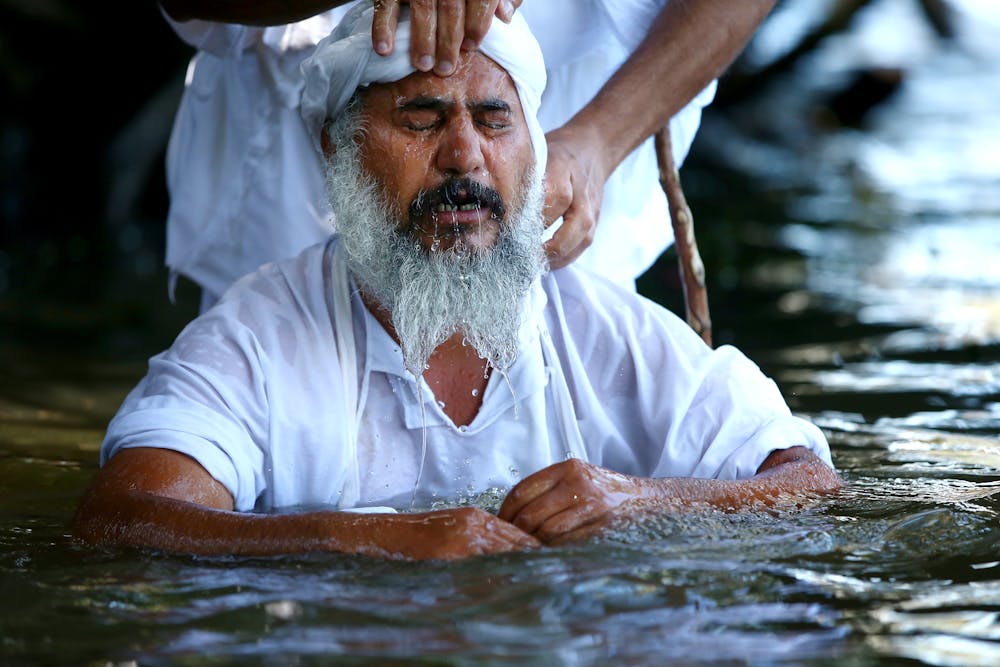
Followers of the Sabean Mandaeans faith, a pre-Christian sect that follows the teachings of the Bible's John the Baptist, perform their rituals in the Tigris River during a celebration marking "Banja" or Creation Feast, in central Baghdad, Iraq, Monday, March 15, 2021.
Like their ancient ancestors, contemporary Mandaeans revere John the Baptist and consider baptism the most important of their religious rituals. Hadi Mizban/AP

In March 2021 Pope Francis became the first leader of the Roman Catholic Church to visit Iraq. The number of Christians in Iraq has fallen sharply in the past two decades amid mass violence at the hands of the Islamic State group. Iraq stands today in the region of the ancient Babylonian Empire, generally understood as the homeland of the patriarch Abraham, the foundational figure shared by Judaism, Christianity and Islam – commonly called the “Abrahamic” religions.

As the pope met with local Christian and Muslim leaders, the names of other, smaller religious groups found in Iraq also made the news. One of these was likely unfamiliar to the majority of those in the English-speaking world: the Mandaeans. Also called Sabians, they are followers of the last Gnostic religion to survive continuously from ancient times down to the present day.

Gnostic religions view the material world as the product of a mistake in the heavenly realm, the creation of one or more inferior divine beings rather than the supreme God. Gnosticism also emphasizes that human beings can become aware of this and prepare their souls to escape from under the influence of the malevolent spiritual forces that created and rule this realm, so that when they die they can ascend to the good realm that lies beyond them.

As a scholar of religion, I’ve been involved in translating into English one of the Mandaeans’ sacred texts, known as the Mandaean Book of John. Working in this area has also connected me with the living tradition and persuaded me that more people need to know about Mandaeans.

Do experts have something to add to public debate?

We think so

The ancient roots of Gnosticism

Mandaeism, like other forms of Gnosticism, is an esoteric religion whose literature remains mostly in the hands of priestly families. Their sacred texts are written in a distinctive alphabet used only for that purpose. The contents and meaning of these works are largely unknown even to most Mandaeans, never mind others.

But the Mandeans’ alternative view has periodically attracted popular interest. In the 19th century, their most important sacred text, the Great Treasure or Ginza Rba, was translated into Latin. That is believed to have contributed to the heightened interest in esoteric mysticism and spirituality in that era. However, this was largely among people who had no contact with or real awareness of the Mandaeans in the present day.

Baptism: The core of Mandaean religion

A follower being baptised during a Mandaean baptism ceremony in the Nepean river at Emu Plains on October 26, 2014 in Sydney, Australia.
For Mandaeans, baptism is not a one-time action, but a repeated rite of of seeking forgiveness and cleansing any wrongdoing. Mark Kolbe/Getty Images

The Mandaeans’ central ritual is baptismimmersion in flowing water, which is referred to in Mandaic as “living water,” a phrase that appears in the Bible’s New Testament as well. Baptism in Mandaean faith is not a one-time action denoting conversion as in Christianity. Instead it is a repeated rite of seeking forgiveness and cleansing from wrongdoing, in preparation for the afterlife.

“Baptist” today usually denotes a form of Christianity, but Mandaeans aren’t Christians. They have a special place, however, for the individual who is said to have baptized Jesus, namely John the Baptist. The Mandaean Book of John, which I was involved in translating, tells stories about John the Baptist and attributes speeches to him containing various ethical teachings.

In the first half of the 20th century, the Mandaeans received significant attention from New Testament scholars who thought that their high view of John the Baptist might mean they were the descendants of his disciples. Many historians think that Jesus of Nazareth was a disciple of John the Baptist before breaking away to form his own movement, and I am inclined to agree.

Whatever tensions and competition there may have been among Mandaeans, Jews and Christians in Iraq in the past, today they seek to coexist amicably, finding themselves in a context in which all minority groups face much the same struggle to survive and maintain their identity.

[Over 100,000 readers rely on The Conversation’s newsletter to understand the world. Sign up today.]

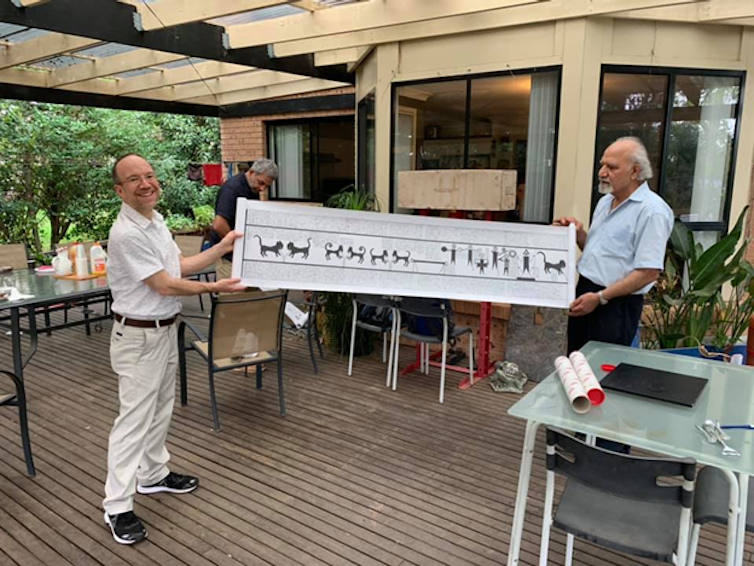
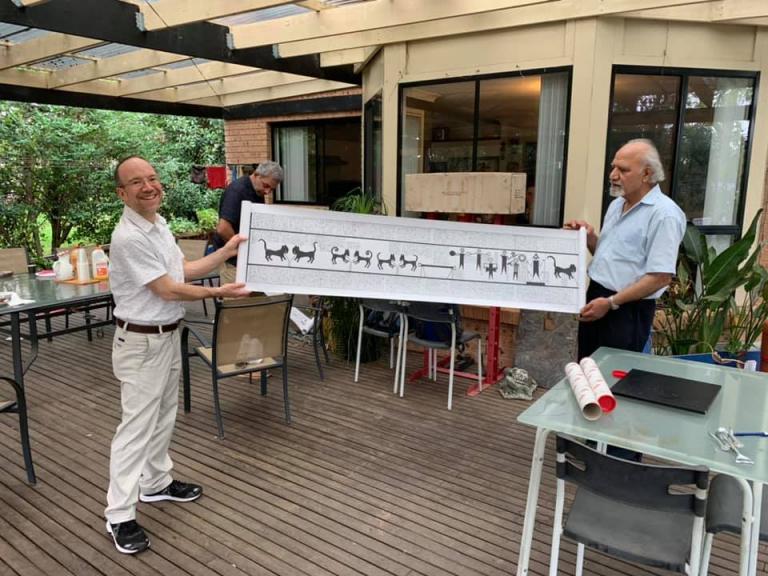
A number of Mandaean scrolls contain fascinating artwork and illustrations depicting varied images including the celestial figures mentioned in their texts, scenes from the afterlife, trees and animals. All are drawn in a style that isn’t quite like what one finds in the artwork or illustrated manuscripts of other religions. One of my favorite scenes in the scroll known as Diwan Abatur depicts people being tormented with trumpets and cymbals in purgatories through which souls are liable to pass. The point is most likely the loud noise such instruments can make, and not a negative statement about music in general.

The author holding a copy of an illustrated Mandaean scrollwork on the porch of a private residence in Australia.
James F. McGrath holds a copy of the Mandaean work known as the Diwan Abatur, together with the Mandaean who copied it, Majid al-Mubaraki. Courtesy of the author., Author provided

Mandaeism today

Estimates vary as to how many Mandaeans there are today. Some can still be found in their historic homelands in Iraq and Iran. However, persecution in those places has led to the creation of small but significant Mandaean diaspora communities in such places as Australia, Sweden and the U.S.

This scattering, combined with Mandaeans’ dwindling numbers, has made it much harder for them to preserve their identity and pass their traditions along to the next generation. Mandaeans do not accept converts or consider children of marriages with non-Mandaeans to be part of their religious community, which has also contributed to their dwindling population.

There is a reasonable chance that Mandaeans may be among your neighbors, whether you live in San Diego, San Antonio or Sydney. Look for them, and you may get a chance to do more than catch a glimpse of living history.

(Courtesy of Janet Cornwell, H.W,. m.)

Elaine Pagels – What do “secret gospels” suggest about Jesus and his teaching?

Kaufman Interfaith Institute On October 30, 2019, we hosted Dr. Elaine Pagels as the featured speaker at our annual interfaith academic conference. She gave two lectures, the first being “What do ‘secret gospels’ suggest about Jesus and his teaching?” (https://youtu.be/ZAQ8DsXDxQ) which was followed by a Panel discussion with Robert Van Voorst, Professor Emeritus of Western Theological Seminary, Sheldon Kopperl, Professor Emeritus, GVSU, Diane Madoush-Pitzer, Professor of Religious studies, GVSU with Douglas Kindschi, Kaufman Interfaith Institute’s director, moderating. The panel discussion is viewable here: https://youtu.be/3EC5WYiQ0_Q The evening session was a conversation between Dr. Pagels and Calvin University’s Frans van Liere which focused on her latest book, “Why Religion: A Personal Story” in which she reflects on the persistence and nature of belief and why religion matters in the wake of her own great personal tragedy: the death of her young son, followed a year later by the shocking loss of her husband. The evening session is available here: https://youtu.be/nROIfIK9csU Dr. Pagels is an American religion historian. She is the Harrington Spear Paine Professor of Religion at Princeton University. Pagels conducted extensive research into early Christianity and Gnosticism as a part of her graduate study at Harvard University. Her best-selling book The Gnostic Gospels examines the divisions in the early Christian church, and the way women were viewed throughout Jewish and Christian history. Modern Library named it as one of the 100 best books of the twentieth century. In 2001, Sylvia Kaufman brought together a group called the West Michigan Academic Consortium in order to extend the work of the West Shore Committee for Jewish-Christian Dialogue and the Kaufman Interfaith Institute. The mission of these groups is to provide programming that leads to greater interfaith understanding and mutual acceptance. The committee consists of representatives from Aquinas College, Calvin College, Calvin Theological Seminary, Cornerstone University, Grand Valley State University, Hope College, Kuyper College and Western Theological Seminary. They jointly choose the speakers and plan the conferences; the participating schools rotate hosting the conferences. Find out more at interfaithunderstanding.org

Bio: Primo Levi

From Wikipedia, the free encyclopedia

AA305971 cucina 254 388 300 3001 4584 Scala di grigio
Primo Levi
Born31 July 1919
TurinItaly
Died11 April 1987 (aged 67)
Turin, Italy
Pen nameDamiano Malabaila (used for some of his fictional works)
OccupationWriter, chemist
LanguageItalian
NationalityItalian
EducationDegree in chemistry
Alma materUniversity of Turin
Period1947–1986
GenreAutobiography, short story, essay
Notable worksIf This Is a ManThe Periodic Table
SpouseLucia Morpurgo (1920–2009)[1][2]
Children2

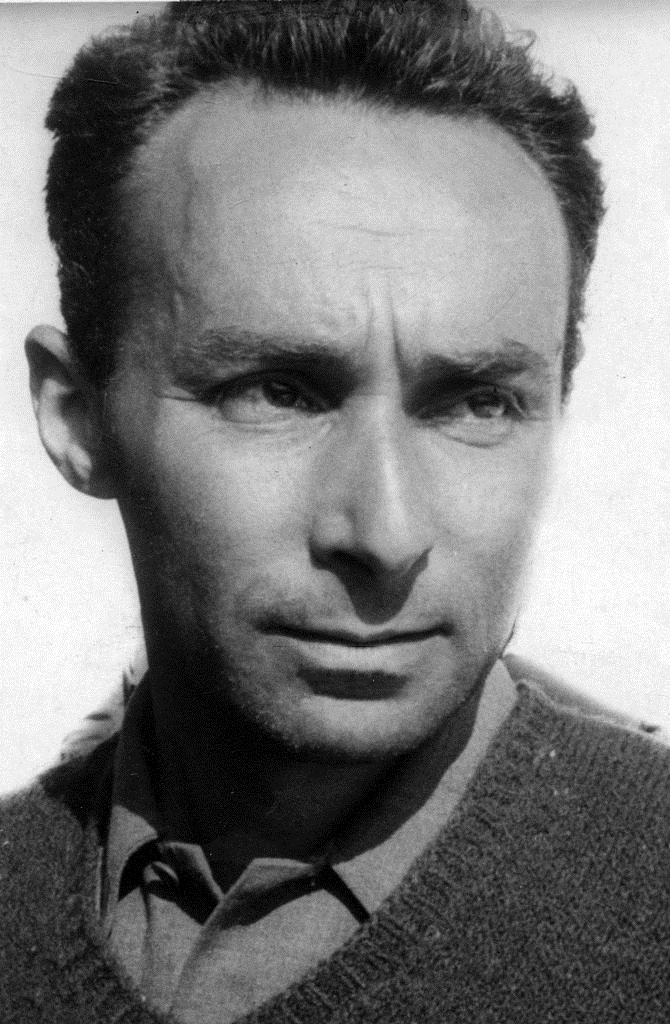
Primo Michele Levi[3][4] (Italian: [ˈpriːmo ˈlɛːvi]; 31 July 1919 – 11 April 1987) was an Italian Jewish chemist, partisanHolocaust survivor and writer. He was the author of several books, collections of short stories, essays, poems and one novel. His best-known works include If This Is a Man (1947, published as Survival in Auschwitz in the United States), his account of the year he spent as a prisoner in the Auschwitz concentration camp in Nazi-occupied Poland; and The Periodic Table (1975), linked to qualities of the elements, which the Royal Institution named the best science book ever written.[5]

Levi died in 1987 from injuries sustained in a fall from a third-story apartment landing. His death was officially ruled a suicide, but some, after careful consideration, have suggested that the fall was accidental because he left no suicide note, there were no witnesses, and he was on medication that could have affected his blood pressure and caused him to fall accidentally.[6][7]

Biography

Early life

Levi was born in 1919 in Turin, Italy, at Corso Re Umberto 75, into a liberal Jewish family. His father, Cesare, worked for the manufacturing firm Ganz and spent much of his time working abroad in Hungary, where Ganz was based. Cesare was an avid reader and autodidact. Levi’s mother, Ester, known to everyone as Rina, was well educated, having attended the Istituto Maria Letizia. She too was an avid reader, played the piano, and spoke fluent French.[8] The marriage between Rina and Cesare had been arranged by Rina’s father.[8] On their wedding day, Rina’s father, Cesare Luzzati, gave Rina the apartment at Corso Re Umberto, where Primo Levi lived for almost his entire life.Levi, ca. 1950s

In 1921 Anna Maria, Levi’s sister, was born; he remained close to her all her life. In 1925 he entered the Felice Rignon primary school in Turin. A thin and delicate child, he was shy and considered himself ugly; he excelled academically. His school record includes long periods of absence during which he was tutored at home, at first by Emilia Glauda and then by Marisa Zini, daughter of philosopher Zino Zini.[9] The children spent summers with their mother in the Waldensian valleys southwest of Turin, where Rina rented a farmhouse. His father remained in the city, partly because of his dislike of the rural life, but also because of his infidelities.[10]

In September 1930 Levi entered the Massimo d’Azeglio Royal Gymnasium a year ahead of normal entrance requirements.[11] In class he was the youngest, the shortest and the cleverest, as well as being the only Jew. Only two boys there bullied him for being Jewish, but their animosity was traumatic.[12] In August 1932, following two years attendance also at the Talmud Torah school in Turin to pick up the elements of doctrine and culture, he sang in the local synagogue for his Bar Mitzvah.[13] In 1933, as was expected of all young Italian schoolboys, he joined the Avanguardisti movement for young Fascists. He avoided rifle drill by joining the ski division, and spent every Saturday during the season on the slopes above Turin.[14] As a young boy Levi was plagued by illness, particularly chest infections, but he was keen to participate in physical activity. In his teens, Levi and a few friends would sneak into a disused sports stadium and conduct athletic competitions.

In July 1934 at the age of 14, he sat the exams for the Liceo Classico D’Azeglio, a Lyceum (sixth form or senior high school) specializing in the classics, and was admitted that year. The school was noted for its well-known anti-Fascist teachers, among them the philosopher Norberto Bobbio, and Cesare Pavese, who later became one of Italy’s best-known novelists.[15] Levi continued to be bullied during his time at the Lyceum, although six other Jews were in his class.[16] Upon reading Concerning the Nature of Things by Sir William Bragg, Levi decided that he wanted to be a chemist.[17]

In 1937, he was summoned before the War Ministry and accused of ignoring a draft notice from the Italian Royal Navy—one day before he was to write a final examination on Italy’s participation in the Spanish Civil War, based on a quote from Thucydides: “We have the singular merit of being brave to the utmost degree.” Distracted and terrified by the draft accusation, he failed the exam—the first poor grade of his life—and was devastated. His father was able to keep him out of the Navy by enrolling him in the Fascist militia (Milizia Volontaria per la Sicurezza Nazionale). He remained a member through his first year of university, until passage of the Italian Racial Laws of 1938 forced his expulsion. Levi later recounted this series of events in the short story “Fra Diavolo on the Po”.[18]

He retook and passed his final examinations, and in October enrolled at the University of Turin to study chemistry. As one of 80 candidates, he spent three months taking lectures, and in February, after passing his colloquio (oral examination), he was selected as one of 20 to move on to the full-time chemistry curriculum.

In the liberal period as well as in the first decade of the Fascist regime, Jews held many public positions, and were prominent in literature, science and politics.[19] In 1929 Mussolini signed an agreement with the Catholic Church, the Lateran Treaty, which established Catholicism as the State religion, allowed the Church to influence many sectors of education and public life, and relegated other religions to the status of “tolerated cults”. In 1936 Italy’s conquest of Ethiopia and the expansion of what the regime regarded as the Italian “colonial empire” brought the question of “race” to the forefront. In the context set by these events, and the 1940 alliance with Hitler’s Germany, the situation of the Jews of Italy changed radically.

In July 1938 a group of prominent Italian scientists and intellectuals published the “Manifesto of Race,” a mixture of racial and ideological antisemitic theories from ancient and modern sources. This treatise formed the basis for the Italian Racial Laws of October 1938. After its enactment Italian Jews lost their basic civil rights, positions in public offices, and their assets. Their books were prohibited: Jewish writers could no longer publish in magazines owned by Aryans. Jewish students who had begun their course of study were permitted to continue, but new Jewish students were barred from entering university. Levi had matriculated a year earlier than scheduled enabling him to take a degree.

In 1939 Levi began his love affair with hiking in the mountains.[20] A friend, Sandro Delmastro, taught him how to hike, and they spent many weekends in the mountains above Turin. Physical exertion, the risk, and the battle with the elements while following Sandro’s example enabled him to put out of his mind the nightmare situation precipitating all over Europe as, communing with the sky and earth, he managed to satisfy his desire for liberty realize fully his own strength, and the reasons behind his ardent need grasp the nature of things that had led him to study chemistry, as he later wrote in the chapter “Iron” of The Periodic Table (1975).[21] In June 1940 Italy declared war as an ally of Germany against Britain and France, and the first Allied air raids on Turin began two days later. Levi’s studies continued during the bombardments. The family suffered additional strain as his father became bedridden with bowel cancer.

Chemistry

Because of the new racial laws and the increasing intensity of prevalent fascism, Levi had difficulty finding a supervisor for his graduation thesis, which was on the subject of Walden inversion, a study of the asymmetry of the carbon atom. Eventually taken on by Dr. Nicolò Dallaporta, he graduated in mid-1941 with full marks and merit, having submitted additional theses on x-rays and electrostatic energy. His degree certificate bore the remark, “of Jewish race”. The racial laws prevented Levi from finding a suitable permanent job after graduation.

In December 1941 Levi received an informal job offer from an Italian officer to work as a chemist, under a clandestine identity, at an asbestos mine in San Vittore. The project was to extract nickel from the mine spoil, a challenge he accepted with pleasure. Levi later understood that, if successful, he would be aiding the German war effort, which was suffering nickel shortages in the production of armaments.[22] The job required Levi to work under a false name with false papers. Three months later, in March 1942, his father died. Levi left the mine in June to work in Milan. Recruited through a fellow student at Turin University, working for the Swiss firm of A Wander Ltd on a project to extract an anti-diabetic from vegetable matter, he took the job in a Swiss company to escape the race laws. It soon became clear that the project had no chance of succeeding, but it was in no one’s interest to say so.[23]

In July 1943, King Victor Emmanuel III deposed Mussolini and appointed a new government under Marshal Pietro Badoglio, prepared to sign the Armistice of Cassibile with the Allies. When the armistice was made public on 8 September, the Germans occupied northern and central Italy, liberated Mussolini from imprisonment and appointed him as head of the Italian Social Republic, a puppet state in German-occupied northern Italy. Levi returned to Turin to find his mother and sister in refuge in their holiday home ‘La Saccarello’ in the hills outside the city. The three embarked to Saint-Vincent in the Aosta Valley, where they could be hidden. Being pursued as Jews, many of whom had already been interned by the authorities, they moved up the hillside to Amay in the Col de Joux [it], a rebellious area highly suitable for guerilla activities.[24]

The Italian resistance movement became increasingly active in the German-occupied zone. Levi and some comrades took to the foothills of the Alps, and in October formed a partisan group in the hope of being affiliated to the liberal Giustizia e Libertà. Untrained for such a venture, he and his companions were arrested by the Fascist militia on 13 December 1943. When told he would be shot as an Italian partisan, Levi confessed to being Jewish. He was sent to the internment camp at Fossoli near Modena. He recalled that as long as Fossoli was under the control of the Italian Social Republic, rather than Nazi Germany, he was not harmed.

We were given, on a regular basis, a food ration destined for the soldiers”, Levi’s testimony stated, “and at the end of January 1944, we were taken to Fossoli on a passenger train. Our conditions in the camp were quite good. There was no talk of executions and the atmosphere was quite calm. We were allowed to keep the money we had brought with us and to receive money from the outside. We worked in the kitchen in turn and performed other services in the camp. We even prepared a dining room, a rather sparse one, I must admit.[25]

Auschwitz

IG Farben factory in Monowitz (near Auschwitz) 1941
50.036094°N 19.275534°ECoordinates50.036094°N 19.275534°EBuna WerkeMonowitz and subcamps

Fossoli was then taken over by the Nazis, who started arranging the deportations of the Jews to eastern concentration and death camps. On the second of these transports, on 21 February 1944, Levi and other inmates were transported in twelve cramped cattle trucks to Monowitz, one of the three main camps in the Auschwitz concentration camp complex. Levi (record number 174517) spent eleven months there before the camp was liberated by the Red Army on 27 January 1945. On their arrival, people were sorted according to whether they could work or not. An acquaintance said that it would make no difference, in the end, and declared he was unable to work and was killed immediately. Of the 650 Italian Jews in his transport, Levi was one of twenty who left the camps alive. The average life expectancy of a new entrant at the camp was three to four months.

Levi knew some German from reading German publications on chemistry; he worked to orient quickly to life in the camp without attracting the attention of the privileged inmates. He used bread to pay a more experienced Italian prisoner for German lessons and orientation in Auschwitz. He was given a smuggled soup ration each day by Lorenzo Perrone, an Italian civilian bricklayer working there as a forced labourer. Levi’s professional qualifications were useful: in mid-November 1944, he secured a position as an assistant in IG Farben‘s Buna Werke laboratory that was intended to produce synthetic rubber. By avoiding hard labour in freezing outdoor temperatures he was able to survive; also, by stealing materials from the laboratory and trading them for extra food.[26] Shortly before the camp was liberated by the Red Army, he fell ill with scarlet fever and was placed in the camp’s sanatorium (camp hospital). On 18 January 1945, the SS hurriedly evacuated the camp as the Red Army approached, forcing all but the gravely ill on a long death march to a site further from the front, which resulted in the deaths of the vast majority of the remaining prisoners on the march. Levi’s illness spared him this fate.

Although liberated on 27 January 1945, Levi did not reach Turin until 19 October 1945. After spending some time in a Soviet camp for former concentration camp inmates, he embarked on an arduous journey home in the company of former Italian prisoners of war who had been part of the Italian Army in Russia. His long railway journey home to Turin took him on a circuitous route from Poland, through Belarus, Ukraine, Romania, Hungary, Austria, and Germany. In later writings, he noted the millions of displaced people on the roads and trains throughout Europe in that period.

More at: https://en.wikipedia.org/wiki/Primo_Levi

The Wisdom of Trauma, Official Trailer

scienceandnonduality A feature-length documentary to be released in June 2021. If you would like to receive updates from us regarding the film, please go to: https://www.thewisdomoftrauma.com/ One in five Americans are diagnosed with mental illness in any given year. Suicide is the second most common cause of death in the US for youth aged 15-24. Depression kills over a million people a year globally and 50,000 in the USA. Drug overdoses kills 70,000 in the USA. The autoimmunity epidemic affects 23.5 – 50 million people in the US. What is going on? The interconnected epidemics of anxiety, chronic illness and substance abuse are, according to Dr Gabor Maté, normal. But not in the way you might think. “So much of what we call abnormality in this culture is actually normal responses to an abnormal culture. The abnormality does not reside in the pathology of individuals, but in the very culture that drives people into suffering and dysfunction.” — Gabor Maté In “The Wisdom of Trauma”, we travel alongside bestselling author and Order of Canada recipient Dr Gabor Maté to explore why our wester society is facing such epidemics. This is a journey alongside a man who has dedicated his life to understand the connection between illness, addiction, trauma, and society. “Trauma is not what happens to you. Trauma is what happens inside you, as a result of what happens to you.” — Dr. Gabor Maté Trauma is the invisible force that shapes our lives. It shapes the way we live, the way we love and the way we make sense of the world. It is the root of our deepest wounds. Dr. Maté gives us a new vision: a trauma-informed society in which parents, teachers, physicians, policy-makers and legal personnel are not concerned with fixing behaviors, making diagnoses, suppressing symptoms and judging, but seek instead to understand the sources from which troubling behaviors and diseases spring in the wounded human soul. Join us for this exploration this June! “The Wisdom of Trauma” a SAND production Directed by: Zaya and Maurizio Benazzo Director of photography: Caroline Harrison Editor: Kirk Demorest and Caroline Harrison

Everything is Made of Mind: Norman Fischer on the Playing-Out of Impermanence and Eternity

Vanessa Able (thedewdrop.org)

“Life is the wind. Life is the water. As long as life appears as phenomena there will be the stirrings of delusion. Delusion is in fact the movement, the stir­ring, of awakening.”

– Norman Fischer

In this 2019 essay featured in his new book, When You Greet Me, I Bow, Zen teacher and poet, Norman Fischer addresses the perplexing topic of mind, and the Buddhist insight into the interplay of the relative and the absolute. Within our human condition, we can have some sense of this relationship, which Fischer pictures as the kinship of waves to the ocean: the surface of the sea, like the state of our everyday minds, is subject to upheaval and turbulence, but the immense and profound body of water that underlies it remains undisturbed. Click here for The Dewdrop’s interview with Norman Fischer.

The teachings about mind are perhaps the most pre­cious, profound, and foundational in Buddhism. Without some understanding of the expansive concept of mind described in these teachings, it’s hard to appreciate the full context of Buddhist meditation practice and the enlightenment promised as its ultimate goal.

The Awakening of Faith in the Mahayana, an important text in East Asian Buddhism, begins by saying that mind—not only mind in the abstract but the actual minds of sentient beings—“includes within itself all states of being of the phenomenal world and the transcen­dent world.”

In other words, mind isn’t just mental. It isn’t, as we understand it in the West, exclusively intellectual and psychological. Mind includes all the material world. It also includes the “transcendent world,” which sounds odd. Isn’t it commonplace to think of Bud­dhism as having, refreshingly, no idea of the transcendent, which sounds like God? We are told that Buddhism is practical and down-to-earth, a human teaching for human beings. It’s about calming and understanding the mind in order to put an end to suffering.

This is certainly true, and is a prominent theme of early Bud­dhism. But in contemplating what mind is, later Mahayana Buddhist pundits teased out huge and astounding implications embedded in the early teachings.

They began by distinguishing two aspects of mind—an absolute aspect and a relative, phenomenal aspect. These, they said, are both identical and not identical. So mind (not only in the abstract, but also my mind, your mind, the mind of all sentient beings) is at the same time both transcendent and not.

Mind can be both absolute and phenomenal because it is empty of any hard-and-fast characteristics that could distinguish one thing from another. It is fluid. It neither exists nor doesn’t exist. So, strictly speaking, it isn’t impermanent. It is eternal.

This means that the transcendence isn’t a place or state of being elsewhere or otherwise: it is here and now. Mind and matter, space and time, animate and inanimate, imaginative and real—all are mind. Mind can be both absolute and phenomenal because it is empty of any hard-and-fast characteristics that could distinguish one thing from another. It is fluid. It neither exists nor doesn’t exist. So, strictly speaking, it isn’t impermanent. It is eternal.

In effect, mind equals reality equals impermanence equals eter­nity. All of which is contained in the workings of my own mind and that of all sentient beings. So this little human life of mine, with all its petty dramas, as well as this seemingly limited and painful world, is in reality the playing-out of something ineffably larger and grander. As Vasubandhu, the Indian Yogachara (Mind Only) sage, writes in his famous Thirty Verses, reality is simply the trans­formations of mind.

This is staggering, baffling, and heady. What does it have to do with the inescapable fact that I definitely feel as if I am suffering? My mind may be empty, eternal, transcendent, and vast, but I still experience my life unhappily. What to do?

We could pose the question like this: If my mind is mind, and mind is reality, what is the relationship of my unenlightened mind, the cause of my suffering, to the enlightened mind that puts suf­fering to an end?

The teachings on mind assert that enlightenment and unenlightenment are in actuality not different. They are fundamentally suchness.

From a psychological and logical point of view, enlightenment and unenlightenment are opposites. I am either enlightened and not suffering or unenlightened and suffering, and these certainly feel to me like vastly different states. But the teachings on mind assert that enlightenment and unenlightenment are in actuality not different. They are fundamentally suchness (and the word fundamentally—meaning “at bottom, at their core”—is important here). Suchness is a word coined in the Mahayana to connote the mind’s perfect appearance as phenomena. When we receive phe­nomena as suchness, we don’t experience what we call suffering—even if we suffer!

What we call suffering, and experience as suffering, isn’t actu­ally suffering. It is confusion, illusion, misperception, like seeing a snake that turns out to be merely a crooked stick. Suchness is the only thing we ever really experience. But since we mistake it for something painful and dangerous, we stand apart from it. We see ourselves as its victim, and so are pushed around by it, although in truth there is nothing that pushes, nothing that can be pushed, and no reason in the first place to feel pushed. Reality is not, as we imagine it to be, difficult and painful. It is always only just as it is: suchness.

But lest we project suchness to be something we can reach for or depend on, something other than what we are and see all the time in front of us, we are reminded that suchness isn’t anything. It is a mere word, and the limit, so to speak, of verbalization. It is a word proposed for the purpose of putting an end to words and concepts whose mesmerizing effect on us is the real source of our initial mistaken perception. Since all things are equally and funda­mentally suchness, there is literally nothing to be said. Even calling it suchness is too much!

Suchness isn’t anything. It is a mere word, and the limit, so to speak, of verbalization. It is a word proposed for the purpose of putting an end to words and concepts whose mesmerizing effect on us is the real source of our initial mistaken perception.

So my suffering, as real as it seems to me, is delusional. But it’s a powerful delusion! Its very structure is built into mind, and there­fore my personal consciousness. Since its shape and location (these words are metaphorical: mind has no shape or location) is the same as that of enlightenment, to which it is identical, and since both are empty of any grounding reality, my delusion can’t be gotten rid of. How can you get rid of something that doesn’t exist? Trying to get rid of it will only make matters worse. Besides, to get rid of my delusion is to get rid of my enlightenment, which is my only hope!

In a famous metaphor, Mahayana teachings liken the relation­ship of delusion and enlightenment to that of a wave and the ocean. The wave is delusion, full of motion and drama. It rises up, crests, breaks, dissipates, and gathers strength to drive again. With my eyes on the wave, I see it as real.

But the wave isn’t anything. There is no such entity as “wave.” There is only water, in motion or not. Wind acts on water to make what we call a wave. If the wind stops, the movement ceases and the water remains quiet. Whether there are waves or no waves, water remains always water, salty and wet. Without wind, the water is quiet and deep. But even when wind activity is strong on the sur­face, deep below water remains quiet.

Mind is like this. It is deep, pure, and silent. But when the winds of delusion blow, its surface stirs and what we call suffering results. But the waves of my suffering are nothing more or less than mind. And even as I rage, the depths below remain quiet. Life is the wind. Life is the water. As long as life appears as phenomena there will be the stirrings of delusion. Delusion is in fact the movement, the stir­ring, of awakening. My ocean mind is inherently pure and serene, always. When I know this, I can navigate the waves with grace.

From When You Greet Me I Bow: Notes and Reflections from a Life in Zen by Norman Fischer, edited by Cynthia Schrager © 2021 by Norman Fischer. Reprinted in arrangement with Shambhala Publications, Inc. Boulder, CO. www.shambhala.com

How equality slipped away

For 97 per cent of human history, all people had about the same power and access to goods. How did inequality ratchet up?

Dani people preparing for a pig feast. Baliem Valley, West Papua, Indonesia, 1996. Photo by Susan Meiselas/Magnum

Kim Sterelny is professor of philosophy at the Australian National University. His books include Language and Reality: An Introduction to the Philosophy of Language (2nd ed, 1999), co-authored with Michael Devitt; The Evolved Apprentice: How Evolution Made Humans Unique (2012) and From Signal to Symbol: The Evolution of Language (forthcoming, 2021), co-authored with Ronald J Planer. His most recent book is The Pleistocene Social Contract: Culture and Cooperation in Human Evolution (2021).

10 June 2021 (aeon.co)

Edited by Sam Dresser

Aeon for Friends

Find out more

Most of us live in social worlds that are profoundly unequal, where small elites have vastly more power and wealth than everyone else. Very few of the have-nots find this congenial. As experimental economists have shown, we tend to enter social situations prepared to take a chance and cooperate in collective activities. But if others take more than their share, we resent being played for a sucker. We live in unequal worlds, and few of us are unaware of, or indifferent to, that fact.

Since the elites are massively outnumbered, the origins and stability of unequal divisions of the cake are puzzling, especially once we realise that this is a very recent aspect of our social existence. Our particular species of humans has been around for about 300,000 years and, best as we can tell, for about 290,000 of those years we lived materially poorer but much more equal lives. For most of our life as a species, most communities lived as mobile foragers, shifting camps when local resources became scarce, but probably sticking to a regular pattern over a defined territory.

Mobile foragers live in small bands (tens, not hundreds), but with connections of kith and kin to neighbouring bands, in social worlds of a few hundred to a few thousand. In many respects, these forager cultures are varied. They have differing cultural traditions and face different environments. The Australian Western Desert and the High Arctic could hardly be less alike, and both differ sharply from the rainforests of the Congo basin. Even so, in crucial ways, their social lives are remarkably similar. They sometimes have elders or initiates, but they have no chiefs. No-one has command authority over other adult males. Relations between the sexes vary but, in many forager cultures, women are indispensable, skilled, autonomous and essential props of the foraging economy. They gather plant foods and small game, and make much of the equipment of everyday life. They often have a good deal of social and sexual choice.

In contrast with subsistence farmers, foragers are indulgent towards their children, who roam self-educating in mixed-age groups, learning by exploring and experimenting. While the US cultural anthropologist Marshall Sahlins exaggerated the ease of forager life in his book chapter ‘The Original Affluent Society’ (1972), he was right that they met their subsistence needs efficiently, and often quite quickly, in part through a profound commitment to sharing. These communities didn’t just happen to be fairly equal, but actively sought equality. The Canadian archaeologist Brian Hayden has long insisted that every community contains aggressive, ambitious individuals who’d like to be leaders. Foragers keep these upstarts on a short leash.

Somehow, after 290,000 years of living without anyone having the power to tell us what to do, and with every member of a community having about as much as everyone else, most of us are now subject to command, and with immensely less than a favoured few. Why? Of course, in the state societies we live in, there’s no mystery about the many accepting their subordination to elites. While elites are vastly outnumbered, they control the army, the police, the state apparatus. An attempt to seize elite wealth would be met by overwhelming coercive power, and even successful revolutions have a dismal record of largely replacing one elite with another, usually at the expense of many lives, mostly of the poor. So, for those outside the elite world, their least-worst option is to accept subordination, perhaps with individual or collective attempts at amelioration, depending on the specifics of the political environment.

No social world ever went from an egalitarian community to an elite-dominated, state-structured society in one fell swoop. It’s a gradual movement towards inequality. The pathway to inequality leads through unequal, but still small-scale and stateless, communities, in which incipient elites lived with and among their neighbours, and without control of coercive state institutions. As such, they were vulnerable, and as Christopher Boehm notes in Hierarchy in the Forest (1999), and Stephen Pinker too, in The Better Angels of Our Nature (2011), the denizens of pre-state communities aren’t shy about the judicious application of violence. So how did inequality establish and grow without the cloak of law and the shield of organised state power?

Once hereditary leadership backed by military power establishes, subordination and inequality are explained by entrenched differences in access to force. So the critical problem is to explain inequality in village societies where it doesn’t yet have the protection of institutionalised power. These ‘transegalitarian communities’ are dominated by ‘Big Men’ (as they’re called in New Guinea and Melanesia), that is, individuals with wealth and status. But they don’t rule as a right, and their sons don’t automatically inherit their standing. It’s in communities of this kind that inequality establishes. Once these cultures exist, we’ve had a shift from social worlds that were equal to worlds in which inequality was a routine and accepted fact of life – so much so that it often seemed natural.

There are two developments in mobile forager cultures that tend to set the stage for the establishment of inequality. One such scaffold to inequality was the emergence of clan structure. Clans have a strong corporate identity, built around real or mythical genealogical connection, reinforced by demanding initiation rites and intense collective activities. They become central to an individual’s social identity. Individuals see themselves, and are seen by others, primarily through their clan identity. They expect and get social support mostly within their clan, as the anthropologist Raymond C Kelly writes in Warless Societies and the Origin of War (2000). Once storage and farming emerged, incipient elites used clan membership to mobilise social and material support.

The second development was the emergence of a quasi-elite based on the control of information, which created a hierarchy of prestige and esteem, rather than wealth and power. This was originally based on subsistence skills. Forager life depends on very high levels of expertise in navigation, tracking, plant identification, animal behaviour, and artisan skills. The genuinely expert attract deference and respect in return for generously sharing their knowledge, as the evolutionary biologist Joseph Henrich argues in The Secret of Our Success (2015). As the social anthropologist Jerome Lewis has shown, this economy of information can include story and music, and the same can be true of its ritual and normative life. Indeed, there might be a fusion of ritual with subsistence information, if ritual narratives are used as a vehicle for encoding important but rarely used spatial and navigational information. There’s some suggestion of this fusion in Australian Aboriginal songlines, and the idea is expanded from Australia and defended in detail by the orality scholar Lynne Kelly in Knowledge and Power in Prehistoric Societies (2015). So there can be expertise and deference not just in subsistence skills, but also with regards to religion and ritual.

Farming and storage make inequality possible, even likely, because they tend to undermine sharing norms

While the original exchange of deference for access to expertise was probably adaptive for both parties, oblique social transmission (from a favoured few in generation N to all of N+1) puts manipulation on the agenda. When social information flows just from parents to children, maladaptive instructions have an automatic tendency to fade away. But the centralised transmission of the norms, rituals and ideology of a community can easily favour one group at the expense of others. The explorer E Lucas Bridges, in his classic Uttermost Part of the Earth (1948), details with amusement how the entirely cynical Yaghan initiates (a people indigenous to the Southern Cone in South America) terrify women and adolescents by dressing as ghosts. He had no doubt that any signs of female scepticism would have been dealt with by murder. We probably see this as well in some Australian forager communities that privilege a gerontocracy. Charles Hart and Arnold Pilling’s The Tiwi of North Australia (1960) is renowned for its description of one such gerontocracy, with the power of older men residing in their control of esoteric knowledge. It also made possible an alliance between incipient priests and elites in communities transitioning to inequality.

So, two scaffolds of inequality developed in the still fairly equal forager world. These scaffolds became potent as communities gave up movement in favour of a settled life – storage and farming – beginning about 10,000 years ago. Some foragers developed a lifestyle around storage (sometimes called ‘collectors’ rather than ‘foragers’). Hunters and fishers of the Pacific Northwest built an economy around salmon runs and marine resources. It’s possible that, in glacial Europe, sedentary foragers intercepted migrating herds, and built their economy around stored or smoked game. But giving up a life on the move and depending instead on stored foods is mostly connected to the origins of farming, and the new climatic regime of the Holocene, beginning about 12,000 years ago.

The viability of farming depends not just on access to the few wild species that can be shaped into crops and flocks, but on predictable weather patterns. The Holocene is not just warmer and wetter than the Pleistocene glacial that preceded it. It’s much more stable. Grain agriculture never developed in Aboriginal Australia in part because of the marked annual variation in many Australian climates. Without industrial storage and transport, dependence on crops would have been suicidal. Whatever the causes of this revolutionary change, its consequences were immense. Farming and storage make inequality possible, perhaps even likely, because they tend to undermine sharing norms, establish property rights and the coercion of labour, amplify intercommunal violence, and lead to increases in social scale.

First, let’s consider storage, sharing and property. For mobile foragers, sharing is insurance. Hunting especially is very chancy, requiring both luck and skill, so it’s adaptive to share if you succeed today, on condition that others share with you when you fail. Targeting plants and small animals is more of a sure bet, though in some forager communities even these are shared, as the social rewards of generosity are important, and the social costs of refusing are high since the intimacy of forager camps makes success hard to conceal.

Storage, however, tends to erode sharing. Storing, like sharing, is a way of managing risk, and farmers are more likely to store than to share. Variation in supply within the community is likely to flow from variation in commitment and effort, not differences in luck. Local bad luck – unfavourable weather, a plague of pests – will probably affect everyone in a community, which makes sharing a poor form of insurance. It’s to my advantage to share with you, if my good years are your bad ones, and vice versa (so long, of course, as you return the favour). Not so if we’re both having it tough at the same time, as we have no surplus to share; and not so if we both have good years together, as then we don’t need one another.

Crop farming is also arduous and time-consuming. The returns are low, per hour worked, and no one has ever thought subsistence farmers made affluent societies. Land must be cleared, weeded, protected, improved, sometimes watered. These efforts must be maintained for years, not just months. It would simply be a bad idea for people to commit to these efforts without something like property rights. Likewise, it would be maladaptive for children to remain with their parents working their land unless these rights included a right of transfer. So storage, especially storage based on crops, will tend to produce a community of independent family economies. With inheritance, that will in itself tend to produce wealth inequalities, if only because family size variation will force some families to divide their pie more finely than others. Once wealth inequalities develop, they tend to increase. If a son inherits only a quarter of his parents’ land, his children are apt to have still less, and living on the edge of just enough, they’re more vulnerable to minor bad luck, and to the accumulation of debts and obligations they can never repay.

Storage opens the door to coerced labour. Sedentary collectors sometimes keep slaves, but mobile foragers don’t. Foraging, even when it’s not large-game hunting, depends on high levels of autonomy and skill. Foragers spend their time alone, or in groups of three or four, half a day’s walk from camp. Autonomous, small-party searching is essential to the efficient use of territory. As a consequence, the economic challenge of coercive supervision of mobile foraging is insurmountable since you’d need as many guards as slaves. Labour on farms is spatially focused and often much less skilled. It can be supervised and controlled. Moreover, it’s tempting to do so, as much farm work is intrinsically unappealing: unlike archery, hoeing will never be an Olympic sport. In many subsistence agricultural communities, when slaves aren’t to be had, much of the work is offloaded to women and children. Storage, and especially storage based on crops, often leads to subsistence economies with less autonomy and more coercion.

The social mechanisms that keep alphas in check in forager communities depend on intimacy and trust

Storage also makes intercommunity violence more likely. There is among scholars immense controversy about the extent of intercommunal violence among mobile foragers. On one view, the threat of intercommunal violence was the overriding feature of the world of mobile foragers of the mid- to late-Pleistocene; see the economists Samuel Bowles and Herbert Gintis’s book A Cooperative Species (2011). I am very sceptical. There’s no archaeological evidence of such violence till very late in the Pleistocene. Moreover, forager camps are difficult and unrewarding targets. Outsiders will rarely know their exact locations because, if violence is such a threat, there would be little or no friendly travel between tribes, and so neighbouring groups won’t know much of one another’s territories. Foragers have few material possessions, are armed by default, and are expert at tracking and reading their country, making them hard to surprise in their camp sites. Finally, foragers’ emphasis on autonomy and consensus in decision-making is hardly an ideological signature of a militarised world.

There’s no doubt, however, that intercommunal violence has often been a major threat to collectors and subsistence farmers. The neighbours’ stores are a tempting target, as are their flocks, improved lands and the people themselves, as slaves and second wives. But they’re more than just tempting targets – they’re potential threats, as your possessions are equally a temptation to them. Sedentary folk can also accumulate goods worth stealing in a way that foragers never could. Unusual material possessions came to be a sign of wealth and influence. Pottery, obsidian and metal began as prestige goods in these early sedentary communities. This permanent threat of intercommunity violence offers incipient elites an opportunity to present themselves as able to negotiate peace, barter and build alliances on the community’s behalf, so long as this leading role is backed by the community as a whole.

Moreover, farming tends to lead to population growth. Interbirth intervals shrink as mothers no longer have to carry toddlers between camps, while farming provides a reliable source of weaning foods. Crop-growing is arduous, but it intervenes lower in the food web, and thus secures a greater proportion of local biological productivity for human use. That’s especially true if yields are improved by weeding, fertilising or irrigating. A farmer’s food supply isn’t as balanced and healthy as forager foods. But there’s certainly more food. An increase in community size matters, for many of the social mechanisms that keep alphas in check in forager communities are scale-dependent. They depend on intimacy and trust.

Finally, storage will often lead to a surplus, as it’s prudent for each family (or economic unit) to store more than they expect to need. It’s wise to allow for contingencies. But when a family does end up with stores in excess of their subsistence needs, that surplus is available as a tool in local politics. By lending it to those whose stocks have run short, it can create obligations; a favour that can be called in. Alternatively, a surplus can be used to build prestige by transmuting it into high-status goods or services. Crops can be turned into beer, pigs or displays (by being used to support non-subsistence activities). Competition for status, influence and power is fuelled by surplus. Yet there’s no surplus without storage, and only a limited surplus without farming.

These downstream effects of storage and farming set up an engine of inequality, with transegalitarian societies emerging as a dynamic consequence of storage in conflicted environments. Recognition of property rights and inheritance allows wealth inequalities to establish and even grow. These can provide a surplus used for internal politics, and an ambitious, persuasive individual can add to their own stores through calling in debts and mobilising support from his clan. These accumulated stores can then be spent in prestige-enhancing displays such as feasts or other expensive rituals, and sometimes by sponsoring the building of ritual structures. These displays are partly to impress their own community, but also, and very importantly, they’re targeted at their opposite numbers in other communities, others who equally combine ambition with access to wealth.

In regional environments in which intercommunity violence is a threat but not inevitable, a display of wealth and community organisation sends other communities a message that you’d be a dangerous enemy but a valuable partner in both trade and predatory alliances against third parties. This gives most members of the community some self-interested reason to support these ambitious displays. But the successful sponsors of such displays reap the main benefits, establishing themselves in the eyes of other communities as the go-to person, becoming the conduit through which social and material exchange with other communities flows. It’s a high-risk strategy, especially early in the shift to a transegalitarian world. But if the incipient Big Man pulls it off, an initial disparity of wealth is parlayed into prestige and political influence, which in turn builds further wealth through a pivotal role as fixer and facilitator, and the cycle iterates. Polly Wiessner’s ‘The Vines of Complexity’ (2002) is a wonderful case study from Papua New Guinea of this dynamic in action, and of how the dynamic escalates. Early in this process of biding for prestige, and a pivotal factor in mediating between communities, an ambitious would-be mover-and-shaker might accumulate and give away 10 pigs at a feast. A few generations later, it was both possible and necessary (for the same political effect) to accumulate and give away 250.

Widespread sharing and consensus decision-making aren’t contrary to ‘human nature’ (whatever that is)

So bids for power work by transmuting wealth into political influence, which returns more wealth. Those bids are much more likely to succeed because of the decay of levelling coalitions that enforced (approximate) equality in forager worlds, because collective action to restrain ambition became increasingly difficult. The change in scale mattered: foragers live in small (and to Western eyes) astonishingly intimate social worlds (their shelters, for example, are typically small, closely packed and without walls). The social worlds of farmers are larger and less intimate, and this makes collective consensus-formation more difficult. Additionally, the interests of those outside elite circles are only partially aligned. In transegalitarian worlds, wealth differences aren’t yet extreme, and those in the middle have a stake in the recognition of property rights, with some being allies or supporters of the local Big Man, expecting some return for their support. While they might want ambition to be kept within bounds, their interests aren’t served by equalisation, and conflict within the community increases the risk of predatory interventions from outside, a risk important to all but the poorest. Finally, the egalitarian ethos of forager communities – an ethos that motivates and mobilises restraint of ambition – erodes in an economy based on storage rather than sharing.

Such erosion is likely to be much accelerated by alliances between ritual leaders and incipient elites, alliances documented in Hayden’s The Power of Ritual in Prehistory (2018), since the normative life of these communities is articulated and taught through its communal ritual life. It’s no coincidence that we tend to see (for example) shifts in marriage norms, so that would-be husbands have to pay a bride price in pigs or other prestige resources. For poorer men, marriage will thus bind them in obligations of debt to their wealthier sponsors. Elite-favouring ritual beliefs can be more dramatic still. In their work on transegalitarian communities in Melanesia, the anthropological archaeologists Kent Flannery and Joyce Marcus give a vivid example from the Solomon Islands: a mover-and-shaker established his local reputation in part by sponsoring the construction of a ritual house (itself a sign of wealth and a source of prestige), but also through his reputed alliance with, and protection by, a pigs-blood drinking demon. It helps to have the priests on side.

If this picture of the road to inequality is right, it leads to four expectations. First, inequality depends on a prior establishment of an economy of storage and an expansion in social scale. Second, transegalitarian communities emerge from forager communities with clan-based organisation. Third, transegalitarian communities emerge from forager communities where the normative and ritual life is in the hands of a small group of initiates. And finally, such communities emerge in regional contexts with intermediate levels of intercommunity violence, contexts in which violence is a risk, but one that can be managed.

Bottom line: egalitarian, cooperative human communities are possible. Widespread sharing and consensus decision-making aren’t contrary to ‘human nature’ (whatever that is). Indeed, for most of human history we lived in such societies. But such societies are not inherently stable. These social practices depend on active defence. That active defence failed, given the social technologies available, as societies increased in scale and economic complexity. There’s no going back to Pleistocene equality, and I for one wouldn’t embrace the social intimacy and material simplicity of such lives. But we do have new social technologies. China (especially) is showing how those can be used to enhance elite surveillance. Let’s hope they can be reconfigured to support more bottom-up social action, to mitigate some of the effects of imbalances of wealth and power.

AnthropologyHistory of technologyHuman evolution