COVID Consciousness: A Contagion of Awakening or a Consensus Reality?

BY KINGSLEY DENNIS

FacebookTwitterEmailRedditPinterestWhatsApp

From New Dawn 181 (Jul-Aug 2020)

Many of us are asking – is reality broken? This is the question I posed at the beginning of my ‘Year Ahead 2020’ piece published in New Dawn 178 (Jan-Feb 2020). In my review of the year ahead, which I titled ‘Consensus Reality Meltdown,’ I wrote: 

What we have come to regard as ‘reality’ will officially become intangible and fluid, leading to the rise of adverse ideologies… We are increasingly losing our bearings, our fixed moorings, and this is likely to lead to further anxiety as people try to cling to invested beliefs. My sense is that throughout 2020 many of us will experience discomfort in one form or another. 

The fluidity and changeability of reality that I suspected would emerge came suddenly, and not in a trickle but with the bursting of the dam. 

In my review of the consensus reality meltdown, I noted that a certain rootlessness would creep into the world – a rootlessness of frantic uncertainty mixed with desperate tech-salvation. Things would become increasingly more liquid-like as older, established social forms dissolved faster than new ones could replace them. As the full COVID-19 pandemic began to arrive upon our shores, I wondered whether during the consensus reality meltdown there would be a reshuffling, allowing each person to take this time to listen to themselves. In the reshuffling, I considered that new pathways of connection could be forged. In a follow-up essay, I wrote: 

After the consensus reality meltdown – after the reset button has been pressed – life will not be the same again. We will begin a new historical era. People across the world will climb out of their quarantined cocoons into a new time. Today as I write these words it is the day of the Spring Equinox – it is when a new year begins. The reset button was pressed before this Spring Equinox. Afterwards, there will be no Anno Domini, no Common Era. It shall be a New Era (N.E.).

It now appears evident that a rising confusion is entering into the world ‘reality-bubble’. Our social and political systems seem so full of abstract madness partly because they have lost their relation to anything tangible or remotely truthful. The writer Elias Canetti recognised this situation when he wrote: 

A tormenting thought: as of a certain point, history was no longer “real.” Without noticing it, all mankind suddenly left reality; everything happening since then was supposedly not true; but we supposedly didn’t notice.

We are now beginning that gradual climb out of our quarantined cocoons and seeing the world anew. What now faces us is the question of how we accept, or allow, our collective future to unfold. The ‘COVID Consciousness’ that has infected us globally, through the entire human species, can have the effect of awakening us into a stimulated frame of mind, with new perceptions triggered – or it can force us into accepting a new consensus reality (the ‘new normal’) for the foreseeable future. Do we come out of our cocoons with a butterfly consciousness, or do we retain the caterpillar’s mind?

We are presently not out of our ‘cocooned lockdown’ – not fully yet. And this, I feel, is a good thing as many of us still have time for a reconsideration of where we are, what we are doing, and where we wish to go. This is not a story about viruses or dead infectious parasites – this is a tale of contagious sentient life. 

Global ‘Stop’ Exercise

What I see is that human life has been radically halted – the brakes applied – as if being placed under a microscope of our own viewing. We have been compelled to view and to see ourselves in a way that has never been done before. We have entered into humanity’s largest experiment, and we are the test cases. Before we can take our further steps into what will become the most significant era for humanity’s future – into a phase of rapid evolutionary acceleration – we first need to take a ‘stop’ and to examine ourselves. 

This forced stoppage reminds me of a physical-psychological exercise used by the Greek-Armenian mystic G.I. Gurdjieff. He named this his ‘stop’ exercise. According to Gurdjieff’s own words:

…at the command “stop,” or at a previously arranged signal, every student must instantly stop all movement, wherever he may be and whatever he may be doing… while he is in this state of arrested movement, the student must also arrest the flow of his thoughts, not admitting any new thoughts whatever… this is simply a movement interrupted at the moment of passage from one posture to another… generally we pass from one posture to another so rapidly that we do not notice the attitudes we take in passing. The “stop” exercise gives us the possibility of seeing and feeling our own body in postures and attitudes which are entirely unaccustomed and unnatural to it… the style of the movements and postures of every epoch, every race and every class is indissolubly connected with distinctive forms of thought and of feeling. And they are so closely bound together that a man can change neither the form of his thought nor the form of his feeling without having changed his repertory of postures…

This extract illustrates that its function was to give the ‘student’ a necessary moment for unhindered self-observation. A person, remarked Gurdjieff, is generally not aware as they pass from one posture to another – we are ‘entirely unaccustomed’ to this point of observation to the extent that it is unnatural to us. The only way to enforce this is through an externally produced state of arrested movement. Interestingly, Gurdjieff states that every epoch, race, and class have their distinctive forms of thought which are so tightly bound to their ‘posture’ that they cannot be changed. Later in this description it is remarked that, 

psychological analysis and the study of the psychomotor functions, applied in a certain manner, demonstrate that each of our movements, voluntary or involuntary, is an unconscious transition from one automatically fixed posture to another, equally automatic…

If we now consider this at the larger scale, it implies that people are culturally bound to particular ‘postures’ of thought (aka, social conditioning); and that these thoughts and feelings are automatic (programmed). Gurdjieff’s method of breaking down these automatisms so that they could be observed was through imposing an external command of ‘stop’ that had to be obeyed. Now, what if we are to apply this to the current global social quarantines and the halt on global trade and business. Have we not just experienced a ‘stop’ command enforced upon us by an external impact in response to the 2020 pandemic?

For the first time in our known history, human civilisation in most of its forms came to a halt. We were stopped in mid-posture – a state of arrested movement – and placed in a space we are totally unaccustomed to. Time now, is it not, to ‘arrest the flow of thoughts’ – i.e., our regular social programming – in order to enter into a period of self-observation? What are we likely to find in this moment of ‘frozen’ introspection? What are the implications of the reset button being pressed?

Similarly, we may consider this as an act of force majeure, whereby humanity is now free from its prior commitments to a way of life it had contracted itself into. If we are free from our past contract, then whilst the world’s politicians are speaking of a ‘Second Wave’ of the virus, perhaps we should be considering this as allowing a ‘Second Wave’ for our human experiment – to begin a new trajectory, a new timeline for a human-planetary future. The past contract that humanity got itself involved in came to represent dysfunctional systems, damaging ideals and beliefs, and a ruinous path to a destructive future. If there was ever a time to break with this contract and to agree upon a new manner of collaboration and reciprocal maintenance, then this force majeure offers us a unique opportunity.

We entered a ‘stop’ phase upon an individual, community, and global level. Never before has this occurred, nor has it been possible. For most of humanity’s evolution, we existed as localised aspects of psyche and consciousness. We participated in the ‘mental life’ of those around us, the community; and later, the country. Only within a relatively short span of time has our species gained a global perspective. Whilst a collective unconscious species mind has existed, this lay beneath the conscious awareness of most people. This has now ‘flipped over’ into a physical presence in that so many more people are currently aware of psychical fluctuations across the world. We are presently experiencing these fluctuations during the 2020 pandemic. This was not possible before, even at the time of the ‘Spanish Flu’ of 1918–20. Why does this matter? It matters because the effects of consciousness, although seemingly intangible, are just as important as those tangible, physical effects we are generally more aware of. 

Contagions of Consciousness

Consciousness is just as contagious as any biological virus. Perhaps more so, as it is not bound by physical parameters of movement. Consciousness is an open arena – and it spreads like ripples across fluid and intangible, interconnected fields. Each person, too, creates these ripples, which are then strengthened by the larger community and national consciousness fields. Similar to what Gurdjieff spoke of, we are creating thought postures that belong to collectives of human thought. As many people are aware, like things attract and resonate with like things. It is the same with thought. This is the reason why so many ‘like-minded’ people group together. They share a common bond in their thinking. At the same time, these physical groupings create collective fields of consciousness. These fields can become powerful and very influential. They have operated throughout extreme cases, such as warfare, where people behaved against their ‘better judgement’. Likewise, they have operated during moments of mob violence and mob psychosis. Such collectives of thought are easy to be caught up within – that’s why they are contagious. And now, as our species’ collective psyche is growing and developing, such ‘contagions of consciousness’ are extremely powerful. 

Generally, as a person becomes ‘socially programmed’ by layers of conditioning, they are absorbed into the ‘national psyche’ of their respective country. This has always operated as a useful function of social management. As a person learns to de-condition themselves, and to throw off these layers of their psychological conditioning, they create more expansive states of awareness by having access to a broader range of consciousness fields. We are each of us affected by the ‘consciousness ripples’ emanating from others. It is how the ecology of consciousness operates. And since it is an interconnected ecology, individual awakening – or expansion of awareness – does not just remain at the individual level. As transpersonal researcher Chris Bache puts it, the ecology of consciousness is an inherently collective ecology. What we feed into our localised fields of consciousness will then go on to form part of a larger body or consciousness field. And this, ultimately, will form part of a grander resonating field of collective consciousness – at the community, national, and global level. Therefore, what and how we think is indeed part of our responsibility. 

What we are experiencing now is not only a biological pandemic but also a psychological one. How we feed into this, and what is fed into this, will establish the tone of an overall psychic resonance. And this overall field of resonance can be coherent or dissonant, and many other degrees in-between. That is, if a psychological environment of fear, panic, and anxiety is created through thousands, or even millions, of individualised fields of consciousness, these will ripple out to congeal into a grander collective field of increased psychic density. The resonance of disturbance will be on a scale far exceeding the individual level. Similarly, if localised ripples of coherence, hope, trust, and empowerment are transmitted, these will not only influence local and community environments at the psychological level but also the larger global psyche. This is not voodoo or magical thinking – it reflects how the intangible realm of thoughts and human consciousness operates. Psychologically, we are not alone. Each person lives as a part of the world, and not apart from it. Each person has a responsibility to manage their thoughts – what they receive and process as well as what they transmit. 

This present moment of a global ‘stop’ phase should give us time for reflection and consideration. Our automated movements and our automatic thinking patterns have been put on hold. We should take advantage of this unique opportunity. It may never happen again. It is likely we shall receive external impacts in our lives that momentarily make us pause as individuals – yet global ones are a very, very rare occurrence. In this exceptional moment, we should consider carefully. We will have questions now that are of great importance. It is crucial that people do not fall back into a heightened state of cultural programming swayed by external agents/systems that compete for increased control and social management. The ‘COVID Consciousness’ is an opportunity for a contagion of awakening, or it can be used as a strategy for managing a controlled consensus reality. It is now very much a question of our human freedom.

Human freedom, with genuine conscious awareness, also recognises the need for the social community, but not as an unconscious community. The human community needs to come together with at least a minimum of psychological insight. When communities and individuals lack psychological insight, they are open and vulnerable to the impulses of the unconscious from within as without. That is, manifestations of the unconscious do not just occur within an individual’s mind but also within the mass psyche of the collective. Unawareness of such forces can bring about emotional, mental, and physical instability. It is a psychological trait that when our minds recognise a repressed force within ourselves, a corresponding expression manifests in our outer, physical world. The source for so many ills resides within us. This is because the psychic or soul reality is real. We are conditioned into thinking that ‘psychic’ elements or things of the spirit are inferior to the physical things of life because they are non-material. The images we have within us, however, can be just as powerful as those without. It is a necessity that human civilisation returns to the fundamental recognition of the person as a human being; also, as a being with psychical force. We need to get back to ourselves in so many ways.

In the gnostic Gospel of Thomas, it is written that Jesus pronounced: “If you bring forth what is within you, what you bring forth will save you. If you do not bring forth what is within you, what you do not bring forth will destroy you.” The inner resources each person has within them can bring insight, conscious awareness, and experiential knowing onto contemporary issues and their distress. It is essential to bring the inner world to bear onto the physical, material world. Both realms must participate and be in congruence. In order to achieve genuine solutions, each of us must be prepared to change and transform from within, and not just by changing our ideas. Each person has a responsibility not only to the outer world but also to their individual inner life. 
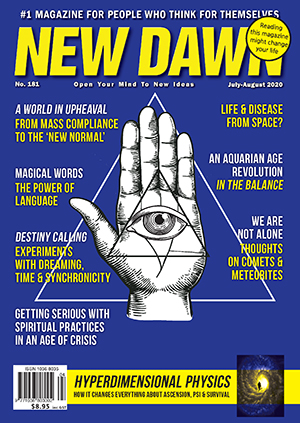
Get the issue this article appears in

Resist Conditioned Conventions of Mass Mind

A person cannot live by the conventions of society alone, or from the impacts and influences of everyday life. We need sustenance from a source that is beyond all social institutions, and from beyond the distractions and attractions of physical life. It is necessary to create a distance from the tirades that life brings us. Ironically, the newly imposed rules of social distancing may assist indirectly by triggering an awareness of a form of distancing in terms of unhealthy energetic attachment and identification. In this, perhaps, a more acute state of self-awareness can develop as an antidote to the general state of social unconsciousness. Of importance now is how to resist the conditioned conventions of the mass mind by cultivating new faculties of perception. It is a question of personal freedom of thought and perspective. Our choice is thus twofold: between recognising the unconscious forces of the mass mind; and aiming for the personal development of our awareness to act as individuals. 

What humanity is largely experiencing today is the moral uncertainty that precedes a new understanding as the old morality enters its death phase. As long as the majority of people expect all problems to be solved outside of themselves then our societies will continue to be dominated by unruly forces. The question of human freedom from these forces depends upon people willing to assume the responsibility of conscious awareness. 

The great perennial task of humanity has always been the same: to become what we have always been and to show others the way by our own individual presence and behaviour. When we are finally able to heal ourselves from within then, and only then, can we heal others and the world without. The power for change begins and ends with us, the individual – not from the hand of a minority elite. 

The question of human responsibility is to resist the forces of dehumanisation. If we do not awaken to our potentials during this space of ‘COVID consciousness,’ then we are vulnerable to the encroaching forces of dehumanising social-technological control, as I shall explore in the second part of this essay in the next issue of New Dawn.This article was published in New Dawn 181.If you appreciate this article, please consider a contribution to help maintain this website.

Footnotes

1. kingsleydennis.com/the-reset-button/
2. Taken from his collection of personal writings from 1942 to 1972 called The Human Province.
3. Taken from ‘Talks with Gurdjieff’ – various online sources.

© Copyright New Dawn Magazine, www.newdawnmagazine.com. Permission granted to freely distribute this article for non-commercial purposes if unedited and copied in full, including this notice.

© Copyright New Dawn Magazine, www.newdawnmagazine.com. Permission to re-send, post and place on web sites for non-commercial purposes, and if shown only in its entirety with no changes or additions. This notice must accompany all re-posting.
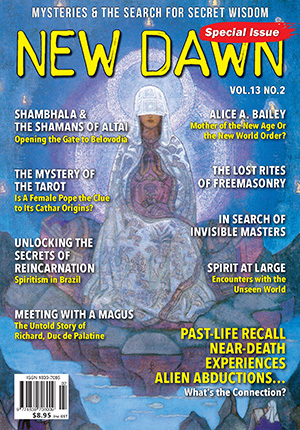
Alice A. Bailey: Mother of the New Age or the New World Order?

BY ISOBEL BLACKTHORN

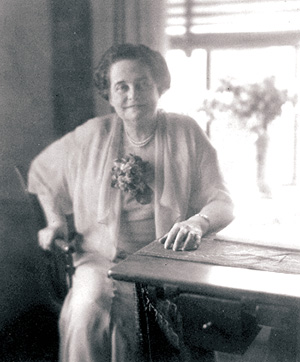
ALICE ANN BAILEY (1880–1949)

From New Dawn Special Issue Vol 13 No 2 (June 2019)

One of the most controversial figures to emerge from the Theosophical Society (TS) in the early twentieth century grew up a devout Christian far removed from occult circles. For many decades her faith was unshakeable, yet the seeds of her conversion lay in her introspective nature and sensitivity to mysticism. 

In the scholarly milieu, she is considered to be the mother of the New Age movement, harnessing the term circulating among occultists and the spiritually minded in her milieu, and composing a series of foundational texts which provide much of the theoretical basis of New Age thinking. 

The obscure Theosophist has left a hidden legacy that continues to this day to influence world affairs behind the scenes through various key roles, bodies and organisations operating within the United Nations. The degree of influence is difficult to gauge, but conspiracy theorists would argue it is significant.

Alice Ann Bailey (1880–1949) was born into the aristocratic La Trobe-Bateman family. Among her ancestors are Victoria’s first governor, Charles La Trobe, and the renowned book illuminator, Edward La Trobe. Other notables include neoclassical architect Benjamin Henry Boneval La Trobe and Alice’s grandfather, civil engineer John Frederick La Trobe Bateman. 

Unlike her younger sister, Alice deviated from the path her family expected her to tread. She did not marry, and she had no interest in pursuing a university education. Instead, adhering to her unwavering belief in the need for the salvation of souls, she worked as a missionary in soldier’s homes for the British army in Ireland and India, expounding the Gospels, entertaining the men playing checkers, serving cocoa and eggs, and sitting beside the ill and dying. 

Her time in India came to an abrupt end when she suffered a physical and psychological breakdown. Her faith, which she had held dear for so long, began to waver. It was then she fell in love with a soldier in the Hussar regiment, Walter Evans. It was an unfortunate match. The couple moved to Cincinnati where Walter attended Lane Theological Seminary. 

Three daughters and numerous bruises later, Alice managed to free herself from Walter’s violence. She then spent several years packing sardines in one of Monterey’s canneries, made famous by John Steinbeck in Cannery Row.

It was during this period that Alice converted to Theosophy after attending a lecture at the home of some acquaintances. She devoured the teachings and received guidance from founder Madame Helena Blavatsky’s personal students. Before long, Alice was giving her own classes in Theosophy.

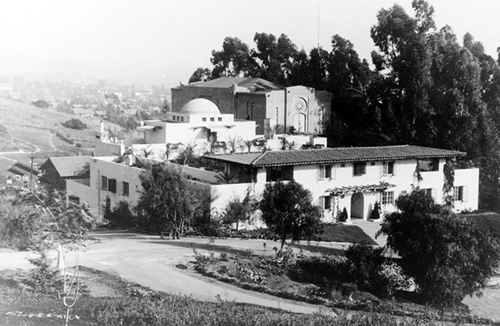
Consumed by this new body of knowledge, she moved to the Theosophical headquarters at Krotona, Hollywood, where she worked in the café. As soon as she could, she joined the elite Esoteric Section of the society. 

Krotona Institute of Theosophy, Hollywood, USA, early 1900s. Credit: Los Angeles Public Library

In January 1919, Alice Evans met her second husband, Foster Bailey, a lawyer and Freemason from Massachusetts born into a distinguished family of politicians and lawyers, hailing on the maternal line from founding father of Fitchburg, Amos Kimball. The couple soon took on key administrative roles in the TS, Foster as secretary and Alice as editor of the sectional magazine. 

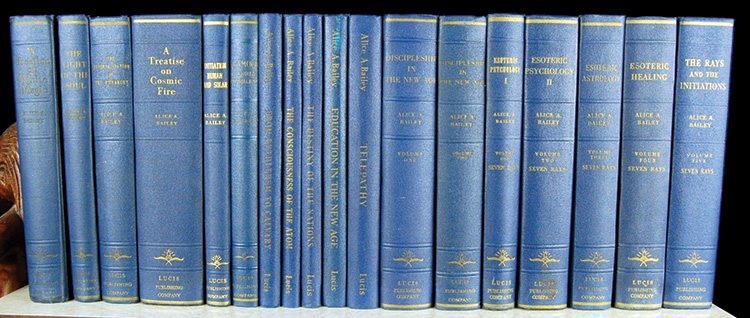
Around October of that year, Alice began writing as amanuensis for The Tibetan or Djwhal Khul, one of the Theosophical Masters of Wisdom. The Tibetan had also been Blavatsky’s master, from which her seminal text The Secret Doctrine arose. Reluctant at first, Alice took on the role of writing for The Tibetan, a role that would culminate in twenty-four volumes of esoteric teachings and commentary, a number written in her own right and many published posthumously. The collection became known as the Blue Books due to their indigo covers. 

A year later, an organisational row resulted in both Alice and Foster being ousted from their roles in the TS. They moved to New York where Foster was offered work as secretary of a Theosophical association. The couple quickly married and settled in Ridgefield Park, NJ. While Foster continued to campaign to change key organisational practices of the TS, Alice continued writing as she visioned their future. 

She established a Secret Doctrine class held in a room on Madison Avenue, which became an outstanding success. Interest grew and grew from all over the United States and beyond, and correspondence mounted. In 1922, the Baileys established the Lucis Trust and published the first three volumes of her opus. In 1923, they founded the Arcane School – an esoteric training school delivered by correspondence to disciples around the world. 

Alice Bailey would dedicate the rest of her life to laying the foundations of a new age of spiritual enlightenment, in the hope of countering the continued rise of materialism, hatred and greed.

The Blue Books

Alice Bailey’s body of work is in part a reformulation of the Theosophical current of Western Esotericism, composed in language accessible to the contemporary mind. Central to Theosophy are: a belief in the existence of the soul, reincarnation and the interconnectedness of all existence; an epochal view of evolution that includes consciousness; the transmission of an Ageless Wisdom from master to disciple; and a commitment to humanitarianism. 

There is nothing fluffy between the pages of the Blue Books. The atmosphere the teachings evokes is business-like, with an emphasis on responsibility, leadership and executive management. The volumes are instructional texts for aspirants and disciples of the spiritual path. Some are harder to read than others. The volumes include A Treatise on Cosmic Fire, an intricate cosmology drawing on Neoplatonist metaphysics and Eastern philosophy. Other works provide instructions for disciples on how to live, think and behave. A Treatise on the Seven Rays provides a detailed formulation of human psychology and advice on meditation and healing. 

Cemented in Alice Bailey’s particular version of Theosophy are Christian ideas of goodwill and good works, and she sought to make these basic principles the cornerstones of her teachings. She made it her mission to elevate occultism from the lower reaches of charlatans and counter the left-hand path some occultists follow. For Alice Bailey, esoteric thought and practice needed to be oriented towards selfless, altruistic goals and always for the good of the whole. 

Controversies

Despite these noble aims, during her lifetime Alice Bailey aroused the wrath of purist Theosophists, Christians and Jews who all took issue with her body of work.

Purist Theosophists accused Alice Bailey of false claim-making over her assertion that the source of most of her writings was none other than Blavatsky’s master Djwhal Khul. That she was merely a conduit in telepathic rapport receiving the next outpouring of the Ageless Wisdom provided her with a handy disclaimer should any issues of copyright or plagiarism arise. Some even alleged Alice Bailey made use of secret Theosophical teachings only available to members of the society’s Esoteric Section, a matter that cannot be proven as the teachings have not been made available in the public domain. 

She upset members of the Jewish community through her criticisms of their exclusive practices and an attachment to the notion of a Chosen People, which separated Jews from the rest of humanity in her eyes. Controversy also surrounds interpretations of the Theosophical root races, which appear to position Jews as less advanced. She trod sensitive ground even then, although to her credit some of her closest allies and co-workers were Jewish, including renowned psychiatrist Roberto Assagioli, who was highly influential in the foundation of humanistic and transpersonal psychology. Today, the Lucis Trust has issued an explanation of Alice Bailey’s position on the Jewish faith which can be found on their website. 

The Lucis publishing company started life as the Lucifer Publishing Company; an unfortunate choice and Alice Bailey quickly changed the name when she realised the upset it was causing among fundamentalist Christians. Her original choice stuck in the minds of later Christians, including author Constance Cumbey, who uses the original name to take Alice Bailey to task over her alliance with pure evil. Conspiracy thinkers cite the same. 

Throughout her writing life, Alice Bailey strove to gain credibility in academic circles. She wanted her texts to be taken seriously and set apart from the gamut of occult literature being published at the time. She solicited forewords and prefaces from sympathetic scholars including popular psychologist Harry Allen Overstreet and eminent professor of philosophy Oliver L Reiser. Not having received a tertiary education, she was at pains to include references to leading scholars in the fields of psychology, philosophy and religion, including the eminent psychiatrist Carl Jung. She met with some success but failed to achieve acceptance among the intellectual milieu. 

She rose above all of these threats to her reputation and credibility, yet a close reading of her unfinished autobiography reveals a defensive tone in relation to her husband, her daughters, her views on Jews, her own Christian fundamentalism and the Theosophical Society. It is transparent that she was painfully aware of her critics and sought to counter their claims.

Influencing the New Age Movement

Alice Bailey can be called the mother of the New Age movement if for no other reason than she set out to give birth through her texts, organisations and followers to a new and spiritually informed world order. Many who know of and respect Alice Bailey can be found in the New Age movement, yet few may realise just how influential her work has been in the movement’s foundation.

The New Age began as a utopian counter culture which rejected mainstream beliefs and values and searched for alternatives. The roots of the New Age are deep and can be traced back at least to the 1800s when interest in spirituality as an alternative to mainstream religion and dull intellectualism burgeoned, culminating, in esoteric circles, in the founding of the Theosophical Society in 1885. Alice Bailey, along with Rudolf Steiner and Krishnamurti, brought Theosophical teachings to their own audiences, helping to perpetuate continuing interest in the Ageless Wisdom. 

Hopes for a new utopian age were prevalent in Europe, Britain and America in the 1920s and 30s, at a time when the occult and spirituality to some degree fused. While dedicated seekers were committing to particular currents, dabblers and ‘armchair enthusiasts’ tried out or considered various strands, everything from the ideas of Mary Swainson, through Gurdjieff, Ouspensky, Meher Baba, Sufism, Rosicrucianism, Wicca and Jung, along with the aforementioned Theosophists. 

Alice Bailey was a prominent figure in the scene. She lectured far and wide. The Beacon was acknowledged to be a high-quality occult periodical.Book reviews and her letters appeared in the prestigious Occult Review

What others may have lacked and Bailey had in abundance was a highly focused missionary zeal. Everything she did in every hour of every day for thirty years was devoted to her cause. Her single-mindedness fuelled a similar dedication in her students, especially among her Arcane School graduates, those who have carried forward her vision. She continues to draw towards her, out of the general pool of seekers, those who are as serious, focused and committed as she. 

Her entire body of work can be described a New Age thought-form. She sought to found a paradigm, not a movement of spiritual seekers. All the personal-growth training contained in the New Age movement is, in Alice Bailey’s worldview, meant to be preparation for world service, not self-aggrandisement. For her, healing of various emotional and mental wounds is a side issue, something that may occur solely to divest the personality of its own obstacles. 

A Treatise on White Magic: or The Way of the Disciple is a work prized as a training manual for spiritual discipleship, containing fifteen ‘rules’ of the path, in essence a guide on how to avoid the dark path of black magic and render the student equipped for world service. Disciples are “instruments of service,” charged with developing their intuition and their sense of values, and turning their inner ear to those voices on the inner planes in order to inaugurate the New Age. 

Should her disciples fail in their responsibilities, then the Masters will withdraw, change their plans, and find some other way to proceed. Alice Bailey’s entire canon pivots on this one single charge. An opportunity exists for a new orientation, for humanity to pass through the portal of initiation into the kingdom of the soul. This is the New Age, should we want it.

Alice Bailey’s New Age is the dawning of global consciousness and the manifestation of the World Disciple, one with an expanded awareness of affairs affecting humanity and the planet. The hallmark of such global consciousness is world service, relinquishing selfish desires of the personality and acting in goodwill to foster right relations for the good of the whole. 

Through her texts and organisations, she not only helped conceptualise the New Age, she energised the concept with her evangelical drive, infusing the very notion with the atmosphere of ‘born again’ religious fervour. Her mission was to convert, to foster the birth of the soul, to guide her readers towards spiritual enlightenment. 

She was not unsuccessful. Her followers went on to interpret and step down her teachings to render them intelligible to seekers among the general population. Authors such as Vera Stanley Alder, Nancy Magor and Michael J. Eastcott, and Roberto Assagioli, provided interpretive bridges for later seekers, practitioners and writers. New Age luminaries inspired by Alice Bailey include David Spangler, William Bloom, Benjamin Creme and Jean Houston.

Alice Bailey has influenced Western understanding of the chakras, colour therapy, light work, astrology and transpersonal psychology, as well as providing core inspiration for the well-known alternative community of Findhorn in Scotland’s northeast. 

Get the issue this article appears in

Alice Bailey & the United Nations

The New Age Alice Bailey sought to inspire took a new turn during World War II. In response to the evils of dictatorship, Bailey, like many others of her time, yearned for better governance. She was distressed by the war, deeply affected by the suffering she saw and appalled by the aggressor nations. She argued the need for a new world order, one founded on ideas of equality, goodwill and leadership. She advocated equality of opportunity for all, individual freedom and autonomy, the eradication of poverty, the sovereign rights of all nations, a universal education, shared resources distributed fairly, and disarmament. 

She had no outward anchor for her reflections until 1st January 1942, when government representatives of twenty-six nations pledged to fight against the Axis powers and signed the Declaration of the United Nations, a declaration that led to the founding of the United Nations on 24th October 1945 in San Francisco, when its charter was ratified. Until then, all her efforts were poured into training disciples who were to go off in their various directions in the capacity of world service. The United Nations gave Bailey a focus and from then on she directed her disciples towards the organisation. 

Her support of the United Nations is unsurprising, the organisation representing a dovetailing of her spiritual ethos with the pressing concerns of the era to address the situation that had led to another world war, not least a widespread desire to create some form of international law designed to protect individuals and groups from abuses meted out by nation states, challenging the idea that a nation has an inviolable right to treat its citizens or anyone within its borders however it wishes. Through Alice Bailey’s eyes, there was at last hope of a better world, one founded on unity, goodwill and right relations. 

Alice Bailey’s call for a New World Order and support of the United Nations have resulted in an uproar among conspiracy theorists. Conspiracists are not wrong when they point to the infiltration of the UN by Alice Bailey’s co-workers. Membership of the UN’s Spiritual Caucus is filled with her people. Her organisation, World Goodwill, is a UN NGO. In 1952, Eleanor Roosevelt read Alice Bailey’s prayer, The Great Invocation, on a radio broadcast from the UN building in New York. 

One key UN figure closely associated with Alice Bailey is Robert Muller, who served in the UN for forty years and was assistant to three Secretary Generals. Muller devised the World Core Curriculum for which he was awarded the UNESCO Peace Education Prize in 1989, a curriculum loosely based on Alice Bailey’s Education in the New Age. He contributed to Alice Bailey’s magazine, The Beacon, and addressed Arcane School conferences. 

A coterie of influential figures operating out of plain sight would arouse suspicion in most of us. When those individuals believe in and are practising a form of occultism, suspicions inflame. And when the focus of activity is the United Nations – a locus for the New World Order – the result is a perfect storm of fear, speculation and evidence gathering. Whether Alice Bailey deserves it or not, she has become a pet hate among conspiracists.

The Passing of a Remarkable Occultist

Alice Bailey can be called the mother of the New Age movement if for no other reason than she set out to give birth through her texts, organisations and followers to a new and spiritually informed world order.

Alice Bailey passed away in December 1949 with her husband Foster at her bedside. She had been ill for many years. Among her health conditions, she suffered from pernicious anaemia. Symptoms are wide-ranging and incapacitating. Even with treatment, the condition can be debilitating and painful. Alice received regular blood transfusions. Despite this, she worked tirelessly to the very end, holding executive meetings from her hospital bed. 

After her death, Foster and their closest co-workers set about continuing the work. The Lucis Trust continues to publish the Blue Books in twenty languages and maintains and promotes the organisations she founded. Her co-workers to this day occupy key roles within the United Nations, and her texts continue to influence alternative spirituality and Western esoteric understanding and practice. 

Alice Bailey’s version of esoteric truth is meant to foster goodwill and right relations. It is up to the individual to decide if it does.

Isobel Blackthorn has written a biography of Alice Bailey. To learn more, visit this web page: isobelblackthorn.com/alice-a-bailey-life-and-legacy/This article was published in New Dawn Special Issue Vol 13 No 2.If you appreciate this article, please consider a contribution to help maintain this website.

Bibliography

Alice Bailey was prolific. Here is a selection of her works mentioned above. All her teachings are available for purchase at the Lucis Trust (www.lucistrust.org) or via online retailers.
A Treatise on Cosmic Fire, 1925
A Treatise on White Magic or The Way of the Disciple, 1934
A Treatise on the Seven Rays: Esoteric Psychology Vol I, 1936
A Treatise on the Seven Rays: Esoteric Psychology Vol II, 1942
Education in the New Age, 1954
The Externalization of the Hierarchy, 1957

© Copyright New Dawn Magazine, www.newdawnmagazine.com. Permission granted to freely distribute this article for non-commercial purposes if unedited and copied in full, including this notice.

© Copyright New Dawn Magazine, www.newdawnmagazine.com. Permission to re-send, post and place on web sites for non-commercial purposes, and if shown only in its entirety with no changes or additions. This notice must accompany all re-posting.

You Counter Trumpism By Ending The Conditions Which Created It, Not With Authoritarian Policies

JANUARY 22, 2021 (caitlinjohnstone.com)

AUTHOR: CAITLIN JOHNSTONE

The US political/media class have been pushing hard for more authoritarian policies to stave off the threat of “domestic terrorism” in the wake of the Capitol riot. President Biden, who was already working on rolling out new domestic terror policies well before January sixth, confirmed after the riot that he is making these new measures a priority. Political internet censorship is becoming increasingly normalized, anti-protest bills are being passed, and now we’re seeing liberals encouraged to form “digital armies” to spy on Trump supporters to report them to the authorities.

And an amazingly large percentage of the US population seems to have no problem with any of this, even in sectors of the political spectrum that should really know better by now.

“What else can we do?” they reason. “What other solution could there possibly be to the threat of dangerous fascists and conspiracy theorists continuing to gain power and influence?”

Well there’s a whole lot that can be done, and none of it includes consenting to sweeping new Patriot Act-like authoritarian measures or encouraging monopolistic Silicon Valley plutocrats to censor worldwide political speech. There’s just a whole lot of mass-scale narrative manipulation going on to keep it from being obvious to everyone.

The way to stem the tide of Trumpism (or fascism, or white supremacism, or Trump cultism, or whatever term you use for what you’re worried about here) is to eliminate the conditions which created it.

Trump was only able to launch his successful faux-populist campaign in the first place by exploiting the widespread pre-existing opinion that there was a swamp that needed draining, a corrupt political system whose leadership does not promote the interests of the people.

Conspiracy theories only exist because the government often does evil things and lies about them with the help of the mass media, forcing people to just guess what’s happening behind the opaque wall of government secrecy.

People only get it in their heads that they need a trustworthy strongman to overhaul the system if the system has failed them.

People who are actually interested in ending Trumpism would be promoting an end to the corruption in the political system, an end to the opacity of their government, an end to their uniquely awful electoral system, and an end to the neoliberal policies which have been making Americans poorer and poorer with less and less support from the government which purports to protect them.

But these changes are not being promoted by the US political/media class, because the US political/media class speaks for an empire that depends on these things.

Without corruption, the plutocratic class couldn’t use campaign donations and corporate lobbying to install and maintain politicians who will advance their interests.

Without government secrecy, the oligarchic empire could not conspire in secret to advance the military and economic agendas which form the glue that holds the empire together.

Without a lying mass media, people’s consent could not be manufactured for wars and a system which does not serve their interests.

Without widespread poverty and domestic austerity, people could not be kept too busy and politically impotent to challenge the massive political influence of the plutocrats.

So the option of stopping the rise of Trumpism by changing the system is taken off the table, which is why you never hear it discussed as a possibility in mainstream circles. The only option people are being offered to debate the pros and cons of is giving more powers to that same corrupt system which created Trump, powers which will be under the control of the next Trumpian figure who is elevated by that very system.

You’re not going to prevent fascism by creating a big authoritarian monster to stomp it into silence, and even if you could you would only be stopping the fascism by becoming the fascism. To stop the rise of fascism you need to actually change. Drastically. Believing you can just make it go away without changing your situation is like believing you can avert an oncoming train by putting your hands over your eyes.

There is no valid argument against what I am saying here. Saying the powerful won’t allow any positive change is just confirming everything I’m saying and confirming the need to remove the powerful from power. Saying that ending corruption, government secrecy and injustice would just be giving the terrorists what they want would be turning yourself into a bootlicker of such cartoonish obsequiousness there aren’t words in the English language adequate to mock you.

Yes, change is desperately needed. Yes, the powerful will resist that change with everything they have. But the alternative is letting them plunge the world into darkness and destruction. We’re going to have to find a way to win this thing.

(Contributed by Gwyllm Llwydd)

Bio: Edna St. Vincent Millay

From Wikipedia, the free encyclopedia

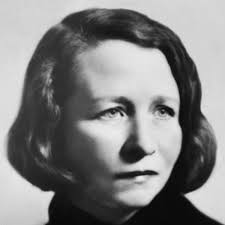
Edna St. Vincent Millay
Edna St. Vincent Millay, photographed by Carl Van Vechten, 1933
BornFebruary 22, 1892
Rockland, Maine, US
DiedOctober 19, 1950 (aged 58)
Austerlitz, New York, US
Pen nameNancy Boyd
OccupationPoet
NationalityAmerican
Alma materVassar College
Notable awardsPulitzer Prize for Poetry
(1923)
Robert Frost Medal
(1943)

Edna St. Vincent Millay (February 22, 1892 – October 19, 1950) was an American lyrical poet and playwright.

Encouraged to read the classics at home, she was too rebellious to make a success of formal education, but she won poetry prizes from an early age, including the Pulitzer Prize in 1923, and went on to use verse as a medium for her feminist activism. She also wrote verse-dramas and a highly-praised opera The King’s Henchman. Her novels appeared under the name Nancy Boyd, and she refused lucrative offers to publish them under her own name.

Millay was a prominent social figure of New York City’s Greenwich Village, just as it was becoming known as a bohemian writer’s colony, and she was noted for her uninhibited lifestyle, forming many passing relationships with both sexes. A road accident in middle-age left her part-invalided and morphine-dependent for life.

Early life

Millay was born in Rockland, Maine, to Cora Lounella Buzelle, a nurse, and Henry Tolman Millay, a schoolteacher who would later become a superintendent of schools. Her middle name derives from St. Vincent’s Hospital in New York, where her uncle’s life had been saved just before her birth. The family’s house was “between the mountains and the sea where baskets of apples and drying herbs on the porch mingled their scents with those of the neighboring pine woods.”[1] In 1904, Cora officially divorced Millay’s father for financial irresponsibility and domestic abuse, but they had already been separated for some years. Henry and Millay kept a letter correspondence for many years, but he never re-entered the family. Cora and her three daughters, Edna (who called herself “Vincent”), Norma Lounella (born 1893), and Kathleen Kalloch (born 1896), moved from town to town, living in poverty and surviving various illnesses. Cora travelled with a trunk full of classic literature, including Shakespeare and Milton, which she read to her children. The family settled in a small house on the property of Cora’s aunt in Camden, Maine, where Millay would write the first of the poems that would bring her literary fame.Edna St. Vincent Millay in Mamaroneck,[2] NY, 1914, by Arnold Genthe.

The three sisters were independent and spoke their minds, which did not always sit well with the authority figures in their lives. Millay’s grade school principal, offended by her frank attitudes, refused to call her Vincent. Instead, he called her by any woman’s name that started with a V.[3] At Camden High School, Millay began developing her literary talents, starting at the school’s literary magazine, The Megunticook. At 14 she won the St. Nicholas Gold Badge for poetry, and by 15, she had published her poetry in the popular children’s magazine St. Nicholas, the Camden Herald, and the high-profile anthology Current Literature.

Millay entered Vassar College in 1913 when she was 21 years old, later than usual. Her attendance at Vassar became a strain to her due to its strict nature. Before she attended the college Millay had a liberal home life that included smoking, drinking, playing gin rummy, and flirting with men. Vassar, on the other hand, expected its students to be refined and live according to their status as young ladies.[4] She had relationships with many fellow students during her time there and kept scrapbooks including drafts of plays written during the period.[3][5] While at school, she had several relationships with women, including Edith Wynne Matthison, who would go on to become an actress in silent films.[6]

New York City

Edna St. Vincent Millay’s home in 1923–24 at ​75 12 Bedford Street, Greenwich Village (2013 photo)

After her graduation from Vassar in 1917, Millay moved to New York City. She lived in a number of places in Greenwich Village, including a house owned by the Cherry Lane Theatre[7] and 75½ Bedford Street, renowned for being the narrowest[8][9] in New York City.[10] While in New York City, Millay lived an openly bisexual lifestyle.[4] The critic Floyd Dell wrote that the red-haired and beautiful Millay was “a frivolous young woman, with a brand-new pair of dancing slippers and a mouth like a valentine.”[1] Millay described her life in New York as “very, very poor and very, very merry.” While establishing her career as a poet, Millay initially worked with the Provincetown Players on Macdougal Street and the Theatre Guild. In 1924 Millay and others founded the Cherry Lane Theater “to continue the staging of experimental drama.”[11] Magazine articles under a pseudonym also helped support her early days in the Village.[1] During her stay in Greenwich Village, Millay learned to use her poetry in her feminist activism. She often went into detail about topics others found taboo, such as a wife leaving her husband in the middle of the night.[4]

Counted among Millay’s close friends were the writers Witter BynnerArthur Davison Ficke, and Susan Glaspell, as well as Floyd Dell and the critic Edmund Wilson, both of whom proposed marriage to her and were refused.[6][12] Millay had a way of wrapping men around her finger, even after she rejected them.[4] Edmund Wilson, for example, spoke of her highly because Millay took his virginity but she recanted of his advances and rejected his marriage proposal, but he remained a loyal friend.[4] She was inclined to fall out of love easily, bluntly answering a marriage proposal: “Never ask a girl poet to marry you.”[13]

Career

Millay’s fame began in 1912 when, at the age of 20, she entered her poem “Renascence” in a poetry contest in The Lyric Year. The poem was widely considered the best submission, and when it was ultimately awarded fourth place, it created a scandal which brought Millay publicity. The first-place winner Orrick Johns was among those who felt that “Renascence” was the best poem, and stated that “the award was as much an embarrassment to me as a triumph.” A second-prize winner offered Millay his $250 prize money.[14] In the immediate aftermath of the Lyric Year controversy, wealthy arts patron Caroline B. Dow heard Millay reciting her poetry and playing the piano at the Whitehall Inn in Camden, Maine, and was so impressed that she offered to pay for Millay’s education at Vassar College.[15]

After graduating from Vassar, Millay moved to Greenwich Village. A friend remembered seeing her red hair flying as she ran down MacDougal Street, “flushed and laughing like a nymph.”[13] Holed up in a small, unheated apartment, she began to write shorter, pithier poems.

Millay’s 1920 collection A Few Figs From Thistles drew controversy for its exploration of female sexuality and feminism.[16] In 1919, she wrote the anti-war play Aria da Capo, which starred her sister Norma Millay at the Provincetown Playhouse in New York City. Millay won the Pulitzer Prize for Poetry in 1923 for “The Ballad of the Harp-Weaver”;[17] she was the third woman to win the poetry prize, after Sara Teasdale (1918) and Margaret Widdemer (1919).[18]

Millay also wrote short stories for the magazine Ainslee’s – but she was a canny protector of her identity as a poet and an aesthete, and insisted on publishing this more mass-appeal work under a pseudonym, Nancy Boyd. As her fame grew and she became a household name, the publisher of Ainslee’s offered to double her fees if he could use her real name. She refused.

In January 1921, she went to Paris, where she met and befriended the sculptors Thelma Wood[19] and Constantin Brancusi, photographer Man Ray, had affairs with journalists George Slocombe and John Carter, and became pregnant by a man named Daubigny. She secured a marriage license but instead returned to New England where her mother Cora helped induce an abortion with alkanet, as recommended in her old copy of ”Culpeper’s Complete Herbal”.[20]

Possibly as a result, Millay was frequently ill and weak for much of the next four years.

After experiencing his remarkable attentions to her during her illness, in 1923 she married 43-year-old Eugen Jan Boissevain (1880–1949), the widower of the labor lawyer and war correspondent Inez Milholland, a political icon Millay had met during her time at Vassar.[21] A self-proclaimed feminist, Boissevain supported Millay’s career and took primary care of domestic responsibilities. Both Millay and Boissevain had other lovers throughout their 26-year marriage. For Millay, one such significant relationship was with the poet George Dillon, a student 14 years her junior, whom she met in 1928 at one of her readings at the University of Chicago. Their relationship inspired the sonnets in the collection Fatal Interview (published 1931).[22]Main house at Steepletop, where Millay spent the last 25 years of her life

In 1925, Boissevain and Millay bought Steepletop near Austerlitz, New York, which had once been a 635-acre (257 ha) blueberry farm.[23] They built a barn (from a Sears Roebuck kit), and then a writing cabin and a tennis court. Millay grew her own vegetables in a small garden.[23][24] Later, they bought Ragged Island in Casco Bay, Maine, as a summer retreat.[25] Frequently having trouble with the servants they employed, Millay wrote, “The only people I really hate are servants. They are not really human beings at all.”[26]

In the summer of 1936, Millay was riding in a station wagon when the door suddenly swung open, and Millay “was hurled out into the pitch-darkness…and rolled for some distance down a rocky gully”[27] The accident severely damaged nerves in her spine, requiring frequent surgeries and hospitalizations, at least daily doses of morphine. Millay lived the rest of her life in “constant pain”.[28] Despite this, she was sufficiently alarmed by the rise of fascism to write against it. During World War I, Millay had been a dedicated and active pacifist; however, in 1940 she advocated for the U.S. to enter the war against the Axis and became an ardent supporter of the war effort. She later worked with Writers’ War Board to create propaganda, including poetry.[29] Millay’s reputation in poetry circles was damaged by her war work. Merle Rubin noted, “She seems to have caught more flak from the literary critics for supporting democracy than Ezra Pound did for championing fascism.”[30] In 1942 in The New York Times Magazine, Millay mourned the destruction of the Czechoslovak town of LidiceNazi forces had razed Lidice, slaughtered its male inhabitants and scattered its surviving residents in retaliation for the assassination of Reinhard Heydrich. Millay wrote:

The whole world holds in its arms today
The murdered village of Lidice,
Like the murdered body of a little child.[1]

This article would serve as the basis of her 32-page poem, “Murder of Lidice“, in 1942[31] and loosely served as the basis of the 1943 MGM movie Hitler’s Madman.[32][circular reference] Douglas Sirk directed the movie. Harper and Brothers published the poem in 1942.[31]

In 1943, Millay was the sixth person and the second woman to be awarded the Frost Medal for her lifetime contribution to American poetry.

Despite the excellent sales of her books in the 1930s, her declining reputation, constant medical bills, and frequent demands from her mentally-ill sister Kathleen meant that for most of her last years, Millay was in debt to her own publisher.[33] Author Daniel Mark Epstein also concludes from her correspondence that Millay developed a passion for thoroughbred horse-racing, and spent much of her income investing in a racing stable of which she had quietly become an owner.[34] Boissevain died in 1949 of lung cancer, and Millay lived alone for the last year of her life.

More at: https://en.wikipedia.org/wiki/Edna_St._Vincent_Millay

Bio: Martin Heidegger

From Wikipedia, the free encyclopedia

Martin Heidegger
Heidegger in 1960
Born26 September 1889
MeßkirchBadenGerman Empire
Died26 May 1976 (aged 86)
Freiburg im BreisgauWest Germany
NationalityGerman
EducationCollegium Borromaeum [de]
(1909–1911)[1]
University of Freiburg
(PhD, 1914; Dr. phil. hab. 1916)
Spouse(s)Elfride Petri (m. 1917)
Partner(s)Elisabeth Blochmann (1918–1969)
Hannah Arendt (1924–1928)
Era20th-century philosophy
RegionWestern philosophy
SchoolContinental philosophy
Phenomenology
Hermeneutics
Ontological hermeneutics[2]
Hermeneutic phenomenology (early)[3]
Transcendental hermeneutic phenomenology (late)[4]
Existentialism
Existential phenomenology[5]Irrationalism[citation needed]
InstitutionsUniversity of Marburg
University of Freiburg
ThesesDie Lehre vom Urteil im Psychologismus. Ein kritisch-theoretischer Beitrag zur Logik (The Doctrine of Judgment in Psychologism: A Critical-theoretical Contribution to Logic) (1914)Die Kategorien- und Bedeutungslehre des Duns Scotus (Duns Scotus’s Doctrine of Categories and Meaning) (1916)
Doctoral advisorArthur Schneider (PhD advisor)
Heinrich Rickert (Dr. phil. hab. advisor)
Doctoral studentsHans Jonas
Main interestsOntologyChristian philosophyMetaphysicsArtGreek philosophyTechnologyLanguagePoetryThinking
Notable ideasHeideggerian terminologyDaseinGestellOntotheologyOntological difference (Ontologische Differenz)Existentials (Existenzialien)EkstaseSigetics (Sigetik)Hermeneutic circleAletheiaDisclosureFundamental ontologyForgetfulness of Being (Seinsvergessenheit)Dwelling (Wohnen)Language as the vehicle through which the question of Being can be unfolded[6]Language speaks“Art’s ability to set up a strife between “world” and “earth”[7]
Influences[show]
Influenced[show]
Signature

Martin Heidegger (/ˈhaɪdɛɡər, ˈhaɪdɪɡər/;[12][13] German: [ˈmaʁtiːn ˈhaɪdɛɡɐ];[14][12] 26 September 1889 – 26 May 1976) was a German philosopher who is widely regarded as one of the most important philosophers of the 20th century. He is best known for contributions to phenomenologyhermeneutics, and existentialism.

In Being and Time (1927), Heidegger addresses the meaning of “being” by considering the question, “what is common to all entities that makes them entities?” Heidegger approaches this question through an analysis of Dasein, his term for the specific type of being that humans possess, and which he associates closely with his concept of “being-in-the-world” (In-der-Welt-sein).[15]:193 This conception of the human is in contrast with that of Rationalist thinkers like René Descartes, who had understood human existence most basically as thinking, as in Cogito ergo sum (“I think therefore I am”).

Heidegger’s later work includes criticism of the view, common in the Western tradition, that all of nature is a “standing reserve” on call, as if it were a part of industrial inventory.[16][17]

Heidegger was a member and supporter of the Nazi Party.[18][19] There is controversy as to the relationship between his philosophy and his Nazism.[20][21]

Biography

Early years

The Mesnerhaus in Meßkirch, where Heidegger grew up

Heidegger was born in rural MeßkirchBaden-Württemberg, the son of Johanna (Kempf) and Friedrich Heidegger.[22] Raised a Roman Catholic, he was the son of the sexton of the village church that adhered to the First Vatican Council of 1870, which was observed mainly by the poorer class of Meßkirch. His family could not afford to send him to university, so he entered a Jesuit seminary, though he was turned away within weeks because of the health requirement and what the director and doctor of the seminary described as a psychosomatic heart condition. Heidegger was short and sinewy, with dark piercing eyes. He enjoyed outdoor pursuits, being especially proficient at skiing.[23]

Studying theology at the University of Freiburg while supported by the church, later he switched his field of study to philosophy. Heidegger completed his doctoral thesis on psychologism in 1914,[24] influenced by Neo-Thomism and Neo-Kantianism, directed by Arthur Schneider.[25] In 1916, he finished his venia legendi with a habilitation thesis on Duns Scotus[26] directed by Heinrich Rickert[27] and influenced by Edmund Husserl‘s phenomenology.[28]

In the two years following, he worked first as an unsalaried Privatdozent then served as a soldier during the final year of World War I; serving “the last ten months of the war” with “the last three of those in a meteorological unit on the western front“.[6]

Marburg[edit]

In 1923, Heidegger was elected to an extraordinary Professorship in Philosophy at the University of Marburg.[29] His colleagues there included Rudolf BultmannNicolai Hartmann, and Paul Natorp.[30]:65 Heidegger’s students at Marburg included Hans-Georg GadamerHannah ArendtKarl LöwithGerhard KrügerLeo StraussJacob KleinGünther Anders, and Hans Jonas. Following on from Aristotle, he began to develop in his lectures the main theme of his philosophy: the question of the sense of being. He extended the concept of subject to the dimension of history and concrete existence, which he found prefigured in such Christian thinkers as Saint PaulAugustine of HippoLuther, and Kierkegaard. He also read the works of Wilhelm Dilthey, Husserl, Max Scheler,[31] and Friedrich Nietzsche.[32]

Freiburg

In 1927, Heidegger published his main work, Sein und Zeit (Being and Time). When Husserl retired as Professor of Philosophy in 1928, Heidegger accepted Freiburg’s election to be his successor, in spite of a counter-offer by Marburg. Heidegger remained at Freiburg im Breisgau for the rest of his life, declining a number of later offers, including one from Humboldt University of Berlin. His students at Freiburg included Hannah ArendtGünther AndersHans JonasKarl LöwithCharles MalikHerbert MarcuseErnst Nolte, and Karl Rahner.[33][34][35] Emmanuel Levinas attended his lecture courses during his stay in Freiburg in 1928, as did Jan Patočka in 1933; Patočka in particular was deeply influenced by him.[36][37]

Heidegger was elected rector of the University on 21 April 1933, and joined the National Socialist German Workers’ (Nazi) Party on 1 May.[38] During his time as rector of Freiburg, Heidegger was not only a member of the Nazi Party, but an enthusiastic supporter of the Nazis.[39][40][19] There is controversy as to the relationship between his philosophy and his Nazism.[20]

He wanted to position himself as the philosopher of the Party, but the highly abstract nature of his work and the opposition of Alfred Rosenberg, who himself aspired to act in that position, limited Heidegger’s role. His resignation from the rectorate owed more to his frustration as an administrator than to any principled opposition to the Nazis, according to historians.[41] In his inaugural address as rector on 27 May he expressed his support of a German revolution, and in an article and a speech to the students from the same year he also supported Adolf Hitler.[42]:3:11 In November 1933, Heidegger signed the Vow of allegiance of the Professors of the German Universities and High-Schools to Adolf Hitler and the National Socialistic State.

Heidegger resigned the rectorate in April 1934, but remained a member of the Nazi Party until 1945 even though (as Julian Young asserts) the Nazis eventually prevented him from publishing.[42]:3 In the autumn of 1944, Heidegger was drafted into the Volkssturm, assigned to dig anti-tank ditches along the Rhine.[43]

Heidegger’s Black Notebooks, written between 1931 and 1941 and first published in 2014, contain several expressions of anti-semitic sentiments, which have led to a re-evaluation of Heidegger’s relation to Nazism.[44][45] Having analysed the Black Notebooks, Donatella di Cesare asserts in her book Heidegger and the Jews that “metaphysical anti-Semitism” and antipathy toward Jews were central to Heidegger’s philosophical work. Heidegger, according to di Cesare, considered Jewish people to be agents of modernity disfiguring the spirit of Western civilization; he held the Holocaust to be the logical result of the Jewish acceleration of technology, and thus blamed the Jewish genocide on its victims themselves.[46]

Post-war

In late 1946, as France engaged in épuration légale in its Occupation zone, the French military authorities determined that Heidegger should be blocked from teaching or participating in any university activities because of his association with the Nazi Party.[47] The denazification procedures against Heidegger continued until March 1949 when he was finally pronounced a Mitläufer (the second lowest of five categories of “incrimination” by association with the Nazi regime). No punitive measures against him were proposed.[48] This opened the way for his readmission to teaching at Freiburg University in the winter semester of 1950–51.[48] He was granted emeritus status and then taught regularly from 1951 until 1958, and by invitation until 1967.

Personal life

Heidegger’s stone-and-tile chalet clustered among others at Todtnauberg

Heidegger married Elfride Petri on 21 March 1917,[49] in a Catholic ceremony officiated by his friend Engelbert Krebs [de], and a week later in a Protestant ceremony in the presence of her parents. Their first son, Jörg, was born in 1919.[50]:159 Elfride then gave birth to Hermann [de] in August 1920. Heidegger knew that he was not Hermann’s biological father but raised him as his son. Hermann’s biological father, who became godfather to his son, was family friend and doctor Friedel Caesar. Hermann was told of this at the age of 14;[51] Hermann became a historian and would later serve as the executor of Heidegger’s will.[52] Hermann Heidegger died on 13 January 2020.[53]

Heidegger had a long romantic relationship with Hannah Arendt and an affair (over many decades) with Elisabeth Blochmann, both students of his. Arendt was Jewish, and Blochmann had one Jewish parent, making them subject to severe persecution by the Nazi authorities. He helped Blochmann emigrate from Germany before the start of World War II and resumed contact with both of them after the war.[54] Heidegger’s letters to his wife contain information about several other affairs of his.[52]

Heidegger spent much time at his vacation home at Todtnauberg, on the edge of the Black Forest.[55] He considered the seclusion provided by the forest to be the best environment in which to engage in philosophical thought.[56]Heidegger’s grave in Meßkirch

A few months before his death, he met with Bernhard Welte, a Catholic priest, Freiburg University professor and earlier correspondent. The exact nature of their conversation is not known, but what is known is that it included talk of Heidegger’s relationship to the Catholic Church and subsequent Christian burial at which the priest officiated.[57][58][59]:10 Heidegger died on 26 May 1976,[60][61]:1 and was buried in the Meßkirch cemetery.[62]

Philosophy

View from Heidegger’s vacation chalet in Todtnauberg. Heidegger wrote most of Being and Time there.

Dasein

In the 1927 Being and Time, Heidegger rejects the Cartesean view of the human being as a subjective spectator of objects, according to Marcella Horrigan-Kelly (et al.).[63] The book instead holds that both subject and object are inseparable. In presenting “being” as inseparable, “Heidegger introduced the term Dasein (literally: being there), intended to embody a ‘living being’ through their activity of ’being there’ and ‘being in the world’ “(Horrigan-Kelly).[63] “Famously, Heidegger writes of Dasein as Being-in-the-world,” according to Michael Wheeler (2011). Understood as a unitary phenomenon rather than a contingent, additive combination, being-in-the-world is an essential characteristic of Dasein, Wheeler writes.[64]

Heidegger’s account of Dasein in Being and Time passes through a dissection of the experiences of Angst, “the Nothing” and mortality, and then through an analysis of the structure of “Care” as such. From there he raises the problem of “authenticity,” that is, the potentiality for mortal Dasein to exist fully enough that it might actually understand being and its possibilities. Dasein is not “man,” but is nothing other than “man,” according to Heidegger. Moreover, he wrote that Dasein is “the being that will give access to the question of the meaning of Being.”[65]

Being

Dasein’s ordinary and even mundane experience of “being-in-the-world” provides “access to the meaning” or “sense of being” (Sinn des Seins) This access via Dasein is also that “in terms of which something becomes intelligible as something.”[66] Heidegger proposes that this meaning would elucidate ordinary “prescientific” understanding, which precedes abstract ways of knowing, such as logic or theory.[67]

This supposed “non-linguistic, pre-cognitive access” to the meaning of Being didn’t underscore any particular, preferred narrative, according to an account of Richard Rorty‘s analysis by Edward Grippe.[68] In this account, Heidegger holds that no particular understanding of Being (nor state of Dasein and its endeavors) is to be preferred over another. Moreover, “Rorty agrees with Heidegger that there is no hidden power called Being,” Grippe writes, adding that Heidegger’s concept of Being is viewed by Rorty as metaphorical.

But Heidegger actually offers “no sense of how we might answer the question of being as such,” writes Simon Critchley in a nine-part blog commentary on the work for The Guardian (2009). The book instead provides “an answer to the question of what it means to be human,” according to Critchley.[69] Nonetheless, Heidegger does present the concept: “‘Being’ is not something like a being but is rather “what determines beings as beings.”[70] The interpreters Thomas Sheehan and Mark Wrathall each separately assert that commentators’ emphasis on the term “Being” is misplaced, and that Heidegger’s central focus was never on “Being” as such. Wrathall wrote (2011) that Heidegger’s elaborate concept of “unconcealment” was his central, life-long focus, while Sheehan (2015) proposed that the philosopher’s prime focus was on that which “brings about being as a givenness of entities.”[71][72]

Heidegger claims that traditional ontology has prejudicially overlooked the question of being. His analysis employs a hermeneutic circle, relying upon repetitive yet progressive acts of interpretation.[73]

Time

Heidegger believes that time finds its meaning in death, according to Michael Kelley. That is, time is understood only from a finite or mortal vantage. Dasein’s essential mode of being in the world is temporal: Having been “thrown” into a world implies a “pastness” to its being. Dasein occupies itself with the present tasks required by goals it has projected on the future. Thus Heidegger concludes that Dasein’s fundamental characteristic is temporality, Kelley writes.[74][75]

Dasein as an inseparable subject/object, cannot be separated from its objective “historicality.” On the one hand, Dasein is “stretched along” between birth and death, and thrown into its world; into its possibilities which Dasein is charged with assuming. On the other hand, Dasein’s access to this world and these possibilities is always via a history and a tradition—this is the question of “world historicality.”

Ontological difference and fundamental ontology

Central to Heidegger’s philosophy is the notion of ontological difference: the difference between being as such and specific entities.[76][77] He accuses the philosophical tradition of being forgetful of this distinction, which has led to the mistake of understanding being as such as a kind of ultimate entity, for example as “idea, energeia, substance, monad or will to power”.[76][78][79] Heidegger tries to rectify this mistake in his own fundamental ontology by focusing on the meaning of being instead, a project which is akin to contemporary meta-ontology.[80][81] One method to achieve this is by studying the human being, or Dasein, in Heidegger’s terminology.[82] The reason for this is that we already have a pre-ontological understanding of being that shapes how we experience the world. Phenomenology can be used to make this implicit understanding explicit, but it has to be accompanied by hermeneutics in order to avoid the distortions due to the forgetfulness of being.[76]

More at: https://en.wikipedia.org/wiki/Martin_Heidegger

Yes, We Have COVID-19 Vaccines That Are 95% Effective. But That Doesn’t Mean the End of the Pandemic is Near

BY ALICE PARK  NOVEMBER 20, 2020 (Time.com)

It’s a rare glimmer of hope in a brutal and battering pandemic year: in November, both Moderna and Pfizer reported that their much-anticipated COVID-19 vaccines are 95% effective in protecting people against getting sick with the disease.

Scientists were encouraged (and even surprised by the magnitude of the protection), public health officials finally saw what could be the beginning of the end of the pandemic, and families everywhere began fantasizing about a return to normalcy where gathering around the table to celebrate the holidays are a given and not a matter of public health concern.

But the same public health experts who are encouraged by the positive vaccine results are also warning that vaccines aren’t the panacea that many are desperately hoping they will be. And that, even after more people get the shots, we’ll still have to wear masks and stay a respectful six feet apart from each other.

First, there’s the question of efficacy. Yes, Moderna and Pfizer reported that their shots are 94.5% and 95% effective, respectively. But that efficacy refers to the vaccines’ ability to protect against COVID-19 disease—and not necessarily against infection with the virus. Both of the rigorous trials to test the vaccines were designed to measure COVID-19 illness—trial volunteers were randomly given either the vaccine or a placebo, and then asked to report any symptoms of COVID-19 they experienced, such as fever, cough, shortness of breath or muscle aches. The study researchers then determined whether or not to test them. If people tested positive, they were logged as a confirmed COVID-19 case, and the researchers then looked at the group of COVID-19 cases and compared how many people had been vaccinated versus how many had gotten placebo. The effectiveness measured whether these people went on to develop more symptoms of COVID-19.

That means that people who are vaccinated are not necessarily immune to getting infected; but they are more likely to experience fewer symptoms and not get as sick as those who aren’t vaccinated.

That’s still a huge advantage over the virus, since severe COVID-19 sends people to the hospital where they may need intensive care and ventilators to breathe. The more people who can experience milder symptoms and recover at home, the less burden on the health care system and the less exposure that health care workers will have to the virus, which all contributes to better control of the pandemic.

However, because the vaccines do not necessarily protect against infection, that means that public health measures such as wearing masks, social distancing and avoiding indoor gatherings are still critical to containing the virus. More data will provide clues about whether people who are vaccinated and never experience symptoms can still spread the disease to others. But that’s not known yet, so experts say it’s better to keep up the behaviors that have proven to stymie spread of COVID-19.

In addition, while both Moderna and Pfizer plan to file shortly for authorization to start distributing their vaccines, even after they receive the green light, it will take a while for the shots to be shipped and actually arrive at hospitals, doctors’ offices and pharmacies. Both companies have already begun producing doses, banking on the fact that their vaccines would be effective, but that manufacturing still won’t churn out enough doses to meet demand this year.

Because doses will be limited, the government has asked state health departments to submit proposals for how they will distribute vaccines in phases, starting with highest-risk groups like health care workers and other frontline workers with essential jobs such as first responders and law enforcement personnel. As more doses become available, the elderly and people with chronic health conditions would be vaccinated, and eventually, the rest of the population. It’s likely that the majority of the American public won’t be vaccinated until next spring at the earliest.

That means that the ultimate goal in controlling the pandemic, herd immunity, likely won’t happen until well into next year, when enough people are vaccinated and can ward off serious illness. “Not until a substantial proportion of the population is vaccinated, and the caseload has dropped to very low levels, will we be able to breathe (without a mask) a sigh of relief,” says Emanuel Goldman, professor of microbiology at Rutgers University. And even then, he points out, researchers will have to remain vigilant about tracking any changes in the virus as it finds fewer and fewer welcoming hosts. “The virus might have other ideas and try to change in a way that makes the vaccine less effective.”

Only by vaccinating millions of people, and monitoring how their immune systems react, will experts get a better handle on what it takes to extinguish COVID-19 or at least make it much more difficult for it to spread. “The big message is that we have an additional tool [in the form of vaccines] for fighting COVID-19, but we don’t have a tool to replace everything we do just yet,” says Dr. Anthony Fauci, director of the National Institute of Allergy and Infectious Diseases. “Hopefully as the country and world gets massively vaccinated, this virus will be essentially backed in, with no place to go because everybody is protected.”

With reporting by Amy Gunia/Hong Kong

The Coronavirus Update

(image) WIRED Coronavirus Update Logo

01.22.21 (wired.com)

Biden gets to work on the pandemic, the CDC adjusts vaccine guidelines, and death tolls rise worldwide. Here’s what you should know:Headlines

Biden institutes sweeping pandemic measures during his first days in office

Joe Biden has wasted no time when it comes to tackling the public health crisis that will invariably define his presidency. On Wednesday, just hours after he was sworn in as America’s 46th president, he signed three executive orders pertaining to the pandemic.The following day, he issued 10 executive orders and released his administration’s 198-page plan for handling coronavirus. The new provisions cover everything from enhancing data collection to increasing testing capacity to boosting vaccine supply manufacturing with the help of the Defense Production Act. Biden described the strategy as “a wartime undertaking.”Among those represented in Biden’s first spate of executive orders are essential workers. The new president has directed OSHA to more strictly enforce workplace safety rules to curb the virus’s spread, and to potentially issue a new measure that would require employers to take more precautions. Today he plans to sign another order that would boost protections for federal workers. New safety rules are in place inside the White House as well. Those working closely with the president wear wristbands signaling they’ve been tested that day, and N95s are mandatory for anyone working in the White House.

CDC updates vaccine administration guidelines as boosting efficiency continues to be a challenge

Yesterday, the CDC updated the vaccination guidelines on its website, saying that second doses of the Moderna and Pfizer/BioNTech vaccines can be administered up to six weeks after the first dose if the recommended time frame isn’t feasible. This change dovetails with the Biden administration’s plan to release all available doses of the vaccine rather than holding back half to ensure those who’ve gotten the first installment get the second at the right time. Those opposed to the change have voiced concern about deviating from the way the vaccines were administered during clinical trials.Biden is releasing these doses as part of his pledge to vaccinate 100 million Americans in his first 100 days in office. CDC data suggests the country has already reached a pace of approximately one million vaccines administered per day several times in the last few weeks, but it also indicates that states and cities are administering fewer than half of the doses that they’ve received. Speedy vaccination is more important than ever as new strains of the virus emerge. Mutations develop when a virus spreads: The more people are inoculated, the easier they will be to suppress.

One year after coronavirus arrived stateside, the pandemic is hardly under control

Exactly one year ago, WIRED reporter Megan Molteni asked: “Could China’s New Coronavirus Become a Global Epidemic?” Now we know. As of this week, more than 400,000 Americans have been killed by the virus, a grim milestone Joe Biden marked in a memorial service on the eve of his inauguration. Even as hundreds of thousands of Americans are being vaccinated every day, there are still many areas—from reopening schools to traveling safely—where Americans are feeling their way through the dark.Around the world, the state of the pandemic remains touch and go. Germany, once touted for its effective pandemic response, has seen its death count rise swiftly in recent weeks after cases peaked last month. In the UK, the situation continues to worsen: Its daily per capita death toll is currently second only to Portugal. Even China, where life had largely gone back to normal during the fall, now faces a new outbreak.